Address for correspondence Dr. Saira Niazi
Medical Officer, Department of dermatology, Post Graduate Medical Institute, Ameer-ud-Din Medical College,
Lahore General Hospital, Lahore Email: [email protected]
Original Article
Comparison of efficacy of fixed low-dose
regimens (daily vs alternate day) of oral
isotretinoin in mild to moderate acne
vulgaris
Introduction
Acne is a chronic inflammatory disease of the pilosebaceous units, characterized by seborrhea, comedones, erythematous papules, pustules, nodules, pseudocysts and in some cases, scarring. It is due to an increased sebum
production, hypercornification of the pilosebaceous unit, colonization with Propionibacterium acnes and inflammation.1
It is a common skin condition, particularly in younger people, with an estimated prevalence of 70-87% in adolescents but it may continue as a clinical problem into the twenties and older.2,3 Although it is not a fatal disease but it causes more psychological symptoms.4
There are three main groups of systemic therapies available for the treatment of acne Saira Niazi, Atif Shehzad
Department of Dermatology, Postgraduate Medical Institute, Ameer-ud-Din Medical College/ General Hospital, Lahore
Abstract Objective To compare the efficacy of alternate day fixed low-dose regimen of isotretinoin (20mg)
with daily low-dose regimen in mild to moderate acne vulgaris.
Methods Sixty patients of mild to moderate acne vulgaris were divided into two groups A and B, each having 30 patients. In group A patients, oral Isotretinoin 20mg/day was used. In group B patients, oral isotretinoin 20 mg on alternate days was given. Both regimens were continued for six months. The disease severity was assessed by Global Acne Grading System. Patients were followed up monthly and their GAGS scores were calculated at each visit. Percentage decrease in GAGS score at the end of six months was taken as efficacy.
Results The mean age of the patients was noted as 20.72±4.06 years. There were 4 (7%) male patients whereas 56 (93%) patients were females. The mean weight of the patients was noted as 57.88±7.36 kg. In daily dose group, the mean percentage decrease in GAGS was 73.95±14.04 whereas in alternate day group, the mean percentage decrease in GAGS was 66.57±14.97 (P>0.05). In daily dose group, efficacy was achieved in 27 (90%) patients whereas in alternate dose group, efficacy recorded was in 26 (86.7%) patients (P>0.05).
Conclusion In the management of mild to moderate acne vulgaris, the alternate day low-dose isotretinoin has almost equal efficacy as compared to daily low-dose therapy.
Key words
vulgaris: systemic antibiotics, hormonal therapy (for females) and oral isotretinoin.5
Isotretinoin is an FDA approved drug for the treatment of severe cases of acne vulgaris. Its conventional recommended dose has been 0.5-1.0 mg/kg body weight per day for 16-32 weeks, with a cumulative dose of 120-150 mg/kg.6 This high dose regimen is known to produce good results, but might cause several dose-dependent side effects. Also this high dose is an overtreatment in cases with lesser severity of acne. So in an attempt to reduce these side effects and make the regimen cost-effective, low-dose regimens for mild/moderate grades of acne have been advocated.6,7
Many dermatologists also support its use for treatment of lesser degrees of acne that prove resistant to other treatments, or that produce scarring or psychological symptoms.9Literature from international studies also suggests that low-dose isotretinoin is useful for mild to moderate acne with less side-effects as compared with the standard regimen (1mg/kg/day) which is mostly used for severe acne.8,10
Low-dose isotretinoin has been used to treat acne in various regimens, like daily dose, intermittent therapy, alternate day therapy or gradually increasing the daily dose.9,11-13As there is marked heterogeneity in these regimens, a more logical way is to compare them on the basis of dose per day (mg/kg/day), which ranges from 0.14 mg/kg/day to 0.75 mg/kg/day. Except for one study, low-dose isotretinoin was uniformly of a dose less than 0.5 mg/kg/day.6
Studies on acne do not have similar acne classification schemes, nor do they have same protocols or age and sex parameters. So, it is difficult to compare the results in various studies. But, an analysis of the studies reveals that the efficacy of low-dose isotretinoin is as
high as 94%,11 excluding one study (69%),15 a mean of 90% efficacy is maintained.6
Studies on dose regimen 20 mg/day show almost similar results with efficacy around 94%.11,14But there is paucity of evidence-based data on alternate day dose regimens and few studies are available which show conflicting results.9,13,15
We conducted this study because of the conflicting results of studies on alternate day dosing regimen and also no randomized controlled trial has been conducted before, comparing these different low-dose regimens (20mg daily vs. alternate day). Another rationale of our study was that because isotretinoin is an expensive drug and creates financial burden on many families, so dosage of 20mg/kg on alternate days as compared to the daily dose will further cut down the cost and will make it cost-effective with less side effects and with similar efficacy.
Methods
isotretinoin or taking any oral medication during last 4 weeks, patients having diabetes mellitus, hyperlipidemia or any other systemic disease (like renal or hepatic insufficiency) and drug induced acne were excluded.
All patients were diagnosed on the basis of history and clinical examination and their acne was graded into mild or moderate on basis of Global Acne Grading System score.16,17 Mild acne was assigned to the patients with GAGS score of 1-18. Moderate acne was assigned to the patients with GAGS score of 19-30.
Written informed consent was obtained before starting treatment. Sixty patients were randomly divided into group A and B each having 30 patients. In group A patients, oral isotretinoin 20mg/day for 6 months was used. In group B patients, oral isotretinoin 20 mg on alternate days for 6 months was used. Topical clindamycin gel was advised to all the patients of both groups. β-hCG, liver function tests (LFTs) and serum lipid profile were carried out at baseline and repeated at 2 monthly intervals. Assessment of patients for improvement was done at monthly visits in the form of decrease in the global scores. Percentage decrease in global score at the end of six months was taken as efficacy. All results were analyzed statistically by SPSS version 17. P value less than or equal to 0.05 was taken as significant.
Percentage decrease in GAGS score = Total decrease in score/baseline score x 100
Efficacy
It was defined in terms of good to excellent results according to percentage decrease in GAGS score at the end of 6 months as follows: excellent (> 80% decrease in GAGS score), good (> 50% decrease), moderate (30%-50% decrease), and slight (<30% decrease).
Results
Total 60 patients were enrolled in this study and were randomly divided in two equal groups (30 in each). The mean age of the patients in group A was 20.73±3.19 years while mean age of patients in group B was 20.70±4.82 years. The overall mean age of patients was 20.72±4.06 years Table 1. Four (7%) patients were males whereas 56 (93%) were females. The mean weight of the group A patients was 56.70±7.74kg while weight of patients in group B was 58.67±6.78kg. The overall mean weight of patients was 57.68±7.28kg.
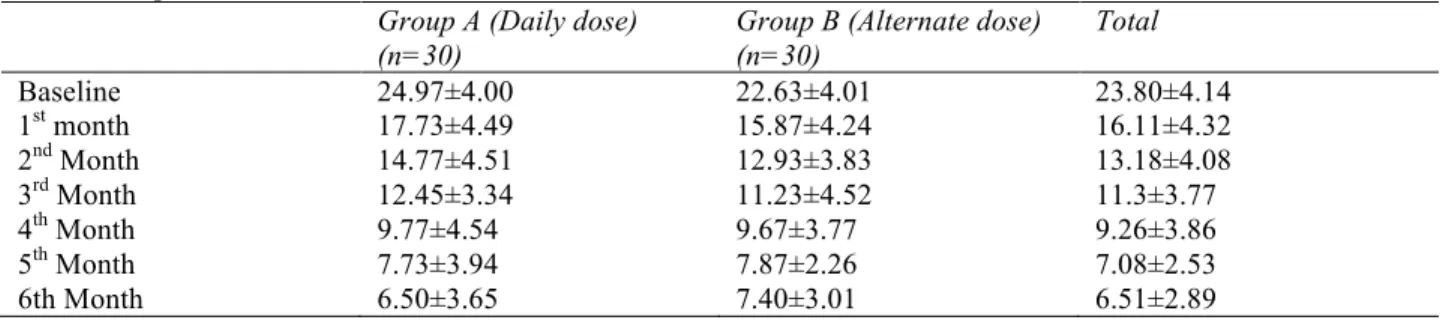
The statistics of improvement of GAGS in both groups was given in table below. There was significant difference from baseline observed in both groups Table 2. There was significant decrease in GAGS score from baseline score observed in both groups Figure 1.
In daily dose group, the mean percentage decrease in GAGS was observed as 73.95±14.04 whereas in alternate day group, the mean percentage decrease in GAGS was observed 66.57±14.97. There was insignificant difference observed between both groups for mean percentage decrease in GAGS (P=0.054), Table 4.
Table 1 Demographic data of study population (n=60). Group A Daily dose (n=30)
Group B Alternate dose (n=30)
Total
Mean age (years) 20.73±3.19 20.70+4.82 20.72+4.06
Range 15-25 16-35 15-35
Sex
Male 7%
Female 93%
Mean weight (kg) 56.70+7.74 58.67+6.78 57.68+7.28
Range 40-70 50-75 40-75
Table 2 Improvement on basis of GAGS from baseline till end of trial. Group A (Daily dose)
(n=30)
Group B (Alternate dose) (n=30)
Total
Baseline 24.97±4.00 22.63±4.01 23.80±4.14
1st month 17.73±4.49 15.87±4.24 16.11±4.32
2nd Month 14.77±4.51 12.93±3.83 13.18±4.08
3rd Month 12.45±3.34 11.23±4.52 11.3±3.77
4th Month 9.77±4.54 9.67±3.77 9.26±3.86
5th Month 7.73±3.94 7.87±2.26 7.08±2.53
6th Month 6.50±3.65 7.40±3.01 6.51±2.89
ANOVA = 1373.00, P = 0.000 (Significant)
Table 3 Percentage decrease from baseline till final follow-up in both groups Group A
Daily dose (n=30)
Group B
Alternate dose (n=30)
Total
Overall decrease 73.95+14.04 66.57+14.97 70.26+14.86*
<35% 0 (0%) 1 (3.3%) 1 (1.7%)
35-45% 1 (3.3%) 2 (6.7%) 3 (5%)
45-55% 4 (13.3%) 1 (3.3%) 5 (8.3%)
55-65% 1 (3.3%) 7 (23.3%) 8 (13.3%)
65-75% 7 (23.3%) 9 (30%) 16 (26.7%)
75-85% 9 (30%) 8 (26.7%) 17 (28.3%)
85-95% 8 (26.7%) 2 (6.7%) 10 (16.7%)
P value insignificant
Table 4 Comparison of final efficacy in two study groups (n=60).
Efficacy Daily dose group
(N=30)
Alternate group (n=30)
Total
Yes 27 (90%) 26 (86.7%) 53 (88%)
No 3 (10%) 4 (13.3%) 7 (12%)
Chi-square value= 0.162, P = 0.688 (insignificant). not achieve efficacy. Statistically there was insignificant difference between the study groups i.e. P >0.05, Table 4.
Discussion
Conventional treatments used in acne do not decrease inflammation rapidly because of late onset of their effects and this can cause
Figure 1 Improvement on basis of GAGS from baseline till end of study.
New isotretinoin formulations and low-dose or intermittent dose protocols have been tried in recent years.12 The conventional recommended dose is associated with many side effects. Because of these side effects and necessity of long-term daily dose, patients often have difficulty in complying with the conventional regimen. So, in an effort to overcome this limitation, low-dose or intermittent regimes have been introduced in several recent studies.7,8,11,12,15,19
In our study, group A (n=30) patients were treated with oral isotretinoin 20mg/day (0.28-0.5mg/kg/day) for 6 months and group B (n=30) patients were treated with oral isotretinoin 20mg every alternate day (0.13-0.2mg/kg/day) for 6 months. The mean total dose per kg at the end of 6 months in daily dose group was 63.15mg/kg
and in alternate dose group, it was 30.51mg/kg. The primary efficacy end point was the comparison (as a percentage reduction) of the GAGS score at baseline and at the end of 6 months.
dose 20mg/day works equally well as compared to high dose 40mg/day with less incidence of side effects (excellent results >80% improvement in 80% patients).
In the present study, in the daily dose group, 90% of patients showed >50% reduction in GAGS score at end of 6 months. So results are almost similar to the previous studies done on this dose regimen.
Data on the dose regimen 20mg every alternate day is sparse, very few studies are available on this dose regimen but none from in Pakistan. Also, the available studies did not compare this dose regimen with the daily dose regimen, except for 1 study by Agarwal et al.9 who compared this regimen with high dose and intermittent dose regimens. There has been no previous study to our knowledge comparing these 2 different low-dose regimes simultaneously.
In a study by Sardana et al.13 in India, 320 adult patients with moderately severe acne were treated with fixed dose isotretinoin at 20mg every alternate day (approx. 0.15mg/kg/day to 0.28mg/kg/day) for 6 months along with topical clindamycin gel. Clinically significant response (> 50% resolution of acne lesions) was observed in 87.6% of patients. Similarly another study on this dose regimen by Agarwal et al.9 led to 93% decrease in acne load of the patients. In our study, the alternate day dose regimen group showed good results in 86.7% of the patients which were similar to that by Sardana et al.13
Lee et al.12 compared different isotretinoin regimens; daily low-dose, intermittent dose and conventional dose in treating patients with moderate acne, and concluded that a low-dose treatment is the most suitable for patients with moderate acne.
In our trial, we observed that overall efficacy was achieved in 88% patients, out of which 27 (90%) cases from daily-dose group and 26 (86.7%) cases from alternate-day group achieved efficacy. The difference in efficacy between both groups was found to be insignificant (P=0.688)
In the study by Akman et al.7 dryness of mouth was seen in 47% patients with conventional group and 9% of patients with low-dose group. So, the side effects of oral isotretinoin are dose-dependent and can be decreased by using low doses. So 20mg every alternate day is good choice for mild to moderate acne to reduce side effects.
While comparing the efficacy of both groups in this study, the percentage decrease in GAGS score from baseline till end of 6 months is almost comparable in both groups (P= 0.054).
The limitation in this study was that relapse rate was not assessed after completion of therapy. So one can argue that relapse can occur as cumulative dose of 120mg/kg was not achieved. But an analysis on relapse rates in different studies was done6 and showed that difference in the mean relapse rate of standard versus low-dose therapy (34.6 versus 21.478) was not statistically significant. Thus the low-dose therapy has a relapse rate comparable with that of standard therapy. Also the low cumulative doses in our study can be explained by the administration of concomitant topical combination therapy (topical clindamycin gel and cleanser) and also we dealt with mild to moderate acne.
Conclusion
In the management of mild to moderate acne vulgaris, the standard dose of 1mg/kg/day is pharmacologically incorrect as it causes more side effects. Our study results showed that 20mg oral isotretinoin every alternate day has almost equal efficacy as compared to daily dose. So we can recommend alternate day regimen for management of mild to moderate acne vulgaris to prevent dose-dependent side effects and to cut down the cost of drug.
References
1. Layton AM, Disorders of the pilosebaceous glands. In: Burns T, Cox N, Breathnach S, Christopher GC, editors. Rook’s Textbook of Dermatology. 8th ed. London; 2010 p. 42.17-27.
2. Barratt H, Hamilton F, Car J et al. Outcome measures in acne vulgaris: systematic review. Br J Dermatol. 2009;160:132-6.
3. Ali G, Mehtab K, Sheikh ZA et al. Beliefs and perceptions of acne among a sample of students from Sindh Medical College, Karachi. J Pak Med Assoc. 2010;60:51-4. 4. Shazia M, Afzal M, Aftab M et al.
Precipitating factors of acne vulgaris in females. Ann Pak Inst Med Sci. 2009;5:104-7.
5. Strauss JS, Krowchuk DP, Leyden JJ et al. Guidelines of care for acne vulgaris management. J Am Acad Dermatol. 2007;56:651-63.
6. Sardana K, Garg VK. Efficacy of low-dose isotretinoin in acne vulgaris. Indian J Dermatol Venereol Leprol. 2010;76:7-13. 7. Akman A, Durusoy C, Senturk M et al.
Treatment of acne with intermittent and conventional isotretinoin: a randomized, controlled multicenter study. Arch Dermatol Res. 2007;299:467-73.
8. Kaymak Y, Ilter N. The effectiveness of intermittent isotretinoin treatment in mild or moderate acne. J Eur Acad Dermatol Venereol. 2006;20:1256-60.
9. Agarwal US, Besarwal RK, Bhola K. Oral isotretinoin in different dose regimens for acne vulgaris: a randomized comparative
trial. Indian J Dermatol Venereol Leprol. 2011;77:688-94.
10. Rademaker M. Adverse effects of isotretinoin: A retrospective review of 1743 patients started on isotretinoin. Aus J Dermatol. 2010;51:248-53.
11. Amichai B, Shemer A, Grunwald MH. Low-dose isotretinoin in the treatment of acne vulgaris. J Am Acad Dermatol. 2006;54:644-6.
12. Lee JW, Yoo K, Park K et al. Effectiveness of conventional, low-dose and intermittent oral isotretinoin in the treatment of acne: a randomized, controlled comparative study. Br J Dermatol. 2011;164:1369-75.
13. Sardana K, Garg V, Sehgal V et al. Efficacy of fixed low dose isotretinoin (20 mg, alternate days) with topical clindamycin gel in moderately severe acne vulgaris. J Eur Acad Dermatol Venereol. 2009;23:556-60.
14. Plewig G, Dressel H, Pfleger M et al. Low dose isotretinoin combined with tretinoin is effective to correct abnormalities of acne. J Dtsch Dermatol Ges. 2004;2:31-45. 15. Mandekou L, Delli F, Teknetzis A et al.
Low-dose schema of isotretinoin in acne vulgaris. Int J Clin Pharmacol. 2003;23:41-6.
16. Adityan B, Kumari R, Thappa DM. Scoring systems in acne vulgaris. Indian J Dermatol Venereol Leprol. 2009;75:323-6 17. Doshi A, Zaheer A, Stiller MJ. A
comparison of current acne grading systems and proposal of a novel system. Int J Dermatol. 1997;36:416-8.
18. Goulden V, Layton AM, Cunliffe WJ. Current indications for isotretinoin as a treatment for acne vulgaris. Dermatology. 1995;190:284-7.
19. Goulden V, Clark S, McGeown C, Cunliffe W. Treatment of acne with intermittent isotretinoin. Br J Dermatol. 1997;137:106-8.
20. Rao PK, Bhat RM, Nandakishore B et al. Safety and efficacy of low-dose isotretinoin in the treatment of moderate to severe acne vulgaris. Indian J Dermatol. 2014;59:316. 21. Kapadia FN, Khalid G, Burhany T,