Address for correspondence Dr. Muhammad Irfan Anwar, Assistant Professor of Dermatology
Bahria University Medical & Dental College, Pakistan
Email: [email protected]
Original Article
A prospective, split-face, randomized, open-label
study comparing efficacy of trichloroacetic acid
(100%) and cryotherapy in xanthelasma palpebrarum
Introduction
The word “Xanthoma” is derived from a Greek word ‘Xanthos’ which means yellow. It involves variety of subcutaneous fat deposition.1 There are various types of xanthomas and some are associated with hyperlipidemia.1Xanthelasmata can independently predict the risk for ischemic heart disease, atherosclerosis, myocardial infarction and death in general population.2 Xanthelasmas occur in the form of soft yellowish plaques. They are most common near the inner canthus of the eyelid, usually the upper
one.3 Xanthelasma palpebrarum is the most common type of xanthoma presenting as a cosmetic concern.4
Various methods are available for treatment of xanthelasma palpebrarum including cryotherapy, electrocauterization, surgical excision, and blepharoplasty, chemical cauterization using tri- or bichloroacetic acid and laser ablation.5 All the treatment options carry certain risk of side effects and have limitations. The recurrence rate in xanthomas is high.6 Trichloroacetic acid (TCA) treatment is a cheap and simple procedure with high patient satisfaction. Requirement for retreatment and hypopigmentation are associated problems.6,7 Cryotherapy is relatively painless, safe and effective treatment for xanthelasma with a Moizza Tahir, Javeria Hafeez, Muhammad Irfan Anwar*, Uzma Bashir, Nasser Rashid Dar *Bahria University Medical And Dental College, Pakistan
Abstract
Objective To compare the clinical efficacy of trichloroacetic acid (TCA) 100% and cryotherapy inxanthelasma palpebrarum (XP).
Methods 40 patients fulfilling the inclusion criteria were treated with cryotherapy on right eye (group A) and TCA on left eye (group B). Patients were followed up for 6 weeks and final outcome variable of efficacy i.e. complete resolution of xanthelasma was assessed at 6 weeks. Adverse side effects of therapy were also recorded as secondary outcome variables. Data were analyzed by SPSS 19.0.
Results Mean age of patients was 43.75 ± 5.90 years and age ranged from 34 to 56 years. Out of 40 patients 9 (22.5%) were male and 40 (77.5%) were female. Complete resolution of xanthelasma was seen in only 7 (17.5%) in group A, while complete resolution of lesions was seen in 30 (75%) of patients in group B (p = 0.000).
Conclusion A single session of 100% TCA is highly effective than cryotherapy in the treatment of Xanthelasma palpebrarum .
Key words
cosmetically acceptable outcome.8 The present study aimed to compare efficacy of TCA (100%) with cryotherapy in treatment of xanthelasma. This is the first study of its type in comparison in split-face treatments modality. The study would inform dermatological practice in choice of xanthelasma treatment in terms of its efficacy, cost effectiveness and complications.
Methods
This split-face, randomized open-label study was conducted over a period of 6 months, at Dermatology Outpatient Department of Combined Military Hospital, Rawalpindi and Quetta. Informed consent was taken from each patient before treatment, along with ethical review committee approval from both hospitals. Sample size was 40 patients. Non-probability convenience sampling technique was used to enroll patients. Patients aged 30-55 years of either gender, who had not received any treatment in past, having bilateral xanthelasmas between 0.5-1cm, were included in the study. Those with previous treatment history were excluded from the study. In all the patients fasting lipid profile, fasting glucose levels and serum TSH were obtained.
Each patient received cryotherapy on right eye (group A) and TCA on left eye (group B). TCA (100%) was applied with a swab stick. Two 15-seconds’ freeze-thaw cycles of liquid nitrogen were done on the right eye. Both eyes were treated simultaneously. After the procedure, the patients were observed for 10-15 minutes for immediate complications like edema, pain, erythema and bullae formation. Follow-up was done at 2, 4, and 6 weeks. Baseline photographs of all patients were taken after their consent, followed by photographs on final follow-up visit. At each follow-up visit both eyes of each patient were observed for late complications like secondary infection, bullae formation, post
inflammatory hypo- or hyperpigmentation, crust formation and scarring. Final outcome of the treatment was assessed at 6th week and was labelled as efficacy (flattening and complete disappearance of the lesion).
The collected data were entered and analyzed using Statistical Packages for Social Sciences version 19. Frequencies and percentages were computed for qualitative variables like gender and efficacy. Mean ± SD for continuous variables like age was calculated. Chi-square test was used to compare efficacy of treatment in both eyes. P value 0.001 was considered statistically significant.
Results
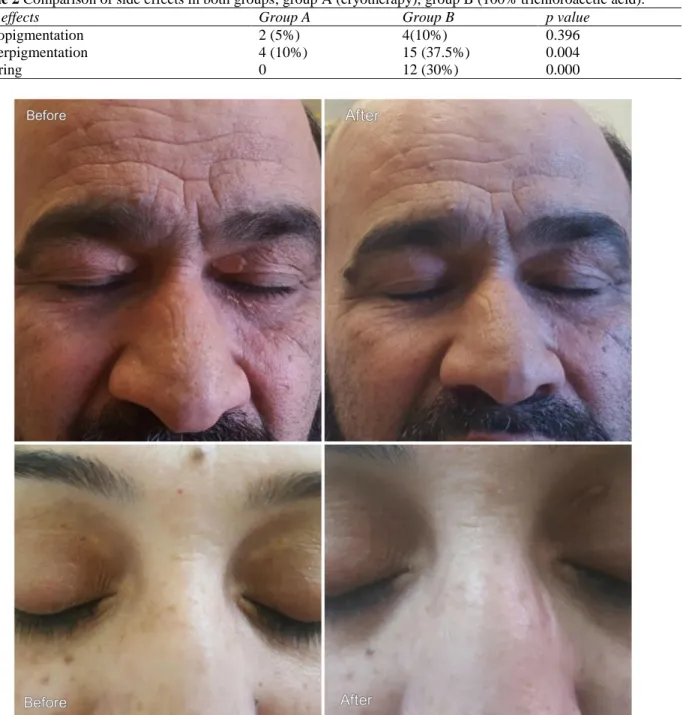
A total of 40 patients were treated for xanthelasma in both eyes. Total of 80 sites were treated in both groups (group A and group B). Mean age of patients was 43.75 ± 5.90 and age ranges from 34-56 years. Out of 40 patients 9 (22.5%) were male and 40 (77.5%) were female. Fasting blood sugar was raised in 7 (17.5%) patients, serum cholesterol in 9 (22.5%) and serum TSH was raised in 2 (5%) patients. Complete resolution of xanthelasma was seen in only 7 (17.5%) patients in group A, while complete resolution of lesions was noticed in 30 (75%) patients in group B (Table 1), (Figure 1). The difference was statistically significant (p = 0.000).
Table 2 shows the frequencies of adverse side effects in both groups. 2 (5%) patients showed hypopigmentation, 4 (10%) patients showed hyperpigmentation and no scarring was seen in any patient treated with cryotherapy in group A
Table 1 Comparison of efficacy in two treatment groups, A (cryotherapy), B (100% trichloroacetic acid).
Grades of improvement Group A
N (%)
Group B N (%)
Complete response 7 (17.5%) 30 (75%)
Partial response 33 (82.5%) 10(25%)
No response 0 0
p = 0.000
Table 2 Comparison of side effects in both groups; group A (cryotherapy), group B (100% trichloroacetic acid).
Side effects Group A Group B p value
Hypopigmentation 2 (5%) 4(10%) 0.396
Hyperpigmentation 4 (10%) 15 (37.5%) 0.004
Scarring 0 12 (30%) 0.000
Figure 1 Xanthelasma before and after treatment with TCA and Cryotherapy In group B, hypopigmentation was seen in 4
(10%) patients, hyperpigmentation was noticed in 15 (37.5%) and scarring was seen in 12 (30%)
no patient in group B required a session with TCA.
Discussion
Xanthelasma palpebrarum (XP) is the most common cutaneous xanthoma presenting in periorbital region and is usually symmetrical.9 It
is a cosmetic and psychological burden to the patient.10 A number of methods have been tried
for treating XP including electrocautery, cryotherapy, and application of trichloroacetic acid and surgical excision with variable results.11
Each modality of treatment has variable number of side effects and limitations.12
Various studies have been conducted to show effectiveness of various treatments in XP. Comparative trials have also been carried out between various modalities. However, to the best of our knowledge, no study has been carried out to date, comparing effectiveness of cryotherapy with TCA in the treatment of XP. Although these modalities have been compared in treatment of other dermatological conditions. A comparative study using 30% TCA and cryotherapy for solar lentigines found cryotherapy to be more superior to TCA but more painful in the treatment of solar lentigens.13
A study carried out with 70% TCA for XP showed excellent result in 45.8% and good result in 33.3% with 25% having recurrence after 6 months.14 Another study carried out with
70% TCA in treatment of XP showed a success rate of 61% at a mean follow up of 31.8 months.6 In few studies the effectiveness of TCA
has been shown to be almost equal to lasers.4
100 % TCA has been found to be most effective in papulonodular lesions of XP.15 The most
common side effects reported with TCA have been hyperpigmentation, hypopigmentation and scarring.15,16
In one study using cryotherapy for XP, a cosmetically acceptable result has shown to be 74% with a recurrence in 26% of cases after 6 months of treatment. Lid edema was seen in 8%, tense bullae in 3%, secondary infection in 3% and dark brown adherent crusting in 100% of the cases, one week after cryotherapy. Most common side effect was pigmentary changes seen in 96% at 4 weeks, reducing to 88% at the end of 4th month.8
In our patients, complete response was seen in 75% in TCA treated group and only 17.5% in group receiving cryotherapy. The frequency of side effects was greater in the group receiving TCA. Pigmentary changes were seen in both groups, frequency of these being greater in group receiving TCA. Scarring, however, was seen only with TCA. The patients were only followed up to 6 weeks, so a longer duration of follow-up (6 months) needs to be done to see for the regression of the side effects encountered. Furthermore, the patients need to be followed up for a longer duration to observe the relapse of treatment in both groups. No patient in group B receiving TCA required a second session, however, 80% in group A required a second session of treatment. Our patients had bilateral xanthelasma subjected to TCA on left and cryotherapy on right side, however, the size and thickness of xanthelasma were not equal on both sides.
long-term efficacy of each modality, side effects and relapse.
Acknowledgement
We acknowledge contribution of our patients for participation in this study and allowing to be digitally photographed.
References
1. Paul D. Flynn. Xanthomas and abnormalities of lipid metabolism and storage. In: Burns T, Breathnach S, Cox N, Griffiths C. Rook’s Textbook of Dermatology. 9th edn. Oxford, UK: Wiley-Blackwell Publishing; 2016. P. 62.1-62.12. 2. Christoffersen M, Frikke-Schmidt R,
Schnohr P, Jensen GB, Nordestgaard BG, Tybjærg-Hansen A. Xanthelasmata, arcus corneae and ischemic vascular disease and death in general population: prospective cohort study. BMJ. 2011;343:d5497. 3. Mehmet A. The effects of radiofrequency in
xanthelasma of eyelid: case report. J Int Dent Med Res. 2013;6(3):128-131.
4. Goel K, Sardana K, Garg VK. A prospective study comparing ultrapulse CO2 laser and trichloroacetic acid in treatment of xanthelasma palpebrarum. J Cosmet Dermatol. 2015;14(2):130-9.
5. Gungor S, Canat D, Gokdemir G. Erbium: YAG laser ablation versus 70% trichloroacetic acid application in treatment of xanthelasma palpebrarum. J Dermatol Treat. 2014;25:290-3.
6. Cannon PS, Ajit R, Leatherbarrow B. Efficacy of trichloroacetic acid (95%) in the management of xanthelasma palpebrarum. Clin Exp Dermatol. 2010;35:845-8.
7. Haygood LJ, Bennett JD, Brodell RT. Treatment of xanthelasma palpebrarum with
bichloroacetic acid. Dermatol Surg. 1998;24:1027-31.
8. Dewan SP, Kaur A, Gupta RK. Effectiveness of cryosurgery in xanthelasma palpebrarum. Indian J Dermatol Venereol Leprol. 1995;61:4-7.
9. Abdelkader M, Alashry SE. Argon laser versus erbium: YAG laser in the treatment of xanthelasma palpebrarum. Saudi J Ophthalmol. 2015;29:116-20.
10. Nguyen AH, Vaudreuil AM, Huerter CJ. Systemic review of laser therapy in xanthelasma palpebrarum, Int J Dermatol. 2017;56(3):e47-e55.
11. Pathania V, Chatteriee M. Ultrapulse carbon dioxide laser ablation of xanthelasma palpebrarum: a case series. J Cutan Aesthet Surg. 2015;8:46-9.
12. Mourad B, Elgarhy LH, Ellakkawy HA, Elmahdy N. Assessment of efficacy and tolerability of different concentrations of trichloroacetic acid vs. carbon dioxide laser in treatment of xanthelasma palpebrarum. J Cosmet Dermatol. 2015;14:209-15.
13. Lugo-Janer A, Lugo-Somolinos A, Sanchez JL. Comparison of trichloroacetic acid solution and cryosurgery in the treatment of solar lentigines. Int J Dermatol. 2003;42:829-31.
14. Nahas TR, Marques JC, Nicolleti A, Cunha M, Nishiwaki-Dantas MC, Filho JV. Treatment of eyelid xanthelasma with 70% trichloroacetic acid. Ophthal Plast Reconstr Surg. 2009;25:280-3.
15. Haque MU, Ramesh V. Evaluation of three different strengths of trichloroacetic acid in xanthelasma palpebrarum. J Dermatolog Treat. 2006;17:48-50.