Acid-Base Theories
to Your World
Bracken Cave, near San Antonio,Texas, is home to twenty to forty million bats, which is probably the largest colony of mammals in the world.Visitors to the cave must wear
protective goggles and respirators to protect themselves from the dangerous levels of
ammonia in the cave. Ammonia is a by product of the bats’ urine. In this section, you will learn why ammonia is considered
Properties of Acids and Bases
Acids and bases play a central role in much of the chemistry that affects your daily life. Your body needs acids and bases to function properly. Vine gar, carbonated drinks, and foods such as citrus fruits contain acids. The electrolyte in a car battery is an acid. Most manufacturing processes use acids or bases. Bases are present in many commercial products, including antacids and household cleaning agents. Figure 19.1 shows some of the many products that contain acids and bases.
Acids Acids have several distinctive properties with which you are proba bly familiar. Acidic compounds give foods a tart or sour taste. For example, vinegar imparts a tart taste to salad dressing. Vinegar contains ethanoic acid, sometimes called acetic acid. Lemons, which taste sour enough to make your mouth pucker, contain citric acid.
Aqueous solutions of acids are electrolytes. Recall from Chapter 15 that electrolytes conduct electricity. Some acid solutions are strong electrolytes, and others are weak electrolytes. Acids cause certain chemical dyes, called indicators, to change color. Many metals, such as zinc and magnesium, react with aqueous solutions of acids to produce hydrogen gas. Acids react with compounds containing hydroxide ions to form water and a salt. Acids taste sour, will change the colorofan acid-base indicator, and can be strong or weak electrolytes in aqueous solution.
Guide for Reading
a base.
Key Concepts
• What are the properties of acids and bases?
• How did Arrhenius define an acid and a base?
• What distinguishes an acid from a base in the Brønsted Lowry theory?
• How did Lewis define an acid and a base?
Vocabulary monoprotic acids diprotic acids triprotic acids conjugate acid conjugate base
conjugate acid-base pair hydronium ion (HO) amphoteric
Lewis acid Lewis base
Reading Strategy Building Vocabulary As you read the section, write a definition for each vocabulary term. Include an example with a formula for each term.
Figure 19.1 Many items
contain acids or bases, or produce acids and bases when dissolved in water.
o
Citrus fruit contain citric acid. Tea contains tannic acid.G
Antacids use bases to neutralize excess stomach acid. j The base calcium hydroxide is a component of mortar.2
_____________________________
Bases
Bases have properties with which you are less familiar. Bases have a bitter taste, but tasting most bases is hazardous. Soap is a familiar material that has the properties of a base. Ifyou have tasted soap, you know that it has abitter taste. The slippery feel of soapis another property of bases.like acids,aqueoussolutions ofbasesare electrolytes and will cause an indicator to change color. Water and a salt are formed when a base that contains hydroxide ions reacts with an acid. With a few exceptions, none of the foodsyou eat are bases. Milk of magnesia (a suspension of magnesium hydroxide in water) is a base used to treat the problem of excess stomach acid. ( Bases taste bitter, feel slippery, will change the color of an acid-base indicator, and can be strong or weakelectrolytes inaqueous solution.
(Checkjit Give an example of a base.
Arrhenius Acids and Bases
Although chemists had recognized the properties of acids and bases for many years, they were not able to propose a theory to explain this behavior. Then, in 1887, the Swedish chemist Svante Arrhenius (1859-4927) pro posed a revolutionary way of defining and thinking about acids and bases. Arrheniussaid that acids are hydrogen-containingcompoundsthat ion ize to yield hydrogen ions (W)inaqueous solution. He also said thatbases are compounds that ionize to yield hydroxide ions (0111inaqueous solution. Arrhenjus Acids Table 19.1 lists some common acids. Acids that contain one ionizable hydrogen, such as nitric acid (HNO), are called monoprotic acids. Acids that contain two ionizable hydrogens, such as sulfuric acid
(l--l,S0
1
), are calleddiprotic acids.Acids that contain three ionizable hydro gens, such as phosphoric acid (I11P04), are called triprotic acids. Not all compounds that contain hydrogen are acids, however. Also, not all the hydrogens in an acid may be released as hydrogen ions. Only the hydrogens in very polar bonds are ionizable. In such bonds, hydrogen is joined to a very electronegative element. When a compound that contains such bonds dissolves in water, it reLeases hydrogen ions because the hydrogen ions are stabilized by solvation. An example is the hydrogen chloride molecule, shown in Figure 19.2. 1-lydrogen chloride is a polar covalent molecule. It ionizes to form an aqueous solution of hydronium ions and chloride ions.
110
H—C1(g) > H(aq) + Cl(aq)
flydrogen Hydrogen Chloride chloride on ion
(hydrochloric acid)
Figure 19.2 Hydrochloric acid + +
is actually an aqueous solution
of hydrogen chloride. Hydrogen
chloride forms hydronium ions, HCI H20 H3O making this compound an acid. Hydrogen chloride Water Hydronium ion
Table 19.1
Some Common Acids
Name Formula
Hydrochloric acid HCI
Nitric acid HNO3
Sulfuric acid HSO4
Phosphoric acid H3P04
Ethanoic acid CH3COOH
Carbonic acid H2C03
cr
11 ()
11 C C--0—H
1-I
F.thanoiu acid
((:IcooIf)
The threehydrogensattached to the carbon are in weakly polar bonds. They do not ionize. UnIv the hydrogen bonded to the highly electronegative oxygen can he ionized. As you gain more experience looking at written formulas for acids, you will be able to recognize which hydrogen atoms can be ionized.
Arrhenius Bases Iäble 19.2 lists some common bases. The base with which you are perhaps most familiar is sodium hydroxide (NaOH). Sodium hydroxide is commonly known as lye. Sodium hydroxide is an ionic solid. It dissociates into sodium ions and hydroxide ions in aqueous solution.
NaOIl(s) —-* Na(aq) + OH (aq)
Sodiu n Soditiin F lyd roxide
hydroxide i n
Because of its extremely caustic nature, sodium hydroxide is a major com ponent of consumer products used to clean clogged drains.
Potassium hydroxide (KOH) is another ionic solid that dissociates to form potassium ions and hydroxide ions in aqueous solution.
KOH(s K (aq) + OH(aq
Potassium Potassium Hydroxide hydroxide ion ion
Sodium and potassium are Group 1A elements. The elements in Group 1A, the alkali metals, react with water to produce solutions that are basic. Sodium metal reacts violently with water to form sodium hydroxide and hydrogen gas. The following equation illustrates the reaction of sodium metal with water.
2Na(s) + 21120(1) > 2NaOH(aq) + H2(g)
Sodium Water Sodium Hydrogen metal hydroxide
Table 19.2
Some Common Bases
Formula Solubility in water
KOH - High
Sodium hydroxide NaOH High
Calcium hydroxide Ca(OH)2 Very low
Magnesium hydroxide Mg(OH)2 Very low
In contrast, the four hydrogens in methane (CH4) are attached by weakly polar C—H bonds. Methane has no iomzahle hydrogens and is not an acid. Ethanoic (acetic> acid (CH1COOll), used in the manufacture of plastics,
pharmaceuticals, and photographic chemicals, is different. Although this molecule contains four hydrogens, ethanoic acid is a monoprotic acid. The
structural formula shows why.
I—
nhi
LINKSFor:Links on Acids and
Bases in thehome
Visit:www.SciLinks.org
Web Code:cdn-1191
Name
Potassium hydroxide
Sodium hydroxide and potassium hydroxide are very soluble in water. Concentrated solutions of these compounds can be readily prepared. Such solutions, like other basic solutions, would have a bitter taste and slippery feel, However, they areextremelycaustic to the skin and can cause deep, painful, slow-healing wounds if not immediately washed off.
Calcium hydroxide (Ca(OH)2) and magnesium hydroxide (Mg(OH)2) are compounds of Group 2A metals. These compounds are not very soluble in water. Their solutions are always very dilute, even when saturated. The concentration of hydroxide ions in such solutions is correspondingly low. A saturated solution of calcium hydroxide contains only 0.165 g Ca(OH)2 per 100 g of water. Magnesium hydroxide is much less soluble than calcium
hydroxide. A saturated solution contains only 0.0009 g Mg(OH)2 per 100 g of water. Suspensions of magnesium hydroxide in water contain low con centrations of hydroxide ion. People take these suspensions internally as milk of magnesia, shown in Figure 19.3, which is an antacid and a mild laxative.
Brønsted-Lowry Acids and Bases
The Arrhenius definition of acids and bases is not a very comprehensive one. It defines acids and bases rather narrowly and does not include certain substances that have acidic or basic properties. For example, aqueous solu tions of sodium carbonate (Na2CO3(aql) and ammonia (NH3(aq)) are basic. Neither of these compounds is a hydroxide, however, and neither would e classified as a base under the Arrhenius definition. In 1923, the Danish chemist Johannes Bronsted (1879—1947) and the English chemist Thomas Lowry (1874—1936) independently proposed a new definition. The Bronsted- Lowry theorydefinesan acidas a hydrogen-Ion donor,and a base as a hydrogen-ionacceptor.All the acids and bases included in the Arrhenius
theory are also acids and bases according to the Bronsted-Lowry theory. Some compounds not included in the Arrhenius theory are classified as bases in the Bronsted-Lowry theory.
Why
AmmoniaisaBase
The behavior of ammonia as a base can be understood by using the Bronsted-Lowry theory. Ammonia gas is very solu ble in water. When ammonia dissolves in water, it acts as a base because it accepts a hydrogen ion from water.NH 1
(aq) + H20(1) “ NH4(aq) + OW(aq)
Water Ammonium Hydroxide ion
ion rnakes the thnor,ijrOflS[(j- S(UtiOit t••
Lowry acLi.)
In this reaction, ammonia is the hydrogen-ion acceptor and therefore
is a Bronsted-Lowry base. Water, the hydrogen-ion donor, is a Bronsted
Lowry acid. Hydrogen ions are transferred from water to ammonia, as is shown in Figure 19.5. This causes the hydroxide-ion concentration to be greater than it is in pure water. As a result, solutions of ammonia are basic.
kpotnt Why is ammonia considered to be a Brønsted-Lowry base’ Figure 19.3 Milk of magnesia is
a base used as an antacid. Bases
are usually hazardous when taken internally, but the low solubility of milk of magnesia makes it safe to use.
Figure 19.4 Sodium carbonate decahydrate(Na2CO3IOH2O)is used as a laundry aid. Its common name is washing soda.
Ammonia
{LVdt)L00000 0000ptwr.
Figure
193
Ammonia dissolvesin water to form ammonium
ions and hydroxide ions. In this reaction, the water molecule donates a hydrogen ion to the ammonia molecule.
OH Explaining Whyisammonia Hydroxide ion not classified as an Arrhenius
base?
Conjugate Acids and Bases
Because all gases become less soluble in water as temperature increases, increasing the temperature of an aqueous solution of ammonia releases ammonia gas. As ammonia gas leaves the solution, the equilibrium in the equation shifts to the left. The ammonium ion (NH4 ) reactswith0lI to form NH1 and FLU. When the reaction goes from right to left, NH.1 gives up a hydrogen ion; iLacts as a Bronsted-Lowry acid, The hydroxide ion accepts an H; it acts as a BronstedLowry base. Overall, then, this equilibrium has two acids and two bases.NH 3
(aq) + 1120(1) NH44(aq) ± 0Hq)
Base Acid Conjugate Conjugate acid base
When ammonia dissolves and then reacts with water, NH4 is the con juate acid of the base NFl. A conjugate acid is the particle formed when a base gains a hydrogen ion. Similarly, OH is the conjugate base of the acid water. A conjugate base is the particle that remains when an acid has donated a hydrogen ion. Conjugate acids and bases are always pairedwith a base or an acid, respectively. A conjugate acid-base
pair
consists of two substances related by the loss or gain of a single hydrogen ion. The ammo nia molecule and ammonium ion are a conjugate acid-base pair. The water molecule and hydroxide ion are also a conjugate acid-base pair.NH 1
(aq) + 1120(l) NH4(aq) + OHq)
Base Acid Conjugate Con jugate
acid base
The Bronsted-Lowry theory also applies to acids. Consider the dissoci ation of hydrogen chloride in water.
HC1(g) + H20(1) H3O(aq) + Cl (aq)
Acid Base Conjugate Conjugate acid base
In this reaction, hydrogen chloride is the hydrogen-ion donor. Thus it is a Bronsted-Lowry acid. Water is the hydrogen-ion acceptor and therefore water is a Bronsted-Lowry base. A water molecule that gains a hydrogenion becomes a positively charged
hydronium ion
(H3O). The chloride ion is the conjugate base of the acid HC1. The hydronium ion is the conjugate acid of the base water.NH
3 H70
Ammonia Water Ammonium ion
Table 19.3
Several Conjugate
Acid-Base Pairs
Acid Base
HCI Cl
H 2 S0
4 HSO4
H30H20
HSO
4 SO42
CH 3
COOH CH3COO
H 2 C0
3 HC03
HCO CO32
H
2
0 0H
H
2
0 H3O HSO4
Water Hydronium ion Hydrogen sulfate ion
Figure 19.6 shows the reaction that occurs when sulfuric acid dissolves in water. The solution formedconsists of hydronium ions and hydrogen sulfate ions.
Sometimes water accepts a hydrogen ion. At other times, it donates a hydrogen ion. A substance that can act as both an acid and a base is said to be amphoteric. Water is amphoteric. In the reaction with HCI, water accepts a proton and is therefore a base.
Lewis Acids and Bases
A third theory of acids and bases was proposed by GilbertLewis (1875-1946),
(
Lewis proposed that an acid accepts a pairofelectrons during a reac tion, while a base donates a pair of electrons. This concept is moregeneral than either the Arrhenius theory or the Brønsted- Lowry theory A Lewis acid is a substance that can accept a pair of electrons to form a covalent bond. A Lewis base is a substance that can donate a pair of electrons to form a covalent bond. A hydrogen ion (Bronsted-Lowry acid) can accept a pair of electrons in forminga bond. A hydrogen ion, therefore, is also aLewis acid. A Brons ted-Lowry base, or a substance that accepts a hydrogen ion, must have a pair of electrons avail able and, thereft)re, is also a Lewis base. Consider the reaction of H and OH.
H +:O—H
Lewis Lewis H H acid base
-In this reaction, a hydroxide ion is a Lewis base. It is also a Hronsted-Lowry base. The hydrogen ion is both a Lewis acid and a Bronsted-Lowry acid. The Lewis definition also includes some compounds not classified as Bronsted-Lowry acids or bases.
Ammonia dissolved in water is another example of a Lewis acid and Lewis base. In this reaction, the hydrogen ion from the dissociation of water is an electron-pair acceptor and is a Lewis acid. Ammonia is an elec tron-pair donor and is a Lewis base.
Brønsted-Lowry H donor H acceptor
Lewis electron-pair acceptor electron-pair donor
a
H 2 S0 4 Sulfuric acid
+ Figure 19.6 When sulfuric acid
dissolvesinwater, it forms hydronium ions and hydrogen sulfate ions, Identify Which ion Is the conjugate acid and which is the conjugate base?
Word
Origins
Amphoterlc comes from the Greek word amphateros, meaning “partly one andpartly the other.”
An amphoteric substance can act as both an acid and a base. What makes an
amphibiousairplane
dif
ferentfrom other air planes?F.
Textbook
Animation 25 Compare the three important definitions of acids and bases.
withChemASAP
Table 19.4
Acid-Base Definitions
Type Acid Base
Arrhenius H producer 0H producer
Identifying Lewis Acids and Bases
H F HF
rI
I
I
FI—N+ B—F ) H—N—-B—F
I
I
H F H F
Analyze Identify the relevant concepts. The Lewis acid—Lewis base definitions, which are to be used in solving the problem, are based on the acceptance and donationof a pair of electrons.
Solve Apply concepts to this situation. Ammonia is donating a pair of electrons. Boron trifluoride is accepting a pair of elec trons. Lewisbasesdonate electrons, so ammoniaisactingasa Lewis base,Lewis acidsaccept a pair of electrons, soboron trifluoride isactingasa Lewis acid.
Practice Problems
b. AICIj + Cl >AICI4
3. Key Concept What are the properties of acids and bases?
4. Key Concept Howdid Arrhenius define an acid and a base?
5. Key Concept How are acids and bases defined by the Bronsted-Lowry theory?
6. Key Concept What is the Lewis theory of acids and bases?
7. a. What is a conjugate acid-base pair?
b. Write equations for the ionization of HNO3 in
waterandthe reaction of CO with water. For each equation, identify the hydrogen-ion donor andhydrogen-ion acceptor. Then label the conju gate acid-base pairsineach equation.
2. Would you predict PCl. to be a Lewisacid or a Lewis base in typical reactions? Explain your prediction.
Textbook
Problem..Solving 19.1 Solve Problem 1 withthe help of an interactive guided tutorial.
withChemASAP
8. Identify the following acids as monoprotic, di protic, or triprotic. Explain your reasoning. a. H2CO; b. H3P04 C. HC1 d. H2S04
Writing
Activity
Write a
Report Household drain cleaners contain pellets of sodium hydroxide (NaOH) and small metal particles. Use the library or Internet to find out how drain cleaners work. Include the identity of the metal particles in your written report.Ammonia is widely used in fertilizers, plastics, and explosives. Identify the Lewis acid and the Lewisbase in this reaction involving ammonia.
0
0
1. Identify the Lewis acid and Lewis base in each reaction.
a. H + H3O
H H
. .
19.1
.Section.Assessment
,0
F.
Textbook
Assessment 19.1 Testyourself on the conceptsin Section 19.1.
______with
ChemASAP
Hydrogen Ions and Acidity
Guide for
Reading
( Key Concepts
• How are [Hf] and [OH 1 related in an aqueous solution? • How is the hydrogenion
concentration used to classify a solutionas neutral, acidic, or
basic?
- What is the most important characteristic of an acid-base indicator?
Vocabulary selfionization neutral solution
ionproduct constant
for water(<) acidic solution basic solution alkaline solutions
pH
Reading Strategy Relating Text and Visuals As you read about pH, look carefully at the diagram in Figure
19.10. Make sure that you can explain why the differences in [H and (OH ]exist in acidic, neutral, and basic solutions.
Cqnnectlng
tO
YOUr
World i
A patient 15 brought to ahospital unconscious and with a fruity odor on his breath.The doctor suspects the patient has fallen into a diabetic
coma. To confirm her diagnosis, she orders several tests, including one of the acidity of the patient’s blood.The results from this test will be expressed in units of pH, not molar concentration. In this section, you will learn how the pH scale is used to indicate the acidity of a solution and why the pH scale is used.
Hydrogen Ions from Water
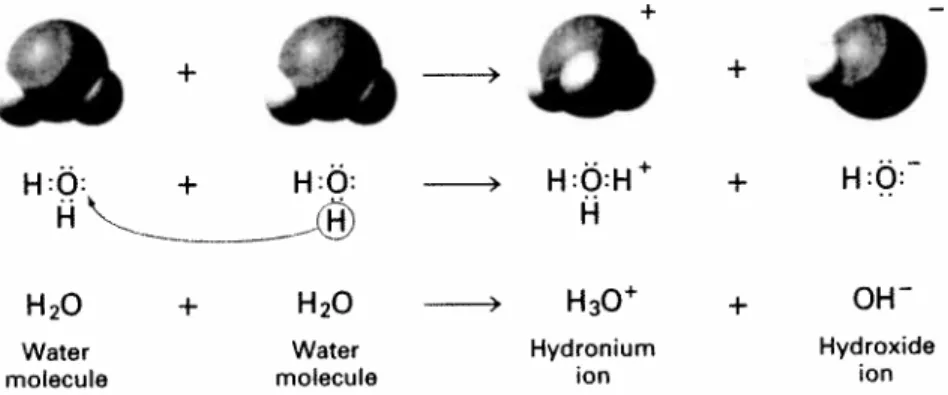
As you already know, water molecules are highly polar and are in con tinuous motion, even at room temperature. Occasionally, the collisions between water molecules are energetic enough to transfer a hydrogen ion from one water molecule to another. A water molecule that loses a hydro gen ion becomes a negatively charged hydroxide ion (OH ). A water mole cule that gains a hydrogen ion becomes a positively charged hydronium ion (H-O’).
The reaction in which water molecules produce ions is called the self-ionization of water. This reaction can be written as a simple dissociation.
H 2
O(l) H(aq) + OH(aq)
I lydrogen ion Hydroxide ion
In water or aqueous solution, hydrogen ions (Hi are always joined to water molecules as hydronium ions (H3O). Hydrogen ions in aqueous solution have several names. Some chemists call them protons. Others prefer to call them hydrogen ions or hydronium ions. In this textbook, either H’ or is used to represent hydrogen ions in aqueous solution. Figure 19.7 shows howtwo water molecules react to form one hydronium
ion and one hydroxide ion.
Figure 19.7 The
self-ion izatself-ion of water. A proton
(hydrogen ion) transfers from one water molecule to another water molecule. The result is one hydronium ion (H3O) and one hydroxide ion (OHj.
H:O: + H:O: H:O:H
H
H
2 0
Water molecule
+ H20 > HO
Water Hydroriium molecule ion
+ H:O:
+ 0H
The self-ionization ofwater occurs to averysmall extent. In purewater
at 25°C, the equilibrium concentration of hydrogen ions (IF!‘I) and the
equilibrium concentration of hydroxide ions ([OH I) are each only I X 10 7M This means that the concentrations of H’ andOH are equalin pure waler. Any aqueous solution in which [I-! [ and 011 I are equal is described as a neutral solution.
on Product Constant for Water
In any aqueous solution, when [H’ [increases, [OH [decreases, When [H4 decreases, [01-1 [ increases. Le Châtelier’s principle, which you learned about in chapter 18, applies here. If additional ions (either hydrogen ions orhydroxide ions) are added to a solution, the equilibrium shifts. The con centration of the other type of ion decreases. More water molecules are formed in the process.
11 (aq) + 0H (aq) 1-1,0(1)
Foraqueous solutions, the product of the hydrogen-ion concentra tionand thehydroxide-ionconcentration equals1.0
x
10 .(H’J X [OW] = 1.0 x 10
This equation is true for all dilute aqueous solutions at 25°C. Asyouwill see, the concentrations of 11 andOH may change when substances are added towater. However,theproductof[H] and [OIL] isaiways X
1
oN
Theproduct of the concentrations of the hydrogen ions and hydroxide
iç
= [WIx
lOW] 1.0 x 10’Not all solutions are neutral. When some substances dissolve in water, they release hydrogen ions. For example, when hydrogen chloride dis solves in water, it forms hydrochloric acid.
HCI(g) H20> H(aq) + Cr(aq)
In such a solution, the hydrogen-ion concentration is greater than the hydroxide-ion concentration. The hydroxide ions are present from the self-ionization of water. An acidic solution is one in which (Hi is greater than [OH [.The [H [of an acidic solution is greater than I X 10 7M
When sodium hydroxide dissolves in water, it forms hydroxide ions in solution.
NaOH(s) 2> Na(aq) + OH(aq)
In such a solution, the hydrogen-ion concentration is less than the hydroxide-ion concentration. Remember, the hydrogen ions are present from the self-ionization of water. A basic solution is one in which (Wj is less than jOHj. The [H’i of a basic solution is less than 1 x 10⁷M. Basic solu tions are also known as alkaline solutions. Some uses for acids and bases are shown in Figure 19.8.
Qheckpoint] What is a basic solution?
Figure 19.8 Acids and bases have many uses in the home and in industry.
0
Unrefined hydrochloric acid, commonly called muriatic acid, is used to clean stone buildings and swimming pools. Sodium hydroxide, or lye, is commonly used as a drain cleaner. Predicting How will each chemical affect the hydrogen ion and hydroxide-ion concen tration of an aqueous solution?ions in water is called the ion-product constant for water (K).
For help with scientific notation, go to page R56.
‘
Textbook
Problem-Solving 19.10 Solve Problem 10 with the help of an interactive guided tutorial.
______witnChemASAP
SAMPLE PROBLEM 19.1
Finding the [OH
I
of a Solution
Colas are slightly acidic. it’ the Ill I in a solutionis 1.() x 10 5M, is the solution acidic, basic, or neutral? What is the [01-1 1 of this solution?
Analyze List the knowns and the unknowns.
knowns
• Il-Pi =
1.0 x
10M• Ion-product constant for water:
çrr [III X [OHI lx 10
Unknowns
• solution -= acidic, basic, or neutral?
• [OH1 = ?M
Calculate Solve for the unknowns.
[H ‘H is 1.0 x 10 ‘M. Because this is greater than 1.0 x 10 FM, the solution is acidic.
13y definition K= [11*1 X [OH i.Therefore, [OH] =
Substituting the known numerical values, compute IOH [as follows.
1 ñ it 14
F I .1) 1 U
1.0 x 10
Evaluate Do the results make sense?
If [H’H is greater than 1.0 x 10 1M, the [OH
1
must be less than 1,0 X 10⁷MAt 1 >< 109M, IOHI is less than I X 107M.9. Classify each solution as
io.
If the hydroxide-ion concen acidic, basic, or neutral. tration of an aqueous solution a. [H’H 6,0>< 10 10M is 1 x 101M, what is the [H’H b. [OH H 3,0 X 10²M in the solution? Is the solution c. [NJ 2.0 X 10”M acidic, basic, or neutral? d. IOH I = 1.0 x 10 7MThe pH Concept
Expressing hydrogen-ion concentration in molarity is cumbersome. A more widely used system for expressing 1W] is the pH scale, proposed in 1909 by the Danish scientist Soren Sorensen (1868—1939). On the pH scale, which ranges from 0 to 14, neutral solutions have a pH of 7. A pH of 0 is strongly acidic. A solution with a pH of 14 is strongly basic.
Calculating pH
The pH of a solution is the negative logarithm of the hydrogen-ion concentration. The pH may be represented mathematically using the following equation.pH = —log[H]
Math
Handbook
I
11
I;
lii aneutral solution, the Ill I I / 10 ‘Al,ihe 1)11 ofa neutralsolution is 7. pH —log(1
x
10)= —(log 1 + log 10)
—(0.0 (—7.0))
7.0
You can calculate the pH of a solution usiHg the log function key on a calculator. (You can review finding the logarithm of anumberon a calcula tor in the Math Handbook on page R78.)
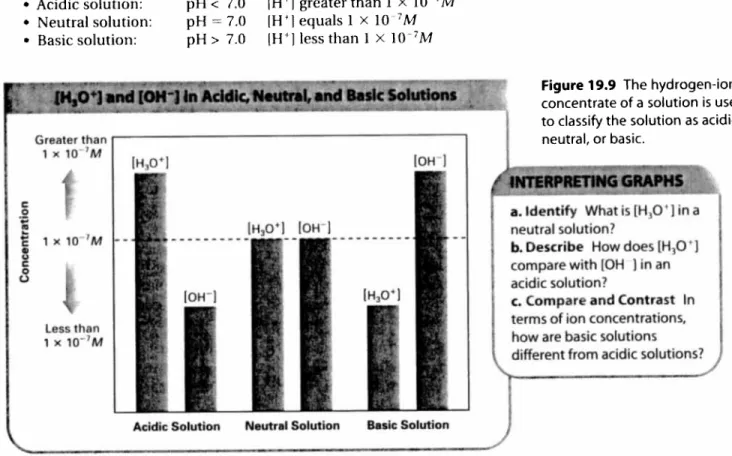
Figure 1) 9 shows how the hydrogen ion concentration of a solution is used to classify the solution asncutral acidic or basic A solution in which lHl Is greater than I X107M has a pH less than 7.0and isacidic. The pH of pure water or a neutral aqueous solution is 7.0. A solution with a p11 greater than 71s basic and has a I11l of less than I X 10 7M.
Greater than 1 x 1O’M
- fH3oj
C
o
lxlfF
1 M
a)
0
C
L
Less than 1 x 1O7M
(n1ine
LINKS
For:Links on pH
Visit: www.SciLinks.org Web Code:cdn—1 192
The pH values of several common aqueous solutions are listed in Table 19.5. The table also summarizes the relationship among [WI, [OW], and pH. You may notice that pH can sometimes be read from the value of
[H 4
]. If [H4 I is written in scientific notation and has a coefficient of 1, then the p11 of the solution equals the exponent, with the sign changed from minus to plus. For example, a solution with [H*l = 1 x 10²M has a pH of
2.Oandasolutionwith [H*] = 1 X 10°MhasapHof 13.0.
If the pH is an integer number, it is also possible to directly write the value of 1W]. A solution with a pH of 9.0 has a [WI = 1>< 109M. A pH of 4
indicates a 1W] of 1 X 10⁴M.
• Acidic solution: pH < 7.0 • Neutral solution: pH 7.0
• Basic solution: pH> 7.0
[H]greaterthanl x lO’M
1W] equals 1 x 10 7M [W] less than 1 x 10⁷M
Figure 19.9 The hydrogen-ion concentrate of a solution is used to classify the solution as acidic, neutral, or basic.
[H 3
ol
[ow]
a. Identify What is[H3O]in a
neutral solution?
b. Describe How does [H3O] compare with [OH I in an acidic solution?
c. Compare and Contrast In
terms of ion concentrations, how are basic solutions
different from acidic solutions? I
Acidic Solution Neutral Solution Basic Solution
pH
0 1 2 3 4 5 6 7 8 9 10 11 12 13 14
I I I I I I I
Increasing acidity Increasing basicity
Table 19.5
Relationship among LH 1, [OH I, and pH
[H I (mol/L)
[OH I (mol/L)
lxlO 14
1 x 10 13
1x10
12
1 x 101i
1 X 10¹⁰
1 ><
iO-1 X 10 El
1 < 100
1x10
1
II
lxlO21 < i0
I
1x1051 )< 106
Neutral 1 )< 10 1
1x10 8
I
1x101o1
.9 1 x 10¹²
1 x 1O
1 x 10¹⁴
1 X iO
Aqueous system
-.-1MHCl
-0.1MHCI Gastric juice Lemon juice
—Tomato juice
—Blackcoffee
Milk
—Pure water
-Blood
‘‘-Sodium bicarbonate, seawater
—Milk of magnesia
—Household ammonia
—Washing soda
0.1MNaOH —1MNaOH
1 x 10⁶
1 )< iO
1 X 10
1 x 10
1x10⁻²
1 x 101
1 x 10°
Calculating pOH
The pOH of a solution equals the negative logarithm of the hydroxide-ion concentration.pOH = -logIOHI
A neutral solution has a p01*1 of 7. A solution with a pOH less than 7is basic.
A solution with a p01-1 greater than 7isacidic. A simple relationship between pH and pOH allows you to find either one when the other is known.
pH + pOH = 14
pH
= 14 -p0K
pOH = 14 — pH
pH and Significant Figures
For p1*1 calculations, you should express the hydrogen-ion concentration in scientific notation. For example, a hydrogen-ion concentration of 0.OOIOM, rewritten as 1.0>< 103Min scien tific notation, has two significant figures. The pH of this solution is 3.00, with the two numbers to the right of the decimal point representing thetwo significant figures in the concentration. A solution with a pH of 3.00 is acidic, as shown in Figure 19.10.I
Figure 19.10 The pH scale shows the relationship between pH and the hydrogen-ion concentration. Interpreting Diagrams What happens to (HJ as pH increases?
T I I I I
10° 10_i 10_2 i—
io
10_6 10_a i0 10°10_li 10_12 10_13 10_14on
CHEMath
Logarithms
The common logarithm (log) of a number (N)isthe expo nent (x) to which the base 10 must be raised to yield the number. uN= 1Ox,then
log N= x,
The use of logarithms allows alargerange of values to be conveniently expressed as small, rionexponential numbers. For example, ioglO
3 =3andloglO6=6. Although thereisa range of three orders of magnitude (lOx lOX lOorl000) betweenthe numbers iO and 106, the range of the log valuesisonly3.
The concentration of hydrogen ions in most aque ous solutions, although small, can vary over many orders of magnitude. Scientists use pH, a logarithmic scale that ranges between 0 and 14,to more conveniently express the hydrogen ion concentra tion of a solution.
Math
Handbook
For help calculating logarithms, go to page R78.
Textbook
Problem-Solving 19.12 Solve Problem 12 with the help of an interactive guided tutorial. ______wIthChemASAP
Most pH values are not whole numbers. For example, milk of magnesia has a pH of 10.5, Using the definition of pH, this means that (H’) must equal 1 10 0“M. Thus (11
‘
I
must be less than I 10 Al (pH 10.0), hutgreater thaii I —. 10 ‘Ni (p1 111.0). If Iii’ I is written in scientific notation
but itscoefficient is not 1, then you use a calculator with a log function key to calculate pH.
SAMPLE PROBLEM 19.2
I
I
Calculating pH from [H
I
What is the p1-1 of a solution with a hydrogen-ion concentration of
4.2 )< It)
Analyze List the knowns and the unknown.
Knowns Unknown
• (1-1’) 4.2 x 10 ‘0M • p1! ?
• pH —--log)! I’ I
Calculate Solve for the unknown.
pH — —-logIH
Using a calculator, find logI H 1. log (4.2 X 10 0) —9.37675
pH = —(—9.38)
9.38
Evaluate Do the results make5n5
The calculated pH is between 9 ((H I = I x 10 ‘M and
10 ((Wj 1 x 10’A4).The pH is rounded to two decimal places because the hydrogen-ion concentration has two significant figures.
Practice Problems
11. Find the pH of each solution. a. 1H’I = 1 >< 104M
b. IFI’l=0.0015M
12. What are the pH values of the following solutions, based on their hydrogen-ion concentrations?
a.
lii’] = 1.0 x 10 ‘2Mb. IH*l =0.045M
You can calculate the hydrogen-ion concentration of a solution if you know the pH. For example, if the solution has a pH of 3.00, then
[WI = I x 103M. When the pH is not a whole number, you will need a cal
culator with a yx function key to calculate the hydrogen-ion concentration. For example, if the pH is 3.70, the hydrogen-ion concentration is greater than 1 X 10⁴M (pH 4.0) and less than 1 x 10³M (pH 3.0). To get an accu rate value, use a calculator as shown in the following example.
Math
Handbook
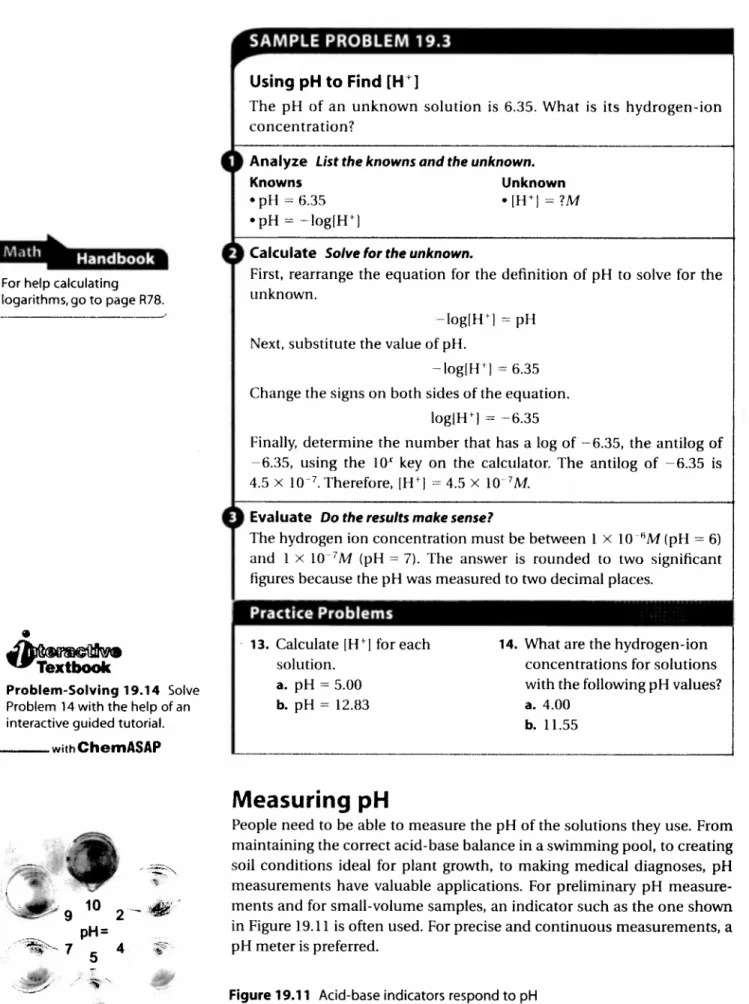
For help calculating logarithms, go to page R78.SAMPLE PROBLEM 19.3
Using pH to Find [H]
The p1-I of an unknown solution is 6.35. What is its hydrogen-ion
Concent ration?
Analyze List the knowns and the unknown.
Knowns Unknown
•pH 6.35 • IHH
•pH= --logiHI
Calculate Solve for the unknown.
Measuring
pH
10
2
pH=
754
j
600 Chapter 19
People need to be able to measure the pH of the solutions they use. From maintaining the correct acid-base balance in a swimming pooi, to creating soil conditions ideal for plant growth, to making medical diagnoses, pH measurements have valuable applications. For preliminary pH measure ments and for small-volume samples, an indicator such as the one shown in Figure 19.11 is often used. For precise and continuous measurements, a pH meter is preferred.
Figure 19.11 Acid-base indicators respond to pH changes over a specific range. Phenolphthalein changes from colorless to pink at pH 7—9.
1
First, rearrange the equation for the definition of p1-I to solve for the unknown.
—logiHI pH
Next,substitute thevalue of pH.
—logiHi 6.35
Change the signs on both sides of the equation.
loglH’i = —6.35
Finally, determine the number that has a log of --6.35, the antilog of —6.35, using the 10’ key on the calculator. The antilog of —6.35 is 4.5 >< 10 .
Therefore, jH
i
4.5 X 10 ?M.I
Evaluate Do the results make sense?The hydrogen ion concentration must be between I x 10hM (pH = 6)
and I x 10 M (p1-I = 7). The answer is rounded to two significant
figures because the p11 was measured to two decimal places.
1t
Problem-Solving 19.14 Solve Problem 14 with the help of an I interactive guided tutorial.
withCheniASAP
[
Practice Problems
13. Calculate (Hi for eachsolution. a. pH = 5,00
b. pH = 12.83
14. What are the hydrogen-ion concentrations for solutions with the following pH values? a. 4.00
SAMPLE PROBLEM 19.4
Calculating pH from [OH I
What
is the pH of a solution if OH I 4.0 X I () ‘‘M? Analyze List the knowns and the unknown.Knowns Unknown
• 1011 I = 4.0 x 10 ‘M •pH =?
• îç
101-Il >< [H4] 1 x i0 •pH —logiHiCalculate Solve for the unknown.
Io calculate pH, first calculate [H’ by using the (leflmtion of .
Ic=[OH
1><H
r 1-1 i —
-— 1.0 X 10
—029
x
10 M IOHj
— 4.0 x 10 —= 2,5 x 10⁴M
With the value of 1H1 I determined, use the definition oipi Ito solve fbr the pH.
p11 —log[H = —log(2.5 >< 10
4)
A calculator indicates that log 2.5 >K 10 1M = —3.60205, therefore
pH —(-3.60)
= 3.60
Evaluate Do the results make sense?
A solution in which IOHI is less than I )< 107M would be acidic because FF1’ I would be greater than I X 107M.
The
pH is expressed to 2 decimal places because [OH 1 is expressed to 2 significant figures.1xt
Problem-Solving 19.15 Solve Problem 15 with the help of an interactive guided tutorial.
______ __________
__________ __________ _______— ______with
ChemASAP
Acid-Base
Indicators
An indicator (HIn) is an acid or a base that undergoes dis sociation in a known pH range. An indicator is avaluable toolfor
measuringpH because
its acidform
andbase form have diffenrnt
colors in solution. The following genemlized equation represents the dissociation of an indicator(Hin).HIn(aq) H4(aq) + 1n(aq)
Acid form Base form
The acid form dominates the dissociation equilibrium at low pH (high [WI), and the base form dominates the equilibrium at high pH (high [OH-I).
Section 19.2 Hydrogen Ions and Acidity 601 If you know the 1011 1 ofa solution, you can lind its p11.11w ion—product
for water defines the relationship between [11 1 and [011 1. Therefore, you can determine [WI by dividing K, by the known OH 1.
I
Practice Problems
15. Calculate the pH of each solution.
a. [OH]
= 4.3>< 105Mb. IOH I = 4.5 X 10 M
16. Calculate the pH of each solution.
a. [WI = 5.0 X 10⁵M
U
I
__
I
I
0 1 2 3 4 b 6 1 8 9 10 11 12 13 14
pH
Figure 19.13 You can find acidic and basic substances in your home.
0
Universal indicator solution has been added to solutions of known pH in the range from 1 to 12 to producea set of reference colors.
()Universal indicator has been added to samples of vinegar, soda water, and ammonia solution. Interpreting Photographs Use the refer ence colors to assign pH values to vinegar, soda water, and ammonia solution.
For each indicator, the change from dominating acid form to dominating base form occurs ina narrow range of approximately two pH units. Within this range, the color of the solution is a mixture of the colors of the acid and thebase forms. Knowing the pFl range over which this color change occurs can give you a rough estimate of the p1-I of a solution. At all pH values below this range, you would see only the color of the acid form. At all pH values above this range, you would see only the color of the base form. You could
get a more precise estimate ofthepH of the solution by repeating the exper iment with indicators that have different pH ranges for their color changes. Many different indicators are needed to span the entire pH spectrum. Figure 19.12 shows thepH ranges of some commonly used indicators.
Indicators have certain characteristics that limit their usefulness. The listed pH values of indicators are usually given for 25°C. At other tempera tures, an indicator may change color at a different pH. If the solution being tested is not colorless, the color of the indicator may be distorted. Dissolved saltsina solution may also affect the indicator’s dissociation. Using indica
tor strips can help overcome these problems. An indicator strip is a piece of paper or plastic impregnated with an indicator. The paper is dipped into an unknown solution and compared with a color chart to measure the pH. Some indicator paper is impregnated with multiple indicators. The colors that result, which cover a widep1-Irange, are shown in Figure 19.13.
I, Figure 19.12 Indicators change
color at a different pH.
I
Thymol blue
Bromphenol blue
Bromcresol green a,Identify Which indicator
changes color in a solution withapHof2?
b. Compare and Contrast What do you notice about the range over which each indicator changes color? c. Apply Concepts Which indicator would you choose to show that a solution has changed from pH 3 to pH 5?
Methyl red Alizarin
Bromthymol blue
Phenol red
Phenolphthalein
Alizarn yellow B
I
p
p
c
pH
Meters
A pH meter makes rapid, accurate pH measurements. Mostchemistry laboratories have a pH meter. A pH meter connected to a com puter or chart recorder can be used to make a continuous recordingofp11 changes. As you can seeinFigure 19.15, the pH meter gives a direct readout of pH.
A pH meter is often easier to use than liquid indicators or indicator
strips. Measurements of pH obtained with a pH meter are typically accu rate to within 0.01 pH unit of the true pH. The color and cloudiness of the unknown solution do not affect the accuracy of the pH value obtained. Hospitals use pH meters to find small but meaningful changes of pH in blood and other body fluids. Sewage, industrial effluents, and soil pH are also easily monitored with a pH meter.
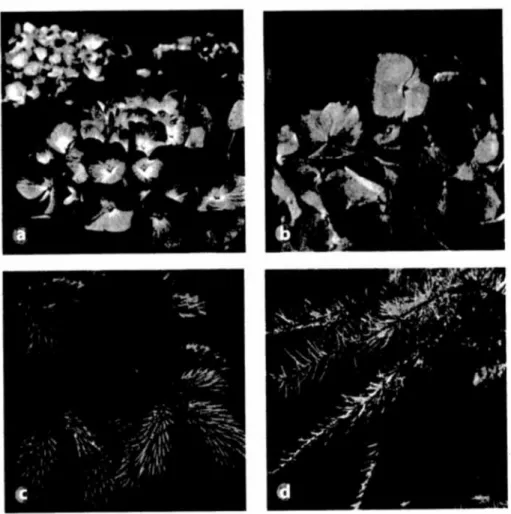
Figure 19.14 Altering soil pH canaffectthe development of plants.
0
In acidic soils,hydrangeas produce blue flowers. 4 In basic soils, hydrangeas produce pink flowers. Evergreen plants
G
suffer from chlorosis, a yellowing of the foliage ifsoil pH istoo basic.
Figure 19.15 A pH meter provides a quick and accurate way to measure the pH of a solution.
0
Water is neutral, having a pH of 7.)
The pH of vinegar, a dilute aqueous solution of ethanoic (acetic) acid,is about 3.
G
The pH of milk of magnesia, an aqueous suspension of magnesium hydroxide, is 10.5.Applying Concepts What are someadvantages of using a pH meter rather than an indicator?
Procedure
0
1. Put cup of finely chopped red cab bageleavesin a jar and add cup of hot water. Stir and crush the leaves with a spoon. Continue the extraction until the water is distinctly colored.
2. Strain the extract through a piece of cloth into a clean jar. This liquid is your natural indicator.
3. Tape three sheets of paper end to end, Draw a line along the center and label
it at 5-cm intervals with the numbers 1
to 14. This is your pH scale. 4. Pour your indicator to about 1 crn
depth into each of three plastic cups.
To one cup, add several drops of vine
gar, to the second add a pinch of bak ing soda, and to the third add several drops of ammonia,The resulting colors indicate pH values of about 3,9, and
11, respectively. Place these colored
positions on your pH scale.
18. Key Concept What is true about the relative concentrations of hydrogen ions and hydroxide ions in eachkindof solution?
a. basic b. acidic c. neutral
19. Key Concept What is true about the colors of a pH indicator?
20. Determine the pH of each solution.
a. [WI = IX 106M b. [W[ = 0.0001OM
c. [OW] = 1 x 10²M d. [OH] = 1 x 10”M
21. What are the hydroxide-ion concentrations for solutions with thefollowingpH values?
a. 6.00 b. 9.00 c. 12.00
Indicators from Natural Sources
Purpose
To measure the pH of vari
ous household materials by using a natural indicator to make an indicator chart.
Materials • knife
• red cabbage leaves • icup measure • hot water • 2jars
• clean white cloth • teaspoon • tape
• 3 sheets of plain white paper
• pencil • ruler
• 10 clear plastic cups • white vinegar
(CH 3
COOH)
• baking soda (NaHCO3)
• household ammonia
toothpaste, shampoo, and carbonated beverages.
Analyze and Conclude
1. What was the color of the indicator at acidic, neutral, and basic conditions?
2. What chemical changes were responsi ble for the color changes?
3. Label the materials you tested as acidic,
4. Which group contains items used for 5. Repeat Step 4 for household items
• dropper such as table salt, borax, milk, lemon • various household items juice, laundry detergent, dish deter
gent, milk of magnesia, mouthwash,
basic, or neutral.
cleaning or for personal hygiene?
17. Key Concept What is the relationship between
[Wi and IOWI in an aqueous solution?
Handbookj
Group 7A Elements Hypochlorite salts are used to disinfect swimming pools. Use page R34 of the Elements Handbook to find out how the pH of swim ming pool water is regulated to maintain the neces sary concentration of hypochlorous acid1 HOCI
Textbook
Assessment 19.2 Test yourself on the concepts in Section 19.2.
______