AUSTRALIAN JOURNAL OF BASIC AND
APPLIED SCIENCES
ISSN:1991-8178 EISSN: 2309-8414 Journal home page: www.ajbasweb.com
Open Access Journal
Published BY AENSI Publication
© 2016 AENSI Publisher All rights reserved
This work is licensed under the Creative Commons Attribution International License (CC BY).
http://creativecommons.org/licenses/by/4.0/
To Cite This Article: Mustafa Hassan and Dr. Amin Babikir., Adaptive Traffic light using Image Processing and Fuzzy Logic. Aust. J. Basic & Appl. Sci., 10(6): 49-54, 2016
Adaptive Traffic light using Image Processing and Fuzzy Logic
1Mustafa Hassan and 2Dr. Amin Babikir
1Future University, Faculty of Engineering, Computer Engineering Department, Box.1055. Khartoum. Sudan. 2Anilin University, Faculty of Engineering, Telecommunication Department, Box. 12707. Khartoum. Sudan
Address For Correspondence:
Mustafa Hassan, Future University, Faculty of Engineering, Computer Engineering Department, Box.1055. Khartoum. Sudan
A R T I C L E I N F O A B S T R A C T Article history:
Received 12 February 2016 Accepted 12 March 2016 Available online 20 March 2016
Keywords:
Adaptive traffic light, Image processing, Image segmentation, Region of interest segmentation, fuzzy logic.
As we know the problem of the traffic congestion has increased in many cities round the world, and thus became an urgent need for the introduction of advanced technology and equipment to improve traffic. Where the traffic is growing at the present time because of the increasing number of vehicles and the limited resources provided by the existing infrastructure. The simplest way to control the traffic light is fixed time or timer for each phase. Another way is adaptive traffic control is using electronic sensors to detect vehicles and send it to microcontroller to produce cycle. The recent way is using digital camera to detect vehicles by implementing image processing. In this study, we propose a system to control the traffic light by merging image processing technique and fuzzy logic. By utilizing the benefits of region of interest segmentation technique to determine reliable traffic load situation and send it to the microcontroller to produce cycle.
INTRODUCTION
With the increasing of roads users today the number of vehicles on the roads is creating a heavy traffic that is very difficult to control and maintain safety. This is a major concern in many countries leading towards a critical situation of congestion. Thus, there is a requirement for optimizing traffic control methods for better accommodating the increasing demand. Many methods has been applied to solve the problem. One of that is inductive loop detectors provide a cost-effective solution, however they are subject to a high failure rate when installed in poor road surfaces, decrease pavement life and obstruct traffic during maintenance and repair. Other method used is image processing is a far more efficient method of traffic control as compared to traditional techniques. (P.Srinivas and et al., 2013). Various techniques have been developed in image processing during the last four to five decades which are utilized in designing optimized system for traffic management. For example of that developing a research of using image processing in adaptive traffic signal proved that there is no need to use sensors that have been commonly used to detect traffic (Pejman Niksaz., 2012). In 2014 another a research has showed estimation of 80% accuracy of using image processing in traffic management (Arif A. Bookseller and Rupali R bJagtap, 2014) and so on of researches proved the efficiency of using the technique. The technique is recognized that vision-based camera system are more versatile for traffic parameter estimation. In addition to qualitative description of road congestion, image measurement can provide quantitative description of traffic status including speeds, vehicle counts, etc. Moreover, quantitative traffic parameters can give us complete traffic flow information, which fulfills the requirement of traffic management theory. Image tracking of moving vehicles can give us quantitative description of traffic flow.
based on pixels characteristics like gray level , color, texture, intensity and other features. The field of image segmentation is very large and there are many methods as listed on the following (A.M. khan and et al., 2013):
• Intensity based segmentation
• Discontinuity based method
A. First order derivative operators
B. Second order derivative operators
i.Laplacian of Gaussian operator ii.Cany edge operator
• Region based segmentation
A. Region growing methods
i.Seeded region growing method ii.Unseeded region growing method
B. Region split and merge method
i.Fuzzy C-means algorithm
• Hybrid Methods
• Graph based methods.
Fuzzy Logic:
Fuzzy Logic was initiated in 1965, by Lotfi A. Zadeh , professor for computer science at the University of California in Berkeley(M. Hellmann., 2001). Basically, Fuzzy Logic (FL) is a multivalve logic, that allows intermediate values to be defined between conventional evaluations like true/false, yes/no, high/low, etc. Notions like rather tall or very fast can be formulated mathematically and processed by computers, in order to apply a more human-like way of thinking in the programming of computers (L.A. Zadeh., 1984).
Fuzzy classifiers:
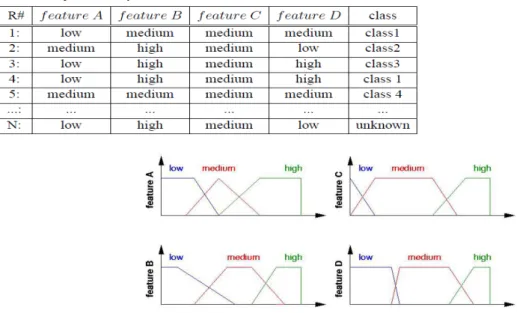
Fuzzy classifiers are one application of fuzzy theory. Expert knowledge is used and can be expressed in a very natural way using linguistic variables , which are described by fuzzy sets Now the expert knowledge for this variables can be formulated as a rules like IF feature A low AND feature B medium AND feature C medium AND feature D medium THEN Class = class 4 The rules can be combined in a table (1) calls rule base and linguistic variables shown in figure (1).
Table 1: Example for a fuzzy rule base.
Fig. 1: Linguistic Variables.
MATERIAL AND METHODS
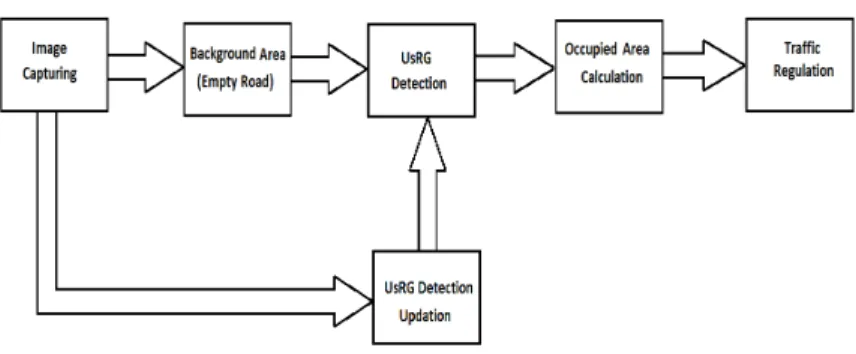
controlled by PC through microprocessor to change its direction in steps of 90 degree to face each lane in a certain time and capture image. This single image of lane will be processed using image processing techniques to estimate the traffic load. Estimated traffic load on particular roads will be used to calculate the required time duration to control the signal lights. The System block diagram as shown in figure (2) will calculate the time and operate in a cyclic clockwise signal lights control. Maximum and minimum time limit will be maintained to prevent over waiting of vehicle in queue of other lanes which would be found out experimentally. Controlling of the signal will be routed through the microcontroller. MATLAB programming environment will be used for simulating and developing the proposed system.
Fig. 2: System overview.
Model proposed:
A camera is placed on the centre of the intersection (cross shape) with the rotate mechanism to take first an image of empty four roads with interval time between each road to calculate the empty area in pixels to be as reference (original area). Secondly image is taken periodically when the system is started to calculate the occupied area by cars (segmented image). This done by analyze the image and segment it by using region growing method. This segmentation method has been selected because of the flexibility and accurate segmentation approach for calculating area of segmented image (R.Yogamangalam and B.Karthikeyan., 2013). It is also reliable output compared to its other counterparts (A.M. khan and et al., 2013). The design of the system algorithm is consist of two phases as following:
Phase 1:
Image segmentation algorithms:
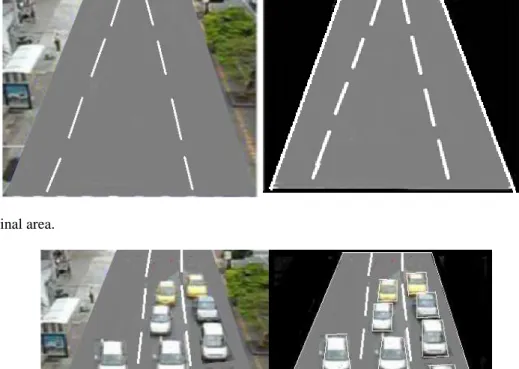
1. Capture the image of empty four roads (fixed and equaled area) and then defined it to the system as reference empty area (original area) as shown in figure (3).
2. Capture the image from video of four roads (the model of traffic signal is four-way intersection) occupied
by vehicles and apply image segmentation to calculate region of interest (area of vehicle queue) at each road compared to the reference area as shown in figure (4).
3. Conversion to gray scale after capturing the image it can be done by some functions of MATLAB to segment the image. The algorithm of segmentation will be used is region growing method as illustrated on the following steps :
a. Determine seeds to start the segmentation process.
b. Determine the criteria to grow the region. In case of multiple regions, clearly the characteristic of regions should be mentioned. So that no ambiguity exists to place the pixel in particular region.
c. The candidate pixels to include in the region it should be 8-connected to at least` one of the pixel in the region.
d. Cross-check is to be done to ensure all the pixels are tested for allocation and then label has to be given to all regions.
e. If two different regions get same label then they have to be merged.
4. Then calculate the area ratio by dividing the segmented area which is represents the occupied area by cars
to the original area using the following codes in MATLAB:
Fig. 3: Original area.
Fig. 4: segmented area.
Phase 2:
Time calculation for signal lights:
By Applying fuzzy logic to calculate the time for each road according to the percentage area occupied by cars compared to the reference area. The algorithm design of calculating green light time will be as following: 1- Define variables x1, x2, x3 and x4 which are representing the traffic roads situation corresponding to the
number of road at intersection.
2- Equation of calculating the percentage:
X1 = sum of vehicles area / Total road area * 100
3- The ratio of traffic load between number of roads as following: Traffic loads ratio = x1 : x2 : x3 : x4
4- The Total Time Ratio (Txt) is distributed according to the ratio above and it is the sum of xt. Which xt
represent variable time for each road according to their traffic loads.
5- Then the distributed Total Time Ratio (Tr) will be:
Tr = xt0 : xt1 : xt2 : xt4
6- The green light is calculated by finding the highest percentage of traffic load. By allocating a certain time to each percentage of variable. That can be done by applying programming language to let the system periodically compares the amount of traffic load at each road. The amount of time is determined experimentally for each percentage of traffic load as follows:
10-20% = t1 , 21-30% = t2 , 31-40% = t3 , 41-50% = t4 , 51-60% = t5 , 61-70% = t6 , 71-80% = t7 , 81-90% = t8
, 91-100 = t9
The priority of given green light is given to the road with highest percentage of traffic and then goes to less until to lowest one. Then start from the beginning to capture a new picture of each road.
xt1 < xt2 < xt3 < xt4
Then to apply fuzzy logic algorithm let the traffic amount load T (t) is quantified such as “Low” and “High” which are used in real life (inputs) as followed.
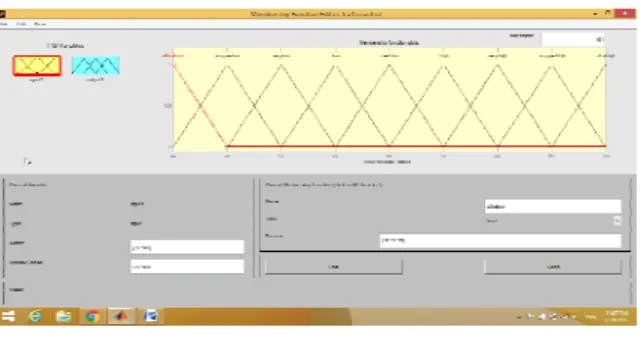
The quantified area is distributed by customize it the fuzzy logic membership as shown in figure (5). Figure (6) shows the fuzzy logic rules between the between area ratio and corresponding time.
Fig. 5: Fuzzy logic memberships.
Fig. 6: Rules between area ratio and time.
The whole program logic is explained in figure (7) showing how the control unit controlling the operating of signal lights for each road. In addition there is an operation option for emergency case. Which interrupt the system by giving green light to the emergency road and red for all others road. Then the system will switch to the normal operation.
Fig. 7: The logic of the program.
Conclusion:
The study showed that the image processing is the better technique to control the changing state of the traffic light style. Accordingly, it can thereby reduce traffic congestion and avoids loss of time in case the roads are empty. It is also more accurate in detecting the presence of a car because it uses real traffic. The study showed that the method is effective with the integration of image processing algorithms and fuzzy logic algorithms. Because of the flexibility of determining the amount of the occupied area. This is reflected to the accurate time estimation that is needed for a similar load of traffic.
REFERENCES
Khan, A.M. and S. Ravi, 2013. Image Segmentation Methods: A Comparative Study. International Journal of Soft Computing and Engineering (IJSCE), 2231-2307.
Arif, A., Bookseller and Rupali, R. Jagtap, 2014. Image processing based Adaptive Traffic Control System. IOSR Journal of Electronics and Communication Engineering (IOSR-JECE), 33-37.
Zadeh, L.A., 1973. Outline of A New Approach to the Analysis of Complex Systems and Decision Processes
Hellmann, M., 2000. Fuzzy Logic Introduction. http://www.epsilon.nought.de
Srinivas, P.,Y.L. Malathilatha and Dr. M.V.N.K Prasad, 2013. Image Processing Edge Detection Technique used for Traffic Control Problem. International Journal of Computer Science and Information Technologies, 4(1): 17-20.
Pejman Niksaz, 2012. Automatic Traffic Estimation Using Image Processing. International Journal of Signal Processing, Image Processing and Pattern Recognition.