Sharif University of Technology
Scientia IranicaTransactions A: Civil Engineering www.scientiairanica.com
Application of damage spectra as seismic intensity
measures in endurance time method for steel
moment-resisting frames
M.J. Maleki-Amin
and H.E. Estekanchi
Department of Civil Engineering, Sharif University of Technology (SUT), Tehran, P.O. Box 11155-9313, Iran. Received 19 December 2014; received in revised form 18 September 2015; accepted 28 November 2015
KEYWORDS Damage spectra; Endurance time method;
Steel moment frame; Damage indices; Seismic resistant design.
Abstract. In seismic resistant design of moment frames, the structure behavior under earthquakes has to be examined considering various damage criteria. Damage indices can be estimated by Endurance Time (ET) method with minimum computational eort. The quality of this estimation can be improved in dierent ways. In this paper, the graphs of a certain damage index versus natural period of the structure, called damage spectra, are produced applying intensifying ET records and scaled Ground Motions (GM). Then, the excitation duration of ET acceleration functions (target time) is modied in order to reach acceptable consistency between ET and GM damage spectra. Moreover, various damage indices of a steel moment frame at two hazard levels are evaluated via nonlinear time-history analyses of the structure under scaled earthquakes and ET records. It is observed that the frame damage estimation can be improved by modifying the target time of ET records based on damage spectra. In addition, in most cases, there are negligible discrepancies between values of frame damage indices corresponding to ground motions and ET acceleration functions with the damage-based target time.
© 2017 Sharif University of Technology. All rights reserved.
1. Introduction
In recent years, performance-based seismic design has been introduced in earthquake engineering, and many damage parameters have been accounted to describe the behavior of structures during seismic excitations. These parameters commonly include inter-story drift, plastic deformation, and cumulative energy dissipation of structural members. Although damage parameters were benecial, some other criteria were developed to reveal the damage state of structures, comprising of the ratio between damage parameters and the ultimate capacity of structural members. These criteria, called damage indices, are quantities varying from zero to one
*. Corresponding author. Tel.: +98 21 22235164 E-mail addresses: [email protected] (M.J. Maleki-Amin); [email protected] (H.E. Estekanchi)
corresponding to elastic behavior and state of collapse, respectively.
Researchers have proposed dierent damage in-dices. Krawinkler and Zohrei [1] examined local buckling in some steel members and attributed the deterioration in strength, stiness, and energy dissi-pation to plastic rotations. They introduced damage indices based on relative deterioration. Powell and Allahabadi [2] suggested a ductility-based damage in-dex involving plastic deformation, which had a simple concept and an easy computational method. Cosenza et al. [3] dened another damage index for the Elastic-Perfectly-Plastic (EPP) behavior to consider the eect of cumulative energy dissipation on the structural dam-age. This energy-based damage index depended on the number of cycles which include inelastic deformations. The most popular and practical damage index was presented by Park et al. [4] for Reinforced Concrete
(RC) buildings, which was almost the combination of ductility-based and energy-based damage criteria. Bozorgnia and Bertero [5] prescribed improved damage indices on the basis of correcting the value of Park-Ang index (DIPA) for both slight and sever damage states.
Thereafter, Ladjinovic and Folic [6] proposed a new damage index by modifying the well-known DIPA,
incorporating the cumulative plastic excursion. This index was adjusted to be exactly zero for elastic responses and one for the entire collapse of structures. Moreover, its parameters could be calculated indepen-dently. Later, Estekanchi and Arjomandi [7,8] evalu-ated the mentioned damage indices in steel moment frames and obtained the correlation between them and performance levels. In addition, Datta and Ghosh [9] generated design spectra at dierent hazard levels based on DIPA.
Damage spectra were generated [10] to evaluate the damage potential of various earthquake accelero-grams. A damage spectrum is variation of a certain damage index versus natural period of the Single-Degree-Of-Freedom (SDOF) system, considering that other system dynamic properties are constant and a certain earthquake record is applied. This spectrum can be extended to dierent levels of excitations and can be employed in the seismic performance assessment of both existing and new structures. Zhai et al. [11] depicted various damage spectra relating to systems and earthquakes with dierent dynamic features.
Nonlinear dynamic analyses are applied to make a realistic prediction of structural behavior during seis-mic excitations and to incorporate almost any type of material and geometrical behavior. Many researchers severely advise to use nonlinear dynamic analyses to take into account strong-motion duration eect and behavioral complications such as fatigue, hysteresis energy dissipation, and cyclic deformation. Nonlin-ear time history analyses, which are time-consuming procedures, especially for the systems with a high degree of freedom, would be carried out in order to calculate most damage indices accurately. The Endurance Time (ET) method can be eectively used to reduce the computational eort needed to determine damage values of structures under various earthquake accelerograms at dierent hazard levels [12].
In the ET method, the structure is subjected to intensifying dynamic excitation, whose response is evaluated using time history analysis [13]. The damage indices of the structure can also be determined during the excitation, and the performance of the structure will be judged based on the endurance time at which some damage indices reach the maximum acceptable value. In addition, the denite time related to each hazard level can be detected such that the response spectrum of the ET records up until that time agrees with the target spectrum at that hazard level. This
time, called target time, depends on the type of both the response and target spectrum, which were initially accounted for linear acceleration response and code spectrum, respectively [13].
The purpose of this paper is to apply damage spectra to modify the target time in ET method, which leads to the improvement of the damage estimation of steel moment frames by the ET method. Considering this goal, average damage spectra of Ground Motions (GM) and ET acceleration functions at two levels of excitation were generated, and the target time of ET series for each hazard level was modied in such a way that ET damage spectra coincide with GM spectra. Then, damage indices of a steel moment frame were estimated using the ET method with damage-based target time; furthermore, the accuracy of this estimation was discussed.
2. The concept of endurance time method In the Endurance Time (ET) method, a structure is subjected to an articial intensifying accelerogram, and its damage criteria are evaluated during excitation by nonlinear time history analysis. The time at which the selected damage criterion reaches its ulti-mate acceptable value{having to do with the seismic performance level assigned for the structure{will be the endurance time, which is used to determine the seismic performance of the structure [14].
Generation of ET acceleration functions is a kind of optimization problem, in which the target function is the integration of squared dierences between ET spec-tral response and template specspec-tral response (Eq. (1)). The time span of ET excitation at which the target function has to be minimized is called basic target time, which is frequently considered 10 s. The ET response spectra, which depend on time duration of ET excita-tion, or target time, are typically linear or nonlinear acceleration response spectra. Template spectra can be code-based spectra or average acceleration response spectra relating to several real earthquakes. The ET accelerograms will be induced such that their linear spectral acceleration is proportional with the excitation duration (Eq. (2)) [15]:
min F (ag) =
Z Tmax
0 [Sa(T; tb) SaT(T )]
2dT; (1)
Sa(T; t) = tt
bSaT(T ): (2)
In Eqs. (1) and (2), T is the period of SDOF system, t is the time duration of ET excitation, tb shows basic
target time, and Sa as well as SaT are ET linear
spec-tral acceleration and template specspec-tral acceleration, respectively. Additionally, F (ag) indicates the error
of correlation between ET response spectrum and the template spectrum.
Every target time in ET method corresponds to a particular ET response spectrum, which can be compatible with a target spectrum{used to scale the earthquakes in a seismic dynamic analysis{at a certain hazard level. In other words, for distinct hazard levels, dierent target times will be specied such that ET response spectra related to those target times conform to the target spectra at those levels of excitation. With this in mind, seismic responses of structures can be determined at various levels of excitation through just one ET analysis. Therefore, the ET method dramatically reduces the computational eort needed in nonlinear dynamic analyses in an acceptable way.
The ET analysis, in comparison with spectral or pushover analyses, is able to take into account the eect of strong-motion duration and behavioral complications such as buckling, hysteresis energy dis-sipation, and cyclic deformation. Moreover, compared to conventional time history analyses, which directly apply ground motions, ET method is an adequate alternative to decrease the computational demand with a reasonable precision. This is because only three ET records are imposed on the structure, and the average response time history will be obtained to assess the performance of the structure at various hazard levels. Consequently, ET records have been used in the seismic assessment of various structures and in the generation of several types of spectra.
For instance, Valamanesh and Estekanchi [16] examined a number of steel moment frames under bidirectional seismic loading and estimated the seis-mic response by the ET method. They veried the results by comparing ET responses with those obtained by nonlinear time history analyses. Similarly, Hariri et al. [17] investigated seismic performance of several steel moment frames using time history,
incremental dynamic, and endurance time methods, which approve acceptable accuracy of ET method. Likewise, Mirzai et al. [18] successfully employed ET method in performance-based design of steel frames. Mashayekhi and Estekanchi [19] generated eective-number-of-cycles spectra with ET and ground motions accelerograms. Furthermore, they modied the target time of some ET series based on duration consistency. In this study, the spectra suggested in ASCE/ SEI7-10 [20] for Design Basis Earthquake (DBE) and Maximum Considered Earthquake (MCE) hazard lev-els are considered as target spectra. And, \ETA20inx" records [21]{a type of ET acceleration functions{with dierent target times are applied to produce ET spec-tra. Moreover, some other ET accelerograms{namely, ETA20a, \ETA20e", and \ETA40g" records [21]{are tacitly used for comparative study.
Since \ETA20inx" records have been optimized to t the average of GM nonlinear response spectra{ corresponding to 20 records in FEMA{440 [22] on soil type C{its response spectra are not much consistent with code spectra (target spectra). For further ac-curacy, specic target time for every system period (T ) and hazard level will be computed such that the average of ET linear acceleration response spectrum is equal to the average of target spectrum in the periodic range of 0.2T -1.5T . In this paper, the target time ob-tained under this procedure is recognized as Sa-based
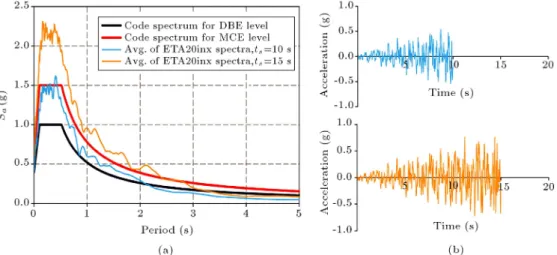
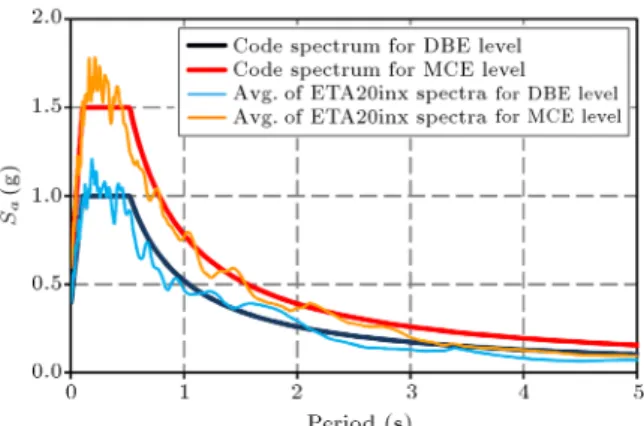
target time. In Figure 1, the ET linear response spectra related to dierent target times together with target spectra are conveyed. Moreover, the ET response spectra scaled at DBE and MCE hazard levels using Sa-based target time are displayed in Figure 2.
3. Damage spectra
Damage spectrum is a variation of certain damage index against natural period of SDOF system under
Figure 1. (a) Target spectra and average of response spectra of ETA20inx records at dierent target time. (b) Typical ETA20inx acceleration function.
Figure 2. Average of response spectra of ETA20inx records scaled at DBE and MCE levels using Sa-based target time.
denite earthquake excitation, where other system dynamic properties are constant. Hence, three items should be determined to produce damage spectrum: (1) the type of damage index, (2) the assumed dynamic characteristics of SDOF system, and (3) the earthquake record.
Among all damage indices, \Modied Park-Ang" Damage Index (DIm) has been selected in this study,
since this index becomes exactly zero in the case of system elastic behavior, and it becomes one when the system collapses under uniformly increasing lateral deformation. In addition, the parameters of the index can be calculated or assumed to be independent of other indices [23]. Because there is a nearly good correlation between the values of DIm and DIPA in
the range of 0.2-0.8 and because Park-Ang index has already been veried by experimental researches [4], parameter DIm will correctly represent the seismic
performance of structures.
In Eq. (3), the formulation of DImis represented:
DIm= 1 u 1+
Eh
Fyuy(u 1);
= 1 c ac;
c=uc;maxu y ;
ac= 1 +
P
iju+p;ij +
P
ijup;ij
uy ; (3)
where is maximum ductility, which is the ratio of maximum to yield displacement, demanded by earthquake excitation; u is the ultimate ductility
capacity of the structure under uniformly increasing lateral deformation, reported in FEMA-356 [24] for structural members; Eh, Fy, and uyare the cumulative
energy dissipation demanded by earthquake excitation, yield strength, and yield displacement of the structure,
respectively. According to Cosenza et al. [3], coecient varies between 0.025 and 0.25, and it can be taken 0.15 for steel members. In addition, complicated coe-cient includes cyclic ductility (c) and accumulative
ductility (ac). c quantity contains maximum
excur-sion of deformation (uc;max) when plastic responses
exist and will be assumed zero in elastic behavior. Parameter ac depends on the sum of absolute plastic
excursion (jup;ij) all through the cyclic deformation
(the up;i parameter represents the plastic excursion in
ith cycle).
All dynamic properties of SDOF system should be constant to induce damage spectrum, except for natural period, which varies in the range of 0.2-3 s. In this paper, system mass (m), damping ratio (x), and u are considered 1 kg, 5%, and 10, respectively, to
generate damage spectra. Given DIm formulation, the dominators of two fractions have the same expression including u parameter, which makes the development
of the damage spectra more comfortable for other val-ues of ductility capacity. Material hysteresis behavior is supposed to be Elastic-Perfectly-Plastic (EPP), and earthquake coecient (C){the ratio of yield strength to the weight of system{takes dierent values of 0.1, 0.15, 0.2, and 0.25 according to ASCE/SEI7-10 [20] advice.
For the production of GM damage spectra, 21 earthquake records, suggested in FEMA-695 [25] for Site Class C, have been selected including far-eld and near-eld ground motions. These real accelerograms are scaled at DBE and MCE hazard levels, such that the average of GM and target linear response spectra become equal in the periodic range of 0.2T -1.5T . For instance, GM damage spectra for C = 0:15 and DBE level, together with their average and deviation, are illustrated in Figure 3. Nonlinear time history analyses have been performed to properly depict these graphs.
As was mentioned in the previous part, three \ETA20inx" records are chosen to generate ET damage
Figure 3. Damage spectra of 21 records in FEMA-695 (Site Class C) corresponding to DIm, m = 1 kg, x = 5%, = 0:15, u= 10, C = 0:15, EPP behavior, and DBE level.
Figure 4. Moving average of damage time history for ETA20inx records: x = 5%, C = 0:2, T = 0:6 s, u= 10, and EPP behavior.
Figure 5. Average damage spectra for ETA20inx records: x = 5%, u= 10, EPP behavior, and DBE level.
spectra. The diagram of maximum damage index of certain SDOF system subjected to each ET record versus ET excitation duration will be damage time history. The moving average of three cases of damage time history will represent system damage index at distinct hazard levels through knowing the Sa-based
target time corresponding to each hazard level and each system period. A moving average of ET response curves for a system with T = 0:6 s and C = 0:2 is displayed in Figure 4. As it is shown, the system damage index at dierent levels of excitation can be obtained by producing only three damage response diagrams. For example, the damage value at DBE level{whose related target time will be 7.46 s{is 0.43 that agrees with the corresponding damage spectrum (Figure 5).
Theoretically speaking, SDOF systems with dif-ferent natural periods can have the same yield strength, resulting in the same earthquake coecient (C), in which case, the more exible the system is, the less its damage index will be. However, in a practical context, decreasing the stiness of a structure accompanies the reduction of strength, which might increase or decrease the damage index. These obvious facts can be seen in Figure 5.
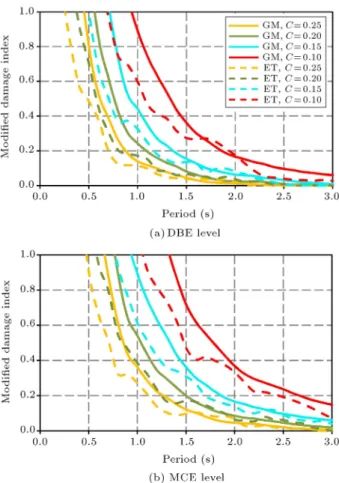
Figure 6. Comparison between ETA20inx and GM damage spectra: x = 5%, u= 10, and EPP behavior.
4. Comparison among damage spectra
For the evaluation of the potential of ET records in estimating the damage state of structures, it is useful to compare the average of ET and GM damage spectra with each other. This comparison is presented in Figure 6 for damage values between zero and one, which are meaningful quantities. As it depicts, \ETA20inx" acceleration functions generally underesti-mate the damage index at both DBE and MCE hazard levels. Furthermore, the discrepancy between ET and GM spectra increases in the periodic range of 0.7-1.5 s and diminishes for long-period structures. There are two possible ways to achieve more consistency: modifying the target time of ET records or generating new ET excitation functions.
It is also benecial to examine the eect of excitation level on damage spectra. The higher level of ET or GM excitations causes more damage values. The special case is the exact coincidence of the GM damage spectrum related to DBE level and C = 0:1 with the one related to MCE level and C = 0:15. This could be because both earthquake accelerograms and system yield strength are multiplied by the same number (1.5); hence, mathematically, the damage index and damage spectrum stay unchanged.
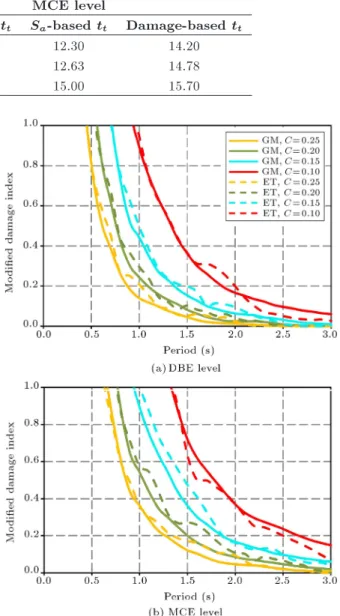
Table 1. The Sa-based and damage-based target times for dierent ET series and hazard levels.
Series DBE level MCE level
Sa-based tt Damage-based tt Sa-based tt Damage-based tt
ETA20e 8.20 9.92 12.30 14.20
ETA20in 8.42 10.32 12.63 14.78
ETA40g 10.00 11.00 15.00 15.70
5. Modifying the target time based on damage spectra
In the previous sections, ET damage spectra were depicted using the Sa-based target time, and their
discrepancy with average of GM damage spectra was investigated. One way to make ET damage spectra compatible with real GM spectra is perhaps to change the target time. In other words, damage spectrum can be used as intensity measure to modify the target time in ET method. In this regard, the ratio between the average of GM damage spectrum and that of ET in the range of 0-3 s will be calculated for each value of coecient C, and the results are averaged to acquire \spectral damage ratio" at a specic hazard level. Then, the average of the Sa-based target time
corresponding to that hazard level is multiplied by the spectral damage ratio to reach a new target time. Afterwards, the ET damage spectra based on the new target time can be induced, and the procedure will be repeated until the spectral damage ratio lies between 0.95 and 1.05. The last target time, called the damage-based target time, is presented in Table 1 for dierent ET series (ETA20e, ETA20inx, and ETA40g) and two hazard levels.
Although the average of ET and GM damage spectra can be almost equal-by modifying target time in ET method{the trend of these spectra might be still distinct. Therefore, ET damage spectra based on the damage-based target time have been compared with GM spectra in Figure 7. As can be seen, the discrepancy between the damage values related to ET and GM accelerograms is reduced to less than 0.1, which is acceptable value in practical applications. Therefore, damage spectrum can be an appropriate intensity measure to produce a new target time which is more helpful than Sa-based target time to estimate
the damage state of structures.
6. Structural application of damage-based target time
It is interesting to use the damage-based target time obtained in the previous section to estimate various damage indices of a real frame by the ET method. It is also important to compare these damage values with those acquired by GM records or ET series with the Sa
-based target time. In this study, a steel moment frame
Figure 7. Comparison between modied ETA20inx and GM damage spectra: x = 5%, u= 10, and EPP behavior.
is investigated, and its damage indices are evaluated applying the mentioned methods.
6.1. Design of steel moment frame
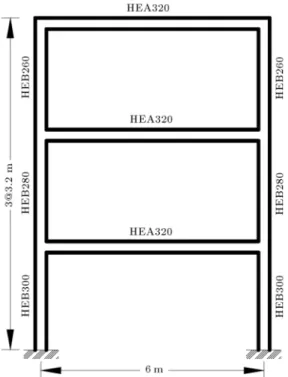
According to ANSI/AISC360-10 [26] and LRFD method, a two-dimensional steel moment frame with three stories and one bay has been designed in which the drift is the controlling item. The frame sections are selected from usual rolled W sections, and the used material is ST-37. Moreover, the fundamental period of the frame is 0.86 s. Other important properties of the frame are shown in Figure 8.
Dead and live loads are assigned similar to those in oce buildings. For an ordinary design, the seismic loading is specied based on Iranian Seismic Stan-dard [27], considering seismic zone factor, reection co-ecient, importance factor, and reduction coco-ecient,
Figure 8. The steel moment frame geometry.
which are equal to 0.35, 2.5, 1, and 5, respectively. All frame connections are rigid, and the panel zones are strengthened by an enough number of stieners. 6.2. Seismic analysis procedure
The \OPENSEES" software [28] will be very useful to carry out nonlinear dynamic analysis of the frame, which is the best method proposed in seismic design codes. Therefore, in this study, the OPENSEES model of the frame with nonlinear beam-column elements, uniaxial ber sections, and STEEL01 material has been prepared. The strain hardening coecient is assumed 0.01 to make the material behavior similar to EPP behavior. Each member is equally divided into four elements by dening ve recorded points{ where damage indices are calculated{for the member and seven integration points for every element. The recorded points as well as a typical ber section of structural members are displayed in Figure 9.
In addition, two vertical load combinations in the nonlinear dynamic analysis are examined according to ASCE/SEI7-10 [20], considering the geometrical nonlinear behavior or secondary moments. The story mass is distributed to the beam ends as lumped masses. Additionally, Rayleigh damping is supposed, including the damping ratio equal to 0.05 and the frequencies of the rst and second vibration modes of the frame. Moreover, the ductility capacity of structural elements is determined based on FEMA-356 report [24].
ET records and scaled real earthquakes are sepa-rately imposed on the frame; thereafter, the time his-tory of moment and plastic rotation at recorded points as well as inter-story drifts are computed. Eventually,
Figure 9. Recorded points and a ber section of a member.
through applying a post processor piece of software induced for this research, various damage indices at each recorded point are calculated.
6.3. Presentation of used damage indices The mentioned damage index, DIm, is calculated for
frame members, considering section rotation () and yield moment (My), instead of deformation (u) and
yield strength (Fy) in DIm formulation, respectively.
In addition to \Modied Park-Ang" damage criterion, some well-known damage indices are used to evaluate the damage state of the frame.
The rst damage index is the inter-story drift dened as the ratio of the story relative displacement to the story height. The drift ratio (DIdrift) used in this
study is the proportion of maximum inter-story drift to drift capacity (Cdrift), which agrees with the damage
index denition. This index is given in Eq. (4):
DIdrift=
max
H
=(Cdrift); (4)
where H is the story height and max is the maximum
relative displacement between the top and bottom of the story. Drift capacity is usually presumed 0.05 for steel frames [24].
The next damage criterion is \Krawinkler-Zohrei" index (DIKZ), the proportion of cumulated cyclic
deterioration (Pdi) to the ultimate deterioration
ca-pacity (dc). This index attributes deterioration (d)
in terms of strength, stiness, and energy dissipation to the plastic rotation (p). The related formulations
are presented in Eq. (5), where parameters a and A are constant depending on the properties of the structural member, assumed 1.226 and 0.930 for energy dissipation, where strength and stiness deterioration have been neglected. The parameter pc indicates
pushover analysis of the frame:
DIKZ =
P di
dc ;
d = A(p)a;
dc= A(pc)a: (5)
Two damage parameters applied directly in some dam-age criteria (such as DIm) are presented in Eq. (6),
where DIduc and DIeng indicate ductility-based and
energy-based damage indices, respectively. Further-more, the expression in the dominator of DIeng is the
ultimate energy dissipation capacity of the structure, with EPP behavior under uniformly increasing lateral deformation, where y and My are yield rotation and
yield moment of a section, respectively. All other quantities were dened previously:
DIduc= 1 u 1;
DIeng= Eh
yMy(u 1): (6)
The next popular damage index is \Park-Ang" index (DIPA), containing both ductility and energy
dissipa-tion of structural members. The DIPA formulation is
given in Eq. (7); all parameters have been explained in the prior sections. Moreover, the interpretation of DIPA
values was represented by Ladjinovic and Folic [6]:
DIPA= u +
Eh
Myyu: (7)
The last damage criteria used in this study are \Bozorgnia-Bertero" indices (DI1 and DI2). They
are almost similar to DIm index, but many nonlinear
analyses as well as regression analysis are needed to evaluate their modifying coecients (1 and 2) for
each earthquake excitation. These indices are shown
in Eq. (8):
DI1= (1 1)DIduc+ 1DIeng;
DI2= (1 2)DIduc+ 2
p
DIeng: (8)
6.4. Comparison and discussion
When the designing, modeling, and seismic analysis of the frame were performed, the explained damage indices at recorded points for a certain earthquake record will be calculated, similar to the procedure of damage computation for SDOF systems. The maximum value of each damage index, for example DIm, related to every structural member is considered
as the damage index of that member, which can be averaged for distinct excitations. The damage indices of the panel zones will be zero because of preparing enough number of stieners [29].
In this study, the average and maximum values of each damage index for structural members are evalu-ated to compare the damage results having to do with GM records and ET excitations. These comparative damage values at DBE hazard level are gathered in Table 2, relating to GM and ET records with Sa-based
and damage-based target times. Apparently, DIducand
DIengparameters have minimum and maximum values
among all damage criteria, respectively. In addition, some parameters{namely DIm, DIPA, DI1, DI2, and
DIdrift{refer to the same damage grade in most cases
of the study.
As was previously mentioned, in the ET method, damage indices of members can be simultaneously evaluated for various levels of excitations. Additionally, a few numbers of accelerograms will be imposed on the frame. Hence, the analysis time will be considerably reduced. It is noteworthy that the damage values of \ETA20e" and \ETA20inx" series will be close to each other, since they have been generated based on real earthquakes.
The values of damage index DImfor all structural
members are demonstrated in Figure 10,
correspond-Table 2. Average and maximum damage values of the frame members with respect to GM and ET records with Sa-based and damage-based target times at DBE level.
Damage index GM Sa-based ET Damage-based ET
Average Max. Average Max. Average Max.
DIduc 0.119 0.255 0.060 0.173 0.096 0.251
DIeng 0.683 1.000 0.158 0.372 0.328 0.902
DIm 0.185 0.453 0.070 0.176 0.125 0.292
DIPA 0.211 0.502 0.081 0.208 0.140 0.322
DI1 0.283 0.715 0.088 0.201 0.163 0.404
DI2 0.233 0.465 0.146 0.284 0.219 0.444
DIkz 0.414 1.000 0.084 0.223 0.178 0.535
Figure 10. Comparison between DImvalues of frame members under GM and ETA20inx records with damage-based target time at DBE level.
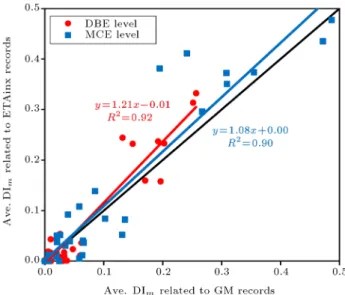
Figure 11. Comparison between DImvalues related to GM and ETA20inx records, with damage-based target time, at recorded points of the frame.
ing to GM records and \ETA20inx" series with the damage-based target time. As it reveals, the elements in the rst story have received most of the damage. Additionally, the damage estimation by the ET method can be acceptable. For more details, in Figure 11, dam-age values at recorded points of the frame, connected to GM records, have been compared with those of ET series at two levels of excitation, where the trend line is close to the bisector, and R-square coecient is near to one, which indicates the reliability of ET results.
The comparison among damage criteria relating to GM records and ET accelerograms with Sa-based
and damage-based target times will be important in order to survey both the accuracy and improvement of the ET method in which damage spectrum is applied as intensity measure to modify the target time. Therefore, the average damage of structural members for the mentioned three cases at two hazard levels is illustrated in Figure 12. As can be seen, the usage of damage-based target time considerably reforms the damage estimation by ET method.
Figure 12. Comparison between the average of damage indices corresponding to GM and ETA20inx records, with the Sa-based and damage-based target times.
7. Conclusions
To sum up, by taking into account what was examined in this study, the following conclusions will be drawn:
The estimation of damage spectra by Endurance Time (ET) method using Sa-based target time{
corresponding to linear target spectra{is prone to a considerable inaccuracy, and in general, the system damage index is underestimated using this proce-dure;
By modifying the target time of ET series on the basis of the damage spectra, using the ratio between the average of damage spectrum of scaled Ground Motions (GM) and that of ET records, ET damage spectra become much more consistent with GM damage spectra. Thus, damage spectrum can be applied as an intensity measure in ET method to modify the target time;
The damage estimation of steel moment frames by the ET method can be highly improved by modifying the target time based on damage spectra. In general, it seems that the damage level of conven-tional structures might be estimated in an adequate faction through employing the method proposed in this research. Given the results, it is proposed to
generate ET excitation functions based on damage spectra, which can further improve the accuracy and reliability of damage estimation;
The damage of steel moment frame at DBE and MCE hazard levels, examined in this study, will be roughly approximated by two ET acceleration func-tions, that is, \ETA20e" and \ETA20inx" records, with the damage-based target time.
Nomenclature
a Krawinkler and Zohrei material-dependent constant
ag ET acceleration function
A Krawinkler and Zohrei constant depending on section properties C Earthquake coecient
Cdrift Drift capacity of the frame
DBE Design basis earthquake
DI1and DI2 Bozorgnia-Bertero damage indices
DIdrift Drift ratio
DIduc Ductility-based damage index
DIeng Energy-based damage index
DIKZ Krawinkler-Zohrei damage index
DIm Modied Park-Ang damage index
DIPA Park-Ang damage index
EPP Elastic-perfectly-plastic behavior ET Endurance time method
Eh Hysteretic energy dissipation
demanded by earthquake excitation F (ag) The error of correlation between ET
response spectrum and the target spectrum
Fy Yield strength of a structure
GM Ground motions H Height of story
LRFD Load and Resistance Factor Design m Mass of a structure
MCE Maximum Considered Earthquake My Yield moment of a section
RC Reinforced Concrete
Sa Spectral acceleration response
Sa(T; t) The ET acceleration response at time
t for structure with period T SaT(T ) Template acceleration response for
structure with period T
SDOF Single-Degree-Of-Freedom System t Time duration of ET record tb Basic target time
tt Target time
T The natural period of a structure uc;max Maximum cyclic deformation
up;i Plastic deformation at ith cyclic
uy Yield displacement of a structure
1 and 2 Bozorgnia-Bertero coecients
Park-Ang coecient
di Element deterioration at ith cyclic
dc Ultimate deterioration capacity
max Maximum story drift
p Plastic rotation of a section
pc Maximum plastic rotation of a section
during the pushover analysis of a frame y Yield rotation of a section
Ductility demanded by earthquake excitation
ac Accumulated cyclic ductility of an
element c Cyclic ductility
u Ductility capacity of an element
x Damping ratio
References
1. Krawinkler, H. and Zohrei, M. \Cumulative damage in steel structures subjected to earthquake ground motions", Computers and Structures, 16, pp. 531-541 (1983).
2. Powell, G.H. and Allahabadi, R. \Seismic damage prediction by deterministic methods: concepts and procedures", Earthquake Engineering and Structural Dynamics, 16, pp. 719-734 (1988).
3. Cosenza, E., Manfredi, G. and Ramasco, R. \The use of damage functionals in earthquake engineering: A comparison between dierent methods", Earthquake Engineering and Structural Dynamics, 22, pp. 855-868 (1993).
4. Park, Y.J., Ang, AH.S. and Wen, Y.K. \Damage-limiting a seismic design of buildings", Earthquake Spectra, 3(1), pp. 1-25 (1987).
5. Bozorgnia, Y. and Bertero, V.V. \Damage spectra: Characteristics and applications to seismic risk reduc-tion", Journal of Structural Engineering, 129(10), pp. 1330-1340 (2003).
6. Ladjinovic, D. and Folic, R. \Application of improved damage index for designing of earthquake resistant structures", Thirteenth World Conference on Earth-quake Engineering, Vancouver, B.C., Canada, Paper No. 2135 (2004).
7. Estekanchi, H.E. and Arjomandi, K. \Comparison of damage indices in nonlinear time history analysis of steel moment frames", Asian Journal of Civil Engi-neering, 8(6), pp. 629-646 (2007).
8. Arjomandi, K., Estekanchi, H.E. and Vafai, A. \Corre-lation between structural performance levels and dam-age indexes in steel frames subjected to earthquakes", Scientia Iranica, 16(2), pp. 147-155 (2009).
9. Datta, D. and Ghosh, S. \Uniform hazard spectra based on Park-Ang damage index", Journal of Earth-quake and Tsunami, 2(3), pp. 241-258 (2008).
10. Bozorgnia, Y. and Bertero, V.V. \Damage spectrum and its applications to performance-based earthquake engineering", Thirteenth World Conference on Earth-quake Engineering, Vancouver, B.C., Canada, Paper No. 1497 (2004).
11. Zhai, C.H., Wen, W.P., Chen, Z.Q., Li, S. and Xie, L.L. \Damage spectra for the mainshock-aftershock sequence-type ground motions", Soil Dynamics and Earthquake Engineering, 45, pp. 1-12 (2013).
12. Estekanchi, H.E., Arjomandi, K. and Vafai, A. \Esti-mating structural damage of steel moment frames by endurance time method", Journal of Constructional Steel Research, 64, pp. 145-155 (2008).
13. Estekanchi, H.E., Vafai, A. and Sadeghazar, M. \En-durance time method for seismic analysis and design of structures", Scientia Iranica, 11(4), pp. 361-370 (2004).
14. Estekanchi, H.E., Valamanesh, V. and Vafai, A. \Ap-plication of endurance time method in linear seismic analysis", Engineering Structures, 29, pp. 2551-2562 (2007).
15. Nozari, A. and Estekanchi, H.E. \Optimization of endurance time acceleration functions for seismic as-sessment of structures", International Journal of opti-mization in Civil Engineering, 2, pp. 257-277 (2011).
16. Valamanesh, V. and Estekanchi, H.E. \Nonlinear seis-mic assessment of steel moment frames under bidi-rectional loading via endurance time method", The Structural Design of Tall and Special Buildings (2012). DOI:10.1002/tal.1054
17. Hariri-Ardebili, A.M., Zarringhalam, Y., Estekanchi, H.E. and Yahtai, M. \Nonlinear seismic assessment of steel moment frames using time-history, incremental dynamic, and endurance time analysis methods", Sci-entia Iranica, 20(3), pp. 431-444 (2012).
18. Mirzai, A., Estekanchi, H.E. and Vafai, A. \Ap-plication of endurance time method in performance based design of steel moment frames", Scientia Iranica, 17(6), pp. 482-492 (2010).
19. Mashayekhi, M. and Estekanchi, H.E. \signicant of eective number of cycles in endurance time analysis", Asian Journal of Civil Engineering, 13(5), pp. 647-657 (2012).
20. ASCE/SEI7-10, Minimum Design Loads for Buildings and Other Structures, American Society of Civil En-gineers and Structural Engineering Institute, Reston, Virginia (2010).
21. Estekanchi, H.E. \Website of the endurance time method", http://sharif.edu/ stkanchi/ET (2011).
22. FEMA-440, Improvement of Nonlinear Static Seismic Analysis Procedures, Federal Emergency Management Agency, Washington, DC (2005).
23. Ladjinovic, D., Radujkovic, A. and Raseta, A. \Seismic performance assessment based on damage of structures - Part 1: Theory", Architecture and Civil Engineering, 9(1), pp. 77-88 (2011).
24. FEMA-356, Prestandard and Commentary for the Seismic Rehabilitation of Buildings, Federal Emer-gency Management AEmer-gency, Washington, DC (2000).
25. FEMA-695, Quantication of Building Seismic Per-formance Factors, Federal Emergency Management Agency, Washington, DC (2009).
26. ANSI/AISC360-10, Specication for Structural Steel Buildings, American Institute of Steel Construction, Chicago, Illinois (2010).
27. Standard No. 2800-05, Iranian Code of Practice for Seismic Resistant Design of Buildings, Building and Housing research Center, Iran (2005).
28. OPENSEES \Open system for earthquake engineering simulation", Pacic Earthquake Engineering Research Center, Version 2.4.0 (2007).
29. Maleki-Amin, M.J. \Application of damage spectra in the estimation of steel moment frames damage by ET method", Thesis presented to the Faculty of the Department of Civil Engineering, Sharif University of Technology, partial Fulllment of the Requirements for the Master of Science Degree, Tehran, Iran (2014).
Biographies
Mohammad Jalal Maleki-Amin was born in 1989. He was qualied in Shahid Danesh High School in Tehran, Iran, as the best student in the eld of mathematics and physics in 2008. Subsequently, he entered Sharif University of Technology and began studying Civil Engineering. He achieved a BS degree in Civil Engineering and an MS degree in Structure Engineering in the years of 2012 and 2014, respectively. He successfully defended his MS degree thesis entitled \Application of Damage Spectra in the Estimation of Steel Moment Frames Damage by ET Method" in August 2014. He was ranked 2nd in the PhD Professional Examination, and is presently a PhD candidate in Structure Engineering in the faculty of Civil Engineering at Tehran University.
He has focused on some research areas comprising: performance-based design of steel and concrete struc-tures, nonlinear dynamic analysis of buildings, seismic assessment and rehabilitation of existing structures, and damage estimation of steel frames.
Homayoon Estekanchi is a Professor of Civil En-gineering at Sharif University of Technology (SUT), Tehran, Iran. He attained his PhD degree in Structure Engineering at SUT in 1997, where he is now a faculty
member. He is also a member of the Iranian Construc-tion Engineers OrganizaConstruc-tion, ASCE, Iranian Inventors Association and some other professional organizations. His research interests include, in general, various top-ics in structural and earthquake engineering and, in special, the design of tall buildings and industrial structures. He currently teaches the design of Steel
Structures, Tall Buildings, and Industrial Structures at SUT. In recent years, he has mainly focused on the development of an advanced seismic analysis procedure called the `Endurance Time Method', which he pro-pounded in 2000. In this regard, He has published many research articles with the cooperation of his colleagues and students.