Sharif University of Technology
Scientia IranicaTransactions A: Civil Engineering www.scientiairanica.com
An integrated decision support system for dam site
selection
Y. Minatour
a, J. Khazaie
a;, M. Ataei
band A.A. Javadi
c a. Department of Civil Engineering, Razi University of Kermanshah, Kermanshah, Iran. b. Department of Mining Engineering, Shahrood University of Technology, Shahrood, Iran. c. Department of Engineering, University of Exeter, Exeter, UK.Received 5 February 2013; received in revised form 20 September 2013; accepted 28 July 2014 KEYWORDS
Dam site selection; Fuzzy AHP; Multi-Criteria Decision-Making (MCDM); VIKOR; Water resources management.
Abstract. Selection of suitable site for dam is one of the problems associated with water resources management, and it is dependent on a set of qualitative and quantitative criteria. Such problems can be resolved using Multi-Criteria Decision-Making (MCDM) approaches. This study aims to develop a MCDM method integrated with fuzzy logic and group decision-making, specically focused on dam site selection. A fuzzy AHP method was extended to group decision making, and then the resulting group fuzzy AHP was combined with the VIKOR method. In the integrated method, fuzzy concepts were used to account for decision-makers' subjective judgments when considering the uncertainties of the site selection process. Group fuzzy AHP was used to determine the weights of dierent criteria and VIKOR was used to rank alternatives. The integrated method was applied to selection of the optimal site for an earth dam in Harsin city, Iran. The results show that the proposed method is an eective and reliable method in selecting the optimal dam site. © 2015 Sharif University of Technology. All rights reserved.
1. Introduction
Selection of the best site for a dam is among the decisions that are of particular importance in water supply management, as an optimal selection can im-prove the security of the water supply of a region and groundwater regeneration. However, dam construction is very expensive and has long-term environmental impacts. Therefore, the selection of optimal location for dam could lead to signicant cost saving. In order to locate the optimal dam site, various studies are necessary. Decision-making and planning on issues of such signicance cannot be conducted only through the traditional viewpoint of cost-benet analysis. Decisions on these issues are related to dierent criteria, and the
*. Corresponding author.
E-mail addresses: [email protected] (Y. Minatour); [email protected] (J. Khazaie); [email protected] (M. Ataei); [email protected] (A.A. Javadi)
criteria related to water resource management them-selves have many dierent characteristics accompanied by uncertainties. This makes decision-making and planning a very complex task. The most important characteristics of water resource management are as follows:
1. The attributes are in conict with each other in some cases;
2. Some attributes are not measurable;
3. Various organizations and individuals are interested in water resources;
4. Each attribute contains a lot of information and a lot of research is needed;
5. Evaluation of some qualitative attributes is complex and they can be judged only by verbal variables; 6. Qualitative attributes are associated with
uncer-tainty, so the opinions of dierent people must be used to assess them.
Multi-Criteria Decision Making (MCDM) meth-ods are very suitable in addressing these problems. In MCDM, among all possible alternatives, the best one is selected based on evaluation criteria. MCDM meth-ods have been usually introduced based on classical mathematics. Often MCDM problems are dependent on dierent and in some cases, conicting criteria. It is also possible that complying with the nature of decision making problems, the expert opinions could be dierent, or there could exist no exact information about them. In such conditions, utilizing traditional MCDM methods does not render the capacity to handle uncertainties and may in some cases lead to wrong decision making results. To address this problem, researchers have expanded the MCDM methods based on fuzzy sets (fuzzy MCDM methods).
Analytic Hierarchy Process (AHP) which was rst introduced by Saaty [1], is one of the most powerful and simplest MCDM methods. Many researchers have extended the AHP based on fuzzy sets (fuzzy AHP methods). Fuzzy AHP methods are systematic approaches to the determination of the criteria weights and justication problem by using the concepts of fuzzy set theory and hierarchical structure analysis. The most important and earliest fuzzy AHP methods include the following: Van Laarhoven and Pedrcyz [2] presented the rst study on the application of fuzzy logic principle to AHP; Buckley [3] initiated trapezoidal fuzzy numbers to express the decision maker's evalua-tion on alternatives with respect to each criterion while Van Laarhoven and Pedrcyz [2] used triangular fuzzy numbers; Chang [4] introduced a new approach for han-dling fuzzy AHP with the use of triangular fuzzy num-bers for pair-wise comparison scale of fuzzy AHP, and the use of the extent analysis method for the synthetic extent values of the pair-wise comparisons; Cheng [5] proposed a new algorithm for evaluating naval tactical missile systems by the fuzzy AHP based on grade value of membership function; Deng [6] presented a fuzzy approach for tackling qualitative multi-criteria analysis problems in a simple and straightforward manner.
The VIKOR which is an abbreviation of the Serbian expression of \VlseKriterijumslca Optimizacija I Kompromisno Resenje", meaning \multi-criteria op-timization and compromise solution" [7], was rst introduced by Opricovic [8] as an MCDM method. The VIKOR is used to solve discrete multi criteria problems with non-commensurable and conicting criteria. It focuses on ranking and selecting from a set of alter-natives, and determines compromise solutions for a problem with conicting criteria. It is one of the most widely used MCDM methods in rating problems.
To date, MCDM and fuzzy MCDM methods have been used in the various elds of water engineering by many researches. These include urban water supply of Zahedan city, Iran [9], watershed management [10],
San Francisco river basin management [11], urban water supply of Zahedan, Iran [12], prioritization of water management for sustainability [13], urban water supply, Melbourne city, Australia [14], ranking the reservoirs systems [15], environmental assessment of water programmers [16], water resources planning [17], assessment model of water supply system [18], applica-tion of recycled water for household laundry in Sydney, Australia [19], mapping urban water demands [20], evaluating water transfer projects [21], and ood risk assessment [22].
The main objectives of the present study are rstly to determine eective criteria in dam site se-lection, secondly to present a fuzzy MCDM method to determine the criteria weights based on opinions of a decision making group and rating proposed sites, and thirdly to select the optimal site for the Harsin dam as a case study.
A fuzzy AHP approach was extended to group decision-making. The resulting group fuzzy AHP was then combined with VIKOR. Group fuzzy AHP was used to determine the weights of criteria, and VIKOR was used to rank alternatives. The integrated method was applied to the selection of the optimal site for an earth dam in Harsin city, Iran.
2. Method
The method used in this study is based on the integra-tion of fuzzy AHP and VIKOR methods. The weights that are obtained from group fuzzy AHP calculations are considered and used in VIKOR calculations. Deci-sion making in this integrated method involves several essential steps.
2.1. Forming a team of decision makers
This team involves dam construction experts and deci-sion makers.
2.2. Determining eective criteria and potential alternatives
In this step, eective criteria in locating the dam site are determined by using comprehensive review of liter-ature and expert opinions. The potential alternatives are then proposed based on determined criteria. 2.3. Developing the hierarchical structure The hierarchy diagram is a graphic representation of a complex problem in which objectives, criteria, and alternatives are at the highest, intermediate and lowest levels, respectively.
2.4. Dening the fuzzy scale
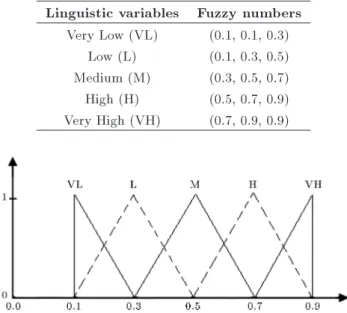
In order to express the importance of criteria and formation of the pair-wise comparison matrix, a fuzzy scale is dened by decision makers. Table 1 shows a fuzzy scale that was used in this study. The graphical form of this scale is shown in Figure 1.
Table 1. Fuzzy scale used in this study. Linguistic variables Fuzzy numbers
Very Low (VL) (0.1, 0.1, 0.3) Low (L) (0.1, 0.3, 0.5) Medium (M) (0.3, 0.5, 0.7) High (H) (0.5, 0.7, 0.9) Very High (VH) (0.7, 0.9, 0.9)
Figure 1. Graphical form of fuzzy scale used in this study.
2.5. Pooling the decision maker's opinions The expert's opinions, expressing the importance of the criteria are pooled using a questionnaire.
2.6. Obtaining the aggregated fuzzy weight of criteria
The decision maker's opinions about the importance of the dierent criteria are aggregated. The aggregated fuzzy weight of criterion j( ~Wj) is obtained as:
~
Wj= (aj; bj; cj); (1)
where:
aj=Mink fajkg; bj =
Pk k=1bjk
K ;
cj =Maxk fcjkg; k = 1; 2; :::; K; (2) with K being the number of decision groups.
2.7. Forming the fuzzy pair-wise comparison matrix of criteria
Each criterion in the hierarchical structure is compared with other criteria in a fuzzy pair-wise comparison matrix. The fuzzy pair-wise comparison matrix is dened as: ~ A = 2 6 6 6 4
(1; 1; 1) ~x12 : : : ~x1n ~x21 (1; 1; 1) : : : ~x2n
... ... ... ...
~xn1 ~xn2 : : : (1; 1; 1) 3 7 7 7
5; (3)
~xij = (1; 1; 1); (i; j = 1; 2; 3; :::; n; i = j); (4)
~xij= ~ Wi
~
Wj; (i; j = 1; 2; 3; :::; n; i 6= j); (5) where ~A is a fuzzy pair-wise comparison matrix, ~xij is a triangular fuzzy number that expresses the relative importance of criterion i with respect to criterion j.
~
Wi and ~Wj are the aggregated fuzzy weights of criteria i and j, respectively.
2.8. Applying Chang's extent analysis
Chang's extent analysis is used to determine the rel-ative weights of the criteria. The method of Chang's extent analysis [4] is briey described below.
Let X = fx1; x2; x3; :::; xng be an object set, and G = fg1; g1; g3; :::; gmg be a goal set. Each object is taken and extent analysis is performed for each goal. Therefore, m extent analysis values for each object can be obtained as:
M1
gi; Mgi2; :::; Mgim; i = 1; 2; 3; :::; n; (6) where Mgij(j = 1; 2; 3; :::; m) all are triangular fuzzy numbers. The steps of Chang's extent analysis are as follows.
The values of fuzzy synthetic extent with respect to the ith object (Si) are dened as:
Si= m X j=1
Mgij O 2 4Xn
i=1 m X j=1
Mgij 3 5
1
: (7)
To obtain Pmj=1Mgij, the fuzzy addition operation of m extent analysis values is performed for a particular matrix such that:
m X j=1
Mgij = 0 @Xm
j=1 lj;
m X j=1
mj; m X j=1
uj 1
A : (8)
To obtain hPni=1Pmj=1Mgiji 1, the fuzzy addition operation of Mgij(j = 1; 2; 3; :::; m) values is performed such that: n X i=1 m X j=1
Mgij = n X i=1
li; n X i=1
mi; n X i=1 ui ! : (9)
The inverse of the vector in Eq. (9) is then computed according to:
2 4Xn
i=1 m X j=1
Mgij 3 5 1 = 1 Pn i=1ui;
1 Pn
i=1mi; 1 Pn
i=1li
: (10) As M1 = (l1; m1; u1) and M2 = (l2; m2; u2) are two triangular fuzzy numbers, the degree of possibility of M2= (l2; m2; u2) M1= (l1; m1; u1) is dened as:
Figure 2. The intersection between M1 and M2 [4].
V (M2 M1) = sup
yxbmin(M1(x); M2(y))c: (11) And it can be expressed as:
V (M2 M1) = hgt(M1 \
M2) = M2(d)
= 8 > > < > > :
1 if m2 m1
0 if l1 u2
l1 u2
(m2 u2) (m1 l1) otherwise
(12) Figure 2 is a graphical representation of Eq. (12) where d is the ordinate of the highest intersection point D between M1 and M2. To compare M1 and M2 we
need both values of V (M1 M2) & V (M1 M2). If the degree of possibility for a convex fuzzy number is greater than k, then convex fuzzy Mi(i = 1; 2 k) numbers can be dened as follows:
V (M M1; M2; :::; Mk) = V [(M M1) and (M M2) and ::: and (M Mk)]
= minV (M Mi); i = 1; 2; 3; :::; k: (13) Assuming that:
d0(A
i) = minV (Si Sk) for k = 1; 2; :::; n; k 6= i; (14) the weight vector is given by:
W0= (d0(A
1); d0(A2); :::; d0(An))T; (15) where Ai(i = 1; 2:::n) are n elements. The normalized weight vectors are obtained as:
W = (d(A1); d(A2); :::; d(An))T; (16) where W is a non-fuzzy number.
2.9. Applying the VIKOR method to rank alternatives
Assume an MCDM problem has m alternatives (A1; A2; :::; Am) and n decision criteria (C1; C2; :::; Cn). The following steps are involved in the VIKOR method [23,24].
The decision matrix can be obtained as:
X = (xij)mn; (17)
where xij is the performance of alternative Ai with respect to criterion j. The normalized decision matrix can be obtained as:
F = (fij)mn; (18)
fij =qPxmij i=1x2ij
; i=1; 2; 3; :::; m; j =1; 2; 3; :::; n: (19) The best values (f+
j ) and the worst values (fj ) of all criterion functions for j = 1; 2; :::; n are determined as:
f
j = maxifij; fj = minifij; if j 2 B; (20) f
j = minifij; fj = maxifij; if j 2 C; (21) in which f
j and fj represent the positive ideal solution and the negative ideal solution for the criterion j, respectively; B is the set of benet criteria (+) and C is the set of cost criteria (-).
The values of Si and Ri for i = 1; 2; 3; :::; m are computed as:
Si= n X j=1
wj(fj fij) (f
j fj )
; (22)
Ri= maxj 2 4Xn
j=1
wj(fj fij) (f
j fj ) 3
5 ; (23)
where wj (Pnj=1wj = 1; wj 2 [0; 1], j = 1; 2; :::; n) are the relative importance weights of the criterion j.
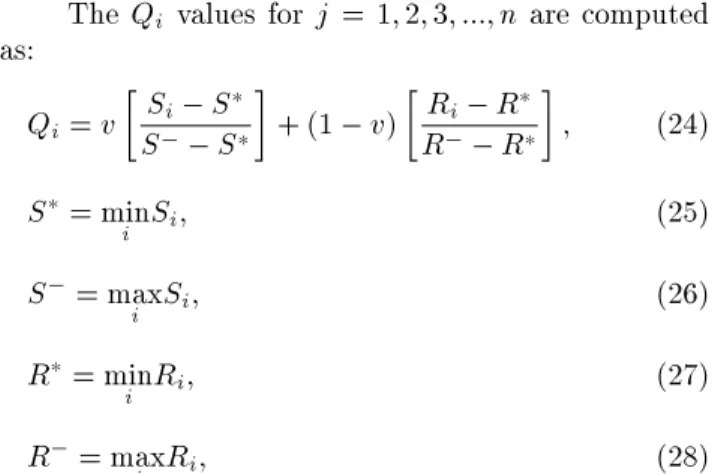
The Qi values for j = 1; 2; 3; :::; n are computed as:
Qi= v
Si S
S S
+ (1 v)
Ri R
R R
; (24)
S= min
i Si; (25)
S = max
i Si; (26)
R= min
i Ri; (27)
R = max
i Ri; (28)
with v introduced as a weight for the strategy of maximum group utility, whereas 1 v is the weight of the individual regret.
Ranking the alternatives (sorting by the values Si, Riand Qiin decreasing order), the results will be three ranking lists. Proposed as a compromise solution, the alternative A1 which is the best rank by the measure
Qi (minimum) will be reached if the following two conditions (Condition 1 and Condition 2) are satised: Condition 1. Acceptable advantage:
QA2 QA1
1
n 1; (29)
where A2 is the alternative with second position in the ranking list by Qi, and n is the number of alternatives.
Condition 2. Acceptable stability in decision mak-ing:
The alternative A1 must also be the best rank by Si or/and Ri. This compromise solution is stable within a decision making process, which could be the strategy of maximum group utility (when v > 0:5 is needed), or \by consensus" v 0:5, or \with veto" (v < 0:5).
If one of the conditions is not satised, then a set of compromise solutions is proposed, which consists of: Alternatives A1; A2; :::; AM if Condition 1 is not
satised; AM is determined by the relation QAM
QA1 (1=(n 1)) for maximum M (the positions
of these alternatives are \in closeness"), or:
Alternatives A1 and A2 if only Condition 2 is not satised.
3. Case study
The case study focuses on selection of a suitable site for an earth dam in Harsin City. The aims of this dam are developments in agriculture and industry, drinking water supply, power generation, sheries, etc. in Harsin City, Iran. The city is located 16 km east of Kermanshah (the capital of Kermanshah Province, Iran). Its longitude and latitude are 34160 and 45350 respectively.
In the rst step, to determine eective factors in selecting an appropriate earth dam site for the Harsin dam, a comprehensive literature review was conducted and the most important criteria were selected. A brief explanation of the selected criteria is presented below.
Health of dam site (C1): In this criterion, geotech-nical and geological parameters were considered. Overall cost (C2): The overall cost includes the costs of construction of dam body and reservoir, wa-ter diversion during construction, wawa-ter transfer to consumption location, energy supply, site preparation, land use, and other costs associated with the dam project.
Annual yield (C3): It is the annual volume of the water that passes through the cross section of the river at the dam site. Annual yield plays an important role in locating the dam site.
Topographic conditions (C4): The existence of a secondary valley or rock abutments with suitable topography around the main river is important for constructing dam spillway. In general, the best site for an earth dam is where a wide valley with high walls leads to a narrow canyon with tenacious walls.
Access to materials and facilities (C5): Access to materials (borrow sources, cement, etc.) and facilities (power transmission lines, oil and gas distribution pipelines, road, etc.) is also important in deciding the best location for a dam.
Economic development (C6): The eects of dam construction on agricultural and industrial develop-ment, power generation, shery, job creation, etc. (which are related to economic development) are re-garded as important attributes for selecting the dam site.
Water quality (C7): Quality of water stored in reservoirs used for drinking and agricultural purposes is important.
Damage of dam body and reservoir (C8): Envi-ronmental damages (wildlife, vegetation, cutting trees, etc.), and socio-economic damages (destroying mines, historical monuments, agricultural lands, displacement of peoples, displacement of roads, railway and power lines, changing the route of oil and gas pipelines, telecommunication facilities, etc.) caused by the con-struction of the dam body should be considered. Volume of reservoir (C9): When the reservoir that is created after dam construction has a large volume, the surface area of the reservoir water is increased and it has more impact on the local climate. Furthermore, evaporation and potential for water pollution will increase with increasing the surface area. Therefore, the dam should be constructed where the reservoir capacity is optimal.
River ow regime (C10): Seasonal rivers have more sediment transport and hence lower water quality. In addition, the management of water resources is more dicult due to the lack of accurate informa-tion on the discharge of water entering the reservoir. Therefore, a permanent ow regime would be more favorable.
Figure 3. Alternatives for the Harsin earth dam site.
Water diversion and transfer (C11): The dam site should be located where the costs of water diversion during construction and water transfer to consumption location are minimum.
Annual volume of sediment (C12): If the annual volume of sediment entering the reservoir is kept to minimum, the volume of the reservoir during its useful life, water quality and the eciency of dam would be higher.
Probability of dam break (C13): The dam should be constructed in a place that minimizes the socio-economic risks posed by a possible dam break.
Probable maximum ood (C14): The maximum volume of water caused by thawing snow and ice or other atmospheric precipitation occurring within a specied return period in rivers is called probable maximum ood.
Average annual evaporation (C15): Due to the annual average temperature dierences in dierent regions in Iran, evaporation from the dam reservoirs varies regionally. This variability has eects on the retention time of water in the reservoir (in terms of volume) and consequently on the eciency of the dam. Environmental impacts (C16): Changing weather conditions, vegetation, and wild life are other at-tributes that play signicant roles in locating the dam site.
Social impacts (C17): The social impacts of relo-cation of population centers and the integration of dierent ethnic cultures due to the appropriation of
residential lands for dam construction, reservoir dewa-tering and also utilizing the dam water in downstream should be considered.
Political impacts (C18): The dam construction goals for reducing political tensions including water supply of a city, preventing grievances and immigration of residents of a border city, etc. are among the attributes that should also be considered.
After collecting and evaluating the required in-formation based on the selected criteria (mentioned above), four feasible alternatives were proposed for the Harsin earth dam site. The locations of the proposed alternatives are shown in Figure 3 and identied by `A', `B', `C' and `D' letters.
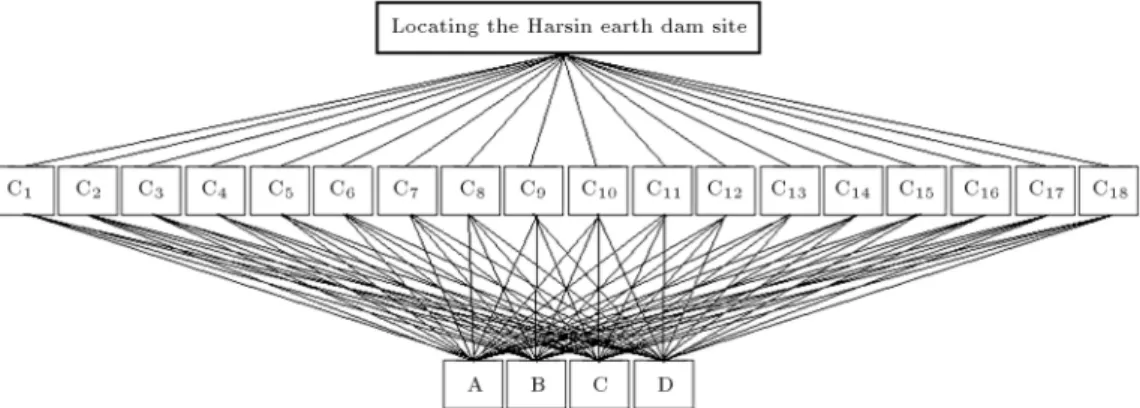
After selecting the criteria for locating the earth dam site and considering alternatives (see Figure 3), the integrated fuzzy AHP and VIKOR method was applied to select the best site. Figure 4 shows the problem of Harsin earth dam site selection using a hierarchical structure. The structure has three levels: objective (locating the Harsin earth dam site), criteria (C1 to C18) and alternatives (A, B, C, and D).
To assess the relevance of the criteria incorporated in the fuzzy AHP group method, a questionnaire was developed, and 4 experts (E1, E2, E3and E4) involved in Harsin earth dam project were asked to express the importance of each criterion using linguistic variables which were inserted in the questionnaire. Table 2 summarizes the expert opinions about the importance of the dierent criteria.
The aggregated fuzzy weights of the criteria were obtained by integrating expert opinions using Eqs. (1) and (2). Then, a fuzzy pair-wise comparison matrix for determining the weights of criteria was formed according to Table 3 (see Eqs. (3) to (5)).
Figure 4. Problem of the Harsin earth dam site selection using a Hierarchical structure. Table 2. Expert opinions about the importance of the
dierent criteria.
Criteria Expert
E1 E2 E3 E4
C1 VH VH VH VH
C2 M L H H
C3 VH H VH H
C4 H VH H M
C5 VH VH VH VH
C6 VH VH VH H
C7 H H VH VH
C8 H H M H
C9 L H H M
C10 H M L L
C11 VH H VH VH
C12 M M H H
C13 M H M L
C14 H H L M
C15 M H L H
C16 M M H L
C17 M M L L
C18 L L L L
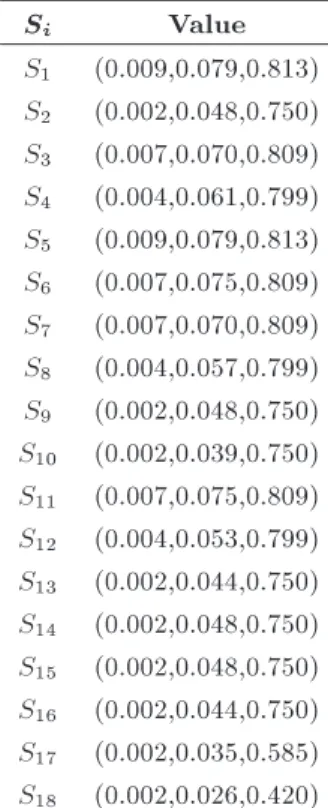
The weights of the criteria were calculated using the fuzzy HAP process where the values of fuzzy synthetic extent with respect to the ith object (i = 1; 2; :::; 18) were obtained using Eq. (7); the results are given in Table 4. Table 5 lists the degrees of possibility Si Sk (i; k = 1; :::; 18; i 6= k) calculated using Eq. (12), while Table 6 enumerates the mini-mum degrees of possibility Sj Si obtained using Eq. (14).
These values (Table 6) yield the following weight vector according to Eq. (15):
W0 = (1:000; 0:960; 0:989; 0:978; 1:000; 0:995; 0:989; 0:973; 0:960; 0:949; 0:995; 0:968; 0:955;
0:960; 0:960; 0:955; 0:929; 0:887)T:
After normalization, the normalized weights of the criteria were calculated using Eq. (16) as:
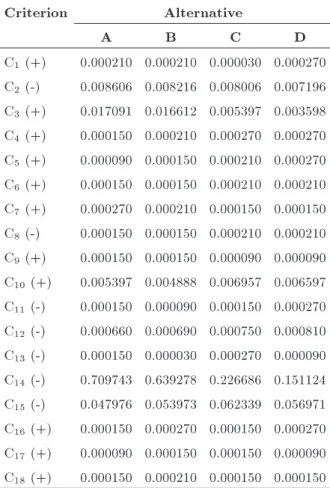
W = (0:0575; 0:0552; 0:0568; 0:0562; 0:0575; 0:0572; 0:0568; 0:0559; 0:0552; 0:0546; 0:0572; 0:0556; 0:0549; 0:0552; 0:0552; 0:0549; 0:0534; 0:0509)T: The VIKOR method was then applied to rank the alternatives. The normalized decision matrix was obtained using Eqs. (18) and (19), and the resulting matrix is given in Table 7. Table 8 presents the values of f
j and fj with respect to each criterion using Eqs. (20) and (21).
Using Eqs. (22) and (23), the values Si and Rifor alternative i were obtained as:
SA= 0:5424; RA= 0:0575; SB = 0:3452; RB= 0:0572; SC= 0:6012; RC= 0:0575; SD= 0:4996; RD= 0:0572:
The values of S, S , R and R were obtained according to Eqs. (25)-(28) as:
S= 0:3452; S = 0:6012; R= 0:0572; R = 0:0575:
Then, using Eq. (24) the VIKOR values (Qi) for each alternative were obtained as:
Table 3. Fuzzy pair-wise comparison matrix of criteria.
C1 C2 C3 C4 C5 C6 C7 C8 C9
C1 (1.00,1.00,1.00) (0.78,1.64,9.00) (0.78,1.13,1.80) (0.78,1.29,3.00) (0.78,1.00,1.29) (0.78,1.06,1.80) (0.78,1.13,1.80) (0.78,1.38,3.00) (0.78,1.64,9.22) C2 (0.11,0.61,1.29) (1.00,1.00,1.00) (0.11,0.69,1.80) (0.11,0.79,3.00) (0.11,0.61,1.29) (0.11,0.65,1.80) (0.11,0.69,1.80) (0.11,0.85,3.00) (0.11,1.00,9.00) C3 (0.56,0.89,1.29) (0.56,1.45,9.00) (1.00,1.00,1.00) (0.56,1.14,3.00) (0.56,0.89,1.29) (0.56,0.94,1.80) (0.56,1.00,1.80) (0.56,1.23,3.00) (0.56,1.45,9.00) C4 (0.33,0.78,1.29) (0.33,1.27,9.00) (0.33,0.88,1.80) (1.00,1.00,1.00) (0.33,0.78,1.29) (0.33,0.82,1.80) (0.33,0.88,1.80) (0.33,1.08,3.00) (0.33,1.27,9.00) C5 (0.78,1.00,1.29) (0.78,1.64,9.00) (0.78,1.13,1.80) (0.78,1.29,3.00) (1.00,1.00,1.00) (0.78,1.06,1.80) (0.78,1.13,1.80) (0.78,1.38,3.00) (0.78,1.64,9.00) C6 (0.56,0.94,1.29) (0.56,1.55,9.00) (0.56,1.06,1.80) (0.56,1.21,3.00) (0.56,0.94,1.29) (1.00,1.00,1.00) (0.56,1.06,1.80) (0.56,1.31,3.00) (0.56,1.55,9.00) C7 (0.56,0.89,1.29) (0.56,1.45,9.00) (0.56,1.00,1.80) (0.56,1.14,3.00) (0.56,0.89,1.29) (0.56,0.94,1.80) (1.00,1.00,1.00) (0.56,1.23,3.00) (0.56,1.45,9.00) C8 (0.33,0.72,1.29) (0.33,1.18,9.00) (0.33,0.81,1.80) (0.33,0.93,3.00) (0.33,0.72,1.29) (0.33,0.76,1.80) (0.33,0.81,1.80) (1.00,1.00,1.00) (0.33,1.18,9.00) C9 (0.11,0.61,1.29) (0.11,1.00,9.00) (0.11,0.69,1.80) (0.11,0.79,3.00) (0.11,0.61,1.29) (0.11,0.65,1.80) (0.11,0.69,1.80) (0.11,0.85,3.00) (1.00,1.00,1.00) C10 (0.11,0.50,1.29) (0.11,0.82,9.00) (0.11,0.56,1.80) (0.11,0.64,3.00) (0.11,0.50,1.29) (0.11,0.53,1.80) (0.11,0.56,1.80) (0.11,0.69,3.00) (0.11,0.82,9.00) C11 (0.56,0.94,1.29) (0.56,1.55,9.00) (0.56,1.06,1.80) (0.56,1.21,3.00) (0.56,0.94,1.29) (0.56,1.00,1.80) (0.56,1.06,1.80) (0.56,1.31,3.00) (0.56,1.55,9.00) C12 (0.33,0.67,1.29) (0.33,1.09,9.00) (0.33,0.75,1.80) (0.33,0.86,3.00) (0.33,0.67,1.29) (0.33,0.71,1.80) (0.33,0.75,1.80) (0.33,0.92,3.00) (0.33,1.09,9.00) C13 (0.11,0.56,1.29) (0.11,0.91,9.00) (0.11,0.63,1.80) (0.11,0.71,3.00) (0.11,0.56,1.29) (0.11,0.59,1.80) (0.11,0.63,1.80) (0.11,0.77,3.00) (0.11,0.91,9.00) C14 (0.11,0.61,1.29) (0.11,1.00,9.00) (0.11,0.69,1.80) (0.11,0.79,3.00) (0.11,0.61,1.29) (0.11,0.65,1.80) (0.11,0.69,1.80) (0.11,0.85,3.00) (0.11,1.00,9.00) C15 (0.11,0.61,1.29) (0.11,1.00,9.00) (0.11,0.69,1.80) (0.11,0.79,3.00) (0.11,0.61,1.29) (0.11,0.65,1.80) (0.11,0.69,1.80) (0.11,0.85,3.00) (0.11,1.00,9.00) C16 (0.11,0.56,1.29) (0.11,0.91,9.00) (0.11,0.63,1.80) (0.11,0.71,3.00) (0.11,0.56,1.29) (0.11,0.59,1.80) (0.11,0.63,1.80) (0.11,0.77,3.00) (0.11,0.91,9.00) C17 (0.11,0.44,1.00) (0.11,0.73,7.00) (0.11,0.50,1.40) (0.11,0.57,2.33) (0.11,0.44,1.00) (0.11,0.47,1.40) (0.11,0.50,1.40) (0.11,0.62,2.33) (0.11,0.73,7.00) C18 (0.11,0.33,0.71) (0.11,0.55,5.00) (0.11,0.38,1.00) (0.11,0.43,1.67) (0.11,0.33,0.71) (0.11,0.35,1.00) (0.11,0.38,1.00) (0.11,0.46,1.67) (0.11,0.55,5.00)
C10 C11 C12 C13 C14 C15 C16 C17 C18
C1 (0.78,2.00,9.00) (0.78,1.06,1.80) (0.78,1.50,3.00) (0.78,1.80,9.00) (0.78,1.64,9.00) (0.78,1.64,9.00) (0.78,1.80,9.00) (1.00,2.25,9.00) (1.40,3.00,9.00) C2 (0.11,1.22,9.00) (0.11,0.65,1.80) (0.11,0.92,3.00) (0.11,1.10,9.00) (0.11,1.00,9.00) (0.11,1.00,9.00) (0.11,1.10,9.00) (0.14,1.38,9.00) (0.20,1.83,9.00) C3 (0.56,1.78,9.00) (0.56,0.94,1.80) (0.56,1.33,3.00) (0.56,1.60,9.00) (0.56,1.45,9.00) (0.56,1.45,9.00) (0.56,1.60,9.00) (0.71,2.00,9.00) (1.00,2.67,9.00) C4 (0.33,1.56,9.00) (0.33,0.82,1.80) (0.33,1.17,3.00) (0.33,1.40,9.00) (0.33,1.27,9.00) (0.33,1.27,9.00) (0.33,1.40,9.00) (0.43,1.75,9.00) (0.60,2.33,9.00) C5 (0.78,2.00,9.00) (0.78,1.06,1.80) (0.78,1.50,3.00) (0.78,1.80,9.00) (0.78,1.64,9.00) (0.78,1.64,9.00) (0.78,1.80,9.00) (1.00,2.25,9.00) (1.40,3.00,9.00) C6 (0.56,1.89,9.00) (0.56,1.00,1.80) (0.56,1.42,3.00) (0.56,1.70,9.00) (0.56,1.55,9.00) (0.56,1.55,9.00) (0.56,1.70,9.00) (0.71,2.13,9.00) (1.00,2.83,9.00) C7 (0.56,1.78,9.00) (0.56,0.94,1.80) (0.56,1.33,3.00) (0.56,1.60,9.00) (0.56,1.45,9.00) (0.56,1.45,9.00) (0.56,1.60,9.00) (0.71,2.00,9.00) (1.00,2.67,9.00) C8 (0.33,1.44,9.00) (0.33,0.76,1.80) (0.33,1.08,3.00) (0.33,1.30,9.00) (0.33,1.18,9.00) (0.33,1.18,9.00) (0.33,1.30,9.00) (0.43,1.63,9.00) (0.60,2.17,9.00) C9 (0.11,1.22,9.00) (0.11,0.65,1.80) (0.11,0.92,3.00) (0.11,1.10,9.00) (0.11,1.10,9.00) (0.11,1.00,9.00) (0.11,1.10,9.00) (0.14,1.38,9.00) (0.20,1.83,9.00) C10 (1.00,1.00,1.00) (0.11,0.53,1.80) (0.11,0.75,3.00) (0.11,0.90,9.00) (0.11,0.82,9.00) (0.11,0.82,9.00) (0.11,0.90,9.00) (0.14,1.13,9.00) (0.20,1.50,9.00) C11 (0.56,1.89,9.00) (1.00,1.00,1.00) (0.56,1.42,3.00) (0.56,1.70,9.00) (0.56,1.55,9.00) (0.56,1.55,9.00) (0.56,1.70,9.00) (0.71,2.13,9.00) (1.00,2.83,9.00) C12 (0.33,1.33,9.00) (0.33,0.71,1.80) (1.00,1.00,1.00) (0.33,1.20,9.00) (0.33,1.09,9.00) (0.33,1.09,9.00) (0.33,1.20,9.00) (0.43,1.50,9.00) (0.60,2.00,9.00) C13 (0.11,1.11,9.00) (0.11,0.59,1.80) (0.11,0.83,3.00) (1.00,1.00,1.00) (0.11,0.91,9.00) (0.11,0.91,9.00) (0.11,1.00,9.00) (0.14,1.25,9.00) (0.20,1.67,9.00) C14 (0.11,1.22,9.00) (0.11,0.65,1.80) (0.11,0.92,3.00) (0.11,1.10,9.00) (1.00,1.00,1.00) (0.11,1.00,9.00) (0.11,1.10,9.00) (0.14,1.38,9.00) (0.20,1.83,9.00) C15 (0.11,1.22,9.00) (0.11,0.65,1.80) (0.11,0.92,3.00) (0.11,1.10,9.00) (0.11,1.00,9.00) (1.00,1.00,1.00) (0.11,1.10,9.00) (0.14,1.38,9.00) (0.20,1.83,9.00) C16 (0.11,1.11,9.00) (0.11,0.59,1.80) (0.11,0.83,3.00) (0.11,1.00,9.00) (0.11,0.91,9.00) (0.11,0.91,9.00) (1.00,1.00,100) (0.14,1.25,9.00) (0.20,1.67,9.00) C17 (0.11,0.89,7.00) (0.11,0.47,1.40) (0.11,0.67,2.33) (0.11,0.80,7.00) (0.11,0.73,7.00) (0.11,0.73,7.00) (0.11,0.80,7.00) (1.00,1.00,1.00) (0.20,1.33,7.00) C18 (0.11,0.67,5.00) (0.11,0.35,1.00) (0.11,0.50,1.67) (0.11,0.60,5.00) (0.11,0.55,5.00) (0.11,0.55,5.00) (0.11,0.60,5.00) (0.14,0.75,5.00) (1.00,1.00,1.00) Table 4. The value of fuzzy synthetic extent with respect
to the ith object.
Si Value
S1 (0.009,0.079,0.813)
S2 (0.002,0.048,0.750)
S3 (0.007,0.070,0.809)
S4 (0.004,0.061,0.799)
S5 (0.009,0.079,0.813)
S6 (0.007,0.075,0.809)
S7 (0.007,0.070,0.809)
S8 (0.004,0.057,0.799)
S9 (0.002,0.048,0.750)
S10 (0.002,0.039,0.750)
S11 (0.007,0.075,0.809)
S12 (0.004,0.053,0.799)
S13 (0.002,0.044,0.750)
S14 (0.002,0.048,0.750)
S15 (0.002,0.048,0.750)
S16 (0.002,0.044,0.750)
S17 (0.002,0.035,0.585)
S18 (0.002,0.026,0.420)
QA= 0:8850; QB = 0:0000; QC= 1:0000; QD= 0:3016:
In the nal step, the alternatives were ranked based on Si, Ri, Qi as individuals and the results are presented in Table 9. Based on Qi, B and D are the alternatives with the rst and second positions, respectively. For these two alternatives, Condition 1:
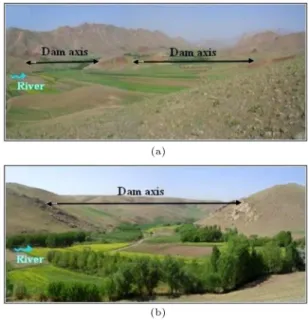
(QD QB = 0:3016) < (n 11 = 0:33); (30) is not satised based on Eq. (29), but Condition 2 is satised. Therefore, with respect to these results (Table 9), B and D are proposed as the best alternatives for the Harsin earth dam site. Figure 5 shows the front view of these alternatives.
4. Sensitivity analysis
To evaluate the performance of the proposed method, a comprehensive sensitivity analysis was carried out based on the importance of the criteria. In one of the tests, the eect of each criterion was examined by reducing the weight of each criterion separately by
Table 5. Degrees of possibility Si Sk.
i k
1 2 3 4 5 6 7 8 9 10 11 12 13 14 15 16 17 18
1 1.000 1.000 1.000 1.000 1.000 1.000 1.000 1.000 1.000 1.0 00 1.000 1.000 1.000 1.000 1.000 1.000 1.000 2 0.960 0.971 0.983 0.960 0.966 0.971 0.988 1.000 1.000 0.9 66 0.994 1.000 1.000 1.000 1.000 1.000 1.000 3 0.989 1.000 1.000 0.989 0.995 1.000 1.000 1.000 1.000 0.9 95 1.000 1.000 1.000 1.000 1.000 1.000 1.000 4 0.978 1.000 0.989 0.978 0.984 0.989 1.000 1.000 1.000 0.9 84 1.000 1.000 1.000 1.000 1.000 1.000 1.000 5 1.000 1.000 1.000 1.000 1.000 1.000 1.000 1.000 1.000 1.0 00 1.000 1.000 1.000 1.000 1.000 1.000 1.000 6 0.995 1.000 1.000 1.000 0.995 1.000 1.000 1.000 1 .000 1.0 00 1.000 1.000 1.000 1.000 1.000 1.000 1.000 7 0.989 1.000 1.000 1.000 0.989 0.995 1.000 1.000 1.000 0.9 95 1.000 1.000 1.000 1.000 1.000 1.000 1.000 8 0.973 1.000 0.984 0.995 0.973 0.978 0.984 1.000 1.000 0.9 78 1.000 1.000 1.000 1.000 1.000 1.000 1.000 9 0.960 1.000 0.971 0.983 0.960 0.966 0.971 0.988 1.000 0.9 66 0.994 1.000 1.000 1.000 1.000 1.000 1.000 10 0.949 0.988 0.960 0.971 0.949 0.955 0.960 0.977 0.988 0.955 0.983 0.994 0.988 0.988 0.994 1.000 1.000 11 0.995 1.000 1.000 1.000 0.995 1.000 1.000 1.000 1.000 1.0 00 1.000 1.000 1.000 1.000 1.000 1.000 1.000 12 0.968 1.000 0.978 0.989 0.968 0.973 0.978 0.995 1.000 1.000 0.973 1.000 1.000 1.000 1.000 1.000 1.000 13 0.955 0.994 0.966 0.977 0.955 0.960 0.966 0.983 0.994 1.0 00 0.960 0.988 0.994 0.994 1.000 1.000 1.000 14 0.960 1.000 0.971 0.983 0.960 0.966 0.971 0.988 1.000 1.0 00 0.966 0.994 1.000 1.000 1.000 1.000 1.000 15 0.960 1.000 0.971 0.983 0.960 0.966 0.971 0.988 1.000 1.0 00 0.966 0.994 1.000 1.000 1.000 1.000 1.000 16 0.955 0.994 0.966 0.977 0.955 0.960 0.966 0.983 0.994 1.0 00 0.960 0.988 1.000 0.994 0.994 1.000 1.000 17 0.929 0.978 0.943 0.957 0.929 0.936 0.943 0.964 0.978 0.9 93 0.936 0.971 0.985 0.978 0.978 0.985 1.000 18 0.887 0.950 0.904 0.922 0.887 0.896 0.904 0.931 0.950 0.9 70 0.896 0.941 0.960 0.950 0.950 0.960 0.979
Table 6. Minimum degrees of possibility Si Sk.
Min V (si Sk) value
min V (S1 Sk) 1.000
min V (S2 Sk) 0.960
min V (S3 Sk) 0.989
min V (S4 Sk) 0.978
min V (S5 Sk) 1.000
min V (S6 Sk) 0.995
min V (S7 Sk) 0.989
min V (S8 Sk) 0.973
min V (S9 Sk) 0.960
min V (S10 Sk) 0.949
min V (S11 Sk) 0.995
min V (S12 Sk) 0.968
min V (S13 Sk) 0.955
min V (S14 Sk) 0.960
min V (S15 Sk) 0.960
min V (S16 Sk) 0.955
min V (S17 Sk) 0.929
min V (S18 Sk) 0.887
two levels (i.e., from VH to M). If the importance of C2, C3, C4, C5, C7, C8, C9, C10, C11, C12, C13, C14, C15, C16, C17 and C18 is reduced by two levels, the optimal alternatives remain unchanged (alternatives B and D).
Table 7. Normalized fuzzy decision matrix.
Criterion Alternative
A B C D
C1 (+) 0.000210 0.000210 0.000030 0.000270
C2 (-) 0.008606 0.008216 0.008006 0.007196
C3 (+) 0.017091 0.016612 0.005397 0.003598
C4 (+) 0.000150 0.000210 0.000270 0.000270
C5 (+) 0.000090 0.000150 0.000210 0.000270
C6 (+) 0.000150 0.000150 0.000210 0.000210
C7 (+) 0.000270 0.000210 0.000150 0.000150
C8 (-) 0.000150 0.000150 0.000210 0.000210
C9 (+) 0.000150 0.000150 0.000090 0.000090
C10(+) 0.005397 0.004888 0.006957 0.006597
C11(-) 0.000150 0.000090 0.000150 0.000270
C12(-) 0.000660 0.000690 0.000750 0.000810
C13(-) 0.000150 0.000030 0.000270 0.000090
C14(-) 0.709743 0.639278 0.226686 0.151124
C15(-) 0.047976 0.053973 0.062339 0.056971
C16(+) 0.000150 0.000270 0.000150 0.000270
C17(+) 0.000090 0.000150 0.000150 0.000090
Table 8. Best and worst values with respect to each criterion.
Criterion f
j fj
C1 (+) 0.000270 0.000030
C2 (-) 0.007196 0.008606
C3 (+) 0.017091 0.003598
C4 (+) 0.000270 0.000150
C5 (+) 0.000270 0.000090
C6 (+) 0.000210 0.000150
C7 (+) 0.000270 0.000150
C8 (-) 0.000150 0.000210
C9 (+) 0.000150 0.000090
C10 (+) 0.006957 0.004888
C11 (-) 0.000090 0.000270
C12 (-) 0.000660 0.000810
C13 (-) 0.000030 0.000270
C14 (-) 0.151124 0.709743
C15 (-) 0.047976 0.062339
C16 (+) 0.000270 0.000150
C17 (+) 0.000150 0.000090
C18 (+) 0.000210 0.000150
If the importance of C1 is reduced by two levels, the set of alternatives If the importance of C1is reduced by two levels, the set of alternatives B, C and D are selected as the optimal alternatives. If the importance of C4is reduced by two levels, the alternative B climbs to rst position in overall ranking.
Considering the results of the sensitivity analysis and local surveys, the experts involved in design of the dam conrmed the soundness of the research methodology and ndings.
5. Conclusions
This paper has two main contributions. First, it presents the inuential criteria and their corresponding weights to locate optimal site for a dam. Second, it presents a combined group fuzzy AHP and VIKOR method to locate the dam site. The proposed method has a number of advantages. For instance, it en-gages dierent qualitative and quantitative variables in selecting the nal choice. The determination of
Figure 5. Front view of the proposed alternatives for the Harsin earth dam site: (a) Alternative B; and (b)
alternative D.
the weights of the criteria is of great importance as they have qualitative nature and are associated with uncertainties. To deal with this feature, the fuzzy AHP approach performed well.
Once the weights of the criteria are determined and all other information from potential dam sites are collected, a decision-making system is needed to prioritize dierent alternatives. In this study, the VIKOR method was used for prioritization. The method presented in this paper was applied to locate the optimal site for the Harsin dam, Iran. Among the potential alternative locations, sites `B' and `D' were found to be the best alternatives. Finally, by considering the results of this integrated method and consulting experts, the alternative `D' was selected as the optimal location for the Harsin earth dam site. The proposed method is considered an eective and reliable method in selecting the optimal dam site.
Acknowledgment
The authors would like to appreciate Kermanshah Regional Water Company and Pandam Consulting
Table 9. Ranking the alternatives.
Alternative Based on Si Based on Ri Based on Qi Proposed alternative(s)
Value Rank Value Rank Value Rank Based on Condition 1
Based on
Condition 2 Generally
A 0.5424 3 0.0575 2 0.8850 3
B and D B B and D
B 0.3452 1 0.0572 1 0.0000 1
C 0.6012 4 0.0575 2 1.0000 4
Engineers Company for providing the required infor-mation and data.
References
1. Saaty, T.L., The Analytic Hierarchy Process, McGraw-Hill, New York (1980).
2. Van Laarhoven, P.J.M. and Pedrycz, W. \A fuzzy extension of Saaty's priority theory", Fuzzy Sets and Systems Journal, 11(1-3), pp. 229-241 (1983).
3. Buckley, J.J. \Fuzzy hierarchical analysis", Fuzzy Sets and Systems journal, 17(3), pp. 233-247 (1985).
4. Chang, D.Y. \Applications of the extent analysis method on fuzzy AHP", European Journal of Oper-ational Research, 95(3), pp. 649-655 (1996).
5. Cheng, C.H. \Evaluating naval tactical missile systems by fuzzy AHP based on the grade value of membership function", European Journal of Operational Research, 96(2), pp. 343-350 (1997).
6. Deng, H. \Multicriteria analysis with fuzzy pairwise comparison", International Journal of Approximate Reasoning, 21(3), pp. 215-231 (1999).
7. Chu, M.T., Shyu, J., Tzeng, G.H. and Khosla, R. \Comparison among three analytical methods for knowledge communities group-decision analysis", Ex-pert Systems with Applications, 33(4), pp. 1011-1024 (2007).
8. Opricovic, S. \Multi-criteria optimization of civil en-gineering systems", Faculty of Civil Enen-gineering, Bel-grade (1998).
9. Abrishamchi, A., Ebrahimian, A. and Tajrishi, M. \Case study: Application of multi criteria decision making to urban water supply", Journal of Water Resources Planning and Management, ASCE, 131(4), pp. 326-335 (2005).
10. Wang, L., Wei, M., Huaicheng, G., Zhenxing, Z., Yong, L. and Yingying, F. \An interval fuzzy multiobjective watershed management model for the lake Qionghai Watershed China", Water Resources Management, 20(5), pp. 701-721 (2006).
11. Bojan, S. \Linking analytic hierarchy process and so-cial choice methods to support group decision-making in water management", Decision Support Systems, 42(4), pp. 2261-2273 (2007).
12. Zarghami, M., Abrishamchi, A. and Ardakanian, R. \Multi-criteria decision making for integrated urban water management", Water Resources Management, 22(8), pp. 1017-1029 (2008).
13. Chung, E.S. and Lee, K.S. \Prioritization of wa-ter management for sustainability using hydrologic simulation model and multi criteria decision making techniques", Journal of Environmental Management, 90(3), pp. 1502-1511 (2009).
14. Kodikara, P.N., Perera, B.J.C. and Kularathna, M.D.U.P. \Stakeholder preference elicitation and mod-elling in multi-criteria decision analysis - A case study
on urban water supply", European Journal of Opera-tional Research, 206(1), pp. 209-220 (2010).
15. Afshar, A., Mari~no, M.A., Saadatpour, M. and Afshar, A. \Fuzzy TOPSIS multi-criteria decision analysis applied to Karun reservoirs system", Water Resources Management, 25(2), pp. 545-563 (2011).
16. Nitirach, S. and Vilas, N. \Strategic decision making for urban water reuse application: A case from Thai-land", Desalination, 268(1-3), pp. 141-149 (2011).
17. Opricovic, S. \Fuzzy VIKOR with an application to water resources planning expert", Systems with Applications, 38(10), pp. 12983-12990 (2011).
18. Wei, L.H., Jing, L.Y., Wu, W. and Mou, L. \Research on security assessment model of water supply system based on leakage control", Procedia Environmental Sciences, 11, pp. 749-756 (2011).
19. Chen, Z., Ngo, H.H., Guo, W.S., Listowski, A., O'Halloran, K., Thompson, M. and. Muthukaruppan, M. \Multi-criteria analysis towards the new end use of recycled water for household laundry: A case study in Sydney", Science of the Total Environment, 438(1), pp. 59-65 (2012).
20. Panagopoulos, G.P., Bathrellos, G.D., Skilodimou, H.D. and. Martsouka, F.A. \Mapping urban water demands using multi-criteria analysis and GIS", Water Resources Management, 26(5), pp. 1347-1363 (2012).
21. Razavi, S.L., Toosi, J. and Samani, M.V. \Evaluating water transfer projects using Analytic Network Process (ANP)", Water Resources Management, 26(7), pp. 1999-2014 (2012).
22. Zou, Q., Zhou, J., Zhou, C., Song, L. and Guo, J. \Comprehensive ood risk assessment based on set pair analysis-variable fuzzy sets model and fuzzy AHP Stochastic", Environmental Research and Risk Assessment, 27(2), pp. 525-546 (2013).
23. Opricovic, S. and Tzeng, G.H. \The compromise solution by MCDM methods: A comparative analysis of VIKOR and TOPSIS", European Journal of Opera-tional Research, 156(2), pp. 445-455 (2004).
24. Opricovic, S. and Tzeng, G.H. \Extended VIKOR method in comparison with outranking methods", European Journal of Operational Research, 178(2), pp. 514-529 (2007).
Biographies
Yasser Minatour has received his BSc from Mining Engineering Department at Shahid Bahonar Kerman University in September 2008. He nished his MSc at Razi University of Kermanshah, Iran, in March 2012. His research interests span a wide range of topics including numerical modeling in water engineering, wa-ter reservoir management, evolutionary optimization, decision making, fuzzy logic and genetic algorithm applications in mining.
Jahangir Khazaie has graduated as a civil engineer from Bu-Ali Sina University in September 1994. He nished MSc at Amikabir University of technology in February 1997. He obtained his PhD degree in Numerical Analysis of Soil and Large Scale Foundation Statically Interactions from Amirkabir University of technology in September 2008. Currently he is an Assistant Professor at Razi University Kermanshah, Iran. His research interests span a wide range of topics including nite element modeling, improvement soil, deep excavation, unsaturated soils, decision making, modeling and control of seawater intrusion and evo-lutionary optimization. The results of his research have been published in over 35 papers in international journals, conference proceedings, book chapters and research reports.
Mohammad Ataei has received his BSc from Mining Engineering Department at Shahid Bahonar Univer-sity in September 1995, and his MSc from Amikabir University of Technology in August 1997. He obtained his PhD degree in modeling of optimum cuto grade for multi-metal deposit from Amirkabir University of Technology in July 2003. Currently he is a Professor at Shahrood University of Technology, Shahrood, Iran. His specialists are about open pit and underground
mining, mine management, operation research and optimization in mine operations, computer applications in mining, open pit design, decision making, fuzzy logic and genetic algorithm applications in mining. He is the author of 8 books. Dr. Ataei has published 130 journal papers and more than 150 conference papers. He is currently holding 2 patents.
Akbar Javadi received his BSc degree in Civil Engi-neering in 1989 and MSc degree in Hydraulic Structures in 1991, both from Tabriz University, and his PhD in Geotechnical Engineering in 1998 from Bradford University in UK. He is currently a Professor of Geotechnical Engineering and Head of the Computa-tional Geomechanics at the University of Exeter in the UK. His research interests span a wide range of topics including nite element modeling, unsaturated soils, ow and contaminant transport in saturated and unsaturated soils, modeling and control of seawater intrusion, fracture mechanics, biomechanics, evolution-ary optimization, engineering applications of articial intelligence and data mining and storm water collec-tion systems. The results of his research have been published in over 230 papers in international journals, conference proceedings, book chapters and research reports.