Sharif University of Technology
Scientia IranicaTransactions E: Industrial Engineering www.scientiairanica.com
Some generalized Einstein aggregation operators based
on the interval-valued intuitionistic fuzzy numbers and
their application to group decision making
P.D. Liu
a,b;, Y.H. Li
aand Y.B. Chen
aa. School of Economics and Management, Civil Aviation University of China, Tianjin 300300, China.
b. School of Management Science and Engineering, Shandong University of Finance and Economics, Jinan Shandong 250014, China.
Received 2 April 2014; received in revised form 16 July 2014; accepted 25 October 2014
KEYWORDS Group decision-making; Interval-valued intuitionistic fuzzy numbers;
Einstein aggregation operators;
Multiple attribute decision making.
Abstract. In this paper, for the Multiple Attribute Group Decision Making (MAGDM) problems where attribute values are the Interval-Valued Intuitionistic Fuzzy Numbers (IVIFNs), the group decision making method based on some generalized Einstein aggre-gation operators was developed. Firstly, Interval-Valued Intuitionistic Fuzzy Generalized Einstein Weighted Averaging (IVIFGEWA) operator, Interval-Valued Intuitionistic Fuzzy Generalized Einstein Ordered Weighted Averaging (IVIFGEOWA) operator, and Interval-Valued Intuitionistic Fuzzy Generalized Einstein Hybrid Weighted Averaging (IVIFGE-HWA) operator were proposed. Some general properties of these operators such as idempotency, commutativity, monotonicity, and boundedness, were discussed, and some special cases in these operators were analyzed. Furthermore, the method for MAGDM problems based on these operators was developed, and the operational processes were illustrated in detail. Finally, an illustrative example was given to show the decision steps of the proposed method and to demonstrate their eectiveness.
© 2015 Sharif University of Technology. All rights reserved.
1. Introduction
Fuzzy theory is an important tool to process fuzzy information. Zadeh [1] rstly proposed the fuzzy set theory, then Atanassov [2,3] proposed the Intuition-istic Fuzzy Set (IFS) by adding a non-membership function. Furthermore, Atanassov and Gargov [4], and Atanassov [5] proposed the Interval-Valued Intu-itionistic Fuzzy Set (IVIFS) in which the membership and non-membership degrees were extended to interval numbers. Chen et al. [6] proposed a fuzzy ranking method for Interval-Valued Intuitionistic Fuzzy Num-bers (IVIFNs) based on likelihood-based comparison relations, and then presented a new multi-attribute
de-*. Corresponding author.
E-mail address: [email protected] (P.D. Liu)
cision making method based on the proposed interval-valued intuitionistic fuzzy weighted average operator. Gomathi Nayagam et al. [7] proposed a new accuracy function for IVIFNs. Liu et al. [8] proposed the interval-valued intuitionistic fuzzy entropy. Wei et al. [9] proposed an entropy measure for IVIFS, which generalizes three entropy measures of intuitionistic fuzzy sets dened independently by Szmidt, Wang, and Huang. Zhang and Yu [10] constructed an optimiza-tion model to determine the attribute weights based on cross-entropy for multi-attribute decision making problems with interval-valued intuitionistic fuzzy in-formation; then, an extended TOPSIS method was proposed to rank all the alternatives. Wang et al. [11] dened a new score function for the IVIFNs based on the prospect value functions. Xu and Yager [12] developed a new similarity measure between IVIFSs
and utilized it to solve the group decision making problems where attribute values are interval-valued intuitionistic fuzzy numbers. Wan and Dong [13] proposed a possibility degree decision method for multi-attribute group decision making with interval-valued intuitionistic fuzzy information. Wang et al. [14] proposed a decision approach based on interval belief degrees and fuzzy evidential reasoning for multi-criteria decision problems in which the criteria weights are interval numbers and criteria values are triangular intuitionistic fuzzy numbers. Wang and Zhang [15] proposed a new decision-making method based on the evidential reasoning algorithms for multicriteria fuzzy decision-making problems in which the criteria's weight is not completely certain, and the criteria values are Atanassov's Intuitionistic Fuzzy Sets (A-IFSs). The above-mentioned researchers have investigated the basic methods for ranking the intuitionistic fuzzy numbers or some extensions of them based on some extended theory such as entropy, possibility degree, similarity, etc. However, these methods can only give the ranking of the alternatives with intuitionistic fuzzy information, and cannot give the overall evaluation values of each alternative.
The information aggregation operators, based on IVIFS, are the important decision making tools which can give the overall evaluation values of each alternative, and then rank the alternatives based on these overall values. The aggregation operators are receiving more and more attentions [16-31]. Xu [23], and Xu and Chen [24,25] proposed some aggregation operators for IVIFSs such as the Interval Intuitionistic Fuzzy Weighted Aggregation operator (IIFWA), the Interval Intuitionistic Fuzzy Ordered Weighted Ag-gregation operator (IIFOWA), Interval Intuitionistic Fuzzy Hybrid Aggregation operator (IIFHA), the Inter-val Intuitionistic Fuzzy Weighted Geometric operator (IIFWG), the Interval Intuitionistic Fuzzy Ordered Weighted Geometric operator (IIFOWG), and the In-terval Intuitionistic Fuzzy Hybrid Geometric operator (IIFHG). Furthermore, some properties of these oper-ators were investigated. Wei and Yi [26] developed an Induced Interval Intuitionistic Fuzzy Ordered Weighted Geometric operator (I-IIFOWG) by adding the induced parameters. Yu et al. [27] proposed the Interval-Valued Intuitionistic Fuzzy Prioritized Weighted Av-erage (IVIFPWA) operator and the Interval-Valued Intuitionistic Fuzzy Prioritized Weighted Geometric (IVIFPWG) operator according to the priority of the dierent attributes, and studied some of their desirable properties. Furthermore, a decision making approach based on these operators is given to solve the MADM problems in which attribute values take the form of interval-valued intuitionistic fuzzy numbers. Zhao [28] proposed generalized interval intuitionistic fuzzy aggre-gation operators, including arithmetic weighted
averag-ing operator, ordered weighted averagaverag-ing operator, and hybrid weighted averaging operator, which extended the generalized aggregation operators to the environ-ment in which the attribute values are interval-valued intuitionistic fuzzy sets. The generalized aggregation operators are a generalization of arithmetic aggregation operators and geometric aggregation operators. Wang et al. [29,30] dened intuitionistic interval numbers, and proposed intuitionistic interval weighted arith-metic averaging operator, intuitionistic interval ordered weighted averaging operator, and intuitionistic interval heavy averaging operator, etc. Wang et al. [31] dened the Normal Intuitionistic Fuzzy Numbers (NIFNs), and proposed some normal intuitionistic fuzzy aggrega-tion operators, including Normal Intuiaggrega-tionistic Fuzzy-Induced Generalized Ordered Weighted Averaging op-erator (NIFIGOWA), etc.
All the above aggregation operators are based on the algebraic operational rules of IVIFNs, and the keys of the algebraic operations are Algebraic product and Algebraic sum, which are one type of operations that can be chosen to model the intersection and union of IVIFNs. In general, a general T norm and T -conorm can be used to model the intersection and union of IVIFNs [32,33]. Wang and Liu [34] proposed the intuitionistic fuzzy Einstein aggregation operators based on Einstein operations which meet the typical T -norm and T -conorm and have the same smooth approximations as the algebraic operators such as the Intuitionistic Fuzzy Einstein Weighted Geometric op-erator (IFEWG) and the Intuitionistic Fuzzy Einstein Ordered Weighted Geometric operator (IFEOWG), and established some general properties of these oper-ators such as idempotency, commutativity, and mono-tonicity. Wang and Liu [35] proposed the Intuitionistic Fuzzy Einstein Weighted Averaging operator (IFEWA) and the Intuitionistic Fuzzy Einstein Ordered Weighted Averaging operator (IFEOWA), and studied various properties of these operators and analyzed the relations between the existing intuitionistic fuzzy aggregation operators and them. Maris and Iliadis [36] further explained the advantages of Einstein operations by using some T -norms to unify the risk indices and to produce a unied means of risk measure. The algebraic T -norm estimated the risky areas under average rainfall conditions, and the Einstein T -norm oered a good approach for an overall evaluation. The computer system has proven its ability to work more eectively compared to the older methods.
Because the interval-valued intuitionistic fuzzy numbers are easier to express the fuzzy decision information and Einstein operations have the good smooth approximations, and the generalized aggrega-tion operators are a generalizaaggrega-tion of most aggregaaggrega-tion operators such as arithmetic aggregation operators and geometric aggregation operators, how to extend the
Einstein operations to aggregate the interval-valued intuitionistic fuzzy information based on the gener-alized aggregation operators is a meaningful works, which is also the focus of this paper. In the following, we will investigate interval-valued intuitionistic gener-alized Einstein aggregation operators which combine Einstein aggregation operators with the generalized aggregation operators based on interval-valued intu-itionistic fuzzy information in order to generalize the existing aggregation operators.
In order to do so, the remainder of this paper is shown as follows. In Section 2, we briey review some basic concepts of interval-valued intuitionistic fuzzy sets, generalized aggregation operators, and Ein-stein operations. In Section 3, we establish EinEin-stein operations of IVIFNs and their characteristics, fur-thermore, develop some generalized Einstein aggre-gation operators such as Interval-Valued Intuitionis-tic Fuzzy Generalized Einstein Weighted Averaging (IVIFGEWA) operator, Interval-Valued Intuitionistic Fuzzy Generalized Einstein Ordered Weighted Averag-ing (IVIFGEOWA) operator, and Interval-Valued Intu-itionistic Fuzzy Generalized Einstein Hybrid Averaging (IVIFGEHA) operator. We also study some desirable properties of them such as idempotency, commutativ-ity, monotonicity and boundedness and some special cases of them. In Section 4, based on the operators introduced in Section 3, we propose a decision making method for multiple attribute group decision making problems with interval-valued intuitionistic fuzzy infor-mation. In Section 5, we give an example to illustrate the application of proposed method, and compare the developed methods with the existing methods. In Section 6, we conclude the paper.
2. Preliminaries
2.1. Interval-valued intuitionistic fuzzy set Denition 1 [2]. If X = fx1; x2; ; xng is a
universe of discourse, then an Intuitionistic Fuzzy Set (IFS) A in X is given by:
A = f< x; uA(x); vA(x) > x 2 Xg; (1)
where uA: X ! [0; 1] and vA: X ! [0; 1], on condition
that 0 uA(x) + vA(x) 1, 8x 2 X. The numbers
uA(x) and vA(x) represent the membership degree and
non-membership degree of the element x to the set A, respectively.
For each IFS A in X, if (x) = 1 uA(x) vA(x),
8x 2 X, then (x) is called the degree of indeterminacy of x to the set A [2,3]. It is obvious that 0 (x) 1, 8x 2 X.
To give element x, the pair (uA(x); vA(x)) is
called an Intuitionistic Fuzzy Value (IFV) [37] which for convenience can be denoted as ~a = (u~a; v~a) such
that u~a2 [0; 1], v~a2 [0; 1] and 0 u~a+ v~a 1.
Atanassov and Gargov [4] further extended the intuitionistic fuzzy set to the Interval-Valued Intu-itionistic Fuzzy Set (IVIFS) in which membership and non-membership functions are expressed by interval numbers.
Denition 2 [3,5]. Let X = fx1; x2; ; xng be a
universe of discourse, then an IVIFS ~A in X is given by:
~
A = f< x; ~uA~(x); ~vA~(x) > x 2 Xg ; (2)
where ~uA~(x) [0; 1] and ~vA~(x) [0; 1] are
inter-val numbers, on condition that 0 sup(~uA~(x)) +
sup(~vA~(x)) 1, 8x 2 X. The numbers ~uA~(x)
and ~vA~(x) represent the membership degree and
non-membership degree of the element x to the set ~A, respectively. For convenience, if ~uA~(xi) = [a; b] and
~vA~(xi) = [c; d], then ~a = ([a; b]; [c; d]) is called an
Interval-Valued Intuitionistic Fuzzy Number (IVIFN). Denition 3 [6]. If ~a = ([a; b]; [c; d]) be an IVIFN, a score function S of the IVIFN ~a can be represented as follows:
S(~a) = a + b c d
2 : (3)
Obviously, S(~a) 2 [ 1; 1].
Denition 4 [6]. Let ~a = ([a; b]; [c; d]) be an IVIFN, then an accuracy function H of the IVIFN ~a can be represented as follows:
H(~a) = a + b + c + d2 : (4) Denition 5 [6]. If ~a1= ([a1; b1]; [c1; d1]) and ~a2=
([a2; b2]; [c2; d2]) are any two IVIFNs, then: 1. If S(~a1) > S(~a2), then, ~a1> ~a2;
2. If S(~a1) = S(~a2), then:
If L(~a1) > L(~a2), then ~a1> ~a2;
If L(~a1) = L(~a2), then ~a1= ~a2.
2.2. GHWA operator
Denition 6 [28]. A GWA operator of dimension n is a mapping GWA: (R+)n! R+. Such that:
GWA(a1; a2; ; an) =
0 @Xn
j=1
wjaj
1 A
1=
; (5)
where w = (w1; w2; ; wn)T is a weight vector of
(a1; a2; ; an), satisfying wj 2 [0; 1] (j = 1; 2; ; n)
and Pnj=1wj = 1. is a parameter such that 2
(0; +1), and R+ is the set of all nonnegative real
Denition 7 [28]. A GOWA operator of dimension n is a mapping GOWA: (R+)n! R+, such that:
GOWA(a1; a2; ; an) =
0 @Xn
j=1
!jbj
1 A
1=
; (6)
where ! = (!1; !2; ; !n)T is a weight vector which
is correlative with GOWA, satisfying !j 2 [0; 1] (j =
1; 2; ; n) and Pnj=1!j = 1; bj is the jth largest
among real numbers ak(k = 1; 2; ; n). is a
parameter, such that 2 (0; +1), and R+ is the set
of all nonnegative real numbers.
Denition 8. A GHWA operator of dimension n is a mapping GHWA: (R+)n! R+, such that:
GHWA(a1; a2; ; an) =
0 @Xn
j=1
!jbj
1 A
1=
; (7)
where ! = (!1; !2; ; !n)T is a weight vector which
is correlative with GOWA, satisfying !j 2 [0; 1](j =
1; 2; ; n) and Pnj=1!j = 1; bj is the jth largest
among real numbers (nwkak)(k = 1; 2; ; n); w =
(w1; w2; ; wn)T is a weight vector of (a1; a2; ; an),
satisfying wk 2 [0; 1](k = 1; 2; ; n) andPnk=1wk =
1. is a parameter, such that 2 (0; +1), and R+ is
the set of all nonnegative real numbers. 2.3. Einstein operators
The t-operators are intersection and union operators in fuzzy set theory which are composed of T -norm (T ) and T -conorm (T), respectively [38]. Although
they are originated from the eld of statistical metric spaces, they also have important applications in the fuzzy inference and fuzzy decision making.
Based on a T -norm and T -conorm, a generalized union and a generalized intersection of intuitionis-tic fuzzy sets were introduced by Deschrijver and Kerre [39].
Denition 9 [39]. Let A and B be any two intu-itionistic fuzzy sets, then the generalized intersection and union are dened as follows:
A \T;TB = f < x; T (uA(x); uB(x));
T(v
A(x); vB(x)) > x 2 Xg; (8)
A [T;TB = f < x; T(uA(x); uB(x));
T (vA(x); vB(x)) > x 2 Xg; (9)
where T denotes a T -norm and T a T -conorm.
For instance, the algebraic product ~a1 ~a2 and
the algebraic sum ~a1~a2on two IVIFNs ~a1and ~a2can
be obtained by dening T -norm and T -conorm. When T (x; y) = xy and T
(x; y) = x + y xy, we can obtain:
~a1 ~a2=([a1+ a2 a1a2; b1+ b2 b1b2];
[c1c2; d1d2]); (10)
~a1 ~a2=([a1a2; b1b2]; [c1+ c2 c1c2;
d1+ d2 d1d2]); (11)
n~a1= ([1 (1 a1)n; 1 (1 b1)n]; [cn1; dn1])
n > 0; (12)
~an
1 = ([an1; bn1]; [1 (1 c1)n; 1 (1 c1)n])
n > 0: (13)
Obviously, the above operational laws are the same as those given by Atanassov [5].
Furthermore, based on the T norm and T -conorm, Einstein operations are dened as follows [40]: T (x; y) = 1 + (1 x)(1 y)xy ; (14)
T
(x; y) = 1 + xyx + y ; (15)
where T denotes a T -norm and T a T -conorm.
Wang and Liu [34] dened the Einstein opera-tional rules of IFVs as shown in the following.
Let ~a1 = (a1; b1) and ~a2 = (a2; b2) be two IFVs,
then the operational rules based on Einstein T -norm and T -conorm are dened as follows:
~a1E~a2=
a1+ a2
1 + a1a2;
b1b2
1 + (1 b1)(1 b2)
; (16)
~a1E~a2=
a1a2
(1 + (1 a1)(1 a2);
b1+ b2
1 + b1b2
; (17)
n~a1=
(1 + a1)n (1 a1)n
(1 + a1)n+ (1 a1)n;
2bn 1
(2 b1)n+ bn1
n > 0; (18)
~an 1 =
2an 1
(2 a1)n+ an1;
(1 + b1)n (1 b1)n
(1 + b1)n+ (1 b1)n
n > 0: (19)
3. Einstein operations of IVIFNs
3.1. The operational rules based on Einstein T -norm and T -conorm
In order to establish Einstein operation rules of IV-IFNs, rstly, we can give the following denitions.
Denition 10. Let ~a1 = ([a1; b1]; [c1; d1]) and ~a2 =
([a2; b2]; [c2; d2]) be two IVIFNs, then, the generalized
intersection and union are dened as follows: ~a1T;T~a2= ([T (a1; a2); T (b1; b2)];
[T(c
1; c2); T(d1; d2)]); (20)
~a1T;T ~a2= ([T(a1; a2); T(b1; b2];
[T (c1; c2); T (d1; d2)]): (21)
Based on Denition 10, Einstein T norm and T -conorm, we can establish the Einstein operational rules for two IVIFNs, respectively.
Let ~a1 = ([a1; b1], [c1; d1]) and ~a2 = ([a2; b2],
[c2; d2]) be two IVIFNs, then the operational rules
based on Einstein T -norm and T -conorm are dened as follows:
~a1E~a2=
a
1+ a2
1 + a1a2;
b1+ b2
1 + b1b2
; "
c1c2
1 + (1 c1)(1 c2);
d1d2
1 + (1 d1)(1 d2)
#!
; (22)
~a1E~a2=
"
a1a2
1 + (1 a1)(1 a2);
b1b2
1 + (1 b1)(1 b2)
# ;
c1+ c2
1 + c1c2;
d1+ d2
1 + d1d2
!
; (23)
n~a1=
"
(1 + a1)n (1 a1)n
(1 + a1)n+ (1 a1)n;
(1 + b1)n (1 b1)n
(1 + b1)n+ (1 b1)n
# ;
2cn 1
(2 c1)n+ cn1;
2dn 1
(2 d1)n+ dn1
!
n > 0; (24)
~an
1 = 2a
n 1
(2 a1)n+ an1;
2bn 1
(2 b1)n+ bn1
;
"
(1 + c1)n (1 c1)n
(1 + c1)n+ (1 c1)n;
(1 + d1)n (1 d1)n
(1 + d1)n+ (1 d1)n
#!
n > 0: (25)
Theorem 1. Let ~a1 = ([a1; b1]; [c1; d1]) and ~a2 =
([a2; b2]; [c2; d2]) be any two IVIFNs, and > 0, then:
~a1E~a2= ~a2E~a1; (26)
~a1E~a2= ~a2E~a1; (27)
(~a1E~a2) = ~a1E~a2; 0; (28)
1~a1E2~a1= (1+ 2)~a1;
1; 2 0; (29)
~a1
1 E~a12= (~a1)1+2;
1; 2 0; (30)
~a1E~a2 = (~a1E~a2);
0: (31)
It is easy to prove that the formulas in Theorem 1 are all right, the proofs are omitted in here.
3.2. The interval-valued intuitionistic fuzzy generalized Einstein hybrid averaging operators
We can give denition of the interval-valued intuition-istic fuzzy generalized Einstein averaging operators. Denition 11. Let ~aj = ([aj; bj]; [cj; dj]) (j =
1; 2; ; n) be a collection of the IVIFNs, and IVIFGEWA : n ! , if:
IVIFGEWA (~a1; ~a2; ; ~an)=
n
E j=1 wj~a
j
1=
; (32) where is the set of all IVIFNs, and > 0. w = (w1; w2; ; wn)T is weight vector of (~a1; ~a2; ; ~an),
such that wj> 0 andPnj=1wj= 1. Then IVIFGEWA
is called the interval-valued intuitionistic fuzzy gener-alized Einstein weighted averaging operator.
Based on the Einstein operational rules of the IVIFNs, we can derive the result shown as Theorem 2. Theorem 2. Let ~aj = ([aj; bj]; [cj; dj]) (j =
1; 2 ; n) be a collection of the IVIFNs, then, the result aggregated from Denition 11 is still an IVIFN, and even:
IVIFGEWA(~a1; ~a2; ; ~an) = 0 B B B B B @ 2 6 6 6 6 6 4
2 Qn
j=1x wj aj n Q j=1y wj aj !1= n Q j=1x wj
aj +3
n Q j=1y wj aj !1=
+ Qn
j=1x wj aj n Q j=1y wj aj
!1=;
2 Qn
j=1x wj bj n Q j=1y wj bj !1= n Q j=1x wj
bj +3
n Q j=1y wj bj !1=
+ Qn
j=1x wj bj n Q j=1y wj bj !1= 3 7 7 7 7 7 5; 2 6 6 6 6 6 4 n Q j=1z wj
cj +3
n Q j=1t wj cj !1= n Q j=1z wj cj n Q j=1t wj cj !1= n Q j=1z wj
cj +3
n Q j=1t wj cj !1=
+ Qn
j=1z wj cj n Q j=1t wj cj
!1=;
n
Q
j=1z wj
dj +3
n Q j=1t wj dj !1= n Q j=1z wj dj n Q j=1t wj dj !1= n Q j=1z wj
dj +3
n Q j=1t wj dj !1=
+ Qn
j=1z wj dj n Q j=1t wj dj !1= 3 7 7 7 7 7 5 1 C C C C C A(33);
where:
xaj = (2 aj)+ 3aj; yaj = (2 aj) aj;
xbj = (2 bj)+ 3bj; ybj = (2 bj) bj;
zcj = (1 + cj)+ 3(1 cj);
tcj = (1 + cj) (1 cj);
zdj = (1 + dj)+ 3(1 dj);
tdj = (1 + dj) (1 dj):
Proof.
1. From Eq. (32), we can calculate ~a
j rstly, and
obtain: ~a 1 = 2a 1
(2 a1)+ a1;
2b 1
(2 b1)+ b1
;
(1 + c1) (1 c1)
(1 + c1)+ (1 c1);
(1 + d1) (1 d1)
(1 + d1)+ (1 d1)
:
2. Calculate wj~aj, and obtain the equation as shown
in Box I.
3. CalculatenE j=1(wj~a
j). For convenience, let:
xaj=(2 aj)+3aj; yaj=(2 aj) aj;
xbj = (2 bj)+ 3bj; ybj = (2 bj) bj;
zcj = (1 + cj)+ 3(1 cj);
tcj = (1 + cj) (1 cj);
zdj = (1 + dj)+ 3(1 dj);
tdj = (1 + dj) (1 dj):
Then: wj~aj =
" xwj
aj yawjj
xwj
aj + yawjj
;x
wj
bj y
wj
bj
xwj
bj + y
wj
bj
# ; "
2twj
cj
zwj
cj + twcjj
; 2t
wj
dj
zwj
dj + t
wj
dj
#! :
In the following, by mathematical induction, we can prove:
n
E j=1(wj~a
j) =
0 B B @ 2 6 6 4 n Q j=1x wj aj n Q j=1y wj aj n Q j=1x wj
aj +
n Q j=1y wj aj ; n Q j=1x wj bj n Q j=1y wj bj n Q j=1x wj
bj +
n Q j=1y wj bj 3 7 7 5 ; 2 6 6 4
2 Qn
j=1t wj cj n Q j=1z wj
cj+
n Q j=1t wj cj ;
2 Qn
j=1t wj dj n Q j=1z wj
dj+
n Q j=1t wj dj 3 7 7 5 1 C C
A : (34)
(a) When n = 1, * w1= 1:
For the left-hand side of Eq. (34):
n
E j=1(wj~a
j) = ~a1
=
2a 1
(2 a1)+ a1;
2b 1
(2 b1)+ b1
;
(1 + c1) (1 c1)
(1 + c1)+ (1 c1);
(1 + d1) (1 d1)
(1 + d1)+ (1 d1)
;
wj~aj =
"
((2 aj)+ 3aj)wj ((2 aj) aj)wj
((2 aj)+ 3aj)wj + ((2 aj) aj)wj;
((2 bj)+ 3bj)wj ((2 aj) aj)wj
((2 bj)+ 3bj)wj + ((2 aj) aj)wj
# ; "
2((1 + cj) (1 cj))wj
(1 + cj)+ 3(1 cj)wj + (1 + cj) (1 cj)wj;
2((1 + dj) (1 dj))wj
(1 + dj)+ 3(1 dj)wj + ((1 + dj) (1 dj))wj
#! : Box I
and for the right-hand side of Eq. (34), we have: 0 B B B @ 2 6 6 6 4 1 Q j=1x wj aj 1 Q j=1y wj aj 1 Q j=1x wj
aj +
1 Q j=1y wj aj ; 1 Q j=1x wj bj 1 Q j=1y wj bj 1 Q j=1x wj
bj +
1 Q j=1y wj bj 3 7 7 7 5; 2 6 6 6 4
2 Q1
j=1t wj cj 1 Q j=1z wj
cj +
1 Q j=1t wj cj ;
2 Q1
j=1t wj dj 1 Q j=1z wj
dj +
1 Q j=1t wj dj 3 7 7 7 5 1 C C C A = x
aj yaj
xaj + yaj
;xbj ybj
xbj + ybj
; 2t
cj
zcj + tcj
; 2tdj
zdj+ tdj
=
2a 1
(2 a1)+ a1;
2b 1
(2 b1)+ b1
;
(1 + c1) (1 c1)
(1 + c1)+ (1 c1);
(1 + d1) (1 d1)
(1 + d1)+ (1 d1)
: Therefore, Eq. (34) holds for n = 1.
(b) Assume that Eq. (34) holds for n = k, then we have:
k
E j=1(wj~a
j) = 0 B B B @ 2 6 6 6 4 k Q j=1x wj aj k Q j=1y wj aj k Q j=1x wj
aj +
k Q j=1y wj aj ; k Q j=1x wj bj k Q j=1y wj bj k Q j=1x wj
bj +
k Q j=1y wj bj 3 7 7 7 5; 2 6 6 6 4
2 Qk
j=1t wj cj k Q j=1z wj
cj +
k Q j=1t wj cj ;
2 Qk
j=1t wj dj k Q j=1z wj
dj +
k Q j=1t wj dj 3 7 7 7 5 1 C C C A;
when n = k + 1,
k+1
E j=1 wj~a
j
=k+1h
j=1 wj~a j
E wk+1~ak+1
= 0 B B B @ 2 6 6 6 4 k Q j=1x wj aj k Q j=1y wj aj k Q j=1x wj
aj +
k Q j=1y wj aj ; k Q j=1x wj bj k Q j=1y wj bj k Q j=1x wj
bj +
k Q j=1y wj bj 3 7 7 7 5; 2 6 6 6 4
2 Qk
j=1t wj cj k Q j=1z wj
cj +
k Q j=1t wj cj ;
2 Qk
j=1t wj dj k Q j=1z wj
dj +
k Q j=1t wj dj 3 7 7 7 5 1 C C C A E " xwj+1
aj+1 yawj+1j+1
xwj+1
aj+1 + y
wj+1
aj+1
;x
wj+1
bj+1 y
wj+1
bj+1
xwj+1
bj+1 + y
wj+1
bj+1
# ; "
2twj+1
cj+1
zwj+1
cj+1 + twcj+1j+1
; 2t
wj+1
dj+1
zwj+1
dj+1 + t
wj+1 dj+1 #! = 0 B B B B B B B @ 2 6 6 6 6 6 6 6 4 k Q j=1x wj aj k Q j=1y wj aj k Q j=1x wj aj+ k Q j=1y wj aj
+xwj+1aj+1 yaj+1wj+1
xwj+1aj+1+yaj+1wj+1
1 + k Q j=1x wj aj k Q j=1y wj aj k Q j=1x wj aj+ k Q j=1y wj aj
xwj+1aj+1 yaj+1wj+1
xwj+1aj+1+yaj+1wj+1
k Q j=1x wj bj k Q j=1y wj bj k Q j=1x wj bj+ k Q j=1y wj bj +x wj+1 bj+1 ybj+1wj+1
xwj+1bj+1+ywj+1bj+1
1 + k Q j=1x wj bj k Q j=1y wj bj k Q j=1x wj bj+ k Q j=1y wj bj
xwj+1bj+1 ywj+1bj+1
xwj+1bj+1+ywj+1bj+1
3 7 7 7 7 7 7 7 5 ; 2 6 6 6 6 6 6 6 4
2 Qk
j=1t wj cj k Q j=1z wj cj + k Q j=1t wj cj
2twj+1cj+1
zcj+1wj+1+twj+1cj+1
1+ 0 @1 2 k Q j=1t wj cj k Q j=1z wj cj+ k Q j=1t wj cj 1
A1 2twj+1cj+1
zwj+1cj+1+twj+1cj+1
;
2Qk
j=1t wj dj k Q j=1z wj dj+ k Q j=1t wj dj
2twj+1dj+1
zdj+1wj+1+twj+1dj+1
1+ 0 @1 2 k Q j=1t wj dj k Q j=1z wj dj+ k Q j=1t wj dj 1
A1 2twj+1dj+1
zdj+1wj+1+twj+1dj+1
3 7 7 7 7 7 7 7 5 1 C C C C C C C A = 0 B B B @ 2 6 6 6 4 k+1Q j=1x wj aj k+1Q j=1y wj aj k+1Q j=1x wj
aj +
k+1Q j=1y wj aj ; k+1Q j=1x wj bj k+1Q j=1y wj bj k+1Q j=1x wj
bj +
k+1Q j=1y wj bj 3 7 7 7 5; 2 6 6 6 4
2k+1Q
j=1t wj cj k+1Q j=1z wj
cj +
k+1Q j=1t
wj
cj
;
2k+1Q
j=1t wj dj k+1Q j=1z wj
dj +
k+1Q j=1t wj dj 3 7 7 7 5 1 C C C A:
Therefore, when n = k + 1, Eq. (34) holds.
(c) According to steps (a) and (b), we can deduce that Eq. (34) holds for any n. Therefore:
n
E j=1 wj~a
j = 0 B B @ 2 6 6 4 n Q j=1x wj aj n Q j=1y wj aj n Q j=1x wj
aj +
n Q j=1y wj aj ; n Q j=1x wj bj n Q j=1y wj bj n Q j=1x wj
bj +
n Q j=1y wj bj 3 7 7 5 ; 2 6 6 4
2 Qn
j=1t wj cj n Q j=1z wj
cj +
n Q j=1t wj cj ;
2 Qn
j=1t wj dj n Q j=1z wj
dj +
n Q j=1t wj dj 3 7 7 5 1 C C A :
4. Calculate (nE j=1(wj~a
j))1=; we can obtain the
equation as shown in Box II. The proof ends.
It is easy to prove that the IVIFGEWA operator has the following properties.
1. Theorem 3 (monotonicity) Let (~a0
1; ~a02; ; ~a0n) and (~a1; ~a2; ; ~an) be two
collections of IVIFNs, if ~a0
j ~aj for all j =
1; 2; ; n, then: IVIFGEWA (~a0
1; ~a02; ; ~a0n)
IVIFGEWA (~a1; ~a2; ; ~an): 2. Theorem 4 (idempotency)
Let ~aj = ~a, j = 1; 2; ; n, then IVIFGEWA
(~a1; ~a2; ; ~an) = ~a. 3. Theorem 5 (bounded)
The IVIFGEWA operator lies between the max and min operators.
min(~a1; ~a2; ; ~an) IVIFGEWA (~a1; ~a2; ; ~an)
max (~a1; ~a2; ; ~an):
Now we can discuss some special cases of the IV-IFGEWA operator with respect to the parameter .
1. If = 1, then the IVIFGEWA operator (Eq. (32)) will be reduced to the Interval-Valued Intuitionistic Fuzzy Einstein Weighted Averaging (IVIFEWA) operator, which is shown as follows:
IVIFEWA(~a1; ~a2; ; ~an)
= w1~a1Ew2~a2E Ewn~an:
According to Eq. (33), we can obtain: IVIFEWA(~a1; ~a2; ; ~an)
= 0 B B @ 2 6 6 4 n Q
j=1(1 + aj) wj Qn
j=1(1 aj) wj
n
Q
j=1(1 + aj) wj + Qn
j=1(1 aj) wj
;
n
Q
j=1(1 + bj) wj Qn
j=1(1 bj) wj
n
Q
j=1(1 + bj) wj+ Qn
j=1(1 bj) wj 3 7 7 5 ; 2 6 6 4
2 Qn
j=1c wj
j n
Q
j=1(2 cj) wj + Qn
j=1c wj
j
;
2 Qn
j=1d wj
j n
Q
j=1(2 dj)
wj+ Qn
j=1d wj j 3 7 7 5 1 C C
n
E j=1 wj~a
j 1= = 0 B B @ 2 6 6 4 n Q j=1x wj aj n Q j=1y wj aj n Q j=1x wj
aj +
n Q j=1y wj aj ; n Q j=1x wj bj n Q j=1y wj bj n Q j=1x wj
bj +
n Q j=1y wj bj 3 7 7 5 ; 2 6 6 4
2 Qn
j=1t wj cj n Q j=1z wj
cj +
n Q j=1t wj cj ;
2 Qn
j=1t wj dj n Q j=1z wj
dj +
n Q j=1t wj dj 3 7 7 5 1 C C A 1= = 0 B B B B B B B @ 2 6 6 6 6 6 6 6 4 2 0 @ n Q j=1x wj aj n Q j=1y wj aj n Q j=1x wj aj+ n Q j=1y wj aj 1 A 1= 0 @2 n Q j=1x wj aj n Q j=1y wj aj n Q j=1x wj aj+ n Q j=1y wj aj 1 A 1= + 0 @ n Q j=1x wj aj n Q j=1y wj aj n Q j=1x wj aj+ n Q j=1y wj aj 1 A 1=; 2 0 @ n Q j=1x wj bj n Q j=1y wj bj n Q j=1x wj bj+ n Q j=1y wj bj 1 A 1= 0 @2 n Q j=1x wj bj n Q j=1y wj bj n Q j=1x wj bj+ n Q j=1y wj bj 1 A 1= + 0 @ n Q j=1x wj bj n Q j=1y wj bj n Q j=1x wj bj+ n Q j=1y wj bj 1 A 1= 3 7 7 7 7 7 7 7 5 ; 2 6 6 6 6 6 6 6 4 0
@1 + 2
n Q j=1t wj cj n Q j=1z wj cj+ n Q j=1t wj cj 1 A 1= 0 @1 2 n Q j=1t wj cj n Q j=1z wj cj+ n Q j=1t wj cj 1 A 1= 0
@1 + 2
n Q j=1t wj cj n Q j=1z wj cj+ n Q j=1t wj cj 1 A 1= + 0 @1 2 n Q j=1t wj cj n Q j=1z wj cj+ n Q j=1t wj cj 1 A 1=; 0
@1 + 2
n Q j=1t wj dj n Q j=1z wj dj+ n Q j=1t wj dj 1 A 1= 0 @1 2 n Q j=1t wj dj n Q j=1z wj dj+ n Q j=1t wj dj 1 A 1= 0
@1 + 2
n Q j=1t wj dj n Q j=1z wj dj+ n Q j=1t wj dj 1 A 1= + 0 @1 2 n Q j=1t wj dj n Q j=1z wj dj+ n Q j=1t wj dj 1 A 1= 3 7 7 7 7 7 7 7 5 1 C C C C C C C A = 0 B B B B B @ 2 6 6 6 6 6 4
2 Qn
j=1x wj aj n Q j=1y wj aj !1= n Q j=1x wj
aj+3
n Q j=1y wj aj !1=
+ Qn
j=1x wj aj n Q j=1y wj aj
!1=;
2 Qn
j=1x wj bj n Q j=1y wj bj !1= n Q j=1x wj
bj +3
n Q j=1y wj bj !1=
+ Qn
j=1x wj bj n Q j=1y wj bj !1= 3 7 7 7 7 7 5 ; 2 6 6 6 6 6 4 n Q j=1z wj
cj + 3
n Q j=1t wj cj !1= n Q j=1z wj cj n Q j=1t wj cj !1= n Q j=1z wj
cj + 3
n Q j=1t wj cj !1=
+ Qn
j=1z wj cj n Q j=1t wj cj
!1=; n
Q
j=1z wj
dj + 3
n Q j=1t wj dj !1= n Q j=1z wj dj n Q j=1t wj dj !1= n Q j=1z wj
dj + 3
n Q j=1t wj dj !1=
+ Qn
j=1z wj dj n Q j=1t wj dj !1= 3 7 7 7 7 7 5 1 C C C C C A : Box II 2. If ! 0, then the IVIFGEWA operator (Eq. (32))
will be reduced to the Interval-Valued Intuitionistic Fuzzy Einstein Weighted Geometric (IVIFEWG) operator, which is shown as follows:
IVIFEWG(~a1; ~a2; ; ~an)
= ~aw1
1 E~aw22E E~awnn:
According to Eq. (33), we can obtain: IVIFEWG(~a1; ~a2; ; ~an)
= 0 B B @ 2 6 6 4
2 Qn
j=1a wj
j n
Q
j=1(2 aj)
wj+ Qn
j=1a wj
j
;
2 Qn
j=1b wj
j n
Q
j=1(2 bj) wj+ Qn
j=1b wj j 3 7 7 5 ; 2 6 6 4 n Q
j=1(1 + cj) wj Qn
j=1(1 cj) wj
n
Q
j=1(1 + cj) wj + Qn
j=1(1 cj) wj
;
n
Q
j=1(1 + dj)
wj Qn
j=1(1 dj) wj
n
Q
j=1(1 + dj)
wj + Qn
j=1(1 dj) wj 3 7 7 5 1 C C
A : (36)
1; 2 ; n) be a collection of the IVIFNs, and IVIFGEOWA : n! , if:
IVIFGEOWA(~a1; ~a2; ; ~an) =nE j=1
!j~a(j)
1=
; (37) where is the set of all IVIFNs, and > 0. ! = (!1; !2; ; !n)T is the weighted vector associated
with IVIFGEOWA, such that !j> 0 andPnj=1!j = 1.
((1); (2); ; (n)) is a permutation of (1; 2; ; n), such that ~a(j 1) ~a(j) for any j. Then
IVIFGE-OWA is called the Interval-Valued Intuitionistic Fuzzy Generalized Einstein Ordered Weighted Averaging (IV-IFGEOWA) operator.
Based on the Einstein operational rules of the IVIFNs, we can derive the result shown as Theorem 6. Theorem 6. Let ~aj = ([aj; bj]; [cj; dj]) (j =
1; 2 ; n) be a collection of the IVIFNs, and > 0, then, the result aggregated from Denition 12 is still an IVIFN, and can be expressed in Eq. (38) as shown in Box III. The proof is similar to Theorem 2, and it is not repeated here.
The IVIFGEOWA operator can weigh the input data according to the data position in ranking from largest to smallest for all data. We can call ! the position weighted vector. In general, position weighted vector ! can be assigned according to the real decision-making needs. In some cases, it can be determined by some mathematical methods. Two examples are shown as follows:
1. The method proposed by Herrera et al. [41] is as follows:
!j= Q
j n
Q
j 1
n
j = 1; 2; ; n; (39)
where quantitative fuzzy semantics operator, Q, can be given by the following formula:
Q(r) = 8 > > > < > > > :
0; r <
r ; r
1; r >
; ; r 2 [0; 1]: (40)
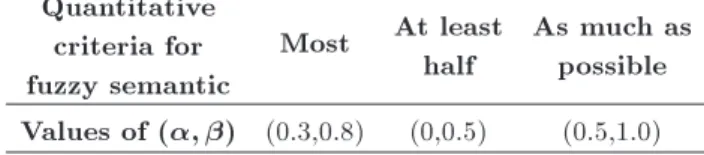
The parameters and in function Q are de-termined by the fuzzy linguistic quantitative rules according to Table 1.
2. The method proposed by Wang and Xu [42] is as follows:
!i+1= C i n 1
2n 1 i = 0; 1; ; n 1: (41)
Table 1. Relation between the fuzzy linguistic quantitative rules and values of the parameters.
Quantitative criteria for fuzzy semantic
Most At least half
As much as possible Values of (; ) (0.3,0.8) (0,0.5) (0.5,1.0) The IVIFGEOWA operator has the following proper-ties:
1. Theorem 7 (monotonicity) Let (~a0
1; ~a02; ; ~a0n) and (~a1; ~a2; ; ~an) be two
collections of IVIFNs. If ~a0
j ~aj for all j =
1; 2; ; n, then: IVIFGEOWA(~a0
1; ~a02; ; ~a0n)
IVIFGEOWA(~a1; ~a2; ; ~an): 2. Theorem 8 (idempotency)
Let ~aj = ~a, j = 1; 2; ; n, then IVIFGEOWA
(~a1; ~a2; ; ~an) = ~a. 3. Theorem 9 (bounded)
The IVIFGEOWA operator lies between the max and min operators.
min(~a1; ~a2; ; ~an) IVIFGEOWA
max(~a1; ~a2; ; ~an): 4. Theorem 10 (commutativity)
Let (~a0
1; ~a02; ; ~a0n) and (~a1; ~a2; ; ~an) be two
collections of IVIFNs, and (~a0
1; ~a02; ; ~a0n) is any
permutation of (~a1; ~a2; ; ~an), then:
IVIFGEOWA (~a0
1; ~a02; ; ~a0n)
= IVIFGEOWA(~a1; ~a2; ; ~an):
Similarly, some special cases of the IVIFGEOWA operator with respect to the parameter are discussed as follows:
1. If = 1, then the IVIFGEOWA operator (Eq. (37)) will be reduced to the Interval-Valued Intuitionistic Fuzzy Einstein Ordered Weighted Averaging (IV-IFEOWA) operator, which is shown as follows:
IVIFEOWA (~a1; ~a2; ; ~an)
= !1~a(1)E!2~a(2)E E!n~a(n):
According to Eq. (38), we can obtain: IVIFEOWA(~a1; ~a2; ; ~an)
IVIFGEOWA(~a1; ~a2; ; ~an) =
0 B B B B B @ 2 6 6 6 6 6 4
2 Qn
j=1x !j
a(j)
n
Q
j=1y !j
a(j)
!1=
n
Q
j=1x !j
a(j)+ 3
n
Q
j=1y !j
a(j)
!1=
+ Qn
j=1x !j
a(j)
n
Q
j=1y !j
a(j)
!1=;
2 Qn
j=1x !j
b(j)
n
Q
j=1y !j
b(j)
!1=
n
Q
j=1x !j
b(j)+ 3
n
Q
j=1y !j
b(j)
!1=
+ Qn
j=1x !j
b(j)
n
Q
j=1y !j
b(j)
!1=
3 7 7 7 7 7 5; 2
6 6 6 6 6 4
n
Q
j=1z !j
c(j)+ 3
n
Q
j=1t !j
c(j)
!1= n
Q
j=1z !j
c(j)
n
Q
j=1t !j
c(j)
!1=
n
Q
j=1z !j
c(j)+ 3
n
Q
j=1t !j
c(j)
!1= + Qn
j=1z !j
c(j)
n
Q
j=1t !j
c(j)
!1=;
n
Q
j=1z !j
d(j)+ 3
n
Q
j=1t !j
d(j)
!1= n
Q
j=1z !j
d(j)
n
Q
j=1t !j
d(j)
!1=
n
Q
j=1z !j
d(j)+ 3
n
Q
j=1t !j
d(j)
!1= + Qn
j=1z !j
d(j)
n
Q
j=1t !j
d(j)
!1= 3 7 7 7 7 7 5
1 C C C C C
A; (38)
where:
xaj = (2 aj)+ 3aj; yaj = (2 aj) aj; xbj = (2 bj)+ 3bj; ybj = (2 bj) bj;
zcj = (1 + cj)+ 3(1 cj); tcj = (1 + cj) (1 cj); zdj = (1 + dj)+ 3(1 dj);
tdj = (1 + dj) (1 dj):
Box III
= 0 B B @ 2 6 6 4
n
Q
j=1(1 + a(j)) !j Qn
j=1(1 a(j)) !j
n
Q
j=1(1 + a(j)) !j+ Qn
j=1(1 a(j)) !j
;
n
Q
j=1(1 + b(j)) !j Qn
j=1(1 b(j)) !j
n
Q
j=1(1 + b(j)) !j + Qn
j=1(1 b(j)) !j
3 7 7 5 ;
2 6 6 4
2 Qn
j=1c !j
(j) n
Q
j=1(2 c(j)) !j + Qn
j=1c !j
(j)
;
2 Qn
j=1d !j
(j) n
Q
j=1(2 d(j)) !j+ Qn
j=1d !j
(j)
3 7 7 5
1 C C
A : (42)
2. If ! 0, then the IVIFGEOWA operator (Eq. (37)) will be reduced to the Interval-Valued Intuitionistic Fuzzy Einstein Ordered Weighted Geometric (IV-IFEOWG) operator, which is shown as follows:
IVIFEOWG(~a1; ~a2; ; ~an)
= ~a!1
(1)E~a!(2)2 E E~a!(n)n :
According to Eq. (38), we can obtain: IVIFEOWG(~a1; ~a2; ; ~an)
= 0 B B @ 2 6 6 4
2 Qn
j=1a !j
(j) n
Q
j=1(2 a(j)) !j + Qn
j=1a !j
(j)
;
2 Qn
j=1b !j
(j) n
Q
j=1(2 b(j)) !j + Qn
j=1b !j
(j)
3 7 7 5 ;
2 6 6 4
n
Q
j=1(1 + c(j)) !j Qn
j=1(1 c(j)) !j
n
Q
j=1(1 + c(j)) !j+ Qn
j=1(1 c(j)) !j
;
n
Q
j=1(1 + d(j)) !j Qn
j=1(1 d(j)) !j
n
Q
j=1(1 + d(j)) !j+ Qn
j=1(1 d(j)) !j
3 7 7 5
1 C C A :
(43) We have discussed two interval-valued intuitionistic fuzzy Einstein operators, i.e. the IVIFGEWA and IVIFGEOWA. They have their own characteristics; the IVIFGEWA operator weights only the IVIFN, and IVIFGEOWA operator weights only each IVIFN by their ordered positions. In the real decision-making, we need to consider these two weighted modes because they represent dierent aspects of decision making problems. However, each operator considers only one of them. In order to overcome these shortcomings, hybrid averaging operator based on Einstein operations is given as follows.
Denition 13. Let ~aj = ([aj; bj]; [cj; dj]) (j =
1; 2 ; n) be a collection of the IVIFNs, and IVIFGEHWA : n! , if:
IVIFGEHWA(~a1; ~a2; ; ~an) =nE j=1
!j~s(j)
1=
; (44) where is the set of all IVIFNs, and > 0. ! = (!1; !2; ; !n)T is the weighted vector associated
with IVIFGEHWA, such that !j > 0 and Pnj=1
!j = 1. w = (w1; w2; ; wn) is the weight vector of
~aj(j = 1; 2; ; n), and wj 2 [0; 1]; Pnj=1 wj = 1.
Let ~sj = nwj~aj =
[_aj; _bj]; [ _cj; _dj]
, n is the ad-justment factor. Suppose ((1); (2); ; (n)) is a permutation of (1; 2; ; n), such that ~s(j 1) ~s(j)
for any j, and then function IVIFGEHWA is called the Interval-Valued Intuitionistic Fuzzy Generalized Einstein Hybrid Weighted Averaging (IVIFGEHWA) operator.
Based on the Einstein operational rules of the IVIFNs, we can derive the result shown as Theorem 11.
Theorem 11. Let ~aj = ([aj; bj]; [cj; dj]) (j =
1; 2 ; n) be a collection of the IVIFNs, and > 0, then, the result aggregated from Denition 13 is still an IVIFN, and even can be expressed in Eq. (45) as shown in Box IV. The proof is similar to Theorem 2, so it is not repeated here.
Theorem 12. The IVIFGEWA and IVIFGEOWA operators are the special cases of the IVIFGEHWA operator.
It is easy to prove that when:
W =
1 n;
1 n; ;
1 n
;
the IVIFGEHWA operator will reduce to IVIFGEOWA operator, and when:
! =
1 n;
1 n; ;
1 n
;
the IVIFGEHWA operator will reduce to IVIFGEWA operator.
From Denition 13, we can know that the IV-IFGEHWA operator rstly weights the given dada, and then reorders the weighted values in descending order and weights these ordered data. Therefore, the IVIFGEHWA operator can reect the importance degrees of both the given data and their ordered positions.
4. Multiple attribute group decision making methods based on generalized Einstein aggregation operators
In this section, we will use these generalized Einstein aggregation operators to the Multiple Attribute Group Decision Making (MAGDM) problems where the at-tribute values are the interval-valued intuitionistic fuzzy information.
4.1. Description of the decision making problems
For the MAGDM problems, let A = fA1; A2; ; Amg
be the collection of alternatives, C = fC1; C2; ; Cng
be the collection of attributes, and E = fe1; e2; ; eqg
be the collection of decision-makers. Suppose that ~ak
ij = ([akij; bkij]; [ckij; dkij]) is an attribute value for the
alternative Ai with respect to the attribute Cj given
by the decision-maker ek. w = (w1; w2; ; wn) is the
weight vector of attribute set C = fC1; C2; ; Cng,
and wj 2 [0; 1], n
P
j=1wj= 1. = (1; 2; ; q) is the
weight vector of decision-makers fe1; e2; ; eqg, and
k2 [0; 1], q
P
IVIFGEHWA(~a1; ~a2; ; ~an) =
0 B B B B B @ 2 6 6 6 6 6 4
2 Qn
j=1_x !j
a(j)
n
Q
j=1_y !j
a(j)
!1=
n
Q
j=1_x !j
a(j)+ 3
n
Q
j=1_y !j
a(j)
!1=
+ Qn
j=1_x !j
a(j)
n
Q
j=1_y !j
a(j)
!1=;
2 Qn
j=1_x !j
b(j)
n
Q
j=1_y !j
b(j)
!1=
n
Q
j=1_x !j
b(j) + 3
n
Q
j=1_y !j
b(j)
!1=
+ Qn
j=1_x !j
b(j)
n
Q
j=1_y !j
b(j)
!1=
3 7 7 7 7 7 5; 2
6 6 6 6 6 4
n
Q
j=1_z !j
c(j)+ 3
n
Q
j=1_t !j
c(j)
!1= n
Q
j=1_z !j
c(j)
n
Q
j=1_t !j
c(j)
!1=
n
Q
j=1_z !j
c(j)+ 3
n
Q
j=1_t !j
c(j)
!1= + Qn
j=1_z !j
c(j)
n
Q
j=1_t !j
c(j)
!1=;
n
Q
j=1_z !j
d(j)+ 3
n
Q
j=1_t !j
d(j)
!1= n
Q
j=1_z !j
d(j)
n
Q
j=1_t !j
d(j)
!1=
n
Q
j=1_z !j
d(j)+ 3
n
Q
j=1_t !j
d(j)
!1= + Qn
j=1_z !j
d(j)
n
Q
j=1_t !j
d(j)
!1= 3 7 7 7 7 7 5
1 C C C C C
A; (45)
where:
_xaj = (2 _aj)+ 3_aj; _yaj = (2 _aj) _aj; _xbj =
2 _bj
+ 3_b j;
_ybj =
2 _bj
_b
j; _zcj = (1 + _cj)+ 3(1 _cj); _tcj = (1 + _cj) (1 _cj);
_zdj =
1 + _dj
+ 3(1 _dj); _tdj =
1 + _dj
(1 _dj); _aj =(1 + aj)
nwj (1 a
j)nwj
(1 + aj)nwj + (1 aj)nwj;
_bj =(1 + bj)
nwj (1 b
j)nwj
(1 + bj)nwj + (1 bj)nwj; _cj=
2cnwj
j
(2 cj)nwj + cnwj j
; _dj= 2d
nwj
j
(2 dj)nwj + dnwj j
: Box IV
4.2. The decision making method based on generalized Einstein hybrid weighted averaging operator
Step 1. Normalize the decision-making information. In general, there are two types for the at-tribute values: benet atat-tributes (I1) (the
bigger the attribute value is, the better it is), and cost attributes (I2) (the bigger the
attribute value is, the worse it is). In order to eliminate the impact of dierent types in the
attribute values, it is necessary to normalize the decision-making information.
We may transform the attribute values from cost type to benet type; in such a case, decision matrices Ak = [~ak
ij]mn (k =
1; 2; ; q) can be transformed into matrices Rk = [~rk
ij]mn (k = 1; 2; ; q), where ~rkij =
([uk
ij; ukij]; [fkij; fijk]).
~rk ij =
[uk
ij; ukij]; [fkij; fijk]
= 8 > > > > > > < > > > > > > :
[ak
ij; bkij]; [ckij; dkij]
for benet attribute Cj
[ck
ij; dkij]; [akij; bkij]
for cost attribute Cj
i = 1; 2; ; m; j = 1; 2; ; n: (46)
Step 2. Utilize the IVIFGEHWA operator: ~rij=uij; uij;
h fij; fij
i
= IVIFGEHWA ~r1
ij; ~rij2; ; ~rijq
; (47) to aggregate all the individual interval-valued intuitionistic fuzzy decision matrixes Rk =
[~rk
ij]mn (k = 1; 2; ; q) into the collective
decision matrix R = [~rij]mn. Step 3. Utilize the IVIFGEHWA operator:
~ri=
[uk
i; uki]; [fi; fi]
= IVIFGEHWA (~ri1; ~ri2; ; ~rin) ; (48)
to derive the collective overall preference val-ues ~r(i = 1; 2; ; m).
Step 4. Calculate the score function S(~ri) (i =
1; 2; ; m) of the collective overall values ~ri(i = 1; 2; ; m), and then rank all the
alternatives fA1; A2; ; Amg. When two
score functions S(~ri) and S(~rj) are equal, it is
necessary to calculate their accuracy functions H(~ri) and H(~rj), then we can rank them by
accuracy functions.
Step 5. Rank all the alternatives fA1; A2; ; Amg
and select the best one(s) by score function S(~ri) and accuracy function H(~ri).
Step 6. End.
5. An application example
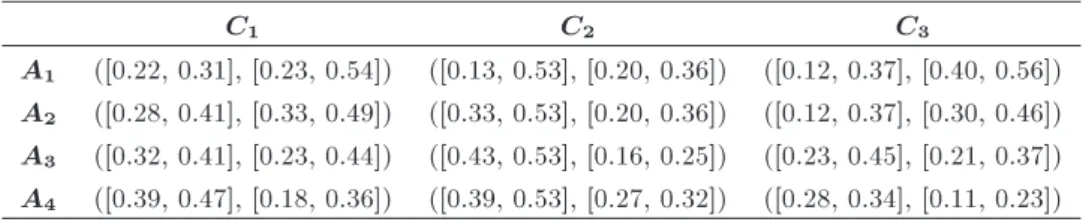
In order to demonstrate the application of the proposed method, we will cite an example about the air quality evaluation (adapted from [43]). To evaluate the air quality of Guangzhou for the 16th Asian Olympic Games held during November 12-27, 2010, the air quality in Guangzhou for the Novembers of 2006, 2007, 2008, and 2009 were collected in order to nd out the trends and to forecast the situation in November 2010. There are 3 air-quality monitoring stations (e1; e2; e3)
which can be seen as decision-makers, and their weight is (0:314; 0:355; 0:331)T. There are 3 measured indices,
namely SO2 (C1), NO2 (C2), and PM10 (C3), and
their weight is (0:40; 0:20; 0:40)T. The measured values
from air-quality monitoring stations under these indices are shown in Tables 2-4, and they can be expressed by interval-valued intuitionistic fuzzy numbers. Let (A1; A2; A3; A4) = fNovember of 2006, November of
Table 2. Air quality data from station e1.
C1 C2 C3
A1 ([0.22, 0.31], [0.23, 0.54]) ([0.13, 0.53], [0.20, 0.36]) ([0.12, 0.37], [0.40, 0.56])
A2 ([0.28, 0.41], [0.33, 0.49]) ([0.33, 0.53], [0.20, 0.36]) ([0.12, 0.37], [0.30, 0.46])
A3 ([0.32, 0.41], [0.23, 0.44]) ([0.43, 0.53], [0.16, 0.25]) ([0.23, 0.45], [0.21, 0.37])
A4 ([0.39, 0.47], [0.18, 0.36]) ([0.39, 0.53], [0.27, 0.32]) ([0.28, 0.34], [0.11, 0.23])
Table 3. Air quality data from station e2.
C1 C2 C3
A1 ([0.04, 0.21], [0.35, 0.46]) ([0.10, 0.34], [0.27, 0.45]) ([0.32, 0.37], [0.13, 0.20])
A2 ([0.32, 0.39], [0.27, 0.39]) ([0.03, 0.57], [0.30, 0.36]) ([0.16, 0.25], [0.14, 0.19])
A3 ([0.26, 0.37], [0.21, 0.40]) ([0.23, 0.43], [0.06, 0.15]) ([0.21, 0.35], [0.11, 0.29])
A4 ([0.30, 0.43], [0.19, 0.35]) ([0.28, 0.43], [0.31, 0.34]) ([0.39, 0.46], [0.01, 0.17])
Table 4. Air quality data from station e3.
C1 C2 C3
A1 ([0.25, 0.27], [0.23, 0.40]) ([0.17, 0.27], [0.26, 0.40]) ([0.21, 0.30], [0.17, 0.32])
A2 ([0.25, 0.29], [0.33, 0.39]) ([0.18, 0.46], [0.43, 0.50]) ([0.06, 0.21], [0.28, 0.30])
A3 ([0.22, 0.27], [0.27, 0.31]) ([0.13, 0.37], [0.16, 0.20]) ([0.11, 0.24], [0.14, 0.19])
2007, November of 2008, November of 2009g be the set of alternatives. The rank of air quality from 2006 to 2009 can be found as follows.
5.1. Rank the alternatives by the proposed method
To obtain the best alternative(s), the following steps are involved:
Step 1. Normalize the decision-making information. Since all the measured values are of the same type, they do not need normalization.
Step 2. Utilize the IVIFGEHWA operator expressed by Eq. (47) to aggregate all the individ-ual interval-valued intuitionistic fuzzy decision matrices Rk = [~rk
ij]43 (k = 1; 2; 3) into the
collective decision matrix R = [~rij]43. We
can obtain (suppose = 2, ! = (1 3;13;13)):
R = 2 6 6 6 6 6 6 6 6 6 6 6 6 6 6 6 6 6 6 6 6 6 6 6 6 6 4
([0:208; 0:275]; [0:264; 0:462]) ([0:141; 0:410]; [0:241; 0:400]) ([0:226; 0:350]; [0:207; 0:327]) ([0:285; 0:371]; [0:308; 0:420]) ([0:241; 0:523]; [0:294; 0:400]) ([0:119; 0:295]; [0:228; 0:297]) ([0:276; 0:360]; [0:235; 0:378]) ([0:311; 0:454]; [0:116; 0:196]) ([0:195; 0:366]; [0:148; 0:273]) ([0:339; 0:463]; [0:146; 0:383]) ([0:295; 0:503]; [0:255; 0:296]) ([0:332; 0:490]; [0:023; 0:153])
3 7 7 7 7 7 7 7 7 7 7 7 7 7 7 7 7 7 7 7 7 7 7 7 7 7 5 :
Step 3. Utilize the IVIFGEHWA operator expressed by Eq. (48) to derive the collective overall pref-erence values (suppose = 2, ! = (1
3;13;13)),
then we can obtain:
~r1= ([0:243; 0:426]; [0:225; 0:368]);
~r2= ([0:313; 0:486]; [0:261; 0:348]);
~r3= ([0:357; 0:461]; [0:153; 0:258]);
~r4= ([0:375; 0:525]; [0:092; 0:245]):
Step 4. Calculate the score function S(~ri)(i =
1; 2; 3; 4) of the collective overall values ~ri(i =
1; 2; 3; 4), then we can obtain: S(~r1) = 0:038; S(~r2) = 0:095;
S(~r3) = 0:203; S(~r4) = 0:282:
Step 5. According to the score function
S(~ri)(i = 1; 2; 3; 4), rank the alternatives
fA1; A2; A3; A4g shown as follows:
A4 A3 A2 A1:
Therefore, the best alternative is A4, i.e. the
best air quality in Guangzhou is November of 2009 among the Novembers of 2006, 2007, 2008, and 2009.
5.2. Inuence of the parameter on decision making result of this example
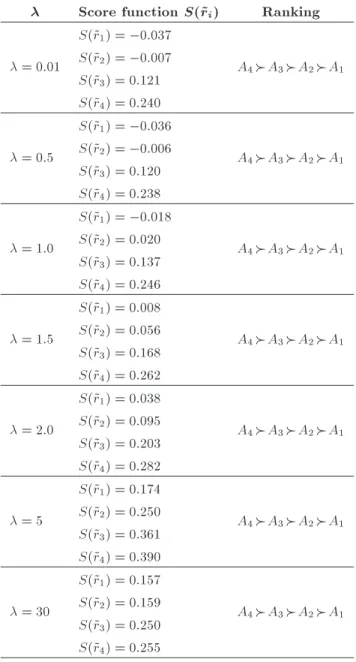
In order to illustrate the inuence of the parameter on decision making of this example, we use the dierent values of in Steps 2 and 3 to rank the alternatives. The ranking results are shown in Table 5.
Table 5. Ordering the alternatives by utilizing dierent values of .
Score function S(~ri) Ranking
= 0:01
S(~r1) = 0:037
A4A3A2A1
S(~r2) = 0:007
S(~r3) = 0:121
S(~r4) = 0:240
= 0:5
S(~r1) = 0:036
A4A3A2A1
S(~r2) = 0:006
S(~r3) = 0:120
S(~r4) = 0:238
= 1:0
S(~r1) = 0:018
A4A3A2A1
S(~r2) = 0:020
S(~r3) = 0:137
S(~r4) = 0:246
= 1:5
S(~r1) = 0:008
A4A3A2A1
S(~r2) = 0:056
S(~r3) = 0:168
S(~r4) = 0:262
= 2:0
S(~r1) = 0:038
A4A3A2A1
S(~r2) = 0:095
S(~r3) = 0:203
S(~r4) = 0:282
= 5
S(~r1) = 0:174
A4A3A2A1
S(~r2) = 0:250
S(~r3) = 0:361
S(~r4) = 0:390
= 30
S(~r1) = 0:157
A4A3A2A1
S(~r2) = 0:159
S(~r3) = 0:250
As we can see from Table 5, the aggregation results using the dierent aggregation parameter are dierent, but the orderings of the alternatives are the same in this example. In general, we can regard parameter as the attitude of decision makers; the more the value of parameter is, the more optimistic attitude is. In real decision making, we can select the specic parameter according to real decision making problem. Of course, we can take the values of the parameter = 1 for arithmetic aggregation operator, or ! 0 for geometric aggregation operator.
5.3. Comparing the proposed method with the other methods
In order to verify the eectiveness of the proposed method, we can compare it with the method by Yue [43] because the data of this example came from it. Firstly, it is easy to see that there are similar ranking results for two methods. Secondly, the aggregation operators used by Yue [43] are based on algebraic operations, and those in this paper are based on the generalized Einstein operations. Since the generalized Einstein operations for IVIFNs are with parameter , the method proposed in this paper is more general and more exible. In comparison with Einstein operators proposed by Wang and Liu [34,35], they are only the special cases of the proposed operators in this paper. When = 0 and the upper and lower limits of the membership and non-membership degrees in IVIFNs are equal, the generalized Einstein operations for IVIFNs proposed in this paper can be reduced to intuitionistic fuzzy geometric aggregation operators based on Einstein operations introduced by Wang and Liu [34]. Similarly, When = 1 and the upper and lower limits of the membership and non-membership degrees in IVIFNs are equal, the generalized Einstein operations for IVIFNs proposed in this paper can be reduced to intuitionistic fuzzy information aggregation using Einstein operations introduced by Wang and Liu [35], i.e. the operators proposed in this paper are the generalization of those proposed by Wang and Liu [34,35] by two aspects; one extension is from intuitionistic fuzzy numbers to interval-valued intuitionistic fuzzy numbers, the other extension is from the arithmetic aggregation operators or geometric aggregation operators based on Einstein operations to the generalized Einstein operations for IVIFNs. Obviously, the operators and methods proposed in this paper are more general. Of course, supercially, it is more complicated in calculation. However, in real applications, we rst need to assign the specic parameter ; then the calculation will be greatly simplied; for example, when parameter = 1 or ! 0, these operators will be simplied to arithmetic aggregation operator or geometric aggregation opera-tor.
6. Conclusion
In this paper, we explored some generalized Einstein aggregation operators based on IVIFNs and applied them to the multi-attribute group decision making problems where attribute values are the IVIFNs. Firstly, Interval-Valued Intuitionistic Fuzzy General-ized Einstein Weighted Averaging (IVIFGEWA) oper-ator, Interval-Valued Intuitionistic Fuzzy Generalized Einstein Ordered Weighted Averaging (IVIFGEOWA) operator, and Interval-Valued Intuitionistic Fuzzy Gen-eralized Einstein Hybrid Weighted Averaging (IV-IFGEHWA) operator were proposed. Some of their general properties such as idempotency, commutativ-ity, monotoniccommutativ-ity, and boundedness, were studied, and some special cases of them were analyzed. Further-more, a method to multi-criteria group decision making based on these operators was developed, and the operational processes were illustrated in detail. Finally, an illustrative example was given to show the decision steps of the proposed method and to demonstrate their eectiveness. In further research, it is necessary and signicant to give the applications of these operators to the other domains such as pattern recognition, fuzzy cluster analysis, uncertain programming, etc.
Acknowledgment
This paper is supported by the National Natural Science Foundation of China (Nos. 71471172 and 71271124), the Special Funds of Taishan Scholars Project of Shandong Province, National Soft Science Project of China (2014GXQ4D192), the Humanities and Social Sciences Research Project of Ministry of Education of China (No. 13YJC630104), and Shan-dong Provincial Social Science Planning Project (Nos. 11CGLJ02 and 15BGLJ06).
References
1. Zadeh, L.A. \Fuzzy sets", Information and Control, 8(3), pp. 338-353 (1965).
2. Atanassov, K.T. \Intuitionistic fuzzy sets", Fuzzy Sets and Systems, 20(1), pp. 87-96 (1986).
3. Atanassov, K.T. \More on intuitionistic fuzzy sets", Fuzzy Sets and Systems, 33(1), pp. 37-46 (1989).
4. Atanassov, K.T. and Gargov, G. \Interval-valued in-tuitionistic fuzzy sets", Fuzzy Sets and Systems, 31(3), pp. 343-349 (1989).
5. Atanassov, K.T. \Operators over interval-valued intu-itionistic fuzzy sets", Fuzzy Sets and Systems, 64(2), pp. 159-174 (1994).
6. Chen, S.M., Lee, L.W., Liu, H.C. and Yang, S.W. \Multiattribute decision making based on interval-valued intuitionistic fuzzy values", Expert Systems with Applications, 39(12), pp. 10343-10351 (2012).
7. Gomathi Nayagam, V.L., Muralikrishnan, S. and Sivaraman, G. \Multi-criteria decision making method based on interval-valued intuitionistic fuzzy sets", Ex-pert Systems with Applications, 38(3), pp. 1464-1467 (2011).
8. Liu, X.D., Zheng, S.H. and Xiong, F.I. \Entropy and subsethood for general interval-valued intuitionistic fuzzy sets", In Fuzzy Systems and Knowledge Discov-ery, Wang, L. and Jin, Y., Eds., pp. 42-52 (2005).
9. Wei, C.P., Wang, P., and Zhang, Y.Z. \Entropy, sim-ilarity measure of interval-valued intuitionistic fuzzy sets and their applications", Information Sciences, 181(19), pp. 4273-4286 (2011).
10. Zhang, H.M. and Yu, L.Y. \MADM method based on cross-entropy and extended TOPSIS with interval-valued intuitionistic fuzzy sets", Knowledge-Based Sys-tems, 30, pp. 115-120 (2012).
11. Wang, J.Q., Li, K.J. and Zhang, H.Y. \Interval-valued intuitionistic fuzzy multi-criteria decision-making ap-proach based on prospect score function", Knowledge-Based Systems, 27, pp. 119-125 (2012).
12. Xu, Z.S. and Yager, R.R. \Intuitionistic and interval-valued intuitionistic fuzzy preference relations and their measures of similarity for the evaluation of agreement within a group", Fuzzy Optimization and Decision Making, 8(2), pp. 123-139 (2009).
13. Wan, S.P. and Dong, J.Y. \A possibility degree method for interval-valued intuitionistic fuzzy multi-attribute group decision making", Journal of Com-puter and System Sciences, 80, pp. 237-256 (2014).
14. Wang, J.Q., Nie, R.R., Zhang, H.Y. and Chen, X.H. \Intuitionistic fuzzy multi-criteria decision-making method based on evidential reasoning", Applied Soft Computing, 13(4), pp. 1823-1831 (2013).
15. Wang, J.Q. and Zhang, H.Y. \Multi-criteria decision-making approach based on Atanassov's intuitionistic fuzzy sets with incomplete certain information on weights", IEEE Transactions on Fuzzy Systems, 21(3), pp. 510-515 (2013).
16. Liu, P.D. \Some Hamacher aggregation operators based on the interval-valued intuitionistic fuzzy num-bers and their application to group decision making", IEEE Transactions on Fuzzy Systems, 22(1), pp. 83-97 (2014).
17. Liu, P.D., Liu, Z.M. and Zhang, X. \Some intu-itionistic uncertain linguistic Heronian mean operators and their application to group decision making", Ap-plied Mathematics and Computation, 230, pp. 570-586 (2014).
18. Liu, P.D. and Wang, Y.M. \Multiple attribute group decision making methods based on intuitionistic lin-guistic power generalized aggregation operators", Ap-plied Soft Computing, 17, pp. 90-104 (2014).
19. Liu, P.D. \Some generalized dependent aggregation operators with intuitionistic linguistic numbers and their application to group decision making", Journal of Computer and System Sciences, 79(1), pp. 131-143 (2013).
20. Liu, P.D. and Jin, F. \Methods for aggregating intuitionistic uncertain linguistic variables and their application to group decision making", Information Sciences, 205, pp. 58-71 (2012).
21. Liu, P.D. \A weighted aggregation operators multi-attribute group decision-making method based on interval-valued trapezoidal fuzzy numbers", Expert Systems with Applications, 38(1), pp. 1053-1060 (2011).
22. Liu, P.D. and Liu, Y. \An approach to multiple attribute group decision making based on intuition-istic trapezoidal fuzzy power generalized aggregation operator", International Journal of Computational In-telligence Systems, 7(2), pp. 291-304 (2014).
23. Xu, Z.S. \Methods for aggregating interval-valued intuitionistic fuzzy information and their application to decision making", Control and Decision, 22(2), pp. 215-219 (2007).
24. Xu, Z.S. and Chen, J. \Approach to group decision making based on interval-valued intuitionistic judg-ment matrices", Systems Engineering - Theory and Practice, 27(4), pp. 126-133 (2007).
25. Xu, Z.S. and Chen, J. \On geometric aggregation over interval-valued intuitionistic fuzzy information", In Proceedings of the Fourth International Conference on Fuzzy Systems and Knowledge Discovery, Washington, DC, USA, IEEE Computer Society Press. pp. 466-471 (2007).
26. Wei, G.W. and Yi, W.D. \Induced interval-valued intuitionistic fuzzy OWG operator", In Proceedings of Fifth International Conference on Fuzzy Systems and Knowledge Discovery, Jinan, Shandong, October 18-20. pp. 605-609 (2008).
27. Yu, D.J., Wu, Y.Y. and Lu, T. \Interval-valued intuitionistic fuzzy prioritized operators and their ap-plication in group decision making", Knowledge-Based Systems, 30, pp. 57-66 (2012).
28. Zhao, H., Xu, Z.S., Ni, M.F. and Liu, S. \Generalized aggregation operators for intuitionistic fuzzy sets", International Journal of Intelligent Systems, 25(1), pp. 1-30 (2010).
29. Wang, J.Q., Han, Z.Q. and Zhang, H.Y. \Multi-criteria group decision-making method based on intu-itionistic interval fuzzy information", Group Decision and Negotiation, 23(4), pp. 715-733 (2014).
30. Wang, J.Q., Li, K.J., Zhang, H.Y. and Chen, X.H. \A score function based on relative entropy and its application in intuitionistic normal fuzzy multiple criteria decision making", Journal of Intelligent and Fuzzy Systems, 25(3), pp. 567-576 (2013).
31. Wang, J.Q., Zhou, P., Li, K.J., Zhang, H.Y. and Chen, X.H. \Multi-criteria decision-making method based on normal intuitionistic fuzzy-induced generalized aggre-gation operator", TOP, 22(3), pp. 1103-1122 (2014).
32. Xia, M.M., Xu, Z.S. and Zhu, B. \Some issues on intuitionistic fuzzy aggregation operators based on Archimedean t-conorm and t-norm", Knowledge-Based Systems, 31, pp. 78-88 (2012).
33. Yu, D.J. \Group decision making based on generalized intuitionistic fuzzy prioritized geometric operator", International Journal of Intelligent Systems, 27(7), pp. 635-661 (2012).
34. Wang, W.Z. and Liu, X.W. \Intuitionistic fuzzy geo-metric aggregation operators based on Einstein oper-ations", International Journal of Intelligent Systems, 26(11), pp. 1049-1075 (2011).
35. Wang, W.Z. and Liu, X.W. \Intuitionistic fuzzy infor-mation aggregation using Einstein operations", IEEE Transactions on Fuzzy Systems, 20(5), pp. 923-938 (2012).
36. Maris, F. and Iliadis, L. \A computer system using two membership functions and t-norms for the calculation of mountainous watersheds torrential risk: The case of lakes trixonida and lisimaxia eco- and ground bio-engineering: The use of vegetation to improve slope stability", Developments in Plant and Soil Sciences, A. Stokes, I. Spanos, J.E. Norris, and E. Cammeraat, Eds. Springer, Netherlands, 103, pp. 247-254 (2007).
37. Xu, Z.S. and Xia, M.M. \Induced generalized intu-itionistic fuzzy operators", Knowledge-Based Systems, 24(2), pp. 197-209 (2011).
38. Roychowdhury, S. and Wang, B.H. \On generalized Hamacher families of triangular operators", Interna-tional Journal of Approximate Reasoning, 19(3-4), pp. 419-439 (1998).
39. Deschrijver, G. and Kerre, E.E. \A generalization of operators on intuitionistic fuzzy sets using triangular norms and conforms", Notes Intuition Fuzzy Sets, 8, pp. 19-27 (2002).
40. Beliakov, G., Pradera, A. and Calvo, T., Aggregation Functions: A Guide for Practitioners, Springer, Hei-delberg, Berlin, New York (2007).
41. Herrera, F., Herrera-Viedma, E. and Chiclana, F. \Multi-person decision-making based on multiplicative preference relations", European Journal of Operational Research, 129(2), pp. 372- 385 (2001).
42. Wang, Y. and Xu, Z.S. \A new method of giving OWA weights", Mathematics in Practice and Theory, 38(3), pp. 51-61 (2008).
43. Yue, Z.L. \Deriving decision maker's weights based on distance measure for interval-valued intuitionistic fuzzy group decision making", Expert Systems with Applications, 38(9), pp. 11665-11670 (2011).
Biographies
Peide Liu (China, 1966) received the BS and MS degrees in signal and information processing from Southeast University, Nanjing, China, in 1988 and 1991, respectively, and the PhD degree in information management from Beijng Jiaotong University, Beijing, China, in 2010. He has authored or coauthored more than 90 publications, and is an Associate Editor of Journal of Intelligent and Fuzzy Systems, a member of Editorial Board of Technological and Economic Development of Economy, the Scientic World Journal, and so on. His research interests include aggregation operators, fuzzy logic, fuzzy decision making, and their applications.
Yanhua Li (China, 1972) obtained her Doctoral degree in Technological Economics from Tianjin Uni-versity. Now, she is Vice-Dean of School of Economics and Management in Civil Aviation University of China, and Director of the Research Institute of Aviation Industry. She has authored or coauthored more than 20 publications. His main research elds are aviation transport economics and management, decision sup-port, production and operation management.
Yubao Chen (China, 1963) obtained his MBA degree in School of Management in Northwestern Polytechni-cal University, and obtained his Bachelor's degree in Department of Economics in Nanjing University. Now, he is Dean of School of Economics and Management in Civil Aviation University of China. He has authored or coauthored more than 20 publications. His main research elds are decision support, technology and information management, production and operation management.