ISSN: 2252-8938, DOI: 10.11591/ijai.v9.i2.pp310-316 310
A general framework of genetic multi-agent routing protocol for
improving the performance of MANET environment
Mustafa Hamid Hassan, Mohammed Ahmed Jubair, Salama A. Mostafa, Hazalila Kamaludin,Aida Mustapha, Mohd Farhan Md. Fudzee, Hairulnizam Mahdin
Faculty of Computer Science and Information Technology, Universiti Tun Hussin Onn Malaysia, Johor, Malaysia
Article Info ABSTRACT
Article history: Received Jan 30, 2020 Revised Apr 20, 2020 Accepted Apr 29, 2020
These days, the fields of Mobile Ad hoc Network (MANET) have provided increasing prevalence and consequently, MANET is now a subject of considerable significance for the researchers to instigate research activities. MANET is the collaborative commitment of an assemblage of portable (or mobile) hubs (or nodes) without the necessary mediation of any unified (or centralized) gateway (or access point) or existent framework. There exists a growing inclination or course to embrace MANET for business utilization. MANET is a rising domain of research to give different services in communication to end-clients or consumers. However, these communication services of MANET utilize a large amount of transfer speed (or bandwidth) and a huge measure of web speed. Bandwidth optimization is essential in different information interchanges for fruitful acknowledgement and the application of such a technological innovation. This paper integrates the Genetic Algorithm (GA) and the Multi-Agent System (MAS) to improve the QoS requirements. The proposed framework called Genetic Multi-Agent Routing Protocol (GMARP). The aims of the proposed framework are to utilize the benefits of both approaches in order to fulfil QoS such as (delay, bandwidth, and the number of hops) in the different types of routing conventions (or protocols) such as being (proactive and reactive). In this paper is a simulation scenario to demonstrate the ability of the proposed framework to be satisfied with QoS requirements.
Keywords: Bandwidth Delay
Genetic algorithm Mobile Ad-hoc network Multi-agent system
This is an open access article under the CC BY-SA license.
Corresponding Author: Salama A. Mostafa
Faculty of Computer Science and Information Technology, Universiti Tun Hussein Onn Malaysia (UTHM),
86400, Parit Raja, Batu Pahat, Johor, Malaysia. Email: [email protected]
1. INTRODUCTION
The rise of mobile computational gadgets and wireless (or remote) correspondence innovation as of late has brought about the quick development in the quantity of portable terminal clients. A MANET is a multi-hop remote system in which the system segments, for example, PCs, individual computerized associates and remote telephones are portable [1-3]. Generally, the hubs inside the MANET fill in as routers. While relaying with different hubs, these hubs meander unreservedly. The utilization of MANET is increasingly appropriate in instances of inaccessibility of infrastructure and/or additionally costly sending of hub portability. The MANET can be utilized in the development of a cheap and economical system at any place, as it is efficient and needs no specific gateways or hubs. It is viewed as a decent alternative for application in systems in circumstances of crisis or catastrophes. Furthermore, the hubs present in MANETs
can speak with one another without a manager, as a result of the existence of a disseminated control framework [4-6].
Regardless of the benefits associated with MANET, it additionally has a few constraints which do not exist in fixed systems. For example, the versatility of hubs brings about steady alterations in the topology of the network, in this way resulting in a high transmission of data in the system. Other restrictions of the MANET are the little limit of batteries and constrained data transfer capacity for remote channels. Once more, communication may get unrealizable and the QoS may deteriorate because of information get to that is centred on a solitary point. MANET disseminates important and real-time information to the nodes such as weather information, transit systems, internet access, mobile e-commerce, and other multimedia applications. Most of these applications or systems demand a huge bandwidth capacity and a large measure of internet speed so that users can communicate among themselves. Most of the previous research on ad hoc networking has been done using exist many techniques of bandwidth optimization in MANET. MANETs in recent times have become the choice wireless network due to the numerous advantages it proffers. In a wired system, the accessible data transfer capacity estimation is carried out utilizing a functioning estimation procedure [7-9]. This procedure is inappropriate for MANET since it utilizes test packets when estimating the accessible data transfer capacity present for the source and destination. On the possibility that the quantity of sources to destination pair is sufficiently huge, it will bring about sending more test packets which thus expends a lot of bandwidth.
Sarr et al. [10] propose an available bandwidth-based flow affirmation (or admission) control (ABE) calculation for a remote network. Estimation of the accessible transmission capacity is carried out by utilizing the remote channel detecting mechanism. The drawbacks of this technique are when there is an increment in the information traffic load inside a system, the only factor considered is the additional back-off overhead. Other important factors, the collision likelihood is calculated without regarding the hidden and exposed node causing unnecessary delay. An improved available bandwidth (IAB) has been proposed by Zhao et al. [11]. This protocol estimates the available bandwidth of a giving link for QoS support in a wireless ad-hoc network. It considers the synchronization between the source and the destination node by differentiating the busyness caused by the transmitting and receiving node from those caused by the sensing node. Furthermore, the work also improved the accuracy of estimating the overlapping probability of the idle time of two adjacent nodes. The drawback of this technique is also Collision probability is calculated without considering the hidden and exposed node causing unnecessary delay.
Cognitive passive estimation of accessible bandwidth (cPEAB) was proposed by [12]. This convention assesses the accessible data transfer capacity of a system in a covered WiFi condition. It considers the extra expense brought about by affirmation frames, which were not considered in both AAC and ABE, therefore assessing the accessible transmission capacity by estimating the extent of waiting and backoff delays, packet collision likelihood, affirmation postponement, and channel inactive time. Nam et al. [13] improved on the work of [7] by enhancing its algorithm to incorporate the retransmission system and back-off cost. The downside of this strategy is that the conflict window expense was not considered with an increase in information traffic load inside the system. However, more time delay and a big amount of packet drop are happening in many schemes like Leaky bucket and Token bucket. In the Token bucket method packet drop is happened less than the Leaky bucket but the time delay is relatively more than the Leaky bucket algorithm. So, in order to improve the performance of mobile ad hoc network (MANET) bandwidth optimization is highly desirable.in this work proposed framework called Genetic Multi-Agent Routing Protocol (GMARP). The aims of the proposed framework are to utilize the benefits of both approaches in order to fulfil QoS such as (delay, bandwidth, and a number of hops) in the different types of routing protocols like (proactive and reactive).
2. MATERIALS AND METHODS
2.1. Genetic algorithm
The evolution of Genetic algorithms (GA) was inspired by closely examining and replicating biological evolutions such as reproduction, recombination, and mutation. Over the years the genetic algorithm has become one of the most important methods for obtaining approximate solutions of optimization problems. GA works by letting the competing variables interact with one another to evolve a potential solution naturally. A large number of optimization problems of various types spanning diverse areas of engineering and natural sciences have been solved by the application of GA. The basic principles of GA were introduced, for the first time, by John Henry Holland [14] for solving practical optimization problems and are well documented [15-19]. The point of using a GA is to accomplish better outcomes via selection, hybrid, and transformation (or mutation). The accomplishment of any GA relies upon the blueprint of its
search controllers (or operators) including their suitable combination. There is a great deal of writing to enhance the viability of GA operators.
In a crossover operator, new strings are created by trading data among strings of mating pools. Numerous hybrid (or crossover) operators are present in the literature of GA. In many crossover operators, two strings are randomly selected from the mating pool and a few bits of the strings are traded between the strings. The two strings taking part in the crossover activity are referred to as parent strings and the subsequent strings are called offspring strings. Practically speaking, for crossover activity with the goal that a portion of the good strings might be protected all parents in the mating pool are not chosen. This is accomplished by choosing a fixed amount of parents from the mating pool. This is called the crossover likelihood.
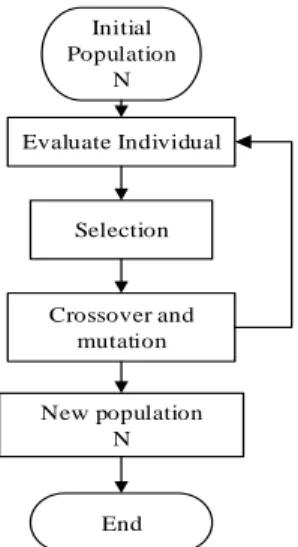
The transformation or mutation is applied to each child individually after crossover. This operator flips or modifies randomly at least one piece values at arbitrarily chosen areas in a chromosome with a small probability. This is not an assurance that global maxima will be achieved. In any case, notwithstanding brute force, GA does not ensure management of non-inconsequential issues. In any case, the chance of being attached to neighbourhood maxima at beginning stages is a problem that one would need to handle for example with a type of reproduced stimulating the rate of decay of mutation. GA takes time before reaching convergence. A nicely estimated populace and various breeds are vital before achieving expected outcomes. With high reproduction/simulation, a resolution will regularly take days to be figured out. Figure 1 shows the main steps of GA.
Figure 1. A basic procedure of GA
2.2. Multi-agent system
A Multi-Agent framework is portrayed as a lot of insightful specialists or agents that have a connection with one another inside a domain [20]. These agents work together to tackle issues that they can't settle autonomously [21]. Agents have such a large number of attributes which incorporate adjustment, self-governance, adaptability, responsiveness, appropriation and neighbourhood outlook or perspective In view of accomplishing a specific objective, the agents require to collaborate with one another [22-24]. MAS has distinctive application areas, and some of them incorporate aeroplane support or conservation, web agents, observation, ecological check and observations, medical services, military demining, control of spacecraft and industrial control [24-25].
The reason why these agents are used in the kind of systems is to improve: 1. the speed performance and efficiency,
2. the flexibility and scalability of the operations, and 3. the reusability of the system modules.
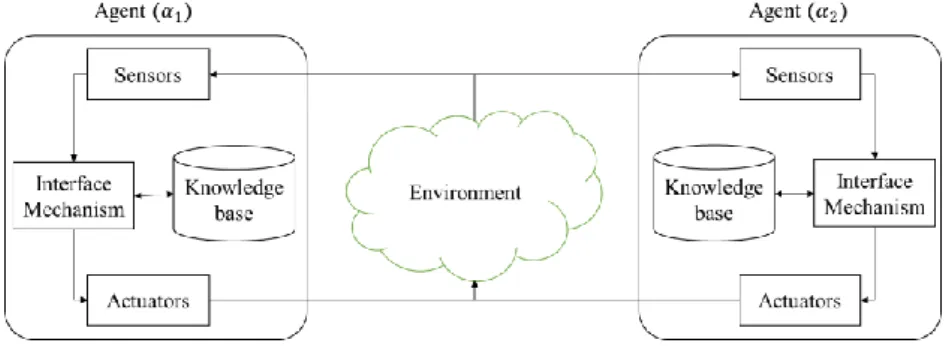
The multi-agents have been used by many researchers to propose different systems based on dynamic routing. For the most part, an agent is an autonomous element that completes single or numerous undertakings in order to achieve a few objectives. In the networking area, an agent works constantly regardless of whether clients disengage from the system. While a few agents run on standardized platforms, some others operate in servers dedicated for such. Figure 2 depicts a simple example of a MAS.
Initial Population
N Evaluate Individual
Selection
Crossover and mutation
New population N
Figure 2. A Multi-Agent System
2.3. Genetic algorithm based multi-agent system
Generally, MANET is an assortment of hubs that interface between one another without a framework, there are various sorts of routing conventions that are employed to establish the path between nodes in MANET, there are three main kinds of routing protocols; reactive, proactive and hybrid [20]. All of them create the path based on two kinds of messages; Route Request (RREQ) and Route Reply (RREP). The RREQ used to find all hubs/nodes in the network. Then again, all potential paths between source and destination hubs are found via the RREP message. In the reactive routing protocol, the path choice is relay on the minimum delay rather than other parameters like energy, and bandwidth. Otherwise, the proactive routing protocol depends on the shortest path without care to other parameters. These mechanisms achieved a good result; however, it still required more improvement due to other parameters like; bandwidth and energy. This paper employs one of the most popular optimization algorithms that achieved many successes in several domains (like ref), this algorithm is called the Genetic Algorithm (GA). The fundamental GA architecture incorporates chromosome depiction, fitness function, selection, crossover and change operators. GAs initially represents it as an assortment of individually named chromosomes by an encoding scheme. As indicated by the probabilities of crossover and transformation/mutation, these chromosomes are iteratively chosen to produce new chromosomes by crossover and mutation operators. In the interim, all chromosomes compete with one another via a quality measure known as fitness in every alteration cycle. Since crossover and mutation are the operators to create new chromosomes and the probability of the occurrence of a crossover is typically much larger than that of a mutation, the crossover operator constitutes the core operation in GAs. However, GA still suffering from several problems:
Global maxima accomplishment is not guaranteed by GA. GA does not ensure management of non-inconsequential issues.
The chance of being fixed to nearby maxima at starting stages is a problem that requires handling for example with a type of simulated galvanizing rate of mutation decay.
GA takes time before reaching convergence.
An adequately estimated populace and various breeds are fundamental preceding accomplishing expected outcomes. With powerful simulation, several days pass before solutions are achieved.
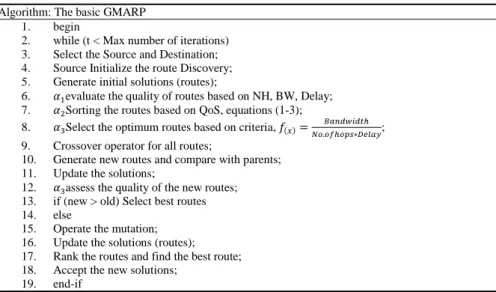
To overcome these issues, the Multi-Agent System (MAS) is present to integrate with GA to tackle the aforementioned problems. The MAS is a new technique that applied in different domains and achieves a promising result. In this paper, the GA and MAS (GMARP) will be merged to propose a new framework that used to improve the routing process in MANET. The path selection mechanism will be relay on three QoS parameters such, Number of Hops (NH), Bandwidth (BW), and Delay. The following algorithm depicted the main steps of the GMARP framework.
Firstly, determine the source and destination hubs and the source hub communicate a RREQ to locate a particular destination, besides, the destination hub sends a RREP to the source, this procedure finds every conceivable path between the source and destination hubs. At that point, the GMARP saves all paths and assesses the nature or value of them by concentrating on three QoS metrics; NH, BW, and delay, moreover, it categorizes these paths dependent on high value or quality. In the end, it chooses the best path through which data is sent to the destination. In figuring out these metrics, the following formulas: (1-3) are respectively utilized. The paths are categorized by their quality to allow or facilitate the choice of the path; beginning with the path that accomplishes less NH, deferral or delay, and maximum BW. The following equations are used in calculating the best routes:
𝑁𝑜. 𝑜𝑓𝐻𝑜𝑝𝑠 = ∑𝑃𝑖=0𝑁𝐻𝑆𝐷 (1)
𝐵𝑊 =∑ 𝐵𝑊𝑚
𝑚 𝑗=1
ℎ (2)
𝐷𝑒𝑙𝑎𝑦 =∑𝑛𝑖=1𝑇𝑟𝑒𝑐𝑒𝑖𝑣𝑒−𝑇𝑠𝑒𝑛𝑡
ℎ ∗ 100% (3)
where 𝑆, 𝐷 denote the source and destination nodes respectively, 𝑃 refer to the number of paths, 𝑖,𝑛,
𝑗, 𝑚 denote the counter, 𝑇 represents the time and the number of nodes in the path is signified by ℎ. Algorithm: The basic GMARP
1. begin
2. while (t < Max number of iterations) 3. Select the Source and Destination; 4. Source Initialize the route Discovery; 5. Generate initial solutions (routes);
6. 𝛼1evaluate the quality of routes based on NH, BW, Delay;
7. 𝛼2Sorting the routes based on QoS, equations (1-3);
8. 𝛼3Select the optimum routes based on criteria, 𝑓(𝑥)=
𝐵𝑎𝑛𝑑𝑤𝑖𝑑𝑡ℎ 𝑁𝑜.𝑜𝑓ℎ𝑜𝑝𝑠∗𝐷𝑒𝑙𝑎𝑦;
9. Crossover operator for all routes;
10. Generate new routes and compare with parents; 11. Update the solutions;
12. 𝛼3assess the quality of the new routes;
13. if (new > old) Select best routes 14. else
15. Operate the mutation; 16. Update the solutions (routes); 17. Rank the routes and find the best route; 18. Accept the new solutions;
19. end-if
3. SIMULATION AND RESULTS 3.1. Example scenario
Accept a MANET contains 11 hubs/nodes, these nodes are connected with each other with different parameters (QoS). A few paths may be present between the source hub, 𝑆 and the destination hub, 𝐷. The path selection process in MAGA is relay on the values of three parameters (no. of hops, bandwidth, and delay). Figure 3 presents an instance scenario of the system.
Figure 3. An example scenario
At the underlying stage, a RREQ broadcast is made by the source S node to acquire data about the accessible paths leading to the destination D. In the MAGA routing convention displayed in Figure 3 above, the path with the most transfer speed (or bandwidth), fewer bounces or hops, and deferral (or delay) is given more consideration as shown in Table 1.
Table 1. Routes details
No. Possible Route No. of hop Bandwidth Delay
1 S-1-4-7-D 4 52.5 7
2 S-2-4-7-D 4 55 7
3 S-2-5-8-D 4 57.5 6.7
4 S-2-4-5-7-8-D 6 55 6.5
5 S-2-3-5-9-D 5 64 6.4
6 S-3-6-9-D 4 80 4.5
7 S-3-5-7-8-9-D 6 55 5.5
8 S-3-5-8-D 4 65 6
9 S-3-6-8-D 4 70 6
10 S-1-2-3-6-8-D 6 71.7 6.7
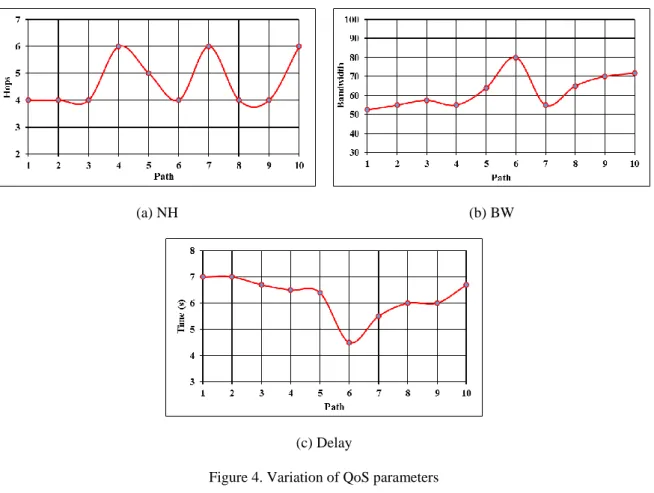
The variation of the NH, BW and Delay for all paths that presented in Table 1 are depicted in Figure 4. Based on Figure 4(a) there are various routes are discovered from the source to the destination nodes to send the data packet, each path has a different number of hops. Otherwise, the bandwidth for each path is shown in Figure 4(b). Finally, the variation of delay is depicted in Figure 4(c). These Figures are used to facilitate the monitoring process.
(a) NH (b) BW
(c) Delay
Figure 4. Variation of QoS parameters
4. CONCLUSION
A MANET is a collection of remote/wireless nodes that link together without infrastructure, each node in the network utilize as a sink to collect the data packets or a router to retransmit the data packets. MANET consider an efficient and reliable network for launching communication in a critical circumstance because it has several characteristics. The movement of the nodes are arbitrarily, and the network topology is changed dynamically. Numerous kinds of routing protocols in MANET are proposed, most of them under either reactive or proactive mechanism. However, the routing protocols still suffering from a different problem such as delay, energy consumption, bandwidth, and so on. This paper presented a new framework called Genetic Multi-Agent Routing Protocol (GMARP). The aims of the GMARP framework is to utilize the benefits of both approaches (GA and MAS) in order to fulfil QoS such as (number of hops, bandwidth, and
delay) in the different types of routing protocols like (proactive and reactive). The simulation scenario is present to show the ability of the proposed framework to be satisfied with QoS requirements.
ACKNOWLEDGEMENTS
The authors express appreciation to the Malaysia Ministry of Education (MoE) and Universiti Tun Hussein Onn Malaysia (UTHM). This research is supported by the Fundamental Research Grant Scheme (FRGS) grant vot number K216.
REFERENCES
[1] P. Joshi, et al., "Comparative Study of Different Routing Protocols for IEEE 802.15. 4-Enabled Mobile Sink Wireless Sensor Network." In Advances in VLSI, Communication, and Signal Processing, pp. 161-170. Springer, Singapore, 2020.
[2] K. Prabha, "Performance Assessment and Comparison of Efficient Ad Hoc Reactive and Proactive Network Routing Protocols." SN Computer Science 1, no. 1: 13, 2020.
[3] M. H. Hassan, et al., "Integrating African Buffalo Optimization Algorithm in AODV Routing Protocol for improving the QoS of MANET," Journal of Southwest Jiaotong University, 54 , 3 , 2019.
[4] M. A Jubair, et al., "Performance Evaluation of Ad-Hoc On-Demand Distance Vector and Optimized Link State Routing Protocols in Mobile Ad-Hoc Networks,". International Journal on Advanced Science, Engineering and Information Technology, 8(4), 1277-1283, 2018.
[5] M. A Jubair, et al., "Bat Optimized Link State Routing Protocol for Energy-Aware Mobile Ad-Hoc Networks,"
Symmetry, 11(11), 1409, 2019.
[6] M. A. Jubair et al., "Competitive analysis of single and multi-path routing protocols in mobile Ad-Hoc network,"
International Journal on Advanced Science, Engineering and Information Technology, Vol 19, No 1, 2020.
[7] H. Ziani, et al., "Mobility Condition to Study Performance of MANET Routing Protocols," In Emerging Technologies for Connected Internet of Vehicles and Intelligent Transportation System Networks, pp. 73-82. Springer, Cham, 2020.
[8] M. H. Hassan, et al., "Mobile Ad-Hoc Network Routing Protocols of Time-Critical Events for Search and Rescue Missions," Bulletin of Electrical Engineering and Informatics, 2020. In press.
[9] S. A. Mostafaet al., "Comparative Analysis to the Performance of Three Mobile Ad-Hoc Network Routing Protocols in Time-Critical Events of Search and Rescue Missions," International Conference on Applied Human Factors and Ergonomics, 2020. In press.
[10]C.Sarr, et al., "Bandwidth estimation for IEEE 802.11-based ad hoc networks," IEEE transactions on Mobile Computing, 7, 10, 1228-1241, 2008.
[11]H. Zhao, et al., "Accurate available bandwidth estimation in IEEE 802.11-based ad hoc networks," Computer Communications, vol. 32, no. 6, pp. 1050-1057, 2009.
[12]S. Tursunova, et al., "Cognitive passive estimation of available bandwidth (cPEAB) in overlapped IEEE 802.11 WiFi WLANs," IEEE Network Operations and Management Symposium-NOMS pp.448-454, IEEE, April, 2010. [13]N. V. Nguye, et al., "Retransmission-based available bandwidth estimation in IEEE 802.11-based multihop wireless
networks," In Proceedings of the 14th ACM international conference on Modeling, analysis and simulation of wireless and mobile systems, pp, 377-384, 2011.
[14]D. E.Goldberg and J. H. Holland, "Genetic algorithms and machine learning,"1988.
[15]M. A Mohammed, et al., "Solving vehicle routing problem by using improved genetic algorithm for optimal solution," Journal of Computational Science, 21, 255-262, 2017.
[16]M. A. Mohammed, et al., "Using genetic algorithm in implementing capacitated vehicle routing problem,"
International conference on computer & information science (ICCIS). IEEE. Vol. 1, pp. 257-262.
[17]A. S. Al-Khaleefa, et al., "Optimized authentication for wireless body area network. Journal of Telecommunication," Electronic and Computer Engineering (JTEC), 10(2), 137-142, 2018.
[18]M. A. Mohammed, et al., "An anti-spam detection model for emails of multi-natural language," Journal of Southwest Jiaotong University, 54(3), 2019.
[19]B. A Khalaf, et al., "Simulation Study of Syn Flood Attack in Cloud Computing Environment," REVISTA AUS 26-1, 2019.
[20]S. A Mostafa, et al., "A Multi-Agent Ad Hoc On-Demand Distance Vector for Improving the Quality of Service in MANETs," International Symposium on Agent, Multi-Agent Systems and Robotics (ISAMSR), IEEE, pp. 1-7, 2018. [21]S. N. Mansor, et al., "An emotional agent approach for online customer satisfaction surveys analysis," Int J Eng
Tech, 8, 227-233, 2019.
[22]M. A. Jubair, et al., " A Survey of Multi-Agent Systems and Case-Based Reasoning Integration," International Symposium on Agent, Multi-Agent Systems and Robotics (ISAMSR),IEEE, pp. 1-6, 2018.
[23]M. h. Hassan, et al., "A Statistical Risk Assessment Method of Dynamic Environments: A Case Study of Air Pollution," REVISTA AUS 26-1, 2020.
[24]A. B. A. Mosmana et al., "An automated attendance management method for football stadium attendance systems"
REVISTA AUS 26-1, 2019.
[25]M. H. Hassan et al., "A survey of multi-agent system approach in risk assessment," International Symposium on Agent, Multi-Agent Systems and Robotics (ISAMSR), IEEE, pp. 1-6, 2018.