Reliability and Failure Functions of the Consecutive
k
-out-of-
m
-from-
n
: F Linear and Circular System
Imad I. H. Nashwan
Faculty of Technology and Applied Science, Al Quds Open University, Palestine
Abstract: The consecutive k-out-of-m-from-n: F system consists of n linearly or circularly ordered components, it fails if, and only if among any m-consecutive components, there is at least k failed components. In this paper, a new algorithm to find the reliability and the failure functions of the consecutive k-out-of-m-from-n: F linear and circular systems is obtained.
Keywords: Consecutive k-out-of-n: F system, Consecutive k -out-of-m-from-n: F system, Modular arithmetic, Equivalent relation.
1.
Introduction
The consecutive k-out-of-n: F system models appeared in the last quarter of the last century, it had many generalizations and a wide applications area such as, the design of integrated circuits, microwave relay stations in telecommunications, oil pipeline systems, vacuum systems in accelerators, computer ring networks (k loop), and spacecraft relay etc., see [2-4], [7-8], [11-14], [17-18] and therein.
One of these generalization is the consecutive k-out-of-m -from-n: F system, where
1
k
m
n
, (sometimes called consecutive k-within m-out-of-n: F system or k -within-consecutive m-out-of-n: F system), it was formally introduced by Griffith [18] despite it has been mentioned by Tong [19]. It has two types, the linear and the circular systems; it consists of n linearly or circularly ordered components and fails if, and only if, there exist at least kfailed components among any m consecutive components. When k=m, it is a consecutive k-out-of-n: F system, while if
m=n, it is a k-out-of-n: F system. The system applied in many problems related to connection with tests for nonrandom clustering, quality control & inspection procedures, service systems, radar detection and the telecommunication system that uses n-bytes messages.
Sfakianakis et al. [10] studied the reliability of system when the components are i.i.d., Papastavridis and Koutras [15] provided an upper and lower bound of the reliability of the system, with unequal components failure probabilities, Habib and Szatai [1] improved these boundaries, Iyer [16] studied the distribution of the lifetime of the system with independent exponentially distributed components lifetime, while Higashiyama et al. [18] obtained a recursive algorithms for a linear and the circular types, for k=2, where the components are s-independent with unequal probabilities of failure, Malinowski and Preuss [5-6] studied the system and introduced a recursive algorithm for both, the linear and the circular system respectively.
In the second section, we recall and adapt the needed facts, and results from the set theory that is concerning relation between components, and used it to represent the consecutive
k-out-of-m-from-n: F circular system, which is helpful to determine the properties of its failure states. Next, we provide a definition of the collection of all failure and
functioning states, and compute the maximum number of failed components, whenever, the system is in the functioning state. In section 3, we make a projection of all relations and definitions of the circular type on to the linear one. In the fourth section, we proposed an algorithm to compute the reliability and the failure functions of the linear and circular consecutive k-out-of-n: F system, illustration example is provided also.
The following assumptions are assumed to be satisfied by all system bellow:
1.The state of the component and the system is either “functioning” or “failed”
2.All the components are mutually statistically independent. Also, we provide below, the notations and definitions that will be used throughout the article.
L(C) : Linear (circular)
i.i.d. : Independent and identically distributed
i j
I
i i, 1,...,j
1 i j n
1n
P I : The power set of 1
n
I .
1, 2,..., j
X x x x : a subset of 1
n
I , such that xi xhfor all 1 i h j n
n
f : The composite function
1 times, where mod 1:n n n
f x x xI
1 , 2 ,...,
X X X
X j
d d d d : The rotation of X
x x1, 2,...,xj
,where diX 1 is the minimum integer number such that
1X i
d
n i i
f x x , for i=1,2,…, j-1, and
1X j
d n j
f x x , such that
1 j
X i i
n d
.r X
d
1,...., , 1 ,...,
X X X X
j r j j r
d d d d
rZ, where
0 ,
j j s s
X X X X
d d d d
X : The complement of the set X.
X : The cardinality of the set X. , ~
: Equivalence relations
j
is
mod , if thenj
i s j i s nj i s j
i ip q :The reliability (unreliability) of the i
th
components
X i j j X i XR X F X p p q
, the reliability(unreliability) of the set X. s
n
p
, s n sp n s p q
2.
The
consecutive
k
-out-of-
m
-from-
n
:
F
circular system
Consider the circular consecutive k-out-of-m-from-n: F system, 1
n
I denotes the indices of the components, P
I1n is the failure space of the components. The set
11, 2,..., j n
X x x x I represents the system and consists of all indices of the failed components (For example in the consecutive 2-out-of-3-from-6: F circular system, the set
2, 4
X
, for simply, write it X 24, it means that the 2nd and the 4th components are only the failed component. Actually, X is a failure state, since; there are 2 failed components among the three consecutive components with indices 2, 3, and 4.Nashwan [9] define a symmetric property of a circular system using a bijection function : 1 1
n n n
f I I , and partitioned
1n
P I into finite mutually pairwise disjoint equivalence classes like
X
fn
X :
Z , where X Y if
n
f
X
Y
for some
Z
, where1. Y is a rotation of X, and written as X ~Y, if
1 nY P I such that dY D X
dXr :rI1j
. 2.X
Y
X
~
Y
i.e.
X
Y
.If X
x x1, 2,...,xj
I1n represents the consecutive k-out-of-m-from-n: F circular system, define X
X : 1
C i j
S S i I
where
2
0 j
k
X X
i i t t
S d
, X id is the number of steps to walk on the circle from xi to 1
j
i
x , hence X i
S is the total number of steps walk through k failed components (from xi to 1
j
i k
x ),
if X 1
i
S m , then there is at maximum m-1 steps (m
consecutive components), in other words, k failed components among m consecutive components, which leads to the failure state of the system.
Definition 2.1: Let X P
I1n represents the consecutive k -out-of-m-from-n: F circular system, X is called a failed set if there exists X Xi C
S S , such that X i
S m . Vice versa, it is called a functioning set if X
i
S m for all X X i C
S S .
In this context, the failure (functioning) space of the system
, , , ,
k m n k m n
C C
respectively is the collection of all failed (functioning) sets.
Lemma 2.1: Consider the consecutive k-out-of-m-from-n: F circular system, X Y, P
I1n such thatY
X
1. If X Ck m n, ,
Ck m n, ,
, then Y Ck m n, ,
Ck m n, ,
.2.
n
f X
R Y F Y p for some
Z
.3. If the components are i.i.d., then
Xn
R Y
R X
p
andF Y
F X
p
nX .Proof:
1.Assume k m n, , C
X , then there exists X X i C
S S , such that X
i
S m , let
Y
X
, then there exists 1j
r
I
such that , r Y Xd d , then Y X C C
S S , i.e. there exists Y Y
i C
S S , such that Y i
S m, then Y is a failed set. On the contrary, if k m n, ,
C
X , then X i
S m for all X X
i C
S S , and since
Y
X
, there existsr
I
1jsuchthat , r
Y X
d d , then Y X C C
S S , then then for all Y Y
i C
S S , Y
i
S m, hence k m n, , C
Y .
2.If
Y
X
, there exists
Z
, such thatY
f
n
X
n
Y f X
R Y p p . Also
n
Y f X
F Y p p
3.If the components are i.i.d., then
X
Y
, apply 2,
X Y
n n
R X p p R Y .
Example 2.1:
1245
3,4,9C , since S11245S21245 3 4and SC1245
3, 6 , moreover,
3,4,91245
1245,....,1259
C . While ,
1257
3,4,9C , since SC1257
4, 5 and all X Xi C
S S , such that X 4 i
S ,
3,4,91257
1257, 2368,...,1469
C .Notes:
1. According lemma 2.1, if C, ,
C, ,
k m n k m n
X ,
X iscalled failed (functioning) class, since all set Y
X is failed (functioning) set.2. Using lemma 2.1, classify these classes for a failed or functioning classes, hence, , ,
1 s k m n
C i
i
X
U
and
, ,
1
r k m n
C t s Xt
U
, then P
I1n Ck m n, , Uk m nC, , .3. Define the reliability of these classes is
Z
Z X Z X
X R Z p
R , and the failure function is
Z
Z X Z X
X F Z p
F .
Lemma 2.2: In the functioning consecutive k-out-of-m
-from-n: F circular system, the maximum possible number of failed components is MC
k 1
n m
sC where1 1
0 otherwise C
b m k b m k
s
: bnmodm
Proof: Let
1,...,
C
M
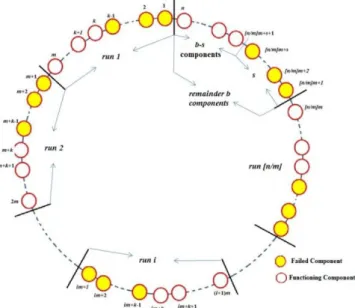
X x x represents the system, divide the circle by arcs, each arc consists of m consecutive components. To reach the maximum number of failed components on the circle that keeping the system in the functioning state, each arc has at maximum k-1 failed components, such that, the last failed component in any arc is away from the 1st failed component in the next arc is at least
Figure 1. The functioning consecutive k-out-of-m-from-n: F circular system.
If m divides n, then we have
n m
arcs, i.e.
1
C
M k n m , otherwise n
n m m b
where modmbn m , which implies that, b n
n m m
m, thenb
m
k
1
k
1
, see figure 1.Let sCthe number of failed components in the remainder b
components, then sC k 1 failed components, otherwise
the system fails, Note that MC
n m k
1
sCand thedistance from the 1st component in the 1st arc is far away from the last failed component in the remainder components is at least m-k +1 components, otherwise the system fails. i.e.
1 C
bs m k b m k 1 sC, which implies that
1 1
0 1 C
b m k b m k
s
b m k
3.
The consecutive
k
-out-of-
m
-from-
n
: F linear
system
The difference between the structure of the linear and the circular consecutive k-out-of-m-from-n: F system is the connection between the 1st and the nth components, which causes more failure states than that in the linear system, i.e.
, , , ,
k m n k m n
L C
. In this context, if X P
I1n represents the consecutive k-out-of-m-from-n: F linear system, and
1
1
:
X X
L i j k
S S iI where
2
0 k
X X
i i t t
S d
. The system fails if there exists X Xi L
S S , such that X i
S m, where condition iI1j k 1removes the effects of the connection between the 1st and the nth components, Recall example 2.1,
3,4,92389 1245 C , while
3,4,92389 L since
2389 1,5,1, 2
d and SL2389
6 4.In the next lemmas, our mission is to omit the extra failures states from k m n, ,
C
to achieve k m n, , L
.
Lemma 3.1: Consider the consecutive k-out-of-m-from-n: F linear system in the functioning state, then the maximum
number of failed component is
1
L L
M k n m s where 1 1
-1 L
k b k
s
b b k
and
mod
bn m.
Proof: Use the same technique of the proof in lemma 3.2, and open the circle between the 1st and the nth components, but the remainder has at maximum any k-1 failed components. Hence the remainder bnmodm at maximum has k-1 failed components if b k 1, otherwise b k 1, hence no matter the number of failed components in the remainder.
Lemma 3.2: Let
, , 1,...,k m n
j C
X x x represents the consecutive k-out-of-m-from-n: F circular system, then
, , k m n L
X , if X holds the following boundary conditions: 1. There exists X
i
S m for any i Ijj k 2. All X
i
S mfor all iI1j k 1.
Figure 2. The functioning consecutive k-out-of-m-from-n: F linear system.
4.
The proposed algorithm of the reliability
and failure functions of the consecutive
k
-out-of-
m
-from-
n
: F linear & circular
systems
If j is the total number of failed components in the consecutive k-out-of-m-from-n: F linear and circular system, then
1.For j=0,1, …, k-1, all states are functioning states, then
C n j
j n
n p j
R and C 0
j
F .
2.For each j=k,k+1,…, MC, determine the rotations
d d1, 2,....,dj
such that1 j
i i
n d
, and find thecorresponding set X and
X
fn
X :
Z
.3.Compute
1
:
X
C i j
S S iI .
4.If there exists Si SC, where Si m, then
k m n, ,C X , otherwise
k m n, ,C X .
5.For the linear system, separate all states from k m n, , C
that do not hold the boundary conditions of lemma 3.2. and 3.1., and add it to k m n, ,
L
6.For each
j
M
L C all states are a failure, thenC n j
j n n p j
F and C 0
j
R
7.Find FL Cj
RL Cj
, which is the failure (reliability) summation of the classes
X k m nL C , ,
k m nL C , ,
, whereX j .
8.The reliability function is 0 L C M L C j L C j
R R , while the
failure function is n
L C j L C
jk
F F .
Example 4.1: Find the failure and the functioning functions of the i.i.d. consecutive 3-out-of-4-from-8: F linear and circular system ML C
k 1
n m
sL C 2 2 0 4For j=3
123 3,4,8 3,4,8 124 3,4,8 3,4,8 125 3,4,8 1,1,6123 123, 234,345, 456,567,678,178,128 178,128
1, 2,5
124 124, 235,346, 457,568,167, 278,138 278,138
1,3, 4
125 125, 236,347, 458,156, 267,378,148 1, 4,3 C L C L L C d d d d
126 3,4,8 127 3,4,8 3,4,8 135 3,4,8 136126 126, 237,348,145, 256,367, 478,158 1,5, 2
127 127, 238,134, 245,356, 467,578,168 127, 238,168
2, 2, 4
135 135, 246,357, 468,157, 268,137, 248 2,3,3
136 136, 247,3
L C C L L C d d d
3,4,8 5 5 5 5
3 8 3 8 3 8 3 8
58,146, 257,368,147, 258
24 32 17 39
L C
C C L L
p p p p
F R F R
For j=4
1234 3,4,8 3,4,8 1235 3,4,8 3,4,8 1236 1,1,1,51234 1234, 2345,3456, 4567,5678,1678,1278,1238 1278
1,1, 2, 4
1235 1235, 2346,3457, 4568,1567, 2678,1378,1248 1378
1,1,3,3
1236 1236, 2347,3458,1456, 2567,
C L C L d d d
3,4,8 3,4,8 3678,1478,1258 1478,1258 C L
1237 3,4,8 3,4,8 1245 3,4,8 3,4,8 12461,1, 4, 2
1237 1237, 2348,1345, 2456,3567, 4678,1578,1268 1268
1, 2,1, 4
1245 1245, 2356,3467, 4578,1568,1267, 2378,1348 1267, 2378
1, 2, 2,3
1246 1246, 2357,3468,1457,
C L C L d d d
3,4,8 3,4,8 1247 3,4,8 3,4,8 3,4,8 1256 2568,1367, 2478,1358 2478,13581, 2,3, 2
1247 1247, 2358,1346, 2457,3568,1467, 2578,1368 1368
1,3,1,3 1256 1256, 2367,3478,1458 1,3, 2, 2
1257 1257, 2368,1347, 245
C L C L L C d d
3,4,8 3,4,8 3,4,8 13574 4 4 4
4 8 4 8 4 8 4 8
8,1356, 2467,3578,1468 1257, 2368
2, 2, 2, 2 1357 1357, 2468
64 6 52 18
C
L
L C
C C L L
d
p p p p
F R F R
For j=5, 6, 7, 8 all states are in the failure states, hence jL C 8 p88 j
j
F , and C
0
j
R
.8
5 4 3 2 1 0
8 8 8 8 8 8
3
1
8 7 6 5 4
8 8 8 8 8
0
8
5 4 3 2 1 0
8 8 8 8 8 8
3
1
8 7 6 5 4
8 8 8 8 8
0
24 64 56 28 8
8 28 32 6
24 64 56 28 8
8 28 40 18
C C j j n k C C j j L L j j n k L L j j
p p p p p p
p p p p p
p p p p p p
p p p p p
F F R R F F R R5.
Conclusions
This paper introduced an algorithm to find the reliability and the failure function of the consecutive k-out-m-from-n: F linear and circular systems, in this context, the algorithm determines the failure and the functioning space of the system (all failure and functioning states), where, the failure space of the linear system is a sub collection of the circular one. Moreover, the proposed algorithm computes the maximum number of failed components, whenever, the system is in the functioning state, whether in the linear or circular type.
References
[1]. A. Habib, and T. Szatai, “New bounds on the reliability of the consecutive k-out-of-r-from-n: F system”, Reliability Engineering and System Safety, Vol. 68, pp. 97–104, 2000. [2]. C. Derman, G.J. Lieberman, and S.M. Ross, “On the
consecutive k-out-of-n: F system”, IEEE Transactions on
Reliability, Vol. 31, pp. 57-63, 1982.
[3]. D. T.Chiang, and S. C. Niu, “Reliability of consecutive k -out-of-n: F system”, IEEE Transactions on Reliability, Vol. 30,
[4]. J. G. Shanthikumar, “Recursive algorithm to evaluate the reliability of a consecutive k-out-of-n: F system”, IEEE,
Trans. Reliability, Vol. 31, pp. 442-443, 1982.
[5]. J. Malinowski, and W. Preuss, “A recursive algorithm evaluating the exact reliability of a consecutive k-within-m -out-of-n: F system”. Microelectronics and Reliability, Vol.
35, pp. 1461-1465, 1995.
[6]. J. Malinowski, and W. Preuss, “A recursive algorithm evaluating the exact reliability of a circular consecutive k -within-m-out-of-n: F system”. Microelectronics and
Reliability, Vol. 36 (10), pp. 1389-1394, 1996.
[7]. J. S. Wu, and R. J. Chen, “An O(kn) algorithm for a circular consecutive k-out-of-n: F system”, IEEE, Trans. Reliability,
Vol. 41, No. 2, pp. 303-306, 1992.
[8]. I. Antonpoulou, and S. Papastavridis, “Fast recursive algorithm to evaluate the reliability of a circular consecutive
k-out-of-n: F system”, IEEE Trans. Reliability, Vol. 36, pp.
83-84, 1987.
[9]. I. I. H. Nashwan, “New algorithms to find the reliability and unreliability functions of the consecutive k-out-of-n: F linear and circular system”, The 16th
International Arab Conference on Information Technology, Jordan, pp. 1-9, 2015.
[10].M. E. Sfakianakis, S. Kounias, and A. Hillaris,” Reliability of a consecutive k-out-of-r-from-n: F system”, IEEE, Trans. Reliability, Vol.41, pp. 442-447, 1992.
[11].M. E. Sfakianakis, and S. G. Papastavridis” Reliability of a general consecutive k-out-of-n: F System”, IEEE
Transactions on Reliability, Vol. 42, pp. 491-496, 1993. [12].M. T. Chao, J. C. Fu and Koutras M. V. “Survey of reliability
studies of consecutive k-out-of-n: F and related system”, IEEE Transactions on Reliability, Vol. 44, No. 1, pp. 120-127, 1995.
[13].R. C. Bollinger, “An algorithm for direct computation in consecutive k-out-of-n: F Systems”, IEEE Trans.
Reliability, Vol. R-35, No. 5, pp. 611-612, 1986.
[14].R. C. Bollinger, “Direct computation for consecutive k
-out-of-n: F systems” IEEE Trans. Reliability, Vol. 31, No.5, pp.
444-446, 1982.
[15].S. G. Papastavridis, and M. V. Koutras, “Bounds for Reliability of consecutive k-within-m-out-of-n: F Systems”,
IEEE Trans. Reliability, Vol.42, pp. 156-160, 1993. [16].S. Iyer, “Distribution of the lifetime of consecutive k
-within-m-out-of-n: F systems”, IEEE Trans. Reliability, Vol. 41,
1992.
[17].W. Griffith, “On consecutive k-out-of-n failure systems and their generalizations,” Reliability and quality control, A.P. Basu (Editor), Elsevier (North-Holland), Amsterdam, pp. 157–165, 1986.
[18].Y. Higasiyama, H. Ariyoshi and M. Kaetzl, “Fast solution for the consecutive 2-out-of-r-from-n: F systems”, IEICE
Transaction Fundamentals Electronics Communication and Computer Sciences, Vol. E78A No. 6, pp.680-684, 1995. [19].Y. Tong, “A rearrangement inequality for the longest run with