About the Document
Justice organizations are looking for ways to provide secured access to multiple agency information systems with a single logon. The Global Federated Identity and Privilege Management (GFIPM) initiative, developed by the U.S. Department of Justice’s Global Justice Information Sharing Initiative, provides the justice community with a security and information sharing architecture that is based on an electronic justice credential. This standards-based justice credential can be used to securely connect law enforcement and public safety personnel to interagency applications and data over the Internet.
Background: The GFIPM framework provides the justice community and partner organizations with a standards-based approach for implementing federated identity. Common use of these standards across federation systems is essential to their interoperability. Leveraging the Global Justice XML and National Information Exchange Model (NIEM), a standard set of XML-based elements and attributes (referred to collectively as GFIPM metadata) about a federation user’s identities, privileges, and authentication can be universally communicated.
Value to the Justice Community:
1. User Convenience: Users can access multiple services using a common set of standardized security credentials, making it easier to sign on and access applications and to manage account information.
2. Interoperability: By specifying common security standards and framework, applications can adopt interoperable security specifications for authentication and authorization.
3. Cost-Effectiveness: GFIPM facilitates information sharing by using a standardized XML-based credential that includes information about each user’s identity and privileges. This reduces the cost and complexity of identity administration required to access applications and vet users.
4. Privacy: GFIPM can reduce the propagation of personally identifiable information, reduce the redundant capture and storage of personal identity information, and depersonalize data exchanges across domains using privacy metadata.
5. Security: A federation model can improve the security of local identity information and data in applications by providing a standardized approach to online identities between agencies or applications.
Contents: The GFIPM Implementation Guide contains detailed instructions for implementers of identity providers (IDPs) and service providers (SPs), which are the two types of systems that participate in user-to-system transactions as specified in the
GFIPM Web Browser User-to-System profile. The document covers all aspects of IDP and SP implementation, from requirements analysis to system deployment.
Target Audience: The target audience for this document includes managers and technical representatives of prospective GFIPM participant organizations who are planning to implement an identity provider (IDP) and/or a service provider (SP) within a GFIPM federation. It also includes vendors, contractors, and consultants who are required to establish technical interoperability with GFIPM standards as part of their project or product implementation.
Table of Contents
1. Introduction ... 1
1.1 GFIPM Background ... 1
1.2 About This Document ... 2
1.3 Target Audience ... 2
1.4 GFIPM Normative Technical Standards ... 3
1.5 Acknowledgements ... 4
1.6 References ... 4
2. Implementing an Identity Provider ... 5
2.1 Developing a GFIPM Information Sharing Plan for an IDP ... 5
2.1.1 Discover Federation Resources... 6
2.1.1.1 Survey Federation Resources ... 6
2.1.1.2 Determine Valuable Resources ... 9
2.1.1.3 Review Access Control Policies ... 10
2.1.2 Identify Local Users ... 10
2.1.3 Design User Metadata ... 12
2.1.4 Fill Out a Local Attribute Mapping Form ... 13
2.2 Submitting a Request for Federation Membership ... 16
2.3 Choosing an IDP Product ... 17
2.3.1 Shibboleth IDP ... 19
2.3.2 Ping Identity PingFederate IDP ... 19
2.3.3 CA Federation Manager IDP ... 19
2.3.4 Sun OpenSSO IDP ... 20
2.3.5 Oracle Identity Federation IDP ... 20
2.4 Implementing a GFIPM IDP ... 20
2.4.1 IDP Components ... 21
2.4.2 IDP Core Software Module ... 21
2.4.3 Web Servlet Container ... 22
2.4.4 IDP Integration Points ... 22
2.4.5 Web Single Sign-On System ... 22
2.4.6 Attribute Data Store ... 23
2.5 Writing an IDP Test Plan ... 23
2.6 Deploying an IDP in a Test Environment ... 25
2.7 Executing an IDP Test Plan ... 26
2.8 Deploying an IDP in an Operational Federation ... 26
3. Implementing a Service Provider ... 27
3.1 Developing a GFIPM Information Sharing Plan for an SP ... 28
3.1.1 Identify Local Resources ... 28
3.1.2 Determine Business Rules for Resources ... 29
3.1.3 Develop Access Control Rules ... 30
3.1.4 Fill Out Local Access Policy Mapping Form ... 30
3.2 Submitting a Request for Federation Membership ... 33
3.3 Choosing an SP Product ... 34
3.3.1 Shibboleth SP ... 35
3.3.2 Ping Identify PingFederate SP ... 36
3.3.3 CA Federation Manager SP ... 36
3.3.5 Oracle Identity Federation SP... 36
3.4 Implementing a GFIPM SP ... 37
3.4.1 SP Components ... 37
3.4.2 Web Server ... 38
3.4.3 SP Core Software Module ... 38
3.4.4 Protected Resource Integration Point ... 39
3.4.5 Optional GFIPM-Enabled Proxy/Portal Service ... 40
3.4.6 Protected Resources ... 42
3.5 Writing an SP Test Plan ... 43
3.6 Deploying an SP in a Test Environment ... 45
3.7 Executing an SP Test Plan ... 45
3.8 Deploying an SP in an Operational Federation ... 46
4. Implementing a Web Service Consumer ... 47
5. Implementing a Web Service Provider... 47
6. Additional Implementation Guidance ... 48
6.1 IDP Discovery Service ... 48
6.2 Web Browser Choices and Usage ... 49
6.3 GFIPM Enablement of Resources ... 50
6.3.1 Resource Integration Profiles ... 52
6.3.2 Resource Integration Techniques ... 54
6.3.3 Profiles and Techniques for Existing Resources ... 56
6.4 Shibboleth Implementation ... 58
6.4.1 Hardware Recommendations ... 58
6.4.2 Install Identity Provider ... 59
6.4.3 Install Service Provider ... 62
6.4.4 Known Issues ... 66
6.5 PingFederate Implementation ... 66
6.6 Testing SAML Interoperability ... 66
6.7 Implementing a Reverse Proxy Solution ... 67
6.8 Implementing an HTML Rewriting Solution ... 67
Appendix A: GFIPM Reference Federation ... 68
Appendix B: Acronyms ... 75
Table of Tables
Table 1: References for GFIPM-Specific Standards ... 5Table 2: Example of Local Attribute Mapping Form ... 15
Table 3: Integration Profiles and Integration Techniques for Resources in NIEF ... 57
Table of Figures
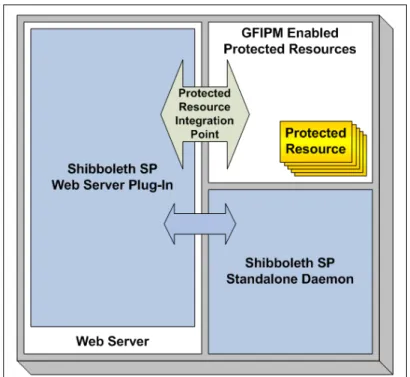
Figure 1: GFIPM Shibboleth Identity Provider Structure ... 21Figure 2: GFIPM Shibboleth Service Provider Structure ... 37
Figure 3: GFIPM Shibboleth Service Provider Structure With GFIPM-Enabled Proxy/Portal Service ... 41
1.
Introduction
This document comprises a collection of accumulated expertise and insights about how to implement information systems that are interoperable with a Global Federated Identity and Privilege Management (GFIPM) federation. It addresses four system implementation scenarios: identity provider, service provider, Web service consumer, and Web service provider. The remainder of this section provides introductory information about the GFIPM program and the scope of this document. Sections 2 through 5 provide guidance on each of the implementation scenarios listed above, and Section 6 contains additional insights not covered in previous sections.
1.1 GFIPM Background
The Global Federated Identity and Privilege Management (GFIPM) Security Interoperability Demonstration project was initiated in 2005 by the Global Security Working Group (GSWG) to investigate the concept of federated identity and privilege management (FIPM) as a candidate solution for information sharing interoperability challenges that have arisen in the law enforcement and justice community. Jointly funded by the Department of Justice (DOJ) and the Department of Homeland Security (DHS), the demonstration project successfully met all of the initial objectives and resulted in the creation of several valuable products, including a set of draft interoperability specifications, a freely available implementation of GFIPM middleware, and an operational pilot GFIPM federation. As a result of this success, the Global Justice Information Sharing Initiative (Global) recognized GFIPM as “the recommended approach for development of interoperable security functions for authentication and privilege management for information exchange among cross-domain justice information sharing systems.”1
The GSWG established a GFIPM Delivery Team (GFIPM DT) to evolve the initial GFIPM products and specifications into a fully vetted and production-quality capability that can be leveraged across federal, state, local, and tribal justice and public safety communities. The GFIPM DT currently acts as the governance body for a GFIPM pilot operational federation and for day-to-day decisions on developing the GFIPM implementation framework.
For purposes of this document, the term “operational federation” refers to a GFIPM-compliant federation that provides live data to authorized law enforcement users associated with a small number of “early adopter” organizations. This operational pilot federation is the National Information Exchange Federation (NIEF). NIEF allows law enforcement organizations to engage in the process of sharing controlled unclassified information (CUI) with each other in a cost-effective and scalable
manner. The Georgia Tech Research Institute (GTRI) is currently acting as the Federation Manager for NIEF with the GFIPM DT acting as the NIEF Board of Directors. (The roles of Federation Manager and Federation Board of Directors are defined in the GFIPM Governance Guideline document [GFIPM Gov].)
Additional information on Global and GFIPM can be found at
1.2 About This Document
The purpose of this document is to provide implementers with essential information and instructions on how to integrate information systems into a GFIPM federation such as NIEF. These systems may include existing user databases or directories, and/or various existing or planned databases, portals, or other mission information resources. The document provides an organized collection of knowledge and insights gained by the initial GFIPM implementers; it will evolve over time to capture additional best practices and insights as they are developed.2
Note that some of the key technologies used within GFIPM are relatively new open standards (e.g., OASIS SAML 2.0, WS-Security, and others). Given that most justice-community organizations will presumably be interested in integrating their existing, older legacy systems with these new technologies in a GFIPM federation, it is likely that they will encounter unique implementation challenges for which there is no established “best” solution. This document provides implementers with guidance based on initial experience, but it does not address all possible implementation scenarios. For the benefit of the entire GFIPM stakeholder community, implementers are encouraged to submit summaries of lessons learned during their GFIPM implementation process to be incorporated into future versions of this document.
1.3 Target Audience
The target audience for this document includes managers and technical representatives of prospective GFIPM participant organizations that are planning to implement an identity provider (IDP) and/or a service provider (SP) within a GFIPM federation.3 It also includes vendors, contractors, and consultants who are required to establish technical interoperability with GFIPM standards as part of their project or product implementation.
1.4 GFIPM Normative Technical Standards
The implementation guidance in this document pertains to the use of the following GFIPM normative technical standards.
• GFIPM Metadata Specification 2.0 [GFIPM Meta]—Defines
a vocabulary of attributes that can be used to describe facts about federated users and federated service endpoints. The GFIPM Metadata standard is an essential part of the GFIPM concept of federated identity and privilege management.
• GFIPM Cryptographic Trust Model 1.0 [GFIPM Trust]—
Defines a cryptographic trust model that provides a technical basis for all trusted communications between service endpoints in a GFIPM federation.
• GFIPM Web Browser User-to-System Profile 1.0 [GFIPM
U2S Profile]—Specifies technical interoperability requirements for connection to a GFIPM federation as an IDP or SP.4
• GFIPM Web Services System-to-System Profile 1.0
[GFIPM S2S Profile]—Specifies technical interoperability requirements for connection to a GFIPM federation as a Web service consumer (WSC) or Web service provider (WSP).5
Each of these standards is evolving. The maintainers of this Implementation Guide will make every attempt to keep its content up to date with respect to changes in the GFIPM technical standards, but in some cases this document may not reflect the most current implementation best practices.
Also note that the normative standards listed here do not cover non-IT topics such as governance, policy, or other nontechnical interoperability requirements.6 Please review [GFIPM U2S Profile] and/or [GFIPM S2S Profile] in conjunction with this document prior to beginning the on-boarding process.
4 Security Assertion Markup Language (SAML) 2.0 is a product of the Organization for the
Advancement of Structured Information Standards (OASIS) Security Services Technical Committee (SSTC).
5 The GFIPM Web Services System-to-System Profile is still in development, and this document does
not yet contain any implementation guidance related to GFIPM Web services. The document will be revised to include Web services implementation guidance after GFIPM early adopters have gained enough experience and lessons learned to provide such guidance.
1.5 Acknowledgements
The primary developer of this document was the Georgia Tech Research Institute (GTRI). Other contributors include the Criminal Information Sharing Alliance (CISA) and the Pennsylvania Justice Network (JNET). Specifically, the following individuals have made significant contributions to this document.
• John Wandelt—GFIPM Project Director, GTRI
• Stefan Roth—Research Scientist, GTRI
• Matt Moyer—GFIPM Technical Lead, GTRI
• Jeff Krug—Research Scientist, GTRI
• John Ruegg—Chair, GFIPM Delivery Team, and Global Security Working Group
• Glen Gillum—Executive Director, CISA
• James Dyche—Architecture Manager, JNET
1.6 References
The following documents or resources are referenced throughout this Implementation Guide. These documents describe companion standards or systems that may be used by GFIPM implementers.
Document ID Document Name and URL
GFIPM Map GFIPM Document Map
Available at GFIPM Terms GFIPM Terminology Matrix
Available at GFIPM Gov GFIPM Governance Guidelines
Available at
GFIPM OPP GFIPM Operational Policies and Procedures Available at
GFIPM Meta GFIPM Metadata Standard 2.0 Available at GFIPM Trust GFIPM Cryptographic Trust Model 1.0
Available at GFIPM U2S
Profile GFIPM Web Browser User-to-System Profile 1.0 Available at GFIPM S2S
Profile GFIPM Web Services System-to-System Profile 1.0 Available at SAML2 Security Assertion Markup Language (SAML) 2.0
GFIPM Demo GFIPM Security Interoperability Demonstration Project Final Report, Georgia Tech Research Institute, 30 August 2007
Document ID Document Name and URL
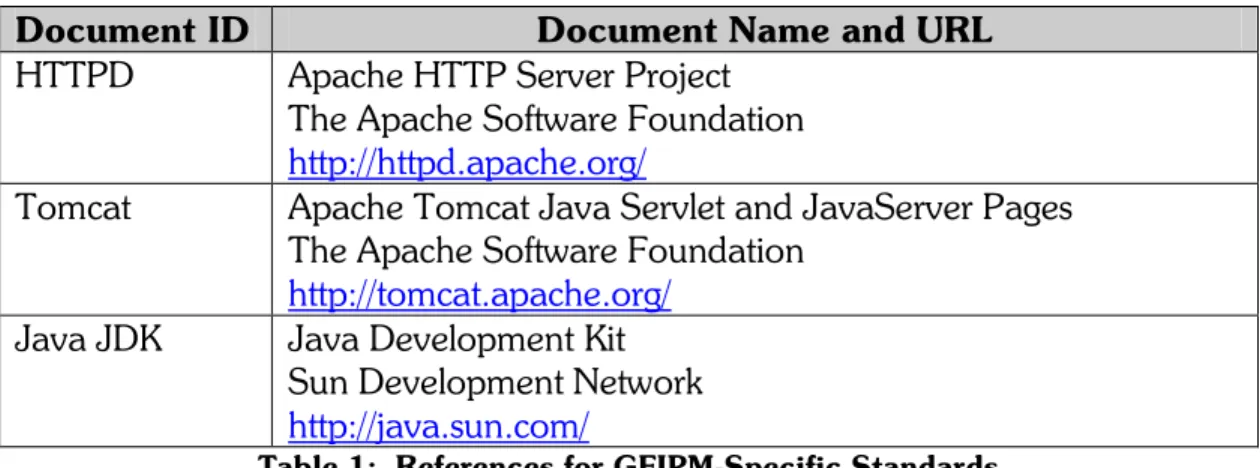
HTTPD Apache HTTP Server Project The Apache Software Foundation
Tomcat Apache Tomcat Java Servlet and JavaServer Pages The Apache Software Foundation
Java JDK Java Development Kit
Sun Development Network
Table 1: References for GFIPM-Specific Standards
2.
Implementing an Identity Provider
This section outlines the steps necessary to implement a GFIPM Identity Provider (IDP).
A GFIPM IDP collects information (typically from an existing identity store) about a local user and generates corresponding user metadata when a user attempts to connect to a local or remote GFIPM Service Provider.
This section is organized into the following steps to help you implement an IDP. It covers topics from the early design to final deployment.
1. Developing a GFIPM information sharing plan 2. Submitting a request for federation membership 3. Choosing a product for building an IDP
4. Implementing your organization’s IDP 5. Writing a test plan for an IDP
6. Deploying an IDP in a test environment 7. Executing the test plan for your IDP
8. Deploying your IDP in an operational federation
2.1 Developing a GFIPM Information Sharing Plan for an IDP
During this process, you will accomplish the following:
1. Develop a list of federation resources to which you want your users to have access.
2. Identity your local users and collect all sources of information about them.
4. Fill out a Local Attribute Mapping Form to map local attributes about your users into GFIPM metadata attributes.
If your organization has multiple attribute stores and/or authentication systems, you may need to consider implementing multiple IDPs at your site. Alternatively, you may wish to consider using a virtual LDAP product to consolidate your multiple sources of user data into one source. This situation may be especially applicable if the information in the attribute stores cannot be merged or different sets of users must stay with separate authentication or authorization systems. In the case of multiple IDPs at your site, the steps in this section should be performed for each IDP.
2.1.1 Discover Federation Resources
This section guides you through the process of discovering available resources in your federation and determining which of them may be of value to your organization’s users. Additionally, you need to consider the future as your federation adds more Service Providers with more and more resources. You will want your users to have access to the appropriate resources in the future, preferably without having to add capabilities to your IDP. At the end of this section, you should have a list of access control policies for which your users need to qualify. This list will be used in subsequent sections to help you implement an IDP that can assert the appropriate metadata.
The following steps will help you accomplish the above goals:
1. Survey the current landscape of available federation resources. 2. Determine which existing resources would be of value to your
users. Also consider what other future resources you might want for your users and what the access requirements for those resources might be.
3. Review the access control polices for the resources you would like to use.
To explain these concepts and help you put them into action, resources in the NIEF federation are used as examples throughout this section.
2.1.1.1Survey Federation Resources
This section describes how to examine the list of federation resources and generate a list of resources that you want your users to access.
To allow prospective federation members to determine what members’ resources would be of value to their users, the federation should maintain a registry of existing resources, including a description and access control policy for each resource. The information should be available from your federation manager.
For NIEF, the resource list is available at each current federation member.
The following are a few examples of NIEF resources and their access control policies with implementation guidelines and explanations.
Resource Example Number 1:
As can be seen from the resource list, each resource has an access control policy. The policy may be as simple as for the Arizona Counter Terrorism Information Center resource, provided by the CISAnet portal:
Access Control Policy
Any user with a valid federation login may access this resource. In addition, sufficient audit data is required for all users.
In the above requirement, a “valid federation login” refers to a user who is able to log in to an IDP of any NIEF federation member. In effect, this is the absolute minimum requirement possible for being granted access to a resource. Some portals provide useful public resources in this manner and the users gain from seeing a collection of such resources in one location, but such public resources do not provide law enforcement data.
Because some Service Providers (SPs) may actually require that a user have permission to view public resources, we recommend that IDPs assert the “Public Data Self Search Home Privilege Indicator” in the user’s metadata. Service Providers are free to assume that all users have public permission but are not required to and may not implement such an assumption.
The “sufficient audit data” includes information that can be used to uniquely identify a user and is stored in the audit log files of a service provider, portal, and/or application.
Resource Example Number 2:
Most resources have more complex policies; for example, the resource Texas Criminal Law Enforcement Online (CLEO) provided by the CISAnet Service Provider:
Access Control Policy
Any user who is a sworn law enforcement officer may access this resource. In addition, sufficient audit data is required for all users.
The definition of a sworn law enforcement officer (SLEO) is as follows. He/she is: • A full-time employee of a state-recognized law enforcement
agency.
• Authorized to make an arrest (has the authority).
• Certified by a state certifying authority (e.g., Peace Officer Standards and Training [POST]), or equivalent.
OR
• A full-time employee of a state-recognized law enforcement agency, acting on behalf of a SLEO, in performance of his or her assigned duties.
An IDP indicates that a user is a sworn law enforcement officer by asserting the “Sworn Law Enforcement Officer Indicator” as “true” in that user’s metadata. Many of the more useful resources available require that the user be a sworn law enforcement officer, so you as the IDP developer are strongly urged to implement the necessary code to determine whether your user qualifies.
The requirement for the audit data is described in example Number 1 above.
Resource Example Number 3:
Other resources may have very restrictive access policies, as demonstrated by the Texas Criminal Law Enforcement Reporting and Information System (CLERIS) resource:
• Be a sworn law enforcement officer. • Have an agency ORI code.
• Have either the criminal investigative home data search privilege OR a combination of the criminal intelligence home data search privilege and 28 CFR certification.
• Identity-proofing assurance is NIST level 4, and electronic identity assurance is at least NIST level 3.
• In addition to the policy specified above, sufficient audit data is required for all users.
The IDP must assert the sworn law enforcement officer indicator as demonstrated in example Number 2 above.
To access CLERIS, a user must have an ORI code, which must be asserted by the user’s IDP in the user’s metadata in the attribute “Employer ORI.” Many resources available from GFIPM participants require an ORI code, so IDP developers are strongly urged to supply them.
Further, a user’s home IDP must assert the attribute “Criminal Investigative Data Self Search Home Privilege Indicator” or must assert the attributes “Criminal Intelligence Data Self Search Home Privilege Indicator” and “28 CFR Privilege Indicator.”
The requirement for sufficient identity proofing (asserted as the attribute “Identity Proofing Assurance Level Code”) refers to the level of assurance that the person assigned this electronic identity is actually the user. The levels of assurance vary from no requirements to appearing in person with certain photo IDs or supplying certain identification assurances from a remote location that are inspected or validated to a specified degree by the issuing authority.
The requirement for electronic identity authentication assurance level (asserted as the attribute “Electronic Authentication Assurance Level Code”) refers to the level of confidence in the asserted digital identity. The asserted level depends on the IDP’s authentication mechanism, which ranges from simple and relatively insecure methods (such as username/password authentication) to more secure methods (such as two-factor authentication with a hardware crypto token). The requirement for the audit data is described in example Number 1 above.
2.1.1.2 Determine Valuable Resources
At this point, you should have a list of resources for your users. After finishing the survey of federation resources in the previous section, you should have a feel for the types of resources that you might add to that list if they become available in the future.
If your federation plans to add new members, or if prospective members are already in the process of joining your federation, you may wish to inquire about the resources that may soon be added to the federation via the addition of those new federation members. If you determine that these additional resources would be
valuable for your users, you may wish to plan ahead for asserting their required attributes even before they come online in the federation.
For example, NIEF is a relatively new federation, with few members at this time. However, as of this writing, several new members are in the process of submitting their application packages, so it is likely that NIEF will increase significantly in size in the near future. A new IDP implementer should contact the NIEF federation manager for advice on expected new members and resources, so that the IDP’s users can gain access to these new resources without the implementer having to add support for more attributes at a later date.
For example, on the CISAnet Service Provider, you saw that several resources (such as NM Law Enforcement Information Network with Corrections or NM Complete Arrest Information) require the Criminal History privilege. Suppose you determine that these would be useful resources for your users, except that your users are not necessarily interested in the New Mexico data but would be interested in other states’ similar resources. You should add “Criminal History Resources” to your list of desired resources. Further, you see that some of these same resources also require the NCIC Criminal History Certification, so you add “NCIC Criminal History Certification Resources” to your list of desired resources.
2.1.1.3 Review Access Control Policies
Next, review your list of desired resources and determine which privileges, certifications, indicators, and electronic identifications you must support in your IDP to allow your users to access those resources. This list represents the privileges, certifications, and indicators that you would like to assert for your users, but not necessarily those that you can assert. At this point, it is better to build an over-inclusive list than a list that may be missing some desired permissions.
After you identify your users from a GFIPM perspective in the section below (Section 2.1.2), this list will be used in Section 2.1.3 to design the GFIPM user metadata to be built by your IDP.
2.1.2 Identify Local Users
This section guides you through a process to collect all known information about your organization’s users and collect it for use as a basis for a GFIPM Identity Provider (IDP).
To implement a GFIPM IDP, you must gather existing sources of information about your local users. These sources may consist of a user directory, a database system, applications that manage user identities, and organizational policies and other documents.
A user directory may be implemented as LDAP or Active Directory or some other in-house or commercial system. A database may be implemented as a system such as Oracle or SQL Server or one of many other commercial or open-source systems. Other sources may include user applications such as criminal information systems, case management systems, or records management systems. These systems will then serve as the providers of local user information to the federation member’s IDP. Each source about local users should provide information such as the following:
• Name, address, phone number
• E-mail address
• Unique user ID
• Home organization, employer, assignment, job classification
• Certifications and clearances
• Permissions and privileges
• Electronic or digital identity
In addition, there may be other, more indirect sources of information about users. Organizations typically have documented security policies. Users may also be required to sign user agreements, which typically specify levels of training or qualifications for the user. These may specify conditions of employment such as background checks, user qualifications, certifications, or security clearances.
Three specific instances of these types of documents include the following:
1. Local Security Policy Document—A document describing the
security policy that is currently in place within your organization.
2. Local User Agreement Document—A document describing the
terms and conditions to which your users must agree as a prerequisite for using an electronic identity issued by your organization.
3. Local User Vetting Policies and Procedures Document—A
document describing the user vetting policies and procedures that are currently in place within your organization.
Implicit or derived information from the above documents can add to the knowledge base about your users, either individually or as a group. At this point, you should collect these documents from your organization and use them as a basis for additional knowledge about your users. In addition to serving as sources of information about users, the three documents listed above will be used during your organization’s federation application process (see [GFIPM OPP]) described in Section 2.2.
An example of information derived from a security policy is the following derivation rule used by CISAnet, which is a federation member in NIEF:
All CISAnet users have 28 CFR training as a documented organizational policy. These users have the CISAnet Criminal Intelligence permission. While the 28 CFR training information is not stored in the local identity management system, the policy is used as a basis for the CISAnet IDP to assert the “28 CFR Privilege Indicator” in the GFIPM user metadata. Furthermore, the CISAnet IDP also asserts the attribute “Criminal Intelligence Data Self Search Home Privilege Indicator” for its users.
After you finish this section, your GFIPM Information Sharing Plan should include details about all your sources of user information and also document details about which specific information is available for users from each source. This information will eventually appear in your Local Attribute Mapping Form; see Section 2.1.4 for more information.
2.1.3 Design User Metadata
This section presents instructions on how your organization should design its user metadata, based on your list of desired federation resources (from Section 2.1.1) and the information about your users (from Section 2.1.2).
The GFIPM Metadata Specification includes a standard set of informational attributes that can be asserted for a user. Example attributes are a user’s name, phone number, title, permissions, etc. These attributes are collected by an IDP, assembled into a SAML assertion, and securely transmitted to an SP on behalf of a user.
Your federation manager should provide you with advice on which metadata attributes are required or recommended for assertion by IDPs in your federation. Taking into account the GFIPM definition of each metadata attribute you want to assert, determine whether and how you can truthfully assert it for your users based on your locally available user information. Assertions can be based either on explicit local attribute data (stored in a user repository) or on implicit assumptions about users based on local policies.
You may encounter a situation in which you want to assert an attribute but are unable to assert it based on locally available information. In this case, you have two choices—do not assert it or collect and store the data necessary to assert it.
Remember that the basis for asserting each user attribute must be documented in the Local Attribute Mapping Form (Section 2.1.4).
At the end of this process, you should have a list of GFIPM metadata attributes that your IDP will assert, along with the precise GFIPM definition for each of those attributes.
Each metadata attribute that your IDP is able to assert must be asserted with a valid value in the SAML assertion. The values must be either extracted from one of your local data sources or validly derived for each user. In addition, how you assert these attributes (i.e., the data source or reasoning you used) must be documented in your Local Attribute Mapping Form to be prepared in Section 2.1.4.
As defined by your federation manager, required metadata attributes are mandatory based on their use to uniquely identify a user and to audit transactions. Your IDP must assert these metadata attributes.
Strongly recommended attributes are those attributes used by many Service Providers or resources in their access control policies. Assertion of these attributes typically leads to more data access opportunities for users. Your IDP should assert these metadata attributes if possible.
The other listed attributes are recommended, which means that useful resources tend to use them in their access control policies. Your IDP should assert these metadata attributes if possible.
2.1.4 Fill Out a Local Attribute Mapping Form
This section will help you fill out a Local Attribute Mapping Form to map local attributes about your users into GFIPM metadata attributes. The Local Attribute Mapping Form for your IDP is later used as part of your request for federation membership.
The Local Attribute Mapping Form is briefly described in the Operational Policies and Procedures document [GFIPM OPP]:
A document describing how the organization plans to map its local policies and locally stored user attributes into attributes conforming to the GFIPM Metadata standard.
When the federation manager reviews your application package, he or she will provide a copy of your Local Attribute Mapping Form (for an IDP) to all existing members for review and comment.
The Local Attribute Mapping Form should be written as a spreadsheet (i.e., in Microsoft Excel). A template of this form is included with the membership
application forms provided by the federation manager when you request to join the federation.
Before editing the file, you should rename it to include your IDP name in the file name.
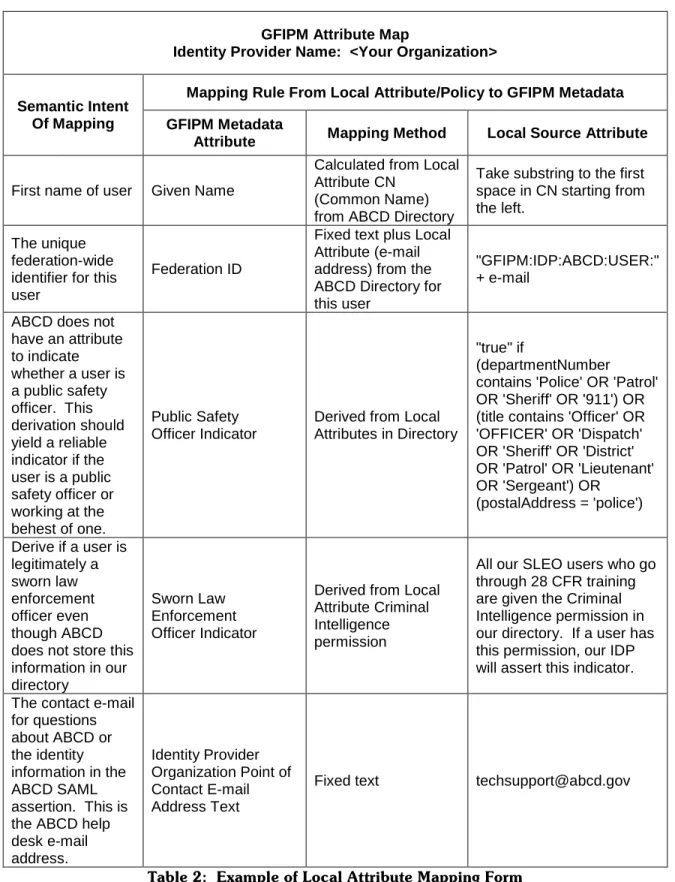
Table 2 contains an example of the design of the spreadsheet, including the headers followed by five rows describing attribute mappings. Note that these examples are from different members, so their derivations are not related to each other.
GFIPM Attribute Map
Identity Provider Name: <Your Organization>
Semantic Intent Of Mapping
Mapping Rule From Local Attribute/Policy to GFIPM Metadata GFIPM Metadata
Attribute Mapping Method Local Source Attribute
First name of user Given Name
Calculated from Local Attribute CN
(Common Name) from ABCD Directory
Take substring to the first space in CN starting from the left.
The unique federation-wide identifier for this user
Federation ID
Fixed text plus Local Attribute (e-mail address) from the ABCD Directory for this user
"GFIPM:IDP:ABCD:USER:" + e-mail
ABCD does not have an attribute to indicate whether a user is a public safety officer. This derivation should yield a reliable indicator if the user is a public safety officer or working at the behest of one. Public Safety Officer Indicator
Derived from Local Attributes in Directory
"true" if
(departmentNumber contains 'Police' OR 'Patrol' OR 'Sheriff' OR '911') OR (title contains 'Officer' OR 'OFFICER' OR 'Dispatch' OR 'Sheriff' OR 'District' OR 'Patrol' OR 'Lieutenant' OR 'Sergeant') OR (postalAddress = 'police') Derive if a user is legitimately a sworn law enforcement officer even though ABCD does not store this information in our directory
Sworn Law Enforcement Officer Indicator
Derived from Local Attribute Criminal Intelligence permission
All our SLEO users who go through 28 CFR training are given the Criminal Intelligence permission in our directory. If a user has this permission, our IDP will assert this indicator. The contact e-mail
for questions about ABCD or the identity information in the ABCD SAML assertion. This is the ABCD help desk e-mail address. Identity Provider Organization Point of Contact E-mail Address Text
Fixed text [email protected]
In the above spreadsheet, you must have a row for every GFIPM Metadata attribute that your IDP asserts, explaining the source of the value and how you plan to map from the source to the GFIPM attribute.
If you would like additional examples of a Local Attribute Mapping Form, please contac
At this point, you should have completed the GFIPM Information Sharing Plan and the Local Attribute Mapping Form.
2.2 Submitting a Request for Federation Membership
This section serves as a supplemental aid to the membership application process by listing the membership documents that should be collected or generated during the IDP implementation process. The authoritative document for the process of submitting a membership request in NIEF is the Operational Policies and Procedures Document [GFIPM OPP].
The membership process is defined in [GFIPM OPP]. The process follows the following four phases:
1. Request-to-join process 2. Application process 3. On-boarding process 4. Ongoing membership
While going through the IDP implementation process, you should either collect or produce the following membership documents:
1. Authority-to-Operate Document—A document attesting to the
organization’s authority to operate as an identity provider and provide access to the federation for the organization’s users. It typically takes the form of a signed memorandum or letter from the organization’s executive officer to the federation manager.
2. Local Security Policy Document—A document describing the
security policy that is currently in place within your organization. This document should already exist within your organization. It should be collected during Section 2.1.2.
3. Local User Agreement Document—A document describing the
terms and conditions to which your users must agree as a prerequisite for using a digital identity issued by your organization.
This document should already exist within your organization. It should be collected during Section 2.1.2.
4. Local User Vetting Policies and Procedures Document—A
document describing the user vetting policies and procedures that are currently in place within your organization. This document should already exist within your organization. It should be collected during Section 2.1.2.
5. Local Attribute Mapping Form for IDP—A document
describing how the organization plans to map its local policies and locally stored user attributes into attributes conforming to the GFIPM Metadata standard [GFIPM Metadata]. You develop this document by following the instructions in Section 2.1.4.
6. Implementation Documentation Form for IDP—A document
describing how your local federation-aware infrastructure is implemented. You develop this document by following the instructions in Section 2.8.
Other documents are required for the membership application process, but these are outside the scope of this document. For more complete documentation about the membership application and technical onboarding process for a GFIPM federation, please see the GFIPM Operational Policies and Procedures Guideline [GFIPM OPP].
2.3 Choosing an IDP Product
This section lists the requirements for products that may be considered for a GFIPM IDP. It also briefly describes the IDP products for which GFIPM implementers currently have some amount of knowledge and implementation experience.
As you work through the process of choosing an IDP product, consider which product best meets your organization’s needs, and keep in mind that the best product for you may not necessarily be included in this document. For those organizations that have an existing enterprise identity management platform, the best choice may be to implement a GFIPM IDP via that existing platform – especially if the existing identity management platform conforms to the GFIPM IDP technical requirements (listed below).
An Identity Provider (IDP) is responsible for authenticating an end user and asserting a SAML assertion for that user in a trusted fashion to Service Providers. When a user attempts to access a Service Provider, the user’s IDP collects local attribute information about the user and uses it to generate a SAML assertion for the user.
A GFIPM IDP must meet the following minimum requirements:
1. It must conform to the SAML 2.0 Web Single Sign-On (SSO) Profile [SAML2].
2. It must support SP-initiated Web Browser SSO.
3. It must be compliant with the IDP requirements in [GFIPM U2S Profile].
Typically, an IDP consists of several components, including:
• User authentication
• Local user repository
• SAML assertion generation
An IDP product may address one or more of these components, but in any case, it must perform the SAML assertion generation. It is likely that your organization already supports several of these components, including user authentication and a local user repository. Any IDP product must support interfaces to these existing systems.
While an IDP generates a SAML assertion that provides attributes about a user, an SP handles access to protected resources based on information given to it by an IDP. To perform their respective roles, an IDP and an SP need to communicate with each other, and the protocol through which this communication occurs in GFIPM is the Security Assertion Markup Language [SAML2].
SAML is a product of the OASIS Security Services Technical Committee (SSTC). It is an XML-based framework for communicating user authentication, entitlement, and attribute information. SAML allows business entities to make assertions regarding the identity, attributes, and entitlements of a subject (an entity that is often a human user, but may also be an application or system) to other entities, such as a partner company or another enterprise application.
Any IDP product chosen for a GFPIM federation must be SAML 2.0 compatible. The product must also have support for looking up GFIPM Metadata attributes in a local data source, so they can be assembled into a SAML assertion.7
The following is a non-exhaustive list of products that provide SAML-based identity provider capabilities. You should evaluate these and other products to determine which best meet your needs within your budget.
2.3.1 Shibboleth IDP
Shibboleth is a standards-based, freely available open-source software package for Web single sign-on across or within organizational boundaries. It allows sites to make informed authorization decisions for individual access of protected online resources in a privacy-preserving manner. It was developed by the Internet 2 project using the OpenSAML open-source implementation of SAML 2.0. It is being used by at least one participant in GFIPM.
The GFIPM federation extends the authorization functions to include privilege management for the justice community and partner organizations with a standards-based approach for implementing federated identity. Note that Shibboleth has separate components that act as an IDP and an SP.
Several components of the GFIPM Reference Federation8 are implemented using Shibboleth, including the Reference IDP, the Reference SP, and the production CISA IDP and SP.
Existing federation members and technical support staff have extensive implementation experience with Shibboleth. The GFIPM reference IDP and SP use Shibboleth.
The product Web page is at See Section 6.4 for Shibboleth implementation and installation instructions.
2.3.2 Ping Identity PingFederate IDP
PingFederate is a commercial product marketed by Ping Identity Management, and Identity-Enabled Web Services. PingFederate is SAML 2.0-compatible. Note that the PingFederate Internet Identity Security Platform can act as both an IDP and an SP.
2.3.3 CA Federation Manager IDP
Federation Manager is a commercial product marketed by CA9 (formerly Computer
Associates,
capabilities that enable the users of one organization to easily and securely access the data and applications of another. It delivers support of federation standards, including SAML, enabling both Identity Providers and Service Providers. CA Federation Manager also provides for the administration of federation partnerships.
Note that CA Federation Manager can act as both an IDP and an SP. Its product Web page is at
2.3.4 Sun OpenSSO IDP
The Sun Open Web SSO project (OpenSSO, core identity services to simplify the implementation of transparent single sign-on (SSO) as a security component in a network infrastructure. OpenSSO provides the foundation for integrating diverse Web applications that might typically operate against a disparate set of identity repositories and is hosted on a variety of platforms such as Web and application servers. This project is based on the code base of Sun Java System Access Manager infrastructure product offered by Oracle (formerly Sun Microsystems, commercialized packaged product from Oracle with support. Note that Sun OpenSSO can act as both an IDP and an SP.
2.3.5 Oracle Identity Federation IDP
Identity Federation is a commercial product marketed by Orac It is part of the Oracle Identity & Access Management Suite. Note that the Oracle Identity Federation product can act as both an IDP and an SP. Its Web page is at
2.4 Implementing a GFIPM IDP
This section provides an overview of the logical structure of a GFIPM IDP and also guides the reader through the process of implementing a GFIPM IDP at a high level. Note that it is possible for implementers to become confused about the difference between a GFIPM IDP and an existing local identity management system. A GFIPM IDP is a secure service that produces a SAML assertion for a user. The user information in the SAML assertion should be based on your organization’s local identity management system, which may be a directory, a database, or another application to manage your user identities. GFIPM does not dictate how your user identities are managed, nor does it require modification to your identity management system beyond establishing a means to interface your GFIPM IDP to it. After choosing an appropriate IDP product, the next step is implementing a GFIPM IDP using it. While this document cannot lead an implementer through all the details of installing a product and interfacing it to your organization’s identity management system, it does outline broad steps and offer guidelines on how to overcome specific
IDP implementation issues that other GFIPM participant organizations have experienced.
2.4.1 IDP Components
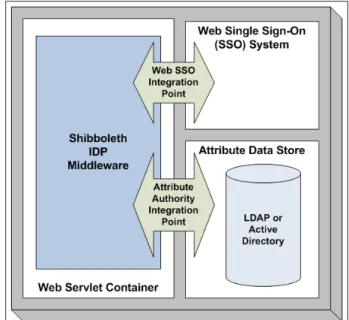
An IDP consists of several logical components. Using a Shibboleth IDP as an example, the IDP components are illustrated in Figure 1 and discussed below. Other IDP products vary in their implementation details; however, all the components described here need to be present in some form for any IDP product.
Figure 1: GFIPM Shibboleth Identity Provider Structure 2.4.2 IDP Core Software Module
The IDP software module, depicted by the blue box (“Shibboleth IDP Middleware”) in Figure 1, consists of a set of interfaces, called integration points, which must be connected to other system components for the IDP to work. In the case of Shibboleth, it is implemented as a Java servlet and runs within a Web servlet container.
The IDP core software module handles the processing of incoming SAML messages from SPs, as well as the creation of outgoing SAML messages to SPs. In addition, it manages signing and encryption of all outgoing SAML messages, as well as signature verification and decryption of all incoming SAML messages. In the case of Shibboleth, the Web servlet container in which the software runs is responsible for handling the IDP’s connection-level (TLS) encryption needs. Interested readers may refer to [GFIPM U2S Profile] for normative details about the SAML protocols and messages used within the GFIPM federation; however, note that detailed knowledge
of these protocols is not typically necessary for implementation of an IDP using COTS or open-source software.
2.4.3 Web Servlet Container
A Web servlet container is often required on a GFIPM IDP to run the IDP core software module. (It is required in the case of Shibboleth.) Many such Web servlet containers are available for use, but GFIPM participants have chosen to use the freely available Tomcat [Tomcat] open-source servlet container. Tomcat was chosen for several reasons. First, Tomcat is fully compatible with the Shibboleth IDP middleware; in other words, it runs the Shibboleth code without any problems. Second, Tomcat supports connection-level encryption using both SSL and TLS.10 Third, Tomcat supports client certificate authentication of browsers with support for certificate revocation lists (CRLs). Fourth, Tomcat runs on both of the major operating system platforms (Microsoft Windows and Red Hat Enterprise Linux) that GFIPM participants use.
2.4.4 IDP Integration Points
Implementing an IDP in a federation requires that two integration issues be addressed. The first of these issues involves the integration of the IDP with the local site’s user authentication system (the single sign-on integration point), and the other involves connecting the IDP to the local site’s attribute repository (the attribute authority integration point).
At the single sign-on integration point, the user authentication system can be a username/password authentication system (though this form of authentication does not provide enough assurance for the use of most federation resources), a token-based authentication system, a PKI-token-based client certificate authentication system, or another two-factor authentication system. By having chosen Tomcat as the Web servlet container, we automatically gained support for client certificate authentication of browsers with support for certificate revocation lists (CRLs).
At the attribute authority integration point, the IDP should be connected to the existing attribute data store, which is your local identity management system (such as a LDAP repository).
2.4.5 Web Single Sign-On System
The Web single sign-on (SSO) system integrates with the IDP core software module via an SSO integration point and provides the basis for the IDP core software module to generate SAML authentication statements about users. To realize the
single sign-on benefit of federated identity management, an SSO system must already exist and must already be used to authenticate your users for other purposes.
2.4.6 Attribute Data Store
The attribute data store integrates with the IDP core software module via an attribute authority integration point. It provides a source of trusted data about users that can be used to construct SAML assertions. Any component that acts as an attribute data store is essentially a database. There are virtually no limitations on the attribute data store in terms of how it stores attributes; however, in the case of Shibboleth, it must store attributes in a fashion that allows for attribute queries based on a user ID or some other key that can be understood by the Shibboleth IDP and maps uniquely to a specific user. Typically, an organization will want to connect an IDP to an existing user attribute repository—often an LDAP repository or an Active Directory database. It is also possible to use an ODBC or SQL database, a flat file on the local machine’s file system, or any other repository, via custom Java code. But these cases are rare. The most common implementation scenario involves connecting an IDP directly to a local LDAP or Active Directory server.
2.5 Writing an IDP Test Plan
This section describes how to write a plan for testing a new IDP in a test environment such as the GFIPM Reference Federation.
The new Identity Provider should be first deployed and tested in a test environment, followed by deployment and testing in the operational federation.
If you are also developing a new Service Provider, you can deploy and test it at the same time that you deploy and test your Identity Provider. Note that testing for interoperability between your own IDP and SP is insufficient in terms of full interoperability testing. Comprehensive interoperability testing requires that you test for interoperability between your IDP and other organizations’ SPs, as well as between your SP and other organizations’ IDPs.
There are a wide variety of possible test environments, each having different IDP implementations and security requirements. It is therefore not possible for this guide to provide you with a “complete” test plan for your IDP. But this section outlines the basic testing steps that you should perform, regardless of your test environment. Based on these steps, you should be able to generate a test plan that is sufficient and specific to your organization. Your test plan should address the following issues:
1. Test Goals—Your plan must address the following questions: a. Will you test individual modules (IDP middleware, SSO system,
attribute data store, assertion generator, etc.)?
b. Will you perform integration testing? If so, how will you test the interfaces between the IDP’s components (single sign-on integration point, attribute authority integration point, etc.)? For example, if you vary the data on one side of the interface, does the information on the other side reflect the change correctly?
c. How will you perform interoperability testing of your IDP? Keep in mind that the ultimate purpose of GFIPM interoperability testing is to determine whether your IDP’s user attributes are compatible with the SPs that consume and use them.11 To ensure broad test coverage of user attributes, you should create multiple test identities with varying attributes (user data, permissions, privileges, etc.) to ensure that user attributes for your local identities are correctly translated into the appropriate GFIPM user attributes. Also, be sure to notify your testing partners (the federation manager, SP administrators, etc.) of your testing goals and plans.
d. What are your organization’s formal processes for acceptance testing? Be sure to notify your testing partners if you need results or other inputs from them.
2. Testing Schedule—Your testing schedule can be as simple as an
e-mail asking/notifying your testing partners of the days you will need to communicate with them. Note that before testing begins, all required resources must be available.
3. Resource Logistics—You must identify all required resources,
including all of the personnel, test machines, and network connections that will be required for testing.
a. Test machines should be 100 percent available on test days. b. Identify and arrange for the required network connections
(especially firewall and router configurations) well in advance of the test date. Connections (i.e., all specific port numbers)
should also be tested. If necessary connections are denied, your local network administrator may need to open firewalls, which can take several weeks in some organizations.
c. Notify all personnel who are required for testing well in advance of the testing date. This may include persons who are not part of your local organization.
4. Documented Testing Procedures—Generate a list of test cases,
each of which must pass. Test cases should include SAML assertions that include the following:
a. Only the minimum attributes. b. An excessive number of attributes. c. A reasonable number of attributes.
It is strongly recommended that you create a user identity in your identity management system that is not a valid identity (such as missing last name, missing e-mail, or malformed phone number) and perform tests to ensure that your IDP behaves properly when dealing with it.
5. Responsibility for Carrying Out the Test Plan—Which
person in your organization should execute the test plan? Experience has shown that a test plan works best when the person performing the testing is not the same person who implemented the software.
2.6 Deploying an IDP in a Test Environment
This section presents steps required to deploy an IDP in a test environment to ensure its connectivity and interoperability with SPs within the context of the test environment’s GFIPM Trust Fabric.12
Any new IDP must be “connected” to the test environment by adding the IDP to the test environment’s trust fabric file. The trust fabric file update process consists of these steps:
12 The term “GFIPM Trust Fabric” refers to a cryptographically signed document containing SAML
service endpoint information and X.509 certificate data for each endpoint (IDP, SP, etc.) in a GFIPM federation. In practice, “GFIPM Trust Fabric” or “trust fabric” refers to an XML file. It is generally signed by the federation manager and distributed to all federation member organizations as a
1. Provide your IDP’s entity metadata to your federation manager (or the organization that manages the test environment you will use). 2. The federation manager adds the new entity to the trust fabric file. 3. All participants load the new trust fabric file into their IDPs and
SPs.
You can test whether your IDP’s entry into the test environment’s trust fabric has succeeded by verifying its SAML interoperability with other members of the test environment, as described in Section 6.6.
The GFIPM Reference Federation is an excellent resource that is generally available for use as a test environment for GFIPM IDPs. It contains a large number of useful and necessary resources for implementing and testing your IDP. These topics are covered more thoroughly in Appendix A.
2.7 Executing an IDP Test Plan
After you have written your test plan and implemented your Identity Provider, you must execute the test plan.
While software issues almost always arise during testing, experience has shown that personnel scheduling problems and network configuration problems tend to cause the most delays during testing. The bottom line is that you must make sure all required personnel (especially required testing partners from other organizations) will be available as expected during the testing process, and that all machines used in the testing process have Internet connectivity on all required ports as needed.
Work through your test plan. Take thorough notes, and compile a test report to be distributed within your organization and to all testing partners.
2.8 Deploying an IDP in an Operational Federation
This section presents steps required to deploy an IDP in the operational federation to ensure its connection and interoperability to the GFIPM Trust Fabric.
During your deployment in the test environment, you were able to use all the test environment’s resources. If you are now deploying your IDP in the NIEF operational federation, here are the equivalent production resources that you can leverage:
• Publicly accessible information about NIEF is available at
• The NIEF Trust Fabric document is located at Error! Hyperlink reference not valid..
Note that there are no “test” IDPs or SPs in an operational federation such as NIEF. The operational federation contains live data, and test identities should never be used within it.
Any new IDP must be “connected” to NIEF (or your own operational GFIPM federation) by adding the IDP to the federation’s trust fabric. The trust fabric update process consists of these steps:
1. Provide your IDP’s entity metadata to the federation manager. 2. The federation manager adds the new entity to the federation trust
fabric.
3. All participants load the new federation trust fabric into their IDPs and SPs.
Before or during your deployment, you must also fill out an Implementation Documentation Form for your IDP and submit it to the federation manager as part of the membership application process described in Section 2.2. A template of this form is available from the federation manager. The form requests the following information:
• IDP software platform details (OS, Web server, SAML software)
• User authentication endpoint details
• User attribute endpoint details
• Network configuration notes
Your ability to test your IDP in the operational federation will be limited because of the lack of test SPs in the operational federation. According to the usage policies of most SPs in an operational federation, only real users using real identities (with valid user data, permissions, and privileges) are permitted to use (i.e., test) the operational systems. Therefore, when executing your IDP’s test plan in the operational federation, you must perform the necessary tests with real users (from your organization and others). As before, write a test report to be distributed within your organization and to all testing partners.
3.
Implementing a Service Provider
This section outlines the steps necessary to implement a GFIPM Service Provider (SP). The following steps are presented:
1. Developing a GFIPM information sharing plan 2. Submitting a request for federation membership 3. Choosing a product for building your SP
4. Implementing your organization’s SP 5. Writing a test plan for your SP
6. Deploying your SP in a test environment 7. Executing the test plan for your SP
8. Deploying your SP in an operational federation
3.1 Developing a GFIPM Information Sharing Plan for an SP
During this process, you will accomplish the following:
1. Develop a list of your local resources to which you want to allow access for other organizations’ users.
2. Determine your organization’s business rules for granting access to your local resources.
3. Using your business rules, develop and codify the access control policies for your resources in terms of the GFIPM user metadata. 4. Fill out a Local Access Policy Mapping Form for your SP.
3.1.1 Identify Local Resources
This section will help you identify local resources that may be useful to other federation members and to determine whether they can be made available to other organizations’ users under certain access rules.
Service Providers need to determine which production resources they should make available to other federation members. An equally important consideration is which of these resources can be permitted to be made available and how long the decision making process will take. Federation members typically “own” some resources; in other words, the federation member administers the resource or otherwise has control over access decisions. For these resources, the decision to make the resource available to federation users may be easy. But some federation members may be
distributing data that belongs to another organization. In this case, receiving permission to release the data may be more complex and time consuming. The required timelines for gaining permission to make resources available within a federation need to be built into an SP’s implementation schedule.
Resources that might be useful to other law enforcement organizations include the following:
• Arrest records
• Incident reports
• Criminal history reports
• Criminal justice reports
• Criminal investigative reports
• Criminal intelligence reports
• Counterterrorism notifications
• Driver’s license records
• Public safety messages
• Other federal/state/tribal/local law enforcement information
Types of resources that would be less useful but still of potential interest to federation users include the following:
• Amber Alerts (i.e., missing child alerts)
• Sex offender information
• Other publicly available information
As part of the process of determining which local resources are to be made available, you must also collect the appropriate authority-to-operate documents for providing those resources to federation users. These documents will be needed in Section 3.2.
3.1.2 Determine Business Rules for Resources
For each resource you identified in the previous section, you must now collect or document its access policy.
It is likely that all of the identified resources already have documented access policies. For example, a resource’s access policy might be as simple as the following:
• Any user who is a sworn law enforcement officer may access this resource.
Or a resource’s access policy might be more complicated, such as this:
• The user must also have NCIC certification and criminal history privileges.
Many resources with their access policies are listed on the NIEF federation Web site a
In the unlikely event that your organization does not already have documented access control policies, you will need to work through the process of writing them and getting the appropriate approval(s) to provide those resources to federation members.
3.1.3 Develop Access Control Rules
This section uses the business rules from the previous section to guide you through the process of codifying the rules in terms of the GFIPM user metadata.
Note that this section uses the NIEF federation as an example for developing access control rules. Specifically, this section relies on the required and recommended attributes in a SAML assertion. If you are building an SP for a different federation, your set of metadata attributes may be different. However, it is likely that there will be many similarities to the NIEF requirements.
The access control rules are written in terms of attributes in the GFIPM user metadata. The minimal access requirements that a user identity must contain are the following fields:
• User’s Last Name
• User’s First Name
• User’s Phone Number
• User’s E-mail Address
• User’s Federation ID
• User’s Home Organization Name
• User’s Identity Provider Name
The above fields are typically used for auditing purposes by a Service Provider to meet the “Federation Login” requirement. Because these attributes do not assert any permissions or privileges, a user identity that contains only the above attributes typically will not be granted access to any law enforcement resources.
3.1.4 Fill Out Local Access Policy Mapping Form
This section will help you fill out a Local Access Policy Mapping Form to translate your plain-English access policies into Boolean logic rules based on GFIPM metadata
attributes. The Local Access Policy Mapping Form for your SP is later used as part of your request for federation membership.
The Local Access Policy Mapping Form is a document describing how the organization plans to map its local access control policies into rules that can be expressed using attributes from the GFIPM Metadata standard.
When the federation manager reviews your application package, it will provide a copy of your Local Access Policy Mapping Form (for an SP) to all existing members for review and comment.
The Local Access Policy Mapping Form should be written as a spreadsheet (i.e., Microsoft Excel). A template of this form is included with the membership application forms provided by the federation manager when you request to join the federation.
Before editing the file, you should rename it to include your SP name in the file name.
Below is an example of the design of the spreadsheet, including the headers followed by several rows describing access policy mappings. Note that these examples are from different members, so their derivations are not related to each other.