PART 2 —
Part 2 — Best Management Practices
Table of Contents
Introduction... 2.5 Processes And Principles Of Erosion And Sedimentation ... 2.5 Activity and BMP Planning/Selection Sample Checklist #1 ... 2.7 Activity and BMP Pre-Construction/Maintenance Sample Checklist #2 ... 2.8 Activity and BMP Implementation Sample Checklist #3 ... 2.9 Activity and BMP Routine Part 1 BMPs Sample Checklist #4 ... 2.10
The Eight Outcome Categories
Keep Water From Work Area... 2.11 Reduce Potential for Soil From Becoming Water Borne – Or Air Borne ... 2.12 Filter/Perimeter Protection ... 2.13 Settling ... 2.14 Reduce Water Velocity/Erosive Forces ... 2.15 Containment ... 2.16 Habitat Protection/Maintenance ... 2.17 Reduce Potential for Contaminants Falling Into Water ... 2.18
BMP/Outcome Categories Matrix ... 2.19
BMPs
Aqua Barrier ... 2.21 Back of Slope Planting ... 2.24 Cofferdam ... 2.26 Coir Fabric ... 2.29 Coir Log ... 2.31 Concrete Containment (1) ... 2.34 Concrete Containment (2) ... 2.37 Construction Access Road ... 2.39 Continuous Berm ... 2.42 Curb Inlet Sediment Trap ... 2.45 Dewatering ... 2.50 Diaper Netting ... 2.52 Ditch Lining ... 2.54 Diversion Berm ... 2.56 Diversion Channel ... 2.58 Dust Control ... 2.61 Excelsior Filled Log ... 2.63 Filter Fabric ... 2.65 Grass Lined Channel ... 2.67
TABLE OF CONTENTS (continued)
BMPs Continued
Gravel Filled Sump ... 2.71 Half Round Filter ... 2.72 Hand Seeding ... 2.75 Hydroseeding... 2.77 Inlet Protection ... 2.79 Kimble Filter Pipe ... 2.86 Large Woody Material ... 2.88 Live Staking ... 2.93 Mulching ... 2.97 Plastic Covering ... 2.99 Plywood Work Platform ... 2.101 Rip Rap ... 2.103 Rock Check Dam ... 2.105 Sandbag ... 2.109 Sedimentation Sump ... 2.113 Silt Fence ... 2.114 Silt Mat ... 2.117 Siltation Pond/Settling Tank ... 2.119 Soil Stabilization (Blankets And Matting) ... 2.122 Straw Bale Barrier (1) ... 2.127 Straw Bale Barrier (2) ... 2.130 Straw Bale Barrier (3) ... 2.135 Straw Log ... 2.138 Stream Bank Stabilization (Bio-engineering) ... 2.141 Stream Bypass ... 2.142 Streambed Gravel ... 2.146 Surface Roughening ... 2.148 Sweeping ... 2.152 Temporary Sediment Trap ... 2.155 Triangular Silt Dike ... 2.158 Turbidity Curtain ... 2.162 Vactoring ... 2.166 Vegetative Buffer ... 2.168 Washed Rock ... 2.170
Processes and Principles of
Erosion and Sedimentation
S
oil disturbance, whether by natural forces or by construction and maintenance activities, can accelerate the rate of erosion.Careful planning combined with proper selection and installation of erosion control measures can reduce the impact of construction and
maintenance related erosion.
SOIL EROSION PROCESS
• Splash erosion results when raindrops fall on bare or sparsely vegetated soil and detach the soil particles.
• Sheet erosion occurs when these soil particles are transported in a thin layer, or sheet, by flowing water.
• Rills and gullies are formed by concentrated, high velocity sheet flow. More soil detaches, increasing the erosion damage.
• Stream and channel erosion occurs by even higher rates of velocity and steepness of slope.
• Wind erosion occurs during dry weather conditions and high winds. Size of particles being moved is related to wind velocity. Particles moved by wind may cause air pollution, soil loss and/or water quality degradation.
Water quality and fish habitat are the major concerns associated with soil movement. BMPs combined with training and oversight will enable road maintenance personnel to lessen the effects of soil erosion from the work site.
PRINCIPLES OF EROSION AND SEDIMENTATION CONTROL
Effective erosion and sedimentation control requires first that the soil surface be protected from the erosive forces of wind, rain, and runoff, and second that eroded soil is controlled onsite. The following principles shall be integrated into a system of control measures and management techniques to control erosion and reduce offsite sediment migration.
Minimize the Extent and Duration of Exposure
Scheduling can be a very effective means of reducing the hazards of erosion. Schedule construction activities to minimize the exposed area and the duration of exposure. Maintenance activities can not always be scheduled, it is
important to stabilize disturbed areas as quickly as possible in scheduled or unscheduled maintenance.
Protect Areas to be Disturbed from Stormwater Runoff
Use berms, diversions, pumps, dams, barriers, sediment traps and
constructed waterways to intercept runoff and divert it away from cut-and fill slopes or other disturbed areas. Install these measures before beginning maintenance and/or land disturbing activities.
Stabilize Disturbed Areas
Removing the vegetative cover and altering the soil structure by clearing the surface may increase an area’s susceptibility to erosion. Apply stabilizing measures after the land is disturbed and implement temporary or permanent vegetation, mulches, or other BMP’s to correspond with maintenance activities. During the winter season, October through June, no soils shall remain exposed and unworked for more than 2 days. During the summer season, July through September, no soils shall remain exposed and unworked for more than 7 days. This condition applies to all soils on site, whether at final grade or not.
Minimize Runoff Velocities
Clearing existing vegetation may reduce the surface roughness and infiltration rate, thereby increasing runoff velocities and volumes. Use measures that break the slopes to reduce the problems associated with concentrated flow volumes and runoff velocities.
Retain Sediment on the Site
Even with careful planning, some erosion is unavoidable. The resulting sediment can be reduced by BMP placement that reduce on site erosion. Plan the location where sediment deposition will occur and maintain access for maintenance cleanout. Plan, install and use sediment trap and basin BMPs before other land-disturbing activities (except in emergencies).
Inspect and Maintain BMPs
Inspection and maintenance of BMPs is vital to the performance of erosion and sedimentation BMPs. It is essential to inspect all BMPs to determine that they are working properly and to ensure that problems are corrected as they are detected.
Activity and bmp
Planning and Selection Sample Checklist #1
Figure 14
ACTIVITY INFORMATION
Location: Maintenance Activity:
Lead: Date:
Description of Activity:
CHECKLIST
Steps Completed Comments
1. Make site visit before starting work. 2. Define activity, scope and limits.
3. Identify sensitive areas and drainage features. 4. Is environmental staff required to review plans
or provide crew support?
5. Are fish present (or likely to be present) in work area or activity impact area. (If yes, contact environmental support staff or WSDFW.) 6. Will fish exclusion be required? (If yes,
coordinate with designated staff or agency.) 7. Review Maintenance Category BMP options
related to site-specific conditions.
8. Select applicable BMPs from Part 1 and 2 of the Guidelines.
9. Secure permits.
10. Read and understand all permit conditions. Resolve permit conditions before moving forward.. 11. Prepare construction/maintenance schedule,
and/or sequence (Including installing, monitoring, maintaining, and removing BMP(s).)
12. Schedule a maintenance or pre-construction meeting as necessary.
13. Review activity as possible model for training and/or adaptive management discussions.
Activity and bmp
Pre-construction and Pre-maintenance Meeting Sample Checklist #2
Figure 15
ACTIVITY INFORMATION
Location: Maintenance Activity:
Lead: Date:
Description of Activity:
CHECKLIST
Steps Completed Comments
1. Invite appropriate personnel and/or agencies. 2. Prepare agenda and attendance/sign-in form. 3. Outline construction/maintenance, schedule,
and/or sequence (Including installation, monitoring, maintaining, & removing BMP(s)). 4. Identify sensitive areas and drainage features. 5. If fish exclusion required, follow Fish Exclusion
Protocol in Appendix E.
6. Clarify roles & responsibilities of all personnel & agencies related to all aspects of the activity. 7. Discuss permits, approvals and their
conditions.
8. If environmental staff is required to be onsite during work activities: introduce personnel and their role(s).
Activity and bmp
Installation, Monitoring, Maintianing and Removal Sample Checklist #3
Figure 16
ACTIVITY INFORMATION Location: Maintenance Activity:
Lead: Date:
Description of Activity:
CHECKLIST
Steps Completed Comments
1. Identify/mark work area and location of BMP(s). 2. Arrange for delivery of BMP(s) products. 3. Environmental staff support as appropriate. 4. Make sure BMP(s) are installed in accordance
with the Guidelines, permit conditions and/or specifications.
5. Monitor/check BMP(s) routinely to make sure BMP outcomes are achieved, and make repairs, adjustments, and/or additions as necessary. 6. Remove BMP(s) and re-vegetate in accordance
Activity and bmp
Routine Part 1Sample Checklist #4
Figure 17
Task Yes No
1. Make site visit before starting work 2. Define activity, scope, and limits 3. Review Part 1 BMPs
• Permit needed
• Scheduling considerations • Equipment maintenance • Disturbed soil
• Waste material removed • Spill kit
• Part 2 BMPs needed
• Evaluate using detailed checklist 1, 2, and/or 3
4. Is environmental staff required? NO – continue maintenance
YES – contact environmental staff for review 5. In water work
• Stop work
• Contact environmental staff for review • Evaluate using detailed checklist 1, 2,
OUTCOME CATEGORY:
Keep Water from Work Area
Definition: The BMPs in this category are used to keep water from reaching the work area or disturbed soils generally by means of a bypass, diversion or interception process.
Desired Outcome: The desired outcome of these BMPs is to bypass or divert sheet flow, stormwater or stream flow around or through the work area. The intercepted water will be discharged to an acceptable storm drainage system or outfall.
Applications: These BMPs work well:
• In streams or ditches where the normal flow can be piped around the work area by temporarily damming and conveying the flow by pumping or gravity. (HPA)
• Covering stock piles or disturbed soils with impermeable fabric to intercept rainfall. Sheet flows shall be collected and diverted at the bottom of the covering.
• Diverting sheet flow around work area or disturbed soils by constructing upslope berms or channels.
Limitations: These BMPs are often used in combination with other BMPs (i.e., dewatering work area, grass-lined swales). Refer to individual (Part 2) BMP limitations.
Permit Conditions: Follow acceptable procedures, if required in HPA, to exclude fish from work area. Reintroduce water flow into the work area to reduce sediment transport. Comply with permit requirements. Inspect and maintain BMPs according to these Guidelines.
BMP Options (include but not limited to):
• Aqua Barrier. • Coffer Dam. • Dewatering. • Diversion Berm. • Diversion Channel. • Plastic Covering. • Sandbag. • Stream Bypass. • Vactoring.
OUTCOME CATEGORY:
Reduce Potential for Soil from Becoming
Water Borne- or Air Borne
Definition: The BMPs in this category work to keep soil particles in disturbed areas from becoming water borne or air borne.
Desired Outcome: The desired outcome of these BMPs is to reduce erosion by reducing soil particles from becoming water borne or air borne.
Application: These BMPs work well to stabilize: • Slopes.
• Soils. • Roadways. • Channels.
Limitations: Often used in combination with other BMPs allowing the disturbed area to stabilize. Refer to individual BMP (Part 2) limitations. Permit Conditions: Comply with permit requirements. Inspect and maintain BMPs according to these guidelines.
BMP Options (include but not limited to): • Back of Slope Planting.
• Construction Access Road. • Ditch Lining.
• Dust Control. • Filter Fabric.
• Grass Lined Channel. • Hand Seeding. • Hydroseeding. • Live Staking. • Mulching. • Plastic Covering.
• Soil Stabilization (Blankets/Matting). • Surface Roughening.
• Sweeping.
OUTCOME CATEGORY:
Filter/Perimeter Protection
Definition: The BMPs in this category reduce erosion and sedimentation of soil particles/contaminants as the water passes through a filtering device. This outcome will also apply to perimeter protection around the job site.
Desired Outcome: The desired outcome of these BMPs is to reduce soil particles/contaminants before the water discharges from the job site. Application: These BMPs work well:
• When the rate of flow is relatively low and the filter can be inspected and maintained to ensure the BMP continues to function.
• Perimeter protection around job site.
Limitations: Not effective in areas of high flows. Refer to individual BMP (Part 2) limitations.
Permit Conditions: Comply with permit requirements. Inspect and maintain BMPs according to these guidelines.
BMP Options (include but not limited to): • Coir Log.
• Continuous Berm.
• Curb Inlet Sediment Trap. • Excelsior Filled Log. • Filter Fabric.
• Grass Lined Channel. • Gravel Filled Sump. • Half Round Filter. • Inlet Protection. • Kimble Filter Pipe. • Silt Fence.
• Silt Mat.
• Straw Bale Barrier (1). • Straw Bale Barrier (2). • Straw Bale Barrier (3). • Straw Log.
OUTCOME CATEGORY:
Settling
Definition: The BMPs in this category allow particles/contaminants to settle as the water velocity decreases.
Desired Outcome: The desired outcome of these BMPs is to allow sediment to settle out of the water. This will reduce soil particles/contaminants from leaving the job site.
Application: These BMPs work well: • When the rate of flow is relatively low.
• When there is sufficient space or volume to properly size a settling BMP. Limitations: Not effective in areas of high flows. Refer to individual BMP (Part 2) limitations.
Permit Conditions: Comply with permit requirements. Inspect and maintain BMPs according to these guidelines.
BMP Options (include but not limited to): • Coir Log.
• Continuous Berm.
• Curb Inlet Sediment Trap. • Excelsior Filled Log. • Filter Fabric.
• Rock Check Dam. • Sandbag.
• Sedimentation Sump. • Silt Fence.
• Silt Mat.
• Siltation Pond/Tank. • Straw Bale Barrier (1). • Straw Bale Barrier (2). • Straw Bale Barrier (3). • Straw Log.
• Temporary Sediment Trap. • Triangular Silt Dike. • Turbidity Curtain.
OUTCOME CATEGORY:
Reduce Water Velocity/Erosive Froces
Definition: The BMPs in this category reduce or diminish the water velocity, thereby dissipating its erosive force.
Desired Outcome: The desired outcome of these BMPs is to create energy dissipation and reduce erosion.
Application: These BMPs work well: • On stream and ditch banks. • In swales/grass lined channels. • In waterbodies.
• On slopes.
• On large disturbed areas.
Limitations: These BMPs should not be used when maintenance activities are conducted in locations that could reduce actual or potential high flow salmonid refuge functions. These BMPs may be used if required by permit conditions. Refer to individual BMP (Part 2) limitations.
Permit Conditions: Comply with permit requirements. Inspect and maintain BMPs according to these guidelines.
BMP Options (include but not limited to): • Back of Slope Planting. • Sandbag.
• Coir Fabric. • Silt Fence.
• Coir Log. • Silt Mat.
• Continuous Berm. • Straw Bale Barrier (1). • Ditch Lining. • Straw Bale Barrier (2). • Excelsior Filled Log. • Straw Bale Barrier (3).
• Hand Seeding. • Straw Log.
• Hydroseeding. • Stream Bank Bio-Engineering.
• Large Woody Material. • Surface Roughening.
• Live Staking. • Triangular Silt Dike.
• Mulching. • Turbidity Curtain.
• Rip Rap. • Vegetative Buffer.
OUTCOME CATEGORY:
Containment
Definition: The BMPs in this category retain water and soil particles/ contaminants on the work site.
Desired Outcome: The desired outcome of these BMPs is to reduce water discharge from the job site.
Application: These BMPs work well: • In enclosed drainage systems. • In swales.
• In open drainage systems.
• In waterbodies. (bridge maintenance etc)
Limitations: These BMPs should not be used when maintenance activities are conducted in locations that could reduce actual or potential high flow
salmonid refuge functions. These BMPs may be used if required by permit conditions. Refer to individual BMP (Part 2) limitations.
Permit Conditions: Comply with permit requirements. Inspect and maintain BMPs according to these guidelines.
BMP Options (include but not limited to): • Concrete Containment (1).
• Concrete Containment (2). • Vactoring.
OUTCOME CATEGORY:
Habitat Protection/maintenance
Definition: The BMPs in this category maintain or protect habitat. Desired Outcome: The desired outcome of these BMPs is to maintain or protect habitat by providing:
• Bank/slope stabilization. • Spawning/rearing areas. • Habitat shading.
• Reducing erosion by providing ground cover, binding soil particles with roots, and lowering water velocity.
• Habitat for primary production.
• Habitat for prey base organisms such as macro-invertebrates. Application: These BMPs work well in:
• Riparian areas. • Sensitive areas.
• Watercourses and streams.
Limitations: These BMPs should be done in accordance with project design. Refer to individual BMP (Part 2) limitations.
Permit Conditions: Comply with permit requirements. Inspect and maintain BMPs according to these guidelines.
BMP Options (include but not limited to): • Coir Fabric.
• Coir Log.
• Excelsior Filled Log. • Hand Seeding. • Hydroseeding.
• Large Woody Material. • Live Staking.
OUTCOME CATEGORY:
Reduce Potential for Contaminants
Falling into Water
Definition: The BMPs in this category reduce the potential for the
contaminants from the work area from entering the water. This outcome can be achieved by capturing falling particles from bridge or other over-water work.
Desired Outcome: The desired outcome of these BMPs is to reduce contaminants from entering the water.
Application: These BMPs work well:
• On bridge or pipeline maintenance projects.
Limitations: Refer to individual BMP (Part 2) limitations.
Permit Conditions: When used in watercourses or streams, these BMPs must be used in accordance with permit requirements. Inspect and maintain BMPs according to these guidelines.
BMP Options (include but not limited to): • Diaper Netting.
= Recommended BMP Application but not limited to
BMP Outcome Category Matrix
Figure 13
BMP OUTCOME CATEGORY
Keep Water From Work Area Reduce Potential for Soil Erosion Filter / Perimeter Protection Settling Reduce Water Velocity / Erosive Forces Containment Habitat Protection / Maintenance Reduce Potential for Contaminants Falling Into Water
BMP PAGE
AQUA BARRIER 2.20 BACK OF SLOPE PLANTING 2.23
COFFERDAM 2.25
COIR FABRIC 2.28
COIR LOG 2.30
CONCRETE CONTAINMENT (1) 2.33 CONCRETE CONTAINMENT (2) 2.36 CONSTRUCTION ACCESS ROAD 2.38 CONTINUOUS BERM 2.41 CURB INLET SEDIMENT TRAP 2.44 DEWATERING 2.49 DIAPER NETTING 2.51 DITCH LINING 2.53 DIVERSION BERM 2.55 DIVERSION CHANNEL 2.57 DUST CONTROL 2.60 EXCELSIOR FILLED LOG 2.62 FILTER FABRIC 2.64 GRASS LINED CHANNEL 2.66 GRAVEL FILLED SUMP 2.70 HALF ROUND FILTER 2.71 HAND SEEDING 2.73 HYDROSEEDING 2.75 INLET PROTECTION 2.77 KIMBLE FILTER PIPE 2.84 LARGE WOODY MATERIAL 2.86 LIVE STAKING 2.91
MULCHING 2.95
PLASTIC COVERING 2.97 PLYWOOD WORK PLATFORM 2.99
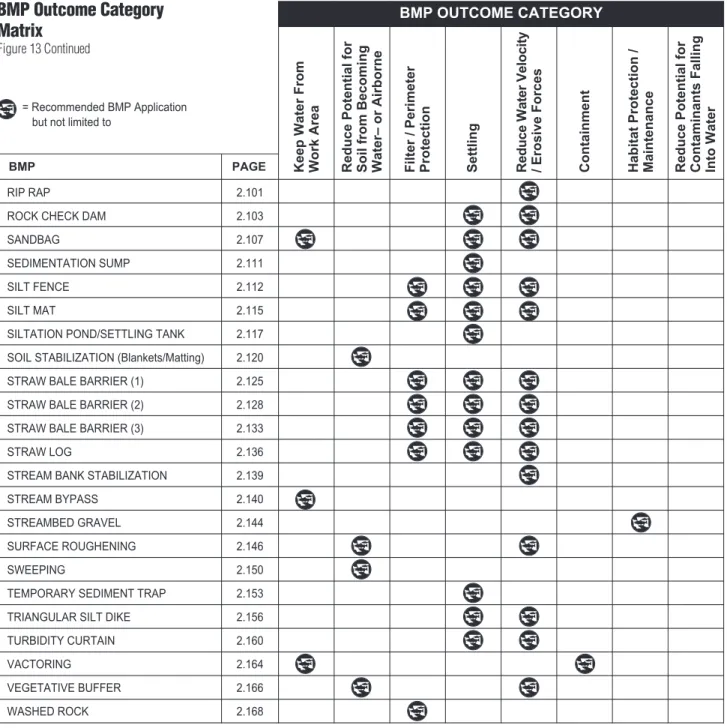
= Recommended BMP Application but not limited to
BMP Outcome Category Matrix
Figure 13 Continued
BMP OUTCOME CATEGORY
Keep Water From Work Area Reduce Potential for Soil from Becoming Water– or Airborne Filter / Perimeter Protection Settling Reduce Water Velocity / Erosive Forces Containment Habitat Protection / Maintenance Reduce Potential for Contaminants Falling Into Water
BMP PAGE
RIP RAP 2.101
ROCK CHECK DAM 2.103
SANDBAG 2.107
SEDIMENTATION SUMP 2.111
SILT FENCE 2.112
SILT MAT 2.115
SILTATION POND/SETTLING TANK 2.117 SOIL STABILIZATION (Blankets/Matting) 2.120 STRAW BALE BARRIER (1) 2.125 STRAW BALE BARRIER (2) 2.128 STRAW BALE BARRIER (3) 2.133
STRAW LOG 2.136
STREAM BANK STABILIZATION 2.139
STREAM BYPASS 2.140
STREAMBED GRAVEL 2.144 SURFACE ROUGHENING 2.146
SWEEPING 2.150
TEMPORARY SEDIMENT TRAP 2.153 TRIANGULAR SILT DIKE 2.156 TURBIDITY CURTAIN 2.160
VACTORING 2.164
VEGETATIVE BUFFER 2.166
BMP
Aqua Barrier
DESCRIPTION
An aqua barrier is a manufactured vinyl tube filled with water to provide a temporary/portable dam or barrier positioned to contain or divert the movement of water.
PURPOSE
The purpose of this BMP includes, but is not limited to:
• Providing a dry construction area in a stream or waterway. • Providing a bypass for a stream or waterway.
• Temporary reservoirs for water storage.
• Excluding waters from work area under and around bridges or piers.
APPLICATIONS
This BMP may be used for stream diversion at a construction site. It may be used in fish habitat restoration, flood control, erosion control through
diversion or containment of flowing water, silt containment, sedimentation collection or settling ponds, and/or as a portable dam.
LIMITATIONS
This BMP should not be used:
• To cross more than 2/3 of the main flow of any salmonid bearing water at the time of the year when any life history stage of salmonids are expected to be present. (unless required by permit)
• Other than specified by the manufacturer’s guidelines.
CONSTRUCTION GUIDELINES
• When used in watercourses or streams, aqua barriers must be used in accordance with permit requirements.
• Refer to Appendix E for Fish Exclusion Protocols.
• Follow manufacturer recommendations and guidelines for installation and safety measures.
• Knives shall be worn by workers for emergency deflation. • Keep a repair kit on site in case of small punctures.
BMP: AQUA BARRIER (continued)
Aqua barrier used as
coffer dam • Remove any visible rocks or sharp objects prior to installing barrier.
• The aqua barrier can be deployed on dry ground, in standing and/or flowing water.
• Multiple aqua barriers can be joined with connections.
BMP MAINTENANCE
• Inspect BMPs several times daily during the workweek. Schedule additional inspections during storm events. Any required repairs shall be made.
• Repair punctures with repair kit immediately. • Allow to dry before rolling up for storage. • Store away from chemicals, and above 10° F.
BMP REMOVAL
• Follow manufacturer recommendations for removal. • Remove BMP (recycle and/or reuse if applicable).
• Water discharged from water barrier shall meet water quality temperature standards at the point of discharge.
BMP: AQUA BARRIER (continued)
Installing aqua barrier in river to provide a dry construction area
BMP
Back of slope Planting
DESCRIPTION
Back of slope planting requires leaving the roadway slope clear for public safety. This BMP includes planting grass, forbs, small trees and brush. This BMP provides long term soil stabilization and/or reduces water velocity/ erosive forces.
PURPOSE
The purpose of this BMP includes, but is not limited to:
• Ditch slopes vegetated with grass and forbs to reduce exposed soil. • Planting trees and brush outside of the ditch on the back of the slope
allowing plants to grow over the ditch or channel.
• Providing shade as long as it does not become a public safety hazard (No trees larger than 4-inches allowed in clear zone or recovery area).
APPLICATIONS
This BMP may be used in ditches (including ditches which are watercourses or streams) parallel to roadways or at road crossings. Revegetation plans will be done in accordance with permit requirements and federal highway safety design or standards. It may be used in combination with other BMPs. This BMP provides long term soil stabilization once plantings have been established. Soil stabilization can only be achieved in combination with other BMPs. For example; Grasses and forbs on shoulder and in ditch slopes with brush, shrubs or trees behind the ditch.
LIMITATIONS
This BMP should not be used:
• If it creates a potential public safety hazard. • In clear zone areas.
• If it could cause water flow problems that may result in flooding of the roadway..
CONSTRUCTION GUIDELINES
• Review planting guidelines; plant at the appropriate time of year. • Planting must be done in accordance with design and/or permit
conditions.
BMP MAINTENANCE
• Inspect during plant establishment period. Replant, due to plant mortality, as necessary.
BMP REMOVAL
• BMP removal is not necessary.
DITCH CROSS SECTION BACK OF SLOPE PLANTING
Trees/Shrubs (shade) Back of Slope Ditch Roadway Shoulder Grass Lined Slope
BMP
Cofferdam
DESCRIPTION
A cofferdam is a temporary structure built into a waterway to enclose a construction area and reduce sediment pollution from construction work in and under water. Cofferdams can be made of steel, rock, sand bags, wood or aqua barriers.
PURPOSE
The purpose of this BMP includes, but is not limited to: • Dewatering construction areas.
APPLICATIONS
This BMP may be used in construction activities such as culvert installation, bridges, piers, or abutments. It may be used in combination with other barriers and is commonly used in conjunction with stream bypass and/or pumps.
LIMITATIONS
This BMP should not be used:
• In deep water unless designed or reviewed by an engineer.
CONSTRUCTION GUIDELINES
• When used in watercourses or streams, cofferdams must be used in accordance with permit requirements.
• Refer to Appendix B for Fish Exclusion Protocols.
• Construction guidelines depend on cofferdam material selection. See pictures for construction details.
BMP MAINTENANCE
• During construction, inspect BMPs daily during the workweek.
Schedule additional inspections during storm events. Make any required repairs.
BMP: COFFERDAM (continued)
BMP REMOVAL
• Evaluate site to determine BMP is no longer needed (the area has stabilized—potential of sediment laden water exiting the area has passed).
• Remove sediment buildup in front of BMP.
• Remove BMP (recycle and/or re-use if applicable).
• Re-vegetate area disturbed by BMP removal (if applicable).
BMP
Coir Fabric
DESCRIPTION
Coir Fabric is a geo-textile product made from coconut fibers loosely woven into a fabric usually packaged in roll form. This fabric can be used to provide a reduction in water velocity/erosive forces and/or habitat protection/
maintenance.
PURPOSE
The purpose of this BMP includes, but is not limited to:
• Decreasing bank erosion in high flow/high velocity channels. • Long term slope stabilization.
• Stream and riverbank stabilization. • Revegetation projects.
APPLICATIONS
This BMP may be used to provide stabilization/protection to the soil surface of steep slopes, stream and/or river banks. It can be used in combination with vegetation to reinforce soil in high flow/high velocity waters and on slopes as steep as 1 horizontal to 1 vertical. It may be used as bank stabilization before vegetation/re-vegetation has occurred.
LIMITATIONS
This BMP should not be used: • In the streambed of a channel.
• When short term biodegradability is required.
CONSTRUCTION GUIDELINES
• When used in water courses or streams, this BMP must be used in accordance with permit requirements.
• The fabric may be laid out horizontally or vertically on a slope.
• Use stakes or staples to anchor fabric to ground. Use anchoring devices on the edges and in the field of the fabric.
• Lay loosely on the surface so fabric makes contact with the ground. (Don’t stretch the fabric.)
BMP: COIR FABRIC (continued)
• If the seam is perpendicular with water flow, overlap fabric at least 18 inches in the direction of water flow.
• If the seam is parallel with the water flow, overlap edges at least 8 inches, staking both edges securely.
• The fabric should be trenched at least 12" deep at top and bottom ends of the installation to prevent undercutting of the fabric.
• Hand Seeding and/or Hydroseeding should occur prior to coir fabric placement.
• Live staking may be done after coir fabric placement by piercing fabric.
BMP MAINTENANCE
• During construction, inspect BMPs daily during the work week.
Schedule additional inspections during storm events. Make any required repairs.
BMP REMOVAL
• BMP removal is not necessary.
BMP
Coir Log
DESCRIPTION
A
coir log is a manufactured coconut fiber log used as a structural and rooting mechanism for bioengineered systems. These logs can be used to provide filter/perimeter protection, settling, reduction in water velocity/erosive forces and habitat protection/maintenance. They may be cut or folded, to the appropriate length, to fit the desired location.PURPOSE
The purpose of this BMP includes, but is not limited to: • Intercepting sheet flow.
• Intercepting and detaining small amounts of water from disturbed areas during construction operations in order to promote settling of soil particles.
• Filtering soil particles and debris.
• Trapping topsoil and retaining moisture from rainfall, which aids in growth of seedlings planted along the upslope side of the rolls.
APPLICATIONS
This BMP may be used for temporary check dams in ditches of any dimension, temporary soil stockpile protection, drop inlet protection, temporary
interceptor dike and swale, check dam in ditches and/or bank stabilization. Coir logs may also be used for habitat protection at the toe of a bank and can be incorporated with vegetative planting. This BMP may be used for
perimeter sediment control. This BMP is particularly useful in areas where the effects of soil disturbance need to be minimized. It may be used in
combination with other BMPs.
LIMITATIONS
This BMP should not be used:
• Where flow volume or velocity inhibit BMP function.
• When maintenance activities conducted in locations could reduce actual or potential high flow salmonid refuge functions, this BMP will be used if required by permit conditions.
BMP: COIR LOG (continued)
CONSTRUCTION GUIDELINES
• Coir log installation must be done in accordance with applicable design and/or permit conditions.
• Install to prevent water from going around or under BMP.
• BMP must be staked (wood only) to insure soil particle containment. • When using as a check dam, prior to installation, cut or fold to proper
length.
BMP MAINTENANCE
• During construction, inspect BMPs daily during the workweek.
Schedule additional inspections during storm events. Make any required repairs.
• Sediment should be removed when deposits reach one-half the height of the BMP.
BMP REMOVAL
• Evaluate site to determine BMP is no longer needed (the area has stabilized—potential of sediment laden water exiting the area has passed).
• Remove sediment buildup in front of BMP. • Removal of BMP may not always be necessary.
• Depending upon BMP placement, re-vegetation of site may be necessary.
BMP: COIR LOG (continued)
Coir logs used as habitat protection at the toe of a bank
Coir log used to allow settling and to decrease water velocity/erosive forces
BMP
Concrete Containment (1)
DESCRIPTION
C
oncrete containment is the method(s) of containing uncured concrete that is pumped or poured into forms while repairing structures in or around watercourses.PURPOSE
The purpose of this BMP includes, but is not limited to:
• Reducing uncured concrete and chemicals from leaving the work site and entering the adjacent body of water.
APPLICATIONS
This BMP may be used when dewatering is not possible for bridge repair work. Concrete containment devices may include fiberglass/steel column forms, a "Sea-form" bag system and/or steel plates to line work area. It may be used in combination with other BMPs such as cofferdams, turbidity curtains and/or dewatering/silt ponds.
LIMITATIONS
• Limitations are site specific.
CONSTRUCTION GUIDELINES
• When used in watercourses or streams, this BMP must be used in accordance with permit requirements.
• Concrete containment systems should be designed or reviewed by an engineer.
• Identify work site.
• Isolate work area. If possible, dewater construction area. • As conditions allow, provide approved secondary containment.
• Have adequate fuel supply and backup pumps in the event of emergency or mechanical failure.
• For tool and/or equipment cleanup onsite, a temporary sump may be used to contain water from cleanup.
BMP: CONCRETE CONTAINMENT (1) (continued)
BMP MAINTENANCE
• Inspect structure during construction for leaks. • Repair any leaks in structure.
• Contain and remove any excess materials, such as chemicals and/or concrete.
BMP REMOVAL
• Remove BMP as concrete and permit conditions require; this may be immediately or it may be up to 10 days after the concrete is cured (recycle and/or re-use if applicable).
BMP
Concrete Containment (2)
DESCRIPTION
C
oncrete containment is a method of containing uncured concrete pumped or poured into forms while constructing and/or repairing structures, such as sidewalks, curbs, gutters, manholes and catch basins.PURPOSE
The purpose of this BMP includes, but is not limited to:
• Containing uncured concrete and chemicals from leaving the work site. • Containing water from exposed aggregate work areas.
• Containing water from equipment cleanup.
APPLICATIONS
This BMP may be used when performing flatwork, curb and gutter or utility concrete repair work. It may be used in combination with other BMPs.
LIMITATIONS
• Limitations are site specific.
CONSTRUCTION GUIDELINES
• When used in watercourses or streams, this BMP must be used in accordance with permit requirements.
• Locate work area. • Isolate work area.
• Install drain protection downslope, for example, filter fabric, drainage plug and/or use a Vactor truck.
• Cover catch basins adjacent to work area with filter fabric.
• For tool and/or equipment cleanup onsite, a temporary sump may be used to contain water from cleanup.
BMP: CONCRETE CONTAINMENT (2) (continued)
BMP MAINTENANCE
• Contain and remove any excess materials, such as chemicals and/or concrete.
• Make sure onsite cleanup sump is of adequate size and overflow does not occur.
• Remove sediment buildup as required.
BMP REMOVAL
• Remove waste material.
BMP
Construction Access Road
DESCRIPTION
A
construction access road is a stabilized rock (or an alternative material) pad located at points of vehicular ingress and egress at a construction site. The construction access road may include a fabric underliner.PURPOSE
The purpose of this BMP includes, but is not limited to:
• Allowing stability for vehicle access to construction sites. • Limiting mud and debris deposited on roadways from adjacent
construction sites.
APPLICATIONS
This BMP may be used at construction sites with unstable soils and/or steep slopes to gain traction, especially during wet weather. It may be used in combination with other BMPs.
LIMITATIONS
This BMP should not be used: • As the sole BMP.
CONSTRUCTION GUIDELINES
• Unsuitable material should be excavated prior to placement of fabric and rock.
• Place an optional "fabric underliner" the full width and length of the access road, as required by design.
• Compact road as appropriate.
• Drainage is designed to state and local design standards (see sediment ponds).
BMP MAINTENANCE
• During construction, inspect BMPs daily during the workweek.
Schedule additional inspections during storm events. Make any required repairs.
• Materials spilled, dropped or tracked from vehicles onto roadways should be removed.
BMP: CONSTRUCTION ACCESS ROAD (continued)
• Water trucks will not be used to remove dropped, spilled, or tracked materials, unless the water can be treated by other BMPs.
BMP REMOVAL
• Remove BMP if appropriate (recycle and/or re-use if applicable). • Re-vegetate and/or restore area disturbed by BMP.
BMP: CONSTRUCTION ACCESS ROAD (continued)
BMP
Continuous Berm
DESCRIPTION
A
continuous berm is a temporary diversion dike or sediment barrier constructed with infill material, either soil, sand or gravel, encased within geosynthetic fabric. This BMP requires a Continuous Berm Machine (CBM) for filling and placing. A continuous berm can be used to provide filter/perimeter protection, settling, and reduction in water velocity/erosive forces.PURPOSE
The purpose of this BMP includes, but is not limited to: • Diverting sheet flow.
• Intercepting sheet flow.
• Intercepting and detaining small amounts of water from disturbed areas during construction operations in order to allow settling of soil particles. • Decreasing down slope sheet flow velocity.
• Retaining soil particles/debris on site.
APPLICATIONS
This BMP may be used for perimeter sediment control. It may be used in combination with other BMPs.
This BMP may be used below disturbed areas subject to sheet and rill erosion where drainage area is no greater than .25 acre per 100 lineal feet of barrier and the slope behind the barrier should be no steeper than 2 horizontal feet to 1 vertical foot. On relatively flat slopes the maximum disturbed slope distance should not exceed 100 feet. The allowable disturbed slope distance decreases as the slope gets steeper.
LIMITATIONS
This BMP should not be used: • Directly in water courses. • In front of storm outlets.
BMP: CONTINUOUS BERM (continued)
CONSTRUCTION GUIDELINES
• Use a Continuous Berm Machine (follow operating manual).
• Apply to relatively smooth surfaces to form a tight seal with ground. • A source of infill material is required (sand, gravel, or local soils). • Increase the elevation at the ends of the BMP installation to prevent "end
runs."
BMP MAINTENANCE
• During construction, inspect BMPs daily during the workweek.
Schedule additional inspections during storm events. Make any required repairs.
• Repair any damaged BMPs due to end runs or undercutting.
• Sediment should be removed when deposits reach one-half the height of the BMP.
BMP REMOVAL
• Evaluate site to determine BMP is no longer needed (the area has stabilized—potential of sediment laden water exiting the area has passed).
• Remove sediment buildup in front of BMP.
• Remove BMP (recycle and/or re-use is applicable).
- Removal consists of slitting and removing the fabric.
- Remove the infill material from the site or grade infill material into the existing shoulder or soil.
• Depending upon BMP placement, re-vegetation of site may be necessary.
BMP: CONTINUOUS BERM (continued)
Continuous berm machine
Continuous berm
Continuous berm retaining soil particles and debris
Continuous berm intercepting water from construction area
BMP
Curb Inlet Sediment Trap
DESCRIPTION
A
curb inlet sediment trap is a temporary barrier constructed from concrete blocks, gravel, filter fabric or gravel bag filter. Geotextile grade covers and geotextile collectors (inserts) are available pre-manufactured. Curb inlet sediment traps can be used to provide filtering and settling of soil particles.PURPOSE
The purpose of this BMP includes, but is not limited to:
• Reducing the soil particles discharged into storm drains by settling and/ or filtering the runoff.
• Allowing for overflow from high runoff events.
• Allowing the ponded water to filter rapidly through gravel.
APPLICATIONS
These BMPs are used at curb inlets on gently sloping streets where water can pond and allow particles to filter or settle.
LIMITATIONS
This BMP should not be used:
• Where the ponding area will encroach into the travel lanes or pedestrian walkways.
• Steep grades.
CONSTRUCTION GUIDELINES
• A spillway structure shall be constructed with the sandbags to allow overflow.
• Place sandbags in a curved row from the top of curb at least 3 feet into the street; curve the ends upward.
• Overlap several layers of bags and pack tightly.
• Leave a one-sandbag gap at the upstream end in the top row to act as a spillway.
• Slope runoff should flow over blocks and gravel and not be bypassed over the curb.
BMP: CURB INLET SEDIMENT TRAP (continued)
• Install pre-manufactured grade covers and geo-textile collectors in accordance with manufacturer specifications.
• Install grade covers, geo-textile collectors, or filter fabric on top of or in front of the inlet. Construct a small dam immediately downstream of the inlet to stop flow.
BMP MAINTENANCE
• Sediment shall be removed.
• If the gravel becomes clogged with sediment, it must be carefully removed from the inlet and either cleaned or replaced.
• During construction, inspect BMPs daily during the workweek.
Schedule additional inspections during storm events. Make any required repairs.
BMP REMOVAL
• Evaluate site to determine BMP is no longer needed (the area has stabilized—potential of sediment laden water exiting the area has passed).
• Remove sediment buildup in front of BMP.
• Remove BMP (recycle and/or re-use if applicable).
• Use vacuum sweeper or hand broom to clean road surface. • Use "Vactor-Truck" to clean drainage system.
BMP: CURB INLET SEDIMENT TRAP (continued)
BMP: CURB INLET SEDIMENT TRAP (continued)
BMP
Dewatering
DESCRIPTION
D
ewatering can be used to keep water from a work area by using any or all of the following: pump, barrier, vactor, or bypass culvert.PURPOSE
The purpose of this BMP includes, but is not limited to: • Allowing work to be performed in dewatered conditions. • Reducing the transport of soil particles by flowing water. • Reducing the liquefaction of soils.
APPLICATIONS
This BMP may be used in, but not limited to, ditches, watercourses or streams, channels, swales and excavations. It will generally be used in combination with other BMPs.
LIMITATIONS
This BMP should not be used:
• Where flows are greater than pump capacity.
CONSTRUCTION GUIDELINES
• Determine if the project will require continuous dewatering.
• Schedule pumping, monitoring, equipment and maintenance activities accordingly.
• Dewatering must be used in accordance with applicable design and/or permit conditions.
• Refer to Appendix E for Fish Exclusion Protocols. • Install a "Keep Water from Work Area" BMP. • Install dewatering devices.
• Install site specific barrier, prior to dewatering, to prevent exterior water from entering construction area.
BMP: DEWATERING (continued)
• Dewatered water will be discharged to: • A containment device.
• A sanitary sewage system.
• Other BMPs to reduce water borne soil particles prior to the water being reintroduced to a storm drainage system, water course or stream.
BMP MAINTENANCE
• Schedule pumping, monitoring, equipment and maintenance activities in accordance with dewatering needs.
• During construction, inspect BMPs daily during the workweek.
Schedule additional inspections during storm events. Make any required repairs as needed.
• Inspect bypass, pump, and barrier periodically. Make necessary repairs. • Check for erosion at discharge. Repair or move as necessary.
• Have adequate fuel supply and backup pumps in the event of mechanical failure.
BMP REMOVAL
• Remove BMP (recycle and/or re-use if applicable). • Reintroduce water gradually.
BMP
Diaper Netting
DESCRIPTION
D
iaper/netting is a fine mesh netting or canvas suspended under a bridge, pipeline or pier to catch debris during construction or maintenance activities.PURPOSE
The purpose of this BMP includes, but is not limited to:
• Catching and containing falling debris (such as: concrete, wood chips, sawdust, slag and metal) from entering water during construction, maintenance and repair activities.
APPLICATIONS
This BMP is used in bridge, pipeline or pier construction and repairs. It may also be used in maintenance activities such as cleaning and painting. It may be used in combination with other BMPs.
LIMITATIONS
This BMP should not be used:
• During periods of high winds that reduce the effectiveness of the BMP.
CONSTRUCTION GUIDELINES
• Multiple nets with different mesh sizes may be required, depending upon the work tasks performed. Mesh size gets progressively smaller from top to bottom.
• Attach diaper/netting securely prior to starting work.
• Remove diaper/netting carefully after work, not allowing debris to fall. • Maintain separation between diaper/netting and water surface.
BMP MAINTENANCE
• During construction, inspect BMPs daily during the workweek.
Schedule additional inspections during storm events. Make any required repairs.
BMP: DIAPER NETTING (continued)
BMP REMOVAL
• Evaluate site to determine BMP is no longer needed. • Remove debris on BMP.
• Remove BMP (recycle and/or re-use if applicable).
• Inspect after job is complete to make sure diaper/netting is in good repair for next project.
Diaper netting under bridge
BMP
Ditch Lining
DESCRIPTION
D
itch lining provides a long/short-term erosion resistant lining of the ditch flow line and side slopes utilizing biodegradable or non-biodegradable geo-textile fabrics and/or angular rock to stabilize ditches and channels from erosion and soil particle movement.PURPOSE
The purpose of this BMP includes, but is not limited to:
• Protecting the soil from erosive forces of concentrated runoff. • Slowing the velocity of concentrated runoff while enhancing the
potential for infiltration and vegetation growth.
• Stabilizing slopes adjacent to ditches which have seepage problems and/ or non-cohesive soils.
APPLICATIONS
This BMP may be used in ditches, channels, swales and banks or slopes. It may be used in conjunction with other BMPs.
LIMITATIONS
This BMP should not be used directly in water courses unless required by permit.
CONSTRUCTION GUIDELINES
• When used in watercourses or streams, this BMP must be used in accordance with permit requirements.
• Plan for site specific uses.
• Use design specifications when available.
• Channels should be constructed with a wide and shallow cross section.
BMP MAINTENANCE
• During the initial establishment, inspection should occur and any necessary repair made.
BMP: DITCH LINING (continued)
• Grass seed should be applied in accordance with manufacturer specifications.
• After implementation, the channel should be inspected periodically to determine if channel is withstanding flow velocities without damage. • Check the channel for debris, scour, or erosion and make necessary
repairs.
• Remove all significant sediment accumulations to maintain the desired flow line and capacity during maintenance activity.
• Check channel slopes, outlets and all road crossings for bank stability and evidence of erosion, during maintenance activity, and make repairs as necessary.
BMP REMOVAL
• Evaluate site to determine BMP is no longer needed (the area has stabilized—potential of sediment laden water exiting the area has passed).
• Remove BMP (recycle and/or re-use if applicable). • BMP removal is not always necessary.
BMP
Diversion Berm
DESCRIPTION
A
diversion berm is a temporary ridge of compacted soil constructed at the top or base of a disturbed slope.PURPOSE
The purpose of this BMP includes, but is not limited to:
• Diverting storm runoff from upslope drainage areas away from unprotected disturbed areas and toward a stabilized outlet.
• Diverting laden runoff from a disturbed area to a sediment-containment facility such as a sediment trap or a sediment basin.
APPLICATIONS
This BMP may be used wherever stormwater runoff must be temporarily diverted away from a disturbed slope and toward a sediment containment facility. These structures generally have a life expectancy of 18 months or less. This BMP may be used in combination with other BMPs.
LIMITATIONS
This BMP should not be used:
• If water flow is likely to erode the berm. • If there is inadequate space for construction.
CONSTRUCTION GUIDELINES
• Berms should be installed as a first step in the land-disturbing activity. • The berm should be adequately compacted to reduce failure.
• Minimum freeboard can be 0.3 feet.
• Temporary seeding and mulch can be applied to the berm following construction of the berm.
• Clear plastic may be used as an additional erosion control method. See "Plastic Covering" BMP construction guidelines.
BMP MAINTENANCE
BMP: DIVERSION BERM (continued)
Schedule additional inspections during storm events. Make any required repairs.
• During long term implementation inspect once every two weeks, whether a storm has occurred or not.
BMP REMOVAL
• Evaluate site to determine BMP is no longer needed (the area has stabilized—potential of sediment laden water exiting the area has passed).
• Remove sediment buildup.
• Remove BMP (recycle and/or re-use if applicable).
• Re-vegetate area disturbed by BMP removal (if applicable).
BMP
Diversion Channel
DESCRIPTION
A
diversion channel is constructed across a slope with a supporting earthen ridge on the lower side.PURPOSE
The purpose of this BMP includes, but is not limited to: • Reducing slope length.
• Intercepting and diverting stormwater runoff to stabilized outlets at non-erosive velocities.
• Intercepting sheet flow.
• Decreasing down slope sheet flow velocity.
APPLICATIONS
This BMP may be used where runoff from areas of higher elevation may damage property, cause erosion, or interfere with the establishment of vegetation on downslope areas. It may also be used where surface and/or shallow subsurface flow is damaging a slope and where the slope length needs to be reduced to minimize soil loss. This BMP may be used in combination with other BMPs.
LIMITATIONS
This BMP should not be used:
• If the downslope is greater than 2 horizontal by 1 vertical. • If water flow is likely to erode the channel.
• If there is inadequate space for construction.
CONSTRUCTION GUIDELINES
• The diversion channel shall be excavated or shaped to line, grade and cross-section as required:
- Side slopes of the channel shall be no steeper than 2 horizontal by 1 vertical.
- Minimum freeboard shall be 0.3 feet.
BMP: DIVERSION CHANNEL (continued)
• Temporary seeding and mulch can be applied to the channel following construction of the channel.
• Clear plastic may be used as an additional erosion control method. See "Plastic Covering" BMP construction guidelines.
BMP MAINTENANCE
• During construction, inspect BMPs daily during the workweek.
Schedule additional inspections during storm events. Make any required repairs.
• Seeded areas which fail to establish a vegetative cover shall be reseeded as necessary.
• During long term implementation inspect periodically, whether a storm has occurred or not.
BMP REMOVAL
• Evaluate site to determine BMP is no longer needed (the area has stabilized—potential of sediment laden water exiting the area has passed).
• Remove sediment buildup.
• Remove BMP (recycle and/or re-use if applicable).
BMP
Dust Control
DESCRIPTION
D
ust control is the use of water, products, and/or measures for reducing wind erosion. Particles moved by wind may cause air pollution, soil loss and/or water quality degradation.PURPOSE
The purpose of this BMP includes, but is not limited to:
• Reducing soil particle travel by wind due to construction or maintenance operation activities.
• Reducing air and water pollution.
APPLICATIONS
This BMP may be used on construction sites, roads, shoulders, operating headquarters or pit/quarry sites. It may be used in combination with other BMPs. Protecting the soil surface is accomplished through measures such as roughening the soil to reduce the surface wind velocity, applying straw/mulch, water, matting, hydroseeding, plastic covering, Lignum derivative, or
Magnesium Chloride.
LIMITATIONS
This BMP should not be used:
• With straw in locations where compaction is required (for example, roadway shoulders or road bases).
• If a chemical suppressant could enter watercourses or streams.
CONSTRUCTION GUIDELINES
• Water, Lignum derivative, or Magnesium Chloride can be applied by mechanical means.
• A temporary straw covering may be applied by hand to a small area of exposed soil where compaction is not required.
• Surface roughening may be accomplished by using a machine. • Create a berm downslope to control possible runoff from watering.
BMP: DUST CONTROL (continued)
BMP MAINTENANCE
• During the construction period, inspect BMPs daily during the workweek. Make any required repairs.
• Reapply BMP as needed.
BMP REMOVAL
• Evaluate site to determine BMP is no longer needed (the area has stabilized—potential of wind erosion has passed).
• Straw removal may be necessary if the area is to be re-vegetated. • Re-vegetate area disturbed by BMP removal.
Water wagon wetting down field for dust control
Wetting down stockpiles to reduce airborne soil particles
BMP
Excelsior Filled Log
DESCRIPTION
A
n excelsior filled log is a manufactured log filled with curled wood excelsior. When cut or folded to appropriate length, these logs can be used to provide filter/perimeter protection, settling, reduction in water velocity/erosive forces and habitat protection/maintenance.PURPOSE
The purpose of this BMP includes, but is not limited to:
• Reducing slope length to capture and retain sediment on the slope. • Temporarily stabilizing slopes by reducing soil creep, sheet and rill
erosion until permanent vegetation can be established.
• Trapping topsoil and retaining moisture from rainfall, which aids in growth of seedlings planted along the upslope side of the rolls.
• Intercepting and detaining small amounts of water from disturbed areas during construction operations in order to promote settling of soil particles.
• Filtering soil particles and debris.
• Reducing water velocity and erosive forces.
APPLICATIONS
This BMP may be used in ditches or across culvert ends of any dimension. Excelsior filled logs may also be used for habitat protection at the toe of a bank and can be incorporated with vegetative planting. It may be used instead of straw logs, coir logs, or straw bale filtering systems. Excelsior filled logs may also be used for perimeter sediment control.
This BMP may be used in gullies and stream channels as check dams in conjunction with gabions, rip rap, articulated block, or cellular confinement systems. It may be used to anchor and enhance the effectiveness of willow wattles (fascines), turf reinforcement mats, coir mats, continuous berms and other erosion control material. Excelsior filled logs may be used to replace silt fences or straw bales on steep slopes. It may be used in combination with other BMPs.
LIMITATIONS
This BMP should not be used:
• Where flow volume or velocity inhibit BMP function. • For long term applications.
• When maintenance activities conducted in locations could reduce actual or potential high flow salmonid refuge functions, this BMP will be used if required by permit conditions.
CONSTRUCTION GUIDELINES
• Excelsior filled log must be placed in accordance with applicable design and/or permit conditions.
• Logs are placed and staked along the contour of newly constructed or disturbed slopes, in 2-3 inch deep trench.
• Spacing depends on soil type and slope steepness. • Tightly abut any adjacent logs.
• Install to prevent water from going around or under BMP.
• See "Live Staking", "Handseeding" and/or "Hydroseeding" BMP for planting.
BMP MAINTENANCE
• During construction, inspect BMPs daily during the workweek.
Schedule additional inspections during storm events. Make any required repairs.
• Sediment should be removed when deposits reach one-half the height of the BMP.
BMP REMOVAL
• Evaluate site to determine BMP is no longer needed (the area has stabilized—potential of sediment laden water exiting the area has passed).
• Remove sediment buildup in front of BMP.
• Depending upon BMP placement, re-vegetation of site may be necessary.
BMP
Filter Fabric
DESCRIPTION
F
ilter fabric is a permeable material made with synthetic fibers. It may be a woven or non-woven fabric and is usually packaged in roll form. This fabric can be used to reduce potential for soil becoming water borne, filter/ perimeter protection and/or settling.PURPOSE
The purpose of this BMP includes, but is not limited to: • Filtering soil particles from water.
• Stabilizing and reinforcing soils.
APPLICATIONS
This BMP may be used in drainage filtration, to reinforce paved and unpaved roads, stabilize access or haul roads and to separate soils.
LIMITATIONS
This BMP should not be used: • In the streambed of a channel.
• When short term biodegradability is required.
CONSTRUCTION GUIDELINES
• When used near watercourses or streams, this BMP must be used in accordance with permit requirements.
• Some applications may be designed or reviewed by an engineer. - Woven filter fabric should only be used for soil separation, road
reinforcement and soil separation.
- Non-woven filter fabric should only be used for drainage filtration although it may be used under unpaved roads in certain
circumstances.
- Use according to manufacturers details.
BMP MAINTENANCE
BMP: FILTER FABRIC (continued)
Schedule additional inspections during storm events. Make any required repairs.
BMP REMOVAL
• Evaluate site to determine BMP is no longer needed (the area has stabilized—potential of sediment laden water exiting the area has passed).
• If used as a filter, remove sediment buildup from in front of the BMP. • Re-vegetate area disturbed by BMP removal (if applicable).
BMP
Grass Lined Channel
DESCRIPTION
A
grass lined channel is the vegetative lining of a ditch, watercourse, stream, or swale to protect it from erosion and to provide filter/perimeter protection.PURPOSE
The purpose of this BMP includes, but is not limited:
• Reducing erosion by providing ground cover, binding soil particles with roots, and lowering water velocity.
• Providing filter/perimeter protection. • Providing habitat for primary production.
• Providing habitat for prey base organisms such as macro-invertebrates.
APPLICATIONS
This BMP may be used where a vegetative lining can provide sufficient stability for the channel grade by decreasing velocity; where site conditions require establishment of vegetation (climate, soil and topography are present). This BMP may be used in combination with other bank stabilizing methods.
LIMITATIONS
This BMP should not be used:
• When maintenance activities are conducted in locations which could reduce actual or potential high flow salmonid refuge functions. • In locations where there is frequent turbulence with flows likely to rip
out grass lining, creating erosion and downstream plugging of system.
CONSTRUCTION GUIDELINES
• This BMP must be used in accordance with applicable permit requirements.
BMP: GRASS LINED CHANNEL (continued)
BMP MAINTENANCE
• During initial vegetation establishment, inspection should occur and any necessary repairs made.
• After vegetation establishment, the channel should be inspected periodically to determine if the channel is withstanding flow velocities without damage.
• Check the channel for debris, scour, or erosion and make repairs.
• Remove all significant sediment accumulations to maintain the designed carrying capacity. Debris such as litter, car parts, appliances and items that pose a risk to public safety should be removed. Any LWM that falls into the channel and does not pose a threat to public safety or structure damage should be left in place or relocated to an area that is not a public safety hazard or ROW structure problem.
• Check channel outlet and all road crossings for bank stability, evidence of piping or scour holes and make repairs.
BMP REMOVAL
• BMP removal is not necessary.
Grass lined channel: reducing erosion by providing ground cover
BMP
Gravel Filled Sump
DESCRIPTION
A
gravel filled sump is a constructed sump filled with gravel and astanding perforated pipe or bucket that allows pumping filtered water out of a non-erosive location.
PURPOSE
The purpose of this BMP includes, but is not limited to: • Dewatering construction sites.
• Filtering sediment from water.
APPLICATIONS
This BMP is used in conjunction with flow bypass.
LIMITATIONS
This BMP should not be used:
• When peak flows exceed the pump capacity.
CONSTRUCTION GUIDELINES
• Excavate hole at least 3 feet deep.
• Line the base and sides of the hole with filter fabric. • Place perforated pipe inside the hole.
• Shore up pipe by adding washed rock to space between hole and pipe exterior.
• Have adequate fuel supply and backup pumps in the event of mechanical failure.
BMP MAINTENANCE
• Inspect bypass, pump, and sump periodically. Repair any leaks immediately.
• Check for scour at bypass outfall. Repair or move as necessary. • Provide downstream sediment filtration.
BMP REMOVAL
• Remove BMP when in water work is complete. • Remove BMP (recycle and/or re-use if applicable).