[
#
DEPARTMENT OF HEALTH & HUMAN SERVICES REGION 111k
Memorandum
DateJAN
2
7
2004
Regional Inspector General for Audit Services
subject Audit Report - REVIEW OF OUTPATIENT CARDIAC REHABILITATION
SERVICES AT ANNE ARUNDEL MEDICAL CENTER, ANNAPOLIS, MARYLAND (Report Number A-03-03-0001 1)
To
Sonia A. Madison Regional Administrator
Centers for Medicare & Medicaid Services
Attached are two copies of the Department of Health and Human Services (HHS), Office of Inspector General's report entitled "Review of Outpatient Cardiac Rehabilitation Services at Anne Arundel Medical Center, Annapolis, Maryland." This review is part of a nationwide analysis of Medicare reimbursement for outpatient cardiac rehabilitation services. The objectives of our review were to ascertain whether Anne Arundel Medical Center's (Anne Arundel) policies and procedures complied with Medicare requirements and whether Medicare properly reimbursed Anne Arundel for outpatient cardiac
rehabilitation services. Should you have any questions or comments concerning the matters commented on in this report, please contact me or have your staff contact Eugene Berti, Audit Manager at 2 15-86 1-4474.
To facilitate identification, please refer to Report Number A-03-03-0001 1 in all correspondence relating to this report.
DEPARTMENT OF HEALTH & HUMAN SERVICES
OFFICE OF INSPECTOR GENERAL OFFICE OF AUDIT SERVICES 150 S. INDEPENDENCE MALL WEST
SUITE 3 16
PHILADELPHIA, PENNSYLVANIA 19 106-3499
Report Number: A-03-03-000 1 1 Vickie Diamond, RN
Vice President of Clinical Services Anne Arundel Medical Center 200 1 Medical Parkway
Annapolis, Maryland 2 140 1 Dear Ms. Diamond:
Enclosed are two copies of the Department of Health and Human Services (HHS), Ofice of Inspector General's report entitled "Review of Outpatient Cardiac Rehabilitation Services at Anne Arundel Medical Center, Annapolis, Maryland." This review is part of a nationwide analysis of Medicare reimbursement for outpatient cardiac rehabilitation services. The objectives of our review were to ascertain whether Anne Arundel Medical Center's (Anne Arundel) policies and procedures complied with Medicare requirements and whether Medicare properly reimbursed Anne Arundel for outpatient cardiac
rehabilitation services. Should you have any questions or comments concerning the matters commented on in this report, please direct them to the HHS official named below. In accordance with the principles of the Freedom of Information Act, 5 U.S.C. 552, as amended by Public Law 104-23 1, Office of Inspector General's reports issued to the Department's grantees and contractors are made available to members of the press and general public to the extent information contained therein is not subject to exemptions in the Act which the Department chooses to exercise (see 45 CFR Part 5).
Page 2 - Vickie Diamond, RN
To facilitate identification, please refer to Report Number A-03-03-0001 1 in all correspondence relating to this report.
Sincerely yours,
Stephen Virbitsky
Regional Inspector General for Audit Services
Enclosure
Direct Reply to HHS Action Official:
Ms. Sonia Madison Regional Administrator
Centers for Medicare & Medicaid Services, Region I11 Public Ledger Building, Suite 2 16
150 S. Independence Mall West Philadelphia, PA 191 06-3499
Department of Health and Human Services
OFFICE OF
INSPECTOR GENERAL
JANUARY 2004 A-03-03-00011
R
EVIEW OF
O
UTPATIENT
C
ARDIAC
R
EHABILITATION
S
ERVICES AT
A
NNE
A
RUNDEL
M
EDICAL
C
ENTER
,
Office of Inspector General
http://oig.hhs.gov
The mission of the Office of Inspector General (OIG), as mandated by Public Law 95-452, as amended, is to protect the integrity of the Department of Health and Human Services (HHS) programs, as well as the health and welfare of beneficiaries served by those programs. This statutory mission is carried out through a nationwide network of audits, investigations, and inspections conducted by the following operating components:
Office of Audit Services
The OIG's Office of Audit Services (OAS) provides all auditing services for HHS, either by conducting audits with its own audit resources or by overseeing audit work done by others. Audits examine the performance of HHS programs and/or its grantees and contractors in carrying out their respective responsibilities and are intended to provide independent assessments of HHS programs and operations in order to reduce waste, abuse, and mismanagement and to promote economy and efficiency throughout the department.
Office of Evaluation and Inspections
The OIG's Office of Evaluation and Inspections (OEI) conducts short-term management and program evaluations (called inspections) that focus on issues of concern to the department, the Congress, and the public. The findings and recommendations contained in the
inspections reports generate rapid, accurate, and up-to-date information on the efficiency, vulnerability, and effectiveness of departmental programs.
Office of Investigations
The OIG's Office of Investigations (OI) conducts criminal, civil, and administrative investigations of allegations of wrongdoing in HHS programs or to HHS beneficiaries and of unjust enrichment by providers. The investigative efforts of OI lead to criminal
convictions, administrative sanctions, or civil monetary penalties. The OI also oversees state Medicaid fraud control units, which investigate and prosecute fraud and patient abuse in the Medicaid program.
Office of Counsel to the Inspector General
The Office of Counsel to the Inspector General (OCIG) provides general legal services to OIG, rendering advice and opinions on HHS programs and operations and providing all legal support in OIG's internal operations. The OCIG imposes program exclusions and civil monetary penalties on health care providers and litigates those actions within the
department. The OCIG also represents OIG in the global settlement of cases arising under the Civil False Claims Act, develops and monitors corporate integrity agreements, develops model compliance plans, renders advisory opinions on OIG sanctions to the health care
Notices
THIS REPORT IS AVAILABLE TO THE PUBLIC
at http://oig. hhs.gov
In accordance with the principles of the Freedom of Information Act (5 U.S.C. 552,
as amended by Public Law 104-231), Office of Inspector General, Office of Audit
Services reports are made available to members of the public to the extent the
information is not subject to exemptions in the act. (See 45 CFR Part
5.)
OAS FINDINGS AND OPINIONS
The designation of financial or management practices as questionable or a
recommendation for the disallowance of costs incurred or claimed, as well as other
conclusions and recommendations in this report, represent the findings and opinions
of the HHSIOIGIOAS. Authorized officials of the HHS divisions will make final
EXECUTIVE SUMMARY BACKGROUND
This review is part of a nationwide analysis of Medicare reimbursement for outpatient cardiac rehabilitation services. The analysis was requested by the Administrator of the Centers for Medicare & Medicaid Services to determine the level of provider compliance with national Medicare outpatient cardiac rehabilitation policies.
OBJECTIVE
The overall objective of our review was to determine whether Medicare properly reimbursed Anne Arundel Medical Center (Anne Arundel) for outpatient cardiac rehabilitation services. Specifically, we determined whether:
• Anne Arundel’s policies and procedures reflected Medicare cardiac rehabilitation
coverage requirements for direct physician supervision, "incident to” services, and Medicare covered diagnoses; and
• Payments to Anne Arundel for outpatient cardiac rehabilitation services provided to
Medicare beneficiaries during calendar year (CY) 2001 were for Medicare covered diagnoses, were supported by adequate documentation, and were otherwise allowable for reimbursement.
RESULTS OF AUDIT
Even though physician supervision is assumed to be met in an outpatient hospital department, Anne Arundel contracted with a physician to supervise the services provided by its cardiac rehabilitation program. The physician’s responsibilities included approval of the patients’
exercise prescriptions and reviewing patients’ progress. We could not determine whether the
physician was in the exercise area during regularly scheduled exercise sessions or whether he saw the patients.
In addition, from our specific claims review for a sample of 30 beneficiaries who received outpatient cardiac rehabilitation services during CY 2001, we determined that Anne Arundel received Medicare payments of $3,997 for:
• Services where the diagnoses used to establish the patients’ eligibility for cardiac
rehabilitation may not have been supported by medical records (8 beneficiaries);
• Services for which Anne Arundel’s medical records did not contain any documentation (1
beneficiary);
• Services for which Anne Arundel’s medical records did not contain electrocardiogram
strips (2 beneficiaries); and
The sample errors and Medicare payments are part of a larger statistical sample and will be included in the multistate projection of outpatient cardiac rehabilitation service claims not meeting Medicare coverage requirements.
We attribute these questionable services to weaknesses in Anne Arundel’s internal controls and oversight procedures. Most notably, Anne Arundel did not consistently ensure that beneficiaries had an adequately supported Medicare covered diagnosis supported by the referring physician’s medical records, that supporting documentation for Medicare billings and reimbursements for outpatient cardiac rehabilitation services was maintained, and that the covered diagnoses were adequately supported in their medical records.
Our determinations regarding Medicare covered diagnoses were based solely on our review of the medical record documentation. We believe that Anne Arundel’s fiscal intermediary (FI), CareFirst Blue Cross Blue Shield of Maryland (CareFirst), should determine the allowability of the Medicare claims and appropriate recovery action.
RECOMMENDATIONS
We recommend that Anne Arundel:
• Work with CareFirst to ensure that Anne Arundel’s outpatient cardiac rehabilitation
program is being conducted in accordance with the Medicare coverage requirements for direct physician supervision and for services provided “incident to” a physician’s professional service;
• Work with CareFirst to establish the amount of repayment liability, estimated to be
$3,997, for services provided to beneficiaries where medical documentation may not have supported Medicare covered diagnoses and for services not otherwise allowable; and
• Enforce existing policies to ensure that medical record documentation is obtained and
maintained to support Medicare outpatient cardiac rehabilitation services.
AUDITEE’S COMMENTS
In its comments to our report, Anne Arundel agreed to work with CareFirst to ensure its program is being conducted in accordance with Medicare requirements for direct physician supervision and services provided “incident to” a physician’s professional service. Additionally, Anne Arundel stated that services for seven beneficiaries whose payments we questioned underwent prepayment reviews by the CareFirst. Finally, Anne Arundel explained its policies for review and audit of medical record documentation for cardiac rehabilitation services. Anne Arundel’s comments are included as Appendix B.
OFFICE OF INSPECTOR GENERAL’S RESPONSE
We are pleased that Anne Arundel agreed to work with CareFirst to ensure that its cardiac rehabilitation program is being conducted in accordance with Medicare requirements. Although we evaluated Anne Arundel’s documentation related to the repayment liability, we generally did not adjust our findings or recommendations and continue to recommend that Anne Arundel work with CareFirst to address the claims that we believe may be unsupported by medical
documentation or that are otherwise unallowable. We are encouraged by Anne Arundel’s self-described policies for reviewing and auditing medical record documentation and believe that the enforcement of such policies will help to ensure adequate support for its cardiac rehabilitation services.
TABLE OF CONTENTS
Page
INTRODUCTION 1
BACKGROUND 1
Medicare Coverage 1
Cardiac Rehabilitation Programs 2
OBJECTIVES, SCOPE, AND METHODOLOGY 2
Objective 2
Scope 3
Methodology 3
RESULTS OF AUDIT 4
PHYSICIAN INVOLVEMENT IN OUTPATIENT CARDIAC REHABILITATION 4
Direct Physician Supervision 4
“Incident To” Physician Services 5
MEDICARE COVERED DIAGNOSES AND DOCUMENTATION 6
Categories of Errors 7
Medicare Covered Diagnoses 7
Documentation of Services 8
Billing Procedures 8
Underlying Causes for Errors 9
Medicare Covered Diagnoses 9
Documentation of Services 9
Billing Procedures 9
RECOMMENDATIONS 10
AUDITEE’S COMMENTS 10
OFFICE OF INSPECTOR GENERAL’S RESPONSE 10
APPENDICES
STATISTICAL SAMPLE SUMMARY OF ERRORS A
AUDITEE’S COMMENTS B
INTRODUCTION BACKGROUND
Medicare Coverage
The Medicare program, established by title XVIII of the Social Security Act (Act), provides health insurance to people aged 65 and over, the disabled, people with end stage renal disease, and certain others who elect to purchase Medicare coverage. The Medicare program is
administered by the Centers for Medicare & Medicaid Services (CMS). CMS currently covers Phase II outpatient cardiac rehabilitation programs conducted in specialized, free-standing cardiac rehabilitation clinics and in outpatient hospital departments under the “incident to” benefit (section 1861(s)(2)(A)) of the Act.
Medicare coverage policy for cardiac rehabilitation services is found in section 35-25 of the Medicare Coverage Issues Manual. Medicare coverage of outpatient cardiac rehabilitation programs is considered reasonable and necessary only for patients with a clear medical need, who are referred by their attending physicians, and (1) have a documented diagnosis of acute myocardial infarction within the preceding 12 months, (2) have had coronary artery bypass graft surgery, and/or (3) have stable angina pectoris. Services provided in connection with the cardiac rehabilitation program may be considered reasonable and necessary for up to 36 sessions, usually 3 sessions per week in a single 12-week period. Each cardiac rehabilitation session is considered to be one unit of service.
Cardiac rehabilitation is provided by nonphysician personnel, who are trained in both basic and advanced life support techniques and exercise therapy for coronary disease, under the direct supervision of a physician. Direct supervision means that a physician must be in the exercise area and immediately available and accessible for an emergency at all times the exercise program is conducted. It does not require a physician to be physically present in the exercise room itself. For outpatient therapeutic services provided in a hospital, the Medicare Intermediary Manual states, “The physician supervision requirement is generally assumed to be met where the services are performed on hospital premises.”
In order to be covered under the “incident to” benefit in an outpatient hospital department, services must be furnished as an integral, although incidental part of the physician’s professional service in the course of diagnosis or treatment of an illness or injury. This does not mean that each occasion of service by a nonphysician need also be the occasion of the actual rendition of a personal professional service by the physician. However, during any course of treatment
rendered by auxiliary personnel, the physician must personally see the patient periodically and sufficiently often to assess the course of treatment and the patient’s progress and, where necessary, to change the treatment program.
Cardiac Rehabilitation Programs
Cardiac rehabilitation consists of comprehensive programs involving medical evaluation, prescribed exercise, cardiac risk factor modification, education, and counseling. Cardiac rehabilitation programs are typically divided into three phases, as follows:
• Phase I. Phase I rehabilitation is initiated in the acute convalescent period following a
cardiac event during the hospital phase of treatment. This phase of cardiac rehabilitation is considered part of the hospital stay.
• Phase II. Phase II begins with a physician’s prescription (referral) after the acute
convalescent period and after it has been determined that the patient’s clinical status and capacity will allow for safe participation in an individualized progressive exercise program. This phase requires close monitoring and is directed by a physician who is on-site. Phase II outpatient cardiac rehabilitation is covered by Medicare.
• Phase III. Phase III begins after completion of Phase II and involves a less intensively
monitored aerobic exercise program. Phase III level programs are considered maintenance and are not covered by Medicare.
Medicare reimburses outpatient hospital departments for cardiac rehabilitation services under the outpatient prospective payment system. However, since 1977, Maryland hospitals have operated under a waiver from Medicare’s reimbursement methodology for hospital services. Under the waiver, Medicare reimburses Maryland hospitals on the basis of rates set by the state’s Health Services Cost Review Commission. The FI for Anne Arundel is CareFirst. For CY 2001, Anne Arundel billed for outpatient cardiac rehabilitation services to 139 Medicare beneficiaries and received $148,035 in Medicare reimbursements for these services.
OBJECTIVE, SCOPE, AND METHODOLOGY Objective
Our review is part of a nationwide analysis of Medicare reimbursement for outpatient cardiac
rehabilitation services. The analysis was requested by the CMS Administrator to determine the
level of provider compliance with Medicare coverage requirements for outpatient cardiac rehabilitation services. As such, the overall objective of our review was to determine whether Medicare properly reimbursed Anne Arundel for outpatient cardiac rehabilitation services. Specifically, we determined whether
• Anne Arundel’s policies and procedures reflected Medicare cardiac rehabilitation
coverage requirements for direct physician supervision, "incident to” services, and Medicare covered diagnoses; and
• Payments to Anne Arundel for outpatient cardiac rehabilitation services provided to
Medicare beneficiaries during CY 2001 were for Medicare covered diagnoses, were supported by adequate documentation, and were otherwise allowable for reimbursement.
Scope
To accomplish these objectives, we reviewed Anne Arundel’s policies and procedures and interviewed staff to gain an understanding of Anne Arundel’s management of its outpatient cardiac rehabilitation program and the billing procedures for cardiac rehabilitation services. We reviewed Anne Arundel’s outpatient cardiac rehabilitation procedures for and controls over physician supervision, cardiac rehabilitation program staffing, maintenance and availability of advanced cardiac life support (ACLS) equipment, and documentation of services provided to beneficiaries and billed to Medicare. In addition, we reviewed Anne Arundel’s cardiac rehabilitation services documentation, hospital medical records, referring physician medical records and referrals, and Medicare reimbursement data for a statistical sample of beneficiaries who received outpatient cardiac rehabilitation services from Anne Arundel during CY 2001 as
part of a multistate statistical sample.
The sample included 30 of 139 Medicare beneficiaries for whom Anne Arundel received
payment for CY 2001 outpatient cardiac rehabilitation services. We reviewed all Medicare paid claims for cardiac rehabilitation services provided to these 30 beneficiaries during CY 2001. We conducted our audit in accordance with generally accepted government auditing standards.
Methodology
We compared Anne Arundel’s policies and procedures for outpatient cardiac rehabilitation to national Medicare coverage requirements and identified any differences. We did not compare Anne Arundel’s policies and procedures to the FI local medical review policy because CareFirst does not have such a policy for cardiac rehabilitation services. We documented how Anne Arundel’s staff provided direct physician supervision for cardiac rehabilitation services and verified that Anne Arundel’s cardiac rehabilitation program personnel were qualified in
accordance with Medicare requirements. We also verified the availability of ACLS equipment in the cardiac rehabilitation exercise area.
For each sampled beneficiary, we obtained the CY 2001 Medicare outpatient cardiac rehabilitation paid claims and lines of service and compared this data to Anne Arundel’s outpatient cardiac rehabilitation program’s documentation. We reviewed the medical records maintained by the cardiac rehabilitation program to determine whether services were provided “incident to” a physician’s professional service. We also verified the accuracy of the diagnoses identified on the Medicare claims to each beneficiary’s inpatient medical record, the referring physician’s medical record and referral (for beneficiaries with angina or no readily identifiable Medicare covered diagnosis), and Anne Arundel’s outpatient cardiac rehabilitation medical record. In addition, we verified that Medicare did not reimburse Anne Arundel beyond the maximum number of services allowed.
We performed our fieldwork at Anne Arundel, Annapolis, Maryland, and the Philadelphia Regional Office between June and August 2003.
RESULTS OF AUDIT
Even though physician supervision is assumed to be met in an outpatient hospital department, Anne Arundel contracted with a physician to supervise the services provided by its cardiac rehabilitation program staff. The physician’s responsibilities included approving the patients’ exercise prescriptions and reviewing patients’ progress. We could not determine whether the physician was in the exercise area during regularly scheduled exercise sessions or whether he saw the patients.
In addition, from our specific claims review for a sample of 30 beneficiaries receiving outpatient cardiac rehabilitation services during CY 2001, we determined that Anne Arundel billed and received Medicare payments of $3,997 for:
• Services where the diagnoses used to establish the patients’ eligibility for cardiac
rehabilitation may not have been supported by medical records (8 beneficiaries);
• Services for which Anne Arundel’s medical records did not contain any documentation
(1 beneficiary);
• Services for which Anne Arundel’s medical records did not contain electrocardiogram
(ECG) strips (2 beneficiaries); and
• Claims containing a non-covered diagnosis code (1 beneficiary).
PHYSICIAN INVOLVEMENT IN OUTPATIENT CARDIAC REHABILITATION Direct Physician Supervision
Medicare requirements for outpatient cardiac rehabilitation state that direct supervision means that a physician must be in the exercise area and immediately available and accessible for an emergency at all times the exercise program is conducted. The physician supervision
requirement is generally assumed to be met when the outpatient therapeutic services are performed on hospital premises.
According to Anne Arundel cardiac rehabilitation center personnel, Anne Arundel contracted with a physician to serve as the director of the cardiac rehabilitation program and provide
physician supervision to the cardiac rehabilitation center’s exercise staff. The medical director’s main clinical responsibility was the cardiac rehabilitation center. He did not perform cardiac procedures within the hospital nor did he have his own cardiology practice. According to the cardiac rehabilitation staff, the medical director was either in the cardiac center or in the main hospital building during Phase II cardiac exercise sessions. We could not verify whether the medical director was in the exercise area during regularly scheduled exercise sessions because we could not interview the medical director (he was unavailable during our audit) and the cardiac staff did not document his involvement during our audit period.
Anne Arundel’s policies required that the medical director, or a designated staff physician, was on-call for emergencies and for consultation during the center’s hours of operation. On-call, however, meant that the physicians could be in the cardiac rehabilitation center or the main hospital building. (The cardiac rehabilitation center is located in the Anne Arundel Medical Center complex and is connected to the main hospital by a tunnel.)
On a day-to-day basis, the cardiac rehabilitation program director1 and/or a registered nurse and
the exercise physiologist supervised the cardiac rehabilitation program. In the event of an emergency, the Anne Arundel cardiac rehabilitation center staff would assess the patient, initiate ACLS procedures, and call the hospital’s resuscitation response “code blue” team and the medical director or his designee. The code blue team is comprised of a hospital physician, a respiratory therapist, critical care nurses, and registered nurses. The code blue team was
responsible for medical emergencies that occurred throughout the hospital, including the cardiac rehabilitation exercise area. During our review period, there were no reported emergencies in the cardiac rehabilitation center.
Although Medicare policy provides that physician supervision is assumed to be met in an outpatient hospital department, Anne Arundel should work with CareFirst to ensure that its practices of having doctors on-call and utilizing a “code blue” team conforms with Medicare requirements.
“Incident To” Physician Services
Medicare covers Phase II cardiac rehabilitation under the “incident to” benefit. In an outpatient hospital department, the “incident to” benefit does not require that a physician perform a
personal professional service on each occasion of service by a nonphysician. However, during any course of treatment rendered by auxiliary personnel, the physician must personally see the patient periodically and sufficiently often to assess the course of treatment and the patient’s progress and, where necessary, to change the treatment program.
At Anne Arundel, the medical director approved exercise prescriptions. According to Anne
Arundel’s policies,after a physician referred a patient to its cardiac rehabilitation center, the
cardiac rehabilitation staff conducted an intake evaluation. During the evaluation, the staff reviewed the patient’s cardiovascular, medical, and social histories; performed a limited physical examination; and reviewed the patient’s most recent exercise test results. After the evaluation, the cardiac staff and the medical director developed the patient’s treatment plan including the patient’s exercise prescription. We reviewed the 30 sampled beneficiaries’ medical records and determined that the medical director approved all of the exercise prescriptions, as evidenced by his signature.
According to Anne Arundel policy and cardiac rehabilitation staff, the medical director also performed reviews of the patients’ progress. The policy required that the medical director, or his designee, review patient progress, but it did not state the frequency with which this should be performed. Additionally, the cardiac staff explained that they communicated progress and
documenting this communication until it became aware of the national cardiac audits at area hospitals.
Because the medical director was unavailable during our audit, we met with one of his designees who informed us that the medical director monitored the patients during their exercise session, read reports and staff notes, reviewed ECG strips, and made adjustments when necessary. If a patient’s status changed, the medical director personally assessed the patient’s condition and called the referring cardiologist. As previously noted, neither the medical director nor the cardiac staff documented the medical director’s involvement until this year.
We could not determine whether the medical director actually saw the patients. According to the medical director’s designee and the cardiac rehabilitation staff, the medical director’s daily schedule included visiting with patients. Specifically, the medical director made rounds of the cardiac center, which included monitoring the patients during their exercise session, as well as talking to the patients and the staff about the patients’ care. The rounds lasted between 20 and 90 minutes. Because the medical director was not available during our audit, we could not verify this information with him. And, as previously discussed, the cardiac center did not maintain documentation of the medical director’s reviews.
Since we were not able to determine whether during the course of treatment rendered by auxiliary personnel, the physician personally saw the patients, we cannot determine whether Anne Arundel’s cardiac rehabilitation program met the requirements for providing "incident to”
services. Accordingly, we recommend that Anne Arundel coordinate with CareFirst to ensure
that Anne Arundel’s cardiac rehabilitation program is operating in accordance with Medicare’s requirements for “incident to” services.
MEDICARE COVERED DIAGNOSES AND DOCUMENTATION
Medicare coverage policy considers cardiac rehabilitation services reasonable and necessary only for patients with a clear medical need, who are referred by their attending physician, and (1) have a documented diagnosis of acute myocardial infarction within the preceding 12 months, (2) have had coronary bypass surgery, and/or (3) have stable angina pectoris. Medicare reimburses providers for Phase II outpatient cardiac rehabilitation services and allows one unit of service to be billed per cardiac rehabilitation session. Documentation for these services must be
maintained in the patients’ medical records.
Our sample of 30 of 139 Anne Arundel Medicare beneficiaries, with claims for 664 outpatient cardiac rehabilitation services amounting to $28,419 during CY 2001, disclosed that Medicare claims for 11 beneficiaries contained 12 errors totaling $3,997. One beneficiary had more than one error. Error categories and underlying causes are presented below.
Categories of Errors
Medicare Covered Diagnoses
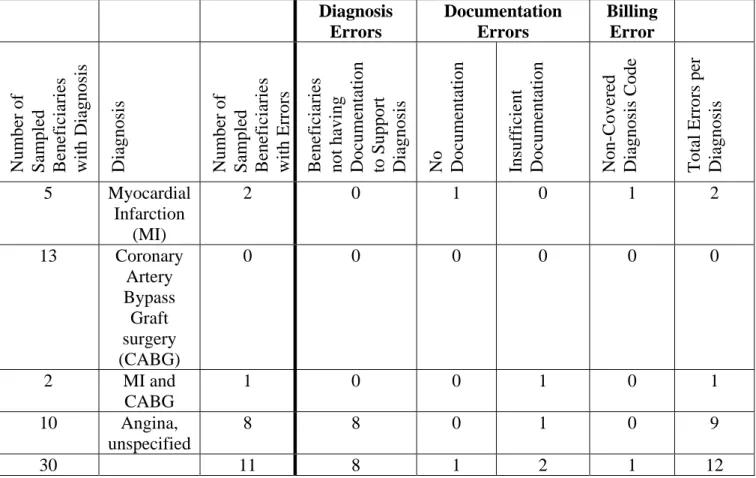
For eight beneficiaries, Anne Arundel billed and received payment for outpatient cardiac rehabilitation services when the diagnoses used to establish the beneficiaries’ eligibility for cardiac rehabilitation may not have been supported by notes in the beneficiaries’ medical records. As shown in the Appendix A, Table 1, we determined that sampled beneficiaries participated in the cardiac rehabilitation program based on the following Medicare covered diagnoses: myocardial infarction (5 beneficiaries), coronary artery bypass graft surgery (13 beneficiaries), myocardial infarction and coronary artery bypass graft surgery (2
beneficiaries). The remaining 10 beneficiaries participated in the program based on a diagnosis of unspecified angina.
For the 20 beneficiaries with diagnoses of myocardial infarction and/or coronary artery bypass graft surgery, medical records contained documentation to support the diagnoses. However, the medical records for eight beneficiaries with diagnoses of unspecified angina did not appear to indicate that he/she continued to experience stable angina post-procedure or post office visit. Each of the 10 beneficiaries who qualified for cardiac rehabilitation based on the unspecified angina diagnosis received treatment at Anne Arundel or another local hospital for cardiac related symptoms such as unstable angina or ischemia. According to the hospital records, nine
beneficiaries underwent cardiac catheterization procedures, and many also underwent angioplasty, angiography, ventriculography, and stenting. The remaining one beneficiary received drug therapy to treat his diagnoses of congestive heart failure and atrial fibrillation and was referred to the cardiac rehabilitation program after office visits with his cardiologist. Upon discharge from the hospital, their physicians referred these beneficiaries to the outpatient cardiac rehabilitation program.
As previously discussed, Anne Arundel’s procedures required that the cardiac rehabilitation staff conduct an initial evaluation of each beneficiary. During the evaluation, the policy required the staff to acquire previous medical records, including hospitalization summaries and recent exercise tests. Additionally, the cardiac staff said that they contacted referring physicians to request documentation supporting the patients’ medical need for the cardiac rehabilitation. For 10 beneficiaries, we found that the documentation maintained by Anne Arundel did not support whether the patients experienced angina symptoms post-procedure or had another Medicare covered diagnosis within 12 months prior to beginning the cardiac rehabilitation program. Consequently, to validate a stable angina diagnosis or another Medicare covered diagnosis, we obtained and reviewed the hospital medical records as well as the referring physicians’ medical records for the 10 beneficiaries with unspecified angina. The medical records obtained covered the dates of the beneficiaries’ hospital stay/office visit through their completion of Phase II of the cardiac rehabilitation program.
throughout their completion of Phase II of the cardiac rehabilitation program or (2) had another Medicare covered diagnosis within 1 year prior to beginning the cardiac rehabilitation program. As a result, Medicare may have inappropriately paid $3,954 to Anne Arundel for the cardiac rehabilitation services provided to these 8 beneficiaries.
Documentation of Services No Documentation
Anne Arundel billed Medicare for one beneficiary (one service) when it could not provide any supporting documentation that the beneficiary received Phase II cardiac rehabilitation services on the date billed. For all Phase II exercise sessions, the beneficiaries must wear an ECG monitoring device. In March 2001, Anne Arundel implemented an automated system for
tracking beneficiary exercise sessions. The system tracked the information from the ECG device and was capable of printing an automated exercise flow sheet and ECG strip data. The system also interfaced directly with the hospital’s billing system. Therefore, if a patient was monitored on this system, the hospital’s system would automatically generate a bill. Anne Arundel could not provide the exercise flow sheet and the ECG data to support the billed service. Anne Arundel received $43 for this service.
Insufficient Documentation
For two beneficiaries (three services), Anne Arundel billed and received payments for services that were not supported by the patients’ ECG readings. Prior to the March 2001 implementation of the automated system, Anne Arundel’s cardiac rehabilitation staff manually recorded exercise flow sessions and affixed the ECG strips in the medical charts. Although Anne Arundel could not provide the missing ECG strips for these services, we concluded that the patients received the services based on our review of additional documentation. Furthermore, the 3 missing strips represented an immaterial number of the 664 services we reviewed.
Billing Procedures
Non-Covered Diagnosis Code
For one beneficiary, Anne Arundel’s claims included a non-covered diagnosis code. That is, Anne Arundel billed Medicare for services using the diagnosis code for “Coronary
Atherosclerosis of unspecified type of vessel, native or graft.” We reviewed the patient’s medical records and determined the patient actually suffered a myocardial infarction. Because the beneficiary’s medical records supported a Medicare covered diagnosis, there is no monetary effect for this error.
The results from our sample will be included in a multistate estimate of Medicare
reimbursements for outpatient cardiac rehabilitation services that may not have met Medicare coverage requirements or were otherwise unallowable for payment.
Underlying Causes of Errors Medicare Covered Diagnoses
Anne Arundel did not ensure that beneficiaries’ stated Medicare covered diagnoses were
supported by medical documentation prior to providing cardiac rehabilitation services and billing Medicare. Without such documentation, Anne Arundel could not ensure the patients’
participation in the cardiac program was in compliance with Medicare requirements.
Documentation of Services No Documentation
Anne Arundel explained that due to a computer system failure, it was unable to provide documentation such as the exercise flow sheet and ECG data.
Insufficient Documentation
Anne Arundel noted that these services were provided prior to their implementation of the automated exercise system and at that time, Anne Arundel manually entered data on exercise flow sheets and affixed ECG strips in the patients’ folders. For these three insufficiently documented services, Anne Arundel stated that the ECG strips were not properly affixed to the beneficiaries’ medical record.
Billing Procedures
Non-Covered Diagnosis Code
Anne Arundel billed Medicare using a non-covered diagnosis code because the registration coder incorrectly identified the patient’s diagnosis. According to Anne Arundel billing personnel, during the initial registration process, patients explained their diagnosis to a registration clerk. A registration coder then determined the most appropriate diagnosis code to enter in the patients’ billing information. For this beneficiary, the coder entered the wrong code.
Additionally, during 2001, neither the hospital’s billing system nor the CareFirst’s payment system used automated edits that would have precluded a claim with a non-covered diagnosis code from being billed or paid. Both the hospital and CareFirst indicated that their current systems contain automated system edits that generate an error if a claim contains an incorrect diagnosis code.
Medical personnel did not validate our audit conclusions, particularly those regarding Medicare covered diagnoses. Therefore, we believe that CareFirst should determine the allowability of the
RECOMMENDATIONS
We recommend that Anne Arundel:
• Work with CareFirst to ensure that Anne Arundel’s outpatient cardiac rehabilitation
program is being conducted in accordance with the Medicare coverage requirements for direct physician supervision and for services provided “incident to” a physician’s professional service;
• Work with CareFirst to establish the amount of repayment liability, estimated to be
$3,997, for services provided to beneficiaries where medical documentation may not have supported Medicare covered diagnoses and for services not otherwise allowable; and
• Enforce existing policies to ensure that medical record documentation is obtained and
maintained to support Medicare outpatient cardiac rehabilitation services.
AUDITEE’S COMMENTS
In a letter dated November 12, 2003, Anne Arundel responded to our draft report. Anne Arundel:
• agreed to work with CareFirst to ensure its program is being conducted in accordance
with Medicare requirements for direct physician supervision and services provided “incident to” a physician’s professional service;
• stated that seven of ten beneficiaries’ services, whose payments we questioned,
underwent prepayment reviews by CareFirst and Anne Arundel received subsequent payment, therefore clinical documentation it provided met the necessary documentation for medical necessity; and
• explained its policies for review and audit of medical record documentation for cardiac
rehabilitation services.
Anne Arundel’s comments are presented as Appendix B. We excluded the 38 pages of patient account detail provided by Anne Arundel because the detail contained patient specific
information.
OFFICE OF INSPECTOR GENERAL’S RESPONSE
We are pleased that Anne Arundel agreed to work with CareFirst to ensure that its cardiac rehabilitation program is being conducted in accordance with Medicare requirements. Although we evaluated Anne Arundel’s documentation related to the repayment liability, we generally did not adjust our findings or recommendations as discussed below. We continue to recommend that Anne Arundel work with CareFirst to address the claims that we believe may be unsupported by medical documentation or that are otherwise unallowable. We are encouraged by Anne
Arundel’s self-described policies for reviewing and auditing medical record documentation and believe that the enforcement of such policies will help to ensure adequate support for its cardiac rehabilitation services.
We reviewed the information provided by Anne Arundel for the seven beneficiaries: four beneficiaries whose payments we questioned because the medical documentation may not have supported Medicare covered diagnoses and three beneficiaries whose payments were otherwise not allowable (two beneficiaries’ services were not documented or not sufficiently documented and one beneficiary’s claims contained a non-covered diagnosis code). We also followed up with CareFirst to obtain information on it review.
We modified our findings and recommendations to reflect the new information related to two of the four beneficiaries whose medical documentation may not have supported Medicare covered diagnoses. However, we did not modify our findings or recommendations for errors related to other unallowable services because the documentation provided by Anne Arundel did not reveal any new information relevant to the findings.
APPENDIX A
STATISTICAL SAMPLE SUMMARY OF ERRORS
The following table summarizes the errors identified during testing of our 30 Medicare
beneficiaries who received outpatient cardiac rehabilitation services from Anne Arundel during CY 2001. The 30 beneficiaries reviewed were part of a multistate statistical sample. The results from our sample will be included in the multistate estimate of Medicare errors for outpatient cardiac rehabilitation services that may not have met Medicare coverage requirements or were otherwise unallowable for payment.
Table 1. Summary of Errors by Beneficiary Diagnosis and Type of Error
Diagnosis Errors Documentation Errors Billing Error
Number of Sampled Beneficiaries with Diagnosis Diagnosis Number of Sampled Beneficiaries with Error
s
Beneficiaries not having Documentation to Support Diagnosis No Documentation Insufficient Documentation Non-Covered Diagnosis C
ode
Total Errors per Diagnosis
5 Myocardial Infarction (MI) 2 0 1 0 1 2 13 Coronary Artery Bypass Graft surgery (CABG) 0 0 0 0 0 0 2 MI and CABG 1 0 0 1 0 1 10 Angina, unspecified 8 8 0 1 0 9 30 11 8 1 2 1 12
APPENDIX B Page 1 of 3
APPENDIX B Page 2 of 3
APPENDIX B Page 3 of 3
ACKNOWLEDGMENTS
This report was prepared under the direction of Stephen Virbitsky, Regional Inspector General for Audit Services. Other principal Office of Audit Services staff that contributed includes:
Eugene G. Berti, Jr. Audit Manager
Nicole Freda, Senior Auditor
Claudia DiBattista, Auditor
Richard Polen, Auditor