A Type System for
Reflective Program Generators
Christof Lutteroth
a Department of Computer ScienceThe University of Auckland
38 Princes Street, Auckland 1020, New Zealand
Dirk Draheim
Central Information Technology Services University of Innsbruck
Technikerstrasse 23, 6020 Innsbruck, Austria
Gerald Weber
aAbstract
We describe a type system for a generative mechanism that generalizes the concept of generic types by combining it with a controlled form of reflection. This mechanism makes many code generation tasks possible for which generic types alone would be insufficient. The power of code generation features are carefully balanced with their safety, which enables us to perform static type checks on generator code. This leads to a generalized notion of type safety for generators.
Key words: type safety, generic programming, reflection, model-based generation
1 Introduction
Generators are a cornerstone of today’s software engineering, especially in the area of enterprise application development. A large variety of tools exists for
Email addresses: [email protected](Christof Lutteroth),
[email protected](Dirk Draheim),[email protected](Gerald Weber).
URLs: http://www.cs.auckland.ac.nz/~lutteroth(Christof Lutteroth),
http://draheim.formcharts.org(Dirk Draheim),
the generation of database interfaces, GUIs and compilers, and even CASE tools can be subsumed under the notion of generators. A generative approach fits naturally with important enterprise computing paradigms [16].
Besides these very specialized examples of code generation technology, many systems have been developed that offer a more generic approach to code gener-ation. Some of these systems allow the user to extend a programming language with new constructs which trigger the generation of customized code. Code generation is a particularly powerful decomposition and reuse mechanism. The use of custom-made code generators based on classic technologies such as compiler-compilers is a challenging task. Generation typically depends on other code as a parameter, and the traditional data structure involved, a syn-tax tree, is not trivial. Code generators require not only firm knowledge of the theory of compiler construction, but also familiarity with the technicali-ties of the particular source and target languages involved. From a software engineering standpoint, this amounts to additional risks concerning the long term maintainability of such code.
Generators introduce new classes of errors. A generator may work well most of the time, but may fail with some rare actual parameters. An error may not be obvious, but express itself in some slightly malformed parts of gener-ated code. Using generators always bears the risk of introducing hard-to-find bugs. However a good generator has the potential to provide an economic and solid solution to a common problem. Complexity in the development of code generators leads to generators that are more error-prone.
In this article, we show how the concept of code generators can be made directly accessible to the user in object-oriented languages, and how a type system can be extended to take generators into account. The aim is to make generators part of a program rather than part of the compiler while retaining the safety properties of a typed language. No internal knowledge of the com-piler would be required, and the generation process should be transparent for the user. Placing generators in the language itself instead of in a compiler af-fects the language syntax as well as its semantics and safety. The challenge lies in integrating the new constructs syntactically without interfering with exist-ing semantics. Typed languages usually offer a high degree of safety through the use of type systems, and type checkers are able to detect many poten-tial execution errors statically. However, with the new concept of generators, new types of potential execution errors are introduced, namely when code generation produces ill-typed code. Consequently, code generation poses new challenges for type systems.
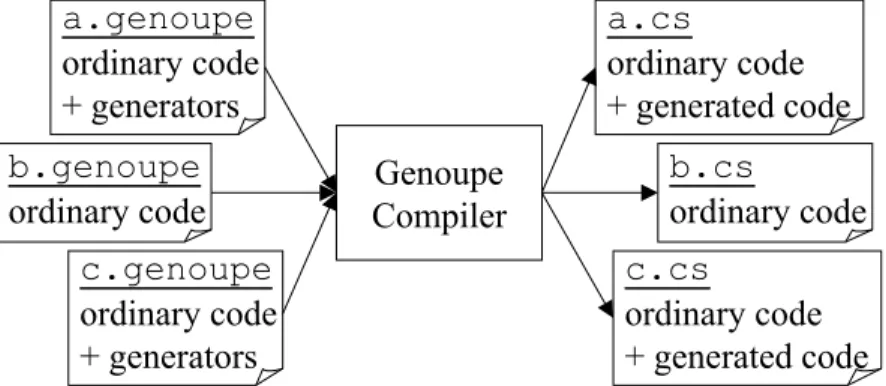
In Sect. 2, we introduce the Genoupe language, which integrates code gen-erators into the C# language, and give some source code examples. We also
discuss its general applicability to different problems. Section 3 presents the Genoupe type system and discusses some malformed examples of Genoupe code that cannot be given a correct type. It also discusses the limitations of the type system. Section 4 discusses soundness aspects of the type system, in particular in relation to the use of imperative code in the Generators. Section 5 discusses how the integration into a novel code repository can alleviate some of the problems faced in the language definition. Section 6 discusses the rela-tion between code generators and reflecrela-tion. Secrela-tion 7 looks at related work, and explains how Genoupe is different from similar approaches. In Sect. 8 we summarize the main findings of our work.
2 Object-Oriented Programming with Parameterized Generators: The Genoupe Language
Our concept for the integration of generators into object-oriented program-ming is called Genoupe. It was developed from the language Factory [11], which integrated reflective generators into Java, and implements a similar but strongly revised concept for C#. Genoupe introduces a syntax that is reminis-cent of that of generic types, although it is not limited to classes or interfaces. As with generic types, the template paradigm is used. But in contrast to sim-ple genericity, the template can contain generator code written in a special compile-time level language. This sublanguage is kept in an imperative style and along the lines of the C# language itself, so that a C# programmer will understand its meaning intuitively.
Natutrally, the type system used to check generator code requires additional features that are not found in ordinary type systems. As we will see in Sects. 3, the new type system makes it possible to detect parts of a generator that can potentially generate malformed code, in contrast to just detecting code that is malformed itself. One of the significant features of the Genoupe language is that calls can be made to ordinary C# code during generation, even if this code contains non-determinism or side effects. An explanation for why Genoupe can allow the execution of arbitrary C# code in the generator with-out compromising type safety is given in Sect. 4.1.
In the Genoupe language a generator can be embedded into the source code in the same way an ordinary type definition. Generators can have parameters that are accessible in the generator code through generator variables. Unlike generic types, these parameters can be used to pass any kind of values into a generator, and not just types. In contrast to runtime variables, generator variables hold objects at generation-time and make them accessible in the generator code. Analogous to the parameters of an ordinary method, each declared generator parameter is a generator variable, which can be used in
generator expressions. A generator expression describes a value that is used at generation time, just as an ordinary expression describes a value that is used at runtime. It is very similar to an ordinary C# expression in the sense that most generator expressions are valid C# expressions. One speciality of generator expressions is that if same values have been assigned to the generator variables, two structurally equivalent generator expressions describe the same value. This is guaranteed through the use of memoization during the evaluation of generator expressions, which is explained further in Sect. 4.1.
Generator expressions are often used to introspect type parameters and extract or construct the information that is needed for intercession, i.e. information that represents code that should be made part of the generator output. In order to make the value of a generator expression part of the generated code, the generator expression is enclosed in @ characters and placed into the code template at a position where the entity represented by the expression’s value is allowed to occur. For example, if we want to generate a certain type in a declaration of a generated class, we would create a generator expression that evaluates to a Type object representing the desired type. This generator expression would be placed, enclosed in @ characters, at the position in the source code where we would normally place a type name. At generation time, all generator expressions are evaluated and substituted by the code represented by their values. That is, if we had a generator expression of type Type, i.e. one that evaluated to a Type object, Genoupe would replace the generator expression by the name of the type represented by the type object during code generation. Genoupe makes use of the standard C# metaobject protocol, so that it is obvious in most cases which type represents which language entity. In the following subsections, we will describe important parts of the Genoupe syntax, and consider some simple examples of Genoupe source code, which will point up how Genoupe can be used. Some applications for Genoupe, e.g. the generation of interfaces like GUIs or APIs, are not discussed here. Information on those and further examples can be found in [14,13].
2.1 Syntax
This section describes the syntax of the Genoupe language, using context-free grammar rules. After describing the syntax of generator expressions, the syntax of class generators with method and variable definitions will be given. Finally we discuss the syntax of statements as they appear in generated meth-ods and constructors.
2.1.1 Generator Expressions
Generator expressions are similar to ordinary C# expressions in structure. However, they are evaluated not during runtime but during generation time. A generator expression has the following syntax:
ge : id | typeid| @gname((geargs)?)@ | @this@ | @gepart@
geargs : gepart(,gepart)∗
A generator expression is either an ordinary C# identifier id, an ordinary C# type name typeid, a generator call, the generated type @this@, or an expression gepart enclosed by@ characters. In the first two cases, we call this a constant generator expression because the result is always the same identifier or type name. In the latter three cases, the generator expression may evaluate to different values depending on the generator parameters. A generator call may invoke any Genoupe generator with name gname in any of the source files given to the Genoupe precompiler.@this@refers to the type that is being generated. An expression gepart enclosed in @-signs may evaluate to any C# object. Arguments in a generator expression are comma-separated lists of C# expressions.
Many generator expressions are composed of partial generator expressions
gepart, which have the following syntax:
gepart : literal | id | gepart.id | typeid.id
| gepart.id((geargs)?) | typeid.id((geargs)?)
| newtypeid((geargs)?) | typeof(typeid) | (typeid) gepart
The grammar rulegepart describes a minimal syntax for C# expressions: an expression is either a literal, an identifier of a generator variable, a field access on an object, a static field access on a class, a method call on an object, a static method call on a class, a constructor call, an application of thetypeof
operator, or a type cast. For simplicity, other operators are not considered here since they can be wrapped in methods.
A literal is any of the standard C# literals, such as "hello" for a string, 21
for an integer ornull for a null reference. An identifier is either the identifier of a generator parameter or an identifier of any other generator variable in the scope. How generator variables enter the scope will be described later on. A field access on an object can be performed if the expression before the dot operator denotes a valid object and the following identifier is a valid field name. A static field access can be performed if there is a valid class identifier before the dot, and the following identifier is a valid field name. A method call on an object can be performed if the expression before the dot operator denotes
a valid object and the following identifier is a valid method name, followed by optional arguments in brackets. A static method call can be performed if there is a valid class identifier before the dot and the following identifier is a valid method name, followed by optional arguments in brackets. A constructor call consists of the new operator, a type identifier and optional arguments in brackets. A type cast consists of a C# type name in brackets, followed by an expression.
A generator expression can be used to generate a program part. This is done by using that expression instead of the program part in the generator code. Analogously to an ordinary expression, a generator expression has a type. To generate a particular program part, the generator expression has to have a particular type. The following rules apply for the generation of a program part with a generator expression:
• To generate a type, the generator expression has to be of type Type or
GeneratedType.
• To generate a variable or method identifier, the generator expression has to be of type String.
• To generate an integer literal, the generator expression has to be of type
Integer.
• To generate a string literal, the generator expression has to be of type
StringLiteral.
All those types, with the exception of StringLiteral, are standard C# classes. Type StringLiteral is necessary to distinguish string literals from identifiers: if a generator expression is of type string, then an identifier is gen-erated (e.g.foo), but if it is of typeStringLiteralthen a string literal will be generated (e.g. "foo"). Other literals such as those for Booleans or Doubles can be generated using a generator expression of the corresponding C# type, e.g. Boolean or Double.
2.1.2 Generators and Definitions
A class generator has the following syntax:
generator: (modif ier)∗ class id((gpars)?) (:supertypes)? { gbody } gpars: typename id(,typename id)∗
supertypes: ge(,ge)∗
The generator begins with a sequence of modifiers such as public and the
class keyword. The identifier of the generator is given by id. For Genoupe identifiers, the same rules apply as for ordinary C# identifiers. The generator parameters are defined in gpars, in the same way as in C# methods as a
comma separated list of type names and parameter identifiers. There can be an arbitrary number of generator parameters: the ()?operator in the grammar above indicates that the parameters are optional; the ()∗ operator indicates that there can be several other parameters, separated by commas, after the first one. For simplicity, we assume here that the types are class types. This is not a limitation as all other types, e.g. primitive types and arrays, can be wrapped in a class. The generator parameters can only be accessed by the generator code inside the generator. Similar to methods, the parameter list can be empty, but the pair of parentheses after the identifier has to remain to indicate that this is a generator and not an ordinary class. Normal brackets()
are used instead of the angle brackets <> that are commonly used for generic types. This stresses that generators can have parameters of arbitrary type and not just type parameters, and keeps the Genoupe syntax separated from C#’s syntax for generic types. Generated classes can have supertypes, and a supertype can be generated with a generator expression ge.
In the following we will look at the syntax for the body of the generatorgbody. This is where most of the generation usually takes place. In general, gbody is similar to the body of an ordinary C# class:
gbody : (vardef | methoddef | constructordef |gconst |gif
|gf or)∗
vardef : (modif ier)∗ ge ge;
methoddef : (modif ier)∗ ge ge((pars| gf orpars)?) { mbody } constructordef : (modif ier)∗ @this@((pars| gf orpars)?) { mbody } pars : ge ge (,ge ge)∗
mbody : (stat)∗
The generator body can contain an arbitrary number of definitions. Each def-inition is either a variable definitionvardef, a method definitionmethoddef, a constructor definition constructordef, or a generator construct for defining a constant gconst, conditional generation gif or iterative generation gf or. A variable definition consists of a sequence of modifiers such as public or
private, a generator expression specifying a type and a generator expression specifying an identifier. A method definition consists of a sequence of mod-ifiers, a generator expression for the return type, a generator expression for the method identifier, and an optional specification of parameters enclosed in brackets. A constructor definition consists of a sequence of modifiers, the keyword @this@, which refers to the name of the type that is generated, and an optional specification of parameters enclosed in brackets. Parameters are either specified as a comma-separated list of pairs of generator expressions, one for the type and one for the parameter identifier, or by an iterative
gener-ation gf orpars, which will be described later. A method or constructor body
mbody consists of an arbitrary number of statements, which will be described in the next section.
We now want to look at the generator constructs that can be used in a gen-erator body gbody. First of all, we look at the gconst constructs for defining generation-time constants. If a generator expression is used more than once, then it is convenient to define a new generator variable that holds the value of that expression. Instead of repeating the generator expression, the value of the generator variable can be used. Such a generator variable can be defined in the following way:
gconst: @const id = gepart;
The new generator variable has the identifieridand the value given by partial generator expressiongepart. The@constkeyword indicates that the generator variable is a constant at generation time. A value is only assigned once after evaluating the expression gepart.
If variable and method definitions in a class should only be generated under a particular condition, thegif construct for conditional generation is used. It has the following syntax:
gif: @if(gepart) {(def)∗ } (else { (def)∗ })?
The condition gepart must be of type Boolean. The first sequence of defini-tions (def)∗ is generated if the condition is true, the second sequence, after the else, is generated if the condition is false. The else-clause is optional.
The construct for iterative generation of variable or method definitions in a class has the following syntax:
gf or: @foreach(id in gepart) { (def)∗ }
gepart must evaluate to a collection type that implements the standard C# interface for collections ICollection. The standard collections and all arrays do that. id is the name for a new generator variable that is assigned each of the elements in the collection successively, and makes the element accessible in the loop body. The definitions (def)∗ in the loop body are generated once, for each element in the collection.
As pointed out above, iterative generation can also be used to generate method parameter specifications, and also to generate method arguments:
gf orpars: @foreach(id in gepart) {ge ge } gf orargs: @foreach(id in gepart) { ge }
As specified in the rules above, gf orpars can be used in a method definition to generate a list of parameter specifications. Analogous togf or,gepartmust evaluate to a collection type that implements the standard C# interface for collections ICollection. For each element in the collection, one parameter is generated. The first generator expression between the curly brackets generates the parameter type and the second generator expression generates the param-eter name. Similarly,gf orargscan be used in a method call to generate a list of arguments. For each element in the collection, one argument is generated. The arguments are generated by the generator expression between the curly braces. Arguments cannot be iteratively generated for generator expressions, therefore rule gepartdoes not containgf orargsin its specification of method arguments. Iteratively generated arguments are made available for generated C# expressions only as they appear in methods. This is described below.
2.1.3 Statements
The generator constructs can also be used in a method body to generate statements. A method body mbody has the following syntax:
stat : me; | ge = me; | return me; | gconst | gstatif | gstatf or
A statement stat is either an expression me followed by a semicolon, an as-signment, a return statement, the definition of a generator constant gconst, a sequence of conditionally generated statements gstatif, or a sequence of iteratively generated statements gstatf or. We only consider some exemplary statement types; other types of statements work similarly to those presented here. An assignment consists of a generator expression for the identifier of the variable to assign the value to, the equal sign, and an expression me for the value followed by a semicolon. A return statement returns the value of an expression me.
me : literal | ge | me.id | ge.id
| me.id((args)?) | ge.id((args)?) |new ge((args)?)
| ge(gf orargs) | new @this@(gf orargs)
| typeof(ge) | (ge) me | this
args: me (,me)∗
An expression me is similar to the aforementioned simple C# expressions de-fined in gepart. However, there are a few differences. Identifiers are generated with generator expressions, which may be constant. When accessing a static field of a type, the type identifier is generated with a generator expression, which may be constant. Analogously, types for static method calls,
construc-tor calls, applications oftypeofand type casts are generated with a generator expression as well. For example, the type of a constructor call can be@this@, referring to the generated type itself. The arguments of a method or construc-tor call can alternatively be generated iteratively with the aforementioned
gf orargs, if the method or constructor was defined in the generated class. The keyword this can be used to access the current object in a method, which is not possible in generator expressions as there is no current object during generation time.
The constructs gstatif and gstatf or for conditional and iterative generation in methods are almost identical togif and gf or:
gstatif: @if(gepart) { (stat)∗ } (else { (stat)∗ })?
gstatf or: @foreach(id in gepart) {(stat)∗ }
The only difference fromgifandgf oris that the bodies contain (stat)∗instead of (def)∗.
explain scoping of generator variables and parameters
2.2 Parametric Polymorphism
One of the simplest applications for Genoupe is parametric polymorphism. The following generic stack generator has a single parameter T of type Type
and generates a stack class for elements of type T:
1 public class Stack(Type T)
2 {
3 private Stack s = new Stack();
4
5 public void push(@T@ x) {
6 s.push(x); 7 } 8 9 public @T@ pop() { 10 return (@T@) s.pop(); 11 } 12 }
In lines 5, 9 and 10, we insert generator expressions containing only the gener-ator parameter in order to generate correct type declarations and type casts. In order to generate a statically type safe stack containing String elements with theStackgenerator, one would write a generator expression that applies
the generator to type String. This generator expression would evaluate to a
Type, so it can be used in a variable definition:
@Stack(typeof(String))@ myStack = new @Stack(typeof(String))@();
A similar generator expression of typeTypeis used to generate the type name after the newoperator.
2.3 Class Extensions
Genoupe can be used for the generation of useful extensions. In contrast to ordinary inheritance mechanisms, which also extend classes, a generator can adapt the extension it generates to the class that is extended. This makes it possible to address static crosscutting concerns [28].
The following code snippet shows a generator that takes a classTand a list of field namesFNames for that class. It generates a subclass of T that provides a new methodRandomize. This method assigns random values to those fields of
Tthat have their name mentioned in FNames. This can be useful, for example, for the generation of test data.
1 public class Randomizeable(Type T, List<String> FNames) : @T@
2 {
3 Random r;
4
5 public void Randomize() {
6 r = new Random(); 7 @foreach(F in T.GetFields()) { 8 @if(FNames.Contains(F.Name)) { 9 @if(F.FieldType==typeof(Double)) { 10 @F.Name@ = r.NextDouble(); 11 } else { 12 @if(F.FieldType==typeof(Boolean)) { 13 @F.Name@ = (r.NextDouble()>=0.5); 14 }
15 // ...handle other data types...
16 }
17 } }
18 } }
In line 7 we see the@foreach construct for iterative generation of statements, which is used to iterate through all the fields of T. The iteration variable F
holds the FieldInfo object for the field that is currently processed in the loop. Only the fields mentioned in FNames should be assigned random values.
Therefore the @if in line 8 checks that the field name of the current field is inFNames, and only then a value is assigned. The following @ifs check which type the current field has, and generate an assignment to set an appropriate random value. The generator expression @F.Name@ of type String is used to generate a field access to a field inherited fromT.
2.4 Proxies and Wrappers
A common pattern for modifying the behavior of existing classes or bridging incompatibility is the use of proxies [20] and wrappers. With Genoupe both of these can be generated automatically, which makes it possible to address dynamic crosscutting concerns [28].
The following class generator takes a type parameterT and creates a subtype of T that overrides T’s methods. A class generated by this generator can be used to create mocking objects for T, i.e. objects that do not implement the real functionality but are convenient for testing. In this case, the methods only print out all method calls, which can be useful for debugging purposes.
1 public class Mock(Type T) : @T@
2 {
3 @foreach(M in T.GetMethods()) {
4 @const Pars = M.GetParameters();
5
6 public override @M.ReturnType@ @M.Name@
7 (@foreach(P in Pars) { @P.ParameterType@ @P.Name@ })
8 {
9 Console.WriteLine("Method "
10 +@new StringLiteral(M.Name)@+" called.");
11 }
12 } }
In lines 6 and 7, we use generator expressions to generate the signature of each of T’s public methods. A list of method parameter declarations is generated by iterating over all the parameters and generating each parameter declaration individually. The StringLiteral object constructed in line 10 represents a generated string literal, opposed to a generated identifier.
3 Generator Type Safety
When dealing with metaprograms, i.e. programs that process other programs or themselves in some suitable representation, a whole set of new sources of execution errors comes into play. Generation errors in generators are those parts of the generator program that can potentially generate malformed code, which in turn may cause execution errors. Of course, we also want our gen-erators to be free of execution errors themselves. In addition to normal type systems, which can only detect potential forbidden errors in the code that is type checked, we need a new kind of type system that can also detect parts in generators that can potentially generate ill-typed code. This requirement leads to a notion of type safety, which we want to call generator type safety. This is the property of a generator not to be able to generate ill-typed code, i.e. code that may cause a forbidden execution error. If a generator is not generator type safe, it contains one or more generator type errors, i.e. parts in the generator code that are responsible for the generation of ill-typed code. We call a type system that can detect generator type errors a generator type system.
Before we describe the generator type system of Genoupe in the next section, let us look at examples of malformed generators that can potentially generate ill-typed code. The following generator generates a class with a single field: 1 class C(Type T)
2 {
3 @T@ x = 1;
4 }
The fact that x is assigned a numerical value restricts its possible type. The type parameterThowever is not subject to any such restriction. This is clearly a generator type error that leads to some arguments producing type-correct code and others not.
The next example demonstrates another issue of type compatibility. 1 class C(T istype Component)
2 {
3 @T@ x = new Button();
4 }
The Genoupe keyword istype makes it possible to set a bound for type pa-rameters, i.e. parameters of type Type. Line 1 signifies that parameter T is a type parameter and that all possible arguments represent types that are either classComponentitself or one of its subclasses. In the generator body we define a member variablexwith typeT, to which we assign aButton object.Button
is a subclass ofComponent. But what happens if T is a subclass ofComponent
but is not compatible with Button, i.e. not either Button itself or one of its superclasses? The generated code is type correct iff T is Button or one of its superclasses.
The following example is a class generator that has a string parameter ID. As the name suggests, the string is used to generate the identifier of a local variable in a method.
1 class C(String ID)
2 { 3 void m() { 4 int @ID@ = 1; 5 x++; 6 } 7 }
In line 5 we increment a variablex. Since there are no other variable definitions in the generator,xmust be defined in the preceding line where the identifier of a variable is generated by a generator expression. If the generator is given the argument"x", the generated code works satisfactorily, otherwise it is ill-typed. This is also known as the problem of inadvertent capture [30].
The next generator contains a conditional generation. 1 class C(String X) 2 { 3 @if(X.Equals("hello")) { 4 String y = "world"; 5 } 6 7 void m() { 8 Console.WriteLine(y); 9 } 10 }
The definition of the member variable y is only generated when "hello" is the string argument in X. Again, we have cases where this generates an error and others where it does not.
Our last example illustrates a generator type error that can occur in iterative generation.
1 class C(Type S, Type T)
2 {
4 @F.FieldType@ @F.FieldName@; 5 } 6 7 void m() { 8 @foreach(F in T.GetFields()) { 9 Console.WriteLine([email protected]@); 10 } 11 } 12 }
The first generative iteration replicates the field definitions of type parameter
S. The second one in method mgenerates statements that access and print the values of fields as defined in type parameter T. Clearly this can only work ifT
contains fields with an identical name for all the field definitions in T, which is of course the case when S and T are bound to the same type.
All these generator type errors also occur in real generators, although usu-ally they occur in a more subtle way that makes them much harder to find. Such errors are typically introduced, for example, when applying inconsistent changes: one part of a generator is changed without adjusting other parts that are affected by that change.
Note that the Genoupe language has another property which makes its gen-erators safer than those in many other languages: if all the methods we use in generator code terminate and we do not use generators recursively, a gen-erator is guaranteed to terminate. This is because our looping construct, the @foreach, iterates over collections without modifying them, and the collections contain, of course, only a finite number of elements. In C++ templates, for example, we must use recursion when we want to repeat something arbitrarily often. C++ templates can potentially recurse endlessly, and only a limited recursion-depth prevents this [10]. In other technologies which use a Turing-complete language for metaobject manipulation, like CLOS [19], OpenC++ [9] or Jasper [36,37], generators potentially do not terminate as well.
3.1 The Genoupe Type System
In order to detect generator type errors, we have developed a generator type system which is compatible with and extends the type system of the host lan-guage C#. Its notation is similar to the one used in [8]. It consists of rules with judgments about the correctness of certain program parts in their pre-and postconditions, pre-and only the programs that can be derived by those rules are considered type correct. In some respects, however, our type system devi-ates from the way in which type systems of object-oriented languages usually
work. We use an environment Γ that keeps track not only of the signatures of declared runtime variables but also of the signatures of generator variables, among other things. The signature of a runtime variable can contain genera-tor expressions because its identifier and type may be generated by them. For handling conditional and iterative generation of declarations correctly, defini-tions that are generated conditionally or iteratively have special signatures. Γ is also used to store additional facts about the code portion that is being type-checked.
The type system that we present here is provably decidable. The proof is rather straightforward and we give the main argument here. The naming scheme of the type rules indicates the order in which the rules will be applied. The following pseudocode represents the top-level sequence in which the type rules must be applied: the derivation can be denoted in a tree-like fashion, and the levels of the tree correspond to nesting levels of the two block concepts of the generator, namely @if and @f oreach blocks. Our nesting depth is the combined depth for both blocks.
1. Apply [env ...] rules for primitive expressions 2. For each nesting level in the block structure:
apply the [def ...] rules and then the [env ...] rules using those [def ...] rules.
3. Apply the [generator] rule.
The type system is decidable because we can bind a size metric of the deriva-tion by a metric of the program: the derivaderiva-tion can be denoted in a tree-like fashion and the maximum depth of the tree is bound by the maximum nesting depth of the @if and @f oreach blocks.
A derivation always starts with the rule [env ∅] for creating an empty envi-ronment Γ, which does not have any preconditions and can thus be applied first:
[env ∅]
∅
The postcondition states that the empty environment is a well-formed envi-ronment. Usually a judgment of the form ΓX states that a program partX
in an environment Γ is correct. This rule states only that the environment on the left side of is well-formed, so theon the right side is just a placeholder for no program part at all.
3.1.1 Generator Expressions
In this section we look at rules for generator expressions. The syntax of gen-erator expressions is defined by the grammar rules ge, geargs and gepart. Grammar rulegetreats identifiers idandtypeidas constant generator
expres-sions. For simplicity, the following type rules will not support this. Without loss of generality, identifiersid andtypeidhave to be generated explicitly with constant generator expressions @"id"@ and @typeof(typeid)@. Both can be derived with the following rules.
The Genoupe precompiler uses a function Generatorsto keep track of all the generators in the scope:
Generators:GeneratorIds→(T ypes)∗
For each generator in the scope, the function maps the identifier of the gen-erator, which is an element of set GeneratorIds, to the generator signature, which is an n-tuple of types. For example, the Randomizeable generator de-scribed above corresponds to an elementRandomizeable →(Type,String[]). Generator calls are checked with rule [ge gcall]:
[ge gcall]
generatorname∈dom(Generators)
Generators(generatorname) = (type1, . . . , typen) Γgepart1: :type1 . . . Γgepartn: :typen
Γ@gname(gepart1, . . . , gepartn)@: :Type
The precondition requires that generatorname is the name of an accessible generator with the parameter types type1, . . . , typen, and that gepart1, . . . , gepartn are correct partial generator expressions of the same types. The : : symbol is used to associate a partial generator expression or generator ex-pression with its type. By contrast, ordinary C# exex-pressions are associated with a generator expression that generates their type using the : symbol, as we will see later on. The postcondition contains a generator expression that is a call to generator generatorname, using the partial generator expressions as arguments. Since generators generate types, the generator expression is of typeType.
Rule [ge @this@] can be used to check a generator expression that refers to the type that is generated:
[ge @this@] Γ
Γ@this@: :Type
If Γ is a well-formed environment, then @this@ is a correct generator expres-sion of type Type.
As specified in the syntax rule ge, we can use a partial generator expression
gepart enclosed by@-signs to construct a generator expression:
[ge @gepart@] Γgepart: :t Γ@gepart@: :t
Ifgepartis a correct partial generator expression of type t, it can be enclosed in@-signs and the result is a generator expression of typet.
Similarly to ordinary C# expressions, partial generator expressions can con-tain literals, which are checked with rule [gepart literal]:
[gepart literal] Γ x∈Literals(t) Γx: :t
Literals is a function that maps types to their literal values, e.g.
Literals(int) ={. . . ,−1,−,1, . . .}.
If Γ is a well-formed environment and x is a correct literal of type t, then a partial generator expression x can be formed that has type t.
Rule [gepart id] checks a partial generator expression that accesses a generator variable:
[gepart id] Γ∪ {id: :t} Γ∪ {id: :t} id: :t
If there is a well-formed environment that contains the signature of a generator variable, then the identifier of the generator variable can be used as a partial generator expression that has the type of the generator variable. The signature of a generator variable consists of the variable identifier, the : : sign, and the variable type.
For all the possible elements in Γ, we need rules that allow us to add them to Γ. In principle, these rules make it possible to add things to the environment that are not correctly part of it. However, the rules that derive larger generator parts, e.g. rule [generator] later on, require that their constituents are derived in correct environments. So if we derived a generator part using an incorrect environment, it would no longer be possible to combine that part with other parts to form a complete generator. Rule [env gvar] can be used to add the signature of a generator variable, e.g. a generator parameter or the iteration variable of a @f oreach-loop, to the environment:
[env gvar] Γ t∈T ypes (generator variableID)∈/ Γ Γ∪ {ID: :t}
The precondition makes sure that Γ is a well-formed environment, that t is a valid C# type, and that the identifierIDis not already defined as a generator variable in the environment, which would indicate a collision of identifiers. Rule [gepart f ield] is used to derive a partial generator expression that ac-cesses a field of an object:
[gepart f ield] Γgepart: :s s has accessible field id:t Γgepart.id: :t
Ifgepartis a correct partial generator expression of type t, andthas an acces-sible field idof typet, thengepart.id is a correct partial generator expression of type t. The rules to determine whether type s has an accessible field idare the standard C# rules.
Rule [gepart sf ield] is used to derive a partial generator expression that ac-cesses a static field of a type:
[gepart sf ield] typeid∈T ypes typeidhas accessible static field id:t Γtypeid.id: :t
Iftypeidis a correct C# type identifier, and typetypeidhas an accessible static field id of type t, then typeid.id is a correct partial generator expression of type t. The rules to determine whether type typeid has an accessible field id
are the standard C# rules.
Rule [gepart call] is used to derive method calls in partial generator expres-sions:
[gepart call]
Γgepart: :s
s has accessible method id:t1×. . .×tn →t
Γgepart1: :t1 . . . Γgepartn: :tn
Γgepart.id(gepart1, . . . , gepartn): :t
The precondition requires three things. First,gpart is a correct partial gener-ator expression of type s. Second, s has an accessible methodid taking n pa-rameters of the typest1, . . . , tn. This is checked using the standard C# rules. Third, gepart1, . . . , gepartn are n correct generator expressions in the same environment as gepart and have the same types as the method parameters
t1, . . . , tn. With these requirements satisfied, a partial generator expression can be derived consisting of a call to methodidongpartusinggepart1, . . . , gepartn
as arguments. This partial generator expression has the return type of method
id.
Rule [gepart scall] is used to derive static method calls in partial generator expressions:
[gepart scall]
typeid∈T ypes
typeidhas accessible static method id:t1×. . .×tn→t
Γgepart1: :t1 . . . Γgepartn: :tn
Γtypeid.id(gepart1, . . . , gepartn): :t
If typeid refers to a correct C# type with a static method id that takes n
expressions in the same environment with the same types t1, . . . , tn, then a partial generator expression can be formed for a static method call onid. The availability of an appropriate static method is checked using the standard C# rules. gepart1, . . . , gepartn are used as arguments and the resulting partial generator expression has the return type of the methodid.
Rule [gepart new] is used to derive constructor calls in partial generator ex-pressions:
[gepartnew]
typeid∈T ypes
typeidhas accessible constructor with parameters :t1×. . .×tn
Γgepart1: :t1 . . . Γgepartn: :tn
Γnew typeid(gepart1, . . . , gepartn): :typeid
If typeid refers to a correct C# type with a constructor that takesn param-eters of the types t1, . . . , tn, and there are n correct partial generator expres-sions in the same environment with the same types t1, . . . , tn, then a partial generator expression can be formed for a constructor call on id. Whether
typeidhas an appropriate constructor is checked using the standard C# rules.
gepart1, . . . , gepartnare used as arguments and the resulting partial generator expression has type typeid.
Rule [gepart typeof] is used to derive an application of the typeof operator in a partial generator expression:
[geparttypeof] Γ typeid∈T ypes Γtypeof(typeid): :Type
If Γ is a well-formed environment and typeidis a valid C# type, then we can derive that typeof(typeid) is a correct partial generator expression of type
Type. The resulting Type object is the one representing type typeid.
Rule [gepart cast] is used to derive an application of the type cast operator in a partial generator expression:
[gepart cast] typeid∈T ypes Γgepart: :t Γ(typeid)gepart: :typeid
If typeid is a valid C# type and gepart a correct partial generator expres-sion, then(typeid)gepartis also a correct partial generator expression of type
typeid. Note that by their very nature, type casts may fail during runtime. However, using the standard C# rules, some type casts that are guaranteed to fail can be detected statically.
3.1.2 Generators and Definitions
In this section we describe the type rules for checking the correctness of a generator and the variable and method definitions it generatesd by it. For simplicity, we omit the rules for the @const generator construct since it is only syntactic sugar for the generator developer. Using @const to define a new generator variable with an expression is equivalent to substituting the expression for the name of the generator variable wherever it is used. For example, @const T = "x"; int @T@; is equivalent to int @"x"@;. We also do not consider modifiers in the following type rules.
In the following we will describe the rules for the definitions that can be generated in the body of the generator, starting with the generation of variable definitions:
[def var] Γgetype: :Type Γgeid: :String Γgetype geid ;∴{geid:getype}
This rule can be used to derive a local variable definition in the generator body. The precondition requires suitable generator expressions for generating the variable’s identifier and type. The ∴ symbol in the postcondition asso-ciates a signature with the definition. The signature is a set that contains the information that needs to be added to the environment so that the variable can be used in other parts of the generator. For the above variable definition, the signature contains only the generator expression that generates the vari-able identifier and the generator expression that generates the varivari-able type, separated by the : symbol.
Rule [env var] inserts the signature of a generated variable into the environ-ment, so that it can be used in other parts of the generator:
[env var] Γgeid: :String Γgetype: :Type (variablegeid)∈/ Γ Γ∪ {geid:getype}
The precondition states that we need a correct generator expression of type
String for the variable’s identifier, and a correct generator expression of type
Type for the variable’s type. Furthermore, the generator expression geid must not already be used to generate another variable identifier in Γ to help avoid identifier collisions. Note how the symbol between an expression and its type is used to express whether an expression is an ordinary expression or a gener-ator expression. In the case of an ordinary expression, the symbol between the expression and its type is :; in the case of a generator expression the symbol is : :. In the postcondition the new environment is a conjunction of the old Γ and the new signature. In a signature, the : symbol associates the genera-tor expression that generates the identifier of the variable with the generagenera-tor expression that generates its type.
Rule [def method] can be used to derive a method definition in the body of a generator:
[def method]
Γgeid: :String Γgeret: :Type
Γgeid1: :String, . . . ,Γ geidn: :String
Γget1: :Type, . . . ,Γgetn: :Type
Γ∪ {geid:get1×. . .×getn →geret,
geid1:get1, . . . , geidn:getn} stati fori∈ {1, . . . , k}
Γgeret geid(get1 geid1, . . . , getn geidn) {stat1. . . statk}
∴{geid:get1×. . .×getn →geret}
The precondition requires appropriate generator expressions for the method identifier, method return type, the identifiers of the method parameters and the types of the method parameters. Furthermore, it requires k correct state-ments for the method body. The environment of the statestate-ments contains the signature of the method itself so that it can be called recursively from within the method body, as well as the signatures of the method parameters. The postcondition contains a method definition in which all types and identifiers are generated with – possibly constant – generator expressions. The method body contains the k statements. The signature of a method, i.e. the set after the ∴ sign, consists of the generator expression for the method identifier and the method type, separated by the : symbol. The type consists of a carte-sian product × of the generator expressions for the parameter types and the generator expression for the return type, separated by the→ sign.
Rule [env method] inserts the signature of a generated method into the envi-ronment, so that it can be used in other parts of the generator:
[env method]
Γgeid: :String Γgeret: :Type
Γget1: :Type, . . . ,Γgetn: :Type
(methodgeid:get1×. . .×getn)∈/Γ Γ∪ {geid:get1×. . .×getn →geret}
This requires a generator expression geid for generating the method identi-fier, generator expressions get1, . . . , getn for generating the method parameter types, and a generator expressiongeretfor generating the method return type. The generator expression that generates an identifier has to be of typeString, and the generator expressions generating the types have to be of type Type. To help avoid identifier collisions, geid must not yet be used in Γ to gener-ate an identifier of a method with the same parameter types. The result is a well-formed environment that contains a method signature.
Rule [def constructor] is used to derive a constructor definition in the body of the generator:
[def constructor]
Γgeid1: :String, . . . ,Γgeidn: :String
Γget1: :Type, . . . ,Γgetn: :Type
Γ∪ {@this@:get1×. . .×getn →@this@,
geid1:get1, . . . , geidn:getn} stati for i∈ {1, . . . , k}
Γ@this@(get1 geid1, . . . , getn geidn) {stat1. . . statk}
∴{@this@:get1, . . . , geidn →@this@}
Similarly to a method definition, the precondition requires correct generator expressions for the constructor parameter identifiers and types. However, since the constructor has the same identifier and return type as the type it is as-sociated with, no generator expressions for the identifier and return type are required. Apart from that, the rule works analogously to rule [env method]. The signature of a constructor for the generated type always has identifier and return type@this@, which is the generator expression denoting the generated type itself.
Rule [env constructor] inserts the signature of a generated constructor into the environment, so that it can be used in other parts of the generator:
[env constructor] Γget1: :Type, . . . ,Γgetn: :Type Γ∪ {@this@:get1×. . .×getn →@this@}
The rule is analogous to rule [env method].
Rule [def @if] is used to derive conditional generation of definitions in a generator body:
[def @if]
Γgepart: :Boolean
Γ∪sig1∪. . .∪sigm∪ {gepart} def1 ∴sig1, . . . ,
Γ∪sig1∪. . .∪sigm∪ {gepart} defm ∴sigm
Γ∪sig1 ∪. . .∪sign ∪ {¬gepart} def1 ∴sig1, . . . ,
Γ∪sig1 ∪. . .∪sign ∪ {¬gepart} defn ∴sign
Γ@if(gepart) { def1. . . defm } else {def1. . . defn }
∴{gepart→sig1, . . . , gepart →sigm,
The precondition requires three things. First,gepartmust be a correct partial generator expression of type Boolean. Secondly, the m definitions def1, . . . , defm with signatures sig1, . . . , sigm must be correct in an environment that contains their signatures and the element gepart. The signatures are con-tained in the environment because this enables recursive definitions, e.g. a the definition of a recursive method that calls itself. The element gepart in the environment of the definitions def1, . . . , defm signifies that the definitions are generated in the then-clause of a conditional generation where the condition
gepart is true. This element is used later on to make sure that conditionally generated definitions are only used if the condition under which they were generated is true. Thirdly, the precondition requires that the n definitions
def1, . . . , defn with signatures sig1, . . . , sign must be correct in an environ-ment that contains their signatures and the eleenviron-ment gepart. Analogous to the second requirement, these definitions are generated in the else-clause of a conditional generation, and element gepart signifies that in the environment the condition is false. The postcondition contains the conditional generation of definitions with a special signature on the right side of the ∴ symbol. The signatures of the definitionsdef1, . . . , defm are prefixed with gepart→to ex-press that the definitions are only accessible when gepart is true, i.e. when they were actually generated. Analogously, the signatures of the definitions
def1, . . . , defn are prefixed with ¬gepart→.
Rule [env@if] inserts the signatures of conditionally generated definitions into the environment, so that they can be used in other parts of the generator:
[env @if]
Γgepart: :Boolean
Γdef1 ∴sig1, . . . ,Γdefm ∴sigm
Γdef1 ∴sig1, . . . ,Γdefn ∴sign
Γ∪ {gepart→sig1, . . . , gepart→sigm,
¬gepart→sig1, . . . ,¬gepart→sign}
If there are both a partial generator expression gepart of type Boolean and correct definitions, then the signatures of the definitions can be prefixed with either gepart→or ¬gepart→ and inserted into the environment.
Rule [env then] registers in Γ that a partial generator expression gepart eval-uates to true:
[env then] Γgepart: :Boolean (¬gepart)∈/ Γ Γ∪ {gepart}
The partial generator expression must be of type Boolean and the opposite, i.e. that gepart evaluates to false, must not be registered in Γ already. The rule is used for type checking in the then-clause of an @if construct, where
the partial generator expression describing the condition of the @ifis known to be true. In such an environment, definitions that were generated under the conditiongepartare accessible, as we will see later. Analogously, rule [env else] registers in Γ that a partial generator expression gepartevaluates to false:
[env else] Γgepart: :Boolean gepart /∈Γ Γ∪ {¬gepart}
The rule is used for type checking in the else-clause of an@ifconstruct, where the partial generator expression describing the condition of the @ifis known to be false. In such an environment, definitions that were generated under the condition ¬gepart are accessible.
Rule [def @foreach] derives iterative generation of definitions in a generator body using the@foreach construct:
[def @foreach]
Γgepart: :t t implements ICollection
Γ∪sig1∪. . .∪sign∪ {ID: :t, ID ∈gepart}
def1 ∴sig1, . . . ,
Γ∪sig1∪. . .∪sign∪ {ID: :t, ID ∈gepart}
defn∴sign
Γ@foreach(ID in gepart) { def1. . . defn }
∴{∀α∈gepart.sig1[α/ID], . . . ,
∀α ∈gepart.sign[α/ID]}
The precondition requires three things. First, gepart is a correct partial gen-erator expression with typet. Second, timplements the standard c# interface
ICollection, which means that it is a collection type that can be iterated over. Third, the definitions def1, . . . , defn with signatures sig1, . . . , sign are correct in an environment that contains their own signatures, the genera-tor variable ID of type t, and the element ID ∈ gepart. The signatures of the definitions themselves are contained in the environment to enable recur-sive definitions. The generator variable ID is the iteration variable used in the @foreach-loop that generates the definitions, and hence can be used in generator expressions occurring in the definitions. The element ID ∈ gepart
indicates that the environment is located in a @foreach-loop that uses an iteration variable with identifier ID to iterate over a collection gepart. The postcondition contains a correct iterative generation of definitions, using ID
as the iteration variable andgepartas the collection to iterate over. The loop body consists of the definitions def1, . . . , defn, which are generated for each iteration. The iterative generation of definitions has a special signature: it uses the prefix ∀α ∈ gepart. to signify that, for each element α of the
col-lection that was iterated over, a definition was generated. After the prefixes, we have the signatures of the definitions in the loop body,sig1, . . . , sign, with the identifier of the iteration variable ID replaced by the special universally quantified variableα. The special symbol α is used instead ofID because the generated definitions do not depend on the name of the iteration variable; they merely depend on the collection that was iterated over. Hence, the signatures are normalized and no longer contain the particular identifier ID. By using the symbol α, which cannot appear syntactically in a generator, clashes with other generator variables in the definitions are avoided.
Rule [env @foreach] inserts the signature of an iterative generation of defini-tions into the environment, so that the definidefini-tions can be used in other parts of the generator:
[env @foreach]
Γgepart: :t t implements ICollection
Γdef1 ∴sig1, . . . ,Γdefn∴sign
Γ∪ {∀α∈gepart.sig1[α/ID], . . . ,
∀α∈gepart.sign[α/ID]}
If there is a partial generator expressiongepartof type t,tis a collection type, and def1, . . . , defn are correct definitions, then after replacing any occurrence of an identifier ID with the symbol α, the signatures can be prefixed with
α∈gepart. and inserted into the environment.
Rule [env loop] registers in Γ that an iterator variable of a@foreach contains an element of a particular collection:
[env loop] Γgepart: :t t implements ICollection (ID ∈gepart)∈/ Γ Γ∪ {ID∈gepart}
The typetof the partial generator expression must be a collection type and the element (ID∈gepart) must not already be part of Γ. The rule is used for type checking the body of a @foreach-loop, where the iteration variable contains an element of the partial generator expression gepart over which is iterated. In such an environment, definitions that were generated while iterating over elements of gepartare accessible, as we will see later.
are generated iteratively:
[def gmethod]
Γgeid: :String Γgeret: :Type
Γgepart: :t t implements ICollection
Γgepid: :String Γgept: :Type
Γ∪ {geid: (∀α∈gepart.gept[α/ID])→geret,
∀α∈gepart.(gepid:gept[α/ID])} stati
for i∈ {1, . . . , k}
Γgeret geid(@foreach(ID in gepart) {gept gepid })
{stat1. . . statk}
∴{geid: (∀α ∈gepart.gept[α/ID])→geret}
The precondition requires the following. First, there must be correct generator expressions for the method identifier and return type. Secondly, there must be a partial generator expression gepart of a collection type. Thirdly, there must be correct generator expressions that can be used to generate a param-eter identifier and paramparam-eter type. Fourthly, stat1, . . . , statk must be correct statements in an environment that includes the signature of the generated method and the signatures of the generated method parameters. The signa-ture of the generated method, which is described in detail below, is included to enable recursive method calls. The signature of the iteratively generated method parameters is analogous to the signature of the iteratively generated definitions in rule [def @foreach]. The difference is that the exact nature of the signature after the prefix∀α∈gepart.is known: the definition is a param-eter definition, which has the structure of a variable definition as described in rule [def var]. The precondition consists of a method definition in which the parameters are generated by iterating over the elements of collection gepart. The signature of the definition is similar to that of an ordinary method defini-tion, as described in rule [def method]. However, the parameters are iteratively generated for each element of gepart. Therefore after all occurrences of the iteration generator variable ID have been replaced with the special symbol
α for normalization, the generator expression for the parameter types gept is prefixed with ∀α∈gepart., similarly to rule [def @foreach].
Rule [env gmethod] inserts the signature of a method with iteratively gen-erated parameters into the environment, so that the method can be used in
other parts of the generator:
[env gmethod]
Γgeid: :String Γgeret: :Type
Γgepart: :t t implements ICollection
Γgepid: :String Γgept: :Type
(methodgeid: (∀α∈gepart.gept[α/ID]))∈/ Γ Γ∪ {geid: (∀α∈gepart.gept[α/ID])→geret}
There must be appropriate generator expressions for the method identifier and return type. The typetof the partial generator expression must be a collection type. There must also be appropriate generator expressions for a parameter identifier and parameter type. There must not be a method signature in the environment already where geid is used to generate the method identifier and the parameter types are generated with generator expression gept[α/ID] by iterating over the elements of gepart.
Rule [env gargs] inserts the signature of iteratively generated method or con-structor parameters into the environment, so that the method or concon-structor arguments can be accessed in the method or constructor body:
[env gargs]
Γgepart: :t t implements ICollection
Γgepid: :String Γgept: :Type
(∀α∈gepart.(gepid:gept)[α/ID])∈/Γ Γ∪ {∀α∈gepart.(gepid:gept)[α/ID]}
The typetof the partial generator expression must be a collection type. There must also be appropriate generator expressions for a parameter identifier and parameter type. There must not be a parameter signature in the environment already wheregepid[α/ID] andgept[α/ID] are used to generate parameters by iterating over the elements of gepart.
construc-tor definition where the construcconstruc-tor parameters are generated iteratively:
[def gconstructor]
Γgepart: :t t implements ICollection
Γgepid: :String Γgept: :Type
Γ∪ {@this@: (∀α∈gepart.gept[α/ID])→@this@,
∀α ∈gepart.(gepid:gept[α/ID])} stati
fori∈ {1, . . . , k}
Γ@this@(@foreach(ID in gepart) { gept gepid })
{stat1. . . statk}
∴{@this@: (∀α∈gepart.gept[α/ID])→@this@}
The difference to rule [def gmethod] is that the identifier as well as the return type of generated constructors is @this@.
Analogously to rule [env gmethod], rule [env gconstructor] inserts the signa-ture of a constructor with iteratively generated parameters into the environ-ment, so that the constructor can be used in other parts of the generator:
[env gconstructor]
Γgepart: :t t implements ICollection
Γgepid: :String Γgept: :Type
(@this@: (∀α∈gepart.gept[α/ID])→@this@)∈/ Γ Γ∪ {@this@: (∀α∈gepart.gept[α/ID])→@this@}