Elucidation of the calcineurin-Crz1 stress
response transcriptional network in the
human fungal pathogen Cryptococcus
neoformans
Eve W. L. Chow1, Shelly A. Clancey1, R. Blake Billmyre1, Anna Floyd Averette1, Joshua A. Granek2,3, Piotr Mieczkowski4, Maria E. Cardenas1, Joseph Heitman1
*
1 Department of Molecular Genetics and Microbiology, Duke University Medical Center, Durham, North
Carolina, United States of America, 2 Department of Biostatistics and Bioinformatics, Duke University Medical Center, Durham, North Carolina, United States of America, 3 Duke Center for the Genomics of Microbial Systems, Duke University Medical Center, Durham, North Carolina, United States of America,
4 High-Throughput Sequencing Facility, School of Medicine, University of North Carolina, Chapel Hill, North
Carolina, United States of America
Abstract
Calcineurin is a highly conserved Ca2+/calmodulin-dependent serine/threonine-specific pro-tein phosphatase that orchestrates cellular Ca2+signaling responses. In Cryptococcus
neo-formans, calcineurin is activated by multiple stresses including high temperature, and is
essential for stress adaptation and virulence. The transcription factor Crz1 is a major calci-neurin effector in Saccharomyces cerevisiae and other fungi. Calcicalci-neurin dephosphorylates Crz1, thereby enabling Crz1 nuclear translocation and transcription of target genes. Here we show that loss of Crz1 confers phenotypes intermediate between wild-type and calci-neurin mutants, and demonstrate that deletion of the calcicalci-neurin docking domain results in the inability of Crz1 to translocate into the nucleus under thermal stress. RNA-sequencing revealed 102 genes that are regulated in a calcineurin-Crz1-dependent manner at 37˚C. The majority of genes were down-regulated in cna1Δand crz1Δmutants, indicating these genes are normally activated by the calcineurin-Crz1 pathway at high temperature. About 58% of calcineurin-Crz1 target genes have unknown functions, while genes with known or predicted functions are involved in cell wall remodeling, calcium transport, and pheromone production. We identified three calcineurin-dependent response element motifs within the promoter regions of calcineurin-Crz1 target genes, and show that Crz1 binding to target gene promoters is increased upon thermal stress in a calcineurin-dependent fashion. Addi-tionally, we found a large set of genes independently regulated by calcineurin, and Crz1 regulates 59 genes independently of calcineurin. Given the intermediate crz1Δmutant phe-notype, and our recent evidence for a calcineurin regulatory network impacting mRNA in P-bodies and stress granules independently of Crz1, calcineurin likely acts on factors beyond Crz1 that govern mRNA expression/stability to operate a branched transcriptional/ post-transcriptional stress response network necessary for fungal virulence. Taken to-gether, our findings reveal the core calcineurin-Crz1 stress response cascade is maintained a1111111111 a1111111111 a1111111111 a1111111111 a1111111111 OPEN ACCESS
Citation: Chow EWL, Clancey SA, Billmyre RB, Averette AF, Granek JA, Mieczkowski P, et al. (2017) Elucidation of the calcineurin-Crz1 stress response transcriptional network in the human fungal pathogen Cryptococcus neoformans. PLoS Genet 13(4): e1006667.https://doi.org/10.1371/ journal.pgen.1006667
Editor: Alex Andrianopoulos, University of Melbourne, AUSTRALIA
Received: July 18, 2016
Accepted: March 1, 2017
Published: April 4, 2017
Copyright:©2017 Chow et al. This is an open access article distributed under the terms of the Creative Commons Attribution License, which permits unrestricted use, distribution, and reproduction in any medium, provided the original author and source are credited.
from ascomycetes to a pathogenic basidiomycete fungus, but its output in C. neoformans appears to be adapted to promote fungal virulence.
Author summary
The ubquitiously conserved serine/threonine-specific protein phosphatase calcineurin is crucial for virulence of several opportunistic human fungal pathogens includingCandida albicans,Aspergillus fumigatus, andCryptococcus neoformans. We show that Crz1 acts downstream of calcineurin, to 1) govern expression of genes involved in cell wall integrity, and calcium and small molecule transport, and 2) contribute to stress survival and viru-lence ofC.neoformans. Our studies reveal that calcineurin also controls mRNA expression levels of other genes independently of Crz1. We propose that calcineurin operates in a branched signal transduction cascade controlling targets at both the transcriptional and post-transcriptional levels.
Introduction
Ca2+signaling cascades are employed by eukaryotic cells to control gene expression and other cellular processes. Calcineurin is a highly conserved Ca2+/calmodulin-dependent serine/threo-nine-specific protein phosphatase that plays a central role in orchestrating cellular responses to Ca2+signaling in fungi and mammals [1]. Calcineurin consists of two subunits: a catalytic A subunit (CNA) and a regulatory B subunit (CNB). Calcineurin activity is inhibited by the immunosuppressive, antifungal drugs tacrolimus (FK506) and cyclosporine A (CsA), which bind to the immunophilins FKBP12 and cyclophilin A, respectively [2,3]. The cyclophilin A-CsA and FKBP12-FK506 complexes bind to calcineurin and inhibit its phosphatase activity by blocking substrate access to the calcineurin active site [2,4]. In mammalian systems, calci-neurin dephosphorylates and activates the NF-AT family of transcription factors [5]. In resting T-cells, NF-AT accumulates in the cytosol in a phosphorylated form. Antigen presentation to the T-cell receptor elicits a Ca2+signal, and calcineurin dephosphorylates NF-AT to result in the translocation of dephosphorylated NF-AT into the nucleus where it induces the expression of cytokine genes.
In the model budding yeastSaccharomyces cerevisiae, calcineurin is not essential for growth under standard culture conditions. However its function is necessary for maintaining cell via-bility under specific environmental stress conditions such as the presence of high concentra-tions of various caconcentra-tions including calcium (Ca2+), sodium (Na+), and lithum (Li+) ions, or endoplasmic reticulum stress [6–10]. The transcription factor Crz1 (Calcineurin Responsive Zinc Finger 1) is a phosphoprotein and substrate of calcineurin, functioning downstream as the major effector of calcineurin inS.cerevisiae[11]. Disruption of theCRZ1gene results in similar but less severe phenotypes compared to calcineurin mutants, while overexpression of
CRZ1suppresses calcineurin mutant phenotypes [12]. Similar to the mammalian model, calci-neurin controls the activity of Crz1 by regulating its subcellular localization. Under standard conditions, Crz1 is phosphorylated and localized in the cytoplasm. Upon activation, calci-neurin dephosphorylates Crz1, resulting in the rapid translocation of Crz1 into the nucleus [13].
The calcineurin-Crz1 signaling pathway plays important roles in stress responses and viru-lence and is conserved across various pathogenic fungi of both plants and mammals, including Funding: This work was funded by the NIH/NIAID
MERIT Award R37 AI39115-18, awarded to JH, and NIH/NCI R01 CA154499 to MEC. The funders had no role in study design, data collection and analysis, decision to publish, or preparation of the manuscript.
Candidaspecies,Aspergillus fumigatus,Magnaporthe oryzae, andBotrytis cinerea[14–18]. In
A.fumigatus, a filamentous human pathogenic fungus, calcineurin is required for regular sep-tation and hyphal growth;cnaAΔmutants form compact colonies with blunt hyphae with irregular branching, whilecnaBΔandcnaAΔcnaBΔdouble mutant strains form hyphae with impaired tip branching [19]. Loss of CrzA also results in reduced asexual sporulation and coni-diation, and acute sensitivity to ionic stresses and heat-mediated killing [16,20]. However, hyphal morphology defects are less severe in thecrzAΔmutant than thecnaAΔmutant. Viru-lence of thecrzAΔmutant is greatly attenuated due to increased susceptibility to ionic stresses and reduced hyphal growth and impaired tissue penetration. Similarly, inB.cinerea, a filamen-tous plant pathogenic fungus, loss of Crz1 impairs vegetative growth and alters hyphal mor-phology, significantly reduces conidiation and sclerotium formation, and attenuates virulence [15]. In the human pathogenicCandidaspecies,C.albicansandC.glabrata,crz1Δmutants dis-play less severe phenotypes than calcineurin mutants. InC.glabrata, loss of calcineurin renders cells sensitive to high temperature (40˚C) and cell wall stress, but thecrz1Δmutant displays an intermediate phenotype between wild-type and calcineurin mutants [17,21]. InC.glabrata
andC.albicans, calcineurin, but not Crz1 is required for growth in the presence of serum [18, 21]. InC.albicans, loss of Crz1 causes increased azole and serum susceptibility, but only mod-estly attenuates virulence and confers an intermediate phenotype in response to ionic stresses compared to calcineurin mutants [17,18,22]. Comparison of calcineurin-Crz1-dependent genes identified inM.oryzaeto those identified inS.cerevisiaeandA.fumigatusrevealed that only a small subset of 9 genes were shared in common suggesting that the calcineurin-Crz1 pathway is plastic, and that gain or loss of target genes is species-specific and may be attributed to evolution and transcriptional rewiring [11,14,23].
Cryptococcus neoformansis a globally distributed human fungal pathogen that causes meningoencephalitis in immunocompromised individuals, such as HIV/AIDS patients, with more than one million cases of cryptococcosis and ~620,000 mortalities reported annually [24]. InC.neoformans, calcineurin mutation results in loss of virulence [25,26]. Calcineurin relocalizes to P-bodies and stress granules following thermal stress, and may therefore play novel post-transcriptional physiological roles [27]. Recent studies have implicated a candidate
CryptococcusCrz1 ortholog, albeit with conflicting conclusions [28–30]. Adleret al. first iden-tified a gene (CNAG_00156) encoding a putativeCRZ1ortholog, noting that it contains three Cys2-His2-type zinc finger domains in its C-terminal region, unlike theS.cerevisiaeCrz1 that contains only two zinc finger domains. They found thatcrz1Δmutants displayed phenotypes different from calcineurin mutants; notably the mutant was able to grow at 37˚C, and dis-played attenuated virulence in a murine infection model. The authors named the geneSP1, concluding that it was not a Crz1 ortholog and was instead homologous to the Sp1/KLF tran-scription factor family in metazoans that has three C-terminal Cys2-His2-type zinc finger domains [28–30]. In the second study, Levet al. identified this same gene based on a similarity search using the zinc finger domains ofS.cerevisiaeCrz1. Employing the yeast two-hybrid assay, they found that the calcineurin catalytic A subunit interacted with the CNAG_00156 gene product and concluded that it indeed encodes an ortholog ofS.cerevisiaeCrz1. While they also found that the mutant strain displayed phenotypes that were different from calci-neurin mutants, they did observe the translocation of Crz1 to the nucleus in a calcicalci-neurin- calcineurin-dependent fashion under thermal stress or in the presence of CaCl2[29]. In the third study, Moranovaet al. identified the same gene through a random insertional mutagenesis screen for genes responding to hypoxic stress, and reported that it was required for survival under limited aeration [30]. They concluded that it might be an ortholog of Crz1.
recent study, we demonstrated that upon thermal stress, Crz1 dephosphorylation, nuclear translocation and transcriptional activity is governed by calcineurin [31]. In this study, we show that calcineurin control of Crz1 is dependent upon integrity of the calcineurin docking domain of Crz1 inC.neoformans. We demonstrate that loss of Crz1 results in an intermediate phenotype compared to wild-type and calcineurin mutant strains. We elucidated the calci-neurin-Crz1 signaling pathway by conducting RNA-sequencing, and found that the pathway controls genes that are involved in cell wall integrity, ion and small molecule transport, oxida-tion-reduction processes, and metabolism. Strikingly, the genes regulated by the calcineurin-Crz1 signaling pathway inC.neoformansunder thermal stress are vastly different from those previously identified inS.cerevisiaeandA.fumigatusunder calcium or sodium stress [11,23]. These results suggest that under different stress conditions, the calcineurin-Crz1 pathway reg-ulates different gene sets, and that network re-adaptation occurred as the fungus evolved in its environmental niche. We also identified 393 genes that are regulated by calcineurin, inde-pendently of Crz1 and 59 genes that are regulated by Crz1 indeinde-pendently of calcineurin. By employing both MEME (Multiple Expectation maximization for Motif Elucidation) and DREME (Discriminative Regular Expression Motif Elicitation) analyses, we identified three putative motifs within the promoter regions of 81 out of the 102 genes regulated by the cal-cineurin-Crz1 pathway. We demonstrated that Crz1 binding to target gene promoters is increased upon thermal stress in a calcineurin-dependent fashion. Our results indicate that calcineurin acts on both Crz1 and other factors that govern mRNA expression or stability to operate in a branched transcriptional/post-transcriptional stress responsive network necessary for cryptococccal virulence.
Results
Deletion of the calcineurin docking motif affects Crz1 function in C.
neoformans
The transcription factor Crz1 is a major downstream effector of calcineurin in various model and pathogenic fungi. Recent studies have identified CNAG_00156 as the putativeC. neofor-mans CRZ1ortholog, but drew conflicting conclusions that suggested this gene is 1) the ortho-log of Crz1, 2) not the orthoortho-log of Crz1, or 3) might be the orthoortho-log of Crz1 [28–30]. In our recent study, we identified CNAG_00156 as a substrate of calcineurin [31], and in this study reciprocal BLAST searches revealed that CNAG_00156 is an ortholog ofS.cerevisiae CRZ1(S1 Fig). Similar results were obtained with Crz1 fromC.albicansandA.fumigatusCrzA (S1 Fig). Phylogenetic analysis performed using the protein sequences ofCryptococcusCrz1, including the outgroup speciesCryptococcus amylolentusandTsuchiyaea wingfieldii, demonstrated that the Crz1 protein is highly divergent between different fungal species, but all feature at least two zinc finger domains at the C-terminus (S1 Fig).
To test if451PMICIQ456is a calcineurin docking domain, the motif was deleted from the wild-type Crz1, and both the Crz1WTand the Crz1PMICIQΔmutant were fused with the mCherry protein and expressed in thecrz1Δmutant strain; expression of the Crz1-mutant construct was confirmed by Western blot (Fig 1B). We first verified if the calcineurin-depen-dent dephosphorylation of Crz1WT-mCherry expressed in thecrz1Δmutant strain results in its nuclear translocation. The strain expressing the Crz1WT-mCherry tagged protein (ECt172) was grown at 24˚C, shifted to 37˚C for 15 min, and then examined by direct fluorescence microscopy. At 24˚C, the Crz1-mCherry signal was diffuse and evenly distributed throughout the cytosol (Fig 1C). Following incubation at 37˚C for 15 min, Crz1-mCherry fluorescence was localized to the nucleus as evidenced by co-localization with the nucleolar marker protein GFP-Nop1 (Fig 1C). Furthermore, addition of the calcineurin inhibitor FK506 to the culture 30 min prior to the temperature shift prevented the translocation of Crz1 into the nucleus, consistent with Crz1 acting downstream of calcineurin (S2 Fig). Next, the strain expressing the Crz1PMICIQΔ-mCherry tagged protein (ECt375) was grown at 24˚C, shifted to 38˚C for 20 min, and then examined by direct fluorescence microscopy. At 24˚C, the mCherry signal was diffuse and evenly distributed throughout the cytosol (Fig 1C). Following incubation at 38˚C for 20 min, mCherry fluorescence was still localized in the cytosol (Fig 1C).
Earlier studies have shown thatC.neoformanscalcineurin mutant strains are sensitive to high temperature and cell wall stresses [25,26]. First, we determined if the deletion ofCRZ1
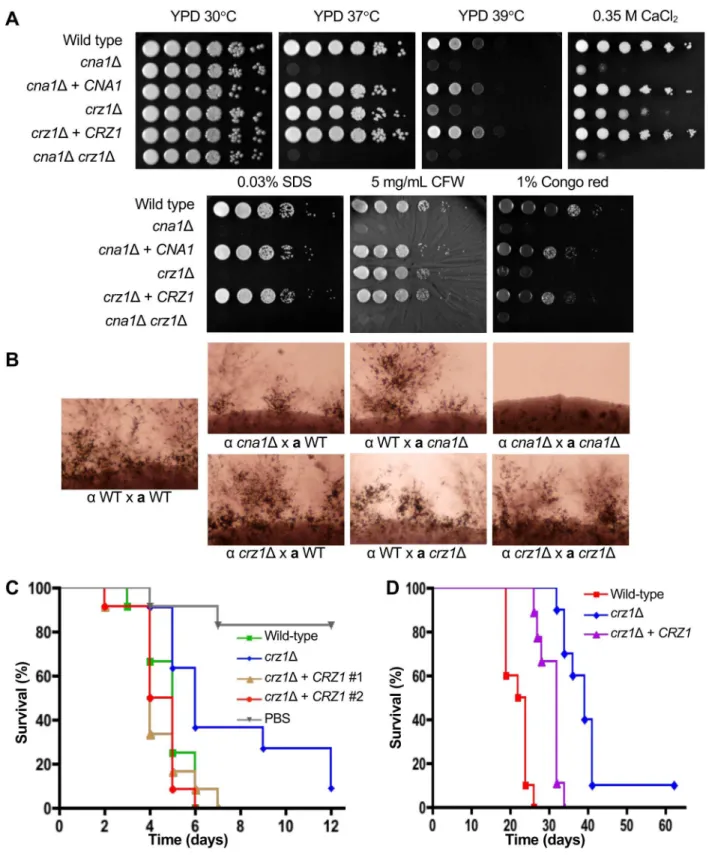
results in calcineurin-related phenotypes by assessing growth of thecrz1Δmutant at 37˚C and 39˚C and with a panel of different cell wall stresses. As previously reported, thecna1Δmutant exhibits dramatic temperature sensitivity at 37˚C and 39˚C (Fig 2A). In contrast, thecrz1Δ
mutant displayed a modest temperature defect at 37˚C compared to wild-type, and this was more pronounced at 39˚C (Fig 2A). Similar to thecna1Δmutant, thecrz1Δmutant displayed a growth defect on media containing 0.03% SDS. However, thecrz1Δmutant displayed an inter-mediate phenotype compared to the wild-type andcna1Δmutants on media containing 0.35 M CaCl2or 1% Congo red, and a very slight growth defect on media containing 5 mg/ml cal-cofluor white (Fig 2A). Complementation of thecrz1Δmutant with the wild-typeCRZ1gene restored a wild-type phenotype under these stress conditions.
To determine if the deletion of PMICIQ motif confers any phenotypes, thecrz1Δ+ Crz1WT andcrz1Δ+ Crz1PMICIQΔstrains were assayed at 37˚C and 39˚C, in addition to a panel of different cell wall stresses (Fig 1D). We found that compared to thecrz1Δ+ Crz1WTstrain, thecrz1Δ+ Crz1PMICIQΔwas growth impaired at 39˚C, or in the presence of 0.02% SDS. Thecrz1Δ+ Crz1PMICIQΔstrain presented an intermediate phenotype between the wild-type andcrz1Δon media containing 1% Congo red (Fig 1D). In summary, our results show that deletion of the PMICIQ domain results in the inability of Crz1 to translocate to the nucleus and sensitivity to growth at high temperature, strongly suggesting that this domain is functional.
verify expression of the Crz1WTand the mutant Crz1PMICIQΔconstructs. (C) The CRZ1WT-mCherry strain (ECt172) (Crz1-mCH) was grown at 24˚C and then shifted to 37˚C for 15 min. To verify that Crz1 translocation was due to calcineurin activity, FK506 (1μg/ml) was added 30 min prior to the 37˚C temperature shift. Strains ECt172 and ECt386 were grown at 24˚C and then shifted to 38˚C for 20 min. Cells were fixed with 4% formaldehyde for 15 min and washed, prior to imaging by direct fluorescence microscopy using the Zeiss Axioskop 2 Plus microscope. Scale bar = 5μm. Note that GFP-Nop1 served as a nucleolar marker. (D) Wild-type (H99), cna1Δ(KK1), crz1Δ(AFA3-3) mutants, and strains ECt172 (crz1Δ+ Crz1WT) and ECt375 (crz1Δ+ Crz1PMICIQΔ) were grown in YPD media, washed, and resuspended in PBS. Five 10-fold serial dilutions of each strain were spotted on YPD solid media, with the various additives as described and incubated at 30˚C for 48 h, unless otherwise stated. Strains were incubated at 39˚C for 72 h before imaging. CFW: calcofluor white.
The crz1Δ
mutant displays an intermediate phenotype in comparison to
wild-type and the calcineurin cna1Δ
mutant
Calcineurin mutations impair hyphal elongation during sexual reproduction [25]. To deter-mine ifcrz1mutations affect mating, unilateral and bilateral mating crosses ofcrz1Δmutants of opposite mating types were conducted. Unlike thecna1Δmutants, hyphal formation was not affected in thecrz1Δmutants in either unilateral or bilateral mating crosses, suggesting that either another target is involved or Crz1 and a second target of calcineurin are together redundant for the control of mating (Fig 2B). These phenotypic results support roles for Crz1 in cell wall integrity and calcium sequestration in the calcineurin signaling pathway, and sug-gest that calcineurin acts on factors other than Crz1 to govern thermotolerance and mating.
Calcineurin has been previously shown to be required for virulence and deletion ofCNA1
resulted in an avirulent phenotype [26]. In theGalleriainfection model, we observed that loss of Crz1 resulted in reduced virulence in comparison to wild-type (crz1Δmutant median sur-vival = 6 days, WT median sursur-vival = 5 days; WT vscrz1Δmutantp-value = 0.0142), which was restored by complementation of thecrz1Δmutant strain with the wild-typeCRZ1gene (crz1Δ
mutant vscrz1Δ+CRZ1complemented strain (ECt3 median survival = 4 days),p-value = 0.0035;crz1Δmutant vscrz1Δ+CRZ1complemented strain (AFA3-3-17 median survival = 5 days),p-value = 0.0022) (Fig 2C). To determine if Crz1 is also required for the virulence ofC.
neoformansin a vertebrate model, animals were infected with the wild-type strain (H99), the
crz1Δmutant strain (AFA3-3), and thecrz1Δ+CRZ1complemented strain (AFA3-3-17) (in-tranasal infection, 105CFUs). Thecrz1Δmutant (median survival = 39 days) displayed attenu-ated virulence compared to wild-type (median survival = 23 days;p-value<0.0001) (Fig 2D). Complementation of thecrz1Δmutant with the wild-typeCRZ1gene largely restored virulence (median survival = 32 days;crz1Δ+CRZ1vs wild-typep-value<0.0001;crz1Δmutant vscrz1Δ+
CRZ1 p-value = 0.0002) (Fig 2D).
We observed that the loss ofCRZ1resulted in attenuated virulence in both infection mod-els, which is in contrast to the fully avirulent phenotype displayed by thecna1calcineurin mutation (Fig 2C and 2D). Thecrz1Δvirulence defect was largely remediated and restored to wild-type when thecrz1Δmutant was complemented with the nativeCRZ1gene.
Identification of calcineurin-Crz1 target genes by RNA-sequencing
A goal of this study was to identify the genomic targets of the calcineurin-Crz1-signaling path-way under high temperature stress. To this end, we performed RNA-sequencing of the wild-type strain,cna1Δandcrz1Δmutant strains, and their respective complemented strains. In brief, strains were grown at 24˚C and then shifted to 37˚C for 1 hour, with three biological replicates. Direct polyA RNA sequencing was conducted and pairwise analyses of wild-type against thecna1Δmutant and wild-type against thecrz1Δmutant were performed. Genes were regarded as differentially expressed if the expression ratio was altered2-fold at a false discov-ery rate<0.2.
imaged. (C) 12 G. mellonella larvae per group were infected by injection with 4x10³cells of wild-type (H99), crz1Δ(AFA3-3), or the crz1Δ+
CRZ1 complemented strains (AFA3-3-17 and ECt3). The larvae were incubated at 37˚C and monitored daily. (H99 vs PBS, p-value< 0.0001; AFA3-3 vs PBS, p-value = 0.0006; AFA3-3-17 vs PBS, p-value<0.0001; ECt3 vs PBS, p-value<0.0001; H99 vs AFA3-3,
p-value = 0.0142; AFA3-3 vs AFA3-3-17, p-value = 0.0022; AFA3-3 vs ECt3, p-value = 0.0035; H99 vs AFA3-3-17, p-value = 0.2804; H99
vs ECt3, p-value = 0.5209) (D) Ten female BALB/c mice per group were infected through intranasal instillation with 1x10⁶cells of wild-type (H99), crz1Δ(AFA3-3), and the crz1Δ+ CRZ1 complemented (AFA3-3-17) strains. The mice were monitored daily and sacrificed at predetermined clinical end points that are predictive of imminent mortality. (H99 vs AFA3-3, p-value<0.0001; AFA3-3 vs AFA3-3-17,
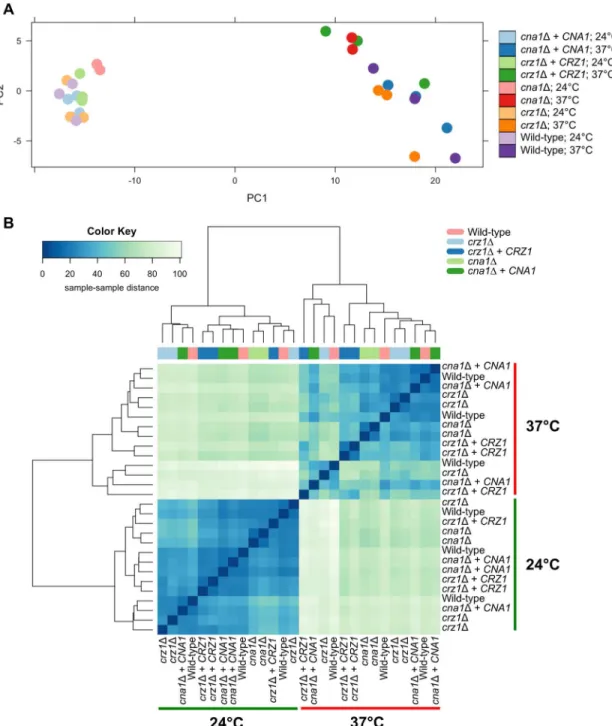
Principle component analysis (PCA) and hierarchical clustering were used to explore the relationship in gene expression between samples (Fig 3A and 3B). PCA demonstrated,
unsur-prisingly, that high-temperature stress has a larger effect on gene expression than either of the mutations. PC1 clearly distinguishes the samples grown at 37˚C from the 24˚C samples, which clustered to the right or left side of the graph respectively (Fig 3A). Moreover, the 24˚C sam-ples tightly clustered on PC1 and PC2, indicating much lower variability in gene expression under this growth condition, as is expected. In contrast, we observed greater variability in gene expression under temperature stress at 37˚C for each of the strains analyzed (Fig 3A). A hier-archical cluster analysis was also preformed to verify the observations from the PCA. We observed the same clustering pattern, whereby gene expression patterns of strains grown at 24˚C were more similar compared to each other than when compared to the gene expression of strains grown at 37˚C (Fig 3B). The variability of gene expression at 37˚C was again greater than that at 24˚C, and the effect of the temperature shift is greater than the effect of the muta-tions (Fig 3B).
Quantitative real-time PCR was performed to validate the results obtained from RNA sequencing. Of the 22 genes analyzed, 20 genes showed very similar fold changes in expres-sion compared to RNA-sequencing (S3 Fig). The magnitude of fold change in two genes (CNAG_02415 and CNAG_00025 (VCX1)) observed in the real-time PCR was higher than in the RNA-sequencing but still supported the relationships of the gene expression patterns among the isolates at 37˚C. Only in one case (CNAG_07725 (Rox1)) were we not able to vali-date the RNA-sequencing results as the magnitude of fold change in wild-type at 37˚C was lower by real-time PCR.
Pairwise analyses of wild-type against thecna1Δmutant, and wild-type against thecrz1Δ
mutant at 24˚C, showed that under non-stress inducing conditions, loss ofCNA1andCRZ1
did not have a significant impact on gene expression at a whole genome level. From the pair-wise analysis of wild-type against thecna1Δmutant, 32 genes were identified as being differen-tially expressed, and 50% of the genes were downregulated in thecna1Δmutant, and the other half were up-regulated (S1 Table). Comparing the gene expression of thecrz1Δmutant against the wild-type, we found that only five genes were differentially expressed; of the five genes, four genes were also differentially expressed in thecna1Δmutant (S1 Table).
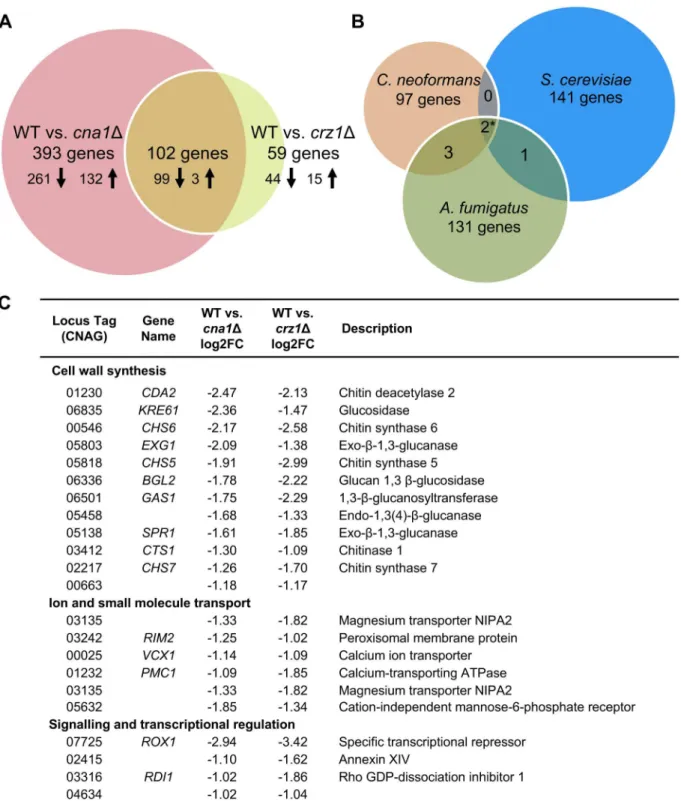
At 37˚C, 495 genes were identified as being differentially expressed and regulated in a calci-neurin-dependent manner in the comparison between wild-type and thecna1Δmutant. In contrast, only 161 genes were differentially expressed in the pairwise analysis of wild-type against thecrz1Δmutant at 37˚C (Fig 4A).
To elucidate gene networks that are regulated by the calcineurin-Crz1 signaling pathway, the gene sets obtained from the pairwise analyses were compared. From the comparison of the 37˚C gene sets, 102 genes were regulated in a calcineurin-Crz1 dependent manner (Fig 4A). 99 genes (97.1%) were down regulated in both thecna1Δandcrz1Δmutants, indicating that these genes are normally positively activated by the calcineurin-Crz1-signaling pathway under thermal stress.
Fig 3. Expression dynamics of calcineurin and Crz1 target genes. (A) Principal component analysis (PCA) was
performed to compare gene expression levels of the WT (H99), cna1Δ(KK1), cna1Δ+ CNA1 (KK5), crz1Δ(AFA3-3), and
crz1Δ+ CRZ1 (AFA3-3-17) strains grown at 24˚C and 37˚C. Lighter colors indicate the 24˚C samples and the bright colors indicate the 37˚C samples. Note that results for one cna1Δ37˚C biological replicate were not included in the analysis, due to sample contamination. (B) Hierarchical cluster analysis recapitulates the observation from the PCA. The heatmap indicates the pairwise distance between samples. The x-axis of the color key indicates the distances between the samples, with the darker blue signifying a higher similarity (i.e. small distance) between the samples, while the lighter blue signifies a lower similarity (i.e larger distance) between the samples. The color bar above the heatmap indicates the sample type. Gene expression levels at 24˚C were different from the gene expression levels at 37˚C. In general, gene expression of samples grown at 24˚C showed less variability (dark blue). However, gene expression of samples grown at 37˚C showed more variability (light blue).
1.3%), stress response (4 genes, 1%), and the remaining 73 gene products (18.6%) were involved in other metabolic and biological processes (S2 Table).
We identified a smaller subset of genes (59 genes) as being regulated by Crz1, indepen-dently of calcineurin, under thermal stress (S3 Table). 43 genes (73%) were down-regulated in thecrz1Δmutant, indicating that these genes are normally activated by Crz1 under thermal stress, and 16 genes (27%) were up-regulated. A majority of the genes (43 genes; 73%) encoded proteins of unknown functions. The remaining 16 genes had ascribed functional categories including: cell wall integrity (FKS1andCHS8), membrane transport (6 genes, 10%), oxidation-reduction processes (4 genes, 6.8%), carbohydrate metabolism (4 genes, 6.8%), protein kinases (3 genes, 5%), encoded vesicle-mediated transport (2 genes, 3.4%), and other metabolic and biological processes (5 genes, 8.5%) (S3 Table).
Of the 102 genes that are controlled by the calcineurin-Crz1 pathway, 64 (62.75%) are genes of unknown functions (S4 Table). Consistent with the hypothesis that Crz1 acts down-stream of calcineurin to regulate cell wall integrity based on the phenotypic assays, 11% of the genes encode proteins that contribute to cell wall integrity/maintenance; examples of these include:CHS7,CHS6,CHS5,KRE6,CDA2,CTS2,EXG1, andBGL2(Fig 4C). We also identified genes involved in membrane transport (VCX1,PMC1, andRIM1), melanin production (LAC2), signaling and transcription (ROX1), and amino acid and carbohydrate metabolism (Fig 4C).
Calcineurin-Crz1-signaling pathway has been adapted in C. neoformans
to enable growth at 37˚C
InS.cerevisiae, 163 calcineurin-Crz1-dependent genes were identified in a genome wide-profil-ing study under Ca2+and Na+stresses, including genes involved in ion homeostasis and cell wall integrity [11]. Here we focused on those that were calcium regulated (153 genes), and also excluded nine that were hypothetical genes, and from the remaining 144 genes we found that 79 have an ortholog inC.neoformans. Interestingly, when we compared the 102 calcineurin-Crz1-dependent genes identified in our study with theS.cerevisiaecalcineurin-Crz1-dependent genes identified upon calcineurin stimulation by high Ca2+stress, we found that while 30 genes have an ortholog inS.cerevisiae, only two genes (CNAG_01232PMC1and CNAG_02217
CHS7) have a yeast ortholog that was also regulated by the calcineurin-Crz1 pathway (Fig 4B
andS5 Table). Both genes were downregulated in thecrz1Δmutant, indicating that the genes are upregulated in response to thermal stress. The twoS.cerevisiaeorthologs (PMC1andCHS1) are similarly upregulated in response to Ca2+stress. To determine the significance of this over-lap between the two gene sets, we performed a resampling test to evaluate the probability that the overlap occurred by chance (as described in Materials and Methods). The estimated pro-bability for theC.neoformansandS.cerevisiaegene sets was 0.250, indicating that two-gene overlap between the two gene sets is likely due to chance, not conservation of a regulated gene.
In the pathogenic fungusA.fumigatus, 141 calcineurin-dependent genes were identified upon high Ca2+stress [23]. From these we excluded four hypothetical proteins and found that from the remaining 137 there were 78 genes that have an ortholog inC.neoformans. When we compared the 102 genes identified from our study to theA.fumigatusgene set, we found that 56 genes have an ortholog inA.fumigatus, and from this subset, five genes (CNAG_00025
VCX1, CNAG_01232PMC1, CNAG_02217CHS7, CNAG_03412CTS1, and CNAG_04737) have six orthologs that were regulated by the calcineurin pathway inA.fumigatus(Fig 4Band
S5 Table). The five genes are downregulated in thecrz1Δmutant, indicating that the genes are upregulated in response to thermal stress. Of the five genes, two genes (CNAG_04737 and
mutant,chiB1(Afu7g08490) and Afu6g03450 are upregulated under Ca2+stress. We repeated the resampling test, and found that the estimated probability for the overlap between theC.
neoformansandA.fumigatusgene sets was 0.002. The low probability of an overlap of at least six genes by chance suggests some conservation of calcineurin/Crz1 regulation betweenC. neo-formansandA.fumigatus.
We further applied this analysis to compare theS.cerevisiaegene set with the gene set from
A.fumigatus. From the OrthoMCL analysis, we found that 116 out of 144S.cerevisiae calci-neurin-dependent genes have orthologs inA.fumigatus, and 63 out of 137A.fumigatus calci-neurin-dependent genes have orthologs inS.cerevisiae. When we compared the two subsets, we found threeS.cerevisiaegenes (YGL006WPMC1, YLR350WORM2, and YNL192WCHS1) overlapping with fourA.fumigatusorthologs (S5 Table). The resampling analysis found a probability of 0.268 suggesting that this number of overlapping genes could occur by chance, as noted in the comparison betweenC.neoformansandS.cerevisiae.
This analysis shows that the genes regulated by the calcineurin-Crz1 pathway differ signifi-cantly betweenC.neoformansandS.cerevisiae,C.neoformansandA.fumigatus, andA. fumi-gatusandS.cerevisiae. Given that the gene sets ofS.cerevisiaeandA.fumigatuswere obtained using different stress-inducing conditions, our results could suggest that under thermal stress, theC.neoformanscalcineurin-Crz1 pathway may regulate a subset of genes that is different from the genes it may regulate under ionic stresses. But given that the genes regulated inS. cer-evisiaeandA.fumigatusdiffer significantly in response to the same stress condition (calcium ion stress) lends support to the conclusion that the output of the pathway differs between these species.
We found that theC.neoformanscalcineurin-Crz1 pathway positively regulated both
PMC1and the calcium ion transporter geneVCX1, unlike inS.cerevisiae, where the Vcx1 pro-tein is negatively regulated by calcineurin post-transcriptionally and independently of Crz1 [12,34–36]. In addition toPMC1, a small number of genes have been previously identified as calcineurin-dependent gene targets inS.cerevisiae:FKS2, which encodesβ-1,3-glucan synthase; the P-type ATPasesPMR1andENA1; and the calcineurin regulator,RCN1[34,36– 38]. We found thatFKS1, encoding the soleβ-1,3-glucan synthase, andMPK1, encoding the downstream protein kinase in the PKC pathway, were regulated by Crz1 independently of cal-cineurin under thermal stress. Adleret al. previously concluded that Pkc1 positively regulates Crz1 under glucose starvation, through phosphorylation. From our RNA-sequencing analysis results, we propose that Crz1 is regulated by calcineurin under thermal stress, and that the PKC pathway may act antagonistically to calcineurin.
Motif enrichment analyses
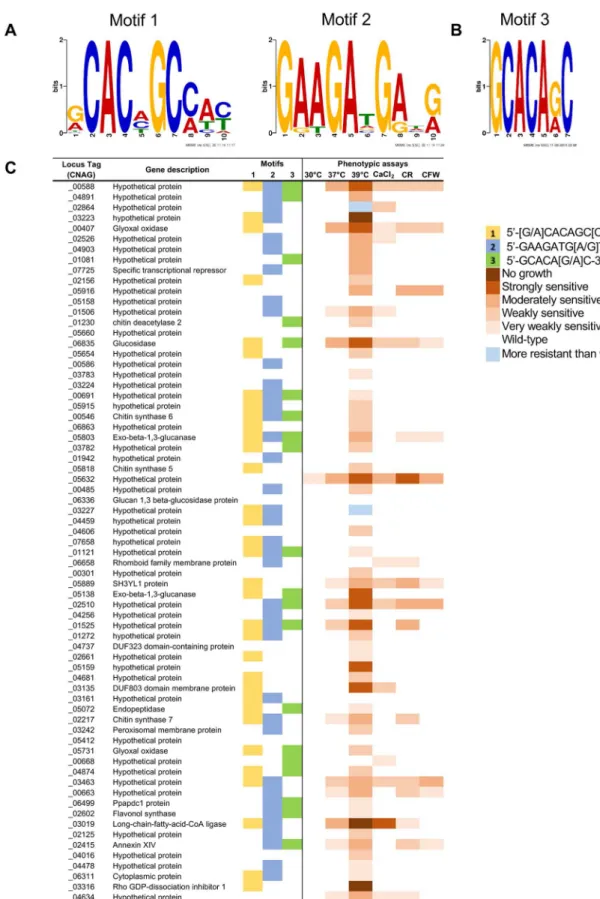
Crz1 target genes have been shown to contain a Crz1 binding motif in their promoter regions, also known as the calcineurin-dependent response element (CDRE). To identify the CDRE motif inC.neoformans, we performed a motif search employing MEME (Multiple Em for Motif Elucidation) with theS.cerevisiae,C.albicans,M.oryzae, andA.fumigatusCDRE motif sequences serving as consensus sequences [12,22,23]. However, we were unable to identify any unique motif sequences. We next attempted to identify the putative CDRE motifs with MEME by using 1 kb of upstream promoter sequences of the 102 calcineurin-Crz1 regulated genes and restricting the maximum size of the motif to 10 bp. Two putative motifs were identi-fied: motif 1 (5’-[G/A]CACAGC[C/A]AC-3’) was found in 48 genes, and motif 2 (5’-GAAGA TG[A/G]T[G/A]-3’) was present in 52 genes (Fig 5AandS6 Table).
Fig 5. Genes regulated by the calcineurin-Crz1 pathway feature three motifs. (A) DNA motifs generated by MEME
of theCHS6gene (CNAG_00546), which has been found to be a target of Crz1, and three other genes (CNAG_00588, CNAG_04891, and CNAG_00407) that displayed the highest fold-change in expression levels in the RNA-seq analysis. Corresponding promoter sequences from the orthologs inC.deneoformans,C.gattii, andC.amylolentuswere also used in order to increase specificity of the motif search. From this search, a third motif that is 7 bp in length (5’-GCACA[G/A]C-3’) was identified with an e-value of 1.3e-4(Fig 5B). This motif is a shorter variant of motif 1 identified in the MEME analysis. We used Analysis of Motif Enrichment (AME) to check for motif enrichment among the promoter regions of the 102 calcineurin-Crz1 regulated genes, and found that the motif was enriched (p-value = 1.95e-4), and is present in the promoter regions of 29 genes. We found that 21 genes did not contain any of the three putative motifs, suggesting that these genes may be indirect targets of the calcineurin-Crz1 pathway (S6 Table).
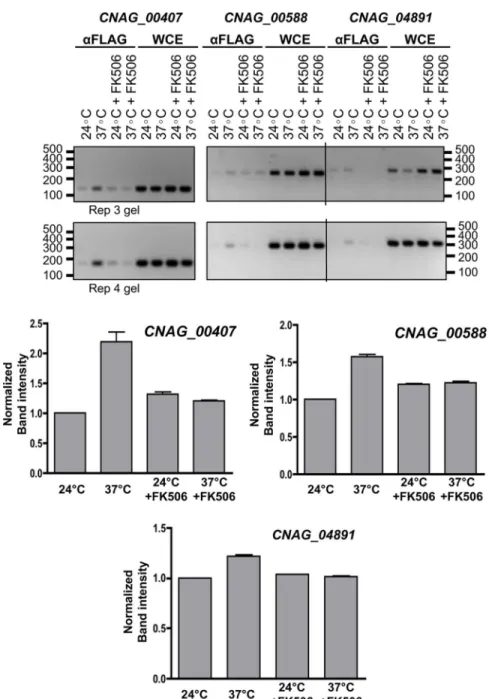
To verify if genes containing the motifs were direct targets of Crz1, we performed ChIP-PCR using thecrz1Δmutant complemented with the Crz1-4xFLAG construct described in [31]. Cultures were grown at 24˚C and then shifted to 37˚C for 1 hour, with and without FK506, with biological duplicates. Three genes with the highest fold-changes (CNAG_00588, CNAG_00407, CNAG_04819) were selected, and primers were designed to amplify 150–280 bp segments of the promoter regions containing the motifs (S4 Fig). We observed that in gen-eral, Crz1 binding intensity was increased upon temperature shift to 37˚C compared to 24˚C and this increase was inhibited by exposure to FK506 (Fig 6).
Deletion mutants of genes regulated by the calcineurin-Crz1 pathway
display differential phenotypes
Of the 102 genes regulated in a calcineurin-Crz1 dependent manner, we were able to pheno-typically assay 70 gene deletion mutants from theC.neoformansgene deletion collection deposited at the FGSC by the Madhani lab [39]. From the group of 70 mutants tested, 10 mutants displayed similar phenotypes to wild-type when assayed on media containing 0.5 M CaCl2, 1% Congo red, and 5 mg/mL calcofluor white, or growth at 37˚C and 39˚C. 14 mutants presented with an intermediate phenotype compared to thecna1Δandcrz1Δmutants at 37˚C, while 55 mutants presented with similar temperature sensitive growth phenotypes to thecrz1Δ
mutant (Fig 5C,S5andS6Figs). One mutant (cnag_03463Δ) encoding a protein of unknown function displayed slower growth across all conditions assayed (S5 Fig). Interestingly, two deletion mutants (cnag_02864Δandcnag_03227Δ) displayed a slightly increased resistance at 39˚C (S6 Fig). In summary, 60 out of 70 genes regulated by the calcineurin-Crz1 pathway, when mutated, conferred stress sensitivity to different degrees. This represents a significant enrichment of this phenotype, reinforcing the model that genes regulated by the calcineurin-Crz1 pathway have roles in stress resistance.
Discussion
The transcription factor Crz1 has been shown to be a major downstream effector of calci-neurin in various model and pathogenic fungi. Recent studies have identified CNAG_00156 as the putativeC.neoformans CRZ1ortholog, with differing conclusions [28–30]. We identi-fied Crz1 from a calcineurin-dependent phosphoproteomic screen in a recent study [31]. (CNAG_00546), and three other genes (CNAG_00588, CNAG_04891, and CNAG_00407). (C) Comparison of the presence or absence of the motifs against the phenotypic analyses of the target gene deletion mutants. CaCl2= 0.5 M calcium chloride; CR = 1% Congo red; CFW = 5 mg/mL calcofluor white.
Reciprocal protein BLAST searches suggest that CNAG_00156 is an ortholog ofS.cerevisiae
Crz1, and similar results were obtained with Crz1 fromC.albicansandA.fumigatusCrzA. At room temperature, we observed that wild-type Crz1 is distributed throughout the cytosol. At 37˚C, Crz1 translocated into the nucleus in a calcineurin-dependent manner; inhibition of
Fig 6. Crz1 binding of promoter regions increases under thermal stress. Cultures of the Crz1-4xFLAG
strain were grown to exponential phase at 24˚C, shifted to 37˚C with and without FK506 for 30 min, and crosslinked with formaldehyde. Whole cell lysates (WCE) were prepared and ChIP-PCR was performed employing anti-FLAG nickel beads and specific DNA primers for three genes (CNAG_00588, CNAG_00407, and CNAG_04861) as described in material and methods. PCR DNA products for the DNA obtained from the anti-FLAG CHIP-PCR or from WCE-PCR were fractionated in agarose gels. Primers for each gene tested were designed to produce a product 150–280 bp long. Quantification of band intensity was analyzed using ImageJ, and values were normalized to the 24˚C control. Results shown are representative of two biological replicates (labelled as Rep 3 gel and Rep 4 gel above).
calcineurin at 37˚C by the presence of FK506 prevented the translocation of Crz1 into the nucleus. We identified two putative calcineurin docking domains (i)451PMICIQ456and (ii) 868
PALSIS873. Deletion of the451PMICIQ456domain prevented the translocation of Crz1 into the nucleus under thermal stress (Fig 1C), suggesting that this domain is important for calci-neurin interaction with Crz1, and its dephosphorylation activity. Levet al. had previously pre-dicted three candidates: (i)659PRLDPD664, (ii)394PNIVTQ399, and (iii)451PMICIQ456, and mutagenized the latter two motifs to PNIddQ and PMIddQ respectively, and did not observe any effects on nuclear targeting of mutant proteins [29]. InS.cerevisiae, the calcineurin dock-ing domain PIISIQ in Crz1 has been demonstrated to mediate direct binddock-ing with calcineurin, and loss of the motif compromises regulation by calcineurin and results in sustained cytosolic localization of Crz1 under stress conditions [32].
Concurrent with earlier reports, we found that thecrz1Δmutant was sensitive to cell wall perturbing agents (SDS and Congo red), and to high concentrations of CaCl2. Deletion of
CRZ1did not compromise the ability to grow at the host physiological temperature (37˚C), but we found that growth at higher temperatures (39˚C) was inhibited (Fig 2A). Loss ofCRZ1
did not affect hyphal formation or sporulation in a bilateral genetic cross. We observed that the loss ofCRZ1resulted in attenuated virulence in an animal infection model, albeit to a much lesser extent observed for thecna1calcineurin mutant, which is avirulent. This virulence defect was largely remediated to wild-type when thecrz1Δmutant was complemented with the wild-typeCRZ1gene. These phenotypic results support roles for Crz1 in cell wall integrity and calcium sequestration in the calcineurin signaling pathway, and also indicate that calcineurin acts on other factors that function to govern thermotolerance and mating (Fig 7).
To identify the downstream target genes of the calcineurin-Crz1 signaling pathway, we employed RNA-sequencing on cultures grown at 24˚C and 37˚C. At the resting, non-induced state (24˚C), we found that only a small number of genes were differentially expressed in the
cna1Δmutant, and of these genes, five were also differentially expressed in thecrz1Δmutant. However, under thermal stress, we found 495 genes were regulated by calcineurin and 161 genes by Crz1. Comparing the two gene datasets, we identified 102 genes as being differentially regulated in a calcineurin-Crz1-dependent manner; of these, 99 genes were down-regulated in both thecna1Δandcrz1Δmutants, indicating that under thermal stress, the calcineurin-Crz1 pathway acts predominantly to positively regulate gene expression. Consistent with our hypothesis that Crz1 acts downstream of calcineurin to regulate cell wall integrity based on the phenotypic assays, 11% of the genes encode proteins that contribute to cell wall integrity/main-tenance; examples of these include:CHS7,CHS6,CHS5,KRE6,CDA2,CTS2,EXG1, andBGL2. We also identified genes involved in membrane transport (VCX1,PMC1, andRIM1), signaling and transcription, and amino acid and carbohydrate metabolism.
Employing both MEME and DREME analyses, we identified three putative CDRE motifs: (1) 5’-[G/A]CACAGC[C/A]AC-3’, (2) 5’-GAAGATG[A/G]T[G/A]-3’, and (3) 5’-GCACA[G/ A]C-3’ present within the promoter regions of 81 out of the 102 genes regulated by the calci-neurin-Crz1 pathway. All three motifs bear little similarity to the CDRE motifs previously identified in the ascomycetesS.cerevisiae,C.albicans, andA.fumigatus. Interestingly, the three motifs were also present in the promoter regions of 41 out of the 59 genes that were regu-lated by Crz1 independently of calcineurin (S7 Table). Under different stress conditions, such as ionic stresses, these genes may be regulated in a calcineurin-dependent manner.
a feedback loop involving the transcriptional activation ofRCN1. TheCBP1gene (Calcineurin Binding Protein 1) encodes a homolog ofRCN1inC.neoformansthat has previously been shown to interact with the calcineurin A catalytic subunit and play a role in mating. Interest-ingly, Cbp1 was not regulated by either calcineurin or Crz1 under thermal stress inC. neofor-mans, based on our RNA-sequencing analysis. Moreover,CBP1is not needed for growth at high temperature and plays a modest role in virulence [41,42]. Taken together, these results indicate that the thermally activated calcineurin-Crz1 pathway inC.neoformansdiffers from that responding to Ca2+stress inS.cerevisiae, and suggests that either the calcineurin-Crz1 path-way varies in response to different stresses or the network has been rewired during fungal evolution.
Although the core signaling cascade involving calmodulin, calcineurin, and Crz1 is highly conserved across species, the downstream effectors seem to have diverged. Even within the
Fig 7. Model of calcineurin-Crz1 signaling pathway in C. neoformans. Under stress conditions such as
high Ca2+concentration or thermal stress, calcineurin is activated and dephosphorylates Crz1, resulting in its translocation to the nucleus. In the nucleus, Crz1 upregulates the expression of stress response genes, such as those involved in cell wall maintenance or remodeling and small molecule transport. Calcineurin also translocates to P-bodies and stress granules [27] where it may act upon other factors that influence mRNA expression or stability to operate a bifurcated transcriptional/post-transcriptional stress response network necessary for fungal virulence.
ascomycete calcineurin-Crz1 signaling pathway, downstream target genes are different in response to different stimuli [14,23]. Comparative analyses of the 102C.neoformans calci-neurin-Crz1 dependent genes against the gene sets previously identified forS.cerevisiae[11] andA.fumigatus[23] supports this hypothesis. Comparison between theC.neoformansandS.
cerevisiaegene sets revealed that while 30 of the 102 genes haveS.cerevisiaeorthologs, only two of these genes are regulated by the calcineurin-Crz1 pathway in both species, and the probability of the observed overlap (0.250) suggest that the occurrence is most parsimoniously by chance. When the same analysis was performed comparing theC.neoformansandA. fumi-gatusgene sets, we found that 56 of the 102C.neoformansgenes have orthologs inA. fumiga-tus. From these 56 orthologs, five genes are calcineurin-Crz1 targets in both fungi, with a lower probability of 0.002, suggesting some modest conservation in the downstream target genes between the two fungal species. While relatively few orthologs are commonly regulated in all three species, some of the remaining downstream target genes may play related functions, such as in cell wall integrity/maintenance, ionic stress resistance, and vacuolar calcium seques-tration. This plasticity may reflect network rewiring during evolution, allowing each species to cope with the stresses encountered in their particular environmental niches.
Additionally, Crz1 may not be the only transcription factor inC.neoformansacted upon by calcineurin. This is evident based on: 1) the intermediate phenotypes observed in thecrz1Δ
mutant at 37˚C compared to the wild-type and thecna1Δmutant, 2) attenuated virulence of the
crz1Δmutant, rather than the complete loss of virulence observed in thecna1Δmutant, and 3) the regulation of other transcription factors by calcineurin, independently of Crz1, based on RNA-sequencing. Thus if rewiring occurred it could have happened by a mechanism similar to that pro-posed by Baker et al. involving the integration of a new transcriptional regulator into the existing network, as in the MATa specific gene network rewiring in the Saccharomycota [43].
In summary, we have identified a suite of genes that is regulated by the calcineurin-Crz1 signaling pathway under thermal stress. Given the intermediatecrz1Δmutant phenotype, evi-dence for a calcineurin regulatory network impacting mRNA independently of Crz1, and the finding that calcineurin relocalizes to P-bodies and stress granules during thermal stress [27], calcineurin may act on factors in addition to Crz1 that govern mRNA expression or stability to operate a bifurcated transcriptional/post-transcriptional stress response network necessary for fungal virulence (Fig 7). Taken together, our findings suggest that the calcineurin-Crz1 stress response cascade has been maintained from ascomycetous to basidiomycetous fungi, but its output inC.neoformansseems to have been rewired during evolution. Future studies to fur-ther characterize the calcineurin-Crz1-regulated genes will likely illuminate links between the three major stress response pathways inC.neoformans, namely the alkaline stress response, HOG, and PKC pathways, and thereby provide new avenues for research into the identifica-tion of antifungal targets.
Materials and methods
Strains and plasmids
Fungal strains and plasmids constructed in this study are listed inS8 Table. All fungal strains listed inS8 Tablewere derived fromC.neoformansvar.grubiilaboratory reference strain H99 (#4413), unless otherwise stated. Fungal transformation was carried out using the biolistic method [44]. Fungal strains were maintained on YPD agar (1% yeast extract, 2% bactopeptone, and 2% dextrose) supplemented with the relevant antibiotics and grown at 30˚C.
overlap PCR, cloned into pCR2.1-TOPO (Invitrogen) to yield plasmid pXW15 which was veri-fied by sequencing. The 7.96 kb BamHI Crz1-mCherry fusion fragment was subcloned into the BamHI site of the safe haven plasmid pSDMA25 [45], to generate plasmid pEC13 which was verified by sequencing. The recombinant Crz1-mCherry plasmid was linearized using the restric-tion enzyme AscI, and thecrz1Δ::NATdeletion mutant was biolistically transformed. Transfor-mants were screened for proper integration into the safe haven locus as previously described [45]. Targeted integration of each construct was confirmed by PCR amplification (5’ junction: JOHE40956/JOHE40957; 3’ junction: JOHE40958/JOHE41562). Tandem array integration was ruled out by PCR using inverse primers (JOHE41450/JOHE41451) that would only yield a prod-uct if two or more copies of the constrprod-uct were tandemly integrated at the safe haven site. The
NATselectable marker in pSL04, which contains the nucleolar fluorescence marker GFP-Nop1, was replaced with theHYGselectable marker from pJAF15. The GFP-Nop1 construct was intro-duced into the recombinant Crz1-mCherry mutant strains by ectopic integration. All primers that were used in this study are listed inS9 Table. The Crz1PMICIQΔ–mCherry plasmid was con-structed by Gibson cloning, using the plasmid pEC13 as the template.
Phenotypic assays
Strains were grown in liquid YPD media at 30˚C overnight with shaking, and washed with PBS. Five 10-fold serial dilutions of each strain were made, and spotted out onto solid media. Unless otherwise stated, strains were incubated for 2 days at 30˚C. YPD was supplemented with 2.5 M CaCl2solution, mixed to achieve a final concentration of 0.35 M, 0.4 M, or 0.5 M of CaCl2. YPD was supplemented with 20% SDS, mixed to achieve a final concentration of 0.02% or 0.03% SDS. Congo red was added to YPD to a final concentration of 1% (w/v). Calcofluor white was added to final concentrations of 4 mg/mL or 5 mg/mL. MS mating medium was pre-pared as previously described [25]. Strains of opposite mating types were grown in liquid YPD media at 30˚C overnight with shaking, and washed with PBS. Equal volumes of cell suspen-sions of each mating type were mixed, spotted onto MS mating media, and incubated at room temperature in the dark for 12 days before visualization using a Nikon Eclipse E400 micro-scope with an attached DXM200F digital camera.
Microscopy
Strains were grown overnight in liquid YPD medium at room temperature with shaking. Cells were then diluted to OD600= 0.1–0.2 with fresh YPD medium (20 mL), and grown for a fur-ther five hours, until OD600= 0.5–0.6 was achieved. A 5 mL aliquot of the cell culture was incu-bated in a 37˚C water bath for 15 min. Cells incuincu-bated at 24˚C and at 37˚C were then fixed with 4% formaldehyde for 15 min, and washed with KPO4/sorbitol buffer. To verify that trans-location of Crz1 is due to calcineurin activity, FK506 (final concentration = 1μg/mL) was added to the cultures, and cells were incubated for a further 15 min before being shifted to 37˚C. To observe the localization of the Crz1PMICIQΔconstruct, cells were shifted to 38˚C for 20 min prior to formaldehyde fixing. Cell suspensions were spotted onto slides with a layer of 1.5% YNB-agarose and covered with a coverslip. Cells were visualized by direct fluorescence microscopy using a Zeiss Axioskop 2 Plus microscope and AxioVision 4.6 image acquisition software. Nuclear fluorescence was quantified by ImageJ software.
RNA isolation and real-time PCR
lyophilized overnight. Total RNA was isolated from lyophilized cells using Trizol solution (Invitrogen Life Technologies, Carlsbad, CA) and the Qiagen RNeasy Mini kit (Qiagen, Valen-cia, CA). All RNA samples were collected in biological triplicates.
For quantitative PCR, total RNA was reversed transcribed into first strand cDNA by oligo dT priming using the AffinityScript cDNA synthesis kit according to the manufacturer’s instructions (Ailgent Technologies, Santa Clara, CA). The resulting cDNA was diluted with ultra-pure water. Real-time PCR was performed using the Brilliant III Ultra-Fast SYBR Green QPCR master mix (Agilent Technologies) and the Applied Sciences StepOnePlus Real Time-PCR system. Primers are listed inS9 Table.
RNA-sequencing data analysis
Direct polyA RNA sequencing was performed by the High Throughput Sequencing Facility at the University of North Carolina, Chapel Hill. Preliminary quality analysis of the raw FASTQ files was conducted using FastQC [46], quality filtering was then performed using fastq-mcf [47] to remove sequencing adapters (adapter sequences supplied by Illumina, Inc) and trim low qual-ity bases. Tophat2 [48] was used to map the processed reads to the H99 genome and transcrip-tome as determined from the genome annotation (version 2, downloaded from the Broad Institute) [49], using the following parameters: "—transcriptome-max-hits 1—max-multihits 1— max-intron-length 4000—library-type fr-unstranded—no-coverage-search". The program htseq-count [50] was used to determine read counts per gene from the BAM file output by Tophat; the htseq-count parameters used were "—stranded = no—type = exon—idattr = gene_id". A custom script was developed in the R programming language [51] to analyse the count data in order to do quality testing, identify differentially expressed genes, and generate figures. This script used the R packages DESeq2 [52], gplots [53], RColorBrewer [54], and optparse [55].
Preliminary data analysis led us to excluded from analysis one of thecna1Δ37˚C replicates, which was found to contain reads mapping to the deleted portion of CNA1. This preliminary analysis also indicated that theCRZ1complementedcrz1Δstrains have much higher expres-sion of CRZ1 than the wild-type strain.
The RNA-Seq data discussed in this publication have been deposited in NCBI’s Gene Expression Omnibus (GEO) [56] and are accessible through GEO Series accession number GSE93005 (https://www.ncbi.nlm.nih.gov/geo/query/acc.cgi?acc=GSE93005). The custom programs developed for processing and analyzing the RNA-Seq data are available in a GitHub software repository (https://github.com/granek/crne_cna1crz1_rnaseq). This repository includes all programs, support files, and instructions for automatically replicating all analyses presented here using the data available from GEO.
Orthology search and resampling test analysis
Afu2g05330 was used in this analysis. In total, 144 genes fromS.cerevisiae, 137 genes fromA.
fumigatusand 102 genes fromC.neoformanswere analyzed.
The resampling test was performed to examine the likelihood that the overlap in regulated gene sets were to occur by chance. Briefly, sets of genes equivalent in size to the number of reg-ulated genes with orthologs were randomly selected: 30 from allC.neoformansgenes with an ortholog inS.cerevisiae, and 79 from allS.cerevisiaegenes with an ortholog inC.neoformans. These two sets were compared to determine the number of orthologs shared between these two sets. This resampling procedure was repeated 1000 times, and the proportion of times that a simulated overlap was equal to or larger than the true overlap was tallied to give a probability estimate. The same test was carried out betweenC.neoformans(56 genes) andA.fumigatus
(78 genes), as well asS.cerevisiae(116 genes) andA.fumigatus(63 genes). Scripts and data for replicating the resampling analysis are available in the GitHub software repository (https:// github.com/granek/crne_cna1crz1_rnaseq).
Motif discovery
To perform motif discovery, we employed the CDRE fungal motif sequences as indicated in the results section and the MEME suite was employed through use of the MEME webserver. In order to identify candidate motifs, both MEME [58] and DREME [59] were employed, with the input sequences randomly shuffled to provide a negative data set for DREME. Candidate motifs were tested for enrichment in the upstream 1 kb promoter sequences of candidate calci-neurin-Crz1 regulated genes using AME [60].
Chromatin immunoprecipitation
mL 100% ethanol. DNA was pelleted by centrifugation at 13,000 rpm for 30 min at 4˚C, and resolved in Ultra-Pure water and treated with 20μg/mL RNaseA, before storage at -20˚C.
DNA concentration was measured by Nanodrop, and diluted to an equimolar concentra-tion for all samples. ChIP PCRs were done under typical laboratory PCR condiconcentra-tions with 1x ExTaq Buffer, 400nM dNTPs, 200nM forward primer, 200nM reverse primer, 0.625 units of ExTaq (Clonetech) and 1.2ul ChIP DNA template. Primers for each gene used can be found in
S9 Table. PCR products were run on a 2% agarose gel containing 500μg/mL of ethidium bro-mide and imaged using the BioRad Gel Doc System.
Virulence assays
Galleria mellonellawere infected as previously described [62]. Cells were grown overnight in liquid YPD medium at 30˚C with shaking, washed with PBS and suspended in the same buffer. Cell density was calculated using a hemocytometer and cell suspensions of 106cells/mL were prepared. Groups of 12 larvae were injected with 4μL of the cell suspension (4 x 10³cells) through the proleg; one group of larvae was injected with PBS as a control. The larvae were incubated at 37˚C, and death was monitored daily for 15 days. Larvae that pupated during the 15-day period were censored.G.mellonellainfections were performed in triplicate.
5–6 week old BALB/c female mice were used for the murine infection model. Groups of 10 mice were infected with wild-type,crz1Δmutant, andcrz1Δ+ CRZ1complemented strains (105cells) using the intranasal inhalation model previously described [63]. Mice were moni-tored and weighed daily; mice that appeared moribund or weighed less than 20% of their initial starting weight were euthanized.
Survival curves for both infection models were adjusted using the Kaplan-Meier method and estimation of differences in survival were analyzed using the log rank and Wilcoxon tests with GraphPad Prism software (GraphPad, San Diego, CA). Ap-value below 0.05 was consid-ered significant.
Ethics statement
All experiments and animal care were conducted in accordance with the ethical guidelines of the Institutional Animal Care and Use Committee (IACUC) of Duke University Medical Cen-ter (DUMC). The DUMC IACUC approved all of the vertebrate studies under protocol num-ber A245-13-09. Mice studies were conducted in the Division of Laboratory Animal Resources (DLAR) facilities that are accredited by the Association for Assessment and Accreditation of Laboratory Animal Care (AAALAC).
Supporting information
S1 Fig. Identification of abona fide Crz1 ortholog in C. neoformans. (A) Reciprocal protein
BLAST results ofC.neoformansCrz1 (CNAG_00156) againstS.cerevisiaeCrz1; YNL027W,C.
albicansCrz1; ORF19.7359,C.glabrataCrz1; CAGLOM06831g,A.nidulanscrzA; AN5726,A.
fumigatuscrzA; Afulg06900,S.pombePrz1; SPAC4G8.13c, andM.oryzaeCrz1; MGG_05133. BLASTp analyses were performed using the FungiDB and BROAD portals. (B) Phylogenetic tree of fungal Crz1 proteins inferred using the Maximum Likelihood method using the Dayh-off matrix based model. Bootstrap values and branch lengths are indicated.Cn,C.neoformans;
Ca,C.amylolentus;Tw,T.wingfieldii;Mo,M.oryzae;Af,A.fumigatus,An,A.nidulans;Sc,S.
cerevisiae;Cg,C.glabrata;Cal,C.albicans;Sp,S.pombe. Schematic representations of the fun-gal Crz1 proteins with the PolyQ and zinc-finger domains, serine-rich regions and the PxIxIT domains indicated.
S2 Fig. Calcineurin docking domain motif inC. neoformans. Two candidate motifs were
identified inC.neoformans:868PALSIS873and451PMICIQ456. The PALSIS motif is conserved between the differentCryptococcusspecies, while the PMICIQ motif is conserved in the patho-genic species complex. The green box represents the PolyQ domain; red boxes represent the zinc finger domains.
(TIF)
S3 Fig. Real-time qPCR to validate differential gene expressions. Quantitative real-time
qPCR was performed to validate the results obtained from RNA sequencing. Of the 22 genes analyzed, 20 genes showed very similar fold changes in expression to that detected by RNA-sequencing. CNAG_01525, CNAG_01230, CNAG_01081 and CNAG_06499 displayed higher magnitude of fold-change incna1Δ(KK1) compared tocrz1Δ(AFA 3–3) in the RT-qPCR. CNAG_00546, CNAG_07406 and CNAG_07725 showed lower magnitude of fold-change in the RT-qPCR.
(TIF)
S4 Fig. ChIP PCR to quantify Crz1 binding to promoter regions of target genes. Schematic
diagram indicating the location of ChIP-PCR primers in the promoter regions of the genes tested. Primers for each gene tested were designed to produce a product 150–280 bp long. (TIF)
S5 Fig. Phenotypic analysis of calcineurin-Crz1 regulated genes. Wild-type (KN99α),cna1Δ
(KK1), andcrz1Δ(AFA1-4) strains and gene deletion mutants from the Madhani deletion col-lection were grown in YPD media, washed, and resuspended in PBS. Five 10-fold serial dilu-tions of each strain were spotted on YPD solid media, with the various additives as listed and incubated at 30˚C for 48 h, unless otherwise stated. Strains were incubated at 39˚C for 72 h before imaging. CFW: calcofluor white.
(TIF)
S6 Fig. Phenotypic analysis of calcineurin-Crz1 regulated genes. Wild-type (KN99α),cna1Δ
(KK1), andcrz1Δ(AFA1-4) strains and gene deletion mutants from the Madhani deletion col-lection were grown in YPD media, washed, and resuspended in PBS. Five 10-fold serial dilu-tions of each strain were spotted on YPD solid media, with the various additives as listed and incubated at 30˚C for 48 h, unless otherwise stated. Strains were incubated at 39˚C for 72 h before imaging. CFW: calcofluor white.
(TIF)
S1 Table. Genes differentially expressed incna1Δandcrz1Δmutants under non-induced conditions. Gene fold-change values from thecna1Δand thecrz1Δmutant were compared against wild-type separately, and genes were deemed differentially expressed if the fold-change was2-fold. Within each comparison, genes were organized in ascending log2FC values. Gene names and descriptions listed were identified using the FungiDB search portal; gene orthology was determined using the GO function. Log2FC = Log2 Fold change
(DOCX)
S2 Table. Genes regulated by calcineurin, independent of Crz1, under thermal stress. Gene
fold-change values from thecna1Δmutant were compared against wild-type and genes were deemed differentially expressed if the fold-change was2-fold. Within each function classifi-cation, genes were organized in ascending log2FC values. Gene names and descriptions listed were identified using the FungiDB search portal; gene orthology was determined using the GO function. Log2FC = Log2 Fold change
S3 Table. Genes differentially regulated by Crz1 under thermal stress, in a calcineurin-independent manner. Gene fold-change values from thecrz1Δmutant were compared against wild-type and genes were deemed differentially expressed if the fold-change was2-fold. Within each function classification, genes were organized in ascending log2FC values. Gene names and descriptions listed were identified using the FungiDB search portal; gene orthology was determined using the GO function. Log2FC = Log2 Fold change
(DOCX)
S4 Table. 102 genes are differentially expressed incna1Δandcrz1Δmutants under thermal stress. Genes are deemed differentially expressed if the fold-change was2-fold. Within each classification, genes were organized in ascending log2FC values. Gene names and descriptions listed were identified using the FungiDB search portal; gene orthology was determined using the GO function. Log2FC = Log2 Fold change
(DOCX)
S5 Table. List of calcineurin-Crz1 regulated genes shared in common across species.
Orthologs were determined from the FungiBD database using OrthoMCL. Note that Afu3g10690 (pmcB) and Afu7g01030 (pmcC) are both homologs of CNAG_01232 and YGL006W (PMC1); both genes were downregulated under Ca2+stress inA.fumigatus crzAΔ
mutant. (DOCX)
S6 Table. Motif discovery in promoter regions of genes regulated by the calcineurin-Crz1 pathway. Genes are arranged based on fold-change. Color shading indicates the presence of
CDRE motifs; yellow = 5’-[G/A]CACAGC[C/A]AC-3’; blue = 5’-GAAGATG[A/G]T[G/A]-3’; green = 5’-GCACA[G/A]C-3’.
(XLSX)
S7 Table. Motif discovery in promoter regions of genes regulated by the Crz1 indepen-dently of calcineurin. Genes are arranged based on fold-change. Color shading indicates the
presence of CDRE motifs; yellow = 5’-[G/A]CACAGC[C/A]AC-3’; blue = 5’-GAAGATG[A/ G]T[G/A]-3’; green = 5’-GCACA[G/A]C-3’.
(XLSX)
S8 Table. List of fungal strains and plasmids used in the study.
(DOCX)
S9 Table. List of primers.
(DOCX)
Acknowledgments
We thank Samantha Arras and James Fraser for the safe haven vectors. We thank Hiten Mad-hani for making theC.neoformansdeletion collection available at the FGSC.
Author Contributions
Conceptualization: JH MEC.
Data curation: JAG.
Formal analysis: EWLC JAG RBB.
Investigation: EWLC SAC AFA MEC.
Methodology: EWLC JH RBB JAG MEC.
Project administration: JH MEC.
Resources: JH MEC PM.
Software: JAG.
Supervision: JH MEC.
Validation: SAC RBB AFA EWLC.
Visualization: EWLC.
Writing – original draft: EWLC.
Writing – review & editing: RBB JH MEC SAC JAG.
References
1. Stewart AA, Ingebritsen TS, Manalan A, Klee CB, Cohen P. Discovery of a Ca2+-dependent and cal-modulin-dependent protein phosphatase—probable identity with calcineurin (Cam-Bp80). FEBS Let-ters. 1982; 137(1):80–4. PMID:6279434
2. Liu J, Farmer JD, Lane WS, Friedman J, Weissman I, Schreiber SL. Calcineurin is a common target of cyclophilin-cyclosporine-A and FKBP-FK506 complexes. Cell. 1991; 66(4):807–15. PMID:1715244 3. O’Keefe SJ, Tamura J, Kincaid RL, Tocci MJ, O’Neill EA. FK-506- and CsA-sensitive activation of the
interleukin-2 promoter by calcineurin. Nature. 1992; 357(6380):692–4. Epub 1992/06/25.https://doi. org/10.1038/357692a0PMID:1377361
4. Kissinger CR, Parge HE, Knighton DR, Lewis CT, Pelletier LA, Tempczyk A, et al. Crystal structures of human calcineurin and the human FKBP12-FK506-calcineurin complex. Nature. 1995; 378(6557):641– 4. Epub 1995/12/07.https://doi.org/10.1038/378641a0PMID:8524402
5. Northrop JP, Ho SN, Chen L, Thomas DJ, Timmerman LA, Nolan GP, et al. NF-AT components define a family of transcription factors targeted in T-cell activation. Nature. 1994; 369(6480):497–502. Epub 1994/06/09.https://doi.org/10.1038/369497a0PMID:8202141
6. Miyakawa T, Mizunuma M. Physiological roles of calcineurin in Saccharomyces cerevisiae with special emphasis on its roles in G2/M cell-cycle regulation. Bioscience, Biotechnology, and Biochemistry. 2007; 71(3):633–45. Epub 2007/03/08. PMID:17341827
7. Bonilla M, Nastase KK, Cunningham KW. Essential role of calcineurin in response to endoplasmic retic-ulum stress. The EMBO Journal. 2002; 21(10):2343–53. Epub 2002/05/15.https://doi.org/10.1093/ emboj/21.10.2343PMID:12006487
8. Lagorce A, Hauser NC, Labourdette D, Rodriguez C, Martin-Yken H, Arroyo J, et al. Genome-wide anal-ysis of the response to cell wall mutations in the yeast Saccharomyces cerevisiae. The Journal of Bio-logical Chemistry. 2003; 278(22):20345–57. Epub 2003/03/20.https://doi.org/10.1074/jbc.
M211604200PMID:12644457
9. Serrano R, Bernal D, Simon E, Arino J. Copper and iron are the limiting factors for growth of the yeast
Saccharomyces cerevisiae in an alkaline environment. The Journal of Biological Chemistry. 2004; 279
(19):19698–704. Epub 2004/03/03.https://doi.org/10.1074/jbc.M313746200PMID:14993228 10. Matsumoto TK, Ellsmore AJ, Cessna SG, Low PS, Pardo JM, Bressan RA, et al. An osmotically induced
cytosolic Ca2+transient activates calcineurin signaling to mediate ion homeostasis and salt tolerance of
Saccharomyces cerevisiae. The Journal of Biological Chemistry. 2002; 277(36):33075–80. Epub 2002/
06/27.https://doi.org/10.1074/jbc.M205037200PMID:12084723
11. Yoshimoto H, Saltsman K, Gasch AP, Li HX, Ogawa N, Botstein D, et al. Genome-wide analysis of gene expression regulated by the calcineurin/Crz1p signaling pathway in Saccharomyces cerevisiae. The Journal of Biological Chemistry. 2002; 277(34):31079–88. Epub 2002/06/12.https://doi.org/10. 1074/jbc.M202718200PMID:12058033