Heterogeneity in Comparisons of
Discontinuation of Tumor Necrosis Factor
Antagonists in Rheumatoid Arthritis - A
Meta-Analysis
Anat Fisher
1*
, Ken Bassett
1,2, Gautam Goel
3, Dana Stanely
1, M. Alan Brookhart
4, Hugh
R. Freeman
5, James M. Wright
1,5, Colin R. Dormuth
11 Department of Anesthesiology, Pharmacology & Therapeutics, University of British Columbia, Vancouver, British Columbia, Canada, 2 Department of Family Practice, University of British Columbia, Vancouver, British Columbia, Canada, 3 Department of Family and Community Medicine, University of Toronto, Toronto, Ontario, Canada, 4 Department of Epidemiology, Gillings School of Global Public Health, University of North Carolina, Chapel Hill, North Carolina, United States of America, 5 Department of Medicine, University of British Columbia, Vancouver, British Columbia, Canada
Abstract
Objective
We did a systematic review of studies comparing discontinuation of tumor necrosis factor
alpha (TNF) antagonists in rheumatoid arthritis (RA) patients, pooled hazard ratios and
assessed clinical and methodological heterogeneity.
Methods
We searched MEDLINE and EMBASE until June 2015 for pairwise hazard ratios for
discon-tinuing infliximab, etanercept, and adalimumab from cohorts of RA patients. Hazard ratios
were pooled using inverse variance weighting and random effects estimates of the
com-bined hazard ratio were obtained. Clinical and methodological heterogeneity was assessed
using the between-subgroup I-square statistics and meta-regression.
Results
Twenty-four unique studies were eligible and large heterogeneity (I-square statistics
>
50%)
was observed in all comparisons. Type of data, location, and order of treatment (first or
sec-ond line) modified the magnitude and direction of discontinuation comparing infliximab with
either adalimumab or etanercept; however, some heterogeneity remained. No effect
modi-fier was identified when adalimumab and etanercept were compared.
Conclusion
Heterogeneity in studies comparing discontinuation of TNF antagonists in RA is partially
explained by type of data, location, and order of treatment. Pooling hazard ratios for
a11111
OPEN ACCESS
Citation: Fisher A, Bassett K, Goel G, Stanely D,
Brookhart MA, Freeman HR, et al. (2016) Heterogeneity in Comparisons of Discontinuation of Tumor Necrosis Factor Antagonists in Rheumatoid Arthritis - A Meta-Analysis. PLoS ONE 11(12): e0168005. doi:10.1371/journal. pone.0168005
Editor: Rachel Louise Allen, Saint George’s
University, UNITED KINGDOM
Received: May 3, 2016
Accepted: November 23, 2016
Published: December 8, 2016
Copyright:©2016 Fisher et al. This is an open access article distributed under the terms of the Creative Commons Attribution License, which permits unrestricted use, distribution, and reproduction in any medium, provided the original author and source are credited.
Data Availability Statement: All data generated or
analysed during this study are included in this published article [and its supplementary information files]. All studies included in this systematic review have been previously published, and data are available from these publications. The reference list of his revision included doi (if available) for all published studies (included and excluded due to high risk of bias).
Funding: The study was supported by the
discontinuing TNF antagonists is inappropriate because largely unexplained heterogeneity
was demonstrated when random effect estimates were calculated.
Introduction
The tumor necrosis factor alpha (TNF) antagonists target a cytokine that regulates
inflamma-tion in multiple diseases, including rheumatoid arthritis (RA) [
1
]. Evidence on the relative
effi-cacy and safety of these medications is indirect and incomplete because no randomized
controlled trials (RCTs) directly compare two or more TNF antagonists in RA patients [
2
].
Lack of efficacy and adverse effects are the most common reasons for discontinuing TNF
antagonists [
3
–
9
], and therefore discontinuation risk is a good measure of the benefit-harm
balance of these medications [
10
]. Hence, comparison of discontinuation risk of different TNF
antagonists can help in treatment decisions, especially selection of an individual medication.
Since their introduction in the late 1990s, multiple observational studies have compared
discontinuation of TNF antagonists, but the results were inconsistent [
11
–
15
] due to
methodo-logical and clinical heterogeneity. Methodomethodo-logical heterogeneity, defined as “variability in
study design and risk of bias” [
16
], may be caused, for example, by differences in data
collec-tion. Clinical heterogeneity, defined as “variability in the participants, interventions and
out-comes” [
16
], could be caused by differences in location and dates, or frequency of dose
adjustments. A previous systematic review summarized hazard ratios for discontinuing TNF
antagonists but failed to identify predictors of methodological or clinical heterogeneity [
15
].
The objective of this study is to investigate methodological and clinical heterogeneity in hazard
ratios for discontinuing TNF antagonists in RA patients.
Methods
Systematic literature search
Electronic databases (MEDLINE and EMBASE) to June 2015 were searched using the
follow-ing strategy: (1) adalimumab.mp. (2) infliximab.mp (3) etanercept.mp. (4) tumour necrosis
factor antagonists.mp. or Receptors, Tumour Necrosis Factor/ (5) 1 or 2 or 3 or 4 (6) (patient
compliance or adherence or persistence or discontinuation or switching or treatment
dura-tion).mp. [mp = ti, ab, sh, hw, tn, ot, dm, mf, ps, rs, nm, ui] (7) rheumatoid arthritis.mp. or
rheumatoid arthritis/ (8) 5 and 6 and 7. Additional studies were identified by reviewing
refer-ence lists of publications meeting the inclusion criteria and other published reviews.
Selection criteria for studies
We included studies of RA patients treated with infliximab, adalimumab, or etanercept that
met the following criteria:
Study design. Cohort studies with multiple TNF antagonists. RCTs were excluded due to
differences between RA patients in RCTs and those treated in routine clinical practice [
17
–
20
].
Studies were selected regardless of the language and the type of publication (full articles,
abstracts, or conference proceedings).
Participants. RA patients, based on either the American College of Rheumatology
diag-nosis criteria [
21
,
22
] or the clinical judgment of the care-providing physicians. Studies of
mul-tiple diseases were included only if the outcomes of interest were presented separately for RA.
Competing Interests: The authors have declared
Types of interventions. First or second line treatments with infliximab, adalimumab, or
etanercept selected by the care-providing physician and/or the patient. Studies of the newer
TNF antagonists, such as certolizumab pegol or golimumab, were excluded due to shorter
availability and fewer studies [
15
].
Duration of follow-up. At least one year from treatment initiation.
Outcome of interest. Pairwise hazard ratios for discontinuation: infliximab vs.
etaner-cept, infliximab vs. adalimumab, and adalimumab vs. etanercept.
Data extraction
Two reviewers (AF and GG/DS) independently selected studies and extracted data. In case of
a discrepancy, a decision was reached by consensus. Authors of published studies were
con-tacted when reports were incomplete, confusing, or difficult to interpret. The reviewers
extracted as-reported hazard ratios, and 95% confidence intervals (CI) or p-value. If the hazard
ratio for a specific comparison was missing, we attempted to calculate it using indirect
com-parison methodology [
23
] or synthesis of estimates from subgroups. To prevent the use of
duplicate or overlapping data from the same source, we selected a single hazard ratio from a
fully-published manuscript with the largest population for each comparison and data source.
Risk of bias
We identify two specific sources of bias in studies of discontinuation and included only studies
with low risk of bias, defined as:
1. The study outcome was discontinuing the individual medication or switching to a second
biologic anti-rheumatic medication. Patients remaining on treatment at the end of the
study period were censored.
2. Discontinuation was not associated with the likelihood to be included in the study; i.e.,
new-user design without mandatory minimum treatment duration. In prevalent-new-user design,
patients who started treatment before the study period are included only if they are still
treated at the beginning of the study; hence, patients with longer use are overrepresented.
Statistical analysis
Hazard ratios for discontinuation with 95% CI were combined using an inverse variance
approach, and data were recorded on the natural logarithm scale [
24
]. We calculated random
effect estimates [
25
] because substantial heterogeneity has previously been observed [
11
,
15
].
using the Review Manager (RevMan) statistical software (Version 5.3, The Nordic Cochrane
Centre, The Cochrane Collaboration, Denmark) and SAS software package (Version 9.4, SAS
Institute Inc., Cary, NC).
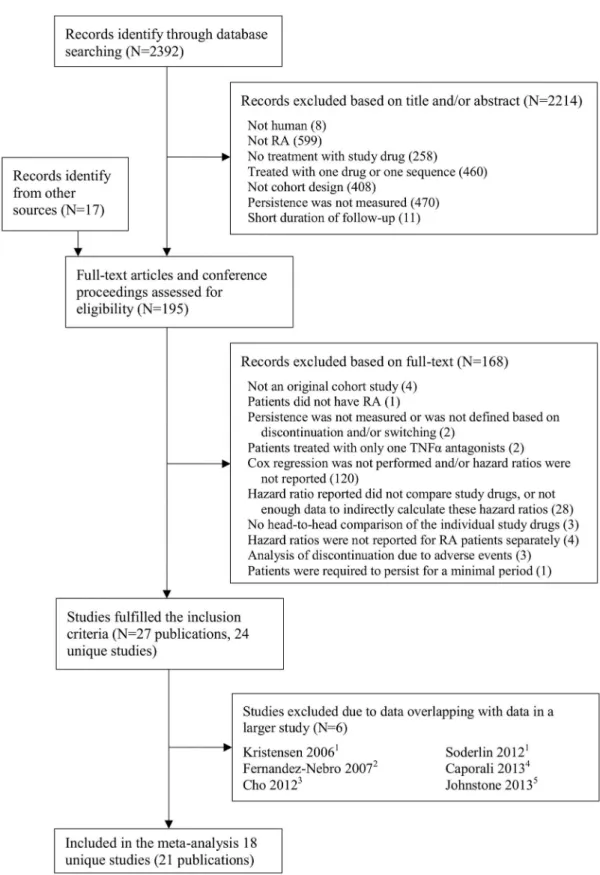
Results
A total of 2,409 unique citations were identified and screened (
Fig 1
), and 24 unique studies
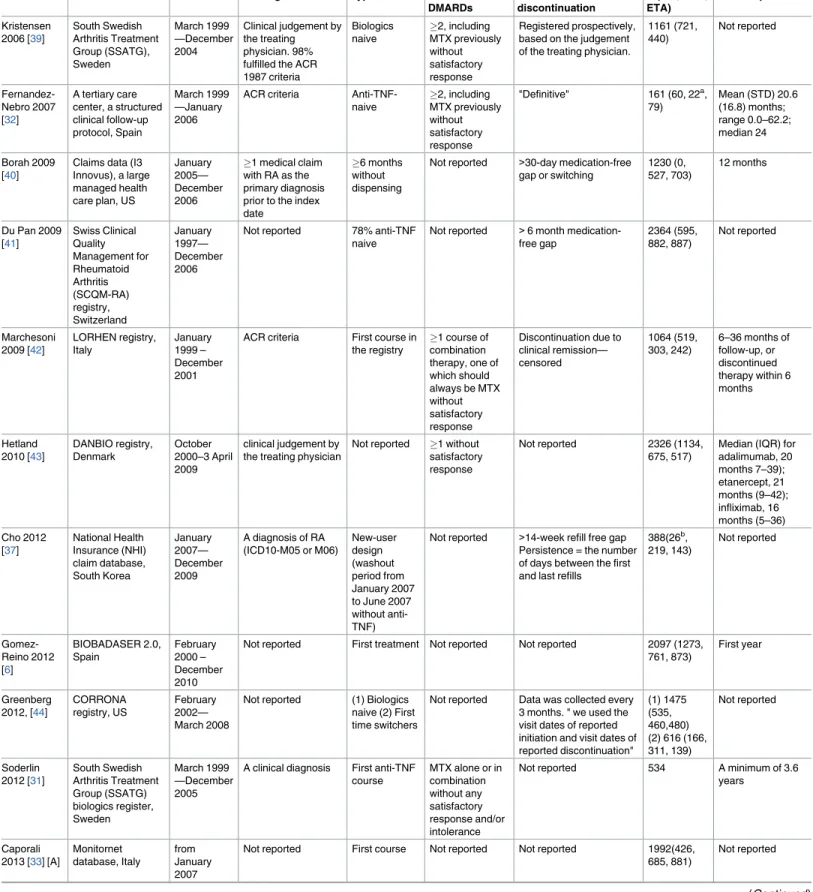
were eligible for inclusion (
Table 1
). Forty studies reported hazard ratios for discontinuing
TNF antagonists but were excluded, most commonly because the study drugs were not
com-pared (
S1 Table
in the on-line supporting information). Two of the studies were excluded due
to high risk of bias [
28
,
29
]. Three studies reported outcomes from the SSTAG/ARTIS Swedish
registry [
5
,
30
,
31
], two studies from the Spanish BIOBADASER 2.0 registry or hospitals
con-tributing to it [
6
,
32
], two studies from the Italian Monitornet registry [
33
,
34
], two studies from
the American claim database MarketScan [
35
,
36
], and three studies from the national
insur-ance claim data or hospitals in South Korea [
37
,
38
] (
Table 1
).
Fifteen studies (20,796 patients) from unique data sources compared infliximab and
adali-mumab with the overall pooled hazard ratio of 1.08 (95% C] 0.92–1.27) (
S1 Fig
). Fifteen
stud-ies (23,671 patients) from unique data sources compared infliximab and etanercept with the
overall pooled hazard ratio of 1.22 (1.00–1.49) (
S2 Fig
). Seventeen studies (27,799 patients)
from different data sources showed higher risk of discontinuing adalimumab compared with
etanercept and the overall pooled hazard ratio was 1.17 (1.08–1.27) (
S3 Fig
). There was
signifi-cant heterogeneity between studies for all three comparisons, with I square statistics of 86%,
92%, and 56%, respectively.
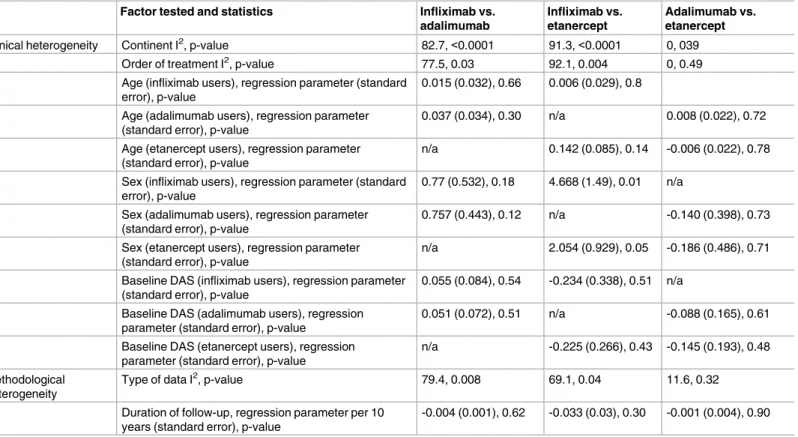
Assessment of methodological and clinical heterogeneity is presented in
Table 2
. In analysis
of categorical factors, effect modifications of the type of data (
Fig 2
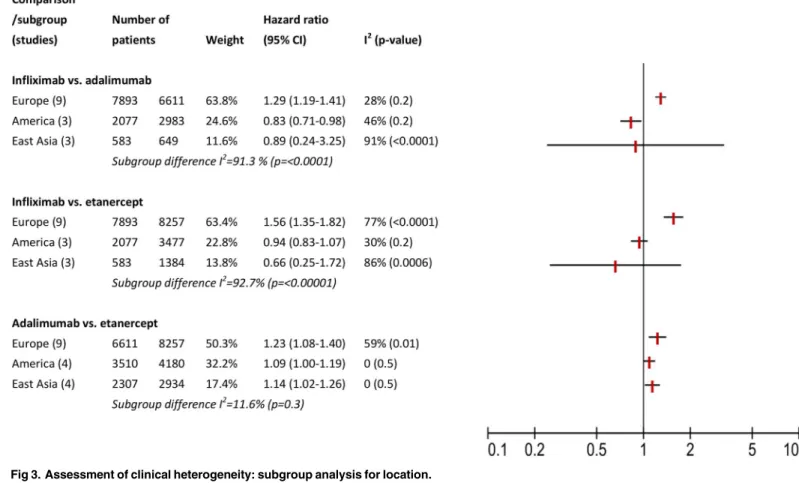
), location (
Fig 3
), and
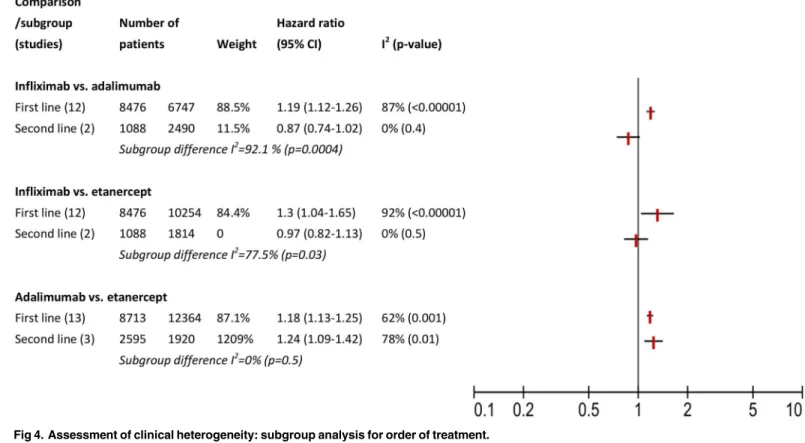
order of treatment (
Fig 4
) was observed in comparisons of infliximab with adalimumab or
etanercept, but not comparing adalimumab with etanercept. This effect modification was
expressed as I squared statistics of 69.1–92.7%, with p-value
<
0.05 in Chi squared test. These
percentages could be interested as following: 69.1–92.7% of variation across subgroups in each
comparison is due to heterogeneity rather than chance. We also noticed that in all
compari-sons, not all subgroup hazard ratios reach statistical significance level and in most cases a
resid-ual within subgroup heterogeneity was observed. For example, in analysis of type of data (
Fig
2
), when comparing infliximab with etanercept, we observed significant heterogeneity between
the three subgroups compared: studies based on clinical charts, those conducted on registries
and analyses of claim data (I square statistics of 69.1%). Only studies conducted on registries
had a significant pooled hazard ratio of 1.49 (95% CI 1.23–1.81), but they also consisted the
largest subgroup. A reversed direction of hazard ratio was estimated in two studies based on
clinical charts and three analyses of claim data, i.e., lower risk of discontinuing infliximab,
but these polled estimates did not reach significance level. We noticed residual heterogeneity
within each subgroup: clinical chart, registries, and claim data.
In analysis of continuous factors (
Table 2
), the proportion of female patients using
inflixi-mab modified the hazard ratio in comparison of inflixiinflixi-mab with etanercept. However, in the
presence of multiple comparisons and in the absence of similar effect of the proportion of
female patients using etanercept we discarded this finding. Finally, duration of follow up, age,
and baseline DAS-28 did not modify the hazard ratios (
Table 2
).
Discussion
Fig 1. QUOROM flow chart.1SSATG is part of ARTIS, data were overlapping with Neovius 2015.2Carlos Haya hospital is included in BIOBADASER 2.0, data were overlapping with Gomez-Reino 2012.3Data from South Korea
NIH, also known as Health Insurance Review and Assessment Service, were included in Lee 2014.4Data from
MonitorNet were included in Scire 2013.5Data from MarketScan were included in Johnstone 2015.
Table 1. Characteristics of eligible studies.
Reference Data source Period RA diagnosis Type of users Previous DMARDs
Persistence/ discontinuation
N (INF, ADA, ETA)
Follow up
Kristensen
2006 [39]
South Swedish Arthritis Treatment Group (SSATG), Sweden March 1999 —December 2004
Clinical judgement by the treating physician. 98% fulfilled the ACR 1987 criteria Biologics naive 2, including MTX previously without satisfactory response Registered prospectively, based on the judgement of the treating physician.
1161 (721, 440)
Not reported
Fernandez-Nebro 2007 [32]
A tertiary care center, a structured clinical follow-up protocol, Spain
March 1999 —January 2006
ACR criteria
Anti-TNF-naive 2, including MTX previously without satisfactory response
"Definitive" 161 (60, 22a,
79)
Mean (STD) 20.6 (16.8) months; range 0.0–62.2; median 24
Borah 2009 [40]
Claims data (I3 Innovus), a large managed health care plan, US
January 2005— December 2006
1 medical claim
with RA as the primary diagnosis prior to the index date
6 months
without dispensing
Not reported >30-day medication-free
gap or switching
1230 (0, 527, 703)
12 months
Du Pan 2009 [41]
Swiss Clinical Quality Management for Rheumatoid Arthritis (SCQM-RA) registry, Switzerland January 1997— December 2006
Not reported 78% anti-TNF
naive
Not reported >6 month
medication-free gap
2364 (595, 882, 887)
Not reported
Marchesoni
2009 [42]
LORHEN registry, Italy January 1999 – December 2001
ACR criteria First course in
the registry
1 course of
combination therapy, one of which should always be MTX without satisfactory response
Discontinuation due to clinical remission— censored
1064 (519, 303, 242)
6–36 months of follow-up, or discontinued therapy within 6 months
Hetland
2010 [43]
DANBIO registry, Denmark
October 2000–3 April 2009
clinical judgement by the treating physician
Not reported 1 without
satisfactory response
Not reported 2326 (1134,
675, 517)
Median (IQR) for adalimumab, 20 months 7–39); etanercept, 21 months (9–42); infliximab, 16 months (5–36) Cho 2012
[37]
National Health Insurance (NHI) claim database, South Korea January 2007— December 2009
A diagnosis of RA (ICD10-M05 or M06)
New-user design (washout period from January 2007 to June 2007 without anti-TNF)
Not reported >14-week refill free gap
Persistence = the number of days between the first and last refills
388(26b,
219, 143)
Not reported
Gomez-Reino 2012 [6]
BIOBADASER 2.0, Spain February 2000 – December 2010
Not reported First treatment Not reported Not reported 2097 (1273,
761, 873)
First year
Greenberg
2012, [44]
CORRONA registry, US
February 2002— March 2008
Not reported (1) Biologics
naive (2) First time switchers
Not reported Data was collected every
3 months. " we used the visit dates of reported initiation and visit dates of reported discontinuation"
(1) 1475 (535, 460,480) (2) 616 (166, 311, 139)
Not reported
Soderlin
2012 [31]
South Swedish Arthritis Treatment Group (SSATG) biologics register, Sweden March 1999 —December 2005
A clinical diagnosis First anti-TNF
course
MTX alone or in combination without any satisfactory response and/or intolerance
Not reported 534 A minimum of 3.6
years
Caporali
2013 [33] [A]
Monitornet database, Italy
from January 2007
Not reported First course Not reported Not reported 1992(426,
685, 881)
Not reported
Table 1. (Continued)
Reference Data source Period RA diagnosis Type of users Previous DMARDs
Persistence/ discontinuation
N (INF, ADA, ETA)
Follow up
Chen 2013
[45] [A]
National Health Insurance (NHI), Taiwan
Not reported Not reported Anti-TNF
naïve
Not reported >84-day refill free gap 4592 (0,
1982,2609)
First year
Hishitani
2013 [46]
Osaka BiRD registry, Japan
September 1999—April 2012
ACR criteria Biologics
naivec
1 Discontinuation due to
remission or miscellaneous reasons and missing data were treated as censored cases
401d(103,
58, 143)
Not reported
Johnston
2013 [35] [A]
Truven Health MarketScan databases, US January 2010—June 2011
Not reported Used at least
one biologic prior to index
Not reported A 90-day medication-free
gap or switching to another biologic
7515e(672,
1504, 1114)
Not reported
Scire 2013 [34]
Monitornet database, Italy
January 2007—April 2012
Not reported
Anti-TNF-naive
Failure Medication
interruption3 months.
Persistence = the number of days between the first and last day of treatment
2640 (718, 887, 1035)
Not reported
Senabre-Gallego
2013 [47,48]
[A]
"our local cohort" Asociacio´n para la Investigacio´n en Reumatologı´a de la Marina Baixa (AIRE-MB), Spain January 2001— November 2011
Not reported Not reported Not reported Not reported 318 (97,
116, 105)
Not reported
Fisher 2014 [49]
BC Ministry of Health databases, Canada
March 2001 —December 2009
2 outpatient at least
60 days apart or1
inpatient diagnosis of RA (ICD-9 714.XX) the three years prior to TNF-b initiation
Biologics naive
Not reported 180 days
medication-free gap or switching to another ‘biologic’
2286 (620, 344, 1322)
Not reported
Flouri 2014 [50]
Hellenic Registry of Biologic Therapies, Greece
January 2004—April 2011
according to the treating physician
79% anti-TNF
naïve
1 "registered prospectively" 1028
patients, 1297 courses (560, 435, 302)
The median (IQR) 3.0(1.2–6.2) years for infliximab, 2.9 (1.1–5.9) years for adalimumab, and 2.9(1.1–5.0) years for etanercept.
Frazier-Mironer 2014 [51,52]
Medical charts, eight rheumatology centers, France
March 2005 —April 2011
1987 ACR criteria (1) Biologics
naïve (2)
second anti-TNF medication
Not reported The first definitive
treatment interruption or last observation on treatment after initiation (exact time collected via the patient chart): indicated by the treating rheumatologist, or no consecutive re-introduction of treatment
(1) 706 (99, 203, 404) (2)
231 (20f,
105, 106)
2–6 years
Kang 2014 [53,54]
Medical charts, Chonnam National University Hospital, Gwangju, South Korea December 2002— November 2011
ACR criteria Anti-TNF
naive
Not reported Not reported 144 (22, 48,
39)
At least one year
Lee 2014
[38] [A]
Health Insurance Review and Assessment Service, South Korea 2006— December 2010
2 prescriptions of
DMARD under the diagnosis of RA
New-user design (washout period without DMARDs during 2006)
Not reported Medication-free gap
of>half of the days
supply of the previous prescription, or switching to other TNF inhibitors
2203 (458, 1202, 543)
Not reported
Neovius
2015, [5]
Swedish Biologics Register (ARTIS), Sweden January 2003— December 2011
Assessment of the treating rheumatologists
Anti-TNF-naive
Not reported As reported by the
treating rheumatologist, due to any cause, except for pregnancy and remission. discontinuation
2898 Up to 5 years
Table 1. (Continued)
Reference Data source Period RA diagnosis Type of users Previous DMARDs
Persistence/ discontinuation
N (INF, ADA, ETA)
Follow up
Johnston
2015 [55]
Truven Health MarketScan database, US
January 2010 – December 2011
ICD-9-CM codes recorded on medical claims between January 2009 and March 2012
Previously
used1 other
biologic
Not reported 90 days Medication-free
gap or switching to another biologic
9782g(922,
2179, 16750
Not reported
aPatients treated with adalimumab were excluded due to the reduced sample size.
bPatients treated with infliximab were excluded from analysis, since this medication was not available throughout the analysis period cPatients who started therapy before entering the registry were included.
dIncluding 97 patients treated with tocilizumab.
eIncluding patients treated with abatacept (1297), certolizumab (681), golimumab (951), and rituximab (622). fPatients treated with infliximab were excluded from analysis of second anti-TNF due to small numbers. gIncluding patients treated with abatacept (1759), certolizumab (962), golimumab (1195), and tocilizumab (1090)
[A] Abstract, ACR American Collage of Rheumatology, DMARDs Disease Modifying Anti-Rheumatic Drugs, ICD-9 the International Classification of Diseases Ninth Revision, ICD-9-CM the International Classification of Diseases Ninth Revision Clinical Modification, ICD10 the International Classification of Diseases Tenth Revision, IQR Interquartile Range, MTX Methotrexate, STD Standard Deviation, TNF Tumor Necrosis Factor alpha, US United Stated of America
doi:10.1371/journal.pone.0168005.t001
Table 2. Assessment of heterogeneity: association between study design and patient characteristics and effect sizes.
Factor tested and statistics Infliximab vs. adalimumab
Infliximab vs. etanercept
Adalimumab vs. etanercept
Clinical heterogeneity Continent I2, p-value 82.7,<0.0001 91.3,<0.0001 0, 039
Order of treatment I2, p-value 77.5, 0.03 92.1, 0.004 0, 0.49
Age (infliximab users), regression parameter (standard error), p-value
0.015 (0.032), 0.66 0.006 (0.029), 0.8
Age (adalimumab users), regression parameter (standard error), p-value
0.037 (0.034), 0.30 n/a 0.008 (0.022), 0.72
Age (etanercept users), regression parameter (standard error), p-value
n/a 0.142 (0.085), 0.14 -0.006 (0.022), 0.78
Sex (infliximab users), regression parameter (standard error), p-value
0.77 (0.532), 0.18 4.668 (1.49), 0.01 n/a
Sex (adalimumab users), regression parameter (standard error), p-value
0.757 (0.443), 0.12 n/a -0.140 (0.398), 0.73
Sex (etanercept users), regression parameter (standard error), p-value
n/a 2.054 (0.929), 0.05 -0.186 (0.486), 0.71
Baseline DAS (infliximab users), regression parameter (standard error), p-value
0.055 (0.084), 0.54 -0.234 (0.338), 0.51 n/a
Baseline DAS (adalimumab users), regression parameter (standard error), p-value
0.051 (0.072), 0.51 n/a -0.088 (0.165), 0.61
Baseline DAS (etanercept users), regression parameter (standard error), p-value
n/a -0.225 (0.266), 0.43 -0.145 (0.193), 0.48
Methodological heterogeneity
Type of data I2, p-value 79.4, 0.008 69.1, 0.04 11.6, 0.32
Duration of follow-up, regression parameter per 10 years (standard error), p-value
-0.004 (0.001), 0.62 -0.033 (0.03), 0.30 -0.001 (0.004), 0.90
P-value<0.05 represents a significant effect of the factor tested on the hazard ratio in the individual comparison (between-subgroup I-square statistics [26] and p-value of chi-squared test for categorical factors, and meta-regression [27] with a fixed effect model and weights based on the inverse of the variance of the logarithm of the hazard ratio for continuous factors).
DAS- disease activity score; n/a–not applicable
or claims) modified the effect size in comparisons of infliximab with etanercept or
adalimu-mab. However, this factor was not responsible for all the heterogeneity. Different types of data
are susceptible to different types of biases. Registries are susceptible to selection bias caused by
the volunteer enrollment and data collection [
56
]. Administrative data are susceptible to
con-founding due to the absence of clinical variables and exposure ascertainment bias because of
the uncertainty whether patients who refilled the medication actually used it. Type of data also
determines how the outcome, discontinuation, is defined. In analysis of registries or medical
charts, discontinuation is recorded by physicians, either during a routine visit or in real-time.
In analysis of administrative data, discontinuation is usually ascertained using
prescription-refill analysis and applying grace periods [
57
]. Comparisons of discontinuing TNF antagonists
are especially sensitive to these differences in outcome definition because of the intermittent
dosing schedules and different lengths of dose interval for different medications. Comparisons
of infliximab were more sensitive to the data source probably because it has a significantly
lon-ger dose interval than adalimumab and etanercept.
A second hazard modifier is location. In European countries, the risk of discontinuing
eta-nercept and adalimumab is lower compared to infliximab, but in America, patients on
inflixi-mab had lower discontinuation risk compared to adalimuinflixi-mab and similar risk as patients
treated with etanercept. In a previous review reported similar proportions of patients from
European and non-European countries who discontinued any TNF antagonists [
15
], but the
results were not presented separately for each individual medication. Souto et al [
15
] failed to
determine whether these findings are constant across different medications.
Fig 2. Assessment of methodological heterogeneity: subgroup analysis for type of data.
Hazard ratio estimates were also modified by the order of treatment (first or second line) in
comparisons of infliximab with adalimumab or etanercept. However, in these comparisons the
only two studies that reported hazard ratios for second line treatment were American studies
Therefore, we cannot rule out that the modification observed is related to location and not to
order of treatment.
Age, sex, baseline disease activity score (DAS), and duration of follow-up did not modify
the hazard ratios. The absence of modification by baseline DAS opposes the hypothesis by
Greenberg 2014 [
58
] that the difference in estimates between American and European studies
is caused by differences in disease severity.
The results of this review question the reliability of hazard ratios for discontinuing TNF
antagonists. Specifically, the residual heterogeneity within subgroups may indicate that stable
results cannot be duplicated by different researchers nor can conclusive scientific findings be
obtained. Alternately, researchers may not be measuring the same outcome because different
types of data, and possibly different definitions of discontinuation, modified the hazard ratios.
Standardization of methodological approaches may help achieving the requisite reliability.
There are several limitations to our study. First, we were unable to adequately assess risk of
bias in the absence of a specific evaluation tool for discontinuation studies. Available tools for
observational studies, such as Newcastle-Ottawa scale [
59
], do not assess relevant items such as
new-user design and ascertainment of discontinuation. The other tools, e.g., STROBE
state-ment [
60
], assess the quality of reporting and not the risk of bias. Second, in the absence of a
statistical test to determine causes of heterogeneity between studies, we could only assess effect
Fig 3. Assessment of clinical heterogeneity: subgroup analysis for location.modification. Last, we found significant residual heterogeneity within many of the subgroups
and therefore pooled estimates were impossible to interpret.
This review had several strengths including the wide scope: no temporal or linguistic
con-straints. Second, to minimize bias, this review included only studies reporting adjusted
hazard ratios for discontinuation. Earlier systematic reviews summarized proportions of
discontinuation for each TNF antagonist individually [
14
,
15
]. Because these proportions
were crude estimates from observational data, comparisons between medications were most
likely confounded. Last, we identified two major risks of bias in discontinuation studies and
applied them in study selection.
Conclusions
Substantial heterogeneity was found in studies estimating head-to-head hazard ratios for
dis-continuing TNF antagonists in RA patients due to differences in type of data, location, and
order of treatment. The heterogeneity observed shows that stable results have not been
dupli-cated by different researchers and conclusive scientific findings cannot be obtained by pooling
results.
Supporting Information
S1 Fig. Forest Plots: Hazard Ratios of included studies: Infliximab vs. Adalimumab.
(TIFF)
S2 Fig. Forest Plots: Hazard Ratios of included studies: Infliximab vs. Etanercept.
(TIFF)
Fig 4. Assessment of clinical heterogeneity: subgroup analysis for order of treatment.
S3 Fig. Forest Plots: Hazard Ratios of included studies: Adalimumab vs. Etanercept.
(TIFF)
S1 Table. Excluded studies.
(PDF)
S2 Table. PRISMA 2009 checklist.
(PDF)
Acknowledgments
The authors have no conflicts of interest to declare. The study was supported by the University
of British Columbia Graduate Fellowship grant.
Author Contributions
Conceptualization: AF KB JMW CRD.
Data curation: AF GG DS.
Formal analysis: AF KB JMW CRD.
Investigation: AF KB JMW CRD.
Methodology: AF KB JMW CRD MAB.
Project administration: AF JMW CRD.
Software: AF.
Supervision: AF KB JMW MAB HRF CRD.
Validation: AF KB JMW MAB HRF CRD.
Visualization: AF KB JMW MAB HRF CRD.
Writing – original draft: AF GG DS KB JMW MAB HRF CRD.
Writing – review & editing: AF GG DS KB JMW MAB HRF CRD.
References
1. Brennan FM, McInnes IB. Evidence that cytokines play a role in rheumatoid arthritis. J Clin Invest 2008 Nov; 118(11):3537–3545. doi:10.1172/JCI36389PMID:18982160
2. Favalli EG, Bugatti S, Biggioggero M, Caporali R. Treatment comparison in rheumatoid arthritis: Head-to-head trials and innovative study designs. BioMed Research International 2014 2014;2014. 3. Fafa BP, Louzada-Junior P, Titton DC, Zandonade E, Ranza R, Laurindo I, et al. Drug survival and
causes of discontinuation of the first anti-TNF in ankylosing spondylitis compared with rheumatoid arthritis: analysis from BIOBADABRASIL. Clin Rheumatol 2015 May; 34(5):921–927. doi:10.1007/ s10067-015-2929-7PMID:25851594
4. Bolge SC, Goren A, Tandon N. Reasons for discontinuation of subcutaneous biologic therapy in the treatment of rheumatoid arthritis: a patient perspective. Patient Prefer Adherence 2015; 9:121–131. doi: 10.2147/PPA.S70834PMID:25653505
5. Neovius M, Arkema EV, Olsson H, Eriksson JK, Kristensen LE, Simard JF, et al. Drug survival on TNF inhibitors in patients with rheumatoid arthritis comparison of adalimumab, etanercept and infliximab. Ann Rheum Dis 2015 01 Feb 2015; 74(2):354–360. doi:10.1136/annrheumdis-2013-204128PMID: 24285495
10 years: Data from the Spanish registry BIOBADASER 2.0. Ann Rheum Dis 2012 March 2012; 71 (3):382–385. doi:10.1136/annrheumdis-2011-200302PMID:21998116
7. Markenson JA, Gibofsky A, Palmer WR, Keystone EC, Schiff MH, Feng J, et al. Persistence with anti-tumor necrosis factor therapies in patients with rheumatoid arthritis: Observations from the RADIUS registry. J Rheumatol 2011 July 2011; 38(7):1273–1281. doi:10.3899/jrheum.101142PMID: 21572150
8. Hyrich KL, Watson KD, Lunt M, Symmons DPM. Changes in disease characteristics and response rates among patients in the United Kingdom starting anti-tumour necrosis factor therapy for rheumatoid arthritis between 2001 and 2008. Rheumatology 2011 January 2011; 50(1):117–123. PMID:20671021 9. Hetland ML, Christensen IJ, Tarp U, Dreyer L, Hansen A, Hansen IT, et al. Direct comparison of
treat-ment responses, remission rates, and drug adherence in patients with rheumatoid arthritis treated with adalimumab, etanercept, or infliximab: Results from eight years of surveillance of clinical practice in the nationwide Danish DANBIO registry. Arthritis Rheum 2010 January 2010; 62(1):22–32. doi:10.1002/ art.27227PMID:20039405
10. Wolfe F. The epidemiology of drug treatment failure in rheumatoid arthritis. Baillieres Clin Rheumatol 1995 Nov; 9(4):619–632. PMID:8591645
11. Koncz T, Pentek M, Brodszky V, Ersek K, Orlewska E, Gulacsi L. Adherence to biologic DMARD thera-pies in rheumatoid arthritis. Expert Opin Biol Ther 2010 Sep; 10(9):1367–1378. doi:10.1517/14712598. 2010.510508PMID:20681888
12. Blum MA, Koo D, Doshi JA. Measurement and rates of persistence with and adherence to biologics for rheumatoid arthritis: A systematic review. Clin Ther 2011 Jul; 33(7):901–913. doi:10.1016/j.clinthera. 2011.06.001PMID:21715007
13. Navarro-Millan I, Sattui SE, Curtis JR. Systematic review of tumor necrosis factor inhibitor discontinua-tion studies in rheumatoid arthritis. Clin Ther 2013 November 2013; 35(11):1850–1861.e1. doi:10. 1016/j.clinthera.2013.09.015PMID:24156821
14. Arora A, Mahajan A, Spurden D, Boyd H, Porter D. Long-term drug survival of TNF inhibitor therapy in RA patients: A systematic review of European national drug registers. International Journal of Rheuma-tology 2013 2013; 2013:764518. doi:10.1155/2013/764518PMID:24307903
15. Souto A, Maneiro JR, Gomez-Reino JJ. Rate of discontinuation and drug survival of biologic therapies in rheumatoid arthritis: a systematic review and meta-analysis of drug registries and health care data-bases. Rheumatology (Oxford) 2016; 55(3):523–34.
16. Deeks JJ, Higgins JPT, Altman D.J. on behalf of the Cochrane Statistical Methods Group. Section 9.5: Heterogeneity. In: Higgins JPT, Green S, editors. Cochrane Handbook for Systematic Reviews of Inter-ventions. 5.1.0 ed.: The Cochrane Collaboration; 2011.
17. Kievit W, Fransen J, Oerlemans AJ, Kuper HH, van der Laar MA, de Rooij DJ, et al. The efficacy of anti-TNF in rheumatoid arthritis, a comparison between randomised controlled trials and clinical practice. Ann Rheum Dis 2007 Nov; 66(11):1473–1478. doi:10.1136/ard.2007.072447PMID:17426065 18. Sokka T, Pincus T. Eligibility of patients in routine care for major clinical trials of anti-tumor necrosis
fac-tor alpha agents in rheumatoid arthritis. Arthritis Rheum 2003 Feb; 48(2):313–318. doi:10.1002/art. 10817PMID:12571838
19. Zink A, Strangfeld A, Schneider M, Herzer P, Hierse F, Stoyanova-Scholz M, et al. Effectiveness of tumor necrosis factor inhibitors in rheumatoid arthritis in an observational cohort study: Comparison of patients according to their eligibility for major randomized clinical trials. Arthritis Rheum 2006 Nov; 54 (11):3399–3407. doi:10.1002/art.22193PMID:17075823
20. Berthelot JM, Benoist-Gerard S, le Goff B, Muller-Chevalet F, Maugars Y. Outcome and safety of TNFalpha antagonist therapy in 475 consecutive outpatients (with rheumatoid arthritis or spondyloar-thropathies) treated by a single physician according to their eligibility for clinical trials. Joint Bone Spine 2010 Dec; 77(6):564–569. doi:10.1016/j.jbspin.2010.05.011PMID:20621538
21. Arnett FC, Edworthy SM, Bloch DA, McShane DJ, Fries JF, Cooper NS, et al. The American Rheuma-tism Association 1987 revised criteria for the classification of rheumatoid arthritis. Arthritis Rheum 1988 Mar; 31(3):315–324. PMID:3358796
22. Aletaha D, Neogi T, Silman AJ, Funovits J, Felson DT, Bingham CO 3rd, et al. 2010 Rheumatoid arthri-tis classification criteria: An American College of Rheumatology/European League Against Rheumaarthri-tism collaborative initiative. Arthritis Rheum 2010 Sep; 62(9):2569–2581. doi:10.1002/art.27584PMID: 20872595
23. Glenny AM, Altman DG, Song F, Sakarovitch C, Deeks JJ, D’Amico R, et al. Indirect comparisons of competing interventions. Health Technol Assess 2005 Jul; 9(26):1–134, iii–iv. PMID:16014203 24. Parmar MKB, Torri V, Stewart L. Extracting summary statistics to perform meta-analyses of the
25. DerSimonian R, Laird N. Meta-analysis in clinical trials. Control Clin Trials 1986 Sep; 7(3):177–188. PMID:3802833
26. Higgins JP, Thompson SG. Quantifying heterogeneity in a meta-analysis. Stat Med 2002 Jun; 21 (11):1539–1558. doi:10.1002/sim.1186PMID:12111919
27. Thompson SG, Higgins JPT. How should meta-regression analyses be undertaken and interpreted?. Stat Med 2002 Jun; 21(11):1559–1573. doi:10.1002/sim.1187PMID:12111920
28. Zhang J, Xie F, Delzell E, Yun H, Lewis JD, Haynes K, et al. Impact of biologic agents with and without concomitant methotrexate and at reduced doses in older rheumatoid arthritis patients. Arthritis Care Res (Hoboken) 2015 May; 67(5):624–632.
29. Martinez-Santana V, Gonzalez-Sarmiento E, Calleja-Hernandez M, Sanchez-Sanchez T. Comparison of drug survival rates for tumor necrosis factor antagonists in rheumatoid arthritis. Patient Preference and Adherence 2013 January 2013; 7:719–727. doi:10.2147/PPA.S47453PMID:24023512 30. Kristensen LE, Saxne T, Geborek P. The LUNDEX, a new index of drug efficacy in clinical practice:
Results of a five-year observational study of treatment with infliximab and etanercept among rheuma-toid arthritis patients in Southern Sweden. Arthritis Rheum 2006 February 2006; 54(2):600–606. doi: 10.1002/art.21570PMID:16447237
31. Soderlin MK, Petersson IF, Geborek P. The effect of smoking on response and drug survival in rheuma-toid arthritis patients treated with their first anti-TNF drug. Scand J Rheumatol 2012 Feb; 41(1):1–9. doi: 10.3109/03009742.2011.599073PMID:22118371
32. Fernandez-Nebro A, Irigoyen MV, Urena I, Belmonte-Lopez MA, Coret V, Jimenez-Nunez FG, et al. Effectiveness, predictive response factors, and safety of anti-tumor necrosis factor (TNF) therapies in anti-TNF-naive rheumatoid arthritis. J Rheumatol 2007 Dec; 34(12):2334–2342. PMID:17985409 33. Caporali R, Scire CA, Todoerti M, Galeazzi M, Valesini G, Sfriso P, et al. Drug survival of the first course
of anti-TNF agents in patients with rheumatoid arthritis and spondyloarthropathies. Results from the MonitorNet database. Annals of the Rheumatic Disease 2013 June 2013; 71.
34. Scire CA, Caporali R, Sarzi-Puttini P, Frediani B, Di Franco M, Tincani A, et al. Drug survival of the first course of anti-TNF agents in patients with rheumatoid arthritis and seronegative spondyloarthritis: Anal-ysis from the MonitorNet databas. Clin Exp Rheumatol 2013 Nov/Dec 2013; 31(6):857–863. PMID: 23981363
35. Johnston S, McMorrow D, Farr AM, Juneau P, Ogale S. Real world study of biologic disease modifying antirheumatic drug persistence among patients with rheumatoid arthritis who have previously used at least one other biologic agent: A U.S. administrative claims database analysis. Ann Rheum Dis 2013 June 2013; 72.
36. Johnston S, Lobo F, McMorrow D, Fowler R, Smith D, Nadkarni A. Comparison of patient characteris-tics, healthcare costs, and biologic persistence between patients with rheumatoid arthritis initiating first or second-line subcutaneous abatacept, adalimumab, or etanercept. Arthritis and Rheumatology 2014 October 2014; 66:S40.
37. Cho SK, Sung YK, Choi CB, Bae SC. Impact of comorbidities on TNF inhibitor persistence in rheuma-toid arthritis patients: an analysis of Korean National Health Insurance claims data. Rheumatol Int 2012 Dec; 32(12):3851–3856. doi:10.1007/s00296-011-2312-1PMID:22193228
38. Lee J, Choi N-, Yang BR, Jin X-, Park B-. Utilization pattern of tumor necrosis factor alpha inhibitors among patients with rheumatologic arthritis in Korea. Pharmacoepidemiol Drug Saf 2014 October 2014; 23:471.
39. Kristensen LE, Saxne T, Nilsson JA, Geborek P. Impact of concomitant DMARD therapy on adherence to treatment with etanercept and infliximab in rheumatoid arthritis. Results from a six-year observational study in southern Sweden. Arthritis Res Ther 2006 Nov; 8(6):R174. doi:10.1186/ar2084PMID: 17121678
40. Borah BJ, Huang X, Zarotsky V, Globe D. Trends in RA patients’ adherence to subcutaneous anti-TNF therapies and costs. Curr Med Res Opin 2009 Jun; 25(6):1365–1377. doi:10.1185/
03007990902896386PMID:19425902
41. Du Pan SM, Dehler S, Ciurea A, Ziswiler HR, Gabay C, Finckh A, et al. Comparison of drug retention rates and causes of drug discontinuation between anti-tumor necrosis factor agents in rheumatoid arthritis. Arthritis Rheum 2009 May; 61(5):560–568. doi:10.1002/art.24463PMID:19405000
42. Marchesoni A, Zaccara E, Gorla R, Bazzani C, Sarzi-Puttini P, Atzeni F, et al. TNF-alpha antagonist sur-vival rate in a cohort of rheumatoid arthritis patients observed under conditions of standard clinical prac-tice. Ann N Y Acad Sci 2009 Sep; 1173(1):837–846.
nationwide Danish DANBIO registry. Arthritis Rheum 2010 Jan; 62(1):22–32. doi:10.1002/art.27227 PMID:20039405
44. Greenberg JD, Reed G, Decktor D, Harrold L, Furst D, Gibofsky A, et al. A comparative effectiveness study of adalimumab, etanercept and infliximab in biologically naive and switched rheumatoid arthritis patients: Results from the US CORRONA registry. Ann Rheum Dis 2012 July 2012; 71(7):1134–1142. doi:10.1136/annrheumdis-2011-150573PMID:22294625
45. Chen H, Chen D, Tang C, Yang Y, Fang C, Huang N. Concomitant methotrexate use and the risk of drug discontinuation for adalimumab compared with etanercept in anti-TNF-naive rheumatoid arthritis patients: A nationwide population-based cohort Study. Arthritis Rheum 2013 October 2013; 65:S452. 46. Hishitani Y, Ogata A, Shima Y, Hirano T, Ebina K, Kunugiza Y, et al. Retention of tocilizumab and
anti-tumour necrosis factor drugs in the treatment of rheumatoid arthritis. Scand J Rheumatol 2013 2013; 42 (4):253–259. doi:10.3109/03009742.2012.762037PMID:23470089
47. Senabre-Gallego JM, Rosas J, Santos-Soler G, Santos-Ramirez C, Sanchez-Barrioluengo M, Barber X, et al. Comparison of drug retention rates between anti-tumor necrosis factor agents in rheumatoid arthritis and ankylosing spondylitis in daily clinical practice. Annals of the Rheumatic Disease 2013 June 2013; 71.
48. Senabre Gallego JM, Rosas JC, Cano Pe´rez C, Barber Valle´s X, Salas Heredia E, Llahı´ Vidal N, et al. Retencio´n de los Inhibidores del Factor de Necrosis Tumoral en Artritis Reumatoide y Espondilitis Anquilosante en condiciones de pra´ctica clı´nica. Revista de la SVR: Sociedad Valenciana de Reumato-logı´a 2012; 4(3):5–10.
49. Fisher A, Bassett K, Wright JM, Brookhart MA, Freeman H, Dormuth CR. Comparative Persistence of the TNF Antagonists in Rheumatoid Arthritis—A Population-Based Cohort Study. PLoS One 2014 Aug 20; 9(8):e105193. doi:10.1371/journal.pone.0105193PMID:25141123
50. Flouri I, Markatseli TE, Voulgari PV, Boki KA, Papadopoulos I, Settas L, et al. Comparative effective-ness and survival of infliximab, adalimumab, and etanercept for rheumatoid arthritis patients in the Hel-lenic Registry of Biologics: Low rates of remission and 5-year drug survival. Semin Arthritis Rheum 2014 Feb; 43(4):447–457. doi:10.1016/j.semarthrit.2013.07.011PMID:24012040
51. Frazier-Mironer A, Dougados M, Mariette X, Cantagrel A, Deschamps V, Flipo RM, et al. Retention rates of adalimumab, etanercept and infliximab as first and second-line biotherapy in patients with rheu-matoid arthritis in daily practice. Joint Bone Spine 2014 Jul; 81(4):352–359. doi:10.1016/j.jbspin.2014. 02.014PMID:24721422
52. Frazier-Mironer A, Cantagrel A, Combe B, Deschamps V, Dougados M, Flipo R-, et al. Retention rates of adalimumab, etanercept and infliximab as first and second-line biologic therapy in patients with rheu-matoid arthritis in daily practice: The maintain study. Ann Rheum Dis 2013 June 2013; 72:A221–A222. 53. Kang JH, Park DJ, Lee JW, Lee KE, Wen L, Kim TJ, et al. Drug survival rates of tumor necrosis factor
inhibitors in patients with rheumatoid arthritis and ankylosing spondylitis. J Korean Med Sci 2014 Sep; 29(9):1205–1211. doi:10.3346/jkms.2014.29.9.1205PMID:25246737
54. Lee S, Lee K, Park D. Drug survival rates of anti-tumor necrosis factor therapies in patients with rheu-matoid arthritis. Ann Rheum Dis 2013 June 2013; 72:A875.
55. Johnston SS, McMorrow D, Farr AM, Juneau P, Ogale S. Comparison of biologic disease-modifying antirheumatic drug therapy persistence between biologics among rheumatoid arthritis patients switch-ing from another biologic. Rheumatol The 2015; 2(1):59–71.
56. Curtis JR, Jain A, Askling J, Bridges SL Jr, Carmona L, Dixon W, et al. A comparison of patient charac-teristics and outcomes in selected European and U.S. rheumatoid arthritis registries. Semin Arthritis Rheum 2010 Aug; 40(1):2–14.e1. doi:10.1016/j.semarthrit.2010.03.003PMID:20674669
57. Dezii CM. Persistence with drug therapy: A practical approach using administrative claims data. Manag Care 2001 Feb; 10(2):42–45. PMID:11236643
58. Greenberg JD, Shan Y, Reed GW, Bitman B, Collier D. Comparison of switching to reduced dose vs continuation of standard dose etanercept for rheumatoid arthritis patients in the CORRONA registry. Ann Rheum Dis 2014 June 2014; 73:241.
59. Wells GA, Shea B, O’Connell D, Peterson J, Welch W, Losos M, et al. The Newcastle-Ottawa Scale (NOS) for assessing the quality of nonrandomised studies in meta-analyses. 2013;http://www.ohri.ca/ programs/clinical_epidemiology/oxford.asp. Accessed 08/20/2013, 2013.
60. von Elm E, Altman DG, Egger M, Pocock SJ, Gotzsche PC, Vandenbroucke JP, et al. The strengthen-ing the reportstrengthen-ing of observational studies in epidemiology (STROBE) statement: Guidelines for report-ing observational studies. Epidemiology 2007 Nov; 18(6):800–804. doi:10.1097/EDE.