Community effectiveness of indoor spraying
as a dengue vector control method: A
systematic review
Moody Samuel1, Dorit Maoz2, Pablo Manrique3, Tara Ward4, Silvia Runge-Ranzinger5, Joao Toledo6, Ross Boyce7, Olaf Horstick1*
1 Institute of Public Health, University of Heidelberg, Heidelberg, Germany, 2 Public Health Consultant,
Muenchen, Germany, 3 Universidad Auto´noma de Yucata´n, Me´rida, Me´xico, 4 Public Health Consultant, Accra, Ghana, 5 Public Health Consultant, Ludwigsburg, Germany, 6 Ministry of Health, Brasilia, Brazil,
7 Division of Infectious Diseases, University of North Carolina at Chapel Hill, Chapel Hill, United States of
America
Abstract
Background
The prevention and control of dengue rely mainly on vector control methods, including indoor residual spraying (IRS) and indoor space spraying (ISS). This study aimed to system-atically review the available evidence on community effectiveness of indoor spraying.
Methods
A systematic review was conducted using seven databases (PubMed, EMBASE, LILACS, Web of Science, WHOLIS, Cochrane, and Google Scholar) and a manual search of the ref-erence lists of the identified studies. Data from included studies were extracted, analysed and reported.
Results
The review generated seven studies only, three IRS and four ISS (two/three controlled stud-ies respectively). Two IRS studstud-ies measuring human transmission showed a decline. One IRS and all four ISS studies measuring adult mosquitoes showed a very good effect, up to 100%, but not sustained. Two IRS studies and one ISS measuring immature mosquitoes, showed mixed results.
Conclusions
It is evident that IRS and also ISS are effective adulticidal interventions against Aedes mos-quitoes. However, evidence to suggest effectiveness of IRS as a larvicidal intervention and to reduce human dengue cases is limited–and even more so for ISS. Overall, there is a pau-city of studies available on these two interventions that may be promising for dengue vector control, particularly for IRS with its residual effect.
a1111111111 a1111111111 a1111111111 a1111111111 a1111111111
OPEN ACCESS
Citation: Samuel M, Maoz D, Manrique P, Ward T,
Runge-Ranzinger S, Toledo J, et al. (2017) Community effectiveness of indoor spraying as a dengue vector control method: A systematic review. PLoS Negl Trop Dis 11(8): e0005837.
https://doi.org/10.1371/journal.pntd.0005837
Editor: Christopher M. Barker, University of
California, Davis, UNITED STATES
Received: March 30, 2017
Accepted: July 27, 2017
Published: August 31, 2017
Copyright:©2017 Samuel et al. This is an open access article distributed under the terms of the
Creative Commons Attribution License, which permits unrestricted use, distribution, and reproduction in any medium, provided the original author and source are credited.
Data Availability Statement: All data is available
within the public domain; manuscripts analysed are listed in Table 1.
Funding: This work was supported by the
Author summary
The effectiveness of indoor residual spraying (IRS) and indoor space spraying (ISS) as dengue vector control methods depends on many factors. This study aims to systemati-cally review the evidence on the community effectiveness of indoor spraying of insecti-cides to reduceAedesmosquito populations and thereby to control dengue transmission. A systematic literature review was performed in PubMed, EMBASE, LILACS, Web of Sci-ence, WHO library database (WHOLIS), Cochrane, and Google Scholar, including a man-ual search of the reference lists of the identified studies since its inceptions until
15.02.2017. A total of 39 articles were retrieved for full assessment. Seven studies were included and analysed after final application of inclusion and exclusion criteria: two IRS studies with control, one without, three ISS studies and one, respectively. One IRS study and four ISS studies showed good evidence of effectiveness on adultAedesmosquitoes. Evidence of effectiveness of IRS as a larvicidal intervention exists but is still inadequate, and is weak for ISS. Evidence of effectiveness of IRS on human dengue cases as a single intervention exists, but was limited and not available for ISS. It is recommended to scale up the research regarding the community effectiveness of IRS and ISS, including measur-ing dengue transmission, particularly, for IRS with its residual effect. It is also suggested to study in depth the factors that could affect the community effectiveness of IRS and ISS on
Aedespopulations and on human dengue cases.
Introduction
Dengue is the most prevalent arthropod-borne viral disease, infecting 300 to 500 million indi-viduals each year. Approximately 100 million infections are symptomatic, which can range from mild to severe disease [1,2,3]. An estimated 500 000 people suffer from the severe forms, nearly 90% of whom are children, with a resulting 22 000 dengue-related deaths annually [4]. Global climate change, urbanisation, travel, poor sanitation, and inadequate public health ser-vices, all have the potential to increase the intensity of dengue transmission [5,6].
The four serotypes of the dengue virus (DENV 1–4) are transmitted principally by female
Aedes aegyptiand to a lesser extent byAedes albopictusmosquitos [7].Aedesspecies are
anthro-pophilic, feed in the dark, the early morning and twilight hours and show an indoor-resting behaviour preferentially in secluded stationary locations e.g. under furniture, lower walls, under sinks, in curtain folds, or in wardrobes [2,8,9]. Dzul-Manzanilla [10] determined that
Aedes aegyptirested mostly below 1.5 meters of height, and mostly in bedrooms (44%), living
rooms (25%) and bathrooms (20%).
At present, there is no effective vaccine available, for public health use, to prevent or treat dengue infections, efficacy of the existing vaccine is variable and not high [11,12]. Therefore, vector control is the primary method of dengue prevention and control. Since the turn of the 19th century, chemical insecticides applied to the environment in a variety of methods have served as one of the mainstays of dengue vector control programmes, basically outdoors against immature and indoors-outdoors against adult vectors.
Indoor application of insecticides (IAI) includes indoor space spraying (ISS) or indoor residual spraying (IRS). Both target the endophilic adultAedesmosquitoes that bite and rest indoors [10,13]. IRS entails the coating of walls and surfaces of the entire house with a residual insecticide [14]. ISS is done to treat indoor spaces to control flying insects with less residual effect. IRS can potentially targetAedes aegyptias it was used for the first time in Malaysia in 1952 [15]. IRS, however, is not generally recommended for dengue vector control, as it is
Competing interests: The authors have declared
thought that adultAedes aegyptioften rest on non-sprayable surfaces in houses [16]. Despite this, reductions inAedes aegyptipopulations have been observed in areas where IRS is utilised for malaria control. A recent meta-analysis [17] concluded that there is a need of more empiri-cal evidence supporting the potential utility of IRS for dengue prevention, since it was based on only two studies. For a meta-analysis comparability of studies precludes inclusion of many articles, thus providing a justification with an update and further inclusion and analysis of studies using IRS/ISS with a further systematic review.
This study systematically reviews the available evidence on community effectiveness of IRS and ISS for reducingAedespopulations and thereby for controlling dengue transmission.
Methodology
This review follows the guidelines set forth in the PRISMA criteria for the reporting of system-atic reviews and meta-analyses [18]. The literature search was conducted in parallel by two data extractors until 15.02.2017, with an update until 28.02.17.
A wide range of search terms was used in combinations to identify all relevant studies. The search terms included (a) disease specific terms: Dengue, Dengue hemorrhagic fever, Dengue haemorrhagic fever, Dengue shock syndrome, DHF, and DF, (b) vector specific terms:Aedes,
Aedes aegypti,Aedes albopictus,Ae.aeygpti, andAe.albopictus, and (c) intervention specific
terms: Indoor space spray, ISS, Indoor residual spray, IRS, Residual house spray, and Intra domiciliary residual spray.
For the purposes of this review, IRS was defined as the application of chemical insecticides on walls and other surfaces with the aim to controlAedesmosquitoes inside houses, using sub-stances which remain effective for 1 month or more. ISS was defined as any indoor spray using ultra-low volume spray (ULV), low-volume spray (LV), thermal fogging and other devices such as insecticide fumigant canisters. This review is limited to public health application of IRS/ISS, not commercial (household) use. Community effectiveness studies were defined as those studies conducted to evaluate the impact of IRS/ISS under normal field conditions, while efficacy studies were defined as those studies conducted under laboratory conditions.
The above search strategy was applied to the following databases: PubMed, EMBASE, LILACS, Web of Science, WHO library database (WHOLIS), Cochrane, and Google Scholar.
Eligible studies met the following inclusion criteria: 1) peer-reviewed publications present-ing original data evaluatpresent-ing the community effectiveness of IRS/ISS 2) studies with control group(s) during intervention, studies with pre- and post-intervention assessments, and cross-sectional studies, 3) no language restrictions were applied, and 4) the target was vector and human populations. The exclusion criteria were limited to the following: 1) abstracts, confer-ence posters, short communications, and letters to the editor, 2) studies with not enough infor-mation on community effectiveness of IRS/ISS, 3) efficacy studies and 4) surveillance data or reviews.
All identified studies were screened by title and abstract. Relevant studies were sent to End-Note X7 reference manager software. The numbers of relevant, irrelevant, and duplicated arti-cles were identified and recorded for each database.
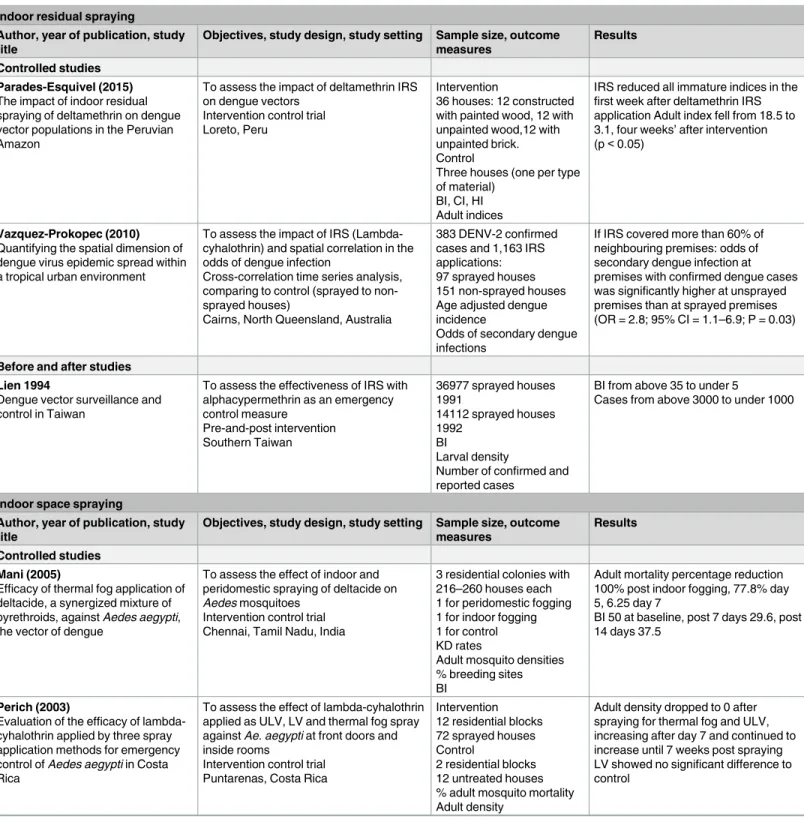
By using a pre-designed extraction sheet, the following data were extracted from each included study: author name, year of publication, source database, study title, geographical location, objective(s) of the study, study design, relevant outcomes, main results, and key con-clusions of the authors (Table 1).
To assess for quality, included studies were categorised into studies with and without a con-trol arm. They were further classified by study design and number of interventions. Outcome measures were extracted, classified and summarised across studies. Different measures were used to record the frequency of observations and the way of presentation varied according to the type of the presented data. Different insecticides and methods of application, together with varying statistical methods and outcome measures across the studies precluded any attempt at meta-analysis. Articles included through an update of the initial searches, until 28.02.17, are presented in the discussion section.
Results
Data search
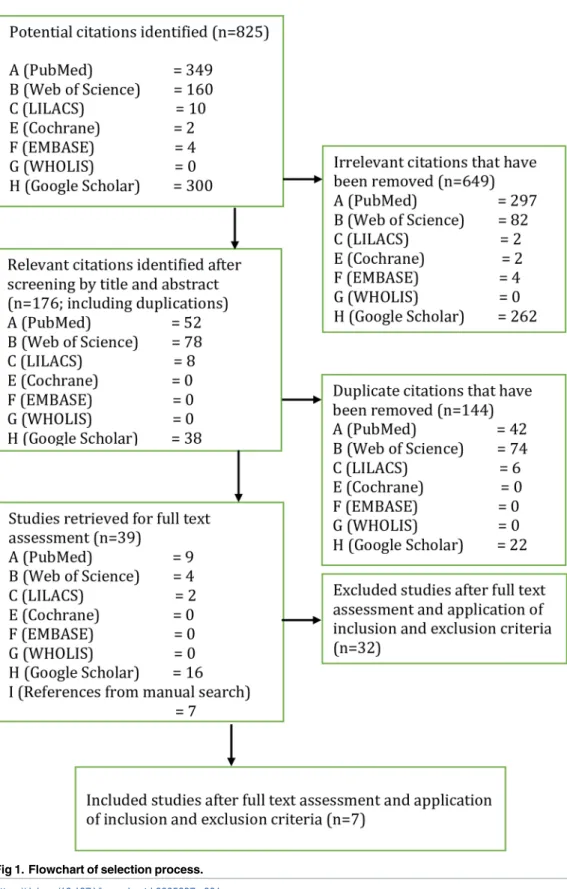
A comprehensive literature search of the seven databases identified 825 potentially relevant citations. After screening for title and abstract, 144 duplicates and 649 irrelevant articles were excluded. The reference lists of the 32 remaining articles added seven more studies. The 39 studies were retrieved for full text assessment. Upon meeting eligibility criteria, seven studies were included and 32 studies were excluded, most of the latter were efficacy studies only (Fig 1). Summaries of included studies were arranged chronologically in an evidence table (Table 1).
General characteristics
Seven studies met the pre-specified eligibility criteria (1) Three IRS studies: Parades-Esquivel 2015 [20], Vazquez-Prokopec 2010/1 [21], Lien 1994 [22]; 2) Four ISS studies: Mani 2005 [23], Perich 2003 [24], Perich 2001 [25] and Koenraadt 2007 26]). Most dengue risk areas were rep-resented except Africa, with three studies from Asia [22,23,26], one study from Australia [21] and three from Latin America and the Caribbean [20,24,25]. All articles were reported in English. The time period of publication ranged from 1994 to 2015.
The seven studies were broadly classified into five controlled studies, two for IRS and three for ISS, and two non-controlled studies (one each IRS/ISS) (Table 1). Controlled studies were subsequently classified into four intervention control studies all testing IRS [20] and ISS [23,24,25]with multiple study arms. One cross-sectional time series compared data from sprayed and non-sprayed areas [21]. For the two non-controlled studies [22,26], Lien [22] had one study arm only, Koenraadt [26] had multiple study arms.
Reporting on sample size varied across included studies either for the diversity of methods or for the unavailability of data in some studies. For controlled studies, the smallest sample size for intervention was 36 houses [20] and the biggest three residential colonies with 216–260 houses each. The non-controlled studies covered 36977 houses [22] and four houses in two areas [26].
Characteristics of study settings
Table 1. Evidence table. Indoor residual spraying Author, year of publication, study title
Objectives, study design, study setting Sample size, outcome measures
Results
Controlled studies Parades-Esquivel (2015)
The impact of indoor residual spraying of deltamethrin on dengue vector populations in the Peruvian Amazon
To assess the impact of deltamethrin IRS on dengue vectors
Intervention control trial Loreto, Peru
Intervention
36 houses: 12 constructed with painted wood, 12 with unpainted wood,12 with unpainted brick. Control
Three houses (one per type of material)
BI, CI, HI Adult indices
IRS reduced all immature indices in the first week after deltamethrin IRS application Adult index fell from 18.5 to 3.1, four weeks’ after intervention (p<0.05)
Vazquez-Prokopec (2010)
Quantifying the spatial dimension of dengue virus epidemic spread within a tropical urban environment
To assess the impact of IRS (Lambda-cyhalothrin) and spatial correlation in the odds of dengue infection
Cross-correlation time series analysis, comparing to control (sprayed to non-sprayed houses)
Cairns, North Queensland, Australia
383 DENV-2 confirmed cases and 1,163 IRS applications: 97 sprayed houses 151 non-sprayed houses Age adjusted dengue incidence
Odds of secondary dengue infections
If IRS covered more than 60% of neighbouring premises: odds of secondary dengue infection at premises with confirmed dengue cases was significantly higher at unsprayed premises than at sprayed premises (OR = 2.8; 95% CI = 1.1–6.9; P = 0.03)
Before and after studies Lien 1994
Dengue vector surveillance and control in Taiwan
To assess the effectiveness of IRS with alphacypermethrin as an emergency control measure
Pre-and-post intervention Southern Taiwan
36977 sprayed houses 1991
14112 sprayed houses 1992
BI
Larval density
Number of confirmed and reported cases
BI from above 35 to under 5
Cases from above 3000 to under 1000
Indoor space spraying
Author, year of publication, study title
Objectives, study design, study setting Sample size, outcome measures
Results
Controlled studies Mani (2005)
Efficacy of thermal fog application of deltacide, a synergized mixture of pyrethroids, against Aedes aegypti, the vector of dengue
To assess the effect of indoor and peridomestic spraying of deltacide on
Aedes mosquitoes
Intervention control trial Chennai, Tamil Nadu, India
3 residential colonies with 216–260 houses each 1 for peridomestic fogging 1 for indoor fogging 1 for control KD rates
Adult mosquito densities % breeding sites BI
Adult mortality percentage reduction 100% post indoor fogging, 77.8% day 5, 6.25 day 7
BI 50 at baseline, post 7 days 29.6, post 14 days 37.5
Perich (2003)
Evaluation of the efficacy of lambda-cyhalothrin applied by three spray application methods for emergency control of Aedes aegypti in Costa Rica
To assess the effect of lambda-cyhalothrin applied as ULV, LV and thermal fog spray against Ae. aegypti at front doors and inside rooms
Intervention control trial Puntarenas, Costa Rica
Intervention 12 residential blocks 72 sprayed houses Control
2 residential blocks 12 untreated houses % adult mosquito mortality Adult density
Adult density dropped to 0 after spraying for thermal fog and ULV, increasing after day 7 and continued to increase until 7 weeks post spraying LV showed no significant difference to control
housing structures. The latter is described in detail by Parades-Esquivel [20], Vazquez-Proko-pec [21] and Perich [24,25]. Parades-Esquivel [20] and Mani [23] present target populations and their socio-economic background. Pre-intervention dengue estimates were reported by Vazquez-Prokopec [21] and Lien [22]. Vazquez-Prokopec [21] reported on previous dengue outbreaks.
Characteristics of the intervention
Method(s) of intervention: All studies used IRS as a single intervention. Although Vazquez-Prokopec [21] compared data from areas sprayed and not sprayed with IRS, in addition to the ongoing local control programme, including control of breeding places. Mani [23] compared ISS and peridomestic spraying, Perich [24] compared ISS with ULV, LV and thermal fogging and Perich [25] compared ISS with ULV and thermal fogging. Koenraadt [26] compared ISS and peridomestic spraying, with different insecticide concentrations.
Forms of application and formulations: Forms of application varied considerably, but including either ultra-low volume spray (ULV), thermal fog spray, or low-volume spray (LV). Formulations varied as well, including deltamethrin [20], lambda-cyhalothrin [21,24,25], alphacypermethrin [22], pyrethrin [26] and deltacide, a mixture of Deltamethrin 0.5%, S-Bioallethrin 0.75% and Piperonyl Butoxide 10% [23].
Duration of residual effect: Paredes-Esquivel [20] estimates a good residual effect of IRS up to 16 weeks, for ISS Perich [24,25] demonstrated three weeks and four weeks’ residual effect, respectively. Mani [23] and Koenraadt [26] showed a residual effect of one week.
Control groups
Five of seven studies incorporated a control group into the study. They were assigned in differ-ent ways according to the methods used in each study. 1) IRS studies: Parades-Esquivel [20] used three single houses with similar structures to the 3 clusters of intervention houses
Table 1. (Continued) Perich (2001)
Evaluation of the efficacy of lambda-cyhalothrin applied as ultra-low volume and thermal fog for emergency control of Aedes aegypti in Honduras
To assess the effect of lambda-cyhalothrin against Ae. aegypti when applied as ULV and thermal fog spray at front doors and inside rooms
Intervention control trial El Progreso, Honduras
Intervention 4 residential blocks 24 treated houses Control
1 residential block 6 untreated houses Mean % mortality of adult mosquitoes
Adult mosquito density
Adult density dropped to 0 for both treatments, increasing after day 7 and continued to increase until 7 weeks post spraying
Before and after studies Koenraadt (2007)
Spatial and temporal patterns in the recovery of Aedes aegypti (Diptera: Culicidae) populations after insecticide treatment
To assess the effectiveness of insecticide applications in the field and to study different strategies of spraying against
Aedes in both space and time (pyrethrin
mixture, ULV)
Pre-and-post intervention study Kamphaeng Phet province, Thailand
Four houses in two areas Adult mortality
Adult mosquito density Parity rates
Spatial and temporal relationship
Indoor spray reduced the number of adult mosquitoes to around 10%, however gradually recovering after day 2
Further relevant studies published after initial searches Vazquez-Prokopec (2017)
Combining contact tracing with targeted indoor residual spraying significantly reduces dengue transmission.
To assess the effectiveness of IRS using space-time statistical data modelling with existing data
Cairns, Australia
Data from 2008 and 2009 Probability of future DENV transmission
Data from 2008 and 2009 confirm that targeted IRS in potential exposure locations reduced the probability of future DENV transmission by 86 to 96%, compared to unsprayed premises
Fig 1. Flowchart of selection process.
(12 each). Vazquez-Prokopec [21] compared 97 sprayed houses to 151 non-sprayed houses, as the data were retrospectively available. 2) For ISS studies: Mani [23] used one cluster of houses (216–260) of three clusters for control. Perich [24] used two residential blocks with 12 untreated houses as control, Perich [25] used one residential bock with 6 untreated houses.
Outcome measures
A variety of entomological and disease specific outcome measures were used to assess the impact of IRS: 1) Measures for adultAedes: Adult mosquito mortality and knock down (KD) rates[20,23,24,25]; Adult mosquito density [20,23,24,25,26] and spatial and temporal patterns [26]; 2) Measures for immatureAedes: Breteau Index (BI) [20,22,23]; House Index (HI) [20,22]; Percentages of breeding site [23]; Number of parous females [26]; 3) Disease specific measures: Age adjusted dengue incidence [21]; Odds of secondary dengue infection [21]; reported number of cases [22].
Impact of indoor spraying of insecticides
The effect of indoor spraying of insecticides on adult mosquitoes is strong immediately after application in all studies measuring these parameters. For IRS studies, in Peru [20] the Adult Index fell from 18.5 to 3.1 four weeks’ after intervention (p<0.05). For ISS studies, adult mor-tality percentage reduction was 100% post indoor spraying, 77.8% on day 5, 6.25 on day 7[23]. Similarly, adult density dropped to 0 after spraying with thermal fog and ULV, increasing after day 7 and continued to increase until 7 weeks post spraying, with similar results in Costa Rica [24] and Honduras [25]. In an uncontrolled setting in Thailand [26], indoor spraying reduced the number of adult mosquitoes to around 10%, however gradually recovering after day 2. The latter study measured also that there was a relationship between mosquito density and distance to the centre of application with an area of protection extending to 85 m. Parity rates also dropped after spraying.
The effect on immature mosquitoes is less strong on all studies measuring larval indices. For IRS studies, deltamethrin in Peru reduced all immature indices in the first week and sus-tained throughout the period of studies [20]. Also, there was a noted reduction of BI from 35 to 5 in Taiwan [22]. However, for ISS, in India, with a BI of 50 at baseline, this reduced to 29.6 post 7 days, and recovered post 14 days to 37.5.
For human dengue infection parameters, there are only two IRS studies. Odds of dengue infection shown by Vazquez-Prokopec [21], in Australia, were significantly higher at unsprayed than at sprayed premises (OR = 2.8; 95%CI = 1.1–6.9; p = 0.03). When 60% of the premises were sprayed around the index case house the odds reduced significantly to zero. Also the number of dengue cases was strongly and positively correlated to the number of IRS applications (r>0.6). Also, in Taiwan [22], the number of cases reported over time, dropped with IRS applications from above 3000 to 1000 (no control).
Discussion
The evidence presented here suggests that IRS and ISS can be an effective dengue control inter-vention. The majority of included studies demonstrated a significant post-intervention reduc-tion in adult and some effect on immatureAedespopulations. Notably, of the studies that measured dengue incidence, both showed decreases in new dengue cases after the application of IRS. These findings support the use of IRS as a component of integrated vector management (IVM) [27], and perhaps ISS as well.
application of IRS and ISS. Estimates of the duration of effect are limited by the relative short time-frames studied, but multiple studies reported residual efficacy up to two months post-intervention. The impact of IRS on the incidence of dengue may be of even longer duration. The impact of ISS on dengue transmission was not measured. Further confirmations of the effect of IRS and ISS arise by two further studies [28,29]–the studies focused however on other elements and were excluded in the analysis. Ritchie [28] noticed an effect that started late but continued, using a combination of containers treated with S-methoprene or lambda-cyhalo-thrin and adult control with IRS using lambda-cyhalolambda-cyhalo-thrin, “human cases subsequently dropped from a high of seven cases per day in mid-March to only sporadic cases in late April, with the final reported onset of 7 May”. Stoddard [29] analysed surveillance data of dengue for explanatory models of transmission, ISS delivered in three cycles, using deltamethrin, cyper-methrin, or alpha-cypercyper-methrin, resulted in a good reduction of dengue transmission in tri-mester III. An update of the searches generated a further article, published shortly after the initial searches [30]. The authors conducted a study using space-time statistical data modelling from Cairns, Australia (data from 2008 and 2009). Targeted IRS “in potential exposure loca-tions reduced the probability of future DENV transmission by 86 to 96%, compared to unsprayed premises”. This study strongly confirms the potential of IRS for reducing dengue transmission.
While there is evidence for indoor spraying in the control of dengue, there are a number of challenges with scaling up such interventions. Since, indoor spraying can require high levels of coverage, which requires widespread community acceptance and participation. Few studies included in the review reported qualitative estimates of community acceptance, although IRS is often popular as it has the ancillary benefit of killing many nuisance insects [1,4]. However, Chang [31] emphasised how communities are still reluctant to take appropriate dengue control measures. Furthermore, Gu¨rtler [32] suggested integrating sustained social participation into IVM activities like source reduction, biological control, and environmental management, in order to overcome such a challenge and to ensure long-term sustainability of dengue preven-tion and control.
In addition, none of the included studies examined the associated costs of indoor spraying. In Australia however, where IRS is used for dengue control, a cost-analysis shows that the total costs of preparedness through surveillance are far lower than the ones needed to respond to the introduction of vector-borne pathogens [33]. Universal application and re-application is likely beyond the resources of many dengue-affected countries. Therefore, effective use of indoor spraying will require timely surveillance and response mechanisms. Combination of effective early warning systems with vector control measures could reduce densities ofAedes
and subsequently dengue transmission [34]. Response systems could include mapping tech-nologies like GIS [35]. Using space-temporal units besides such technologies is essential in delivering the resources and in measuring the coverage [36]. Analysis of one of the included studies showed similar evidence on how early detection of dengue outbreak helped to imple-ment rapid and effective control actions, including early use of residual pesticides [22].
Experiments emphasised an association between type of insecticide used and its residual effect onAedesand showed how the susceptibility of mosquitoes differs from one insecticide to another [37,38]. Perich [24,25] reported on another factor, which was the droplet size and linked it to post-spray residual effect. Sulaiman [39] pointed out how applying IRS on wooden surfaces is potentially controlling dengue. Another efficacy study in Malaysia linked house construction to the residual activity of IRS, since its wall bioassays indicated that bothAe.
aegyptiandAe.albopictuswere more susceptible to IRS on wooden surfaces than on brick
may affect severely the effectiveness of IRS/ISS. For residual treatment for example a study in Brazil showed a mortality of only 10% forAedesin some communities for Deltamethrin [41]. A further challenge is the application of IRS, and where IRS is targeted. Whereas for Malaria and transmitting vectors IRS is defined as “the application of insecticide to the inside of dwell-ings, on walls and other surfaces that serve as a resting place for malaria-infected mosquitoes” and conditions for the use of IRS are set as “1) Majority of vectors (i.e., organisms that transmit malaria) must feed and rest indoors 2) Vectors are susceptible to the insecticide in use, 3) Houses have “sprayable” surfaces and 4) A high proportion of the houses in target areas are sprayed (more than 80 percent)” [42], such conditions are not as clear set for dengue vectors.
In addition to routine control measures, the use of indoor spraying as an emergency response is also feasible. Perich [24] pointed out how ISS successfully fulfils the criteria to be used as an emergency operation, which were: 1) providing an initial kill of adultAedes, and 2) allowing a significant level of residual activity. Although residual activity with ISS may be mixed up with a time lag in recovery of mosquito populations. Evidence from that study and other efficacy studies in Malaysia and Taiwan plus ineffectiveness of outdoor spraying to con-trol indoorAedespopulations make indoor spraying a true effective alternative for emergency suppression ofAedesmosquitoes [22,23,24,25,39,43]. This may also include the use of house-hold (commercial) insecticides, another field that warrants analysis.
The key limitation of this systematic review is the very limited number of studies that typi-cally researched community effectiveness of IRS and ISS. This study reports therefore on the different forms of application in relation to the outcomes. Also, potential publication and selection bias are most concerning. It is well documented that studies with positive outcomes are more often reported in literature than negative outcomes. The diversified and extensive search strategy along with no restrictions in languages should minimise the publication and selection bias.
The findings must also be interpreted with regard to the quality of the included studies: 1) Different methodologies, 2) Different study settings, 3) Limited use of statistical methods to assess for significance/control for confounding, 4) Relatively short study periods and 5) Lack of randomisation in most studies, influence the results.
However, the review is the most comprehensive to date and highlights the need for future work in this area. Concluding, evidence obtained from this systematic review showed that the use of IRS and ISS can produce significant reductions ofAedespopulations (adult and imma-ture forms). IRS can also produce significant reductions in human dengue cases, with very lim-ited available evidence, but no data are available for ISS. However, evidence to suggest the effectiveness of IRS/ISS either on immature and adult stages ofAedesor on human dengue cases as a single intervention is limited.
The community effectiveness of IRS is affected, directly and indirectly, by many factors. Examples for these factors are disease epidemiology, virus dynamics, human movements, effective surveillance systems, community participation in vector control, the insecticides used, particularly considering insecticide resistance, environmental factors, and house con-struction. When these factors work in harmony with IRS/ISS applications, they would maxi-mise its community effectiveness. Moreover, they could maximaxi-mise the applicability of IRS/ISS, also being used as an emergency control measure during epidemics instead of being just applied as a routine control measure.
Supporting information
S1 PRISMA Checklist.
Author Contributions
Conceptualization: Moody Samuel, Dorit Maoz, Pablo Manrique, Tara Ward, Silvia
Runge-Ranzinger, Joao Toledo, Ross Boyce, Olaf Horstick.
Data curation: Moody Samuel, Dorit Maoz, Pablo Manrique, Tara Ward, Silvia
Runge-Ran-zinger, Joao Toledo, Ross Boyce, Olaf Horstick.
Formal analysis: Moody Samuel, Dorit Maoz, Pablo Manrique, Tara Ward, Silvia
Runge-Ran-zinger, Joao Toledo, Ross Boyce, Olaf Horstick.
Investigation: Moody Samuel, Dorit Maoz, Pablo Manrique, Tara Ward, Silvia
Runge-Ran-zinger, Joao Toledo, Ross Boyce, Olaf Horstick.
Methodology: Moody Samuel, Dorit Maoz, Pablo Manrique, Tara Ward, Silvia
Runge-Ran-zinger, Joao Toledo, Ross Boyce, Olaf Horstick.
Project administration: Moody Samuel, Dorit Maoz, Pablo Manrique, Tara Ward, Silvia
Runge-Ranzinger, Joao Toledo, Ross Boyce, Olaf Horstick.
Resources: Moody Samuel, Dorit Maoz, Pablo Manrique, Tara Ward, Silvia Runge-Ranzinger,
Joao Toledo, Ross Boyce, Olaf Horstick.
Supervision: Silvia Runge-Ranzinger, Olaf Horstick.
Validation: Moody Samuel, Dorit Maoz, Pablo Manrique, Tara Ward, Silvia
Runge-Ranzin-ger, Joao Toledo, Ross Boyce, Olaf Horstick.
Visualization: Moody Samuel, Dorit Maoz, Pablo Manrique, Tara Ward, Silvia
Runge-Ran-zinger, Joao Toledo, Ross Boyce, Olaf Horstick.
Writing – original draft: Moody Samuel, Dorit Maoz, Pablo Manrique, Tara Ward, Silvia
Runge-Ranzinger, Joao Toledo, Ross Boyce, Olaf Horstick.
Writing – review & editing: Moody Samuel, Dorit Maoz, Pablo Manrique, Tara Ward, Silvia
Runge-Ranzinger, Joao Toledo, Ross Boyce, Olaf Horstick.
References
1. Guzman MG 2009 Dengue: where are we today? Malaysian Journal of Medical Sciences, Vol. 16, No. 3
2. WHO 2009. Dengue guidelines for diagnosis, treatment, prevention and control: new edition, Geneva-Switzerland World Health Organization.http://whqlibdoc.who.int/publications/2009/9789241547871_ eng.pdf(accessed 17.02.17)
3. Bhatt S, Gething PW, Brady OJ, Messina JP, Farlow AW, Moyes CL, et al. (2013) The global distribu-tion and burden of dengue, Nature 2013, Volume 496, pp 504–507
4. WHO 2015. Emergencies preparedness, response. Impact of Denguehttp://www.who.int/csr/disease/ dengue/impact/en/(accessed 17.02.17)
5. Kyle JL, Harris E. 2008. Global spread and persistence of dengue. Annu Rev Microbiol, 62, 71–92.
https://doi.org/10.1146/annurev.micro.62.081307.163005PMID:18429680
6. Wilder-Smith A, Quam M, Sessions O, Rocklov J, Liu-Helmersson J, Franco L, et al. 2014. The 2012 dengue outbreak in Madeira: exploring the origins. Eurosurveillance, Volume 19, Issue 8, 27 February 2014
7. Cheah WK, NG KS, Marzilawati AR, Lum LC 2014. A review of dengue research in Malaysia. Med J Malaysia, 69 Suppl A, 59–67
8. Strobel M, Lamaury I 2001. Dengue fever: a review. Rev Med Interne, 22, 638–47 PMID:11508157 9. Liebman KA, Stoddard ST, Reiner RC, Perkins TA, Astete H, Sihuincha M, et al. 2014. Determinants of
10. Dzul-Manzanilla F, Ibarra-Lo´pez J, Bibiano Marı´n W, Martini-Jaimes A, Leyva J Torres, Correa-Morales F, et al. 2017 Indoor Resting Behavior of Aedes Aegypti (Diptera: Culicidae) in Acapulco, Mexico. J Med Entomol 54 (2), 501–504. 2017 Mar 01https://doi.org/10.1093/jme/tjw203PMID:28011725 11. Capeding MR, Tran NH, Hadinegoro SR, Ismail HI, Chotpitayasunondh T, Chua MN,et al. 2014.; The
CYD14 Study Group 2014 Clinical efficacy and safety of a novel tetravalent dengue vaccine in healthy children in Asia: a phase 3, randomised, observer-masked, placebo-controlled trial The Lancet. 2014 Jul 10.https://doi.org/10.1016/S0140-6736(14)61060-6
12. Saadatian-Elahi M, Horstick O, Breiman R, Gessner B, Gubler DJ, Louis J, et al. 2016 Beyond efficacy: The full public health impact of vaccines, Vaccines January 2016
13. Curtis CF, Lines JD 2000. Should DDT be banned by international treaty? Parasitol Today, 16, 119–2 PMID:10689332
14. WHO 1982. Manual on environmental management for mosquito control, with special emphasis on malaria vectors.
15. Cheong WH 1986. The vectors of dengue and dengue haemorrhagic fever in Malaysia. In: Rudnick A, Lim TW, editors. Dengue fever studies in Malaysia, Bulletin 23. Kuala Lumpur, Malaysia: Institute of Medical Research. pg. 155–167
16. WHO 1997. Dengue Haemorrhagic Fever: Diagnosis, Treatment, Prevention and Control. Geneva: World Health Organization.http://www.who.int/csr/resources/publications/dengue/Denguepublication/ en/(Accessed 17.02.17)
17. Bowman LR, Donegan S, McCall PJ (2016) Is Dengue Vector Control Deficient in Effectiveness or Evi-dence?: Systematic Review and Meta-analysis.PLoS Negl Trop Dis 10(3) 2016http://journals.plos.org/ plosntds/article/asset?id=10.1371%2Fjournal.pntd.0004551.PDF(Accessed 17.02.17)
18. Moher D, Liberati A, Tetzlaff J, Altman DG, The Prisma Group (2009) Preferred Reporting Items for Systematic Reviews and Meta-Analyses: The PRISMA Statement. PLoS Med 6(7). PLoS Med 6(6): e1000097.https://doi.org/10.1371/journal.pmed.1000097PMID:19621072
19. Shea BJ, Grimshaw JM, Wells G A, Boers M, Anderson N, Hamel C,et al. 2007. Development of AMSTAR: a measurement tool to assess the methodological quality of systematic reviews. BMC Medi-cal Research Methodology, 7,10.http://www.biomedcentral.com/1471-2288/7/10(accessed 17.02.17)
20. Paredes-Esquivel C, Lenhart A, Del Rı´o R, Lena MM, Estrugo M, Chalco E, et al. 2015 The impact of indoor residual spraying of deltamethrin on denguevector populations in the Peruvian Amazon Acta Tro-pica 154 (2016) 139–144https://doi.org/10.1016/j.actatropica.2015.10.020PMID:26571068
21. Vazquez-Prokopec GM, Kitron U, Montgomery B, Horne P, Ritchie SA 2010/1. Quantifying the spatial dimension of dengue virus epidemic spread within a tropical urban environment. PLoS Negl Trop Dis, 4, e920.
22. Lien JC, Lin TH, Huang HM 1994. Dengue vector surveillance and control in Taiwan. Tropical medicine, 35, 269–276.
23. Mani T, Arunachalam N, Rajendran R, Satyanarayana K, Dash A 2005. Efficacy of thermal fog applica-tion of deltacide, a synergized mixture of pyrethroids, against Aedes aegypti, the vector of dengue. Tropical Medicine & International Health, 10, 1298–1304.
24. Perich MJ, Solano T, Platt KB, Rowley W, Castro OL, Rocha NO, Alfaro AW 2003. Evaluation Of The Efficacy of Lambda-Cyhalothrin Applied by Three Spray Application Methods for Emergency Control of
Aedes Aegypti in Costa Rica. Journal of the American Mosquito Control Association, 19, 58. PMID: 12674536
25. Perich MJ, Sherman C, Burge R, Gill E, Quintana M, Wirtz RA 2001. Evaluation of the efficacy of lambda-cyhalothrin applied as ultra-low volume and thermal fog for emergency control of Aedes aegypti in Honduras. J Am Mosq Control Assoc, 17, 221–4. PMID:11804457
26. Koenraadt C, Aldstad J, Kijchalao U, Kengluecha A, Jones J, Scott T. 2007. Spatial and temporal pat-terns in the recovery of Aedes aegypti (Diptera: Culicidae) populations after insecticide treatment. Jour-nal of medical entomology, 44, 65–71. PMID:17294922
27. WHO 2004. Global strategic framework for integrated vector management. WHO, Geneva, Switzerland
http://whqlibdoc.who.int/hq/2004/WHO_CDS_CPE_PVC_2004_10.pdf(Accessed 17.02.17)
28. Ritchie SA, Long S, Smith G, Pyke A, Knox TB. Entomological Investigations in a Focus of Dengue Transmission in Cairns, Queensland, Australia, by using the Sticky Ovitraps. Journal of Medical Ento-mology 2004, 41(1):1–4. PMID:14989339
30. Vazquez-Prokopec GM, Montgomery BL, Horne P, Clennon JA, Ritchie SA. 2017. Combining contact tracing with targeted indoor residual spraying significantly reduces dengue transmission. Sci Adv. 2017 Feb 17; 3(2):e1602024https://doi.org/10.1126/sciadv.1602024PMID:28232955
31. Chang MS, Christophel EM, Gopinath D, Abdur RM, on behalf of Vectorborne Diseases, World Health Organization Regional Office for the Western Pacific 2011. Challenges and future perspective for den-gue vector control in the Western Pacific Region. Western Pacific Surveillance and Response Journal: WPSAR, 2, 9–16.https://doi.org/10.5365/WPSAR.2010.1.1.012PMID:23908883
32. Grtler RE, Garelli FM, Coto HD. 2009. Effects of a five-year citywide intervention program to control
Aedes aegypti and prevent dengue outbreaks in northern Argentina. PLoS neglected tropical diseases,
3, e427.https://doi.org/10.1371/journal.pntd.0000427PMID:19399168
33. Vazquez-Prokopec GM, Chaves LF, Ritchie SA, Davis J, Kitron U 2010/2. Unforeseen Costs of Cutting Mosquito Surveillance Budgets. PLoS Negl Trop Dis 4(10): e858.https://doi.org/10.1371/journal.pntd. 0000858PMID:21049010
34. Gubler DJ. 1989. Surveillance for dengue and dengue hemorrhagic fever. Bull Pan Am Health Organ, 23, 397–404 PMID:2611461
35. Ali M, Wagatsuma Y, Emch M, Breiman RF. 2003. Use of a geographic information system for defining spatial risk for dengue transmission in Bangladesh: role for Aedes albopictus in an urban outbreak. The American journal of tropical medicine and hygiene, 69, 634–640. PMID:14740881
36. Rotela C, Fouque F, Lamfri M, Sabatier P, Introini V, Zaidenberg M, Cet al. 2007. Space–time analysis of the dengue spreading dynamics in the 2004 Tartagal outbreak, Northern Argentina. Acta tropica, 103, 1–13.https://doi.org/10.1016/j.actatropica.2007.05.003PMID:17603989
37. Das M, Singh R, Lalc R, Dhimanb R. 2011. Susceptibility of Aedes aegypti to insecticides in Ranchi city, Jharkhand state, India. Dengue, 35, 194.
38. Manda H, Shah P, Polsomboon S, Chareonviriyaphap T, Castro-Llanos F, Morrison A et al. 2013. Con-tact irritant responses of Aedes aegypti sing sublethal concentration and focal application of pyrethroid chemicals. PLoS Negl Trop Dis. 2013; 7(2):e2074.https://doi.org/10.1371/journal.pntd.0002074Epub 2013 Feb 28. PMID:23469302
39. Sulaiman S, Pawanchee ZA, Ghauth I, Wahab A, Vadiveloo B, Jeffery J, Mansor AF 1996. The residual effects of alphacypermethrin and permethrin against the dengue vector Aedes albopictus (Skuse) in wooden huts in Malaysia. Journal of Vector Ecology, 21, 85–88.
40. Rozilawati H, Lee HL, Mohd Masri S, Mohd Noor I, Rosman S 2005. Field bioefficacy of deltamethrin residual spraying against dengue vectors. Trop Biomed, 22, 143–8. PMID:16883280
41. Macoris MLG; Andrighetti MTM; Wanderley DMV, Ribolla PEM. 2014 Impact of insecticide resistance on the field control of Aedes aegypti in the State of São Paulo. Rev. Soc. Bras. Med. Trop. [online]. 2014, vol.47, n.5 pp.573–578
42. AIRS 2017, Indoor Residual Spraying,http://www.africairs.net/indoor-residual-spraying/(Accessed 17.02.17)