Cover Page
The handle
http://hdl.handle.net/1887/20916
holds various files of this Leiden University
dissertation.
Published by
LOT phone: +31 30 253 6006
Trans 10
3512 JK Utrecht e-mail: [email protected]
The Netherlands http://www.lotschool.nl
Cover illustration: A family of mona monkeys in the Tafi Atome Monkey Sanctuary, VR, Ghana–Picture taken by author
ISBN: 978-94-6093-113-0 NUR 616
A Grammar of Tafi
Proefschrift
ter verkrijging van
de graad van Doctor aan de Universiteit Leiden,
op gezag van Rector Magnificus prof.mr. C.J.J.M. Stolker,
volgens besluit van het College voor Promoties
te verdedigen op donderdag 30 mei 2013
klokke 15:00 uur
door
Mercy Bobuafor
geboren te Accra, Ghana.
Promotiecommissie
Promotor: Prof.dr. M.P.G.M. Mous Co-promotor: Dr. F.K. Ameka
Overige leden: Prof.dr. B. Heine (University of Cologne) Dr. J.A.B.K. Essegbey (University of Florida) Prof.dr. Th.C. Schadeberg
Research of this doctoral dissertation was made possible by financial support from the Endangered Languages Programme of the Council of Humanities (GW) and WOTRO of the Netherlands Organisation for Scientific Research (NWO) as part of the project The Southern Ghana-Togo Mountain Groups: A description of their
Acknowledgements
During the writing of this thesis, I benefitted immensely from the help of a large number of people, who in various ways supported, encouraged and guided me and I am deeply indebted to them.
First and foremost, I would like to thank Felix Ameka for believing in me and accepting to supervise me as a Ph.D student. Not only did I benefit immensely from his insightful comments on earlier drafts of the manuscript but he also made himself available to assist in whatever way he could with whatever problems there were. Whenever I approached him for advice, be it linguistic or non-linguistic and whether it was the right time or not, he always gave a listening ear and was ready to give the needed advice. His constant encouragements were an enormous support.
I owe my deep gratitude to Prof. Maarten Mous who has helped me at various moments with his advice, guidance and support.
I am also grateful to Prof. Kweku Osam, the Pro-Vice-Chancellor of the University of Ghana and his family as well as Wing Commander Emmanuel Kwesi Apietu (Wingco) for their immense help and hospitality by offering me a place in their homes anytime I was in Ghana on fieldtrip. Prof. Kweku Osam made his office in the Linguistics Department, University of Ghana available to me to use as and when I needed an office space to work. Wingco was always ready and willing to offer help at anytime despite all the odds. Thank you all for the moral support at all times.
Tafi-Agɔme for making time to tell me the migration history of the people of Tafi. It is hard to express my gratitude adequately to the Tafi speakers who contributed the data on which this grammar is based, especially Beatrice Amoadza, Nelson Agbley, Emmamuel Amoadza, Euphelia Avorklai, Victoria Amoadza, Ablorde Kwaku, Florence Amoadza, Johnson Kasu, Manfred Ocrah, Juliana Ocrah, Michael Agbesi, Wilhemina Sonkro and Leonard Dzandu.
Moreover, I thank Thomas Payne so much for his kind offer to read one of my chapters and for his very helpful comments.
I was fortunate to benefit from the immense help and company of friends and colleagues at the LUCL (Leiden University Centre for Linguistics) and TCA (African Languages and Cultures Department): Alice Middag, Angela Kluge, Anne-Christine Hellenthal, Azeb Amha, Christian Rapold, Constance Kutsch-Lojenga, Daniela Merolla, Gea Hakker, Heleen Smits, Jean Chavula, Jenneke van der Wal, Juliette Huber, Khalid Mourigh, Kofi Dorvlo, Kristina Riedel, Maarten Kossmann, Maggy Konter-Katani, Mulugeta Seyoum, Ongaye Oda, Oumou Diaby-Kassamba, Ramada Elghamis, Rebecca Voll, Sander Steeman, Sandra Barassa, Stanly Oomen, Thilo Schadeberg and Victoria Nyst. Thank you Victoria, for agreeing to be my paranimf and for providing the Dutch summary.
Being a Ph.D student in a foreign country and in an institution such as the LUCL can, at times, be a mind blowing experience and it was the support, kindness, friendship and encouragement of people like Azeb Amha, Caroline Angenent, Anneke Breedveld, Benedicta Baffour Obeng (B.B), Maggy Konter-Katani and their families, Frits Erades, Marlous Tamminga, Sylvia Amevor, Kofi Dorvlo and Teshome, which helped me carry on and made the bad times bearable and which made me feel at home.
Thanks to Francis Ndi and Ongaye Oda for the bicycle riding lessons they gave me. Though it was pretty tough their patience and desire to see me acquire the skills were rewarding.
Furthermore, I wish to express my gratitude to my cousins Wonder Atakpa and her husband in Amsterdam, Matilda Brenke and Gifty Soltani-Ramati and their families in Hamburg. Thank you all for the invitations and I really enjoyed all my stays with you all. To Nada Gbegble in Antwerp, I say thank you very much for the countless number of times you hosted me any time I was in Antwerp.
there. I also enjoyed those times we had to work together covering those ceremonies in Nyagbo.
My heartfelt appreciations go to Mercy Akrofi-Ansah and Samuel Atintono who hosted me when I was in Manchester and also to my cousins Mawuli Dikah, Rosina Lebene Dorfie, Godfred Arthur, Gladys Agyeiwaa, Simon Logah and his family, all of whom are in Atlantic City, New Jersey, Akpene Ehla and her family in Texas, Vivian Doh in Connecticut and Jemima Dompreh in New York. Thanks for your support and encouragement during all the six months I spent in the U.S.A. A special thank you to Cecilia Nyarkoa for all the assistance you offered me. I, once again, thank Prof. Osam for introducing Jemima Drompreh to me. Thanks to Margaret Puplampu for her friendship and assistance. I very much cherish all the long distance calls from Canada trying to find out how things were going on with me and my work as well as with my family.
Special thanks to Sulley Amadu (Deputy Chairman, Finance and Administration), Muhammed Adoquaye (Director, Human Resource and General Services), Tony Amedzakey (Director, I.T. Department) and my colleagues Johnson Akafia, Faith Amedzakey, and Philip Adzomadi, all of the Electoral Commission of Ghana, for their prayers and support.
Agatha Augustt of the Linguistics Department, University of Ghana, I am grateful for all the calls and e-mails trying to find out how things were going on, for the chilli sauces and for everything you did for me. I also thank Vera Arhin of the Language Centre, University of Ghana, for all her encouragements. Thank you, Pastor Ben Turkson and your family for all your prayers and support.
I owe many thanks to my family for their endless patience, support and understanding. Thanks to my parents who made me understand that the greatest inheritance a parent can bequeath to a child is education. Through thick and thin, you did your very best to see me and my siblings through our education. Even up to this level, you continue to support me and take over all my responsibilities in
my absence. Efo kple AƒenEfo kple AƒenEfo kple Aƒenɔɔɔɔ, what else can I pray for? May the Good Lord bless Efo kple Aƒen
you and may He continue to grant you good health and long life to enjoy the fruits of your labour. QT, thank God for your life and the joy you bring into my life. Thank you for accepting to carry on with your life and making the best out of it
even in my absence. There were countless times I missed your calling me “ɛɛ́ɛɛ́ɛɛ́siɛɛ́sisisi” or
“nánásinánásinánásinánási”. I am most grateful for who you are. Hope you will forgive me for not
being there for you all the time, for all those mornings that you woke up and I was already gone and for all those several months that I was away. Enam, it is real fun being with you. Once again, I extend my heartfelt thanks to you all for all the sacrifices you have made.
steadfast love never ceases and His mercies never come to an end. They are new every morning and great is His faithfulness.
Once again, of all the ways to thank everybody, there seems no better way than simply THANK YOU ALL VERY MUCH. Your kindness, support and encouragement are very much appreciated. God richly bless you all.
W̃
W̃W̃
W̃ʊ̃ʊ̃ʊ̃ʊ̃nnnnɔ́ɔ́ɔ́ɔ́ bhitiibui pópóópóbhitiibui pópóópóbhitiibui pópóópóbhitiibui pópóópó.
Table of Contents
Acknowledgements ... i
Abbreviations……….xv
Map of Ghana-Togo Mountain Languages……….…….…….xvi
Map of the Tafi………...……...xvii
1. INTRODUCTION ... 1
1.1 The language and its speakers ... 1
1.1.1 Migration history ... 1
1.1.2 Geographical location ... 3
1.1.3 Some religious and cultural practices ... 5
1.2 Language ... 6
1.2.1 Genetic classification ... 6
1.2.2 Previous studies on the language ... 6
1.2.3 Sociolinguistic situation ... 7
1.3 Brief outline of the language ... 8
1.4 Data collection... 10
1.5 Methodology and theoretical framework ... 12
1.6 Outline of the grammar and presentation of data ... 13
2 PHONOLOGY ... 15
2.1 Syllable structure ... 15
2.1.1 The V/N syllable ... 15
2.1.2 The VC syllable ... 17
2.1.3 The CV syllable ... 17
2.1.4 The CVV syllable ... 17
2.1.5 The CCV syllable ... 18
2.2 Consonants ... 19
2.2.1 Stops ... 21
2.2.2 Fricatives ... 23
2.2.3 Affricates ... 24
2.2.4 Nasals ... 24
2.2.5 Liquids ... 26
2.2.6 Glides ... 26
2.3 Vowels ... 27
2.3.1 Vowel harmony ... 30
2.4 Tone ... 32
2.4.1 Tone patterns in verbs and nouns ... 33
2.4.2 Tonal Morphemes ... 37
2.4.3 Changes in tone ... 37
2.5.1 Deletion of consonants ... 39
2.5.2 Vowel elision ... 40
2.5.3 i/ɩ-insertion ... 41
2.5.4 Vowel Rounding ... 42
2.5.5 Changes in vowel height/ quality ... 43
2.5.6 [+ATR] feature assimilation ... 43
2.5.7 Compensatory lengthening ... 44
2.5.8 Vowel Coalescence ... 45
2.6 Loanwords ... 46
2.7 Tafi orthography ... 48
3 Nouns and Noun classes ... 51
3.1 Nouns ... 51
3.1.1 Noun classes ... 51
3.1.2 Noun class prefixes ... 52
3.1.2.1 The a1- class……….53
3.1.2.2 The o- class ……….…….54
3.1.2.3 The ki- class………..………54
3.1.2.4 The ka- class……….55
3.1.2.5 The bu1- class………...55
3.1.2.6 The ba(a)- class………57
3.1.2.7 The i- class………...57
3.1.2.8 The a2- class……….57
3.1.2.9 The bu2- class………...58
3.1.2.10 The ti- class………58
3.1.3 Summary of the noun classes ... 59
3.2 Loanwords ... 59
3.3 The system of grammatical agreement ... 61
3.3.1 Subject-verb agreement markers ... 62
3.3.2 Agreement involving noun modifiers ... 68
3.3.2.1 Head noun and numerals………..68
3.3.2.2 Head noun and indefiniteness marker………....…...69
3.3.2.3 Head noun and Demonstrative………...….69
3.3.2.4 Head noun and interrogative quantifier -shshshshɩ̃̄ɩ̃̄ɩ̃̄ɩ̃̄……….…………71
3.3.2.5 The modifier kákákáká----nyáányáányáányáá----kákákáká………..………..72
3.3.2.6 Head noun and other modifiers/ qualifiers………..73
3.4 Compounding ... 76
3.4.1 Noun-noun compounds ... 76
3.4.2 Postpositional phrase + noun compounds ... 78
3.4.3 Compounding of noun + sex-determining word ... 79
3.5.1 Agentive nominalisation ... 81
3.5.2 Nominalisation involving prefix + verb roots ... 81
3.5.3 Nominalisation involving reduplicated verbs ... 82
3.5.4 Compounding of verb + ɔɔɔɔkkkkɔ́ɔ́ɔ́ɔ́ ‘place’ ... 83
3.5.5 Instrumental nominals ... 84
3.5.6 Gerunds ... 84
3.5.7 Nominalisation involving adjectives ... 84
3.5.8 Diminutive nominals ... 85
3.6 Pronouns ... 85
3.6.1 Personal pronouns ... 85
3.6.2 Possessive pronouns ... 91
3.6.3 Reflexive pronouns ... 95
3.6.4 Reciprocal pronouns... 96
4 NOUN PHRASES AND NOMINAL MODIFIERS ... 99
4.1 The structure of the noun phrase ... 99
4.2 Types of noun phrases... 100
4.2.1 Conjoined Noun Phrase ... 100
4.2.2 Alternate Noun Phrase ... 101
4.2.3 Possessive Noun Phrase ... 102
4.3 Nominal Modifiers ... 103
4.3.1 Adjectives ... 103
4.3.1.1 Non-derived adjectives………...104
4.3.1.2 Ideophonic Adjectives………104
4.3.1.3 Derived adjectives by reduplication………...105
4.3.1.4 Derivational possibilities of adjectives………..105
4.3.1.4.1 Adverbialisation of adjectives………105
4.3.1.4.2 Adverbialisation of adjectives by suffixation……..……106
4.3.1.4.3 Nominalisation of adjectives………..106
4.3.1.5 Non-adjectival means of coding property concepts………...107
4.3.1.5.1 Modification by relative clauses………107
4.3.1.5.2 Quality/property concepts expressed with verbs……….108
4.3.1.5.3 Quality/property concepts expressed with verb phrases..108
4.3.1.5.4 Quality/Property concepts expressed by a periphrastic “medio-passive” construction……….109
4.3.1.5.5 Nominals as Qualifiers………....111
4.4 Numerals ... 112
4.3.1 Cardinal numbers ... 112
4.4.2 Fractions ... 116
4.4.2 Ordinal numbers ... 119
4.4 The modifier nyáá ... 122
4.5 Interrogative quantifier ... 123
4.6.1 Definiteness marker ... 124
4.6.2 Indefiniteness marker ... 125
4.6.3 Demonstratives ... 127
4.7 Intensifiers ... 129
5. ADPOSITIONS AND ADPOSITIONAL PHRASES ... 131
5.1 Prepositions ... 131
5.1.1 The locative preposition nnnnɩ́ɩ́ɩ́ɩ́ ... 131
5.1.2 The comitative preposition nnnnɩɩɩɩ ... 133
5.1.3 Other prepositions ... 134
5.1.3.1 The preposition déndéndéndénɔ̄ɔ̄ɔ̄ɔ̄ ‘from’………...134
5.1.3.2 The preposition kúkúkúkú ‘to, towards’………135
5.1.3.3 The preposition kkkkɔ́ɔ́ɔ́ɔ́ ‘for’……….………...136
5.1.3.4 The preposition ganganganganɔɔɔɔ ‘through’……….137
5.2 Postpositions ... 138
6 CLAUSE STRUCTURE AND CLAUSE TYPES ... 143
6.1 Basic clause structure and grammatical relations ... 143
6.2 Copula clause ... 146
6.3 Presentational constructions ... 147
6.4 Existential constructions ... 148
6.5 Predicate possessive constructions ... 149
6.6 Locative constructions ... 151
6.6.1 The meaning and use of the verbs ... 154
6.6.1.1 The general topological verbs………155
6.6.1.1.1 llllɩɩɩɩ ‘be.at’………...155
6.6.1.1.2 tsirítsirítsirítsirí ‘be.on’………..157
6.6.1.1.3 kpaskpaskpaskpasɩ́ɩ́ɩ́ɩ́ ‘be.in’………...158
6.6.1.1.4 búnbúnbúnbúnɔ̄ɔ̄ɔ̄ɔ̄ ‘be.near’………...….161
6.6.1.2 Positional verbs………..…………..161
6.6.1.2.1 The verb lílílílí ‘be.positioned’……….….161
6.6.1.2.2 dzídzídzídzí ‘be.located.on.base’……….…..162
6.6.1.2.3 ssssɔɔɔɔmmmɩ́ɩ́ɩ́ɩ́ ‘hang’………...162m 6.6.1.2.4 kpaplkpaplkpaplkpaplɩ́ɩ́ɩ́ɩ́nnnnɔ̄ɔ̄ɔ̄ɔ̄ ‘lean.against’……….………163
6.6.1.2.5 bbbbʊʊʊʊbbbbɔɔɔɔ ‘squat’………164
6.6.1.3 Verb of adhesion………164
6.6.1.3.1 tátátátá ‘be.fixed, be.pasted’………....164
6.6.1.4 Verbs of attachment……….………...…165
6.6.1.4.1 nyányányányá ‘be.tied’………...…165
6.6.1.4.2 mmmmɩɩɩɩnananana ‘be.around’………165
6.6.1.4.3 kanakanakanakana ‘surround, go.around’……….166
6.6.1.4.4 dadadada ‘be.covered’……….…...…………...166
6.7.1 Frame topic constructions ... 168
6.7.2 Contrastive topic constructions ... 171
6.7.3 Focus constructions ... 173
6.7.3.1 Subject focus constructions……….…173
6.7.3.2 Object focus constructions………..….174
6.7.3.3 Verb focus constructions………176
6.7.4 Post-verbal topic marker ananananɩ́ɩ́ɩ́ɩ́ ... 176
6.7.5 Topic-comment only constructions ... 177
7. VERBS AND VERBAL MODIFIERS ... 179
7.1 The structure of verb forms ... 179
7.2 Verbs and their argument structure ... 180
7.2.1 One-place predicates ... 180
7.2.1.1 Directed motion verbs………..……182
7.2.1.2 Non-agentive manner of motion……….……183
7.2.1.3 Verbs of emission………...184
7.2.1.4 Property verbs………....……186
7.2.1.5 Verbs of (involuntary) bodily processes………187
7.2.1.5 Achievement verbs………..………….188
7.2.2 Two-place predicates ... 189
7.2.2.1 Verbs of Perception………..…………190
7.2.2.2 Verbs of Cognition………...…….191
7.2.2.3 Speech act verbs………..……….191
7.2.2.4 Verbs of creation………192
7.2.2.5 ‘Do’ verbs………..193
7.2.2.6 Verbs of planting………..194
7.2.2.7 ‘Peel’ verbs……….………195
7.2.2.8 Body-grooming verbs………196
7.2.2.9 Verbs of caused change of location………...197
7.2.2.10 Verbs of cutting………197
7.2.2.10.1 Instruments of verbs of cutting ………...200
7.2.3 Obligatory complement verbs ... 202
7.2.3.1 Two-place predicates with generic complements………202
7.2.3.2 Two-place predicates with cognate objects……….……….203
7.2.4 Three-place predicates ... 205
7.2.4.1 Canonical three-place predicates ………..205
7.2.5 Summary ... 208
7.3.1 Future ... 209
7.3.2 Non-future and the aorist ... 211
7.3.3 The Perfective ... 213
7.3.4 The Progressive ... 213
7.3.4.1 The Present Progressive………...213
7.3.4.2 The Past Progressive………..214
7.3.5 Negation ... 215
7.3.5.1 Negative clefts………218
7.3.5.2 Prohibitive………..218
7.3.5.3 Privative negation………...219
7.3.5.4 Negative existential………219
7.3.5.5 Negative perfective……….…………219
7.3.6 The persistive aspect ... 220
7.3.7 The repetitive marker ... 221
7.3.8 The marker vlavlavlavla ‘again’ ... 222
7.3.9 The excessive marker gblagblagblagbla ... 222
7.3.10 Habitual ... 223
7.3.10.1 Present habitual………223
7.3.10.2 Past habitual………224
7.3.11 Phasal Aspect ... 225
7.3.11.1 The inceptive………225
7.3.11.2 The continuative aspect construction………...226
7.3.11.3 The durative aspect construction……….……….227
7.3.11.4 The completive aspect………..227
7.3.11.5 The cessative/ terminative aspect……….228
7.3.12 Modality ... 228
7.3.12.1 The ability and possibility markers………...228
7.3.12.2 NyáNyáNyáNyá ‘certainly, really’……….…...……..229
7.3.12.3 Necessity and other modal meanings……….……..230
7.3.12.4 The desiderative………...231
7.3.13 The directional preverbs ... 232
7.3.13.1 The itive………...232
7.3.13.2 The ventive……….…..233
7.3.14 Operator verbs with “adverbial” meanings ... 233
7.3.14.1TiklěnTiklěnTiklěnTiklěnɔ̄ɔ̄ɔ̄ɔ̄ ‘be susceptible to, be prone to, have a high propensity to do something’………...233
7.3.14.2 tsytsytsytsyɩɩɩɩ ‘do something in vain’………..234
7.3.14.3 busobusobusobuso ‘do first’………..234
7.3.14.4 tstststsɔɔɔɔ ‘do early’……….235
7.4.1 Manner ... 235
7.4.2Degree adverbs………236
7.4.3 Temporal expressions ... 237
7.4.4 Days of the week ... 238
7.4.5 Adverbs of place ... 239
7.4.6 Modal adverbials ... 239
7.4.7 Prepositional phrases ... 240
7.4.8 Postpositional phrases ... 240
7.4.9 Clause positions for adverbials ... 241
8 SENTENCE TYPES: DECLARATIVES, INTERRO-GATIVES AND IMPERATIVES ... 243
8.1 Declaratives ... 243
8.2 Interrogatives ... 244
8.2.1 Propositional or polar questions... 244
8.2.2 Alternative questions ... 247
8.2.3 Tag questions ... 247
8.2.4 Topic only questions ... 248
8.2.5 Content questions ... 248
8.2.4.1 -nnnnɩ̄ɩ̄ɩ̄ɩ̄ ‘who’……….250
8.2.4.2 KídeKídeKídē ‘what’……….251Kíde 8.2.4.3 FákFákFákɔ́ɔ́ɔ́ɔ́ ‘where’………...252Fák 8.2.4.4 KKKɩɩɩɩllllɩɩɩɩK ́ ‘how’………...252
8.2.4.5 KídēsoKídēsoKídēso ‘why’………..253Kídēso 8.2.4.6 -shshshɩ̃̄ɩ̃̄ɩ̃̄ɩ̃̄ ‘how many/much’………...…………...254sh 8.2.4.7 ɖɖɖɖúweúweúweúweɖɖɖɖúúúú/ / / / ɖɖɖɖúweúweúweúwē ‘which’……….……...…...255
8.2.4.8 Kibeɖúweɖúibe/ kibeɖúwebe ‘when’……….256
8.2.5 Some uses of questions ... 257
8.2.5.1 Rhetorical questions………...257
8.2.5.2 Greeting questions………..258
8.3 Imperative utterances ... 259
8.3.1 Imperatives ... 259
8.3.2 Prohibitives... 260
8.3.3 Optative ... 262
9 CLAUSE COMBINATIONS: SUBORDINATION ... 263
AND COORDINATION ... 263
9.1 Subordination ... 263
9.1.1 Relative clauses ... 263
9.1.1.1 Internal structure of relative clauses………..266
9.1.1.1.1 Subject relativisation………..267
9.1.1.1.2 Object relativisation: objects in transitive and ditransitive constructions………..267
9.1.1.1.3 Dative Objects in ditransitive and SVCs with three place predicate in V2 position………...268
9.1.1.1.5 Possessors and specifiers/dependent NPs ofPostpositional
Phrases……….270
9.1.1.2 Types of phrases that can head the relative clause………272
9.1.1.3 Other functions of the relative marker………..….274
9.1.2 Complement clauses ... 276
9.1.2.1 Complement of ‘want’………...….…..279
9.1.2.2 Complements of the modal expressions………280
9.1.2.3 Functions of ssssɩ́ɩ́ɩ́ɩ́: main verb, quotative and complementiser………280
9.1.3 Adverbial clauses ... 283
9.1.3.1 Conditional clauses………...…………283
9.1.3.2 Temporal clauses………286
9.1.3.2.1 ‘Before’ clauses………..287
9.1.3.3 Purpose clauses………..288
9.1.3.4 Reason clauses………...290
9.1.3.5 Result clauses……….291
9.1.3.6 Simultaneous Clauses……….……292
9.1.3.7 Manner clauses………...293
9.1.3.8 Concessive clauses……….294
9.1.3.9 Sequential clauses………....…………..294
9.2 Coordination ... 295
9.2.1 The NP coordinator nnnnɩɩɩɩ ‘COM’ ... 295
9.2.2 The conjunctive marker kkkkɩɩɩɩllllɩ́ɩ́ɩ́ɩ́ ‘CONJ’ ... 296
9.2.3 The disjunctive markers ppppɩ́ɩ́ɩ́ɩ́nnnnɔ̄ɔ̄ɔ̄ɔ̄ɔ̄ɔ̄ɔ̄ɔ̄/ ppppʊ́ʊ́ʊ́ʊ́nnnnɔ̄ɔ̄ɔ̄ɔ̄ɔ̄ɔ̄/alóɔ̄ɔ̄alóaló(óóóó)/lóaló lólóló((((óóóó)))) ‘or’ ... 296
9.2.4 The adversative markers ppppɔɔɔɔ/gakégakégakégaké ‘but’ ... 297
9.2.5 The correlative disjunctive marker o(o)o(o)o(o)o(o)…(o(o))(o(o))(o(o))(o(o)) ... 298
10 SERIAL VERB CONSTRUCTIONS ... 301
10.1 Serial Verb Constructions in Tafi ... 301
10.2 Characteristics of Tafi SVCs ... 302
10.3 Some functional types of SVCs in Tafi ... 308
10.3.1 Manipulative/handling SVCs ... 308
10.3.2. Directional SVCs ... 309
10.3.3 Dative SVCs ... 310
10.3.4 Comparative SVCs ... 310
10.3.5 Aspectual SVCs ... 311
10.3.6 Resultative SVCs ... 312
10.3.7 Posture SVCs... 312
10.3.8 Causative multiverb constructions ... 313
10.4 SVCs and grammaticalisation ... 314
11. ROUTINE EXPRESSIONS ... 315
11.1.1 Attention calling ... 316
11.1.2 Welcome ... 316
11.1.3 Offer of seat ... 317
11.1.4 Offer of water ... 318
11.1.5 Greeting sequences ... 318
11.1.5.1 Pre-greetings………...……….318
11.1.5.2 The greeting exchange……….…319
11.1.6 Inquiry about the purpose of visit ... 320
11.1.7 Leave-taking ... 323
11.2 Greetings ... 325
11.2.1 Morning greetings ... 326
11.2.2 Midday to evening greetings ... 329
11.2.3 Greeting people when they are eating ... 330
11.3 Gratitude expressions ... 332
11.4 Expressing congratulations ... 334
11.5 Expressions addressed to someone at work ... 335
11.5.1 Welcoming people from work ... 337
11.6 Expressing sympathy ... 338
11.7 Disclaimers ... 341
11.8 Expressing farewell ... 342
11.9 Goodnight expressions ... 345
11.10 Other salutations ... 345
12 IDEOPHONES, INTERJECTIONS AND PARTICLES ... 347
12.1 Ideophones... 347
12.2 Interjections ... 354
12.3 Particles ... 359
12.3.1 Clause final particles ... 360
12.3.2 Utterance final particles ... 362
12.3.2.1 The particle oooooooo……….……….363
12.3.2.2 The particle lo(o)lo(o)lo(o)lo(o)……….……….364
12.3.2.3 The particle mmmmɔɔɔɔ……….…………364
12.3.2.4 The particles dzadzadzadza and xããxããxãã……….………….365xãã 12.3.2.5 The utterance final particle aaaa………...…………..365
12.3.2.6 The utterance final particle e(e)e(e)e(e)e(e)……….…..…….366
13 TAFI TEXTS ... 369
13.1 Kásãlã agbaní ekusí nɩ́ y’eyiadzɩ ‘Tortoise marries the king’s daughter’ ... 369
13.2 Tɩgbɔɛmɩ akpalɩ́ telí ‘Some proverbs in Tafi’ ... 415
13.3 Adzyo ‘Riddles’ ... 428
13.4 Bʊdzɔ tʊ́tɔ́ ‘Preparation of palm oil’ ... 432
13.5 Kɩmʊkɔ́ gige ‘Preparation of red rice porridge’ ... 440
References………..445
Summary………..457
Samenvatting………..………461
Abbreviations
A Transitive subject
ADD Addressive particle
ALL Allative
AM Agreement Marker
[+ATR] Advanced tongue root [-ATR] Unadvanced tongue root
C Consonant
CERT Certainty
CFM Clause final marker
CM Class marker
CM.PL Class marker (plural)
COM Comitative
COMP Complementiser
COMPL Completive
COND Conditional
CONJ Conjunction
COP Copula
D Dative object
DAT Dative
DEF Definiteness marker
DEM Demonstrative
DEP Dependent
DESID Desiderative
DISJ Disjunctive
DIST Distal
DISTR Distributive
EXC Excessive preverb marker
EXP Experiential aspect marker
FS Frog Story
FUT Future
IDEO Ideophone
IND Independent
INDEF Indefinite
INT Intensifier
INTJ Interjection
LOC Locative
MOD Modal
NEG Negative
NEGCL Negative cleft
N Noun
NP Noun phrase
O Object
Obj Object
PERF Perfective
PERS Persistive
POSSD Possessed
PostPp Postpositional phrase
PRIV Privative
PROHIB Prohibitive
PROX Proximal
PRSPROG Present progressive
PST Past
PSTPROG Past progressive
PURP Purpose
QP Question particle
RECIP Reciprocal
REFL Reflexive
REL Relative marker
REP Repetitive marker
S Intransitive subject
SFX Suffix
SM Subject marker
TAM Tense-Aspect-Mood
TOP Topic marker
UFP Utterance final particle
V Verb
V Vowel
V1 Initial verb in SVC
V2 Second verb in SVC
VENT Ventive
VP Verb Phrase
VP1 Initial Verb Phrase
VP2 Second Verb Phrase
1SG First person singular
2SG Second person singular
3SG Third person singular
1PL First person plural
2PL Second person plural
Map 1: Map of the Ghana Togo Mountain Languages
1.
1.
1.
1. INTRODUCTION
INTRODUCTION
INTRODUCTION
INTRODUCTION
This thesis is a descriptive grammar of Tafi, a hitherto undescribed Ghana-Togo-Mountain (hereafter GTM) language. It is an outcome of a programme of Tafi language and culture documentation. The fieldwork for this thesis was carried out in Tafi during two field trips over a period of fifteen months. This chapter presents an introduction to the Tafi people, their language, geographical location and sociolinguistic situation, the genetic classification of the language and the linguistic typological profile of the language. It also describes the fieldwork setting and methodology and the kinds of data upon which the grammar is based.
1.1
1.1
1.1
1.1 The language and its speakers
The language and its speakers
The language and its speakers
The language and its speakers
Tafi is the name used by other people to refer to the place, language and the people. This name which the Tafis claim was given to them by the neighbouring
Ewe groups means ‘thieves of (human) heads’. They refer to themselves as BaagbBaagbBaagbBaagbɔɔɔɔ
(sg. AgbAgbAgbɔɔɔɔ) and their language as TAgb TTTɩɩɩɩgbgbgbgbɔɔɔɔ. The people live in four communities,
namely, Agɔme, Abuiƒe1, Madɔ and Atome located in the Hohoe District of the
Volta Region in the south-eastern part of Ghana. The names of these communities are sometimes used in combination with the area name Tafi, hence the names Tafi Agɔme, Tafi Abuiƒe, Tafi Madɔ and Tafi Atome in Map 2. The 2010 Population and Housing Census figures give the population of Tafi as 16,700 distributed as follows: Madɔ: 3,500; Atome: 6,000; Abuiƒé: 4,200; and Agɔme: 3,000 (see Map 2 for their geographical location). It must, however, be noted that these figures represent the number of residents during the census period. It does not represent only the speakers of Tafi. Ethnologue (2009) gives 4,400 as the number of speakers of Tafi based on 2003 estimates. This figure possibly excludes Tafi speakers in the diaspora.
1.1.1 Migration history
According to oral tradition, the Tafi people migrated from Assini which some claim is in the Brong Ahafo Region of Ghana. Apparently, they were living together with other ethnic groups but as a result of conflicts, they lost two units of their ethnic group who left earlier, one after the other. The remaining group also migrated from Assini crossing the Kwawu mountains in present day Eastern Region of Ghana. After they left Assini, they regarded that place as a place of bitter memories and a forbidden place so anytime people disagree with what
1 AbuiƒéAbuiƒéAbuiƒé is the Ewe appellation for this community. The Tɩgbɔ name is Ofú. AbuiƒéAbuiƒé AbuiƒéAbuiƒé means Abuiƒé
someone is saying or if they want to express disbelief at what the person is saying
it is said that ‘asasasasɩ́ɩ́ɩ́ɩ́rrrrɩ́ɩ́ɩ́ɩ́ y’áásy’áásy’áásy’áásɩ́ɩ́ɩ́ɩ́’2 it means that ‘s/he is telling lies’. Then they came to a
place called Asrabi Gabi. Funke (1909) and Heine (1968) cited in Dakubu (2009)
mention “Srabi Gabi”3. Again due to conflicts, from Asrabi Gabi they moved on
and they met the Volta River. The Tafis refer to the Volta River as KKKKɩɩɩɩllllɛɛɛɛ meaning
‘air/wind’ because their leader and king would not let his subjects live near the river since they do not know how to swim. As such, he did not want them to get
drowned and get lost in thin air. . . . He, therefore, led them to cross the river by rafts.
After that, they continued their journey until they got to the Dayĩ River. Here unfortunately, there were no materials readily available for building rafts. The people became distressed. However the next morning, they saw a large and a long log across the river which they used to cross it. According to one account, before the last person could cross the river, there was a loud shout of distress and they
realised that what they thought was a log was indeed a very big kkkkɩ́ɩ́ɩ́ɩ́tststsɔɔɔɔppppɩ̄ɩ̄ɩ̄ɩ̄ ‘python’ ts
and it had swallowed the last person. Another account also has it that all the people crossed the river successfully. It was later revealed that the python was a
messenger of the god(dess) Abǒ DayAbǒ DayAbǒ DayAbǒ Dayɩ̃ɩ̃ɩ̃ɩ̃ which helped them to cross the Dayĩ river.
The crossing of the river is now commemorated in the festival called DayDayDayDayɩ̃ɩ̃ɩ̃ɩ̃ tststsʊ́ʊ́ʊ́ʊ́tsts tststsɔ́ɔ́ɔ́ɔ́kkkkɩ̄ɩ̄ɩ̄ɩ̄
‘crossing of the Dayɩ̃ River’. All this while, the Tafis were led by Tɔgbe Afari. In the course of their migration, the people of Tafi came across some stones (ore) which they smelted and used in making farm implements and weapons. They claim some of their people remained in present day Santrokofi and they form the Bátsyɔná clan. It is reported that a language known as Sɛtafi, whose speakers seem to have been integrated into the Santrokofi people following the destruction of their town has totally vanished (see Dakubu 2009). It is possible that the language of the Bátsyɔná is what has been claimed to be Sɛtafi even though the autonym of the language has never been Tafi. The ssssɛɛɛɛ- prefix is the reflex of the language prefix in some GTM languages such as Sɛlɛɛ, the language of the Santrokofi people or Sɛkpɛle, the language of the Likpe people. So, it is possible that the language those Tafi people who remained in present day Santrokofi spoke was referred to as Sɛtafi in the area.
The Tafis claim that they finally settled at Anatu. The name Anatu, according to
them, is derived from the statement ɩ́ɩ́ɩ́ɩ́ttttɩ́ɩ́ɩ́ɩ́aná ’útú naná ’útú naná ’útú naná ’útú nɩ́ɩ́ɩ́ɩ́ ’úwū’úwū’úwū’úwū (ɩ́ɩ́ɩ́ɩ́ttttɩ́ɩ́ɩ́ɩ́baná butú nbaná butú nbaná butú nbaná butú nɩ́ɩ́ɩ́ɩ́ buwūbuwūbuwū) ‘I can buwū
no more climb the mountain.’ This statement was made by Tɔgbe Afari, their leader who was then old and weak. So he decided to live at the foot of the mountain. It was from here that the people started spreading out and Madɔ, Atome,
2 It is not clear how asasasassisisisinnnniiii became [asasasasɩ ́ɩ́ɩ́ɩ́rrrrɩ́ɩ́ɩ́ɩ́]. I was informed that the people of Nyagbo still use
[asasasasiiiinnnniiii] whereas the Avatimes use [asíáasíáasíáasíá].
3 Some hints that this place is west of the Volta are offered by Dakubu (2009) who reports
and Abuiƒe were established in that order. Those who remained in Anatu are the people of Agɔme today. After some time, the people of Agɔme moved from Anatu and got settled at their present location, Bediaxwé, where the present Agɔme is. The Tafi people were then many and they were in nine divisions. However, due to fighting of wars, five divisions perished leaving only four.
As part of the oral history, the Tafis claim that they were living at their present location before the Avatimes and Ewes arrived. The Tafis stated that they fought the Ewes because they did not want them to take their land from them. So at night, their warriors who were also hunters will go and clandestinely kill the Ewes by beheading them and since the Ewes did not know those who had been committing
those heinous acts they asked “mewoe ke le tǎ fi tsǒ le amewó nu lmewoe ke le tǎ fi tsǒ le amewó nu lmewoe ke le tǎ fi tsǒ le amewó nu lmewoe ke le tǎ fi tsǒ le amewó nu lɛ̂ɛ̂ɛ̂ɛ̂?” ‘who were
the people secretly beheading people and taking the heads away?’ Thus, anytime
people were beheaded and their heads taken away the Ewes said “The ‘tǎfilawotǎfilawotǎfilawotǎfilawo’
‘head thieves’ have struck again’. It was later when the Ewes sent their people to scout around that they identified the Tafis as the people who had been commiting the crime. This is how the Ewes gave them the ethnonym Tafi. According to the Tafis, some Ewe groups like the Vakpos decided to make peace with them. Later on, the Tafi spies discovered another group of people who were climbing the hills and spreading over the valleys. With time they got to know that these people are speaking a form of their language. They started referring to them as ‘bééhū’ meaning ‘they are speaking [a similar language]’. These are the people referred to as the Avatimes by the Ewes. The Bééhū, the Tafis are speculating, could be one of the groups that left them earlier on before the migration of the whole ethnic group to their present location. After the arrival of the Bééhū, the Batrugbu (Nyagbos) also came to join the Baazɛ̃ (the people of Emli) who were already at their present location.
According to the people of Tafi, the Baagbɔ and Baazɛ̃ had been living in their present settlement long before the arrival of the Ewes from Notsie. It is important to note that when a chief is being installed in Emli, it is the Agɔme chief that administers the oath of office. Some cultural practices observed by both the Baagbɔ and Baazɛ̃, such as marriage and funeral rites, are the same. The Tafis observe Monday as a sacred day or Sabbath day because it is believed that it was on a Monday that the mysterious crossing of the Dayɩ̃ River took place. In Tafi, it is a taboo for a person to die on Monday. If it happens so, “it is believed the person may have wronged the gods of the land. There should be some form of purification with a ram before the soil is dug on Monday for burial.”
1.1.2 Geographical location
live in four (4) communities, namely, Agɔme, Madɔ, Abuiƒé and Atome. Agɔme and Madɔ are along the Accra-Hohoe trunk road while Abuiƒe and Atome are in the interior, several kilometres from the main road.
The people of Tafi are peasant farmers and the crops they cultivate include maize, yams, groundnuts, and vegetables. Cotton used to be one of the crops cultivated. In those days, the cotton was spinned and woven into cloths and used to make clothings such as hunter’s attire, shorts and towels. There are two farms in Abuiƒe where pineapple and mango are grown for commercial purposes and which provide employment opportunities for the youth in Tafi and surrounding towns. Also
Abuiƒe is a kente4-weaving community where kente is woven in commercial
quantities.
Atome has a monkey sanctuary with Mona monkeys in a tropical forest surrounding the community (refer to picture on cover page). According to oral tradition, the Tafi people did not migrate together with the monkeys and neither were they living together with the monkeys before migrating to that place. The claim is that during the migration, the Kágbɔ́ɛ́m̄ clan carried along a fetish of their forefathers. When they got settled in Atome, at a point in time, for a period, the fetish possessed someone and made the people look for a cool place in the bush for it. They found a swampy place and within a short period, all of a sudden, monkeys came to occupy the trees in the swampy place. Nobody knew the place where they came from. Another account claims that even though they did not migrate with the monkeys they were living with them at Assini and that when they arrived at their present location then the monkeys appeared. The Tafi people believe that the monkeys are messengers of the gods. When the monkeys came into contact with people they did not run away. This was surprising. So the chief who was ruling at that time made a law that since the animals do not run away whenever they see human beings, anytime the monkeys enter anybody’s dwelling place or they are on trees nobody should shoot them. The chief also gave orders that during the dry season or the harmattan season before fire will be set to bushes, fire belts should be made around that swampy area such that (after a long time,) it became a very thick forest around the town. The monkey sanctuary has become a tourist attraction site where tourists from all over the world come to visit. In the evenings, there is entertainment which includes drumming, dancing or story telling around a bonfire. Revenue from tourism has brought electricity to the village, as well as improvements to the school and a community clinic.
4 Kente is a locally woven cloth mostly used on ceremonial occasions. It is made from thin
1.1.3 Some religious and cultural practices
Christianity is practised in Tafi and churches that are in Tafi include Evangelical Presbyterian, Roman Catholic, Global Evangelical and Pentecost. There are traditional religion practitioners also. The Tafi people have two fetishes which they worship. One is Ogolokwe which is their god of war. It protects and guides them during wars. It is based in Atome and it is the god that controls the monkeys. The other one is Abodayɩ̃ which is the god(dess) of the river Dayɩ̃. It was this
god(dess), they believe, that helped them to cross river Dayɩ̃. As a result, the daydaydaydayɩ̃ɩ̃ɩ̃ɩ̃
ts
tsts
tsʊ́ʊ́ʊ́ʊ́tstststsɔ́ɔ́ɔ́ɔ́kkkkɩ̄ɩ̄ɩ̄ɩ̄ ‘crossing of the Dayɩ̃ River’ festival was instituted to commemorate the
crossing of the river. This festival used to be celebrated yearly, however, now it is celebrated once in so many years. The most recent was in February 2012. During the celebration of the festival, a goat is sacrificed to Abǒ Dayɩ̃. There are also certain cultural practices and beliefs in which the people participate. Some of the cultural practices and customary rites include birth, death, marriage, and puberty rites. Libation is poured during most of these ceremonies.
Puberty rites consist of a number of events. The rites are referred to as either ehuíehuíehuí ehuí
kp
kpkp
kpɩ́ɩ́ɩ́ɩ́kpkpkpɩ́ɩ́ɩ́ɩ́ or kkkkɩɩɩɩppppɔɔɔɔttttɩ́ɩ́ɩ́ɩ́ kkkkʊ́ʊ́ʊ́ʊ́kkkkɔ́ɔ́ɔ́ɔ́ meaning ‘putting on beads’ or ‘giving of cloth’ respectively. kp
This ceremony is performed to initiate young girls into womanhood. The ritual is usually performed for the girls by elderly women in the community, specifically, the girls’ paternal aunts. During the ceremony, the girls are taught the culture and tradition of their people and the art of playing the expected roles of both wife and mother when they get married. It is expected that all girls participating in the
puberty rites are virgins. The ceremony begins on Saturday and ends on Monday.5
On Saturday evening, the ritual begins with a prayer. Formerly, libation is poured but these days, prayers are said by an elderly woman from the clan. Then kkkkɩ́ɩ́ɩ́ɩ́ddddɔ̄ɔ̄ɔ̄ɔ̄ ts
tsts
tsɩ́ɩ́ɩ́ɩ́tsátsátsátsá ‘tying of beads’ (lit.: tying thing’) begins in the house of the girl’s paternal
uncle. All the beads are tied around various parts of her body including her neck, wrist, and ankles by her paternal aunt. In the evening, after being bedecked with beads, the girl is outdoored and her friends and family will accompany her to go from house to house to invite friends and relatives to accompany her to church on Sunday for thanksgiving. The ritual has thus become syncretised with aspects of traditional lore and Christian practice. After the church service, there is drumming and dancing during which time food and drinks are served to members of the community at large. The ceremony itself is performed on Monday. The climax of the ceremony is on Monday when very early in the morning, a specific cloth,
kkkkɩ́ɩ́ɩ́ɩ́walwalwalwalɔɔɔɔ (k)(k)(k)ɩɩɩɩppppɔɔɔɔttttɩ́ɩ́ɩ́ɩ́ ‘Monday cloth’, is wrapped around the girl’s waist by her paternal (k)
aunt among other things done on this day. It is only then that the girls can be said to have passed out. She is again accompanied by friends and family to go round the community till the afternoon when the ceremony comes to an end.
1.2
1.2
1.2
1.2 Language
Language
Language
Language
Tafi has, hitherto, been one of the least described Ghana-Togo-Mountain (GTM) languages (Ring 1995) spoken in Ghana. The GTM languages are spoken in Ghana, Togo and Benin. Earlier works on these languages referred to them, in German, as “Togorestsprachen” (Struck 1912) or, in English, as “Togo Remnant Languages”. They have also been referred to as “Central-Togo languages” (Kropp Dakubu & Ford 1988).
1.2.1 Genetic classification
The genetic affiliation of these languages within Niger-Congo has been much contested. Westermann and Bryan (1952:96) considered them as constituting an isolate group and observed that they have some similarity to the Kwa languages in terms of vocabulary while their noun class system is reminiscent of Bantu languages. Greenberg (1966) puts them in Kwa. Heine (1968a) surveyed the languages, reconstructed a Proto-GTM and sub-classified the group into two: NA and KA based on the root for ‘meat’. These two groups, now called NA-Togo and KA-Togo, are presumed to branch out from Proto-Kwa (Williamson and Blench 2000; Blench 2009). Tafi belongs to the KA-Togo group. Other members of the group are Animere, Kebu, Tuwuli, Igo, Ikposo, Nyagbo (Tutrugbu), and Avatime (Siya). The closely related Nyagbo has together with Tafi, sometimes, been thought of as constituting one group and they show a certain degree of mutual intelligibility. Unlike the other geographically contiguous southern GTM languages ‒ Avatime, Nyagbo and Tafi - Logba stands out as belonging to the NA-Togo group, it is thus genetically not so closely related to them.
1.2.2 Previous studies on the language
1.2.3 Sociolinguistic situation
The Tafi language is endangered and not documented up till now. Speakers are highly multilingual and every Tafi speaker is bilingual in at least Tafi and Ewe (the dominant regional language). Ewe is the language of communication with their immediate neighbours and in commercial transactions in the market. Some speakers also have Akan and English in their repertoire. Tafi is also threatened by the official language policy in the sense that it is not recognised for official use in the classroom. Tafi is also not used in mass media, e.g. radio or television. UNESCO red book rates it as vulnerable. There are five primary schools, one of which is private, and four Junior High Schools in Tafi and there are also kindergartens in all the Tafi communities. English is the official language and Ewe is taught as a school subject and is the medium of instruction for the first three years of primary school and in the kindergartens. In addition, though Tafi is spoken at home, most children speak Ewe in school and this is because they have to interact with other children who are not Tafi speakers. Having come in contact with these languages has had an effect on the language itself and linguistic practices. Speakers tend to code-mix a lot such that Tafi has a lot of borrowings from Ewe, Akan, English and Ga (see § 2.6 and also Heine (1968b) and Bobuafor (2007)). Moreover, the chief of Tafi, Tɔgbe Afari who led his subjects to their present settlement was a noble leader and he won several appellations to his honour. These appellations are in Akan and they stemmed from his bravery and courage which made him lead them to fight many wars. Some of the appellations
include Afari “OkukurubOkukurubOkukurubOkukurubɔɔɔɔ”””” where he was being likened to a beetle which could lift
a stone and yet fly with it easily. Another appellation is “adikadikadikadikɛɛɛɛse firi suro bse firi suro bse firi suro bɛɛɛɛbbbbɔɔse firi suro b ɔɔɔɔɔɔ
akyikyide
akyikyideakyikyide
akyikyideɛɛɛɛ akyi akyi akyi akyi ɛɛɛɛyyyyɛɛɛɛ ɔɔɔɔkkkkɔɔɔɔttttɔɔɔɔ anka apaeanka apaeanka apae” meaning ‘a heavy object fell from above and anka apae
hit the back of a tortoise, if it were a crab it would have got broken into pieces’. Furthermore, some dirges used at funerals are in Akan or Ewe.
Speakers of Tafi also speak and understand Nyagbo since both languages are mutually intelligible. Also some speakers understand and communicate in Avatime as a result of slight similarities between Tafi and Avatime; schooling in the Avatime area where schools were located in the early days; and inter-marriages. Nyagbo, Tafi and Avatime have sometimes been considered a language cluster (Dakubu 2009). Even though Logba is a geographical neighbour and a commercial centre, speakers of Tafi do not speak the Logba language. Knowledge of other GTM languages is virtually non-existent.
Dialect differentiation in Tafi seems to be minimal. One difference I have noticed
so far is in the use of the postposition kkkkɩɩɩɩmmmɩɩɩɩ ‘in(side). In Agɔme and Abuiƒé, the kkkkɩɩɩɩ- m
prefix is totally elided while in Madɔ and Atome, it is only the initial consonant kkkk that is elided. In this study, where the example text is taken from a recording from Agɔme or Abuiƒé, and the difference is obvious it is pointed out. Also comparing my data with that of a Swadesh GTM Wordlist, collected by Casali (n.d.) in Ring et. al. (n.d.), based on the speech of one speaker from Agɔme, one notices a
correspondence between u/u/u/u/ʊʊʊʊ and i/i/i/i/ɩɩɩɩ vowels which may be attributed to dialect
differences. Thus in my data gathered mainly from Madɔ the words for ‘child’,
‘sea’ and ‘rain’ are anananʊʊʊʊvvvvɔɔɔɔ, aƒuan aƒuaƒu and ssssʊʊʊʊbhaaƒu bhabha respectively whereas they are anbha ananɩɩɩɩvvvvɔɔɔɔ, axwian axwiaxwiaxwi
and ssssɨɨɨɨbvabvabvabva6 in Casali’s data. More systematic investigation is needed to verify the
extent of the variation.
1.3
1.3
1.3
1.3 B
B
Brief outline of the language
B
rief outline of the language
rief outline of the language
rief outline of the language
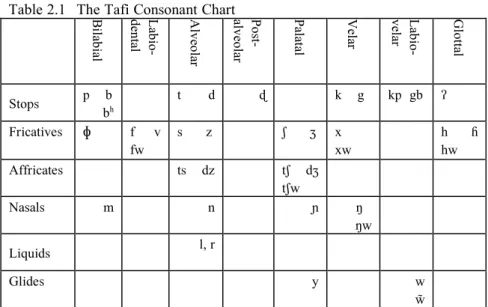
Tafi has five syllable types. These are V/N which is a vowel or nasal; VC, made up of a vowel and a consonant; CV, made up of a consonant and a vowel; CVV which consists of a consonant and a long vowel; CCV which is made up of two consonants and a vowel, the second consonant may be a liquid or a glide. Tafi has consonant phonemes made at these places of articulation: bilabial, labio-dental,
alveolar, post-alveolar, palatal, velar and glottal. The consonants include /bhbhbhbh/ and
/ƒƒƒƒ/. /bhbhbhbh/ is an aspirated voiced labial stop. It has no voiceless counterpart in the
language and occurs in some words including kábhākábhākábhā ‘top’ and bhulí kábhā bhulí bhulí ‘small’. /ƒƒƒƒ/ is a bhulí
voiceless labial fricative which has no voiced counterpart in the language. It appears that this sound was introduced into the language as a result of borrowing
from Ewe. It only occurs in two words which are aƒuaƒuaƒu ‘sea’ and Abuiƒéaƒu AbuiƒéAbuiƒé ‘the name of Abuiƒé
one of the Tafi communities’. Tafi has double articulated labial velar stops /kp//kp//kp/ and /kp/
/gb/
/gb//gb/
/gb/ as well as alveolar and palatal affricates /ts//ts//ts//ts/, /dz//dz//dz//dz/ and /t/t/t/tʃʃʃʃ////, /d/d/dʒʒʒʒ/////d 7 respectively.
Tafi has a nine vowel system. All these vowels except /o//o//o//o/ have nasalised
counterparts. The vowels participate in ATR vowel harmony. Thus, they are
divided into two sets, [+ATR] - / / / / i, e, o, u /i, e, o, u /i, e, o, u /i, e, o, u / and [-ATR] - / / / ɩɩɩɩ, / , , , ɛɛɛɛ, , , , ɔɔɔɔ, , , , ʊʊʊʊ //// as shown in
Table 2.2 below. The /a//a//a//a/ vowel occurs with vowels from both sets. ATR vowel
harmony in Tafi is stem-controlled, in the sense that the vowel of prefixes harmonises with the vowel of the first syllable of the stem. Thus, depending on the [ATR] value of the initial vowel in the root, the prefix may have varied forms. In connected speech, Tafi displays both level and contour tones. It has three level tonemes: High, Mid and Low. In addition to the three levels, there are two gliding tones: Falling and Rising which are phonetically realised on the peak of one
6 The sound I represent as [bhbhbh] is represented as [bvbh bvbvbv] by Casali.
7 The orthographic representation of the IPA symbols /t/t/t/tʃʃʃʃ//// and /d/d/d/dʒʒʒʒ//// are ‘tsy’ and ‘dzy’
syllable.8 There are three falling tones: High-Mid, High-Low and Mid-Low and
two rising tones: Low-Mid and Low-High. The contour tones can be lexical or they can be generated in context. Tones are used for lexical contrast and to express grammatical functions. The notational conventions used for marking tones in this book are as follows: a High tone is marked ( ́); a Low tone is unmarked or marked ( ̀) on nasals; a Mid tone is marked ( ̄); the rising tones are marked ( ̌) and ( ) representing Low-High and Low-Mid respectively and the falling tones are marked ( ), ( ̂), ( ) representing High-Mid, High-Low and Mid-Low tones respectively.
Tafi is an active noun class language and nouns are classified into ten classes comprising five singular classes, one non-count class and four plural classes. Tafi is a language whose basic constituent order is SV/AVO/AVDO. Subjects (S/A) are cross-referenced on the verb with markers that agree with the class of the subject NP except for the two bbbbuuuu- classes. The classes with prefixes containing the vowel
/iiii/, namely iiii----, kikikiki---- and titititi---- classes, are either cross-referenced with the corresponding
subject markers or zero. Some modifiers show agreement with the head noun while others, like the adjective and the ordinal, maintain no concord relationship with the head noun. As regards the cardinal numerals, it is one to nine that show agreement with the head noun. Some modifiers can be nominalised through the addition of nominal prefixes and the pronominal forms of the various noun classes. In double-object (AVDO) constructions, the Goal or Dative precedes the Theme. In locative constructions, the Theme occurs before the Locative. Moreover, adjuncts may occur after the core arguments in the clause.
Tafi has a marked kinship possessive grammar. Singular kinship possession is marked with the 3SG independent pronoun yyyyɩ́ɩ́ɩ́ɩ́ referring to the possessor placed between the possessor and the kinship term. Plural kinship possession is expressed by juxtaposition (see Chapter 4 on Noun phrases).
Tafi has two bona fide prepositions and others that have verbal sources, some of which are undergoing grammaticalisation and one that has completely grammaticalised. Spatial regions and parts are specified by about a dozen or so postpositions in the language. These postpositions are spatial nominals or body-part nouns which are at different stages in the process of grammaticalisation.
There are about eight question words which are used to ask content questions. Two
of which are interrogative modifiers (ɖɖɖɖúweúweúweúwē ‘which’ and ----shshshshɩ̃̄ɩ̃̄ɩ̃̄ɩ̃̄ ‘how many/much’) so
they occur after the head noun. Two of the question words (-shshshshɩ̃̄ɩ̃̄ɩ̃̄ɩ̃̄ ‘how many/much’
and -nnnnɩ̄ɩ̄ɩ̄ɩ̄ ‘who’) show concord with the head noun. When some of the question
8 The tone system of Tafi still presents several analytic challenges which require further
words are in focus, they are followed by the relative marker ggggɩɩɩɩ ‘REL’ or the connector ppppɩɩɩɩ ‘CONN’.
Tafi is a verb serialising language. In serial verb constructions, two or more verbs occur without any overt marker of coordination or subordination. The verbs share at least one argument and same tense and mood which is marked only once on the first verb. The verbs cannot be independently negated. The verbs can be independently focused or questioned. Tense, aspect and mood are mainly marked by preverbs in Tafi and there are about a dozen preverbal markers. Depending on the number of arguments they take, verbs in Tafi are classified as one-place, two-place and three-two-place predicates and they occur in various argument structure constructions such as one-place, two-place and three-place constructions respectively. Tafi has very few non-derived adjectives. However, derived adjectives are formed through reduplication of property verbs. Relativisation, and the use of nominal property words as complements of predicators, medio-passive constructions as well as the use of other qualifiers are other strategies for expressing adjectival meanings.
Like many other languages in the area, Tafi has ideophonic words – marked words that depict sensory images (Dingemanse 2011). Syntactically, they function as nominal modifiers or verbal modifiers.
Topic is marked by a form nnnnɩ́ɩ́ɩ́ɩ́ which is also the form of the definiteness marker. In topic constructions, a noun phrase or a postpositional phrase may be fronted to the left periphery as an external argument of the clause, that is, to sentence initial position. An out-of-focus part of focus utterances, especially those where the
highlighted elements are marked by intensifiers like kokoko ‘just’, are marked by ko
another marker anananɩ́ɩ́ɩ́ɩ́ ‘TOP’. This form is the same as the proximal demonstrative. an
Relative clauses are optionally marked off by the topic marker nnnnɩ́ɩ́ɩ́ɩ́ signalling that they convey background information with respect to the head nominal. Thus, the head noun of the relative clause occurs on the left periphery of the clause and is
followed by the relative clause introduced by the marker ggggɩɩɩɩ. Focus is not marked
by a particle but a subject argument in focus is referred to by an independent pronoun. If the argument focused is not the subject then there is a gap left in its position after it has been fronted (Schachter 1973). Verbs are focused by
nominalising the verb with the class prefix bbbbʊʊʊʊ/bu/bu/bu/bu- of the bubububu1111---- class and then placing
them before the subject NP of the clause. If the subject NP is a pronoun then it is the dependent form of the pronoun that is used.
1.4
1.4
1.4
1.4 Data collection
Data collection
Data collection
Data collection
also learn to speak the language to help enhance my understanding of it. At the beginning of the fieldwork, I elicited data using the Ibadan 400 wordlist as well as the SIL comparative African wordlist which comprises about 1700 words (Snider and Roberts 2004). The data collected using these questionnaires allowed for a preliminary analysis of the phonology and the identification of loan words as well as the nominal class prefixes.
Direct lexical elicitation has an important role in language documentation, however, it also has its limitations (see e.g. Hellwig 2011). Thus, I also recorded spontaneous spoken texts of different genres in the field including folktales, conversations, proverbs, riddles, some procedural discourses etc. in the language. These were supplemented by a Frog Story (FS) narrative description elicited using
the wordless picture book Frog, where are you? (Mayer 1969) and various
standardised picture and video stimuli designed and developed by the Language and Cognition Group at the Max Planck Institute for Psycholinguistics for the investigation of topological relations and the semantics of positional verbs and for semantics of categories, e.g. ‘Cut and Break’ (Bohnemeyer et al. 2001), ‘Put and Take’ (Bowerman et al. 2004) etc. (see fieldmanuals.mpi.nl). Data elicited with these picture and video stimuli are marked as TRPS (Topological Relations Picture Series) (Bowerman & Pederson (1993); PSPV (Picture Series for Positional Verbs) (Ameka et al. 1999) and C&B (‘Cut and Break’) (Bohnemeyer et al. 2001) etc. Supplementary information was obtained from direct elicitation based on questionnaires for linguistic and cultural fieldwork derived from manuals (e.g. Bouquiaux and Thomas 1992, Comrie and Smith 1977, McKinney 2000, Payne 1997, Shopen 2007 volumes, and other questionnaires available at http://www.eva.mpg.de/lingua/resources.php). Informal or structured interviews were also conducted. The data were recorded using a solid state digital audio (Roland Edirol R-09) and video transferred to computer platform for transcription, translation, annotation and interlinearisation. Some phrases, clauses and even full sentences in this grammar have been lifted from the narrative texts as well as from the elicitations.
I elicited information from some children using stimuli and I also recorded a frog story narrative discourse from a youth after which these recordings were played to some adults for comments and the comments I received included “if you want to be working with children this is what you get” and “don’t work with the children, they are destroying the language”. In addition, there is variation among adult speakers. Some speakers tend to simplify the phonological and grammatical processes. This is reflected in the recordings I made of different speakers. It is evident that the noun class system is in the process of decaying in the sense that the agreement system is being simplified, thus for example, it is the subject-verb
agreement markers of the aaaa1111/ba(a)/ba(a)/ba(a)/ba(a)---- classes that are used to cross-reference all
subject NPs on the verb, irrespective of their classes. Similarly, the agreement on
modifiers within the noun phrase are also being generalised to the aaaa1111/ba(a)/ba(a)/ba(a)/ba(a) classes,
for instance the agreement form of the indefiniteness marker modifying a noun of
the oooo---- class such as ɔɔɔɔ----kkkkɔ́ɔ́ɔ́ɔ́ ‘place’ should be ttttoooolílílílí, however, some speakers use tttteeeelílílílí, the
agreement form of the aaaa1111/ba(a)/ba(a)---- classes. I also realised that the phonological /ba(a)/ba(a)
process of ɩɩɩɩ/i/i/i/i---- insertion after the deletion of the initial kkkk of the ka/keka/keka/keka/ke---- prefix (see §
2.5.3) is gradually getting lost from the speech of children so you hear kplkplkplkplɔ̃̌ɔ̃̌ɔ̃̌ɔ̃̌ábhāábhāábhāábhā
instead of kplkplkplkplɔ̃̌ɩɔ̃̌ɩɔ̃̌ɩɔ̃̌ɩábhāábhāábhāábhā (kplkplkplkplɔ̃̌ɔ̃̌ɔ̃̌ɔ̃̌ kábhākábhākábhākábhā (table top)) ‘on a table’. Moreover, some youth
could not enumerate the numerals without mixing them with some Ewe numerals. As regards the adult speakers, most of them condemn the speech of those who make extensive use of Ewe vocabulary however unconsciously some of them indulge in the same practice.
1.5
1.5
1.5
1.5 Methodology and theoretical framework
Methodology and theoretical framework
Methodology and theoretical framework
Methodology and theoretical framework
The methodology adopted in this grammar is a field work based approach to the study of linguistic structures and their use in socio-cultural contexts. I try to describe the Tafi language in its own terms or ‘from the inside’, rather than imposing on the language concepts whose primary motivation comes from other languages.
linguists as well as the interested reader to explain each grammatical phenomenon that will be examined or talked about.
1.6
1.6
1.6
1.6 Outline of the grammar and presentation of data
Outline of the grammar and presentation of data
Outline of the grammar and presentation of data
Outline of the grammar and presentation of data
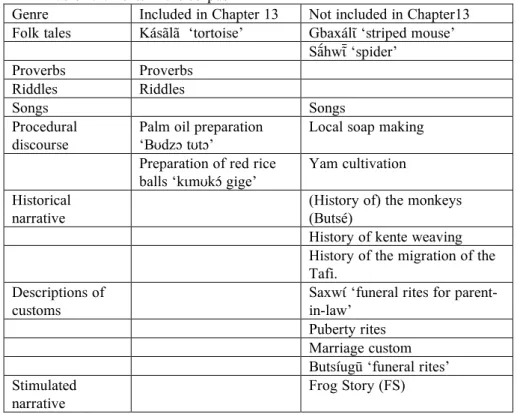
This book is organised as follows: Chapter 2 examines the phonological system of the language. The discussions in Chapters 3 and 4 are devoted to nominals. In Chapter 3, I describe the noun class system of the language whereas in Chapter 4, I look at the various types of noun phrases and the structure of the noun phrase. Chapter 5 focuses on adpositions and adpositional phrases while Chapter 6 examines clause structure and clause types. In Chapter 7, I give a description of verbs and verbal modifiers. Sentence types are presented in Chapter 8 and various clause combinations are described in Chapter 9. In Chapter 10, I discuss Serial Verb Constructions. Routine expressions and formulae used in social interactions are presented in Chapter 11. Three types of words: ideophones, interjections and particles, are discussed in Chapter 12. The final chapter contains a transcription and translation of selected texts in Tafi. Table 1.1 lists the various texts in my corpus showing the ones included or not included in Chapter 13. I have indicated the texts from which various examples are taken against them in the grammar whether they are included in Chapter 13 or not.
Table 1.1: Texts in the corpus
Genre Included in Chapter 13 Not included in Chapter13
Folk tales Kásãlã ‘tortoise’ Gbaxálɩ̃ ‘striped mouse’
Sã́hwɩ̃̄ ‘spider’
Proverbs Proverbs
Riddles Riddles
Songs Songs
Procedural discourse
Palm oil preparation ‘Bʊdzɔ tʊtɔ’
Local soap making
Preparation of red rice balls ‘kɩmʊkɔ́ gige’
Yam cultivation
Historical narrative
(History of) the monkeys (Butsé)
History of kente weaving History of the migration of the Tafi.
Descriptions of customs
Saxwɩ́ ‘funeral rites for parent-in-law’
Puberty rites Marriage custom Butsíugū ‘funeral rites’ Stimulated
narrative
In the grammar, the texts and their translations are presented in four lines as illustrated below:
1. Kásãlã adawʊ̃sɔ̃’iesí.
ká ká ká
ká----sãlãsãlãsãlãsãlã aaaa----dadadada----wwʊ̃ʊ̃ʊ̃ʊ̃ssssɔ̃́ɔ̃́ɔ̃́ɔ̃́ ww kekekeke....sísísísí
CM-tortoise SM-ITIVE-lie down
‘Tortoise went and lay down.’ (Kásãlã)
The Tafi data is presented on the first line showing word divisions. The apostrophe sign (’) is used to indicate deletions. The data is shown in bold with hyphens (-) representing morpheme breaks in the second line. The morphs in the first line are fully spelt out as morphemes in the second line such that initial consonants and syllables deleted are presented in their recoverable forms. The interlinear English gloss and a free English translation given in single quotes are presented in the third and fourth lines respectively. The source of the example if available in the texts is given in brackets. In the above example, the sentence comes from the folk tale of Kasãlã
Kasãlã Kasãlã
Kasãlã ‘tortoise’, hence the name in brackets after the free translation.
Class-markers that are fossilised with grammaticalised nominals are separated from the nominal stems by a full stop indicating the form has a single meaning and to
distinguish it from the nominals, e.g., kekeke....síkesísísí ‘under, beneath’ and kekeke----sí kesí sí ‘bottom, sí
down part’.
The object forms of pronouns are the same as the independent forms of the pronouns. In the glosses on the third line, however, the object forms are not glossed as IND partly because the initial consonants on the object forms tend to be elided.
The following IPA representations /bbbbhhhh/, /ɸɸɸɸ/, /ʃʃʃʃ/, /ʒʒʒʒ/, /ʧʧʧʧ/, /ʧʧʧʧwwww/, /ʤʤʤ/, /ɦɦɦɦ/, /j/ʤ /j//j//j/ and /ɲɲɲɲ/ are
written as ‘bhbhbh’, ‘ƒƒƒƒ’, ‘shbh shshsh’, ‘zhzhzhzh’, ‘tsytsy’, ‘tsywtsytsy tsywtsywtsyw’, ‘dzydzydzydzy’, ‘hhhh’, ‘yyyy’ and ‘nynynyny’ respectively.