In silico discoveries for
biomedical sciences
Promotiecommissie
Promotor prof. dr. J.T. den Dunnen LUMC
Co-promotors dr. B. Mons NBIC
dr. P.A.C. 't Hoen LUMC
dr. M.J. Schuemie EMC Rotterdam
Overige leden prof. dr. ir. M.J.T. Reinders TU Delft
prof. dr. J.N. Kok LIACS Leiden
prof. dr. F. A. H. van Harmelen VU Amsterdam
Herman van Haagen
In silico discoveries for biomedical sciences
ISBN/EAN: 978-90-817676-0-6
In silico discoveries for
biomedical sciences
Proefschrift
ter verkrijging van
de graad van Doctor aan de Universiteit van Leiden
op gezag van Rector Magnificus prof. mr. P. F. van der Heijden
volgens besluit van het College van Promoties
te verdedigen op woensdag 21 september 2011
klokke 11.15 uur
door
Herman van Haagen
Table of content
Chapter Title
Page
1
Introduction
3
2
In silico knowledge and content tracking
19
3
Novel protein-protein interactions inferred
from literature context
32
4
In silico
discovery and experimental validation
of new protein-protein interactions
65
5
Finding gene-disease relations using implicit
information in the scientific literature
98
6
General discussion
115
Summary
127
Samenvatting
130
Chapter 1
Introduction
When a researcher starts a new research project, he performs a literature study. Let’s say he starts with a new project in muscle diseases and he needs to collect information about Duchenne Muscular Dystrophy (DMD). He collects all papers about this topic that are relevant for him. A starting point would simply be to go to the local public library and ask if they have some textbook about DMD. He will also go to Google and enter the topic name or some keywords in the search box; thousands of WebPages pop-up. He is hoping that the first pages contain weblinks that are most relevant for him. Another solution would be to go to more field-specific databases like PubMed (www.pubmed.org). PubMed is the collection of scientific literature for life sciences. This is the place to be for biologists and bioinformaticians.
It is ironic today that the primary problem encountered in literature research is not finding information, but finding too much information. For instance, typing the search query Duchenne muscular dystrophy in PubMed results in more than 6000 hits. Reading 6000 articles is not an option. This problem occurs with other search queries as well. When you need information, in the form of text, you get it but it is simply too much information for any human being to process.
Information overload
Figure 1. The growth of scientific literature over the last 40 years.
Text-mining
Text-mining is a specific sub-field of data-mining. It is the process of extracting meaningful information from human written text with a computer, for instance, the statement “Malaria is transmitted by mosquitoes”. This introduction gives an overview of how text-mining had been developed the last two decades and how it has become an integral part of life science. First we described state of the art search engines and how they tackle the problem of finding relevant documents. Next we introduce the concept as a building block for extracting relevant relationships from text. We then describe how text-mining can be enriched using other non textual data sources. Finally we describe what is discussed in this thesis and coming chapters.
Searching for relevant documents
Mesh Terms. Figure 2 shows schematically what happens in a very simple information retrieval system.
Figure 2. Schematic drawing of a simple text-mining system
In the search bar a query is entered, in this case “duchenne”. The word “duchenne” is scanned in all documents and the documents in which “duchenne” appears are returned. If the document does not contain the word “duchenne”, but the article is about this topic, then the Mesh Terms keyword “duchenne” might be added to the keyword list for this article. This allows the document to be retrieved using a keyword search alone.
Figure 3. Example for a search query when only the first four letters in a search bar are entered.
Box1: Text-mining jargon
Indexing
Indexing is the process of scanning all documents for relevant keywords and storing the keywords per document in a database.
Concept
A concept is the smallest, unambiguous unit of thought. People reach consensus on the same meaning of the concept. In text-mining a concept is uniquely identifiable.
Thesaurus
A thesaurus is a list containing the concepts and all synonyms. In addition it contains accession numbers that are used in databases like Uniprot and Entrez Gene. Most often used thesauri for the biomedical field is UMLS (Unified Medical Language System)[1] and Biothesaurus[3]. Sometimes a combination of different thesauri is made to make the thesaurus more complete and that is covers more terms[4]. For instance UMLS contains less information for proteins. Therefore UMLS information can be complemented with protein information taken from Entrez Gene and Uniprot. An example for Duchenne Muscular Dystrophy is given in figure 4.
Concept recognition software (CRS)
The concepts in text are recognized with concept recognition software (CRS)[5, 6]. A CRS scans a document for words that are stored in the thesaurus. The software recognizes a word and normalizes it. For instance the word mosquitoes is a plural and it is normalized to mosquito.
Ambiguity
Based on the context in which a term appears the CRS needs to disambiguate the term and map it to a concept.
Concept Unique identifier (CUI)
A concept that is uniquely identified in text is assigned a CUI. This is a number that uniquely represents the concept and is used to exchange the concept over different platforms and databases. A CUI normally is specific for the thesaurus that is used. For instance the CUI for Duchenne muscular dystrophy in UMLS is C0013264 (Figure 3)
A specific search query can still result in thousands of retrieved articles that have to be read manually. If a query results in a thousand hits, one might ask whether or not all these documents are equally relevant. Should all documents be read or only a selection? Can the relevance of the documents be prioritized? A first option is then to increase the specificity of the search by adding more search terms to the query.
Is there is a redundancy between articles, in other words, do they share the same information? Redundancy is normally the case, especially in the introduction of the article. A substantial amount of information is repetition of previous articles. Little new knowledge is added per new published article. This is called ‘organized plagiarism’ (quote by Jan Velterop[10]). Reading the same information, though rhetorically useful, is far too time consuming.
More sophisticated systems are those that are able to extract relevant sentences and phrases from text instead of simply counting words and retrieving whole documents. Automatic information extraction from text is more difficult than indexing keywords. Text is structured in such a way that makes it straightforward for humans to read, but very difficult for computers to interpret automatically. An example of a sentence that can be extracted from text is “malaria is transmitted by mosquitoes”. A computer actually needs to understand the meaning of the sentence as we humans do. Processing a sentence like this involves two steps.
1. Recognizing single concepts in text.
2. Mining the relationship into a concept and assertion.
PubMed uses a so called WORD based approach for scanning the literature. Its counterpart is called the concept based approach (see Box 1 for definitions). Concepts in text are recognized using concept recognition software (CRS) and a thesaurus. One of the most important tasks of the CRS is to disambiguate a word (see Box1) and map it to its concept unique identifier (CUI). Once a document is tagged and all concepts are recognized, the CUI of the concepts are stored in a database. Figure 5 shows an example of a document in PubMed tagged by IHOP[11]. IHOP is a text-mining tool based on concepts and is an abbreviation for ‘Information hyperlinked over proteins’. It tags documents especially for proteins and links them if they appear in the same document. IHOP can be found on http://www.ihop-net.org/.
Figure 5. Screenshot of a PubMed abstract. The words highlighted in color are recognized as concepts by IHOP.
triplet. Another group of biomedically relevant triples are the protein-protein interactions (PPIs). For instance the protein Dystrophin (subject) physically interacts (predicate) with the protein Ankyrin-2 (object).
Figure 6. Schematic drawing of a relationship in triplet format.
Extracting relationships can be done in two ways namely:
1.
Natural Language Processing (NLP)2.
Co-occurrences in some defined region of text.NLP is the field within text-mining that studies how a computer analyses a sentence into its building blocks like nouns (e.g. the subject and the object) and verbs (e.g. the predicate). For instance PIE [12] (http://pie.snu.ac.kr/) is an online webtool based on NLP. It is designed to predict PPIs from PubMed abstracts. A similar approach was used in [13], where they used Bayesian networks for finding novel PPIs.
An alternative method for relationship extraction is that of co-occurrences. PubMed contains more than 20 million abstracts online. With this amount of data it is possible to use a statistical approach to extract relations. The co-occurrence approach is to identify concepts that co-occur within abstracts, sentences or full documents[14, 15], assuming that frequently co-occurring concepts have meaningful association. In PPI, the predicate becomes in all cases “is associated with”. The level of association can be calculated using well known statistical tests such as chi square test or Fisher exact test.
Extending text-mining with other data sources: data-mining
The quality of extracted relationships from text can be improved by adding other data sources such as genome sequences, microarray expression data, and annotation databases like the Gene Ontology. This is called data-mining. Data-mining in general contains two steps:
1. Extract information from each database, either non-textual or text.
2. Combine the information from these databases into one statistical measurement.
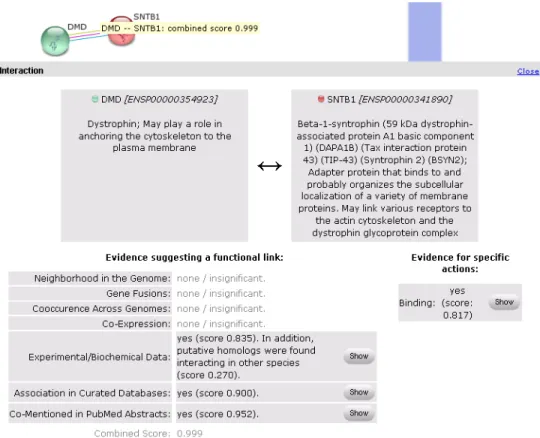
Relationships established by a computer may become more reliable when several data sources are combined, producing an evidence factor for the relationship. There are systems available as online web applications that work on data integration for the extraction of relationships[16, 17]. One of them is STRING[18] (figure 7), where there is evidence for a relationship between the proteins DMD and SNTB1.
Another application is when text-mining assists wetlab experiments in annotating the result. For instance in microarray experiments a set of differentially expressed genes is enriched with information from the literature to find gene functions. This is called gene set enrichment or functional enrichment[19-23]. We have used microarrays to complement text-mining for the prediction of PPIs. This is described in chapter 4.
A web of concepts
The next logical step in building triplets is to make a web of interrelated concepts. Currently the world wide web is evolving towards a concept web or semantic web[24-26] (also called web 3.0). Instead of retrieving documents or WebPages the concept web is a web of related concepts where the relationship is extracted from text and databases. The current web is a network of document whereas the concept web is a network of data (of linked data). One of the first applications in biology would be to generate a web of protein-protein interactions[27, 28]. This we can call the protein interaction space. Figure 8 shows an example of the interaction space surrounding the dystrophin protein generated by STRING.
Figure 8. Example of a protein network surrounded around the dystrophin protein (DMD)
Beyond relationship extraction: Inferred relationships
able to find a relationship in less time or is able to find relationships that are overlooked. However, in theory and with great effort, a human being would have been able to extract the relationship by manual searching.
The goal is that a computer is able to find new relationships that no human being could ever find by hand. It might at first seem impossible for a computer to make discoveries on the basis of literature alone; after all, Information Extraction is only able to extract the facts that have already known (i.e., have been published). The principle of inferred relationship extraction is to use facts that have been extracted from several different publications and link them with each other (concept A affects concept B and B affects concept C). One of the first text-mining pioneers, Don Swanson, hypothesized that words in text can be linked with each other via intermediate words and the links would be something meaningful [33, 34]. Swanson found an example in the medical field where he inferred links between Reynaud’s disease and fish oil based on the mutual association with concepts such as blood viscosity, platelet aggregation, and vascular reactivity. Later research confirmed that this disease can be treated with fish oil. Before the discovery the disease and the ‘drug’ had never been co-mentioned before in any article.
This finding was an inspiration and fundamental result for future work based on the same idea of the A-B-C triplet [35-38]. In most cases it concerns single examples of a biological discovery that was inferred using implicit links. Figure 8 shows a schematic drawing how inferred relationship extraction works. A large scale analysis that proves that this text-mining approach will work for many novel relationships has not been done yet. How much implicit information is there in text? and how effectively can it be inferred are burning questions.
The search space for all possible combinations of related concepts is typically huge. The human genome contains approximately 30,000 genes (and therefore more than 30,000 gene products, e.g. proteins)[39]. The search space for finding protein interaction pairs becomes >900 million possible combinations. Text-mining will not only be useful for knowledge discovery, but also assist a scientist in narrowing this search space to only the most informative protein pairs first.
Figure 9. Principle of inferred relationship extraction. Concept A and B are never co-mentioned together in a document. Therefore they do not have a direct relationship. However, via the intermediate concepts X, Y, and Z an indirect relationship can be inferred.
We believe that the full discovery potential of text-mining tools will only be realized with the advent of data-mining approaches that integrate the literature with other large data sets such as genome sequences, microarray expression data, and annotation databases like the Gene Ontology.
However, these resources are generally not entirely independent from the published literature. For instance, the gene ontology (GO) consortium assigns functional annotations to genes that are usually based on evidence described in literature. Another example is microarray experiments where results are summarized in articles, as well as deposited in a database. Given the partial redundancy of literature and other data sources, the question arises as to what exactly is the added value is of other data sources other than text for the extraction of new relationships.
Lastly, we are interested in the predictive power of knowledge discovery algorithms for different kind of relationships. Is this different for protein-protein interactions than for gene-disease relationships?
Content of this thesis
ROC curves, retrospective studies and how to collect test data. Chapter 3 shows how implicit information extraction from PubMed abstracts works for protein-protein interactions in a large-scale dataset analysis. We compare the implicit information extraction method with the classical direct co-occurrence method. Also the WORD based method (used by Google and PubMed) is compared with the concept based method.
We extend the text-mining part in chapter 4 with other data sources, such as microarrays and Gene Ontology, and evaluate what is the added value of additional data sources. This chapter is therefore about data-mining. We also evaluate different methods to combine data sources and show the pros and cons of each one. We benchmark our system against the application STRING.
In chapter 5 we investigate another type of relationship namely gene mutation in relation to disease. Here, the implicit information extraction is described in detail and we show what the B part is in the A-B-C relationship.
Chapter 6 is the discussion where all findings are outlined and discussed in detail. We will discuss the power of text- and data-mining but also the limitations. We give future recommendations where data-mining, and in particular text-mining, can be improved.
1. Bodenreider, O., The Unified Medical Language System (UMLS): integrating biomedical terminology. Nucleic Acids Res, 2004. 32(Database issue): p. D267-70.
2. Hirschman, L., Park, J.C., Tsujii, J., Wong, L., and Wu, C.H.,
Accomplishments and challenges in literature data mining for biology.
Bioinformatics, 2002. 18(12): p. 1553-61.
3. Liu, H., Hu, Z.Z., Zhang, J., and Wu, C., BioThesaurus: a web-based thesaurus of protein and gene names. Bioinformatics, 2006. 22(1): p. 103-5.
4. Kors, J.A., Schuemie, M.J., Schijvenaars, B.J.A., Weeber, M., and Mons, B., Combination of genetic databases for improving identification of genes and proteins in text. BioLINK, 2005
5. Schuemie, M.J., Jelier, R., and Kors, J.A. Peregrine: Lightweight gene name normalization by dictionary lookup. in Biocrative 2 workshop. 2007. Madrid.
7. Mons, B., Which gene did you mean? BMC Bioinformatics, 2005. 6: p. 142.
8. Manning, C., Raghavan, P., and Schütze, H., Introduction to Information Retrieval. 2008: Cambridge University Press.
9. Rebholz-Schuhmann, D., Kirsch, H., and Couto, F., Facts from text--is text mining ready to deliver? PLoS Biol, 2005. 3(2): p. e65.
10. Velterop, J., Open Access: Science Publishing as Science Publishing Should Be. Serials Review, 2004. 30(4): p. 308-309.
11. Hoffmann, R. and Valencia, A., A Gene Network for Navigating the Literature. Nature Genetics, 2004. 36: p. 664.
12. Kim, S., Shin, S.Y., Lee, I.H., Kim, S.J., Sriram, R., et al., PIE: an online prediction system for protein-protein interactions from text. Nucleic Acids Res, 2008. 36(Web Server issue): p. W411-5.
13. Chowdhary, R., Zhang, J., and Liu, J.S., Bayesian inference of protein-protein interactions from biological literature. Bioinformatics, 2009.
25(12): p. 1536-42.
14. J. DING, D. BERLEANT, D. NETTLETON, and WURTELE, E. MINING
MEDLINE: ABSTRACTS, SENTENCES, OR PHRASES? . in Pacific Symposium on Biocomputing. 2003.
15. Lin, J., Is searching full text more effective than searching abstracts? BMC Bioinformatics, 2009. 10: p. 46.
16. Alexeyenko, A. and Sonnhammer, E.L., Global networks of functional coupling in eukaryotes from comprehensive data integration. Genome Res, 2009. 19(6): p. 1107-16.
17. Aerts, S., Lambrechts, D., Maity, S., Van Loo, P., Coessens, B., et al.,
Gene prioritization through genomic data fusion. Nat Biotechnol, 2006.
24(5): p. 537-44.
18. Jensen, L.J., Kuhn, M., Stark, M., Chaffron, S., Creevey, C., et al.,
STRING 8--a global view on proteins and their functional interactions in 630 organisms. Nucleic Acids Res, 2009. 37(Database issue): p. D412-6. 19. Jelier, R., t Hoen, P.A., Sterrenburg, E., den Dunnen, J.T., van Ommen,
G.J., et al., Literature-aided meta-analysis of microarray data: a compendium study on muscle development and disease. BMC Bioinformatics, 2008. 9: p. 291.
20. Minguez, P., Al-Shahrour, F., Montaner, D., and Dopazo, J., Functional profiling of microarray experiments using text-mining derived bioentities.
Bioinformatics, 2007. 23(22): p. 3098-9.
21. Jelier, R., Jenster, G., Dorssers, L.C., Wouters, B.J., Hendriksen, P.J., et al., Text-derived concept profiles support assessment of DNA microarray data for acute myeloid leukemia and for androgen receptor stimulation.
22. Natarajan, J., Berrar, D., Dubitzky, W., Hack, C., Zhang, Y., et al., Text mining of full-text journal articles combined with gene expression analysis reveals a relationship between sphingosine-1-phosphate and invasiveness of a glioblastoma cell line. BMC Bioinformatics, 2006. 7: p. 373.
23. Kuffner, R., Fundel, K., and Zimmer, R., Expert knowledge without the expert: integrated analysis of gene expression and literature to derive active functional contexts. Bioinformatics, 2005. 21 Suppl 2: p. ii259-67. 24. Robu, I., Robu, V., and Thirion, B., An introduction to the Semantic Web
for health sciences librarians. J Med Libr Assoc, 2006. 94(2): p. 198-205. 25. Burger, A., Romano, P., Paschke, A., and Splendiani, A., Semantic Web
Applications and Tools for Life Sciences, 2008--preface. BMC Bioinformatics, 2009. 10 Suppl 10: p. S1.
26. Berners-Lee, T., Hendler, J., and Lassila, O., The Semantic Web A new form of Web content that is meaningful to computers will unleash a revolution of new possibilities. 2001.
27. Wu, J., Vallenius, T., Ovaska, K., Westermarck, J., Makela, T.P., et al.,
Integrated network analysis platform for protein-protein interactions. Nat Methods, 2009. 6(1): p. 75-7.
28. Jenssen, T.K., Laegreid, A., Komorowski, J., and Hovig, E., A literature network of human genes for high-throughput analysis of gene expression.
Nat Genet, 2001. 28(1): p. 21-8.
29. Krallinger, M. and Valencia, A., Text-mining and information-retrieval services for molecular biology. Genome Biol, 2005. 6(7): p. 224.
30. Cohen, K.B. and Hunter, L., Getting started in text mining. PLoS Comput Biol, 2008. 4(1): p. e20.
31. Rzhetsky, A., Seringhaus, M., and Gerstein, M.B., Getting started in text mining: part two. PLoS Comput Biol, 2009. 5(7): p. e1000411.
32. Rodriguez-Esteban, R., Biomedical text mining and its applications. PLoS Comput Biol, 2009. 5(12): p. e1000597.
33. Swanson, D.R., Fish oil, Raynaud's syndrome, and undiscovered public knowledge. Perspect Biol Med, 1986. 30(1): p. 7-18.
34. Swanson, D.R., Medical literature as a potential source of new knowledge.
Bull Med Libr Assoc, 1990. 78(1): p. 29-37.
35. Wren, J.D., Bekeredjian, R., Stewart, J.A., Shohet, R.V., and Garner, H.R.,
Knowledge discovery by automated identification and ranking of implicit relationships. Bioinformatics, 2004. 20(3): p. 389-98.
36. Srinivasan, P. and Libbus, B., Mining MEDLINE for implicit links between dietary substances and diseases. Bioinformatics, 2004. 20 Suppl 1: p. i290-6.
37. Swanson, D.R., Migraine and magnesium: eleven neglected connections.
38. Swanson, D.R., Somatomedin C and arginine: implicit connections between mutually isolated literatures. Perspect Biol Med, 1990. 33(2): p. 157-86.
39. Claverie, J.M., Gene number. What if there are only 30,000 human genes?
Science, 2001. 291(5507): p. 1255-7.
40. Jelier, R., Schuemie, M.J., Roes, P.J., van Mulligen, E.M., and Kors, J.A.,
Chapter 2
In silico knowledge and content tracking
H.H.H.B.M. van Haagen, B. Mons
Abstract
We give a brief overview of a text-mining pipeline and the techniques allow explicit and implicit knowledge to be extracted from large text collections. First, a given ontology is used to tag terms in text as machine-readable concepts. Second, concepts are associated with each other using 2x2 contingency tables and test statistics. Third, from the contingency tables informative pair-wise links between concepts can be recovered. These links may be explicitly stated or implied through indirect associations. Fourth, validation techniques such as ROC curves and retrospective studies can be used to quantify the performance of the information extraction and knowledge discovery process. Lastly, we discuss methods combining text information with various non-textual data sources such as microarray expression data.
We conclude with a brief look at future directions for text-mining and knowledge discovery on the internet at large.
Keywords: text-mining, data-mining, information retrieval, disambiguation, retrospective analysis, ROC curve, prioritizer, ontology, semantic web
1 Introduction
The amount of biomedical literature is growing tremendously. It has become impossible for researchers to read all publications in their moving field of interest, which forces them to make a stringent selection of relevant articles to read. For the actual knowledge discovery process, which is in essence a systematic association process over an expanding number of interrelated concepts, life scientists
increasingly rely on the computer. This stringent reduction of the percentage of relevant articles that can actually be ‘read’ has the disadvantage that relevant information from non-selected articles can be missed. The largest database of recorded biomedical literature is PubMed, which contains over 14 million articles published in the last 30 years (from 1980 till 2010). Besides the literature there are many other resources ranging from curated databases to online blogs, digital books recorded in libraries, and any text information that can be found via a search engine like Google.
search query and matches it with words found in abstracts with no additional information how the words are related with other words in text. In this chapter we describe the concept based method for automated information extraction from text.
2 Concept based text-mining
For concept based text-mining three ‘ingredients ‘are needed: (1) text data (2) a word tagger, and (3) a terminology system, mostly controlled vocabulary, or ontologies.
For biomedical text data, normally the abstracts recorded in PubMed are chosen. Reasons for this are that this is the greatest source of recorded literature, the abstracts are publically available and free to download, and the information density of abstracts is higher than that of full text documents (1).
Words in text are recognized by a so called word tagger and mapped to a concept identifier (2). In order to do so we first need to understand what a concept is. A concept is a unit of thought meaning that people agree that they share information about one and the same thing. A concept has terms and other ‘tokens’ that ‘refer’ to it. It can have synonyms, abbreviations, but also for instance Uniform Resource Identifiers (URI’s) or accession numbers.
For instance, there exists a protein called dystrophin. When the gene encoding for this protein is mutated it can cause diseases such a Duchenne muscular dystrophy or Becker muscular dystrophy. Dystrophin normally is abbreviated to DMD. DMD (either in italic) also refers to the gene or the disease. Dystrophin is stored in databases like Entrez Gene (http://www.ncbi.nlm.nih.gov/gene) with the accession number 1756 and Uniprot Knowledge Database (http://www.uniprot.org/) with accession number P11532. The words dystrophin, DMD, 1756, and P11532 all refer to one and the same concept (we treat a gene and a protein as the same concept). The tagger maps the words to the concept identifier for dystrophin. Lastly the synonyms, abbreviations, accession numbers, and concept identifiers are stored in an Ontology. The most common vocabulary for the biomedical field is the unified medical language system (UMLS)(3). An Ontology may be field specific. If only drug information from text needs to be extracted a drug-vocabulary is used instead of the whole vocabulary with all medical concepts.
3 Classical direct relationship detection
interaction, (2) a mutated gene that causes a disease, (3) a protein that has a
particular function and (4) a drug that treats a disease or has a (adverse) side effect. Any relationship between two concepts can be seen as a triplet with a subject, predicate and object. An example of a triplet is protein dystrophin (subject) interacts with (predicate) protein ankyrin 2 (object).
The statistical way to define the strength of relationship between two concepts is by making a 2x2 contingency table (or frequency table). The table below gives an example for concepts X and Y.
X Not X
Y A B
Not Y C D
A are the number of documents where both concept X and Y are co-mentioned. B
are the number of documents where concept Y occurs but not concept X. C is the reverse version of B and D are the number of documents where X and Y are not mentioned. Any statistical test can be applied to this table such as the likelihood ratio test, chi-squared test or the uncertainty coefficient. If X and Y are frequently co-mentioned together (e.g.A is a relatively large number) and the concepts are not exceptionally generic so that they occur frequently in text (e.gB and C are small) then the two concepts may be significantly related. There are many text-mining systems available based on direct relationship detection such as IHOP(4), PubGene(5), and systems where text-mining is an integral part such as STRING(6), FunCoup(7), and Endeavour(8).
4 Implicit information extraction via concept profiling
The classical direct relationship detection method has the disadvantage that concepts that are not co-mentioned together are missed, while they still might be related to each other. This could be due to the reason that related concepts are stored in full text (frequently not freely available for mining) and not in the abstract or that concepts are related but no-one made the link yet. Via indirect links between terms in text, terms can still be related to each other even when they have never been co-mentioned - (9). This we call implicit information extraction. Swanson et.al. (10) were the first to demonstrate that this approach works by linking the treatment of Raynaud's disease with fish oil. Van Haagen et. al. (11)
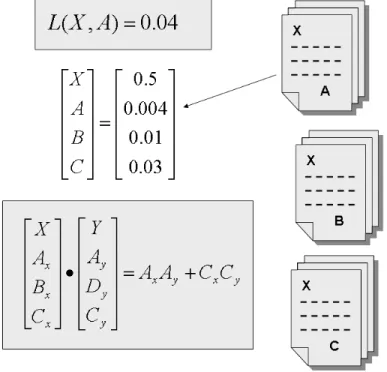
Concept profiling contains the following steps (see Fig. 1). First for a concept X (e.g a gene, a chemical or drug) the documents are selected wherein X appears. Next all other concepts that are co-mentioned with X are processed using the direct relationship detection method described previously (Fig. 1b). The 2x2 table information for each concept pair is stored in a profile. This concept profile for X is basically a vector of N dimensions. N are the number of concepts that are co-mentioned with X. Each entry in the vector is a number associating concept X with another concept (taken from a 2x2 table, Fig. 1a). Computation of the ‘conceptual association’ between two concepts can now be performed by matching their respective concept profiles by vector matching (Fig. 1c). Any distance measure can be used for this matching(9) such as the inner product, cosine, angle, Euclidean distance or Pearson’s correlation. If two concept profiles have many concepts in their individual concept profiles in common, e.g. many implicit links, then the two concepts may be related to each other. A webtool is available, dubbed ‘Anni’, for implicit information extraction by concept profiling(12). In the next section we will describe how to validate text-mining approaches and the amount of relatedness.
Figure 1. Basic scheme for concept based profiling. (a) Example of a likelihood function calculated between concept X and A. Information is taken from a 2x2 contingency table. The score reflects the strength of association between X and A. (b) Documents selected where concept X appears and is co-mentioned with other
concept profiles. The score is only calculated over the concepts the two profiles have in common.
5 Cross validation within text-mining and other performance measures 5.1 Defining a positive and a negative set.
In the previous sections we described how to extract relationships (content) between concepts from text either with direct relationship detection or concept profiling. Once a system is designed it needs to be tested to evaluate its performance in extracting or predicting relationships. To enable this step we need data to train the system and after training testing it. For instance data on protein function can be collected from the Gene Ontology (13) and data on gene-disease relationships from OMIM (http://www.ncbi.nlm.nih.gov/omim). Here we describe an example of the relationship type protein-protein interactions (PPIs). PPIs can be collected from online databases such as UniProt(14), DIP(15), BioGrid(16) and Reactome(17). These samples of curated protein-protein interactions are labeled as positives instances. These positives instances are compared with negative instances to see if the text-mining system can discriminate between the two groups. In biology research no databases exists that stores samples of negatives instances, e.g.
two proteins that have been confirmed not to interact. Normally generating negative instances is done by selecting random pairs from a group of proteins(18).
5.2 Receiver operating characteristics curves
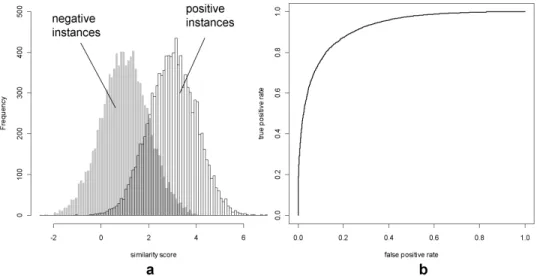
point a number of positive and negative instances will pass the threshold resulting in a point in ROC space anywhere between 0 and 1 on both axes. Finally the threshold reaches the extreme left point on the x-axis (around -2, Fig. 2a). Here all positive and negative instances pass this threshold. This corresponds with the point (1,1) in ROC space (top right corner Fig. 2b).
To translate the ROC space to a single measurement for performance we calculate the Area under the ROC curve (AuC). The AuC value normally varies between 0.5 and 1.
If a system shows a random behavior (e.g. two completely overlapping distributions, no discrimination between positive and negative set) the ROC space results in a straight line from the point (0,0) to (1,1). This corresponds with an AuC of 0.5. If a system behaves like a perfect classifier the ROC curve starts at point (0,0) and moves up to point (0,1) (e.g. first all positive instances are predicted) then it moves from point (0,1) to point (1,1) (e.g. all negative instances are predicted). This corresponds with an AuC of 1. The AuC for the example in Fig. 2 is 0.92.
Figure 2. Histogram and its corresponding ROC plot. (a) the distribution of the positive and negative set. (b) a ROC curve with an AuC of 0.92.
5.3 Cross validation and bias
10-fold CV. The first step (1) is to randomly shuffle the samples in your dataset (both positive and negative instances). (2) Then the dataset is divided into 10 equally sized subsets. Each piece contains samples of the positive and negative set. (3) In one iteration, 9 of the 10 subsets is used for training and the remaining subset is used for testing. (4) Step three is repeated until each subset is used once for testing. An extremely important step during cross validation is to make sure that none of the test data is used during training. Else this would introduce a bias and gives an overestimation of the true performance. Within the field of text-mining and biology this seems virtually impossible. Most of the data stored in curated databases, such as protein-protein interactions or gene-disease relationships recorded in OMIM are based on published articles. This means that positives instances in the test set are based on articles that are also used to train a text-mining system. Other data sources also have this problem. For instance the Gene Ontology contains functional descriptions for a protein that are normally also based on literature evidence. In order to evaluate prediction performance it is therefore more appropriate to make use of a retrospective analysis
5.4 Retrospective validation
Before we explain the basics of retrospective validation, we need to distinguish between two types of prediction. The first one is prediction of current knowledge stored in databases. This knowledge is already known and the system recovers what is stored in these databases. For this, the cross-validation approach described above is useful.
5.5 Prioritizers
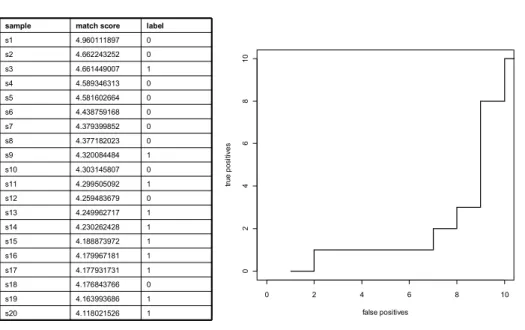
Another way to view a ROC curve is as a prioritized list. The ROC curve is constructed by varying the threshold. The samples (e.g. protein pairs either a PPI or random) are ranked from the highest match score to the lowest. Going down in this ranked list from the top prediction to the lowest is done by walking over the ROC curve from point (0,0) to point (1,1). Experimental biologists are mainly interested in what is predicted in the top, e.g. the most likely predictions. Prioritizers are useful to evaluate where your test samples rank in the top. A ROC curve can also be plotted on the absolute scales of true positives and false positives by translating a prioritized list in a graphical way. Figure 3 shows an example of 20 ranked samples and its corresponding ROC curve. This curve is also called a ROC10 curve. It reflects the amount of true positive predictions (baits) at a fixed number of false positives (the costs), in this case 10. You can vary this threshold and define for instance a ROC50 or ROC100 curve.
0 2 4 6 8 10
0 2 4 6 8 1 0 false positives tr ue p o si tiv e s 1 4.118021526 s20 1 4.163993686 s19 0 4.176843766 s18 1 4.177931731 s17 1 4.179967181 s16 1 4.188873972 s15 1 4.230262428 s14 1 4.249962717 s13 0 4.259483679 s12 1 4.299505092 s11 0 4.303145807 s10 1 4.320084484 s9 0 4.377182023 s8 0 4.379399852 s7 0 4.438759168 s6 0 4.581602664 s5 0 4.589346313 s4 1 4.661449007 s3 0 4.662243252 s2 0 4.960111897 s1 label match score sample
Figure 3. Prioritized list of 20 samples and its corresponding ROC10 curve.
Text-mining actually is a subdivision of the broader field of data-mining. Data-mining is the field of research to extract any kind of information from a variety of resources. For instance, there are many data sources available for proteins. Besides the literature, there exists information in curated databases, microarray expression
data(21, 22), domain interaction databases(23), functional annotations from the
Gene Ontology, phylogenetic trees and sequence data. There are many tools and techniques available for data-mining on databases but they all share a common idea. To combine all information from several distinct data sources into one should reveal more information than can be recovered by the mining of each data source alone. Data-mining basically is a two step approach. The first step is to define a match or evidence score for every data source that is included in the system. For instances a microarray dataset may be transformed into a data matrix by calculating Pearson correlations between any two expression profiles for proteins or genes. The second step is to combine each evidence score for a data source into a single score. This can be done, for instance, using a Bayesian classifier. For protein-protein interactions there are several resources available based on data-mining techniques such as STRING(6), FunCoup(7), IntNetDB(24), and Prioritizer(25).
7 Beyond data-mining and scalable technology for the internet: the semantic web
Data-mining and text-mining are fields of technology that are used for the future web 3.0 technology: the semantic web (SW). The first trend in web technology (or web 1.0) included the static webpages that made the first version of the internet. No information exchange was possible, just readable plain text pages. The second trend (web 2.0) made it possible for users to interact with the internet. Think of uploading movies to YouTube, or writing your blog online and online shopping with a credit card. Web 2.0 is really the most unstructured and scattered form of information. Therefore, the new trend became web 3.0. It will structure the internet into a network of concepts and relationships between these concepts. Other terms for web 3.0 are the concept web or the semantic web. One of the goals of the web is to present information in a computer readable compact format instead of the current webpages that are retrieved after a search query. The predictions that are made using concept profiles or other technologies will be part of this SW.
there (machine learning, information theory, pattern recognition, first order logic). All information on LarKC can be found on http://www.larkc.eu.
8 References
1. Schuemie, M. J., Weeber, M., Schijvenaars, B. J., van Mulligen, E. M., van der Eijk, C. C., Jelier, R., Mons, B., and Kors, J. A. (2004) Distribution of information in biomedical abstracts and full-text publications,
Bioinformatics20, 2597-2604.
2. Schuemie, M. J., Jelier, R., and Kors, J. A. (2007) Peregrine: Lightweight gene name normalization by dictionary lookup, in Biocrative 2 workshop, pp 131-140, Madrid.
3. Bodenreider, O. (2004) The Unified Medical Language System (UMLS):
integrating biomedical terminology, Nucleic Acids Res32, D267-270.
4. Hoffmann, R., and Valencia, A. (2004) A Gene Network for Navigating
the Literature, Nature Genetics36, 664.
5. Jenssen, T. K., Laegreid, A., Komorowski, J., and Hovig, E. (2001) A
literature network of human genes for high-throughput analysis of gene expression, Nat Genet28, 21-28.
6. Jensen, L. J., Kuhn, M., Stark, M., Chaffron, S., Creevey, C., Muller, J., Doerks, T., Julien, P., Roth, A., Simonovic, M., Bork, P., and von Mering, C. (2009) STRING 8--a global view on proteins and their functional interactions in 630 organisms, Nucleic Acids Res37, D412-416.
7. Alexeyenko, A., and Sonnhammer, E. L. (2009) Global networks of functional coupling in eukaryotes from comprehensive data integration,
Genome Res19, 1107-1116.
8. Aerts, S., Lambrechts, D., Maity, S., Van Loo, P., Coessens, B., De Smet, F., Tranchevent, L. C., De Moor, B., Marynen, P., Hassan, B., Carmeliet, P., and Moreau, Y. (2006) Gene prioritization through genomic data fusion, Nat Biotechnol24, 537-544.
9. Jelier, R., Schuemie, M. J., Roes, P. J., van Mulligen, E. M., and Kors, J. A. (2008) Literature-based concept profiles for gene annotation: the issue of weighting, Int J Med Inform77, 354-362.
10. Swanson, D. R. (1986) Fish oil, Raynaud's syndrome, and undiscovered
public knowledge, Perspect Biol Med30, 7-18.
11. van Haagen, H. H. H. B. M., t Hoen, P. A. C., Botelho Bovo, A., de
12. Jelier, R., Schuemie, M. J., Veldhoven, A., Dorssers, L. C., Jenster, G., and Kors, J. A. (2008) Anni 2.0: a multipurpose text-mining tool for the life sciences, Genome Biol9, R96.
13. Gene Ontology, C. (2000) Gene ontology: tool for the unification of biology, pp 25 - 29.
14. (2009) The Universal Protein Resource (UniProt) 2009, Nucleic Acids Res 37, D169-174.
15. Salwinski, L., Miller, C. S., Smith, A. J., Pettit, F. K., Bowie, J. U., and Eisenberg, D. (2004) The Database of Interacting Proteins: 2004 update,
Nucleic Acids Res32, D449-451.
16. Stark, C., Breitkreutz, B. J., Reguly, T., Boucher, L., Breitkreutz, A., and Tyers, M. (2006) BioGRID: a general repository for interaction datasets,
Nucleic Acids Res34, D535-539.
17. Matthews, L., Gopinath, G., Gillespie, M., Caudy, M., Croft, D., de Bono, B., Garapati, P., Hemish, J., Hermjakob, H., Jassal, B., Kanapin, A., Lewis, S., Mahajan, S., May, B., Schmidt, E., Vastrik, I., Wu, G., Birney, E., Stein, L., and D'Eustachio, P. (2009) Reactome knowledgebase of human biological pathways and processes, Nucleic Acids Res37, D619-622.
18. Ben-Hur, A., and Noble, W. (2006) Choosing negative examples for the
prediction of protein-protein interactions, p S2, BMC Bioinformatics.
19. Fawcett, T. (2003) ROC Graphs: Notes and Practical Considerations for
Data Mining Researchers, Hewlett-Packard Company.
20. Wessels, L. F., Reinders, M. J., Hart, A. A., Veenman, C. J., Dai, H., He, Y. D., and van't Veer, L. J. (2005) A protocol for building and evaluating predictors of disease state based on microarray data, Bioinformatics 21, 3755-3762.
21. Obayashi, T., Hayashi, S., Shibaoka, M., Saeki, M., Ohta, H., and Kinoshita, K. (2008) COXPRESdb: a database of coexpressed gene networks in mammals, Nucleic Acids Res36, D77-82.
22. Su, A. I., Wiltshire, T., Batalov, S., Lapp, H., Ching, K. A., Block, D., Zhang, J., Soden, R., Hayakawa, M., Kreiman, G., Cooke, M. P., Walker, J. R., and Hogenesch, J. B. (2004) A gene atlas of the mouse and human protein-encoding transcriptomes, Proc Natl Acad Sci U S A 101, 6062-6067.
integrated documentation resource for protein families, domains and functional sites, Brief Bioinform3, 225-235.
24. Xia, K., Dong, D., and Han, J. D. (2006) IntNetDB v1.0: an integrated
protein-protein interaction network database generated by a probabilistic model, BMC Bioinformatics7, 508.
Chapter 3
Novel protein-protein interactions inferred from
literature context
H.H.H.B.M. van Haagen
1, P.A.C. ’t Hoen
1, A. Botelho Bovo
2, A. de
Morree
1, E.M. van Mulligen
1, C. Chichester
1, J.A. Kors
1, J.T. den Dunnen
1,
G.J.B. van Ommen
1, S.M. van der Maarel
1, V. Medina Kern
2, B. Mons
1,
M.J. Schuemie
11 Biosemantics Association, Department of Human Genetics, Leiden University Medical Center, Leiden, and Department of Medical Informatics, Erasmus University Medical Center, Rotterdam, The Netherlands
2 Post-Graduate Program in Knowledge Engineering and Management (EGC), Federal University of Santa Catarina (UFSC), Florianópolis, Brazil
Abstract
We have developed a method that predicts Protein-Protein Interactions (PPIs) based on the similarity of the context in which proteins appear in literature. This method outperforms previously developed PPI prediction algorithms that rely on the conjunction of two protein names in MEDLINE abstracts. We show significant increases in coverage (76% versus 32%) and sensitivity (66% versus 41% at a specificity of 95%) for the prediction of PPIs currently archived in 6 PPI databases. A retrospective analysis shows that PPIs can efficiently be predicted before they enter PPI databases and before their interaction is explicitly described in the literature. The practical value of the method for discovery of novel PPIs is illustrated by the experimental confirmation of the inferred physical interaction between CAPN3 and PARVB, which was based on frequent co-occurrence of both proteins with concepts like Z-disc, dysferlin, and alpha-actinin. The relationships between proteins predicted by our method are broader than PPIs, and include proteins in the same complex or pathway. Dependent on the type of relationships deemed useful, the precision of our method can be as high as 90%. The full set of predicted interactions is available in a downloadable matrix and through the webtool Nermal, which lists the most likely interaction partners for a given protein. Our framework can be used for prioritizing potential interaction partners, hitherto undiscovered, for follow-up studies and to aid the generation of accurate protein interaction maps.
Introduction
extracted from MEDLINE and other sources is freely available in the STRING database[10], or can be found by querying the iHOP website[11].
However, text mining can go one step further; by combining known associations, previously unknown PPIs can be inferred. Because most text mining research, including this study, limits itself to MEDLINE abstracts, these ‘previously unknown’ interactions also include interactions that are effectively known, but not explicit in MEDLINE as they are only mentioned in a full text article. Swanson[12, 13] et al. were the first to demonstrate that text mining can lead to the discovery of new knowledge (e.g. the treatment of Raynaud’s disease by fish oil). Other studies in the biomedical domain verified the importance of implicit information for knowledge discovery[14-16]. Whereas Swanson used a word-based approach, linking entities by intermediate words that appeared frequently in the contexts of both entities, in our work we use a concept-based approach: different terms denoting the same concept (i.e. synonyms) are mapped to a single concept identifier, and ambiguous terms, e.g., identical terms used to indicate different concepts (i.e. homonyms) are resolved by a disambiguation algorithm. Such an approach is essential given the wide diversity and many ambiguities in gene and protein nomenclature[17, 18].
In order to predict PPIs, we summarize the typical context in which each protein appears into concept profiles[15, 16, 19]. We hypothesize that a high similarity between the concept profiles of two proteins is indicative for an actual biological interaction. For example, if two proteins are consistently mentioned together with a particular disease, the probability that these proteins interact is higher than the a priori probability of two randomly selected proteins[20, 21]. This probability should increase further when they are also frequently co-mentioned with a particular pathway, a sub-cellular localization, or other proteins.
These predictions will be useful for (i) the ranking of potential PPIs for more specific experimental analysis, and (ii) complementing other types of data such as co-expression and yeast two-hybrid data when using an integrative systems biology approach.
Results
Improved PPI detection using concept profiles
We compared the performance of different PPI prediction approaches in detecting known human PPIs in MEDLINE. The online human-curated databases Biogrid, DIP, HPRD, MINT, Reactome, and UniProt/Swiss-Prot were used to establish a set of 61,807 known human PPIs. A set of probable Non-Interacting Protein Pairs (NIPPs) was generated from all pairs of proteins that do not occur in the above databases nor in the IntAct[22] database, which includes, in addition to all PPIs recorded in UniProt/Swiss-Prot, many non-curated PPIs from high-throughput experiments. We compare four approaches:
• Word-based direct relation. This approach uses direct PubMed queries (words) to detect if proteins co-occur in the same abstract. This is the simplest approach and represents how biologists might use PubMed to search for information.
• Concept-based direct relation. This approach uses concept-recognition software to find PPIs, taking synonyms into account, and resolving homonyms. Here two concepts (in our case two proteins) are detected if they co-occur in the same abstract.
• STRING[10]. The STRING database contains a text mining score which is based on direct co-occurrences in literature.
• Concept profile-based relation. This approach uses the similarity in literature context. Here two proteins (concepts) can also be indirectly related via the concepts in their profiles. More detail on concept profiles and their construction can be found in the Methods section.
The word-based and concept-based direct relation methods could find at least one abstract containing both proteins for respectively 33% and 32% of the pairs in the PPI set. A text mining score from STRING could be obtained for 30% of the PPIs, in line with the co-occurrence based approach used to create STRING. Thus, a majority of the known PPIs cannot be found explicitly in MEDLINE. For the concept profile-based approach, we could create concept profiles and calculate a similarity score for 76% of the PPI set.
continuous scores can be used to rank protein pairs. After ranking the pairs in the PPI and in the NIPP set, we calculated the sensitivity at a specificity of 99% and 95%, and the Area under the Curve (AuC), which is often used in the evaluation of classifiers, and expresses the area under the Receiver Operator Characteristics (ROC) curve (see supplement S5). An AuC of 0.5 indicates a random classifier; an AuC of 1 indicates a perfect classifier. For this analysis, we limited ourselves to those pairs in the PPI and NIPP set for which all methods could make a prediction. We analyzed 44,920 pairs in the PPI set, and 58,388,409 pairs in the NIPP set. The results show that, using concept profiles, we can detect 43% of the known PPIs, with a specificity of 99%, and 66% of all known PPIs with a specificity of only 95%. In contrast, the direct relations methods and STRING show much lower scores (Table S1).
Table 1. Performance of different PPI prediction approaches on detecting known PPIs in MEDLINE. CDR stands for Concept-based Direct Relation method.
Word-based CDR Concept profiles STRING
Sensitivity at spec = 99% 28% 37% 43% 39%
Sensitivity at spec = 95% 33% 41% 66% 41%
Figure 1. Histogram of the distributions of similarity scores of the concept profile-based method for the PPI and NIPP sets. A log transformation is applied to the similarity scores for better visualization.
Proteins connected via one intermediate protein
Table 2. Performance on predicting proteins that are connected via an intermediate protein.
Concept-based CDR
STRING
Sensitivity at spec = 99% 8% 9% 8%
Sensitivity at spec = 95% 13% 29% 12%
Area under Curve 0.54 0.78 0.53
Average prediction performance per protein
Most researchers will not be interested in all PPIs, but only in those interactions involving a (set of) protein(s) of interest. Therefore, for each protein we created a top 10, top 100, and top 1,000 best matching proteins according to the concept-based direct relation, the concept profile method, and STRING. In these lists, we calculated the number of PPIs that are either (i) part of the PPI set, or (ii) described in the IntAct database, or else (iii) part of the pairs that are connected through intermediate proteins as described in the previous section. We limited our analyses to the 10,812 proteins that were detected in at least five MEDLINE abstracts (covered by the concept profiles method). The averages of these performance measures in terms of precision and recall are shown in Table S3. For comparison, the average total number of pairs per protein in each set is provided in the third column. For instance, on average each protein is involved in 8.73 interactions according to the PPI set, of which on average 6.34 are found in the top 1,000 of the concept profile method (precision and recall of 0.006 and 0.73 respectively) , and only 3.93 and 3.83 in the top 1,000 of the concept-based direct relation method and STRING respectively. The latter two methods show a slightly better performance for the top 10. Thus, it appears that co-occurrence-based methods can detect a smaller number of PPIs with a somewhat higher accuracy, but the concept profile method, by including indirect evidence, can predict more PPIs and is therefore likely to be more valuable for actual knowledge discovery.
Table 3. Analysis of the top 10, 100, and 1,000 returned by the Concept Profile (CP) method, the Concept-based Direct Relation (CDR) method, and by STRING. The analysis shows the precision and recall of protein pairs that are in the PPI set, of additional pairs
Top 10 Top 100 Top 1,000
Method Total Precision Recall Precision Recall Precision Recall
PPI
CP 8.73 0.096 0.110 0.033 0.37 0.006 0.73
CDR 8.73 0.108 0.124 0.026 0.30 0.004 0.45
STRING 8.73 0.112 0.128 0.026 0.30 0.004 0.44
IntAct
CP 1.61 0.009 0.056 0.002 0.12 0.000 0.29
CDR 1.61 0.009 0.056 0.002 0.11 0.000 0.24
STRING 1.61 0.008 0.050 0.002 0.11 0.000 0.24
Indirectly connected
CP 190.21 0.105 0.006 0.080 0.042 0.048 0.25
Retrospective prediction of currently known PPIs
Protein annotation databases are struggling to stay up-to-date with the literature, and there is often a substantial time lag between the first publication of a finding, and the time the PPI is entered in a database. It could therefore be postulated that many of the unknown PPIs predicted today are in fact correct, but may not be entered in a database for several years. We have performed a retrospective study to answer the question: how many of the PPIs that would have been predicted by the different methods in 2005 were confirmed in 2007?
Both direct relation and concept profile method-based PPI prediction scores were created using a MEDLINE corpus with publication dates up to February 2005. We ranked the PPIs according to the scores, and set a cut-off value at the 95% and 99% specificity levels based on PPIs present in Swiss-Prot 2005 (this is the only database for which historic versions are available). We subsequently evaluated how many of the 3,295 PPIs that were added to Swiss-Prot between 2005 and 2007 were above these cut-off values in 2005. These are the sensitivity values reported in Table S4. We also calculated the AuC based on Swiss-Prot 2007 alone.
The prediction performance is much better for concept profiles (52% versus 38% for a specificity level of 95%). This indicates that the majority of currently known PPIs were not yet explicitly described in MEDLINE at our testing point, but would have been predicted at a specificity rate of 95%. We postulate that this finding is indicative for the assumption that based on the full current literature a meaningful percentage of the ‘unknowns’ that pass the prediction threshold will be actual pairs worth studying in more detail.
Table 4. Results of the retrospective prediction of PPIs added to Swiss-Prot between 2005 and 2007. PPIs are ranked based on MEDLINE up to 2005, and specificity levels are based on Swiss-Prot 2005.The sensitivity is determined on Swiss-Prot 2007
Concept-based Concept profiles
Sensitivity at spec = 99% 27% 33%
Sensitivity at spec = 95% 38% 52%
Area under Curve 0.70 0.84
Case Studies
when defective, and (ii) Calpain 3 (CAPN3), a protease when mutated causing Limb-girdle muscular dystrophy (LGMD).
DMD
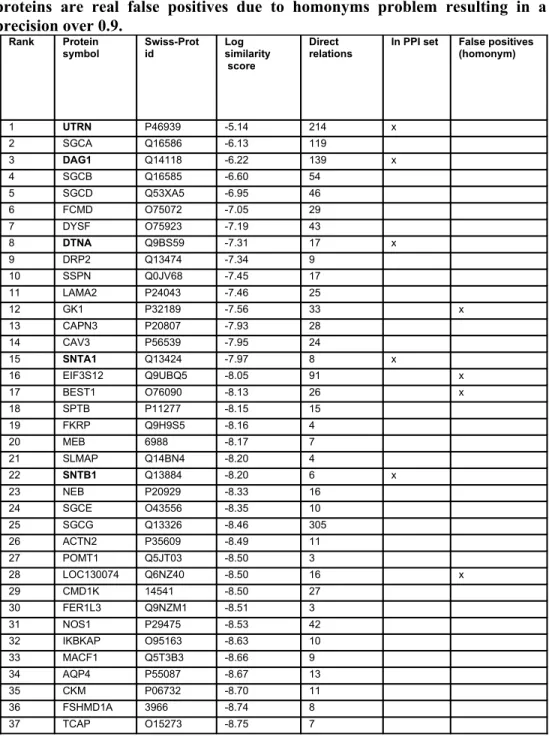
We presented the list of predicted interacting proteins with DMD ordered by descending association scores, to two experts for evaluation. At a specificity of 99%, there are 196 proteins predicted to interact with DMD. This list was too long to manually evaluate and we therefore restricted the human curation analysis to the 99.8% specificity level (top 42 proteins, Table S5). The full list is presented as Table 7 in the supplementary file. The 42 proteins include 7 of the 19 dystrophin-interacting proteins that are known from curated databases (sensitivity of 37% at this very high specificity level). The remaining established interaction partners generally rank high in the list of literature-predicted targets (13/19 in the top 196, p-value from Kolmogorov-Smirnov test for comparison with overall ranking: 3.4 .
10-10). There are three proteins in the predicted set with at least indirect evidence in
the literature for a physical interaction with DMD (CAV3, SPTB, ACTN2). One protein (SLMAP) may well interact given its distribution and localization but this needs experimental testing. Ten proteins in the list are found in the same protein complex as DMD but do not interact directly as far as known. Four proteins in the list were found wrongly associated with DMD due to homonym problems during literature indexing.
Table 5. Top 42 ranked proteins with DMD. In total 10,812 proteins were matched against DMD. 7 proteins as known to interact with DMD. Only 4 proteins are real false positives due to homonyms problem resulting in a precision over 0.9.
Rank Protein
symbol Swiss-Prot id Log similarity score
Direct
relations In PPI set False positives (homonym)
1 UTRN P46939 -5.14 214 x
2 SGCA Q16586 -6.13 119
3 DAG1 Q14118 -6.22 139 x
4 SGCB Q16585 -6.60 54
5 SGCD Q53XA5 -6.95 46
6 FCMD O75072 -7.05 29
7 DYSF O75923 -7.19 43
8 DTNA Q9BS59 -7.31 17 x
9 DRP2 Q13474 -7.34 9
10 SSPN Q0JV68 -7.45 17
11 LAMA2 P24043 -7.46 25
12 GK1 P32189 -7.56 33 x
13 CAPN3 P20807 -7.93 28
14 CAV3 P56539 -7.95 24
15 SNTA1 Q13424 -7.97 8 x
16 EIF3S12 Q9UBQ5 -8.05 91 x
17 BEST1 O76090 -8.13 26 x
18 SPTB P11277 -8.15 15
19 FKRP Q9H9S5 -8.16 4
20 MEB 6988 -8.17 7
21 SLMAP Q14BN4 -8.20 4
22 SNTB1 Q13884 -8.20 6 x
23 NEB P20929 -8.33 16
24 SGCE O43556 -8.35 10
25 SGCG Q13326 -8.46 305
26 ACTN2 P35609 -8.49 11
27 POMT1 Q5JT03 -8.50 3
28 LOC130074 Q6NZ40 -8.50 16 x
29 CMD1K 14541 -8.50 27
30 FER1L3 Q9NZM1 -8.51 3
31 NOS1 P29475 -8.53 42
32 IKBKAP O95163 -8.63 10
33 MACF1 Q5T3B3 -8.66 9
34 AQP4 P55087 -8.67 13
35 CKM P06732 -8.70 11
36 FSHMD1A 3966 -8.74 8
38 DTNB O60941 -8.76 9 x
39 LOC619409 619409 -8.82 5
40 VCL P18206 -8.87 36
41 LGMD1A 6574 -8.88 3
42 SNTG1 Q9NSN8 -8.90 5 x
CAPN3
For CAPN3, an evaluation of the precision is more difficult since there is, compared to an intensively studied protein such as DMD, not enough established knowledge about its regulatory partners and substrates. Table S6 summarizes the currently known interaction partners for CAPN3: 13 interactions have been described in the literature (not necessarily in the abstracts that were used for our predictions, see column ‘direct relation’) and of those, six interactions have been entered in PPI databases. These known interaction partners generally rank high in the list of literature-predicted targets (Table S6, p-value from Kolmogorov-Smirnov test: 5.7 . 10-5). Interestingly, the concept profiling method correctly
predicted the interaction between myosin light chain 1 (MYL1) and CAPN3 on the basis of conceptual overlap in MEDLINE abstracts (specificity > 99%), although this interaction was only described in a full text paper[23] and not in any MEDLINE abstract used to generate the concept profiles.
Apart from literature based rediscovery of known interactions, we also set out to actually find new interaction partners for CAPN3. We selected predicted interaction partners that have not been entered in PPI databases so far and that do not have a direct co-occurrence in MEDLINE. The top ranked conceptual match is with Sarcoglycan-epsilon (SGCE), which is the smooth muscle counterpart of SGCA. Like for CAPN3, mutations in SGCA cause LGMD, but as far as we know, the protein is not expressed in skeletal muscle.
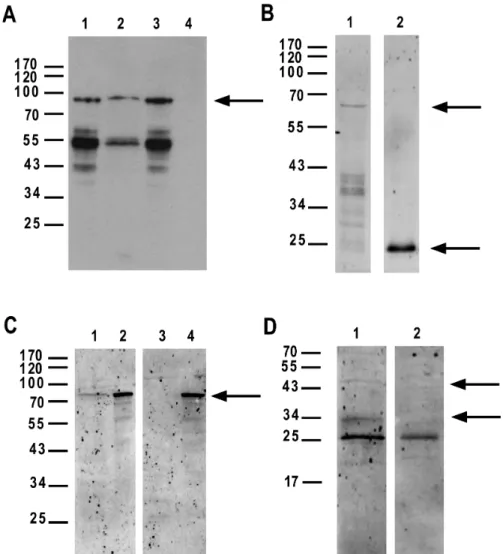
The second highest ranking protein was deemed to be an interesting candidate by the experts: Parvalbumin B (PARVB). The concept profiling method yielded a high association score because both proteins are described to have a physical interaction with dysferlin (DYSF)[24, 25], and with α-actinin (ACTN2)[26, 27], and they are both located at the Z-disc[28, 29]. For this predicted protein pair, we experimentally demonstrated a physical interaction, using three different set-ups. First, it was shown that immobilized GST-fused PARVB could pull down recombinant T7-CAPN3 from bacterial lysates. Second, immobilized GST-PARVB could pull down endogenous CAPN3 from IM2 mouse myoblasts, and vice versa (Figure S2).
muscle, where it plays a role in cell spreading and localizes to focal adhesions[26] (for a review, see [31]). The predicted interaction is coherent with this hypothesis, and substantiates the evidence for a role for CAPN3 outside the sarcomere.
This showcase is just one example of a correct and meaningful PPI prediction using concept profiles. This exemplary case study can not be seen proof that many of the other high ranking predictions will also be true physical and biologically relevant interactions. However none of the other consulted applications (STRING, iHOP) predicted this pair of interacting proteins. As the predictions using concept profiling are based on conceptual relatedness rather than an explicit co-occurrence in MEDLINE, this case study is indicative of the power of concept profiles to discover new, implicitly related pairs of interacting proteins. The statistics presented in this paper support the conclusion that predicted PPIs using our method, especially the subset that remains after expert analysis of the top ranking list are likely to be very significantly enriched for proteins that are worthwhile studying in wet lab experiments.
Table 6. List of proteins known to interact with Calpain-3. In total 10,812 proteins known to have a concept profile are matched against Calpain-3.
Name Symbol In PPI set In literature
(full text)
Direct relation (abstract)
Rank in literature-based prediction
Significant at specificity of 95 %
Dysferlin DYSF x x x 2 x
Titin TTN x x x 4 x
Filamin C FLNC x x x 27 x
Alpha-actinin ACTN2 x x 43 x
Calpastatin CAST x x 55 x
IkappaBalpha NFKBIA x x x 126 x
Myosin light
chain 1
MYL1 x 398 x
Alpha-spectrin SPTAN1 x x 426 x
Filamin A FLNA x 853
Ezrin VIL2 x 2739
Vinexin SORBS3 x 3301
Talin TLN1 x 4725
AHNAK AHNAK x No (*) 7371
YWHAQ YWHAQ x 7617