Effects of oxytocin administration on spirituality
and emotional responses to meditation
Patty Van Cappellen,
1Baldwin M. Way,
2Suzannah F. Isgett,
1and
Barbara L. Fredrickson
11
Department of Psychology and Neuroscience, University of North Carolina, Chapel Hill, NC, USA and
2Department of Psychology, The Ohio State University, Columbus Ohio, OH, USA
Correspondence should be addressed to Patty Van Cappellen, Department of Psychology and Neuroscience, University of North Carolina, Chapel Hill, CB 3270, Chapel Hill, NC 27599, USA. E-mail: [email protected]
Abstract
The oxytocin (OT) system, critically involved in social bonding, may also impinge on spirituality, which is the belief in a meaningful life imbued with a sense of connection to a Higher Power and/or the world. Midlife male participants (N¼83) were randomly assigned to receive intranasal OT or placebo. In exploratory analyses, participants were also genotyped for polymorphisms in two genes critical for OT signaling, the oxytocin receptor gene (OXTRrs53576) andCD38(rs6449182 and rs3796863). Results showed that intranasal OT increased self-reported spirituality on two separate measures and this effect remained significant a week later. It also boosted participants’ experience of specific positive emotions during meditation, at both explicit and implicit levels. Furthermore, the effect of OT on spirituality was moderated by OT-related genotypes. These results provide the first experimental evidence that spirituality, endorsed by millions worldwide, appears to be supported by OT.
Key words: oxytocin; spirituality; emotion; meditation; OXTR; CD38
Introduction
Spirituality—the belief in a meaningful life imbued with a sense of connection to a Higher Power, the world, or both—is endorsed by millions of people worldwide. What are the neurochemical systems that may undergird these beliefs? Because the oxytocin (OT) system is critically implicated in social bonding, here, we investigate its role in supporting spirituality.
Spirituality and OT
Based on emerging scholarly consensus (see Zinnbauer and Pargament, 2005), here we define spirituality as one’s personal affirmation of and relationship to a higher power or to the sa-cred. Spirituality typically implies the belief in a life infused with meaning and purpose, and the belief in relatedness and interconnectedness with the world and all living beings (Van Cappellen and Rime´, 2014).
OT is a polypeptide synthesized in the hypothalamus, which can be released into the bloodstream as well as to the forebrain. Peripherally, it acts as a hormone and centrally as a neuromo-dulator affecting many regions of the brain (Leeet al., 2009). OT has received increasing attention among social psychologists for its implication in many social affiliative processes, such as empathy, trust and gaze to the eye region (e.g. MacDonald and MacDonald, 2010). At least in contexts that are not interpreted as competitive or threatening (Olffet al., 2013), OT promotes reduced self-focus (Liuet al., 2013), increased positive focus on others (Bartz et al., 2011), parochial and universal altruism (Israelet al., 2012), and extended affiliation motives (e.g. em-pathy, even toward the pain of an outgroup; Shamay-Tsoory
et al., 2013). An open question is whether the social bonding ef-fect of OT may extend more broadly to support the affiliative components within spirituality’s definition. These include a sense of connectedness with the world and all living beings or with a Higher Power, which people tend to conceptualize as a person and can be considered a symbolic figure of attachment
Received:9 October 2015;Revised:11 May 2016;Accepted:31 May 2016
VCThe Author (2016). Published by Oxford University Press. For Permissions, please email: [email protected]
1579 doi: 10.1093/scan/nsw078
(Granqvist and Kirkpatrick, 2013). Given the demonstrated so-cial functions of OT, we hypothesized that OT prompts a mind-set that supports the emergence and salience of spirituality-like beliefs.
Two recent correlational studies support the idea that OT is involved in spirituality. First, among 79 HIV patients, endogenous OT (assayed from plasma) was positively correlated with two self-report spirituality measures (i.e. one item on how spiritual one considers himself/herself and the Ironson-Woods Spirituality/Religiousness Index; Kelschet al., 2013). Plasma levels of OT were also two times higher among patients who reported a spiritually transformative experience. Second, in a non-clinical sample of 34 devout American Christians, endogenous OT (assayed from saliva) was positively correlated with self-reported spirituality (using a similar one-item measure as in Kelschet al., 2013), even after accounting for church attendance, positive af-fect, gender and relationship status (Holbrooket al., 2015).
These initial correlations suggest that OT is generally related to spirituality. However, experimental evidence is needed to test the causal role of OT on spiritual experiences. By randomiz-ing participants to receive OT or placebo, our first primary aim was to investigate whether an increase in exogenous OT leads to an increase in spirituality. In addition, we reasoned that the boost in spirituality might lead participants to be more engaged and immersed in an activity that is often tied to spirituality and practiced by spiritual people, i.e. meditation. As a consequence, participants in the OT condition would more intensely experi-ence the positive emotions derived from engaging in medita-tion. Therefore, our second primary aim was to test whether during an initiation to meditation, participants who received OT would experience greater positive emotions, especially ones relevant to spirituality and spiritual practices, i.e. self-transcendent positive emotions such as awe (Saroglou et al., 2008; Van Cappellenet al., 2013).
Genetic differences in response to OT administration
Intranasal OT administration does not appear to affect everyone uniformly (Bartzet al., 2011). Individual differences at the gen-etic level are likely to be one factor that can moderate the psy-chological effects of intranasal OT administration. Such effects have been demonstrated for the most commonly studied poly-morphism in the OT receptor gene,OXTRrs53576 (Marshet al., 2012; Fenget al., 2015). Therefore, in exploratory analyses we sought to replicate this effect of rs53576 as well as extend evi-dence of genetic moderation to theCD38gene.CD38is crucial for the release of OT from hypothalamic neurons in the brain. Accordingly, mice with the deletion ofCD38 gene show pro-found social deficits (Jinet al., 2007). In a regulatory control re-gion (intron 1) of the human CD38 gene, there is a polymorphism (rs6449182) that affects transcription factor bind-ing and subsequent expression of the gene (Saborit-Villarroya
et al., 2011). Consistent with a role for OT in social bonding, rs6449182 has been associated with social emotions (Algoe and Way, 2014; I.S., W,O., E,R.P., B,G., Unpublished data). Another polymorphism (rs3796863) located in a different region ofCD38
(intron 7) has been linked to unextracted plasma OT levels and social attunement (Feldman et al., 2012).In exploratory ana-lyses, we tested whether the effect of OT administration on spirituality would be moderated by OT polymorphisms because this provides additional evidence of oxytocinergic involvement in spirituality.
The present study aims to illuminate potential biological mechanisms underlying spirituality by focusing on the OT
system. Participants were randomized to receive intranasal OT or placebo. We hypothesized that OT, a neuropeptide critically involved in social bonding, has a facilitative effect on spiritual-ity beliefs and the positive emotions derived from engaging in meditation. In exploratory analyses, we also evaluate who is more susceptible to these effects of intranasal OT by examining variation in genes related to OT signaling.
Materials and methods
Participants and procedure
This study was approved by the Institutional Review Board of the first author’s institution and all participants gave written in-formed consent. Local newspapers, websites and posted flyers recruited mid-life adults (ages 35–64). This study is part of a multiple study grant that specifically targeted mid-life adults, an age during which psychological changes can be critical for later life health. This demographic also offers more generaliz-ability than most studies of OT administration. Exclusion crite-ria were maintaining regular meditation practice (currently or previously), taking antihypertensive medication and having the ability to read Chinese pictographs (this criterion applied to an-other task unrelated to the current investigation). The data pre-sented here are part of a larger study testing additional hypotheses not related to the present ones. For the larger study and to test a larger model, based on power calculation, a sample of 240 participants was targeted with a breakdown female–male of 125–115 to reflect the composition of the community from which the sample was drawn. Data collection, which occurred from September 2013 to July 2014, stopped at 239 but despite cruitment effort, the sample is skewed toward females. This re-port focuses only on the 83 males who took part in the study, which is a slightly higher sample size than most studies investi-gating the psychological effects of OT among males and seems sufficient to detect effects (recent examples: Israelet al., 2014; Bartzet al., 2015). Growing evidence suggests that the effects of OT are different for males and females (Fenget al., 2015) and most of the current evidence on intranasal OT’s psychological effects, which support the current hypotheses, come from stud-ies with exclusively male samples. A separate analysis of fe-male participants, controlling for a series of additional variables related to natural variations in OT (MacDonald, 2012), is ongoing.
A total of 83 mid-life men took part in the study (MAge¼45.1, s.d.Age¼8) in return for $120 in compensation. The majority of participants self-identified as White/Caucasian (86.7%), and the remaining participants were Black/African American (7.2%), or Asian (4.8%), one participant did not report race; additionally, 7.2% of the entire sample identified as being ethnically Hispanic. Participants were Christian (50.6%), Muslim (1.2%), Buddhist (2.4%), Jewish (2.4%), Agnostic (19.3%), Atheist (19.3%) or other (4.8%).
and pH. Participants, the experimenter and the research staff were blind to experimental condition, which was revealed only once data collection was complete. Experimenters were all thor-oughly trained to behave in a professional and neutral way with participants. After the administration of OT or placebo, all par-ticipants provided a saliva sample for genotyping. Effects of OT typically emerge after 30–40 min (e.g. Israelet al., 2014); there-fore, approximately 40 min after the nasal spray, participants first completed questionnaires assessing spirituality. Then, par-ticipants were invited to follow a 20 min guided meditation.1 Implicit and explicit measures of emotions felt as a result of and during meditation directly followed. A week later, partici-pants (N¼81) completed a follow-up measure of spirituality as part of a larger online questionnaire.
Measures
Spirituality. We assessed spirituality through two self-report
measures: a single-item assessment of spirituality (a measure devoid of any investigator-established conception of spiritual-ity, allowing participants to project their own definition of spir-ituality) and a validated and widely used scale of spirituality [Spiritual Transcendence Scale (STS); Piedmont, 1999]. First, we administered the one-item measure of state spirituality: ‘Right now, would you say that spirituality is important in your life?’ Participants responded using a 8-point Likert type scale (0¼not at all; 7¼completely;Van Cappellenet al., 2013). This measure was repeated again 1 week after the laboratory session as part of a larger online questionnaire. Second, we administered the STS (Piedmont, 1999). In creating this scale, Piedmont (1999) defined spirituality as the tendency to orient oneself toward a larger transcendent reality that binds all things into a unitive harmony. It reflects the personal search for connection with a larger sacredness. The subscale Prayer Fulfillment was not included in this study because this measure of spirituality is not clearly distinct from religiosity. Indeed, it has an explicitly reli-gious content (reference to God and relireli-gious practices such as prayer) and has been found to relate positively to traditional re-ligious attitudes and behaviors (Piedmont, 1999). Reliability for the items included was satisfactory (a¼0.86).
Emotions as a result of meditation.Right after the 20 min guided
meditation, participants completed an adaptation of the Implicit Positive and Negative Affect Test (Quirinet al., 2009). Participants were instructed that they would see a list of words (a total of six words) from an artificial language and that these words (e.g. safme) are intended to express various moods. Then, they were asked to rate the extent to which the word conveys each of the following emotions: happy, relaxed, loving, helpless and sad. We chose these emotion words for their relevance to positive or negative experiences during meditation. Participants were asked to let themselves be guided by their spontaneous feelings in making these ratings. Past research has shown that participants tend to rate these artificial words according to how they currently feel (Quirinet al., 2009). Participants responded using a Likert-type scale (1¼does not fit at all, 2¼fits some-what, 3¼fits quite well, 4¼fits very well). Mean scores are com-puted across the six artificial words for the three positive emotions and separately for the two negative emotions. Reliability was satisfactory for both the positive and negative
emotions scores (respectively,a¼0.82,a¼0.72). We also used an explicit measure of emotional experience, the ‘modified Differential Emotions Scale’ (Fredrickson, 2013), which assesses 10 different positive emotions (amusement, awe, gratitude, hope, inspiration, interest, joy, love, pride and serenity) and 10 negative emotions (anger, shame, contempt, disgust, embar-rassment, guilt, hate, sadness, fear and stress). Participants were asked to rate the extent to which they felt each emotion during the guided meditation and respond on a Likert-type scale (0¼not at all, 1¼hardly, 2¼some of the time, 3¼often, 4¼most of the time). Mean scores were computed for positive emotions (a¼0.91), negative emotions (a¼0.82) and self-transcendent positive emotions (awe, gratitude, inspiration and love;a¼0.87).
Involvement in organized religion.Participants provided their
reli-gious affiliation at the time of registering for the study. We coded their answers to correspond to 1¼affiliated with a reli-gion, 2¼not affiliated with a religion (i.e. agnostics and athe-ists). Four participants had responded ‘other’ without specifying it further and were thus excluded through list-wise deletion for the analyses including this variable. Given the specific focus in the present study on spirituality and given that involvement in organized religion is strongly correlated with spirituality (Marler and Hadaway, 2002), we used this variable as a covariate in all analyses for which spirituality was an outcome. This approach is also in keeping with past experimental research that tested the causal role of positive emotions on spirituality and found that having a religious affiliation moderated the primary effect (Van Cappellen et al., 2013). More information is provided in Supplementary Data available online.
DNA extraction and genotyping
All participants provided a saliva sample by passive drool into a 15 ml centrifuge tube right after the OT/placebo administration. Samples were frozen within 5 min. Samples were thawed and DNA was extracted using Qiagen QIAamp DNA Mini Kit accord-ing to manufacturer’s instructions. Samples were genotyped using Taqman single nucleotide polymorphism (SNP) Genotyping Assays (Applied Biosystems, Inc) according to the standard protocol provided with the kit. Polymerase chain reac-tions were performed using 20ml reaction volumes in 96-well plates with 25 ng of DNA. End point reads of fluorescence levels were obtained with an Applied Biosystems Incorporated 7300HT Sequence Detection System. For quality control, 26% of rs6449182 genotypes, 4% of rs3796863 genotypes and 18% of rs53576 genotypes were re-run and showed perfect concord-ance. Haploview (version 4.2; Barrettet al., 2005) was used to cal-culate Hardy–Weinberg Equilibrium values using the exact test (Wiggintonet al., 2005). The distribution of genotypes did not de-viate from Hardy-Weinberg equilibrium (all P’s>0.250). For rs53576, genotyping was unsuccessful for two participants, one in the placebo condition and one in the OT condition. For rs6449182, genotyping was unsuccessful for two participants, one in the placebo condition and one in the OT condition.
Genes were coded in the following fashion:CD38rs3796863 was coded in a dominant manner, AA/AC¼0, CC¼1, following Feldman et al. (2012); CD38 rs6449182 was coded in a co-dominant way CC¼0, CG¼1, GG¼2, following Algoe and Way (2014); see Supplementary Data available online for alternative coding and tests.OXTRrs53576 was coded in a dominant way, GG¼0, GA/AA¼1, consistent with a meta-analysis of this marker (Bakermans-Kranenburg and van IJzendoorn, 2014). 1 Participants were randomly assigned to either a Mindfulness or a
Numbers of participants for each genotype by condition are pro-vided in Table S1 in the Supplementary Data available online.
Analyses
All analyses were performed with SPSS v.23. Conditions were dummy coded, Placebo¼0, OT¼1. For models including spiritu-ality variables, we conducted one-way analyses of covariance (ANCOVAs), controlling for a variable that is distinct although strongly correlated with spirituality, religious affiliation. See Supplementary Dataavailable online for additional discussion of this confounding variable and tests for assumptions of ANCOVAs. For the other models, we ran one-way analyses of variance (ANOVAs). These analyses included a total of eight tests and were corrected for multiple comparisons using a false discovery rate (FDR) (Benjamini and Hochberg, 1995) of 0.05. In Table 1, we provide raw P-values and FDR adjustedP-values. See Table S3 in Supplementary Data available online for FDR per test. Two-way ANOVAS were used to test for effects of condi-tions, genotype and their interactions.Post hoccontrasts were run using ANOVAs. We report exactP-values using two-tailed tests.
Results
At the end of the lab session, participants indicated whether they thought they received OT or a placebo, or whether they really did not know. Sixty-two percent of participants sponded that they did not know. Among participants who re-sponded that they had taken one treatment over another, a chi-square test of independence was performed to examine whether actual treatment predicted participants’ perceived treatment. This test was not significant, v2 (1, N¼31)¼1.55, P¼0.213.
Participants in both groups were similar on a series of rele-vant baseline measures (i.e. emotions, mindfulness and reli-gious affiliation). See Supplementary Dataavailable online for full results.
Intranasal OT’s effects
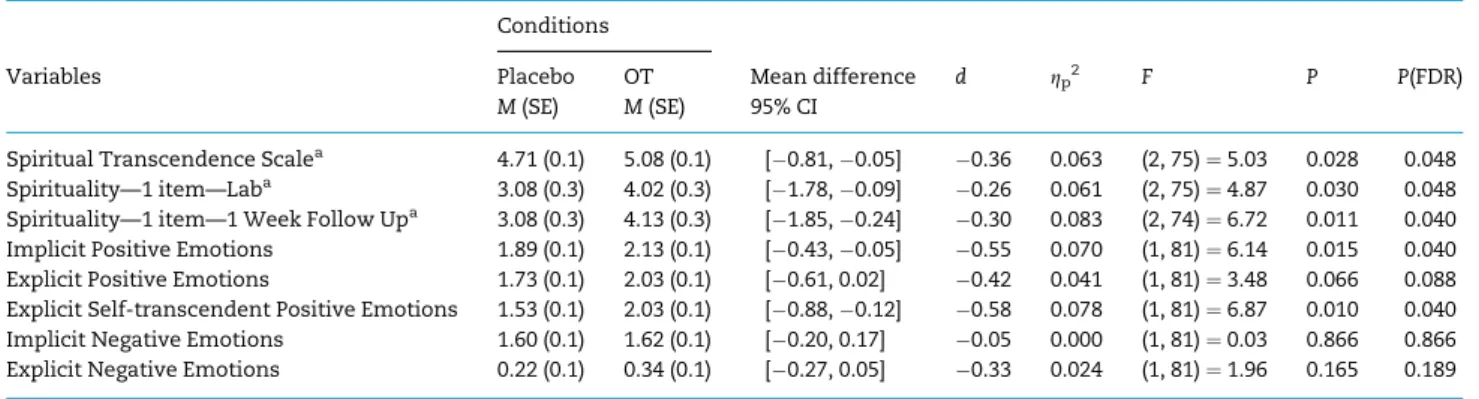
Spirituality-related outcomes.Means, standard deviations as well
as mean differences tests are detailed in Table 1. The one-item measure of spirituality taken in lab and the STS were positively correlated (r¼0.75,P<0.001), see Table S2 in Supplementary Data available online for full correlation matrix of dependent variables. Results show that compared to participants in the
placebo condition, participants in the OT condition reported greater spirituality during the lab session (on both spirituality scales) and 1 week later. These effects remained significant when controlling for baseline positive and negative emotions and for dispositional mindfulness (see Supplementary Data available online).
We also ran additional analyses on the STS to better under-stand which items were affected by OT. First, we computed a new mean score excluding three items of the STS that include notions of death and contact with deceased people, which are less typical spiritual beliefs. Removing these items did not change the pattern of results (OT:M¼5.26, SE¼0.1; Placebo: M¼4.85, SE¼0.1, F(2,75)¼4.40,P¼0.039,gp2¼0.055, mean dif-ference¼ 0.41, 95% CI [0.80,0.02],d¼ 0.35). Then, to better disentangle between the aspects of connection and of meaning in the STS, we computed two scores, one including all items related to interconnectedness (i.e. ‘I feel that on a higher level all of us share a common bond’; ‘All life is interconnected’; ‘There is a higher plane of consciousness or spirituality that binds all people’; ‘Although individual people may be difficult, I feel an emotional bond with all of humanity’; ‘I believe that on some level my life is intimately tied to all of humankind’) and one including all items related to meaning and purpose (i.e. ‘I believe that there is a larger meaning to life’; ‘I believe there is a larger plan to life’; ‘There is an order to the universe that tran-scends human thinking’). Results reveal that OT increased par-ticipants’ level on STS interconnectedness (OT: M¼5.24, SE¼0.2; Placebo: M¼4.77, SE¼0.2, F(2,75)¼3.79, P¼0.055, gp2¼0.048, mean difference¼ 0.47, 95% CI [0.94, 0.01],
d¼ 0.37) and on STS meaning and purpose (OT: M¼5.10, SE¼0.2; Placebo: M¼4.37, SE¼0.2, F(2,75)¼6.19, P¼0.015, gp2¼0.076, mean difference¼ 0.74, 95% CI [1.33, 0.15],
d¼ 0.33).
Emotion outcomes.Means, standard deviations as well as mean
differences tests are detailed in Table 1. For positive emotions, self-reported and implicit measures were positively correlated (r¼0.45,P<0.001). This was not the case for negative emotions (r¼0.12,P>0.250). Results show that compared to participants in the placebo condition, participants in the OT condition re-ported greater implicit positive emotions following meditation, and greater explicit retrospective reports of self-transcendent positive emotions during meditation. These effects remained significant when controlling for baseline positive and nega-tive emotions and for dispositional mindfulness (see Supplementary Data available online).
Table 1.Means, standard deviations and between-conditions comparisons of all the dependent variables
Conditions
Variables Placebo OT Mean difference
95% CI
d gp2 F P P(FDR)
M(SE) M(SE)
Spiritual Transcendence Scalea 4.71 (0.1) 5.08 (0.1) [0.81,0.05] 0.36 0.063 (2, 75)¼5.03 0.028 0.048
Spirituality—1 item—Laba 3.08 (0.3) 4.02 (0.3) [1.78,0.09] 0.26 0.061 (2, 75)¼4.87 0.030 0.048
Spirituality—1 item—1 Week Follow Upa 3.08 (0.3) 4.13 (0.3) [1.85,0.24] 0.30 0.083 (2, 74)¼6.72 0.011 0.040
Implicit Positive Emotions 1.89 (0.1) 2.13 (0.1) [0.43,0.05] 0.55 0.070 (1, 81)¼6.14 0.015 0.040 Explicit Positive Emotions 1.73 (0.1) 2.03 (0.1) [0.61, 0.02] 0.42 0.041 (1, 81)¼3.48 0.066 0.088 Explicit Self-transcendent Positive Emotions 1.53 (0.1) 2.03 (0.1) [0.88,0.12] 0.58 0.078 (1, 81)¼6.87 0.010 0.040 Implicit Negative Emotions 1.60 (0.1) 1.62 (0.1) [0.20, 0.17] 0.05 0.000 (1, 81)¼0.03 0.866 0.866 Explicit Negative Emotions 0.22 (0.1) 0.34 (0.1) [0.27, 0.05] 0.33 0.024 (1, 81)¼1.96 0.165 0.189
Mediation tests.Given that participants in the OT condition re-ported increased spirituality and positive emotions derived from meditation, we tested whether the increase in spirituality partially accounted for the subsequent increase in positive emo-tions related to meditation. We ran bootstrapped mediation analyses using the PROCESS macro for SPSS, model 4, 5000 sam-ples (Hayes, 2013). Religious affiliation was used as a covariate for the mediator (spirituality measures) only. In Table 2, for each model tested, we report data parameters and bias cor-rected 95% confidence intervals of the indirect effect and the direct effect of conditions on the outcome once the mediator is taken into account. Results show that spirituality (one-item measure and STS) mediated the relation between conditions and the positive emotions felt during or as a result of medita-tion at both the implicit and explicit levels****.
Exploratory analyses of genetic moderation
Interaction effects
Analyses were run using each SNP individually. Interaction ef-fects are detailed in Table 3.
CD38 rs3796863.Interaction tests were significant for the
one-item measure of spirituality at lab session.Post hoccontrasts re-vealed that A carriers (AA/AC) showed a significant increase on this measure in the OT condition (M¼4.46, SE¼0.40) compared to the Placebo condition (M¼2.54, SE¼0.40), F(2, 35)¼11.03, P¼0.002, gp2¼0.240, mean difference¼ 1.92, 95% CI [3.09, 0.74],d¼ 0.55. For CC homozygotes, there was no significant difference between OT and placebo conditions (P>0.250). There was also a significant interaction for the STS.Post hoccontrasts revealed that again A carriers (AA/AC) showed a significant in-crease on this measure in the OT condition (M¼5.31, SE¼0.18) compared to the Placebo condition (M¼4.55, SE¼0.18), F(2, 35)¼8.45,P¼0.006,gp2¼0.194, mean difference¼ 0.76, 95% CI [1.29,0.23],d¼ 0.80. For CC homozygotes, there was no sig-nificant difference between OT and placebo conditions (P>0.250). Finally, there was a marginally significant inter-action for the one-item measure of spirituality at the 1 week fol-low up. Post hoc contrasts revealed that A carriers (AA/AC) showed a significant increase on this measure in the OT condi-tion (M¼4.32, SE¼0.40) compared to the Placebo condition (M¼2.72, SE¼0.41), F(2, 34)¼7.38, P¼0.010, gp2¼0.178, mean difference¼ 1.60, 95% CI [2.80, 0.40], d¼ 0.41. For CC homozygotes, there was no significant difference between OT and placebo conditions (P>0.250).
CD38 rs6449182.Interaction tests were significant for the
one-item measure of spirituality at lab session.Post hoccontrasts re-vealed that CC homozygotes showed a significant increase on this measure in the OT condition (M¼4.32, SE¼0.38) compared to the Placebo condition (M¼2.78, SE¼0.55), F(2, 41)¼8.70, P¼0.005, gp2¼0.175, mean difference¼ 1.56, 95% CI [2.63, 0.49], d¼ 0.60. For CG and GG genotypes, there was no
Table 2.Mediation analyses: conditions predicting positive emotions related to meditation as a result of spirituality
Indirect effect c’ path
Outcome Mediator PE SE 95% BC CI PE SE 95% BC CI
Implicit Positive Emotions Spiritual Transcendence Scale 0.05 0.03 [0.01, 0.14] 0.20 0.10 [0.002, 0.39] Spirituality—1 item—Lab 0.06 0.03 [0.01, 0.14] 0.20 0.10 [0.01, 0.39] Explicit Positive Emotions Spiritual Transcendence Scale 0.12 0.07 [0.02, 0.30] 0.18 0.16 [0.14, 0.50] Spirituality—1 item—Lab 0.10 0.06 [0.02, 0.26] 0.21 0.16 [0.11, 0.53] Explicit Self-transcendent Positive Emotions Spiritual Transcendence Scale 0.16 0.09 [0.03, 0.38] 0.35 0.19 [0.03, 0.72] Spirituality—1 item—Lab 0.14 0.08 [0.03, 0.34] 0.38 0.19 [0.01, 0.76]
Notes: 5000 bootstrap samples. PE stands for point estimate. 95% BC CI stands for 95% Bias Corrected Confidence Interval. Covariate included for mediator only (con-trolling for whether participants are religiously affiliated).
Table 3.Summary of results for condition predicting spirituality-related measures as moderated by variations of CD38 and OXTR
Variables Main effects and interaction
gp2 F P
Spirituality—1 item—Lab
CD38rs3796863 0.000 (4,73)¼0.001 0.980 Conditions 0.137 (4,73)¼11.63** 0.001 Interaction 0.081 (4,73)¼6.47* 0.013
CD38rs6449182 0.004 (4,72)¼0.30 0.583 Conditions 0.116 (4,72)¼9.43** 0.004 Interaction 0.063 (4,72)¼4.88* 0.030
OXTRrs53576 0.001 (4,72)¼0.05 0.823 Conditions 0.015 (4,72)¼1.08 0.302 Interaction 0.004 (4,72)¼0.30 0.583
Spirituality—1 item—Week 1
CD38rs3796863 0.000 (4,72)¼0.10 0.922 Conditions 0.116 (4,72)¼9.46** 0.003 Interaction 0.042 (4,72)¼3.12† 0.082
CD38rs6449182 0.004 (4,70)¼0.31 0.582 Conditions 0.108 (4,70)¼8.47** 0.005 Interaction 0.042 (4,70)¼3.03† 0.086
OXTRrs53576 0.001 (4,70)¼0.05 0.826 Conditions 0.005 (4,70)¼0.35 0.555 Interaction 0.025 (4,70)¼1.82 0.182
Spiritual Transcendence Scale
CD38rs3796863 0.001 (4,73)¼0.06 0.815 Conditions 0.130 (4,73)¼10.96** 0.001 Interaction 0.072 (4,73)¼5.70* 0.020
CD38rs6449182 0.009 (4,72)¼0.62 0.434 Conditions 0.098 (4,72)¼7.83** 0.007 Interaction 0.044 (4,72)¼3.31† 0.073
OXTRrs53576 0.006 (4,72)¼0.46 0.499 Conditions 0.000 (4,72)¼0.00 0.989 Interaction 0.049 (4,72)¼3.68† 0.059
Note: Controlling for whether participants are religiously affiliated. **P<0.01,
*P<0.05, †P
significant difference between OT and placebo conditions (all P’s>0.250). There was also a marginally significant interaction for the STS.Post hoccontrasts revealed that again CC homozy-gotes showed a significant increase on this measure in the OT condition (M¼5.25, SE¼0.15) compared to the Placebo condi-tion (M¼4.59, SE¼0.14), F(2, 41)¼10.62, P¼0.002, gp2¼0.206, mean difference¼ 0.66, 95% CI [1.07,0.25],d¼ 0.72. For CG and GG genotypes, there was no significant difference between OT and placebo conditions (allP’s>0.250). Finally, there was a marginally significant interaction for the one-item measure of spirituality at the 1 week follow up.Post hoccontrasts revealed that again CC homozygotes showed a significant increase on this measure in the OT condition (M¼4.43, SE¼0.38) compared to the Placebo condition (M¼3.00, SE¼0.37), F(2, 40)¼7.18, P¼0.011, gp2¼0.152, mean difference¼ 1.43, 95% CI [2.51, 0.35],d¼ 0.56. For the CG genotype, there was no significant difference between OT and placebo conditions (P>0.250), and for GG homozygotes a marginal difference in the opposite direc-tion such that they had lower scores on this measures in the OT condition (M¼2.34, SE¼0.27) compared to the Placebo condi-tion (M¼3.77, SE¼0.22), F(2, 2)¼16.67, P¼0.055, gp2¼0.893, mean difference¼1.43, 95% CI [0.08, 2.93],d¼1.20.
There were no significant interactions between condition and either SNP regarding emotions felt as a result of or during meditation across either the implicit and explicit measures (all P’s>0.143).
OXTR rs53576.Although there was no interaction between
con-dition and rs53576 with respect to the one-item measures of spirituality, there was a marginally significant interaction with respect to the STS (Table 3).Post hoccontrasts revealed that A carriers (AG/AA) showed a significant increase on the STS in the OT condition (M¼5.32, SE¼0.17) compared to the Placebo con-dition (M¼4.58, SE¼0.19), F(2, 38)¼8.40,P¼0.006,gp2¼0.181, mean difference¼ 0.74, 95% CI [1.25,0.22],d¼ 0.85. For GG homozygotes, there was no significant difference between OT and placebo conditions (P>0.250). As for the variants inCD38, no significant interactions emerged regarding emotions felt as a result of or during meditation across either the implicit and ex-plicit measures (allP’s>0.250).
Discussion
Compared to a placebo, administration of OT increased male participants’ levels of self-reported spirituality using two dis-tinct measures. This effect remained significant a week later. Intranasal OT also increased specific positive emotions derived from meditation, an activity commonly practiced by spiritual people, as reflected in both implicit and explicit assessments. These results held after adjusting for the FDR (Benjamini and Hochberg, 1995).
These findings build on prior evidence of correlations be-tween measures of endogenous OT with ratings of spirituality (Kelschet al., 2013; Holbrooket al., 2015) in two ways. First, the experimental design employed here takes a step toward estab-lishing causality and provides information on the direction of causality by showing that, at least among men, elevations in OT lead to increases in spirituality. Future experimental research will be necessary to determine whether the other direction of causality—i.e. whether spirituality (beliefs and/or practices) can increase OT—is also possible. Second, the relationship between peripheral measures of OT, whether assayed in the blood or sal-iva, to OT levels in the brain is unclear (Kagerbaueret al., 2013). In contrast, evidence suggests that intranasal administration of
OT increases OT levels in the brain (Striepenset al., 2013; and in animal research, Dal Monte et al., 2014; Modi et al., 2014). As such, the data presented here suggest that central OT is in fact driving the increase in spirituality.
Having established a link between OT and spirituality, the next question concerns the psychological processes underlying this phenomenon. We speculate that the effects of OT on social affiliation account for the current findings, although direct test-ing of this speculation awaits future research. Additional ana-lyses revealed that OT also impacted items of the STS beyond those related to interconnectedness, specifically those targeting belief in larger meaning and purpose in life. Future research should unpack the distinct concepts embedded within defin-itions of spirituality, aspects that can also be studied separately from the larger construct of spirituality. OT also impacted spe-cific positive emotions participants derived from an initiation to meditation. One potential explanation for this effect, supported by the data, is that the boost in spirituality evident among those in the OT condition led participants to experience more in-tensely the accompanying positive emotions. OT did not impact negative emotions felt during or as a result of the meditation, which may be attributable to a floor effect. Additionally, meas-ures of positive and negative emotions were uncorrelated in this study (self-reported positive and negative emotions, r¼ 0.04, P>0.250; implicit positivity and negativity, r¼0.08, P>0.250), in keeping with a wide range of evidence that positive and negative affective states are independent dimensions of human experience (e.g. Watsonet al., 1988; Fredricksonet al., 2008). Finally, the finding that OT still impacted spirituality a week after the administration merits further research to better understand the underlying mechanisms of action. Although long-term effects of OT have not been reported in past litera-ture, to our knowledge they may not have been directly tested (exceptions include studies on ‘repeated’ OT administration over several days in clinical samples; e.g. Eppersonet al., 1996; Guastellaet al., 2010). Turning to psychological interpretations, one possibility is that OT administration increased the enjoy-ment of spirituality-related activities over that week and/or the frequency of self-transcendent positive emotions, each of which have been shown to promote spirituality (Van Cappellen and Saroglou, 2012; Van Cappellenet al., 2013).
Our exploratory analyses of polymorphisms in the OT sys-tem suggest that genetic variation moderates the effects of intranasal OT administration. Because OT can bind to non-OT receptors, for example vasopressin receptors (Gimpl and Fahrenholz, 2001), behavioral effects of OT administration could possibly be a result of these effects. However, the genetic vari-ants moderating the effects of intranasal OT that we studied are in the OT system, which supports the inference that the observed effects of administered OT on spirituality are indeed due to action within the OT system.
The most robust effects on spirituality were found for the vari-ants inCD38. That polymorphisms located in two different re-gions of the CD38 gene each moderated the effect provides convergent validity for the involvement ofCD38 in moderating the effects of intranasal OT. The genotypes most responsive to intranasal OT (rs3796863: A carriers, AA/AC; rs6449182: CC) were each associated with higher levels ofCD38expression in immor-talized cell lines generated from blood cells (Lerer et al., 2010; Rieboldet al., 2011). Although these measures are based onin vitro
differential expression could impact OT signaling is not clear. One hypothesis is that because CD38 is critical for the release of OT from neurons, this differential expression affects OT release. One potential mechanism accounting for this would arise from the unique property of OT neurons: their ability to autoregulate. OT neurons express the OT receptor on their dendrites (Freund-Mercieret al., 1994). Activation of this dendritically located OT re-ceptor initiates an intracellular signaling cascade that can lead to either the actual release of OT from the dendrites or the priming of this release (Tobinet al., 2012). Once activated, this positive feedback loop can lead to an enduring, self-sustaining release of OT. Because CD38 is a critical intermediary of the intracellular signaling cascade between binding of the dendritic OT receptor and OT release from the dendrites (Salminaet al., 2013), gene vari-ants affecting expression of CD38 may impact this process. Naturally, with the nascent understanding of how these variants affect oxytocinergic signaling, such a hypothesis should be viewed as speculative as should any links between this autoregu-latory capacity of oxytocinergic neurons and psychological changes in response to OT administration.
The most commonly studied polymorphism of OXTR (rs53576) also moderated the effects of intranasal OT on one of the three measures of spirituality. The A allele carriers were the most responsive to the OT manipulation. We note that prior lit-erature has found that the GG genotype is more responsive to either exogenous (Marsh et al., 2012; Fenget al., 2015) or en-dogenous OT (Moonset al., 2014) so the present findings should be considered preliminary. Taken together, these findings indi-cate that there are individual differences in the OT system that impact the response to intranasal OT.
In the present study, consistent with other research on spir-ituality (Van Cappellenet al., 2013), we found that controlling for one aspect culture, i.e. involvement in organized religion, was critical to observing the effects of exogenous OT on spirituality (see Saroglou and Cohen, 2013 for a discussion on religion as a cultural system). Religion, or the belief in a Higher Power in a structured way, is related yet distinct from spirituality. Here, we found that when controlling for this confounding variable, OT administration increased all participants’ level of spirituality. However, additional analyses (described in the Supplementary Data available online) revealed that this effect is more evident among participants who are not affiliated with an organized re-ligion, potentially because they tend to score lower on measures of spirituality (see similar findings in Van Cappellenet al., 2013). Future research may investigate whether other cultural aspects moderate the psychological outcomes of the OT system (e.g. Kimet al., 2011).
Intriguingly, recent empirical developments have uncovered a host of psychological effects of OT that are strikingly similar to those of spiritual beliefs and practices. Although context and individual differences qualify the effects of OT and of spiritual-ity, they have both generally been related, in separate research literatures, to social affiliation and prosociality (at least to some extent, MacDonald and MacDonald, 2010; Saroglou, 2012) as well as to physical and mental health (OT: Striepenset al., 2011; Spirituality: Koeniget al., 2012; Positive emotions derived from meditation: Fredrickson, 2013; Van Cappellen et al., 2016). Finding that OT can increase spirituality and specific positive emotions derived from practicing meditation allows the gener-ation of new hypotheses on mediating processes. For example, given the evidence that spirituality and the enjoyment of medi-tation are related to health, the data presented here suggest that they both may represent sustained mechanisms through which OT may impact health.
Because several different neurotransmitters have been implicated in spirituality (McNamara and Butler, 2013), we do not consider OT to be ‘the spiritual hormone’. Spiritual beliefs and related practices represent complex phenomena that are shaped by complex and multidimensional processes. However, growing evidence (e.g. Gervais, 2013), including the data pre-sented here, suggests that humans—and perhaps some more than others—are biologically and cognitively predisposed to be receptive to spiritual experiences.
Acknowledgements
We thank Ann Firestine and Tracy Powers for their efforts in managing the study and collecting the data. The data for the study presented in this manuscript are freely accessible through the Open Science Framework.
Funding
This research was supported by grants from The National Center of Complementary and Alternative Medicine R01 AT007884 and the National Institute of Nursing Research R01 NR012899 awarded to B.L.F. R01NR012899 is supported by the National Institutes of Health Common Fund, which is managed by the National Institutes of Health Office of the Director/Office of Strategic Coordination.
Supplementary data
Supplementary dataare available atSCANonline. Conflict of interest. None declared.
References
Algoe, S.B., Way, B.M. (2014). Evidence for a role of the OT sys-tem, indexed by genetic variation in CD38, in the social bond-ing effects of expressed gratitude.Social Cognitive and Affective Neuroscience,9(12), 1855–61
Bakermans-Kranenburg, M.J., van IJzendoorn, M.H. (2014). A so-ciability gene? Meta-analysis of oxytocin receptor genotype ef-fects in humans.Psychiatric Genetics,24(2), 45–51.
Barrett, J.C., Fry, B., Maller, J.D.M.J., Daly, M.J. (2005). Haploview: analysis and visualization of LD and haplotype maps. Bioinformatics,21(2), 263–5.
Bartz, J.A., Lydon, J.E., Kolevzon, A.,et al. (2015). Differential ef-fects of oxytocin on agency and communion for anxiously and avoidantly attached individuals. Psychological Science, 26(8), 1177–86.
Bartz, J.A., Zaki, J., Bolger, N., Ochsner, K.N. (2011). Social effects of oxytocin in humans: context and person matter.Trends in Cognitive Sciences,15(7), 301–9.
Benjamini, Y., Hochberg, Y. (1995). Controlling the false discov-ery rate: a practical and powerful approach to multiple testing. Journal of the Royal Statistical Society,57(1), 289–300.
Dal Monte, O., Noble, P.L., Turchi, J., Cummins, A., Averbeck, B.B. (2016). CSF and blood oxytocin concentration changes follow-ing intranasal delivery in macaque.PLoS One,9(8), e103677. Epperson, C.N., McDougle, C.J., Price, L.H. (1996). Intranasal
oxy-tocin in obsessive-complusive disorder. Biological Psychiatry, 40, 547–9.
polymorphisms in the OXTR and CD38 genes. Biological Psychiatry,72(3), 175–81.
Feng, C., Lori, A., Waldman, I.D., Binder, E.B., Haroon, E., Rilling, J.K. (2015). A common oxytocin receptor gene (OXTR) poly-morphism modulates intranasal oxytocin effects on the neural response to social cooperation in humans. Genes, Brain and Behavior,14, 516–25.
Fredrickson, B.L. (2013). Positive emotions broaden and build. Advances in Experimental Social Psychology,47, 1–53.
Fredrickson, B.L., Cohn, M.A., Coffey, K.A., Pek, J., Finkel, S.M. (2008). Open hearts build lives: positive emotions, induced through loving-kindness meditation, build consequential per-sonal resources. Journal of Personality and Social Psychology, 95(5), 1045.
Freund-Mercier, M.J., Stoeckel, M.E., Klein, M.J. (1994). Oxytocin receptors on oxytocin neurones: histoautoradiographic detec-tion in the lactating rat.The Journal of Physiology,480, 155–61. Gervais, W.M. (2013). Perceiving minds and gods: how mind
per-ception enables, constrains, and is triggered by belief in gods. Perspectives on Psychological Science,8(4), 380–94.
Gimpl, G., Fahrenholz, F. (2001). The oxytocin receptor system: structure, function, and regulation.Physiological Reviews,81(2), 629–83.
Granqvist, P., Kirkpatrick, K.L. (2013). Religion, spirituality, and attachment. In: Pargament, K. I., Exline, J. J., Jones, J. W., edi-tors.APA Handbook of Psychology, Religion, and Spirituality (Vol 1): Context, Theory, and Research, (pp. 139–55). Washington, DC: American Psychological Association.
Guastella, A.J., Einfeld, S.L., Gray, K.M.,et al. (2010). Intranasal oxytocin improves emotion recognition for youth with autism spectrum disorders.Biological Psychiatry,67, 692–4.
Hayes, A.F. (2013). Introduction to Mediation, Moderation, and Conditional Process Analysis: A Regression-Based Approach. New York: Guilford Press.
Holbrook, C., Hahn-Holbrook, J., Holt-Lunstad, J. (2015). Self-re-ported spirituality correlates with endogenous oxytocin. Psychology of Religion and Spirituality,7(1),46–50.
Israel, S., Hart, E., Winter, E. (2014). Oxytocin decreases accuracy in the perception of social deception. Psychological Science, 25(1), 293–5.
Israel, S., Weisel, O., Ebstein, R.P., Bornstein, G. (2012). Oxytocin, but not vasopressin, increases both parochial and universal al-truism.Psychoneuroendocrinology,37(8), 1341–4.
Jamroziak, K., Szemraj, Z., Grzybowska-Izydorczyk, O., et al. (2009). CD38 gene polymorphisms contribute to genetic sus-ceptibility to B-cell chronic lymphocytic leukemia: evidence from two case-control studies in Polish Caucasians. Cancer Epidemiology, Biomarkers & Prevention : A Publication of the American Association for Cancer Research, Cosponsored by the American Society of Preventive Oncology,18(3), 945–53.
Jin, D., Liu, H.X., Hirai, H.,et al. (2007). CD38 is critical for social behaviour by regulating OT secretion.Nature,446(7131), 41–5. Kagerbauer, S.M., Martin, J., Schuster, T., Blobner, M., Kochs, E.F.,
Landgraf, R. (2013). Plasma oxytocin and vasopressin do not predict neuropeptide concentrations in human cerebrospinal fluid.Journal of Neuroendocrinology,25(7), 668–73.
Kelsch, C.B., Ironson, G., Szeto, A., Kremer, H., Schneiderman, N., Mendez, A.J. (2013). The relationship of spirituality, benefit finding, and other psychosocial variables to the hormone oxy-tocin in HIV/AIDS.Research in the Social Scientific Study of Religion, 24, 137–62.
Kim, H.S., Sherman, D.K., Mojaverian, T.,et al. (2011). Gene–cul-ture interaction oxytocin receptor polymorphism (OXTR) and
emotion regulation.Social Psychological and Personality Science, 2(6), 665–72.
Koenig, H., King, D., Carson, V.B. (2012).Handbook of Religion and Health. New York: Oxford University Press.
Lee, H.J., Macbeth, A.H., Pagani, J.H., Young, W.S. (2009). Oxytocin: the great facilitator of life.Progress in Neurobiology, 88(2), 127–51.
Lerer, E., Levi, S., Israel, S.,et al. (2010). Low CD38 expression in lymphoblastoid cells and haplotypes are both associated with autism in a family-based study.Autism Research : Official Journal of the International Society for Autism Research,3(6), 293–302. Liu, Y., Sheng, F., Woodcock, K.A., Han, S. (2013). Oxytocin effects
on neural correlates of self-referential processing. Biological Psychology,94(2), 380–7.
MacDonald, K.S. (2012). Sex, receptors, and attachment: a review of individual factors influencing response to oxytocin.Frontiers in Neuroscience,6, 194.
MacDonald, K., MacDonald, T. (2010). The peptide that binds: a systematic review of oxytocin and its prosocial effects in humans.Harvard Review of Psychiatry,18(1), 1–21.
Marler, P.L., Hadaway, C.K. (2002). “Being religious” or “being spiritual” in America: a zero-sum proposition?Journal for the Scientific Study of Religion,41(2), 289–300.
Marsh, A.A., Henry, H.Y., Pine, D.S., Gorodetsky, E.K., Goldman, D., Blair, R. (2012). The influence of oxytocin administration on responses to infant faces and potential moderation byOXTR genotype.Psychopharmacology,224(4), 469–76.
McNamara, P., Butler, P.M. (2013). The neuropsychology of reli-gious experience. In: Paloutzian, R. F., Park, C. L., editors. Handbook of the Psychology of Religion and Spirituality, (pp. 215–33). New York: Guilford Press.
Modi, M.E., Connor-Stroud, F., Landgraf, R., Young, L.J., Parr, L.A. (2014). Aerosolized oxytocin increases cerebrospinal fluid oxy-tocin in rhesus macaques.Psychoneuroendocrinology,45, 49–57. Moons, W.G., Way, B.M., Taylor, S.E. (2014). Oxytocin and
vaso-pressin receptor polymorphisms interact with circulating neuropeptides to predict human emotional reactions to stress. Emotion,14(3), 562.
Olff, M., Frijling, J.L., Kubzansky, L.D.,et al. (2013). The role of oxy-tocin in social bonding, stress regulation and mental health: an update on the moderating effects of context and interindi-vidual differences.Psychoneuroendocrinology,38(9), 1883–94. Piedmont, R.L. (1999). Does spirituality represent the sixth factor
of personality? Spiritual transcendence and the Five-Factor Model.Journal of Personality,67, 985–1013.
Quirin, M., Kaze´n, M., Kuhl, J. (2009). When nonsense sounds happy or helpless: The Implicit Positive and Negative Affect Test (IPANAT).Journal of Personality and Social Psychology,97(3), 500–16.
Riebold, M., Mankuta, D., Lerer, E.,et al. (2011). All-trans retinoic acid upregulates reduced CD38 transcription in lymphoblas-toid cell lines from autism spectrum disorder. Molecular Medicine,17(7), 799.
Saborit-Villarroya, I., Vaisitti, T., Rossi, D.,et al. (2011). E2A is a transcriptional regulator of CD38 expression in chronic lymphocytic leukemia.Leukemia,25(3), 479–88.
Salmina, A.B., Lopatina, O., Kuvacheva, N.V., Higashida, H. (2013). Integrative neurochemistry and neurobiology of social recognition and behavior analyzed with respect to CD38-dependent brain oxytocin secretion.Current Topics in Medicinal Chemistry,13(23), 2965–77.
Saroglou, V., Buxant, C., Tilquin, J. (2008). Positive emotions as leading to religion and spirituality. The Journal of Positive Psychology,3, 165–73.
Saroglou, V., Cohen, A.B. (2013). Cultural and cross-cultural psychology of religion. In: Paloutzian, R. F., Park, C. L., editors. Handbook of the Psychology of Religion and Spirituality, 2nd edn, (pp. 330–53). New York: Guilford Press.
Shamay-Tsoory, S.G., Abu-Akel, A., Palgi, S., et al. (2013). Giving peace a chance: oxytocin increases empathy to pain in the context of the Israeli-Palestinian conflict. Psychoneuroendocrinology,38(12), 3139–44.
Striepens, N., Kendrick, K.M., Hanking, V.,et al. (2013). Elevated cere-brospinal fluid and blood concentrations of oxytocin following its intranasal administration in humans.Scientific Reports,3, 3440. Striepens, N., Kendrick, K.M., Maier, W., Hurlemann, R. (2011).
Prosocial effects of oxytocin and clinical evidence for its thera-peutic potential.Frontiers in Neuroendocrinology,32(4), 426–50. Tobin, V., Leng, G., Ludwig, M. (2012). The involvement of
actin, calcium channels and exocytosis proteins in somato-dendritic oxytocin and vasopressin release. Frontiers in Physiology,3, 261.
Van Cappellen, P., Rime´, B. (2014). Positive emotions and self-transcendence. In: Saroglou, V. editor. Religion,
Personality, and Social Behavior, (pp. 123–45). New York: Psychology Press.
Van Cappellen, P., Saroglou, V. (2012). Awe activates religious and spiritual feelings and behavioral intentions.Psychology of Religion and Spirituality,4(3), 223–36.
Van Cappellen, P., Saroglou, V., Iweins, C., Piovesana, M., Fredrickson, B.L. (2013). Self-transcendent positive emotions increase spirituality through basic world assumptions. Cognition and Emotion,27(8), 1378–94.
Van Cappellen, P., Toth-Gauthier, M., Saroglou, V., Fredrickson, B. (2014). Religion and well-being: the mediating role of posi-tive emotions.Journal of Happiness Studies,17(2), 485–505. Watson, D., Clark, L.A., Tellegen, A. (1988). Development and
val-idation of brief measures of positive and negative affect: the PANAS Scales. Journal of Personality and Social Psychology, 54, 1063–70.
Wigginton, J.E., Cutler, D.J., Abecasis, G.R. (2005). A note on exact tests of Hardy-Weinberg equilibrium.The American Journal of Human Genetics,76(5), 887–93.