The Journal of Infectious Diseases
M A J O R A R T I C L E
Epidemic History and Iatrogenic Transmission of
Blood-borne Viruses in Mid-20th Century Kinshasa
Catherine A. Hogan,1,aJames Iles,2,aEric H. Frost,1,aGeneviève Giroux,1Olivier Cassar,4,5Antoine Gessain,4,5Marie-Josée Dion,1Vicky Ilunga,6 Andrew Rambaut,3André-Édouard Yengo-ki-Ngimbi,7Frieda Behets,6,8Oliver G. Pybus,2,band Jacques Pépin1,b1
Université de Sherbrooke, Canada;2
University of Oxford, and3
University of Edinburgh, United Kingdom;4
Institut Pasteur, and5
Centre National de la Recherche Scientifique, UMR 3569, Paris, France; 6
Programme ESP/UNC-DRC, and7
Université de Kinshasa, Democratic Republic of the Congo; and8
University of North Carolina, Chapel Hill
(See the editorial commentary by Frost and Kwofie on pages 341–3.)
Background. The human immunodeficiency virus type 1 (HIV-1) pandemic was ignited in Léopoldville (now known as Kin-shasa), in the former Belgian Congo. Factors that jump-started its early expansion remain unclear. Nonlethal hepatitis C virus (HCV) and human T-cell lymphotropic virus (HTLV-1) can be used to investigate past iatrogenic transmission.
Methods. We undertook a cross-sectional study of elderly inhabitants of Kinshasa, with serological assays, amplification, and sequencing. Risk factors were assessed through logistic regression. Phylogenetic methods reconstructed the genetic history of HCV.
Results. A total of 217 of 839 participants (25.9%) were HCV seropositive; 26 (3.1%) were HTLV-1-seropositive. Amplification products were obtained from 118 HCV-seropositive participants; subtypes 4k (in 47 participants) and 4r (in 38) were most common. Independent risk factors for HCV subtype 4r seropositivity were intramuscular tuberculosis therapy, intravenous injections at hos-pital A, intravenous injections before 1960, and injections at a colonial-era venereology clinic. Intravenous injections at hoshos-pital B and antimalarials were associated with HCV subtype 4k seropositivity. Risk factors for HTLV-1 seropositivity included intravenous injections at hospitals C or D and transfusions. Evolutionary analysis of viral sequences revealed independent exponential amplifi -cation of HCV subtypes 4r and 4k from the 1950s onward.
Conclusions. Iatrogenic transmission of HCV and HTLV-1 occurred in mid-20th century Kinshasa, at the same time and place HIV-1 emerged. Iatrogenic routes may have contributed to the early establishment of the pandemic.
Keywords. HCV; HTLV-1; HIV-1; Kinshasa; Democratic Republic of the Congo; iatrogenic transmission.
The human immunodeficiency virus (HIV)/AIDS pandemic has affected approximately 75 million people, half of whom have died [1]. The source of the pandemic strain, HIV-1 group M, is thePan troglodytes troglodyteschimpanzee, which inhabits central African forests west and north of the Congo river [2,3]. Cross-species transmission is thought to have oc-curred through the manipulation of chimpanzee meat by hunt-ers or cooks. The common ancestor of all group M infections existed during thefirst 2 decades of the 20th century [4,5].
After cross-species transmission, probably in southeastern Cameroon, the virus appears to have travelled south, reaching Léopoldville (now Kinshasa, Democratic Republic of the Congo; DRC) by 1920 [4–6]. Evolutionary analyses of viral gene sequences show that HIV-1flourished and diversified in the capital of the former Belgian Congo, which was the major trading center of Central Africa [4,5]. The virus spread to
Brazzaville, across the river, and to other cities of the Belgian Congo from the mid-1930s and, later, to the rest of the world [5]. This explains why the 2 oldest HIV-1 isolates, recovered from a 1959 blood sample and a 1960 biopsy specimen, were both procured in Kinshasa [4,7] and why Kinshasa and Brazza-ville harbor a very broad genetic diversity of HIV-1 [8,9], as too does rural Cameroon [6], where the ancestors of HIV-1 in apes are located.
Genetic estimates of the transmission history of HIV-1 group M in central Africa indicate that the epidemic grew more slowly be-fore 1950 and then transitioned to much faster exponential growth sometime between 1952 and 1968 [4,5]. Factors that drove the emergence and spread of HIV-1 toward epidemic spread in Kinshasa remain unknown. It has been hypothesized that iatro-genic transmission routes contributed substantially to the early dissemination of HIV-1 [10,11]. Although risk factors for HIV-1 transmission decades ago cannot be studied directly because of its high mortality, 2 blood-borne viruses compatible with survival can serve as proxies: hepatitis C virus (HCV) and human T-cell lymphotropic virus type 1 (HTLV-1). HCV provides a valuable marker for iatrogenic transmission as sexual and vertical routes are comparatively less effective. To assess the contribution of iatrogenic transmission to the spread of blood-borne viruses in Kinshasa, we conducted a cross-sectional study of HCV and HTLV-1 infections among the city’s elderly population.
Received 28 August 2015; accepted 13 November 2015; published online 14 January 2016. a
C. A. H., J. I., and E. H. F. contributed equally to this work. b
O. G. P. and J. P. contributed equally and are joint senior authors.
Correspondence: J. Pépin, Department of Microbiology and Infectious Diseases, Université de Sherbrooke, 3001 12th Avenue North, Sherbrooke, Qc, J1J 4L4 Canada (jacques.pepin@ usherbrooke.ca).
The Journal of Infectious Diseases®
2016;214:353–60
© The Author 2016. Published by Oxford University Press for the Infectious Diseases Society of America. All rights reserved. For permissions, e-mail [email protected]. DOI: 10.1093/infdis/jiw009
METHODS
Study Population and Data Collection
The protocol was approved by the ethics committees of École de Santé Publique de Kinshasa and Centre Hospitalier Universi-taire de Sherbrooke. The study was registered at ClinicalTrials. gov, (NCT02439918). The unlinked anonymous method was used. In July‒August 2012, we recruited a convenience sample of individuals aged≥70 years who had lived in Kinshasa for
≥30 years, understood Lingala, and were not demented or apha-sic. Potential participants were identified through Catholic parishes. Facilitators visited neighborhoods to explain to candi-dates the purpose of the study and to seek their collaboration. Those who gave a written consent in Lingala came to the parish, where nurses administered a questionnaire and collected sam-ples under medical supervision.
The questionnaire collected demographic data and past med-ical history, focusing on tropmed-ical diseases and intravenous injec-tions during the participant’s lifetime. Regions of birth were categorized according to geographic proximity and/or common ethnicity. For each episode of intravenous treatment, we sought information concerning the indication, the approximate year, and the healthcare facility. Timing was estimated by reference to well-known historical events (Congo’s independence, in 1960; the nationalization of all foreign-owned enterprises, in 1973; and the Sovereign National Conference, in 1990–1992), which were then used to define periods for analyses. We did not attempt to document all injections received intramuscularly or subcutaneously, as participants would have received too many such injections. Instead, information was collected con-cerning conditions that required an outstanding number of injections (diabetes, streptomycin-treated tuberculosis, and injectable contraceptives), transfusions, vaccine scars, scarifi ca-tions, circumcision, and care received at a colonial-era venere-ology clinic.
We expected an underlying prevalence of HCV of 15% in in-dividuals unexposed to intravenous injections and a risk ratio of 1.6 between those exposed and those unexposed. The recruit-ment target was thus set at 650 participants, which correspond-ed to a power of 80% and a significance level of 5%. As the recruitment phase proceeded faster than anticipated, the target sample size was increased to 800. This improved the power of the study to slightly <90%.
Laboratory Assays
Dried blood spots were made from capillary blood specimens deposited on Whatman 3filter paper (for serological analysis) and Whatman Protein Saver Cards ( for molecular biologic analysis; Sigma-Aldrich). To document our 2 main outcomes (HCV and HTLV-1 infections), serological assays were per-formed as detailed in Supplementary Methods. For HCV, polymerase chain reaction amplification of the NS5b (485 nu-cleotides) and core/E1 (1026 nunu-cleotides) genome regions was
attempted on reactive samples. For HTLV-1, the gp21envgene was amplified (885 nucleotides). Amplification and sequencing are outlined in theSupplementary Methods. Sequences have ac-cession numbers KP347272‒431.
Data Analysis
Classical Epidemiology
Crude and adjusted odds ratios (ORs) and their 95% confidence intervals (CIs) were calculated by logistic regression. Models for multivariable analyses were built starting with the variable most strongly associated with the outcome in univariable analyses, adding variables one by one until no other reached significance. When thefinal model was reached, each variable was dropped in turn, using likelihood ratio tests (significance level, 0.05) to determine whether a given variable enhanced modelfit. Wald tests assessed stratum-specific significance for each categorical variable. As the participants had been recruited through specific parishes, parish was included, along with age, in all models to allow for unmeasured confounders. Interaction tests were per-formed only for variables, which, a priori, could have been re-lated so as to generate effect modification.
HCV sequences were subtyped by computing p-distances to a reference alignment of HCV subtype 4 isolates [12]. A distance threshold of <0.15 was used to assign subtypes. Analyses for specific HCV subtypes considered only participants infected with that subtype and those who were seronegative; those infect-ed with another subtype were considerinfect-ed refractory to the sub-type of interest [13].
Evolutionary Epidemiology
In addition to the HCV sequences from this study, all other ge-notype 4 gene sequences from the DRC that spanned the core or NS5b regions sequenced here were collated from GenBank (Supplementary Table 1). Sequences were aligned by hand, and maximum likelihood phylogenies were estimated using Garli 0.951 [14] from 4 alignments: (1) HCV subtype 4k core sequences, (2) subtype 4k NS5b sequences, (3) subtype 4r core sequences, and (4) subtype 4r NS5b sequences.
Evolutionary rates and epidemic histories were estimated using the Bayesian phylogenetic approach with BEAST [15]. Both HCV subtypes prevalent here (4k and 4r) were analyzed independently. Analyses were repeated,first using sequences from this study only and second using those plus all other HCV DRC sequences from GenBank. Evolutionary rates were estimated from an independent set of HCV genotype 1 genomes sampled from different patients at different times ( Supplemen-tary Methods) [16].
To ensure the robustness of results, a variety of coalescent and molecular clock methods for estimating epidemic history were used: both strict and relaxed molecular clock models were tested, and parametric and nonparametric coalescent models were explored [17,18]. The parametric coalescent ap-proach comprised a 3-phase model of epidemic history
representing sequential phases of constant population size, ex-ponential growth, and constant size (hereafter, the “CEC model”) [19].
RESULTS
Classical Epidemiology
A total of 848 participants were enrolled. Nine did not fulfill the inclusion criteria and were excluded despite blood specimens having been collected. Thirty-five other potential participants had been given a study number but were excluded before blood specimen collection, as they were found to be ineligible on the basis of age upon review of their identity papers by one of the study physicians. Among the 839 eligible partici-pants, ages varied between 70 and 97 years (median, 75 years; interquartile range [IQR], 72–79 years). Participants had lived in Kinshasa for 30–92 years (median, 58 years; IQR, 50–70 years). Seventy-four percent of participants recalled receiving intravenous injections at least once in their lifetime.
Twenty-six percent of participants (217 of 839) were HCV seropositive, while 1% (11) had an indeterminate HCV status.
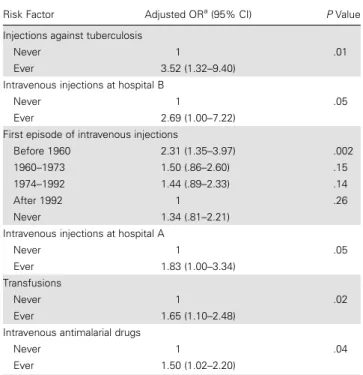
Supplementary Table 2shows the likelihood of HCV infection according to various characteristics. In multivariable analysis (Table 1), the independent risk factors for HCV infection were intramuscular antituberculous injections, afirst episode of intravenous treatment prior to 1960, intravenous injections at hospitals A or B, transfusions, and intravenous antimalarials. No evidence of interaction was found. Injections at the
colonial-era venereology clinic (adjusted OR, 1.56; 95% CI, .96–2.53;
P= .07), injections against schistosomiasis (adjusted OR, 2.79; 95% CI, .93–8.32; P= .07), and a vaccinia scar (adjusted OR, 1.72; 95% CI, .99–3.02;P= .06) were weakly correlated with HCV infection. Among men, having undergone medical cir-cumcision was associated with HCV infection (adjusted OR, 1.98; 95% CI, 1.09–3.57;P= .02).
To allow, with sufficient numbers, stratification of exposures according to the approximate year they occurred, periods were further grouped as pre-1960, 1960–1973, and post-1973 ( Sup-plementary Table 3). HCV prevalence was higher for treatments that occurred before 1960 or in the subsequent decade, with the exception of injections at hospital A (inaugurated in 1958).
HCV subtypes were determined for 118 participants: 116 be-longed to genotype 4, and 1 each to genotypes 1 and 7. The most-common subtypes were 4k (n = 47), 4r (n = 38), and 4c (n = 11).Supplementary Table 4displays risk factors for sub-types 4k and 4r. In multivariable modeling, intravenous antima-larials and intravenous injections at hospital B were associated with subtype 4k, while antituberculous injections, intravenous injections at hospital A, injections at the colonial-era venereol-ogy clinic, and afirst episode of intravenous injections before 1960 were associated with subtype 4r (Table2).
The prevalence of HTLV-1 infection was only 3.1% (26 of 839 participants). Five participants were excluded (2 were
Table 1. Independent Risk Factors for Hepatitis C Virus Seropositivity
Risk Factor Adjusted ORa(95% CI) PValue Injections against tuberculosis
Never 1 .01
Ever 3.52 (1.32–9.40) Intravenous injections at hospital B
Never 1 .05
Ever 2.69 (1.00–7.22) First episode of intravenous injections
Before 1960 2.31 (1.35–3.97) .002 1960–1973 1.50 (.86–2.60) .15 1974–1992 1.44 (.89–2.33) .14
After 1992 1 .26
Never 1.34 (.81–2.21) Intravenous injections at hospital A
Never 1 .05
Ever 1.83 (1.00–3.34) Transfusions
Never 1 .02
Ever 1.65 (1.10–2.48) Intravenous antimalarial drugs
Never 1 .04
Ever 1.50 (1.02–2.20)
Abbreviations: CI, confidence interval; OR, odds ratio.
a
Adjusted for the other variables in the model, as well as for age and parish of recruitment.
Table 2. Independent Risk Factors for Infection With Hepatitis C Virus (HCV) Subtypes 4k and 4r
HCV Subtype, Risk Factor Adjusted ORa
(95% CI) PValue 4k
Intravenous injections at hospital B
Never 1 .05
Ever 3.98 (1.01–15.75)
Intravenous antimalarial drugs
Never 1 .02
Ever 2.10 (1.13–3.90)
4r
Injections against tuberculosis
Never 1 <.001
Ever 12.80 (3.79–43.21) Intravenous injections at hospital A
Never 1 .008
Ever 3.85 (1.43–10.41)
Injections at venereology clinic
Never 1 .03
Ever 2.60 (1.08–6.25)
First episode of intravenous injections
Before 1960 2.91 (1.03–8.26) .04 1960–1973 1.42 (.42–4.81) .57 1974–1992 1.84 (.70–4.80) .22
After 1992 1 .9
No intravenous injections 0.94 (.34–2.60)
Abbreviations: CI, confidence interval; OR, odds ratio.
a
Adjusted for the other variables in the model, as well as for age and parish of recruitment.
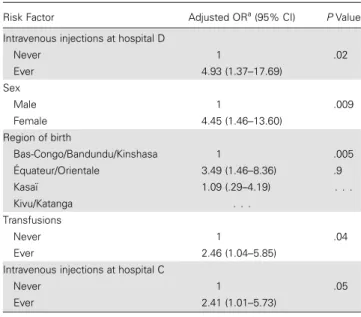
infected with HTLV-2, and 3 were infected with an unknown type or had an indeterminate HTLV status). The prevalence of HTLV-1 infection according to various characteristics is shown inSupplementary Table 5. Table 3displays the independent risk factors for HTLV-1 infection: female sex, birth in Equateur or Orientale provinces, transfusions, and intravenous injections at hospitals C or D. No evidence of interaction was found.
HTLV-1 sequences were available for 23 participants: 20 were infected with subtype 1b, and 3 were infected with subtype 1a. Subtype 1b isolates grouped in one of 2 clades, one containing only DRC strains and the other containing isolates from Cam-eroon and the Central African Republic (Supplementary Fig-ure 1). Small numbers precluded comparisons of risk factors for HTLV-1 infection by subtype.
HCV infection was more common in HTLV-1–infected par-ticipants (12 of 26 [46.2%]) than among HTLV-1–uninfected participants (204 of 797 [25.6%]; P= .03). Whenfitted into the model for the other virus, HTLV-1 was a significant corre-late of HCV infection, and HCV was a significant correlate of HTLV-1 infection (data not shown).
Evolutionary Epidemiology
Supplementary Figures 2 and 3show estimated maximum like-lihood phylogenies for the HCV core and NS5b regions, and
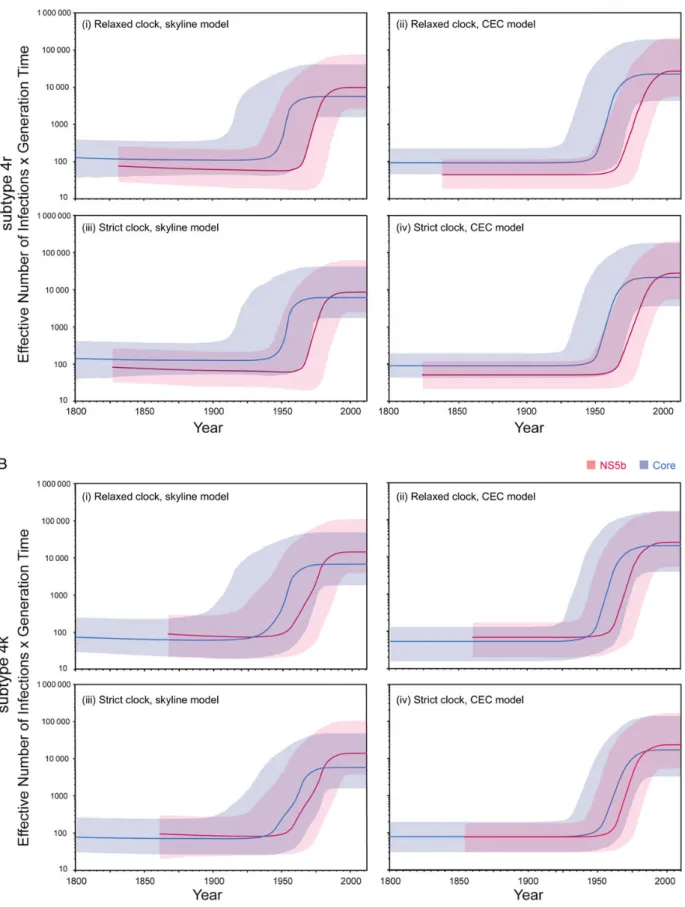
Supplementary Figure 4shows the maximum clade credibility molecular clock trees for each data set. Figure1shows the re-constructed epidemic histories of HCV subtypes 4r and 4k in our study population (insufficient samples were available for other subtypes). Both subtypes, both genome regions, and all analysis methods produced congruent estimates of epidemic
growth trajectory. The common scenario was one of a low, en-demic size until the mid-20th century, followed by a period of rapid exponential growth. The growth phase was followed, in most but not all cases, by a second phase of constant size near the present. Owing to the low lineage coalescence rate near the present, it is difficult to discern whether this plateau is due to sta-bilized prevalence, longer times between infection, lack of statis-tical power, or some combination of these factors. During the epidemic phase, the effective number of infections increased be-tween approximately 10-fold and approximately 100-fold. Addi-tion of all other available DRC HCV sequences to the analysis produced similar results (Supplementary Figure 5).
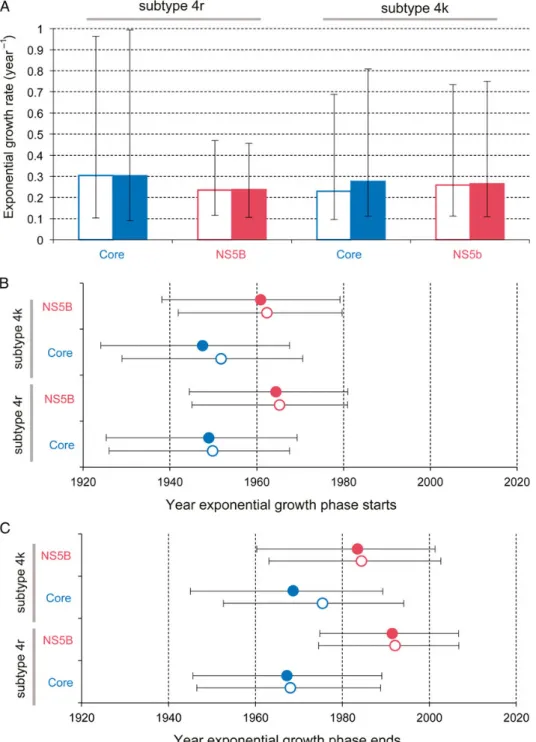
The CEC model was used to estimate the growth rate and the start and end dates of the epidemic phase (Figure2A). Estimates ofr, the exponential growth rate, were high for both subtypes (corresponding to an epidemic doubling time of approximately 2–3 years) and similar to those previously reported for the Egyp-tian HCV epidemic [18], the parenteral causes of which are well characterized [19]. The average estimated start date of the growth phase is 1956 (range, 1947‒1965; Figure2B). Similar estimates were obtained when all other known HCV DRC sequences were included and when sequences from the 2 genome regions were combined (average start date, 1955;Supplementary Figure 6). The estimated end date of the growth phase was more variable among data sets; on average, it was 1979 (range, 1967‒1992; Fig-ure2C). Growth phase start and end dates were typically earlier for the core data sets, suggesting that the core region evolutionary rate was marginally underestimated or that the NS5B rate was overestimated.
DISCUSSION
During the colonial era in much of sub-Saharan Africa, poorly effective antimicrobials were administered intravenously with reused and inadequately sterilized syringes and needles, poten-tially facilitating the transmission of blood-borne viruses, a risk then unknown [10]. Previous epidemiological studies have sup-ported the iatrogenic transmission, approximately 40 to approx-imately 70 years ago, of 3 different blood-borne viruses: HIV-2, in Guinea-Bissau (through treatment of African trypanosomia-sis and tuberculotrypanosomia-sis); HCV, in Cameroon (through receipt of antimalarials and transfusions), Egypt (through treatment of schistosomiasis), and the Central African Republic (through treatment of trypanosomiasis); and HTLV-1, in the Central Af-rican Republic (through receipt of transfusions and chemopro-phylaxis of trypanosomiasis) [13,20–22].
The current study combined 2 independent sources of infor-mation, classical epidemiology and viral gene sequences, to re-construct the time scale and causes of past viral transmission in Kinshasa. It revealed that, among elderly long-term residents of Kinshasa, multiple risk factors from the 1950s onward drove rapid iatrogenic transmission of HCV. HTLV-1 infection was also associated with parenteral risk factors. Since Kinshasa is
Table 3. Independent Risk Factors for Human T-Cell Lymphotropic Virus Type 1 Infection
Risk Factor Adjusted ORa
(95% CI) PValue Intravenous injections at hospital D
Never 1 .02
Ever 4.93 (1.37–17.69) Sex
Male 1 .009
Female 4.45 (1.46–13.60) Region of birth
Bas-Congo/Bandundu/Kinshasa 1 .005 Équateur/Orientale 3.49 (1.46–8.36) .9
Kasaï 1.09 (.29–4.19) . . .
Kivu/Katanga . . .
Transfusions
Never 1 .04
Ever 2.46 (1.04–5.85) Intravenous injections at hospital C
Never 1 .05
Ever 2.41 (1.01–5.73)
Abbreviations: CI, confidence interval; OR, odds ratio.
aAdjusted for the other variables in the model, as well as for age and parish of recruitment.
Figure 1. Reconstructed transmission history of hepatitis C virus (HCV) subtypes 4r and 4k in Kinshasa. Each plot shows the change through time in epidemic size (calculated as [effective population size] × [generation time]) on a log scale. Thick lines indicate the median estimate and the shaded areas show the 95% highest posterior density credible region. Estimates from both the HCV core region and the NS5B region are shown; see the key in the top right.A, Results for subtype 4r.B, Results for subtype 4k. For each subtype, 4 different molecular clock and coalescent model combinations (1–4) are shown.
the location where HIV-1 group M was established some 60 years ago and from where it was ultimately exported to the rest of the world [5], it is plausible that the same factors were involved in the simultaneous amplification of HIV-1.
The high genetic diversity of HCV genotype 4 isolates sup-ports priorfindings that it originated from central Africa [23].
Intravenous antimalarials were associated with genotype 4 in-fection in Kinshasa, where many febrile illnesses are diagnosed as malaria without supporting evidence and where healthcare workers, often directly paid by patients, prefer to administer an injectable, desired, and, hence, more lucrative treatment. As was the case for HIV-2 in Bissau [21], HCV was transmitted
Figure 2. Estimated growth rate and time scale of hepatitis C virus (HCV) subtype 4r and 4k spread in Kinshasa. The CEC model (see“Methods”section) was used to estimate 3 epidemic parameters for each data set: the exponential growth rate during the epidemic phase (A), the start date of the exponential phase (B), and the end date of the exponential phase (C). Boxes and points indicate the median estimate for each parameter, while error bars show the 95% highest posterior density credible regions. Open boxes and points represent values estimated using a strict molecular clock model; solid boxes and points represent those estimates using a relaxed molecular clock model.
in Kinshasa during the treatment of tuberculosis with intramus-cular streptomycin, used throughout the second half of the 20th century [11]. While an intramuscular injection is less prone to transmit HCV (or HIV) than an intravenous injection [24], because a lower inoculum is not pushed directly into a vein, patients with tuberculosis received 60–100 streptomycin injec-tions, daily or twice weekly, and the risk was commensurate.
Specific HCV subtypes were associated with intravenous in-jections, for any indication, in 2 Kinshasa hospitals, while HTLV-1 positivity correlated with intravenous injections in 2 other hospitals, illustrating the importance of founder effects generated by the introduction, or lack thereof, of a particular viral strain within the patient population of a given facility. Fur-ther, HCV subtype 4r infection was associated with injections at a colonial-era venereology clinic where hundreds of intravenous injections were performed each day, with syringes and needles merely rinsed between patients, leading to an outbreak of so-called inoculation hepatitis in 1951–1952 [12,25,26].
Albeit less prevalent than HCV, HTLV-1 is an interesting proxy for historical transmission of HIV-1, as it shares a simian reservoir and the capacity to infect CD4+T cells [27]. Our re-sults indicate that iatrogenic transmission facilitated the spread of HTLV-1 in Kinshasa, along with sexual and vertical routes, even if contaminated injections may be less prone to transmit HTLV-1 because the virus is present as proviral DNA within lymphocytes, not as free virions. Blood transfusions, which re-main unscreened for viruses other than HIV, were administered to one fifth of participants and allowed the transmission of HTLV-1 and HCV, illustrating the co-occurrence in Kinshasa of multiple modes of iatrogenic transmission of blood-borne vi-ruses. The higher HTLV-1 prevalence among women is in line with other studies and with more effective heterosexual trans-mission from males to females than vice versa [27].
Although our evolutionary and epidemiological analyses both have limitations, they are based on independent data (al-beit from the same sample set) and on different model assump-tions, and thus support each other. For some HCV-infected participants who cleared the virus, antibody titers may have waned below the cutoff for positivity [28]. Individuals who died from cirrhosis or liver cancer were not available for study, so, in theory, HCV subtypes perhaps less prone to cause liver disease might be overrepresented. Individuals who acquired HIV infection more than a decade ago, some of them parenterally, were also likely absent from this population. Incomplete recall of medical interventions is inevitable for events that occurred decades earlier. These factors may have bi-ased our measures of association.
Further, a low HTLV-1 prevalence limited our statistical power for that retrovirus. It is likely that other modes of iatrogenic transmission of blood-borne viruses operated in Kinshasa, which we were unable to document with confidence. This is suggested by the independent association between
HCV and HTLV-1 infections, which may reflect unmeasured parenteral exposures common to both viruses (residual confounding).
In cross-sectional studies such as ours, the time sequence be-tween exposures and outcomes is unclear. However, evolution-ary analyses of virus gene sequences from precisely the same study population provided an independent estimate of when HCV transmission took place. Although such analyses can be susceptible to the presence of recombination or strong natural selection in the viral population, recombination is uncommon for HCV, and the congruence of results from different viral ge-nome regions indicates that our results are robust to the effects of selection.
Iatrogenic transmission can drive HCV to high prevalence because, in contrast with HIV-1, most patients survive and re-main viremic for decades, and the per-exposure efficacy of its parenteral transmission may be higher (0.5% vs 0.3%) [29]. In Cameroon and Gabon, HCV prevalence increases steeply with age, far beyond what could be expected from cumulative expo-sure, representing a cohort effect [30,31]. Here we show that in Kinshasa, the city at the center of the emergence of pandemic HIV-1, the exponential growth rate of HCV from the 1950s on-ward paralleled that in Egypt, a country in which millions were infected iatrogenically with the same virus during campaigns against schistosomiasis [19,20]. Further, we estimate that HCV expanded 3 times faster than the population of Kinshasa [5].
Our study provides evidence that at least 2 lineages of HCV grew exponentially in the Belgian Congo’s capital in the mid-20th century. Start dates for this growth period were estimated independently from core and NS5b alignments of subtypes 4k and 4r by using several models, and all fell between 1947 and 1965, with the great majority of posterior probability being placed before 1960 (Figure2). These molecular clock estimates, consistent with the epidemiological results, which indicate a higher risk of HCV before 1960, coincide with the period during which HIV-1 took hold within Kinshasa [4,5]. We therefore conclude that a nonnegligible (yet ultimately unquantifiable) fraction of HIV-1 transmission in Léopoldville during the time window critical for pandemic establishment occurred through iatrogenic routes. In the 1960s, high-risk prostitution appeared in the city [11,26], fewer diseases required multiple administration of intravenous drugs, disease control interven-tions collapsed, and the relative contribution of parenteral transmission may have consequently declined.
The presentfindings represent thefirst empirical evidence for the hypothesis that iatrogenic transmission played a role in the emergence of HIV-1 in Kinshasa in the mid-20th century. The establishment of HIV-1 group M, uniquely among HIV strains, as a global pandemic undoubtedly resulted from multiple causal factors whose relative contributions may never be fully resolved. However, historical iatrogenic transmission in the hub of Cen-tral Africa appears to have been one such contributor.
Supplementary Data
Supplementary materialsare available athttp://jid.oxfordjournals.org. Consisting of data provided by the author to benefit the reader, the posted materials are not copyedited and are the sole responsibility of the author, so questions or comments should be addressed to the author.
Notes
Acknowledgments. We thank Charlotte Khonde (deceased), Christiane Buese, Lablonde Kingolo, and Martine Makulu, for data collection; Jean-Carol Pelletier, Guy Mercier, Jacqueline Bokoo, Erasme Kapenda, Jean Lepetit Khonde-ki-Ngimbi, Lucie Kandu, and Nestor Leta Kandu (deceased), for logistical and administrative support; Annie-Claude Labbé, for advice concerning laboratory issues; and the rectors and administrative staff of the following parishes of Kinshasa for their precious collaboration: St-Michel, St-Pierre, Notre-Dame-du-Congo, St-François-de-Sales, St-Muzeyi, Précieux-Sang, and University.
Financial support. This work was supported by institutional funds from the Université de Sherbrooke, University of Oxford, and Institut Pasteur.
Potential conflicts of interest. All authors: No reported conflicts. All
authors have submitted the ICMJE Form for Disclosure of Potential Con-flicts of Interest. ConCon-flicts that the editors consider relevant to the content of the manuscript have been disclosed.
References
1. UNAIDS. Global report. UNAIDS report on the global AIDS epidemic—2013. Geneva: UNAIDS,2013.
2. Gao F, Bailes E, Robertson DL, et al. Origin of HIV-1 in the chimpanzee Pan trog-lodytes trogtrog-lodytes. Nature1999; 397:436–41.
3. Keele B, Van Heuverswyn F, Li Y, et al. Chimpanzee reservoirs of pandemic and nonpandemic HIV-1. Science2006; 313:523–6.
4. Worobey M, Gemmel M, Teuwen DE, et al. Direct evidence of extensive diversity of HIV-1 in Kinshasa by 1960. Nature2008; 55:661–4.
5. Faria NR, Rambaut A, Suchard MA, et al. The early spread and epidemic ignition of HIV-1 in human populations. Science2014; 346:56–61.
6. Carr JK, Wolfe ND, Torimiro JN, et al. HIV-1 recombinants with multiple paren-tal strains in low-prevalence, remote regions of Cameroon: evolutionary relics? Retrovirology2010; 7:39.
7. Zhu T, Korber BT, Nahmias AJ, Hooper E, Sharp PM, Ho DD. An African HIV-1 sequence from 1959 and implications for the origin of the epidemic. Nature1998; 391:594–7.
8. Peeters M, Toure-Kane C, Nkengasong JN. Genetic diversity of HIV in Africa: impact on diagnosis, treatment, vaccine development and trials. AIDS2003; 17:2547–60. 9. Kalish M, Robbins KE, Pieniazek D, et al. Recombinant viruses and early global
HIV-1 epidemic. Emerg Infect Dis2004; 10:1227–34.
10. Drucker E, Alcabes PG, Marx PA. The injection century: massive unsterile injec-tions and the emergence of human pathogens. Lancet2001; 358:1989–92.
11. Pépin J. The origins of AIDS. Cambridge: Cambridge University Press,2011. 12. Smith DB, Bukh J, Kuiken C, et al. Expanded classification of hepatitis C virus into
7 genotypes and 67 subtypes: Updated criteria and genotype assignment web re-sources. Hepatology2014; 43:915–22.
13. Pépin J, Lavoie M, Pybus OG, et al. HCV transmission during medical interven-tions and traditional practices in colonial Cameroon: potential implicainterven-tions for the emergence of HIV-1. Clin Infect Dis2010; 51:768–76.
14. Zwickl DJ. Genetic algorithm approaches for the phylogenetic analysis of large bi-ological sequence datasets under the maximum likelihood criterion [dissertation]. Austin, TX: University of Texas at Austin,2006.
15. Drummond AJ, Suchard MA, Xie D, Rambaut A. Bayesian phylogenetics with BEAUti and the BEAST 1.7. Mol Biol Evol2012; 29:1969–73.
16. Gray RR, Parker J, Lemey P, et al. The mode and tempo of hepatitis C virus evo-lution within and among hosts. BMC Evol Biol2011; 11:131.
17. Drummond AJ, Rambaut A, Shapiro B, Pybus OG. Bayesian coalescent inference of past population dynamics from molecular sequences. Mol Biol Evol2005; 22:1185‒92.
18. Drummond AJ, Ho SYW, Philipps MJ, Rambaut A. Relaxed phylogenetics and dating with confidence. PLoS Biol2006; 4:e88.
19. Pybus OG, Drummond AJ, Nakano T, Robertson BH, Rambaut A. The epidemi-ology and iatrogenic transmission of Hepatitis C Virus in Egypt: a Bayesian coa-lescent approach. Mol Biol Evol2003; 20:381‒7.
20. Frank C, Mohamed MK, Strickland GT, et al. The role of parenteral antischisto-somal therapy in the spread of hepatitis C virus in Egypt. Lancet2000; 355:887–91. 21. Pépin J, Plamondon M, Alves AC, Beaudet M, Labbé AC. Parenteral transmission during excision and treatment of tuberculosis and trypanosomiasis may be re-sponsible for the HIV-2 epidemic in Guinea-Bissau. AIDS2006: 20:1303–11. 22. Pépin J, Labbé AC, Mamadou-Yaya F, et al. Iatrogenic transmission of human
ret-rovirus HTLV-1 and of hepatitis C virus through parenteral treatment and chemo-prophylaxis of sleeping sickness in colonial Equatorial Africa. Clin Infect Dis
2010; 51:777–84.
23. Iles JC, Raghwani J, Abby Harrison GL, et al. Phylogeography and epidemic his-tory of hepatitis C genotype 4 in Africa. Virology2014; 464‒465:233‒43. 24. Yazdanpanah Y, De Carli G, Migueres B, et al. Risk factors for HCV transmission
to health care workers after occupational exposure: a European case-control study. Clin Infect Dis2005; 41:1423–30.
25. Beheyt P. Contribution à l’étude des hépatites en Afrique. L’hépatite épidémique et l’hépatite par inoculation. Ann Soc Bel Med Trop1953; 33:297–340.
26. Pépin J. The expansion of HIV-1 in colonial Leopoldville, 1950s: driven by STDs or STD control? Sex Transm Infect2012; 88:307–12.
27. Gessain A, Cassar O. Epidemiological aspects and world distribution of HTLV-1 infection. Front Microbiol2012; 3:368–88.
28. Kondili LA, Chionne P, Costantino A, et al. Infection rate and spontaneous seror-eversion of anti-hepatitis C virus during the natural course of hepatitis C virus in-fection in the general population. Gut2002; 50:693–6.
29. Jagger J, Puro V, De Carli G. Occupational transmission of hepatitis C virus. JAMA2002; 288:1469–70.
30. Nerrienet E, Pouillot R, Lachenal G, et al. Hepatitis C virus infection in Cameroon: a cohort effect. J Med Virol2005; 76:208–14.
31. Njouom R, Caron M, Besson G, et al. Phylogeography, risk factors and genetic history of hepatitis C virus in Gabon, central Africa. PLoS One2012; 7:e42002.