EARLY ATHLETE SPECIALIZATION AND THE IMPACT ON PLAY AND BURNOUT MENTALITITES OF DIVISION I COLLEGE ATHLETES
Rachel Renée Leeke
A thesis submitted to the faculty of the University of North Carolina at Chapel Hill in partial fulfillment of the requirements for the degree of Master of Arts in the Department of Exercise
and Sport Science (Sport Administration).
Chapel Hill 2017
ii © 2017
ABSTRACT
Rachel Renée Leeke: Early Athlete Specialization and the Impact on Play and Burnout Mentalities of Division I College Athletes
(Under the direction of Erianne Weight)
In recent years, the National Collegiate Athletic Association has stated an
increased focus on health and wellness. It is important to understand an athlete’s mental outlook in an effort to impede the likelihood of burnout as a result of negative sport experience. This study’s focus is to assess the student-athlete's perspective as they approach their sport by examining the age of sport specialization and other independent variables. Doing so can aid coaches in instituting more targeted measures (i.e. team bonding events, alteration of coaching style, etc.) in order for students to get the most out of their athletic experience. Additionally, understanding mitigating factors such as when an athlete started sport, gender, individual v. team sport and revenue v. Olympic sport factors could influence future parenting decisions and
encourage sport-governing bodies to provide recommendations for better mental health
iv
TABLE OF CONTENTS
LIST OF TABLES...vi
CHAPTER 1: INTRODUCTION...1
Introduction...1
Research Questions...2
Hypothesis...2
Definition of Terms...3
Assumptions...3
Significance of Study...3
CHAPTER 2: REVIEW OF LITERATURE...4
Play...4
Burnout ...9
Sport Specialization...12
CHAPTER 3: METHODOLOGY...16
Purpose of Study...16
Participants...16
Procedure... 16
Instrument...17
Data Analysis... 19
CHAPTER 4: RESULTS...20
Demographic Statistics...20
Summary Statistical Analysis...21
Age of Sport Specialization ...25
Relationship between play and burnout ... 27
CHAPTER 5: DISCUSSION...28
Importance of Study...28
Play instrument development ...29
Play and burnout mindsets in intercollegiate athletics ...29
Relationship between play and burnout ...32
Limitations and Recommendations for Future Research...32
APPENDIX...35
vi
LIST OF TABLES
Table 1: Demographic information of student athletes ...20
Table 2: Summary statistics for scale of play questions ...23
Table 3: Summary statistics for scale of burnout questions...24
Figure 1: Play vs. sport specialization scatterplot...26
Figure 2: Burnout vs. sport specialization scatterplot...26
CHAPTER I Introduction
In the United States, the National Collegiate Athletic Association (NCAA), functions as a member-led organization dedicated to the support of student athletes during their intercollegiate athletic careers. As the regulating body of member institutions, the NCAA upholds collegiate amateurism, enforces sporting rules, and holds national championships for most of its 24 sports. Although a student-athletes undergraduate athletic career is short, the physical and psychological affects felt by the student last a lifetime. The NCAA’s stated focus on health and wellness has been at the heart of recent discussions. NCAA President Mark Emmert, has said, “This is the time now to match our actions with our values” as he called for a “rebalancing of athletics and academics” (New, 2016). Much of the discussion surrounding this rebalance of athletics and academics has focused on student athlete time demands. While this is an important structural impediment that can impact the athlete’s experience, it is equally important to
understand the athlete mental state. The mental state of a person can be just as important, if not more than, the daily tasks they carryout. Thus, the purpose of this study is to investigate the psychological approach to sport collegiate athletes hold and whether the age athletes specialize in their sport impacts burnout and/or a play mindset.
2
psychological outcomes and counter the emotional exhaustion associated with the stress dimensions of burnout (Gustafsson, Kentta, & Hassmen, 2011). Between 6-11% of young athletes experience significant burnout symptoms, characterized by isolated feelings of
exhaustion, depression, and frustration, all of which have negative health implications (Eklund & Cresswell, 2007). The antithesis of these feelings is play (Sutton-Smith, 1997).
Stemming from its evolutionary purpose, play allows individuals to come together, engage in a safe setting, and learn more about ones environment, all while having fun (Brown, 2009). In an attempt to bring about better athlete psychological outcomes, an examination of the intersection of burnout and play can aid athletic staff in better support and development of an athlete’s performance. Specific research questions pursued within this study follow.
Research Questions
(1) How does (a-d) effect play or burnout mindsets in intercollegiate athletes? a. Age of sport specialization
b. Gender
c. Individual v. team sport d. Revenue v. Olympic sport Hypothesis
Ha= as age of specialization increases, presence of burnout decreases, play mindset increases. Hb= gender will have no bearing on the likelihood of predicting play or burnout mindsets Hc=for individual sports the likelihood of burnout will increase, play mindset decrease; for team sports burnout will decrease, play mindset increase.
Definition of Terms
Sports specialization is defined as intense, year-round training in a single sport with the exclusion of other sports (Dugas, Durazo-Arivu, Luke, & Jayanthi-Pinkham, 2011). In the context of this research we are defining the age at which athletes focused on the single sport they currently play.
Assumptions
It is assumed that the procedures provided were followed, that an honest rather than coercive/controlling environment was created, which would potentially affect the answers provided by respondents. It is assumed that the subjects answered objectively and honestly in completing the evaluation of personal play perception and the Athlete Burnout Questionnaire. Significance of Study
Understanding the student-athlete's perspective as they approach their sport can aid coaches in instituting more targeted measures (i.e. team bonding events, alteration of coaching style, etc.) in order for students to get the most out of their athletic experience. Additionally, understanding mitigating factors such as when an athlete started sport, gender, individual v. team sport and revenue v. Olympic sport factors could influence future parenting decisions and
4
CHAPTER II LITERATURE REVIEW
Play
The study of play has yielded many ideas as to its purpose within human development. Researches have held varying opinions on the matter. Some have asserted play is simply
something done in and of itself with no function at all (Sutton- Smith, 1997), while others claim it is an innate behavior useful in building and maintaining social relationships (Fagen, 1981). However, the current leading researcher on the subject and founder of the National Institute of Play, Stuart Brown, indicates during play “ the brain is making sense of itself through simulation and testing” (2009, p. 34). Brown’s studies show through playing we are able to make implicit connections that we use in our everyday life. Because we are playing we are able to minimize risk while learning lessons and building skills. While play may be hard to define it is something not only unique to mammals, but some birds and a few other species play as well (Bateson 2005). Play allows us to interact with our environment and build new connections within the world around us.
Brown (2009) has postulated seven properties of play foundational to assessing play
behavior.
1. It must be done for its own sake, appearing purposeless.
2. It must be voluntary, with participants willing to engage without prior prompt.
3. Participants should feel an inherent attraction – organic magnetism to the activity,
done for no reason other than it feels good.
4. It has to have improvisational potential – be free of pre-determined outcomes, which
many people take advantage of because instead of stopping play when an activity gets
boring many people just switch up the rules to stay engaged.
5. Participants should experience a diminished consciousness of self characterized by
being fully in the moment, or in the zone, where they no longer care about whether
they look awkward, smart, or silly.
6. Participants should experience an inherent continuation desire to play.
7. It should allow participants to feel freedom from time as it occurs, without a
designated time period.
Simply put, “play is not a thing but a process” (Upton, 2015, pg. 21).
Witnessing play within various mammals and other species provides strong evidence of
play’s importance to human life; it aids us in survival. Otherwise, through evolution it would
have been a victim of natural selection and removed from the genetic traits passed on to
offspring (Brown, 2009). Indeed, while play can be thought of as a waste of time because it
takes away from more serious homeostatic needs to survive, Brown (2009) argues we are
interacting with our environment in such a way that we are creating and testing new simulations
6
these new experiences we are creating new cognitive connections that transpose settings and find
their way into our everyday lives.
“When we get really into following the victories and defeats of a favorite football team, we learn about perseverance and how to argue with our friends in a constructive way. When we experience a new physical challenge like learning to ski, we may find that the things we learn on the slopes - like avoiding falling by keeping our weight forward and committing to the turn - may come to mind during business negotiations as important reminders to press forward and commit to the deal - or fail” ( p. 35)
This idea makes sense considering things that “fire together, wire together”. Meaning, the
manner in which one has handled similar challenges when faced with a new situation allows
them to think critically to the same effect because of past experience. Play functions as a way for
us to test-drive new ways of thinking and form new cognitive pathways based on past
experience.
Pulling from the work of animal play scholar, Stephen Siviy (1998), play functions as a
form of cognitive understanding because it continues the activation of neural circuitry. In our
most formative years, childhood, it is no coincidence the time of most rapid brain development
and the overwhelming instinct to play are present at the same time. After birth, mammals,
possess many neurons already in place, however play promotes the creation of new connections
that did not exist before (Brown, 2009). Through play behaviors, which coincide with
interactions within one's surrounding environment, problem solving and creative skills are
naturally nurtured (Smith & Simon, 1984). As stated by L.S. Vygotsky, “play is not the
predominant feature of childhood but it is a leading factor of development” (1978, p. 101). For
the developing brain, play functions as an innocuous way of learning without taxing our physical
and emotional well-being because there is no threat, we are simply playing. While the initial
“in playing we foster the creation of [these] new circuits and test them by running signals
through them”(Brown, 2009, p.41).
Due to play being a pillar in development, the absence of it can have major implications
to one's health. In addition to the continued development of neural circuitry, play functions as a
lead indicator for successful social development (Harlow, 1971; Winnicott, 1971). While other
mammals appear to “play fight” with siblings, in truth they are developing the skills to be able to
not only kill and feed themselves in the wild, but also defend themselves against off competing
predators. As social creatures, human play functions as a way of assessing social norms, which
are critical in our ever-changing environment. Play serves as a way to gauge social boundaries,
realize social expectations placed upon ones by others, and learn the difference between friendly
and mean-spirited interactions (Caillois, 2001). Similarly, the development of emotional
intelligence is accompanied by play where an individual is able to perceive another’s emotional
state and enact an appropriate response. While a very different form of survival, social missteps
have the capacity to damage relationships which could lead to the next promotion at work, a
budding romantic relationship, or invitation to an event which could potentially raise one's social
capital. Similarly, in Harlow’s (1971) Learning to Love, he details, not just in childhood, but
throughout adult life, play is the primary activity for successful social development. Through the
expanding of synaptic connectivity the understanding of how to interact with individuals and
recognize possibly threatening situations allows play to be a guiding form with which we
navigate through different settings.
While the amount of time dedicated to play after childhood significantly declines, its
benefits are still felt regardless of age. In fact, throughout life, humans are able to continually
8
In order to continue through the changing landscape from a child to an adult while navigating
varying degrees of responsibilities, play functions as an agent to remain creative and remain
aware of our environment. In adulthood this is particularly important because “in play thought is
separated from objects and action arises from ideas rather than things” (Vygotsky, 1978, pg.
97). Play, very literally, encourages us to think in ways we have never done so before, enabling
us to physically maintain homeostasis and at best, remain successful at work we undertake. In
adults, play functions as a catalyst to find enjoyment and engage fully with the world. Something
thought of as frivolous or non-productive can bring meaning and liven everything one does. In
nature the only time play is not present within an animal is when it is in survival mode, deprived
of food, sleep or thirst. However, once all other survival hierarchies are met, play returns. As
animals, humans, have the ability to intertwine work and play and live a fulfilled life, one that
not necessarily has to indicate a lack of effort or endeavor on their part. “The distinction of play
from work does not consist in it being less hard; children work astonishingly hard at their games,
which do not on that account cease to be games; Hence, it is a complete mistake to suppose that
play is the overflow of mere physical energy and aimed at merely physical pleasure”
(Collingwood, 1924, p.104). The intertwining of work and play cannot be dispelled simply
because pleasure is not gained from every element of play, because pleasure is not, the defining
characteristic of play (Vygotsky, 1978). In sport where a crushing loss may bring even the most
enthusiastic person down, but because play has an organic attraction, an interest in continuing to
engage is not lost indefinitely. Play in the form of imaginative thought, a form of projecting
future desires and outcomes leave imprints on our mind as well. (Sutton-Smith, 1997). In doing
so we create new combinations of outcomes through our behavior and see what is feasible or
Everyone plays. Be it an example of ancient Mayan ball courts appearing on
pre-Columbian structures in South America or video games in modern day Japan, across cultures and
throughout history, every civilization has had a form of play (Upton, 2015). Play functions as a
way of learning, creating new cognitive pathways spurred by interacting with ones environment
in a safe way. For collegiate athletes who dedicate years in hopes of being elite in their sport it is
worthwhile to investigate how the engagement of the play mindset affects the enjoyment of their
sport and what implications it has on burnout.
Burnout
Sport participation can be a worthwhile and inspiring experience for athletes of all levels.
However there is a range of negative phenomena that can transpire from ones involvement. In
the pursuit of excellence within any sport a great deal of time and effort must be put in in order
to get the desired result of expertise (Ward et al., 2007). In doing so, several hours of practice,
weight lifting and restrictive eating are some of the elements that condition an athlete to shape
their lives in pursuit of athletic excellence. While those factors are not harmful in and of
themselves, an athlete’s pursuit for elitism can expose them to the negative consequence of
athletic burnout (Gustafsson, Kentta, & Hassmen, 2011).
Burnout was first viewed as “a state of emotional exhaustion caused by excessive
psychological and emotional demands placed on people in helping professions” (Jackson,
Schwab, & Schuler, 1986, p.630). Smith (1986) extended the understanding to reflect an
athlete’s maladjusted response to stress associated with competition and practice. Coakley (1992)
and Raedeke (1997) later realize burnout is not a manifestation of inadequate handling of stress
but in actuality, it results from the athlete’s perception of their relationship to their sport. Athlete
burnout is a complex psychological syndrome characterized by (1) devalued experience in sport
10
accomplishment (Raedeke, 1997; Raedeke & Smith 2001, 2009). Devalued sport experience
refers to decreased interest in and negative attitude toward a once loved sport. Reduced sense of
accomplishment relates to perceived lowered ability to execute and perform ones sport while
being physically and emotionally exhausted functions as the core element of athlete burnout
(Gustafsson, et al., 2011).
Personal motivation functions as a foundational element for participation in sport (Gould,
1996). Recent efforts have explored burnout within frameworks of perfectionism,
self-determination, and social support frameworks (Jowett, Hill, Hall, & Curran, 2016; Rasquinha,
Dunn, & Dunn, 2014; Lonsdale, Hodge, & Rose, 2009; Hodge, Lonsdale, & Ng, 2007; Rees &
Freeman, 2007; DeFreese & Smith, 2013; Gustafsson, Hassmen, Kentta, & Johansson, 2008;
Hill, Hall & Appleton, 2009; Raedeke & Smith, 2009). These varying frameworks provide
insight into the possible mindsets that buffer or cause burnout to set in. In terms of perfectionism,
defined as a personality disposition that includes striving for faultlessness accompanied by harsh
self-evaluation, research has shown it is a factor that appears to underpin athlete burnout (Frost,
Marten, Lahart, & Rosenblate, 1990; Jowett et al., 2016). As one might expect, higher levels of
competitive sport are associated with higher perfectionistic strivings (Rasquinha et al., 2014).
While the previous statement might indicate a developmental link between competitive sport
level and perfectionistic strivings, further analysis must be done to dispel the possibility that
perfectionistic strivings enable an athlete to attain higher performances in their sport (Stoeber,
Uphill, & Hotham, 2009).
In the interest of realizing higher performances Deci and Ryan (2000) point to
competence, autonomy and relatedness as the proposed basic psychological needs every human
sport, autonomy relates to an individual’s ability to have choice and self-directedness and
relatedness has to do with the ability to feel connection with others. In general, optimal
wellbeing is expected when these needs are met (Ryan & Fredrick, 1997). In sport contexts when
basic psychological needs are met athletes present self-determined motivation that leads to
positive psychological outcomes such as coping with the practice and competition environment
(Lonsdale et al., 2009; Hodge et al., 2007). Conversely, when these needs are not met, there is
thought that burnout is a negative circumstantial outcome (Perreault, Gaudreau, Lapointe &
Lacroix, 2007).
In hopes of mitigating burnout Coaxley (1992) indicated to truly get to the root of the
issue one must not look to aid the athlete in managing stress but looking at the social structure
surrounding the athlete. In addition to outside support Raedeke and Smith (2004) indicated the
need for internal coping behaviors such as lifestyle management skills are crucial in buffering the
psychological effects of stress and burnout. Similarly, perceived support from teammates is
important to mitigate feelings of athlete burnout (Defreese & Smith, 2012).
While these theories are indicators of how burnout transpires, researchers have differing
outcomes when gauging male and female athletes burnout outcomes as documented using the
Eades Athletic Burnout Inventory and the Competitive State Anxiety Inventory (Gould, D., et. al.
1996, Finch, 1999; Wyner, 2004; Allen, 2006). While outcomes differed, researchers have
observed through their findings that in some cases women have a lower sense of personal
accomplishment (Allen, 2006). However, there is a consensus using the same apparatuses,
individual sport athletes have scored higher on the burnout measures (Finch, 1999; Wyner, 2004;
12
unusually high amount of training that goes into individual sport and its repetitive nature, causes
increased anxiety for the athletes.
As the literature has indicated, burnout can impact the worthwhile sporting experience
athletes partake in. The study at hand investigates a variety of factors that may be associated with
burnout. A better understanding of these factors may facilitate the development of burnout
mitigation pathways. This knowledge can be utilized to provide optimal athlete experience.
Sport Specialization
Approximately 27 million young people in the United States, between the ages of 6 and
18 participate in team sports (DiFiori, Benjamin, Brenner, Gregory, Jayanthi, Landry, & Luke,
2014). The opportunity to participate in organized sport as a youngster can bring about a myriad
of positive health outcomes. Engaging in sports as a child encourages vigorous activity and
energy expenditure, which aids in the reduction of childhood obesity, a key indicator of adult
obesity (Berrigan, Dodd, Masses, McDowell, Troiano, Tilert, 2008). Youth sports also foster
learning, practicing and developing gross motor skills, which, when acquired at a young age, on
average, yields continued engagement in the activity into adulthood (Purcell, 2005; Cardinal,
Lee, Loprinizi & Loprinizi, 2012). A 2010 Center of Disease Control and Prevention study
indicated a positive correlation between young people who participated in high levels of physical
activity and improved weight control, improved academic achievement, decreased risk of heart
disease and diabetes, and less psychological dysfunction (Ullrich-French, McDonough, Smith,
2012). In addition to the numerous physical health benefits organized sport can also provide
psychological and social impact. Youth sport participation has shown an improvement in
student’s social skills, individual self-worth, decreased suicidal thoughts, enhanced time
2013; Dowda, Levin, Pate, Trost, 2000). These positive outcomes for young people in sport,
however, cannot be assumed and must be cultivated in a healthy and supportive environment
(Merkel, 2013).
Early sport specialization, once thought of as a way to bring about elite sport
performance at a young age, can impede the positive outcomes organized sport accomplishes
(Callender, 2010; Figueriredo, Goncalves, Rama, 2012). In fact, early sport specialization can
yield negative physical, social, and psychological implications. Many studies indicate early
sport specialization is not a reliable source at predicting future sport success (Wall & Cote, 2007;
Callender, 2010; Goncalves, et. al, 2012; Elbe, Moesch, Hauge, & Wikman, 2010). In fact, early
sport diversification can be beneficial to young athletes because they develop an array of skills
that does not hinder sport specific skill development (Wall & Cote, 2007). While parents may
see it as a means to gain social, financial, and educational rewards, in actuality, “participation in
one sport early on in life is thought to increase the risk of sport related injuries, peer isolation,
burnout, psychosocial problems and attrition” (Merkel, 2012 p. 155; Hedstrom & Gould, 2004;
Jayanthi et. al., 2013).
The body of a young athlete is still developing and growing during adolescence. It is a
critical time with which they become vulnerable to overuse, from repetitive motion during single
sport play, and traumatic injury (DiFiori et. al., 2014; Merkel & Molony, 2012; Foss, Hall,
Hewett, & Myer, 2015). Depending on their stage of growth, children can injure structures that
are different than those found within adults (Merkel, 2013). With bones weaker than their
ligaments children are at increased risks for breaks and fractures throughout the growth plate and
14
Psychologically, the increased stress of becoming an elite player can lead to sport
attrition, in fact, by the age of 15, 70-80% of child athletes are no longer participating in sport
(Breunner, 2012). Contributing factors include a mismatch in sport readiness and skill
development, in addition to parents perceiving their children like to engage in sport to “win”
(Purcell, 2005; Chung, Gould, Smith & White, 2002). A disconnect between the intentions of
the child and parent on the reason to participate can yield anxiety, stress, and ultimately attrition
for the young athlete (Hedstom & Gould, 2004; Purcell, 2005). The adult interpretation of youth
sports as a miniature version of professional sport overrides the participatory atmosphere and
allows space for the implementation of coaching tactics which mimic that of college and
professional sports, including hypercompetitive practices and physical punishments. (Merkel,
2012). It is suggested that children should wait until after the age of 12 to specialize in a given
sport (Epstein, 2013; Jayanthi, Pinkham., Dugas, Patrick & LaBella, 2013). As indicated by
Wall and Cote (2007), youth sport programs should focus on “sport-specific practice, games and
play activities that foster fun and enjoyment” (p. 78) rather than early sport specialization
practice activities that are not as enjoyable and ultimately undermine intrinsic motivation to
continue on in the sport.
In conclusion “there is no evidence intense training and specialization before puberty are
necessary to achieve elite status” (Jayanthi, et. al., 2013, p. 251). Sport participation at a young
age should be focused on the enjoyment of the experience in hopes of contributing to their
character and motivation toward goals. (Wall & Cote, 2007). While participation in sport carries
a myriad of documented positive outcomes, early sport specialization can foster an unhealthy
environment for young athletes. The research shows early sport specialization is linked to
social behavior when young children do not garner the more foundational elements of organized
sport such as playing together for skill building enjoyment (Wall & Cote, 2007). The skills
developed by young children during this pivotal time in life are vital to creating positive
16 CHAPTER III METHODOLOGY
The purpose of the study was to examine how age of sport specialization, gender,
participation on an individual or team sport, and/or participation in a revenue or Olympic sport
affects play or burnout mindsets for student athletes at the University of North Carolina at
Chapel Hill.
Participants
The target population for the study was all student-athletes participating in University of
North Carolina intercollegiate athletics department during the school year 2016-2017(n=796). A
census sampling method was utilized and the entire population was invited to participate in the
anonymous study via email and follow-up participation opportunities were solicited via
paper-copies of the survey in the Loudermilk Center of Excellence, the student-athlete academic center
of Carolina Athletics. Participants range in age from 18 to 25 years. Individuals can be part of
female sport teams: basketball, cross country, fencing, field hockey, golf, gymnastics, lacrosse,
rowing, soccer, softball, swimming & diving, tennis, track & field, and volleyball; and male
sport teams: baseball, basketball, cross country, fencing, football, golf, lacrosse, soccer,
swimming & diving, tennis, track & field and wrestling.
Procedure
Email addresses were obtained through permission from the UNC-CH department of
intercollegiate athletics. Once email addresses were collected, an invitation to participate in the
Qualtrics. Following electronic data collection, in person responses were collected at The
Loudermilk Center for Excellence, UNC-Chapel Hill’s student-athlete academic center. The
questionnaires were self administered and included an informed consent statement, sport
performance and demographic questions and the play and burnout scales. Participants were
asked to answer honestly and to the best of their knowledge.
Instrument
Part I of the survey asked student athletes to fill out demographic data surrounding their
age, identities, class standing during the academic year 2016-2017, sport, and most importantly
the age they specialized in their current intercollegiate sport. For this study, an instrument was
developed that included demographic measures, a play mindset measure, and the 15 question
Athlete Burnout and Engagement Questionnaire (Raedeke & Smith, 2001). The play mindset
measure was created to specifically assess student-athlete engagement with the play mentality
while performing their sport. The survey instructed participants to attribute their responses to the
play questionnaire on a Likert scale from 1 (not at all true for me) to 5 (completely true for me).
Preliminary validity was established through the development of a four-dimensional construct
based on foundational play literature: “Social Play Behavior”, “Neurobiological substrates of
play behavior: glimpses into the structure and function of mammalian playfulness”, “Play as an
organizing principle: clinical evidence and personal observations” and “Animal play behavior”.
(Beckoff, 1985; Siviy, 1998; Brown, 1998; Fagen, 1981). Examining those sources led to the
development of preliminary questions to be used in the development of the play survey. Initial
questions exemplified the seven play properties essential to assessing play behavior,
purposelessness, voluntary interaction, inherent attraction, improvisational potential, diminished
18
was settled on a 20-question instrument where 6 of the properties had 3 questions and 1 property
had 2 questions. Validity was established through review by a panel of experts including
researchers from the Center for Research in Intercollegiate Athletics, an expert in survey
methodology from the Odom Institute of social science, three administrator that work with
athlete development, and three faculty members who study college sport. Measures of reliability
were examined and included in the results section. Internal reliability was measured via
factor-analysis, and those alpha levels are presented in Table 2. The reliability coefficients ranged
between -.428 and .804 showing aside from the outlier a moderate to high degree of scale
reliability. The instrument’s scale ranged from 1-not at all true of me to 5- completely true for
me.
The survey also includes use of the Athlete Burnout and Engagement Questionnaire
(Raedeke & Smith 2001) with documented reliability and validity in order to assess the student’s
level of burnout. The Athlete Burnout Questionnaire (ABQ), is a renowned psychometrically
sound measure of athlete burnout using a 5-point Likert scale ranging from 1=almost never to
5=almost always. The instrument measures athlete burnout by examining the underlying factors;
emotional/physical exhaustion, reduced sense of accomplishment and sport devaluation. The
researchers initially included 21 items, 7 for each dimension but in the final publication of the
instrument paired down to 15 items, 5 for each dimension. Raedeke (1997) developed face
validity based on burnout dimensions definitions and interviews from previous research.
Researchers then utilized three sport psychology graduate students to rate each item for content
validity and readability. After further modifications based on the received feedback a sample
(n=7) of athletes was used to pilot test the survey for item readability and comprehension. To
accomplishment, and sport devaluation aligned with the definition of burnout a factor analysis
was conducted. Correlations between the factors ranged from .11 to .46 with a mean
intercorrelation of .36. Upon utilization in this study, the reliability coefficients ranged between
.77 and .86 indicating moderate to high reliability. This instrument has been utilized extensively
and has well-cited measures of reliability and validity (Raedeke & Smith, 2001).
Data Analysis
SPSS statistical software was the main tool used in data analyses to test reliability
coefficients and further test the hypothesized measurement model (play instrument). Summary
statistics, one-way ANOVA testing and correlations were run to analyze the data.
20 CHAPTER IV
RESULTS
Demographic Statistics
Questionnaires were sent to 796 student athletes, of which 202 responded (a response rate
of 25.4%). The 202 responses yielded 182 questionnaires completed in their entirety. The age of
participants ranged from 18 to 25 (M=20.12; SD=1.31). Of the respondents, 37% (n=67) were
male and 62% (n=115) were female. Upon examination of the data, the sample is not
representative of the athlete student body as a whole. The student athlete population during
school year 2016-2017 was 54% male and 46% female, a difference of 17% between sample and
actual population gender makeup. Additionally, there was a slight over-representation of rowing
athletes and an under representation of football players. Descriptive statistics for the athlete
sample are listed in Table 1.
Table 1
Demographic information of student athletes
% n
Sex
Male 36.8% 67
Female 62.3% 115
Race
African American 17.6% 32
Asian 1.6% 3
Caucasian 72.0% 131
Hispanic 2.2% 4
Native American 0.5% 1
Mixed Race 6.0% 11
Table 1 (continued) 2016-2017 class standing
Freshman 25.3% 46
Sophomore 28.6% 52
Junior 26.9% 49
Senior 16.5% 30
5th Year 2.7% 5
Sport
Rowing 12.6% 23
Football 8.8% 16
W Lacrosse 6.6% 12
W Gymnastics 6.6% 12
W Cross Country 4.9% 9
Field Hockey 4.9% 9
Softball 4.9% 9
W Track & Field 4.9% 9
M Track & Field 4.4% 8
M Fencing 4.4% 8
M Swim & Dive 3.8% 7
M Lacrosse 3.8% 7
W Swim & Dive 3.8% 7
Volleyball 3.3% 6
Baseball 3.3% 6
W Basketball 2.7% 5
W Soccer 2.7% 5
M Soccer 2.7% 5
Other 10.3% 19
Note: Mean age is 20
"Other" is inclusive of sport teams from which less than 5 athletes took the survey. (W Fencing, W Golf, W Tennis, M Basketball, M Cross Country, M Golf, M Tennis, Wrestling)
Summary Statistical Analysis
Simple summary statistical analyses were conducted to determine the mean (M) and
22
Questionnaire. Play questions included statements assessing Carolina student athlete’s play
mentality toward their sport. Athletes were asked to indicate their agreement on a statement
ranging from 1-not at all true for me to 5- completely true for me. These results are displayed in
Table 2. Also displayed in table 2 are the reliability measures (α)for each of the seven categories
as a whole. The overall mean (M=3.35) and alpha level (α=.819) of the play questionnaire is
listed at the bottom of Table 2. Overall, elements of play that were most highly rated included an
inherent attraction to their sport participation (M = 4.30, SD = .90), and freedom from time while
playing their sport (M = 3.59, SD = 1.21). A high degree of variability was evident from the
standard deviations with many exceeding 1.0. This high variability in responses likely drew the
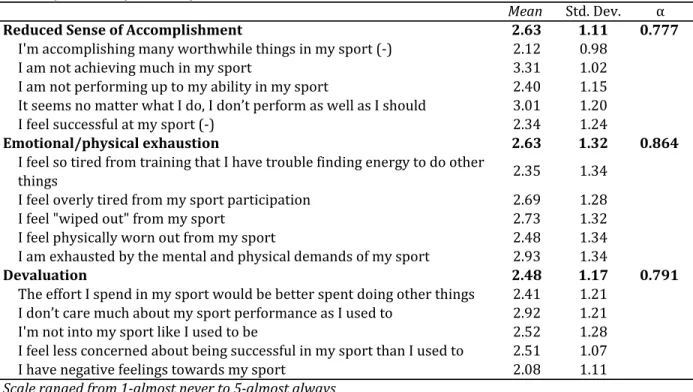
Similarly, the Athlete Burnout Questionnaire (ABQ) presented statements assessing
athlete’s burnout mentality. Athletes were asked to indicate their agreement with statements
ranging from (1) almost never to (5) almost always. These results are displayed in Table 3
alongside the reliability measures (α) for each of the three categories as a whole. The overall
mean (M=2.58) and alpha level (α=.909) of the burnout questionnaire is listed at the bottom of Table&2
Mean% Std.&Dev. α
Inherent'Attraction' 4.30 0.90 0.695
I&like&to&play&my&sport& 4.29 0.88
I&feel&internally&driven&to&play&my&sport& 4.39 0.84
I&feel&an&inherent&attraction&to&my&sport& 4.22 0.96
Freedom'from'time' 3.59 1.21 0.804
I®ualrly&find&myself&losing&track&of&time&while&playing&my&sport& 3.68 1.18 I&am&often&surprised&how&quickly&time&passes&while&I&play&my&sport& 3.62 1.2 As&I&play&my&sport,¬hing&else&in&the&world&matters& 3.47 1.27
Voluntary'Interaction& 3.45 1.12 0.500
When&I&have¬hing&else&to&do&I&find&a&way&to&play&my&sport& 2.91 1.24
I&feel&pressure&to&play&my&sport&from&others&(L) 3.09 1.31
I&play&my&sport&because&I&want&to& 4.36 0.79
Continuation'Desire' 3.39 1.19 0.765
I&often&find&myself&wishing&there&was&more&time&to&engage&in&my&sport& 3.09 1.22 When&I&play&my&sport&I&do¬&want&time&to&end& 3.11 1.33
I&look&forward&to&playing&my&sport& 3.97 1.04
Improvisational'Potential' 3.08 1.32 0.482
When&I&play&my&sport&in&an&unstructured&setting,&I&often&imagine&I'm&
playing&&in&different&scenarios& 3.15 1.29
When&I&play&my&sport&in&an&unstructured&setting,&I&sometimes&change&the&
rules&to&keep&it&interesting& 2.69 1.45
When&I&play&my&sport&in&an&unstructured&setting,&I&rarely&improvise&
scenarios&or&come&up&with&alternative&ways&to&play/practice&my&sport&(L) 3.40 1.24
Diminished'Consciousness'of'Self' 2.99 1.25 0.302
I&am&conscious&of&my&appearance&while&playing&my&sport&(L) 2.8 1.25 I&do¬&feel&concerned&with&personal&issues&while&playing&my&sport& 3.41 1.25 I&am&aware&of&the&presence&of&onlookers&while&I&play&my&sport&(L) 2.78 1.27
Appearing'Purposeless' 2.71 0.97 H0.428
I&enjoy&the&process&of&playing&my&sport&more&than&the&results& 3.33 1.07
I&play&my&sport&to&accomplish&specific&goals&(L) 2.09 0.88
Scale%ranged%from%10almost%never%to%50almost%always% (L)&=&items&are&reverseLscored&
Overall'Scale'mean'='2.58 Overall'Scale'α='.909
24
Table 3. Each of the means were below the 3.0 level, however standard deviations were high
indicating a high degree of variability in responses.
One Way Analysis of Variance
One-way analysis of variance (ANOVA) was conducted to explore whether the variance
evident through the high standard deviations within the play and burnout scales were due to
differences between age of sport specialization, gender, participation in individual v. team sports,
or participation in revenue v. Olympic sports. In each of these comparisons, the variance was
not significant between comparison groups. In examination of gender, the male participants had
slightly higher levels of both play (M = 3.47; SD = .527) and burnout (M = 2.63; SD = .102)
than the female participants play (M = 3.35; SD = .564) and burnout (M = 2.55; SD = .833) Table&3
Mean% Std.&Dev. α Reduced&Sense&of&Accomplishment& 2.63 1.11 0.777
I'm&accomplishing&many&worthwhile&things&in&my&sport&(>) 2.12 0.98 I&am¬&achieving&much&in&my&sport&& 3.31 1.02 I&am¬&performing&up&to&my&ability&in&my&sport& 2.40 1.15 It&seems&no&matter&what&I&do,&I&don’t&perform&as&well&as&I&should& 3.01 1.20 I&feel&successful&at&my&sport&(>) 2.34 1.24
Emotional/physical&exhaustion& 2.63 1.32 0.864
I&feel&so&tired&from&training&that&I&have&trouble&finding&energy&to&do&other&
things& 2.35 1.34
I&feel&overly&tired&from&my&sport&participation& 2.69 1.28 I&feel&"wiped&out"&from&my&sport& 2.73 1.32 I&feel&physically&worn&out&from&my&sport& 2.48 1.34 I&am&exhausted&by&the&mental&and&physical&demands&of&my&sport& 2.93 1.34
Devaluation& 2.48 1.17 0.791
The&effort&I&spend&in&my&sport&would&be&better&spent&doing&other&things& 2.41 1.21 I&don’t&care&much&about&my&sport&performance&as&I&used&to& 2.92 1.21 I'm¬&into&my&sport&like&I&used&to&be 2.52 1.28 I&feel&less&concerned&about&being&successful&in&my&sport&than&I&used&to& 2.51 1.07 I&have&negative&feelings&towards&my&sport& 2.08 1.11 Scale%ranged%from%10almost%never%to%50almost%always%
(>)&=&items&are&reverse>scored& Overall&Scale&mean&=&2.58 Overall&Scale&α=&.909
levels, but these differences were not significantly different F(1, 167) = 2.18, p = .142 (play);
F(1, 163) = .334, p = .564 (burnout).
In the analysis of revenue v. non-revenue sport athletes, revenue athletes had marginally
higher levels of both play (M = 3.59; SD = .392) and burnout (M = 2.71; SD = .501) than the
non revenue athletes play (M = 3.37; SD = .566) and burnout levels (M = 2.55; SD = .840) levels,
though these differences, also, were not significantly different F(1, 167) = 2.71, p = .102 (play);
F (1, 163) = .604, p = .438 (burnout). Lastly, regarding team structure, individual sport athletes
had slightly lower levels of play (M = 3.30; SD = .604) and higher levels of burnout (M = 2.66;
SD = .865) than team sport athletes play (M = 3.43; SD = .523) and burnout levels (M = 2.53;
SD = .778), though these differences were not significantly different. F(1, 167) = 2.30, p = .134
(play); F(1, 163) = .971, p = .326.
Age of Sport Specialization
In order to examine the relationship between age of sport specialization, burnout, and
play, correlations were conducted. Neither play r(167) = -.074, p = .343 nor burnout r(163) =
.003, p = .97 were significantly correlated with age of sport specialization. Scatterplots
26 Figure 1
Relationship between Play and Burnout
In order to examine the relationship between burnout, and play, a final correlation was
conducted, revealing a significant negative relationship r(163) = -.588, p = .000. A scatterplot
demonstrating this relationship is included in Figure 3 below.
28 CHAPTER V DISCUSSION
A child’s participation in organized sport is seen as a marker of normal social
development for many people within American culture. Participation at a young age can
establish continued positive exercise engagement into adulthood decreasing many health risk
factors in addition to young people fostering positive social skills, positive self worth, and a
decreased likelihood to experiment with illicit drugs (Merkel, 2013; Dowda, Levin, Pate, Trost,
2000). Psychologically, playing has maintained evolutionary significance since it continually
activates neural circuitry, creating new connections not present previously (Siviy, 1998; Brown,
2009). However, although there are a myriad of benefits received from playing a sport, children
who specialize too early run the risk of negating the positive outcome associated with sport and
open themselves up to the possibility of burnout when no longer playing for skill building
enjoyment (Wall & Cote, 2007) . Once thought of as a guaranteed path to collegiate sport
participation, early sport specialization is not a reliable source at predicting future sport success
(Wall & Cote, 2007; Callender, 2010; Goncalves, et. al, 2012; Elbe, Moesch, Hauge, & Wikman,
2010). Which suggests athletes can develop negative emotions and mentalities toward their sport
in the pursuit of collegiate sport participation. It is important to gather data on the psychological
approach collegiate athletes hold and whether the age athletes specialize in their sport impacts
Play Instrument Development
A strong contribution of this study to the body of literature is the pilot-testing of a Play
Mentality Instrument (PMI-20). This 20-question apparatus, which includes the seven play
properties - purposelessness, voluntary interaction, inherent attraction, improvisational potential,
diminished consciousness of self, continuation desire, and freedom from time can be utilized in
future research and tested to further test its reliability and validity as a measure of play (Schmid,
2009; Brown, 2009; Upton, 2015). Overall, the pilot testing revealed a strong internal reliability
with an alpha exceeding .90. Subscales varied in their strength, and future researchers utilizing
the survey should consider modifying sections with low or negative alphas. Of particular concern
was the “appearing purposeless” subsection, which had negative alpha level. This was also the
only subsection with two factors rather than three. While there was a reverse scored item within
that subset, which was accounted for, it is unclear why participants responded in different ways
to the two seemingly similar questions.
Play and burnout mindsets in Intercollegiate Athletes
Data within this sample suggested no relationship between the age of sport specialization
and a play or burnout mentality. Additionally, no significant differences in play or burnout
mentalities between male or female athletes, those who participate in individual v. team sports,
or those who participate in revenue v. Olympic sports. These findings along with previous
research indicate athletes from all types of sports can experience burnout however early sport
specialization is not an inherent determinant of the syndrome. Athletes may see the early
commitment to their sport with fervor to excel. This study was the first of its kind measuring
play, but the study builds on previous burnout literature. Directly relevant previous studies have
30
ratings (Gould, D., Tuffey, S., Udry, E., & Loehr, J., 1996, Finch, 1999; Wyner, 2004; Allen,
2006). These varying results could be based on differences in sample, or possibly different scales
of measurement utilized. Other burnout scales utilized in the various studies referenced include
the Eades Athletic Burnout Inventory and the Competitive State Anxiety Inventory.
Relative to differences between individual and team sport athletes, the insignificant
differences in burnout between the two groups contradict previous research that has shown
individual sport athletes to have higher levels of burnout than their team sport counterparts
(Finch, 1999; Wyner, 2004; Allen, 2006). Previous results align with research that indicate
individual athletes do not experience the “team” support dynamic with their peers considering
they become opponents within a competition setting. Additionally, blame cannot be assigned to
another party in the event of fault and individual sport practice is usually highly repetitive in
nature, taxing the athlete even more. Again, differences between this sample and previous
research could be attributed to the sample, or instruments utilized. The measure used in this
study was the Athlete Burnout Questionnaire and differs significantly in structure from the Eades
Athletic Burnout Inventory. The Eades Athletic Burnout Questionnaire is a 36-item
self-reporting instrument, utilizing a 7-point Likert scale, the first of its kind to assess burnout in
athletes (Eades, 1990).
The gap in data surrounding the burnout mentalities comparing revenue and Olympic
sport athletes is particularly curious because the high visibility of revenue sport athletes can
underpin the perfectionistic strivings (Rasquinha et al., 2014) which can yield negative
outcomes, however, the strong team/family identity many revenue sports exhibit can yield a
& Smith, 2012). Further research is necessary to conclusively identify if the added visibility
revenue sports receive makes them more susceptible to burnout than Olympic sport athletes.
The reality may be that differences in burnout and play (evidenced by high standard
deviations) are based on factors other than any of the independent variables examined within this
research, but rather factors such as difference in coaching styles or absence of “collegiate
experience” outside of sport (e.g. excessive sport time demands). Examining the standard
deviations of both the play and burnout output, with many exceeding 1.0, indicates a high degree
of variability was evident in survey responses. For the play scale specifically, this high
variability in responses likely drew the means toward the mid-point of the scale, as many
surrounded 3.0. This variability indicates there were very strong responses either one way or
another either identifying greatly with a play identity or away from it; demonstrating high or low
levels of burnout.
Family support or levels of income could be another factor potentially affecting these
mental states. It could be possible, regardless of the age one starts to play their sport, for an
athlete to view their collegiate performance as something of a contractual obligation. Many
athletes may view participation in their sport as a job, with scholarship assistance as
compensation for this job (Orlick & Mosher, 1978; Amrose & Horn, 2000; Medic et. al., 2007).
The high variability in both the play and burnout measures indicates there are many
athletes who are highly burned-out, and not experiencing a play-centric experience, and others
who are not burned out and experiencing play as they pursue their sport. Sport administrators
can benefit greatly from knowing their athlete’s mindset as it pertains to their sport. Being able
32
for a coach to be successful considering at the end of the day their contract renewal is mostly
based on their ability to win.
Relationship between Play and Burnout
Analysis revealed play is negatively associated with burnout, which is an important
measure for practitioners to be knowledgeable of to ensure the longevity of their athletes’ sport
performance It can provide athletic department sport psychologists with another measure to
gauge their athlete’s mentality towards their sport. More importantly, this information can also
prove fruitful for high school, youth, club sport coaches and administrators an opportunity to
give young athletes a positive sport experience. Considering burnout is a complex
psychological syndrome brought on by an overlay of factors it would be completely correct to
say a sport experience devoid of play could be related to the development of burnout symptoms.
Limitations and Suggestions for Further Research
The creation of a play scale used in conjunction with the Athlete Burnout Questionnaire
filled an important gap in research examining collegiate athletes mentalities toward their sport
considering no study has combined the two measures to gain perspective on the mindset of
Division I athletes. Further research will be needed to expand the claim play and burnouts have
a negative relationship beyond collegiate athletes at University of North Carolina at Chapel Hill.
Researchers could replicate this study within other collegiate athletic departments across the
Division I competition level to conclude if the results witnessed in this study are conclusive
Carolina is a highly competitive school both academically and athletically, meaning the
individuals who get to participate on a sports team at the university have been exposed to
high-level expectations previously. They continue to, at the worst, endure, at the best, thrive within the
highly competitive structure surrounding their collegiate experience. This sample therefore has
an obvious limitation being that the students who might have left their sport due to burnout are
not included in the sample. Another limitation in this study is an absence of coach support in the
distribution of the survey. As individuals responsible for the young people they are coaching the
potential to find out that your athletes feel burnout leads to a responsibility to address and rectify
their situation. This might come from a supervisory position, which could launch further review
and bench players and coaches, alike. The potential for a negative output from the information
within this survey might not be appealing to coaching staff and therefore might not mandate or
push their athletes to complete it.
An area of research that can expand on this study would be examining if there is a
difference in the perceived play and burnout mentalities of starters vs. athletes coming off the
bench. To play at Carolina, even the individuals who do not see play until later in the
competition, are high-level performers, and likely were elite in high school. While both groups
receive extrinsic rewards and motivation (e.g. championship ring, campus notoriety etc.)
regardless of performance when the team wins, internal self perception based on the difference in
playing time could yield interesting results regarding play and burnout mentalities.
Another area of future research surrounds comparing the outcomes of this study against
the three Divisions of intercollegiate play. Noting the structural and financial difference across
the three divisions, further research could explore whether the reduced number/absence of
34
motivating element to ones participation in college sport, at the DII and DIII level, produces
similar outcomes as noted in this study. Doing so will illustrate that a playful engagement with
ones sport is not just something found at the highest level of collegiate competition, but present
APPENDIX #1
Final Athlete Play Mentality Instrument (PMI-20)
Item# Subscale Item Text
1 AP I enjoy the process of playing my sport more than the results
2 AP I play my sport to accomplish specific goals
3 V When I have nothing else to do I find a way to play my sport
4 V I feel pressure to play my sport from others
5 V I play my sport because I want to
6 IA I like to play my sport
7 IA I feel internally driven to play my sport
8 IA I feel an inherent attraction to my sport
9 IP When I play my sport in an unstructured setting, I often imagine I’m playing
in different scenarios
10 IP When I play my sport in an unstructured setting, I sometimes change the
rules to keep it interesting
11 IP When I play my sport in an unstructured setting, I rarely improvise scenarios
or come up with alternative ways to play/practice my sport
12 DC I am conscious of my appearance while playing my sport
13 DC I do not feel concerned with personal issues while playing my sport
14 DC I am aware of the presence of onlookers while I play my sport
15 CD I often find myself wishing there was more time to engage in my sport
16 CD When I play my sport I do not want the time to end
17 CD I look forward to playing my sport
18 FT I regularly find myself losing track of time while playing my sport
19 FT I am often surprised how quickly time passes while I play my sport
20 FT As I play my sport, nothing else in the world matters.
Note: Response set is a 5-point Likert scale of (1) “not at all true for me” (2) “rarely” (3)
36 APPENDIX #2
Athlete Burnout Questionnaire
Item# Subscale Item Text
1 RA I’m accomplishing many worthwhile things in my sport
2 E I feel so tired from my training that I have trouble finding energy to do other
things
3 D The effort I spend in my sport would be better spent doing other things
4 E I feel overly tired from my sport participation
5 RA I am not achieving much in my sport
6 D I don’t care as much about my sport performance as I used to
7 RA I am not performing up to my ability in my sport
8 E I feel “wiped out” from my sport
9 D I’m not into my sport like I used to be
10 E I feel physically worn out from my sport
11 D I feel less concerned about being successful in my sport than I used to
12 E I am exhausted by the mental and physical demands of my sport
13 RA It seems not matter what I do, I don’t perform as well as I should
14 RA I feel successful in my sport
15 D I have negative feelings toward my sport
REFERENCES
Allen, J.D. (2006). Burnout and the effect on the collegiate athlete. (unpublished masters thesis) California University of Pennsylvania, Pennsylvania.
Amorose, A., & Horn, T. (2000). Intrinsic motivation: Relationships with collegiate athletes’ gender, scholarship status, and perceptions of their coaches’ behavior. Journal of Sport & Exercise Psychology, 22, 63-84.
Bateson, G. (2005). The role of play in the evolution of great apes and humans. In A. Pelligrini
& P. Smith (eds.), The nature of play. New York, NY : Guildford Press.
Bekoff, M., & Byers, J.A. (Eds.). (1998). Animal Play: Evolutionary, Comparative, and
Ecological Perspecives. Cambridge, UK: Cambridge University Press
Brown, S. (2009). Play: How it shapes the brain, opens the imagination, and invigorates the
soul. New York, NY: Avery.
Breunner, C.C. (2012) Avoidance of burnout in the young athlete. Pediatric Annals. 41(8) :
335-344
Caillois, R. (2001) Man, Play, and Games. Chicago, IL. University of Illinois Press.
Collingwood, R.G. (1924) Speculum Mentis or The Map of Knowledge. Oxford: The Clarendon
Press
Deci, E.L. & Ryan, R. M. (2000). The “what” and “why” of goal pursuits: Human needs and the
self-determination of behavior. Psychological Inquiry, 11(4), 227-268
DeFreese, J.D. & Smith, A.L. (2013). Teammate social support, burnout, and self determined
motivation in collegiate athletes. Psychology of Sport & Exercise, 14(2), 258-265.
DiFiori, J., Benjamin, H., Brenner, J., Gregory, A., Jayanthi, N., Landry, G., & Luke, A. (2014) Overuse Injuries and burnout in Youth Sports: A Position Statement from the American Medical Society for Sports Medicine. Clinical Journal of Sport Medicine. 24(1): 3-20
Eades A.M. (1990) An investigation of burnout of intercollegiate athletes: the development of the Eades Athlete Burnout Inventory. [Master thesis]. University of California – Berkley, California.
Eklund, R.C. & Cresswell, S.L. (2007). Athlete burnout. In G. Tenenbaum, & R.C. Eklund (Eds.), Handbook of sport psychology (3rd ed., pp. 621-641). Hoboken, NJ: John Wiley & Sons Inc.
38
Fagen, R. (1981). Animal play behavior. New York, NY : Oxford University Press.
Finch, S. (1999). Comparison of team and individuals, male and female athletes’ potential for burnout, and coping strategies, (unpublished masters thesis) McGill University, Quebec,Canada.
Frost, R. O., Marten, P., Lahart, C., & Rosenblate, R. (1990). The dimensions of perfectionism.
Cognitive Therapy and Research, 14(5), 449-468
Goncalves, C.B., Rama, L.M., & Figueriredo, A.B. (2012) Talent identification and
specialization in sport: an overview of some unanswered questions. International Journal of
Sports Physiology and Performance. 7(4): 390-393
Gould, D. (1996). Personal motivation gone awry: burnout in competitive athletes. Quest, 48(3)
: 275-289
Gould, D., Tuffey, S., Udry, E., & Loehr, J. (1996). Burnout in competitive junior tennis players:
II. Qualitative analysis. The Sport Psychologist, 10(4), 341-366.
Gould, D., Tuffey, S., Udry, E., & Loehr, J. (1996). Burnout in competitive junior tennis players:
I. A quantititative psychological assessment. The Sport Psychologist, 10(4), 322-340.
Gustafsson, H., Hassmen, P., Kentta, G., Johansson, M. (2008). A qualitative analysis of burnout
in Swedish athletes. Psychology of Sport and Exercise. 9(6), 800-816.
Gustafsson, H., Kentta, G., Hassmen, P. (2011). Athlete burnout: an integrated model and future
research directions. International Review of Sport and Exercise Psychology, 4 (1), 3-24.
Hall, R., Foss, K.B., Hewett, T.E., & Myer, G.D. (2015) Sports specialization is associated with
an increased risk of developing anterior knee pain in adolescent female athletes. Journal of Sport
Rehabilitation. 24(1): 31-35.
Hedstrom, R. & Gould, D. (2004) Research in Youth Sports: Critical Issues Status, White Paper Summaries of the Existing Literature. East Lansing, MI: Institute for the Study of Youth Sports, Michigan State University; 2004. Available from:
http://www.pysc.org/projects/documents/ResearchinYouthSports-CriticalIssuesStatus.pdf. Accessed January 29th, 2017.
Henriks, T.S. (2015). Play and the Human Condition. Chicago, IL: University of Illinois Press.
Hill, A. P., Hall, H. K. & Appleton P. R. (2010). Perfectionism and athlete burnout in junior elite
athletes: the mediating role of coping tendencies. Anxiety, Stress & Coping. 23(4), 415-430.
Hodge, K., Lonsdale, C., & Ng, J.Y. (2007). Burnout in elite rugby: Relationships with basic
Jackson, S.E., Schwab, R.L., & Schuler, R.S. (1986). Toward an understanding of burnout
phenomenon. Journal of Applied Psychology, 71(4), 630-640.
Jayanthi N.A., Pinkham, C., Durazo-Arivu, R., Dugas, L., & Luke, A. (2011) The risks of sports
specialization and rapid growth in young athletes. Clinical Journal of Sports Medicine. 21(2):
157-158
Jayanthi, N., Pinkham, C., Dugas, L., Patrick, B., & LaBella, C. (2013). Sports specialization in
young athletes evidence-based recommendations. Sports Health: A Multidisciplinary Approach,
5, 251-257
Jowett, G.E., Hill, A.P., Hall, H.K., & Curran, T. (2016). Perfectionism, burnout and engagement
in youth sport: the mediating role of basic psychological needs. Psychology of Sport and
Exercise. 24(1), 18-26.
Lonsdale, C. Hodge, K. & Rose, E. (2009). Athlete burnout in elite sport: A self determination
perspective. Journal of Sport Sciences. 27(8), 785-795.
Loprinzi, P.D., Cardinal, B.J., Loprinzi, K.L., & Lee, H. (2012) Benefits and environmental
determinants of physical activity in children and adolescents. Obesity Facts. 5(4) ; 597-610
Martens, R., Vealey, R., & Burton, D. (1990) Competitive Anxiety in Sport. Champaign, IL.
Human Kinetics Publishers, Inc.
Medic, N., Mack, D., Wilson, P., & Starkes, J. (2007). The effects of athletic scholarships on motivation in sports. Journal of Sport Behavior, 30, 292-306.
Merkel, D.L., Molony, J.T. (2012) Clinical commentary: medical sports injuries in youth athlete:
emergency management. International Journal of Sports Physical Therapy.
7 (2): 242-251
Merkel, D.L. (2013) Youth sport: positive and negative impact on young athletes. Open Access
Journal of Sports Medicine. 4 (4), 151-160
New, J. (January 15th, 2015). Too much Time on Sports.
Retrieved from https://www.insidehighered.com/news/2016/01/15/time-demands-focus-ncaa-convention-policy-changes-may-have-wait
Orlick, T., & Mosher, R. (1978). Extrinsic reward and participant motivation in sport related task. International Journal of Sport Psychology, 9, 27-39.
Pate, R.R., Trost, S.G., Levin, S., & Dowda, M., (2000) Sports participation and health-related
behaviors among US youth. Archives of Pediatric and Adolescent Medicine Journal. 154 (9),
40
Perreault, S., Gaudreau, P., Lapointe, M.-C., & Lacroix, C. (2007). Does it take three to tango?
Psychological need satisfaction and athlete burnout. International Journal of Sport Psychology,
38(4), 437-451
Purcell, L.K., (2005) Sport readiness in children and youth. Pediatric Child Health. 10 (6),
343-344
Rasquinha, A., Dunn, J.G.H., & Dunn, J.C. (2014). Relationships between perfectionistic
strivings, perfectionistic concerns, and competitive sport level. Psychology of Sport & Exercise.
15(6), 659-667
Raedeke, T.D. (1997). Is Athlete Burnout More than Just Stress? A Sport Commitment
Perspective. Journal of Sport & Exercise Psychology, 19(4), 396-417.
Raedeke, T.D. & Smith, A.L. (2001). Development and preliminary validation of an athlete
burnout measure. Journal of Sport & Exercise Psychology, 23(4), 281-306.
Raedeke, T. & Smith, A. (2004). Coping resources and athlete burnout: An examination of stress
mediated and moderation hypothesis. Journal of Sport & Exercise Psychology, 26(4), 525-541
Raedeke, T.D. & Smith, A.L. (2009). The Athlete Burnout Questionnaire manual. Morgantown,
WVJournal of Sport & Exercise Psychology, 23(4), 281-306.
Rees, T. & Freeman, P. (2007). The effects of perceived and received support on
self-confidence. Journal of Sport Sciences. 25(9), 1057-1065
Ryan, R. M., & Frederick, C. M. (1997). On energy, personality, and health: Subjective vitality
as a dynamic reflection of well-being. Journal of Personality, 65(3), 529-565
Siviy, S. (1998). Animal Play: Evolutionary, comparative and ecological perspectives.Bekoff,
M. & Byers, J.A. (Ed.). New York, NY: Cambridge Press.
Smith, P., & Simon, T. (1984) Object play problem-solving and creativity in children. In P.
Smith (Ed.), Play in animals and humans (pp, 199-216). Oxford, England: Basil Blackwell.
Smith, R. (1986). Toward a cognitive-affective model of athletic burnout. Journal of Sport
Psychology, 8 (1), 36-50
Stoeber, J., Uphill, M. A., & Hotham, S. (2009). Predicting race performance in triathlon: the
role of perfectionism, achievement goals, and personal goal setting. Journal of Sport & Exercise
Psychology, 31(2), 211-245