Nursing Plugged In:
Evaluating a Web-based Graduate Nursing Program to
Inform Web-based Instructional Programs in
Ohio and Across the United States
Final Report submitted to the
Research Center for Educational Technology at
Kent State University
Principal Investigator John D. Chovan, Ph.D., P.E.
Institution The Ohio State University
Acknowledgements
Contributors to this project include project team members Doug Brownfield and Helen Pushkarskaya; and Donna Roxey from the OSU Research Foundation. The cooperation of Dr. Betty Lenz, Dean, College of Nursing, and Dr. Carole Anderson, Vice Provost, The Ohio State University is gratefully acknowledged. Thanks are extended to the Ohio Learning Network and the staff of the Research Center for Educational Technology for funding this project and their assistance with it, with special thanks to Dr. Betsy Pryor, Executive Director, for her professional collegiality, patience, and friendship.
Abstract
The College of Nursing at The Ohio State University offers a Master of Science degree in Nursing with several specializations. The curriculum for all of the specializations includes five core courses: Scientific Thought in Nursing (N 601), Theoretical Foundations for Advanced Practice Roles in Nursing (N 602), Nursing within the American Health Care System (N 603), Utilization of Research in Nursing Practice (N 702), and Reimbursement and Cost Methods for Advanced Practice Nurses (N 707).
As of Autumn Quarter, 2001, all of these courses plus four others—Pathophysiology of Altered Health States (N 703), Pharmacology for Advanced Nursing Practice (N 706), Advanced Health Assessment (N 705), and Theories, Concepts, & Issues in Advanced Family Nursing (N 721)—were offered in a web-based format for a wholly online family nurse practitioner master’s degree. Classes are also taught in a traditional face-to-face format. The web-based format was conceptualized and implemented to afford convenience and accessibility, since the target student population comprises practicing registered nurses and other working health professionals.
The College of Nursing had invested significant resources—infrastructure, personnel, faculty development, and marketing—into making these courses available to a widely distributed group of learners, catering to the special needs of non-traditional students. The question now facing the college is this: Are the courses doing what they are supposed to be doing?
To answer this question, several research questions were posed regarding the quality of the learning that occurs in these courses. The results of this study were intended not only to answer the operational question, but also to inform OSU, and other web-based graduate programs in Ohio and across the country so decision-makers might make curricular, faculty development, and
student services decisions before investing in web-based program development or expanding current levels of investment.
Only one component of the study was completed successfully, that of the materials
evaluation and only for four courses. The success of this study was extremely limited for several reasons including difficulty in recruiting student participants, technical issues with the online data collection tool (Flashlight) in the OSU environment, health issues of the members of the project team, and extemporaneous confounding events.
The outcome of the materials evaluation showed that the majority of the matter that appeared online was at either the remembering or processing levels with nearly two-thirds at the
remembering level. Potential implications are that successful online learning experiences occur when the majority of the materials are at the lower cognitive levels of remembering and processing, while sprinkled with some creating and evaluating. A successful online program may be characterized by 90% of the materials at the lower end of the spectrum of cognitive level.
Nursing Plugged In:
Evaluating a Web-based Graduate Nursing Program To Inform Web-based Instructional Programs in Ohio and Across the United States
The Commission on Web-based Education calls for “build(ing) a new framework of how people learn in the Internet age (Kerry & Isakson, 2000; http://www.webcommission.org/).” Accordingly, this study attempted to identify those characteristics of the online learning environment that influence student success.
The number of web-based degree programs offered in the United States is very low (Council on Higher Education Accreditation, 2000; http://www.chea.org/Commentary/distance-learning-3.cfm) but is growing in public 2- and 4-year institutions of higher education. The substantial investment in distance learning has primarily focused on individual courses. The College of Nursing at OSU has invested in more than enough courses to design and offer an online program. Since this study was intended to focus on several courses within one program, collective
information about the factors that contribute or do not contribute to student success in several courses comprised by a program were to be gleaned. Since the goal of the courses in the College of Nursing is in part to assure student achievement and every student who has ever taken the course has passed with a grade of “B” or better, success was to be measured by student
satisfaction. A summative meta-analysis of the findings from each course was to be included to add to the emerging knowledge base about online graduate degree programs in Ohio and across the nation.
Research Question
The research question that this study attempted to address is: Under what conditions do distance learning opportunities in advanced nursing graduate education lead to increased learning as defined by traditional and non-traditional measures, with results specific to application to Ohio’s higher education institutions?
The study as proposed was a program evaluation of the family nurse practitioner
specialization of the Master of Science degree offered by the College of Nursing at The Ohio State University--an exemplar of all web-based programs--focusing on the distance learning component. Nine courses are offered in both web-based and traditional formats during different quarters. This project attempted to identify what characteristics of the entire learning
environment for the family nurse practitioner specialization in the Master of Science degree contribute to student success. Conversely, what characteristics have a negative impact on student success?
Due to the timing of the available funding, only courses offered online during Autumn 2001, Winter 2002 and Spring 2002 were to be studied.
The study intended to address questions about learner characteristics, instructor characteristics, course-level curriculum, student assessment, program-level curriculum, and institutional barriers and enablers. The specific questions asked in this study were:
a. Learner characteristics:
i. What are the characteristics of learners who elect to take web-based nursing courses?
ii. What are the characteristics of those who have little or no difficulty in completing these courses?
iii. How do these characteristics differ from learners who have more difficulty in taking online courses?
b. Instructor characteristics:
i. What are the characteristics of nursing instructors whose students successfully complete web-based nursing courses?
ii. What instructor characteristics do the instructors believe contributed to their students’ success?
iii. What instructor characteristics do the students believe contributed to their success?
c. Course-level curriculum:
i. What are the characteristics of the materials of the nine web-based courses? ii. Which of these characteristics do the students believe contributed to their success
in each course?
iii. Which of these characteristics do the instructors believe contributed to the success of their students?
d. Student assessment:
i. How are students assessed in the web-based format? ii. Why were the assessment techniques selected?
iii. What types of student assessment contribute to student success in distance education courses?
iv. What types of student assessment have little or no impact on student success in the web-based format?
e. Program-level curriculum:
i. When considering the characteristics of the course materials, what are the commonalities and differences in them across the entire family nurse practitioner program?
ii. When considering the course characteristics that contribute to student success for each individual course, what are the commonalities and differences in them across the entire family nurse practitioner program?
iii. When considering the instructor characteristics that contribute to student success for each individual course, what are the commonalities and differences in them across the entire family nurse practitioner program?
f. Institutional barriers and enablers:
i. What support structures for students and instructors enabled their success with web-based courses?
ii. What do students perceive as barriers to / enablers of their success in these courses?
iii. What do instructors perceive as barriers to / enablers of student success in these courses?
iv. What do instructors perceive as barriers to / enablers of their own success teaching these courses?
Methodology
Subjects: The populations for this study were (1) all students in the web-based courses leading to the family nurse practitioner specialization in the College of Nursing at The Ohio
State University during the first three terms of the 2001-2002 academic year and whom agree to participate in the study (n approximately = 280) and (2) the instructors of these courses (n approximately = 7).
Participation of student subjects was solicited via email using instrumentation approved by the OSU Research Foundation Office of Risk Management. Only six students volunteered to participate. Once they volunteered, they did not respond back to further inquiries from the project team, thus rendering segments of the study impossible to complete.
Data Collection & Analysis: This research project was designed in several stages, some occurring concurrently, some occurring serially. The students and the faculty for each course were to be asked periodically during the course to reflect on their experiences with the online course. After each course, the students were to be asked to take an online evaluative tool and to participate in a focus group. Each instructor was also to be asked to take an online evaluative tool and to participate in a focus group, too. The specific data collection and analysis for each part are described below.
Course materials: The cognitive level of the materials appearing on the web pages of each course was to be determined using Newcomb and Trefz’s taxonomy of cognitive levels (1987). The text-based materials were subjected to analysis by the project research staff to describe at what cognitive level the materials have been written. Validity of the ratings was to be
determined by engaging multiple comparisons by different raters. Inter-rater reliability was also to be calculated. The success rate of the students in the class, as measured by the proportion of students in the class that indicate a high or very high level of satisfaction with the course, was to be compared to the cognitive level of the course materials and reviewed for obvious trends.
included in student focus groups. Questions about the faculty perceptions of the materials relevant to their students’ success were to be included in instructor focus groups. Student and faculty reflections were to be reviewed for comments relevant to the course materials as they relate to student success.
(Reference: Newcomb, L.H. & Trefz, M.K. (1987). Levels of cognition of student tests and assignments in the College of Agriculture at The Ohio State University, Columbus. Proceedings of the Central Region 41st Annual Research Conference in Agricultural Education, Chicago: American Association of Teacher Educators in Agriculture.)
Student characteristics: Every student was to be asked to complete a learning style inventory. The results of the learning style inventory were to be made available to the students for their own development and was to be compared to other data sources. Reflections were to be reviewed for comments, as were focus group responses. Attitudes and beliefs about their online learning experiences were to be collected using a version of the Flashlight tool
(http://www.flashlightonline.wsu.edu) and the results were to be tabulated and included in the comparative analysis.
Because of difficulty with student recruitment, this part of the study was not completed. Teacher characteristics: Every instructor was to be asked to complete an online teaching style inventory (http://snow.utoronto.ca/Learn2/mod3/tchstyle.html). The results of the teaching style inventory were to be made available to the instructors for their own development and to be compared to their reflections. The instructors were to be asked to participate in an online survey and focus group session.
Characteristics of the instructors were to be plotted against satisfaction scores for each student to discern a relationship between teaching style of instructors of an online course and the
success of their students as determined by the student’s own judgment. Reflections were to be reviewed for comments, as were focus group responses.
This component of the study was not completed due to project staffing issues and difficulty with the Flashlight tool.
Other factors: Student assessment and properties of the institution that may enable or discourage student success were to be probed in the focus groups with both the students and the instructors. Data points from the student reflections relevant to these topics were to be reviewed as will data collected from the online Flashlight tool.
This component of the study was not completed due to recruitment problems and problems with the Flashlight tool.
Summative analysis: The findings of the above research studies were to be reviewed in toto to extract an overall analysis of the online component of the Family Practice specialization.
Results
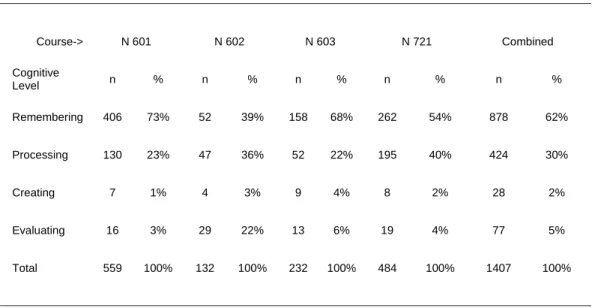
Materials for four courses were analyzed: : Scientific Thought in Nursing (N 601), Theoretical Foundations for Advanced Practice Roles in Nursing (N 602), Nursing within the American Health Care System (N 603), and Theories, Concepts, & Issues in Advanced Family Nursing (N 721). The materials that appear online were subjected to the analysis of cognitive level as described by Newcomb and Trefz. Each item on the screen was assigned to one of four categories: Remembering, processing, creating, or evaluating. Frequencies were tallied and percentages calculated (Table 1) for individual courses and for the four courses combined.
The majority of the items online for each course were written at the remembering level,
processing or remembering levels, ranging from 75% for N 602 to 96% for N 601. No course analyzed offered more than 4% of the online materials written at the creating level. All but one course (N 602) presented 6% or less of the material at the evaluating level.
Table 1. Cognitive Level of Online Course Materials for Graduate Nursing Courses
Course-> N 601 N 602 N 603 N 721 Combined Cognitive Level n % n % n % n % n % Remembering 406 73% 52 39% 158 68% 262 54% 878 62% Processing 130 23% 47 36% 52 22% 195 40% 424 30% Creating 7 1% 4 3% 9 4% 8 2% 28 2% Evaluating 16 3% 29 22% 13 6% 19 4% 77 5% Total 559 100% 132 100% 232 100% 484 100% 1407 100%
When reviewed as a program, only 7% of the course materials were at the creating and evaluating levels.
Conclusions
That the overwhelming majority of the information presented in these four successful courses was either at the remembering or processing level begs for an explanation. One possible reason is that the higher cognitive levels occur during online discussions, which were not analyzed. Another possible reason could be that the curriculum for these courses are more factual and thus
for presenting routine information, but when it comes to presenting materials at higher cognitive levels, the medium’s strength breaks down. Yet another plausible explanation could be that creating online experiences at higher levels is more difficult or takes more knowledge of instructional design to bend the medium to present higher level instructional materials.
Of course, the place of these four courses within the curriculum could be a plausible explanation for the overwhelming majority of low cognitive levels. The materials in these courses could legitimately be at these lower cognitive levels and that might also be due to the higher levels of skills being required in the clinical nursing component of the program. Additional information is required to tease out the appropriate combination of explanations.
Student recruitment and cooperation for participation in the study was time consuming and at times exasperating. New ways to motivate students to cooperate with the researchers could have possibly made this project more successful. OSU’s Risk Management procedures frown on providing incentives to students to gain their cooperation. Perhaps meeting with the students face to face at the beginning of every term would have helped.
After Word
The timely initiation of this study was thwarted in part by the uncooperative administrative environment in sections of the institution. Key leadership decisions delayed the start of the study unnecessarily and set a negative tone and almost hostile environment for the project. In the future, the principal investigators and administrators need to work closely together and with the sponsor to uncover potential land mines that could compromise the stewardship of the funds and the integrity of the program. And potential grantees need to carefully consider the tone of the