A
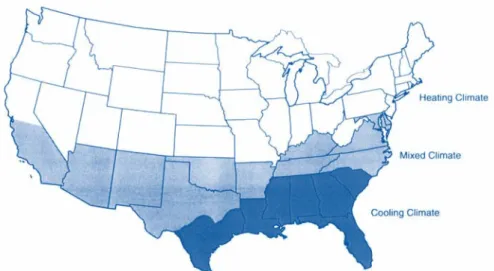
ttic ventilation is one of the most widely publicized yet misunderstood concepts in the roofing industry. As a result, many attics fail to have proper ventilation or may not be vented at all. This is unfortunate because attic ventilation, when required, is an important component of a quality roof system. To help roof-ing professionals understand ventilation issues, I will discuss NRCA recommenda-tions, some industry design guidelines and a sampling of available ventilation prod-ucts. (For the purposes of this article, it is a given that an attic space should be vented.) I also will provide information about manufacturers and their related prod-ucts and recommendations as a service to readers. Inclusion of a manufacturer’s product or recommendation in this article does not imply endorsement from NRCA nor does NRCA possess or maintain any information about these products’ perfor-mance records.Figure 1: Shown are U.S. climatic zones used for moisture recommendations Figure courtesy of The NRCA Roofing and Waterproofing Manual, Fifth Edition.
Approximately 50 percent of the ventilation area.
Approximately 50 percent of the ventilation area.
Figure 2: A balanced ventilation system for attic space shows soffit and ridge vents. Figure courtesy of The NRCA Roofing and Waterproofing Manual, Fifth Edition.
Attic ventilation is needed for two primary reasons:
• To lower attic temperatures: lower-ing attic temperature reduces air-conditioning energy costs and roof deck temperature, optimizes a roof covering’s service life (such as asphalt shingles) and minimizes ice damming. • To promote the removal of excess
moisture from attic spaces: removing excess moisture reduces corrosion potential, potential damage to build-ing components, and mold and mildew growth.
Moisture from within buildings generally originates from one of two sources: construction processes or build-ing occupancy activities.
Significant amounts of water vapor can be generated by the curing of wall and/or
direction and degree of moisture migra-tion that will occur into and out of a building.
In climates where temperatures out-side a building are colder than inout-side, the outside air typically will have a rela-tively low water-vapor pressure. The warmer interior air will exert a higher vapor pressure than the outside air; therefore, the vapor drive will be from the interior of the building to the exte-rior. In climates where the outside air is predominantly warmer and more humid than the interior air, the vapor drive will be predominantly from the exterior to interior.
The U.S. can be divided into the fol-lowing three climatic zones based on the type of environmental control required for most of the year (see Figure 1): • Heating climate zone: In a heating
climate zone, such as Minneapolis, a building’s interior generally is heated for a longer portion of the year than it is cooled. A heating climate zone gen-erally is considered to be one that has 3,000 or more heating-degree days, which are units used for estimating fuel consumption.
• Mixed climate zone: A mixed climate zone, such as Baltimore, is one that has up to 4,000 heating-degree days. In a mixed climate, provisions must be made for vapor-drive conditions in heating and cooling seasons.
• Cooling climate zone: In warm, humid climates, such as Orlando, Fla., where buildings often are cooled below am-bient outside temperatures, the inte-rior air generally is drier than the exterior air.
For heating and mixed climate zones, NRCA recommends a static, balanced ventilation system with a minimum amount of 1 square foot (0.09 m2) of
net-free ventilation area for every 150 square feet (14 m2) of attic space
mea-sured at the attic floor level. A balanced ventilation system provides about half the total ventilation area at or near the ridge, such as a ridge vent, and the remaining area at the low points, such as soffit or
34 September 2005 www.professionalroofing.net
ceiling plaster or concrete, the combus-tion process of propane- or kerosene-fired heaters, and drying paint releasing sub-stantial amounts of moisture. Even though water vapor generated by con-struction processes is temporary, major concentrations in confined areas may cause permanent damage to building components.
Ordinary household functions, such as bathing, cooking and cleaning, can be sources of interior moisture, as well. Im-properly vented gas furnaces, moisture from ground water below basements and crawl spaces, and humidifiers also are sources of interior moisture.
NRCA recommendations
The climate in which a building is lo-cated significantly will affect the type, Continuoussoffit vent
Individual soffit vent
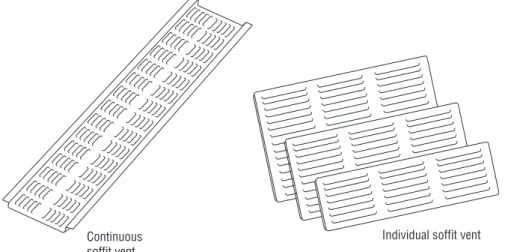
Figure 3: Examples of common intake vents Figure adapted from The NRCA Roofing and Waterproofing Manual, Fifth Edition.
Rectangular undereave vent products
Company Product size Net-free ventilation area
(square inches)
Air Vent Inc. 4 inches by 16 inches 28
6 inches by 16 inches 42
8 inches by 16 inches 56
Duraflo 4 inches by 16 inches 15.5
8 inches by 16 inches 40.5
GAF Materials Corp. 4 inches by 16 inches 26
8 inches by 16 inches 65
Lomanco Inc. 4 inches by 16 inches 25
6 inches by 16 inches 37
8 inches by 16 inches 65
Figure 4: The figure shows a sample of rectangular undereave vent sizes and their net-free ventilation area values.
eave vents (see Figure 2). Balancing ven-tilation in this manner allows for air in-take to occur at the low points and ex-haust to take place at the high points. Air movement from low points to high points is aided by natural convection.
In extremely cold climates or where a building’s interior relative humidity is anticipated to be unusually high during peak heating conditions, it may be desir-able to increase the amount of ventila-tion or use a vapor retarder in the ceiling assembly. A residential building’s interior relative humidity is considered relatively high when it exceeds 45 percent. NRCA suggests using a vapor retarder on the warm side of attic space insulation when the mean January temperature is 30 F (-1 C) or less.
In cooling climate zones, because the vapor drive predominantly is from the exterior to interior, the purpose of venti-lation is to reduce heat buildup. NRCA recommends a static, balanced ventila-tion system with a minimum amount of 1 square foot (0.09 m2) of net-free
ven-tilation area for every 300 square feet (28 m2) of attic space measured at the
attic floor level. This guideline may con-flict with an applicable building code’s minimum requirements.
For large-volume attic spaces (such as attics with roof slopes greater than 8-in-12 [34 degrees]), you should consider increasing the amount of ventilation. This suggestion applies to buildings in all climate zones.
Instead of a balanced ventilation sys-tem, forced or mechanical ventilation may be appropriate. For attics requiring a 1:150 ventilation ratio, ventilation in the amount of 1 cubic foot per minute (CFM) per square foot (0.03 m3/min/m2)
or CFM of attic space measured at the attic floor level is effectively equivalent to 1:150 ventilation ratio. For attics re-quiring a 1:300 ventilation ratio, vent-ilation in the amount of 0.5 CFM per square foot (0.02 m3/min/m2) of attic
space measured at the attic floor level is effectively equivalent to 1:300 venti-lation ratio.
Keep in mind, the 1:150 and 1:300
Continuous soffit vent products
Company Continuous soffit vent Net-free ventilation area
product and size (square inch per lineal foot)
Air Vent Inc. 2 inches by 96 inches 9
GAF Materials Corp. LSV8 Series 10.25
25⁄
8inches by 96 inches
Headrick Building Products Inc. Full Flow™ 8.5
Hat 2 inches by 96 inches
Full Flow™ 8.5
Leg 2 inches by 96 inches
Tamlyn & Sons Inc. Snapvent® 9
2 inches
Snapvent® 12.7
315⁄ 16inches
Lomanco Inc. Continuous soffit vent No. 105 9
23⁄
4inches by 96 inches
Continous soffit vent No. 140 11 33⁄
4inches by 96 inches
Continous soffit vent No. 190 9
23⁄
8inches by 96 inches Figure 5: Examples of hat-channel-shaped continuous soffit vents
Continous soffit vent panels
Company Continuous soffit vent Net-free ventilation area
product and size (square inches per lineal foot) Norandex/Reynolds Distribution D/5˝ Select Soffit (vinyl) 1.9
Double 5-inch 12 inches by 144 inches
D/5˝ Select Soffit (vinyl) 11.9 Full Vent Lanced
12 inches by 144 inches
T4 Matte Vinyl Soffit 1.9
Center Vent 12 inches by 144 inches
T4 Matte Vinyl Soffit 5.7
Full Vent 12 inches by 144 inches
Owens Corning Aluminum Center Vent 5.289
12 inches by 144 inches
Aluminum Full Vent 15.868
12 inches by 144 inches
Vinyl Center Vent 1.56
12 inches by 144 inches
Vinyl Full Vent 4.68
12 inches by 144 inches
Revere Building Products Oxford Premium Vinyl 5.3
Fully vented 10 inches by 120 inches
PVC Supreme Soffit 7.8
Center panels vented 16 inches by 144 inches
PVC Supreme Soffit 15.5
Fully vented 16 inches by 144 inches Figure 6: Examples of continuous soffit vent panels
ratio recommendations are minimum ventilation requirements intended to re-duce problems associated with moisture accumulation in attics. These ratios are not necessarily directed at minimizing heat gain within attics. If significant attic temperature reduction is desired, substantially greater net-free ventilation typically is required.
Code requirements
Each of the four model building codes—
The BOCA National Building Code,Standard Building Code,Uniform Building Code and
Inter-national Building Code(IBC)—requires attics
be ventilated. Generally, building codes require a minimum ventilation ratio of 1:150. Building codes also generally allow for the net-free ventilation area to be reduced to 1:300 ventilation ratio if a vapor retarder is used within a ceiling assembly. Roof system designers are en-couraged to consult governing building codes for specific requirements.
IBC, with reference to the International
Mechanical Code, also includes provisions if
natural ventilation cannot be provided. It stipulates a mechanical exhaust and supply air system should be used in un-inhabited spaces, such as crawl spaces
and attics. The system should have an exhaust rate of no less than 0.02 CFM and be automatically controlled to oper-ate when the relative humidity exceeds 60 percent.
Other sources
There are additional organizations that offer guidelines for attic ventilation. The U.S. Department of Energy (DOE) offers ventilation guidelines in one of its “Technology Fact Sheets.” In general, DOE advises local building requirements be followed, which means adhering to the familiar 1:150 and 1:300 ratios. However, DOE does not recommend electrically powered ventilators because they use more energy than they save; can remove conditioned air; draw in pol-lutants from crawl spaces; and cause ex-haust gases from fireplaces or appliances to enter the building.
The Home Ventilating Institute (HVI) is a nonprofit association of home venti-lating product manufacturers. HVI offers a voluntary ratings program where man-ufacturers can report product perfor-mance data. HVI has a slightly different guideline for dividing vent areas. It rec-ommends the ventilation ratio be 60:40
where 60 percent of the net-free ventila-tion area is located at the eaves and 40 percent is provided by exhaust vents at the ridge or high in the gable area.
HVI also recommends powered attic ventilators be sized by multiplying total square footage of the attic floor by 0.7 to determine the minimum CFM. If a roof is dark or particularly steep, HVI sug-gests adding 15 percent and a slightly higher rating, respectively. In addition, HVI recommends only soffit vents and not gable vents be used with powered attic ventilators because rain and snow can be drawn into an attic through gable vents.
Ventilation products
Ventilation products essentially fall into two categories—intake and exhaust— and come in a wide range of styles. In addition, ventilation products can be fixed (static) or powered. This article will focus on static ventilation products because NRCA recommends static, bal-anced ventilation systems. (The product information listed in this article was taken from manufacturers’ Web sites at press time. Contact manufacturers directly to verify products meet project specifications.)As previously mentioned, intake vents should be placed in or near an eave or soffit. When selecting a product, a build-ing’s configuration, location of the vent installation and amount of net-free ven-tilation area provided by the vent should be considered.
The most common intake vents are undereave vents and continuous soffit vents (see Figure 3). Intake vents are in-stalled in a soffit and commonly available in vinyl, aluminum or steel and in vari-ous colors. The most common undereave shape is rectangular with sizes ranging from 4 inches by 16 inches (102 mm by 406 mm) to 8 inches by 16 inches (203 mm by 406 mm). See Figure 4 for a sample of rectangular undereave vent sizes and their respective net-free venti-lation area values.
Circular shapes also are available;
36 September 2005 www.professionalroofing.net
Gable vent Nonshingle-over-ridge vents
Shingle-over-ridge vents
Static exhaust vents
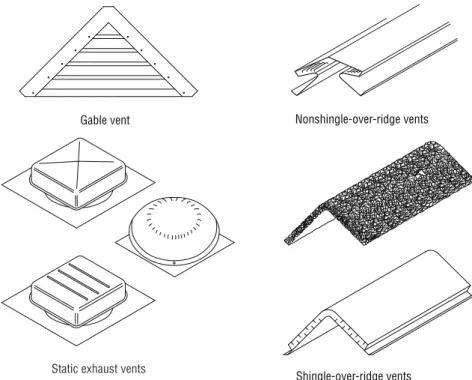
Figure 7: Examples of common exhaust vents. Figure adapted from The NRCA Roofing and Waterproofing Manual, Fifth Edition.
however, these units usually are too small to provide sufficient required net-free ventilation area. For example, an 8-inch (203-mm) diameter roof vent will have a net-free ventilation area of about 13 square inches (8388 mm2).
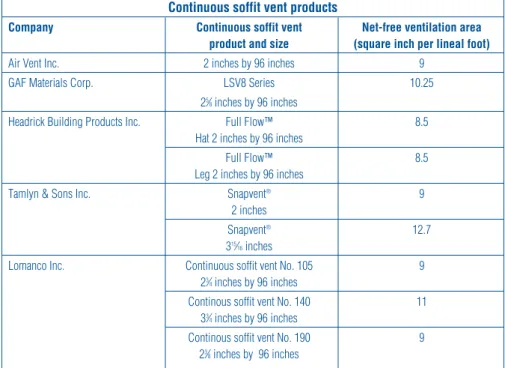
Continuous soffit vents generally are available in aluminum or vinyl and typi-cally are hat-channel-shaped. Figure 5 contains examples of this type of contin-uous soffit vent.
Another continuous soffit vent option is a vented soffit panel. Several siding manufacturers offer these panels, the ad-vantage being the panels can match the
Organizations
Home Ventilating Institute Wauconda, Ill.www.hvi.org
NRCA Rosemont, Ill. www.nrca.net
U.S. Department of Energy, Office of Energy Efficiency and Renewable Energy Washington, D.C. www.eere.energy.gov/buildings/ info/homes/insulatinghome.html
Companies
ADO Products Rogers, Minn. www.adoproducts.comAir Vent Inc. Dallas www.airvent.com Cor-A-Vent Mishawaka, Ind. www.cor-a-vent.com Diversifoam Products Minneapolis www.diversifoam.com Duraflo Denver www.duraflo.com
GAF Materials Corp. Wayne, N.J.
www.gaf.com
Headrick Building Products Cumming, Ga. www.headrick.net Lomanco Inc. Jacksonville, Ark. www.lomanco.com Norandex/Reynolds Distribution Macedonia, Ohio www.norandexreynolds.com Owens Corning Toledo, Ohio www.owenscorning.com/acquainted
Perma “R” Products Inc. Grenada, Miss.
www.leclairindustries.com
Revere Building Products Akron, Ohio
www.reverebuildingproducts.com
Tamlyn & Sons Stafford, Texas www.tamlyn.com
Attic ventilation resources
R
efer to The NRCA Roofing and Waterproofing Manual, Fifth Edition, contact manufacturers and visit the following Web sites for more information about attic ventilation.exterior wall siding. Soffit panels may have venting throughout the full panel or just in the center section; however, many vented soffit panels, especially panels with only the center section vented, have much lower net-free venti-lation area compared with the continu-ous soffit vent panel products listed in Figure 6.
If a building design does not have an eave or soffit, there are unique intake ventilation products to address the situa-tion. COR-A-VENT Inc., Mishawaka, Ind., manufactures the S-400 Strip Vent, a vent made of heat-resistant
polypropylene that can be installed di-rectly behind a fascia board. The S-400 Strip Vent has a net-free ventilation area of 10 square inches (6452 mm2).
COR-A-VENT also has RS-400 “Raft-A-Vent” for eaves where the rafters are exposed. It is a 221⁄
2-inch (572-mm) strip with a
net-free ventilation area of 183⁄ 4inches
(476 mm) and is designed to fit be-tween rafters and on top of blocking.
In reroofing situations where you cannot or do not want to make major modifications to an existing roof deck or wood framing, there are several prod-ucts to consider. Two prodprod-ucts combine
38 September 2005 www.professionalroofing.net
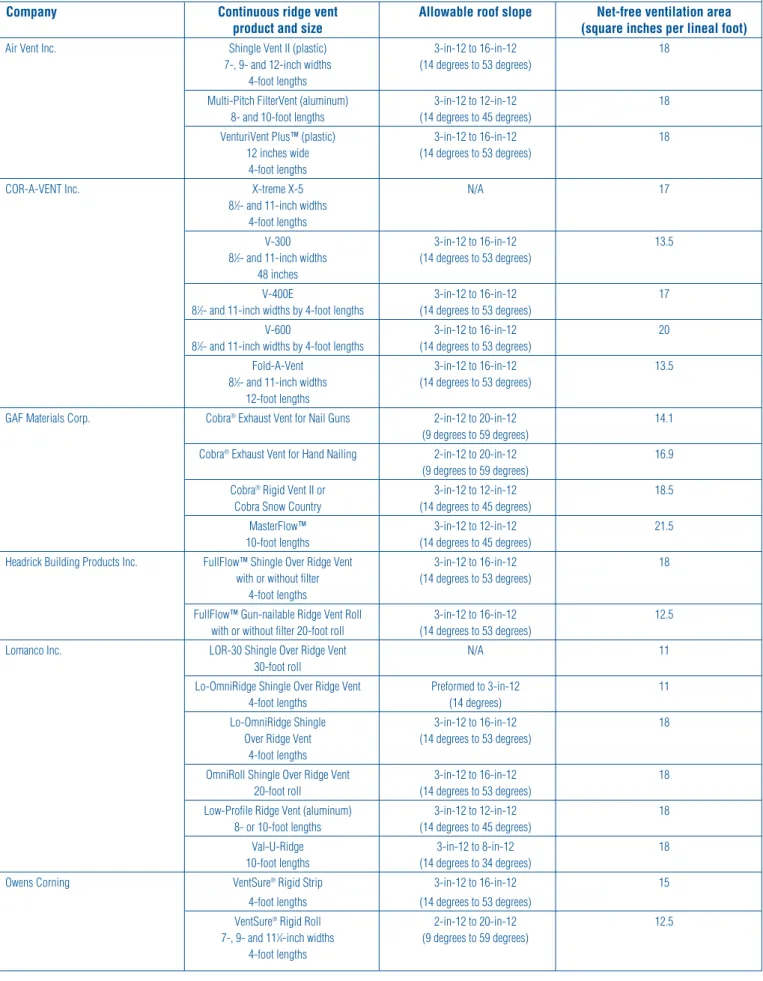
Ridge vent products
Company Continuous ridge vent Allowable roof slope Net-free ventilation area product and size (square inches per lineal foot)
Air Vent Inc. Shingle Vent II (plastic) 3-in-12 to 16-in-12 18
7-, 9- and 12-inch widths (14 degrees to 53 degrees) 4-foot lengths
Multi-Pitch FilterVent (aluminum) 3-in-12 to 12-in-12 18
8- and 10-foot lengths (14 degrees to 45 degrees)
VenturiVent Plus™ (plastic) 3-in-12 to 16-in-12 18
12 inches wide (14 degrees to 53 degrees) 4-foot lengths
COR-A-VENT Inc. X-treme X-5 N/A 17
81⁄
2- and 11-inch widths 4-foot lengths
V-300 3-in-12 to 16-in-12 13.5
81⁄
2- and 11-inch widths (14 degrees to 53 degrees) 48 inches
V-400E 3-in-12 to 16-in-12 17
81⁄
2- and 11-inch widths by 4-foot lengths (14 degrees to 53 degrees)
V-600 3-in-12 to 16-in-12 20
81⁄
2- and 11-inch widths by 4-foot lengths (14 degrees to 53 degrees)
Fold-A-Vent 3-in-12 to 16-in-12 13.5
81⁄
2- and 11-inch widths (14 degrees to 53 degrees) 12-foot lengths
GAF Materials Corp. Cobra®Exhaust Vent for Nail Guns 2-in-12 to 20-in-12 14.1
(9 degrees to 59 degrees)
Cobra®Exhaust Vent for Hand Nailing 2-in-12 to 20-in-12 16.9 (9 degrees to 59 degrees)
Cobra®Rigid Vent II or 3-in-12 to 12-in-12 18.5
Cobra Snow Country (14 degrees to 45 degrees)
MasterFlow™ 3-in-12 to 12-in-12 21.5
10-foot lengths (14 degrees to 45 degrees)
Headrick Building Products Inc. FullFlow™ Shingle Over Ridge Vent 3-in-12 to 16-in-12 18 with or without filter (14 degrees to 53 degrees)
4-foot lengths
FullFlow™ Gun-nailable Ridge Vent Roll 3-in-12 to 16-in-12 12.5 with or without filter 20-foot roll (14 degrees to 53 degrees)
Lomanco Inc. LOR-30 Shingle Over Ridge Vent N/A 11
30-foot roll
Lo-OmniRidge Shingle Over Ridge Vent Preformed to 3-in-12 11
4-foot lengths (14 degrees)
Lo-OmniRidge Shingle 3-in-12 to 16-in-12 18
Over Ridge Vent (14 degrees to 53 degrees) 4-foot lengths
OmniRoll Shingle Over Ridge Vent 3-in-12 to 16-in-12 18
20-foot roll (14 degrees to 53 degrees)
Low-Profile Ridge Vent (aluminum) 3-in-12 to 12-in-12 18
8- or 10-foot lengths (14 degrees to 45 degrees)
Val-U-Ridge 3-in-12 to 8-in-12 18
10-foot lengths (14 degrees to 34 degrees)
Owens Corning VentSure®Rigid Strip 3-in-12 to 16-in-12 15
4-foot lengths (14 degrees to 53 degrees)
VentSure®Rigid Roll 2-in-12 to 20-in-12 12.5
7-, 9- and 111⁄
4-inch widths (9 degrees to 59 degrees) 4-foot lengths
goods. Figure 8 displays a partial list of ridge vent products.
Static exhaust vents are relatively small vents installed near a roof’s ridge. They provide a net-free ventilation area of 50 square inches (32260 mm2) to 60
square inches (38712 mm2) per vent
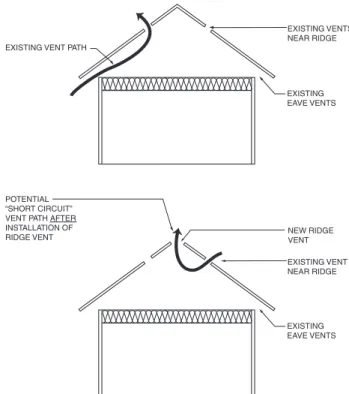
and, as previously discussed, a consider-able amount of static exhaust vents are needed to meet minimum net-free venti-lation area values. Sometimes, static ex-haust vents are installed on a roof that also has a ridge vent. This configuration should be avoided—the combination may render the ridge vent ineffective because the static vents create a “short circuit” of the intended air flow (see Figure 9).
Gable-end vents are installed in the vertical walls at the gable end’s peak. When gable-end vents are used without intake vents at the eaves, gable-end vents function as intake and exhaust vents and performance depends on wind direction. These types of vents are of limited effec-tiveness with light winds and/or winds coming from a direction parallel to the gable ends.
In cases where a roof’s peak intersects intake ventilation with drip-edge
flash-ing. Dallas-based Air Vent Inc.’s Pro Flow™ Vented Drip Edge is an alu-minum drip edge that comes in 10-foot (3-m) sections and provides 9 square inches (5807 mm2) of net-free
ventila-tion area per linear foot. Another product is the SV-10 Starter Vent by Lomanco Inc., Jacksonville, Ark., which also comes in 10-foot (3-m) lengths and provides 6.3 square inches (4065 mm2) of
net-free ventilation area per linear foot. An additional product is SmartVent by DCI Products Inc., Clifton Heights, Pa. It is a tapered, plastic vent installed at the soffit edge and under shingles. A contin-uous slot or series of holes are installed in the roof deck under the plastic vent to allow for air flow. SmartVent has a net-free ventilation area of 9 square inches (5807 mm2) per linear foot. This
product could be used in reroofing situ-ations where eave construction cannot be reconfigured or cases where the soffit is blocked with attic insulation.
No matter which soffit vent product you choose, it will not perform properly if the airflow path is obstructed. Make sure there isn’t any debris or attic insula-tion blocking the soffit vents. One method to establish a clear path of air flow is to use insulation baffles. The fol-lowing manufacturers offer insulation baffles:
• ADO Products, Rogers, Minn.— Durovent and Provent
• Diversifoam Products, Minneapolis— Certivent
• Owens Corning, Toledo, Ohio— Raft-R-Mate
• Perma “R” Products Inc., Grenada, Miss.—Permavent
As with intake vents, there are several exhaust vent design options. The most common exhaust vent types are ridge vents, static exhaust vents and gable vents (see Figure 7).
Of the exhaust vent types, ridge vents present some unique advantages. Ridge vents provide maximum efficiency, and studies have shown ridge vents with external baffles pull air from the attic
regardless of wind direction or speed. Also, a majority of ridge vent products meet the required amounts of net-free ventilation area.
Ridge vents provide uniform move-ment of air flow throughout an attic be-cause they are installed along the entire length of a roof. Most products are low-profile and can be covered with shingles, so their appearance on a roof is subtle.
To illustrate that a ridge vent is an effi-cient, aesthetically pleasing choice, con-sider a 30- by 50-foot (9- by 15-m) house with a simple gable roof. Such a house would require a net-free ventila-tion area of 720 square inches (464544 mm2) for the exhaust vents.You would
need a ridge vent product that has a net-free ventilation area of 14.4 square inches (9290 mm2) per foot. Most ridge
vent products can meet this value. If you were to use static exhaust vents, you would need about 15 individual vents because static exhaust vents typically have a net-free ventilation area of 50 square inches (32260 mm2).
Ridge vents are available in metal, rigid plastic and rolled synthetic mesh
Figure 9: Common example of a “short circuit” caused by static exhaust vents Figure courtesy of The NRCA Roofing and Waterproofing Manual, Fifth Edition.
EXISTING EAVE VENTS EXISTING VENTS NEAR RIDGE EXISTING VENT PATH
EXISTING EAVE VENTS EXISTING VENT NEAR RIDGE NEW RIDGE VENT POTENTIAL “SHORT CIRCUIT” VENT PATH AFTER INSTALLATION OF RIDGE VENT
a wall or doesn’t have a true ridge (such as on a freestanding shed roof), Figure 10 shows specialty exhaust ventilation products to consider.
Unique situations
Two design configurations pose unique ventilation problems—cathedral ceilings and hip roofs. Cathedral ceilings are char-acterized by a compact space between the ceiling and roof deck. NRCA does not recommend installing bitumen-based steep-slope roof coverings (such as as-phalt shingles) directly over insulation or insulated roof decks for two reasons. First, subjecting bitumen-based components to excessive heat accelerates the rate at which these products age and deteriorate. Second, there are problems with ice dams and icicles associated with unvented, im-properly insulated cathedral ceilings in heating climate zones. For these reasons, NRCA recommends cathedral ceilings be properly ventilated, which means the addition of a ventilation space between the roof deck and insulation.
Roofing professionals sometimes specify 2 x 4 wood members as furring strips to create an air space. Vented nail-base insulation systems also are used, and these products typically provide a 1- to 2-inch (25- to 51-mm) air space.
In many cases, the air space depth of these preformed insulation products is not adequate.
The U.S. Army Corps of Engineers’ Cold Regions Research Engineering Lab-oratory (CRREL) researched ventilation and cathedral ceilings. CRREL determined a roof assembly’s R-value, slope and air-way length (ridge to eave distance) affect the sizing of air space depths and intake areas. As a result of that research, CRREL developed simplified guidelines for siz-ing ventilation spaces based on those three variables.
CRREL developed graphs for designers to determine appropriate sizing by refer-encing the airway height or inlet (in-take) area. Keep in mind, the research’s main purpose was to reduce ice-dam formation on cathedral ceilings. These guidelines may indicate a need for venti-lation spaces that are too large to be practically achieved in new or reroofing projects. These graphs can be found in the Moisture Control section of The NRCA Roofing and Waterproofing Manual, Fifth Edition.
Hip roofs also pose unique ventilation problems. One of the most common problems is the ridge on a hip roof is either short or nonexistent. And many hip roofs form large volumetric attic
40 September 2005 www.professionalroofing.net
spaces to ventilate. Unfortunately, there is not a lot of information available about venting hip roofs; however, Air Vent does provide some guidance on this subject and offers the following recommendations:
• If there is a ridge, perform the ventila-tion calculaventila-tions to verify you can meet the minimum requirements. • If you cannot meet the minimum
re-quirements by using a ridge vent or there isn’t a ridge, Air Vent suggests the use of a powered attic vent with a humidistat/thermostat located close to the ridge or top of the roof. There should be intake vents on all four sides to ensure a balanced system. • Do not put a ridge vent on a diagonal
hip line. It also may act as an intake vent and will be prone to weather infiltration.
One final note
Attic ventilation is a significant aspect of a roof system and should not be ignored. Roofing contractors should be sure they understand attic ventilation issues, as well as grasp the purpose and quality of attic ventilation products.
Joan P. Crowe is an NRCA manager of technical services.
Specialty exhaust ventilation products
Company Ridge vent product Application Net-free ventilation area
(square inches per lineal foot)
Air Vent Inc. Flash FilterVent Roof/wall intersection 9
Peak FilterVent Shed roof 9
Utility FilterVent Extra-wide ridge beams and 9
custom applications
COR-A-VENT Inc. X-5 Roof/wall intersection 81⁄
2
S-400 Shed roof 10
DCI Products Inc. SmartVent Roof/wall intersection 9