ARTICLE
Since 1992 the atopic status of asthmatic children attending the Chris Hani Baragwanath Hospital (CHBH) paediatric asthma clinic has been investigated.1,2 This is an almost entirely urban population (97.5%) who have been resident in the greater Soweto area their entire lives. We found that 71.6% of the children had one or more positive skin prick tests (SPTs) to common aero-allergens,1 confirming our belief that these children have a similar atopic diathesis to other groups reported.1 This is contrary to the existing perception that black asthmatic children in South Africa are not atopic.3
Additional findings were a 45.1% positivity rate to house dust mite (HDM) (Dermatophygoides pteronyssinus). This was an unexpected finding and far exceeded previous reports in patients living at high altitude.4 In addition these children had never lived or even visited the coast where sensitisation could have taken place. This study was followed by an analysis of mite antigen levels in the homes of the asthmatic children. Very low levels of mite antigen were found in mattress and floor dust.2 These levels were generally lower than the 2 µg/g required for sensitisation.5 Certainly in these children, it would appear that sensitisation to HDM had occurred on exposure to very small quantities of HDM antigen (Der p 1). No solid explanation for this finding has ever been proposed.
There has been a worldwide increase in the prevalence of atopic disease.6,7 Many environmental factors have been postulated to explain this trend, including urbanisation, dietary changes, changes in microbial burden and industrial pollution.8-10 On the other hand, atopic disease expression carries an inherited or genetic component, and the literature suggests that the most
reliable way of determining this inherited tendency is to seek a positive family history of an atopic condition.11
Lyt et al. reported a low rate of positive family history for atopic conditions (22.2%).1 This has traditionally minimised the importance of family history in determining the nature of chest symptoms in children in this population group. In fact, some experts have gone as far as to suggest that some new environmental exposure was creating the allergic milieu in this group and that these children were expressing a de novo atopic condition. Among the suggested aetiological factors, urban pollution has always been touted as promoting the development of allergy. However, most of the parents of the children studied felt that they did not live in a polluted environment, and this is supported by other South African (and international) studies which do not show an association between pollution and increased incidence of allergy.12-14 A change in the level of allergen exposure is also thought not to be the reason for the rising prevalence in this area.
Atopic conditions impact significantly on quality of life, and in a familial disease pattern this impact is felt by all members of the family. In children who have typical chest and nasal symptoms suggesting an allergic diathesis, a positive family history of an atopic condition is often the diagnostic clincher, especially in a country such as South Africa where medical resources are limited and special investigations are not available to the majority of the population. This study set out to determine if and how the question of ‘family history’ should be used in a practice setting.
Gloria Davis, MB BCh, Dip Allerg (SA)
Robin John Green, PhD, Dip Allerg (SA)
Hubert Hon, FCPaed (SA)
Asthma and Allergy Clinic, Chris Hani Baragwanath Hospital, Johannesburg
Understanding the concept of ‘family
history’ in black asthmatic children
S
A
Jo
ur
nal
of Child
H
ea
lth
S
A
Jo
ur
nal
of Child
H
ea
lth
S
A
Jo
ur
nal
of Child
H
ea
lth
Background. Despite the fact that 71.6% of children at Chris Hani Baragwanath Hospital (CHBH) Asthma Clinic in Soweto, Johannesburg were found to have one or more positive skin-prick tests (SPTs) to common aero-allergens, they reported a low rate of positive family history for atopic conditions (22.2%). In the past this has minimised the importance of family history in determining the nature of chest symptoms in children in this population group, suggesting that some new environmental exposure, rather than the established familial factor, was creating the allergic milieu in this group.
Objective. To determine the predictive value of a family history of symptoms of atopic disease (and allergy) by seeking evidence for this condition in the parents of asthmatic children attending the CHBH Children’s Asthma Clinic, and the reason(s) why a positive family history has been found so seldom in these children.
Methods. A random group of parents of the atopic asthmatic children attending the CHBH Children’s Asthma Clinic completed a detailed questionnaire regarding their atopic status. Skin-prick testing was performed.
Results. Fifty-four sets of parents and 15 single mothers were studied. Of the 48 atopic children, 37 (77%) had at least 1 parent with a positive SPT. Fifty-five per cent of mothers had a positive SPT, while 48% of fathers had at least 1 positive SPT. Seven of 69 mothers (10%) had a definitive diagnosis of asthma. Of these, 5 (71%) were SPT-positive. Only 3 of the fathers (5.5%) had asthma. All had positive SPTs. However, if all the symptoms suggestive of asthma, namely chronic cough or wheeze, were taken into account, the number of potential atopic fathers and mothers increased to 10 (19%) and 18 (26%) respectively. Conclusion. Simple questioning for family history of atopic disease is therefore not a good predictor of atopy in offspring in this cohort of patients. In order to get maximal yield from this question, parents must rather be asked about specific symptoms suggestive of asthma and/or allergic rhinitis.
14
SAJCH APRIL 2007 VOL. 1 NO. 1
ARTICLE
In order to test the value of a family history in determining inheritance of atopy we explored the results of our previous studies.
Objectives
This study had two foci. Firstly, it sought to determine the predictive value of a family history of symptoms of atopic disease (and allergy) by seeking evidence for this condition in the parents of asthmatic children attending the CHBH Children’s Asthma Clinic. Secondly, it investigated the reason(s) why a positive family history was so seldom found in these children.
Methods
A random group of parents of the atopic asthmatic children attending the CHBH Children’s Asthma Clinic were identified and approached to complete a detailed questionnaire regarding their atopic status. In order to randomise the clinic patients adequately, every fourth patient file was selected from an alphabetical list of patients. These parents were contacted telephonically where possible. Only 40% of selected families were contactable, and even fewer responded to the study. The questionnaire included questions on birth history, medical history, symptomatology of atopy, occupation, habits, present environment, and family history. The parents were the biological parents of the children.
Skin-prick testing was done using the Hollister-Stier allergen extracts (Bayer Miles), and negative (0.5% phenol) and positive (1% histamine) controls were performed. The aero-allergen extracts used were Bermuda grass, corn pollen, 5-grass mix, tree mix, Candida albicans, Aspergillus fumigatus, cat-hair epithelium, dog-hair dander, feather mix, house-dust mix, and standardised D. pteronyssinus. Each extract was applied to the volar surface of the forearm with a sterile prick lancet (Dome-Hollister-Stier Laboratories). Reactions were read at 10 minutes and any wheal greater than 3 mm was regarded as positive.
Ethical approval for the study was obtained from the Ethics Committee of the University of the Witwatersrand, and permission to perform the study was granted by the Hospital Therapeutic Committee.
Statistical analysis
Frequencies of each skin test, odds ratios, chi-square tests (where appropriate), and Fisher’s exact tests were run using SAS.
Results
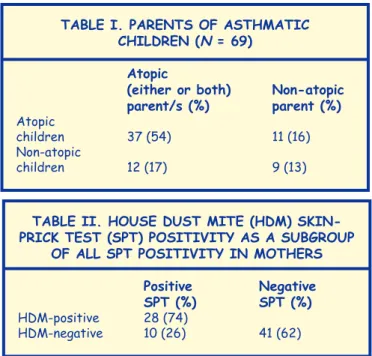
Fifty-four sets of parents and 15 single mothers were studied. Forty of the 54 parent sets (74%) had an atopic child, while 8 of the 15 single mothers (53%) had an atopic child. Of the 48 atopic children, 37 (77%) had at least 1 parent with a positive SPT (p = 0.093, significance at a = 0.1) (Table I).
Fifty-five per cent of mothers had a positive SPT, while 48% of fathers had at least 1 positive SPT. Of special interest in this study was the high prevalence of HDM SPT positivity among parents. Twenty of 26 SPT-positive fathers (77%) had a positive HDM result, while 28 of 38 mothers (74%) had a positive HDM result (Table II).
With regard to the clinical manifestations of an atopic status, analysis of asthma prevalence revealed that 7 of 69 mothers (10%) had a definitive diagnosis of asthma. Of these, 5 (71%) were SPT-positive. Only 3 of the fathers (5.5%) had asthma. All had a positive SPT. However, if all the symptoms suggestive of asthma, namely chronic cough or wheeze, were taken into account, the number of potential asthmatics increased to 18 mothers (26%) and 10 fathers (19%) (Table III). All parents were asked specifically about symptoms suggestive of asthma and rhinitis, including chronic cough and wheeze.
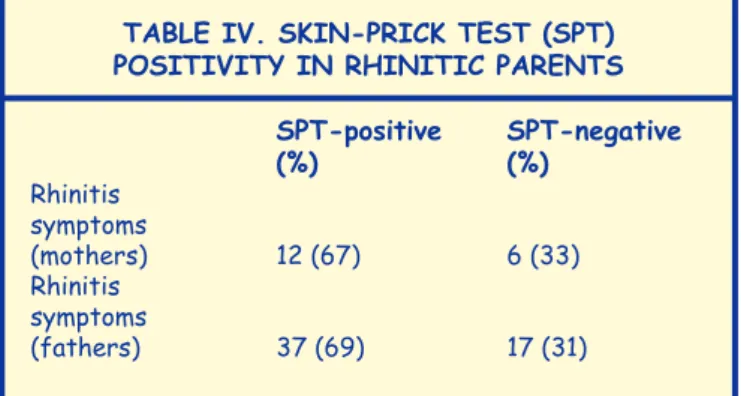
With regard to rhinitis, 26% of mothers and 24% of fathers had symptoms of chronic rhinitis, but none were on therapy. Twelve of the 18 mothers (67%) had allergic rhinitis (SPT-positive), while 69% of fathers had allergic rhinitis (Table IV). However these data are often not reported in ‘family history’ questionnaires.
Table I. PaRenTS Of aSThMaTIc chIldRen (n = 69)
atopic
(either or both) non-atopic parent/s (%) parent (%)
Atopic
children 37 (54) 11 (16) Non-atopic
children 12 (17) 9 (13)
Table II. hOUSe dUST MITe (hdM) SkIn-PRIck TeST (SPT) POSITIvITy aS a SUbgROUP
Of all SPT POSITIvITy In MOTheRS
Positive negative
SPT (%) SPT (%)
HDM-positive 28 (74)
HDM-negative 10 (26) 41 (62)
Table III. SkIn-PRIck TeST (SPT) POSITIvITy In defInITely dIagnOSed
aSThMaTIc PaRenTS
SPT-positive SPT-negative
(%) (%)
Definitive
diagnosis of
asthma (mothers) 5 (71) 2 (29)
Definitive
diagnosis of
asthma (fathers) 3 (100) 0 (0)
Other South African (and
international) studies do not
show an association between
pollution and increased
incidence of allergy.
S
A
Jo
ur
nal
of Child
H
ea
lth
S
A
Jo
ur
nal
of Child
H
ea
lth
S
A
Jo
ur
nal
of Child
H
ea
lth
16
SAJCH APRIL 2007 VOL. 1 NO. 1
ARTICLE
All the diagnosed asthmatic parents were born in urban areas, and of those born in rural areas, none had asthma, providing support for the ‘hygiene hypothesis’ of allergy development.15
discussion
There is a high prevalence of allergy (SPT-positivity) in the parents of atopic asthmatics, but because asthma and allergic rhinitis are seldom diagnosed in this population group, family history of an atopic disease is often absent. Simple questioning for family history of atopic disease is not therefore a good predictor of atopy in offspring in this cohort of patients. It seems obvious that this important aspect, viz. an initial history of a suspected allergic/atopic child is failing because symptoms in parents are not being diagnosed. However, children in this area are not expressing the de novo development of atopic disease. Their condition is clearly familial and a family history is still an important clue.
The incidence of allergic diseases is on the increase in all population groups, and practitioners are likely to see many potentially atopic conditions every day. These conditions, however, carry a differential diagnosis and this is especially true in South Africa, where chronic infections frequently cause chest symptoms. In a busy practice or clinic it is essential to provide doctors with the correct diagnostic tools, so that time is not wasted on questions that may not yield information. Of critical importance in the assessment of patients with chronic chest symptoms, is a positive family history. This is often the clue to atopy. This study suggests that simple questioning for family history of asthma and allergic rhinitis is not sufficient. In the main the outcome will be negative. The reason for this is lack of diagnosis in family members. This may be because
of underreporting of these symptoms by patients, or failure of the medical fraternity to recognise their source. Whatever the cause, it must be obvious that in order to get maximal yield from this question, parents must rather be asked about specific symptoms suggestive of asthma and/or allergic rhinitis. It is now well recognised that in South Africa asthma is diagnosed late.16 This has an impact on the quality of life of these children. Adequate family history questioning is a potential solution to this problem. In addition it seems likely that there is a large population of adults in South Africa suffering unnecessarily from undiagnosed and untreated asthma and allergic rhinitis. This is cause for concern.
This study found no association between sex of the atopic parent and a higher risk of atopy in children, as has been suggested for other races.17 Once again the prevalence of HDM SPT-positivity was found to be high and unexplained in this population living at high altitude, without previous travel to the coast. Some of the questions on origins of allergy and atopic disease may be unravelled through further study of this cohort of parents and their atopic asthmatic children.
References
1. Luyt DK, Davis G, Dance M. Clinical characteristics of black asthmatic children. S Afr Med J 1995; 85: 999-1001.
2. Davis G, Luyt DK, Prescott R, Potter P. Housedust mites in Soweto. Curr Allergy Clin Immunol 1994; 7: 16-17.
3. Wesley AG, Clyde JH, Wallace HL. Asthma in Durban children of three racial groups. S Afr Med J 1969; 43: 87-89.
4. Spieksma FThM, Zuiderme P, Leupen MJ. High altitude and house dust mites. BMJ 1971; 1: 82-84.
5. Platts-Mills TAE, de Weck AL. Dust mite allergens and asthma – a world-wide problem. J Allergy Clin Immunol 1989; 83: 416-427. 6. Britton J. Asthma’s changing prevalence. BMJ 1992; 304: 857-858. 7. Gergen PJ, Weiss KB. The increasing problem of asthma in the United
States. Am Rev Respir Dis 1992; 146: 823-824.
8. Seaton A, Godden DJ, Brown K. Increase in asthma: a more toxic environment or a more susceptible population? Thorax 1998; 49: 171-174.
9. Martinez FD, Holt PG. Role of microbial burden in aetiology of allergy and asthma. Lancet Paediatric Supplement (ii) 1999; 354: 51112-51115. 10. Prescott SL. Bacteria and the allergy epidemic: the culprits and the cure.
Curr Allergy Clin Immunol 2004; 17: 108-114.
11. Marsh DG, Meyers DA, Bias WB. The epidemiology and genetics of atopic allergy. N Engl J Med 1981; 305: 1551-1558.
12. Terblanche APS, Opperman L, Nel CME, Reinach SG, Tosen G, Cadman A. Preliminary results of exposure measurements and health effects of the Vaal Triangle Air Pollution Health Study. S Afr Med J 1992; 81: 550-557.
13. von Mutius E, Fritzch C, Weiland SW, Roll G, Magnussen H. Prevalence of asthma and allergic disorders among children in united Germany: a descriptive comparison. BMJ 1992; 305: 1395-1399.
14. Dockery DW, Spiezer FE, Stram DO, Ware JH, Spengler JD, Ferris BJ jun. Effects of inhalable particles on respiratory health of children. Am Rev Respir Dis 1989; 139: 587-594.
15. Strachan DP. Hay fever, hygiene, and household size. BMJ 1989; 299: 1259-1260.
16. Green RJ, Luyt DK. Clinical characteristics of childhood asthmatics in Johannesburg. S Afr Med J 1997; 87: 878-882.
17. Cookson WOCM, Hopkin JM. Dominant inheritance of atopic immunoglobulin-E responsiveness. Lancet 1988; 1: 86-88.
Table Iv. SkIn-PRIck TeST (SPT) POSITIvITy In RhInITIc PaRenTS
SPT-positive SPT-negative
(%) (%)
Rhinitis symptoms
(mothers) 12 (67) 6 (33) Rhinitis
symptoms
(fathers) 37 (69) 17 (31)