Effect of Probiotic Preparation Enriched with Selenium on
Qualitative Parameters of Table Eggs
Martin Mellen*, Henrieta Arpášová, Ján Kopecký
Slovak University of Agriculturae, 949 76-Nitra, Tr. A. Hlinku 2, Slovak Republic
Abstract
In this experiment the effects of the diet for laying hens supplemented with probiotic product with an organic form of selenium on egg weight, albumen quality, yolk quality and egg shell quality were studied. Isa Brown hens (n=90) were randomly divided at the age of 17 weeks into three groups (30 birds per group). Hens in all groups consumed the complete feed mixture ad libitum. In the control group water for drinking contained no additions. In the first experimental group probiotic product was added to the water, in the second experimental group the same probiotic preparation enriched with 0.8 to 1 mg of organic selenium per 1 g of the product was added to the water. The probiotic preparations were administered at the dose of 15 mg per 6 l of water daily, in both experimental groups. Monitored physical parameters of eggs: egg weight (g), specific egg weight (g/cm3), albumen weight (g), albumen height (mm), albumen index, Haugh units (HJ), yolk weight (g), yolk index, yolk color (HLR), egg shell weight, egg shell specific weight (g/cm3), egg shell strength (N/cm2), the average eggshell thickness (µm). Experiment lasted 48 weeks. The results showed that egg weight was slightly higher in both experimental groups compared with the control group, differences between the groups were not statistically significant (p>0.05). The values in the order of groups: 60.97±4.97, 61.18±5:00; 61.75±5.89 (g±SD). Was found insignificant impact of the add probiotic preparation and probiotic preparation enriched with selenium on the quality parameters of table eggs. Yolk index, albumen index, Haugh units and the average egg shell thickness were only slightly, statistically insignificant higher in the experimental groups (p>0.05).
Keywords: organic selenium, probiotic preparation, table eggs
1. Introduction
Poultry are bred in mass production conditions at high concentrations. Possible resulting health problem so can the birds spread rapidly. The important role played by alternative materials which are in the form of feed additives can be added to feed or water the animals [1].
Feed supplements used for poultry have antimicrobial and antioxidant effects. Among the candidate replacements for antibiotics are competitive exclusion products, probiotics, prebiotics, organic acids, enzymes and plant extracts[2].
* Corresponding author: Hellen Martin Email: [email protected]
Any microorganism irrespective of its origin, capable of surviving in the digestive tract of host and exerting such effects can be a candidate. Most of the currently used probiotics belong to prokaryotic origin [5].
Implementation of probiotics has great potential in delivering promising results by reducing the intestinal pathogenic load and thereby reducing the subsequent contamination in poultry production. Several mechanisms of action have been proposed including resistance to colonization, competitive exclusion, production of toxic and inhibitory compounds, competition for nutrients and stimulation of the immune system [6]. The modulation of the gut microbiota with new feed additives, such as probiotics and prebiotics, towards host-protecting functions to support animal health, is a topical issue in animal breeding and creates fascinating possibilities. Genomic-based knowledge on the composition and functions of the gut microbiota, as well as its deviations, will advance the selection of new and specific probiotics[7].
Options to use of probiotics in poultry breeding. Probiotics research focuses on the impact on health or performance and quality of poultry products. In the experiment of Van Coillie, et al., (2007) [8] were lactobacilli isolated from the cloaca and vagina of laying hens. Lactobacilli were observed to inhibit Salmonella growth in vitro, most probably through production of lactic acid, and to decrease in vivo the Salmonella
enteritidis colonization of chicks. The favorable
impact of certain strains of lactobacilli about salmonella inhibition observed also Yamazaki et al., (2012) [9] or Chen et al., (2012) [10].
Theoretical and scientific knowledge indicate that the number of Escherichia colicells in the control groups should be higher and the number of CFU
Enterococcus faecium and Lactobacillus
sporogenes should be lower [11]. Among animal
products are table eggs of aspect of handling their internal contains one of the most affordable modifiable livestock commodities [12]. According to Yodseranne et al., (2003) [13] probiotics can improve egg yolk color and increase content of
Mo et al. (2004) [15] added to the feed of laying hens, three types of probiotics. Compared to the control group were egg production, egg quality and the number of intestinal lactic acid bacteria improved, or a significantly increased. Balevi et al., (2001) [16] recorded in a group with complement of 500 ppm probiotic products lower feed conversion and significantly lower number of damaged eggs.
2. Materials and methods
Animals, diets and treatments
Hens (n=90) of the laying hybrid Isa Brown 17 weeks old, were randomly divided into 3 groups (n=30) and fed for 48 weeks with standard feed mixture ad libitum.
At the beginning of the experiment, the hens were kept in three–deck cage technology system. The layer hens were kept by the standard bioclimatic conditions.
In the control group hens drank water without any additions. In the experimental groups probiotic was added daily to water. In the first experimental group was added probiotic preparation of
Enterococcus faecium, in the second experimental
group was added the same preparation enriched with selenium.
The product contained in 1 g of dry substance at least 200 x 109 lactacidogenic live bacteria Enterococcus faecium–74.
The probiotic preparation enriched with selenium contained 0.8 to 1 mg of organic selenium in 1 g of the product. The probiotic preparations were administered at a dose of 15 mg of 6 l of water daily, in both experimental groups.
weighting machine and the growth intensity and percentage contents were calculated from weight data. Indexes were calculated as the lenght: width ratio. Haught units (HU) detected egg quality as relation of albumin weight and egg weight [100 log.(dense albumin height–1.7x egg weight0.37+7.6)]. Yolk color was evaluated using Hoffman la Roche color scale (Hoffman–La Roche, Switzerland) and egg shell strength was detected using Egg Crusher 1.1 (VEIT Electronics, Czech Republic).
Statistical analysis
Differences among the observed parameters in the groups were tested by one-way analysis of variance, the results were completed by Tukey's test, in the SAS program.
3. Results and discussion
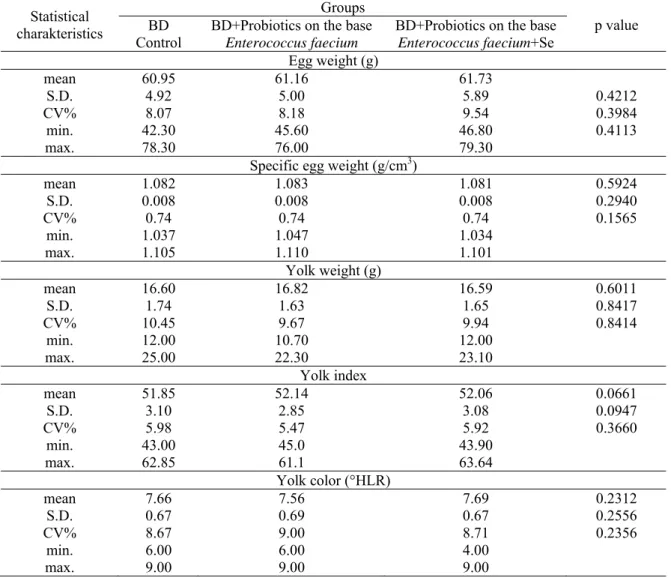
Average egg weight in each group during the entire period was 60.95; 61.16 and 61.73 g respectively. As is clear from the undistinguished differences, the differences between treatment groups and control groups were not statistically significant (p>0.05). When comparing the experimental group with the addition of selenium-enriched probiotics to the control group, the mass of the egg is higher, particularly in the second and third period of the reference of the laying period. Increase of egg weight addition of probiotics found in their experiments Davis, and Anderson,
(2002) [17], respectively Ramasamy et al., (2009) [18]. These conclusions to the results of their experiments, however, do not confirm Sohail et al., (2002) [19], respectively Gallazzi et al., (2008) [20].
In specific egg weight were observed between experimental groups and control group slight differences (p>0.05). The values in the order of groups: 1,082; 1.083 and 1.081 g.cm-3). The results of experiments teams Tangtaweewipat et al., (2003) [21], respectively Kurtoglu et al., (2004) [22] was similarly negligible effect of
probiotics on the change in specific weight of the eggs. Conversely Sohail et al., (2002) [19] after application of the formulation of Bacillus subtilis C-3102 and the addition of the protein had a significant increase in specific egg weight of hens in the experimental groups. Specific egg weight of eggs increased more in hens fed much higher doses than in hens fed the lower dose, at a protein concentration of 15%.
Weight egg yolks in our experiment was on average for the period in the order of groups 16.60 ±1.74; 16.82±1.63 and 16.59±1.65 g. Difference between the groups was not statistically significant (p>0.05). Similarly, Tangtaweewipat et al., (2003) [21] in line with our findings had a insignificant difference in this indicator.
Index yolks gradually decreased in all groups, which generally is related to a decline in the quality of the individual parts during egg laying. Yolk index values in the order of groups 51.85; 52.14 and 52.06. The experimental groups were on average higher yolk index value, a statistically significant difference compared to the control group was not observed (p>0.05). Kurtoglu et al., (2004) [22] reported increases the yolk index, with an increasing rate of probiotics in each group.
Panda et al., (2000) [23] in their experiment had increased daily egg production, but the quality of the yolk is the positive effects of the addition of probiotics significantly not shown. Conversely
Yalcin et al., (2002) [24] showed statistically significant differences not only in the live weight of chickens and feed consumption, but also in the yolk index.
Table 1. Influence of probiotic preparation on the base Enterococcus faecium and probiotic preparation on the base Enterococcus faecium enriched with selenium addition into laying hens feed mixture
on the alterations of Isa Brown laying hen’s egg weight and egg yolk quality Statistical
charakteristics
Groups
p value BD
Control BD+Probiotics on the base Enterococcus faecium BD+Probiotics on the base Enterococcus faecium+Se Egg weight (g)
mean 60.95 61.16 61.73
S.D. 4.92 5.00 5.89 0.4212
CV% 8.07 8.18 9.54 0.3984
min. 42.30 45.60 46.80 0.4113
max. 78.30 76.00 79.30
Specific egg weight (g/cm3)
mean 1.082 1.083 1.081 0.5924
S.D. 0.008 0.008 0.008 0.2940
CV% 0.74 0.74 0.74 0.1565
min. 1.037 1.047 1.034
max. 1.105 1.110 1.101
Yolk weight (g)
mean 16.60 16.82 16.59 0.6011
S.D. 1.74 1.63 1.65 0.8417
CV% 10.45 9.67 9.94 0.8414
min. 12.00 10.70 12.00
max. 25.00 22.30 23.10
Yolk index
mean 51.85 52.14 52.06 0.0661
S.D. 3.10 2.85 3.08 0.0947
CV% 5.98 5.47 5.92 0.3660
min. 43.00 45.0 43.90
max. 62.85 61.1 63.64
Yolk color (°HLR)
mean 7.66 7.56 7.69 0.2312
S.D. 0.67 0.69 0.67 0.2556
CV% 8.67 9.00 8.71 0.2356
min. 6.00 6.00 4.00
max. 9.00 9.00 9.00
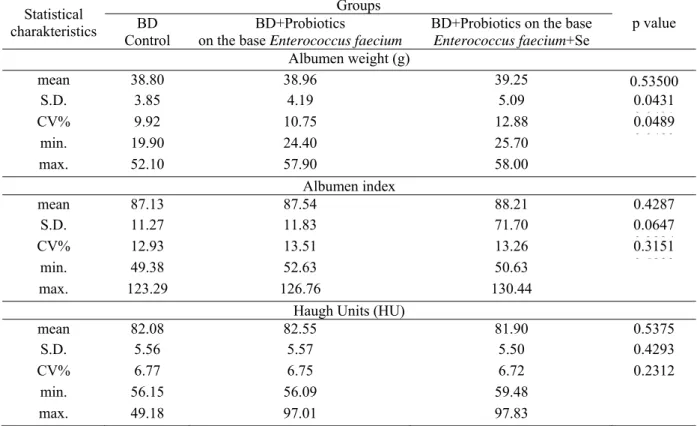
Albumen weight. Over the entire twelve-month experimental period was between the second experimental group and the control group reported a statistically significant difference (p<0.05) (values in the order of groups 38.80, 38.96 and 39.25 g).
Egg albumen index in all groups gradually decreased, which is related to the deteriorating quality of whites advancing laying. Average values for each group were 87.13; 87.54 and 88.21. In the second experimental group with selenium supplement probiotics and the albumen
not observed in either of the combinations of the groups.
Higher index of sclera using probiotics reported
Yalcin et al., (2002) [24].
Table 2. Influence of probiotic preparation on the base Enterococcus faecium and probiotic preparation on the base Enterococcus faecium enriched with selenium addition into laying hens feed mixture on the alterations
of Isa Brown laying hen’s egg albumen quality Statistical
charakteristics
Groups
p value BD
Control on the base Enterococcus faecium BD+Probiotics BD+Probiotics on the base Enterococcus faecium+Se Albumen weight (g)
mean 38.80 38.96 39.25 0.53500
S.D. 3.85 4.19 5.09 0.0431
0 0431
CV% 9.92 10.75 12.88 0.0489
0 0489
min. 19.90 24.40 25.70
max. 52.10 57.90 58.00
Albumen index
mean 87.13 87.54 88.21 0.4287
S.D. 11.27 11.83 71.70 0.0647
0 3834
CV% 12.93 13.51 13.26 0.3151
0 5899
min. 49.38 52.63 50.63
max. 123.29 126.76 130.44
Haugh Units (HU)
mean 82.08 82.55 81.90 0.5375
S.D. 5.56 5.57 5.50 0.4293
CV% 6.77 6.75 6.72 0.2312
min. 56.15 56.09 59.48
max. 49.18 97.01 97.83
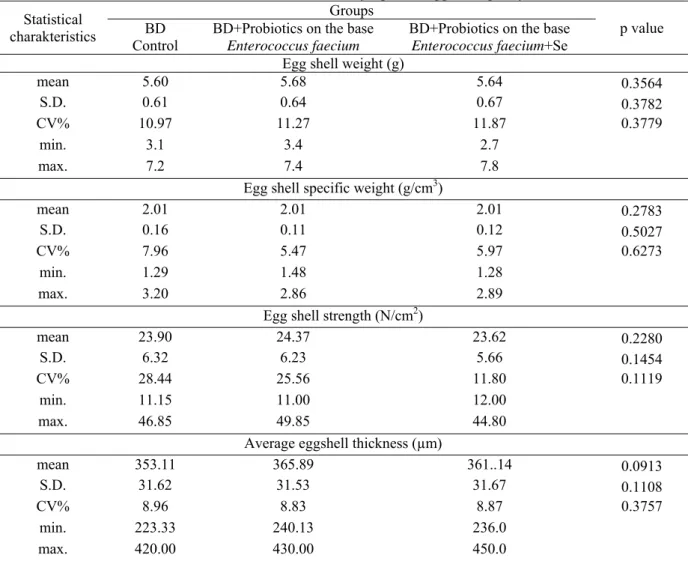
Egg shell weight in our experiment was in the
order of groups; 5.60; 5.68 and 5.64 g. Were
not statistically significant differences for the
whole laying period on average between the
two experimental groups compared with the
control group (p>0.05). The opposite
conclusions reached in their experiment
Perumalla,
et al., (2012) [6]. The specific egg
shell weight were similar to the specific
weight of whole egg between groups and
therefore at least statistically significant
differences (p>0.05). A similar finding has
also
Kalavathy et al., (2005)[25].
Shell strength values in our experiment, 23.90; 24.37 and 23.62 N/cm2. The highest strength was
the first experimental group with the addition of probiotics, but the difference was not statistically significant compared to the control group (p<0.05). Reach the same conclusion in his experiment [28].
Table 3 Influence of probiotic preparation on the base Enterococcus faecium and probiotic preparation on the base Enterococcus faecium enriched with selenium addition into laying hens feed mixture
on the alterations of Isa Brown laying hen’s egg shell quality Statistical
charakteristics
Groups
p value BD
Control BD+Probiotics on the base Enterococcus faecium BD+Probiotics on the base Enterococcus faecium+Se Egg shell weight (g)
mean 5.60 5.68 5.64 0.3564
S.D. 0.61 0.64 0.67 0.3782
CV% 10.97 11.27 11.87 0.3779
min. 3.1 3.4 2.7
max. 7.2 7.4 7.8
Egg shell specific weight (g/cm3)
mean 2.01 2.01 2.01 0.2783
S.D. 0.16 0.11 0.12 0.5027
CV% 7.96 5.47 5.97 0.6273
min. 1.29 1.48 1.28
max. 3.20 2.86 2.89
Egg shell strength (N/cm2)
mean 23.90 24.37 23.62 0.2280
S.D. 6.32 6.23 5.66 0.1454
CV% 28.44 25.56 11.80 0.1119
min. 11.15 11.00 12.00
max. 46.85 49.85 44.80
Average eggshell thickness (µm)
mean 353.11 365.89 361..14 0.0913
S.D. 31.62 31.53 31.67 0.1108
CV% 8.96 8.83 8.87 0.3757
min. 223.33 240.13 236.0
max. 420.00 430.00 450.0
4. Conclusions
The results showed that egg weight was slightly higher in both experimental groups compared with the control group, differences between the groups were not statistically significant (p>0.05). The values in the order of groups: 60.95±4.92, 61.16±5:00; 61.73±5.89 (g±SD). Was found insignificant impact of the add probiotic preparation and probiotic preparation enriched with selenium on the quality parameters of table eggs. Yolk index, albumen index, Haugh units and
Acknowledgements
This study was supported by Grant Agency for Science, VEGA of Slovak Republic, Grant No.1/0493/12 and KEGA No 035 SPU–4/2012
References
animal production and health, Journal of Animal and Veterinary Advances, 2009, 8, 2, 2009, 313-321. 4. Mateova, S., Gaalova, M., Saly, J. and Fialkovicova, M., Investigation of the effect of probiotics and potentiated probiotics on productivity of laying hens, Czech Journal of Animal Science, 2009, 54, 1, 24-30. 5. Sukanta K. N., Biology of Eukaryotic Probiotics, Microbiology Monographs, 2011, 21, 29-55.
6. Perumalla, A. V. S., Hettiarachchy, N. S., Ricke, S. C., Current Perspectives on Probiotics in Poultry Preharvest Food Safety, Direkt-fed Microbials and Prebiotics for Animals, 2012, 89-120
7. Gaggìa, F., Mattarelli, P. and Biavati, B., Probiotics and prebiotics in animal feeding for safe food production, International Journal of Foof Microbiology, 2010, 141, supplement 31, 15–28.
8. Van Coillie, E., Goris, J., Cleenwerck, I., Grijspeerdt, K., Van Immerseel, F., De Buck, J., Vancanneyt, M. and Herman, L., Heyndrickx, M., Identification of lactobacilli isolated from the cloaca and vagina of laying hens and characterization for potential use as probiotics to control Salmonella enteritidis, Journal of Applied Microbiology, 2007, 102, 4, 1095-1106.
9. Yamazaki, M., Ohtsu, H., Yakabe, Y., Kishima, M. and Abe, H., In vitro screening of lactobacilli isolated from chicken excreta to control Salmonella enteritidis and Typhimurium, British Poultry Science, 2012, 53, 2, 183-189.
10. Chen, C., Y., Tsen, H. Y., Lin, C. L., Yu, B. And Chen, C. S., Oral administration of a combination of select lactic acid bacteria strains to reduce the Salmonella invasion and inflammation of broiler chicks, Poultry Science, 2012, 91, 9, 2139-2147.
11. Kačániová, M., Nováková, I., Haščík, P. et al., Aplikácia probiotík a ich vplyv na ekosystém kurčiat, Bezpečnosť a kvalita surovín a potravín. Nitra: SPU, 2009, 38.
12. Sparks, N. H. C., The hen's egg-is its role in human nutrition changing? World Poultry Science Journal, 2006, 62, 2, 308-315.
13. Yodseranne, R., Chantsavang, S. and Bunchasuk, C. Effect of dietary supplementation of mixed culture compost, plantand animal bioextract compost on layer´s productive performance and egg quality, Animal and Veterinary Medicine, 2003, 119–126. 14. Xu, C. L., Ji, C., Ma, Q., Hao, K., Jin, Z.Y. and Li, K., Effects of a dried Bacillus subtilis culture on egg quality, In Poultry Science, 2006, 85, 2, 364-368. 15. Mo, E. K., Lee, J. H., Xu, B. J., Lee, B. D., Moon, Y. J. and Sung, C. K., Effect of Pichia farinosa SKM-1, Pichia anomala SKM-T, and Galactomyces geotrichum SJM-59 on ammonia reduction and laying performance, Journal of Microbiology and Biotechnology, 2004, v14, 1, 22-28.
16. Balevi, T., Ucan, U. S., Coskun, B., Kurtoglu, V. and Cetingul, I. S., Effect of dietary probiotic on
performance and humoral immune response in layer hens, British Poultry Science, 2001, 42, 4, 456–461. 17. Davis, G. S. and Anderson, K. E., The effects of feeding the direct-fed microbial, primalac, on growth parameters and egg production in Single Comb White Leghorn hens, Poultry Science, 2002, , 81, 6, 755–759. 18. Ramasamy, K., Abdullah, N., Jalaludin, S., Wong, M. and Ho, Y. W., Effects of Lactobacillus cultures on performance of laying hens, and total cholesterol, lipid and fatty acid composition of egg yolk, Journal of the Science of Food and Agriculture, 2009, 89, 3, 482-486. 19. Sohail, S. S., Bryant, M. M., Voitle, R. A. and Roland, D. A., Influence of calsporin on commercial leghorns, Journal of Applied Poultry Research, 2002, 11, 4, 379-387.
20. Gallazzi, D., Giardini, A., Mangiagalli, M. G., Marelli, S., Ferrazzi, V., Orsi, C. and Cavalchini, L. G., Effects of Lactobacillus addophilus D2/CSL on laying hen performance, Italian Journal of Animal Science, 2008, 7, 1, 27-37.
21. Tangtaweewipat, S., Pruksakorn, S., Sangsrijun, P. And Cheva-Isakul, B., The effect of Lactobacillus spp. supplement in laying hens., Proceedings of 41st Kasetsart University Annual Conference, Subject: Animals and Veterinary Medicine, 2003, pp. 144–151. 22. Kurtoglu, V., Kurtoglu, F., Seker, E., Coskun, B., Balevi, T. and Polat, E. S., Effect of probiotic supplementation on laying hen diets on yield performance and serum and egg yolk cholesterol, Food Additives and Contaminants, 2004, 1, 9, 817-823. 22. Hong, J. W., Kim, I. V., Kwon, O. S., Han, Y. K. and Lee, S. H., Influence of probiotics supplementation on egg quality and excretal noxious gas in laying hens, Journal of Animal Science and Technology, 2002, 44, 2, 213–220.
23. Panda, A. K., Ramarao, S. V., Reddy, M. R. And Praharaj, N. K., Response of White Leghorn layers to diet fed with various levels of probiotic, Indian Journal of Animal Sciences, 2000, 70, 3, 311-312.
24. Yalcin, S., Guclu, B. K. and Oguz, F. K., The usage of enzyme, probiotic and antibiotic in laying hen rations, Ankara Universitesi Veteriner Fakultesi Dergisi. 2002, 49, 2, 135–141.
25. Kalavathy, R., Abdullah, N., Jalaludin, S., Wong, C. M. V. L. and Ho, Y. W., Effects of Lactobacillus cultures on performance and egg quality during the early laying period of hens, Journal of Animal and Feed Sciences, 2005, 14, 3, 537-547.
probiotic, Tropical Animal Health and Production, 2003, 35, 1, 85–94.
28. Kucukersan, K., Kucukersan, S. and Goncuoglu, E., The effects of probiotics and enzyme supplementation on egg production and quality, Indian Veterinary Journal, 2002, 79, 8, 805–809.