*Correspondence to Author:
Zhong Zheng
College of Electrical Engineering & New Energy, China Three Gorges University, Yichang, 443002, China.
How to cite this article:
Zhong Zheng, Yu Cao, Hairui Zhang, Weiming Jing, Qian Cao. Optimal Solution in Generator Selection. Journal of Theoretical and Applied Sciences, 2020, 3:16
eSciPub LLC, Houston, TX USA. Website: http://escipub.com/
Zhong Zheng et al., JTAS, 2020 3:16
Journal of Theoretical and Applied Sciences
(ISSN:2637-692X)
Research Article JTAS (2020) 3:16
Optimal Solution in Generator Selection
This paper focuses on the application of nonlinear programming in solving the optimal selection strategy of generator. A nonlinear programming model for optimal scheme selection was established. Comparative analysis, numerical combination analysis and sensitivity analysis were used to solve the problem, and MATLAB, LINGO and other software were used to assist the calculation. According to the actual background provided in this paper, it can be concluded that the minimum cost of this factory in a week of power failure is 1868443.7 yuan without charging. If the remaining 20% of the battery is taken into account, the minimum charge is 2575502.0 yuan. After obtaining the results, the sensitivity analysis was carried out to improve the practicability of the results.
Keywords: Nonlinear programming model; Sensitivity analysis; Numerical combination analysis
Zhong Zheng1*, Yu Cao2, Hairui Zhang2, Weiming Jing3, Qian Cao4
1College of Electrical Engineering & New Energy, China Three Gorges University, Yichang, 443002,
China.
2College of Science, China Three Gorges University, Yichang, 443002, China.
3College of Computer and Information Technology, China Three Gorges University, Yichang,
443002, China.
4College of Foreign Languages, China Three Gorges University, Yichang, 443002, China.
1. Introduction
A generator is a device that converts other forms of energy into electricity. In the actual production process, the generator can supply power to al-most all electric equipment and charge the bat-tery at the same time. In order to ensure the pro-duction efficiency in the factory, it is usually equipped with the generator set to meet the re-quirements as backup or emergency power sup-ply. Therefore, the reasonable use of generators is of great significance to the production of fac-tories. The problem of generator selection can be regarded as a problem of finding the optimal solution of production cost. In this paper, a non-linear programming model is established to solve the problem. Combined with the following examples:
A large plant will be without power for a week as a result of a power upgrade, forcing it to run four different types of generators to meet its daily de-mand. Given the daily power needs of the plant, the plant has four types of generators to choose from, each with a different generating capacity, and each with a maximum generating capacity that, when connected to the grid, should not fall below a certain minimum output.
All generators have a start-up cost and a fixed hourly cost for operating at the minimum power state, and if the power is above the minimum, there is a cost per kilowatt per hour for the ex-cess power, called marginal cost.
Generators are allowed to be started or shut
down only at the beginning of each session. Un-like starting a generator, there is no cost involved in shutting it down. In the selection process, var-ious factors need to be taken into account com-prehensively, and the electricity demand of each time period is different. If the case of charging to the battery is not considered, an alternative scheme can be determined, but if charging to the battery is considered, a margin of 20% of the generating capacity needs to be set aside, and another scheme is required.
2. Model assumptions
Hypothesis 1: in each time period, the output power of the generator is stable.
Hypothesis 2: there is no loss of power in the transmission line.
Hypothesis 3: the generator is turned on and off instantaneously.
Hypothesis 4: there is no limit on the working hours of the generator.
3. Problem analysis
Solve the problem of reasonable selection of generators, list the restriction conditions accord-ing to the problem, and work out the specific plan, that is, work out which generators should be used in each period to minimize the total cost of a week. The number of generators, power de-mand, whether to charge the battery and other conditions can be used as constraints. Total costs are the sum of fixed costs, start-up costs, and marginal costs. The details are as follows:
Fig.1: Total cost structure diagram
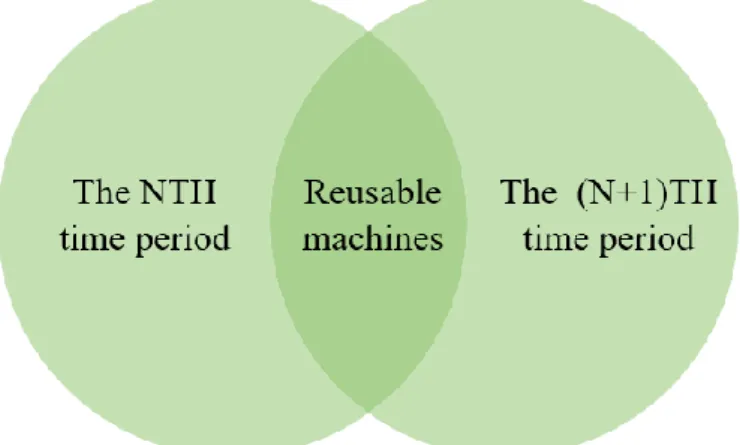
There is a repetition problem in the calculation process, that is, the machine working in each
repeat of the machine working situation, the pro-cessing mode is given based on the calculation of each time period is to restart the machine, then respectively calculate the best measures to
each time period, after a detailed analysis of each time period is likely to repeat the number of machines and cost minus the repeated work of the machine work, finally get the minimum cost.
Fig.2: Machine work repeats
After the optimal scheme is calculated, the sen-sitivity of the scheme is analyzed, and the result is extended according to the actual situation to obtain the final result.
4. Data collection and processing
The daily power demand of the plant is shown in Table 1.
Table 1: Daily demand (kw)
Time frame (0-24) 0-6 6-9 9-12 12-14 14-18 18-22 22-24
Demand 11000 33000 25000 36000 25000 30000 18000
The generator situation is shown in Table 2.
Table 2: Generators
Available quantity
Minimum output
Maximum
output Fixed cost
Marginal cost
Start-up cost Type 1 10 800 1800 2200 2.7 4000 Type 2 5 1000 1500 1800 2.2 1500 Type 3 8 1200 2000 3800 1.8 2500 Type 4 4 1800 3500 4600 3.6 1000
Note: maximum output and minimum output are maximum output power (kw) and minimum output power (kw); Fixed cost, marginal cost (yuan/hour); Fixed cost (yuan).
If a working generator set must set aside 20% of its generating capacity to charge the battery, the
demand for each period is shown in the table be-low:
Table 3: Minimum power generation (kw)
Demand 13750 41250 31250 45000 31250 37500 22500
5. Model building
5.1
Theoretical foundation
A. Nonlinear programming: nonlinear program-ming is a method of solving optimization prob-lems in which one or more nonlinear functions are present in the objective function or constraint. Combined with the practical problems studied in this paper, the objective function, constraint con-ditions and decision variables were found, and the optimal solution was solved by MATLAB and LINGO.
B. Sensitivity analysis: sensitivity analysis is a method of studying and analyzing the sensitivity of a model's state or output changes to system parameters. It can also be understood as the size of the dependency on the relevant parame-ters in the model. Sensitivity analysis is often used in optimization methods to study the stabil-ity of the optimal solution when the original data
is inaccurate or changes. Sensitivity analysis can also determine which parameters have a greater impact on the system or model.
5.2 Modeling
According to the analysis of the actual problem, the minimum total cost should be calculated. The given data include the situation of the gen-erator and the daily demand for electricity. Then the key to solve the problem is to distribute the motor reasonably in each time period according to the situation of the motor. The nonlinear pro-gramming model is established through analysis, the objective function and constraint conditions are listed with the data given by the problem, and the optimal solution is obtained by software cal-culation.
To establish a nonlinear programming model, the specific steps are as follows:
.
a Characterizing objective function:
Start-up cost:
( )
(
)
' ' ' '
1 1 1 1 2
min ,
I J J I
j ij j ij i j
i j j i
Q f a f a a −
= = = =
=
−
Type, Q represents the startup cost;
fj is the starting cost of model j
ma-chine;
aij is the number of model j machine in
the ith time period;
i represents the time period;
j representative machine model;
( )
(
1)
min a aij, i− j is the minimum value of the number of model j machines in two adjacent time periods.
Fixed costs for period i:
(
)
'
1
J
i i ij j
j
G h a k
=
=
Total fixed cost:
(
)
' ' ' 1 2 1 1 I Ji ij j J
i j
G G G G h a k
= =
= + + + =
Type, kj represents the fixed cost of model
j
machine;
i
hrepresents the time of the ith time pe-riod;
i
G represents the fixed cost of the ith pe-riod;
'
I represents the period number;
'
J represents the number of machine
models;
Where, the total fixed cost is accumulated from the fixed cost of each time period, and the fixed cost of each time period is multiplied by the num-ber of machines of the model multiplied by the operating time of the model machine multiplied by the fixed cost of the model machine per hour; Marginal cost in the ith time period:
(
)
'
J
Total marginal cost:
(
)
1 2
1 1
I J
I ij j ij i j
i j
D D D D x n a h J
= =
= + ++ =
− Type, Direpresents the marginal cost of the i th time period;
Jjrepresents the marginal cost per
kilo-watt of model
j
machine;njrepresents the minimum output power
of model
j
machine;ij
x represents the output power of model
j
in the ith time period;Where, the total marginal cost is derived from
the incremental marginal cost of each time pe-riod, and the marginal cost of each time period is derived from the partial power exceeding the minimum output power of the machine multiplied by the number of machines multiplied by the op-erating time of the machine multiplied by the marginal cost per kilowatt.
.
b List the constraints:
A. If do not consider to the battery charge, then:
'
1
J
ij ij i j
x a e
=
Type, eirepresents the actual power required in the i th time period; The output power of the
selected scheme is greater than or equal to the actual required power.
j ij j
n x m
Type, njrepresents the minimum output power
of model
j
machine, mj represents themaxi-mum output power of model
j
machine; Theactual power of each machine in the selected scheme should be between the minimum and maximum power.
0( 0)
ij ij
x = a =
If the machine of a certain type has no power output, the number of the machine of that type in
that period is 0.
0aij cj
Type, cj represents the total number of
ma-chines available for model
j
; The number of machines for each model in the selection should be between 0 and the alternative..
c The optimal solution and value of the objective
function are obtained in the feasible domain. To sum up,
The objective function is: Z = + +G Q D
The constraint conditions are:
' 1 ( 0) 0( 0) 0 J
ij ij i j
j ij j ij
ij ij
ij j
x a e
n x m a
x a a c = = =
B. If 20% charge is considered to the battery, the remaining 80% is used for normal power
generation, then: Change the constraint:
4
1
80%
ij ij i
j
x a e
=
Eighty percent of the actual power of the chosen scheme is greater than or equal to the actual power required.
To sum up,
The objective function is: Z = + +G Q D
'
1
0( 0)
( 0)
0
80%
ij ij
j ij j ij
ij j
J
ij ij i
j
x a
n x m a
a c
x a e
=
= =
6.Model solution and result analysis A.Do not consider charging the battery (1)To solve the model
It is calculated that the minimum total cost of the first day is 241,439.7 yuan, the minimum total
cost of the second day is 273,834.0 yuan, the minimum total cost of the third day to the seventh day is 27,0634.0 yuan, and the minimum total cost of the week is 1868443.7 yuan. See the ta-ble below for details:
Table 4: Daily and total minimum cost
The first day The second day The third day … The seventh day Combined
241439.7 273834.0 270634.0 … 270634.0 18,684,43.7
Note: Unit yuan
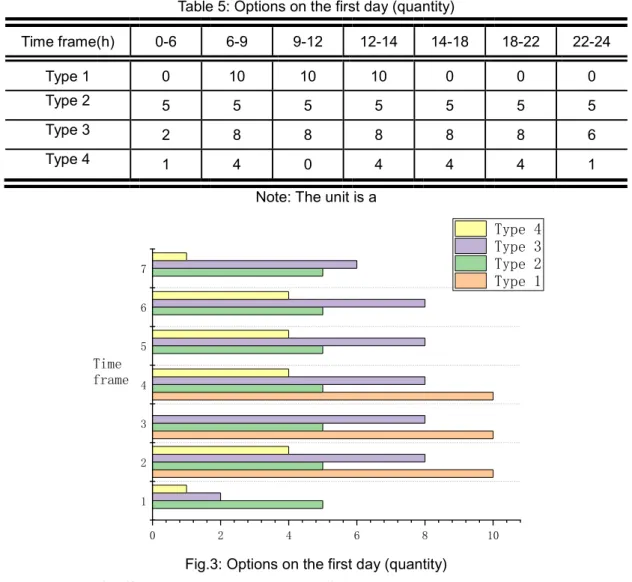
LINGO was used to calculate the distribution re-sults of the previous two days' plans, and the matching plans of different models of machines
on the first day and the second day were ob-tained as follows:
Table 5: Options on the first day (quantity)
Time frame(h) 0-6 6-9 9-12 12-14 14-18 18-22 22-24
Type 1 0 10 10 10 0 0 0
Type 2 5 5 5 5 5 5 5
Type 3 2 8 8 8 8 8 6
Type 4 1 4 0 4 4 4 1
Note: The unit is a
Fig.3: Options on the first day (quantity)
1 2 3 4 5 6 7
0 2 4 6 8 10
Type 4 Type 3 Type 2 Type 1
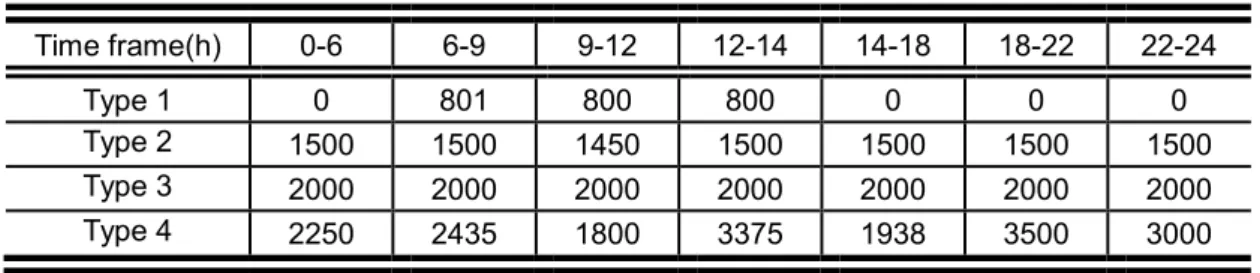
Table 6: Machine power of different models on the first day
Time frame(h) 0-6 6-9 9-12 12-14 14-18 18-22 22-24
Type 1 0 801 800 800 0 0 0
Type 2 1500 1500 1450 1500 1500 1500 1500 Type 3 2000 2000 2000 2000 2000 2000 2000 Type 4 2250 2435 1800 3375 1938 3500 3000
Note: The digital unit is kilowatt.
The selection plan of the second day is as follows:
Table 7: Options on the second day (quantity)
Time frame(h) 0-6 6-9 9-12 12-14 14-18 18-22 22-24
Type 1 5 10 10 10 10 0 0
Type 2 5 5 5 5 5 5 5
Type 3 8 8 8 8 8 8 8
Type 4 4 4 4 4 4 4 4
Note: The unit is a
As can be seen from the above table, the second day's selection scheme is the same as the first day. After analysis, the choice plan for the next few days of this week should be the same as that for the next day, so the choice plan for the seven days of this week is the same, all of which are the choices in the above table. The total cost of the first day and the second day is 283,426.0 yuan and 27,0816.0 yuan respectively, which is
in line with the previous mentioned in this paper. The total cost of the second day and the second day are the same.
(2) Sensitivity analysis
Sensitivity analysis was carried out on the re-sults. The fixed cost of the first type of machine was fluctuated up and down within a certain range. The corresponding total cost of each fixed cost was corresponding to it.
Fig.4: The results were fitted on the first day
The fitting results of the second day are as follows:
Except the first day, the fitting results from the second day to the seventh day are all higher, in-dicating that the total cost is highly dependent on the fixed cost. When the fixed cost changes, the total cost also changes similarly.
B. Consider charging a battery
(1)To solve the model
It is calculated that the lowest cost of the first day is 375986.0 yuan, the lowest cost of the second day to the seventh day is 366586.0 yuan, and the lowest total cost of the week is 2575502.0 yuan, as shown in the following table:
Table 8: Daily and total minimum cost
The first day The second day The third day … The seventh day Combined
375986.0 366586.0 366586.0 … 366586.0 2575502.0
Note: Unit yuan
The minimum total cost for the first day is differ-ent from that for the other six days, and the min-imum total cost for the second to seventh day is the same.
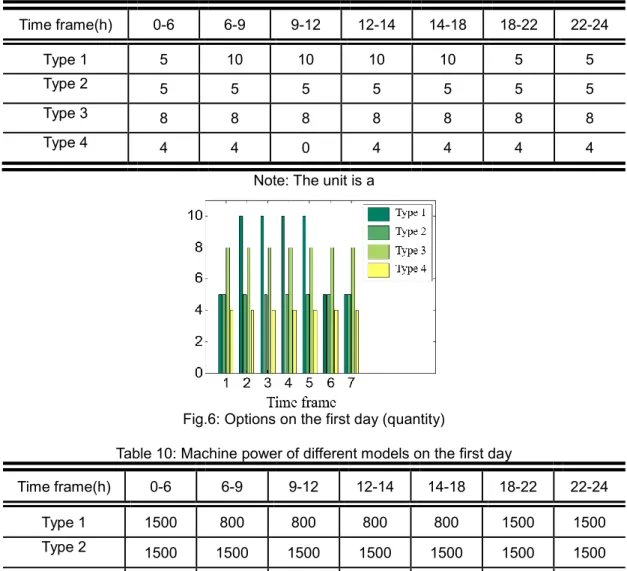
LINGO was used to calculate the distribution
results of the previous two days' plans, and the matching plans of different models of machines on the first day and the second day were ob-tained as follows:
Table 9: Options on the first day (quantity)
Time frame(h) 0-6 6-9 9-12 12-14 14-18 18-22 22-24
Type 1 5 10 10 10 10 5 5
Type 2 5 5 5 5 5 5 5
Type 3 8 8 8 8 8 8 8
Type 4 4 4 0 4 4 4 4
Note: The unit is a
Fig.6: Options on the first day (quantity)
Table 10: Machine power of different models on the first day
Time frame(h) 0-6 6-9 9-12 12-14 14-18 18-22 22-24
Type 1 1500 800 800 800 800 1500 1500 Type 2 1500 1500 1500 1500 1500 1500 1500
Type 3 2000 2000 2000 2000 2000 2000 2000
(2) Sensitivity analysis
Sensitivity analysis was conducted on the calcu-lation results, the fixed cost of the first machine
was changed to float within a certain range, and the fixed cost of the machine was fitted with the total cost. The specific results are as follow
Fig.7: The results were fitted on the first day
The fitting results of the second day are as follows:
Fig.8: Fitting results on the second day
The fitting effect is similar from the second day to the seventh day. Through the above fitting, the effect of the first day is excellent, and the effect of the next few days is reasonable, indicating that the total cost is highly dependent on the fixed cost. In the actual production process, we must ensure the reasonable fixed cost.
7. Model evaluation
7.1Advantages of the model
(1) Nonlinear programming is a mathematical method to assist people in scientific manage-ment. The knowledge of nonlinear programming is very helpful to solve optimization problems. (2) The model can meet a variety of practical conditions by adjusting constraints and objective functions, showing strong flexibility. Moreover, it can use mature linear programming tools to solve the problem in a simple and quick way, which is an effective means to assist decision-making.
(3) The sensitivity analysis was used to test the
optimal solution, which enhanced the feasibility of the optimal solution calculated in this paper.
7.2Disadvantages of the model
(1) Nonlinear programming is mainly affected by constraint conditions and objective functions. If the constraint conditions are not obvious or there are many constraints and some can only be ig-nored, the optimal solution obtained is not nec-essarily the only optimal solution, which will have some influence on the decision-making.
(2) In practice, there will be a climbing process in the start of the generator, but it cannot be con-sidered in this paper. Therefore, there will still be some errors in obtaining the optimal solution
8. Improvement and promotion of the model 8.1 Model improvement
climbing factors and enhance the feasibility of the obtained scheme;
(2) The working time of the generator is limited, so in order to enhance the feasibility of the ob-tained scheme in real life, we need to search for information and increase the running time of each machine;
(3) The power demand of the factory may also change in each period of the day, so we can in-crease the range of power demand and add a constraint;
(4) In this paper, power calculation considers the output power of each generator as an integer, so non-integer calculation can be added to reduce the error.
8.2 Model generalization
(1) Nonlinear programming can also be applied to the co-taxi scheduling problem to reduce the empty driving rate of taxis in urban traffic, im-prove the carrying efficiency of taxis and make full use of road resources;
(2) The linear programming model can also be used to reduce the operation and maintenance cost of the fault indicator and the outage time of the distribution network;
(3) The method of linear programming can also be used to optimize the technical parameters of autoclaved fly ash brick, so as to effectively im-prove the optimization accuracy.
9. Conclusion
This paper studies the application of nonlinear programming model in generator selection. Combined with an example, the established model is used to calculate that the minimum charge is 1868443.7 yuan if battery charging is not taken into account. If the battery is charged 20% and the remaining 80% is used for normal production, the minimum cost is 2575502.0 yuan. Based on the sensitivity analysis of the results, it is concluded that the fixed cost of generator is more important to the total production cost. Therefore, in the actual production process, the fixed cost of the generator itself should be kept as stable as possible to reduce its fluctuation.
References
1. Sen Tian. Research on generation - coal cost
251.
2. Huichun Li, Zhemin Li, Ziyang Mao. A combined taxi dispatching model based on integer linear programming[J]. Transportation research, 2018, 4(05):35-42.
3. Chao Cai, Jianzhong Ding, Feng Lv, Haixing Yuan, Ying Zhu, Guoqiang Sun, Zhinong Wei. Optimization of distribution network fault indica-tor based on integer linear programming model [J/OL]. Power system protection and control: 1-9[2019-07-17].
4. Ying Zhao, Jing Gao. Theoretical thinking of sen-sitivity analysis and its application in business decision-making[J]. Radio and television univer-sity institute of technology, 2005(04):17-18+20. 5. Shengping Yu, Qinghua Wu, Kun Liu, Jiahao