Analysis on the Performance of
Server-less RFID Searching Protocol
Ping Huang, Haibing Mu and Fei Zeng
Beijing Key Laboratory of Communication and Information Systems, School of Electronic and Information Engineering, Beijing Jiaotong University, Beijing, China
Radio frequency identification (RFID)has spread into many fields. Its security and privacy has received more and more attention. Based on traditional authentica-tion protocols, some other branches related to practical applications have been introduced including server-less authentication and searching protocols. The server-less searching protocol is extended from server-less authenti-cation protocol and both of them are executed without the support from the backend servers. Through analyzing some proposed protocols, we found that the probabilistic tracking attack is one of the major threats on the server-less RFID security protocols. The probability of being tracked and the cost on computation are related with the probability of the undesired tag’s response. Based on the analysis, a practical conclusion is given which can be used in most of the server-less RFID systems.
Keywords: RFID, server-less, authentication, searching, security
1. Introduction
Radio frequency identification(RFID)has been widely used in many fields, such as pharmaceu-ticals industry and logistics management. At present, RFID has been embedded into daily life. However, there is still hidden trouble in the security and privacy of RFID systems. Hence the authentication protocols have been presented by many researchers to guarantee the security and privacy involved in RFID systems. At the beginning, the RFID security protocols were only used to check whether the tag is le-gal, i.e. one-way protocol. Afterwards, with deepening of understanding on the RFID sys-tem by malicious adversaries or users, read-ers can be utilized by them to violate the le-gal users’ privacy. Considering this situation,
a large amount of mutual authentication pro-tocols were proposed. Based on these works, the grouping proof protocols were presented to ensure that some of the entities are scanned si-multaneously. It is obvious that the security of these protocols is totally based on the central database. In other words, there has to be a cen-tral server connected with the readers constantly to realize a secure system. However, steady connection between the back-end database and the readers cannot be guaranteed in many prac-tical scenarios, especially in the remote areas. Therefore, server-less security protocol is nec-essary. Among these server-less security proto-cols, the server-less RFID searching protocol is extended from the authentication protocol. The RFID searching protocol is used by the reader to determine whether the desired tag is in the group of tags.
The main contributions of this paper are: (i) the requirements for server-less RFID search-ing protocols are studied,(ii)the analysis of the relationship between the probabilistic tracking attack, the cost on computation and the parame-ter, and(iii)a conclusion is put forward in this section that can be used in most of the server-less RFID systems to optimize the performance of the systems.
2. Related Work
the implementation of “Kill” [5]. That means the Reader sends a command of kill the tag and the tag will be inactive forever. In this way, privacy can be well protected from an adver-sary’s scanning the tag illegally. But the tag will never work anymore. Afterwards, accord-ing to the thought of cryptography presented by Shannon, a number of researchers came up with many RFID protocols for privacy and security of RFID system. Such is the Hash-Lock protocol [12, 13]. Weis S. A. et al.(2002)also described a new research direction in RFID for researchers with cryptography. A randomized Hash-Lock protocol [17]was put forward, and the authors said that low-cost Radio Frequency Identifica-tion (RFID) systems would become pervasive in our daily lives when affixed to everyday con-sumer items as “smart labels”. It predicts that low-cost is important for RFID system’s being applied in our daily life. The hash-chain proto-col[10]can ensure forward-secure privacy, be-cause hash-function has one-way property. In some of the early protocols, both of the par-ties might use security schemes with static IDs [8]. However, these security schemes have been proved to be insecure. Tsai et al.[16]presented their own dynamic ID scheme to achieve secu-rity and anonymity based on the work of Yoon et al.[18]. With the help of central database, most security requirements are realized by many pro-tocols. In this section, a detailed introduction on sever-less protocols will be presented. The idea of “server-less” was firstly shown by Tan et al. [15]. It was introduced in a practical scenario where a truck driver was dispatched to pick up some merchandise attached with RFID tags. Nevertheless the driver only has a PDA (Personal Digital Assistant) as a reader, with-out connection with central database for his re-mote location. Alternatively, it is to download the list of necessary information of the tags. But whether the PDA is stolen cannot be guar-anteed. So an authentication protocol imple-mented only by readers is the best way to solve the problem. Tan et al. proposed several mu-tual authentication protocols and searching pro-tocols without central database. Besides, they created a contact list which has been used in subsequent works. In 2008, some excellent pro-tocols were presented by Ahamed et al. Some researchers put forward a server-less searching protocol and a server-less authentication proto-col separately[1, 2]. These researches indicated
that RFID security protocols without servers would be very meaningful for the development of RFID system[4]. The development of server-less RFID security scheme, analysis on security, privacy, anonymity, etc. has raised people’s at-tention [11]. Then, in 2011, Myneni et al. [9] proposed an anonymous protocol while Kim et al. [6] added untraceability in their own proto-col. Sundaresan et al.[14]combined server-less searching protocols with low-cost RFID tags, which can narrow the range of research and en-hance practicability of protocols. Lee et al.[7] analyzed some previous works on the numeri-cal values firstly. Then, they proposed their own protocols to try to enhance security and privacy. Through analyzing the existing server-less pro-tocols, we find that probabilistic tracking attack is a serious threat. We find out the key of proba-bilistic tracking attack and provide an effective solution to resist this attack.
3. Security Requirements on Sever-less RFID Searching Protocol
Server-less RFID protocol is usually operated in some remote area where the connection be-tween the reader and the backend server may be not steady. This problem could influence the se-curity of RFID systems which need continuous support from the servers
Besides forward security, privacy, anonymity and some other existing security targets for all RFID security protocols, some other require-ments should be reached for server-less RFID searching protocol:
1. Higher stability of the reader. It means that to perform server-less RFID searching pro-tocols, the readers’ ability has to be much more robust to keep the systems steady. 2. Limited scalability of the system. A tag
can-not join the process of operation of RFID searching protocol until the reader commu-nicates with the trusted party, which means the scalability is strictly limited.
connected with the trusted party can the tag be authenticated by its reader.
Overall, high efficiency and security is the ul-timate goal for a server-less RFID searching protocol.
4. Analysis of the Probabilistic Tracking Attack
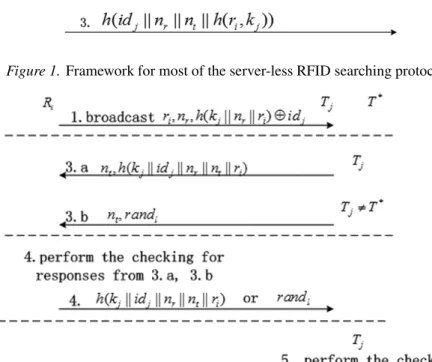
Most of the server-less RFID searching proto-cols can be summarized to the framework below (Figure 1). The protocol proposed by Lee et al. (Figure 2)is taken as an example to demonstrate our analysis more clearly in this paper.
1. The reader broadcasts the active information which includes a random number, its identity and an encryption result of the fresh infor-mation and the shared keys with the desired tag to all the tags.
2. The desired tag will give a response with probability of 1 while the undesired tags will
reply with a probability of.
3. When the reader receives the responses from the tags, it will check and reply to the tags. 4. The desired tag will check the message from
the reader to authenticate it.
4.1. Notations in Lee et al.’s Server-less Protocols
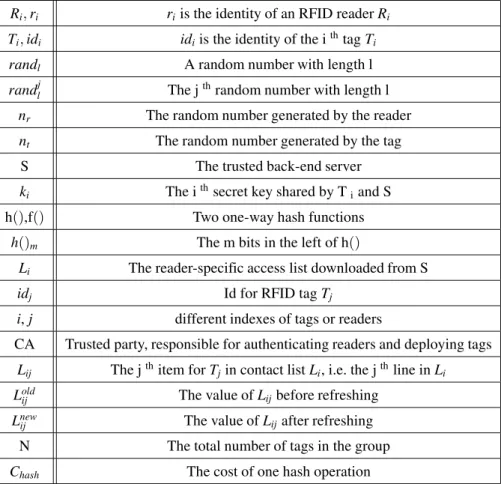
In the paper, we created some new notations besides the ones used in Lee et al.’s server-less authentication and searching protocols. The no-tations are shown in Table 1.
4.2. Lee et al.’s Server-less Searching Protocol
Lee et al.’s protocol is used in the scenario when there is no continuous support from the server, which is shown in Figure 2 in details.
Figure 1.Framework for most of the server-less RFID searching protocols.
Ri,ri riis the identity of an RFID readerRi
Ti,idi idiis the identity of the ithtagTi
randl A random number with length l
randjl The jthrandom number with length l
nr The random number generated by the reader
nt The random number generated by the tag
S The trusted back-end server
ki The ithsecret key shared by Tiand S h(),f() Two one-way hash functions
h()m The m bits in the left of h()
Li The reader-specific access list downloaded from S
idj Id for RFID tagTj
i,j different indexes of tags or readers
CA Trusted party, responsible for authenticating readers and deploying tags
Lij The jthitem forTjin contact listLi, i.e. the jthline inLi
Lold
ij The value ofLijbefore refreshing
Lnew
ij The value ofLijafter refreshing
N The total number of tags in the group
Chash The cost of one hash operation
Table 1.Notations in the protocol.
1. The reader broadcasts nt,h(kjidjnrntri)
to the tags.
2. When T∗ receives the message from the reader,T∗will compute the valueh(kT∗nrri)
and check whether the value ofh(kT∗nrri)l⊕
h(kjnrri)l⊕idjequals its identity; if so, it
will go to 3a, otherwise, it will go to step 3b.
3a. The desired tag Tj will send the message
nt,h(kjidjnrntri)to the reader.
3b. The undesired tagT∗will send the message
nt,randlwith probability.
4. After receiving the response from the tags, the reader will sendh(riidjnrntkj)to the
Tjorrandlto the T*.
5. Tjcomputes and checks whetherh(riidjnr
ntkj) equals the value received in step 4.
If so, it will accept the reader. Otherwise, it will terminate the session.
5. Analysis of the Searching Protocol
5.1. Definition
The protocols presented by Lee et al. would suffer from probabilistic tacking.
In searching protocol, when a tag is not the desired one, it will reply to the reader with a probability . Thus, the probability of some tags’ response can be calculated.
There are two circumstances where we calcu-lated the values of the tracking probability and the overhead of computing hash function on the verifier.
We make a detailed definition on the variables mentioned above.
Definiton 1: the random event that there is the
desired tag among the N tags is denoted asC.
C’s opposite event that there is no desired tag among theNtags is denoted asC¯.
eventC¯as below:
P(C) =P( ¯C) = 12 (1)
We will analyze the two different circumstances from two aspects, as following. We make de-tailed description for these two cases.
Situation 1: it is a special case. It is certain
that there is the desired tag in the group in many circumstances, such as the reader queries for a tag for a second time before updating.
Situation 2: it is uncertain whether the desired
tag is in the group of tags or not. This is the most frequent case.
5.2. Probabilistic Tracking
Tracking means distinguishing one tag from the others by obtaining the same or related infor-mation from different sessions about the tag. As we all know, an unmatched tag will reply with probability and not reply with probabil-ity (1 −). In this way, when there is only one response in the wireless channel, it maybe comes from the undesired tag with the probabil-ity of Suppose that a malicious adversary has already recorded the query of the response and he is patient enough to send the same query over and over again. At the same time he keeps mon-itoring the number of responses transmitted in the wireless channel. When there is only one re-sponse again, the adversary tracks successfully with some probability. We will denote the prob-ability as pt. Suppose M is the random event
that when there is only one response in the chan-nel, it comes from the desired tag andpmis the
probability of the random event. U represents the random event that none of the undesired tags gives any response. puis the probability that the
other unmatched tags do not answer the query from the reader.
We can get an equation:
pt =pm·pu (2)
Situation 1: from the definition of situation 1,
we will get:
pm =1 (3)
pu= (1−)N−1 (4)
So,
pt =pm·pu = (1−)N−1 (5)
In this way, the average number of times that the adversary replays the same query(set asn)
is,
n= p1
t =
1
(1−)N−1 (6)
Situation 2: in this situation, whether the
de-sired tag is in the group of tags or not is not cer-tain. P(Ui) (i=1,2)is the probability that the
other unmatched tags do not answer the query from the reader under random event C or C¯.
P(M|C)means the probability of the case that there is only one response and it comes from the desired tag when the desired tag is in the group.
P(M|C¯) represents the probability of the case that there is only one response and it comes from the desired tag when the desired tag is not in the group.
pt=P(Ttrack|C)·P(C) +P(Ttrack|C¯)·P( ¯C)
=P(M|C)·P(U1)·P(C)
+P(M|C)·P(U2)·P(C) (7)
Where,
P(M|C) =1 (8)
P(M|C¯) =0 (9)
P(U1) = (1−)N−1 (10)
P(U2) = (1−)N (11)
So,
pt= 1
2(1−)
N−1 (12)
In this situation, the average number of times that the adversary replays the same query (set asn)is,
n= p1
t =
2
(1−)N−1 (13)
Since the scale of tags may be very great, i.e. N is large, n is rather large, which means the ad-versary has to replay the same query many times to reach success with some probability. But it is feasible because of computer technology. So the probabilitypt cannot be negligible.
will be reduced while the cost on authentica-tion adds up The property associated with mentioned before is one of the characteristics of the framework. Because of this property, x
is introduced as the weight of security in the comprehensive assessment of the system per-formance. Besides, a parameter S can be used to evaluate the performance of the system, and S can be expressed as the following equation
S=1−(x·pt+ (1−x)·m) (14)
where m represents the normalized performance of computation on authentication, ie:
m= 1 N ·
1
2·N· + 1
2 ·(1+ (N−1))
(15) Above all, performance of the system can be expressed as the equation below:
S=1−
x·
1
2(1−)
N−1+ (1−x)· 1
N
·
1
2 ·N· + 1
2·(1+ (N−1))
(16)
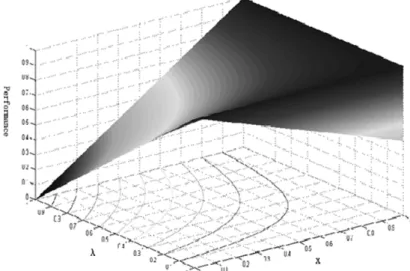
The empirical model is visualized by using mat-lab, as shown in Figure 3. From the figure, it can be seen that the performance of a system will reach the peak in the darkest place of the curve. Because andxare both variable, con-trolling variables method is adopted. With this method, we analyzed two different cases. They are the case whereis fixed and the case where
xis fixed.
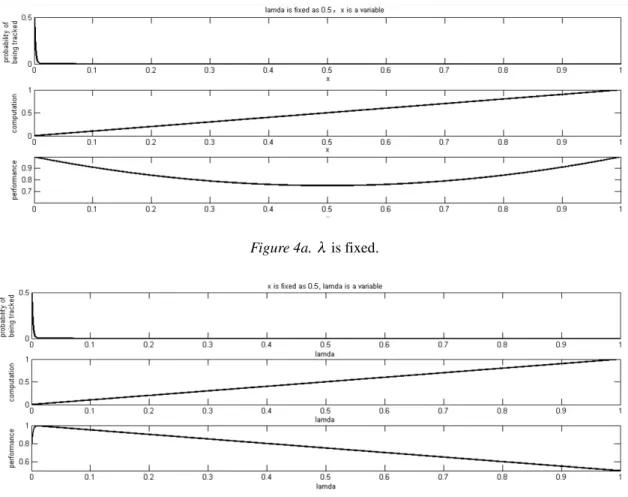
Firstly, is fixed( is set as 0.5), and the prob-ability of being tracked, cost on computation and the performance of the system are shown in Figure 4a. In this case, the operator of the system can adjust the system as he wants. Secondly, x is fixed (x is set as 0.5) and the probability of being tracked, cost on compu-tation and the performance of the system are shown in Figure 4b. It can be seen from the figure that the performance of the system rises to its peak rapidly and goes down with the in-crease of. The operator can adjust the system as he wants.
Above all, the tendency of the system’s perfor-mance related to x and can be seen clearly from the figures above. The parameters can be adjusted by the system’s owner according to the system’s ability and requirements.
6. Conclusion
In our paper, a detailed analysis of the exist-ing server-less RFID searchexist-ing protocols pro-posed by Lee et al. is shown. From our anal-ysis, we find that probabilistic tracking cannot be ignored. Especially with the help of high-tech computer, probability tracking may be a great security threat. In the future, we will do a deep research on server-less RFID searching protocols, to lower the existing security threat and reach the requirements on server-less RFID searching protocol.
Figure 4a. is fixed.
Figure 4b. xis fixed. Acknowledgment
This work is supported by National Natural Sci-ence Foundation of China under Grant 61201159 and by Fundamental Research Funds for the Central Universities under Grant 2012JBM016. The authors also gratefully acknowledge the helpful comments and suggestions of the re-viewers, which have improved the presentation.
References
[1] S. I. AHAMED, E. HOQUE, F. RAHMAN,ET AL. YA-SRAP: Yet another serverless RFID authentication protocol[J], 2008.
[2] S. I. AHAMED, F. RAHMAN, E. HOQUE, ET AL., S3PR: Secure serverless search protocols for RFID[C]//Information Security and Assurance, 2008. ISA 2008.International Conference on. IEEE, (2008)pp. 187–192.
[3] C. CHEN, D. HE, S. CHAN,ET AL., Lightweight and provably secure user authentication with anonymity for the global mobility network[J]. International Journal of Communication Systems,24(3),(2011), 347–362.
[4] M. E. HOQUE, F. RAHMAN, S. I. AHAMED,ET AL., Enhancing privacy and security of RFID system with serverless authentication and search proto-cols in pervasive environments[J].Wireless personal communications,55(1),(2010), 65–79.
[5] JUELS, RFID security and privacy: A research survey.IEEE Journal on Selected Areas in Commu-nication,24(2),(February 2006), 381–394. [6] Z. KIM, J. KIM, K. KIM,ET AL., Untraceable and
serverless RFID authentication and search proto-cols[C]. Parallel and Distributed Processing with Applications Workshops (ISPAW), 2011 Ninth IEEE International Symposium on IEEE, (2011) 278– 283.
[7] C. F. LEE, H. Y. CHIEN, C. S. LAIH, Server-less RFID authentication and searching protocol with enhanced security[J].International Journal of Com-munication Systems,25(3),(2012)376–385. [8] J. S. LI, K. H. LIU, A hidden mutual authentication
protocol for low-cost RFID tags[J]. International Journal of Communication Systems,24(9),(2011) 1196–1211.
[10] M. OHKUBO, K. SUZUKI, S. KINOSHITA, Hash-chain based forward-secure privacy protection scheme for low-cost RFID. In: Proceedings of the 2004 Sym-posium on Crytography and Information Security (SCIS 2004), Sendai,(2004)719–724.
[11] J. H. PARK, Security analysis of mCrypton proper to low-cost ubiquitous computing devices and ap-plications.International Journal of Communication Systems,22(8),(2009)959–969.
[12] S. E. SARMA, S. A. WEIS, D. W. ENGELS, Radio-frequency identification: Secure risks and chal-lenges. RSA Laboratories Cryptobytes,6(1),(2003) 2–9.
[13] S. E. SARMA, S. A. WEIS , D. W. ENGELS, RFID systems and privacy implications. In: Proceedings of the 4thInternational Workshop on Cryptographic
Hardware and Embedded Systems (CHES 2002). Lectures Notes in Computer Science 2523. (B. S. KALISKI, C. K. KOC, C. PAAR EDS.), (2003) pp. 454–469. Springer-Verlag, Berlin.
[14] S. SUNDARESAN, R. DOSS, W. ZHOU, A serverless ultra-lightweight secure search protocol for EPC Class-1 Gen-2 UHF RFID tags[C]. Computer & Information Science (ICCIS). 2012 International Conference on IEEE,(2012)580–585.
[15] C. C. TAN, B. SHENG, Q. LI, Severless search and au-thentication protocols for RFID[C].Pervasive Com-puting and Communications, 2007. PerCom’07. Fifth Annual IEEE International Conference on IEEE,(2007)3–12.
[16] J. L. TSAI, T. C. WU, K. Y. TSAI, New dynamic ID authentication scheme using smart cards[J]. Interna-tional Journal of Communication Systems,23(12), (2010)1449–1462.
[17] S. A. WEIS, S. E. SARMA, R. L. RIVEST, D. W. EN-GELS, Security and privacy aspects of low-cost radio frequency identification systems. In: Proceedings of the 1st International Conference on Security
in Pervasive Computing. Lectures Notes in Com-puter Science 2802 (D. HUTTER, G. MULLER, W. STEPHAN, M. ULLMANN,EDS.), (2004) 201–212. Springer-Verlag, Berlin.
[18] E. J. YOON, K. Y. YOO, Improving the dynamic id-based remote mutual authentication scheme.OTM Workshops. Lecture Notes in Computer Science,
4277,(2006)499–507. Springer, Berlin.
Received:November, 2014 Revised:July, 2015 Accepted: August, 2015
Contact addresses: Ping Huang Beijing Key Laboratory of Communication and Information Systems School of Electronic and Information Engineering Beijing Jiaotong University Beijing 100044 China e-mail:[email protected]
Haibing Mu Beijing Key Laboratory of Communication and Information Systems School of Electronic and Information Engineering Beijing Jiaotong University Beijing 100044 China e-mail:[email protected]
Fei Zeng Beijing Key Laboratory of Communication and Information Systems School of Electronic and Information Engineering Beijing Jiaotong University Beijing 100044 China e-mail:[email protected]
PINGHUANGreceived her Master’s Degree in communication and in-formation system from Beijing Jiaotong University in Apr. 2015. Her research area is RFID network security. She has published three papers during the last three years. After graduation, she has been working on GIS in Baidu.
HAIBINGMUreceived her PH.D. Degree in communication and infor-mation system from Beijing Jiaotong University in Jan. 2008. She is a full-time associate professor in the Department of Communication at Beijing Jiaotong University. Her current research areas include com-puter network and communication, network and information security, Ad Hoc and RFID network security.