VOLUME 15 ISSUE 1 (2017), Page 235 - 244
TRANSLATION OF SOCIAL CITIZENSHIP TO ARCHITECTURE & BUILT ENVIRONMENT: A METHODOLOGICAL REVIEW
Mohd Noorizhar Ismail1, Abdul Razak Sapian2, Peter Scriver3, & Mizanur Rashid4
1
Faculty of Engineering and Built Environment
UNIVERSITI SAINS ISLAM MALAYSIA 2
Kulliyyah of Architecture and Environmental Design
INTERNATIONAL ISLAMIC UNIVERSITY MALAYSIA 3,4
School of Architecture and Built Environment
UNIVERSITY OF ADELAIDE
Abstract
Social Citizenship is a concept that is used to represent acceptance and identity by the local community. This is a manifestation expressed in the form of space, monument or buildings. Buildings such as mosques and other religious buildings are a form of manifestation to such expression left for other generations to see and study. This manifestation of citizenship through religious buildings can be an expression of struggle, establishment, sense of belonging and local acceptance towards achieving social citizenship. The understanding of this concept implicitly shows that these elements are the driving forces behind the architecture that is erected in order to find approval from the local population. This paper reviews the employed research designs, methods and procedures in the process of understanding the translation of social citizenship to architecture expressed by mosques. The methods adopted were aimed toward obtaining archival/historical evidence that can elicit proof of the concept. The methods also involved the process of inquiry that would be the basis for discussion and to draw a conclusion to the relationship between social citizenship and architecture. This paper also highlights the strengths and limitations of the methodological techniques besides spelling out the variables needed to prove the relationship.
Keyword: Archival/historical inquiry, typo-morphology, social citizenship, sense
of belonging, space, architecture
Date Received: 30th April 2016
INTRODUCTION
Social Citizenship is a concept that is represented by displaced people in a foreign country. Displaced people are the minorities of foreign origin that may have come to a place to work and later establish a small community. Social Citizenship is a concept that is used to represent acceptance and identity by the local community. This is a manifestation expressed in the form of space, monument or buildings. This manifestation is crucial to achieving social citizenship because it is a permanent monument is an expression of self-identity, hardship and struggle in order to achieve the acceptance of the local community. According to Proshanky, Fabian and Kaminoff (1983), and Lefebvre (1974), place identity is based on a persons’ sense of memories, ideas, feelings, attitudes, values, preferences, meanings and conception of behavior and experiences that is gained every day. Creating a form of architecture is, in fact an expression of the emotions (Proshanky, Fabian & Kaminoff, 1983). This relationship of space and people can be referred as a form of investment and as a self-proclamation of independence in a foreign place. This collective effort in acquiring a space, land or building is a form of establishment, representation and to establish a sense of belonging (Tuan, 1977).
This paper aims to highlight the translation of social citizenship to architecture. This is because civil citizenship is a recognition that is given on paper (Turner, 1993) that is fulfilling emotionally but does not fulfil their way of life and sense of belonging towards their home country. Social citizenship is a medium of expression that is expressed at urban level translating the sense of belonging and individual expressions to the acceptance of the locals (Turner, 1993; Roche, 1987). This research is based on historical implication to the built environment through the understanding about of culture, ethnicity and historical values (Roche, 1987). It will contribute to the understanding of different cultures in different settings and how they integrate and accepted in the country (Pakulski, 2007; Roche, 1987). Accordingly, the focus of the paper is to describe the research designs, methods and procedures employed to understand the translation of social citizenship to architecture and the built environment. It also highlights the strengths and weaknesses of the methodological tools besides spelling out the variables needed to prove the relationship. This paper will explore the idea of social citizenship in the context of Australia in detail, and Perth Mosque and Adelaide Mosque as the case studies.
BACKGROUND: THE CONTEXT
focuses on to foster civic participation, strengthen community network, promote community tolerance and to support shared sense of social tolerance.
In this context of research, Social Citizenship refers to immigrants from all over the world trying to establish a place in where they reside today (Feldman, 1990). The struggles of the immigrants in establishing a place that represents their culture and society while gaining approval from the locals are well represented in the concept of Social citizenship (Bugg, 2013). The phenomena of Social Citizenship can be viewed in cities with many immigrants such as in Birmingham, New York and Sydney. Immigrants of different backgrounds whether from Indian, Afghan or Arabic descendants have strived in placing their culture and identity in the community and strived in assimilating into the local community while maintaining their uniqueness (Arijit Sen, 2013; Harris, 2013). The translation of Social Citizenship to Architecture is a symbol of their uniqueness represented in solid form for all to see, experience and appreciate (Arijit Sen, 2013).
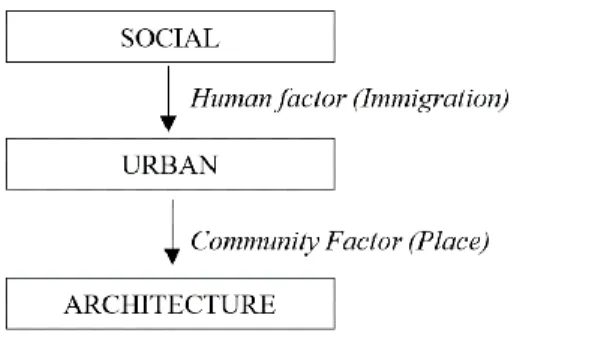
The translation of citizenship to architecture and the built environment is based on certain elements that are defined by the relationship of human sense of establishment and the sense of belonging (Arijit Sen, 2013). These elements are the driving force behind the architecture that is erected in order to find approval from the local population and acceptance of their existence in the land. Drawing from the idea presented by Phillips (2014), Feldman (1990) and Gale (2004), the authors formulated a concept of social citizenship that impacted the architecture and the built environment (refer Figure 2):
Figure 1 Translation of Social and Cultural Implication to Architecture
Figure 2 Concept of Social Citizenship
Source: Modified from Phillips (2014), Feldman (1990) & Gale (2004).
In Figure 2, the concept of Social Citizenship is represented by five elements. These elements are what make social citizenship translated to an architectural form in terms of a building, monument or open space (Tuan, 1977). Each of the elements plays a role in expressing the feeling and the struggle of the immigrants as the sense of belonging to their homeland is strong in them (Arijit Sen, 2013). The first generation of immigrants has a stronger sense of belonging and by establishing a building or structure that represents their existence. This is a strategy that translates into a building that would later be appreciated by the next generations and locals as something unique and exotic representing a sub-minority group of locals (Arijit Sen, 2013).
METHODOLOGY
The methodology adopted incorporates the process of gathering the data, processing the data/information and interpreting the data or archival information obtained. In this study, the method of processing and understanding the data in the most crucial step because of its historical value and story that it has behind it. The methods adopted are aimed toward obtaining archival/ historical evidence that can elicit proof of the concept. It also involved the process of inquiry that would be the basis for discussion and to draw a conclusion to the relationship between social citizenship and architecture.
Historical Inquiry (Historiography)
based and primary sources are the basis of analysis (Peters, 2013). Evidence-based research would require evidence from books, archived information, old newspapers and documents. These information gathered from the government or reliable source relating to the topic of the research. In this case of Social Citizenship, information relating to buildings and mosques is very vital (Berg, 2001). The buildings that are constructed, submitted and approved drawings from government agencies and reports relating to the construction of the buildings is an important element required for analysis (Berg, 2001).
Data used for historical research are divided into two sources. Data sources for histiography is different than any other qualitative methods as the histiography approach is through existing and verified data that is currently available. Histiography data can be divided into primary sources and secondary sources (Berg, 2001).
Primary sources include written statements of eyewitnesses, documentation of original articles and narration of experiences by a person directly related to an event (Berg, 2001). These include documents, photographs, recordings, diaries, memoirs, journals, life histories, drawings and other related relics, (Berg, 2001; Salkind, 2000).
Secondary source is based from oral interview from a person who is not present or directly available the event (Berg, 2001). This is a testimony of people in the form of written objects or documents created by others that relate to a specific research question or area of research interest (Berg, 2001).
Historical inquiry methodology is based on criticism from fixed set of questions (Garraghan, 1946). The set of questions is generated based on the topic that is being researched on. In the case of Social Citizenship, questions regarding the background of Social Citizenship and the source of social citizenship comes into place. According to Garraghan (1946), questions are being formulated based on the guidelines below:
i. When was the source, written or unwritten, produced (date)? ii. Where was it produced (localization)?
iii. By whom was it produced (authorship)?
iv. From what pre-existing material was it produced (analysis)? v. In what original form was it produced (integrity)?
vi. What is the evidential value of its contents (credibility)?
Interpretive Approach
Interpretive Approach is another method used in determining the quality of information and exact analysis of the topic. The interpretive method is used in determining account of journeys, case work, case history and anthropological field study (Howell & Prevenier, 2001; Johansson, 2003). The interpretive approach is a good point of determining fragmented history from multiple sources that require detailed analysis and interpretation in order to extract the particular information need in the research (Peters, 2013).
In the case of Social Citizenship, the approach of historical Inquiry and interpretive approach is used in order to structure and arrange the information that came from numerous sources (Howell & Prevenier, 2001). This information may come from newspaper articles, a fraction of an article mentioning related articles or just an advertisement describing the required information (Berg, 2001).
Typo-Morphology
Typo-Morphology is an approach that focuses on the changes in the physical form of a city over time and how different cities compare to each other (Anne Vernez, 1997). Typology refers to categorized form types in architecture and urban design. Architectural typologies refer to the form characteristics of buildings, the study of categorized form types in architecture and urban design. As opposed to building type, which refers to functionality, architectural typologies refer to the form characteristics of buildings (Anne Vernez, 1997).
Meanwhile, morphology refers to a study of larger urban structures, pattern and issues. Morphology is also a study of the form of human settlements and the development of their formation and transformation according to time and era. Generally, the aim of the technique is to capture and examine the spatial structure and character of a space, village or city through studying the patterns of its components, parts and the process of its development and growth according to time (Anne Vernez, 1997).
To further clarify on the connections of Social Citizenship, typo-morphology approach is used by analysing patterns and structure of the urban landscape against buildings established by the immigrants. The analysis is done in urban settings where immigrants are established. These urban settings represent a variety of settings and different background of urban sceneries and history (Gulgonen, 1998). The similarities between cities and towns are the placement of the immigrants in relation to major elements of the city. Points of analysis that will take into account for all urban elements in this analysis will be:
i. Train station
ii. Major transportation
routes into city
iii. Town hall
iv. Hotels
v. Government buildings
vi. Commercial areas
vii. Mosque location
viii. Industrial area
Based on these elements, the positioning of the building is measured against the location of important places in the town or city. This measurement will be based on the distance between the building and the important infrastructure of the city. This is to analyse the importance of the area and also the significance of the mosque based on the location (Anne Vernez, M., 1997; Gulgonen, 1998).
This method analyses the differences between all urban areas where the cameleers have establish themselves and how do these characteristics affect the architectural outlook of the cameleers’ mosque. These elements will also affect the mosque architectural outlook relating to social and affordance of the Muslim community and what they represent in the area.
DISCUSSION
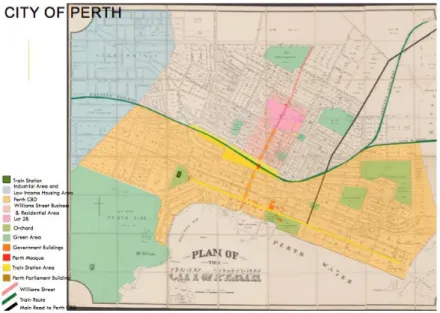
In reference to Figure 4, the mapping of the major elements against Perth Mosque location shows the significance of the mosque (Bartsch et al., 2015). Based on the historical research, Perth Mosque is located in the main area of Williams Street a major retail street of Perth (Bartsch et al., 2015), Western Australia in the early 1900’s. The location of the mosque there shows that the Afghan immigrants strived to establish a building in a major area so that they can be seen and accepted easily.
Figure 4 Sample of Morpho-Typology Mapping Source: Author
The mapping of the location against the major amenities and elements of the city shows that the land that was purchased to build the building is in a significant area where major activities are done. The information historically is further supported by the mapping using typo-morphology method. Certain other cities may not reflect the same situation as in Perth such as the Adelaide mosque where the mosque is built in the fringe area of the city where it is well known to be an immigrant spot (Bartsch, 2015). However, in the long run, the Adelaide mosque today is located in the main area of Adelaide City. The Afghans had established a significant piece of landmark in Adelaide that is well accepted and celebrated by the locals. This is a way of approvement and acceptance of the locals towards the Afghans.
information on a plan of the city to view the changes and relationship of the building towards the urban and local society.
By applying this method more information is easily obtained and the relationship between historical information and architecture of the building is seamlessly translated from the mapping from typo-morphology and historical data.
CONCLUSION
The translation of citizenship to architecture and the built environment is based on elements that are defined by the relationship of human sense of establishment and the sense of belonging. The understanding of this concept implicitly shows that these elements are the driving forces behind the architecture that is erected in order to find approval from the local population and acceptance of their existence in the land. The research also signifies the importance of architecture as a classifying device (Thomas & Deborah, 2002) through social citizenship. The strength of the method in this research is in discovering and understanding the history of places especially relating to migrants and migration and the application of religious architecture as a point of establishment. However, it also poses some limitations which mainly involves the data itself; to obtain credible data and information, verification of the sources and the way one understand and interprets the true meaning of the information. Conclusively, this method can be further explored.
ACKNOWLEDGEMENTS
The authors would like to acknowledge the International Islamic University Malaysia and the University of Adelaide for funding this research through the ARC Linkage Project (LP130100859).
REFERENCES
Anne Vernez, M. (1997). Urban morphology as an emerging interdisciplinary field.
International Seminar on Urban Form, 1, 3-10.
Arijit Sen. (2013). Staged disappointment: interpreting the architectural facade of the Vedanta temple, San Francisco. Winterthur Portfolio 47(4), 207-244.
Bartsch, K. (2015). Building identity in the colonial city: the case of the Adelaide Mosque.Contemporary Islam, 9(3), 247-270.
Bartsch, K., Rashid, M., Scriver, P., Ismail, I., & Jones, P. (2015). Golden threads: understanding the transnational significance of the Perth Mosque (1905).
Australia ICOMOS Conference, Adelaide, Australia.
Berg, B. L. (2001). Qualitative research methods for the social sciences. 4 ed, ed. S.L. Kelbaugh.: United States of America.
Feldman, R. M. (1990). Settlement-identity psychological bonds with home places in a mobile society. Environment and Behaviour, 22 (2), 183-229.
Gale, R. (2004). The multicultural city and the politics of religious architecture: urban planning, mosques and mean-making in Birmingham, UK. Built Environment,
30(1), 18-32.
Garraghan, J.G. (1946). A guide to historical method. New York: Fordham University Press.
Gulgonen, A. (1988). A typo-morphological approach to design thinking. In M. B. Sevcenko (Ed.) Theories and principles of design in the architecture of Islamic societies. Cambridge: Massachusetts.
Harris .J (2013). Identity and adaptation: mosque architecture in south-east Queensland. In A. Brown & A. Leach (Eds.), Proceedings of the Society of Architectural
Historians, Australia and New Zealand 30. Gold Cost, Queensland, Australia:
Griffith.
Howell, M., & Prevenier, W. (2001). From reliable sources: an introduction to historical methods. Ithaca: Cornell University Press.
Johansson, R. (2003). Case study methodology. International Conference
“Methodologies in Housing Research”. Stockholm, Sweden.
Lefebvre, H. (1974). The production of space. UK: Blackwell Publishing. Pakulski, J. (2007). Cultural citizenship. Citizenship Studies, 1(1), 73-86.
Peters, C. J. (2013). What lies beneath: interpretive methodology, constitutional authority, and the case of originalism. Brigham Young University Law Review, 2013(5), 1251-1339.
Phillips, D. (2014). Claiming spaces: British Muslim negotiations of urban citizenship in an era of new migration. Transactions of the Institute of British Geographers, 40(1), 62-74.
Proshansky, H. M., Fabian, A. K., & Kaminoff, R. (1983). Place-identity: physical world socialization of the self. Journal of Environmental Psychology, 3, 57-83. Roche, M. (1987). Citizenship, social theory and social change. Theory and Society,
16(3), 363-399.
Salkind, N. J. (1996). Exploring research. Upper Saddle River, N.J: Prentice Hall. Schmitt, M. H., Brink, P. J., & Wood, M. J. (Eds.) (1989). Advanced Design in Nursing
Research. Newbury Park, CA: Sage Publications.
Thomas A. M., & Deborah, C. (2002). The words between the spaces: buildings and language. USA and Canada: Routledge.