Exploring Water Governance and Management in Oneida Nation
of the Thames (Ontario, Canada): An Application of the
Institutional Analysis and Development Framework
Kate Cave, MES
Department of Environment and Resource Studies, University of Waterloo, [email protected]
Ryan Plummer, Ph.D., Professor
Department of Tourism and Environment, Brock University
Rob de Loë, Professor and University Research Chair in Water Policy and Governance Department of Environment and Resource Studies, University of Waterloo
Abstract
Water is vital to Canada’s First Nations peoples. Despite the significance of water and ongoing efforts by various actors in Canada to make improvements, the conditions of drinking water safety are a persistent concern and deplorable in many First Nation communities. This research explores water institutions and their influence on water governance and management in a First Nations context. Oneida Nation of the Thames, located in southern Ontario, is the specific case investigated. This community has drinking water concerns and a myriad of institutions relating to water governance and management. The Institutional Analysis and Development (IAD) framework guided the exploration in Oneida. Water institutions (formal and informal) are identified and analysed in terms of exogenous factors, the action arena, patterns of interaction, and outcomes of these interactions. An evaluation of institutional performance in relation to water governance and management is offered. Gaining insights about how institutions guide the behavior of people involved in water governance and management in Oneida highlights the need to consider their influences in other First Nation communities.
Acknowledgements
We extend thanks to the entire Oneida community and especially those individuals who participated in this research. April Varewyck, the Oneida Environmental Coordinator, is kindly acknowledged for her kindness and collaboration throughout this collaborative research project. This research is part of the “First Nations and Source Waters: Understanding Vulnerabilities and Building Capacity for Environmental Governance” project. Support for the project comes from the Social Sciences and Humanities Research Council of Canada as well as the consortium of project partners. Support for Kate Cave was additionally provided by the Department of Environment and Resource Studies at the University of Waterloo.
Introduction
environment and are creating significant human health impacts to First Nations‟ communities (COO 2006). While many of these impacts are broad, concerns for human health in regards to drinking water are particularly acute. During the Walkerton Inquiry, which took place following a drinking water disease outbreak in the Town of Walkerton in 2000, Justice O‟Connor (2002, p.487) stated that “there was ample evidence that the water provided in First Nation communities falls well short of the standards of safety and adequacy that are considered acceptable in other parts of the province.” Independent reports by the Polaris Institute (2008) and Neegan Burnside Ltd. (2011) respectively confirm the deplorable water conditions in First Nation communities across Canada and highlight the poor condition of First Nations‟ water services.
The negative conditions surrounding drinking water and water services in First Nations‟ communities in Canada are not new. Since 2003 the federal government has implemented several strategies to improve water and wastewater services on reserves including: the First Nations Water Management Strategy (2003), the Plan of Action for Drinking Water in First Nation Communities (2006), and the First Nations Water and Wastewater Action Plan (2008). The objectives and outcomes of these strategies progressed over time, from addressing the “high risk” systems in First Nation‟s communities in the First Nations Water Management Strategy (2003) to the proposed new federal legislative framework for safe drinking water in First Nations‟ communities. In 2008, the federal government allocated $330 million towards ensuring all First Nations had access to safe drinking water (Eggertson 2008). In May 2010, the federal government brought forward Bill S-11 before the senate (Simeone 2010). This proposed bill provides regulations governing the safety of drinking water in First Nation communities (Simeone 2010). However, due to widespread concern about Bill S-11 it did not proceed to a third reading and dissolved in March 2011. On February 29, 2012 Bill S-8 the Safe Drinking Water for First Nations Act, a second legislative initiative for managing water and wastewater in First Nations, was introduced in the Senate (Simeone 2012). On June 18, 2012 the Senate passed Bill S-8 and it is now under consideration by the House of Commons (Water Canada 2012).
Despite these efforts, for many First Nations‟ communities “unsafe drinking water is a persistent reality of their daily lives” (Simeone 2010, p.1). For example, Landsdowne House (Neskantaga), Ontario, has been on a boil water advisory for 13 years. In Kitigan Zibi Anishinabeg, located a mere 130 kilometres north of Canada‟s capital Ottawa, well water users (accounting for the majority of community members) have been on a „do not consume‟ drinking water advisory since 1999 (Harden and Levalliant 2008). The absence of access to safe drinking water specifically, and poor water quality more generally, potentially impacts the community‟s health, social, cultural (Mascarenhas 2007), and economic wellbeing (Harden and Levalliant 2008). Responding to the situation of water in First Nations‟ communities and gaining insights into how water is governed and managed is imperative.
Institutions influence the manner in which people govern and manage water resources. The concept of governance is used in this paper to refer to “the different ways in which societies can organize themselves to accomplish a goal” (de Loë et al. 2009, p.1). The Global Water Partnership‟s (GWP) (Rogers and Hall 2003, p.16) defines water governance as “the range of political, social, economic and administrative systems that are in place to develop and manage water resources, and the delivery of water services, at different levels of society”. Strong connections exist between water governance and water management. Water management involves understanding the physical sciences (e.g., biology, physics, chemistry, and natural processes), and the interactions of the natural environment with human society (Corkal, Inch and Adkins 2007). Marsalek (1990, p.315) defines water management as “the complex of activities and measures designed to satisfy human needs and social demands concerning water in an optimal way”. Source water protection is an important component of water management designed to protect and provide acceptable water quality and quantity for various water uses for now and future generations (Pollution Probe 2004). As water governance and management are interdependent, in the context of this research, they were considered as two interrelated processes. Institutions pertaining to water can be both formal and informal. They influence both the governance and management of water resources. Through the decision-making process, water institutions are developed and implemented to manage water resources. Water institutions influence water management by guiding how the water managers regulate and monitor water resources. Institutions such as formal legislations inform people‟s behaviour and affects how the decision-making and management of water resources occur.
The institutional analysis undertaken for this research is positioned relative to the myriad of historical and current social, political, and economic issues (e.g., loss of the connection to the land, economic dependency) confronted by First Nations‟ in Canada. Power differentials run deeply throughout these issues. Power issues stem from the historical process of colonization as the government established Indian reserves, residential schools, and government policies to maintain control over First Nations‟ people and communities (Alfred 2009).
With acknowledgement of these interconnections and the issue of power, this research purposefully focuses on water institutions because they offer a way to advance water governance and management strategies in First Nations, and thus to address water concerns. Institutions shaping water governance and management in First Nations‟ communities are numerous and complex. The Federal and provincial governments have developed several formal water institutions. These include the 1985 Indian Act (Foerster 2002); the Expert Panel on Safe Drinking Water in First Nations‟ Communities; the proposed Bill S-11: The Safe Drinking Water for First Nations Act (Simeone 2010); and the proposed Bill S-8: The Safe Drinking Water for First Nations Act (Simeone 2012). Alongside various federal and provincial policies and programs, there are also several First Nations institutions influencing water governance and management such as the First Nations Water Declaration in Ontario (COO 2008) and the Haudeonsaunee‟s thanksgiving address or the Words That Come Before All Else (HETF n.d).
research because it is a community with rich institutions (formal and informal) often associated with water management and governance. Historically, Oneida has faced the range of social and cultural consequences from the federal government intervening in Aboriginal affairs, for example with the creation of the Indian Act (1985). These government interventions have impacted how water resources are governed and managed in First Nations‟ communities. Oneida is also experiencing many drinking water concerns commonly confronting First Nations‟ communities throughout Ontario. At the same time as the institutional analysis is grounded in this specific context, the exploration also offers more general insights about addressing source water protection, enhancing water governance and advancing management strategies in First Nations‟ communities.
Purpose
The purpose of this research is to explore institutions associated with water in the First Nations context at the community scale and to understand how they influence water governance and management. More specifically, the research aims 1) to describe the formal and informal water institutions in Oneida and 2) to examine and evaluate how these formal and informal institutions influence water governance and management in Oneida.
This paper is presented in five sections. The first section introduces the concept of institutions and details the Institutional Analysis and Development (IAD) framework – a widely used tool in institutional analysis and the specific framework used in this case study. The second section describes the research methods used in the study. The third section conveys the results. These include a description of the exogenous factors (water institutions, biophysical/material conditions, community attributes), insights into the action arena, patterns of interaction, outcomes of these interactions, and an evaluation of institutional performance. The fourth section discusses the key findings in light of the literature. Scholarly and practical contributions from this research as well as future research opportunities are also set forth in the conclusion.
Institutions and the Institutional Analysis Development Framework
Institutions are a common focus of inquiry in social science disciplines (Young 1999) because they structure aspects of political, social or economic transactions in society (Pagan 2009). Institutions have been defined as the humanly devised rules and norms that guide societal behaviour (Hearne 2007; Nkonya 2008). In defining institutions there is general agreement that both formal and informal aspects should be considered (Bell 2002). Formal institutions are rules that are observable through written documents such as written codes, regulations, and binding laws that outline what may or may not be done (Leftwich 2006; Hearne 2007). Informal institutions are socially created and upheld (Leach, Mearns and Scoones 1999) and are defined as the unwritten social norms and codes of conduct based on social behaviour and include cultural norms, beliefs, social networks, and accepted ways of doing things (Nkonya 2008; Leftwich 2006).
different response across disciplines within the social sciences (Nee 1998). For example, in sociology the shift from „old institutionalism‟ to „new institutionalism‟ is directed at understanding and explaining institutions rather than simply describing institutional arrangements (Bell 2002). This research specifically draws upon „new institutionalism‟ for studying the institutional frameworks and enabling mechanisms in First Nations‟ communities because it focuses attention on how institutions are being used, the behaviour between institutions and action (Scott 2008), and incorporates culture as a form of institution (Hall and Taylor 1996).
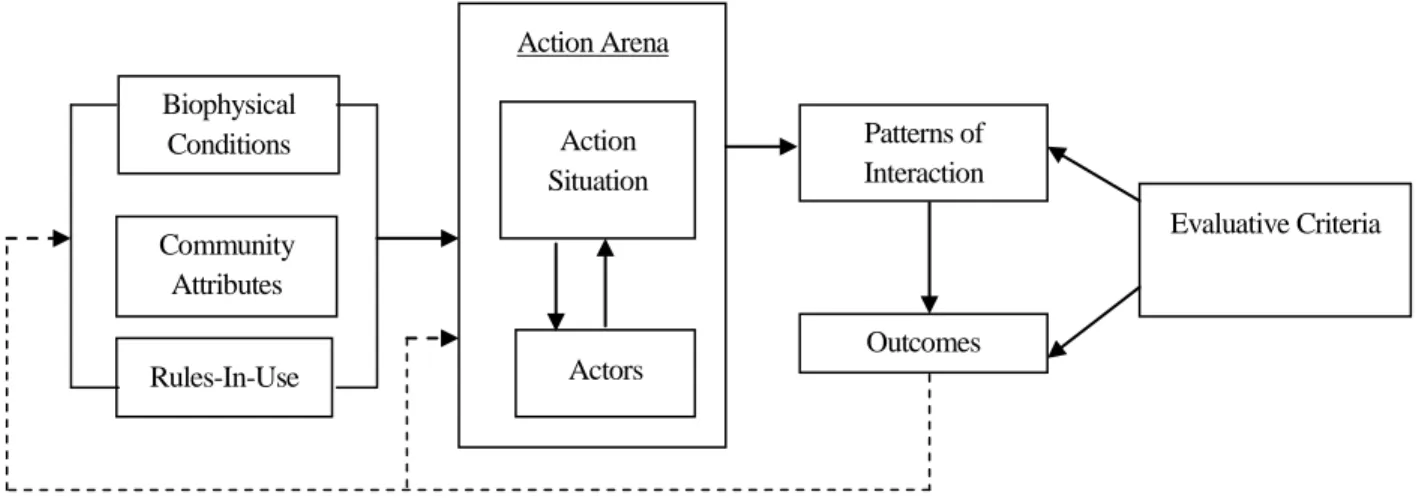
One of the most widely used institutional frameworks within „new institutionalism‟ is Ostrom‟s IAD framework (Figure 1). The IAD framework links research from different disciplines to analyze how institutions are formed and how they affect human behaviour (Hikkila and Isett 2004; Snell, Bell and Leahy 2010). The framework has been applied in a variety of situations to analyze common-pool resources, along with many other various policy and management issues (Polski and Ostrom 1999; Hikkila and Isett 2004; Rudd 2004). While Smajgl, Leitch and Lynam (2009) have applied the IAD framework to water and Indigenous peoples in Australia, to our knowledge it has not been applied in a Canadian First Nations context.
Figure 1: Institutional Analysis and Development (IAD) Framework
Source: Ostrom, 2005.
Institutional analysis following the IAD framework requires careful examination of the exogenous factors (biophysical conditions, community attributes, and rules-in-use) that are external to the decision makers and which influence the structure of the action arena, and in turn the patterns of interaction and outcomes (Imperial 1999). The action arena includes the action situation (a specific activity) and the actors (individuals and groups) who are involved in the situation (Polski and Ostrom 1999). After considering the exogenous factors, the behaviour of actors in the action arena will create patterns of interaction, and insights about outcomes will flow logically from the patterns of interaction (Polski and Ostrom 1999). Institutional analysis also involves the institutional analyst evaluating the patterns of interaction and the outcomes from these interactions (Polski and Ostrom 1999). Ostrom‟s (2005) evaluative criteria (i.e., economic efficiency, equity, accountability, and adaptability) have commonly
Biophysical Conditions
Community Attributes
Rules-In-Use
Action Arena
Patterns of Interaction
Outcomes
Evaluative Criteria Action
Situation
Leitch and Lynam‟s (2009) recent work on applying the IAD framework to water and Indigenous peoples in Australia, supplemental criteria of fostering public trust and gaining access to financial and technical resources were considered.
Research Methodology
A qualitative orientation is employed in this research. Qualitative research is conducted to explore and gain an understanding of a problem or issue (Creswell 2007). Although there are many traditions within qualitative research, this work is oriented towards a „grounded theory‟ approach to allow for themes to emerge from the data during analysis, capturing the essence of meaning or experience drawn from different situations (Bowen 2006).
A single-case study approach was employed to address the research objectives. Case studies are anchored in real-life situations and result in a rich accounting of a particular phenomenon (Merriam 2009). A case study approach offers insights and illuminates meanings, playing an important role in advancing a fields‟ knowledge base (Merriam 2009). Employing a single case study increases the depth of analysis and discussion on water institutions and their influence on water governance and management in a First Nations context.
There are several factors that facilitated the decision to choose Oneida as a case study. This research was part of a larger three year Social Sciences and Humanities Research Council (SSHRC), First Nations and Source Waters: Understanding Vulnerabilities and Building Capacity for Environmental Governance. The second factor was the strong interest specifically from Oneida to participate in the thesis research because exploring water institutions and how these institutions influence water governance and management in Oneida has not been previously investigated. The third factor was related to the current water issues impacting the physical and cultural uses of water in Oneida. The community currently faces drinking water supply challenges and has concerns with various land use activities impacting the community‟s health, traditional activities and way of life. Therefore, exploring Oneida as a single case study increases the depth of the analysis and discussion on water institutions and their influence on water governance and management in a First Nations context.
Qualitative research draws attention to the need for cultural sensitivity. In order to avoid the problems associated with conventional research, such as the lack of respect by researchers or inappropriate research methodologies (PRE 2008), Smith (1999) calls for the “decolonization” of methodologies, to develop a new approach that focuses on effective and ethical ways of undertaking research with indigenous peoples. In order to avoid the problems of reinforcing colonizing processes, research methodologies that respect First Nation cultural integrity and benefit or empower the community were employed throughout the research process (e.g., a participant-selected setting, allocating appropriate time for the interviews, participant involvement in data review and analysis). Prior to the field research, Oneida Chief and Council and the University of Waterloo, Office of Research Ethics granted approval for the study.
narrative on water institutions and to explore how they influence water governance and management. Eighteen key informant interviews were conducted with community representatives (e.g., on-reserve administrators, traditional council members). The Oneida Environmental Coordinator led the recruitment of potential participants at first and subsequently through snowball sampling to recruit additional informants. Personal observations were made to gain insight into the water institutions in Oneida and how these institutions are influencing water governance and management.
The generalizability of a single case study is a concern and to this end the work of Yin (1994) and Stake (1995) are instructive. Yin (1994) suggests the use of analytical generalization where external validity is achieved at a conceptual level. Stake (1995) suggests „naturalistic‟ generalization where the research resonates with the experience of readers and thus contributes to a more full understanding of the phenomena. In these ways the IAD framework used to analyze this particular case contributes to understanding issues in First Nations‟ communities across Canada.
Results
The results are structured according to the elements of the IAD framework (Figure 1). This section starts with a brief community profile of Oneida. In following the IAD framework, an overview of the exogenous factors is then provided. Results according to the action arena, patterns of interaction, outcomes of these interactions, and an evaluation of institutional performance are offered.
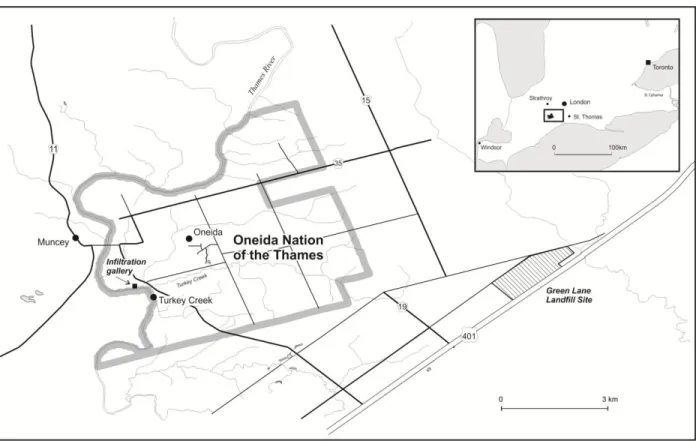
Figure 2: Case Study Region: Oneida Nation of the Thames
Community Profile
The Thames watershed area has been an important cultural heritage site for the past 11,000 years (Taylor et al. n.d.). First Nations people in the watershed use the Thames River (known as Askunessippi or “Antler River”) for hunting, fishing, shelter, and transportation (Taylor et al. n.d.). Oneida is located along the west of north banks of the Thames River southwest of London, Ontario (Figure 2) and encompasses 2,412 hectares of land (FNESL 2009). As of December 31, 2006, 2,023 members lived on the reserve and 3,174 members lived off the reserve (FNESL 2009). In Oneida, both forms of Councils (i.e., the Elected Council imposed through the Indian Act and the Traditional Council) exist, but the community is governed by the Elected Chief and up to twelve councillors (SWLHIN 2009). The Director of Operations and Divisional Administrators manage the day to day administrations (SWLHIN 2009). Clint Cornelius (2010b), past Elected Council member, estimated that approximately 40% of the community has maintained the traditional Haudenosaunee culture.
A. Exogenous Factors
In following the IAD framework, institutional analysis involves identifying exogenous factors which influence the action arena and in turn the patterns of interaction and outcomes. The biophysical/material conditions are described in terms of the hydrogeological features in the region and the water management infrastructure. The community attributes include the physical and cultural uses of water and addresses community awareness/knowledge about water governance and management. The section on rules-in-use describes the formal (e.g., regulations, laws, and programs) and informal (e.g., values, beliefs, and customs) water institutions that are used in the governing and management of water resources in Oneida. The following sub-sections provide a summary of the results for each of these components of the IAD framework (Figure 1).
Biophysical/Material Conditions
Oneida is situated on a gently rolling plain along the Thames River (FNESL 2009). There are several small natural tributaries with intermittent flows (Chief Abram 2010b) travelling through the community including Turkey Creek (FNESL 2009). Historically, there have been several sources of water in Oneida including wells, springs, creeks, and the Thames River. Before the construction of the community‟s waterline, the majority of residents obtained their water from either bored or dug shallow wells (R.J. Burnside and Associates Ltd. 1987). In the past, the Thames River was also used as a popular source of drinking water (Joanne Summers 2010a; Lois Cornelius 2010b). Ida Cornelius (2010b) remembers “my mom, when she was growing up…she can recall when that Thames River was clear, that you could see the bottom [and] you could swim in the river. You don‟t see that [anymore]”. Today, the water distribution system includes an infiltration gallery located in the Thames River floodplain, a water main network with several fire hydrants, an elevated water storage reservoir, and a Greensand filtration system (FNESL 2009).
Community Attributes
drinking, bathing, and watering gardens. In the community there are different sources of water for ceremonial and medicinal purposes including creeks, marshes, swamps, springs, and rainwater (Yotwaniyohste 2010b; Joanne Summers 2010b). For instance, Turkey Creek is an important source of water particularly for ceremonies and provides an environment for medicinal plants and traditional foods to grow (Clint Cornelius 2010b; Joanne 2010b). Through this research it was discovered that several of the participants interviewed were part of a small network of key individuals concerned with water issues. With personal and professional experiences this group of key individuals is aware and knowledgeable particularly about water governance practices in Oneida. In regards to community awareness/knowledge about water governance and management, it was suggested by Clint Cornelius (2010b) and Yotwaniyohste (2010b), a traditional knowledge holder, that only a small percentage of the community is aware of the water management decisions and practices. Although community members are aware there are administrative staff dealing with water (e.g., water treatment operators and a director of operations) (Chief Abram 2010b), Al Day (2010b), a Traditional Council member, suggests that the community has less knowledge about the chain of command and the formal rules in place for managing water.
Rules-In-Use
A rich understanding of the formal and informal institutions related to water governance and management was revealed. The Elected Council has developed several formal water institutions to guide the water treatment operators including a water levy policy, a water pressure policy, and an Emergency Response Plan. Without federal drinking water regulations to monitor water quality in Oneida, Clay Dockstader (2010b), a former water treatment operator, indicated that the Elected Council has taken the initiative to follow the Ontario Safe Drinking Water Act to guide water quality parameters with water quality monitoring conducted at both the water treatment plant and at the household level. While provinces are responsible for developing legislation and regulations (and accompanying management activities) for drinking water provision, these formal institutions do not apply on reserves (Simeone 2009). The Health and Human Services Department also operates under the same provincial regulations to ensure home distribution sampling meets the parameters within the guidelines. Community educational programs regarding water management are primarily delivered by the Health and Human Services Department.
B. Action Arena
Action Situation
Over the past century, human activities have drastically affected the water quality and aquatic habitat of the Thames watershed and its tributaries. Studies suggest the potential threats to water quality in the Thames River include agricultural chemical/fertilizer applications in the area, upstream wastewater treatment plant discharges, road salt and waterborne contaminants (Oakridge Environmental Ltd. 1998; FNESL 2009). Since the Thames River supplies water to the infiltration gallery, any contaminants present in the river have the potential to be captured by the infiltration gallery (Oakridge Environmental Ltd. 1998). This explains the pervasive community concern with environmental events and activities affecting the quality and supply of water. Participants identified several activities causing impacts to the surface water and subsequently the ground water in Oneida. These include the discharge of partially treated sewage into the river, agricultural practices within the floodplain, and the Green Lane landfill site.
Actors
Several actors outside and inside the community influence decision-making and management of water resources in Oneida. At the federal level, the Aboriginal Affairs and Northern Development Canada (AANDC) and Health Canada have different roles in influencing the governing and management of water resources in Oneida. Over the years the Elected Council has hired several consultants to conduct water studies and assessments including, R.J. Burnside Associates Ltd., Oakridge Environmental Ltd., and the Ontario Clean Water Agency. The City of London and the Upper Thames Regional Conservation Authority are other outside actors who influence decision-making and management of water resources in Oneida.
Several actors inside the community influence decision-making and management of water resources. The community is governed by an elected Chief and up to twelve councillors (SWLHIN 2009). The Elected Council includes theDepartments of Public Works and Health and Human Services. The day-to-day decisions are made administratively by the Director of Operations and department administrators (SWLHIN 2009). The Traditional Council, women, and community members, actors inside the community, influence water governance and management practices in Oneida.
C. Patterns of Interaction/Outcomes
In following the IAD framework (Figure 1), the next step in institutional analysis involves identifying the patterns of interaction and their outcome(s) (Polski and Ostrom 1999). The patterns of interaction describe the relationship between actors influencing water issues and decisions. The outcomes are the results of the interactions between participants in an action arena (Smajgl, Leitch and Lynam 2009). Given the purpose of this research, attention is concentrated on the patterns of interaction and outcomes related to water governance and management in Oneida.
The actors involved in informal water institutions are Elected Council and Provincial Government; Actors within Elected Council; Elected Council and Traditional Council; Elected Council and Women; and Elected Council and the community. Table 1 (in Appendix) summarizes the patterns of interaction and outcomes according to these two categories which emerged. General observations are also made regarding the issue of trust. Trust emerged from the analysis as being institutionalized in the community‟s thinking and behavior, which influences both water governance and management. Key findings when considering the patterns of interactions and outcomes include 1) the jurisdictional division of responsibilities influencing the management of water resources in the Thames watershed; 2) the deficiency in public trust between the community and Elected Council; and 3) the inequity in the involvement of Traditional Council and women in water governance and management.
D. Evaluation
During the evaluation process, the institutional analyst evaluates both the patterns of interaction and the outcomes from these interactions (Polski and Ostrom 1999). Ostrom (1999, p.49) explains that: “the institutional analyst may evaluate the outcomes that are being achieved as well as the likely set of outcomes that could be achieved under alternative institutional arrangements”. Imperial (1999, p.456) adds that the overall intent of this evaluation is to “examine the overall performance of an institutional arrangement to better understand its strengths and weaknesses.”
Through the evaluation process Ostrom‟s (2005) criteria (i.e., accountability, economic efficiency, equity, adaptability, and conformance to general morality) were used to analyze the relationships and outcomes. Supplemental criteria of fostering public trust and gaining access to financial and technical resources also considered as per recent work specifically applying the IAD framework to water and Indigenous peoples in Australia (Smajgl, Leitch and Lynam 2009). Table 2 (in appendix) presents the results of the evaluation according to each criterion. An overall performance of the institutional arrangement for each criterion is included in the table, on a scale from low to high. The ranking was guided by results revealed through the analysis process and the literature on the specific criterion. Key findings include 1) multiple actors involved in water governance and management are amplifying issues of accountability and transparency in the community; 2) maintaining formal institutions have strengthened the capacity of technical staff to deal with water related issues; and 3) the Elected Council‟s access to financial and technical resources has strengthened the institutions for water governance and management.
Discussion
This research broadly explores institutions associated with water in a First Nations context and seeks to understand how they influence water governance and management. Oneida Nation of the Thames was the specific case investigated. This section highlights key findings from the study and discusses them in relation to the literature.
The Importance of Formal and Informal Institutions
several formal water institutions to guide the water treatment operators including a water levy policy and a water pressure policy. Both the Public Works and Health and Human Services Departments are currently following the Ontario Safe Drinking Water Standards to ensure adequate drinking water is provided to the community. The informal institutions have been created and upheld either through practical implementation or through historical values, beliefs, and cultural norms. For instance, through practical implementation, the water treatment operators have informally decided to follow the provincial regulations to ensure the distribution of safe drinking water.Beliefs and values to protect the health of the water and the members of the community are also part of the Elected Council‟s decision-making process.
Wilson (2004) explains how various formal water policies, strategies, and management frameworks have been developed to shape or influence actors involved in governing and managing water resources. Formal water institutions have many roles and can ensure drinking water quality standards are maintained, identify who is responsible for surface and groundwater management, and set pollution regulations (Corkal, Inch and Adkins 2007). In a First Nations context, there currently is no federal legislation governing the requirements of safe drinking water on reserves. This means neither the Federal government nor First Nations are legally empowered to ensure that First Nations‟ communities are adequately managing water resources. Even though federal drinking water regulations do not exist, there is an informal system in place for managing water resources. Oneida water treatment operators are informally following the provincial regulations to ensure adequate drinking water is provided to the community. However, there are no regulations to enforce water conservation advisories or programs to curtail unregulated agricultural practices in Oneida.
As Diaz et al. (2006) states, informal rules define people‟s behaviour related to water resources and are common at the community or household level. The research in Oneida demonstrates that at the individual level there are informal institutions as part of everyday life to conserve water and to prevent contamination of the community‟s water resources. In Oneida, informal institutions are preserved in oral traditions shared through stories and ceremonies and passed down from generation to generation. From time immemorial, First Nations have viewed water as sacred, intricately tied to the land and its water (Harden and Levalliant 2008). Through this research, a rich understanding of the informal water institutions in Oneida was discovered, confirming with the literature the deep connection First Nations‟ communities have with the land and its water.
The Influences of Institutions on Water Governance and Management
In following the IAD framework, there are several key findings on the relationship between actors in institutions and how they are influencing water governance and management in Oneida.
positively influenced water governance and management but there are still deficiencies in certain enforcement regulations.
Effective governance is a requirement to solving serious water challenges confronting societies globally (de Loë et al. 2009). Key principles for effective water governance include communication among actors; transparency; accountability; equitability; and a view towards long-term sustainability (Rogers and Hall 2003). Several of the evaluative criteria applied to analyze institutional arrangements and outcomes also match these key principles for effective water governance. In regards to water governance and management in Oneida, it is clear from the evaluation that important issues exist in terms of the communication among actors, accountability, transparency, and equitability. Water governance requires various actors, i.e., government, civil society, private sector, to work together to determine the roles and responsibilities of different interests in water management and development (Roger and Hall 2003). However, in Oneida the jurisdictional division of responsibilities to manage water resources in the Thames River has resulted in insufficient communication between the Elected Council and various actors, influencing the community‟s water governance and management practices. Sanderson (2008) also stresses the importance of involving Indigenous Peoples who are knowledgeable about traditional values, as it would contribute to developing strategies such as reforming water institutions that do not currently recognize the sacred importance of water. However, it was discovered that the Oneida Traditional Council and the women who are knowledgeable about the informal institutions are not involved in the decision-making, limiting the incorporation for these institutions in water governance.
An effective governance system should enable practical water management tools to be implemented correctly (WWAP 2003). Hearne (2007, p.842) explains how “managing water resources, requires institutions capable of monitoring and enforcing land-use practices which maintain water quality.” In a First Nations context, communities are dealing with core drinking water issues including the absence of a regulatory framework, a lack of funds for the operation and maintenance, and unclear roles and responsibilities in water management (Simeone 2009). In Oneida, there is a mismatch between the current formal institutions and the biophysical conditions influencing water management in Oneida. The multiple actors involved in managing water resources and the lack of communication between the actors has impacted the Oneida water treatment operator‟s ability to respond to watershed activities in a timely manner and ensure safe drinking water is provided to the community. The institutional framework for managing water resources in Oneida is not sufficiently robust to monitor and maintain water quality in the community. Water managers are informally following the provincial drinking water regulations because federal regulations do not exist and there are deficiencies in the regulations to enforce water conservation and land use practices. This system is not enabling water managers to implement the proper procedures to ensure adequate drinking water is supplied to its members. Consequently, the Elected Council depends on the Indian Act (1985) to guide what the Council may or may not do in regards to the local distribution of water in the community.
water governance and management in Oneida. Wilson (2004) observes that First Nations continue to struggle for the recognition of their rights in an effort to protect their territories and continue the use of traditional water management laws. The provincial government primarily regulates water off reserve but Aboriginal rights cross jurisdictional boundaries (Nowlan 2004), illuminating the importance of understanding where First Nations needs and rights fit among the demands for water (Phare 2009). For example, Aboriginal rights and treaty rights were identified in the literature as a factor that shapes institutional performance relating to water in First Nations‟ communities. While there is an understanding of what these rights are in Oneida (e.g., inherent rights and basic human rights related to water) further research is required on how these rights influence the effectiveness of institutions related to water governance and management in Oneida and in a broader First Nations‟ context.
Conclusion
Safe drinking water is important to all people. However, safe drinking water conditions do not exist in many First Nations‟ (Harden and Levalliant 2008). This research employed the IAD framework to understand water institutions and how they are influencing decision-making and management of water resource in Oneida Nation of the Thames. This research has a number of scholarly and practical contributions to understanding water institutions and the influences on water governance and management.
This research enriches knowledge on water institutions and the influences on water governance and management in a First Nations context. The cultural importance of water to First Nations people is frequently discussed in the literature (Lavalley 2006; McGregor 2009). The focus on informal institutions in Oneida provided a rich narrative on the First Nations cultural norms and values related to water, contributing to this field of knowledge. Fragmented jurisdictions over First Nations reserves (Wilson 2004; Simeone 2009) contributing to water management issues is also frequently discussed. This research confirms the persistent jurisdictional issues influencing water governance and management in First Nations‟ and contributes specifically to understanding the challenges First Nations‟ face within multi-jurisdictional watersheds. Understanding water challenges in First Nations‟ communities is an important step to their resolution and in this regard the descriptive and analytical insights enhance knowledge about water institutions and the manner they are influencing decision-making and management.
criteria and supplemental criteria in a First Nations context to evaluate the overall institutional performance.
The applied contributions from this research have context specific and broader relevance.
Specifically for Oneida, this research illuminates three main messages. First, it provides a description of water institutions in the community. The description is useful because it highlights the water polices and educational tools water and health managers are employing to provide safe drinking water as well as voids in terms of policies and regulations. Understanding informal institutions could influence and guide how the Elected Council decides to move forward in strengthening institutional arrangements and enhancing water governance and management practices in Oneida. Second, this research provides insight on the relationships between the actors involved in water governance and management and the outcomes of these interactions. These insights are valuable to Elected Council in moving towards developing new water strategies to address their current drinking water conditions. Third, it offers an opportunity to consider institutional performance. Through the evaluation process areas requiring attention in the community are identified.
Water managers, policymakers and practitioners can benefit from this research because it offers an „on-the-ground‟ view of formal and informal water institutions and how they are influencing existing water management strategies in First Nations‟ communities. Such a perspective gives evidence to how communities can deal with source water protection issues and enhance water governance. It is also imperative to understand the cultural connection and uses of water, jurisdictional issues, and the value in building relationships between First Nations and outside actors in order to enhance adaptability and reduce the risks to drinking water.
Appendices
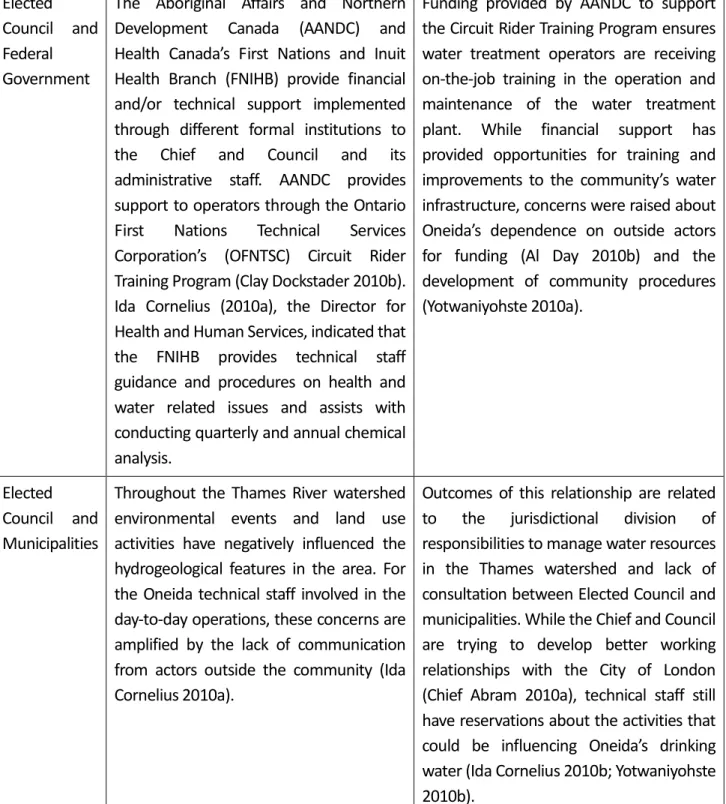
Table 1: Summary of the Patterns of Interaction and Outcomes
Actors Patterns of Interaction Outcome
Relationships between Actors involved in Formal Institutions
Elected Council and Federal Government
The Aboriginal Affairs and Northern Development Canada (AANDC) and Health Canada’s First Nations and Inuit Health Branch (FNIHB) provide financial and/or technical support implemented through different formal institutions to the Chief and Council and its administrative staff. AANDC provides support to operators through the Ontario First Nations Technical Services Corporation’s (OFNTSC) Circuit Rider Training Program (Clay Dockstader 2010b). Ida Cornelius (2010a), the Director for Health and Human Services, indicated that the FNIHB provides technical staff guidance and procedures on health and water related issues and assists with conducting quarterly and annual chemical analysis.
Funding provided by AANDC to support the Circuit Rider Training Program ensures water treatment operators are receiving on-the-job training in the operation and maintenance of the water treatment plant. While financial support has provided opportunities for training and improvements to the community’s water infrastructure, concerns were raised about Oneida’s dependence on outside actors for funding (Al Day 2010b) and the development of community procedures (Yotwaniyohste 2010a).
Elected Council and Municipalities
Throughout the Thames River watershed environmental events and land use activities have negatively influenced the hydrogeological features in the area. For the Oneida technical staff involved in the day-to-day operations, these concerns are amplified by the lack of communication from actors outside the community (Ida Cornelius 2010a).
Elected Council and Conservation Authorities
As a result of the Clean Water Act (2006) both the Upper and Lower Thames Conservation Authorities are part of the Thames-Sydenham Region Source Protection Region and partners on a Committee to coordinate the development of a Source Water Protection Plan for their watershed (Ministry of the Environment 2011). Involvement in the committee provides the opportunity for Oneida community representatives to learn about what is happening in the Thames watershed including future plans for the City of London (Ida Cornelius 2010b).
Yotwaniyohste (2010b) expressed concern that through the source water protection process Oneida is not really involved in any of the decisions of the Thames-Sydenham Region Source Protection Committee. Despite concerns regarding representation on the Committee, Chief Abram (2010a) believes that overall Oneida has a positive working relationship with the Lower and Upper Thames Conservation Authorities outside of the source water protection process. However, Chief Abram (2010a) expressed concern that unsecure funding will affect the success of outcomes from the committee meetings.
Actors within Elected Council
The Chief and Council have developed water policies that have positively influenced water governance and management. The Public Works Department is responsible for the daily maintenance and operation of the water treatment plant, which includes conducting daily and weekly water quality tests (Clay Dockstader 2010a). The Public Works Department has focused on providing educational opportunities for Oneida members to learn about where their drinking water comes from and how it is treated (e.g., the plant tour) (Clay Dockstader 2010b). The Health Department conducts household water quality monitoring and educates Oneida members on water related issues. Ida Cornelius (2010b) also indicated that the Health and Human Services Department has organized health fairs in the community, providing the opportunity for
the Environmental Health Officer (EHO) to demonstrate how the water is being treated.
ongoing educational activities in the community, there is limited knowledge about how Elected Council is promoting safe drinking water and what activities/programs are in place to manage water resources (Clint Cornelius 2010b; Al Day 2010b).
Relationships between Actors Involved in Informal Institutions
Elected Council and Provincial Government
Even without federal drinking water regulations, water treatment operators in Oneida have informally decided to follow the guidelines and regulations set out in the Ontario Safe Drinking Water Act to guide water quality parameters (Clay Dockstader 2010b; Ida Cornelius 2010b).
Even though the Federal government is in the process of developing new water legislation for First Nations’ communities, Chief Abram (2010a) expressed that when the new legislation is developed his community will implement whichever policy has stronger water management guidelines. Yotwaniyohste (2010b) suggested that outcomes from the new legislation could include transparency and accountability to the community by clearly identifying and formalizing what the roles and responsibilities will be concerning water management in Oneida.
Actors within Elected Council
The Elected Council has also been involved in the practical implementation of informal institutions influencing water governance and management. For instance, when the new water treatment plant was first commissioned the Elected Council administration held an open house in the community with a small traditional ceremony (Clay Dockstader 2010b). Informal institutions have also been created through the historical values and beliefs passed on from generation to generation.
Ida Cornelius (2010b) explained that water is significant to all forms of life and since it is viewed in a holistic way it is rooted in how members of the Elected Council are managing water resources. Chief Abram (2010b) explained how the theory that everything is interconnected would be embedded in the decision-making and management of water resources.
Council and Traditional Council
established there has been a division in the relationship between the Traditional and Elected Councils (Clay Dockstader 2010b; Yotwaniyohste 2010b) and this division has impacted how informal institutions have influenced water governance and management in Oneida. Lo:t^t (2010), a Traditional Council member, explained that there is an understanding the Traditional Council have title to the land and ultimately the right to make community decisions about the resources. Al Day (2010a) indicated that the beliefs and values around water go back to the original instructions.
Traditional Council is not currently involved in the decision-making process so any traditional values or beliefs (e.g., the “original instructions”) used to govern or manage water resources are not being incorporated into current practices. This division between Councils has prevented the informal institutions related to water from influencing water governance and management. Clint Cornelius (2010a) explained the importance of the two Councils sharing information to bring awareness and knowledge on water governance and management to their constituents. Al Day (2010a) believes that in order to bring the two councils together, the General Council meetings need to be re-established, where both councils and members can attend to discuss community business.
Elected Council and Women
Joanne Summers (2010b), a traditional knowledge holder, indicated that there has been a lack of involvement from women, the traditional decision-makers and knowledge holders of water beliefs and customs, in the governance and management of water resources in Oneida. Since Oneida is a matriarchal society, the women as Clan Mothers and title holders of the land have historically been the leaders in the community and would traditionally look after the water (Joanne Summers 2010b).
The current Elected Council system is preventing the Clan Mothers from fulfilling their role (Joanne Summers 2010b). There has been discussion in the community about the development of an informal women’s group to work together again in protecting the sources of water in Oneida (Joanne Summers 2010b).
Elected Council and the
community
In Oneida, there is an intrinsic connection or value between the water and the Oneida people (Ida Cornelius 2010a). The intrinsic values to protect and conserve
water resources (Clint Cornelius 2010b) is also linked to the belief there is self regulation at the individual level to conserve water and to prevent contamination of the community’s water resources (Lois Cornelius 2010a).
good way and it is not being done to the community’s benefit (Yotwaniyohste 2010b).
Issue of Trust Influencing the Effectiveness of Institutions
Table 2: Summary of Evaluation
Criteria Evaluation
Accountability and
Transparency
The several outside actors involved in water governance and management amplifying issues of accountability and transparency in the community (Yotwaniyohste 2010b). Chief Abram (2010b) supports these concerns in explaining that the Elected Council can make a lot of decisions in the community but those decisions are dependent on funding agencies such as AANDC. There is a medium degree of accountability and transparency between the Chief and Council and the community. In Yotwaniyohste’s (2010b) experience as the previous Public Works Administrator, it is unclear to community members who are responsible for making decisions and how decisions are being made. However, the Health Department has strengthened water management practices in the community by developing several educational initiatives that have been effective in maintaining transparency between the administrative staff and community members about water related issues. In addition to the educational materials, the Public Works Committee has recently been re-instated and will provide the opportunity for community input (Clay Dockstader 2010b) while increasing accountability and transparency about water governance and management practices. Overall, the performance of institutional arrangements on the accountability and transparency criteria is low to moderate.
Efficiency and Effectiveness
The establishment of a levy to charge all members on the water distribution line has been internally cost-effective and efficient for the Elected Council. At a basic
understanding, the Indian Act has been effective in providing Elected Council with the
funds to generate the administration, including the power to develop bylaws and hir consultants to undertake water studies. The OFNSC Circuit Rider Training Program, the operational manuals prepared by First Nations Engineering Services Ltd., and Oneida’s Emergency Response Plan are effective water management institutions. While existing policies have been effective in accomplishing its intent to guide the Elected Council and technical staff in governing and managing water resources, the community still has concerns about their drinking water. Therefore, the efficiency and effectiveness of institutional arrangements is concerned moderate to high.
Equity While Elected Council’s development of formal institutions have been fairly strong in
traditionally had in taking care of water resources in the community. Their lack of involvement has resulted in the exclusion and influence of informal institutions in
Oneida. Overall, there is a low level of equity in the institutional arrangements
employed to govern and manage water resources in Oneida.
Adaptability One of the strengths of the institutional arrangements in Oneida is the ability of water
treatment operators to maintain performance even under unpredictable circumstances, for example, sewage discharges into the Thames River. Maintaining formal institutions such as the Emergency Response Plan and programs to install water filters in community homes have strengthened the capacity of technical staff to deal with water related issues. Currently, there is not a match or fit between the existing formal institutions and the biophysical conditions influencing water management in Oneida and this is a major challenge because of two important issues. Firstly, with multiple actors managing water resources in the Thames watershed, unclear jurisdictional boundaries have influenced the biophysical and material conditions in Oneida and have created a lack of consultation between Oneida and provincial actors who are influencing the community’s source of drinking water. Secondly, the lack of federal regulations has affected the fit between formal institutions and the biophysical conditions influencing water management in Oneida. Yotwaniyohste (2010b) has indicated that federal regulations would set out clear roles and responsibilities for drinking water in First Nation’s communities. Overall in Oneida there is a moderate level of adaptability with the implementation of Elected Council policies, employing provincial drinking water regulations, and increasing relations with the surrounding municipalities.
Conformance
to General
Morality
A reoccurring theme throughout the evaluation process is the inherent beliefs and values to protect the health of the waters and the community in Oneida. These beliefs and values strengthen institutional performance because they are an inherent part of the measures the Elected Council is taking in water management practices. Despite the positive contributions of these beliefs and values, persistent challenges are confronting their continuation and uptake. As water sources are being affected the community is losing the ability to maintain traditional activities and the opportunities to pass on the cultural norms and values related to water. The division between the two Councils and the lack of involvement of women has weakened institutions for water governance and management because traditions and beliefs related to water are somewhat
disconnected from water governance and management. Overall the low degree of
conformance to general morality is weakening the institutional arrangements employed to govern and manage water resources.
Fostering Public Trust
body. Chief Abram (2010b) believes it started with the development of the Elected Council in 1934. The departments of Public Works and Health and Human Services have implemented several water programs and initiatives to increase the degree of transparency and accountability between technical staff and community members. Yet, there is still an issue of public trust because the water treatment plant is operated by Elected Council. As Clint Cornelius (2010b) suggest, the community needs more information to reduce the resistance with Chief and Council’s decisions. In recognizing the entrenched and longstanding nature of mistrust as well as the present concerns
expressed by interviewees, the low level of trust between community actors has
weakened the formal institutional arrangements guiding the Elected Council.
Access to
Financial and Technical Resources
References
Alred, G.T. 2009. Colonialism and State Dependency. Journal of Aboriginal Health 5(2): 48-60. Bell, S. 2002. Institutionalism: Old and New, Chapter in Government, Politics, Power and Policy
in Australia 7th Edition. Eds. John Summers, 363-380, NSW Australia: Pearson Education Australia.
Bowen, G. A. 2006. Grounded Theory and Sensitizing Concepts. International Journal of Qualitative Methods 5(3):1-9.
Chiefs of Ontario (COO). 2006. Safe Drinking water for First Nations: Written Submission. Retrieved from http://www.sdw-eps.gc.ca/inlv/on_smb_8/index_e.asp
COO. 2008. Water Declaration of the First Nations in Ontario. Retrieved from http://chiefs-of-ontario.org/Assets/COO%20long%20form%20declaration.pdf
Corkal, D. R., Inch, B. and Adkins, P. E. 2007. The Case of Canada – Institutions and Water in the South Saskatchewan River Basin: Prepared for the Social Sciences and Humanities Research Council. Retrieved from http://www.parc.ca/mcri/iacc045.php
Creswell, J. W. 2007. Qualitative Inquiry and Research Design Choosing Among Five Approaches Second Edition. Thousand, CA: Sage Publications Inc.
de Loë, R., Armitage, D., Plummer, R., Davidson, S. and Moraru, L. 2009. From Government to Governance: A State-of-the-Art Review of Environmental Governance. Final Report. Prepared for Alberta Environment, Environmental Stewardship, Environmental Relations. Guelph, ON: Rob de Loë Consulting Services.
Denzin, N. K.. and Lincoln, Y. S. 2008. Critical Methodologies and Indigenous Inquiry, Chapter in
The Handbook of Critical and Indigenous Methodologies. Eds. N. K. Denzin, Y. S. Lincoln
and L. T. Smith, 1-30, Thousand Oaks, CA: Sage Publications Inc.
Diaz, H., Rojas, A., Richer, L. and Jeannes, S. 2006. Institutions and Adaptive Capacity to Climate Change - Draft. Prepared for the Institutional Adaptations to Climate Change Project (IACC). Retrieved from http://www.parc.ca/mcri/pdfs/Diazetal(05).pdf
Eggertson, L. 2008. Despite federal promises, First Nations‟ water problems persist. Canadian Medical Association Journal 178(8): 985.
First Nations Engineering Services Ltd (FNESL). 2009. Oneida Nation of the Thames, Engineer’s Assessment for the Water Treatment Facility – Draft Final Report. Ohsweken, Ontario: FNESL.
Foerster, R. 2002. The Walkerton Inquiry Commissioned Paper 2: Constitutional Jurisdiction over the Safety of Drinking Water. Toronto, Ontario: Ontario Ministry of Attorney General.
Hall, P. A. and Taylor, R. 1996. Political Science and Three New Institutionalism. Koln, Germany: Max-planck-Institut fur Gesellschaftsforschung.
Haudenosaunee Environmental Task Force. N.D. The Words That Come Before All Else: Environmental Philosophies on the Haudenosaunee. Cornwall, ON: Native North American Travelling College.
Hearne, R. A. 2007. Evolving Water Management Institutions in the Red River Basin. Environmental Management 40: 842-852.
Hikkila, T. and Isett, K. R. 2004. Modeling Operational Decision Making in Public Organizations: An Integration of Two Institutional Theories. The American Review of Public Administration 34(3): 3-19.
Imperial, M. T. 1999. Institutional Analysis and Ecosystem-Based Management: The Institutional Analysis and Development Framework. Environmental Management 24(4): 449-465.
Imperial, M. T. and Yandle, T. 2005. Taking Institutions Seriously: Using the IAD Framework to Analyze Fisheries Policy. Society and Natural Resources 18: 493-509.
Interagency Advisory Panel on Research Ethics (PRE). 2008. Section 6: Research Involving Aboriginal Peoples. Ottawa, Ontario: PRE.
Lavalley, G. 2006. Aboriginal Traditional Knowledge and Source Water Protection: First Nations’ Views on Taking Care of Water. Prepared for the Chiefs of Ontario and Environment Canada.
Leach, M., Mearns, R., and Scoones, I. 1999. Environmental Entitlements: Dynamics and Institutions in Community-Based Natural Resource Management. World Development 27(2): 225-247.
Leftwich, A. 2006. IPPG Briefing Paper No. One: What are Institutions? Prepared for the DFID-funded Research Programme, Institutions and Pro-Poor Growth (IPPG).
Marsalek, J. 1990. Integrated Water Management in Urban Areas. Prepared for the Duisberg
Symposium, IAHS publication no. 198. Retrieved from
http://iahs.info/redbooks/a198/iahs_198_0315.pdf
Mascarenhas, M. 2007. Where the Waters Divide: First Nations, Tainted water and Environmental Justice in Canada. Local Environment 12(6): 565-577.
Merriam, S. B. 2009. Qualitative Research: A Guide to Design and Implementation. San Francisco, CA: Jossey-Bass.
McGinnis, M. D. 2011. An Introduction to IAD and the Language of the Ostrom Workshop: A Simple Guide to a Complex Framework. Policy Studies Journal 39(1): 163-177.
McGregor, D. 2009. Honouring Our Relations: An Anishnaabe Perspective on Environmental Justice, Chapter in Speaking for Ourselves: Environmental Justice in Canada. Authors, Julian Agyeman, Peter Cole, Randolph Haluza-DeLay, and Pat O'Riley, 28-41, Vancouver, BC: University of British Columbia Press.
Ministry of the Environment (MOE). 2006. Clean Water Act. Available at http://www.e-laws.gov.on.ca/html/statutes/english/elaws_statutes_06c22_e.htm.
Nee, V. 1998. Sources of the New Institutionalism, Chapter in The New Institutionalism in Sociology. Eds. M. C. Brinton and V. Nee, 1-16, New York, New York: Russell Sage Foundation.
Neegan Burnside Ltd. 2011. National Assessment of First Nations Water and Wastewater Systems. Prepared for AANDC. Retrieved from http://www.ainc-inac.gc.ca/enr/wtr/nawws/rurnat/rurnat-eng.asp
Nkonya, L. K. 2008. Rural Water Management in Africa: the Impact of Customary Institutions in Tanzania. Amherst, NY: Cambria Press.
Nowlan, L. 2004. Customary Water Laws and Practices in Canada. Rome, Italy: Food and Agricultural Organization of the United Nations. Retrieved from http://www.fao.org/legal/advserv/FAOIUCNcs/Canada.pdf
O‟Connor, D.R. 2002. Report of the Walkerton Inquiry: Part Two, A Strategy for Safe Drinking water. Toronto, Ontario: Ontario Ministry of the Attorney General.
Ostrom, E. 2005. Understanding Institutional Diversity. Princeton, New Jersey: Princeton University Press.
Pagan, P. 2009. Laws, Customs and Rules: Identifying the Characteristics of Successful Water Institutions, Chapter in Reforming Institutions in Water Resource Management. Eds. Lin Crase and Vasant P. Gandhi, 20-44, London, UK: Earthscan.
Phare, M.S. 2009. Denying the Source the Crisis of First Nations Water Rights. Surrey, BC: Rocky Mountain Books.
Plummer, R. and Armitage, D. 2007. A resilience-based framework for evaluating adaptive co-management: Linking ecology, economics and society in a complex world. Ecological Economics 61: 62-74.
Pollution Probe. 2004. The Source Water Protection Primer. Toronto, Ontario: Pollution Probe. Polski, M. M. and Ostrom, E. 1999. An Institutional Framework for Policy Analysis and Change.
Retrieved from https://mason.gmu.edu/~mpolski/documents/PolskiOstromIAD.pdf
Rogers, P. and Hall, A. W. 2003. Effective Water Governance TEC Background Papers No. 7. Stockholm, Sweden: Global Water Partnership.
Rudd, M. A. 2004. An institutional framework for designing and monitoring ecosystem-based fisheries management policy experiments. Ecological Economics 48: 109-124.
Sanderson, Cheryl Darlene. 2008. Nipiy Wasekimew/Clear Water: The Meaning of Water, from the Words of the Elders: The Interconnections of Health, Education, Law and the Environment. Doctoral dissertation, Simon Fraser University, Burnaby, British Columbia. Scott, W.R. 2008. Institutions and Organizations: Ideas and Interests. London, UK: Sage
Publications Ltd.
Simeone, T. 2010. Safe Drinking Water in First Nations Communities (Revised). Ottawa, Ontario: Parliamentary Information and Research Service.
Simeone, T., and Troniak, S. 2012. Bill S-8: The Safe Drinking Water Act for First Nations Act. Ottawa, Ontario: Parliamentary Information and Research Service.
Australia’s outback. DKCRC Report 31. Alice Springs, Australia: Desert Knowledge Cooperative Research Centre.
Smith, L. T. 1999. Decolonizing Methodologies: Research and Indigenous Peoples. New York, NY: Palgrave.
Snell, M., Bell, K.P., and Leahy, J. 2010. Local Institutions and Natural Resource Management. Prepared for Agricultural and Applied Economics Association 2010 Joint Annual Meeting. Orono, Maine: University of Maine.
South West Local Health Integration Network (SWLHIN). 2009. Report on the Proceedings of the Aboriginal Meeting: Appendix J Aboriginal Population Profile. Retrieved from http://www.southwestlhin.on.ca/uploadedFiles/Public_Community/Integrated_Health_Servic e_Plan/2009_IHSP/Appendix%20J%20-%20Aboriginal%20Profile%20FINAL.pdf
Stake, R. E. 1995. The Art of Case Study Research. Thousand Oaks, CA: Sage.
Taylor, I., Cudmore, B., MacKinnon., C., Madzia, S., and Hohn, S. n.d. The Thames River
Watershed Synthesis Report. Retrieved from
http://www.thamesriver.on.ca/species_at_risk/synthesis_report/Thames_River_Synthesis_rep ort.pdf
Vatn, A. 2005. Institutions and the Environment. Northampton, Massachusetts: Edward Elgar Publishing Inc.
Water Canada. 2012. Senate Passes Bill S-8. Retrieved from http://watercanada.net/2012/senate-passes-bill-s-8/
Wilson, P. 2004. First Nations Integrated Watershed Management, Chapter in Canadian Perspective on Integrated Water Resource Management. Ed. Dan Shrubsole, 69-83, Cambridge, ON: Canadian Water Resources Association.
Wilson-Raybould, J. and Raybould, Dr. T. 2011. BCAFN Governance Toolkit: A Guide to Nation Building. West Vancouver, British Columbia: British Columbia Assembly of First Nations.
World Water Assessment Programme (WWAP). 2003. The 1st UN World Water Development Report Water for People, Water for Life: Chapter 15 Governing Water Wisely for Sustainable Development. Colombella, Italy: UNESCO.
Yin, R. K. 1994. Case Study Research: Design and Methods (3rd ed). Thousand Oaks, CA: Sage. Young, O. R. 1999. Institutional Dimensions of Global Environmental Change: IHDP Report
No. 9. Bonn, Germany: International Human Dimensions Programme on Environmental Change. Retrieved from http://www.ihdp.uni-bonn.de/html/publications/reports/report09/ Young, O. R. 2002. The Institutional Dimensions of Environmental Change. London, England: