Work Function Algorithm with
a Moving Window for Solving
the On-line
k
-server Problem
Alfonzo Baumgartner
1, Robert Manger
2and
Zeljko Hocenski
ˇ
11Faculty of Electrical Engineering, University of Osijek, Osijek, Croatia 2Department of Mathematics, University of Zagreb, Zagreb, Croatia
We consider a modification of the well known work function algorithm (WFA) for solving the on-line k -server problem. Our modified WFA is based on a moving window, i. e. on the approximate work function that takes into account only a fixed number of most recent on-line requests. The main motivation for using a moving window is to gain control over the prohibitive computational complexity imposed by the original al-gorithm. Experimental results are presented, where the performance of the modified WFA has been compared vs. the original WFA.
Keywords: on-line problems, on-line algorithms, k -server problem, work function algorithm(WFA), moving windows, experiments
1. Introduction
In this paper we deal with on-line problems, and correspondingon-line algorithms[4]. In an on-line problem, input data is supplied incre-mentally, and output is expected to be produced in the same fashion. A typical on-line algo-rithm works in steps: in thei-th step it receives a request (unit of input) ri, and makes a
de-cision (unit of output) di that determines how
ri should be served. Each di produces a cost
ci ≥0. Decision making is based only on some of the previously seen requestsr1,r2,. . .,ri−1,
ri, thus without any knowledge about the future requests ri+1, ri+2, . . .. The objective of the
algorithm is not only to serve requests, but also toreduce the total costici.
An on-line algorithm ALG can be viewed as an approximation algorithm of a certain sort.
Namely, ALG attempts to approximate the per-formance of the corresponding optimal off-line algorithm OPT, which knows the whole input in advance and deals with requests as they arrive at minimum total cost. Vaguely speaking, ALG is said to be competitiveif there exists a theo-retical evidence that its performance is “close" to that of OPT on each input. More precisely
[8], let σ = (r1,r2, . . . ,rn) be a sequence of requests. Denote withCALG(σ)the total cost incurred by ALG onσ, and withCOPT(σ)the minimum total cost onσ. For a chosen constant
p, we say that ALG isp-competitive if there ex-ists another constant q such that on everyσ it holds: CALG(σ)≤p·COPT(σ) +q.
In this paper we concentrate on one particu-lar on-line problem called thek-server problem
[6], which is important because many other on-line problems can be interpreted as its special cases. There are various algorithms for solv-ing thek-server problem found in literature, but most of them are known to be non-competitive. The only competitive algorithm is the so-called
number of most recent requests. We expect that with such modification the computational com-plexity of the algorithm will decrease, while, at the same time, the performance in terms of the incurred total cost will not degrade too much.
The paper is organized as follows. Section 2 gives preliminaries about thek-server problem and the corresponding algorithms. Section 3 de-scribes how the modified WFA differs from the original WFA and how it can be implemented. Section 4 reports on experiments, where the per-formance of the modified WFA has been mea-sured in comparison with the original WFA and some other algorithms. Section 5 offers a con-clusion.
2. Thek-server Problem
In the k-server problem [6] we have to decide howk mobile servers will serve a sequence of requests. More precisely, we have k servers each of which occupies a location (point)in a fixed metric space M consisting of altogether
m locations. Repeatedly, a request ri at some
location x ∈ M appears. Each request must
be served before the next request appears. To serve the request atx, the algorithm must move a server to x unless it already has a server at that location. Whenever the algorithm moves a server from location ato locationb, it incurs a cost equal to the distance betweenaandbin
M. The goal is to minimize the total distance moved by all servers.
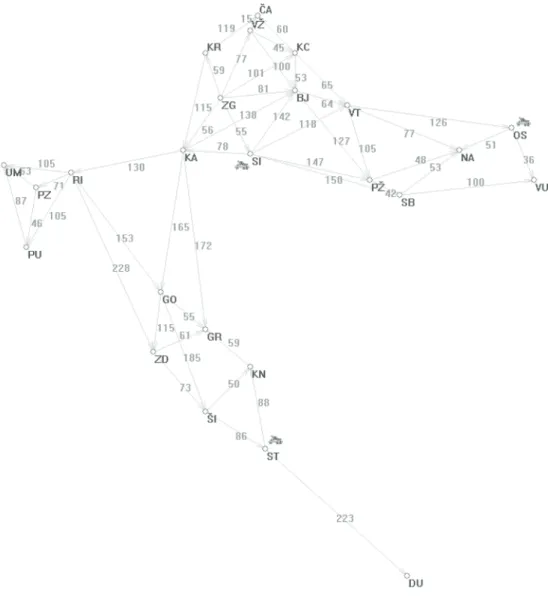
As an example of the k-server problem, let us consider the setM of Croatian cities shown in Figure 1 with road lengths given. The dis-tance between any two cities is determined as the length of the shortest route over the avail-able roads. Suppose thatk = 3 different hail-defending rocket systems are initially located at OS, SI and ST. If the next hail alarm appears for instance in KA, then the hail-defending on-line algorithm has to decide which of the three rocket systems should be moved to KA. Seem-ingly the cheapest solution would be to move the nearest system from SI. But such a choice could be wrong if, for instance, all forthcoming requests would appear in SI, KA and OS and none in ST.
The simplest on-line algorithm for solving thek -server problem is thegreedy algorithm( GREE-DY) [4]. It serves the current request in the cheapest possible way, by ignoring history alto-gether. Thus GREEDY sends the nearest server to the requested location.
A slightly more sophisticated solution is the
balanced algorithm (BALANCE) [6], which attempts to keep the total distance moved by various servers roughly equal. Consequently, BALANCE employs the server whose cumula-tive distance traveled so far plus the distance to the requested location is minimal.
The most celebrated solution to the k-server problem is thework function algorithm(WFA)
[5]. To serve the request ri, WFA switches from the current server configuration Si−1 to
a new configuration Si, obtained from Si−1
by moving one server into the requested lo-cation (if necessary). Among k possibilities
(any of k servers could be moved) Si is cho-sen so that it minimizes the so-called work function (WF). More precisely, Si is chosen so thatCOPT(r1,r2, . . . ,ri,Si) +c(Si−1,Si) be-comes minimal. The WF is defined here as a sum of two parts, the first one being the optimal cost of serving in turn r1,r2, . . . ,ri and end-ing up inSi, the second one being the distance traveled by a server to switch fromSi−1toSi. There are many interesting theoretical results re-garding on-line algorithms for thek-server prob-lem. For instance, it can be proved[6]that any hypotheticalp-competitive algorithm for thek -server problem must havep≥k. Also, it is easy to check[4]that both GREEDY and BALANCE
are not competitive, i.e. they have no boundedp. Finally, it has been proved in[6]that the WFA is(2k−1)-competitive. It is believed that the WFA is in fact k-competitive (thus achieving the best possiblep), but this hypothesis has not been proved, except for some special cases[1].
3. The Modified WFA
In order to implement the WFA, we must also consider the off-line version of the k-server problem, i.e. the version where the whole se-quence of requests is known in advance. It is important to note that the optimal off-line algo-rithm OPT can be implemented relatively eas-ily by network flow techniques [2]. Namely, according to[3], finding the optimal strategy to serve a sequence ofnrequests bykservers can be reduced to computing the min-cost-max-flow on a suitably constructed network with 2n+k+2 nodes. The details of this construction are avail-able in[7].
According to the definition from Section 2, the decision taken in thei-th step of the WFA de-pends on the whole list of requestsr1, r2, . . .,
ri−1, ri, as well as on the initial server config-uration S0. Also, we can see that the i-th step
consists of k optimization problem instances, plus some simple arithmetics. Thus there is a possibility to implement the WFA by using the above mentioned network flow techniques. It is true, however, that the optimization prob-lems within the WFA are not quite equivalent to off-line problems, namely there is an additional constraint regarding the final configuration of servers. Still, we can demonstrate that the con-struction from [3,7] can be used after a slight modification. More precisely, we can show that the i-th step of the WFA can be reduced to k
min-cost-max-flow problems, each on a net-work with 2i+2k+2 nodes. The details of our modified construction cannot be given here due to the page limit, so they will be presented in a forthcoming paper.
networks consists of 2i+2k+2 nodes. Con-sequently, the algorithm gradually slows down until it becomes intolerably slow.
To overcome the described problems with the original WFA, let us now propose our modifi-cation. The modified WFA, denoted more pre-cisely as thew-WFA, is based on the idea that the sequence of previous requests and configu-rations should be examined through a moving window of size w. More precisely, in its i -th step -the w-WFA acts as if ri−w+1, ri−w+2,
. . .,ri−1,riwas the whole sequence of previous requests, and as ifSi−w was the initial config-uration of servers. Obviously, the i-th step of thew-WFA can be implemented ask min-cost-max-flow problems, each on a network with 2w+2k+2 nodes.
Note that each step of thew-WFA has roughly the same computational complexity. Thus the algorithm does not slow down any more. More-over, the complexity of one step can be con-trolled by the window size w, i.e. smaller w
means faster response. On the other hand, one can hope that with a sufficiently largewthew -WFA would closely approximate the behaviour of the original WFA. It must be admitted, how-ever, that we cannot guarantee any more that the
w-WFA is still a competitive algorithm.
4. Experimental Results
In order to obtain experimental results, we have developed a computer program that implements
the w-WFA for any given w. Our
implemen-tation is based on reducing thew-WFA to net-work flows, as described in Section 3. The in-volved min-cost-max-flow problems are solved by a generic algorithm, which first determines a maximal flow and then iteratively improves that flow by finding cost-reducing cycles[2].
To allow comparison, we have also implemented some other algorithms for solving thek-server problem, such as GREEDY, BALANCE, and the original WFA. Also, we have made a pro-gram that implements the corresponding opti-mal off-line algorithm OPT. Note that GREEDY is equivalent to the 1-WFA, and the original
WFA to the∞-WFA.
The algorithms have been tested on 5 k-server problem instances, which are all based on loca-tions and distances from Figure 1. An instance
is characterized by its number of chosen lo-cations m (ranging from 7 to 25), number of serversk(being 3 or 6), and number of consec-utive requestsn(100 or 200). In each instance, the initial server configuration is specified by hand, while the sequence of requests is pro-duced automatically by a random number gen-erator. The distribution of requests among loca-tions is uniform in 2 instances and non-uniform in 3 instances.
The results of our experimental evaluation are given in Table 1. Each row in the table corre-sponds to a particular algorithm, and each col-umn to a particular problem instance. Each en-try records the performance of the correspond-ing algorithm on the correspondcorrespond-ing problem in-stance. Performance is expressed in terms of the incurred total cost.
From Table 1 we can see that thew-WFA indeed achieves the same performance as the original
WFA if w is large enough. For our problem
instances, the equivalence between thew-WFA and the original WFA is reached withwbetween 16 and 30, as denoted by boldface printing. According to Table 1, simpler versions of w -WFA can sometimes(apparently by pure chance)
outperform more complex versions. For exam-ple, on problem instance #4, the 3-WFA is better than any otherw-WFA, even the original WFA. Such anomalies are to be expected when the distribution of requests among locations is uni-form, i. e. in situations when history does not count very much.
Table 1 also shows that the WFA (or the w -WFA respectively)performs better than BAL-ANCE on all problem instances, and better than GREEDY on 4 out of 5 instances. Moreover, the WFA is superior to the other algorithms on all 3 instances with non-uniform distribution of requests.
problem instance #1 #2 #3 #4 #5
number of chosen locationsm 7 22 25 25 25
number of serversk 3 3 3 6 3
number of consecutive requestsn 100 100 100 100 200
uniform distribution of requests? yes no no yes no
OPT 5647 5801 6125 6498 6200
BALANCE 9559 8455 8825 10898 10218
GREEDY 6752 8666 9049 9634 8028
2-WFA 6752 8918 9049 10330 8174
3-WFA 6862 9095 9049 9993 8336
4-WFA 6862 8941 9049 10019 7916
5-WFA 6512 8748 8922 10469 7858
6-WFA 6512 8646 8576 10176 7858
7-WFA 6842 8646 8882 10310 7924
8-WFA 7280 8646 8882 10463 7924
9-WFA 7502 8561 8646 10528 7924
10-WFA 7502 8561 8649 10376 7924
11-WFA 7502 8561 8649 10636 7924
12-WFA 6888 8299 8649 10412 7924
13-WFA 6558 8508 8649 10412 7924
14-WFA 6558 8508 8649 11367 7924
15-WFA 6558 8512 8649 10619 7924
16-WFA 6558 8508 8747 10852 7924
17-WFA 6558 8736 8747 10667 7924
18-WFA 6558 8743 8747 10571 7992
19-WFA 6796 8583 8747 10588 7992
20-WFA 6796 8583 8747 10620 7992
21-WFA 6796 8583 8747 10648 7992
22-WFA 6796 8583 8747 10742 7992
23-WFA 6888 8062 8747 10781 7992
24-WFA 6888 8062 8747 10781 7992
25-WFA 6888 8062 8747 10781 7992
26-WFA 6888 8062 8747 10781 7992
27-WFA 6888 8062 8747 10781 7992
28-WFA 6558 8062 8747 10781 7992
29-WFA 6558 8062 8747 10781 7992
30-WFA 6558 8062 8747 10680 7992
31-WFA 6558 8062 8747 10680 7992
32-WFA 6558 8062 8747 10680 7992
33-WFA 6558 8062 8747 10680 7992
34-WFA 6558 8062 8747 10680 7992
35-WFA 6558 8062 8747 10680 7992
36-WFA 6558 8062 8747 10680 7992
37-WFA 6558 8062 8747 10680 7992
38-WFA 6558 8062 8747 10680 7992
39-WFA 6558 8062 8747 10680 7992
40-WFA 6558 8062 8747 10680 7992
original WFA 6558 8062 8747 10680 7992
5. Conclusion
In this paper we have proposed a modified work function algorithm(WFA)for solving the on-line k-server problem, which is based on a moving window. Contrary to the standard WFA, our modified WFA is suitable for practi-cal purposes since its computational complexity is bounded and can be controlled by the window size. The complexity of the modified WFA is still large compared to simple heuristics, such as the greedy or the balanced algorithm. How-ever, this additional computational effort can be tolerated if it assures better performance, i. e. smaller total cost of responding to requests. The presented experimental results clearly in-dicate that with a reasonably large window the modified WFA achieves the same performance as the original WFA, thus gaining all virtues of competitive computing. Consequently, the modified WFA usually outperforms the men-tioned simple heuristics. The advantages of the WFA are more visible on problem instances with non-uniform distribution of requests. Our plan is to develop a distributed implementa-tion of the modified WFA. By employing more processors it should be possible to speed up the algorithm in order to meet strict response time requirements of on-line computation.
References
[1] Y. BARTALA, E. KOUTSOUPIAS, On the competitive ratio of the work function algorithm for thek-server problem.Theoretical Computer Science324(2004), 337–345.
[2] M. S. BAZARAA, J. J. JARVIS, H. D. SHERALI,Linear
Programming and Network Flows. Third edition, Wiley-Interscience, New York, 2004.
[3] M. CHROBAK,H. KARLOFF, T. H. PAYNE, S. VISH -WANATHAN, New results on server problems.SIAM
Journal on Discrete Mathematics,4 (1991), 172– 181.
[4] S. IRANI, A. R. KARLIN, Online computation. In:
Approximation Algorithms for NP-Hard Problems,
(D. Hochbaum, Ed.), (1997) pp. 521–564. PWS Publishing Company, Boston MA.
[5] E. KOUTSOUPIAS, C. PAPADIMITROU, On thek-server conjecture. In: Proceedings of the 26-th Annual ACM Symposium on Theory of Computing – Mon-treal Quebec, Canada, May 23-25, 1994 (F.T. Leighton, M. Goodrich, Eds). ACM Press, New York,(1994), 507–511.
[6] M. MANASSE, L. A. MCGEOCH, D. SLEATOR, Com-petitive algorithms for server problems.Journal of Algorithms,11(1990), 208–230.
[7] T. RUDEC, The k-server Problem. MSc Thesis (in Croatian), Department of Mathematics, University of Zagreb, 2001.
[8] D. SLEATOR, R. E. TARJAN, Amortized efficiency of list update and paging rules.Communications of the ACM,28(1985), 202–208.
Received:June, 2007 Accepted:December, 2007
Contact addresses: Alfonzo Baumgartner Faculty of Electrical Engineering University of Osijek Kneza Trpimira 2b 31 000 Osijek, Croatia e-mail:[email protected]
Robert Manger Department of Mathematics University of Zagreb Bijenicka cesta 30ˇ
10 000 Zagreb, Croatia e-mail:[email protected]
ˇ
Zeljko Hocenski Faculty of Electrical Engineering University of Osijek Kneza Trpimira 2b 31 000 Osijek, Croatia e-mail:[email protected]
ALFONZOBAUMGARTNERis a research assistant and a PhD student at the Faculty of Electrical Engineering, Josip Juraj Strossmayer University in Osijek, Croatia. His current research interests include on-line problems, parallel algorithms applied to combinatorial optimization problems and other algorithms which use efficient data structures. He has published 5 papers in international scientific journals or conference proceedings.
ROBERTMANGER received the BSc(1979), MSc(1982), and PhD (1990)degrees in mathematics, all from the University of Zagreb. For more than ten years he worked in industry, where he obtained experi-ence in programming, computing, and designing information systems. Dr Manger is presently a professor at the Department of Mathematics, University of Zagreb. His current research interests include: parallel and distributed algorithms, combinatorial optimization, and soft com-puting. He has published 18 papers in international scientific journals, over 20 scientific papers in conference proceedings, 10 professional papers, and 3 course materials. Dr Manger is a member of the Croatian Mathematical Society, Croatian Society for Operations Research and IEEE Computer Society.
ˇ
ZELJKOHOCENSKI is a professor at the Faculty of Electrical