PERCEPTION OF WATER USERS TO HEALTH
IMPACTS: IMPLICATIONS FOR URBAN SELF SUPPLY
WATER SAFETY PLANS
G. O. OLUWASANYADepartment of Water Resources Management and Agricultural-Meteorology, College of Environmental Resources Management, Federal University of Agriculture, Abeokuta * Corresponding author: [email protected]; Tel.: +234 (0) 7039594417
duction of water safety plans in guidance documents, are based on the protection of human health and consumer acceptability (WHO, 2004; 2011; IWA, 2004). Ignoring
ABSTRACT
Water safety plans were introduced ten years ago in international guidance documents. The plans have been extensively applied across developed and developing countries and for rural and urban water supply systems. The adoption and development of the same for self supply systems is, how-ever, long coming. Like any intervention, water safety plans require respectively, adoption, develop-ment, and implementation. Water safety policy will be ineffective and technically useless without adoption. Adoption is linked with perception and attitude of water users, who in the context of self supply systems, are also the asset (source) owners, the water supplier, and invariably, the adopters. This paper investigates water user’s insight to health impact in Abeokuta, Nigeria. The study is prem-ised within a wider research, in which a total of 105 interviews were conducted between 2007 and 2008, towards appropriate water safety plans for self supply systems. The interviews were semi-structured with open ended questions. 61 one respondents were interviewed on health related mat-ters. Details of the raw data were subsequently coded. Findings revealed a general denial attitude to health related impact and five main factors that modulate the identified stance. The paper discusses how the factors combine to shape perception to health impacts and examine the implications on water safety planning for particularly self supply systems.
Keywords: Health impacts, self supply systems, water safety plans, perceptions, water users
INTRODUCTION
Water users have long been recognized as an important actors in water management and their perception may very well be more
Journal of Natural Science, Engineering
and Technology ISSN:
Print - 2277 - 0593 Online - 2315 - 7461 © FUNAAB 2013
understanding of the factors that influence consumer (water user) perception to health related impacts derived from their water sources can contribute to improvements in water management and facilitate better adoption of water safety measures.
The concept of self supply systems is known, common and widely practiced throughout the world, the potential for self supply sources in Sub-Saharan Africa is, however, huge (Sutton, 2007). Sutton (2007) particularly noted that more than a million people per country in the region depend on self supply sources. More than 23 million people take water from same sources in Nigeria, thereby making Nigeria the country with the highest number of self supply systems in the region (Sutton, 2004). Studies on water user perception on health impact from available water sources with implications for water safety plans adoption and implementation is not readily available in literature relative to perception on water quality (Strang, 2001; Doria et al., 2005). In addition, many of the existing perception studies are researched in developed coun-tries where generally the sources are reliable, and water quality and safety standards highly regulated. As a result, current knowl-edge as noted by Doria (2010) may be geo-graphically biased and extrapolations to de-veloping countries may be grossly inappro-priate.
This paper thus investigates water user’s insight to health impact in Abeokuta, Nige-ria. It discusses the main factors that influ-ence perceptions, and concludes by examin-ing the various implications for water safety planning. It aims to foster rapid adoption and implementation of water safety man-agement of especially self supply systems.
MATERIALS AND METHODS
This study is premised within a wider re-search, in which a total of 105 interviews were conducted between March and July 2007, and July to August 2008, towards ap-propriate water safety plans for self supply systems. The purpose of the qualitative as-pect is to assess in part, owners/users’ per-ceptions of water quality, source and water safety, and safety interventions. Robson (2002) advised ‘To find out what people do in public, use direct observation…what they think, feel and/or believe, use interviews, questionnaires or atti-tude scales..’. This rule of thumb was applied. The interviews were semi-structured with open ended questions. 61 of the 105 re-spondents provided insight on health related matters. Transcripts of interviews were made from the original taped conversations. Taped conversations were played back for transcription. Interviews made in vernacular were first translated, hand written and typed. Translation, however, aimed for clear rather than verbatim transcripts. Grammatical cor-rections were made where necessary for fur-ther clarity without changing or influencing the meaning. Details of the raw data were subsequently coded.Coding is an essential analytical process in qualitative research. The importance is to free the author from entanglement in the details of the raw data, and encourages higher level thinking about them (Neuman, 2003; Richards, 2006). The coding analysis was guided by the study objectives and ori-ented towards the water safety plans frame-work. Coding of the interview data was done manually using the colour coding analysis. Interview responses on similar themes were highlighted in same colours. Same colour responses were then grouped into categories. The process started with open coding generating many initial themes from the data. The total number of codes at
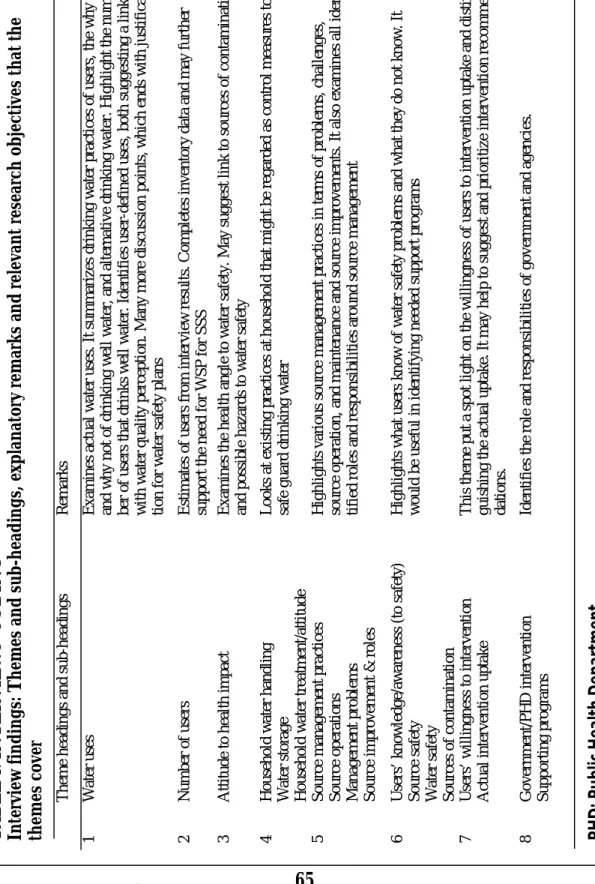
the initial stage was high to maintain a wide range of themes to choose from. Subse-quently, similar codes were merged or grouped into higher or lower level themes (Table 1). All the interview responses asso-ciated with coded themes were examined to identify related and/or contrasting views, and to understand the factors or percep-tions being expressed. Data descrippercep-tions and interpretations eventually followed within each major theme. The final list of codes is presented in Table 2 Themes 3 and 6 are, however, relevant to this paper). The results focus on responses from water users who claimed largely to have good health or no health problems. It should be noted that the self supply well selection cri-teria used in the wider research located wells but did not pre-empt the gender, status of self supply well owner/user, or the health status of respondents. It was how-ever important to retain the owner/user of sampled wells as research subjects for the purpose of triangulation. With this, inter-view results could be triangulated with find-ings from researcher’s observation of the well handling and results from the quantita-tive sanitary inspections and water quality analysis conducted on sampled wells.
Study Area
Abeokuta is the capital city of Ogun State in south-western Nigeria. The city has about 250,000 people inhabiting some 50 heteroge-neous townships. Abeokuta is located in the humid tropics with 7 – 8 months of bi-modal peak rainy season and an average an-nual rainfall of 1, 200 mm. The urban city is covered by the crystalline Basement Com-plex consisting of igneous and metamorphic rocks. Groundwater occurrence in the area is limited to the fractured and in-situ weath-ered portion of the rocks (Martins et al., 2000). As at the year 2007, there were more than 2,000 self supply hand-dug wells across the city (Oluwasanya et al., 2011).
RESULTS AND DISCUSSION
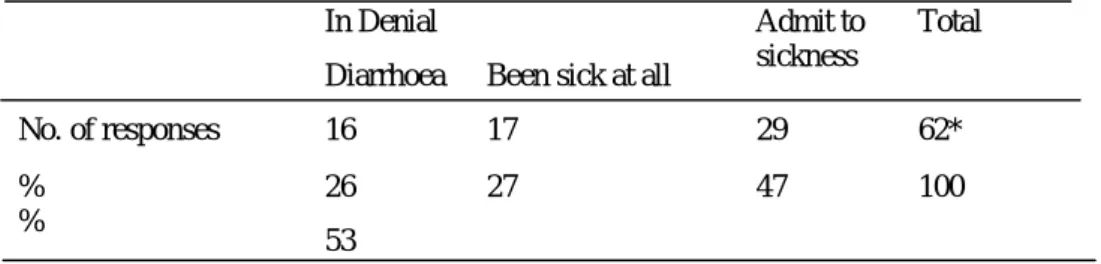
Perception of health impactThe initial reaction of more than half (53%) of the 61 respondents to the question of sickness is denial. ‘I have never been sick’, ‘I do not fall sick’, or ‘Never; sickness is not my portion’ are common responses (Table 2). While 26% denied diarrhoea diseases, 27% claimed that they do not fall sick at all or not often. The observed apparent general denial of sickness is in this paper referred to as denial syndrome or denial attitude to health.
T A B L E 1 : IN T E R V IE W S ’ C O DI N G In te rv ie w f in d in g s: T h e m e s a n d s u b -h e a d in g s, exp la n a tor y r e m a rk s a n d r e le v a n t re se a rc h ob je c tiv e s th a t th e th e m e s c ov e r T h em e h ea d in gs a n d s ub -h ea d in gs R em a rks 1 W a te r us es E xa m in es a ct ua l w a te r us es . It s u m m ar iz es d ri nki n g w a te r p ra ct ic es o f us er s, t h e w h y an d w h y n o t o f dr inki n g w el l w a te r, a n d a lt erna ti v e d ri nki n g w a te r. H ighl ig ht t h e num -b er o f us er s th at d ri n ks w el l w a te r. I de nt if ie s us er -de fi n ed us es , b o th s ugge st ing a l ink w it h w a te r qua li ty pe rc ept io n . M an y m o re d is cus si o n po int s, w h ic h ends w it h jus ti fi ca -ti o n fo r w a te r sa fe ty pl an s 2 N um b er o f us er s E st im at es o f us er s fr o m i nt er v ie w r es ul ts . Co m pl et es i n v en to ry da ta a n d m a y f ur th er suppo rt t h e n ee d fo r W S P f o r S S S 3 A tt it ude t o h ea lt h im p a ct E xa m in es t h e h ea lt h angl e to w a te r sa fe ty . M a y s ugge st l in k t o s o ur ce s of c o n ta m in at io n an d po ss ib le h az ar ds t o w a te r sa fe ty 4 H o us eh o ld w a te r ha n d li n g W a te r st o ra ge H o us eh o ld w a te r tr ea tm ent /a tt it ude L oo ks a t exi st in g p ra ct ic es a t h o us eh o ld tha t m ig ht b e re ga rd ed a s co n tr o l m ea su re s to sa fe gua rd d ri n k in g w a te r 5 S o ur ce m ana ge m en t p ra ct ic es S o ur ce o pe ra ti o n s M an a ge m ent p ro b le m s S o ur ce i m p ro v em en t & r o le s H igh li g h ts v a ri o us s o ur ce m an a ge m ent p ra ct ic es i n te rm s o f pr o b le m s, c h al le n ge s, so ur ce o pe ra ti o n , and m ai n te n an ce a n d s o ur ce i m p ro v em en ts . It a ls o e xa m in es a ll i de n -ti fi ed ro le s an d r es po n si b il it ie s ar o un d s o ur ce m ana ge m en t 6 U se rs ’ k n o w le dge /a w a re n es s (t o s a fe ty ) S o ur ce s a fe ty W a te r sa fe ty S o ur ce s of c o n ta m ina ti o n H igh li g h ts w h at us er s k n o w o f w a te r sa fe ty pr o b le m s an d w ha t th ey do n o t k n o w . It w o ul d b e us e ful i n ide n ti fy in g n ee de d suppo rt p ro gra m s 7 U se rs ’ w il li ng n es s to i nt er v ent io n A ct ua l int er v en ti o n up ta ke T h is t h em e p ut a s po t li g ht o n th e w il li ng n es s o f us er s to i nt er v en ti o n up ta ke a n d di st in -gui sh in g t h e a ct u a l up ta ke . It m a y h el p t o s ugge st a nd p ri o ri ti z e int er v ent io n re co m m en -da ti o n s. 8 G ov er nm ent /P H D i n te rv en ti o n S uppo rt ing p ro gra m s Ide n ti fi es t h e ro le a nd re spo n si b il it ie s o f gove rn m en t an d a ge n ci es . P H D : P u b lic H e al th D e p ar tm e n t
Factors influencing water users’ attitude to health impact
The denial of water users to health impact is influenced by five factors (Figure 1). The factors are deduced from 38 (NI) of 61 re-sponses (N). The five factors are namely the degree of seriousness that users attach to disease/sickness (14 respondents or 36%), the time factor; interval between last sickness and current health status (9 respon-dents or 24%), users’ religious belief (8 re-spondents or 21%), the sense of immunity to source water (4 respondents or 11%), and limited knowledge of particular diseases (3 respondents or 8%).
It is important to note that within the con-text of qualitative research, claiming that identified ‘factor’ is responsible for a per-centage of particular variable, attribute or phenomenon – in this case ‘denial attitude’ - is not what qualitative analysis may confer or tell. While quantitative study involves collection of data in form of numbers,
qualitative collects data in form of words and pictures (Neuman, 2003). However, to un-derstand the factors or describe the percep-tions that are being expressed by responders, it was reasonable to indicate the proportion of responses or number of responders who conveyed a similar point. It was also expedi-ent to allocate higher level of influence to identified factors that were expressed by lar-ger number of users. Consequently, the psented ‘factors’ within the context of the re-search suggest possible links to sources of contamination of self-supply systems (the object of study) and possible hazards to the safety of water from such sources. The highlighted factors and the denial attitude that they point to are also useful in identify-ing needed supportidentify-ing programs within the context of water safety planning.
The five factors are discussed in turn. Table 2: Users’ attitude to sickness; N = 61
*Overlap in responses. One respondent is in denial of having diarrhoea and of being sick at all
In Denial Admit to
sickness
Total Diarrhoea Been sick at all
No. of responses 16 17 29 62*
% %
26 27 47 100
Degree of disease seriousness
Thirty six percent of the responses indi-cated that water users’ perception of the degree of disease seriousness may be linked to denial attitude (Figure 1). The degree of disease seriousness thus appears to be the most influencing factor on users’ attitude to health impact. When sickness is perceived as minor, then users are not sick. When the illness is however considered serious, then that is sickness. Examples of minor ill-nesses are headache, cold and/or malaria, whilst typhoid, cholera or any diarrhea re-lated diseases qualifies as serious sicknesses (Box 1).
Time factor
Time factor denotes the interval or length of time between date of last sickness and current health status. Twenty four percent of responders linked Time factor to denial
syndrome (Figure 1). When the interval is considered long by users, then the user claims ‘I do not get sick’! A long time however means different time span to different users. Box 2 highlights various interpretations of ‘long time’ as explained by five of the nine respondents from whose answers the time factor was deduced. In Box 2 the length of time is a range from one year (last year) to 20 years (from top down)
Religious belief
Belief in God, the Supreme Being is high-lighted by 21% of the responders (Figure 1). Religious belief is inter-related with per-ceived degree of seriousness of sickness. Users are quick to reject or ward off the oc-currence of any disease that they perceived to be serious whenever the disease is men-tioned or referred to. Warding off seems to make the disease go away or prevent the Figure 1: Factors influencing water users’ attitude to health impact.
sickness. It, however, appears that warding off the occurrence of serious diseases is not enough without the expression of faith or belief in the Supreme Being who is consid-ered able to prevent the disease. The above presumption tied to the expression of faith or belief is evident in 8 of 38 responses (Box 3). Examples of such expression of faith include ‘God forbid’, ‘…Jesus is my Healer’, ‘...we pray that such will never happen in our area’, and ‘Thank God, I have never been to the hospital’ (Box 3)!
As shown in Box 3, warding off sicknesses by the expression of faith or belief does not imply that the user has not been sick or was never sick as claimed. Rather, sickness de-nial through the expression of faith or be-lieve conveys two points. Firstly, that the Supreme Being who is believed, is able to and will prevent the occurrence of especially serious diseases (R1, R20, R46, R53, & R68), secondly, the Supreme Being sustains good health status (R78, R94, & R96).
I: So no one here has had cholera before?
R3: Among us? Never
I: The germs found in the water can cause cholera, diarrhoea, etc...What about dysentery?
R3: We would never see that here.
I: When you are sick what do you do, I mean how do you treat yourself?
R73: I don’t normally fall sick, except if I have malaria.
I: Except malaria? Is malaria not a form of sickness?
R73: Not really, I have malaria when I have serious mosquito bites
I: What do you do when you are sick?
R28: I really do not get sick, so I do not know how to answer that.
I: You’ve never fallen sick before?
R28: No; may be slight headache, which comes and goes
…I have not been seriously sick since I grew up I: What about your children?
8: No, not recently. They also don’t fall sick
R27: I don’t get sick
I: You expect us to believe that you have never been ill?
R27: I’ve been sick but not recently…
I: What was the illness? R27: It was cold (flu)
Source: Research interviews; I = Interviewer; R: Respondents
I: If you are sick what do you do?
R1 Never; I’ve never (been) sick
I: Never?
R1: It is over 20 years
R27: I don’t get sick
I: You expect us to believe that you have never been ill?
R27: I’ve been sick but not recently :
I: Did any of your children have diarrhoea or cholera?
R50: They never have it.
I: Is it that they never have it or it has been a long time since they had it?
R50: It has been a long time, about seven years ago.
I: How do you treat yourself when sick?
R93: I don’t get sick, not even once in the last 10 years!
I: How do you take care of yourself when sick?
R94: I was last sick 2-3 years ago.
Source: Research interviews; I: Interviewer; R: Respondent
Box 2: Time factor influence on denial attitude of water users to health impact Perceived (Sense) of immunity to source
water
Eleven percent or four of 38 respondents denied especially water borne diarrhea or related cholera disease (it should be noted that the presence of E. coli - a universally accepted indicator bacteria- suggests the likely presence of germs like Vibrio cholerae, which is responsible for cholera disease) by statements that literarily connote a sense of immunity to source water (Figure 1). State-ments from the four responders may have more than one interpretation (Box 4). For instance ‘…we use it (hand dug well water), drink and cook with it and nothing happened to us…’ may be interpreted in one of two ways. Firstly, ‘if indeed cholera causing germ is in the water and I have not had
cholera since using the water, then I am im-mune to cholera or the causing agent’. Sec-ondly, ‘if I have been using the source water for this long and I have not been infected with cholera, then cholera causing agent can-not be in the water’! Consequently three points can be deduced from the comments in Box 4: ‘No water borne disease (diarrhea/ cholera) is suffered since the usage of the water source’ (R23, R26, R55, & R71; all four respondents); ‘Users are immune to dis-ease-causing agents if indeed the agents are present in water as claimed’ (R23; one out of four respondents); ‘There are no disease-causing agents in the water as claimed’ (R26, R55, & R71; three out of four respondents).
From the above deductions, all four respon-dents denied diarrhea or cholera disease. A statement from one (R23) of the four sug-gests immunity to disease causing agents and admits to link between disease-causing agents and water – ‘…well it (the hand dug well) may contain it (E. coli) but there is no one here who has had cholera since I have been using the (hand dug) well’. Three out of four
respon-ing…..and we have not been infected with cholera...’ The responses of the latter 75% of the users imply that there is the possibility that larger percentage of users may not be making the link between disease-causing agents and me-dium of disease transmission, which is water.
Lack of disease know-how
Water users’ lack or limited knowledge of
I: How many times have you been sick in the last 6 months?
R96: None, Jesus is my healer!
R1: God will not allow such to happen, we will never see sickness.
I: Your water was tested and found to contain E. coli, a germ that can cause diarrhoea (or
indicate the presence of the germ that can cause cholera).
R20: God forbid such in our area.
I: Do you know if anyone here has had cholera before ……..
R46: Mummy said God has not allowed that to happen.
R53: No; we don’t pray for Cholera, we don’t have it around here
I: What about typhoid fever?
R68: No, that will not happen to us in Jesus name. We never had that before
I: Not to you and the children?
R68: By the grace of God, no
I: What about diarrheal?
R68: Not my child
I: Ok, when did you go to hospital last?
R78: Thank God I have not been to the hospital
R94: I was last sick 2-3 years ago. It was normal fever and I use self medication. Presently
however, I live on divine health. ‘’Divinely we are sustained’’!
Source: Research interviews; I: Interviewer; R: Respondents
Box 3: Expression of faith or belief: influence of religious belief on denial of sickness
in Box 5, two (R24 & R43) of the three re-spondents denied sickness in children (‘… nothing is wrong with them…’) but admit that children has been teething. Generally in the study area, the term teething is not used to connote the expected or ideal teeth growing process/stage in a child rather the term is used to denote the sickness that is associ-ated with teeth growing stage in infant. For instance, the dialogue in Box 6 explains what users mean by teething in children – frequent stool with temperature. The third respondent (R53) particularly denied diar-rhea related sicknesses but admit to teething
in children. From Box 6, teething in chil-dren is obviously not regarded as diarrhea or diarrhea related disease and consequently not related with water. Water users’ description of teething in children is however similar to the description of diarrhea in medicine. In medicine, diarrhea is characterized by fre-quent loose or liquid bowel movements. By implication, teething in children is diarrhea. That water users do not understand or take teething in children to be diarrhea can be viewed as disease misrepresentation and an evidence of lack of disease know-how.
I: It contains E. coli that causes cholera and diarrhoea….
R23: Well it may contain it but there is no one here who has had cholera since I
have been using the well
I: What do you think can cause such things since you are the user?
R26: We use it, drink and cook with it and nothing happened to us
I: Since when have you been living here?
R26: 1994
I: And no one has had cholera?
R26: No
I: But you also use it for dish washing?
R55: Yes even for bathing and it causes nothing.
R71: This is the water we have been using. It is the water that I drink and use. And
I have never been affected by cholera or anything
Source: Research interviews; I: Interviewer; R: Respondent
I: Aunty what is wrong with your child? R24: Nothing
I: They said he is teething R24: Yes
I: What did you use for him?
R24: We took him to the hospital in Lantoro (The biggest private hospital in Abeokuta) I: Which drugs were they given?
R24: I don’t know it I: Is it Bonababe? R24: I don’t know.
I: Ok, what is wrong with your child?
R43: my child? Nothing, there is nothing wrong with him I: We heard that he is teething
R43: Yes
I: What did you use for him?
R43: We took him to the hospital, Duro hospital; it’s very close by I: Which drugs were you given?
R43: I don’t know it I: Is it Bonababe? R43: I don’t know.
I: Do they have dysentery?
R53: No; we don’t pray for Cholera, we don’t have it around here I: When your children are teething, what do you use for them? R53: We use Bonababe (Brand name for a local teething medicine)
Source: Research interviews; I: Interviewer; R: Respondents
Box 5: Lack of disease (diarrhoea) know-how exhibited by water users
I: Good day aunty R37: Thank you
I: Your child has stopped teething? R37: Yes
I: What was the problem he had?
R37: He had temperature and he was stooling (loose or watery excrement) I: When last was that?
R37: About 2 months ago I: Which drug did you use?
R37: Bonababe (brand name of teething medication) I: Who asked you to use the drug?
R37: It was advertised on the Television I: Is it not prescribed by a doctor? R37: No
I: Does the drug work after use? R37: Yes
I: Has it happened again? R37: No
I: How frequent was the stooling? R37: Like twice in a day
I: What type of water are you using for him? R37: Tap water
I: Did you add anything to the water? R37: No
I: Do you bath him with well water? R37: No
The role of God in water safety planning Although the ability of the Supreme Being to prevent diseases and sustains good health is not in question, the points expressed in sickness denial through the expression of faith suggest an inherent danger. That is the danger of water users shifting part or all of the responsibility of disease prevention and health management to the Supreme Being. The implication of the identified danger is that water safety measures neces-sary to ensure water and invariably human health safety may be compromised by reli-gious belief, and denial attitude to sick-nesses that the belief fuels.
Water safety planning is expected to impact (prevent water borne or related diseases and improve health status) on health if adopted and implemented (WHO, 2004, 2011). Wa-ter safety plans thus represents the role of man in disease prevention. Water users may not however see the need to adopt source and household water safety plans to prevent sicknesses as there is a God who is deemed responsible for disease prevention and good health.
It would therefore be necessary to promote enlightenment programs to highlight or fo-cus on water users’ role in disease preven-tion. Acknowledge the ability of the Su-preme Being in disease prevention but em-phasize individuals’ responsibility and role as well. It would also be important to in-volve religious leaders in enlightenment programs for participation and teaching on the role of God and man in disease preven-tion.
Disease misrepresentation/know-how and water safety intervention
The possibility that high percentage of users do not make the link between disease-causing agents and the medium of transmis-sion, which is water, is noted in this paper. Similarly, teething in children is neither re-garded as a diarrhea disease nor related with water. These findings signify further con-cerns for water safety planning.
It should be noted that 98% of diarrhoea is as a result of poor water, sanitation and hy-giene. Diarrhoea is responsible for about 2 million child deaths per year (JMP, 2005; 2008; 2012). Food, faeces, flies, fingers, and water are notable faecal-oral routes of dis-ease transmission (Percival et al, 2004). Three of the five noted routes have either a direct or indirect link with water. Ingestion of unsafe water represents a direct link, while food and fingers (through food/fruit, plate or hand washing for instance) represents in-direct link with water.
The identified disease misrepresentation will cloud the link between water and water borne diseases like diarrhea. Disease mis-match will also preclude the importance of ensuring safety measures of sources by users, and invariably undermine the need for water safety plans. Clear understanding of water borne diseases, their causes, and transmis-sion pathways/route is essential for water users. The understanding may facilitate or help users to see the need to take water safety measures to protect their water sources for improved health. Education on water borne or water related diseases, causes
and transmission pathways is thus worth including in enlightenment or water safety plans supporting programs.
CONCLUSION
It is apparent from the results obtained that the perception of water users in relation to health impact is important. Users’ percep-tion of health impact can undermine the adoption and implementation of water safety plans. Disease misrepresentation and lack of disease know-how by users are clear indications of how adoption of water safety plans can be marred. Religious belief that masks the role of man in disease prevention is another example of how the adoption of water safety plans may be compromised. Denial of health impact by users translates to denying the need for water safety plans. Water safety plans represent the role of man in disease prevention and health sustainabil-ity. Water safety plans are expected to im-pact on health if adopted and implemented. To impact on health, facilitating water safety plans would require clear understand-ing of users’ perceptions of health impact and the factors that may be influencing those perceptions.
Besides training users on the basic knowl-edge and skills surrounding water safety plans of their sources, some of the action points for water safety plans facilitators would include among others:
users to health impact through initial sup-porting programs;
Identify key stakeholders to involve in initial supporting programs. Examples of key stakeholders include religious leaders, public health educators, and/or health practitioners. Initial supporting programs should include enlightenment and education on the follow-ing: role of God and man in disease preven-tion; water borne/related diseases, causes and route of transmission; best practice in disease treatment; and identification of regu-lated medical prescription sources.
ACKNOWLEDGEMENTS
The author acknowledges the support of Prof. Richard Carter, Dr. James Webster and Dr. Jennifer Smith in the supervision of the research that led to this paper. The author also appreciates the Commonwealth Scholar-ship Commission, United Kingdom, for sponsorship of the study program.
REFERENCES
Doria, M. F., Pidgeon, N. Hunter, P. R. 2005, Perception of tap water risks and qual-ity: a structural equation model approach, Water Science and Technology, 52(8): 143–149 Doria, M. F., 2010, Factors influencing public perception of drinking water quality, Water Policy 12, doi: 10.2166/wp.2009.051, IWA, UK, 1 – 19
IWA 2004, The Bonn Charter for Safe Drinking Water, IWA, London
UNICEF JMP for water supply and sanita-tion, 29 February, 2012, www.childinfo.org/ files/JMP_MainMessages.pdf
JMP 2008, Progress on Drinking water and Sanitation: Special focus on sanitation, 2008 Report, ISBN 978 92 806 4313 8, WHO/ UNICEF, New York
JMP 2005, Water for life: making it happen. Joint monitoring program for water supply and sanitation, WA 675, WHO/UNICEF, New York
Martins, O., Ajayi, O., Idowu, O. A. 2000, Factors influencing yields of bore-holes in Basement Complex aquifers of South-western Nigeria, Nigeria Journal of Sci-ence, 34: 295-300
Neuman, W. L. 2003, Social research methods: qualitative and quantitative approaches, 5th Edi-tion, ISBN-13: 978-0205457939, Pearson Education Incorporation, USA
Oluwasanya, G., Smith, J., Carter, R. 2011: Self supply systems: urban dug wells in Abeokuta, Nigeria, Journal of Water Science and Technology: Water Supply, IWA Publishing, UK, Vol. 11 (2), 172 – 178. ISSN Print: 1606 – 9749, doi:10.2166/ws.2011.026 Percival, S. L., Chalmers, R. M., Em-brey, M., Hunter, P. R., Sellwood, J. , Wyn-Jones, P. 2004, Microbiology of water borne diseases, Elsevier, UK
Robson, C. 2002, Real World Research - A Resource for Social Scientists and Practitioner-Researchers, 2nd Edition, Blackwell, UK,
599pp.
Richards, L. 2006, Handling qualitative data: A practical guide, Sage Publications, UK Sheat, A., 1992, Public perception of drink-ing water quality: Should we care? Paper pre-sented at the New Zealand Water Supply and Disposal Association Annual Confer-ence, Cited in Syme & Williams 1993
Strang, V., 2001, Evaluating Water: Cultural Beliefs and Values about Water Quality, Use and Conservation, Water UK Publications, Oxford, ISBN-13: 9781840572483, 157pp. Sutton, S. 2004, Preliminary desk study of poten-tial for self supply in Sub-Saharan Africa, Report for Water aid and the Rural Water Supply Net-work , October 2004, Water-Aid/RWSN, UK. Available at http://www.rwsn.ch/ documentation/skatdocumentation.2005-11-14.0367140939
Sutton, S. 2007, Putting the user first: incre-mental improvements and private investment in rural water supply, RWSN Skat Foundation, UK.
http://www.rwsn.ch/documentation/
WHO 2004, Guidelines for drinking-water quality, 3rd Edition, Vol. 1, WHO, Geneva, Switzerland: ISBN 92 4 154696 4
WHO 2011, Guidelines for drinking-water quality, 4th Edition, WHO, Geneva, Switzer-land: ISBN 978 92 4 154815 1