1
The Use of Dexamethasone vs Prednisone in the Treatment
of Asthma Exacerbation
Abstract
Asthma accounts for 2.1 million unscheduled ED visits annually, with a prevalence of 8.4% of the US population.2 Systemic corticosteroids serve as a cornerstone of acute asthma therapy, decreasing relapse rate, length of stay, and hospitalization rates.Since prednisone has multiple side effects and problematic
compliance, studies have been conducted to determine if dexamethasone is as effective in the treatment of asthma exacerbation. This review evaluated a Cochrane systematic review, as well as three additional studies not included in that review. The conclusion was that dexamethasone is a promising alternative to prednisone in treating asthma exacerbation in both adults and children. However, in order for this possibility to be readily adopted into guidelines and clinical practice, higher quality and more consistent data needs to be obtained.
Background
Asthma is a chronic respiratory disease characterized by episodes or attacks of
inflammation and narrowing of small airways.1 If asthma is not well controlled, then
patients are at increased risk of an exacerbation serious enough to require a trip to the
emergency department. The mechanism of an asthma exacerbation is via a
combination of bronchospasm, hyperreactivity, and/or inflammation of the airways.
Inflammation of the airways occurs via mast cell activation as a result of
exposure to an allergen.11Acute bronchoconstriction is the consequence of
2 the primary component of the early asthmatic response. Airway edema occurs 6-24 hours following an allergen challenge and is referred to as the late asthmatic
response.12 Hyperreactivity is a manifestation of reversible airflow obstruction due to smooth muscle contraction as an exaggerated constrictor response to a variety of physical, chemical, or environmental stimuli.11 Chronic inflammation of the airways is associated with increased bronchial hyperresponsiveness, which leads to
bronchospasm and typical symptoms of wheezing, shortness of breath, and coughing.12
Risk factors for an exacerbation vary greatly and include the following: 1)
improper use of medications/inhalers, 2) under dosing of medications, and 3) indoor and
outdoor environmental factors. In addition, endogenous sources can play a large role in
exacerbations, including: 1) illness, 2) comorbidities, and 3) even strong emotions.
Identifying and avoiding triggers, as well as optimization of preventive medication are
part of controlling asthma symptoms and ultimately avoiding an exacerbation.
Epidemiology
According to the WHO, asthma is one of the major non-communicable diseases that affects people in all countries around the world.7 Two hundred thirty-five million people worldwide currently suffer from asthma, with 383,000 asthma-related deaths in 2015.7 Asthma is under-diagnosed and under-treated. It creates substantial burden to individuals and families and often restricts individuals’ activities for a lifetime.7 The WHO’s strategy for prevention and control of asthma aims to reduce the disability and premature death related to asthma.7
3 children younger than 18 years), and approximately 4% of Americans (5% of children) experienced an asthma attack in the previous year.1 Asthma accounts for 2.1 million unscheduled ED visits annually, with a prevalence of 8.4% of the US population.2 The most likely explanation for the apparent increased prevalence is clinician and public awareness of the signs and symptoms of asthma that could have led to a change in diagnostic recognition.1 It is also likely that changes in the risk factors thought to cause and worsen asthma are responsible for much of the increase in asthma prevalence. These include increased survival rates of premature infants, as well as indoor pollutants due to changes in indoor living such as: 1) smoking, 2) aero allergens, 3) viral agents, 4) molds, and 5) irritant gases. These factors appear to have more influence than outdoor air pollution.14 The annual death rate from asthma in the United States has decreased overall, however consistently higher rates have been reported for blacks than for whites, but not for Hispanic or Latino ethnicity.1 This difference in death rates is thought to be due to socioeconomic factors such as low-income and living in inner cities, which are related to difficulty accessing medical care.15
Natural History
The natural history of asthma is variable and difficult to predict for a particular individual.16 Children with asthma experience complete remission more frequently than adults; however, progression to severe disease is unusual in all age groups.17 Although deaths do occur from asthma, they are rare, and asthma in the absence of other
4 have intermittent symptoms, usually in relation to viral illnesses, and then outgrow the symptoms as the child gets older.19 The other group, which tends to have later-onset and more persistent symptoms, is characterized by atopy, a positive family history of asthma, and an increased risk for asthma later in life.19
Despite identification of risk factors, prospective identification of an individual's future asthma experience is not possible.19 Adult-onset asthma tends to have been undiagnosed in childhood.21 One longitudinal study found that of adults with new onset asthma at age 22 that had no prior clinician diagnosis of asthma, 37% had reported wheezing during study visits in childhood and 19% had bronchial hyper responsiveness by cold air bronchoprovocation at age 6.21
Among individuals, asthma severity appears to remain stable over several years. A retrospective, medication-based cohort study of newly diagnosed asthmatics with mild disease showed they were unlikely to progress clinically over the next 5 years; only 3% of patients diagnosed with mild disease progressed to severe disease 5 years later.17 Wheezing and asthma in adolescence are associated with a high rate of persistence into adulthood (approximately 75%).17 Similarly, adults with wheezing are more likely than children to experience persistent asthma.17
Asthma Exacerbation Defined
There is no consensus on the terminology for describing or defining
5 breath, chest tightness or pain, breathlessness, cough, and lack of response to a quick-acting (rescue) inhaler.23 Signs of exacerbation include the following: 1) the presence or absence of wheezing, 2) increased work of breathing, 3) accessory muscle use/tripod position, 4) impaired speaking ability, 5) level of mental status, and 6) decreased peak expiratory volumes and oxygen saturation.23 The degree of the signs and symptoms vary from each individual, but are managed the same way.23
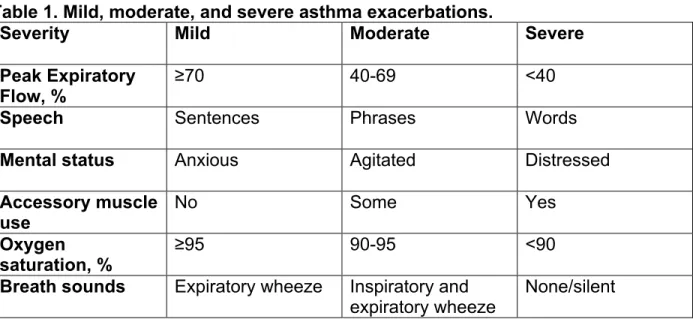
Asthma exacerbations can be classified as mild, moderate, severe, or life threatening24 (Table 1). Asthma exacerbation can be diagnosed clinically, but peak expiratory flow (PEF) and oxygen saturation (SpO2) can be used as objective measures of lung function to further support the diagnosis.23 A PEF of ≥ 70% of predicted or
personal best and/or SpO2 of ≥95% correspond to a mild exacerbation, PEF 40-69% and/or SpO2 of 90-95% are moderate, PEF <40% and/or SpO2 of <90% are severe, and PEF <25% is life threatening.3,24 Response to nebulizer treatment and improvement of oxygen saturation can also support the diagnosis.23
Table 1. Mild, moderate, and severe asthma exacerbations.
Severity Mild Moderate Severe
Peak Expiratory Flow, %
≥70 40-69 <40
Speech Sentences Phrases Words
Mental status Anxious Agitated Distressed
Accessory muscle
use No Some Yes
Oxygen
saturation, % ≥95 90-95 <90
Breath sounds Expiratory wheeze Inspiratory and
expiratory wheeze None/silent
6 Treatment of acute exacerbations
In patients with a peak expiratory flow of 50 to 79% of their personal best, up to two treatments of two to six inhalations of short-acting beta2 agonists 20 minutes apart followed by a reassessment of peak expiratory flow and symptoms may be safely employed at home.24 Administration using a hand-held metered-dose inhaler with a spacer device is at least equivalent to nebulized beta2 agonist therapy in children and adults.24 In the ambulatory and emergency department settings, the goals of treatment are correction of severe hypoxemia, rapid reversal of airflow obstruction, and reduction of the risk of relapse.24 Multiple doses of inhaled anticholinergic medication combined with beta2 agonists improve lung function and decrease hospitalization in school-age children with severe asthma exacerbations.24 Intravenous magnesium sulfate has been shown to significantly increase lung function and decrease the necessity of
hospitalization in children.24 The administration of systemic corticosteroids within one hour of emergency department presentation decreases the need for hospitalization, with the most pronounced effect in patients with severe exacerbations.24
Airway inflammation can persist for days to weeks after an acute attack;
therefore, more intensive treatment should be continued after discharge until symptoms and peak expiratory flow return to baseline.24 Systemic corticosteroids given orally serve as a cornerstone of acute asthma therapy. Relapse rate, length of stay, and
hospitalization rates decline with the routine use of steroids25 (Table 2).
Table 2. SORT (Strength of Recommendation Taxonomy) Key recommendations for treating asthma exacerbation.
7 Systemic Corticosteroids
administered w/in 1 hour of ED presentation decreases need for hospitalization25
A (consistent, good-quality patient-oriented evidence)
Largest effect noted in patients with severe asthma
Oral and parenteral corticosteroids are equally effective in preventing hospitalization in children26
B (inconsistent or limited-quality patient-oriented evidence)
Rowe BH, Spooner C, Ducharme F, Bretzlaff J, Bota G. Corticosteroids for preventing relapse following acute exacerbations of asthma. Cochrane Database of Systematic Reviews2007, Issue 3. Art. No.: CD000195. DOI: 10.1002/14651858.CD000195.pub2.
When prevention and control of asthma symptoms fail and exacerbation results, pharmacotherapy is first line treatment. These include bronchodilators such as albuterol and ipratropium, as well as corticosteroids such as prednisone and dexamethasone. During an asthma exacerbation, bronchodilators are fast-acting medications to initially open the airways. These are short-acting and should not be used long term.27 Chronic use can cause tolerance, requiring higher doses to attain symptom control, which can increase the risk of toxicity.28,29 Prednisone and dexamethasone are used to decrease inflammation in the airways, but can take several hours to elicit an effect. However, their effects last longer and act on a different mechanism than the bronchodilators. As with just about all medications, these can have side effects, issues with compliance, and can vary in cost, depending on choice of corticosteroid, strength, and duration of treatment.
8 should be taken.5 Some problems that occur with this course are medication adherence and side effects, such as 1) nausea, 2) vomiting, and 3) trouble sleeping.5 These
problems are the reason dexamethasone use was explored as an alternative.
Prednisone has a short half-life of 12-36 hours.5 It is dosed at 40 to 60 mg/day for approximately 5 days; administered as a single or 2 divided doses.5 Common side effects include GI upset, irritability, anorexia, and insomnia.5 Dexamethasone is 8 times more potent than prednisone and has a longer half-life of 36-72 hours.6 It is dosed at 12 mg for 1-2 days; administered as single doses.6 While side effects are similar, they tend to occur with less frequency and/or severity.6 Also, since they are similar in
bioavailability and their action on asthma exacerbation, several studies have looked at the use of dexamethasone compared to prednisone in the treatment of acute asthma exacerbation and preventing relapse. Therefore, this review aims to answer the following questions: For treatment of adults and children with acute asthma
exacerbation, is dexamethasone as effective as prednisolone? Are side effects and relapse rate similar for both medications? Is there a difference in compliance between the two medications?
Methods
To address my clinical questions, I searched PubMed with the following terms: ‘dexamethasone AND asthma’, ‘dexamethasone AND adults AND asthma’,
9 For my clinical review on this topic, I included randomized controlled trials,
retrospective cohort studies, and systematic reviews. I excluded studies that compared other medications to prednisone or dexamethasone, other types of corticosteroids (ie. ICS), other routes of administration of either dexamethasone or prednisone, and those that did not address asthma exacerbation. Bias was evaluated with the Cochrane Risk of Bias Tool and the GRADE (Grades of Recommendation, Assessment, Development and Evaluation) system.
Results
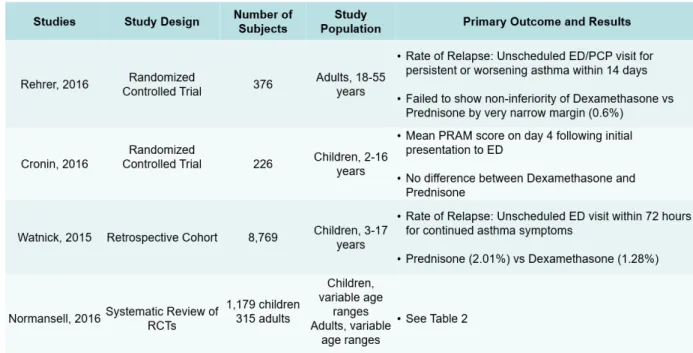
This review included evaluation of a Cochrane systematic review of randomized trials, as well as three studies that were not included in the systematic review. Summary tables of study results, outcomes, and bias evaluations are included (Tables 3,4,5).
Rehrer et al. (2016) conducted a prospective, triple-blind, randomized, controlled non-inferiority trial that aimed to compare a single dose of dexamethasone to a pulsed dose of prednisone for adults with acute asthma exacerbations.2 Three hundred
10 five-day course of oral prednisone by a very narrow margin (0.6%). Selection bias was addressed by having well-balanced baseline characteristics between the two study groups, as well as utilizing a randomization table maintained by the pharmacy and having both medications identical in appearance. The study had no evidence of performance bias; patients, physicians, and researchers were blinded to study arm assignment. There was no detection bias as the data analysis team was blinded to allocation arm until the results were final and the blind was lifted in the article-writing phase. Attrition bias was addressed by using an intention to treat analysis and “worst case” sensitivity analyses to assess the robustness of the result, given that the lost to follow up rate was near 20%. The study appeared to present all data and outcomes despite the fact that they did not yield their expected result, thus addressing reporting bias; they provided discussion of limitations to the study that may have contributed to those results.2
Cronin et al., 2016 conducted a randomized, open-label, non-inferiority trial that examined whether a single dose of oral dexamethasone was not inferior to prednisolone in the emergency department (ED) treatment of asthma exacerbations in children.10 Two hundred twenty-six study participants aged 2 to 16 years old with a known asthma diagnosis or at least 1 previous episode of ß2-agonist–responsive wheeze who
11 contraction (0 to 2), air entry (0 to 3), wheezing (0 to 3), and SaO2 (0 to 2). Secondary outcome measures included requirement for further steroids, vomiting of study
medication, hospital admission, and unscheduled return visits to a health care
practitioner within 14 days. Results showed no difference in mean PRAM scores at day 4 between the dexamethasone and prednisolone groups (0.91 versus 0.91; absolute difference 0.005; 95% CI –0.35 to 0.34). Fourteen patients vomited at least 1 dose of prednisolone compared with no patients in the dexamethasone group. Sixteen children (13.1%) in the dexamethasone group received further systemic steroids within 14 days after trial enrollment compared with 5 (4.2%) in the prednisolone group (absolute difference 8.9%; 95% CI 1.9% to 16.0%). There was no significant difference between the groups in hospital admission rates or the number of unscheduled return visits to a health care practitioner. The study demonstrated that in children with acute
exacerbations of asthma, a single dose of oral dexamethasone (0.3 mg/kg) is not inferior to a 3-day course of oral prednisolone (1 mg/kg per day) as measured by the mean PRAM score on day 4.
Selection bias was addressed with using a randomization design that generated numeric codes. Sealed envelopes were pre-randomized and kept in a locked storage cabinet. Baseline demographic characteristics, except for sex distribution, being similar between the 2 groups. There were significantly more male patients in the prednisone group (74.6% versus 61.8%; P=.03). There was no significant difference between the study groups in symptom duration or in the PRAM score at initial ED clinical
12 was addressed with the primary outcome using an objective measure in the PRAM score; and the number of patients admitted to the hospital where inpatient treatment may have differed from outpatient treatment was addressed by the fact that that number was similar in both groups. Attrition bias was to be addressed by the study aiming to recruit a sufficient number of patients to allow a loss to follow-up rate of 10%, however their actual rate was not reported or discussed. It was also addressed with an intention-to-treat analysis for participants who vomited study medication. Reporting bias was addressed with several tables of detailed results of primary and secondary outcomes, as well as summary tables and discussion of the limitations of the study.10
Watnick et al., 2015 conducted a retrospective cohort study that examined relapse rates in a large population of children treated for acute asthma exacerbations during an era of prednisone and prednisolone use compared with an era of
13 (P = .05, absolute risk reduction 0.73%, relative risk reduction 36%). No demographic characteristics were associated with relapse in multivariable models.
Confounding evidence was addressed with the χ2 test that was used to compare relapse rates of patients receiving oral dexamethasone with those receiving oral
prednisone or prednisolone, and multivariable logistic regression was used to examine for associations of corticosteroid formulation with relapse, adjusted for sex, age, race, ethnicity, and insurance type.13 No demographic characteristics were associated with relapse in multivariable models.13 To avoid double counting of patients, for patients with multiple ED visits within 72 hours, only the first return visit was analyzed. Data from 4,749 patients (35.1%) who received no corticosteroid or an intravenous formulation of corticosteroid were not included in the analysis.13 Additional bias was present due to lack of information regarding the severity of a patient's asthma exacerbation and detailed asthma characteristics (eg, intermittent vs persistent, presence of smoke exposure, and influenza vaccination status). In addition, any patient with an incorrect International Classification of Diseases, Ninth Revision code not reflective of acute asthma as the primary cause for ED visit was missed in the analysis.13 There was no evidence of reporting bias; all results were reported.13
A 2016 Cochrane systematic review assessed the efficacy and safety of any dose or duration of oral steroids (prednisone vs dexamethasone). The authors
14 (RCTs), irrespective of blinding or duration, that evaluated one dose or duration of oral steroid versus any other dose or duration, for management of asthma exacerbations; studies involving both adults and children with asthma of any severity, in which
investigators analyzed adults and children separately; any other co-intervention in the management of an asthma exacerbation allowed, provided it was not part of the randomized treatment; and studies reported as full text, those published as abstract only and unpublished data. Search methods included trials from the Cochrane Airways Group Specialized Register (CAGR), ClinicalTrials.gov (www.ClinicalTrials.gov), the World Health Organization (WHO) trials portal (www.who.int/ictrp/en/) and reference lists of all primary studies and review articles. A detailed list of search terms and filters was provided in this review.
Primary outcomes were admission/readmission to the hospital, asthma symptoms at the end of steroid course, and serious adverse events. In studies
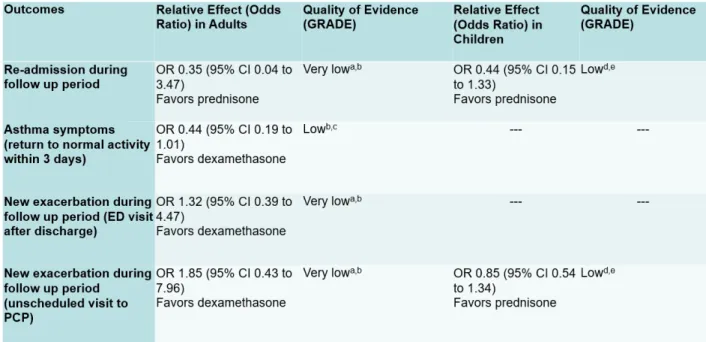
comparing dexamethasone to prednisone, the OR for hospital readmission during the follow up period was 0.35 (very low quality) in adults and 0.44 (low quality) in children; OR for asthma symptoms at the end of the steroid course was 0.44 (low quality) for return to normal activity within 3 days, 1.32 (very low quality) for ED visit after
discharge, and 1.85 (very low quality) for an unscheduled visit to a PCP in adults and 0.85 (low quality) in children; the OR for serious adverse events was not evaluated in adults and was not estimable in children. For two of the primary outcomes - hospital admission and serious adverse events - events were too infrequent to permit
15 rarely used validated scales, again limiting the conclusions.9 Risk of bias in each study was thoroughly assessed in detail in the body of the paper, as well as summarized in a table. Two review authors independently screened the search results for included trials, extracted numerical data and assessed risk of bias; all data were cross-checked for accuracy.9 Disagreements were resolved by discussion with the third review author or with an external advisor.9 Dichotomous data such as odds ratios (ORs) or risk
differences (RDs) were analyzed using study participants as the unit of analysis; continuous data was analyzed as mean differences (MDs).9 A random-effects model was used, and a stratified fixed-effect analysis was carried out to address statistical heterogeneity.9
16
Table 3. Summary of Findings with GRADE evaluation of Prednisone vs Dexamethasone in Adults and Children.
Normansell, R., Kew, K. M., & Mansour, G. (2016). Different oral corticosteroid regimens for acute asthma. Cochrane database of systematic reviews. doi:10.1002/14651858.CD011801.pub2
aOnly 1 study contributed to this outcome with very few events reported in total, resulting in an imprecise estimate
with confidence intervals including both important harms and benefits of either regimen. Downgraded twice for imprecision
bOnly contributing study judged to be at high risk of attrition bias because of post-randomization exclusions and large
numbers lost to follow-up. Downgraded once for risk of bias
cOnly one study contributed to this outcome with imprecise estimate and confidence intervals not completely
excluding the possibility of no differences. Downgraded once for imprecision
dThe 2 studies contributing most events to this outcome were considered to be at high or unclear risk of selection,
performance, and detection bias. In addition, one study allowed 19 participants to enroll more than once in the study. Downgraded once for risk of bias
17
Table 4. Summary of study results and outcomes.
Table 5. Cochrane Risk of Bias Evaluation.
Discussion
18 that dexamethasone is as effective as prednisone.10,13 The few studies that have been conducted on adults have also shown this to be true.2 However, the Cochran systematic review of 6 other studies comparing dexamethasone and prednisone in adults and children concluded that the evidence presented was not strong enough to indicate whether the usual second-line option, dexamethasone, is better or worse than prednisolone. These findings address my first question: For treatment of adults and children with acute asthma exacerbation, is dexamethasone as effective as
prednisolone?
Outcomes varied among the studies reviewed, with many studies using relapse rate as the primary outcome, as there is no consensus on a uniform measure of
symptom severity. Relapse rate was either defined as an unscheduled return visit within 14 days or 72 hours.2,13 The national relapse rate for asthma exacerbation in the United States is 16%.30 Rehrer 2016 showed a relapse rate of 12.1% for the dexamethasone group and 9.8% in the prednisone group. Watnick 2016 showed a relapse rate of 1.28% in the dexamethasone group and 2.01% in the prednisone group. Change in symptoms was measured using an objective reporting scale, the PRAM score.10 While the PRAM score is an objective measure of symptoms, the Cronin 2016 study is the only study to use it to date; other studies that have reported measures of symptom severity were not shown to be objective and they have been variable across studies, making it difficult to compare them with other studies.10 Secondary outcomes were identified as increased steroid requirement, side effects, and hospital admission. More patients in the
19 toward using prednisone as first line treatment, even though there was no significant difference in asthma severity between the two study arms.10 Subjects in the prednisone group vomited the study medication, whereas none in the dexamethasone group did, suggesting increased side effects and decreased palatability of prednisone.10 No other adverse events attributable to the study medications were noted.10 Hospital admission was equal among both groups.10 These findings address my question: Are side effects and relapse rate similar for both medications?
[insert results and RoB tables]
One of the largest benefits of a single dose of oral dexamethasone comes from the likelihood of improved compliance. The medication may be administered in the ED or office setting without any requirement for filling a prescription and then receiving the medication as prescribed at home. The average cost of a 5-day course of 40 mg oral prednisone in the US is $29.14, compared with the cost of 1-2 days of 12 mg oral
dexamethasone at $2.14 – $4.28. Compliance rates after discharge of patients who had been hospitalized for asthma were studied and adherence at 7 days for oral and inhaled corticosteroids was 50%; poor adherence significantly predicted significantly worsened symptom control.31 Dexamethasone has been found to be close in efficacy to
prednisone in the treatment of asthma exacerbation, and has a similar side effect profile and relapse rate. In patients where cost or compliance could be an issue,
dexamethasone could be a comparable alternative. The Rehrer study, by a small
20 the use of a single oral dose of dexamethasone regardless, suggesting that the use of a one-time dose of dexamethasone may lead to fewer relapses in patients who are
unlikely to fill or take the entire course of steroids. These findings addressed my final question: Is there a difference in compliance between the two medications?
Overall, the studies reviewed demonstrated strengths in study design with blinding, well-balanced baseline characteristics among study groups, comprehensive literature searches, objective outcome measures, and low risk of bias. They also demonstrated that dexamethasone can be beneficial in certain patient populations and improve compliance and convenience, thus possibly decreasing relapse rates.
Limitations of these studies include the lack of studies on this specific topic; variable or unidentified asthma severity; variable outcomes and evaluation tools which have led to low quality data; high loss to follow up rate; low participant numbers; as well as variable ages being assessed. Most studies recruited participants from the ED setting, which limits applicability to patients that present to their PCP.
Conclusion
These studies have demonstrated that dexamethasone is a promising
21 More research is needed in adults, larger study populations should be used, and improved steps to minimize loss follow up and/or better tracking of loss to follow up. It is important to identify the most effective treatment for asthma exacerbation; while
prevention is key, sometimes this cannot be avoided. More medication options that are just as effective, but safer and more convenient, would be beneficial to address issues such as adherence, side effects, palatability, cost, as well as decreased relapse, hospital admissions, prolonged course/symptoms, and long term effects. Uncontrolled asthma has a very high healthcare cost, not to mention the cost on quality of life. The ultimate goal is to maximize recovery while minimizing side effects and relapse.
References
1. Akinbami L. Centers for Disease Control and Prevention National Center for Health Statistics. Asthma prevalence, health care use and mortality: United States, 2003–05.
http://www.cdc.gov/nchs/data/hestat/asthma03-05/asthma03-05.htm. Accessed August
7, 2017.
2. Rehrer, M. W., Liu, B., Rodriguez, M., Lam, J., & Alter, H. J. (2016). A Randomized Controlled Noninferiority Trial of Single Dose of Oral Dexamethasone Versus 5 Days of Oral Prednisone in Acute Adult Asthma. Annals of Emergency Medicine,68(5), 608-613. doi:10.1016/j.annemergmed.2016.03.017
3. Alangari, A. A. (2014). Corticosteroids in the treatment of acute asthma. Annals of Thoracic Medicine,9(4), 187-192. doi:10.4103/1817-1737.140120
4. CONTROLLED trial of effects of cortisone acetate in status asthmaticus; report to the Medical Research Council by the subcommittee on clinical trials in asthma.
22 5. Lexicomp. (2017). Prednisone: Drug information. Retrieved August 13, 2017, from
https://www-uptodate-com.libproxy.lib.unc.edu/contents/prednisone-drug-information?source=preview&search=prednisone%20adult&anchor=F213067#F213067
6. Lexicomp. (2017). Dexamethasone: Drug information. Retrieved August 13, 2017, from https://www-uptodate-com.libproxy.lib.unc.edu/contents/dexamethasone-systemic-
drug-information?source=search_result&search=dexamethasone%20adult&selectedTitle=1~
150
7. WHO. (2017, April). Asthma: Fact Sheet. Retrieved June 1, 2017, from
http://www.who.int/mediacentre/factsheets/fs307/en/
8. Litonjua, A. L., & Weiss, S. T. (2017, March 28). Natural history of asthma (P. J. Barnes, R. A. Wood, & H. H., Eds.). Retrieved June 1, 2017, from
https://www.uptodate.com/contents/natural-history-of-asthma
9. Normansell, R., Kew, K. M., & Mansour, G. (2016). Different oral corticosteroid regimens for acute asthma. Cochrane database of systematic reviews.
doi:10.1002/14651858.CD011801.pub2
10. Cronin, J. J., McCoy, S., Kennedy, U., An Fhaili, S. N., Wakai, A., Hayden, J., . . . O'Sullivan, R. (2016). A Randomized Trial of Single-Dose Oral Dexamethasone Versus Multidose Prednisolone for Acute Exacerbations of Asthma in Children Who Attend the Emergency Department. Annals of Emergency Medicine,67(5), 593-601.
doi:10.1016/j.annemergmed.2015.08.001
https://www-uptodate-com.libproxy.lib.unc.edu/contents/pathogenesis-of-23
asthma?source=search_result&search=asthma%20pathophysiology&selectedTitle=1~1
50
12. Morris, M. J. (2017, April 25). Asthma: Practice Essentials, Background, and Anatomy (Z. Mosenifar, Ed.). Retrieved September 12, 2017, from
http://emedicine.medscape.com/article/296301-overview#a4
13. Watnick, C. S., Fabbri, D., & Arnold, D. H. (2015). Single-dose oral dexamethasone is effective in preventing relapse after acute asthma exacerbations. Annals of Allergy, Asthma & Immunology,116(2), 171-172. doi:10.1016/j.anai.2015.11.015
14. Weiss, K. B., Gergen, P. J., & Wagener, D. K. (1993). Breathing better or wheezing worse? The changing epidemiology of asthma morbidity and mortality. Annual Review of Public Health,14(1), 491-513. doi:10.1146/annurev.pu.14.050193.002423
15. Nunes, C., Pereira, A. M., & Morais-Almeida, M. (2017). Asthma costs and social impact. Asthma Research and Practice, 3, 1. http://doi.org/10.1186/s40733-016-0029-3 16. Guilbert, T., & Krawiec, M. (2003). Natural history of asthma [Abstract]. The
Pediatric clinics of North America,50(3), 523-538. Retrieved September 16, 2017, from
https://www-ncbi-nlm-nih-gov.libproxy.lib.unc.edu/pubmed?term=12877234&otool=uncchlib.
17. Ernst, P., Cai, B., Blais, L., & Suissa, S. (2002). The early course of newly diagnosed asthma. The American Journal of Medicine,112(1), 44-48. doi: 10.1016/S0002-9343(01)01033-6
24
http://libproxy.lib.unc.edu/login?url=https://search-proquest-com.libproxy.lib.unc.edu/docview/223990176?accountid=14244
19. Bisgaard, H., & Bonnelykke, K. (2010). Long-term studies of the natural history of asthma in childhood. Journal of Allergy and Clinical Immunology,126(2), 187-197. doi:10.1016/j.jaci.2010.07.011
20. Matricardi, P. M., Illi, S., Gruber, C., Keil, T., Nickel, R., Wahn, U., & Lau, S. (2008). Wheezing in childhood: incidence, longitudinal patterns and factors predicting
persistence [Abstract]. The European Respiratory Journal,32(3), 585-592. doi:10.1183/09031936.00066307
21. Stern, D. A., Morgan, W. J., Halonen, M., Wright, A. L., & Martinez, F. D. (2008). Wheezing and bronchial hyper-responsiveness in early childhood as predictors of newly diagnosed asthma in early adulthood: a longitudinal birth-cohort study. The Lancet, 372(9643), 1058-1064. doi:10.1016/S0140-6736(08)61447-6
22. Fuhlbrigge, A., Peden, D., Apter, A. J., Boushey, H. A., Camargo, C., Gern, J., … Blaisdell, C. (2012). Asthma Outcomes: Exacerbations. The Journal of Allergy and Clinical Immunology, 129(3 Suppl), S34–S48. http://doi.org/10.1016/j.jaci.2011.12.983 23. Asthma attack. (2016, October 20). Retrieved September 16, 2017, from
http://www.mayoclinic.org/diseases-conditions/asthma-attack/symptoms-causes/dxc-20257812
24. Pollart, S. M., Compton, R. M., & Elward, K. S. (2011, July 1). Management of acute asthma exacerbations. Retrieved August 13, 2017, from
25 25. Rowe BH, Spooner C, Ducharme F, Bretzlaff J, Bota G. Corticosteroids for
preventing relapse following acute exacerbations of asthma. Cochrane Database of Systematic Reviews2007, Issue 3. Art. No.: CD000195. DOI:
10.1002/14651858.CD000195.pub2.
26. Barnett PL, Caputo GL, Baskin M, Kuppermann N. Intravenous versus oral corticosteroids in the management of acute asthma in children. Ann Emerg Med. 1997;29(2):212–217.
27. Cazzola, M., Page, C. P., Rogliani, P., & Matera, M. G. (2013). B2-agonist therapy in lung disease. American Journal of respiratory and critical care medicine,187(7), 690-696. doi:10.1164/rccm.201209-1739PP
28. Hausdorff, W. P., Caron, M. G., & Lefkowitz, R. J. (1990). Turning off the signal: desensitization of beta-adrenergic receptor function. The FASEB Journal,4(11), 2881-2889. Retrieved September 16, 2017, from
https://www-ncbi-nlm-nih-gov.libproxy.lib.unc.edu/pubmed?term=2165947&otool=uncchlib
29. Sorkness CA. Beta-adrenergic Agonists. In: Middleton's Allergy: Principles and Practice, 7th ed, Adkinson NF, Bochner BS, Busse WW, et al (Eds), Mosby,
Philadelphia 2009. p.1485-503.
30. Emerman, C. L., Woodruff, P. G., Cydulka, R. K., Gibbs, M. A., Pollack, C. V., & Camargo, C. A. (1999). Prospective multicenter study of relapse following treatment for acute asthma among adults presenting to the emergency department. Chest,115(4), 919-927. Retrieved September 17, 2017, from
http://vb3lk7eb4t.search.serialssolutions.com.libproxy.lib.unc.edu/?sid=Entrez:PubMed&
26 31. Krishnan, J. A., Riekert, K. A., McCoy, J. V., Stewart, D. Y., & al, e. (2004).
Corticosteroid use after hospital discharge among high-risk adults with asthma.
American Journal of Respiratory and Critical Care Medicine, 170(12), 1281-5. Retrieved from