Introduction
North Carolina, like virtually every state in the country, has experienced a dramatic economic trans-formation in recent years amidst the onset of increased global competition and the continued diffusion of more and more sophisticated technologies. This period has been particularly turbulent for the Tarheel state as North Carolina has seen some of its longest standing economic cornerstones – industries such as textiles, furniture, and tobacco – dwindle from the landscape. Nonetheless, the state has weathered the storm rather well and is currently trying to find its place in the new economy. In response, there have been numerous recent endeavors in the state aimed at trying to identify industries that are seemingly well-suited to become meaningful parts of North Caroli-na’s 21st century economic portfolio.
One such effort is the ongoing work of the North Carolina Space Initiative, an organization which is in-terested in the potential for the aerospace industry to be-come a meaningful part of North Carolina’s economic future. To that end, a working group published a white paper in January of 2006 entitled “The Aero/Space Economy in North Carolina: A Preliminary Assessment of Current Performance and Future Prospects,” which found North Carolina to have only a “modest presence” in the aerospace industry – defined in their report as tra-ditional aerospace activities such as aircraft manufactur-ing, airport operations, etc (Hardin, 2006, p.16). None-theless, their analysis suggested that if the conception of
what was considered to be the aerospace industry was somewhat widened, the industry would have a more sig-nificant presence in North Carolina, as well as, greater potential for future growth. Ultimately, their analysis concluded that the next logical step was to perform a fol-low-up study that could explore the issue in much greater detail. Accordingly, this report was funded by the Initia-tive to serve as the second phase of their initial white paper.
Thus, this analysis picks up from where the initial report left off, but with one important caveat. As men-tioned, the Initiative’s white paper essentially contends that traditional aerospace, by itself, does not appear to have the required potential to be a significant part of the state economy and, therefore, should not be pursued as such. Instead, they suggest casting aerospace as a wider category that would include traditional functions like air-craft manufacturing, but also other related industries, in-cluding budding commercial space activity. Commercial space is defined by the Federal Aviation Administration (FAA) as “the movement of, or means of moving ob-jects, such as communications and observation satellites, to, from, or in space” (FAA, 2007a, par. 2). Essentially,
North Carolina’s Aero/Space Economy:
Current Performance and Future Potential...Revisited
As North Carolina’s economy shifts from one based in agriculture and textile manufacturing to a new
economy founded on technological advancement, Harris explores through his award-winning study the
strength and potential of the aero/space industry within North Carolina’s borders. A joint recipient of
DCRP’s distnction of Best Master’s Project of 2007, Harris’ report gives an indepth look at this industry
as it stands in this state and carefully details the resources the aero/space field can draw upon for future
growth and expansion. He also assesses the state’s performance and potential within this industry relative
to three other similarly situated states around the country. Though only an exerpt of this extensive study
is presented here, the report’s findings offer a comprehensive assessment of North Carolina’s current
position and future potential in the aero/space industry.
Christopher M. Harris
UNC-DCRP Best Master’s Project of 2007
commercial space is about the growing participation of private industry in space operations – an historically public sector-only endeavor. The other far less explored frontier of the commercial space industry is space tour-ism which focuses on sending private citizens into space for personal pleasure or interest. Nevertheless, the over-arching point is that the Initiative’s report suggested an expanded notion of aerospace. As a result, they coined the term “aero/space” which will be employed through-out this analysis when referring to the idea of the broader industry, i.e. both traditional aerospace and commercial space applications.
That being said, this analysis will take a slightly different track. Namely, this report will revisit the ques-tion of whether or not tradiques-tional aerospace, alone, can become a meaningful part of the state economy, instead of taking the previous conclusion as a given. The pres-ent study has four fundampres-ental goals. First, it aims to develop a more complete picture of what North Caroli-na’s traditional aerospace presence actually looks like. Second, it attempts to make a realistic assessment of the state’s capacity to expand its aero/space presence and whether or not the industry is a worthy pursuit for the state. Third, it examines the development experiences of other states where the aero/space industry is already an important part of their economy. And finally, the study will use those benchmark findings to gauge whether North Carolina’s case for aero/space is a realistic one. Understanding the State’s Aero/Space Position
In composing a detailed quantitative snapshot of the state’s traditional aerospace presence, this report re-lies on a cluster analysis and evaluation methodology. Drawing on the 17 NAICS codes classified as “traditional aerospace,” this study uses location quotients to examine the industry in terms of employment numbers, establish-ment size, wages and job quality, geographic distribution of firms across the state, and occupational structure.
This analysis suggests a four key findings: First, the overall numbers presented seem to suggest that the North Carolina Space Initiative’s description of the state’s over-all traditional aerospace presence as “modest” is a fairly reasonable assessment. Second, it also reveals that tradi-tional aerospace is a relatively high-paying industry. In fact, traditional aerospace was found to consistently pay better than the state and even sometimes the nation for comparable work. Third, albeit a somewhat preliminary finding, traditional aerospace was found to have a sig-nificant presence in most of the regions of the state. And fourth, despite a “modest” overall presence, the analysis identifies two specific segments of the state’s industry – aerospace manufacturing (specifically engine and engine part manufacturing) and aircraft maintenance and repair – that seem to be areas of existing strength and perhaps future potential.
However, numbers alone cannot tell the whole
sto-ry, especially when it comes to issues like understand-ing whether or not the state is well positioned to expand its presence in traditional aerospace or the commercial space industry. Therefore, a more qualitative approach – relying on interviews, articles, reports, and some data – was also employed in an attempt to paint a more com-plete picture of North Carolina’s aero/space economy and its potential in the future. To do so, this report will evaluate the state on the following six criteria in order to provide an initial assessment of the state’s position with respect to aero/space:
Corporate Presence: While employment levels are use-ful, it is also important to gain an understanding of the firms that employ them, the number of key aero/space companies currently operating in the state, and an inven-tory of those headquartered in North Carolina.
Military Presence: In terms of aero/space activity, par-ticularly with respect to traditional aerospace, private industry is not the only major player in North Carolina. The military is also a key aero/space employer, producer, and consumer.
Educational Assets: An especially key component of the state’s capacity to expand its aero/space presence is its ability to produce the required workforce who must be prepared by the aero/space-related educational pro-grams and curricula offered at the state’s community col-leges and universities.
Institutional Assets: Although they tend to get over-looked, institutional partners and intermediaries such as business associations can be crucial parts of an indus-try’s success. In fact, much of the aero/space development that has occurred thus far in the State has been driven by various institutions and it is safe to say any further ef-forts will also include their hard work and expertise.
Infrastructure Resources: Another key factor in deter-mining the success of almost any industry is the avail-ability of required physical infrastructure. In the aero/ space industry, transportation facilities are key, therefore a full inventory of the industry’s most important physical infrastructure categories, namely airports, must be un-dertaken.
Innovation Activity: In trying to assess North Carolina’s prospects for future aero/space industry growth, a key area to investigate is what, if any, related innovative re-search and development activity is being performed in the state.
Lessons from Other States
and the role that the commercial space industry could play in the state’s economic future. Georgia was selected first and foremost because a large portion of the state’s traditional aerospace industry is focused around the ex-istence of a major military asset, a very similar scenario to North Carolina’s situation in the eastern third of the state. New Mexico was selected in order to examine the effort required to break into the burgeoning commercial space industry essentially from scratch. This is the same reality that North Carolina would face if the state decided to pursue such endeavors. Finally, Virginia was chosen because it too offers a look at the commitment required to crack into the commercial space industry, as well as, some perspective on the intricacies of more general aero/ space recruitment.
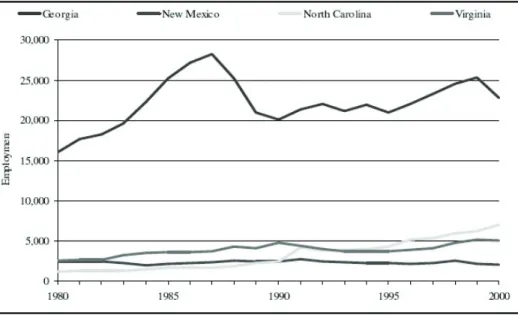
Though the specifics of each state’s experiences are not explored here, Figure 1 provides a general idea of how the aerospace industry has developed over time in each state, specifically during the twenty-year span be-tween 1980 and 2000.
The first result of note from Figure 1 is that Geor-gia’s aerospace industry, on the strength of its sizable manufacturing segment, was the largest among the four states as of the end of 2000. North Carolina’s industry, which began the highlighted period with the smallest to-tal, increased more than six-fold during the twenty-year span. As for the other benchmark states, Virginia’s in-dustry grew fairly steady between 1980 and 2000 as it tracked closely with North Carolina’s path. New Mexico, on the other hand, saw its industry total decrease lightly during the twenty-year period.
Traditional Aerospace Conclusions Revisited
Traditional aerospace positions are generally well-paying. This finding was definitely confirmed via the
benchmark analysis detailed in the full report. In fact, representatives from each of the three peer states inter-viewed explicitly stated that the aerospace employees in their respective states were generally well-paid, due in large part to the high quality work demanded in the in-dustry. Furthermore, officials from Georgia and Virginia pointed out that traditional aerospace pays well across the employment spectrum from aerospace engineer all the way to machinist.
Traditional aerospace can provide employment oppor-tunities for a diverse set of regions. One of the most attractive things about traditional aerospace was the fact that the industry could benefit virtually every corner of North Carolina’s diverse economic landscape, especial-ly distressed regions like eastern North Carolina. For-tunately, that notion was reinforced in the benchmark analysis – especially in Virginia where traditional aero-space is meaningful part of the state’s more corporate and research and development-focused areas, as well as its more rural, production-focused regions.
North Carolina has a favor-able mix of traditional aero-space industry segments. The full analysis suggested that the state’s existing strengths in tra-ditional aerospace – engine and engine part manufacturing, re-placement part manufacturing, and maintenance and repair – are growing segments of the industry and the evidence from chapter three certainly seemed to confirm that idea. Specifi-cally, Georgia officials noted that maintenance and repair is a rapidly expanding part of the industry and the testimonies of Virginia and Georgia officials both highlighted replacement part manufacturing as a busi-ness on the rise. Furthermore, based on New Mexico’s experiences with Eclipse Avia-tion, it also appears that the very light jet market is poised for significant growth in the next decade or so – a par-ticularly important finding given North Carolina’s recent addition of VLJ producer, HondaJet.
The military is a key part of North Carolina’s traditional aerospace industry. Despite employing an initial indus-try definition that explicitly excluded the military from traditional aerospace, the findings from the earlier inven-tory made it abundantly clear that North Carolina’s large military presence was a significant part of the state’s cur-rent and future involvement in the industry. That asser-tion was strongly reinforced throughout the benchmark analysis, most notably in Georgia where a large part of the state’s aerospace-related development efforts center
Source: Bureau of Labor Statistics
around Georgia’s seminal military aviation asset, Warner Robins Air Force Base in Macon.
North Carolina’s rich institutional network plays a cru-cial role in the development of the state’s traditional aerospace industry. The qualitative analysis drew atten-tion to North Carolina’s existing network of aerospace-related institutions and emphasized how important they would be to any future development in the industry – a point that was also emphasized throughout the bench-mark analysis. Specifically, the testimonies from the three states tied the development of traditional aerospace to the involvement of three types of institutions. First off, the benchmark analysis underscored the importance of hav-ing a flexible community college system that can provide customized training and produce significant numbers of key occupations such as machinists. Second, the other states stressed the importance of university involvement in traditional aerospace in order to produce key segments of the workforce such as aerospace engineers, but also to act as a source of innovation for the industry. Finally, the benchmark analysis emphasized the significance of other dedicated aerospace institutions such as the Aero-space Innovation Center in Georgia which often help coordinate overall development efforts. More generally, officials in all three states noted how important all three types of institutions are as a source of partnership and collaboration.
The future of traditional aerospace development in North Carolina faces several workforce availability challenges. Throughout the analysis it has become clear that North Carolina’s traditional aerospace industry is facing several workforce-related constraints, including a lack of machinist production caused in large part by the negative connation associated with manufacturing ca-reers. However, based on the testimonies of other states, North Carolina is not fighting those battles alone. Geor-gia and New Mexico both noted that skilled machinists are in high demand but short supply, while Virginia of-ficials reported an unwillingness among displaced manu-facturing workers towards obtaining the needed training that would allow them fill many of the machinist-type openings in the industry. Furthermore, the larger, more fundamental challenge regarding traditional aerospace’s image was also brought up during the benchmark analy-sis. Georgia officials, in particular, expressed concern over how to get the generation of workers to view tra-ditional aerospace as a viable career alternative. They suggest that the industry’s attractiveness suffers from sustained weakness in manufacturing, as well as, an ever-increasing interest in other technology areas such as computers.
Finally, the benchmark analysis also highlighted another key point regarding the future expansion of North Carolina’s traditional aerospace industry, namely, the importance of smaller, less busy airport facilities. Of-ficials in Virginia and New Mexico both emphasized the
fact that smaller, less busy airports can be real engines of traditional aerospace growth. In North Carolina there are a number of such facilities headlined by the Piedmont Triad International (PTI) Airport, which, as mentioned, has become a real hub of aerospace activity in the state. However, at some point PTI is likely to run out of room or at least become busy enough that it loses some its ini-tial appeal. Accordingly, the question becomes where else in North Carolina might such a hub emerge?
The answer, in the opinion of this analyst, is with-out question the Global TransPark in Kinston. The TransPark has become widely considered a failed eco-nomic development investment. Yet given the apparent attractiveness of less busy airport facilities with ample room for expansion and sufficient infrastructure, i.e. run-ways, this analysis holds that the TransPark could still be a success story. Remarketing the TransPark as a facility well-suited to handle traditional aerospace functions as opposed to global cargo logistics could provide a much needed venue for the further expansion of the state’s tra-ditional aerospace industry, bolster eastern North Caro-lina, and make use of an existing asset that many people have already written off.
An Assessment of Commercial Space
As mentioned throughout this analysis, the com-mercial space industry is largely an emerging field whose uncertain potential is best evaluated via the experiences of other states that have already begun their pursuit of the industry. That being said, this analysis offers the fol-lowing observations regarding North Carolina’s poten-tial pursuit of the commercial space industry.
First and foremost, it must be understood that any effort aimed at developing a commercial space presence in North Carolina is a risky proposition. Officials in both of the active commercial space states evaluated, New Mexico and Virginia, openly admit they are taking a siz-able risk. Furthermore, little of the enabling technology in either area of the industry, transportation or tourism, is well established.
Second, the regulatory environment for both areas is largely undecided. Nonetheless, industry experts be-lieve that private space operations will eventually hap-pen. The real question is when. The central point here is that if North Carolina decided to pursue the industry, it would take a massive amount of precious state resources as up-front investment.
SWOT Analysis
Moreover, North Carolina would be facing a particularlysteep learning curve given the paucity of space-related presence and/or facilities currently in the state. Virgin-ia’s decision to pursue commercial space was primarily a result of the existing NASA facility at Wallops Island. And while New Mexico did not have an existing
space-port per se, they did have a long legacy of space-related activity to build around. North Carolina, on the other hand, would essentially be starting from scratch.
Though an attractive case could probably be made for commercial space in North Carolina, in the end, we are agnostic about whether this emerging industry can
STRENGTHS
WEAKNESSES
Traditional Aerospace: - Provides well-paying jobs
- Industry presence throughout state
- Particularly meaningful presence in eastern North Carolina - State is home to four unique military aviation assets, all of
which are in eastern North Carolina
- Strong network of aerospace-related institutions including the North Carolina Aerospace Alliance
- Favorable industry mix in traditional aerospace including growing areas such as maintenance and repair and aircraft part manufacturing
- Recent addition of HondaJet gives state an aircraft produc-tion presence
- Strong traditional aerospace corporate presence in Char-lotte including firms such as Goodrich
- State has a flexible community college system that has added numerous aerospace-focused programs in recent years
- Ongoing collaboration between N.C. State, private indus-try, and the military
- The state has a long tradition with respect to a manufactur-ing and military presence
Traditional Aerospace:
- A lack of aerospace-related research and devel-opment activity
- Limited workforce production, particularly with respect to machinists and aerospace engineers - A lack of aerospace engineering programs - The recent negative image often associated with
manufacturing careers Commercial Space:
- A general lack of any space-related presence and/or facilities in the state
OPPORTUNITIES
THREATS
Traditional Aerospace:
- HondaJet’s place in the emerging very light jet industry - Traditional aerospace’s potential to help the state increase
its share of DoD dollars
- Traditional aerospace’s potential to help solidify presence of the state’s invaluable military aviation assets
- More small business growth/entrepreneurship opportuni-ties stemming from replacement part business
- Expanded future collaborations between state universities, community colleges, private industry, and the military - Potential spinouts from university-led aerospace research - Growth fueled by smaller, less busy airports such as
Pied-mont Triad International
- An opportunity to turn the Global TransPark into a positive - Synergy between traditional aerospace development and
more general efforts to grow state’s defense and security presence
- Potential to recruit more production operations to the state from companies already based in North Carolina, most notably Goodrich in Charlotte
Traditional Aerospace:
- The very light jet industry not materializing as experts predict
- Future rounds of BRAC closures and consolida-tions
- Consolidations among major aerospace produc-ers such as the possible merger/consolidation of Smiths Aerospace and GE Aviation
- National and international competition in the future recruitment of traditional aerospace firms - National competition for aerospace workforce
as evidenced by the University of North Dakota/ Robeson Community College Program
Commercial Space:
- Tremendous amount of competition from other states who are getting involved in the industry and getting their spaceports off the ground - Delays in the development of commercial
be a significant economic activity in the state. Rather, we are more concerned with making sure the would-be deci-sion makers understand the full nature of the required commitment and the risks associated with such a deci-sion.
Some Final Thoughts
Currently, neither traditional aerospace nor the commercial space industry are dominating fixtures on the North Carolina economic landscape. However, it has been shown throughout the course of this analysis that traditional aerospace does currently have a beneficial presence in state. The commercial space industry, on the other hand, has yet to arrive. The totality of the evidence presented suggests that traditional aerospace is capable of becoming a promising part of the state’s economic future, while the commercial space industry appears to have a lower potential in North Carolina, a result due to the absence of any unique space-related assets to build around and other states having significant head-starts in the marketplace.
As was evident from the benchmark analysis, de-velopment in either industry is largely dependent on an existing foundation of unique assets. However, even with the presence of an existing NASA facility, Virginia’s ex-perience with commercial space has still been a long, hard road toward any results even with a considerable head start. Unfortunately, North Carolina has no such leg up and, accordingly, any commercial-space related effort in the state would be from scratch, making for a very risky proposition with already scarce public economic development dollars.
On the other hand, the state has a rich endow-ment of unique traditional aerospace assets, especially the various military aviation facilities in eastern North Carolina. In fact, traditional aerospace and the military or more generally the defense industry are so intimately intertwined in North Carolina that this analysis feels that the term aero/defense economy is a more appropriate de-scriptor than aero/space. Nonetheless, the ultimate point is that economic development efforts are more likely to be successful when they leverage existing strengths, not when they pursue the latest trend. That being said, the evidence presented throughout this analysis makes a strong case that suggests that traditional aerospace is indeed a strength in North Carolina. Accordingly, this analysis contends that any future effort to expand the state’s traditional aerospace presence has the potential to succeed due to the solid foundation already in place.
Resource List
Aerospace Innovation Center. (2007). “About Us.” Retrieved February 3, 2007 from http://aerospace.georgiainnovation. org/about/us
Benneworth, P., and N. Henry. (2004). “Where is the Value Added in the Cluster Approach? Hermeneutic Theorizing, Economic Geography, and Clusters as a Multiperspectival Approach.” Urban Studies 41 (5/6): 1011-1024.
Bridgestone. (2006). “Bridgestone moving aircraft retreading plant.” Rubber and Plastics News. Retrieved January 25, 2007, from Lexis Nexis database.
Cortright, J. (2006). “Making Sense of Clusters: Regional Competitiveness and Economic Development.” Discus-sion Paper, Brookings Institute.
Craver, R. (2006a). “B/E Aerospace expanding work force af-ter landing United Airlines deal.” Winston-Salem Journal. Retrieved January 25, 2007, from Lexis Nexis database. Craver, R. (2006b). “B/E Aerospace may add jobs.”
Winston-Salem Journal. Retrieved January 25, 2007, from Lexis Nexis database.
DTSA. (2007). “About Us.” Retrieved February 17, 2007, from http://www.dstanc.org/about-dsta.html
FAA. (2007b). “Airport Data.” Retrieved March, 20 2007, from http://www.faa.gov/airports_airtraffic/airports/air-port_safety/airportdata_5010/
---.“Commercial Space Transportation Industry.” Retrieved March, 20 2007, from http://www.faa.gov/about/office_ org/headquarters_offices/ast/industry/
Feser, E. J., and M. I. Luger. (2003). “Cluster Analysis as a Mode of Inquiry: Its Use in Science and Technology Poli-cymaking in North Carolina.” European Planning Studies
11 (1): 11-24.
Georgia Tech. (2006). “Academic Stats”. Retrieved February 17, 2007, from http://www.coe.gatech.edu/academics/stats. php
Goodrich. (2006). “Goodrich Corporation: If There’s an Air-craft in the Sky, We’re On It.” Rotor and Wing. Retrieved January 25, 2007, Lexis Nexis database.
Hardin, J, et al. (2006). “The Aero/Space Economy in North Carolina: A Preliminary Assessment of Current Perfor-mance and Future Prospects.” Retrieved March, 20 2007, from http://www.space-frontier.org/Presentations/Aero-SpaceEconomyinNC.pdf
Hartnett, A.G. (2005). “Aerospace firm Curtiss-Wright moving corporate headquarters to Charlotte.” The Charlotte Ob-server. Retrieved January 25, 2007, Lexis Nexis database. Hirschman, D. (2006). “BIG PLANS for small planes.” The
Atlanta Journal-Constitution. Retrieved January 25, 2007, from Lexis Nexis database.
Manning, P. (2006). “Students participate in aerospace appren-ticeship program at Pisgah.” The Mountaineer. Retrieved January 25, 2007, Lexis Nexis database.
Michaels, K. (2006). “Forging Ahead: A MRO Market Out-look.” Retrieved April 4, 2007, from http://www.aerostrat-egy.com/speeches/speech_42.pdf
Mitchell, M. (2007). “Pending sale of Smiths plant to GE sur-prises Ashe County.” Winston-Salem Journal. Retrieved January 25, 2007, from Lexis Nexis database.
National Institute of Aerospace. (2007). “About Us.” Retrieved February 22, 2007 from http://www.nianet.org/aboutus/ N.C. State. (2005). “Engineering receives $5.4M Golden LEAF
grant.” Bulletin Online. Retrieved February 17, 2007, from http://www.ncsu.edu/BulletinOnline/05_05/leaf.htm Neal, D. (2007). “200 jobs coming to Smiths Aerospace.”
Asheville-Citizen Times. Retrieved March 13, 2007, from h t t p : / / w w w. c i t i z e n - t i m e s . c o m / a p p s / p b c s . d l l/