ABSTRACT
New Nd isotopic data of zircon grains from dikes and spatially associated, penecontemporaneous tuffs within the Latir volcanic field (NM) and Mount Princeton (CO) do not show an isotopic connection between the dikes and tuffs. I hypothesize that these inconclusive results are from inheritance of Precambrian zircons within the samples. U-Pb geochronology data of the Questa ring dike sample supports this hypothesis because it is demonstrably older than previously dated samples. Future research should date the samples using zircon U-Pb geochronologic methods alongside the Nd analysis to ensure that the samples are not contaminated with inherited zircons.
INTRODUCTION
Supereruptions are large (>500 km3) volcanic eruptions that can have devastating effects on Earth’s environment. Fully understanding the source of these eruptions is important in understanding the likelihood of occurrence and the origin and evolution of the magmas. Investigating the relationship between the unerupted plutonic rocks and the erupted volcanic rocks can help elucidate the source of supereruptions.
Evaluating these two hypotheses requires investigation of spatially and temporally related plutonic and volcanic rocks.
The Southern Rocky Mountain volcanic field provides an opportunity to discern the field relations between intrusive and extrusive rocks because coeval plutonic and volcanic rocks are exposed and within close proximity to one another. Zircon U-Pb geochronologic data (Tappa et al., 2011; Mills and Coleman, 2013) indicate that, in two locations (the Latir volcanic field and Mount Princeton), plutonic rocks that are age-equivalent to tuffs are limited to small (meter-scale) dikes: large, kilometer-scale plutons are either demonstrably older or younger than the erupted rocks.
The link between dikes and tuffs suggested by geochronologic data can be tested through the isotope geochemistry of the plutonic and volcanic rocks. If the dikes directly fed tuffs, with little or no upper crustal residence or modification (Glazner et al., 2008; Tappa et al., 2011; Mills and Coleman, 2013), the feeder dikes should be isotopically equivalent to the tuffs. I provide new zircon Nd isotopic data for a ring dike near the Questa caldera and the coeval Amalia Tuff, and a “tuff dike” north of the Mount Aetna caldera and the coeval Badger Creek Tuff.
GEOLOGIC SETTING
an approximately 500 km3 peralkaline high-silica rhyolite (Lipman et al., 1986). Surrounding the Questa Caldera are a number of ring dikes that are compositionally similar to the Amalia Tuff (Lipman et al., 1986). The only plutonic rocks that yield the same age as the Amalia Tuff are the ring dikes surrounding the Questa caldera with a weighted mean 206Pb/238U age of 25.64 ± .08 Ma (Tappa et al., 2011). The dikes intrude the surrounding pre-Tertiary rocks at the northern rim of the caldera (Lipman and Reed, 1989).
The Mount Aetna caldera is located north of Questa in the Colorado portion of the Southern Rocky Mountain volcanic field (Figure 2). Following Laramide shortening, magmatism began at the Mount Aetna caldera at approximately 37 Ma (Lipman and Bachmann, 2015). The Mount Aetna caldera formed during the eruption of the Badger Creek Tuff at 34.47 ± 0.05 Ma (Mills and Coleman, 2013). None of the surrounding plutonic rock temporally matches the Badger Creek Tuff except for small dikes outside and on the rim of the caldera. One of these, the so-called tuff dike because of the occurrence of flattened pumice, was dated to have a weighted mean 206Pb/238U age of 34.57 ± 0.08 Ma (Mills and Coleman, 2013). Another ring dike was dated to have a weighted mean 206Pb/238U age of 34.48 ± 0.09 Ma (Mills and Coleman, 2013). Both the tuff dike and the ring dike intrude the Mount Aetna pluton (Mills and Coleman, 2013).
METHODS
Neodymium isotope geochemistry
concentrate the amount of zircons in each sample. Next the zircon grains were picked by hand for each sample under a microscope. For each sample approximately 100 zircon grains were picked for analysis. These zircon grains were placed in a 220˚C oven for five days in a pressure-dissolution vessel that contained 500 microliters of HF and 500 microliters of HNO3 in order to completely dissolve them. After taking the samples out of
the oven they were dried down, fluxed with HCl, and spiked using a 150Nd/144Nd tracer. Isolation of Nd and Sm was accomplished with α-HIBA cation exchange column chromatography. Columns were filled with a resin and flushed with α-HIBA. Next, samples were loaded into the columns, and α-HIBA was added to elute the Nd and Sm from each sample (Boyet and Carlson, 2005). After collection of both Nd and Sm the samples were in solution with α-HIBA. α-HIBA affects the ionization of Nd on the mass spectrometer, so the samples were dried down to remove any α-HIBA. Samples were dissolved with a mixture of 13 M HNO3 and 6 M HCL, and then dried down to evaporate
any remaining α-HIBA (Boyet and Carlson, 2005). Once dried down the samples were loaded onto Re and Ta filaments (for Nd and Sm samples, respectively) and placed in the mass spectrometer. Neodymium isotopic ratios were measured on the Phoenix X62 thermal ionization mass spectrometer, and Sm isotopic ratios were measured on the VG Sector 54 thermal ionization mass spectrometer.
U-Pb geochronology
For two samples, a small aliquot was taken for U-Pb geochronology analysis after samples had been dissolved. This aliquot was spiked with 205Pb-233U-236U tracer. HCl
down, loaded onto Re filaments, and measured on the VG Sector 54 thermal ionization mass spectrometer.
RESULTS
Nd isotopic data
All samples show a wide range of Nd, 143Nd/144Nd, [Nd] ppm, and [Sm] ppm, and 147Sm/144Nd values (Table 1). I collected multiple samples for the Questa caldera ring dike, and these samples yield varying 143Nd/144Nd age corrected ratios. These samples have a 143Nd/144Nd range of from 0.511981 ± 0.000267 to 0.512628 ± 0.000062. The
Amalia Tuff yields a 143Nd/144Nd age corrected ratio of 0.512234 ± 0.000034. The Mount Princeton tuff dike samples yield varying 143Nd/144Nd age corrected ratios. These samples
have a 143Nd/144Nd range of 0.512137 ± 0.000029 to 0.512297 ± 0.000028. The Badger Creek tuff yields a 143Nd/144Nd age corrected ratio of 0.512219 ± 0.000057.
U-Pb geochronology
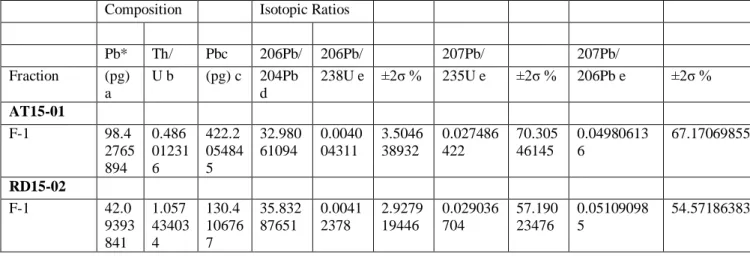
I dated the Questa ring dike and the Amalia Tuff (Table 2). The Questa ring dike yields an age of 26.6 ± 0.77, which is demonstrably older than previous data from Tappa et al. (2011). The Amalia Tuff yields an age of 25.85 ± 0.89, which is consistent with previous data from Tappa et al. (2011) (Figure 3).
DISCUSSION
New Nd data
eNd ±2σ 143Nd/144Nd ±2σ [Nd] ppm
[Sm] ppm
147Sm/144Nd ±2σ
Questa ring dike
RD15-02 -2.73 0.73 0.512466 0.000037 90.723 38.054 0.2536 0.0022
RD15-02C 0.43 1.22 0.512628 0.000062 34.561 11.49 0.201 0.0022
RD15-03 -6.14 0.67 0.512291 0.000034 78.518 24.58 0.3461 0.0024
RD15-03C -12.19 5.21 0.511981 0.000267 3.784 1.418 0.2264 0.0052
Amalia Tuff
AT15-04 -7.43 0.66 0.512224 0.000034 46.131 18.917 0.2479 0.002
Mount Princeton
tuff dike
MPRM-4 -5.77 0.54 0.512297 0.000028 4.962 2.315 0.282 0.0021
MPRM-4C -8.9 0.57 0.512137 0.000029 94.404 21.456 0.1374 0.0011
Badger Creek
Tuff
MPRM-30 -7.3 1.12 0.512219 0.000057 11.565 3.527 0.1843 0.002
Composition Isotopic Ratios
Pb* Th/ Pbc 206Pb/ 206Pb/ 207Pb/ 207Pb/
Fraction (pg) a
U b (pg) c 204Pb d
238U e ±2σ % 235U e ±2σ % 206Pb e ±2σ %
AT15-01
F-1 98.4 2765 894 0.486 01231 6 422.2 05484 5 32.980 61094 0.0040 04311 3.5046 38932 0.027486 422 70.305 46145 0.04980613 6 67.17069855 RD15-02
F-1 42.0 9393 841 1.057 43403 4 130.4 10676 7 35.832 87651 0.0041 2378 2.9279 19446 0.029036 704 57.190 23476 0.05109098 5 54.57186383 Dates (Ma) 206Pb/
238U ±2σ 207Pb/ ±2σ 207Pb/ ±2σ Corr.
<Th> f abs 235U g abs 206Pb g abs coef.
25.85556383 0.89551163 5 27.5325715 4 19.0968219 2 184.917061 1 1564.18359 6 0.89944225 7
26.60482746 0.77122104 3 29.0634373 1 16.3858225 9 243.909242 7 1257.21647 7 0.89940033 5
a Total mass of radiogenic Pb.
b Th contents calculated from radiogenic 208Pb and 230Th-corrected 206Pb/238U date of the sample, assuming concordance between U-Pb Th-Pb systems.
c Total mass of common Pb.
d Measured ratio corrected for fractionation and spike contribution only. e Measured ratios corrected for fractionation, tracer and blank.
f Corrected for initial Th/U disequilibrium using radiogenic 208Pb and Th/U[magma] = 3.5000.
g Isotopic dates calculated using λ238 = 1.55125E-10 (Jaffey et al. 1971) and λ235 = 9.8485E-10 (Jaffey et al. 1971).
samples indicate that the samples may have Precambrian zircons that have caused inheritance in the samples (Figure 4). New Nd data for the Mount Princeton tuff dike and the Badger Creek Tuff do not overlap within uncertainty for age corrected 143Nd/144Nd ratios (Figure 4). I hypothesize that with such a large amount of zircons in the analysis Precambrian zircons contaminated the Nd isotope chemistry of the samples, so there is inconclusive evidence to support an isotopic link between the dike and tuff.
Magmatic Evolution of the Questa and Mount Aetna calderas
For both the Questa and Mount Aetna calderas previous workers (Lipman et al., 1986; Campbell, 1994; Zimmerer and McIntosh, 2012) proposed that the erupted equivalent of the surrounding plutons are the tuffs. However, geochronologic data (Tappa et al., 2011; Mills and Coleman, 2013) indicate that the surrounding plutons are incrementally assembled over millions of years, whereas the eruptions of tuffs happen almost instantaneously. Furthermore, the geochronologic data temporally links small ring dikes to the tuff. The new Nd data cannot isotopically link the dikes and tuffs due to a wide range of age corrected 143Nd/144Nd ratios that are caused from the inheritance of Precambrian zircons. This inheritance is shown in the U-Pb geochronology data (Figure 3). The older age of the Questa ring dike infers that the sample is contaminated with inherited zircons.
Pluton Assembly
Figure 4: 143Nd/144Nd age corrected ratios for the Mount Princeton tuff dike, Badger Creek Tuff, Questa ring dike, and Amalia Tuff. Green data points are whole rock
143Nd/144Nd age corrected ratios taken from Johnson et al. (1990) for the Questa ring dike
eruptions are occurring (Glazner et al., 2004; Tappa et al., 2011; Zimmerer and McIntosh, 2012; Mills and Coleman, 2013). On the basis of previous U-Pb zircon geochronologic data, the only age-equivalent plutonic rocks to the tuffs at Questa and Mount Princeton are small feeder dikes. The temporal link between the dikes and the tuffs show that the dikes are likely to be the source for the high-flux magma that erupts to form the large-volume tuffs. I hypothesized that if the dikes and tuffs are temporally linked, then they should also be isotopically linked. The results were inconclusive to support this hypothesis due to a wide range of Nd isotopic data that do not overlap within uncertainty. I hypothesize that this wide range is due to the large amount of zircons needed for analysis, and this large amount included unwanted Precambrian zircons that affected the data. The U-Pb data of the Questa ring dike indicates this inheritance, and for future research date all of the samples should be dated to to check if there has been contamination with Precambrian zircons. Dating all of the samples and ensuring that the dates of the samples match existing U-Pb zircon geochronologic data (Tappa et al., 2011; Mills and Coleman, 2013), the possibility that the Nd ratios in the samples are contaminated by inherited zircons could be eliminated.
CONCLUSIONS
New zircon Nd isotopic data are inconclusive and cannot isotopically link small feeder dikes to large-scale volcanic eruptions. These new isotopic data cannot support previous research because the samples do not overlap within uncertainty for 143Nd/144Nd
geochronologic data. The U-Pb zircon geochronology date of the Questa ring dike from this study does not overlap within uncertainty with data from Tappa et al. (2011), so I infer that the ring dike samples have inherited zircons. Future Nd analysis needs more U-Pb zircon geochronologic data to ensure that the samples are not contaminated with inherited zircons.
ACKNOWLEDGEMENTS
REFERENCES CITED
Bachmann, O., C. F. Miller, and S. L. de Silva (2007), The volcanic‐ plutonic connection
as a stage for understanding crustal magmatism, J. Volcanol. Geotherm. Res., 167(1–4), 1–23, doi:10.1016/j.jvolgeores.2007.08.002.
Boyet, M., and Carlson, R.W., (2005), 142Nd evidence for early (>4.35 Ga) global
differentiation of the silicate earth: Sceince, v. 3099, 576-581.
Campbell, S. K. (1994). A geochemical and strontium isotopic investigation of Laramide and younger igneous rocks in central Colorado, with emphasis on the petrogenesis of the Thirtynine Mile volcanic field. (volumes I and II). (Order No. 9434102, The Florida State University).
de Silva, S. L., and W. D. Gosnold (2007), Episodic construction of batholiths: Insights from the spatiotemporal development of an ignimbrite flare‐ up, J. Volcanol.
Geotherm. Res., 167(1–4), 320–335, doi:10.1016/j.jvolgeores.2007.07.015. Eichelberger, J. C., P. E. Izbekov, and B. L. Browne (2006), Bulk chemical trends at arc
volcanoes are not liquid lines of descent, Lithos, 87(1–2), 135–154, doi:10.1016/j.lithos. 2005.05.006.
Glazner, A. F. (1991). Plutonism, oblique subduction, and continental growth; an example from the Mesozoic of California. Geology (Boulder), 19(8), 784-786. Glazner A.F., Bartley J.M., Coleman D.S., Gray W, Taylor R.Z. (2004) Are plutons
Glazner, A. F., D. S. Coleman, and J. M. Bartley (2008), The tenuous connection between high‐ silica rhyolites and granodiorite plutons, Geology, 36(2), 183–186,
doi:10.1130/ G24496A.1
Hildreth, W. (2004), Volcanological perspectives on Long Valley, Mammoth Mountain, and Mono Craters: Several contiguous but discrete systems, J. Volcanol. Geotherm. Res., 136(3–4), 169–198, doi:10.1016/j.jvolgeores.2004.05.019.
Jaffey, A.H., Flynn, K.F., Glendenin, L.E., Bentley, W.C. and Essling, A.M., 1971. Precision measurement of the half-lives and specific activities of 235U and 238U. Phys. Rev., 4: 1889-1906.
Johnson, C. M., Lipman, P. W., & Czamanske, G. K. (1990). H, O, Sr, Nd, and Pb isotope geochemistry of the Latir volcanic field and cogenetic intrusions, New Mexico, and relations between evolution of a continental magmatic center and modifications of the lithosphere. Contributions to Mineralogy and Petrology, 104(1), 99-124.
Lipman, P. W. (2007), Incremental assembly and prolonged consolidation of Cordilleran magma chambers: Evidence from the Southern Rocky Mountain volcanic field, Geosphere, 3(1), 42–70, doi:10.1130/GES00061.1.
Lipman, P. W., and J. C. Reed Jr. (1989), Geologic map of the Latir volcanic field and adjacent areas, northern New Mexico, scale 1:48,000, U.S. Geol. Surv. Misc. Map, 1-1907.
Lipman, P. W., H. H. Mehnert, and C. W. Naeser (1986), Evolution of the Latir volcanic field, northern New Mexico, and its relation to the Rio Grande Rift, as indicated by potassium-argon and fission track dating, J. Geophys. Res., 91(B6), 6329– 6345.
Mills, R. D., and D. S. Coleman (2013), Temporal and chemical connections between plutons and ignimbrites from the Mount Princeton magmatic center, Contrib. Mineral. Petrol., 165(5), 961–980, doi:10.1007/s00410-012-0843-4.
Rosera, J. M., Coleman, D. S., & Stein, H. J. (2013). Re‐evaluating genetic models for porphyry Mo mineralization at Questa, New Mexico: Implications for ore deposition following silicic ignimbrite eruption. Geochemistry, Geophysics, Geosystems, 14(4), 787-805.
Tappa MJ, Coleman DS, Mills RD, Samperton KM (2011), The plutonic record of a silicic ignimbrite from the Latir volcanic field, New Mexico. Geochem Geophys Geosyst 12:Q10011