Self-Disclosure and Liking Across Groups
Ellie Wallace
Senior Honors Thesis in Psychology University of North Carolina at Chapel Hill
25 April 2018
Approved:
Abstract
What is it about our communication with other individuals that makes us like them and
subsequently become interested in forming a relationship with them? Is it what they share with us about themselves? Or perhaps the personal information about ourselves that we share with them? This exploratory honors thesis investigates a current gap in the self-disclosure literature, looking at the link between self-disclosure and liking in and between groups. Individuals were given an opportunity to disclose either low, medium, or high intimacy information to a
previously unknown target and then asked to rate their feelings about that person after the disclosures. We were interested in the differing effects of disclosing to an in-group or out-group target on ratings of liking, interest in becoming friends, and interest in obtaining contact
information. We found that as disclosures became more personal, those ratings tended to
increase. But group membership was not a significant moderator of these ratings. This study sets the basis for future research on the subject, by providing initial results as well as easily replicable procedures and measures for the investigation of intergroup effects of self-disclosures.
Acknowledgments
First and foremost I would like to thank my advisor, Dr. Keely Muscatell, for her support and patience over the past two years as this project has evolved into a final product. Thank you for teaching me about the ups and downs of research and serving as a role model over the course of this project. I would have never made it without your encouragement and your never ending supply of new ideas!
I would also like to thank the members of my committee, Dr. Sara Algoe and Tatum Jolink, for giving their time to listen to my ideas and offer their own.
Finally, I’d like to thank the research assistants of the Social Neuroscience and Health lab who have helped with data collection during the Facial Database effort as well as the
Self-Disclosure and Liking Across Groups
Why do people form relationships? What motivates us to communicate with one another? Humans have an innate motivation to survive and reproduce (Baumeister & Leary, 1995). One of the ways in which we ensure our survival and ability to propagate our genes is through
interpersonal communication. Cultural knowledge as well as personal information must be shared from one individual to another in order to establish relationships. This is accomplished through conversation. But what is it that we reveal during those conversations that causes us to like the other individual with whom we’re conversing? This study suggests that relationship-building communication centers on self-disclosure. But is it what people reveal about themselves to us, or perhaps what we reveal about ourselves to them, that forges these connections?
For the purposes of this study, self-disclosure is defined as the exchange of personal information from one individual to another. We will investigate how qualities of self-disclosure predict the desire to pursue relationships as well as liking ratings between individuals. These ratings will include how much the participant likes the person to whom they’re disclosing, how interested they would be in becoming friends with that individual, and how interested they would be in obtaining their contact information. We will look at the differences between three levels of self-disclosure (low, medium, and high) during interpersonal communication as a predictor of liking. Further, we will investigate this in both in-group as well as out-group communication. Prior Research
During interpersonal interactions, people experience positive feelings toward those to whom they have disclosed personal information (Worthy et al, 1969). We disclose more personal information to individuals whom we have already established we like and less personal
self-disclose to us rather than those who do not (Worthy et al, 1969). These interactions have been modeled in the lab in order to predict disclosure behaviors. Stemming from this, the Disclosure Decision Model predicts instances where individuals will self-disclose; it states that individuals must have a salient goal, appropriate target, and must weigh the risk versus utility of the
disclosure (Omarzu, 2000).
While informative, this past research has some important limitations. First, many of these prior investigations focused on liking ratings from the targets of the disclosure, rather than liking ratings from the disclosers themselves. In other words, very little research has examined if, during interpersonal communication, the degree of my disclosure is associated with my liking of the target to whom I disclosed. This is an important limitation, because relationships are a two-way street. They involve both sharing and receiving information, so it is interesting that in the past much of the research has focused on ratings following the receipt of information. We plan to look at the other side, individuals’ opinions about others after they themselves share personal information.
A further limitation is concerned with the intimacy level of these disclosures. Past research has not systematically varied the level of intimacy of information disclosed during an interaction and examined how this effects liking. Thus, our knowledge of the relationship between intimacy of disclosure (i.e., “small talk” versus sharing more intimate knowledge of one’s past experiences and preferences) and liking is limited. We examine the small known background of intimacy-variance in the next section.
Intimacy Level
female participants communicated with partners who were low-disclosing, medium-disclosing, or high-disclosing. One member of the dyad chose to disclose ten items out of a seventy-item list. In order to protect against reactions to content versus disclosure level, the participants were only informed about what topic the other participant had chosen to disclose. Altering the intimacy level of instances of disclosure resulted in a curvilinear relationship between self-disclosure and subsequent liking ratings (Cozby, 1972). Low intimacy self-disclosures were low in liking ratings, medium intimacy disclosures were higher in liking ratings, and high intimacy disclosures were again lower in liking ratings.
High intimacy disclosures were lower in terms of these ratings, because disclosing information at that level produced anxiety and therefore reduced liking (Cozby, 1972).
Conversely, low intimacy disclosures had little effect on relationship formation and were low in liking as well (Cozby, 1972). Therefore, the most impactful level of disclosure can be seen as a compromise between the two extremes. These findings were later expanded, showing
appropriate medium-level disclosures were associated with lower levels of loneliness than inappropriately high levels of disclosure (Chelune, 1980). But what is it about this sharing of personal information that makes us like other individuals? The neural basis of these disclosures is examined in the next section.
Neural Background
opportunity to disclose over the monetary award. This pattern of findings suggests that self-disclosures are intrinsically rewarding to the individual who is making the self-disclosures. These reward processes could be central in the model that we are proposing in which the individual who discloses feels rewarded and thus rates their disclosure partner more highly as a result. Our study will focus on this discloser-based model, while expanding the procedures to investigate both differing levels of disclosure as well as communication between groups.
Intergroup Effects
Group membership has the capacity to moderate the effects of the self-disclosure and liking relationship as well. It cannot be assumed that individuals disclose the same information to others in both their in-group and out-group (whether those groupings be gender, race,
socioeconomic status, age, etc.). Intimate information is seen as intrinsically valuable and self-disclosure is one factor that may decrease biases toward out-group members (Ensari, 2002). Further, individuals disclosing personal information to strangers from their out-group may actually perceive those same out-group individuals as more similar to themselves as a result of the disclosure (Ensari, 2002). Perhaps forcing people to disclose with individuals in their out-group could make them more interested in forming a relationship with those individuals.
Those questions, while important, will not be directly measured in this study. Instead, we will use forced disclosures to both in and out-group members to be able to directly investigate the self-disclosure and liking relationship between groups. After that relationship is understood, the research could then be expanded to investigate instances in which individuals do and don’t disclose to these groups and the resulting liking ratings in those situations. But for now, we will focus on the current research.
The Present Study
Unlike much of the early self-disclosure research, liking will be measured not by the person hearing the personal information but by the person disclosing it. Participants will reveal information about themselves and then rate how much they like the individual to whom they disclosed. Tamir’s methods had several shortcomings, including failure to take intimacy level into account. Every self-disclosure was surface level. Cozby’s methods took disclosure level into account but didn’t include disclosure to multiple targets. Participants were matched in pairs and all methods carried out in that dyadic structure. This research will attempt to investigate these shortcomings by investigating the self-disclosure and liking relationship at three levels of disclosure (low, medium, and high) to both in-group and out-group individuals.
This paper will discuss the results of three studies, the first two of which function to create and norm the stimuli to be used in the final study. The final study will include the chatting simulation and subsequent liking ratings, which will investigate our research questions.
report the highest levels of liking. Further, participants disclosing high intimacy personal information (i.e. their political views, past hardships, views of themselves, etc.) to out-group individuals will report the lowest levels of liking. We hypothesize a curvilinear relationship between self-disclosure and liking for the three levels, with out-group disclosures significantly lower in liking ratings than in-group disclosures.
Study 1: Methods
Study 1A: Facial Database Image Collection
Participants The participants for this study were 133 individuals from the campus of the University of North Carolina at Chapel Hill and 149 individuals from the campus of North Carolina State University. Participants from UNC Chapel Hill were between 18 and 44 years of age (M=19.9, SD=3.06). The majority (80.4%) were current college students. Participants from NC State were between 18 and 39 years of age. The majority were also current college students.
Procedure A data collection table was set up in a highly trafficked area of each campus, advertising creation of a facial database to be used for future psychological research. Interested individuals approached the table and were given a consent form by a research assistant. After giving verbal consent, participants were assigned a subject ID number and asked to complete a brief demographics information form. After completion of the form, a second research assistant took three photographs of the participant. In the first photograph, the participant held up a white board on which their subject ID number was written. In the second photo, the participants were asked to have a neutral face and in the third they were asked to smile. The participants were then thanked for their participation and offered their choice of a candy bar as compensation. The same procedure was used on both campuses.
Participants This study was completed via Amazon’s Mechanical Turk (mTurk). Thirty mTurk workers completed each of six surveys. Participants were permitted to take part in more than one survey if interested, but were not required to complete all six. All participants were over 18 years of age, were in the top 40% of approval ratings for all mTurk workers, and had
completed at least 100 previous HITs.
ProcedureThe mTurk workers rated 180 female faces from the original collection effort. The images were organized into 6 distinct Qualtrics surveys, each containing 15 individuals from UNC Chapel Hill and 15 individuals from NC State (though group membership was
unbeknownst to raters). On each trial, participants were presented with an image, and then asked to select what they thought the gender and race of the individual in the image was, from a series of choices. They then rated the images on a scale of 1-7 for the following characteristics:
likeable, threatening, attractive, trustworthy, happy, surprised, and unusual. They completed this same procedure for each of the 30 images in that survey. At the conclusion of the ratings, the participants were thanked and paid for their participation.
Study 1: Analyses and Results
For the purposes of this study, a facial database was desired that included 45 NC State students and 45 UNC Chapel Hill students. In order to protect against between-groups effects (beyond the intended effect of the differences between schools), only female Caucasian images were selected for the final group. The mTurk ratings were averaged for each image (for the seven categories: likeable, threatening, attractive, trustworthy, happy, surprised, and unusual as well as percent agreement for gender and race) and standard deviations were obtained.
characteristics. Thus, there was not a significant difference in rated ages for UNC Chapel Hill images (M=23.01, SD=1.59) and NC State images (M=22.51, SD=1.21); p=0.09. There was also not a significant difference in the raters’ agreement on the subjects’ race (Caucasian) between UNC Chapel Hill images (M=94.54%, SD=6.91) and NC State images (M=96.38%, SD=4.56); p=0.14. Therefore, for the purposes of this research the two sets of images can be considered equal in terms of age and race. They were also not significantly different on any of the seven other characteristics: likeable, threatening, attractive, trustworthy, happy, surprised, and unusual; all p > 0.05. These distinctions are important when attempting to investigate UNC Chapel Hill as the in-group and NC State as the out-group, as all other differentiating between groups factors (gender, race, age, etc.) should be held equal in order to accurately test our hypotheses.
Study 1: Discussion
The goal of studies 1A and 1B were to collect images of students at UNC Chapel Hill and NC State to be used in the final study. The images were then rated to create a stimulus set that was matched on all the desired characteristics. These goals were accomplished, and a stimulus set of 90 Caucasian females, 45 from UNC Chapel Hill and 45 from NC State, was created. The next step in preparing for the final study was to create and then norm a set of self-disclosure questions to be used in the chatting simulation.
Study 2: Methods
Study 2: Norming Self-Disclosure Questions
ProcedureParticipants were recruited through an advertisement on the UNC SONA participant pool website. If interested, participants registered for the study and were provided a link to the Qualtrics survey. They were told they would be rating a series of “Getting to Know You” questions on three characteristics: “How personal is this question?” “How positive is this question?” and “How comfortable would you feel answering this question to a stranger?”. Participants responded on a scale from 1-7, ranging from 1 = Not at all to 7 = Extremely. Participants rated 143 questions in total, which ranged from the very impersonal (e.g., What’s your favorite genre of music?) to the very personal (e.g., What’s your stance on abortion?). At the conclusion of the survey, participants were thanked and given participant pool credit.
Study 2: Analyses and Results
Out of the initial 143 questions that participants rated, we aimed to create three different categories of questions corresponding to the levels of disclosure of interest (low-disclosure, medium-disclosure, and high-disclosure), with 30 questions per disclosure level. Some questions were removed from the sample due to subject matter (referencing illegal activity or other highly-anxiety producing topics) and others were removed according to the ratings in order to reach the intended number (90 questions total, 30 per disclosure category).
Each disclosure level was statistically different from the other two in terms of participants’ ratings of how personal the question was, as well as how comfortable the participants would be answering the question to a stranger. For ratings of how personal the question was, the low-disclosure questions (M=2.82, SD=0.29) were rated significantly less personal than the medium-disclosure questions (M=4.20, SD=0.25); p=4.86x10-41, and
than the high-disclosure questions (M=5.32, SD=0.43); p=9.33x10⁻¹⁶. For ratings of how comfortable the person would feel answering the question to a stranger, the low-disclosure questions (M=5.78, SD=0.25) were rated as significantly more comfortable to answer than the medium-disclosure questions (M=5.25, SD=0.29); p=3.83x10⁻⁹, and the high-disclosure
questions (M=4.30, SD=0.77); p=1.50x10⁻¹⁰. The comfortable ratings for the medium-disclosure questions (M=5.25, SD=0.29) were significantly higher than the comfortable ratings for the high-disclosure questions (M=4.30, SD=0.77); p=1.79x10⁻⁶. These results suggest that the groups of questions are distinctly different, such that the questions become increasingly personal and less comfortable to answer with each advancing category (low to medium, medium to high).
Turning to the positivity ratings, we selected a set of questions for each disclosure category that were not statistically different on positivity. We did this so that the valence of the question (positive versus negative) was not a contributing factor to future participant responses to these questions. Indeed, the low-disclosure questions (M=4.33, SD=0.49) were rated similarly on positivity to the medium-disclosure questions (M=4.30, SD=0.60); p=0.79, and to the high disclosure questions (M=4.04, SD=1.03); p=0.16. The positivity ratings for the
medium-disclosure questions (M=4.30, SD=0.60) were also not statistically different from the positivity ratings for the high-disclosure questions (M=4.04, SD=1.03); p=0.20.
Study 2: Discussion
subsequent studies utilizing these stimuli should be due to the difference in the disclosure level of the questions, not due to the relative positivity or negativity of the topics that the question addresses.
With our facial database created and our getting to know you questions normed and categorized into three disclosure categories, we could now move to the main study. As a
reminder, the goal of this study was to examine the effects of self-disclosure at three levels (low, medium, and high) on liking ratings for both in-group and out-group targets. We hypothesized that participants disclosing medium intimacy personal information to other in-group individuals will report the highest levels of liking. Further, participants disclosing high intimacy personal information to out-group individuals will report the lowest levels of liking. Overall, we predicted a curvilinear relationship between self-disclosure and liking for the three levels, with out-group disclosures significantly lower in liking ratings than in-group disclosures.
Study 3: Methods
Study 3: Self-Disclosure Simulation and Ratings
Participants The participants for this study were 28 female Caucasian undergraduate students from the University of North Carolina at Chapel Hill. The average age of the
Procedure After registering for participation, participants received a personalized link to a Qualtrics survey that they were instructed to complete at least 12 hours before their scheduled appointment in the lab. The survey began with a consent form and demographic data. Then, participants answered the 90 normed “Getting to Know You” questions (30 low-disclosure, 30 medium-disclosure, and 30 high-disclosure). These questions were followed by an extroversion scale, the UCLA Loneliness scale, and a “Perceptions of NC State” scale intended to look at how individual differences in these factors might influence responses to the experimental task. (Note: Results from moderator analyses will not be presented here, but could be examined in future analyses.)
Upon arriving to the lab for their experimental session (after completing the survey at least 12 hours prior), participants signed a consent form and were introduced to the cover story for the study. They were told they were participating in an investigation of “interpersonal communication in the digital age” and would be chatting with a number of other individuals via an online platform designed for use in the study. Further, participants were told there would be two groups of participants in the study: “senders,” who sent their answers to the previous survey questions to other participants, and “receivers,” who would receive and read the survey answers of the senders. All participants were told that they were assigned to the “senders” group and would thus be sending their responses to the survey questions to “other participants” in the study.
already uploaded to the same profile. After the break, they were shown an example of the chatting simulation.
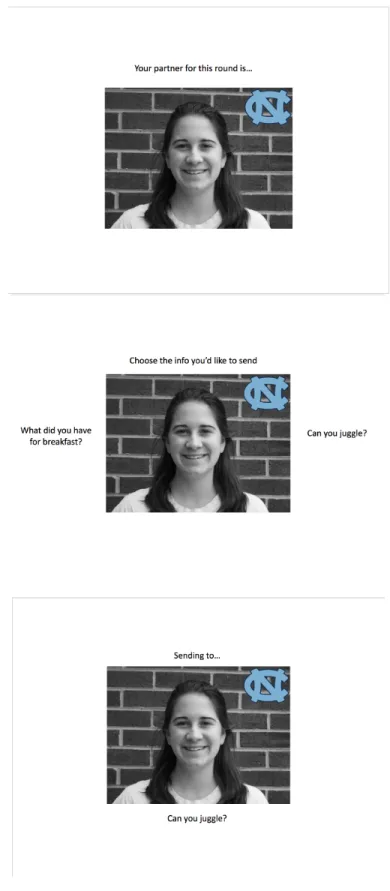
During the chat, participants were introduced to 90 female Caucasian individuals whom they were told were the “receiver” group. These images were taken from the Facial Database (45 UNC Chapel Hill, 45 NC State). Each image was converted to greyscale and the school logo was added in the top right corner so that participants would know if the person pictured was a UNC Chapel Hill or NC State student. On the first screen for each trial, participants saw an image of their interaction partner (Figure 1) for that trial. On the second screen (Figure 1), participants saw the same image of their interaction partner, as well as two questions that they had previously answered in the survey. Both questions belonged to the same self-disclosure category (i.e., on a low-disclosure trial, participants would be shown two low-disclosure questions). Participants were asked to choose one question to send; they believed that question as well as their answer from the survey would be received by the partner (“receiver”) on that round of the chat. Once a choice was made, they were again presented with the image of their partner along with their choice of question (Figure 1). Participants completed this procedure for 90 trials, 30 from each disclosure level (low, medium high). Fifteen trials of each disclosure level included NC State students as interaction partners. The other fifteen of each level were UNC Chapel Hill students. Participants were not told which intimacy level was being used, or that we were studying varying self-disclosure levels, but they were aware of which school the partner attended.
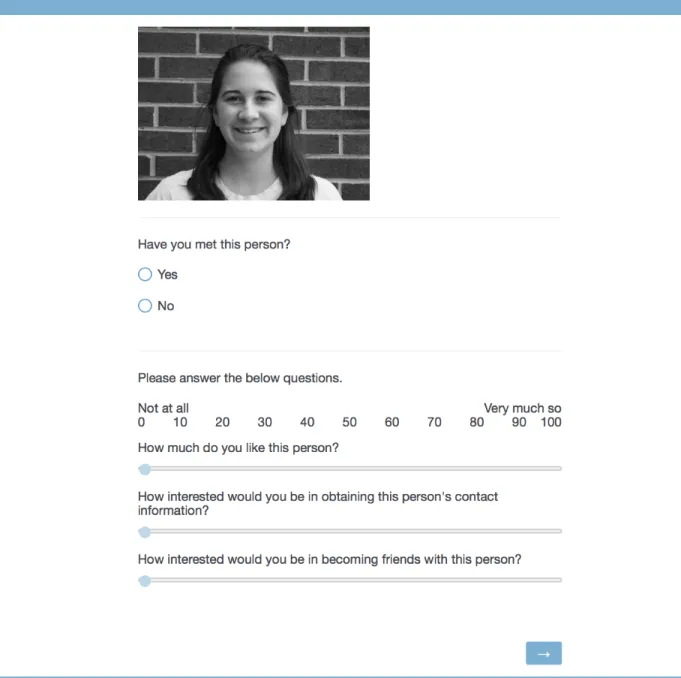
After the chatting simulation, participants were prompted to complete a survey that asked them to rate their interaction partners from the 90 trials (Figure 2). They were first asked if they had ever met the individual in the picture; if so, data for that question was excluded, as a
were then prompted to rate the individual on three characteristics (on a continuous scale of 1-100): how much they “liked” them, how interested they would be in becoming friends with them, and how interested they would be in obtaining their contact information (Figure 2). Ratings on these three questions comprised the primary dependent variables for this study.
Participants were then debriefed, and the deception involved was clarified. They were told the individuals they saw were not actually taking part in the chats with them and that their answers were never shared with anyone. After debriefing, participants were thanked for their participation, and offered the previously agreed upon compensation.
Data Analyses The data were analyzed through 2 (group: UNC or NC State) x 3 (disclosure: low, medium, high) repeated-measures ANOVAs with main effects of group membership and disclosure level for each of the three dependent variables: liking, interest in becoming friends, and interest in obtaining contact information. We followed up any effects observed in the ANOVAs with paired-samples t-tests. Given the relatively small sample size and the fact that this was an exploratory honors thesis, we followed-up any effects observed in the ANOVAs where p<.2. For the purposes of our analyses, p<.05 is interpreted as a significant effect, .05<p<.1 as a marginal effect, and .1<p<.2 as trending toward an effect. The possibility of outliers was examined looking for any values above or below three standard deviations from the mean on every outcome, but no outliers were present in the data. Because the images used in the chatting simulation were current UNC Chapel Hill and NC State students, data points were excluded for any individual that the participants indicated they had previously met and were friends with, in order to avoid possible confounds.
Study 3: Results
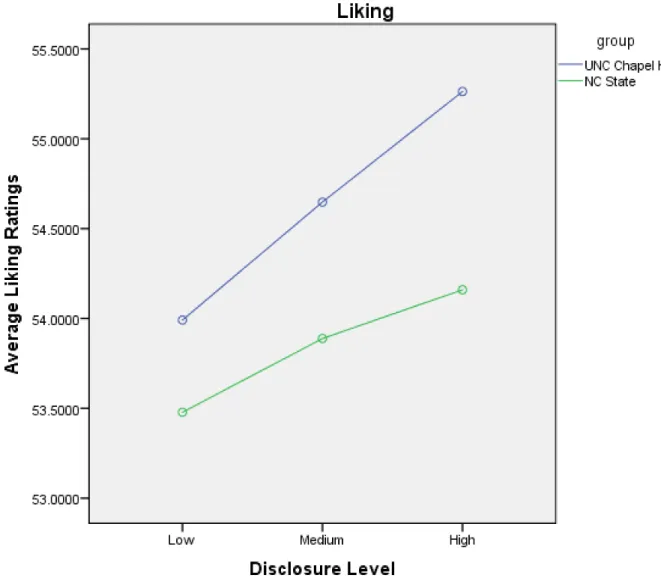
First, we conducted a repeated-measures ANOVA with two within-subjects factors, intimacy of disclosure (three levels: low, medium, high) and group (two-levels: in-group vs. out-group) on post-task ratings of liking (Figure 3). This analysis revealed a significant main effect of disclosure (F, (2, 48) = 3.17, p < 0.05), no significant main effect of group (F, (1, 24) = 1.17, p = 0.29), and no significant disclosure by group interaction (F, (2, 48) = 0.24, p = 0.79).
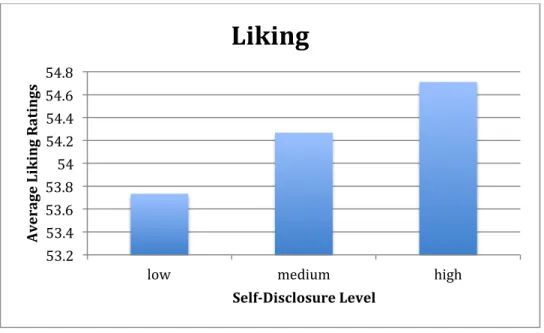
To further explore the main effect of disclosure on liking ratings, we conducted paired-samples t-tests as follow-up tests after combining the data from both groups (given that there was no effect of group) (Figure 4). These tests revealed a trend toward a significant difference
between liking ratings following low disclosures (M=53.73, SD=13.86) as compared to medium disclosures (M=54.27, SD=13.98); p=0.18, with participants reporting higher liking of
individuals to whom they disclosed medium-intimacy information relative to low-intimacy information. There was a significant difference between liking ratings following low disclosures (M=53.73, SD=13.86) as compared to high disclosures (M=54.71, SD=14.27); p=0.02. As with medium disclosures, participants reported liking individuals more if they had disclosed high-intimacy information relative to if they had disclosed low-high-intimacy information. There was no significant difference between liking of individuals to whom medium disclosures were made (M=54.27, SD=13.98) as compared to high disclosures (M=54.71, SD=14.27); p=0.25.
Because graphical depiction of the ANOVA results revealed the possibility of interesting simple effects (Figure 3), we also conducted follow-up t-tests comparing liking ratings for in-group vs. out-in-group members separately at low, medium, and high levels of disclosure. There were no significant differences in liking ratings following low intimacy disclosures to in-group targets (M=53.99, SD=14.13) as compared to out-group targets (M=53.48, SD=14.00);
medium intimacy disclosures to in-group targets (M=54.65, SD=14.61) as compared to out-group targets (M=53.89, SD=13.69); t(24)=0.85, p=0.41. But these tests did reveal a trend toward a significant difference in liking ratings following high intimacy disclosures to in-group targets (M=55.26, SD=14.66) as compared to out-group targets (M=54.16, SD=14.14);
t(24)=1.41, p=0.17. This pattern suggests that participants liked individuals better if they had disclosed high-intimacy information to them, but only if the individual to whom they disclosed was an in-group member (i.e., another UNC Chapel Hill student).
Friendship Outcomes
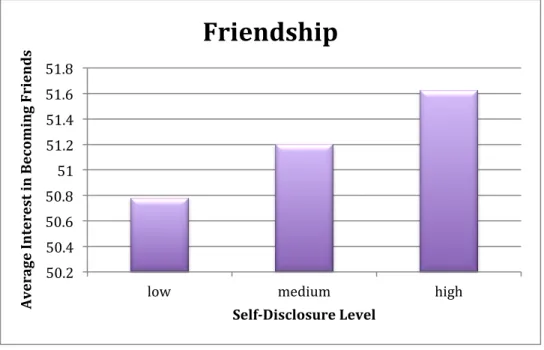
We also conducted a repeated-measures ANOVA with two within-subjects factors, intimacy of disclosure (three levels: low, medium, high) and group (two-levels: in-group vs. out-group) on post-task ratings of interest in forming a friendship with the target of disclosure (Figure 5). This analysis revealed a trend toward a significant main effect of friendship (F, (2, 48) = 1.71, p = 0.19), a marginal main effect of group (F, (1, 24) = 3.59, p = 0.07), and no significant disclosure by group interaction (F, (2, 48) = 0.64, p = 0.53).
were more interested in becoming friends with individuals to whom they had disclosed high-intimacy information relative to low-high-intimacy information.
To further explore the marginal main effect of group, we conducted follow-up t-tests comparing in-group vs. out-group at low, medium, and high levels of disclosure. There were no significant differences in friendship ratings following low intimacy disclosures to in-group targets (M=51.24, SD=16.57) as compared to out-group targets (M=50.32, SD=16.18);
t(24)=0.84, p=0.41. There was a marginally-significant difference in friendship ratings following medium intimacy disclosures to in-group targets (M=53.35, SD=16.02) as compared to out-group targets (M=50.06, SD=16.27); t(24)=1.82, p=0.08, and there was a trend toward a significant difference in friendship ratings following high intimacy disclosures to in-group targets (M=52.63, SD=15.89) as compared to out-group targets (M=50.62, SD=16.05); t(24)=1.70, p=0.10. Both results revealed that there was greater desire to be friends with individuals to whom medium and high-intimacy information was disclosed, but only if the individual disclosed to was an in-group member (compared to out-group members). Contact Outcomes
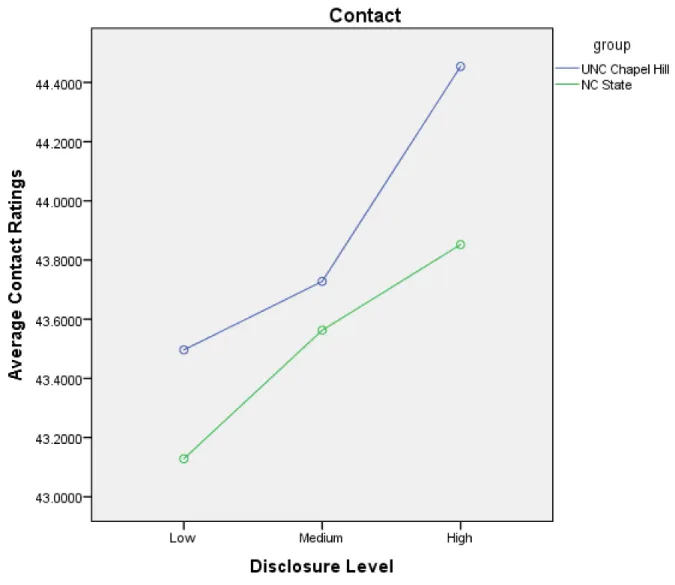
Finally, we once again conducted a repeated-measures ANOVA with two within-subjects factors, intimacy of disclosure (three levels: low, medium, high) and group (two-levels: in-group vs. out-group) on post-task ratings of interest in obtaining contact information (Figure 7). This analysis revealed a trend toward a significant main effect of disclosure (F, (2, 48) = 2.05, p = 0.14), no main effect of group (F, (1, 24) = 0.21, p = 0.65), and no significant disclosure by group interaction (F, (2, 48) = 0.07, p = 0.93).
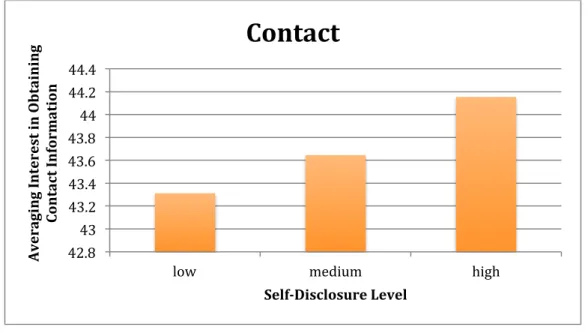
There was no significant difference between interest in obtaining contact information following low intimacy disclosures (M=43.31, SD=18.03) as compared to medium intimacy disclosures (M=43.64, SD=18.20); p=0.48. There was also no significant difference between interest in obtaining contact information following medium intimacy disclosures (M=43.64, SD=18.20) as compared to high intimacy disclosures (M=44.15, SD=18.21); p=0.30. But there was a
significant difference in interest in obtaining contact information following low intimacy disclosures (M=43.31, SD=18.03) as compared to high intimacy disclosures (M=44.15, SD=18.21); p=0.005. This pattern of results suggests participants are more interested in obtaining contact information from individuals to whom they’ve disclosed high intimacy information as compared to low intimacy information.
Study 3: Discussion and Conclusions
The goals of this study were to investigate the relationship between differing levels of self-disclosure and subsequent liking ratings for both in-group and out-group targets. We hypothesized a curvilinear relationship between self-disclosure and liking for the three levels, with out-group disclosures significantly lower in liking ratings than in-group disclosures. We did see a general increase in liking ratings as disclosures became progressively more intimate, but the results of this study did not confirm our hypothesis of a curvilinear model of self-disclosure on liking ratings as based on Cozby’s (1972) previous results.
high intimacy information about themselves than they were in the 1970s. Along these lines, it is possible that the “electronic format” we provided for participants to send information about themselves to their partners was more akin to social media sites like Facebook or Twitter where people are likely to share even the most personal details of their day-to-day life with a broad audience (Joinson, 2001).
In terms of liking ratings, our results suggest that group membership does not moderate the relationship between disclosures and subsequent ratings of liking. In other words, it seems that individuals are no more inclined to like another individual in their in-group compared to an individual in the out-group after personal disclosures.
The liking ratings had more of a linear relationship instead of the curvilinear relationship that we hypothesized. Instead of being anxiety-producing and resulting in lower liking ratings, the higher intimacy disclosures actually increased liking ratings as compared to low intimacy information. Both medium and high intimacy information scored significantly higher on liking ratings than low intimacy information, but there was no significant difference between the medium and high disclosures. This seems to confirm one of our original ideas that if you want to like someone, you should tell them personal information about yourself instead of sharing something surface level (i.e. “small talk”). But there doesn’t appear to be a concern about “over-sharing.” Instead, any relatively personal information will do.
The trend toward a significant main effect of disclosure on friendship ratings suggests that there could be a difference between “small talk” (i.e., low-intimacy disclosures) and more personal conversations when deciding whether or not you want to become friends with another individual. This is reflected in the significant effect of the t-test between low and high
disclosures. This relationship suggests that the more personal the information is that you’re sharing the more likely you are to say you want to become friends with the person you shared the information with.
In terms of group membership, there was a marginal main effect favoring the in-group over the out-group. This could be a reflection of in-group biases. Perhaps individuals are willing to say they like individuals in their out-group just as much after sharing personal information with them, but they won’t endorse actually becoming friends with them. This could prompt an interesting expansion further investigating the differences between liking someone and being interested in becoming friends with them.
Our examination of participants’ interest in obtaining their interaction partners’ contact information revealed a trend for an effect for disclosure whereby people are more interested in obtaining contact information for individuals to whom they disclosed high intimacy information. According to our data, there were no effects of group membership on desire to obtain contact information. This is an interesting finding given that the results for friendship revealed possible intergroup biases but this seemingly more intimate act of actually asking for contact information revealed no such differences.
sample size. With only twenty-eight participants (twenty five after removing those who were not compliant with the study procedure), it is difficult to make any definitive conclusions. There is a good chance that the effects observed could be either greatly magnified or vanish completely with a much larger sample size.
The overall ratings for each category (liking, friendship, contact) also tended to be lower than expected. The means for each of these ratings averaged in the 40s to 50s on a scale from 1-100. This seems to suggest that participants only had moderate interest in the individuals whom they were meeting overall. This could be a result of the lab setting not accurately modeling the principle variables of interest. It could also be a complication of the short conversations and computer-based simulation, as well as the fact that participants interacted with a large number of different partners (90 in total).
An expansion of the data analyses could look at co-varying the post-task ratings with participants’ scores on the “Perceptions of NC State” scale, which they completed before coming into the lab. Perhaps if participants viewed NC State as more of a rival, there would be more of an effect of group on each of the different ratings. But if they viewed them as not much different than UNC Chapel Hill, the hypothesized intergroup effects would no longer be valid.
If successful, the simulation could also be adapted for use in investigations targeting other groups: from race to gender to political ideology. Investigations into differing disclosures in and between these other groups could help to reveal important differences.
References
Aron, A., Melinat, E., Aron, E. N., Vallone, R. D., & Bator, R. J. (1997). The experimental
generation of interpersonal closeness: A procedure and some preliminary findings.
Personality and Social Psychology Bulletin, 23(4), 363-377.
Cozby, P. C. (1973). Self-disclosure: A literature review. Psychological Bulletin, 79(2), 73-91.
Cozby, P. C. (1972). Self-Disclosure, reciprocity and liking. Sociometry, 35(1), 151-….
Chelune, G. J., Sultan, F. E., & Williams, C. L. (1980). Loneliness, self-disclosure, and
interpersonal effectiveness. Journal of Counseling Psychology, 27(5), 462-468.
Csibra, G., & Gergely, G. (2011). Natural pedagogy as E\evolutionary adaptation. Culture
Evolves, 377-392.
Dindia, K., & Allen, M. (1992). Sex differences in self-disclosure: A meta-analysis.
Psychological Bulletin, 112(1), 106-124.
Dindia, K., Fitzpatrick, M., & Kenny, D. A. (1997). Self-Disclosure in spouse and stranger
interaction: A social relations analysis. Human Communication Research, 23(3), 388-412.
Ensari, N., & Miller, N. (2002). The out-group must not be so bad after all: The effects of
disclosure, typicality, and salience on intergroup bias. Journal of Personality and Social
Psychology, 83(2), 313-329.
Green, K., Derlega, V. J., & Mathews, A. Self-Disclosure in personal relationships. In The Cambridge Handbook of Personal Relationships (pp. 409-427).
Joinson, A. N. (2001). Self-disclosure in computer-mediated communication: The role of
Kirshner, B. J., Dies, R. R., & Brown, R. A. (1978). Effects of experimental manipulation of
self-disclosure on group cohesiveness. Journal of Consulting and Clinical Psychology,
46(6), 1171-1177.
Levesque, M. J., Steciuk, M., & Ledley, C. (2002). Self-Disclosure patterns among
well-acquainted individuals: Disclosers, confidants and unique relationships. Social Behavior
and Personality: an International Journal, 30(6), 579-592.
Mcallister, H. A. (1980). Self-disclosure and liking: Effects for senders and receivers. Journal of
Personality, 48(4), 409-418.
Miller, N. (2002). Personalization and the promise of contact theory. Journal of Social Issues, 58(2), 387-410.
Omarzu, J. (2000). A disclosure decision model: Determining how and when individuals will
self-disclose. Personality and Social Psychology Review, 4(2), 174-185.
Stephan, W. G., Stephan, C. W., Wenzel, B., & Cornelius, J. (1991). Intergroup interaction and
self-disclosure. Journal of Applied Social Psychology, 21(16), 1370-1378.
Tamir, D. I., & Mitchell, J. P. (2012). Disclosing information about the self is intrinsically
rewarding. Proceedings of the National Academy of Sciences, 109(21), 8038-8043.
Turner, R. N., Hewstone, M., & Voci, A. (2007). Reducing explicit and implicit outgroup
prejudice via direct and extended contact: The mediating role of self-disclosure and
intergroup anxiety. Journal of Personality and Social Psychology, 93(3), 369-388.
Worthy, M., Gary, A. L., & Kahn, G. M. (1969). Self-disclosure as an exchange process. Journal
Figures and Scales
Extroversion Scale
Please enter a number from the scale below to indicate how well each of the following statements describes you.
1 2 3 4 5
Not at all True of me Very much
true of me to some extent true of me ____ 1. I like to have a lot of people around me.
____ 2. I laugh easily.
____ 3. I don't consider myself especially "light-hearted." ____ 4. I really enjoy talking to people.
____ 5. I like to be where the action is. ____ 6. I usually prefer to do things alone.
____ 7. I often feel as if I'm bursting with energy. ____ 8. I am a cheerful, high-spirited person. ____ 9. I am not a cheerful optimist.
____ 10. My life is fast-paced. ____ 11. I am a very active person.
UCLA Loneliness Scale
The following statements describe how people sometimes feel. For each statement, please indicate how often you feel that way be circling a number.
1 Never 2 Rarely 3 Sometimes 4 Always
1. How often do you feel that you are “in tune” with the people
around you? 1 2 3 4
2. How often do you feel that you lack companionship? 1 2 3 4
3. How often do you feel that there is no one you can turn to? 1 2 3 4
4. How often do you feel alone? 1 2 3 4
5. How often do you feel part of a group of friends?
1 2 3 4
6. How often do you feel that you have a lot in common with the people around you?
1 2 3 4
7. How often do you feel that you are no longer close to anyone?
1 2 3 4
8. How often do you feel that your interests and ideas are not shared by those around you?
1 2 3 4
9. How often do you feel outgoing and friendly?
1 2 3 4
10. How often do you feel close to people? 1 2 3 4
11. How often do you feel left out? 1 2 3 4
12. How often do you feel that you relationships with others are not meaningful?
1 2 3 4
13. How often do you feel that no one really knows you well?
1 2 3 4
1 Never 2 Rarely 3 Sometimes 4 Always
14. How often do you feel isolated from others? 1 2 3 4
15. How often do you feel you can find companionship when you want
16. How often do you feel that there are people who really understand you?
1 2 3 4
17. How often do you feel shy?
1 2 3 4
18. How often do you feel that people are around you but not with you?
1 2 3 4
19. How often do you feel that there are people you can talk to? 1 2 3 4
Perceptions of NC State Scale
Please enter a number from the scale below to indicate how much you agree with each of the following statements.
1 2 3 4 5 6 7
Not at all true True to some extent Very much true
________ 1. NC State is as good of a school academically as UNC
________ 2. NC State is as good of a school athletically as UNC
________ 3. NC State is as good of a school socially as UNC
________ 4. If NC State does well it hurts perceptions of UNC
________ 5. I have positive feelings toward NC State as a whole
Figure 4. Average liking ratings collapsed across groups for each disclosure level.
53.2 53.4 53.6 53.8 54 54.2 54.4 54.6 54.8
low medium high
A
ve
ra
ge
L
ik
in
g
R
at
in
gs
Self-Disclosure Level
Figure 6. Average friendship ratings collapsed across groups for each disclosure level. 50.2 50.4 50.6 50.8 51 51.2 51.4 51.6 51.8
low medium high
Figure 8. Average contact ratings collapsed across groups for each disclosure level. 42.8 43 43.2 43.4 43.6 43.8 44 44.2 44.4
low medium high