Reducing the Risk of Diabetes:
The Role of Self-Efficacy in a Mindfulness-based Intervention
Sarah Emily Rich
A Project presented to the faculty of The University of North Carolina at Chapel Hill
in fulfillment of the requirements for Undergraduate Honors
Date Completed: April 11, 2014
Abstract
Diabetes has reached epidemic proportions in the United States. Pre-diabetes, blood glucose levels higher than normal but less than diagnostic for diabetes, is also on the rise. African
Americans are disproportionately impacted by diabetes, pre-diabetes, and disease complications. Lifestyle modifications can reduce the risk or delay the onset of diabetes; however, behavior change is a complex, challenging, and stressful process. The current study examines the impact of mindfulness on self-efficacy and health behavior changes related to diabetes risk reduction. Methods: Pre-diabetic African Americans, 25-65 years of age, and experiencing significant life stress were randomized into either a conventional diabetes prevention education program
(CDPEP) group or a mindfulness-based diabetes prevention education program (MPDEP) group. Each group met weekly for eight weeks and then each month for six monthly booster sessions. At weeks one and eight, participants were surveyed on their current self-efficacy, or confidence to make change, in diabetes risk reduction behaviors. We hypothesize that the mindfulness group will achieve greater self-efficacy, which is associated with improved health behaviors. Additionally, we believe baseline self-efficacy will predict post-intervention eating habits and physical activity (EHPA) outcomes.
Results and Discussion: Findings do not support a significant difference in self-efficacy
Reducing the Risk of Diabetes:
The Role of Self-Efficacy in a Mindfulness-based Intervention
The prevalence of diabetes in the United States has reached epidemic proportions (Centers for Disease Control and Prevention [CDC], 2011b). Pre-diabetes, defined as blood glucose levels that are elevated (hemoglobin [HbA1c] 5.7-6.4%) but less than diagnostic for diabetes, is also on the rise (American Diabetes Association [ADA], 2014; Tabak, Herder, Rathmann, Brunner, & Kivimaki, 2012). African Americans are disproportionately impacted by pre-diabetes, diabetes, and disease complications(CDC, 2014). Lifestyle changes, primarily to eating habits and physical activity, can reduce the risk or delay the onset of diabetes (Tuomilehto et al., 2012). Diabetes education programs facilitate the process of health-related behavior change (Gaylord et al., 2013). Past research has shown the efficacy of mindfulness-based interventions for changes in health behaviors. The current study is a secondary analysis of data from the “We Can Prevent Diabetes” research study, which examined a mindfulness-based approach to diabetes education to target a high-risk group, pre-diabetic African Americans. For the current project, we examined whether self-efficacy influences the effect of mindfulness training on health-related behavior changes.
Background
2013). Morbidity arising from disease complications may include cardiovascular disease,
kidney failure, nerve damage, limb amputation, blindness, stroke, and depression (CDC, 2011b). The risk of diabetes and pre-diabetes is greater among African Americans. According to the CDC, more than 12% of African Americans 20+ years old are diabetic and more than one third (35%) have pre-diabetes (2011b). Pre-diabetes is characterized by HbA1c of 5.7-6.4%, a fasting blood glucose of 100-125 milligrams per deciliter (mg/dL), or a blood glucose level of 140-199 mg/dL after a two-hour OGTT (ADA, 2014). Compared to Hispanic whites, non-Hispanic black adults are 77% more likely to be diabetic. African Americans are also more likely to suffer from preventable complications of poorly controlled diabetes (Haffner, 1998; Healthy People 2020, 2014).1 Although a large body of research has explored various strategies to prevent or delay diabetes, further research is needed to examinefactors specific to African Americans.
The American Diabetes Association supports the use of prevention strategies (namely weight management and regular physical activity) as the primary defense in diabetes risk
reduction (ADA, 2014; Knowler et al., 2002; Tuomilehto et al., 2001). For individuals at greater risk of diabetes, treatment modalities that support lifestyle changes (i.e. increased physical activity and weight loss) have been shown to be effective (Knowler et al., 2002; Tuomilehto et al., 2001). However, lifestyle change is a complex and challenging process that can be anxiety provoking (Clarke, Crawford, & Nash, 2002; Payne, Jones & Harris, 2002). Therefore, diabetes risk reduction strategies should respect the importance of stress-management.
moment and heightened awareness (Kabat-Zinn, 1990). Mindfulness training teaches
participants to focus their attention on the present moment only, without regard to the past or future, and to accept all thoughts, emotions, and sensations without judgment or reactivity (Bishop et al., 2004; Kabat-Zinn, 1990). Mindfulness-based stress reduction (MBSR) is a structured and standardized program that is a widely used clinical application of mindfulness. Originally developed for patients with chronic pain, MBSR aims to help participants reduce stress, pain, and illness, and achieve greater balance, control, and engagement in one’s life (Kabat-Zinn, 1990).
Over the past 3 decades, MBSR and other mindfulness-based therapies and interventions have catapulted in popularity. Mindfulness-based therapies are noninvasive and generally inexpensive, with an expansive history of applications to various physical and mental health symptoms and conditions. Mindfulness research has indicated the therapeutic effects of mindfulness training for reduction of physiologic stress, anxiety, depression, and chronic pain (Kabat-Zinn, 1990; Grossman, Niemann, Schmidt, & Walach, 2003; Hartmann et al., 2012; Rosenzweig et al., 2010). Participation in mindfulness training is also associated with enhanced health-related quality of life, which entails overall improvements in physical, cognitive, and emotional functioning and wellbeing (Keng, Smoski, & Robins, 2011; Greeson et al., 2011; Grossman et al., 2010; Rosenzweig et al., 2010; Shapiro, Oman, Thoresen, Plante, & Flinders, 2008).
instances of overeating (Miller, Kristeller, Headings, & Nagaraja, 2013), eating behaviors and weight loss (Dalen et al., 2010), and improvements in diet, physical activity, and quality of sleep (Salmoirago-Blotcher et al., 2013). Despite the growing body of research on mindfulness for various health conditions, there is insufficient evidence about the effects of mindfulness among individuals with pre-diabetes. Furthermore, the mechanisms of mindfulness are not sufficiently documented. There is research to indicate that mindfulness training results in higher trait mindfulness (Carmody, Reed, & Merriam, 2008; Miller et al., 2013; Shapiro et al, 2008). Still, further research is indicated to determine the mechanisms of action in the positive health effects of mindfulness.
Research strongly suggests that increasing disease self-management skills (e.g. daily monitoring of blood glucose) is also a valuable approach to diabetes risk reduction (Sarkar et al., 2006). For diabetic individuals, disease self-management ability significantly influences the course and progression of the disease; therefore, self-management is considered a cornerstone of care (Sarkar et al., 2006). Self-efficacy plays an influential role in diabetes self-management; studies support self-efficacy as a vital component in enhancing self-management (Sarkar, 2006).
degree of effort exerted in accomplishing a task or goal. Persons with high measures of self-efficacy are more likely to be persistent, while those who doubt their abilities are prone to abandon the task or goal (Bandura, 1982).
In the decades following Bandura’s proposed theory, self-efficacy research has documented its impact in a variety of settings, including health care. Research indicates that self-efficacy is predictive of positive health behaviors, improved health outcomes, and greater success in self-management of chronic disease, including diabetes (Bauman et al., 2012; Farrell, Wicks, & Martin, 2004; Sarkar, Fisher, & Schillinger, 2006;Wu et al., 2007). Increasing
measures of self-efficacy leads to improvements in certain aspects of self-care regimens (e.g. diet and physical activity), as well as reduction in the use of health care services (Bauman et al., 2012; Sarkar et al., 2006; Wu et al., 2011). Given this body of research, we propose that diabetes education, enhanced by mindfulness training, will increase self-efficacy and consequently
improve health behaviors, specifically physical activity, diet, body mass index (BMI), and stress management among African Americans with pre-diabetes.
Methods and Design
The “We Can Prevent Diabetes” Project was designed to have a three-step screening and recruitment process prior to enrollment and randomization into the two study intervention arms. To reduce pre-randomization dropout, the study subjects were recruited in cohorts.
Study procedures and consents were reviewed with participants at each stage of the screening process. In step one, subjects were recruited from community screening events (e.g., community organizational events, health fairs, churches, local businesses, medical offices, the local health department, and through local newspaper advertisements) to determine risk for pre-diabetes using a Diabetes Risk Questionnaire. The 10-item DRQ survey assessed known diabetes risk factors.
Those individuals then qualified for a telephone-based questionnaire, which was the second step of screening to determine eligibility for randomization. Participants with a DRQ score greater than 10 were screened for the presence of the following exclusion criteria: (1) diabetes diagnosed by a physician; (2) past or current use of hypoglycemic medication (except for
gestational diabetes); (3) disease associated with disordered glucose metabolism (e.g., Cushing’s Syndrome); (4) regular use of medications associated with impaired glucose metabolism (e.g., oral or parenteral steroids); (5) active treatment for or history of a major medical illness such as coronary heart disease, congestive heart failure, malignancy, autoimmune or immune deficiency disorder; (6) previous formal training in meditation and other mind/body practices including yoga, tai chi, or qi gong; (7) psychosis or significant depression, anxiety, or substance abuse under active care (> 2 mental health care visits per month) or requiring more than 2 psychotropic medicines daily or hospitalization within the past 2 years; (8) pregnancy or anticipated
screening), and or lack of significant life stress. Then they were screened for a perceived stress score higher than 7.5 or an endorsement of significant life stress.
Those participants who did not endorse any of the exclusion criteria above qualified for a clinical laboratory assessment to determine pre-diabetes status, the third screening step. The clinical laboratory visit procedures were reviewed and study staff assessed interest in and potential commitment to a lifestyle change research study. Eligible participants who were interested in moving forward to the third screening step were scheduled for an appointment at the UNC Clinical Trials Research Center (CTRC) to schedule laboratory testing for pre-diabetes status and other cardiometabolic risk factors. A total of 165 subjects completed laboratory testing.
At the CTRC visit, written consent was obtained after laboratory procedures were described. Next, height, weight, blood pressure, and waist-to-hip ratio (WHR) were measured. Then a capillary glucose test was conducted to ensure that subjects were at safe glucose levels to receive the glucose solution for the OGTT. Next, a butterfly catheter was placed and blood samples were taken for fasting lipids, HbA1c, and for glucose and insulin at 0-, 30-, and 120-minutes during the OGTT. Subjects used laptop computers to complete web-based study measures while awaiting their 30- and 120-minute OGTT. Subjects were informed of their laboratory test results as soon as they were available. All subjects were asked to follow up with their health providers.
Randomization
prevention educational program (MDPEP) or the Conventional diabetes prevention educational program (CDPEP). The study staff used a computer program designed specifically for the study to randomize subjects. The program randomizes using a random numbers generator and the software is programmed to insure equal numbers of MDPEP and CDPEP assignments within a variable block size of 4-8 subjects. This system utilizes a permuted block design to ensure that the numbers allocated to the two arms are balanced over time, as well as ensuring concealment of allocation. Of the 67 participants, 38 were randomized into the MDPEP group and 29 into the CDPEP group.
Blinding
The nature of the interventions did not allow for blinding of the instructors or
participants; however, although participants could not be blinded to treatment assignment, we attempted to minimize differences in expectancy as follows: The experimental interventions were described to participants as two diabetes prevention group interventions, both of which may lower blood glucose. Because the intent was to prevent the participant from knowing which intervention the investigators believed was most likely to improve symptoms, subjects were only told that they were assigned to one of two equivalent diabetes prevention groups, coded by color (e.g., the “Gold” Group [CDPEP] and the “Purple” Group [MDPEP]). No study literature
identifies either group as more efficacious in any way. The study name was entitled: “We Can Prevent Diabetes.” To verify that participants assigned to the CDPEP had the same expectation of benefit as those assigned to the MDPEP, all participants were asked to complete a credibility assessment after the first treatment session. The statistician and data manager were blinded with respect to group assignment.
engaged with the study, review and practice previously taught material, ask questions, and receive support and encouragement for sustained behavioral change.
Homework assignments were matched with those of the control group in terms of time commitment and relevance to diabetes prevention. Homework involved mindfulness-based practices adapted from the MBSR program and diabetes-prevention activities adapted from the Diabetes Prevention Program “Lifestyle Change Program” materials. As part of homework for both the MDPEP and CDPEP groups, participants were asked to keep and turn in weekly logs of physical activities and diet.
Measures
Participants were asked to complete a self-efficacy questionnaire at week one (pre-intervention) and week eight (post-(pre-intervention) during the eight-week session. This questionnaire was developed to evaluate self-efficacy (confidence) of one’s ability to make changes regarding diabetes risk-related health behaviors (NDEP, 2007). The questionnaire measures participants’ level of self-efficacy related to eating habits, physical activity, and general health status (Appendix).
Body Mass Index (BMI)
Body weight was assessed on a digital scale (to the nearest 0.1 kilogram) that is accurate to within ± 0.05%. Body height was measured to the nearest centimeter using an adult
stadiometer. BMI was calculated as weight (kilograms) divided by height (meters squared). BMI and waist circumference are both valid measures of obesity and have been shown to be predictors of metabolic and cardiovascular risk (Katzmarzyk, 2004; Neovius, Linne, & Rossner, 2005; Wang, 2004).
Only African Americans were eligible to participate in the study. A demographic
questionnaire collected data about each participant’s age, marital status, years of education, work status, and approximate family income. Additional information gathered include medical history items: current medications, including antihypertensive medications, current health problems, and history of tobacco, alcohol, or other substance use.
Five Facet Mindfulness Questionnaire (FFMQ)
The FFMQ was developed based on exploratory and confirmatory factor analyses of five existing questionnaires designed to explore constructs of mindfulness identified in prior research (Baer, 2006). The resulting instrument is a 39-item measure assessing five identified facets of mindfulness: non-reactivity to inner experience; non-judging of inner experience; acting with awareness; describing; and observing. Individual facets of the FFMQ correlate positively with openness to experience, emotional intelligence, and self-compassion, and negatively with alexethymia, dissociation, and psychological distress.
Statistical Analyses
variables (3 ordered categorical and 1 continuous). For the categorical outcome variables (eating, physical activity, and BMI), we used multiple nonlinear regressions (the proportional odds models). For the continuous outcome variable (ability to handle stress better), we used a multiple linear regression/ANOVA. We included the respective self-efficacy measure and the group of the participant for all outcome variables. Finally, the associations among the five items of self-efficacy and the four outcomes of EHPA were investigated using chi-square test of association or ANOVA (for continuous-categorical variables). All analyses were done in SAS 9.3 (SAS Institute Inc., Cary, NC).
Results Exploratory Data Analysis
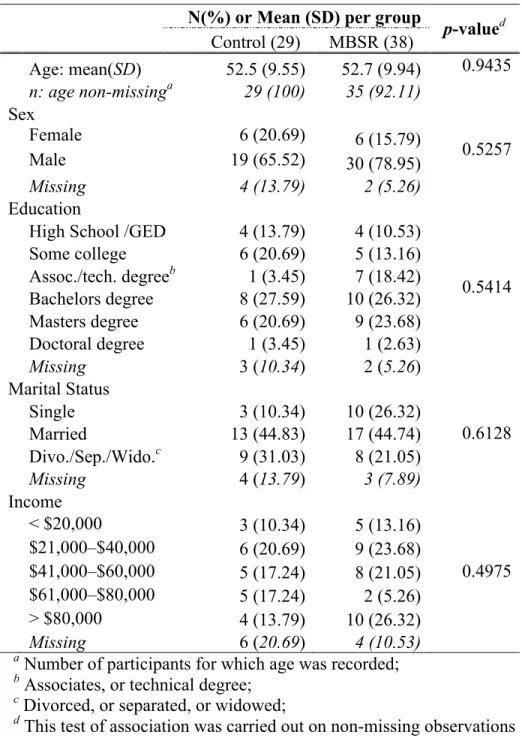
Sixty-seven African-American men and women, meeting diagnostic criteria for pre-diabetes, were randomized into two groups. There were 29 participants in the CDPEP group and 38 in the MDPEP group. The participants’ socioeconomic status (SES) characteristics are
Table 1: Characteristics of Patients in the Follow-Up Study
N(%) or Mean (SD) per group
p-valued Control (29) MBSR (38)
Age: mean(SD) 52.5 (9.55) 52.7 (9.94) 0.9435 n: age non-missinga 29 (100) 35 (92.11)
Sex
Female 6 (20.69) 6 (15.79) 0.5257
Male 19 (65.52) 30 (78.95)
Missing 4 (13.79) 2 (5.26)
Education
High School /GED 4 (13.79) 4 (10.53)
0.5414 Some college 6 (20.69) 5 (13.16)
Assoc./tech. degreeb 1 (3.45) 7 (18.42) Bachelors degree 8 (27.59) 10 (26.32) Masters degree 6 (20.69) 9 (23.68) Doctoral degree 1 (3.45) 1 (2.63)
Missing 3 (10.34) 2 (5.26)
Marital Status
Single 3 (10.34) 10 (26.32)
0.6128
Married 13 (44.83) 17 (44.74)
Divo./Sep./Wido.c 9 (31.03) 8 (21.05)
Missing 4 (13.79) 3 (7.89)
Income
< $20,000 3 (10.34) 5 (13.16)
0.4975 $21,000–$40,000 6 (20.69) 9 (23.68)
$41,000–$60,000 5 (17.24) 8 (21.05) $61,000–$80,000 5 (17.24) 2 (5.26) > $80,000 4 (13.79) 10 (26.32) Missing 6 (20.69) 4 (10.53)
a Number of participants for which age was recorded; b Associates, or technical degree;
c Divorced, or separated, or widowed;
d This test of association was carried out on non-missing observations
Comparison of the MBSR and Control Groups
average change in the control group. It was found that the variances of the change
(improvement) in self-efficacy for the two groups were not different from each other (p-value= 0.1357). We then used the pooled t-test statistic and we concluded that there is no significant difference between the MBSR group and the control group with respect to their average change in self-efficacy (p-value= 0.4518).
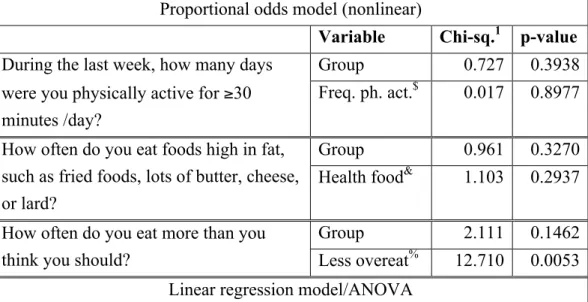
The Effect of Pre-Treatment Self-Efficacy Items on Post-Intervention EHPA Outcomes We considered four post-intervention EHPA outcomes, three of which are categorical and one is continuous. We investigated whether each of these outcomes is predicted by the respective efficacy measure. As the results of these four models presented in Table 2 below, the self-efficacy measures are not significant predictors of their respective eating habit and physical activity outcomes except for the case of “overeat less often”, which was found to be a significant predictor of the outcome “how often do you eat more than you think you should?” (p-value= 0.0053). In addition, the variable “group” was found insignificant in all of the four models ratifying that there is no significant difference between the two groups with respect to the post-intervention eating habit and physical activity outcomes.
Table 2: Wald chi-square statistic and F-statistic (and respective p-values) of the fitted models. Proportional odds model (nonlinear)
Variable Chi-sq.1 p-value During the last week, how many days
were you physically active for ≥30
minutes /day?
Group 0.727 0.3938
Freq. ph. act.$ 0.017 0.8977
How often do you eat foods high in fat, such as fried foods, lots of butter, cheese, or lard?
Group 0.961 0.3270
Health food& 1.103 0.2937
How often do you eat more than you think you should?
Group 2.111 0.1462
Self-Efficacy and Handling stress: MDPEP vs. CDPEP
Out of the five items of self-efficacy outcome, we specifically considered one item, “handling stress better”, and compared the two intervention groups to investigate whether the participants in the MBSR group showed greater improvement in handling stress compared to the participants in the control/conventional group. To compare the two groups, we started by checking the change (improvement) in measure of handling stress from pre-intervention to post intervention and attained normality in each group; however, normality was not attained.
Therefore, we carried out the Wilcoxon-Mann-Whitney test, a nonparametric way of comparing two samples. No significant difference between the MBSR and control groups was found with regard to improvement in handling stress (one sided p-value= 0.1235).
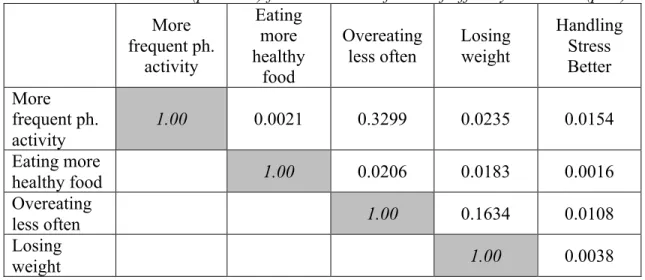
Associations between the 5 items of post-intervention self-efficacy/confidence measures The associations between the five items of the post-intervention self-efficacy/confidence measures were next investigated, pairwise, using the chi-square test of association. Significant association between each of the paired post-intervention measures were observed, except between ‘more frequent physical activity’ and ‘overeating less often’ (p-value= 0.3299) and between ‘losing weight’ and ‘overeating less often’ and (p-value= 0.1634) (Table 3).
Association between the 4 post-intervention eating habit and physical activity outcomes The associations between the four items of the post-intervention eating habit and physical activity outcomes were also investigated, pairwise, using the chi-square test of association if the
Variable F-value2 p-value
Body mass index (BMI) Group 1.410 0.2394
Lose weight# 1.720 0.1578 $ More frequent physical activity; & Eating more healthy food; %
two outcomes are categorical, or using ANOVA if the two outcomes are categorical and continuous. No significant association between any of the paired outcomes was observed, except the existence of borderline association between the outcomes (Table 4).
Table 3: Pairwise association (p-values) for the 5 items of the self-efficacy measures (post)
More frequent ph. activity Eating more healthy food Overeating less often Losing weight Handling Stress Better More frequent ph. activity
1.00 0.0021 0.3299 0.0235 0.0154
Eating more
healthy food 1.00 0.0206 0.0183 0.0016
Overeating
less often 1.00 0.1634 0.0108
Losing
weight 1.00 0.0038
Table 4: Pairwise association (p-values) for the 4 outcomes of eating habit and physical activity (post)
PA_Days1 Eat_Fat2 Over_Eat3 BMI4
PA_Days 1.00 0.2418 0.0417 0.1100
Eat_Fat 1.00 <0.0001 0.9553
Over_Eat 1.00 0.7853
BMI 1.00
1 During the last week, how many days were you physically active for ≥30 minutes /day?
2 How often do you eat foods high in fat, such as fried foods, lots of butter, cheese, or lard?
3 How often do you eat more than you think you should? 4 Body mass index
Discussion
randomized pre-diabetic African Americans into two groups: a conventional group (CDPEP) in which participants received only diabetes education and a mindfulness group (MDPEP) in which participants received mindfulness training in addition to diabetes education. Participants’ self-efficacy measures and EHPA outcomes were recorded at week one andweek eight. In
considering the change in self-efficacy, we expected to find that participants in the mindfulness group would have greater improvement in self-efficacy compared to the participants in the conventional group. However, we found that there was no significant difference between the two groups with regard to improvement in self-efficacy between week 1 and weekeight. Although our findings were not statistically significant, we did find noteworthy trends in the data. In both groups, participants’ average level of self-efficacy increased on physical activity and eating more healthy food. However, the mindfulness group increased on ‘overeat less often’ and ‘handle stress better’, while those in the conventional group did not show this trend. Though not statistically significant, it is possible that a larger sample size would have yielded significant findings.
Our other research question was to investigate whether the pre-intervention self-efficacy items predict their respective post-intervention EHPA outcomes. We expected that participants scoring high on the self-efficacy measure would actually reflect greater improvements in EHPA outcomes. Proportional odds models for the categorical outcomes (EHPA) and a linear
model/ANOVA for the continuous outcome (‘handle stress better’) were used by adjusting their respective self-efficacy items and group. It was found that the self-efficacy does not
post-intervention questionnaire. However, significant associations were observed between most of the EHPA outcomes. Physical activity increased in both groups, and the outcomes ‘overeating less often’ and eating more healthy food’ decreased for both groups. Although not statistically significant, the trends interestingly show that the mindfulness group decreased in BMI over time, while the conventional group actually increased in BMI from baseline.
References
American Diabetes Association. (2014). Diagnosing diabetes and learning about prediabetes. Retrieved from http://www.diabetes.org/diabetes-basics/diagnosis/
American Diabetes Association. (2007). Economic costs of diabetes in the U.S. in 2007. Diabetes Care, 31(3), 595-615. doi: 10.2337/dc08-9017; 10.2337/dc08-9017
Baer, R.A., Smith, G.T., Hopkins, J., Krietemeyer, J., & Toney, L. (2006). Using self-report assessment methods to explore facets of mindfulness. Assessment, 13(1), 27-45.
Bandura, A. (1977). Self-efficacy: Toward a unifying theory of behavioral change. Psychological Review, 84, 191-215.
Bandura, A. (1997). Self-efficacy: The Exercise of Control. New York, W.H. Freeman.
Bauman, A.E., Reis, R.S., Sallis, J.F., Wells, J.C., Loos, R.J.F., & Martin, B.W. (2012). Correlates of physical activity: why are some people physically active and others not? Lancet, 380, 258–271. Bishop, S.R., Lau, M., Shapiro, S., Carlson, L., Anderson, N.D., Carmody, J., … Devins, G. (2004).
Mindfulness: A proposed operational definition. Clinical Psychology: Science and Practice, 11(3), 230-241. doi:10.1093/clipsy/bph077
Bonds, D.E., Zaccaro, D.J., Karter, A.J., Selby, J.V., Saad, M., & Goff, D.C. (2003). Ethnic and racial differences in diabetes care: The Insulin resistance atherosclerosis study. Diabetes Care, 26, 1040-1046.
Boutron, I., Moher, D., Altman, D.G., Schultz, K.F., Ravaud. (2008). Extending the CONSORT statement to randomized trials of nonpharmacologic treatment: Explanation and elaboration. Annals of Internal Medicine, 148(4), 295-309.
Carmody, J., Reed, G., Kristeller, J., & Merriam, P. (2008). Mindfulness, spirituality, and health-related symptoms. Journal of Psychosomatic Research,64, 393–403.
Centers for Disease Control and Prevention. (2011a). How much physical activity do you need? Atlanta, GA: U.S. Department of Health and Human Services. http://
www.cdc.gov/physicalactivity/everyone/guidelines/
Centers for Disease Control and Prevention. (2011b). National diabetes fact sheet: national estimates and general information on diabetes and prediabetes in the United States. Atlanta, GA: U.S.
Department of Health and Human Services. http:// www.cdc.gov/DIABETES/pubs/factsheet11.htm
Centers for Disease Control and Prevention (2014). The facts about diabetes: A leading cause of death in the U.S. Atlanta, GA: U.S. Department of Health and Human Services.
http://ndep.nih.gov/diabetes-facts/
Chen, Shu-Fen & Lin, Chiu-Chu. (2010). The predictors of adopting a health-promoting lifestyle among work site adults with prediabetes. Journal of Clinical Nursing, 19, 2713-2719. Blackwell
Publishing Ltd. doi: 10.1111/j.1365-2702.2010.03320.x
Clarke, J., Crawford, A., & Nash, D. (2002). Evaluation of a comprehensive diabetes disease management program: Progress in the struggle for sustained behavior change. Disease Management, 5(2), 77-86.
Farrell. K., Wicks. M. N., & Martin, J. C. (2004). Chronic disease self-management improved with enhanced self-efficacy. Clinical Nursing Research, 13(4), 289-308.
Gaylord, S.A., Giscombe, C., Faurot, K., Lynch, C., Phillips, P., Coble, R., … Buse, J. (2013).
Mindfulness-based diabetes education vs. conventional diabetes education for African Americans with pre-diabetes: Protocol for a randomized clinical trial. Unpublished research protocol.
Greeson, J., Webber, D., Brantley, J., Smoski, M., Ekblad, A., Suarez, E., & Wolever, R. (2011). Changes in spirituality partly explain health-related quality of life outcomes after Mindfulness-Based Stress Reduction. Journal of Behavioral Medicine, 34(6), 508-518. doi:10.1007/s10865-011-9332-x
Grossman, P. Niemann, L., Schmidt, S., & Walach, H. (2004). Mindfulness-based stress reduction and health benefits: A meta-analysis. Journal of Psychosomatic Research. 57(1) 35-43.
Grossman, P., Kappos, L., Gensicke, H., D'Souza, M., Mohr, D.C., Penner, I.K., & Steiner, C. (2010). MS quality of life, depression, and fatigue improve after mindfulness training: A randomized trial. Neurology, 75, 1141–1149.
Haffner, S.M. (1998). Epidemiology of type 2 diabetes: Risk factors. Diabetes Care, 21(3), 3-6.
Hartmann, M., Kopf, S., Kircher, C., Faude-Lang, V., Djuric, Z., Augstein, F., … Nawroth, P.P. (2012). Sustained effects of a mindfulness-based stress-reduction intervention in type 2 diabetic patients: design and first results of a randomized controlled trial (the heidelberger diabtes and stress-study). Diabetes Care, 35(5), 945–947.
Kabat-Zinn, J. (1990). Full catastrophe living: using the wisdom of your body and mind to face stress, pain, and illness. New York: Bantam Doubleday Dell Publishing.
biracial sample of children and adolescents. Pediatrics, 114(2), 198-205.
Keng, S., Smoski, M.J., & Robins, C.J. (2011). Effects of mindfulness on psychological health: A Review of empirical studies. Clinical Psychological Review, 31(6), 1041-1056.
doi:10.1016/j.cpr.2011.04.006
Knowler, W.C., Barrett-Connor, E., Fowler, S.E., Hamman, R.F., Lachin, J.M., Walker, E.A., & Nathan, D.M. (2002). Reduction in the incidence of type 2 diabetes with lifestyle intervention or
metformin. New England Journal of Medicine,346(6), 393-403.
McCulloch, D.K. & Robertson, P.R. (2013). Risk factors for type 2 diabetes mellitus. In D.M. Nathan & J.E. Mulder (Eds.), UpToDate. http://
www.uptodate.com/contents/risk-factors-for-type-2-diabetes-mellitus
Miller, C.K., Kristeller, J.L., Headings, A., & Nagaraja, H. (2013). Comparison of a mindful eating intervention to a diabetes self-management intervention among adults with type 2 diabetes: A randomized controlled trial. Society for Public Health Education. Sage Publications.
doi: 10.1177/1090198113493092
Milner-Fenwick. (2013). Diabetes patient education media catalog. http://www.milner-fenwick.com National Diabetes Education Program. (2007). Power to Prevent: A family lifestyle approach to
diabetes. http://ndep.nih.gov/media/power-to-prevent
Neovius, M., Linne, Y., & Rossner, S. (2005). BMI, waist-circumference and waist-hip-ratio as
diagnostic tests for fatness in adolescents. International Journal of Obesity, 29(2),163-169. doi: 10.1038/sj.ijo.0802867.
Payne, N., Jones, F., & Harris, P. (2002). The impact of working life on health behavior: The effect of job strain on the cognitive predictors of exercise. Journal of Occupational Health Psychology, 7(4), 342-353.
Rosenzweig, S. et al. (2010). Mindfulness-based stress reduction for chronic pain conditions: Variation in treatment outcomes and role of home meditation practice. Journal of Psychosomatic Research, 68(1): 29-36.
Salmoirago-Blotcher, E., Hunsinger, M., Morgan, L., Fischer, D., & Carmody, J. (2013). Mindfulness- based stress reduction and change in health-related behaviors. Journal of Evidence-Based Complementary & Alternative Medicine, 18 (4): 243-247. doi: 10.1177/2156587213488600
Sarkar, U., Fisher, L., & Schillinger, D. (2006). Is self-efficacy associated with diabetes self management across race/ethnicity and health literacy? Diabetes Care, 29(4), 823-829.
Shapiro, S.L., Oman, D., Thoresen, C.E., Plante, T.G., & Flinders, T. (2008). Cultivating mindfulness: Effects on well-being. Journal of Clinical Psychology, 64, 840–862. doi: 10.1002/jclp.20491 Tabak A.G., Herder, C., Rathmann, W., Brunner, E.J. & Kivimaki, M. (2012). Prediabetes: a high-risk
state for diabetes development. Lancet, 379(9833), 2279-90.
Tuomilehto, J., Lindstrom, J., Eriksson, J.G., Valle, T.T., Hamalainen, H., Ilanne-Parikka, P., …Uusitupa, M. (2001). Prevention of type 2 diabetes mellitus by changes in lifestyle among subjects with impaired glucose tolerance. New England Journal of Medicine, 344(18), 1343-1350. doi: 10.1056/NEJM200105033441801.
United States Department of Health and Human Services, Healthy People 2020 (2014). Diabetes: Overview. U.S. Department of Health and Human Services. http://www.healthypeople.gov
Wang, Y. (2004). Epidemiology of childhood obesity-methodological aspects and guidelines: What is new? International Journal of Obesity Related Metabolic Disorders, 28(Suppl. 3), S21-8. doi: 10.1038/sj.ijo.0802801
Wu, S.V., Courtney, M., Edwards, H., McDowell, J., Shortridge-Bagget, L.M., & Chang, P. J. (2007). Self-efficacy, outcome expectations and self-care behavior in people with type 2 diabetes in Taiwan. Journal of Nursing and Healthcare of Chronic Illnesses, 16(3), 250-257. doi: 10.1111/j.1365-2702.2006.01930.x
Appendix
Self-Efficacy Questionnaire: How Confident are you that you can make changes now?
Physical Activity
Sure I can Think I can Not sure I can
Don’t think I
can
Not applicable
to me 1. Get physical activity more
often 4 3 2 1 9
2. Be physically active for
longer time 4 3 2 1 9
Eating
Sure I can Think I can Not sure I can think I can Don’t
Not applicable
to me
3. Eat more healthful food 4 3 2 1 9
4. Overeat less often 4 3 2 1 9
General Health
Sure I can Think I can
Not sure I can
Don’t think I
can
Not applicable
to me
Lose weight (if overweight) 4 3 2 1 9