by Janet M. Ditto
11 April, 2006
A Master's paper submitted to the faculty of the University of North Carolina at Chapel Hill in partial fulfillment of the requirements for the degree of Master of Public Health in
Abstract
Maternal illiteracy is known to effect child survival. How closely maternal education and illiteracy rates affect child morbidity and mortality is explored in this study. Over 29,000 children die a day from preventable causes. More than a quarter of these deaths occur in the first twenty eight days of life. Child survival is a strategy to improve the health of children under age five. Exact mechanisms of how maternal education effects child health may be based on the age of young mothers and their lack of formal or non formal education. An analysis of infant and child mortality indicates that, on an average, an additional year of education for a mother results in a reduction of 9/1000 in the mortality rate of her children.
The impact of maternal illiteracy on child health is discussed with reference to illness management, health systems access, and psychosocial consequences. Community based training programs can empower a local community for effective change. Models of community programs are reviewed. Options on how to effectively train a non literate
population in non formal methods are discussed. Increasingly, literacy is part of a variety of skills needed for an adult to function and succeed in society. The connection between literacy, health, and disease with child survival will gain more importance in the developing nations the next century. Healthy populations will survive disasters and epidemics. Healthy and literate populations will sustain a national economy.
Maternal illiteracy has a direct bearing on child health and child survival rates.
Although this has been vaguely acknowledged in several studies, few child health programs
address this as a priority. Understanding the diversity of factors in maternal illiteracy is
helpful in planning future child survival strategies. Solutions need to be proposed to see long
term improvement for mothers and their children at risk.
Assessing available materials
A literature review was done, assessing over 33 child survival projects in Africa, Asia
and Latin America. Material was also reviewed regarding literacy in health settings. The
articles were searched by using Pub Med internet literature reviews and an Internet search of
Web sites of organizations dedicated to child survival issues in developing countries.
Background
It is estimated that 29,000 children under the age of five die each day, most due to
preventable causes (UNICEF, 2004). The cause of these deaths is due to diseases that cause
acute respiratory infections, malaria, diarrhea, and infections (many that can be prevented
with immunizations). More than a quarter of the mortalities occur in the first twenty eight
days oflife (US Coalition for Child Survival). Child survival is a strategy to improve the
health of children under the age of five. Key indicators of measurement include the Infant
Mortality Rate (children dying under age 1 yr), the Under Five Mortality Rate (children
dying before age 5), Percentages of Low Birth Weight children, and the Percentage of 1 year
old Children Immunized against 6 Key Diseases (TB, Diphtheria, Polio, Measles, Tetanus
and Pertussis) (UNICEF, 2004). Child survival actions include providing immunizations,
breast feeding promotion, vitamin A supplementation, newborn care, and the prevention and
Over the last 30 years, UNICEF and national government plans have increased immunization rates from 5 to 70 percent (USAID, 2005). A major public health initiative has been the campaign to eradicate polio. Public- private partnerships began in 1996; the wild polio virus has now been contained to six nations (WHO, 2004). Incorporated with this data is the incidence ofHN/AIDS in each nation.
1. Er.a!ll<at<> extre~rn~llung•r
and p<>varzy
2. AchiW<' mllvlii':Slll pllmarv i!d<!eatlon
3, Promo!<> JilmU!l!f <!quality
and :Ml1P!l\tll3r wom@n
S, lmprovo m•t!lfnal boalth
1>. CombatHIV/AIDS, ~mlari•
and <>th.r
<!!""""""
7. Ensur~ -envlronrne.ntaf
11tabiftty
R Dwelop a gk>l>af
patm•rnllip f<>< ®varopm<>~~t
Table I (UNICEF, 2005 p.2)
R..Uuca by hll!t tit<> proportion of peoplt> living on lassthall a dollar a day
Raduc• by hlllt tit<> pfO!)orlion <~f people who suftar fr<>m hung•r
Gnsura that <!lll>oy$ and girlo <:t>rnpl&t.;> a full courS&
ot pr!rnary se11oot1J1g
Eliminate g<m<l<>r m•parity In primary and 1!llcondary •<luo!lt!o:n prml'llbl'( by ;wos, and at a!llev<>ls by 2015
Halt and bagln t<> rav•r•e. tll• spr<>od of HIV!AIOO. Halt and bl>gln to t<IW<S1l thelncldall""' of malaria and olll•r major d!$?••••
FW<Iuco by half Ill• prop.,r!lon <If poop!<> without ouottinabkl .cvess t<> ~fa drll'll<ing watw
Aohiavo a •~n~t improv•m•nt in th• livJ>s of at J<>ast
100 mliUon slum dw~llers by 202\l
!nt>graw 1he prinolplas of •u•t<>lnablo <l•nlopm•nt into c<>untry
pol!ele• ami programmaa; r~vorse loss "t <>nvironmontal r<>Oouro••
Oavalop furlh"' an op•n trading and financl•l syst•m that Is ru!a.booed, predictabla and non·di<~Ciimlnatory .flfld that incl<~<k>s a oornmitmgnt to goo<! gwernanC$, <law!opment an<! pov<>tty reduction- n'lltionally and intemationa!Jy
.~---~--~---Ad<lr••$ th9 l<>ast <lav•k>pa<l countrloo' spacial n - . and tha sp"'llal n•ads <>f l<>n<I!O<'ioo!l and Small !&land Davaloplng Stat•s
0.~! oornpr•h9Miv~ly with dawloplng eountrl4>s' debt prol>l"m$
thro!Jllh natiooal an<l!ntarnational "'""""'"" to mat• <l•bt •u$talnable In thalong t•rm
In coop•ratlon with the d•··'<lloping countries, <k>v•lop <lii'<:.nt and produ<;t;v;. work for youth
tn cooperation with ph.armacaouti<zal <:<tillf.!:artiQS~ provide- a<:•}9$.$ to
affor<k>bl& assontial drugs In <lw•loping <:ountn••
in c<:ops.ration with the. privat4 MGtor, 111akQ "S'laifabkf th:9 b~nafits ot
new t~hnof.agf~s-asp9Ci.alfy infot'f¥l:at1on and communications
In developing countries, high rates of malaria, measles, HN and other infectious diseases have taken a priority over programs for adolescent health needs and child survival programs (UNESCO, 2005). Some of this change in emphasis has been due to funding priorities. Global health issues have taken precedent in the last few years due to international disasters such as the Tsunami of 2004, the HN I AIDS epidemic and fear of global epidemics such as Avian bird flu. In contrast, the great need for education has not been visible. The Millennium Development Goals (MDG) lists universal primary education as one of their eight goals. It is projected that 115 million children could gain access to primary education by 2015 if goals were met (UNICEF, 2005) (Table 2).
300
250 c
;"£ 200
~ fj
Q 150 " c .£ 100 ~ 50 0 ChUdrBt'l gain1t1g
acc~ss to irnprov$"d sanitation by 2015
Children g£~!nlng
access to tu'J
1mprovecl'.~ter source by 2015
These proje<:tions refer to tl11) n1.Jmb-er of-children who would gain access to e.sSBntl~! servi.::~s
bet\Veen now ami 2015 if the MDGs are met.
Under4lves gaining Chlldren galnlng
:acc~ss to ad.e<llla!.a access to primary
nutritiorl by 2015 education by 2015
5.5
Under-fives' lives $$V>ect lti 2015 alone
Table 2 (UNICEF, 2005, p.4)
United Nations for Education, Science and Culture (UNESCO) has the charge for insuring education goals, including primary education, as well as non formal adult education and literacy programs. It has been lagging behind in international visibility and has even been considered "a failure because there were no binding agreements or commitments to provide funding, nor timetables for action at the last World Education Forum in April, 2000." (Kickbusch, 2001, p.290)
For maternal illiteracy to be effectively addressed with child survival, WHO will need to join UNESCO's theme of"Education for All". It could benefit both groups. With
strategies merged as "Health and Literacy for All", mothers in the developing world will live more promising lives for themselves as well as their children. Most child survival programs address a combination of plans to include immunizations, disease prevention and treatment, and nutrition support. Maternal mortality is addressed with increased monitoring at antenatal clinics and increased midwifery training. Within the year 2002, USAID contributed $391 million to child survival programs (USAID, 2005).
There are an estimated 771 million illiterate adults in the world; approximately two-thirds of them are women (UNESCO, 2005). Various studies have demonstrated the association between poor literacy rates and poor health (Ohnishi, 2005). Literacy has been previously defined in a simple context of the ability to read, write and have basic numerical skills (Kickbusch, 2001). A working definition ofliteracy, in a 21st century approach, attempts to integrate a broad range of factors with modem technology. The Center for Literacy of Quebec (CLQ) defined literacy as:
the concept is expanding to include the media and electronic text in addition to
alphabets and numbers. Individuals must be given life-long learning opportunities to
move along a continuum that includes reading, writing, critical understanding and the
decision-making abilities they need in their communities (CLQ, 2000).
Increasingly, literacy is part of a variety of skills needed for an adult to function and
succeed in society (Kickbusch, 2001 ). The connection between literacy, health, disease and
child survival will gain more importance in developing nations the next century. No country
has achieved continuous growth without achieving an adult literacy rate of at least forty
percent (MDG, 2005). Healthy populations will survive disasters and epidemics. Healthy and
literate populations will sustain an economy.
Maternal Illiteracy and Child Survival- Review of Published Studies
Female illiteracy is defined as the percentage of women aged 15 and over who cannot
read and write (UN Development Program [UNDP), 2004). A mother's level of education
correlates closely with a child's risk of death before age two (Kickbusch, 2001) (Table 3).
Illiterate women have a higher risk of early marriage, pregnancy and child mortality (UNDP,
2004). Educated women are more likely to be able to earn a living and support their families.
They are also more likely to postpone marriage, take better care of their families, and pursue
Jnfunt mormlirf rut<~
fOr mothi!J'S unoor 2Q
In Mali, I ln 9 babies born to a mother • d 20 to 29 wl!! die in the first year of life, In Nepal, the figure Is lin 15. As tragic and scaggerlllg as these numbers are, the Situation Is even. bleaker for teen mothers, In India, Bolivia, Bangladesh and Nepal.roughly lin 10 babies born to a tem mother dies 111 the ftrst year
oi lire, In Mali and Ethiopia I In 6 or lin 1 bables will ooc.surmre;
II M001ers With no •du<OOon ~1001ors with secondary •ducation
In !!®gladesh.Malawiand Uganda over half of 15-to 19-year-oldswith no primary education are mothers, while only aboor I in 5 women wlch secondary education has given birth or is pregnant. Even in cooncrles like Egypt, where births to adolesc.oncs am lower overall. girls with secondary
schooling are much less likely to become young mothers. Aboot I In 6 girls without a primary educacl<ln Is a mother, compared co. less than I in W
with s~oodary edtlcatlon.
Table 4 (Save the Children, 2004, p.22)
vital factor) lowers birth rates, but a mother's literacy has a surprising impact. (Kickbusch, 2001)
In India, young mothers are common, with some districts accounting for 50% of girls married before age 15. Low levels of female literacy expose girls to pregnancy in their teenage years. Teenage mothers have an increased maternal mortality, increased birth rate, and increased prematurity compared to older (>20 yrs) mothers. Also, women who were literate had half of the number of children compared to women who were illiterate (Hao,
1990).
A study from Nicaragua looked at the relationship between intelligence and maternal illiteracy. Literacy programs had a strong effect on women of low intelligence, but a minimal effect on women with high intelligence. The study provided evidence that education for mothers of low intelligence may have the greatest effect on child health statistics (Sandiford, Cassell, Sanchez & Coldham, 1997). Babies born to teenage mothers in Nigeria, compared to mothers over 20 years old, had a higher infant mortality rate. The rate for teenage mothers was 121 infant deaths per thousand live births compared with 79 for older mothers. (Nte, Ekanem, Gbaraba, Oruamabo, 1997).
were investigated, representing child mortality and morbidity, clinical management of illnesses, utilization of services and health behaviors. Maternal education was the most significant correlate in each of the outcomes. Even in minimall ow levels of education, child survival prospects and health related behaviors increased (Basu, 2005). Studies from Ghana, Nigeria, Uganda and Pakistan all report similar findings (Bour, 2003) (Caldwell eta!, 1982) (Kuharuza et al2001) (Greenspan, 1992) (Table 5).
100 5lJ ()
50
100
150
200
25()
IIIII
r.>
:Jr
~ ~ ;:pr r:::- ~<:- ' "<Jr "'t
~:- <> s\ l:l'l~~ ~
e"'"'
~q: IS-t:-"'
"41')?
"'1/J.,#
v.,O
tfj>
0-:#
.e{"
'i{f~ .If' .t; ""~
#
t:,<> ,.._<; <>"-' 'V~..,;;.o
~l <:>"" ..,.<$ ' <Q '"' . v..<i" ,,_'IY <:-«_¢1 _'o,.'li
'*'
II
Births p•r I ,000 womenaged 15 to 19
Table 5 (Save the Children, 2004, p.l6)
v '<fi ~
I? '<:--v
P•rce.nt fumall>s •nrol!ed in seoondary school
under 20). In the 2004 data, the list of twenty countries in the highest ranking of risk were also in the highest thirty countries ranking in female illiteracy. This review of statistics presents a causal relationship with risks of young motherhood and the high incidence of female illiteracy in these nations (Save the Children, 2004).
Data from health studies has compared the maternal illiteracy rate with child and infant mortality, and found a positive relationship (Basu, 2005). This significant factor of maternal illiteracy may be based on a number of synergetic issues: 1) the age of the women giving birth, 2) failure to complete primary or secondary schooling, 3) low income living environments, or 4) a generalized lack of health knowledge. (Sandiford et a!, 1997) Although this data is significant, most child health programs worldwide have not incorporated maternal literacy training in their programs. Each year, millions of dollars are poured into child
survival programs in developing nations. One wonders why few are looking at this prime factor.
Evaluating Maternal Education
development. Educated mothers are fifty percent more likely to immunize their children (MDG, 2005). Medication errors occur frequently in an educated population, often near 10
%. In patients that have low literacy skills, prescription information is five times more likely to be misinterpreted or misunderstood (Knopper, 2000).
Illiteracy and navigating the Health System
The question of how literacy rates affect a person's health was reviewed in the US in 1998, when death rates for chronic disease, communicable diseases and injuries were all inversely related to educational level (Neilson- Bohlman et al, 2004). A study of cancer patients found that lower literacy patients were more likely to present with advanced cancer and less likely to have received prior physicals and screening (Fernandez, 2005). Compared to higher literacy groups, patients who could not read or write have the greatest "illness related dysfunction" in their lives (Hartsell, 2005). As an example, an observational study of 408 diabetic patients with low literacy scores were found to have the lowest rates in of glycemic control and higher rates of retinopathy than other diabetic patients in general (Fernandez, 2005).
no knowledge of how to access the local city health services. Trained community health care
workers began initial home visits, built relationships with families, and discussed the
importance of testing and evaluation for TB. Unable to have a clinic at the squatter area, the
health workers then accompanied the residents in public buses to government clinics across
town, enabling the mothers and their infants to access evaluation tests and treatment (Ditto,
1989).
Psychosocial Consequences of Illiteracy
Lack of education and illiteracy has physical, psychological and emotional effects.
Some of these may be due to the economic causes, but can have significant consequences in
behavior. One significant emotional cost is shame and embarrassment due to a lack of
reading or education (Hartsell, 2005). Patients do not want to easily admit a lack of ability to
understand instructions or explanations. This in turn creates more emotional duress. Social
disparities in women's health may shape behaviors in the next generation. As one
disadvantaged generation is educated and services made available, social needs may be
reduced in their children. Literacy, especially in mothers, leads to an enhanced quality of life
for their families and improved long term outcomes for their children (UNESCO, 2005)
!00 200
~
00Jj =
ISO 0 0
:3
-3 00
-"
"
~
"'
~ 401l.
100 ~ ,;; ~ vJ!!
"
"'
"'
j 20 so
:s
~
0
-L---J-0
Sub-Saharan
Africa SDuth Asia Middle East/ North Africa East AsiaiP.acifk latin Caribbean Am-erkaf
Table 6 (Save the Children, 2001, p.9)
Cultural backgrounds can affect health and literacy status. Minorities may not have
access to schools or facilities. Jn the Banaue province ofthe northern Philippines, tribal families in mountain villages could not access the schools that were in the larger towns.
Irregular public buses were the only transport available, and children had no place to sleep in
the town at night. Children said they were ostracized by other students for their different
appearance in colored skin as well as dress. When the children did not go to school, families
were able to use their labor in the rice fields. As a result, few tribal children attended school,
and the illiteracy rates were high (Ditto, 1989). In most developing nations, school is not
free, and parents have to pay tuition fees for their children to enroll. Low income populations
will have lower enrollments in the school system due to the financial burden. The social
fabric of the maternal illiterate finds an increased incidence of smoking, alcohol and drug use
Young Girls, Rnral Environments and Illiteracy
Traditional lifestyles may prevent learning more about resources. In Banaue, young
adolescent girls of child bearing age not surprised to have swollen necks, seen as normal
growth. The indigenous people of the region, the Ifugao tribe, had an increased incidence of
thyroid goiters in women, caused by an iodine deficiency in the soil. The iodine deficiency in
child bearing women produced birth defects known as cretinism and deafness. Injections of
oil based iodine, given to adolescent teenagers, once every 3 years, prevented this problem
from reoccurring (Ditto, 1990).
In Nepal, demographics show that 40% of girls get married before they reach 15
years of age. Marriage of 10-12 year olds is common (Pennells, 1998).With few exceptions,
marriage ends all schooling. This helps promote an illiteracy cycle through generations.
Daughters are expected to be married; daughters are not expected to be schooled. Maternal
illiteracy is more of a factor compared to paternal illiteracy in determining if their daughters
should be schooled. When parents have these negative attitudes towards girls' education,
maternal illiteracy will continue (Pennells, 1998).
Understanding cultural barriers against girls' education is important. In a rural society,
an educated girl may be perceived as difficult to be married. Some schools are not girl
friendly, with efforts and attentions towards boy students. In rural settings, primary schools
may not have running water or toilet facilities (Pennells, 1998). In the rural culture, a girl
child may be seen as a laborer; class times may conflict with household chores or sibling
daycare duties. All of these factors lead to less time for girls to attend school and leave them
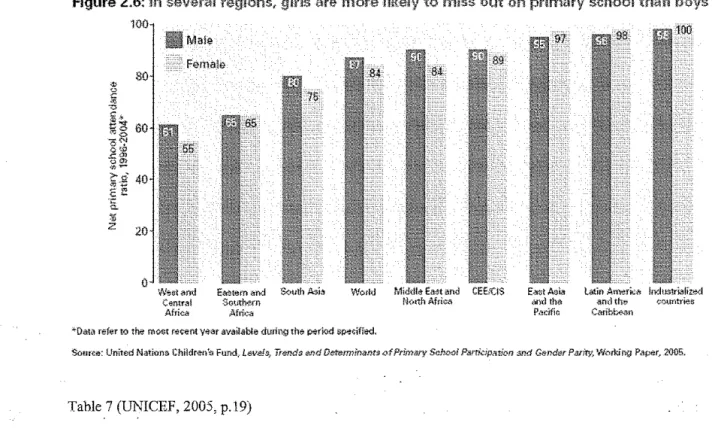
deficient in education and literacy skills at an early age (Aras, 1992) (Pennells 1998) (Table
Figure 2.6: !n several refjiolns,
100
are more to miss out on primary school then
W~r;l,11ncl c~ntra!
Africa
Ea!:!t•Mn and South Asi<'l WorM Midrlle EMt and CEErClS E.J~t>l A$@ L;Jotin Ameri;~ !ndt~Stri<l!lwJ
S<:1uth"'m tk,tth Afri>X> arwltha .and the ~ountrier.
AfriUt Pacific Caribb<Nin
<~Dilta refer to the moct ret~nt year avail.able during the P*riod SP'I''<ifie<J,
Sour.:e: United Nation~ Children's Fund,ilfNe!s, Trends f!Tid OeUmninanuofPrimilry ScbtX!l Parridpatkm s.'Kf &mder P-arity, W.-.rking Paper, 2005.
Table 7 (UNICEF, 2005, p.\9)
After a woman has children in a rural setting, literary and non formal education models are often not seen as an effective investment for the family. Programs have been criticized in the past as non relevant, poorly taught, few materials and poor physical environments for learning (Pennells 1998).
Cultural and social changes continue to evolve as attitudes change regarding sexual activity outside of marriage, especially in urban areas. The media and the press worldwide exert increasing influence for relaxed attitudes regarding sexual activity. In low income situations, sex may be exchanged for material needs. Adolescents do not have the knowledge about their bodies, sexuality nor contraception that is adequate in many environments.
should be allowed to continue their education. It is beneficial to encourage governmental programs and policies, working with national leadership in the Ministries of Education and Health, provincial health officers, local school superintendents and teachers to support such matters.
One of the most effective ways to improve maternal illiteracy is to focus on girls in economically deprived countries who are at a risk at becoming young mothers. There is strong evidence that adolescent girls who remain in school are less likely to have children at a young age. For example, in Nigeria, research showed that only 7 percent of women with seven years of schooling gave birth before age 20, compared to 43 percent of those with no education (Caldwell, 1982). In Pakistan, 16 percent of women with seven years of education gave birth before age 20, compared to 54 percent with no education (Chandrashekar, Rao, Nair, Kutty, 1998). If pregnant students drop out of school, they are more likely tohave a lower paying job, become separated or divorced compared to women who finish school (Singh & Wulf, 1990). Preventive strategies, especially in adolescent female health, need to be implemented for long term gains.
Program Interventions
In order to incorporate maternal illiteracy factors into child health programs, several factors need to be considered, including analyzing local data and developing evidence- based literacy interventions. Evidence- based public health interventions involve analyzing local data, reviewing published studies, assessing available materials, making planned
Organizing and developing a coalition of community based members allows a process when they can have a sense of ownership in the process (Mobilizing for Action through Planning and Partnerships, [MAPP], 2004). In planning for a community based training program, priority should be given to a grassroots organization, rather than a top down model. Efforts should be made to not politicize the planning, and to integrate gender awareness in every step. As the community structure builds its capacity, it is important to establish respectful and regular government communications. MAPP is a community-wide strategic planning tool for improving commnnity health. Community participation leads to collective thinking and, ultimately, results in effective, sustainable solutions to complex problems.
internationally funded projects, local assessments can be assisted by internatiomil
coordinators and a project evaluation team. Coalition groups can form community mapping projects to assess need areas, and how to meet with mothers and their children in home studies or clinic visits. Using focus groups and interviews, ideas and areas of interest can be gathered regarding non formal education and literacy meetings, ideas and beliefs on
pregnancy prevention methods, market cooking classes and child health learning teams. After completing the assessment, coalitions could follow the MAPP model and identify strategic issues, formulate goals and strategies, and work in the community as well as with the local public health system to evaluate, plan and implement a plan of action. (MAPP, 2004)
Grassroots planning requires as much inclusion in the community as possible, getting the lowest tier of community members involved: mothers .. fathers, grandparents, extended
family, school teachers, community health workers, local government agencies, business owners and civic representatives including volunteer and religious groups.
Reviewing Pnblished Data
An analysis of the community's epidemiological data should include data on adult literacy, maternal education and infant and child mortality rates. An analysis of 16 reports from Asia, Africa, Latin America, and the Middle East found maternal education was positively associated with the nutrition status of their children. The impact of the father's education level on a child's survival is, at the most, one half of the mother's education. Income alone does not explain this impact (Cochrane et a!, 1982).
greatly improve to those similar to those women in their culture that are older (Singh & Wulf, 1990). In northern Nigeria, women ages 13 - 16 who were pregnant and received prenatal vitamins and nutritional supplements had reduced rates of obstructed labor (Singh & Wulf, 1990). Family Health International's study from Chile, Egypt, Honduras, Sweden and Thailand found that the number of prenatal visits had a significant effect on the health of the mother and chances of having a healthy baby (Senderowitz, 1995). Attendance at high quality antenatal programs is associated with lower child and maternal mortalities (Chandrashekar et al, 1998).
Is health illiteracy the real problem?
Health literacy, to enhance the standard literacy definitions, looks at the ability to use cognitive and social skills to "determine the motivation and ability of individuals to gain access to, understand and use infornmtion in ways which promote health and maintain good health" (Nutbeam, 1998, p. 357). Another definition by Kickbusch (1997, p.266) states: "Health literacy implies the achievement of a level of knowledge, person skills, and confidence to take action to improve personal and community health by changing personal lifestyles and living conditions." This definition has had a broader interpretation to go
beyond reading pamphlets and making clinic follow up appointments. By improving people's access to health information and their ability to use the information, health literacy is a critical component to empowerment.
Health literacy, by itself, is dependent on a general platform ofliteracy. Poor literacy can affect people's health by direct means, limiting their personal, social and cultural
knowledge of the patients own health status, disease and treahnent knowledge (Kalichman & Rompa, 2000). Limited health literacy is highly associated with poor health status; a lack of literacy skills predicts deficient health more than education, income, ethnic background, or any other socio-demographic factor (Weiss, 2001).
Health literacy is directly related to health education. Failures in health education may be a factor in health illiteracy, but not all health training is done in the formal setting (Kickbusch, 1997). Studies have shown that health care providers need to provide material that is easy to read, with a literacy level that is equal to the population of consumers (Levandowski et a!, 2006). Material must also be culturally appropriate to the population. Even in the United States, reading comprehension is about 4 years below a person's highest grade cqmpleted. Among US high school graduates, about 15% read at or below a 6th grade level (National Work Group on Literacy and Health, 1998). Low literacy has been associated with self perception of poor health by patients and a barrier to care (Baker, Parker, Williams, Clark & Nurss, 1997).
Save The Children has made maternal literacy an important factor in their training programs. In Nepal, they have made the use of illustrations in clean birthing kits more than written instructions due to the assessment of women being trained had poor reading skills (USAID, 2001).To understand the depth of the illiteracy in a clinic setting, maternal age and education data needs to be included in clinic data.
Training Health teams
include local, regional and national government, society groups, teacher groups, NGOs,
advocacy groups and the private sector (business and education). Non formal educators can
include local businessmen and women, those with agriculturally based occupations as well as
civic and social organizational leaders. As an example, hairdressers and grocery clerks could
be mobilized to encourage infant mortality messages, literacy workshops and regular
immunization schedules.
Educators should be a vital partner in supporting literacy movements, especially to
those in the community outside of the formal school system. Resources could include the
national provincial education system and its leadership, as well as local teachers. Non formal
methods of education are the most appropriate for adult learners. Focus groups, community
workshops, and reading groups are examples oflocal advocacy based activities. As parents
are involved in learning how to read, then reading to their children, they will increase their
own literacy (Cross, 200 l ). Training should initially be limited to a small amount of
information at one time, then progressed. Simple methods of training include using the
"teach- back method" of communication, getting the person to repeat back to you what has
been told (AMA, 2002).
In the health care setting, clinic and health care stations need to consider strategies for
effectively reaching the illiterate mother. Young mother are at higher risks for complications
with pregnancy and higher infant mortality. Adolescent health needs to be provided in a more
comprehensive manner, to include pregnancy prevention methods and antenatal care.
Interventions for infant and child health will require an evaluation of training materials and
can review materials and give feedback to the clarity and appropriateness of how each message is communicated.
Eighty percent of the world's population lives in an oral and visual culture. This large population learns through listening, and watching rather than reading or writing (Kickbusch, 2001 ). In working with an illiterate/partially illiterate population, written material should be simple, easy to read and clear. It should contain a lot of visual information including
illustrations, photos and drawings. All materials written or drawn need to be reviewed for cultural appropriateness and sensitivity. Materials need to be developed in multiple
presentations (posters, TV, radio, face-- to-face and at community based health fairs). Using community gatherings for dramas, song contests, story presentations, group discussions and TV or radio education spots are other suggestions to communicate health messages in a non written form for illiterates. Studies show radio is especially effective in retaining literary skill, as well as increasing health communication competencies (Pennells, 1998).
target for the highest health impact. Skills training models are described in non written and verbal techniques with instructions, demonstrations, practice, feedback, and continued homework practice and feedback (Graeff, 1993).
In Paraguay, a community based antenatal program was structured to provide literacy training with each antenatal clinic visit. Booklets with visual images about maternal health were provided. In three visits, mothers could recall and explain in their own words the health care messages. This study demonstrated that women of limited educational experience could make positive gains in maternal health literacy in a community based program (Ohnishi, 2005).
programs, citing improved primary school scores with those that attend (Pennell, 1998) (Table 8).
Table 8 (Save the Children, 2004, p.2)
Evaluating the outcomes
The evaluation of training mothers with literacy is based on the concepts that if mothers have a higher literacy level, their children will live longer. Statistically, significant associations have been fmmd with maternal illiteracy and under five mortality, infant ( < I year) mortality, and low MUAC (mid upper arm circumference) (NIPORT 2003).
focus on a needs assessment of the community. After the assessment is completed, the target topic of maternal illiteracy and child survival can be defined to the specific populations of young, unmarried or married mothers and those mothers that did not complete school. A key input for guidance would be assistance from child survival leadership from non governmental organizations and program goals, objectives and logic model could be established. The process would be completed with the actual implementation of the health care messages, literacy training and evaluation. Key outcomes would include improved literacy rates, infant mortality rates and child survival rates in the population served.
In Manila, a project was started with a community coalition for clean water in the squatter zone ofBalut, where water was carried into the housing area and sold per bucket. The process of deciding where and how water could be brought into the community was decided by an elected group of men and women in the community who met weekly to discuss the issues of not just clean water, but the impact that the water supply would have to the community.
The water project became a training opportunity in the making, using the topic of water to provide health education messages regarding skin diseases and washing, drinking safe water to prevent diarrhea, and drinking water to prevent dehydration. Training was done with posters, discussion groups, drawings, dramas and participation from school age
children. Teams oflocal men and women helped install the pipes, mix the concrete, and wire the pumps for electricity. After the successful installation of the water pipes was complete, the coalition was motivated to work on another project.
The coalition selected immunization of children for measles. Measles would kill 30-40 children each spring in the community of 30-40,000. Many mothers were illiterate and had no knowledge of how to access the health clinics a distance away from the dump, and did not take their children for care. Grandmothers became involved, wanting to help their
grandchildren. A measles vaccmation clinic was initiated by the coalition, inviting primary health workers to train local members how to conduct an immunization clinic. Goals were set for the training times and the program developed into the highlight of the community's social events. After several meetings of planning, immunizations began in July. Vaccinations were held once a month, vaccinating all children under the age of five that had a birthday within the past six months.
Recommendations for Child Survival Projects
1) Be an advocate for girls' education. Help girls attend school, and stay in school. Build effective community coalitions that will support girls' education in their communities.
Support local coalitions to develop plans for supporting and negotiating with local leaders and family leaders to allow girls to attend school and stay in school. Education helps girls become better mothers and increase the child survival rate. Provide ways for pregnant girls to attend school and not drop out.
2) In child survival programs, target services to first time mothers and newly married girls. Require that data be collected in all health clinics regarding the mother's age and education status to access risk factors. This will help in documentation, and allow high risk identification of mothers that may have a death of a child under the age of five. Newly married girls need support for delaying pregnancy. Firsttime mothers need mentoring and training support, especially for the first year as new skills are developed. Provide more frequent clinic visits and informal education settings for first time mothers to help decrease the incidence of the most common preventable childhood diseases. Provide training materials for the illiterate in non written form.
3) Support non formal educational opportunities for women. Target training
opportunities for women that are out of school. Develop models that can be easily adapted in different settings, i.e., market sites and home venues. Use training to improve health literacy as well as general literacy skills. When adolescent girls have options to earn income, they have more options to stay out of poverty.
discuss options and provide community dialogue for change. Collaborate with government and non government organizations to support new opportunities for girls and women. 5) Advocate increasing the age of marriage. Increasing the age of marriage will increase the age of pregnancy and increase child survival rates (UNICEF, 2004). Support grassroots organizations and coalitions that can promote laws increasing the age of marriage. Work as an advocate to the government to encourage government policy or laws to increase the age of mamage.
Advocacy Roles in Public Policy
The issue of supporting maternal literacy and child survival topics in the US government requires lobbying the Senate and House of Representatives. In a survey conducted by Lake, Snell and Perry for the US Coalition for Child Survival (Lake, Snell & Perry, 2004)
congressional staffers were interviewed for their ~ow ledge and option of international child survival needs. After several topics were discussed and definitions of child health defined, conclusions were made as to the best effect method of lobbying the political parties.
Republican staffers seemed to be engaged in topics like child survival for the first time. With President Bush's focus on HIV/AIDS in Africa, Republicans are now involved in new issues that they need and want to learn more about. Democrats, who have been long term supporters of child survival, need to be updated on the issues; they need relevant facts and success stories to keep engaged (Lake et al.2004).
Focused goals for public policy advocacy
I. Keep the message clear that a large number of children are dying from preventable causes. These include child survival messages and the need to support maternal literacy in
2. Encourage congressional representatives to fund global education, especially towards girls, in order to decrease maternal illiteracy. Use messages selectively when lobbying political leaders and their staff. Republicans may understand the benefits of supporting and working in child survival better in the perspective of national security. Democrats need to know that funding levels have been stagnant over the last several years, and need renewed support (Lake eta!.).
3. Collaborate with other organizations and advocacy groups. The US Coalition for Child Survival is a group organized to lobby and support for the needs of child survival in the United States. Non governmental organizations such as World Vision, Save the Children, Oxfam, Global Health Council, The Core Group, and the Bill and Linda Gates Foundation are key groups to support in their efforts to publicize and support programs to decrease materna! illiteracy in their child survival projects. National legislators need effective lobbying in order to be equipped to communicate with the USAID and the United Nations' UNESCO and UNICEF programs. Working with educators, it is important to place illiteracy as the greatest need in a national educational platform for each nation studied. Industries with an international portfolio can also be lobby to support such issues as well.
Conclusions
References
AMA Foundation. (2002). Health literacy: a manual for clinicians. Chicago, IL: American
Medical Association.
Aras, R. (1992). Towards child health through mother's health and education. Indian J.
Maternal Child Health 3 (2)52-53.
Baker, D., Parker, R., Williams, M., Clark, W., & Nurss, J. (1997). The relationship of patient reading ability to self reported health and use of health services. American Journal of Public Health, 87, 1027-1037.
Basu, A.M. & Stephenson, R. (2005). Low levels of maternal education and the proximate determents of childhood mortality: a little learning is not a dangerous thing. Soc Sci Med 60
(9) 211-223.
Bicego, D. & Ahrnand, 0. (1996). Infant and child mortality. Demographic and health surveys comparative studies No. 20. Retrieved March 12, 2006 from
http://www.measuredhs.com/pubs/pdf/CS20/00FrontMatterOO.pdf
Birdsall, N., Levine, R.& lbrahim,A. Towards Universal primary Education: Investments, Incentives, and Institutions. U.N. Millennium Project, Task Force on Education and Gender Equality, 2005. Retrieved on April 1, 2006 from
http :1 /wwv1.mdgender .net/resources/mono graph_ detail. php ?MonographiD=41
Buor, D., (2003). Mother's education and child mortality in Ghana. Health Policy, 64(3)
297-309.
Caldwell, J. & McDonald, P. (1982). Influence of maternal education on infant and child mortality: levels and causes. Health Policy Education, 2(3-4) 251-267.
Center for Literacy of Quebec. (2000). A working definition: literacy for the 21st century. Retrieved February 20, 2006 from http://www.nald.ca/litcent.html
Chandrashekar, S., Rao, R.S., Nair, N.S. & Kutty, P.R. (1998). Socio-demographic determinants of antenatal care. Tropical Doctor, 28, 206-209.
Cochrane, S.H., Leslie, J. & O'Hara, D.J. (1982). Parental education and child health: intraconntry evidence. Health Policy Education, 2 (3-4):3-50.
Cross, C. (2001). School- family partners in literacy. Retrieved March 2, 2006 from www.schoolrenewal.org/strategies/illiteracv cc.html
Ditto, J. (1989) Focus Group interview with families from Dahlanega village, Ifugao, Philippines.
Ditto, J. (1989) Interview with David Anderson. Balut, Manila, Phillippines.
Fernandez, L. (2006). Health literacy and patient care. Retrieved March 22, 2006 from http://www.uptodate.com
Graeff, J., Elder, J. & Booth, E. (1993). Communication for health and behavior change: a developing country perspective. Washington, DC: USAID.
Greenspan, A. (1992). Effects of education on reproductive behavior: lessons from Pakistan.
Asia Pac Pop Policy, Dec (23) 1-4.
Hao, H. (1990) An analysis of discrepancies in China's mortality rate. Chin J Popul Sci 2( 4)
339-349.
Harstell, Z. (2005).Health care illiteracy: implications for providers. Journal of American Academy of Physician Assistants, May 18(5) 41-47.
Jones, F., Franco, S., Metcalf, S. & Popp, R. (2000). The value of book distribution in a clinic based literacy iniervention program: Retrieved-March l, 2006 from
www .merckmedicus.com
Kahn, R.S., Wilson, K. & Wise, P.K. (2005). Intergenerational health disparities: socio economic status, women's health conditions and child behavior problems. Public Health Rep 12 ( 4) 399-408.
Kalichman, S.& Rompa, D. (2000). Functional health literacy is associated with health status and health related knowledge in people living with HIV-AIDS. Journal of Acquired Immune Deficiency Syndromes, 25 (4) 337-344.
Kawachi, I., Kennedy, B.P ., Lochner, K. & Prothrouw-Stish, D. (1997). Social capital, income inequity and mortality. American Journal of Public Health, 87, 1491-1498.
Kickbusch, I. (2002). Health literacy: a search for new categories. Health Promotion International, 17(1) 1-2.
Kickbusch, I. (2001). Health literacy: addressing the health and education divide. Health Promotion International, 16 (3) 289-297.
Kickbusch, I. (1997).Think health: what makes the difference. Health Promotional International, 12, 265-272.
Kuharuza, F., Sabroe, S., & Scheutz, F. (2001). Determinants of child mortality in a rural Ugandan community. East Africa Medical Journal, 78(12)630-635.
Lake, Snell & Perry, (2004). Child Survival. Powerpoint Presentation for the US Coalition for Child Survival. Retrieved March 5, 2006 from http://www.child-survival.org
Levandoski, B., Sharma, S., Lane, S., Webster, N., & Cibula, D. (2006). Parental Literacy and Infant Health: An Evidence-Based Healthy Start Intervention. Health Promotion
Practice, 7, 1, 95-102.
MDG (Millennium Development Goals) (2005). Retrieved April2, 2006 from http://www. unmillenniumproj ect. org/reports/tf education.htm
Mobilizing for Action through Planning and Partnerships (MAPP) (2004). National Association of County and City Health Officials. Retrieved March 5, 2006 from http://MAPP.naccho.org
National Institute of Population Research and Training (NIPORT) (2003). Bangladesh
maternal health services and maternal mortality survey. Dhaka, Bangladesh.
National Work Group on Literacy and Health (1998). Communicating with patients who have limited literary skills. Journal ofFamilyPractice; ,46, .168-176.
Nielson-Bohlman, L., Panzer, A.M. & Kindig, D.A., eds. (2004). Health literacy: a
prescription to end confusion. Committee on Health Literacy, Board on Neuroscience and
Behavioral Health, Institute of Medicine. Washington, D.C.: The National Academies Press. Nte, A., Ekanem,E., Gbaraba, P., Oruamabo, R. (1997). Social-environmental influences on the occurence of neonatal tetanus in some riverine communities in Nigeria. Tropical Doctor,
Oct 27 (4) 234-235.
Nutbearn, D. (2000) Health literacy as a public health goal: a challenge for contemporary health education and communication strategies into the 21st century. Health Promotion
International, 15(3) 259-267.
Nutbearn, D. (1998). Health promotion glossary. Health Promotion International, 13 ( 4) 349-364.
Nutbearn, D. & Kickbusch, I. (2000). Advancing health literacy: a global challenge for the 21st century. Health Promotion International, 15(3) 183-184.
Ohnishi, M. (2005). Improvement in maternal health literacy among pregnant women who did not complete compulsory education: policy implications for community care services.
Pennells, L. (1998) Girls and women's education (policies and implementation mechanisms) case study: Nepal. Bangkok, Thailand: UNESCO regional office for Asia and the Pacific.
Renkert, S. & Nutbeam, D. (2001). Opportunities to improved maternal health literacy through antenatal education: an exploratory study. Health Promotion International, 16 ( 4) 381 -388.
Sandiford, P., Cassell, J., Sanchez, G. & Coldham, C. (1997) Does intelligence account for the link between maternal literacy and child survival? Soc Sci Med, 45 (8) 1231-1239.
Save the Children. (2004). State of the Worlds Mothers. Save the Children. Westport, CT, USA. Retrieved March 18, 2006 from http://www.savethechildren.org/ mothers/
report 2004/images/pdflSOWM 2004 final.pdf
Save the Children. (2001). State of the Worlds Mothers. Save the Children. Westport, CT, USA. Retrieved March 18,2006 from http://www.savethechildren.org/ mothers/
report_ 2001/images
Save the Children. (2000). State of the Worlds Mothers. Save the Children. Westport, CT,
USA.
Senderowitz, J. (1995). Adolescent health: reassessing the passage to adulthood. World Bank discussion paper No. 272, Washington, DC. World Bank.
Singh, A. & Wulf, I. (1990). Today's adolescents, tomorrow's parents- a portrait of the Americas. Alan Guttmacher Institute.
State of the Worlds Children, 2006(SOTWC 2006). United Nations Children's Fund. Retrieved February 16, 2006 from http://www.unicef.org/sowc06/
State of the Worlds Children, 2004 (SOTWC 2004).United Nations Children's Fund. Retrieved February 15, 2006 from http://www.unicef.org/sowc04/
Sufran, A.J. (1989). Socioeconomic correlates life expectancy at birth- the case of developing countries. Ingu Pagan Nonjip 9 (2) 214-226.
UN Development Program. (2004). Identity diversity and globalization. UN Development
program. Retrieved February 19,2006 from
http://hdr.undp.org/reports/global/2004/pdflhdr04 HDI.pdf
UNESCO. (2006). Institute for Statistics. Retrieved March 4, 2006 from www.uis.unesco.org UNESCO. (2005). Literacy initiative for empowerment (LIFE). Paris, France: UNESCO
UNESCO (2002). Policy Statement: "UN: 2003-2012: The Literacy Decade". New York, NY: UN Press.
UNICEF. (2005). State of the World's Children 2006. Retrieved March 15,2006 from http://www.unicef.org/sowc06/english.
UNICEF. (2004). State of the World's Children 2005. Retrieved March 13, 2006 from http://www.unicef.org/sowc05/english.
USAID (2005). Child Survival-Frequently Asked Questions. Retrieved April2, 2006 from http://www.usaid.gov/our work/global healthlmch/ch/news/csfag.html#many
US AID Symposium. (2001) Behind every healthy mother is a healthy child. Westport, CT: Save the Children.
US Coalition for Child Survival. Stated Facts. Retrieved Aprill, 2006 from http://www. child -survival.org/ stateof.html
Weiss, B.D. (2001 ). Health literacy: an important issue for communicating health information to parents. Chinese Medical Journal, 64 (11):603-608.
Westoff, D. {2003). Trends in marriage and early child bearing in developing countries. Demographic and health surveys comparative reports No. 5, 4 7. Retrieved March 22, 2006 from http://www.measuredhs.com/pubs/pdf/CR5/CR5.pdf.
WHO (2004) Polio Eradication: now more than ever. Retrieved April 2, 2006 from http://www. who .int/ features/2004/po lio/ en/
Yajima, S., Takuno, T., Nakamura, K. &Watanabe, M. (2001). Effectiveness of a community leaders program to promote healthy lifestyles in Tokyo. Health Promotion International, Sep