ORIGINAL ARTICLE
Research on the Influence of Regional Economic Development on
Shenzhen’s Economic Vitality
Sihao Fu*, Xinzhu Chen, Zekun Wang
School of International Business, Tianjin Foreign Studies University, Tianjin 300000, China. E-mail: [email protected]
Abstract: We studied the population increment and enterprise increment under the policy of ―building socialism with Chinese characteristics pilot demonstration zone‖ in Shenzhen and calculated the number of permanent residents and enterprises in Shenzhen in terms of short term (next year) and long term (next five to ten years). Combined with the new population and enterprises brought by the new economic policy and the model in question 1, the data of Shenzhen GDP in the short-term and long-term situations are calculated. So we concluded that the long-term impact on Shenzhen will be greater than the short-term impact in the future.
Keywords: Regional Economic; Development; Economic Vitality
1. Introduction
The economic vitality of a region is an important part of the regional comprehensive competitiveness, and the concept of ―economic vitality‖ is composed of a variety of factors. What worth concerning is that the main representa-tive factors are population and corporate vitality, and the function of analyzing the economic vitality of a region is to improve its regional competitiveness[1].
However, the huge differences in economic vitality between regions still exist due to their different policies, de-velopment capabilities and location conditions. Therefore, analyzing the reasonable factors that affect economic vitality and studying the important actions to improve economic vitality play an extremely important role in China’s future economic development[2].
2. Establishment and solution of model
We take Shenzhen as an example to analyze the economic vitality.
2.1 Shenzhen’s economic transition policy
2.1.1 A pioneering demonstration zone of socialism with Chinese characteristics in Shenzhen
On August 18, 2019, the Central Committee of the Communist Party of China and the State Council issued the opinions on supporting Shenzhen to build a pioneering demonstration zone with Chinese characteristics (hereinafter referred to the Opinions), and proposed that Shenzhen will become a modernized, international and innovative city by 2025; in 2035, it will become a model city for China to build a socialist modern power; by the middle of this century, it will become a global benchmark city with outstanding competitiveness, innovation and influence.
Copyright © 2020 Sihao Fu et al. doi: 10.18686/fm.v5i3.2114
This is an open-access article distributed under the terms of the Creative Commons Attribution Non-Commercial License
(http://creativecommons.org/licenses/by-nc/4.0/), which permits unrestricted non-commercial use, distribution, and reproduction in any medium, provided the original work is properly cited.
2.1.2 Changes brought by “Shenzhen’s construction of a pioneering demonstration zone with
Chinese characteristics”
In the future, the planned area might approximately have 368,000 employed people and a residential population of 283,000. To attract high-end talents and enterprises, the planned area encourages the introduction of international public service functions, such as public art, professional medical services, professional education and training. Shenzhen en-courages enterprises to invest in construction and operation and support social organizations to participate in the con-struction of urban public facilities, and it is also encouraged to build a rich and perfect urban public service system, in-cluding 28 kindergartens, 2 primary schools, 9 nine-year consistent schools, and 2 high schools[3].
2.2 Impact of Shenzhen’s construction of a pioneering socialist demonstration area with
Chi-nese characteristics on Shenzhen’s economic vitality
2.2.1 The forecast of Shenzhen’s short-term and long-term GDP by fitting historical data
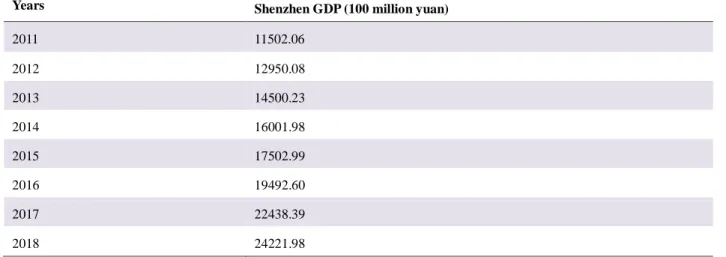
The changes of Shenzhen GDP data over time:
Years Shenzhen GDP (100 million yuan)
2011 11502.06
2012 12950.08
2013 14500.23
2014 16001.98
2015 17502.99
2016 19492.60
2017 22438.39
2018 24221.98
Table 1. Data on Shenzhen’s GDP
Use this data to plot the scatter diagram and trend curve of Shenzhen GDP over time, as shown in the figure.
Through the linear fitting of excel, the linear function GDP=1820.9ln+9132.1 with good fitting goodness is ob-tained, and the GDP values for the next year and the next five years are calculated, as shown in the table.
Time Shenzhen GDP value (100 million yuan)
2019 20,520.2
2020 27341.1
2021 29162
2022 30982.9
2023 32803.8
Table 2 GDP values for the next year and the next five years
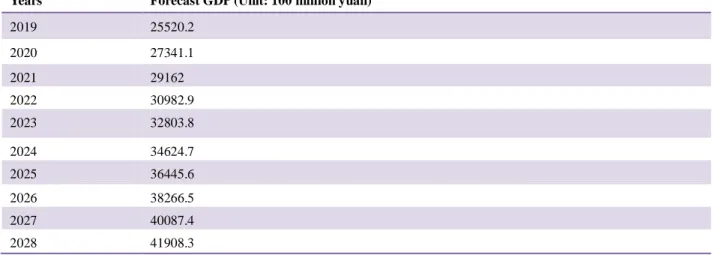
Through the linear fitting of excel, the linear function GDP=1820.9ln+9132.1 with good fitting goodness is ob-tained, so that the mean value of the predicted value of Shenzhen GDP in the next ten years is 33,714.25 billion yuan.
Years Forecast GDP (Unit: 100 million yuan)
2019 25520.2
2020 27341.1
2021 29162
2022 30982.9
2023 32803.8
2024 34624.7
2025 36445.6
2026 38266.5
2027 40087.4
2028 41908.3
Table 3. The long-term forecast of Shenzhen GDP (next ten years)
2.3 Interpretation of Shenzhen’s future economic policy and forecast of new GDP
2.3.1 Forecast of new GDP
Hypothetical variable
There is an assumption that the new GDP under Shenzhen’s policy of ―building a socialist pilot demonstration zone with Chinese characteristics‖ is recorded as GDPSF.
Short-term forecast
According to 5.2.1, the forecast value of Shenzhen’s GDP in 2019 is 2.052 billion yuan, and the total number of Shenzhen residents in the appendix selected in 2019 is 11.0984 million.
According to the calculation formula of GDPSF, GDPSF = 20,520.2 * 108 /1190.84*104 * 28.3 * 104 = 487.66. Long-term forecast
(1) Forecast of Shenzhen GDP in the next ten years (2019-2028)
Years Forecast GDP (Unit: 100 million yuan)
2019 25520.2
2020 27341.1
2021 29162
2022 30982.9
2023 32803.8
2024 34624.7
2025 36445.6
2026 38266.5
2027 40087.4
2028 41908.3
Table 4. Shenzhen GDP forecast results
According to the prediction results, the average value of Shenzhen’s GDP forecast for the ten years from 2019 to 2028 is 337.1425 billion yuan.
(2) The data of Shenzhen GDP forecast and historical values in the next ten years
From 2011 to 2018, Shenzhen’s GDP showed a rapid linear growth (from 1.2 trillion yuan in 2011 to 2.5 trillion yuan in 2018). So we predicted that in the next 10 years, Shenzhen GDP will eventually grow to about 4.300 billion yuan.
(3) Forecast of Shenzhen’s resident population in the next ten years (2019-2028) This table is based on historical data of Shenzhen’s resident population
Years Shenzhen resident population (10,000 people)
2015 1137.87
2016 1190.84
2017 1252.83
2018 1302.66
Table 5. Shenzhen permanent population
Polynomial prediction can be used to obtain the forecast value of the resident population from 2019 to 2028.
Years Permanent population (Unit: 10,000 people)
2019 1190.84
2020 1272.35
2021 1304.84
2022 1337.33
2023 1369.82
2024 1402.32
2025 1434.81
2026 1467.30
2.3.2 Explanation of calculation results
In the short-term, Shenzhen’s economic vitality under the policy of ―building a socialist pilot demonstration zone with Chinese characteristics‖ can be expressed as an increase of 487.66; in the long run, Shenzhen’s economic vitality under the policy of ―building a socialist pilot demonstration zone with Chinese characteristics‖ can be expressed as an increase of 672.59.
2.4 Impact analysis
We concluded that the economic transition policies will have a greater impact on the economic vitality of Shen-zhen. In the future, the long-term impact on Shenzhen will be greater than the short-term impact. In addition, due to the process of urbanization and the development of modern industries during the economic transitions, the primary industry is in an uncertain position in the economic vitality of the Shenzhen area in the future, while the secondary and tertiary industries perform better in economic vitality with linear correlation.
References
1. Cao Y. Declining U.S. economic vitality: Facts, causes and consequences (in Chinese). International Economic Review 2017; (6): 106–116, 117.
2. Liu J, Ma C. Research on the influence and optimization of regional economic environment on the development of emerging industries—Empirical data from 428 listed companies (in Chinese). Journal of Central South University (Social Science) 2015; 21(4): 113–121.
3. Zhou S. Status quo and characteristics of China’s regional economic development (in Chinese). Management and Management 2015; (2): 81–84.