The Republican Party After Charlottesville:
America’s Gatekeepers of Democracy in the Age of Trump — Sort of
By: Kelsey Mason
Senior Honors Thesis School of Media and Journalism University of North Carolina at Chapel Hill
March 29, 2018
Approved: _____________________________ Dr. Daniel Kreiss, Thesis Advisor
ABSTRACT
In August, 2017, a white nationalist rally in Charlottesville, Virginia took place,
attracting media attention and responses from politicians. President Donald Trump in particular
issued three responses, but was undemocratic in the sense that he refused to explicitly repudiate
the racist, extremist groups at the rally. This study asks how the 52 Republican senators in office
during the rally responded to the rally and Donald Trump’s responses in order to determine how
strongly these Republicans are upholding democratic norms and ideals. I first tested to see if a
variety of characteristics had any effect on a senator’s response: state (geographic location),
reelection year, whether they are seeking reelection, who won their state in the 2016 Republican
primary, and who won their state in the 2016 general election. However, it appeared none of
these characteristics strongly indicated any particular response strategy.
I turned to an inductive, qualitative analysis in order to decipher these senators’
responses. In total, I analyzed 333 responses, which included tweets, retweets, Facebook posts,
and press releases. I discovered three broad themes that categorize Republican senators’
responses: 1) “We as the American people…,” in which 16 senators attempted to address race
through unified, American language, 2) “Criticism without explicitly criticizing,” in which 30
senators attempted to break with the President’s rhetoric without challenging him explicitly, and
3) “Mr. President…,” in which 13 senators explicitly denounced Trump’s responses. Broadly,
Republican senators, while they did address race, failed to do so in relation to their own party.
Crucially, they also generally failed to call out Trump’s problematic behavior at a time when he
was explicitly challenging democratic norms. I ultimately argue the Republican Party needs to
reverse this behavior in order to foster a truly multicultural, multiethnic democracy with robust
ACKNOWLEDGEMENTS
I can’t begin this acknowledgements section without thanking anyone other than my
advisor, Dr. Daniel Kreiss, who has provided me with invaluable instruction during my time at
Carolina and throughout the process of writing this thesis. Dr. Kreiss patiently guided me as I
worked through draft after draft, inevitably hitting bumps along the way. I know it was
time-consuming, and I truly can’t thank him enough. That said, anyone who knows Dr. Kreiss
understands that his brilliance as an instructor comes not only from his teaching, but his unique
style of mentorship that pushes students to their fullest potential. Dr. Kreiss was the one who
suggested I pursue an honors thesis. It continues to amaze me how much he invests in his
undergraduate students. For me, it resulted in the proudest accomplishment of my undergraduate
career. Even when my self-confidence wavered, I knew I had at least one person in my corner
cheering me on, who knew I could keep moving forward. I can’t thank Dr. Kreiss enough for
always believing in me.
I also need to thank Professor Ferrel Guillory. I was introduced to Professor Guillory
through a friend whose character I greatly admire. Her praise of Professor Guillory rang
absolutely true, as he is one of the kindest, most intuitive, and most absolutely brilliant people I
have ever had the pleasure of getting to know. I will always owe thanks to Professor Guillory for
his patience and incredible insight during this process. My understanding of my thesis would not
be as thorough without his expertise in a subject he has dedicated his life to. I am indebted to him
for his guidance and the knowledge he passed on to me.
Finally, I have to thank my parents, who have forever been my greatest supporters. When
it comes to the parent lottery, I hit the jackpot. No amount of words will ever be enough. Thank
TABLE OF CONTENTS
Table of Contents . . . . . . 4
CHAPTER 1: INTRODUCTION . . . .. 5
CHAPTER 2: LITERATURE REVIEW . . . .. .10
CHAPTER 3: METHODS . . . 25
CHAPTER 4: FINDINGS . . . 38
CHAPTER 5: DISCUSSION . . . 75
CHAPTER 6: CONCLUSION . . . .. . 77
Chapter 1: Introduction
On August 12, 2017, a movement once mostly confined to Internet websites, blogs, and
message boards—the “alt-right”—came into focus for Americans in a deliberately and
shockingly public way. Videos and images of the “Unite The Right” rally in Charlottesville,
Virginia dominated nearly every major media outlet, with videos and still images of
torch-wielding protesters blazing across front pages and primetime shows. Supposedly a rally to
protest the removal of a Robert E. Lee statue, those participating used it as an opportunity to
promote their white nationalist beliefs. When the rally became deadly after a car struck
32-year-old counter-protester Heather Heyer, the Charlottesville rally became the center of media
attention. After such a public display of racism and violence in Charlottesville, some Republican
influencers believed there was a need to speak out. For example, on August 12, Paul Ryan
tweeted: “The views fueling the spectacle in Charlottesville are repugnant. Let it only serve to
unite Americans against this kind of vile bigotry” (Ryan, 2017).
On the same day of the rally, President Trump addressed reporters regarding the event,
where he said, “We condemn in the strongest possible terms this egregious display of hatred,
bigotry, and violence on many sides. On many sides” (The White House, Office of the Press
Secretary, 2017, para. 5). As Republican influencers were drafting statements in response to the
Charlottesville rally, some deemed it necessary to also respond to the President’s statement,
particularly with regard to his initial refusal to explicitly denounce the white nationalist,
neo-Nazi, alt-right actors. Senator Cory Gardner, a Republican serving the state of Colorado and
chairman of the National Republican Senatorial Committee, tweeted in response to the
President’s comments on Saturday: “Mr. President - we must call evil by its name. These were
presumably prompted to hold another press conference on Monday, August 14, where he made a
more concrete statement: “Racism is evil. And those who cause violence in its name are
criminals and thugs, including the KKK, neo-Nazis, white supremacists, and other hate groups
that are repugnant to everything we hold dear as Americans” (The White House, Office of the
Press Secretary, 2017, para. 7).
The responses regarding the Charlottesville rally continued. On Tuesday, August 15,
President Trump reinforced his first statement, saying there “were very fine people, on both
sides” (The White House, Office of the Press Secretary, 2017).
Q: (Inaudible) both sides, sir. You said there was hatred, there was violence on both sides. Are the --
THE PRESIDENT: Yes, I think there’s blame on both sides. If you look at both sides -- I think there’s blame on both sides. And I have no doubt about it, and you don’t have any doubt about it either.
And if you reported it accurately, you would say.
Q: The neo-Nazis started this. They showed up in Charlottesville to protest --
THE PRESIDENT: Excuse me, excuse me. They didn’t put themselves -- and you had some very bad people in that group, but you also had people that were very fine people, on both sides. You had people in that group. (The White House, Office of the Press Secretary, 2017).
The President’s choice of rhetoric in this third statement, using the term “very fine people,”
elicited more responses from Republicans. While Republicans were attempting to respond to the
rally, it was evident they were responding to Donald Trump simultaneously. For example, Paul
Ryan, despite already having addressed the rally on August 12, tweeted again on August 15:
“We must be clear. White supremacy is repulsive. This bigotry is counter to all this country
stands for. There can be no moral ambiguity” (Ryan, 2017). Because of the timing of Ryan’s
tweet, it is reasonable to assume he is responding more to President Trump’s response on
In this study, I will address the question of how Republican senators—a group of elite,
influential Republicans—in office during the rally responded to the events in Charlottesville as
well as Donald Trump’s responses to the rally.
Addressing the responses to Trump, not just the responses to the rally, is important
because it positions political parties—the Republican Party specifically—as democracy’s
“gatekeepers,” as outlined by Levitsky and Ziblatt (2018). Specifically, Donald Trump broadly
exhibits what Levitsky and Ziblatt (2018) describe as behavior that threatens democratic norms
and values. Because of this, it is the responsibility of the Republican Party (of which Donald
Trump is the current leader) to act as democracy’s gatekeeper and explicitly call him out when
he exudes this problematic behavior and rhetoric. The time is also particularly opportune as
Republicans control a majority of Congress and state houses (Partisan composition of state
houses, 2017).
The Charlottesville rally and Donald Trump’s responses to it reveal Trump’s troubling
toleration of violence and violation of democratic norms. Most importantly, Levitsky and Ziblatt
(2018) argue that these democratic norms are the foundation of America’s democracy and have
sustained it through modern political history. Through 1) mutual toleration and 2) institutional
forbearance, political parties have coexisted in a stable democracy throughout the past several
decades (Levitsky & Ziblatt, 2018). It is important for political parties to play their role as
democracy’s gatekeepers in order to preserve these norms. For example, there was a bipartisan
effort to uncover the truth amidst Nixon’s Watergate scandal, with each party treating the other
as a valid actor and generally refraining from vilifying the other side.
Through an analysis of Republican senators’ responses to both the Charlottesville rally
general coalition, act as democracy’s gatekeepers. Only 13 out of 52 total senators explicitly
criticized the President by name, which should have been the baseline act of a “gatekeeper.”
Why would this be the case for Republican senators? It seems logical that the
preservation of democracy is important. Levitsky and Ziblatt (2018) argue it is often difficult to
recognize potential authoritarian or democracy-violating individuals because of their rise or
emergence through democratic means—not a dictatorial, violent, or militaristic takeover.
Furthermore, Levitsky and Ziblatt (2018) explain that political parties may indeed encourage or
help potential authoritarian leaders within their own party (once elected) because they believe
they 1) can control the figure into complying with party leaders and democratic norms, and 2)
believe they can obtain political success (legislation and policy initiatives) by finding areas of
overlap, or common ground, with the figure. It also seems there is a pressure to help these
leaders in order to achieve electoral success as well. In other words, a politician may refrain from
criticizing a problematic figure if they think it could jeopardize their reelection. This seems to be
the strategy thus far for the Republican Party during Donald Trump’s presidency.
In addition, the Charlottesville rally can also be understood and contextualized through
the Republican Party’s complicated history with race. Several scholars (Berlet & Lyons, 2000,
Hemmer, 2016, and McGirr, 2015, for example) have outlined the rise of the modern Republican
Party as it relates to race and exacerbating racial divides as a means to obtain votes during the
mid to late 20th century. The Republican Party failed to broadly denounce Trump’s rhetoric,
resulting in what one could argue as a “pass” to white supremacy groups such as the alt-right.
This reveals where the party falls in a complicated historical narrative of its handling of race in
America, especially given electoral concerns that presumably further deterred sitting Republican
That being said, it would be unfair to not mention that there is a coalition of Republican
senators—13 senators, or 25%—that did explicitly repudiate both the events at the
Charlottesville rally and, crucially, Donald Trump’s responses to it. It is worth exploring what
these senators have in common, and what makes them important members of the Party as swing
votes. I argue that these senators can first begin to demonstrate new, normative behavior for
Republicans regarding the conversation about race in America, especially in relation to their
party. Even more, they prove they are willing to check Trump’s antidemocratic behavior both
with their rhetoric and with their voting patterns more than other Republican senators, acting as
the gatekeepers of democracy Levitsky and Ziblatt (2016) deem imperative. However, because
only 25% of Republican senators denounced explicitly, it was still an overall failure of
Republican senators to act as democracy’s gatekeepers.
Moving forward in this study, Chapter 2 will situate the Republican Party against the
backdrop of Levitsky and Ziblatt’s (2018) theory in How Democracies Die: that political parties’
role is to act as gatekeepers to prevent authoritarian and demagogic leaders from successfully
acquiring public office and, once there, from eroding democratic norms and processes. I will also
place the Republican Party in a much broader historical narrative—which many scholars detail—
about the Republican Party’s grappling with race in America. Chapter 3 will explain methods of
acquiring and analyzing data, the Republican senators’ response to the data, as well as the
limitations of this data. I used a mix of quantitative and qualitative methods in order to analyze
the phenomenon and driving forces behind Republican senators’ responses, especially focusing
on qualitative methods after the quantitative results were inconclusive. Chapter 4 will provide a
detailed account of findings—both quantitative patterns in data as well as qualitative rhetorical
was a group of senators who more boldly challenged the President. It was also evident
Republicans sought ways to discuss race without directly addressing Trump. Finally, Chapter 5
will discuss why these findings matter, potential ways forward for the Republican Party in light
of their response to the Charlottesville rally and Donald Trump, and areas of future research.
Chapter 6 will be my conclusion, where I offer parting thoughts on democracy in America and
the Republican Party as it stands in 2018.
Chapter 2: Literature Review
In this literature review, I contextualize the Charlottesville rally and the Republican Party
within a framework that constructs the environemnt in which both exist(ed). First, I detail
Levitsky and Ziblatt’s (2018) theory that it is the responsibility of political parties to act as
democracy’s gatekeepers, particularly in reference to Donald Trump and the Republican Party as
it exists currently. Second, I dive into a missing element from Levitsky and Ziblatt’s (2018)
theoretical framework that is crucial to this study: the Republican Party and its relationship with
race in America. Because the Charlottesville rally’s themes were based on white supremacy and
white nationalism, it is important to understand the Republican Party as it relates to the topic of
race. For this reason, I will explain the current Republican Party and how it has interacted with
race in order to contextualize the senators’ responses to the Charlottesville rally and Donald
Trump’s responses. In the context of this study, both of these frameworks will provide a way to
understand Republican senators’ responses to the violence present during and following the
Political parties as democracy’s “gatekeepers”
In a sweeping analysis of democracy and its failures over the course of global history,
Levitsky and Ziblatt (2018) contextualize Donald Trump’s rise to the presidency and first year in
office as a threat to democracy not completely unlike undemocratic leaders outside the United
States. Levitsky and Ziblatt (2018) assert that, based on Linz and Stepan’s (1978) work on the
breakdown of democratic regimes, there are four “behavioral warning signs” to identify
authoritarianism:
1. Rejection of (or weak commitment to) democratic rules of the game 2. Denial of the legitimacy of political opponents
3. Toleration or encouragement of violence
4. Readiness to curtail civil liberties of opponents, including media (p. 21-22)
Oftentimes, candidates that meet these criteria are what Levitsky and Ziblatt (2018) call
“populist outsiders,” or “figures who, claiming to represent the voice of ‘the people,’ wage war
on what they depict as a corrupt and conspiratorial elite” (p. 22). Furthermore, Levitsky and
Ziblatt (2018) warn that these populist outsiders often attack democratic institutions once in
office. The responsibility to stop these individuals from gaining power, Levitsky and Ziblatt
(2018) argue, falls to political parties and party leaders. In other words, political parties and its
leaders are democracy’s gatekeepers (Levitsky & Ziblatt, 2018). According to the test above,
Donald Trump meets each indicator of authoritarian behavior, challenging the Republican Party
to act as a gatekeeper of American democracy.
The responsibility to stop a populist outsider or authoritarian individual from obtaining
power happens through what Nancy Bermeo calls “distancing” (Levitsky & Ziblatt, 2018).
Levitsky and Ziblatt (2018) outline five different ways political parties may distance themselves
1. Keep would-be authoritarians off party ballots at election time, even when they can potentially deliver votes
2. Root out extremists in the grass roots of their own ranks 3. Avoid all alliances with antidemocratic parties and candidates
4. Act to systematically isolate, rather than legitimize, extremists. This requires that politicians avoid acts that help to “normalize” or provide public respectability to public figures
5. Whenever extremists emerge as serious electoral contenders, mainstream political parties must forge a united front to defeat them (p. 24-26)
By engaging in these actions, political parties may sacrifice electoral success, or a victory
for their own political party, but they are considering democracy’s survival even more important
than any political or legislative victory. Levitsky and Ziblatt (2018) outline several examples of
cases where democracies have been spared because political parties acted as democracy’s
gatekeepers. One recent example is from the 2016 French presidential election, where defeated
conservative François Fillon called on conservatives to support center-left candidate Emmanuel
Macron in order to prevent far-right candidate Marine Le Pen from emerging victorious.
Although Fillon undoubtedly created unrest and anger amongst some in the conservative base, it
also resulted in voters looking to Macron, who ultimately defeated Le Pen.
In essence, Levitsky and Ziblatt’s (2018) theory of political parties as the gatekeepers of
democracy sheds light on the very importance of the democratic rights enshrined in the
Constitution. However, it is also important for political parties to act as these gatekeepers in
order to preserve not just what is explicitly granted in the Constitution, but democratic norms
that act as the unwritten rules of the game (Levitsky & Ziblatt, 2018). These unwritten rules
reinforce constitutional rights in a democratic society, and Levitsky and Ziblatt (2018) outline
two norms that have preserved America’s democracy: 1) “mutual toleration, or the understanding
that competing parties accept one another as legitimate rivals,” and 2) “forbearance, or the idea
These democratic norms are not robustly defined and do not even serve as the foundation of
America’s republic, but it has sustained it.
Notably, however, the emergence of these two norms unfortunately came at the expense
of African Americans’ progeress thus far. Mutual toleration arose only after the Civil War, when
the Compromise of 1877 officially made Rutherford B. Hayes the president in exchange for the
removal of federal troops from the South, effectively allowing Southern Democrats to strip
federal protection of African Americans (Levitsky & Ziblatt, 2018). Henry Cabot Lodge’s 1890
Federal Elections Bill, which “would have allowed federal oversight of congressional elections
to ensure the realization of black suffrage,” also failed and thus ensured “[African Americans’]
demise” (Levitsky & Ziblatt, 2018, p. 124). The landmark decision in Plessy v. Ferguson during
the same decade also exacerbated these racial separations—effectively legalizing separate but
equal facilities for African Americans (Plessy v. Ferguson, n.d.). Levitsky and Ziblatt (2018)
stressed that once each party “accepted each other as legitimate rivals,” bipartisan compromise
could be facilitated in the following decades and thus lead to forbearance. This, however, did not
come without the tragic collapse of progress for African Americans thus far.
Holding up these democratic norms have allowed Americans to enjoy a stable democracy
for the better part of the 20th century. However, the rise of Donald Trump has posed a unique
challenge for this democracy, but also for the Republican Party, of which Donald Trump is the
highest ranking member. Because of Donald Trump’s “outsider populist” characteristics and his
adherence to authoritarian tendencies, Levitsky and Ziblatt (2018) argue the Republican Party
should have acted as “gatekeepers” to preserve American democracy and its guardrails, or
moving into the Oval Office? Furthermore, why does the Republican Party currently not critique
the President more often after a speech or Twitter thread exuding authoritarian behavior?
Levitsky and Ziblatt (2018) argue there are two main motivations for political parties to
refrain from checking a leader who threatens democracy. The first is that there is a belief that the
political party in which the leader emerges believes it and its leaders can control the problematic
figure. The second is the belief that there is enough overlap (or “common ground”) between the
political party and the leader to justify elevating him or her to power. And, if elected, they may
be able to help use the figure in order to advance certain legislation or policies important to them.
Although Levitsky and Ziblatt (2018) argue that it is imperative for establishment politicians to
wholly denounce authoritarian leaders despite these two motives, they are still hurdles politicians
must overcome. I also argue electoral success, or getting reelected, is a motivating factor behind
supporting potentially antidemocratic figures.
These two motivations seemed to motivate the Republican Party during and following the
2016 election. Although Levitsky and Ziblatt (2018) note that party elders tried to warn against
Trump after his Super Tuesday victories, the modern primary system “left Republican leaders
virtually weaponless to halt Trump’s rise. The barrage of attacks had little impact and possible
even backfired when it counted: the voting booth” (p. 59). Indeed, following Trump’s
inauguration, it seemed Republican lawmakers were eager to move forward from the divisive
primary and general election, and focus on reaping the benefits of a majority in both the House
and Senate. For Republican lawmakers, the option to explicitly critique Donald Trump lost to
advancing policy legislation.
Levitsky and Ziblatt (2018) acknowledge that the notion of very public, high ranking
2016 general election would have been extraordinary. However, they insist it was still necessary
in an effort to preserve American democracy and its norms (Levitsky & Ziblatt, 2018). While
there was a group of Republican elected officials who refused to endorse Donald Trump, only
one elected official publicly endorsed Hillary Clinton: Congressman Richard Hanna of New
York, and he was retiring (Levitsky & Ziblatt, 2018).
In this way, this thesis is first and foremost a study about democracy. Specifically, it
focuses on America’s democracy and the role political parties take in shaping it through a series
of unwritten norms Americans have come to take for granted. The period of time after
Charlottesville was quite a clear opportunity for the Republican Party to act as a gatekeeper of
democracy. It was their time to denounce Trump’s blatantly antidemocratic rhetoric that refused
to unequivocally condemn the white supremacy and white nationalism encapsulated by the
alt-right at the rally.
This framework yielded broad questions pertaining to the Republican response to the
Charlottesville rally and how their responses indicate whether or not the party acted as
democracy’s gatekeeper. Through what mediums did senators issue responses, and how many?
What was the rhetorical nature of their response? Were they actively trying to normalize, isolate,
root out extremists, etc.? According to Levitsky and Ziblatt (2018), if Republican senators are
acting as democray’s gatekeepers, the rhetorical nature of responses would have been a strong
condemnation of both the rally and the President’s response to it. Furthermore, were there
nuances in responses with regard to their repudiation of the alt-right and/or the President’s
responses? As in, if there were senators who called out the President, did they all do this using
The racial politics of the Republican Party
Beyond the factors Levitsky and Ziblatt (2018) outline as deterring politicians from
speaking out against Trump (control and overlap) there are, likely, other forces shaping the
Republican response to the Charlottesville rally and Donald Trump’s comments—forces driven
primarily by the Republican Party’s relationship with race in America. As previously mentioned,
Levitsky and Ziblatt (2018) note the “tragic significance” of the causes leading up to the
development of America’s two foremost democratic norms. The first is the demise of African
Americans following federal troop removal from the South as a result of the Compromise of
1877, ensuring African Americans would not receive federal protection. The second is the failure
of Henry Cabot Lodge’s 1890 Federal Elections Bill, which ensured African Americans would
not be able to feasibly excercise their right to vote. These two events, however, allowed political
parties to see one another as legitimate rivals and promote institutional forbearance. Thus, the
very foundation of America’s political parties, their relationships, and democratic norms
emerged at the expense of African Americans’ progress. However, it is the Republican Party that
has had particularly throughout history a fraught relationship with race. The Charlottesville rally
not only posed as a way for Republicans to address Donald Trump and our democracy, but it was
a vital moment to discuss race in America and their party.
The Republican Party’s relationship with race is a complex narrative. It is worthwhile to
take a deep dive into the historical context in which this relationship emerged in light of the
Charlottesville rally. This historical narrative is also the context in which the seeds for a
candidacy akin to Donald Trump’s are planted. The Republican Party has before had “populist
outsider” candidates as described by Levitsky and Ziblatt (2018), and it is notable the ways in
The modern breed of conservatism, as we understand it today, came to fruition during the
1950s and 1960s, when several prominent right-wing figures and organizations emerged and
mobilized Americans within the Republican Party (Berlet & Lyons, 2000, Hemmer, 2016,
McAdam & Kloos, 2014). Broadly, this was defined by a struggle between right-wing populist
movements and more politically philosophical conservative movements (Critchlow & MacLean,
2009, Hemmer, 2016). Berlet and Lyons (2000) define right-wing populism as “motivated or
defined centrally by a backlash against liberation movements, social reform, or revolution” (p.
5). Berlet and Lyons also use characteristics such as producerism (which characterizes elites as
unproductive and “subordinate” groups as lazy or immoral), scapegoating, conspiracism, and an
apocalyptic narrative. On the other hand, the conservative movement is defined by Berlet and
Lyons (2000) as having an emphasis on “stability and order, and generally some combination of
cultural traditionalism and ‘free-market’ economics” (p. 16).
In 1964, Barry Goldwater’s run as the Republican nominee for president was a significant
turning point for the modern Republican Party. Overall, Goldwater was an incredibly influential
candidate for Republicans—McGirr (2015) details the sweeping effect he had on Orange
County, California specifically, espousing individualism and anti-regulatory approaches
particularly after New Deal policies were put in place. He also used anti-Washington rhetoric to
appeal to this region, emphasizing that the West and Midwest took more risks and needed a
candidate who reflected that. Moreover, he appealed to religious Americans by speaking to the
breakdown of the family (McGirr, 2015). Although Goldwater voted against the Civil Rights Act
of 1964, McGirr argues his success is not equated with simply “white backlash” (p. 133), but
instead “a broader conservative worldview based on limits to federal government control and a
scholarly debate on Goldwater and his precise effect on the Republican Party, with some arguing
he had a more positive effect and others arguing the opposite (Critchlow & MacLean, 2009).
Even with his broad success, his candidacy still revealed two distinct movements
interacting with the Republican Party. One movement leaned into more right-wing populist
ideals. The John Birch Society (founded by Robert Welch in 1958) is one example of a group
that espoused these ideals. However, it is important to note they did not wholly capture the
Republican Party, and their influence was therefore limited. Berlet and Lyons (2000) point out
some of its more controversial aspects that had to do with implicit appeals to racial superiority,
or at least perceived “white oppression.” Andrew (1997) calls the John Birch Society members
the “advance guard of New Right populism,” in contrast to his comparison to William Buckley,
“a patrician and a conservative”—a proponent of the conservative movement (which will be
discussed at greater length) (p. 103). Berlet and Lyons (2000) argue the Society’s influence
peaked during Goldwater’s nomination, revealing how right-wing populist movements can plant
seeds in the Republican Party. Again, however, the Society’s influence, specifically, was still
limited and certainly did not dominate the entire GOP narrative.
In response to Goldwater’s candidacy, there was also pushback from some in the
conservative movement, spearheaded by William F. Buckley, colleagues at Buckley’s
publication the National Review, and other politicians in agreement with the conservative
movement. McGirr (2015) describes distaste going so far as Governor Edmund G. Brown of
California warning Americans that Goldwater’s speech had the “stench of fascism,” and was
convinced Goldwater was the “hand-picked candidate” of the John Birch Society (p. 141).
William Scranton’s (the Republican governor of Pennsylvania) staff wrote a letter to Goldwater,
Republicans simply refused to stand behind Goldwater, such as Jacob Javits of New York,
George Romney of Michigan, and Nelson Rockefeller, among others.
1964, while proving to be a monumental turning point for conservative influence in
national politics, ultimately resulted in Lyndon B. Johnson’s victory, at least in part a reflection
of the Republican Party’s inability to reconcile these two competing movements. In light of this
divide, Richard Nixon attempted to bridge the coalitions during a 1968 bid for the presidency
(McGirr, 2015).
Walking into a still-divided Republican field, Nixon faced George Wallace, a
segregationist running on the American Independent Party ticket (Berlet & Lyons, 2000). While
Wallace was supported by the likes of the John Birch Society and the KKK, his support base
spanned very much beyond this. He supported social welfare policies for white Americans and
relied on coded racial appeals, as well as appeals to law-and-order, moral traditionalism, and the
fear of centralized government (Berlet & Lyons, 2000). This worried Nixon’s campaign, which
felt he may have trouble in the South because of Wallace’s tactics (Converse, Miller, Rusk, &
Wolfe, 1969). However, while Wallace could flourish in the Deep South with what McGirr
(2015) describes as “populist racism,” it alienated broader groups of Republicans who shared
“hostility” toward federal and liberal elites but rejected racial emphasis (p. 212).
Although Wallace experienced the most successful third-party candidacy since Teddy
Roosevelt in 1912 with 13.5 percent of the vote, he was ultimately defeated by Richard Nixon,
who was able to carry broader Republican support—especially after his vigorous campaigning
for Goldwater in 1964 (Berlet & Lyons, 2000, McGirr, 2015). Nixon also recognized the
important issues to gather this broad support—he took a hard line on “law-and-order” issues,
2015). He spoke of the “forgotten man,” and was able to “refashion” the Republican Party and,
as a result, enjoyed the success that escaped Goldwater (McGirr, 2015).
Although Nixon was successful in 1968, the pressure to secure Wallace’s base was still
prevalent in 1972. Thus, the Nixon campaign adopted the “Southern Strategy” to secure
Wallace’s supporters (Berlet & Lyons, 2000). Phillips, a former Nixon campaign aid, outlined in
The Emerging Republican Majority (1969) the actual emerging Republican majority at the time,
or the realignment of voters in the South and West to form a new Republican base. Phillips
(1969) notes that in reality, the Southern Strategy started well before Nixon, with Goldwater
swinging much of the Deep South Republican with “barely disguised racism,” but therefore
sacrificing other states, including the Outer South1 (p. 170). Nixon and his campaign, in 1972,
sought to utilize populist rhetoric and coded racial appeals to win the support of the “silent
majority of middle Americans,” or a white ethnic constituency.
Furthermore, presidential candidates do not solely define the history of the Republican
Party. During the time Nixon was campaigning for and running for president, another
up-and-coming Republican, actor Ronald Reagan, was running for governor of California. During the
late 1960s, Reagan, like Nixon, also found success by focusing on an American electorate
frustrated with protests, Democrats frustrated with their own party, and lower-middle class and
middle-class whites (McGirr, 2015). Broadly, Reagan found a discontented working class and
cultural changes he could tap into. In this way, Dallek (2004) notes his commitment to
law-and-order in response to race riots and a strong anti-communist stance. During this time Reagan also
opposed the federal Civil Rights Act of 1964 on the basis that this implementation was
unconstitutional. Dallek (2004) additionally notes that the Reagan revolution was less about
1 Phillips separates the South into the Deep South (Louisiana, Mississippi, Alabama, Georgia,
supply-side economics and more about social order—coded in subtle racial appeals to white
Americans. Furthermore, after exit polls from 1980 – 2000 show Republicans’ southern
congressional surge among white voters, Black and Black (2002) argue that Ronald Reagan’s
presidency legitimized the GOP for white southerners.
Ronald Reagan, advancing in the Republican Party, eventually won the Republican
nomination for president in 1980. The right-wing populist and conservative movements were still
deeply influential during his presidential run—making it necessary for Reagan to appeal to a
wide group of voters. However, Reagan was able to capitalize on the effects of the “Southern
Strategy,” and indeed enjoy this widespread popularity. Broadly, McGirr (2015) describes how
Reagan was able to appeal to the nexus of multiple movements fighting for influence over the
Republican Party, but this was not without over twenty years of movements’ struggle to control
the central narrative of the Party. And, it does not mean movements would not continue to
express their disillusionment with the Republican Party. As Ronald Reagan prepared to leave the
Oval Office, his vice president and eventual successor hit the campaign trail.
George H.W. Bush faced the necessity to ensure the Southern realignment in favor of the
Republican Party remained, as well as once again find the intersection of the variety of
movements interacting with the Republican Party. Black and Black (2002) describe Bush’s
capitalizing on the Southern realignment to secure his success there and Balz and Brownstein
(1996) expand by noting his particular commitment to certain issues: gun control, defense, crime
and drugs, the death penalty, and taxes. Like Reagan before him, he relied on issues that could
hold white, Southern voters in the Republican Party, and it was successful—seven-tenths of
white Southerners voted for Reagan in 1984 and two-thirds for Bush in 1988 (Black & Black,
The right-wing populist movements’ overlap with the Republican Party, too, affected
Bush’s 1988 presidential campaign as it had influenced previous campaigns. Lee Atwater,
Bush’s 1988 campaign manager, noted that the GOP’s hope for a Republican-majority South
rested in the hands of populist voters (Balz & Brownstein, 1996). Balz and Brownstein (1996)
pull a relevant quote from Atwater, who notes that culture and social issues would be crucial in
gaining populists’ support in order to secure the Southern vote as a Republican vote:
It is critical to our future success in the South that we understand the reasons for our inroads into the populist vote. Populists have always been liberal on economics. So long as the crucial issues were generally confined to economics — as during the New Deal — the liberal candidate could expect to get most of the populist vote. But populists are conservatives on most social issues, including abortion, gun control and ERA [Equal Rights Amendment]. Also, populists usually lean conservative on foreign policy and national security issues… Thus when Republicans are successful in getting certain social issues to the forefront, the populist vote is ours. (p. 216)
Right-wing populism flared again in 1992, when Pat Buchanan challenged George H.W.
Bush in the Republican primary, broadly espousing what Lyons (2017) describes as
paleoconservative themes, or a criticism of military intervention, free trade, immigration,
globalization, and the welfare state. Müller (2016) notes populism is inextricably tied to
anti-pluralism, and is always a form of identity politics. In this way, populism implies underlying
racial tones, which rejects racial pluralism in the United States (either explicitly or implicitly)
and can instead promote, for example, white Americans (and their protection as a homogeneous
society) as a form of identity politics.
As Berlet and Lyons (2000) note, paleoconservatives (led by Buchanan) wanted to
“revive the anti-interventionist Right,” and portrayed Bush as “a symbol of the sinister Eastern
elite” (p. 279-280). Buchanan and his campaign called Bush a “globalist” as a means to insult
believe in the Old Republic. He would put America’s wealth and power at the service of some
vague New World Order; we will put America first” (Berlet & Lyons, 2000, p. 280). Buchanan
also revived white racial nationalist ideas, writing, for example, in one column that the central
problem with illegal immigrants was that they are “not English-speaking white people from
Western Europe; they are Spanish-speaking brown and black people from Mexico, Latin
America, and the Caribbean” (Berlet & Lyons, 2000, p. 280).
Although Buchanan was not successful in his attempt to grab the reigns of the GOP in
1992, nor was Bush as he sought reelection. The dawn of a new millennium eventually cleared
the way for a new Republican candidate, George W. Bush, who would be able to navigate the
variety of movements related to the Republican Party in 2000. Balz and Brownstein (1996) note
George W. Bush recalling a political truth—“Lesson 101 in politics,” he said, “is never leave
your base” (p. 244).
George W. Bush’s framework in 2000 revolved around his campaigning as a
“compassionate conservative,” hoping to soften the party’s ideological image (Black & Black,
2000, p. 399). Bush knew he could not afford to lose his white and Southern base, a base
preceding him that was built over almost three decades. His “compassionate conservative”
strategy was quite successful, using the “noun to reassure white conservatives” and the
“adjective to attract white moderates” (Black & Black, 2002, p. 399).
After his victory in 2000, Bush’s presidency was permanently altered by terrorist attacks
on September 11, 2001, which reestablished ideals of interventionism and anti-isolationism
within the Republican Party and country (Lyons, 2017). These reestablished ideals within the
Republican Party quieted right-wing populist movements, or paleoconservatives from
It is in this history that we can begin to see the Republican Party historically assuming its
role as a gatekeeper of democracy—it had broadly managed through the 20th century to avoid
leaders who quite blatantly challenged democracy, such as George Wallace. However, this does
not mean these figures did not try to utilize the Republican Party as a way to manifest power.
This history also, obviously, explains the buildup to the Republican Party’s relationship with the
issue of race today.
The appreciation of why elite political response to the alt-right and the events of
Charlottesville matters is also rooted in a foundational understanding of what the alt-right
specificaly is. In a sweeping overview of the movement, Lyons (2017) notes the term itself was
created in 2008 by Richard Spencer3 to encapsulate a group of far right-wing individuals at odds
with the conservative establishment. Spencer also founded AlternataiveRight.com and the
National Policy Institute, a white nationalist think tank, as well as a number of other outlets to
espouse the alt-right’s emerging ideology (Marwick & Lewis, 2017). Since then, the alt-right has
used the Internet as a way to mobilize. The movement itself is rooted in white nationalism, an
umbrella term that encompasses white identity politics, the belief that America is an inherently
white nation, and isolationism (Kreiss & Mason, 2017). Also, although the alt-right holds a
grievance with establishment Republican Party, they demonstrate some influence due to their
targeting Republican voters to join the movement (Hood, 2016, Kreiss & Mason, 2017). Notably,
although the movement is grassroots and will inherently insist on falling back on its own
members, it looks toward Donald Trump as a figure who can help advance their cause and
generally supported him over every other Republican in the 2016 election.
Chapter 3: Methods
In this chapter, I first outline the two research questions that drive this study. I then define
my sample and explain how I collected the data. Finally, I discuss my methods of analysis, both
quantitatively and qualitatively, and limitations.
Research Questions
To begin, it is necessary to explain again what I am looking for and analyzing. This study
asks how Republican senators—a group of elite, influential Republicans—chose to respond to
the Charlottesville rally and Donald Trump’s response to the rally. Thus, this study is broadly
separated by two distinct research questions that can be answered and analyzed quantitatively
and qualitatively:
RQI: How did the Republican Party respond to the Charlottesville rally?
I expect to find Republican senators broadly denouncing the violence and the obviously
racist behavior at the Charlottesville rally. However, given the Republican Party’s history
with race and electoral coalitions (i.e—a white base), it is my expectation that the
Republican Party will refrain from addressing race after the Charlottesville rally, as it
could lead to backlash. I expect there will be some things that likely influence how a
senator responded to the Charlottesville rally, such as a senator’s state’s geographical
location, how the state’s constituents voted in 2016, reelection year, and if the senator is
State (geographic location): I expect Southern senators in particular to be less inclined
to criticize the President given the South’s historical tendency to use race as a factor to
attract white votes. I define the South as one of four regions in the United States
(Northeast, South, West, and Midwest) according to the United States Census
Bureau-designated regions (Census Regions and Divisions of the United States, n.d.). Levitsky
and Ziblatt’s (2018) theoretical framework does not address the Republican Party’s
history with race, which is why I built this second framework to help understand and
ultimately answer these questions.
State (2016 results): I expect that a senator would try to find suitable overlap with
Trump because of his winning performance in their state during the 2016 Republican
primary and the general election (only three out of 52 senators represent a state that did
not swing for Trump in 2016). This is also related to electoral success. I expect a senator
would avoid criticizing the President in order to preserve the votes of their constituency
that also put Trump in the Oval Office. A senator’s state with regard to Trump’s
performance there in the 2016 election implicates the level of policy risk (failure to
overlap and pass legislation) or electoral risk they face should they criticize Donald
Trump. On the contrary, if Trump did not sweep that senator’s state in the GOP primary
or general election, I expect that senator would be less concerned about the party’s
agenda than other concerns about democracy.
Reelection year: I expect reelection year, again viewed through the lens of Levitsky and
role as democracy’s gatekeepers over phenomenon like control, policy overlap, and
electoral success. I expect that the earlier a senator’s reelection year, the more a senator
may want to find “common ground” on policy and legislation with Donald Trump. This
is partially because they also face electoral pressure of getting reelected by a constituency
that voted in favor of the President in 2016. Reelection year is also, of course, related to a
senator’s state and its 2016 results, outlined above. If a senator’s state did not swing for
Trump in the 2016 GOP primary and/or the general election, I expect the reelection year
would hypothetically matter less, as Trump has already proved to be less popular in that
particular state.
Seeking reelection?: I expect to see those who are not running for reelection abandon
their quest for overlap with the President and choose, instead, to criticize him on the basis
of “having nothing to lose.” It will be an important indicator for how the Republican
Party is or is not adequately acting as democracy’s gatekeeper. Like reelection year, I
expect whether or not a senator is seeking reelection to largely play into their amount of
desired “overlap” that Levitsky and Ziblatt (2018) describe, and the lack of commitment
to “electoral success” (or reelection) that I define. It is useful to track which senators are
or are not running for reelection—this could have an impact on their likelihood of
RQ2: How did the Republican Party respond to Donald Trump remarks following the rally?
I expect Republican senators to not denounce Donald Trump becaue of what Levitsky
and Ziblatt (2018) call “control” and “overlap.” “Control” is the idea that politicians can
control figures with potentially antidemocratic behavior, and they thus do not need to
publicly say or do anything. “Overlap” is the idea that senators seek political success in
the form of policy and legislative victories, and that in order to achieve this, it is
important to seek “overlap”—or common ground—with the potentially antidemocratic
figure. I also expect senators to avoid denouncement of Trump because they seek
electoral success (getting reelected) as much as political success. If a senator’s
constituency are a majority Donald Trump fans, it could mean a losing election year for
that senator should they choose to critcize him. However, I do not expect Republican
senators to be totally absent of any criticism. I anticipate senators with specific
characteristics to be likelier to criticize Donald Trump than others, including senators
with a non-2018 election year, senators whose state did not swing for Trump in the 2016
Republican primary, and/or senators whose state did not swing for Trump in the 2016
general election. These senators, in particular, are not as committed to overlap because
they have ample time left in their term to achieve policy victories. They can also still
achieve electoral success without Donald Trump either because their reelection is not for
some time (and the rally would be forgotten news by then) or because their constituency
It is necessary to analyze the responses to Donald Trump’s remarks as well as responses
to the rally. Not only are the two inextricably related, but the responses to the President
are a clear example of how Republican senators are or aren’t acting as gatekeepers of
democracy. It is important to consider how senators not only tackle the important issues
of white supremacism and violence on display at the Charlottesville rally, but also
Trump’s apparent toleration of them through his refusal to explicitly denounce it
immediately. Their responses are an important indicator of the strength of democratic
norms and ideals in party leaders.
Building a sample of Republicans
Before diving further into specific quantitative and qualitative methods to answer these
research questions, it is first important to discuss why I am analyzing Republican senators in
particular. Although a wide range of Republicans—both office holders and non-office holding
influencers—responded to the Charlottesville rally, I decided to analyze only the Republican
senators in office during the time of the Charlottesville rally in the interest of creating a cohesive,
coherent dataset of Republicans to analyze for this study.
Furthermore, Republican senators are a cross-section of the Republican Party in terms of
their ideology. Senators as libertarian as Rand Paul caucus with senators as far-right as Tea Party
Republican Ted Cruz. All of these nuances make senators a worthwhile way to study what may
be at play more broadly within the GOP. It is also important to note that senators are worthwhile
to study because of their undeniable inflence due to their elected status. Furthermore, senators
represent an entire state, so they are likely to be more moderate and broadly representative than a
including Senate Majority Leader Mitch McConnell, a number of 2016 presidential candidates,
the 2008 Republican presidential nominee John McCain, and likely future presidential nominees.
This is important—not only do Senate Republicans vary in ideology, but there is a variety of
“publicity.” For example, some are future party leaders, some are more “newsworthy” and
frequently appear on TV, and some have a bigger influence on journalists and media coverage.
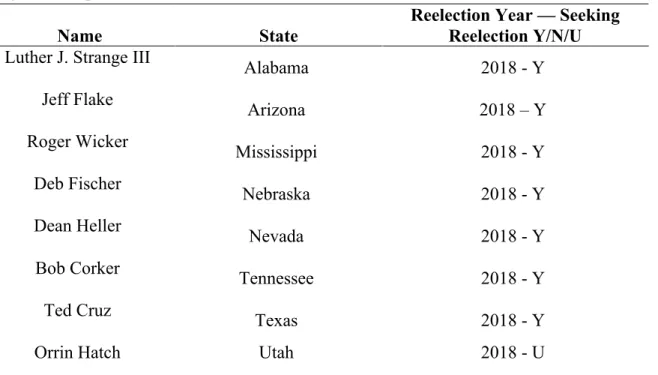
Below, Figure 1 shows each Republican senator, broken down by their state and
reelection year. A “N” indicates that a senator will not be seeking reelection. A “Y” indicates
that a senator will be seeking reelection. Finally, a “U” indicates it is unclear because that senator
has not announced if he or she is seeking reelection, most likely due to the fact that their
reelection year is not until either 2020 or 2022. A senator was assigned a “N,” “Y,” or “U” based
on their status at the time of the Charlottesville rally. For example, at the time of the
Charlottesville rally, Senator Strange from Alabama was actively seeking reelection, even
though he ultimately lost to Roy Moore in the Alabama Republican primary.
Figure 1: Republican senators
Name State
Reelection Year — Seeking Reelection Y/N/U
Luther J. Strange III Alabama 2018 - Y
Jeff Flake Arizona 2018 – Y
Roger Wicker Mississippi 2018 - Y
Deb Fischer Nebraska 2018 - Y
Dean Heller
Nevada 2018 - Y
Bob Corker Tennessee 2018 - Y
Ted Cruz Texas 2018 - Y
John Barrasso Wyoming 2018 - Y
Daniel S. Sullivan Alaska 2020 – U
Tom Cotton Arkansas 2020 - U
Cory Gardner
Colorado 2020 - U
David Perdue
Georgia 2020 - U
Jim Risch
Idaho 2020 - U
Joni Ernst
Iowa 2020 - U
Pat Roberts Kansas 2020 - U
Mitch McConnell Kentucky 2020 - U
Bill Cassidy Louisiana 2020 - U
Susan Collins Maine 2020 -U
Thad Cochran Mississippi 2020 - U
Steve Daines Montana 2020 - U
Ben Sasse Nebraska 2020 - Y
Thom Tillis North Carolina 2020 -U
Jim Inhofe Oklahoma 2020 - U
Lindsey Graham South Carolina 2020 - U
Mike Rounds
South Dakota 2020 - U
Lamar Alexander
Tennessee 2020 - U
John Cornyn
Texas 2020 - Y
Shelley Moore Capito
West Virginia 2020 - U
Lisa Murkowski Alaska 2022 - U
John McCain Arizona 2022 - U
John Boozman Arkansas 2022 - U
Marco Rubio
Florida 2022 - U
Johnny Isakson
Georgia 2022 - U
Mike Crapo
Idaho 2022 - U
Todd C. Young
Indiana 2022 - U
Chuck Grassley Iowa 2022 - U
Jerry Moran Kansas 2022 - U
Rand Paul Kentucky 2022 - U
John Neely Kennedy Louisiana 2022 - U
Roy Blunt Missouri 2022 - U
Richard Burr North Carolina 2022 - N
John Hoeven North Dakota 2022 - U
Rob Portman Ohio 2022 - U
James Lankford Oklahoma 2022 - U
Pat Toomey Pennsylvania 2022 - U
Tim Scott
South Carolina 2022 - U
John Thune
South Dakota 2022 - U
Mike Lee
Utah 2022 - U
Ron Johnson
Collecting the data
I compiled data about each Republican senator: their state, what candidate won their state
in the 2016 Republican presidential primary, if Trump won their state in the 2016 presidential
election, their reelection year, and whether or not they will be seeking reelection. These criteria
may indicate the degree of policy overlap and electoral success pressure senators face. They are
indicators a senator might not actively seek as much “overlap” with the President and his
administration.
I also recorded whether or not a senator explicitly or implicitly criticized the president, if
at all. A senator explicitly criticized the prseident if he or she mentioned Trump by his name or
title and proceeded to criticize him for his remarks. A senator implicitly criticizing Trump
required a bit more interpretation. In order to determine implicit critique, I carefully took into
account the number of responses and the timing of the responses. Recall the timeline of President
Trump’s three separate occasions of responding to the Charlottesville rally. The President’s first
response on August 12 garnered attention for his language that condemned the violence “on
many sides,” which many saw as a pass for the white nationalist marchers because of its lack of
explicit denouncement. While the President did call out specific racist hate groups two days later
on August 14, he quickly retreated to his original language in a press conference on August 15,
where he remarked that there was “blame on both sides” and that there “were very fine people,
on both sides” (The White House, Office of the Press Secretary, 2017). Most likely, if a senator
chose to respond for the first time days after the rally (during the time Donald Trump was still
remarking on the rally) or issue another response, particularly one more strongly condemning the
rally, it is quite likely the senator was hoping to criticize the President without doing so
August 12, as the rally was happening, and then follow up with a more specific statement on
August 15, (three days after the rally’s end, but the same day as Trump’s third statement) unless
responding to the President specifically was the goal. Furthermore, responses that were
particularly sharp on August 12 or August 13 (immediately following the rally) with regard to its
asseration that it is exceedingly important to unequivocally denounce the groups and behavior at
the Charlottesville rally may also be an indicator of “implicit” criticism.
Below, Figure 2 shows my compilation of this data that will help determine if any factors
were significant indicators of a Republican senator’s likelihood of forgoing things like “overlap,”
and acting like the gatekeepers of democray that Levitsky and Ziblatt (2018) outline.
Figure 2: Characteristics of Republican Senators
Name State Region
Reelecti-on year
Seeking Reelect-ion Y/N
Ran for
Preside-nt in 2016?
Y/N
State for ____ in
2016 GOP primary:
State for Trump in 2016 General?
Y/N Bob
Corker Tennessee South 2018 N N Trump Y
Chuck
Grassley Iowa Midwest 2022 U N Cruz Y
Cory
Figure 2: Characteristics of Republican Senators (cont.) Name # Press Releases or
Stateme-nts # Tweets # Retweets # FB Posts
TOTAL # RESP-ONSES Criticize Trump by name (explicit-ly)? Y/N Criticize Trump with timing (implicit-ly)? Y/N Bob
Corker 0 1 1 0 2 N N
Chuck
Grassley 0 1 1 0 2 N N
Cory
Gardner 0 4 0 1 5 Y Y
In addition to collecting quantitative data, I also inductively analyzed responses to draw
out qualitative themes in these senators’ rhetoric. In total, I analyzed responses from 52
senators—each Republican senator in office during the Charlottesville rally. There were 333
total responses. For the purpose of this study, I defined “responses” as press releases or
statements on a senator’s official website, tweets, retweets, or Facebook posts. While senators
also may have participated in TV or radio interviews, it is likely that that senator’s official
narrative or choice of rhetoric in those interviews was also reflected in their online
communication so there is no room for misinterpretation from outside actors on how Republican
senators tackle the topics from the Charlottesville rally. Furthermore, it is likely senators would
have chosen to use similar communications tactics offline to maintain a consistent message.
Thus, analyzing anything more than web-based responses would have presumably been
repetitive and not revealing of new phenomenon. Finally, speeches on the Senate floor couldn’t
be considered, as the Senate was out of session during this time frame. The Congressional
Below, Figure 3 shows a sample of the qualitative data from one senator.
Figure 3: Online Responses of Senators
Name State
Reelection year – Seeking Reelection Y/N/U Release/Retweet /Tweet/FB Post
- Date - Account Text
Jeff
Flake Arizona 2018 - Y
TWEET - August 12, 2017 2:54 PM - @JeffFlake
The #WhiteSupremacy in #Charlottesville does not reflect the values of the America I know. Hate and bigotry have no place in this country.
RETWEET - August 12, 2017 - @JeffFlake
RT @CoryGardener: Praying for those hurt & killed today in Charlottesville. This is nothing short of domestic terrorism & should be named as such.
Mr. President - we must call evil by its name. These were white supremacists and this was domestic terrorism.
TWEET - August 15, 2017 7:12 PM - @JeffFlake
We can't accept excuses for white supremacy & acts of domestic terrorism. We must condemn. Period.
TWEET - August 16, 2017 12:06 AM - @JeffFlake
We can’t claim to be the party of Lincoln if we equivocate in condemning white
supremacy
STATEMENT - August 15, 2017
WASHINGTON – U.S. Sen. Jeff Flake (R-Ariz.) today released the following
statement regarding the president’s most recent comments on the violence in Charlottesville:
RETWEET - August 15, 2017 -
@SenFlakeStaff
RT @JeffFlake: We can't accept excuses for white supremacy & acts of domestic
terrorism. We must condemn. Period.
Analyzing the data: quantitative and qualitative approaches
To begin my analysis, I first took a quantitative appoach to analyze data on whether a
Republican senator’s state, what candidate won their state in the 2016 Republican presidential
primary, if Trump won their state in the 2016 presidential election, their reelection year, and
whether or not they will be seeking reelection shaped a senator’s response.
Without delving too extensively into findings now, it was clear that no solid patterns
emerged from this data, particularly with regard to the theoretical framework of political parties
as democracy’s gatekeeprs. Therefore, I needed to do a qualitative interpretive analysis in order
to inductively find themes through the lens of Levitsky and Ziblatt’s (2018) framework and the
historical racial narrative of the GOP.
From here, I analyzed responses from August 11 – August 19 in order to identify
rhetorical trends and overall themes of the senators’ responses. This time frame includes both
days of the rally and the administration’s three responses. Again, responses may have included
tweets, retweets, Facebook posts, and press releases or official statements. The rally ended on
August 12, so this time frame also gave senators one full week to respond to the Charlottesville
events.
analyzed the senators’ responses to President Trump and gauged their criticism of his three
separate remarks. I have already detailed my process of determining their explicit or implicit
criticism above. Through this inductive analysis I constructed a set of broad themes that define
the Republican senatorial response to the Charlottesville rally and Donald Trump. Again, without
preemptively discussing findings, this qualitative content analysis, unlike the quantitative
analysis, allowed me to discover and analyze the senators that did explicitly criticize the
president or discuss race more openly, acting as Levitsky and Ziblatt’s (2018) gatekeepers of
democracy, and consider their unique characteristics.
I would be remiss if I did not acknowledge certain limitations of the data. There is an
inherent challenge of analyzing online responses: almost anything online can be deleted or
changed, and a web user would not necessarily know whether it had been changed or deleted, nor
how. While it was less than one year after the rally, this data was still collected retroactively,
thus it is possible that some responses may have been deleted or altered in the meantime.
Chapter 4: Findings
In an effort to understand which senators would fit into Levitsky and Ziblatt’s (2018)
framework of political parties as democracy’s gatekeepers and why, I first turned to my
quantitative data to assess potential patterns of responses. I considered my characteristics of a
senator’s state, what candidate won their state in the 2016 Republican presidential primary, if
Trump won their state in the 2016 presidential election, their reelection year, and whether or not
they will be seeking reelection.
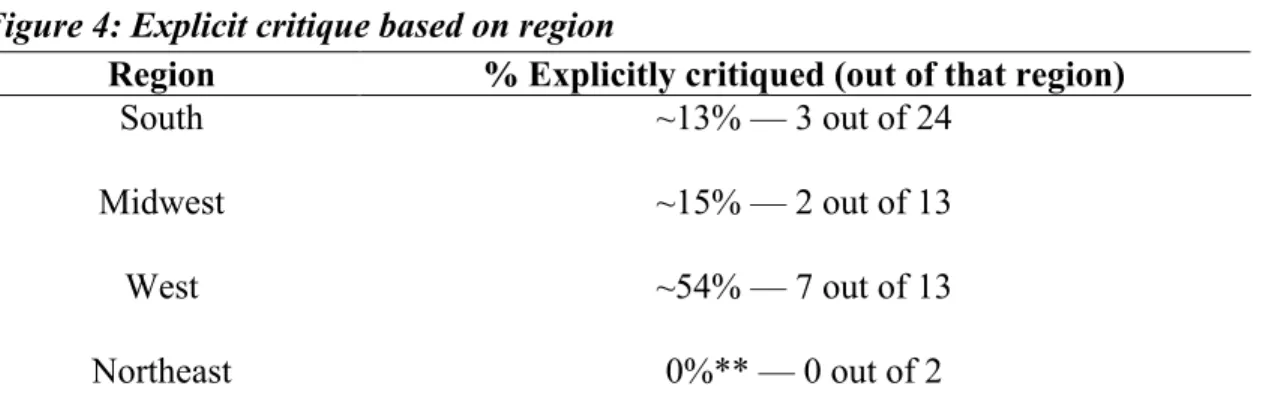
As detailed above, a senator’s state, as it is geographically located in the United States,
Trump. Figure 4, below, illustrates that a senator was likelier to explicitly criticize the President
if he or she is from the Western region of the United States, and less likely to explicitly criticize
if he or she is from the Southern region of the United States. This does reflect the framework of
the Republican Party and its relationship with race, as Republicans in the South have particularly
used white racial supriority as a specific tactic to appeal to voters in the past. However, what is
more unclear is why Western senators were that much liklier to explicitly criticize POTUS than
Midwestern senators as well. Furthermore, both senators from the Northeast did not explicitly
criticize the President—a region of the United States that typically swings Democratic. These
two phenomenon push back against my expectation that geographic location plays a significant
role in determining strength of response. Again, I determined a state’s region based on the
Census Bureau-designated regions and classifications of each state (Census Regions and
Divisions of the United States, n.d.).
Figure 4: Explicit critique based on region
Region % Explicitly critiqued (out of that region)
South ~13% — 3 out of 24
Midwest ~15% — 2 out of 13
West ~54% — 7 out of 13
Northeast 0%** — 0 out of 2
**There are only two Republican senators from Northeastern states — a sample size much smaller than the other regions.
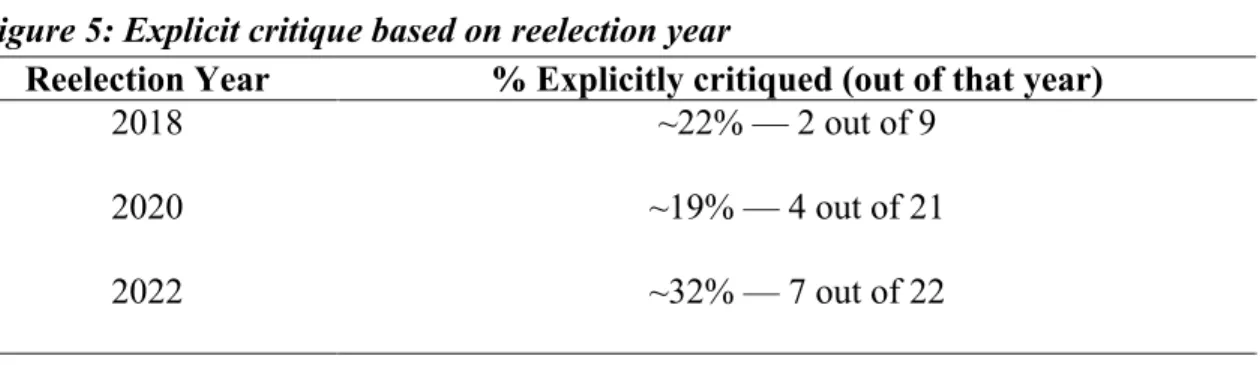
Even less substantive patterns emerge from the rest of the characteristics. To begin,
because only two senators had announced in August 2017 that they would not seek reelection, it
was impossible to test if this characteristic was a determining factor for addressing the research