Natalie Moix. Visual Literacy, Images, and the Archivist. A Master's paper for the M.S. in L.S. degree. April, 2011. 39 pages. Advisor: Christopher A. Lee
This paper describes a questionnaire survey on Visual Literacy (VL) in archives. The study examined claims that VL should be an area of concern for archivists who are working
increasingly with images as a result of the saturation of images in society. Research questions addressed included: Do archivists tend to have any previous training in VL related skills? Do archivists think that the skills identified by the VL index apply well to their work? How do archivists perceive their own VL? Results suggest that many archivists have little training in VL related skills, that the skills identified by the VL index tend to apply to their work, and that they view their own VL skills in a generally positive manner, but would support additional training. Headings:
Archives
Archivists / training of Archivists / United States Visual literacy
VISUAL LITERACY, IMAGES, AND THE ARCHIVIST
by Natalie Moix
A Master’s Paper submitted to the faculty of the school of Information and Library Science of the University of North Carolina at Chapel Hill
in partial fulfillment of the requirements for the degree of Master in Science in
Library Science.
Chapel Hill, North Carolina April 2011
Approved by
Visual Literacy in Archives
Visual information is becoming ubiquitous in our daily lives as technology evolves (Yeh, 2010). Increases in visual messages are occurring more often through a variety of avenues such as television, film, advertisements, blogs, digital photographs, video games, online videos, textbooks, reports, fliers, and books (Yeh, 2010). In “Visual Methodologies” Gillian Rose cites this saturation of visual images and uses the term “ocularcentrism” to describe the centrality that images currently have in modern society (2007). It is this prevalence of images these has caused many to question if society has the skills needed to properly communicate with and interpret images. These skills are increasingly referred to as Visual Literacy (VL). VL, simply put, is the ability to create, interpret, understand, and use visual information.
the skills identified in the VL index developed by Avgerinou (2007) are appropriate to apply to their work? And finally, how do they perceive their own VL?
The goal of the study is to obtain information on issues related to VL in archives from working archivists in order to determine if further steps to measure VL in archives should be taken. By establishing groundwork in this area, this study aims to provide information needed to enable additional research on VL in information environments, offer recommendations for archives, and increase awareness of VL concerns. This information could prove valuable for information professionals, including archivists and librarians, researchers, teachers, administrators, and proponents of VL. The research acts to contribute to the broader understanding of visual literacy by expanding the field of inquiry. Archival and library practices could be influenced by the study’s findings and recommendations to explore the concept of VL further in areas such as description, arrangement and training.
Visual Literacy
The term “Visual Literacy” is one of several recent terms to fall under the general heading of information literacy skills, which includes digital literacy, global literacy, and media literacy. Disciplines identified by Avgerinou and Ericson (1997) as contributors to the field of VL include art, philosophy, linguistics, cognitive/gestalt psychology, visual perception, anatomy of the eye, mental imagery, neurophysiology, hemispheric
VL is considered a set of acquired skills and not a naturally developed ability. Proponents of VL as a discipline cite the ubiquity of sophisticated images in our
contemporary culture as cause for concern. Though one might assume that viewers who have grown up continuously exposed to images in the modern world would develop a natural literacy, VL scholars believe that the untrained consumption of images is currently passive instead of critical (Avgerinou, 2009). Viewers must be taught how to properly “read” visual images (Howells, 2003). In an effort to show that VL can indeed be taught, Yeh and Cheng (2010) conducted a study in which a sample of pre-teachers were tested for VL skills, received a fifty minute lesson on VL related skills in a
technology course, and then retested. Their findings implied that the incorporation of VL principles in educational technology training for pre-service teachers has a positive effect on their overall VL. It is suggested that viewers need long-term educational support like that provided to new readers, despite the many differences between images and text (Yenawine, 1997).
Paul Messaris (1994) identifies four main areas of VL. 1. VL as a “prerequisite for the comprehension of visual media” refers to a familiarity with visual conventions acquired though repeated exposure to visual media. 2.” General cognitive consequences of VL” states that VL enhances not only visual comprehension, but also general cognitive abilities. 3. “Awareness of visual manipulation” makes viewers more aware of how meaning is created visually. 4. “Aesthetic appreciation” enhances evaluation and
Defining Visual Literacy
A precise definition of VL has been consistently difficult to develop. John Debes first coined the term Visual Literacy in 1969. Though well aware of the difficulties associated with defining VL, he also reluctantly provided the following tentative definition as reported by Avgerinou & Ericson (1997):
Visual Literacy refers to a group of vision-competencies a human being can develop by seeing and at the same time having and integrating other sensory experiences. The development of these competencies is fundamental to normal human learning. When developed, they enable a visually literate person to discriminate and interpret the visible actions, objects, symbols, natural or man-made, that he encounters in his environment. Through the creative use of these competencies, he is able to communicate with others. Through the appreciative use of these competencies, he is able to comprehend and enjoy the masterworks of visual communication.
Since its publication, Debes’ definition has been critiqued and revised by
without a widely accepted definition are based on unclear theory. This confusion is often dealt with by abandoning the underlying theory altogether. However, they state that this has never been the case with VL, as efforts to operationalize a definition continue on.
In an attempt to help operationally define VL, Brill, Kim, and Branch (2007) conducted a Delphi study to elicit a first generation definition of VL from established scholars and practitioners of VL. The Delphi technique was chosen as a method to pool the collective opinions of the group, rather than seek specific correct answers.
Regrettably, the results of their study were inconclusive because of a lack of participation and included a call for the IVLA to work toward a standard definition (Brill, Kim, & Branch, 2007).
Though a shared definition does not exist, Avgerinou (2009) identified ten points of convergence among VL theorists. These points included: a visual language exists; VL is a cognitive ability but also draws on the affective domain; VL skills are used to
read/decode/interpret and to write/encode/create visual statements; VL skills are learnable, teachable, and capable of being improved; and that visual communication, visual thinking, and visual learning are inextricably linked to VL (Avgerinou, 2009). In addition, Avgerinou (2007) had conducted a prior series of empirical studies aimed at the creation and refinement of a VL index. Avgerinou (2007) used an integrated
methodological design (triangulation) to blend experimental, quantitative, and qualitative elements into a five-stage study. The results included a validated operational definition of VL, a validated VL index, and confirmation that VL is measurable. The operational definition used for the study reads, “In the context of human, intentional visual
abilities to understand (read), and to use (write) images, as well as to think and learn in terms of images.” The eleven VL abilities identified by Avgerinou as most appropriate for inclusion in the VL index (2007) are: Visualization, Critical Viewing, Visual Reasoning, Visual Discrimination, Visual Thinking, Visual Association, Visual
Reconstruction, Constructing Meaning, Re-Constructing Meaning, Knowledge of Visual Vocabulary and Definitions, and Knowledge of Visual Conventions. Despite her success in the identification of these VL skills, Avgerinou(2009) acknowledges that with the pace of change in the current digital and image-laden era, these skills may already be in need of reconsideration.
Images
Though the term VL relies on the “reading” metaphor to help describe its goals, images and texts convey information and meaning in fundamentally different ways (Collins, 1998; Layne, 1994; Messaris, 1993; Mifflin, 2007). Messaris (1993) writes that images are not just another language, which is exactly what makes them so unique and intriguing. To illustrate this, Collins (1998) likens the difficulties of putting images into words to that of describing music with words. Sara Shatford Layne (1994) adds that images can do things beyond the abilities of texts. She describes the way in which texts convey information and meaning through symbols, while images convey information by resembling objects as they appear. While having a wealth of information in a concise format, images contain many possible meanings that leave some researchers mistrustful of them (Martinez, 2009). Images, therefore, require different approaches and
to find methods for interpreting images that are as thorough and gratifying as those used for textual materials (Martinez, 2009).
Institutions that collect visual images, like archives, libraries, and museums, must assess, interpret, and describe objects in order to organize them and provide access to users. Theoretical objectives used in the cataloging of texts can serve as a starting point for that of images, though further consideration of the uniqueness of images is needed (Shatford, 1984). Context, subject and descriptive cataloging, and the presence of related objects are topics especially important for archives to consider in developing new ways to provide access, arrange, and understand images.
The advent of postmodernism has greatly contributed to the nuances and challenges of interpreting images. As a result of postmodernism, the relationship between seeing and knowing has been broken by a new focus on multiple perspectives, context, and
authorship (Rose, 2001). Postmodernism demands that additional questions be asked of images: Whose point of view is represented? Why? To what effect? Tim Schlak (2009) cites photographs, in particular, as examples of images that have gone from sources of unmediated truth to subjective interpretation since the introduction of postmodern
interpretation. The photograph, like other images, represents a series of choices, is made for a purpose, and is intended for an audience. Schlack highlights that contemporary interpretations of photographs must always be conditional and without absolute truth, which he cites as a challenge for archivists who previously presumed the possession of truth.
itself, and the site where an audience views it. Rose speculates that “audiencing” which occurs when an image’s meaning is actively renegotiated as an audience views it, may be the most important point of the creation of meaning to consider. She then suggests that each of these sites can be looked at with three different modalities. The first is
technological, which examines how the image was made. The second is compositional, which considers formal strategies and material qualities. The third is social, which is a broad modality that includes the culture and environment in which the image was created and used.
and exclusions; and consider one’s own way of looking, thinking careful about the effects of perspective. Content analysis is seen as effective by Rose for dealing systematically with a large amount of images although, because it was originally developed for written and spoken texts, it neglects to account for the expressive qualities of an image (Rose, 2001).
The application of subject cataloging focuses on what a visual image is “of” or “about” (Shatford, 1984). In her paper, “Some Issues in the Indexing of Images”, Layne (1994) suggests three aspects of subject attributes that are particularly important in
images. The first is that an image can be both of and about something. An image may be of wilting flowers, but be about death. The second is that an image is both generic and specific. An image may be of wilting flowers, and also be usefully described as plants or as lilies. Lastly, an image may be indexed as any of four facets: time, space, activities and events, and objects, and each facet may in turn be of or about.
Subject searching has been found by Collins (1998) to be the most popular method of searching for images in archives. In her paper “Providing Subject Access to Images: A Study of User Queries”, Collins analyzed patron requests from two historical photograph collections. She looked at the types of terms used and their attributes to determine if current indexing methods were meeting user needs. She found that generic terms were the most used, followed by time and place. Genre, visual terms, creator, provenance, and format were used infrequently. Three levels of analysis for images are discussed. The first, pre-iconographical, includes description derived from the
knowledge of areas like literature, customs, and cultures. The third, iconographical interpretation, examines the underlying principles behind the image, including religion, nationalism, or social class. Collins suggests that any increase in the subject description of images, particularly generic description, would greatly improve access. Though she feels item level description would be the best for access, she acknowledges the
difficulties of this due to the number of images in need of indexing. The author also suggests that the presence of thumbnail images in combination with textual description might be the best future course for image access (1998). However, further research on how users search for and use images would be helpful in further developing indexing strategies for images (Collins, 1998; Layne, 1994)
believes, is therefore inadequate for use on images. However, she concedes that the differentiation between the subject of an image and a description of an image can be difficult (1984).
Archivists
Archivists are aware that the increasing amounts of images in contemporary society pose new challenges for the profession. Archivists have demonstrated this awareness through the organization of conferences, workshops, committees, and Internet discussion groups to address visual media issues in archives. However, Kaplan and Mifflin have found that these attempts to address the visual have primarily focused on physical and practical issues, and neglect core intellectual issues (1996). Due to
educational backgrounds composed mostly of history and library science, many scholars cite archivists as lacking strong VL skills (Schlak, 2008; Mifflin, 2007), leaving them ill-prepared for a nuanced understanding of images (Mifflin, 2007). Kaplan and Mifflin state that library and archival degree programs lack specialization tracks for those interested in visual resources, and that their curriculums devotes very little attention visual materials (1996). Archivists have historically applied textual methods uncritically to visual images (Schlak, 2008). Mifflin (2007) argues in “Visual Archives in
Perspective: Enlarging on Historical Medical Photographs” that archivists should be more than passive preservers and processors of documents and should strive to share
Methodology
The method chosen for this study was an online questionnaire survey. Creswell (2009) defines a survey design as “a quantitative or numeric description of trends, attitudes, or opinions of a population by studying a sample of that population.” Wildemuth (2009) explains that a survey is made up of items, either statements or questions, which participants of a selected population are asked to respond to. These responses can then be taken and used to statistically estimate the distribution of the survey’s targeted characteristics in the specified population. Surveys can be administered in a variety of ways, including face-to-face, over the phone, on paper, or online. They are generally as brief and directed as possible, allowing a large number of participants to respond in a short amount of time. The small amount of time invested by participants also increases the likeliness of a high participation rate. Since the survey is a popular method for contemporary research, it is familiar to much of the general population (Wildemuth, 2009). This familiarity may help to put participants at ease and increase response rates in the study.
physical copies through the postal system, which has the disadvantage of postage costs to the researcher and a longer turn-around time for results. Online interview software also makes analyzing and presenting data easier and faster for the researcher, with the ability to create tables and graphs within many software applications. Online surveys also incorporate computer technology to create skip patterns for questions that do not apply to participants based on their previous responses. This customization of the survey
experience for each individual user can help increase response rates and decrease dropout rates. The ability to customize the survey appearance can also aid in a more engaging experience for participants (Shropshire, Hawdon, & Witte, 2009).
The online survey was chosen as the appropriate method for the study for several reasons. The study looked to address trends and questions related to working archivists and VL all over the United States. The goal was to gain a generalized understanding from a sample of the population, which surveys are well to. The online aspect sought to address the wide distribution of the potential participants without the postal costs of mailing a printed survey. It also sought to allow potentially busy working archivists the flexibility to decide when, where, and at what pace they responded (Wildemuth, 2009). Finally, the method worked well with the time and financial constraints imposed upon the researcher.
Re-Constructing Meaning, Knowledge of Visual Vocabulary and Definitions, and Knowledge of Visual Conventions.
Participants and Recruitment
The sample for the study was made up of archivists actively working in the United States. Potential participants were recruited through the Archives & Archivists List of the Society of American Archivists. Though a random sample would have been preferable, a convenience sample was used, restricting the ability to generalize
accurately. Participants were self-selecting for inclusion following the distribution of survey invitations. The study did not include stratification, or the sampling within participants with predetermined characteristics (Creswell, 2009). No financial incentives were offered for participation.
Data Collection
The data collection instrument developed for the study was an online
questionnaire created with Qualtrics software provided by The Odum Institute at the University of North Carolina at Chapel Hill. Qualtrics allows for multiple question types to be used, including single response, “check all that apply,” numeric entry, alpha entry, grid style, and questions with images. It also provides skip logic, fills, management tools, online analysis tools, and data set downloading.
designed to elicit information about participants, information on the application of the VL index to archival work, and opinions on the need for increased VL training among
archivists. A complete copy of questionnaire items can be found in the appendix.
Survey Procedure
The survey occurred over a three-week period. Upon receiving approval from the Institutional Review Board, the process began by sending out survey invitations to the Archives and Archivists List. As participants responded to the invitations by clicking the embedded link, they were taken directly to the online questionnaire. Due to a satisfactory initial response, no further sets of survey invitations were sent out. Data collection ended after the third week.
Ethical Considerations
Participation in the survey was contingent upon completion of the informed consent form. This form identified the researcher and sponsoring institution and provided appropriate contact information. Participants were assured of confidentiality and their ability to withdraw from the survey at any time. Data collected from
ethical requirements, the study was approved by the Institutional Review Board of the University of North Carolina at Chapel Hill prior to the launch of the survey.
Limitations
Results
The survey had a total of 82 participants. The entirety of the survey was
completed by 84% of participants. Participants were allowed to choose not to answer any given item and skip logic was used to navigate participants past items that did not apply to them; as a result, the number of responses to each item varies from 41 to 82. The average time to complete the questionnaire was four minutes.
The survey included items aimed at learning more about participants’ formal educational backgrounds to address claims that Archivists tend to only have training in History or Library Science. The majority of participants in the survey identified their undergraduate degree as Bachelor of Arts degree, though many did not specify the area of concentration. Of those specified, the majorities were in English or History. To evaluate postgraduate education, participants were asked to choose between History, Library Science, and Other. Of the 78 respondents, 29 (37%) selected History, 58 (74%) selected Library Science, and 20 (26%) selected Other (see Table 1). The 20 respondents who selected Other were asked to specify their area of postgraduate education. These
Table 1. Item 3 results.
What postgraduate degrees have you earned? (Check all that apply.)
# Answer Response %
1 History 29 37%
2 Library Science 58 74%
3 Other (please specify) 20 26%
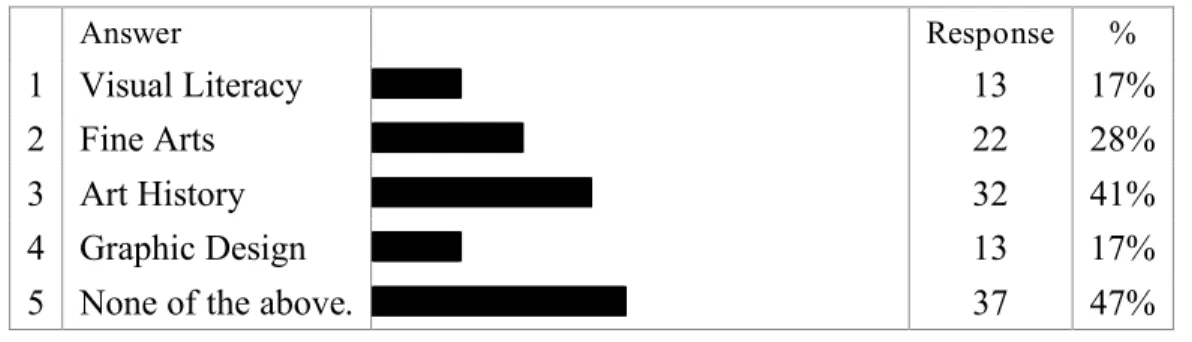
Table 2. Item 4 results.
Have you ever received training in the following areas? (Check all that apply.)
# Answer Response %
1 Visual Literacy 13 17%
2 Fine Arts 22 28%
3 Art History 32 41%
4 Graphic Design 13 17%
5 None of the above. 37 47%
In order to gain a further understanding of the participants’ backgrounds, they were asked to select which of the following areas best describes their primary area of work in archives: Reference, Education/Outreach, Processing, Appraisal, or Other. Of the 78 respondents to this item, Processing was selected most often with 32 (41%) indicating it was their primary area of work. Other was selected by 27 (35%) of
respondents, making up the second largest area. No follow-up question was included to assess what areas of work respondents would have included as Other. Of the remaining, Reference was selected by 10 (13%) respondents, Appraisal by 7 (9%), and
Education/Outreach by only 2 (3%).
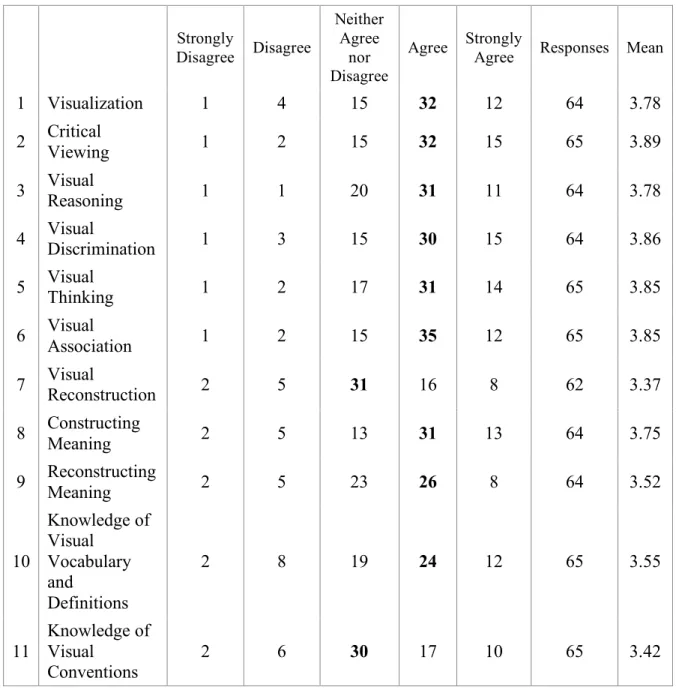
Table 3. Item 7 results.
Please respond to the following: I am comfortable and confident in performing tasks with images that require:
# Strongly
Disagree Disagree
Neither Agree
nor Disagree
Agree Strongly Agree Responses Mean
1 Visualization 1 4 15 32 12 64 3.78
2 Critical Viewing 1 2 15 32 15 65 3.89
3 Visual Reasoning 1 1 20 31 11 64 3.78
4 Visual Discrimination 1 3 15 30 15 64 3.86
5 Visual Thinking 1 2 17 31 14 65 3.85
6 Visual Association 1 2 15 35 12 65 3.85
7 Visual Reconstruction 2 5 31 16 8 62 3.37
8 Constructing
Meaning 2 5 13 31 13 64 3.75
9 Reconstructing Meaning 2 5 23 26 8 64 3.52
10 Knowledge of Visual Vocabulary and Definitions
2 8 19 24 12 65 3.55
11
Knowledge of Visual
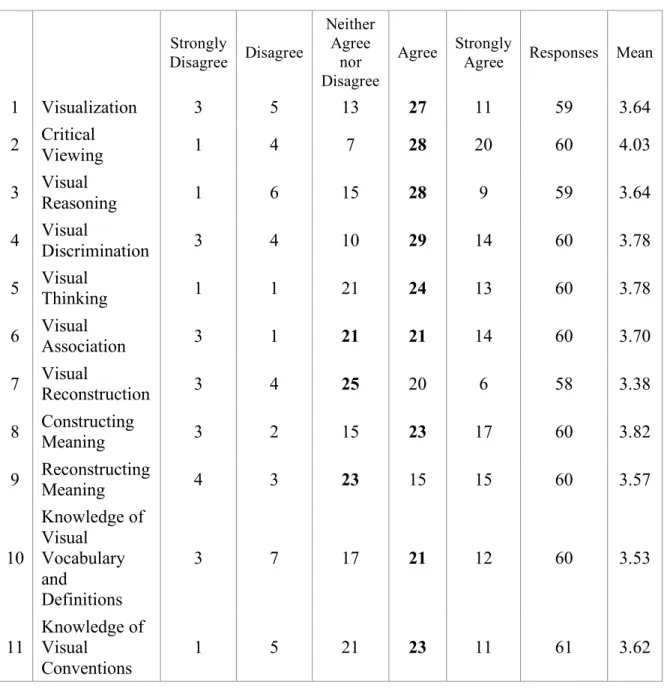
Table 4. Item 8 results.
Please respond to the following: I find the following terms applicable to the work I do as an archivist:
The final two items on the questionnaire also asked users to respond to a statement with a Lickert scale. These two items were intended to poll participants on their perception of need for increased Visual Literacy in archives. Item 9 stated, “Please
# Strongly
Disagree Disagree
Neither Agree
nor Disagree
Agree Strongly
Agree Responses Mean
1 Visualization 3 5 13 27 11 59 3.64
2 Critical
Viewing 1 4 7 28 20 60 4.03
3 Visual
Reasoning 1 6 15 28 9 59 3.64
4 Visual
Discrimination 3 4 10 29 14 60 3.78
5 Visual Thinking 1 1 21 24 13 60 3.78
6 Visual Association 3 1 21 21 14 60 3.70
7 Visual Reconstruction 3 4 25 20 6 58 3.38
8 Constructing Meaning 3 2 15 23 17 60 3.82
9 Reconstructing Meaning 4 3 23 15 15 60 3.57
10 Knowledge of Visual Vocabulary and Definitions
3 7 17 21 12 60 3.53
11 Knowledge of Visual Conventions
respond to the following: I do NOT think that increased training in Visual Literacy would benefit the quality of work done in archives today.” The majority (31 participants) selected Disagree, and 16 selected Strongly Disagree. Item 10 stated, “I would support additional training in Visual Literacy designed for the archives environment.” The majority of responses to this time were Agree (36 of 63 participants). Full responses for items 9 and 10 can be seen in Tables 3 and 4, respectively.
Table 3. Item 9 results.
Question Strongly
Disagree Disagree
Neither Agree nor
Disagree Agree
Strongly
Agree Responses Mean I do NOT think
that increased training in Visual Literacy would benefit the quality of work done in archives today.
16 31 14 0 2 63 2.06
Table 4. Item 10 results.
Question Strongly Disagree Disagree
Neither Agree nor
Disagree
Agree Strongly Agree Responses Mean
I would support additional
training in Visual Literacy designed for the archives environment.
Discussion
The purpose of the survey was to obtain answers to the following research questions about VL in relation to archives: do archivists tend to have any previous
training in VL related skills? Do archivists think that the skills identified in the VL index developed by Avgerinou (2007) are appropriate to apply to their work? Finally, how do they perceive their own VL? The above results provide preliminary answers to these questions and suggest areas that may need to be addressed further.
Of the respondents (78 total) to Item 3 (What postgraduate degrees have you earned?), 74% (58) had a postgraduate Library Science degree and 37% (29) had History degrees (see Table 1). This information supports the concern of proponents of VL that archivists have backgrounds mostly composed of training in History or Library Science. In addition, the responses to Item 4, which asked about other training in areas that teach skills related to VL, also support this claim with 47% (37) of respondents indicating they had no training in any of these areas. However many respondents to this item did report having some level of training in one or more of the VL related areas (Visual Literacy, Fine Arts, Art History, and Graphic Design). The level of training in these areas was split fairly evenly between Introductory (32%), Overview (32%), and Extensive (37%).
that the VL index put forth by Avgerinou (2007) is applicable to the work that archivists do. If this is the case, these skills can be used in future studies to develop a test for VL skills to be used in future research into VL in archives. However, it is also possible to look at these results and question whether or not the respondents had a good
understanding of the terms. It is possible that all the skills were given similar responses because participants used Agree and Neither Agree nor Disagree as default responses. However, responses indicating strong agreement outnumber those of Strongly Disagree and Disagree in all eleven instances, leaving the overall impression that the participant archivists found the VL skills overall applicable to their work.
Three items were incorporated into the questionnaire to assess how the
participating archivists felt about their own VL. Item 7 (full results in Table 3) asked respondents to indicate if they felt comfortable and confident in performing tasks with images in respect to each of the eleven VL skills. As with Item 8, the mean of all
responses fell between Neither Agree Nor Disagree and Agree, with means ranging from 3.37 to 3.89. This again could indicate that many of the respondents were unsure about the terms used and replied with Neither Agree Nor Disagree or Agree as a result.
However, as with Item 8, the responses were overall positive indicating that participating archivist felt mostly comfortable and confident in applying the VL skill to images in their work.
agreeing or agreeing. Item 10 asked if they would support training VL designed for the archives environment. Respondents mostly agreed or strongly agreed with this statement (48 of 63 respondents), with none disagreeing. In assessing how the participating
Summary
It has been suggested that images present a set of unique concerns for archivists and that VL skills have much to offer in the interpretation, organization, and access of images in archives. Historically, unclear definitions of VL have caused difficulties in identifying effective ways to begin studying VL in practice. However, Avgerinou’s work has made considerable progress towards making this possible through the development of a VL index (2007). Though little research has been done with VL and archives
References
Avgerinou, M. (2007). Towards a visual literacy index. Journal of Visual Literacy, 27(1), 29-46.
Avgerinou, M. (2009). Re-viewing visual literacy in the “bain d' images” era.
Techtrends: Linking Research and Practice to Improve Learning, 53(2), 28-34.
Avgerinou, M., & Ericson, J. (1997). A review of the concept of visual literacy. British
Journal of Educational Technology, 28(4), 280.
Brill, J.M., Kim, D., & Branch, R.M. (2007). Visual literacy defined- The results of a Delphi study: Can IVLA (operationally) define visual literacy? Journal of Visual
literacy, 27(1), 47-60.
Collins, K. (1998). Providing subject access to images: A study of user queries. The
American Archivist, 61(1), 36-55.
Creswell, J.W. (2009). Research design: qualitative, quantitative, and mixed methods
approaches (3rd ed.). Los Angles: Sage.
Hortin, J. A. (1981). A Confluence of Theories for Visual Literacy Theory Development.
Reading Improvement, 18 (3), 194-209.
Howells, R. (2003). Visual culture. Oxford: Polity Press.
International Visual Literacy Association. (n.d.). What is “visual literacy?” Retrieved from http://www.ivla.org/org_what_vis_lit.htm#definition
Kaplan, E., & Mifflin, J. (1996). “Mind and sight”: visual literacy and the archivist.
Layne, S. S. (1994). Some issues in the indexing of images. Journal of the American
Society for Information Science, 45(8), 583-88.
Martinez, K. (2009). Image research and use in the humanities: An idiosyncratic bibliographic essay. Art Documentation: Bulletin of the Art Libraries Society of
North America, 28(1).
Messaris, P. (November 1993). Visual “literacy”: A theoretical synthesis.
Communication Theory, 3 (4), 227-294.
Messaris, P. (1994). Visual "literacy": Image, mind, and reality. Boulder: Westview Press.
Mifflin, J. (2007). Visual archives in perspective: Enlarging on historical medical photographs. The American Archivist, 70(1), 32.
Mitchell, W.J.T. (2008). Visual literacy or literary visualcy? In Elkins, J. (Ed.). Visual
literacy. New York: Routledge.
Rose, G. (2001). Visual methodologies: An introduction to the interpretation of visual materials. London: Sage.
Schlak, T. (2008). Framing photographs, denying archives: The difficulty of focusing on archival photographs. Archival Science, 8(2), 85-101.
Shatford, S. (1984). Describing a picture: A thousand words are seldom cost effective.
Cataloging & Classification Quarterly, 4(4), 13-30.
Wildemuth, B. M. (2009). Applications of social research methods to questions in
information and library science. Westport, Conn: Libraries Unlimited.
Yeh, H.T., & Cheng, Y.C. (2010). The influence of the instruction of visual design principles on improving pre-service teachers visual literacy. Computers &
Education, 54, 244-252.
Yenawine, P. (1997). Thoughts on visual literacy. In J. Flood, S.B. Heath, & D. Lapp (Eds.), Handbook of research on teaching literacy though the communicative and