Baily D. Griffith. Increasing Teacher and Librarian Collaborative Projects Through Library Visibility. A Master’s Paper for the M.S. in L.S degree. April, 2014. 36 pages. Advisor: Sandra Hughes-Hassell
This study describes a survey of National Board certified school librarians across North Carolina. The survey was conducted to determine the visibility of the school library program as well as the types and frequency of collaborative projects that took place between classroom teachers and school librarians during the 2012-2013 school year.
Headings:
School librarianship
INCREASING TEACHER AND LIBRARIAN COLLABORATION THROUGH LIBRARY VISIBILITY
by
Baily D. Griffith
A Master’s paper submitted to the faculty of the School of Information and Library Science of the University of North Carolina at Chapel Hill
in partial fulfillment of the requirements for the degree of Master of Science in
Library Science.
Chapel Hill, North Carolina April 2014
Approved by
Table of Contents
INTRODUCTION ... 2
LITERATURE REVIEW ... 4
METHODOLOGY ... 9
FINDINGS ... 12
DISCUSSION ... 18
LOW SURVEY RESPONSE RATES ... 23
CONCLUSIONS ... 25
Introduction
Collaboration between school librarians and teachers in schools leads to an increase in student achievement (Lance, 2000) and has been an important aspect of the librarian's responsibilities for many years (Montiel-Overall, 2011). However,
collaboration between teachers and librarians remains relatively low (Haycock, 2007). Although collaboration with teachers is a major part of most Library Science curriculum, there is little mention of collaboration with librarians in much of the professional
education literature (Haycock, 2007) (Montiel-Overall, 2011). In a 2011 study on teacher perceptions of teacher and school librarian collaboration, Patricia Montiel-Overall found that there is very little mention of the importance of teacher and librarian collaboration in professional education literature, citing that the importance of librarians “…planning, teaching, and evaluating…” students alongside teachers is “…relatively unknown among classroom teachers as a recommended practice for school librarians” (Montiel-Overall, 2011). Although teachers were mostly positive about collaboration after being a part of a co-planned or co-taught project with the school librarian, they tended to be unaware of research connecting student learning and collaboration with the librarian and had little training related to planning and teaching alongside librarians.
disconnect is repaired, the burden of promoting collaboration falls on the school librarian, as they are trained to make collaboration an important part of their role in the school, including planning, implementing, and evaluating lessons alongside teachers. Research Problem
One possible way to increase the number of collaborative projects in schools is to increase the visibility of the library program in the larger school environment. By being a major presence beyond the circulation desk, school librarians can assert their importance in an instructional role. Visits to classrooms and communicating interest and availability to teachers, as well as word-of-mouth promotion of library resources, increases the visibility of the library, thus potentially allowing teachers to see the benefits of teacher-librarian collaboration.
Also important in building the visibility of the library program are the relationships between library staff and classroom teachers. A crucial component of collaboration is a strong, trusting relationship between collaborators. More interaction between the librarian and classroom teachers provides more opportunity to build a trusting relationship.
This study seeks to determine if there is a relationship between library visibility and the number of collaborative projects that take place annually between teachers and librarians. Specifically, this study will look at the correlation between school library visibility within a school and the number of collaborative projects done between teachers and school librarians.
key factor in increasing student learning, and librarians are in a great position to be a part of that collaboration. However, it can be difficult to gain the trust and build relationships with teachers that are necessary for a successful collaborative relationship. Promoting the library program is a step in the right direction. It provides opportunities for librarians to get to know teachers and students and build meaningful relationships with them. Classroom visits, library visits for circulation, and special events held in the library allow for the informal conversations and simple collaborative projects (pulling resources for a class, teaching a research skill) that are crucial to moving toward the next step of integrated collaboration.
Literature Review
In an effort to improve education, that is, to increase student learning across the board, there have been many recommendations for changes in the curriculum and the adoption of different models of instruction. In the school library field, collaboration between school librarians and teachers is one of the proposed models. For over twenty years, collaboration with classroom teachers has been a part of the curriculum at library schools across the United States (Montiel-Overall & Jones, 2011).
Teacher-Librarian Collaboration Defined
There are many definitions for collaboration and many theoretical models have been created to describe collaboration between teachers and school librarians. In 1988, David Loertscher proposed a taxonomy of working relationships between school
move to higher levels in Loertscher’s taxonomy, the intensity and involvement of their working relationship increases. This translates to more collaboration between teachers and school librarians. The lower levels of Loertscher’s taxonomy highlight school librarians gathering and providing resources for teachers, planning informally, and promoting the library. On the higher levels of the taxonomy formal planning,
participation in instruction and evaluation, and involvement in planning for the larger school curriculum are included (Loertscher, 2000).
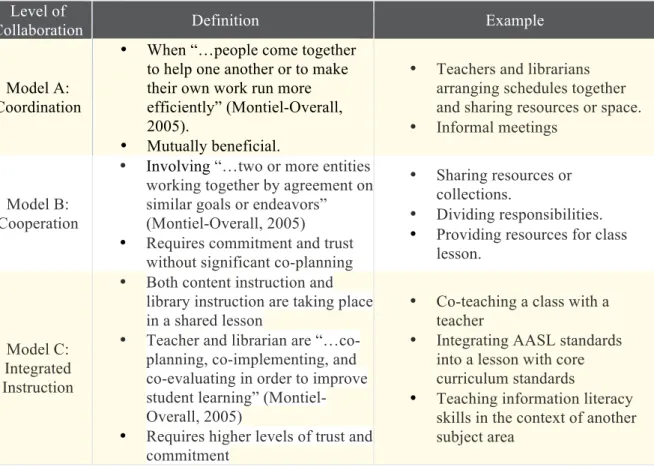
In a 2005 study on teacher and librarian collaboration, Patricia Montiel-Overall (2005) outlines a theoretical model of collaboration specifically for school librarians and teachers, based on Loertscher and others, which outlines four levels of collaboration: coordination, cooperation, integrated instruction, and integrated curriculum (see Table 1).
Table 1. Montiel-Overall’s Model of Collaboration
Level of
Collaboration Definition Example
Model A: Coordination
• When “…people come together to help one another or to make their own work run more efficiently” (Montiel-Overall, 2005).
• Mutually beneficial.
• Teachers and librarians arranging schedules together and sharing resources or space. • Informal meetings
Model B: Cooperation
• Involving “…two or more entities working together by agreement on similar goals or endeavors” (Montiel-Overall, 2005) • Requires commitment and trust
without significant co-planning
• Sharing resources or collections.
• Dividing responsibilities. • Providing resources for class
lesson.
Model C: Integrated Instruction
• Both content instruction and library instruction are taking place in a shared lesson
• Teacher and librarian are “…co-planning, co-implementing, and co-evaluating in order to improve student learning” (Montiel-Overall, 2005)
• Requires higher levels of trust and commitment
• Co-teaching a class with a teacher
• Integrating AASL standards into a lesson with core curriculum standards
This model defines collaboration as “... a trusting, working relationship between two or more equal participants involved in shared thinking, shared planning and shared creation
of integrated instruction” (Montiel-Overall, 2005). This working relationship can occur
at varying levels, the lowest level being coordination and the highest being instruction.
The specific type of interaction that collaborators have determines which model of collaboration is being used.
Teacher-Librarian Collaboration and Student Achievement
Many studies have shown a relationship between teacher-librarian collaboration
and increased student learning. In 1994, a Colorado study found a positive relationship
between student scores on standardized tests and school library services, availability of
staff, and circulation (Lance, 1994). A second study in 2000 by Keith Curry Lance and
his colleagues re-established the previous findings and found a relationship between
several additional aspects of library media programs and increased student achievement.
These aspects include adequate staffing, information resources available, and funding
(Lance, 2000). According to Lance, “…well-developed LM programs and academic
achievement are positive and statistically significant and that they cannot be explained
away by other school and community conditions” (Lance, 2000). Four major Model D:
Integrated Curriculum
• Similar methods of co-planning, co-teaching, and co-evaluation across an entire school’s curriculum
• “…collaborators know the
standards for subject content areas …and for information literacy” (Montiel-Overall, 2005) • Principal is crucial in creating a
school environment that encourages co-planning and shared creation of lessons
• Planning for continuous integration of information literacy skills in core subject areas throughout grade levels • Librarian and teacher co-teach
professional development that fosters combination of AASL and core subject standards in lessons
characteristics of library programs were shown to positively affect reading scores on the
Colorado Student Assessment Program: program development, information technology,
teacher/library media specialist collaboration, and individual visits to the library (Lance,
2000).
A 2007 study by Ken Haycock looked at factors that contribute to successful collaborations. Haycock found that increases in student learning, student involvement in learning, and student creative work are related to collaboration in the school. Individual factors that contribute to collaboration in school environments include mutual respect, flexibility, communication, and leadership. The strong evidence of the relationship between collaboration in schools and increases in student achievement led Haycock to conclude that “…collaboration is the single professional behavior of teacher-librarians that most affects student achievement” (Haycock, 2007).
Leslie Farmer’s 2007 research on the importance of principals in promoting collaboration discusses the library’s unique contributions to student achievement. The important aspects of the school librarian’s role include “…information literacy instruction integrated across the curriculum to facilitate transfer of learning and articulation of
knowledge; and collaboration with the school and community to provide a systematic an interdependent program of teaching and learning” (Farmer, 2007). Integrating
information literacy into the larger curriculum through collaboration is part of the school librarian’s contribution to actions and resources that principals often look for to help the school meet its goal of increasing student achievement (Farmer, 2007).
In order to have a collaborative relationship with teachers in the school, the school librarian must build a confident and trusting relationship with teachers. Haycock's 2007 study identified three key factors that must occur in order to foster collaborative
relationships: trust, shared vision, and communication (Haycock, 2007). Ann Riedling also identified communication as the most important aspect of collaboration (Riedling, 2003). For librarians, attending meetings regularly, creating monthly newsletters, and making the library space more user-friendly are ways to increase communication with the rest of the school (Riedling, 2003).
In a 2007 study, Barbara Immroth and William Lukenbill looked at promoting
collaboration between classroom teachers and librarians by implementing social
marketing strategies, which involves using principles of marketing products to consumers
as a way to “promote socially beneficial ideas” (Zaltman et al, 1972). Immroth and
Lukenbill’s study found that collaboration between teachers and librarians can improve how and what students learn (Immroth & Lukenbill, 2007). Increasing communication and building trust with other teachers in the school requires promotion of the library program in general and marketing the benefits of working with the support of the school librarian on a variety of projects. With regard to increasing collaborative projects between teachers and librarians, Immroth and Lukenbill found that the most effective way to gain interest in collaboration from teachers is direct contact from librarians expressing a desire to work together. They suggest a Collaborative Social Marketing Model for Teacher-Librarian Collaboration that includes four main principles of Social
projects with teachers (Immroth & Lukenbill, 2007). In general, this is seen as increasing the visibility of the library program and specifically increasing the visibility of
collaborative projects that have taken place.
Methodology
Participants
To learn more about the visibility of school library programs and teacher-librarian collaboration, an online survey was created and distributed to 90 National Board certified school librarians across North Carolina. The participants were chosen randomly from the National Board directory list and contacted via email. National Board certified librarians were determined to be good candidates for the survey because of the professional
standards required of Board certified librarians and the likelihood of more years of experience in the field for school librarians with National Board certification. In the email, the purpose and design of the study was outlined and recipients were invited to participate (see Appendix B). The email included a message of consent and a link to the survey. The online survey was created using Qualtrics, a web-based survey creation tool. An online survey was chosen because of its convenience for participants and ease of collecting data for researchers.
Research Design
the staff, and the general role of the librarian in the school. Because the library program in a school can function in many different ways, these questions helped to determine the general goals of the library program.
The section of the survey on Library Visibility was designed to determine what types of services and resources the library provides, how and if those services are utilized by the staff and students, and how often. Questions in this section related to circulation numbers, classroom visits, events in the library, and promotion of services, resources, and events for the 2012-2013 school year. The answers from this section were used to
calculate Library Visibility. Library Visibility is determined by number of librarian visits to classrooms, special events held in the library, classroom visits to the library, and circulation numbers.
The last section of the survey, Teacher/Librarian Collaboration looked at the type and frequency of collaboration between classroom teachers and librarians. Survey respondents were asked to estimate the number of collaborations they had been a part of during the 2012-2013 school year and then describe the type of collaboration from a list of options given (See figure 1). This list was based on Montiel-Overall’s article Toward a Theory of Collaboration for Teachers and Librarians.
Survey participants were also asked to provide access to the annual library report published for the 2012-2013 school year. Providing this information was optional. Limitations
This was a self-reported survey. Although librarians should have data to show the visibility of the library, their survey responses were not substantiated by other data. The same is true for collaborative projects. The numbers and types of collaborations reported are based on estimates from librarians and whatever data they had available.
Findings
Of the 90 surveys distributed, only 21 participants filled out and returned the survey. Of those 21, only eight of the surveys were complete and therefore usable. This response rate makes it impossible to draw any meaningful conclusions; however, the results will be reported in the tables below and tentative conclusions will be suggested in the hopes of informing further research on this topic.
Respondent Demographic Data
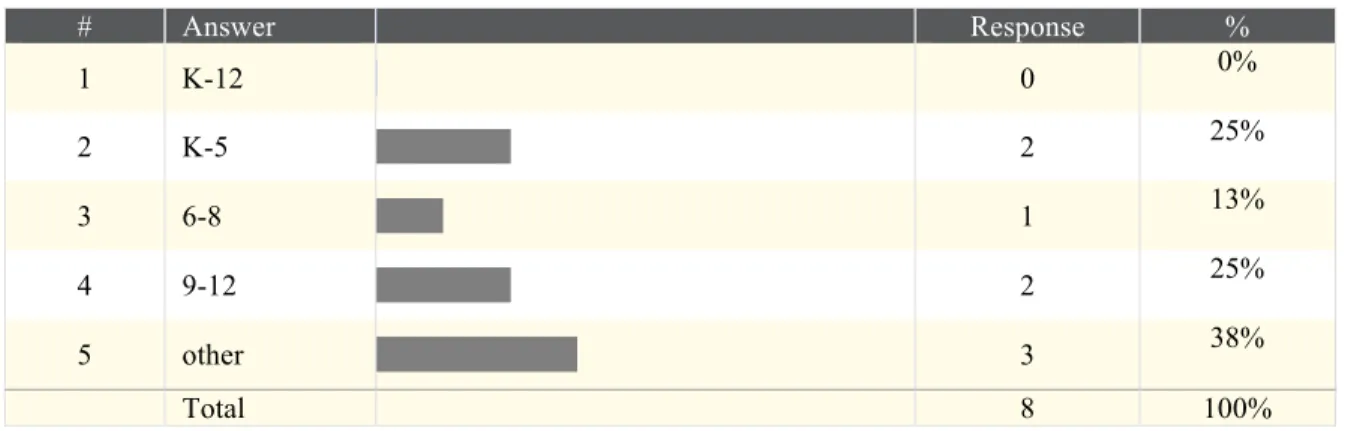
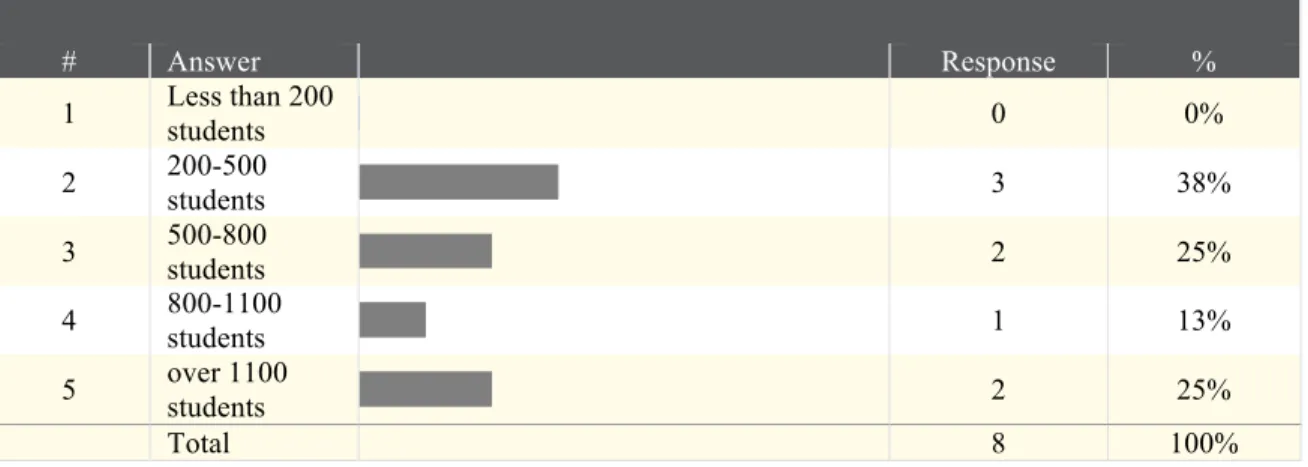
Survey respondents work in library programs that serve a variety of grade levels. No one grade or set of grade levels was more prevalent in the responses gathered. The size of the student population that library programs served varied from 200 to over 1100 students. The majority of the responses (three) came from schools with student
populations between 200 and 500 students. Of the library programs represented in this study, flexible schedules were the most common, though fixed and hybrid schedules were represented.
Table 2. Grade Levels Served by Responding Libraries
# Answer Response %
1 K-12 0 0%
2 K-5 2 25%
3 6-8 1 13%
4 9-12 2 25%
5 other 3 38%
Table 3.Table 3. Number of Students Served By Each Library Program
# Answer Response %
1 Less than 200
students 0 0%
2 200-500 students 3 38%
3 500-800
students 2 25%
4 800-1100
students 1 13%
5 over 1100
students 2 25%
Total 8 100%
Table 4.Type of Library Scheduling
# Answer Response %
1 Fixed 1 13%
2 Flexible 6 75%
3 hybrid/other 1 13%
Total 8 100%
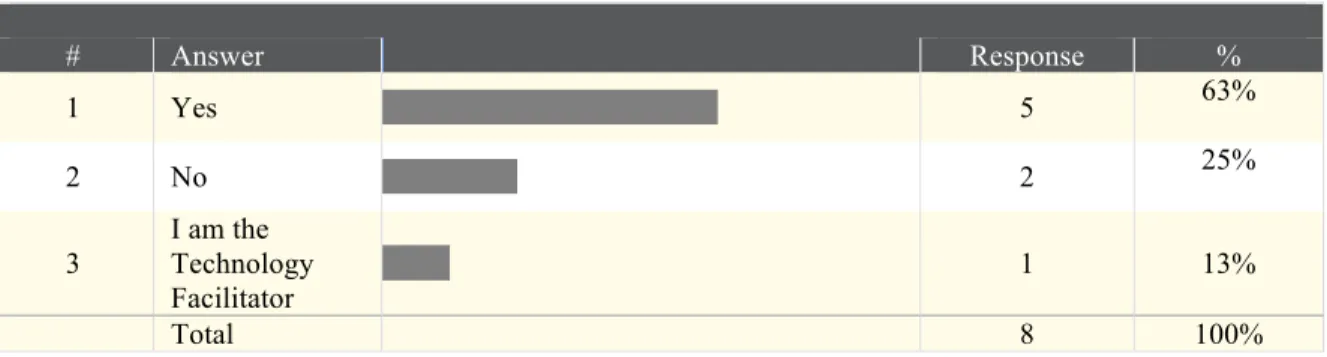
From the responses gathered, having a separate technology facilitator position is more common than having a library position assistant. The survey respondent who reported having a library assistant position also indicated that it is a full-time position and that the school has a separate, full-time technology facilitator position. Of the five
Table 5. Separate Technology Facilitator Position at School
# Answer Response %
1 Yes 5 63%
2 No 2 25%
3
I am the Technology Facilitator
1 13%
Total 8 100%
Table 6. Library Assistant Position at School
# Answer Response %
1 Yes 1 13%
2 No 7 88%
Total 8 100%
Seven out of the eight respondents have five or more years of experience in their current position. No survey respondents had fewer than three years of experience in their current position. The majority of the survey respondents did not report being members of professional learning communities. However, those who are not members of PLCs reported regularly attending PLC meetings on their own.
Table 7. Librarian Years in Current Position
# Answer Response %
1 1-3 years 0 0%
2 3-5 years 1 13%
3 5 or more years 7 88%
Table 8. Member of a Specific Professional Learning Community (PLC)
# Answer Response %
1 Yes 3 38%
2 No 5 63%
Total 8 100%
Table 9. Attend PLC Meetings Regularly (for non-members)
# Answer Response %
1 Yes 3 60%
2 No 2 40%
Total 5 100%
Survey Responses for Visibility Factors and Collaboration
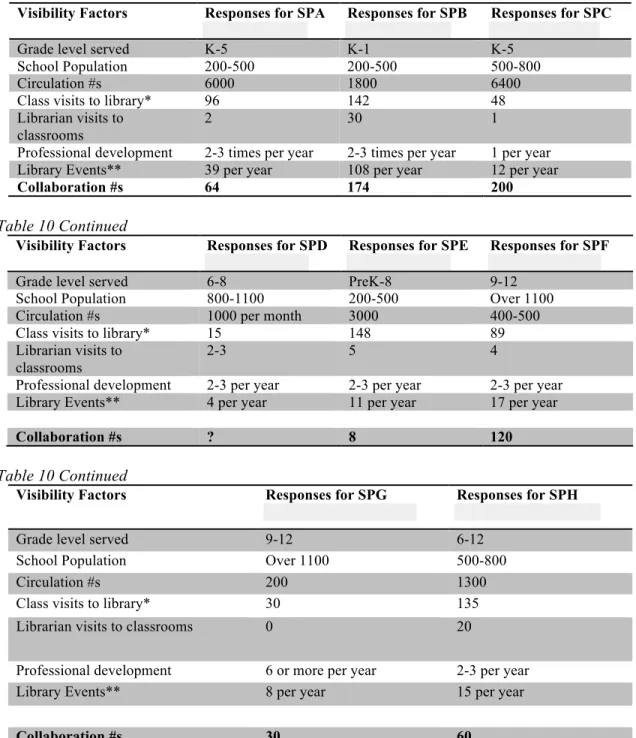
In the Library Visibility section of the survey respondents were asked about the factors that make up the visibility of a school library program. Respondents provided monthly averages for circulation numbers, class visits to the library, and librarian visits to classrooms for the 2012-2013 school year. Survey respondents also provided annual numbers for library events and professional development for the same year. In the survey, respondents were asked specifically about class visits to the library for book checkout, class visits to the library (not for checkout) that included direct librarian involvement, and class visits to the library (not for checkout) that had no direct involvement from the librarian. The responses to these three questions were combined to provide the general class visits to library data shown in Table 10.
in the library, organized by library staff, funded by the library, or publicized by the library. Survey respondents were also asked to estimate how many times they had collaborated with classroom teachers for the 2012-2013 school year.
Table 10. Survey Responses for Library Visibility and Collaboration Visibility Factors Responses for SPA Responses for SPB Responses for SPC
Grade level served K-5 K-1 K-5
School Population 200-500 200-500 500-800
Circulation #s 6000 1800 6400
Class visits to library* 96 142 48
Librarian visits to classrooms
2 30 1
Professional development 2-3 times per year 2-3 times per year 1 per year Library Events** 39 per year 108 per year 12 per year
Collaboration #s 64 174 200
Table 10 Continued
Visibility Factors Responses for SPD Responses for SPE Responses for SPF
Grade level served 6-8 PreK-8 9-12
School Population 800-1100 200-500 Over 1100
Circulation #s 1000 per month 3000 400-500
Class visits to library* 15 148 89
Librarian visits to classrooms
2-3 5 4
Professional development 2-3 per year 2-3 per year 2-3 per year Library Events** 4 per year 11 per year 17 per year
Collaboration #s ? 8 120
Table 10 Continued
Visibility Factors Responses for SPG Responses for SPH
Grade level served 9-12 6-12
School Population Over 1100 500-800
Circulation #s 200 1300
Class visits to library* 30 135
Librarian visits to classrooms 0 20
Professional development 6 or more per year 2-3 per year
Library Events** 8 per year 15 per year
Collaboration #s 30 60
*Class visits include visits for check out, visits (not for check out) when the librarian was directly involved, and visits (not for check out) when the librarian was not involved.
Types of Collaboration for the 2012-2013 School Year
The Teacher/Librarian Collaboration section of the survey focused on the number
of collaborative projects between librarians and classroom teachers and the specific types
of collaboration that took place for the 2012-2013 school year. Table 11 indicates how
many survey respondents reported taking part in each type of collaboration for the
2012-2013 school year
Table 11. Types and Frequency of Collaboration
# Answer Response %
1 Attended PLC meeting 7 88%
2 Met individually with
teachers 8 100%
3 Met with team/group of
teachers (outside of PLC) 6 75%
4 Met with teachers to plan a
specific lesson 7 88%
5
Informal meetings with teachers (chatting in hall e.g.)
7 88%
6 Provided books/resources for
a class lesson 8 100%
7
Planned a lesson with a teacher that
included/addressed AASL standards
4 50%
8 Co-taught a lesson with a
teacher 7 88%
9
Co-Taught a lesson with a teacher that addressed AASL standards
4 50%
10
Took part in student
evaluation of lesson that was co-planned and co-taught with another teacher
5 63%
11
Co-taught a professional development session with another teacher
8 100%
Discussion
The low response rate for this survey, only eight complete responses, makes it impossible to draw conclusions or find correlations about the data collected in this study. However, the data that was collected can be informative for further research on
collaboration between teachers and librarians. The findings of this study highlight several possible avenues that could be the focus in any future research on this subject.
Library Visibility
All of the survey respondents reported the occurrence of each visibility factor that
was included in the survey. These school librarians seem to be aware of the importance
of making the library program visible within their school and community, and they seem
to be focusing on promotion by making visibility factors, such as class visits to the
library, special events held in the library, librarian visits to classrooms, and librarian
involvement in PLC meetings a part of their library program. Each factor was included
in every survey response, but the frequency of each factor varied between responses.
Some factors were reported to take place very frequently while some occurred only once
or twice per month. Five out of the eight respondents reported five or fewer librarian
visits to classrooms per month. One possible explanation for these low numbers could be
that the role of the librarian is not always seen as extending beyond the physical library
space. This coupled with classroom teachers’ limited time for “extra activities” (Immroth
& Lukenbill, 2007) could make visits to classrooms during precious instructional time
less appealing to teachers.
Class visits to the library were reported to take place frequently, with five out of eight
reported more than 130 class visits to library per month. This data includes class visits for
book checkout, class visits in which the librarian is involved, and class visits in which the
library space is utilized with no librarian involvement. Going to the library to check out
books or work on a class project are traditional library activities with which most students
and teachers are familiar. They are also activities that only require coordination or
cooperation, or “…working together by agreement on similar goals or endeavors,”
between librarian and teachers (Montiel-Overall, 2005). It is likely that these visibility
factors were reported to occur more frequently because they are activities that do not
require much planning and can be integrated into the teacher’s daily schedule more
easily.
Types and Frequency of Collaboration
The survey asked participants to explain the types of collaboration that were part
of their programs by choosing examples from a list provided (see Figure1). Examples
were included that reflected all four models of collaboration proposed by
Montiel-Overall. The options included the following examples of coordination or cooperation:
informal meetings with teachers, attending PLC meetings, meeting individually with
teachers, and providing books/resources for a lesson. Coordination and cooperation are
the easiest types of collaboration to be a part of, as they require less commitment and
trust between collaborators. The expectation was to see more instances of coordination
and cooperation than instances of integrated instruction and integrated curriculum from
Table 13. Cooperation and Coordination Collaborations
# Answer Response %
1 Attended PLC meeting 7 88%
2 Met individually with teachers 8 100%
3 Met with team/group of teachers (outside of PLC) 6 75%
4 Met with teachers to plan a specific lesson 7 88%
5 Informal meetings with teachers (chatting in hall e.g.) 7 88%
6 Provided books/resources for a class lesson 8 100%
The less frequent, but more desirable, model of collaboration, integrated
instruction, was represented in the following survey options: co-teaching lessons,
librarians taking part in student evaluation, and co-planning lessons that address AASL
standards. Since these types of collaboration require more trust and more intensive
planning, it was anticipated that they would occur less frequently than coordination and
cooperation (see Table 14).
Table 14 Types and Frequency of Integrated Instruction
# Answer Response %
7
Planned a lesson with a teacher that
included/addressed AASL standards
4 50%
8 Co-taught a lesson with a teacher 7 88%
9 Co-Taught a lesson with a teacher that addressed AASL standards
4 50%
10
Took part in student
evaluation of lesson that was co-planned and co-taught with another teacher
5 63%
11 Co-taught a professional development session with another teacher
Although survey responses showed high levels of collaborative projects annually,
the types of collaborative projects that took place most frequently were those that fall into
Montiel-Overall’s Coordination and Cooperation levels. These types of collaboration
(informal meetings, attending PLC meetings, and providing resources) do not reflect
integrating instruction and curriculum for teachers and librarians and does not require
“…shared thinking, shared planning and shared creation of integrated instruction”
(Montiel-Overall, 2005). Although Cooperation and Coordination are important aspects
of the collaborative process and are still beneficial for increasing student learning, they
do not reflect school librarians and teachers taking full advantage of the benefits of
collaboration. However, it is important to note that the higher levels of collaboration,
integrated instruction and integrated curriculum, are more time consuming and require
more trust between collaborators. For these reasons, it is expected that fewer of these
projects would take place in a school year than projects requiring more simple
involvement (such as pulling resources or meeting informally).
The school librarians who reported higher total collaboration numbers also had more instances of high-level collaboration. More instances of collaboration on lower and more informal levels may have fostered more trust from classroom teachers and provided more opportunities to integrate classroom and library curriculum. For example,
PLC. The latter are all examples of high-level collaboration that require the relationships that are built and strengthened during more informal collaborative projects.
Respondent SPC also reported frequent collaboration during the 2012-2013 school year, with 200 projects during the year. Once again, the majority of those projects fell into the category of low-level collaboration: providing resources for lessons, meeting individually and informally with teachers, and attending PLC meetings. However, respondent SPC also reported multiple instances of collaboration that are considered high-level: co-taught a lesson with a teacher, planned a lesson with a teacher that addresses American Association of School Libraries (AASL) standards, co-taught a lesson with a teacher that addressed AASL standards, took part in student evaluation of a lesson that was co-planned and co-taught with another teacher, and co-taught professional development with another teacher.
Importance of Library Staff
Having support staff in the library appears to help increase library visibility and
promotion by allowing staff to go outside the physical library space while still serving
patrons coming in for traditional library services (for example, book checkout, book
return, in-library use of technology). Library support staff also allow for more
opportunities for librarians and teachers to collaborate. With a library assistant working
at the circulation desk, creating reading promotion materials or programs, or helping
classes with book checkout, the librarian can be out of the library for instruction or
meetings with classroom teachers. A library assistant can do these tasks in the library
space at the same time that the librarian is meeting, planning, or teaching in the library as
Building Relationships
Although it is difficult to measure the strength of relationships between librarians and classroom teachers based on this survey, responses to questions about the number of years working at their current school, visibility factors such as class visits to library and librarian visits to classroom, attendance at Professional Learning Community meetings, and reports of informal collaboration such as chatting briefly after class, suggest strong relationships between librarians and classroom teachers. Seven out of eight survey respondents have been in their current position for five or more years. Although this does not guarantee a strong working relationship with teachers, librarians who have held their position longer have had more time to get to know teachers and to establish their library program. Trust and communication are major factors in promoting collaboration between teachers and librarians (Haycock, 2007; Immroth & Lukenbill, 2007; Riedling, 2003). Three of the eight survey respondents reported being members of a specific professional learning community at their school. These respondents, SPE, SPG, and SPH did not report high collaboration numbers (SPE: 8, SPG: 30, and SPH: 60). However, of the five survey respondents who reported not being a member of a specific PLC, three reported attending PLC meetings on a regular basis. Two of the three respondents, SPB and SPF, provided high estimates for the number of collaborative projects for the 2012-2013 school year (SPB: 174, SPF: 120). Although being a member of a PLC is a great way to build trust and get to know teachers, being tied to a specific PLC could limit the number of interactions librarians are able to have with teachers.
Although the information and data gathered in this study has provided a snapshot
of individual library programs and their focus on library promotion and visibility, no
correlations or trends can be determined due to the low response rate for the survey.
Several factors may have contributed to receiving so few complete and usable surveys
from the ninety that were distributed.
Timing is a factor in any study. In this study, ample time to complete and return
the survey was provided. However, during the window of time when surveys were to be
completed and returned, weather conditions and power outages across North Carolina led
to multiple days of school closures, which could have affected librarians’ abilities to
complete surveys or access the library data that was required to complete the entire
survey.
Length and organization of the survey may have affected response rates as well.
Of the surveys that were started and returned incomplete, thirteen had only the first
section and part of the second section complete (General Library Information and
Librarian Information). These sections had a total of fourteen questions. Survey
respondents may have gone through those first questions, but realized that the survey had
two more sections of about the same length as the first two sections and decided the
survey was too time-consuming to complete. Organizationally, the survey could have
asked for the more pertinent Library Visibility and Collaboration information first and
asked for General Library and Librarian information at the end of the survey.
Of the 21 surveys that were returned, only eight were filled out completely. The
incomplete surveys that were returned tended to drop off at the questions asking for
projects, library events). One possibility for these incomplete responses is that those
library programs do not collect or store the types of data the survey asked for and thus the
survey participants were unable to fill out the survey. Of the eight survey responses
received, only four respondents reported compiling an annual report of library data and
happenings. Not having this information on file would make completing the survey
time-consuming and likely inaccurate.
Conclusions
The focus in this paper has been on the role of the librarian in trying to build
collaboration rather than on the role of the teacher. Although collaboration requires
mutual trust and investment from all parties involved, the school librarian is perhaps in a
better position to lay the groundwork for a school environment that embraces
collaborative projects. As noted in the review of the literature, collaboration is
infrequently mentioned in education literature; however, collaboration is an important
focus of school librarian professional curriculum. In addition, the more flexible role of
school librarian and frequent involvement in school-wide curricular planning and
professional development allows the librarian to highlight the importance and benefits of
collaboration to a much wider audience. Teachers were more willing to be involved in
collaborative projects when they had seen first-hand or heard through word-of-mouth
about other teachers’ experiences. Moving forward, it is important that the library
science field and education field align themselves more closely as they develop
professional curriculum. If both fields recognize the importance of collaboration equally
easily and move more quickly toward those higher levels of collaboration (integrated
instruction, integrated curriculum) that are so important for improving student learning.
The research reflected in this paper shows the importance of developing
collaborative relationships between school librarians and classroom teachers. It also
shows the many factors that help build and shape the relationships that lead to
collaborative projects. The promotion of the library program, the perception of the
program by the school, and the librarian’s efforts in building relationships with other
teachers impact the number and types of collaborative projects that occur. School
librarians are in a unique position within the school to promote collaboration to all grade
levels and subject areas. School librarian involvement in professional development,
professional learning communities, and research instruction provide many opportunities
to show collaboration in practice, educate about its benefits, and build relationships with
Bibliography
Bogel, G. (2008). Social marketing and the school library: An effective path to collaboration? Evidence Based Library and Information Practice, 3(2), 61-64.
Farmer, L. (2007). Principals: Catalysts for collaboration. School Libraries Worldwide, 13(1), 56.
Geitgey, G. A., & Tepe, A. E. (2005). Student learning through ohio school libraries, introduction: Partners-leaders in action. School Libraries Worldwide, 11(1), 55-62.
Haycock, K. (2007). Collaboration: Critical success factors for student learning. School Libraries Worldwide, 13(1), 25-35. Retrieved from
https://auth.lib.unc.edu/ezproxy_auth.php?url=http://search.ebscohost.com/login.asp x?direct=true&db=lih&AN=25545933&site=ehost-live&scope=site
Immroth, B., & Lukenbill, W. B. (2007). Promoting information literacy & teacher-librarian collaboration through social marketing strategies: A human information behavior study. Texas Library Journal, 83(2), 62-64, 66-67.
Miller, E. (2000). Developing a literature culture in the school through library and classroom collaboration. School Libraries in Canada, 19(4), 10-12.
Montiel-Overall, P., & Jones, P. (2011). Teacher and school librarian collaboration: A preliminary report of teachers' perceptions about frequency and importance to student learning. Canadian Journal of Information & Library Sciences, 35(1), 49-76.
Montiel-Overall, P. (2005). Toward a theory of collaboration for teachers and librarians. School Library Research, vol.8.
Montiel-Overall, P. (2007). Research on teacher and librarian collaboration: An examination of underlying structures of models. Library & Information Science Research, 29(2), 277-292. doi:10.1016/j.lisr.2007.04.006
Riedling, A. (2003). Invest time in collaboration, communication efforts. Teacher Librarian, 31(1), 43.
Appendix
A.
Survey
School Library Program Visibility and Collaboration Survey
Q2 Please list your current position or job title:
Q3 What grade level(s) does your school library program serve? m K-12 (1)
m K-5 (2) m 6-8 (3) m 9-12 (4)
m other (5) ____________________
Q4 How many students does your school library program serve? m Less than 200 students (1)
m 200-500 students (2) m 500-800 students (3) m 800-1100 students (4) m over 1100 students (5)
Q5 What type of scheduling is your library on? m Fixed (1)
m Flexible (2)
m hybrid/other (3) ____________________
Q6 Do you have a library assistant employed by the school (this does not include student or parent volunteers)?
m Yes (1) m No (2)
Q7 If you do have a library assistant, how many assistants does your library have and what is their status (full-time, part-time, temporary)?
Q8 Do you have a separate Technology Facilitator position at your school? m Yes (1)
m No (2)
m I am the Technology Facilitator (3)
Q11 How long have you worked in your current position? m 1-3 years (1)
m 3-5 years (2) m 5 or more years (3)
Q12 How many librarians/media specialists are employed at your school? m 1 (1)
m 2 (2) m 3 (3)
Q13 Have you previously worked in schools in another certified capacity? m Administrator
m Teacher
m Instructional Support
m I have not worked in schools in a certified capacity before this position
Q14 Are you a member of a specific Professional Learning Community (PLC) at your school?
m Yes
m No
Q15 If you are not a member or a specific PLC, do you attend any PLC meetings on a regular basis?
m Yes
m No
Q17 How many library resources (books, magazines, audio books, ebooks) did you circulate on average per month in the 2012-2013 school year?
Q18 Does your library compile an annual report of library data and happenings for the school year?
m Yes
m No
Q19 If your library does compile an annual report, would you be willing to share that report for the 2012-2013 school year for the purpose of this study? (The data from this report will be used to provide a better picture of the library program in your school. Although the data from the annual report will be connected with your survey response, your name, the library program, and the school where you work will not be identifiable from the data used)
m Yes, here's the link: ____________________ m No, thanks
Q21 How many class visits for book checkout did you average per month during the 2012-2013 school year?
Q22 How many class visits did you have for reasons other than checkout with which you, or another librarian, were directly involved (research, instruction, projects, etc.) on average, per month during the 2012-2013 school year?
Q23 How many class visits on average did you have for reasons other than checkout in which library space or resources were utilized, but you, or another librarian, were NOT directly involved (teachers bringing students in for research, instruction, or project work) per month during the 2012-2013 school year?
Q24 How many school events was the library a part of in the 2012-2013 school year? (this includes events held in the library, organized by the library staff, publicized in the library, or funded in some way by the library)
Q25 How many visits to classrooms did library staff make per month during the 2012-2013 school year? (Examples: presentations, co-teaching, bringing resources for lessons) Q26 How many community events was the library involved in during the 2012-2013 school year? (Examples: events with the public library or local bookstore)
Q27 Are you involved in leading/planning Professional Development sessions with teachers or other staff in your school?
m Yes
m No
Q28 If yes, how often would you estimate that you lead/plan professional development sessions?
m Never m Once a Year m 2-3 times a Year m 3-5 times a Year m 6 or more times a Year
Q29 What kinds of Professional Development sessions do you offer (check all that apply)?
q Curriculum-based
q Introducing new technology q Instructional techniques q Leading faculty book groups q Other: ____________________
Q31 Indicate which of the following types of collaboration you were involved in. In the box below each option, enter the number of times you collaborated in that way during the 2012-2013 school year:
q Attended PLC meeting ____________________ q Met individually with teachers ____________________
q Met with team/group of teachers (outside of PLC) ____________________ q Met with teachers to plan a specific lesson ____________________
q Informal meetings with teachers (chatting in hall e.g.) ____________________ q Provided books/resources for a class lesson ____________________
q Planned a lesson with a teacher that included/addressed AASL standards ____________________
q Co-taught a lesson with a teacher ____________________
q Co-Taught a lesson with a teacher that addressed AASL standards ____________________
q Took part in student evaluation of lesson that was co-planned and co-taught with another teacher ____________________
Appendix B.
Letter of Informed Consent
Subject: School Library Visibility and Collaboration Practices Research Study Date:
Dear Colleague,
In an effort to improve education, that is to increase student learning across the board, there have been many recommendations for changes in the curriculum and adoption of different models of instruction. In the school librarianship field, collaboration between school librarians and teachers is one of the proposed models. Through a study on school library program visibility in schools and communities, we would like to learn more about the effects of library program visibility on the number of collaborative projects between school library media coordinators (SLMCs) and classroom teachers. As a SLMC who has achieved National Board certification, you were selected from the NBPTS directory as a possible participant in this study. Approximately 50 SLMCs have been chosen across North Carolina to participate in this study. Your participation in this study is completely voluntary.
This study consists of an online questionnaire composed of questions about the library program in which you work, the visibility of the library program in the larger school and community that it is a part of, and collaborative projects between library staff and classroom teachers. Completion of the questionnaire should take 15-20 minutes. You have no obligation to continue answering the questions once you begin. Your
participation is anonymous. All data obtained in this study will be reported as group data. No individual will be identified. We plan on publishing the results of this research as well as communicating these results to the American Association of School Librarians. The only persons who will have access to these data are the investigators named on this message.
Because we want to encourage the participation of as many SLMCs as possible, we will be sending you a reminder email approximately one week after you receive this email and another reminder about 2 weeks after you receive this email.
There are neither risks nor any benefits anticipated from your involvement in this study. There may be professional benefits from this study if the information we obtain is communicated to the profession through publication in the literature, presentation at professional meetings and direct dissemination to the professional associations. There is no cost to you or financial benefit for your participation.
A committee that works to protect your rights and welfare reviews all research on human volunteers. If you have questions or concerns about your rights as a research subject you may contact, anonymously if you wish, the Institutional Review Board at (919) 966-3113 or by email to [email protected].
Thank you for considering participation in this study. We hope that we can share our findings with the greater professional community and use your responses to help shape recommendations for developing library visibility and collaboration among SLMCs and classroom teachers in the future.
To participate in the study follow the link below and complete the online questionnaire. Clicking the link below connotes your consent to be a participant in this study.
[LINK HERE] Sincerely, Baily Griffith
MSLA Candidate, 2014
School of Information and Library Science UNC-Chapel Hill
Sandra Hughes-Hassell, Ph.D. Professor