Douglas C. Hollingsworth. Member Perceptions of the HBCU Library Alliance: A Case Study of Inter-Institutional Collaboration Models. A Master’s Paper for the M.S. in L.S degree. May, 2008. 50 pages. Advisor: Katherine M. Wisser.
The HBCU Library Alliance is examined as a case study for collaborative models in librarianship. A survey was conducted of HBCU library directors and staff to elicit the perceptions of the HBCU Library Alliance collaboration model. Respondents reinforced the important role that social capital and community building play in successful
collaboration. Demographic and perception data are reported and suggestions for lessons learned from the HBCU Library Alliance experience are included.
Headings:
Historically Black Colleges & Universities. Library cooperation.
African American academic libraries. HBCU Library Alliance.
by
Douglas C. Hollingsworth
A Master’s paper submitted to the faculty of the School of Information and Library Science of the University of North Carolina at Chapel Hill
in partial fulfillment of the requirements for the degree of Master of Science in
Library Science.
Chapel Hill, North Carolina May 2008
Approved by
TABLE OF CONTENTS
Introduction………...2
Literature Review...…8
Methodology...14
Results and Discussion...17
Conclusion………...31
Notes...33
Bibliography...35
INTRODUCTION
Many Collaboration Models
Library consortia and collaboration organizations have always been focused on the cooperative use of intellectual resources as a means of reducing their individual overhead costs and increasing the value of their collections to their home institutions and their users. This emphasis on the economic management of resources has held steady since the mid-1970s, mostly as a response to the skyrocketing prices of database and serials subscriptions for libraries.
Furthermore, library consortia have long been advocates of the philosophical advantages inherent in collaboration: the belief that a network of libraries as a whole would be stronger than the sum of its parts. In recent years, as libraries have begun to place greater importance on value-added services to their patrons and the production of their own digital assets, library networks have shifted to support these efforts by placing greater emphasis on the development of social capital among staff, partners, and stakeholders in library communities.
around a specific type of library or around a specific material format. One such organization, North Carolina ECHO, Exploring Cultural Heritage Online (http://www.ncecho.org), centers on the goal of providing universal digital access to North Carolina’s cultural heritage materials.
Other organizations have a dual function of both developing resources and community building. An organization that embodies this hybrid model is the Southeastern Library Network (SOLINET, http://www.solinet.net) – an offshoot of another significant library network, the Association of Southeastern Research Libraries (ASERL, http://www.aserl.org). SOLINET offers a full range of services to its member institutions, such as: cooperative cataloging, reference, and preservation services; collective buying programs and resource development tools; as well as consulting services for digital projects, educational services, and leadership training.
Still other library networks are centered on the mission of providing third-party financial support to libraries and other collaborative library groups. Examples of this type of network can be seen in the Council on Library and Information Resources (CLIR, http://www.clir.org) and with several of the endowment initiatives of the Andrew W. Mellon Foundation
(http://www.mellon.org). Also among these third-party funding agencies are the many government-funded library cooperation groups such as state libraries, multi-campus library systems (such as the libraries of the University of California), and even large regional library systems can be considered library consortia, since they too offer their individual libraries additional power through their governance and financial structure.
dedicated to establishing communication about recent research and trends in library networking, sponsoring programs on consortium management, and publishing materials on strategic planning specifically for administrators of library networks
(http://www.ala.org/ala/ascla/asclaourassoc/asclasections/ican/ican.cfm).
This complex range of collaborative library organizations has established a multi-layered, interdependent web of resource sharing agreements and social capital development opportunities for individual libraries. As long as there is an identified need among a community of libraries or librarians to extend the reach of their intellectual or human resources, there will always be potential for the development of new library collaboration networks.
Measuring Success
Just as there is a diverse set of organizations with myriad goals, there are varied measures of success for the efforts of these collaboration groups. Perhaps a resource-centered organization such as OhioLINK would classify success in terms of the number and diversity of items
question of success for organizations engaged in the business of developing social capital and community building lies with the beneficiaries of those efforts, the members.
This case study seeks to document the collaboration model of a relatively new library network, the HBCU Library Alliance, and will attempt to begin evaluating the success of the HBCU Library Alliance’s activities to strengthen its members through the development of social capital and community building. To evaluate the collaboration model of the HBCU Library Alliance, this case study surveys the perceptions of the members HBCU Library Alliance on the success of the organization. By extension, the study seeks to answer these two more general questions: (1) given all the administrative complexity and overlapping scope of library consortia, how can library collaboration organizations ensure that they are necessary, stay relevant, and avoid redundancy with other consortia? And (2) how can we more effectively measure the success of all the various models of inter-institutional collaboration?
Foundation of the HBCU Library Alliance
shape the direction of the group as it proceeded. Perhaps there is no other library network of its size in the United States that can claim as high a participation rate of its constituents in the foundation of their own organization.
The idea for the Alliance emerged from the initiative of several key, enthusiastic leaders among HBCU libraries, most notably Loretta O’Brien Parham (then director of the Harvey Library at Hampton University in Virginia) and Janice R. Franklin, Ph.D. (director of the Library and Learning Resource Center at Alabama State University, Montgomery). In 2001, while attending a meeting of the Board of Directors of the Southeastern Library Network (SOLINET), of which both Parham and Franklin were Board members, the two opened up discussions about the lack of a consortium designed to meet the specific needs of HBCU libraries. Parham and Franklin approached Kate Nevins, executive director of SOLINET, for assistance in getting the organization off the ground. Their first goal was to secure support for this first meeting of library directors, which SOLINET provided along with additional support from the Council on Library and Information Resources. In addition, lines of communication were established during these early days in the form of an email discussion list for directors and deans as well as a Web site for posting news and other information (www.hbculibraries.org).
At the October 2002 meeting of library directors, Loretta Parham welcomed the directors with a motivating speech. “Why are we here?” she asked “We’re here because of our fortune to be part of the solution for students of African descent. We’re here for our passions for reading, for learning, for intellectual freedom and scholarship…we’re here because to do nothing is to end the story.” (“Preserving a Legacy”, 2004). Parham’s speech was followed by the
together in facilitated break-out sessions to draft mission and vision statements, outline the Alliance’s governance structure, and discuss funding and programmatic priorities.
Following the director’s meeting, in July 2003, the fledgling organization was awarded a planning grant from the Andrew W. Mellon Foundation in order to assess the need for and scope of an organization to promote leadership among HBCU libraries. During this study period over the next year, the group conducted focus groups with HBCU library directors and deans, met with HBCU presidents, and adopted bylaws for the HBCU Library Alliance. The resulting report presented to the Mellon Foundation in August 2004, gave comprehensive testimony for the need for such an organization, outlining a series of challenges faced by HBCU libraries and their staff. Furthermore, the report explained how in merely going through this intense process of self-exploration dozens of HBCU library directors had made collegial connections that promised to strengthen the community even further. It is laudable that throughout the formative period of this new library network, the leaders of the organization continued, with meticulous detail, to question the need for the existence of such a network – rather than simply trudging ahead under an assumption that the organization was needed. Time and again, it seems, the group’s existence was affirmed and legitimized by the quantitative and qualitative information that they collected. The organization was able to parlay these affirmations into its next period of growth.
“Leadership Institute” aimed at professional development for emerging leaders in the HBCU library community.
Other developments have followed. In August 2005, the HBCU Library Alliance announced that it had received a third large grant from the Andrew W. Mellon Foundation in order to begin developing a distributed digital library project. The digital library project, entitled
Building Collections, Building Services, and Building Sustainability: A Collaborative Model for the HBCU Library Alliance (http://contentdm.auctr.edu/), would be directed at providing a central access point to key historical documents, photographs, and other materials from the distinguished history of HBCUs across the nation. Staff from a core group of ten HBCU libraries would train with staff from Cornell University’s digital library initiative in order to gain the knowledge and technical skill necessary to steward (and expand) this project after the initial grant period had passed.
From the description of these and other activities and programs of the HBCU Library Alliance, we can begin to infer some of the basic framework of the organization’s collaboration model. Further investigation into the library and information science literature provides an even greater foundation on which we can layer further characteristics of that model.
LITERATURE REVIEW
books on the subject of library network development. The breadth and depth on the subject shows that collaboration, under various iterations and definitions, has been an important facet of librarianship for decades (if not centuries). The ubiquity of work on the subject also places a fine point on collaboration as a continual area for exploration and growth in libraries.
Since the mid-twentieth-century, most investigations of library collaboration have focused on resource sharing. Perhaps the best summary of this trend during this era comes from a 1979 resolution by the White House Conference on Library and Information Services which states: “resource sharing is now mandated by the information explosion, the advance of modern technology, the rapidly escalating costs of needed resources, and the wide disparity between resources available to individuals by reason of geographic location or socio-economic position” (White House, 1979).
Other works during this period offer a more cynical view about collaboration. For example, in an essay entitled “Cooperation: A Conceptual Framework for Librarians,” Alan MacDougall draws on the metaphor of collaboration as religion to state that there are two lines of perception among librarians about collaboration and its promises, stating that “cooperation for some participants has been elevated to the status of a deity,” and librarians as collaboration’s “disciples” who “preach about it from their different denominational viewpoints.” The second group he defines as “the unconverted or unbeliever claim to see a false god who deceives.” In the end, MacDougall reigns in these two threads by insisting that both of these common
The notions brought up by MacDougall and others point to a noticeable shift from a focus on merely sharing resources to a focus on the strengthening of human resources.
Following the introduction of the World Wide Web and other technological advances that quickly transformed the work of libraries, the paradigm continued to shift. These emerging technologies were greeted with great optimism by collaboration-minded libraries for both their promise in helping to strengthen communication practices between libraries and for the
opportunities that these technologies would offer for shared automation among libraries. With the advent of these technologies, though, came the need for staff with greater technical skills. This aspect helped further the trend in library cooperation towards empowering staff through technology and leadership training. Since this transition period, a substantial amount of studies, articles, and other works have begun to focus on defining collaboration models in terms of community building.
A 2003 study compiled by the Idaho State Library reported on national networking trends in libraries, the ongoing networking activities among the libraries of Idaho, some of the success factors for the activities of networks within the state, some of the challenges faced by these networks, and suggestions for further expansion of Idaho’s library networks. The report was created with the goal of producing a work plan for all future library networks in the state.
Anne Anderson of the National Library of New Zealand conducted a study entitled
the organizations chose their collaboration model, how these organizations are managed, and the possible benefits and drawbacks in terms of the sustainability of each organization’s model. Anderson’s study concludes with the notion that the greatest asset of library consortia is not the buying power or resource sharing that can be gained by pooled resources, it is instead the social capital that the organization can produce that is its greatest asset. Anderson’s study proved useful in outlining the type of collaboration model employed by the subject of the present case study, the HBCU Library Alliance.
Following Anderson’s framework the scale and coverage of the HBCU Library Alliance can be defined as a one hundred member inter-institutional collaboration organization based in Atlanta, Georgia which currently serves only HBCU libraries and their partners. As a result of the heritage of HBCUs in general, the bulk of the member institutions served by the HBCU Library Alliance are institutions within the Southeastern United States. The second aspect outlined in Anderson’s study, funding, provides further framework for a definition of the collaboration model of the HBCU Library Alliance. The Alliance is a non-profit organization, having gained 501(c)(3) status in June 2007. The bulk of the funding for the HBCU Library Alliance comes from grant funding sources, specifically several large endowments from the Andrew W. Mellon Foundation totaling more than $3.3 million to date (counting monies received and promised). An additional percentage of the operating budget comes from member dues. At present, the membership dues for an individual organization to join the Alliance are $250 annually per institution.
HBCU Library Alliance has only one full-time employee, a Program Officer whose main responsibility is the stewardship of the Alliance’s leadership initiative. Additional staff support comes from SOLINET, a trusted partner organization with which the HBCU Library Alliance shares its headquarters in Atlanta.
As mentioned earlier, the HBCU Library Alliance has planned and implemented a wide range of activities and services in collaboration, leadership training, mentorship, technological training, and other human resource development opportunities. The scope of the HBCU Library Alliance’s activities does not extend to such as services as cooperative cataloging, purchasing programs, or other direct resource sharing programs.
• Environment
o History of collaboration or cooperation in the community.
o Collaborative group seen as leader in the community.
o Political/social climate favorable. • Membership
o Mutual respect, understanding, and trust.
o Appropriate cross-section of members.
o Members see collaboration as in their self-interest.
o Ability to compromise. • Process/Structure
o Members share a stake in both process and outcome.
o Multiply layers of decision-making.
o Flexibility.
o Development of clear roles and policy guidelines.
o Adaptability.
o Appropriate pace of development. • Communications
o Open and frequent communication.
o Established informal and formal communication links. • Purpose
o Concrete, attainable goals and objectives.
o Shared vision.
• Resources
o Sufficient funds.
o Skilled convener.
Through the meta-analysis, each of these twenty factors is given a checkmark for each time it is identified as an important factor for collaboration success in the literature surveyed by
Mattessich and Monsey. The twenty factors received between three and eleven checkmarks for appearing in the literature surveyed. The Mattessich and Monsey meta-analysis has been extremely important to the field of collaboration development. Their 1992 paper was later turned into a book, with additional text and analysis contributed by Marta Murray-Close (Mattessich, Murray-Close, and Monsey, 2001).
METHODOLOGY
their institution’s geographic proximity to other HBCUs and to ALA-accredited Master’s of Library Science programs, and about the nature and duration of individual and institutional participation in collaboration programs of the HBCU Library Alliance. The fifteen Likert-scale questions asked respondents about their perceptions about various aspects of the HBCU Library Alliance’s collaboration model. These Likert-scale questions were developed, primarily, by applying many of the twenty factors identified in the Mattessich and Monsey meta-analysis of the literature on collaboration. All six major categories of the Mattessich and Monsey study were reflected in the survey instrument. However, because some of the individual factors did not directly apply to the stated mission of the HBCU Library Alliance, not all twenty factors were used in the resulting survey. Greater weight was placed on those factors from Mattessich and Monsey’s study that were identified most frequently as a key element to success of collaboration. For example, the element of “Mutual respect, understanding, and trust,” under the Membership Characteristics heading was identified in 11 articles surveyed by the meta-analysis. Due to its popularity among other studies, this factor was understood to be a critical one to include in the survey of HBCU Library Alliance members and was, therefore, quoted nearly verbatim in the resulting question (Question 23): “There is a great deal of mutual respect and understanding among the members of the HBCU Library Alliance.” As is shown in this example, in order to make the questions more relevant to the respondents, questions were drafted with the HBCU Library Alliance in mind, addressing the organization and its programs directly.
of the collaboration model of the HBCU Library Alliance, and a quick measure of overall member perceptions of that model.
The text of the thirty-question survey was entered into an online format using the SurveyMonkey.com online software application. The resulting online survey (see Appendix A) was reviewed and approved by the Institutional Review Board of the University of North Carolina at Chapel Hill (Study Number 08-0552; Approved April 1, 2008). Following
institutional review, contact was made with the Program Officer and the Chair of the Board of Directors of the HBCU Library Alliance. The survey was reviewed by the entire Board of
Directors of the HBCU Library Alliance, with the Board giving its full endorsement for the study and agreeing to assist in the dissemination of the survey instrument.
Participants
The primary unit of analysis in this study is the individual survey participant, who fell into one of five groups: library director or dean, other library administrator, full-time librarian or archivist, part-time librarian or archivist, paraprofessional or library technical assistant, and graduate assistant. The secondary unit of analysis in this study is the HBCU Library Alliance member institution employing the individual survey participant. This division in primary and secondary units of analysis is a product of the membership schedule of the HBCU Library Alliance, which confers membership rights and privileges at an institutional level. However, because it is impossible to measure perceptions of an entire institution simultaneously, questions concerning perception are addressed to individual HBCU library professionals.
in two ways: via an email invitation sent through an internal HBCU Library Alliance listserv and via an invitation to participate through an email sent directly to individual HBCU library
directors and deans. Since the survey was intended to collect responses from all job levels, both solicitation methods included language requesting that the survey be forwarded to fellow staff members.
Initially, the survey was intended to be open for a period of one week. Early responses were not enough to ensure a viable sample size; therefore the survey was extended by four additional days (or 11 days total). At the close of this collection period, the online survey had received 67 total responses.
Possible bias may have been introduced into the survey through the sample collected. It is possible that HBCU library professionals who agreed to participate in the online survey had stronger opinions and viewpoints than those who did not participate. It is also possible that library professionals more intensely involved with the HBCU Library Alliance had more incentive to reply to the invitation to participate that was disseminated via the HBCU Library Alliance’s internal listserv. Regardless, the level of participation achieved during the study is considerable and provided sufficient data reported below.
RESULTS AND DISCUSSION
Demographic Data
The first group of questions solicited basic demographic information. Each respondent was not required to answer every question, so the number of respondents varies from question to question and are reported in the tables that follow. Some questions included a space where participants were asked to fill in an additional choice that was pertinent but was not listed among the choices given. Other questions invited respondents to comment further. Answers given in these spaces will be provided here, removing any identifying information. These responses are anonymized.
Figure 1 shows that library directors and deans make up the greatest percentage of survey participants, 70.1% (47 of 67) of all respondents. Library deans and directors outnumber all other job levels by more than a 2:1 ratio. The two responses in the “Other” category were: an IT staff member and a top-level administrator (of the college as a whole and not of just the
libraries).
discussed above were made throughout the data collection to encourage participation by HBCU library staff other than directors and deans. Although these 20 responses cannot fully represent their individual job levels, they do add additional weight to the total sample.
Figure 1: Job level of survey respondents (n=67)
2 0
2 0
10 6
47
0 5 10 15 20 25 30 35 40 45 50
Other Graduate Assistant Paraprofessional Part-time Librarian or Archivist Full-time Librarian or Archivist Other Library Administrator Library Director / Dean
Responses to the next two questions in the demographic section of the survey illustrate that the majority of survey respondents were employed at HBCU Libraries (97.0%) and that those libraries (98.5%, 65 of 67) were members of the HBCU Library Alliance. To reiterate, the HBCU Library Alliance provides membership only at the institutional level and not on an individual basis, therefore individual respondents were asked only about institutional membership in the HBCU Library Alliance.
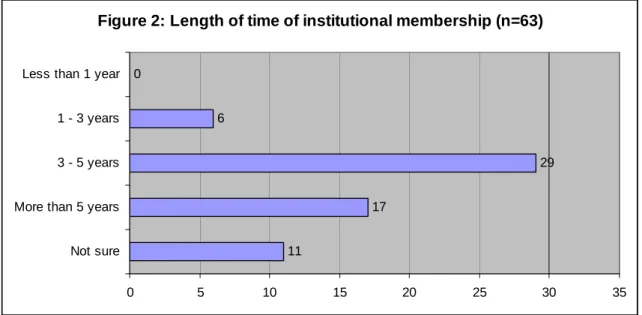
indicating a membership of 1-3 years. One surprise in this range of responses is that 17.5% of participants are not sure about the length of their institution’s membership. It is unclear from the raw data what has produced this gap in knowledge. This could be due in fact to each
respondent’s individual definition of the date of “formal recognition” of the HBCU Library Alliance as an organization. The idea of the organization emerged in 2001 (or even earlier), the first meeting of HBCU library directors was not until October 2002, and it was not until
September 2003 that the organization was formally given its name.
Figure 2: Length of time of institutional membership (n=63)
11
17
29 6
0
0 5 10 15 20 25 30 35
Not sure More than 5 years 3 - 5 years 1 - 3 years Less than 1 year
Another element to explore was the operational budget of HBCU libraries. This question about budgets was included to test if there were any links between the budget of an institution and their perceptions about the success of the HBCU Library Alliance’s collaboration activities. Would a smaller institution be more inclined to indicate that the services offered by the
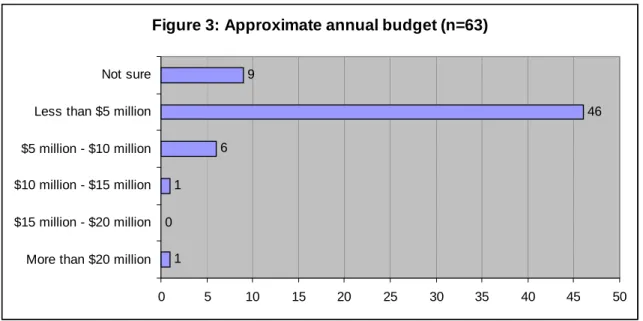
Figure 3 shows that 73.0% (46 of 63) of respondents indicate that their employing
institution has an operational budget that is below $5 million, with sharp decreases in the number of responses for each subsequent $5 million increment. In fact, only one institution was
identified as having an operational budget greater than $20 million (this institution also indicated that it is not an HBCU library). At face value, these responses regarding library budgets are surprising in that there is such a majority in the lowest category. However, with further analysis of this issue, it becomes apparent that the stark statistical contrast between the upper and lower ends of this range is a product of poor question design. Perhaps the best evidence for the
fallibility of this question comes from the two responses given in the additional comments space provided for this question. The first additional comment states, “Obviously, you have little familiarity with HBCU budgets” while the second reinforces this idea by stating “Library budget for Junior College Library $400,000.”
These comments provide an excellent point of reflection. This question on library budgets was written following a review of 2005-2006 budget statistics from the Association of Research Libraries. Ranges in this question were meant to form a loose bell curve around the average ARL library budget. After reviewing this data again with the perspective gained from the responses to this question in the survey, it appears that only one HBCU is an ARL library: Howard University, which reported total library expenditures of $9,854,124 in 2005-2006 – the lowest ranking total library expenditures of all ARL libraries.
Colleges and Universities: A Comparative Analysis Using Data Collected through the Academic Libraries Survey.” This report was compiled by the HBCU Library Alliance and SOLINET in 2005. It may seem strange to point to a resource created by the entity being presently studied, yet “The State of Libraries” report is the only (recent) comprehensive study of its kind. From this report, we learn that the average total expenditures for HBCU libraries are $1,085,494 (HBCU Library Alliance and SOLINET, 2005).
Figure 3: Approximate annual budget (n=63)
1 0
1 6
46 9
0 5 10 15 20 25 30 35 40 45 50
More than $20 million $15 million - $20 million $10 million - $15 million $5 million - $10 million Less than $5 million Not sure
The next two questions (Questions 6 and 7 in the survey) asked about geographic proximity of the respondent’s employing institution to other HBCU libraries and to ALA-accredited Masters of Library Science programs. This line of questioning sought to investigate possible direct links between proximity among HBCU libraries and MLS programs and the likelihood that these proximate institutions would participate more readily in collaboration activities together.
this question of proximity to other HBCUs, there was no substantial increase in the likelihood that these institutions would collaborate with nearby HBCUs or any substantial increase in the likelihood that these 54 respondents had participated more recently in collaborations with their “neighbors” (as gauged by Questions 8-11). Further questioning of this link could be made in order to verify this finding. Perhaps additional questions about the frequency of collaborations with nearby HBCUs could extract more evidence about this possible link.
Similar deductions can be made when looking at the proximity of libraries to MLS programs. A relatively large majority of respondents, 68.8% (or 44 of 64), indicated that their institution was within 100 miles of an ALA-accredited Masters of Library Science program. However, again, this subset of respondents (44) who responded affirmatively about proximity is not any more likely to have increased the nature or timing of their collaboration activities. A separate study on the question of collaboration between HBCU libraries and MLS programs and their graduate students would likely reveal some excellent points, given certain events that have transpired over the past few years relating to educational opportunities at HBCUs for future librarians.
In 2005, after nearly two years of debate the ALA-accredited MLS program at Clark Atlanta University closed its doors. The school’s closing left only one HBCU with an ALA-accredited program: North Carolina Central University in Durham, North Carolina. Given this situation, there is currently a great deal of concern that the lack of educational opportunities for African Americans wishing to enter a career as a professional library will have a long-term effect on the recruitment and retention of African American librarians. This issue will be revisited in the member perception analysis below.
Turning to previous collaboration efforts, the remaining demographic questions of the first section of the survey asked participants to comment about personal and institutional involvement in HBCU Library Alliance collaboration activities. Questions 8 and 9 asked respondents if they had ever personally collaborated with other HBCU libraries (and if so, when). A large percentage of respondents, 80.0% (48 of 60) answered that they had personally collaborated with other HBCUs. The follow-up question about the timeframe of that
collaboration revealed that 50.0% of respondents have participated in collaboration activities with other HBCUs in the last year. The fact that such a large percentage of survey respondents report recent collaboration indicates that the HBCU Library Alliance has been successful in recruiting librarians and administrators to continue their cooperative efforts among the
community. One respondent commented that they are “currently collaborating with 20 HBCUs on a grant-funded project.” Another comment listed three different institutions with which the commenter had recently collaborated.
Along those same lines, and furthering the idea of active participation in the consortium, responses to Question 10 showed that 83.9% of respondents (52 of 62) know that a
third-party’s collaboration activities – therefore some respondents chose not to respond to this question.
Questions 12 and 13 asked survey participants to indicate with which individual program, event, or initiative of the HBCU Library Alliance they had personally participated or knew of someone from their institution that had participated. The list of choices of programs was compiled through an investigation into the past and ongoing activities of the Alliance. This list, which is primarily composed of information gathered from their Web site, was not exhaustive but attempted to include as many initiatives as possible and gave survey participants choices in which to include “other” programs and events. In figure 4, we see consistent participation in the entire range of collaboration activities of the HBCU Library Alliance. It should be noted that both questions allowed respondents to include multiple selections, as it was very likely that survey respondents had attended various events and programs. The most widely-attended program was the Leadership Institute. 60.4% of respondents (29 of 48) indicated that they had personally attended at least one session of the Leadership Institute. Similarly, figure 5 shows that 78.7% of respondents (37 of 47) know of someone else at their institution that has attended the Leadership Institute. The lowest-attended of the listed activities for both questions was the Summer Leadership Exchange. However, this could be due to the fact that it is a much smaller program intended for only a small number of participants.
collaborative activities. Remember that prior to 2005 no group of HBCU library directors and deans had ever come together at one time. Therefore, increased opportunities to convene on a consistent basis are an important part of the overall mission of the HBCU Library Alliance: to encourage HBCU librarians to build a supportive community.
Questions in this second section of the survey polled respondents about their perceptions of the collaboration activities of the HBCU Library Alliance. These 16 Likert-scale questions were intended to examine individual opinions of the organization. Again, the questions in this section are based on the meta-analysis done by Mattessich and Monsey, which drew out 20 different factors that were deemed important for successful collaboration. These 20 factors were then grouped together in six categories: Environment, Membership, Process/Structure,
Communications, Purpose, and Resources. Following a thorough investigation of each of these factors Mattessich and Monsey described how readers of the report might utilize it in managing their own collaboration project. Addressing collaboration project managers directly, the authors suggested that these leaders should return to the meta-analysis from time to time to reflect on their project’s fulfillment of each factor of success. To do so will allow the collaboration manager to reflect on, “What should we be watching out for? Are there changes we need to make mid-course?” Perhaps the present study, and more specifically the analysis of the
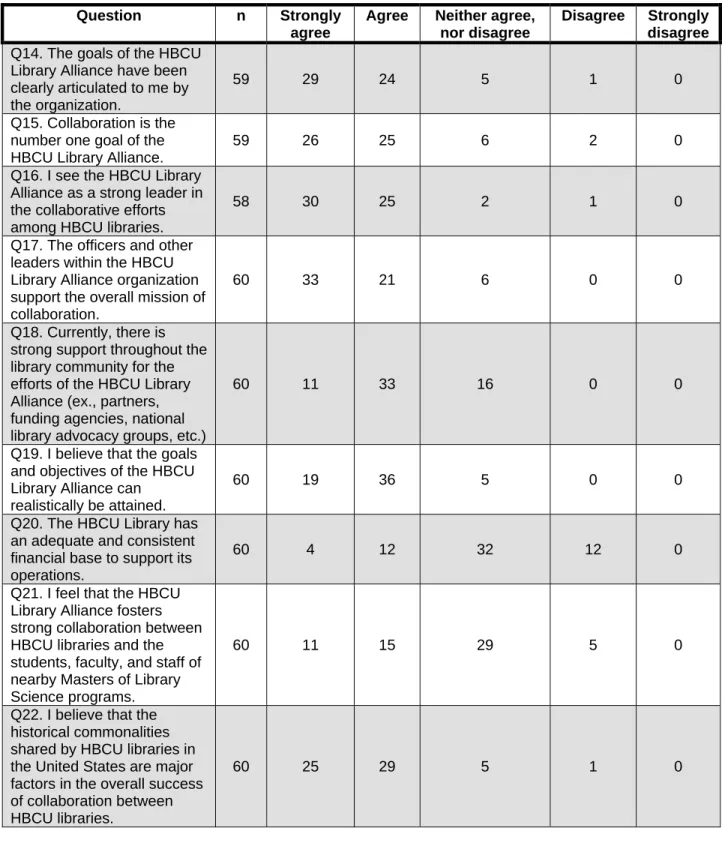
Table 1: Questions surveying member perceptions of HBCU Library Alliance collaboration activities
Question n Strongly
agree
Agree Neither agree, nor disagree
Disagree Strongly disagree
Q14. The goals of the HBCU Library Alliance have been clearly articulated to me by the organization.
59 29 24 5 1 0
Q15. Collaboration is the number one goal of the HBCU Library Alliance.
59 26 25 6 2 0
Q16. I see the HBCU Library Alliance as a strong leader in the collaborative efforts among HBCU libraries.
58 30 25 2 1 0
Q17. The officers and other leaders within the HBCU Library Alliance organization support the overall mission of collaboration.
60 33 21 6 0 0
Q18. Currently, there is strong support throughout the library community for the efforts of the HBCU Library Alliance (ex., partners, funding agencies, national library advocacy groups, etc.)
60 11 33 16 0 0
Q19. I believe that the goals and objectives of the HBCU Library Alliance can
realistically be attained.
60 19 36 5 0 0
Q20. The HBCU Library has an adequate and consistent financial base to support its operations.
60 4 12 32 12 0
Q21. I feel that the HBCU Library Alliance fosters strong collaboration between HBCU libraries and the students, faculty, and staff of nearby Masters of Library Science programs.
60 11 15 29 5 0
Q22. I believe that the historical commonalities shared by HBCU libraries in the United States are major factors in the overall success of collaboration between HBCU libraries.
Question n Strongly agree
Agree Neither agree, nor disagree
Disagree Strongly disagree
Q23. There is a great deal of mutual respect and
understanding among the members of the HBCU Library Alliance.
58 20 26 11 1 0
Q24. The HBCU Library Alliance includes individuals and institutions from a representative cross-section of the community that will be effected by it's efforts.
58 22 26 10 0 0
Q25. I believe the
participation of my institution in the collaboration projects and programs of the HBCU Library Alliance will benefit the overall success of the library at my institution.
60 29 25 6 0 0
Q26. I feel a sense of
ownership in the way that my institution, as a member of the HBCU Library Alliance, participates in the decision-making process of the HBCU Library Alliance.
59 17 25 14 3 0
Q27. I clearly understand my institution's roles, rights, and responsibilities and how to carry out those
responsibilities within the organization of the HBCU Library Alliance.
59 17 30 9 3 0
leader in the collaborative efforts of HBCU libraries (one of the three factors under the Environment category from the Mattessich and Monsey meta-analysis).
Another example of the positive perceptions of survey respondents of the HBCU Library Alliance can be seen in the responses for Question 25. A large majority of respondents, 90.0% (54 of 60), indicated either agreement or strong agreement that they believe that participation of their institution in the programs of the HBCU Library Alliance will benefit the overall success of their institution. This question touches on the self-interest element under the Membership category from the meta-analysis.
These are just two examples of the overwhelmingly positive views that members hold of the organizations. The responses in the remaining thirteen questions are, for the most part, as positive as the two mentioned above. There are a few questions in which respondents show at least some ambivalence. A great example of these neutral responses is Question 20 regarding financial support for the Alliance. Of the 60 responses for this question, 53.3% (32 of 60) indicated that they “neither agree, nor disagree” with the statement that the Alliance has an adequate and consistent financial support base, while 20.0% (12 of 60) indicated that they disagreed with this statement. This is reminiscent of Anderson’s work, which defined the most salient characteristics of a library collaboration model. Finances are one of the four defining characteristics. This ambivalence among the perceptions on this aspect reveals a common anxiety among libraries and library networks about funding.
Two concluding questions of the survey sought to gather information about communication and overall satisfaction. The first question was designed as a further investigation into specific communication methods used by the HBCU Library Alliance.
communication) is by far the most prevalent mode of communication. Less than one quarter (23.3%) indicated that they had received printed newsletters or flyers. This kind of
communication structure reinforces the face-to-face community that they started to build in 2002. The technology-revolutions of the late 20th and early 21st century provide virtual spaces for ongoing community building. It should be noted, however, that two respondents included
comments indicating that face-to-face and telephone conversations were also important lines of communication with the HCBU Library Alliance and partner HBCU Libraries.
It should not be surprising that survey respondents again show an positive satisfaction with the HBCU Library Alliance. 54 (90.0%) of the 60 respondents answering this question either strongly agreed or agreed. Only two (3.3%) indicated dissatisfaction. In redesigning the survey, an optional comments field would have been useful for this question to draw out specific reasons for this dissatisfaction.
CONCLUSION
participation of HBCU librarians in the collaboration programs of the HBCU Library Alliance and showed that much of this participation is recent.
The second section of the study focused on some of the elements of successful
collaboration as identified by the work of Mattessich and Monsey. Positive perceptions were shown for almost all of these elements of success with only some ambivalence regarding the elements surrounding financial support. Additional questions about communication and overall satisfaction of the organization affirmed the positive perceptions about the various elements for successful collaboration
Despite some limitations, this study has important, more general implications for
measuring the success of inter-institutional library collaboration. In particular, the study further documented the importance of social capital among library collaboration organizations (versus merely focusing on resource sharing). Although the literature on this subject has many examples that reiterate this principle of social capital, the present study furthers the work in this area of community building through a case study of a relatively new organization which has shown extremely promising results in only a short time. Furthermore, the desire within the organization to continually self-examine is strong in the HBCU Library Alliance, meaning that further growth is inevitable.
NOTES
i
Historically Black Colleges and Universities (HBCUs) are defined by the Higher Education Act of 1965 as “any historically black college or university that was established prior to 1964, whose principal mission was, and is, the education of black Americans.”
List of HBCUs from the Web site of the White House Initiative on Historically Black Colleges and Universities (http://www.ed.gov/about/inits/list/whhbcu/edlite-list.html, accessed April 24, 2008): Four-year public institutions: Alabama A&M University, Alabama State University, University of Arkansas at Pine Bluff, University of the District of Columbia, Delaware State University, Florida A&M University, Albany State University, Fort Valley State University, Savannah State University, Kentucky State University, Grambling State University, Southern University A&M College, Southern University at New Orleans, Bowie State University, Coppin State College, Morgan State University, University of Maryland Eastern Shore, Alcorn State University, Jackson State University, Mississippi, Valley State University, Harris-Stowe State University, Lincoln University, Elizabeth City State University, Fayetteville State University, North Carolina A&T State University, North Carolina Central University, Winston-Salem State University, Central State University, Langston University, Cheyney University of Pennsylvania, Lincoln University, South Carolina State University, Tennessee State University, Prairie View A&M University, Texas Southern University, Norfolk State University, Virginia State
University, Bluefield State College, West Virginia State University, University of the Virgin Islands. Four-year private institutions: Concordia College Selma, Miles College, Oakwood University, Selma University, Stillman College, Talladega College, Tuskegee University, Arkansas Baptist College, Philander Smith College, Howard University, Bethune-Cookman University, Edward Waters College, Florida Memorial University, Clark Atlanta University, Interdenominational Theological Center, Morehouse College, Morehouse School of Medicine, Morris Brown College, Paine College, Spelman College, Dillard University, Xavier University of Louisiana, Rust College, Tougaloo College, Bennett College, Johnson C. Smith University, Livingstone College, Shaw University, St. Augustine's College, Wilberforce University, Allen University, Benedict College, Claflin University, Morris College, Voorhees College, Fisk University, Knoxville College, Lane College, Lemoyne-Owen College, Meharry Medical College, Huston-Tillotson University, Jarvis Christian College, Paul Quinn College,
BIBLIOGRAPHY
Anderson, Anne. "Building Shared Services - More Bang for Your Buck!" The New Zealand Library & Information Management Journal 50.3 (2007): 216-32.
Babbie, E. (2007). The Practice of Social Research. Eleventh Edition. Belmont, CA: Thomson Wadsworth.
Brown, Carol A. "Elements of a Powerful Partnership {Computer File}." North Carolina Libraries (Online) 61.2 (2003): 52-61.
Burger, John, and Lillian Lewis. "Each One Teach One." American Libraries 38.2 (2007): 34-6. "Cornell, HBCU Awarded Grant for Digital Library." Advanced Technology Libraries 34.10
(2005): 8.
Curry, Elizabeth A. "Play with the Slinky: Learning to Lead Collaboration through a Statewide Training Project Aimed at Grants for Community Partnerships." Resource Sharing and Information Networks 18.1/2 (2005): 25-48.
Devlin, Frances A., Nancy J. Burich, and Marcia G. Stockham. "Getting Beyond Institutional Cultures: When Rivals Collaborate." Journal of Library Administration 45.1/2 (2006): 149-68.
Guard, Roger. "Musings on Collaboration and Vested Interest." The Journal of Academic Librarianship 31.2 (2005): 89-91.
Hart, Carolyn, et al. "The HBCU Library Alliance: Developing Leadership." Virginia Libraries 53.4 (2007): 16-20.
Kuo, Elaine W., and ERIC Clearinghouse for Community Colleges, Los Angeles,CA. Creating Beneficial Institutional Collaborations. ERIC Digest., 1999.
MacDougall, Alan F. “Cooperation: A Conceptual Framework for Librarians” in MacDougall, Alan F. and Ray Prytherch, eds. Handbook of Library Cooperation. Hants, England: Gower Publishing, 1991.
Mattessich, Paul W., et al. Community Building: What Makes it Work : A Review of Factors Influencing Successful Community Building. Saint Paul, Minn.: Amherst H. Wilder Foundation, 1997.
Mattessich, Paul W., et al. Collaboration--what Makes it Work. 2nd ed. Saint Paul, Minn.: Amherst H. Wilder Foundation, 2001.
Molyneux, Robert, and Association of Coll. and Research Libraries, Chicago,IL.
ACRL/Historically Black Colleges & Universities Library Statistics. 1988-89., 1991.
Owens, Irene. "Stories Told but Yet Unfinished: Challenges Facing African-American Libraries and Special Collections in Historically Black Colleges and Universities." Journal of Library Administration 33.3/4 (2001): 165-81.
"Preserving a Legacy: Janice R. Franklin--Alabama State University, Montgomery--Loretta O'Brien--Parham Hampton University, VA." Library Journal 129.5 (2004).
President's Board of Advisors on Historically Black Colleges and Universities (ED),
President on the Results of Participation of Historically Black Colleges and Universities in Federal Programs. US Department of Education, 2007.
Rader, Hannelore B. Managing Academic and Research Libraries Partnerships., 2001.
Shepherd, Murray, Virginia Gillham, and Michael Ridley. "The Truth is in the Details, Lessons in Inter-University Library Collaboration." Library Management 20.6 (1999): 332-7.
Watkins, Christine. "New Study to Shed Light on Library Cooperatives." American Libraries 33.2 (2002): 13.
Appendix 1 – Full Text of the Survey Instrument
Section A: Background Information
1) What is your current status/position in your institution? (Please select all that apply):
___ Library Director
___ Other Library Administrator (Development, Communications, Personnel, etc.) ___ Full-time Librarian or Archivist
___ Part-time Librarian or Archivist
___ Paraprofessional / Library Technical Assistant ___ Graduate Assistant
___ Other (please specify):_________
2. Are you employed by an institution that is defined as a historically black college or university, also known as an HBCU?
___ Yes ___ No ___ Not sure
3. Is your institution a member of the HBCU Library Alliance?
___ Yes ___ No ___ Not sure
4. How long has your institution been a member of the HBCU Library Alliance?
___ Less than 1 year ___ 1 - 3 years ___ 3 - 5 years
___ More than 5 years ___ Not sure
5. What is the approximate annual budget of the entire library at your institution?
___ Less than $5 million ___ $5 million - $10 million ___ $10 million - $15 million ___ $15 million - $20 million ___ More than $20 million ___ Not sure
6. Are there other HBCU libraries located within approximately 100 miles of your institution?
___ Yes ___ No ___ Not sure
7. Is there an ALA-accredited Masters of Library Science program within approximately 100 miles of your institution?
___ Yes ___ No ___ Not sure
8. Have you ever (personally) collaborated with other HBCUs (either HBCU Library Alliance members or non-members)?
___ Yes ___ No
9. If yes, when was the last time?
___ Less than 1 year ago ___ 1 - 3 years ago ___ 3 - 5 years ago
___ More than five years ago Additional comments:__________
10. To the best of your knowledge, has your institution, or a representative of your
institution other than yourself, ever collaborated with other HBCUs (either HBCU Library Alliance members or non-members)?
___ Yes ___ No ___ Not sure
11. If yes, when was the last time?
___ Less than 1 year ago ___ 1 - 3 years ago ___ 3 - 5 years ago
___ More than five years ago Additional comments:__________
12. Have you (personally) participated in any of the following programs or projects of the HBCU Library Alliance?: (Please select all that apply.)
___ I participated in the 2003 HBCU libraries' needs assessment study performed by the HBCU Library Alliance and SOLINET.
___ I have worked on the initiative "Building Collections, Building Services, and Building Sustainability: A Collaborative Model for the HBCU Library Alliance," a digitization project in collaboration with Cornell University and the Andrew W. Mellon Foundation.
___ I have participated in other digitization workshops or programs sponsored by the HBCU Library Alliance.
___ I have participated in the "Preservation of Photographic Collections in Historically Black Colleges and Universities" project.
___ I have attended other preservation and/or conservation workshops sponsored by the HBCU Library Alliance.
___ Other participation (please specify):__________
13. To the best of your knowledge, has your institution, or a representative of your
institution other than yourself, participated in any of the following programs or projects of the HBCU Library Alliance?: (Please select all that apply.)
___ My institution, or a member of my institution, participated in the 2003 HBCU libraries' needs assessment study performed by the HBCU Library Alliance and SOLINET.
___ My institution, or a member of my institution, has attended one of the sessions of the annual Leadership Institute.
___ My institution, or a member of my institution, has participated in the Summer Leadership Exchange Program.
___ My institution, or a member of my institution, has participated in inter-institutional mentoring or site visits.
___ My institution, or a member of my institution, has participated in the "Building Collections, Building Services, and Building Sustainability: A Collaborative Model for the HBCU Library Alliance," a digitization project in collaboration with Cornell University and the Andrew W. Mellon Foundation.
___ My institution, or a member of my institution, has participated in other digitization workshops or programs sponsored by the HBCU Library Alliance.
___ My institution, or a member of my institution, has participated in the "Preservation of Photographic Collections in Historically Black Colleges and Universities" project.
___ My institution, or a member of my institution, has attended other preservation and/or conservation workshops sponsored by the HBCU Library Alliance.
___ Other participation (please specify)_________
14. The goals of the HBCU Library Alliance have been clearly articulated to me by the organization.
[ Strongly agree ][ Agree ][ Neither agree, nor disagree ][ Disagree ][ Strongly disagree ]
15. Collaboration is the number one goal of the HBCU Library Alliance.
[ Strongly agree ][ Agree ][ Neither agree, nor disagree ][ Disagree ][ Strongly disagree ]
16. I see the HBCU Library Alliance as a strong leader in the collaborative efforts among HBCU libraries.
17. The officers and other leaders within the HBCU Library Alliance organization support the overall mission of collaboration.
[ Strongly agree ][ Agree ][ Neither agree, nor disagree ][ Disagree ][ Strongly disagree ]
18. Currently, there is strong support throughout the library community for the efforts of the HBCU Library Alliance (ex., partners, funding agencies, national library advocacy groups, etc.)
[ Strongly agree ][ Agree ][ Neither agree, nor disagree ][ Disagree ][ Strongly disagree ]
19. I believe that the goals and objectives of the HBCU Library Alliance can realistically be attained.
[ Strongly agree ][ Agree ][ Neither agree, nor disagree ][ Disagree ][ Strongly disagree ]
20. The HBCU Library has an adequate and consistent financial base to support its operations.
[ Strongly agree ][ Agree ][ Neither agree, nor disagree ][ Disagree ][ Strongly disagree ]
21. I feel that the HBCU Library Alliance fosters strong collaboration between HBCU libraries and the students, faculty, and staff of nearby Masters of Library Science programs.
[ Strongly agree ][ Agree ][ Neither agree, nor disagree ][ Disagree ][ Strongly disagree ]
22. I believe that the historical commonalities shared by HBCU libraries in the United States are major factors in the overall success of collaboration between HBCU libraries.
[ Strongly agree ][ Agree ][ Neither agree, nor disagree ][ Disagree ][ Strongly disagree ]
23. There is a great deal of mutual respect and understanding among the members of the HBCU Library Alliance.
[ Strongly agree ][ Agree ][ Neither agree, nor disagree ][ Disagree ][ Strongly disagree ]
24. The HBCU Library Alliance includes individuals and institutions from a representative cross-section of the community that will be effected by it's efforts.
[ Strongly agree ][ Agree ][ Neither agree, nor disagree ][ Disagree ][ Strongly disagree ]
25. I believe the participation of my institution in the collaboration projects and programs of the HBCU Library Alliance will benefit the overall success of the library at my
institution.
[ Strongly agree ][ Agree ][ Neither agree, nor disagree ][ Disagree ][ Strongly disagree ]
26. I feel a sense of ownership in the way that my institution, as a member of the HBCU Library Alliance, participates in the decision-making process of the HBCU Library Alliance.
[ Strongly agree ][ Agree ][ Neither agree, nor disagree ][ Disagree ][ Strongly disagree ]
[ Strongly agree ][ Agree ][ Neither agree, nor disagree ][ Disagree ][ Strongly disagree ]
28. There is open and frequent communication from the HBCU Library Alliance with my institution.
[ Strongly agree ][ Agree ][ Neither agree, nor disagree ][ Disagree ][ Strongly disagree ]
29. What types of communication do you receive from the HBCU Library Alliance (Select all that apply):
___ Email updates and news
___ HBCU Library Alliance-related information via listservs
___ Updates and news accessed from the HBCU Library Alliance website ___ Printed newsletters or flyers
___ Other (please specify):__________
30. Overall, how satisfied are you with the programs, events, or other services of the HBCU Library Alliance?
___ Very satisfied ___ Satisfied
___ Neither satisfied, nor dissatisfied ___ Dissatisfied