In this study, I proposed a short text clustering approach with WordNet as the external resources to cluster documents from corpus.byu.edu. Experimental results show that our approach largely improved the clustering performance. The factors that have an influence on the performance of the topic model are the total number of documents, Synsets distribution among topics and words overlapping between the query’s Synsets. In addition, the performance will also be influenced by the missing Synset in WordNet. Finally, we provide an idea of using clustering approaches generating ranked query suggestion to disambiguate the query. Combining with Synsets of the query, text document clustering can provide an effective way to disambiguate user search query by organizing a large set of searching results into a small number of groups labeled with Synsets from WordNet.
Headings:
Short text clustering
Short text enrichment
by Xiaomeng Wang
A Master’s paper submitted to the faculty of the School of Information and Library Science of the University of North Carolina at Chapel Hill
in partial fulfillment of the requirements for the degree of Master of Science in
Information Science.
Chapel Hill, North Carolina
November 2018
Approved by
_______________________________________
Table of Contents
List of Table ... 2
List of Figures ... 2
1. Introduction ... 3
2. Related work ... 8
2.1 Query suggestion ... 8
2.1.1 Session based approach ... 8
2.1.2 Click-through data ... 10
2.2 Short text clustering ... 12
3. Method ... 15
3.1 Research Questions ... 15
3.2 WordNet ... 16
3.3 Query-term selection ... 18
3.4 Data ... 19
3.5 Text representation ... 20
3.6 Compiling WordNet into the short text representation ... 22
3.7 Latent Dirichlet Allocation in Clustering ... 28
3.8 Evaluation ... 29
3.9 Code ... 32
4.Results and discussion ... 33
4.1 Coherent topics and the total number of topics ... 33
4.2 Coherent topics and distribution of Synsets ... 34
4.3 Query suggestion ... 35
4.4 Query’s Synsets in WordNet ... 36
4.5 Additional Observations ... 37
4.6 Performance ... 39
5. Conclusion and future work ... 41
6. Bibliography ... 42
List of Table
1. Synsets of “song’ in WordNet………..17
2. An example of search results returned from BYU iweb corpus search engine...20
3. Synsets Description of “song” in WordNet………..23
4. Total number of Synsets and coherent Synsets………33
5. General performance comparison.………...39
6. Performance of coherent topic and the number of documents in topics………...39
List of Figures
1. Instruction of results………...302. Result of “cape” ………...54
3. Result of “beauty” ………...55
4. Result of “honey” ………...56
5. Result of “kind” ………....…..57
6. Result of “palm” ………... 58
7. Result of “mug” ………...59
8. Result of “crane” ………60
9. Result of “dove” ………...61
10. Result of “term” ………62
1. Introduction
Search engines are considered to be the most successful tool on the Internet since its creation. Nowadays, they have become an indispensable tool for users to tackle various information seeking tasks, such as finding target resources, browsing particular websites.
However, most users inevitably encounter many difficulties in the process of looking for information using search engines. In particular, users have been found feeling challenged to describe their information need in the form of queries properly with the first query they enter (Belkin et al., 1982). They tend to modify their queries several times before retrieving better results. These modifications are called query reformulation. The results of Guo et al. (2017) indicated that more than 60% of search sessions contain query reformulation.
In other words, web search queries are typically short, often ambiguous and polysemous (Jansen et al., 1998). A simple query can have multiple interpretations. For example, based on the Webster dictionary “java” has three senses: island, coffee, and programming language. For users learning how to form a query to limit their search focusing on the required meaning is necessary. For example, a user may input “java + island” to declare that he or she wants results related to location. For search engines, how to disambiguate queries becomes an important problem. When a user enters a query “java”, can the search engine realize that there will be three types of results that are corresponding with three senses of “java”? Modern search engines have tried hard to come up with appropriate assistance for query reformulations. Existing research in this vein have studies query substitution (Jones et al., 2006) and other refinement techniques (Kraft and Zien 2004; Baeza-Yates et al., 2004). Query expansion is instantly offered as a drop-down list under the input box for users to modify their query.
Radlinski & Joachims, 2005). It assumes that users often try to change queries or use a new one to get the results they feel satisfied, and queries in the same session in a short time are searched by the same user (Boldi et al., 2008). Usually, session-based methods can be divided into three groups based on how to measure the structure of user’s own query log: adjacency or query co-occurrence query suggestion, query flow graph based query suggestion, and other query suggestions, such as user experience-based query suggestion, machine learning based query suggestion and so on.
The click-through based method focuses on finding similar queries from search history including all users’ search logs. When the user enters a query and views some of the results, the log records the URLs that are clicked. This theory assumes that two queries are similar to each other if they share a large number of clicked URLs. Several query suggestion models have been proposed based on this approach (Huang et al, 2003). Generally speaking, click-through based query suggestion can be categorized into two groups: clustering based query suggestion and bipartite graph based query suggestion.
page limitation will also bring problems to query suggestion model such as missing some candidate query suggestions. For example, typing "bus service in java" (the example we mentioned before) as a query into Google, we found that the top-ranked results returned by search engine were all related to the java programing language. Results for transportation information of java Island appeared at the second page. Google's query suggestion function also can’t provide any query suggestion related to "java island".
As early as 2012, Bordogna et al. (2012) proposed a study based on the aggregation of suggested disambiguated queries and cluster novelty ranking. The main purpose of their research was to suggest disambiguated queries to reduce the need for search reformulation iterations. In the study, they provided three steps. First, the retrieved documents are clustered, on the basis of words extracted from their titles and snippets. Second, for each cluster, a personalized rank is computed, based on the novelty of contents of the cluster with respect to the user’s past results and the overall content similarity of clusters with respect to the original query. Finally, from each cluster’s representation, a disambiguated query is generated and suggested to the user to optimize the retrieval process.
knowledge. Usually, the clustering method can be classified by the length of raw data into two categories: the normal clustering algorithm and short text algorithm. The major difference between normal clustering approaches and short text clustering approaches is the short text’s sparse feature vector. Researchers have used a feature vector to represent the text data. The short text will lead to the sparse feature vector problem. For instance, Twitter is a popular short text data source researched widely. A single Tweet has less than 280 characters. The major solution provided by researchers is to make the short text data longer by adding words using external resources or finding core terms in the corpus.
2. Related work
2.1 Query suggestion
Query suggestion is a method by which a user can reformulate their query when they didn't receive ideal results from their original query. The search system can improve the user's searching effort by providing effective and useful query suggestions by guessing the user information need, according to user’s past behavior (Cao, et al., 2008). Most query suggestion systems are based on users search history (Ooi, et al., 2015).
2.1.1 Session based approach
On the whole, there are two main groups of session-based query suggestion approaches: the adjacency based method, and the query flow graph based method.
Adjacency based query suggestion
The adjacency based method analyzes the query sequence in sessions, exploits other queries’ co-occurrence in the same session with the initial query, and takes the adjacency queries for a suggestion. Huang et al. (2003) mined co-occurring query pairs from session data and candidates’ relevant terms by taking terms that co-occurred in similar search processes then ranked the candidates based on their frequency of co-occurrence.
Furthermore, Jensen's study (2006) considered not only the co-occurrence frequency but also weighted with the logarithm of the co-occurrence frequency for scoring candidate suggestions and original query. Zhang's study (2006) measured the degree of similarity of queries depends on the adjacent degree of the queries: the more adjacent, the more similar. To improve the similarity degree theory, Zhang and Nasraoui built a soft relation matrix to store the relation between consecutive queries that occur within the same session (Zhang et al., 2008). He (2009) Incorporated the history of query sequence into their query suggestion algorithm. Silviu Cucerzan and Eric Brill (Cucerzan & Brill, 2005) introduced statistics models into a query suggestion algorithm. They used maximum likelihood estimation to approximate both the probability that a query qj follows immediately another query qi in a user search session.
The query flow graph based query suggestion uses a graph to represent the structure of query log mining queries relationship and behavior within the same session. In the query-flow graph, each node represents a distinct query, and a directed edge from query qi to query qj means that at least one user-submitted query qj immediately after submitting qi in the same session. Boldi proposed measured frequency of observed transitions between queries as edge weights in a query flow graph. Select the neighbors with the largest edge as query suggestions for the initial query. (Boldi et al., 2009). Anagnostopoulos (2010) developed Boldi’s theory and argued that providing query suggestions to users may change user behavior. They thus modeled query suggestions as shortcut links on a query-flow graph and considered the resulted graph as a perturbed version of the original one.
2.1.2 Click-through data
By mining users’ click pattern in a search log, researchers can record click-through data for each query. The URL can be used to exploit the relationship between different queries (Meng, et al., 2014). Wen et al. (2001) analyzed click-through the bipartite graph and applied a density-based algorithm DBSCAN to form clusters of similar queries. Jeonghee Y (2009) introduced click through the graph which considers query and clicked page relationship. Generally speaking, there are three groups of session-based query suggestion: clustering session-based query suggestion and bipartite graph session-based query suggestion
Clustering based query suggestion
the cluster, which contains the input query, can be present as query suggestion. That is to say, the queries in the same cluster indicate the same or similar topics and the queries within the same cluster are used as suggestions for each other. Beeferman and Berger (2000) incorporated the commonly clicked URLs in their study. However, this method has high computational cost and cannot deal with large data. Also, Wing Shun Chan (2004) pointed out that this method ignored the noise relationships from the search engine log. Baeza-Yates (2004) built a term-weight vector to represent queries. Larry Fitzpatrick and Mei Dent’s study (1998) calculated the similarity of queries according to the relationships of URLs. Kenneth (2008) introduced an approach that captured the user’s conceptual preferences in order to provide personalized query suggestions.
Bipartite Graph-based Query Suggestion
In the user query log, nodes represent queries and URLs. Creating a bipartite graph with the vertices on one side corresponding to queries and on the other side to URLs, joins the collections of queries and the collections of click-through. The method attempts to find such two sets: (1) A set of disjoint similar query. (2) A set of disjoint URLs. Ma et al. (2010) established a user-query bipartite graph and a query-URL bipartite graph based on click-through.
Song and Li-wei He (2008) took the clicked URLs and skipped URLs into account and proposed an optimal rare query suggestion framework
2.2 Short text clustering
Short text clustering is the clustering technique applied to short text documents. However, the short text contains a few words only. Normal text clustering methods such as K-means, C-means, Fuzzy C-means etc. do not perform well. Short text clustering has the issue of vector feature vector sparsity (Aggarwal and Zhai, 2012). Most words only occur once in the corpus, hence, the most frequently used text representation method: TF-IDF is not able to work well in short text settings.
Enrichment by the external source
similarity between terms for word sense disambiguation by WordNet. Build sophisticated models
Another way to overcome the sparsity problem is to explore more models to cluster short texts. Yin and Wang (2014) proposed a Dirichlet multinomial mixture model for short text clustering. Their model can also cope with the sparse and high-dimensional problem of short texts and can obtain the representative words of each cluster. Latent Dirichlet allocation (LDA), the most commonly used topic model is another sophisticated model can be used in short text clustering. LDA algorithm assumes that documents consist of a group of topics. Each word/element is generated by a specific topic individually and the corresponding topic is drawn from its associated proportion distribution (Blei et al., 2003).
Deep Neural Network
With the recent revival of interest in Deep Neural Network (DNN), many studies concentrated on exploiting deep learning algorithms to extract features from documents. Deep autoencoder (DAE) has been used to learn text representation from raw data by Hinton and Salakhutdinov (2006). With the growing popularity of word embedding (such as Google’s word2vec1), more and more researchers interested in neural networks such as Recursive Neural Network (Socher et al., 2013) and Recurrent Neural Network (Mikolov et al., 2011). Recently, Convolutional Neural Network (CNN), applying convolutional filters to capture local features can provide a better performance among those deep learning models. Xu et al. (2015) proposed a short text clustering via CNN
to learn the text representation and then using K-means to cluster them.
3. Method
In this section, I propose a method to improve the clustering performance on the short text document. I first propose three research questions of this study. Then a criterion for query selection will be established to ensure that queries could sample appropriate dataset from BYU iWeb corpus. Then I’ll add WordNet Synsets to the text representation to enhance clustering performance on short text documents. The clustering method I used in this study is Latent Dirichlet Allocation (LDA). The outputs of LDA are topics and distribution of Synsets for each topic. At the end of this section, I will present an accuracy measurement to evaluate the performance of enhanced LDA model and will do paralleled comparisons between different queries and results.
3.1 Research Questions
The main research questions are:
(RQ1) By clustering documents based on Synsets of query, can we provide search support for users to disambiguate query and to explore diversified results related to various aspect of the query?
(RQ2) Does the introduction of Synsets from WordNet to enrich the text help to improve the performance of LDA model in short text clustering?
3.2 WordNet
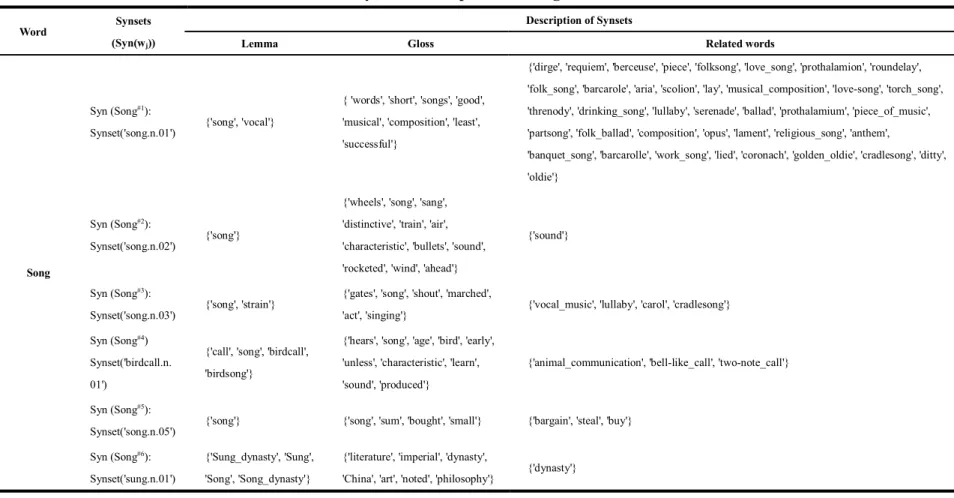
To solve the issue of sparsity of the feature vector, we use WordNet 3.12(updated July 22, 2012 (Princeton University, 2010). For the knowledge expansion of short texts. WordNet is a manually annotated lexical database of the English language. Nouns, verbs, adjectives, and adverbs are grouped into sets of cognitive synonyms. Each group is called a Synset in WordNet. It provides relations among words by connections of Synsets. The structure of a Synset is shown in Table 1. The word “song” has 6 Synsets in WordNet. Each of them has Lemma, and related Synsets. Each Lemma has definition.
Table 1 Synsets of “song’ in WordNet
Word Synsets Lemmas Definition & examples Related Synsets
song
Synset('song.n.01') Lemma('song.n.01.song'), Lemma('song.n.01.vocal')
a short musical composition with words a successful musical must have at least three good songs
hypernyms: [Synset('musical_composition.n.01')]
hyponyms: [Synset('anthem.n.01'), Synset('aria.n.01'), Synset('ballad.n.01'), Synset('barcarole.n.01'), Synset('dirge.n.01'), Synset('ditty.n.01'),
Synset('drinking_song.n.01'), Synset('folk_song.n.01'), Synset('lied.n.01'), Synset('love_song.n.01'), Synset('lullaby.n.01'), Synset('oldie.n.01'), Synset('partsong.n.01'), Synset('prothalamion.n.01'),
Synset('religious_song.n.01'), Synset('roundelay.n.01'), Synset('scolion.n.01'), Synset('serenade.n.02'), Synset('torch_song.n.01'), Synset('work_song.n.01')]
Synset('song.n.02') Lemma('song.n.02.song')
a distinctive or characteristic sound 'the song of bullets was in the air', 'the song of the wind', 'the wheels sang their song as the train rocketed ahead'
hypernyms: [Synset('sound.n.04')]
Synset('song.n.03') Lemma('song.n.03.song'), Lemma('song.n.03.strain')
the act of singing
'with a shout and a song they marched up to the gates'
hypernyms: [Synset('vocal_music.n.02')]
hyponyms: [Synset('carol.n.02'), Synset('lullaby.n.02')]
Synset('birdcall.n.0 1')
Lemma('birdcall.n.01.birdcall'),Lemma('bi rdcall.n.01.call'),Lemma('birdcall.n.01.bir dsong'),Lemma('birdcall.n.01.song')
the characteristic sound produced by a bird 'a bird will not learn its song unless it hears it at an early age'
hypernyms: [Synset('animal_communication.n.01')]
hyponyms: [Synset('bell-like_call.n.01'), Synset('two-note_call.n.01')]
Synset('song.n.05') Lemma('song.n.05.song') a very small sum
'he bought it for a song' hypernyms: [Synset('bargain.n.02')]
Synset('sung.n.01')
Lemma('sung.n.01.Sung'),Lemma('sung.n.01.Su ng_dynasty'),Lemma('sung.n.01.Song'), Lemma('sung.n.01.Song_dynasty')
the imperial dynasty of China from 960 to 1279; noted for art and literature and philosophy
hypernyms: [Synset('dynasty.n.01')]
3.3 Query-term selection
Song et al. (2007) summarize three types of queries in terms of ambiguity and specificity in their study: The first one is the ambiguous query: a query that has more than one meaning: e.g. “java” which may refer to “java coffee” (“a beverage consisting of an infusion of ground coffee beans”), “java Island” (“an island in Indonesia to the south of Borneo”), “java” (“a platform-independent object-oriented programming language”). The second one is the broad query: a query that covers a variety of subtopics and a user might look for one of the subtopics by issuing another query: e.g. “java” which covers some subtopics such as "java library", "java tutorial" and "java platform". Usually, a user issues such a query first and then narrows it down to a subtopic. The last one is the clear query: a query that has a specific meaning and covers a narrow topic: e.g. " The University of North Carolina at Chapel Hill". A user should be able to find high-quality results with a clear query at the top ranking results.
In this study, I only consider the ambiguous query, based on WordNet. Proposed query terms will have at least 2 different Synsets
In addition, the total number of results returned by searching the query will be referred as data size. It plays an important role in clustering. Clustering is an unsupervised learning method. It is necessary to ensure that the data size is large enough to guarantee good performance of clustering model. On the other hand, a large-scale text dataset will cost prohibitively by clustering methods. Steinbach et al. (2000) lists 8 existing data sets that can be used in document clustering. The range of their size is from 690 to 3204 documents. For the purposes of this study, the number of search results for each query term should be more than 1000 (the largest number of documents that BYU.com can provide us within one page) help insure good cluster results.
3.4 Data
I use the iWeb corpus presented by BYU corpora in our experiments, which are the world’s most widely used corpora (Davies, 2018). The iWeb corpus contains about 14 billion words in 22,388,141 web pages from 94,391 websites. BYU corpus website provides an online search function that applies Key Word in Context index method. Each result was extracted from a website. The length of every result is larger than 20 characters but smaller than 30 words. In our experiments, I sample datasets by searching each of the queries on BYU online search website. The two steps in sampling a single dataset are:
1) Enter the selected query (such as “song”) into the search engine provided by the BYU iweb webpage.
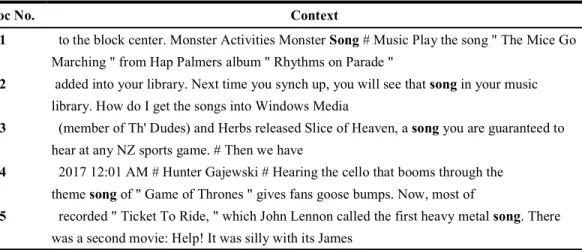
Table 2 an example of search results returned from BYU iweb corpus
search engine (query = “song”)
Doc No. Context
1 to the block center. Monster Activities Monster Song # Music Play the song " The Mice Go
Marching " from Hap Palmers album " Rhythms on Parade "
2 added into your library. Next time you synch up, you will see that song in your music
library. How do I get the songs into Windows Media
3 (member of Th' Dudes) and Herbs released Slice of Heaven, a song you are guaranteed to
hear at any NZ sports game. # Then we have
4 2017 12:01 AM # Hunter Gajewski # Hearing the cello that booms through the
theme song of " Game of Thrones " gives fans goose bumps. Now, most of
5 recorded " Ticket To Ride, " which John Lennon called the first heavy metal song. There
was a second movie: Help! It was silly with its James
In total, I prepared 10 queries to generate 10 sets of results as datasets using this sampling process for this study. They are: “cape”, “beauty”, “honey”, “kind”, “palm”, “mug”, “crane”, “dove”, “term” and “interest”.
Stop wordsare words, which are considered as non-descriptive within a bag of words approach. Following common practice, the top words used in this study is a standard list in Python NLTK with 127 stopwords. This list of Stopwords was expanded with number words, ordinal words, and auxiliary verb that introduce noise in the text representation process.
3.5 Text representation
frequently are more important and descriptive in the text representation of a document. Suppose I have a short text dataset D that includes N documents and M individual words.
D = {𝑑 , 𝑑 , … , 𝑑 } (D𝜖𝑅 × ) (1)
Let W = {𝑤 , 𝑤 , … , 𝑤 } be the complete vocabulary set of the document corpus D after stopwords removal. The term frequency of word 𝑤 of document 𝑑 is defined as:
𝑡 = tf(𝑤, 𝑑 ) (2)
tf w , D = 𝑡𝑓(
∈
𝑤 , 𝑑 ) (3)
tf(𝑊, d ) = 𝑡𝑓(
∈
𝑤 , 𝑑 ) (4)
Based on the basic document representation, I can initialize our term vector 𝑇:
𝑇 = [𝑡 , 𝑡 , … , 𝑡 ] (5)
where i denotes the i’th document. Using 𝑇 as the i’th row, I construct the n × m document-term matrix T. This matrix will be integrated with Synset matrix later to construct an improved text representation for short text.
3.6 Compiling WordNet into the short text representation
Table 3 Synsets Description of “song” in WordNet
Word Synsets
(Syn(wj))
Description of Synsets
Lemma Gloss Related words
Song
Syn (Song#1):
Synset('song.n.01') {'song', 'vocal'}
{ 'words', 'short', 'songs', 'good', 'musical', 'composition', 'least', 'successful'}
{'dirge', 'requiem', 'berceuse', 'piece', 'folksong', 'love_song', 'prothalamion', 'roundelay', 'folk_song', 'barcarole', 'aria', 'scolion', 'lay', 'musical_composition', 'love-song', 'torch_song', 'threnody', 'drinking_song', 'lullaby', 'serenade', 'ballad', 'prothalamium', 'piece_of_music', 'partsong', 'folk_ballad', 'composition', 'opus', 'lament', 'religious_song', 'anthem',
'banquet_song', 'barcarolle', 'work_song', 'lied', 'coronach', 'golden_oldie', 'cradlesong', 'ditty', 'oldie'}
Syn (Song#2):
Synset('song.n.02') {'song'}
{'wheels', 'song', 'sang', 'distinctive', 'train', 'air', 'characteristic', 'bullets', 'sound', 'rocketed', 'wind', 'ahead'}
{'sound'}
Syn (Song#3):
Synset('song.n.03') {'song', 'strain'}
{'gates', 'song', 'shout', 'marched',
'act', 'singing'} {'vocal_music', 'lullaby', 'carol', 'cradlesong'} Syn (Song#4)
Synset('birdcall.n. 01')
{'call', 'song', 'birdcall', 'birdsong'}
{'hears', 'song', 'age', 'bird', 'early', 'unless', 'characteristic', 'learn', 'sound', 'produced'}
{'animal_communication', 'bell-like_call', 'two-note_call'}
Syn (Song#5):
Synset('song.n.05') {'song'} {'song', 'sum', 'bought', 'small'} {'bargain', 'steal', 'buy'} Syn (Song#6):
Synset('sung.n.01')
{'Sung_dynasty', 'Sung', 'Song', 'Song_dynasty'}
{'literature', 'imperial', 'dynasty',
'China', 'art', 'noted', 'philosophy'} {'dynasty'}
Description of Synset in WordNet
In WordNet, the first sense of word “song” as shown in Table 3 is Synset (‘song.n.01’) includes three parts: a set of synonymous words, definition, and examples of the word (Song), a set of words having relation with the Synset. I combine the three parts into a big set of words (removing duplicates) as the description of the ith Synset of word 𝑤 shown as Table 3. Then the description of Syn(w# ) can be defined as:
Syn w# = Lemma w# ∪ Gloss w# ∪ Related w# ∩ stopwords (6)
Where the Lemma(w# ) is the set of words that constitute the ith Synset of word 𝑤 . The Gloss(w# ) is the set of word that constitutes the definition and examples in the ith Synset of word 𝑤. The Related (w# ) is the union of the hypernym, hyponym,
meronym, holonym and troponym in the ith Synset of word 𝑤 . This description is based on the definition of a description of a Synset given by Wei et al. (2014). Based on above instruction, the description of Synset(‘song.n.01’) is Syn (song#1) that can be divided into 3 parts: Lemma(‘song#1’), Gloss( ‘song#1’) and Related(‘song#1’).
Synsets of a word in WordNet
𝑆𝑦𝑛(𝑤 ) = Syn w# , Syn w# , … , Syn w# (7)
Where the #n represents the nth Synset presented by WordNet for word 𝑤. By using this set of Synset descriptions, I can measure the similarity between each pair of words.
Generating Synset list by Query term
WordNet provides part of the relationships among word but doesn’t cover all possible relations between Synsets. For example, it encodes no direct link between the Synsets Java and C, although they are clearly related. Thus, Banerjee and Pedersen (2003) presented a new measure of semantic relatedness that is based on the number of shared words (overlaps) in their descriptions. Our study simplifies their measurement, by counting word overlaps between descriptions of Synsets to find the relationship between the query term and context terms. Then I generate the Synset list based on their semantic relatedness. Synsets of context terms that have words overlap with Synsets of query term will be considered into the Synset list. This process can be written as:
For each word wj in the document 𝑑 (𝛿 ∈ (1 … 𝑁):
If Syn w# ∩ Syn w# ≠ ∅ 𝑥𝜖(1 … 𝑛), 𝑦 ∈ (1 … 𝑚) : (8)
𝑉 = 𝑉 ∪ {𝑆𝑦𝑛(w# )} (9)
Syn w# in 𝑆𝑦𝑛(𝑤 ), if a word overlap occurs, I will assume the term wj is related to the query and add this Synset description Syn w# into the Synset list 𝑉. For instance, the word “music” in document 1(Table 2) also appears in Syn(′Song# ′)
(Table 1), which means the Syn(music) has word overlaps with Syn(‘song’). Hence, Syn(‘music’) will be added into Synset list V .
After going through every word, except the query term, in the document, I join the result Synset list 𝑉 with the Synsets of query 𝑆𝑦𝑛(𝑤 ) to finalize Synset list:
V = 𝑉 ∪ 𝑆𝑦𝑛(𝑤 ) (10)
Now, in the example, V has two 2 elements: Syn(‘music’) and Syn(‘song’).
The reason that I only consider one Synset instead of all Synsets of the word is to reduce the sparsity of text representation matrix. Actually, I can not only enrich the term vector to overcome the sparseness of short text data but can also centralize the information to better fit the clustering method. The Synset list is built based on comparing query's Synsets with context words’ Synset. This method could make sure that all Synsets considered into the text representation later are closely related to the query term. In the next step, I will apply this list to expand the word vector initializing by the text representation.
Expansion of short text documents
of wj in document 𝑑 . The value of Synset frequency for this particular Synset equals the sum of the frequency of all terms in the document.
𝑠𝑓(𝑆𝑦𝑛(w# ), 𝑑 ) = tf 𝑤 ∈ W 𝑤 ∈ Syn(w# ) , 𝑑 ) (𝑆𝑦𝑛 w# ∈ V ) (11)
Using equation (4), I can have:
𝑠𝑓(𝑆𝑦𝑛(w# ), 𝑑 ) = 𝑡𝑓(
∈ { ∈ | ∈ ( # )
𝑤 , 𝑑 ) (12)
Then, I can form a Synsets matrix 𝑆 :
𝑆 = [𝑠 , 𝑠 , … , 𝑠 ] (13)
Where l = |V |. 𝛿 represents the document 𝑑 .
Let 𝑇′ be the enriched term vector. I replace the term vector 𝑇 by the concatenation of the initial term matrix 𝑇 and Synset matrix 𝑆 as the enriched term vector:
𝑇′ = 𝑇 + 𝑆 = [𝑡 , 𝑡 , … , 𝑡 , 𝑠 , 𝑠 , … , 𝑠 ] (14)
In practice, both “music” and the ‘song’ appears once in document 1. Both two words belong to Syn(‘song’). So, sf (Syn(‘song’), d1) =1+1=2 and the Synset matrix can be:
𝑆 =𝑆 𝑆 …
2 1 …
Therefore, document1 in the example can be represented by below matrix:
𝑇′ = 𝑡 … 𝑆
1 … 2
query term’s column.
3.7 Latent Dirichlet Allocation in Clustering
Latent Dirichlet allocation (LDA) is a generative probabilistic model of a corpus. The basic idea is that documents are represented as a distribution over latent topics, where each topic is characterized by a distribution over words. In this study, I use Synsets instead of words. After optimizing parameters by equation (16), the model will divide corpus D into k topics. Each topic will be covered by Synsets. Every topic is formed by 15 Synsets ranked by probability. For instant, document 1 in Table 2 can be clustered in Topic 1 which consist of Synset (song.n.01) with 60% and Synset (music.n.01) 15% and etc.
LDA assumes the following generative process for each document di in a corpus D and K topics:
1. For each topic k, draw 𝛽 ~ 𝐷𝑖𝑟𝑖𝑐ℎ𝑙𝑒𝑡(𝜂), 𝑘 = 1 … 𝐾
2. For each document, 𝑑 draw 𝜃 ~ Dirichlet(α), d = 1, … , D
3. For each of word 𝑤 in 𝑑 :
a) Choose a topic 𝑧 from 𝑀𝑢𝑙𝑡𝑖𝑛𝑜𝑚𝑖𝑎𝑙(𝜃)
b) Choose a word 𝑤 from 𝑝(𝑤 𝑧 , 𝛽 , a multinomial probability conditioned on the topic 𝑧.
For parameter estimation, the posterior distribution is:
𝑝(𝑧, 𝜃, 𝛽|𝑤, 𝛼, 𝑛) =𝑝(𝑧, 𝜃, 𝛽|𝛼, 𝜂)
Since the posterior is intractable, variational Bayesian method uses a simpler distribution 𝑞(𝑧, 𝜃, 𝛽|𝜆, 𝜙, 𝜏) to approximate it, and those variational parameters 𝜆, 𝜙, 𝜏 are optimized to maximize the Evidence Lower Bound (ELBO)
log 𝑃(𝑤|𝛼, 𝜂) ≥ 𝐿(𝑤, 𝜙, 𝜏, 𝜆)
≜ 𝐸 [log 𝑝(𝑤, 𝑧, 𝜃, 𝛽|𝛼, 𝜂)] − 𝐸 [log 𝑝(𝑧, 𝜃, 𝛽)]
(16)
3.8 Evaluation
Definition of coherent topic
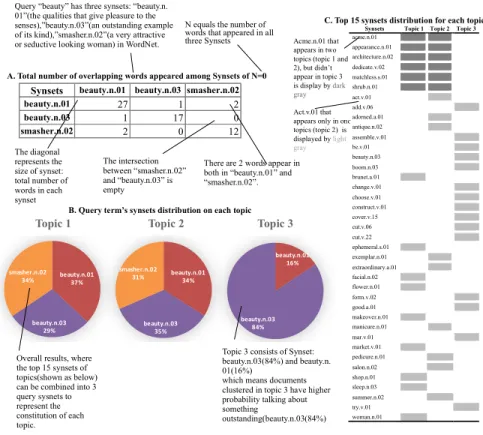
Fig 1. instruction of results
Explanation of the results display
To address the three research questions, I will display the result in three parts. Part A represents the structure of query’s Synsets in WordNet. Part B shows topics that are generated from LDA model. Each topic is composed of one or more Synsets associated with query term. Having parts A and B, the question of whether the Synset structure has influence on Topic distribution can be demonstrated. Part C presents the distribution of the top 15 Synsets that formed each Topic. The shade of color depicts the frequency of occurrence for each Synsets. Through this chart, we can explore characteristics that coherent topics have to address RQ3: What factors impact on the topic coherence generated by LDA model?
beauty.n.01 37%
beauty.n.03 29% smasher.n.02
34% beauty.n.0134%
beauty.n.03 35% smasher.n.02 31% beauty.n.01 16% beauty.n.03 84%
Topic 1 Topic 2 Topic 3
The diagonal represents the size of synset: total number of words in each synset
Query “beauty” has three synsets: “beauty.n. 01”(the qualities that give pleasure to the senses),”beauty.n.03”(an outstanding example of its kind),”smasher.n.02”(a very attractive or seductive looking woman) in WordNet.
There are 2 words appear in both in “beauty.n.01” and “smasher.n.02”. The intersection
between “smasher.n.02” and “beauty.n.03” is empty
Overall results, where the top 15 synsets of topics(shown as below) can be combined into 3 query sysnets to represent the constitution of each topic.
Topic 3 consists of Synset: beauty.n.03(84%) and beauty.n. 01(16%)
which means documents clustered in topic 3 have higher probability talking about something
outstanding(beauty.n.03(84%)
Acme.n.01 that appears in two topics (topic 1 and 2), but didn’t appear in topic 3 is display by dark gray
B. Query term’s synsets distribution on each topic A. Total number of overlapping words appeared among Synsets of N=0
N equals the number of words that appeared in all three Synsets
C. Top 15 synsets distribution for each topic
Act.v.01 that appears only in one topics (topic 2) is displayed by light gray
Synsets beauty.n.01 beauty.n.03 smasher.n.02
beauty.n.01 27 1 2
beauty.n.03 1 17 0
smasher.n.02 2 0 12
Synsets Topic 1 Topic 2 Topic 3
Evaluation criteria
In this study, accuracy will be calculated as evaluation criteria to measure the performance of clustering algorithm. Since I have already filtered topics by coherence as described above, only coherent topics will be considered in evaluation, because only coherent topics can provide us a single label from their major Synset’s definition in WordNet. Accuracy can measure the performance of LDA model in short text clustering to address RQ2: Does the introduction of synonymies represented by Synsets in WordNet help to improve the performance of LDA model in short text clustering? To measure the accuracy, I will generate the labels manually by human identification. This human identification will assign each document a topic number based on the meaning of query term in context. Then the topic number identified by human will be compared with the topic number generated by LDA model. If they are the same, the document is correctly clustered into the topic. Then, the results of accuracy equal to the number of documents that are correctly clustered into the topics over the total number of documents that are clustered into the topic
Comparison methods
solving RQ2 and RQ3.
3.9 Code
4.
Results and discussion
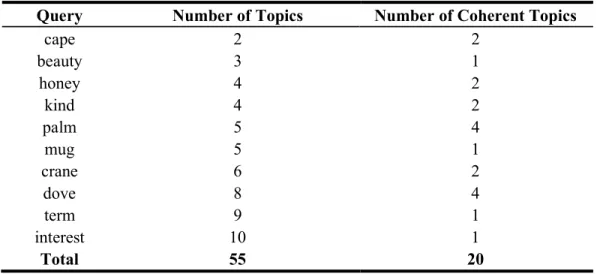
Table 4. Total number of topics and coherent topics
Query Number of Topics Number of Coherent Topics
cape 2 2
beauty 3 1
honey 4 2
kind 4 2
palm 5 4
mug 5 1
crane 6 2
dove 8 4
term 9 1
interest 10 1
Total 55 20
4.1 Coherent topics and the total number of topics
The results suggest that queries with fewer Synsets, which represent different meaning of the query term, tend to perform better in the proposed clustering algorithm.
4.2 Coherent topics and distribution of Synsets
In this study, a topic is formed by a group of Synsets. The distribution of Synsets over a topic may also have an influence on this topic's coherence. Figures 2-11 (C) display the top 15 Synsets for each topic. Each shaded cell marks that the Synset appeared in the topic. The darker shaded cells contribute to multiple topics. The average number of distinct Synsets (appear in only one topic) per topic is 9. 65% of coherent topics have a larger number of distinct Synsets than the average. This suggests that the more distinct Synsets a topic has, the more likely it is to be coherent.
As mentioned above the distribution of Synsets across topics is not the only factor that has an impact on topic coherence. The total number of Synsets associate with query term also influences coherence. When the total number of Synsets is less than 5, all coherent topics have more distinct Synsets than the average. However, when the total number of topics increases to 8, 55% of the coherent topics have less distinct Synsets than average. This phenomenon indicates that when the number of Synsets associated with query term is small, the distribution of Synsets has more influence on the topic coherence. On the other hand, when the number of Synsets associated with query increases, the distribution of Synsets will no longer be the strongest influence on clustering performance. The number of Synsets may have more influence on the coherence of topics.
of them are vague and overlap with each other. Synsets in 25% of the topics were more evenly distributed such as Synsets in Topics 1 and 2 (Figure 3b). The similarity in their proportions makes it difficult to determine which word sense a document refers to. For example, in Topics 1 and 2, Synsets smasher.n.02 (a very attractive or seductive looking woman), beauty.n.01 (the qualities that give pleasure to the senses), and beauty.n.03 (an outstanding example of its kind) are almost identical in size. This result speaks to the research question of this study. A search engine may not be able to provide documents that fulfill the precise user need based on the user’s query terms without any external support because the search engine cannot determine the correct word sense used in the document.
4.3 Query suggestion
4.4 Query’s Synsets in WordNet
Synsets in WordNet can be similar to with each other. In this study, the description of a Synset is a set of words appeared in WordNet. If two Synsets have a common word, this word is an overlapping word for these two Synsets. The similarity between the two Synsets is measured by overlapping words appeared in these two Synsets. The more overlapping words they have, the more similar they are. For example, Table 3 shows word “sound” appears both in Synset(‘birdcall.n.01’) and Synset(‘song.n.02’). “sound” is an overlapping word of these two Synsets. On the other hand, Synset(‘song.n.02’) has no overlapping words with Synset(‘song.n.03’). Therefore, Synset(‘song.n.02’) is more similar to Synset(‘birdcall.n.01’) than Synset(‘song.n.03’).
relation as shown in Figure 11.
4.5 Additional Observations
Query “beauty”: Query “beauty” only has 3 Synsets (Table 4). Figure 3 shows results generated by the LDA model for query "beauty”. Topic 3 is coherent. One of the possible reasons is all Synsets shown in Figure 3c for topic 3 are distinct. Result shows that 84% of the content of Topic 3 is about "beauty.n.03" (“an outstanding example of its kind”). Another possible reason for coherent Topic 3 is that the Synsets in Topic 3 have fewer overlapping words than average which means Synsets in Topic 3 are less similar than others Synsets. Figure 3a shows that “beauty.n.03” and “smasher.n.02” have no overlapping word, which means they are more likely to be distinguishable.
Query “palm”: Figure 6 shows results generated by the LDA model for query "palm”. The results of “palm” are unusual. In Figure 6a, only 50% of Synsets in Figure 6c are distinct. But Topics 2, 3, 4 and 5 are coherent. 51% of Topic 2, 66% of Topic 3, and 55% of Topic 4 are closely related to “palm.n.03” (“any plant of the family Palmae having an unbranched trunk crowned by large pinnate or palmate leaves”). After reviewing the raw data set, I found that one possible reason for this phenomenon is that the total number of documents related to Synset “palm.n.03” is much large than other Synsets. The meaning of word “palm” in 69.8% of documents is closely related to “palm.n.03”.
Synsets in Figure 8c are distinct.
4.6 Performance
Table 5. General performance comparison
Table 6. Performance of coherent topic and the number of documents in topics.
Datasets (query) Cape beauty honey Kind palm
Coherent Topic T1 T2 T3 T2 T4 T2 T3 T2 T3 T4 T5
Accuracy 88% 56% 78% 60% 13% 88% 92% 70% 88% 87% 75%
Proportion of Documents belong
to the Topic
97.7% 2.3
% 4.1%
3.3
% 3.7% 6.4% 8.4%
23.0 %
11.2 %
35.6
% 12.8%
Datasets (queries) cape beauty Honey Kind palm mug Crane dove Term interest
Accuracy 83% 78% 35% 92% 75% 96% 54% 23% 58% 52%
Baseline 32% 29% 20% 35% 30% 60% 21% 16% 25% 22%
Datasets (query) Mug Crane dove term interest
Coherent Topic T4 T3 T6 T3 T5 T6 T7 T5 T10
Accuracy 96% 50% 58% 63% 20% 40% 63% 58% 52%
Proportion of Documents belong to
the Topic
10.4% 3.2% 12% 11.8% 3.7% 4.1% 33.4% 5.3% 2.8%
5. Conclusion and future work
6. Bibliography
ACM.Anagnostopoulos, A., Becchetti, L., Castillo, C., & Gionis, A. (2010, February). An optimization framework for query recommendation. In Proceedings of the third ACM international conference on Web search and data mining (pp. 161-170). ACM. Baeza-Yates, R., Hurtado, C., & Mendoza, M. (2004, March). Query recommendation using query logs in search engines. In International Conference on Extending Database Technology (pp. 588-596). Springer, Berlin, Heidelberg.
Bai, J., Nie, J. Y., & Paradis, F. (2004, October). Using language models for text classification. In Proceedings of the Asia Information Retrieval Symposium, Beijing, China.
Beeferman, D., & Berger, A. (2000, August). Agglomerative clustering of a search engine query log. In Proceedings of the sixth ACM SIGKDD international conference on Knowledge discovery and data mining (pp. 407-416). ACM.
Belkin, N. J., Oddy, R. N., & Brooks, H. M. (1982). ASK for information retrieval: Part I. Background and theory. Journal of documentation, 38(2), 61-71.
Talking to the semantic web-a controlled english query interface for ontologies. In 14th Workshop on Information Technology and Systems (pp. 212-217).
Bernstein, Y., & Zobel, J. (2005, October). Redundant documents and search effectiveness. In Proceedings of the 14th ACM international conference on Information and knowledge management (pp. 736-743). ACM.
Blei, D. M., Ng, A. Y., & Jordan, M. I. (2003). Latent dirichlet allocation. Journal of machine Learning research, 3(Jan), 993-1022.
Boldi, P., Bonchi
, F., Castillo, C., Donato, D., & Vigna, S. (2009, February). Query suggestions using query-flow graphs. In Proceedings of the 2009 workshop on Web Search Click Data (pp. 56-63). ACM.
Boldi, P., Bonchi, F., Castillo, C., Donato, D., Gionis, A., & Vigna, S. (2008, October). The query-flow graph: model and applications. In Proceedings of the 17th ACM conference on Information and knowledge management (pp. 609-618). ACM.
Bordogna, G., Campi, A., Psaila, G., & Ronchi, S. (2012). Disambiguated query suggestions and personalized content-similarity and novelty ranking of clustered results to optimize web searches. Information Processing & Management, 48(3), 419-437. Broder, A. (2002, September). A taxonomy of web search. In ACM Sigir forum (Vol. 36, No. 2, pp. 3-10). ACM.
Burges, C. J. (2010). From ranknet to lambdarank to lambdamart: An overview. Learning, 11(23-581), 81.
In Proceedings of the 30th annual international ACM SIGIR conference on Research and development in information retrieval (pp. 239-246). ACM.
Cao, G., Nie, J. Y., & Bai, J. (2005, August). Integrating word relationships into language models. In Proceedings of the 28th annual international ACM SIGIR conference on Research and development in information retrieval (pp. 298-305). ACM. Cao, G., Nie, J. Y., Gao, J., & Robertson, S. (2008, July). Selecting good expansion terms for pseudo-relevance feedback. In Proceedings of the 31st annual international ACM SIGIR conference on Research and development in information retrieval (pp. 243-250). ACM.
Cao, H., Jiang, D., Pei, J., He, Q., Liao, Z., Chen, E., & Li, H. (2008, August). Context-aware query suggestion by mining click-through and session data. In Proceedings of the 14th ACM SIGKDD international conference on Knowledge discovery and data mining (pp. 875-883). ACM.
Carpineto, C., & Romano, G. (2012). A survey of automatic query expansion in information retrieval. ACM Computing Surveys (CSUR), 44(1), 1.
Chan, W. S., Leung, W. T., & Lee, D. L. (2004). Clustering search engine query log containing noisy clickthroughs. In Applications and the Internet, 2004. Proceedings. 2004 International Symposium on (pp. 305-308). IEEE.
Science, Computer Engineering and Applied Computing (WorldComp).
Chávez, E., Navarro, G., Baeza-Yates, R., & Marroquín, J. L. (2001). Searching in metric spaces. ACM computing surveys (CSUR), 33(3), 273-321.
Chen, H., & Karger, D. R. (2006, August). Less is more: probabilistic models for retrieving fewer relevant documents. In Proceedings of the 29th annual international ACM SIGIR conference on Research and development in information retrieval (pp. 429-436). ACM.
Christopher, D. M., Prabhakar, R., & Hinrich, S. (2008). Introduction to information retrieval. An Introduction To Information Retrieval, 151(177), 5.
Cucerzan, S., & Brill, E. (2005). Extracting semantically related queries by exploiting user session information. Technical report, Microsoft Research.
Cui, H., Wen, J. R., Nie, J. Y., & Ma, W. Y. (2002, May). Probabilistic query expansion using query logs. In Proceedings of the 11th international conference on World Wide Web (pp. 325-332). ACM.
D. Lahat, T. Adali, C. Jutten, Multimodal data fusion: an overview of methods, challenges, and prospects. Proc. IEEE 103 (9) (2015) 1449–1477.
El Ghali, B., & El Qadi, A. (2017). Context-aware query expansion method using Language Models and Latent Semantic Analyses. Knowledge and Information Systems, 50(3), 751-762.
Fitzpatrick, L., & Dent, M. (1997, July). Automatic feedback using past queries: social searching?. In ACM SIGIR Forum(Vol. 31, No. SI, pp. 306-313). ACM.
Fonseca, B. M., Golgher, P., Pôssas, B., Ribeiro-Neto, B., & Ziviani, N. (2005, October). Concept-based interactive query expansion. In Proceedings of the 14th ACM international conference on Information and knowledge management (pp. 696-703). ACM.
Friedman, J. H. (2001). Greedy function approximation: a gradient boosting machine. Annals of statistics, 1189-1232.
Gauch, S., Wang, J., & Rachakonda, S. M. (1999). A corpus analysis approach for automatic query expansion and its extension to multiple databases. ACM Transactions on Information Systems (TOIS), 17(3), 250-269.
Golbus, P. B., Aslam, J. A., & Clarke, C. L. (2013). Increasing evaluation sensitivity to diversity. Information Retrieval, 16(4), 530-555.
Guo, J., Zhu, X., Lan, Y., & Cheng, X. (2017). Modeling users’ search sessions for high utility query recommendation. Information Retrieval Journal, 20(1), 4-24.
Gupta, Y., Saini, A., & Saxena, A. K. (2013). A review on important aspects of information retrieval. International Journal of Computer, Information Science and Engineering, 7(12), 968-976.
He, Q., Jiang, D., Liao, Z., Hoi, S. C., Chang, K., Lim, E. P., & Li, H. (2009, March). Web query recommendation via sequential query prediction. In Data Engineering, 2009. ICDE'09. IEEE 25th International Conference on (pp. 1443-1454). IEEE.
neural networks. science, 313(5786), 504-507.
Hotho, A., Staab, S., & Stumme, G. (2003, November). Ontologies improve text document clustering. In Data Mining, 2003. ICDM 2003. Third IEEE International Conference on(pp. 541-544). IEEE.
Hu, X., Zhang, X., Lu, C., Park, E. K., & Zhou, X. (2009, June). Exploiting Wikipedia as external knowledge for document clustering. In Proceedings of the 15th ACM SIGKDD international conference on Knowledge discovery and data mining (pp. 389-396). ACM.
Huang, C. K., Chien, L. F., & Oyang, Y. J. (2003). Relevant term suggestion in interactive web search based on contextual information in query session logs. Journal of the American Society for Information Science and Technology, 54(7), 638-649. Huang, C. R., & Lee, L. H. (2008). Contrastive approach towards text source classification based on top-bag-of-word similarity. In Proceedings of the 22nd Pacific Asia Conference on Language, Information and Computation.
Huang, P., Huang, Y., Wang, W., & Wang, L. (2014, August). Deep embedding network for clustering. In Pattern Recognition (ICPR), 2014 22nd International Conference on(pp. 1532-1537). IEEE.
J. Li, S. Fong, R.K. Wong, V.W. Chu, Adaptive multi-objective swarm fusion for imbalanced data classification. Inf. Fusion 39 (2018) 1–24.
Jansen, B. J., Booth, D. L., & Spink, A. (2008). Determining the informational, navigational, and transactional intent of Web queries. Information Processing & Management, 44(3), 1251-1266.
Jansen, B. J., Spink, A., Bateman, J., & Saracevic, T. (1998, April). Real life information retrieval: A study of user queries on the web. In Acm sigir forum (Vol. 32, No. 1, pp. 5-17). ACM.
Jensen, E. C., Beitzel, S. M., Chowdhury, A., & Frieder, O. (2006, June). Query phrase suggestion from topically tagged session logs. In International Conference on Flexible Query Answering Systems (pp. 185-196). Springer, Berlin, Heidelberg.
Joachims, T., Granka, L., Pan, B., Hembrooke, H., & Gay, G. (2017, August). Accurately interpreting clickthrough data as implicit feedback. In ACM SIGIR Forum (Vol. 51, No. 1, pp. 4-11).
Jones, K. S. (Ed.). (1997). Readings in information retrieval. Morgan Kaufmann. Jones, R., Rey, B., Madani, O., & Greiner, W. (2006, May). Generating query substitutions. In Proceedings of the 15th international conference on World Wide Web (pp. 387-396). ACM.
Kazama, J. I., & Torisawa, K. (2007). Exploiting Wikipedia as external knowledge for named entity recognition. In Proceedings of the 2007 Joint Conference on Empirical Methods in Natural Language Processing and Computational Natural Language Learning (EMNLP-CoNLL).
Khudyak Kozorovitsky, A., & Kurland, O. (2011, July). Cluster-based fusion of retrieved lists. In Proceedings of the 34th international ACM SIGIR conference on Research and development in Information Retrieval (pp. 893-902).
Krovetz, R., & Croft, W. B. (1992). Lexical ambiguity and information retrieval. ACM Transactions on Information Systems (TOIS), 10(2), 115-141.
Lau, T., & Horvitz, E. (1999). Patterns of search: analyzing and modeling web query refinement. In UM99 User Modeling (pp. 119-128). Springer, Vienna.
Leung, K. W. T., Ng, W., & Lee, D. L. (2008). Personalized concept-based clustering of search engine queries. IEEE transactions on knowledge and data engineering, 20(11), 1505-1518.
Lin, S. M., & Huang, C. M. (2006). Personalized optimal search in local query expansion. In Proceedings of the 18th Conference on Computational Linguistics and Speech Processing (pp. 221-236).
Liu, T. Y. (2009). Learning to rank for information retrieval. Foundations and Trends® in Information Retrieval, 3(3), 225-331.
Lucchese, C., Nardini, F. M., Orlando, S., Perego, R., Tonellotto, N., & Venturini, R. (2015, August). Quickscorer: A fast algorithm to rank documents with additive ensembles of regression trees. In Proceedings of the 38th International ACM SIGIR Conference on Research and Development in Information Retrieval (pp. 73-82). ACM. Ma, H., Lyu, M. R., & King, I. (2010, July). Diversifying Query Suggestion Results. In AAAI (Vol. 10).
retrieval (Vol. 1, No. 1, p. 496). Cambridge: Cambridge university press.
Mei, Q., Zhou, D., & Church, K. (2008, October). Query suggestion using hitting time. In Proceedings of the 17th ACM conference on Information and knowledge management (pp. 469-478). ACM.
Meng, L. (2014). A survey on query suggestion. International Journal of Hybrid Information Technology, 7(6), 43-56.
Meng, L., Huang, R., & Gu, J. (2013). A new model for measuring similarity of web queries and its application in query expansion. Int J Grid Distrib Comput, 6(4), 51-62. Mikolov, T., Kombrink, S., Burget, L., Černocký, J., & Khudanpur, S. (2011, May). Extensions of recurrent neural network language model. In Acoustics, Speech and Signal Processing (ICASSP), 2011 IEEE International Conference on(pp. 5528-5531). IEEE.
Miller, G. A. (1995). WordNet: a lexical database for English. Communications of the ACM, 38(11), 39-41.
Ni, X., Quan, X., Lu, Z., Wenyin, L., & Hua, B. (2011). Short text clustering by finding core terms. Knowledge and information systems, 27(3), 345-365.
Onoda, T., Yumoto, T., & Sumiya, K. (2008, December). Extracting and Clustering Related Keywords based on History of Query Frequency. In Universal Communication, 2008. ISUC'08. Second International Symposium on (pp. 162-166). IEEE.
IEEE.
Peat, H. J., & Willett, P. (1991). The limitations of term co-occurrence data for query expansion in document retrieval systems. Journal of the american society for information science, 42(5), 378.
R. Kohavi, A study of cross-validation and bootstrap for accuracy estimation and model selection. Proceedings of the Fourteenth International Joint Conference on Artificial Intelligence (Volumn 2). Montreal, Canada, (1995), pp. 1137–1145.
Radlinski, F., & Joachims, T. (2005, August). Query chains: learning to rank from implicit feedback. In Proceedings of the eleventh ACM SIGKDD international conference on Knowledge discovery in data mining (pp. 239-248). ACM.
Rosario, B. (2000). Latent semantic indexing: An overview. Techn. rep. INFOSYS, 240, 1-16.
Saint Requier, A., Dupont, G., Adam, S., & Lecourtier, Y. (2010, March). Évaluation d'outils de reformulation interactive de requêtes. In Conférence en Recherche d'Information et Applications (pp. 223-238).
Saneifar, H., Bonniol, S., Poncelet, P., & Roche, M. (2014). Enhancing passage retrieval in log files by query expansion based on explicit and pseudo relevance feedback. Computers in Industry, 65(6), 937-951.
Siddiqui, T., & Aalam, P. (2015). Short Text Clustering; Challenges & Solutions: A Literature Review. International Journal Of Mathematics And Computer Research, 3(06), 1025-1031.
Semi-supervised recursive autoencoders for predicting sentiment distributions. In Proceedings of the conference on empirical methods in natural language processing (pp. 151-161). Association for Computational Linguistics.
Song, W., Liang, J. Z., Cao, X. L., & Park, S. C. (2014). An effective query recommendation approach using semantic strategies for intelligent information retrieval. Expert Systems with Applications, 41(2), 366-372.
Song, Y., & He, L. W. (2010, April). Optimal rare query suggestion with implicit user feedback. In Proceedings of the 19th international conference on World wide web (pp. 901-910). ACM. 1. Princeton University "About WordNet." WordNet. Princeton University. 2010. https://wordnet.princeton.edu
Steinbach, M., Karypis, G., & Kumar, V. (2000, August). A comparison of document clustering techniques. In KDD workshop on text mining (Vol. 400, No. 1, pp. 525-526). Turtle, H. R., & Croft, W. B. (1997). Uncertainty in information retrieval systems. In Uncertainty management in information systems (pp. 189-224). Springer, Boston, MA. Wen, J. R., Nie, J. Y., & Zhang, H. J. (2001, April). Clustering user queries of a search engine. In Proceedings of the 10th international conference on World Wide Web (pp. 162-168). acm.
Wu, Q., Burges, C. J., Svore, K. M., & Gao, J. (2010). Adapting boosting for information retrieval measures. Information Retrieval, 13(3), 254-270.
Yi, J., & Maghoul, F. (2009, April). Query clustering using click-through graph. In Proceedings of the 18th international conference on World wide web (pp. 1055-1056). ACM.
Yin, J., & Wang, J. (2014, August). A dirichlet multinomial mixture model-based approach for short text clustering. In Proceedings of the 20th ACM SIGKDD international conference on Knowledge discovery and data mining (pp. 233-242). ACM. Z. Lan, L. Bao, S. Yu, W. Liu, A.G. Hauptmann, Double fusion for multimedia event detection. Advances in Multimedia Modeling - 18th International Conference, MMM 2012, Klagenfurt, Austria, January 4-6, 2012, Proceedings, (2012), pp. 173–185. Zeng, Q. T., Crowell, J., Plovnick, R. M., Kim, E., Ngo, L., & Dibble, E. (2006). Assisting consumer health information retrieval with query recommendations. Journal of the American Medical Informatics Association, 13(1), 80-90.
Zhang, Z., & Nasraoui, O. (2006, May). Mining search engine query logs for query recommendation. In Proceedings of the 15th international conference on World Wide Web (pp. 1039-1040). ACM.
Appendix: Results
A. Total number of overlapping words appeared among Synsets of query N=0
Topic 1
Topic 2
B. Query term’s synsets distribution on each topic
C. Top 15 synsets distribution for each topic
Fig 2. Results of “cape” cape.n.01
62% cape.n.02
38%
cape.n.01 7%
cape.n.02 93%
Synset Topic1 Topic2
aloe.n.01 herb.n.01
afrikaner.n.01 ahead.r.02
annulus.n.02 belong_to.v.01 boom.v.01
cape.n.01 cape.n.02
cloak.n.02 desire.v.01
flower.n.01 grain.v.02
house.n.01 however.r.01
land.n.04 like.n.01
look.n.03 look.v.02 make.v.42
nantucket.n.01 old_world_buffalo.n.01 praia.n.01 runner.n.10 shop.n.01 spit.n.01 wilmington.n.01 wish.v.02
Synsets cape.n.01 cape.n.02
cape.n.01 15 0
A. Total number of overlapping words appeared among Synsets of query N=0
Topic 1
Topic 2
Topic 3
B. Query term’s synsets distribution on each topic
C. Top 15 synsets distribution for each topic
Fig 3. Results of “beauty”
Synsets Topic 1 Topic 2 Topic 3
acme.n.01 appearance.n.01 architecture.n.02 dedicate.v.02 matchless.s.01 shrub.n.01 act.v.01 add.v.06 adorned.a.01 antique.n.02 assemble.v.01 be.v.01 beauty.n.03 boom.n.03 brunet.a.01 change.v.01 choose.v.01 construct.v.01 cover.v.15 cut.v.06 cut.v.22 ephemeral.s.01 exemplar.n.01 extraordinary.a.01 facial.n.02 flower.n.01 form.v.02 good.a.01 makeover.n.01 manicure.n.01 mar.v.01 market.v.01 pedicure.n.01 salon.n.02 shop.n.01 sleep.n.03 summer.n.02 try.v.01 woman.n.01 beauty.n.01 37% beauty.n.03 29% smasher.n.02 34% beauty.n.01 34% beauty.n.03 35% smasher.n.02 31% beauty.n.01 16% beauty.n.03 84%
Synsets beauty.n.01 beauty.n.03 smasher.n.02
beauty.n.01 27 1 2
beauty.n.03 1 17 0
A. Total number of overlapping words appeared among Synsets of query N=0
Topic 1
Topic 2
Topic 3
B. Query term’s Synsets distribution on each topic
C. Top 15 synsets distribution for each topic
Fig 4. Results of “honey” beloved.n.01 24% honey.n.01 49% honey.s.01 12% honey.v.01 15% beloved.n.01 6% honey.n.01 6% honey.s.01 88% beloved.n.01 18% honey.n.01 45% honey.s.01 17% honey.v.01 20% Topic 4 beloved.n.01 87% honey.n.01 13%
Synsets Topic1 Topic1 Topic3 Topic4
sweetening.n.01 beloved.n.01 candy.n.01 cup.n.03 fructose.n.01 granola.n.01 hive.v.01 honey.n.01 honeybee.n.01 honeycomb.n.01 shrub.n.01 sweeten.v.01 baklava.n.01 beekeeper.n.01 beekeeping.n.01 beginning.n.02 bell_ringer.n.03 bird.n.02 birth.n.01 bowl.n.01 chemical.n.01 chicken.n.01 concern.n.04 design.n.01 direction.n.03 distressing.s.01 egg.n.02 fag_end.n.01 fish.n.02 game.n.07 herb.n.01 initiation.n.02 k.n.07 leg.n.05 locust_tree.n.01 long.r.01 lover.n.01 mead.n.03 offer.n.02 price.n.02 side.n.09 spice.n.02 steel.n.01 stove.n.01 test.n.05 well.r.02
Synsets beloved.n.01 honey.n.01 honey.s.01 honey.v.01
beloved.n.01 10 0 0 0
honey.n.01 0 8 0 0
honey.s.01 0 0 3 0
honey.v.01 0 1 0 5
A. Total number of overlapping words appeared among Synsets of query N=0
Topic 1
Topic 2
Topic 3
B. Query term’s Synsets distribution on each topic
C. Top 15 synsets distribution for each topic
Fig 5. Results of “kind”
Topic 4 piece.n.05 please.v.02 populate.v.01 produce.v.02 raise.v.07 raise.v.09 rather.r.02 reaction.n.07 sad.s.02 spectator.n.01 take.v.09 taste.n.05 touch.v.03 try.v.01 wedge.n.06 wish.v.02 kind.a.01 23% kind.n.01 33% kind.s.02 23% kind.s.03 21% kind.a.01 5% kind.n.01 85% kind.s.02 5% kind.s.03 5% Topic3 kind.n.01 93% kind.s.02 7%
Synsets kind.a.01 kind.n.01 kind.s.02 kind.s.03
kind.a.01 18 0 0 0
kind.n.01 0 33 0 0
kind.s.02 0 0 14 0
kind.s.03 0 0 0 8
kind.a.01 21% kind.n.01 45% kind.s.02 17% kind.s.03 17%
Synset Topic1 Topic2 Topic3 Topic4
A. Total number of overlapping words appeared among Synsets of query N=0
Topic 1
Topic 2
Topic 3 B. Query term’s Synsets distribution on each topic
C. Top 15 synsets distribution for each topic
Fig 6. Results of “palm” Topic 4 decoration.n.02 18% handle.v.04 47% palm.n.01 15% palm.n.02 13% palm.n.03 7% decoration.n.02 16% palm.n.01 9% palm.n.02 9% palm.n.03 66% decoration.n.02 16% handle.v.04 10% palm.n.01 14% palm.n.02 9% palm.n.03 51% decoration.n.02 14% handle.v.04 4% palm.n.01 18% palm.n.02 9% palm.n.03 55% decoration.n.02 10% handle.v.04 52% palm.n.01 38% Topic 5
Synset decoration.n.02 handle.v.04 palm.n.01 palm.n.02 palm.n.03
decoration.n.02 39 0 0 0 0
handle.v.04 0 12 0 0 0
palm.n.01 0 0 10 1 0
palm.n.02 0 0 1 9 0
palm.n.03 0 0 0 0 39
linden.n.02 manipulate.v.02 move.v.02 nut.n.01 palm.n.02 palmar.a.01 palmetto.n.01 palmistry.n.01 pass.v.05 release.v.08 right.a.01 right.n.05 sell.v.01 slip.v.07 travel.v.01 use.v.01 vegetable_oil.n.01
Synsets Topic1 Topic2 Topic3 Topic4 Topic5
A. Total number of overlapping words appeared among Synsets of query N=0
Topic 1
Topic 2
Topic 3
B. Query term’s Synsets distribution on each topic
C. Top 15 synsets distribution for each topic
Fig 7. Results of “mug”
Topic 4 chump.n.01 23% countenance.n.03 23% mug.n.01 16% mug.n.04 16% mug.v.01 22% chump.n.01 25% countenance.n.03 18% mug.n.01 14% mug.n.04 14% mug.v.01 29% chump.n.01 32% countenance.n.0 3 28% mug.n.01 5% mug.n.04 15% mug.v.01 20% chump.n.01 7% countenance.n.03 7% mug.n.01 6% mug.n.04 80% chump.n.01 23% countenance.n.0 3 22% mug.n.01 16% mug.n.04 20% mug.v.01 19% Topic 5
Synsets chump.n.01 countenance.n.03 mug.n.01 mug.n.04 mug.v.01
chump.n.01 18 0 0 0 0
countenance.n.03 0 14 0 0 0
mug.n.01 0 0 5 0 0
mug.n.04 0 0 0 12 0
mug.v.01 0 0 0 0 14
Synsets Topic1 Topic2 Topic3 Topic4 Topic5
A. Total number of overlapping words appeared among Synsets of query N=0
Topic 1
Topic 2
Topic 3
B. Query term’s Synsets distribution on each topic
C. Top 15 synsets distribution for each topic
Fig 8. Results of “Crane”
Topic 4 crane.n.01 6% crane.n.02 6% crane.n.04 31% crane.n.05 13% crane.v.01 34% grus.n.01 10% crane.n.04 16% crane.n.05 20% crane.v.01 59% grus.n.01 5% crane.n.01 12% crane.n.02 11% crane.n.04 23% crane.n.05 22% crane.v.01 20% grus.n.01 12% crane.n.01 12% crane.n.02 12% crane.n.04 26% crane.n.05 19% crane.v.01 20% grus.n.01 11% crane.n.01 12% crane.n.02 12% crane.n.04 23% crane.n.05 21% crane.v.01 20% grus.n.01 12% Topic 5 crane.n.04 7% crane.v.01 93% Topic 6
Synsets Topic1 Topic2 Topic3 Topic4 Topic5 Topic6
wrinkle.v.02 crane.v.01 stretch.v.02 crane crane.n.04 derrick.n.02 gantry.n.01 grus.n.01 grus.n.02 leatherjacket.n.03 transporter.n.02 wading_bird.n.01 crane.n.01 crane.n.02 crane.n.05 act.v.01 change.v.01 move.v.03 travel.v.01 be.v.01 be.v.03 better.v.03 bounce.v.01 change.v.02 change_state.v.01 construct.v.01 die.v.01 examine.v.02 film.v.02 manufacture.v.01 move.v.02 name.v.03 permit.v.01 produce.v.02 scat.v.01 search.v.01 take.v.27 try.v.01 use.v.01 witness.v.02
Synsets crane.n.01 crane.n.02 crane.n.04 crane.n.05 crane.v.01 grus.n.01
crane.n.01 5 2 0 0 0 0
crane.n.02 2 6 0 0 0 0
crane.n.04 0 0 18 0 0 0
crane.n.05 0 0 17 0 1
crane.v.01 0 0 0 0 12 0