Chana Kraus-Friedberg. A Bookstore in a Library (1935-1965): The Bull’s Head Book Shop and the History of Recreational Reading in US Academic Libraries. A Master’s Paper for the M.S. in L.S degree. April, 2017, 41 pages. Advisor: Helen Tibbo
Since academic libraries began to open their doors to students in the late 19th to early 20th century, librarians have engaged in nearly continuous discussion of the college student’s need for leisure reading materials, the broad benefits of reading such material, and the declining rate of American literacy. Given that budget is one of the most
frequently cited obstacles to providing browsing collections or leisure reading materials in academic libraries today, understanding strategies used by librarians in tight times in the past may be informative for present-day academic librarians. This thesis addresses whether/to what extent the incorporation of the campus trade book store, the Bull’s Head, into the university library at the University of North Carolina-Chapel Hill in 1935, at the height of the Great Depression, was one such strategy.
Headings:
Reading as recreation
Universities and colleges
College students — books & reading
A BOOKSTORE IN A LIBRARY (1935-1965): THE BULL’S HEAD BOOK SHOP AND THE HISTORY OF RECREATIONAL READING IN US ACADEMIC
LIBRARIES
by
Chana Kraus-Friedberg
A Master’s paper submitted to the faculty of the School of Information and Library Science of the University of North Carolina at Chapel Hill
in partial fulfillment of the requirements for the degree of Master of Science in
Library Science.
Chapel Hill, North Carolina
April 2017
Approved by
_______________________________________
Contents
INTRODUCTION ... 2
LITERATURE REVIEW ... 5
History of Academic Libraries and Leisure Reading Material on American College Campuses ... 5
The Bull’s Head Book Shop, 1935-1965: A Bookstore in a Library ... 10
METHODS ... 13
Content Analysis ... 13
FINDINGS ... 15
Documents on the Bull’s Head Book Shop ... 15
Qualitative Content Analysis ... 17
Theme: Recreational Reading ... 17
Theme: Students’ Personal Libraries ... 19
Theme: Readers’ Advisory at the Bull’s Head ... 22
Theme: New Books at the Bull’s Head... 24
DISCUSSION ... 27
CONCLUSION ... 34
INTRODUCTION
The question of whether providing for students’ leisure reading, here defined
extracurricular reading (Watson, 2014, pp. 20-31) or reading for pleasure rather than for
information (Dewan, 2010, pp. 44-46), falls under the purview of academic libraries is
one that librarians seem to perpetually rediscover. Since academic libraries began to open
their doors to students in the late 19th to early 20th century (Hamlin, 1981; P. Valentine,
2012, pp. 79-112), librarians have engaged in nearly continuous discussion (Chapin,
1951; Hoole, 1938; Peterson, 2006) of the college student’s need for leisure reading
materials, the broad benefits of reading such material, and the declining rate of American
literacy (Salter & Brook, 2007), always seen as “chronically catastrophic” (Gilbert &
Fister, 2011, p. 474). If current literature in academic librarianship portrays students’
leisure reading as a non-traditional concern (Peterson, 2006), it may be because librarians
are often limited in their ability to provide such materials (Guy R. Lyle, 1944; Sanders,
2009, pp. 174-183) by their budgets. Given that budget is one of the most frequently cited
obstacles to providing browsing collections or leisure reading materials in academic
libraries today (Elliott, 2009, pp. 340-346; Gilbert & Fister, 2011, pp. 474-495),
understanding strategies used by librarians in tight times in the past may be informative
for present-day academic librarians.
Although a fair amount of scholarship exists on the survival and funding of public
libraries during the Great Depression (Kramp, 2010; Novotny, 2011; Seavey, 2003), little
interested in the history of academic libraries seem to view the Depression era primarily
as a dead zone between periods of abundant funding in the 1920s and 40s. Precisely
because of the lack of funding, however, Depression era academic librarians sometimes
used innovative strategies to help them provide for their patrons' needs. This study will
use archival materials to explore an unusual project on the campus of the University of
North Carolina-Chapel Hill during the 1930s---the consolidation of the Bull’s Head Book
Shop with the main campus library---to assess whether campus administrators and Bull’s
Head employees saw it as such a strategy.
Founded in 1925 in the office of UNC English professor Howard M. Jones
(Beach, 1928) , the Bull's Head was initially very much a product of its time. The
question of leisure and “quality” reading for college students was on the minds of many
faculty and librarians across the country in the 1920s (Hamlin, 1981). To address it, some
colleges created browsing rooms. Howard Jones created a browsing-friendly bookstore.
In 1935, the UNC library took over management of the Bull's Head, and in 1941 it
was combined with the library's browsing room. To better understand the situation of the
Bull’s Head in the library, and thereby to address gaps in the library literature
surrounding the history of academic libraries and leisure reading, this study seeks to
answer the following questions:
1. What rationale did involved parties discuss or give for bringing the Bull's Head
Bookshop under the umbrella of the library? To what degree did this decision refer to
contemporary thought about the leisure reading needs of college students?
2. To what degree was it true that the Bull's Head offered access to reading materials that
3. When and why was the relationship between the bookstore and the library severed? What
was the connection (if any) between this decision and the availability of leisure reading
LITERATURE REVIEW
History of Academic Libraries and Leisure Reading Material on American
College Campuses
Early academic libraries on American college campuses had little in common
with the user-centered entities we know today. Beginning with Harvard’s library (first
catalog published in 1723), the earliest academic library collections were composed of
benefactor’s donations, and were not necessarily aligned with students’ interests or
curricular needs. Due to the religious focus of early American colleges, most academic
library collections prior to the mid-19th century tended to be heavily theological, and
even in cases where literature was available (Kraus, 1973), the effort involved in
accessing it was prohibitive. There were few or no regular library hours, and even when
students were allowed into the libraries, they were not always allowed to remove or
borrow the books (Harding, 1959). The libraries also tended to be physically uninviting,
with few places to sit and poor heating. One could say that, at this point in their history,
academic libraries fulfilled neither leisure nor academic reading needs on campus.
To compensate for the lack of recreational activities on campus, 18th and early 19th
century American college students formed literary societies (Harding, 1959). The
societies supported skills that were seen as essential for wealthy, educated men of the
time, including debating and writing/presenting erudite essays. Because these activities
necessitated access to current scientific, philosophical, and literary works, literary
the official college libraries, literary society libraries had set open hours, officially
appointed and compensated librarians (elected from among society members), set lending
periods, and comfortable seating. Society members’ dues were used to fund acquisitions,
which were chosen by members and the appointed librarians, and in some cases
non-members were allowed access to the collections for a fee.
Towards the end of the 19th century, college campuses began to develop an interest
in expanding the services offered by academic libraries. This new interest was partly a
result of a change in American college curricula, which shifted from the traditional
classical emphasis to one more in tune with the professional training needed to work in
an increasingly industrialized society (Hamlin, 1981). The 1862 Morrill Act, which
established land-grant colleges to teach “agriculture and the mechanical arts” (cited in
Hamlin, 1981, 46), also broadened college curricula in ways that required academic
resources beyond the textbooks students had traditionally used. Concurrently, American
colleges adopted the German university system, which included research as one of the
major functions of the academy. This meant that faculty as well as students required
expanded library collections and easier access to them, especially in cases where the
college aspired to become a full-fledged university. These changes led to the
development of the academic research libraries we know today, housed in their own
buildings, staffed by professional librarians, and funded by college administrations.
Faculty remained heavily involved in book selection, but librarians and cataloguers
purchased books and maintained the collections. As part of this move, many colleges
society libraries. At the University of North Carolina-Chapel Hill, for example, the
academic library merged with the libraries of two literary societies (the Dialectic and
Philanthropic Societies) in the 1880s (Harding, 1959), although the societies maintained
ownership of the collections and continued to contribute financially to acquisitions. With
these mergers, the leisure reading needs of students essentially drifted into the purview of
academic libraries, albeit perhaps only because they incorporated collections that had
been created to serve such needs. At the same time, the idea that academic libraries
existed to serve curricular and research needs gained currency.
By the early 1920s, the size of academic libraries and the student populations they
served had increased substantially. Contrary to commonly expressed views in recent
library literature (Peterson, 2006), many academic librarians in this time period do seem
to have assumed that providing for extra-curricular or leisure reading was one of their
duties. It was during the 1920s that “browsing rooms,” which contained comfortable
seating and leisure reading materials, were created in academic libraries (Hamlin, 1981,
p. 64; Guy R. Lyle, 1935, p. 240). The development of these rooms was also consistent
with the growing concern that increased specialization in college curricula failed to
provide students with a broadly shared set of cultural knowledge, the way the classical
curriculum had ("The Disciplines, Interdisciplinarity, and the University," 2009, pp.
31-42). At the same time, many colleges developed dormitory libraries, which were
explicitly devoted to students’ leisure activities (Johnson, 1935; Morgan, 1931;
Oltmanns, 1985).
The Depression in the 1930s placed significant limits on library budgets, and this in
their acquisitions. While these may have been acceptable avenues for acquiring rare and
some reference materials, they did not enable librarians to purchase the current leisure
reading materials that the browsing rooms had provided in the 1920s (McGrath &
Jacobson, 2011). It is possible that this period resulted in a sharper distinction between
materials that were “necessary” (i.e., curricular or needed by researchers) and materials
that were not (i.e., leisure materials).
The 1940s and 50s saw a huge expansion in the number of students attending colleges
and universities, partly due to the GI Bill offered to many veterans of World War II
(Churchwell, 2007, pp. 104-105; Hamlin, 1981). Federal funding was also offered to
academic libraries for the first time for the purchase of specific kinds of materials,
including publications on science, technology, and in specific foreign languages. The
increase in the number and kinds of books libraries were expected to acquire meant that
this duty became the job of librarians, rather than faculty members as had previously
been the case (Hamlin, 1981). At the same time, recreational reading had become a more
popular activity for a wider swathe of Americans. For many US soldiers, specially
produced Armed Services Edition paperbacks alleviated wartime boredom (Loss, 2003),
and even Allied POWs in Germany received book shipments (Shavit, 1999). The idea
that paperbacks could be anything other than dime novels or low culture pulp was new in
the 1940s and 50s (Hamlin, 1958) , and the Armed Services Editions helped spread their
popularity as widely affordable and acceptable purchases. Many GIs would have arrived
on campus after the war accustomed to reading for pleasure.
An exponential increase in research publications (particularly in science and
libraries in the post-WWII period were chronically short of shelf-space, and this may
have led some universities to shift leisure reading material to university funded dorm
libraries (Marsh & Marsh, 1959; Oltmanns, 1985). However, Peterson’s (2006) analysis
of professional literature in library science between 1945 and 1975 shows that most
opinion pieces in major professional journals saw providing leisure reading to students as
an important function of the academic library. During the 1950s, writers and librarians
also continued to bemoan the decline in reading as a pastime among Americans more
generally, and specifically among college students (ibid. 31). While the accuracy of this
perception is not entirely clear, it did serve as a continuing justification for funding
leisure-reading collections on college campuses, whether in dorms or academic library
buildings.
Since the 1950s, the information landscape in which academic libraries operate has
changed in ways almost too numerous to count. Arguably, some of the most significant
changes have involved the increasing availability of information on the internet, the
serials crisis (McGuigan 2004, 13-26), and the “digitization of everything” (Michalak,
2012), as well as the decreasing support for public investment (Buschman, 2007) and
increasing commodification of knowledge (Lawson, Sanders, & Smith, 2015) that have
come with neoliberalization. Interestingly, despite all the changes, discussions about
students' reading habits remain “chronically catastrophic” (Gilbert & Fister, 2011, p.
474);. Academic librarians in the 2000’s continue to have virtually identical discussions
about Americans’ declining reading habits (Dewan, 2013; Elliott, 2009) and the value of
leisure reading collections in academic libraries (Dewan, 2010, 2013; Fullerton, 2015) to
solution to this problem (and continue to see it as) involving encouraging patrons and
students in recreational reading, it seems important for present day librarians to look back
and understand how their colleagues have provided this reading from within limited
budgets in the past.
The Bull’s Head Book Shop, 1935-1965: A Bookstore in a Library
Founded in 1925 in the office of UNC English professor Howard M. Jones, the Bull's
Head was initially very much a product of its time. The question of leisure and “quality”
reading for college students was on the minds of many faculty and librarians across the
country in the 1920s. To address it, some colleges created browsing rooms. Howard
Jones created a browsing-friendly bookstore (Beach, 1928; Littleton, 1958). In doing so,
he set out partly to prove that students were interested in reading and would respond to
quality books if they were made available in a congenial setting (he complained that
traditional college bookstores were unwilling to stock general fiction because they
believed it would not be bought) (Jones, 1928). However, Jones also had concerns that
extended beyond campus; he was disturbed by the lack of “book consciousness” in the
South, and the lack of publisher interest in marketing books to Southerners. Southerners,
like students, he argued, would become interested in leisure reading if book publishers
made specific efforts to provide it and make it seem pertinent to them. The Bull's Head
constituted a kind of pilot study of book buying on a Southern campus, and Jones hoped
it was one that would spread to other campuses and towns. To this end, Jones sought not
only to sell books but to involve students in choosing and reading them. His bookstore
was named after the “bull sessions” that he had with students there about books they read
students be allowed to read and browse within the bookstore, rather than being pressured
to buy (Beach, 1928; Yoder).
In 1932, the Bull's Head moved to the building of the University Library, and in 1935
it was incorporated into the campus library division (McGrath & Jacobson, 2011, p. 308).
There it followed the path of, and shared office space with, the Extension Library, a
public-like library originally run through the North Carolina Agricultural Extension,
which served women’s and book clubs around the state. (The Extension Library had also
been integrated into the library by the University Librarian, R.B. Downs, to avoid closing
when the budget of its original parent department, the University Extension Division, was
slashed in 1933 (McGrath & Jacobson, 2011, p. 308)).
Unlike the Extension Library, however, the Bull’s Head was not directly financed by
the university. While the library provided space, utilities, and some help with furnishings
free of charge, the bookstore was otherwise required to be self-sustaining financially. The
university did not pay the bookstore employees and they were entirely dependent on store
receipts for their income. At the same time, the Bull’s Head budget was tracked and the
acquisitions and business departments of the university ordered its books. The bookstore
was subject to the North Carolina Umstead Act, which prevented state-funded entities
from competing with private businesses in town. The salary of the store manager
(provided store receipts were sufficient) was dictated by the university, and the library
director was always the store manager’s “boss,” although he (the library director was
always male during the Bull’s Head’s time in the library) did not pay her (the store
This arrangement often put store managers in the uncomfortable position of having to
ensure sufficient store income for their paychecks while having little control over store
budget or resources. For example, in reports submitted to the library director during
1954-55, the store manager, Jessica Valentine, repeatedly requested access to a monthly
accounting of the store’s finances. It is not clear from the documents whether she ever got
it. At the same time, the library administration appears to have had mixed feelings about
the Bull’s Head, its presence in the library, and the way it was run. Store documents show
library directors complaining steadily about how books were arranged, how many were
being stocked, and, in one instance, whether UNC Press books were being given
sufficient prominence. They also seemed generally reluctant to respond to continual store
manager requests for things like desks or display space in the library exhibition cabinets.
Despite this tension (and multiple requests from the store manager that the bookstore
either become an independent non-profit or a real department in the university), the
Bull’s Head remained a part of the library until at least 1960 and possibly until 1965.
Why did this, by all accounts, relatively discordant relationship last for as long as it
did, and what reason was given for arranging it to begin with? McGrath and Jacobson
(2011) indicate that integrating the Bull’s Head into the library (at least partly) had
advantages for the library, partly because the bookstore could provide the recreational
material the library did not collect. However, there is no indication in the secondary
literature of the reasoning given for this decision at the time it was made, the degree to
which the Bull's Head really did offer materials that the library could not, or the reason
METHODS
Content Analysis
Although some kinds of content analysis have existed in some form since censorship
methods in the Spanish Inquisition (Wakefield, 2010), it became more popular as a social
scientific method in the 1950s as a way to study the propaganda potential of mass media
(Weber, 1990). Because content analysis is particularly concerned with messages and
how they pass from sender to receiver, it is an appropriate method for this study, which
aims in part to track how a particular decision (the combination of the Bull’s Head with
the library) was justified within the university.
Content analysis enables researchers to systematically categorize the language used in
media into clusters in order to identify patterns or relationships between them (Julien,
2008). This can be done quantitatively by using statistical analyses of language patterns,
such as term frequencies, or qualitatively by attending to the distribution and presence of
selected themes and the relationships between them in selected media collections (Pfeil,
2003, p. 1). The current study used qualitative content analysis of archival materials
contained in the University Archives of UNC-Chapel Hill. The coding of these
documents was performed using a directed approach (Hsieh & Shannon, 2005), where a
starting set of categories was defined prior to the start of coding, and other categories
were added to the scheme as they emerge. Descriptive codes (Saldana, 2014) were also
senders. The initial unit of analysis was the theme of leisure reading in academic
libraries.
In qualitative content analysis, the sample can be selected based on the relevance of
materials to the topic at hand (Zhang & Wildemuth, 2009), and this is the strategy that
was used in this case. There is no way to ensure that a random sample of archival
materials is representative of the full population of original documents pertaining to the
topic, since the materials have already been subject to the non-random processes
associated with selection for preservation. Choosing a sample based on the relevance of
FINDINGS
Documents on the Bull’s Head Book Shop
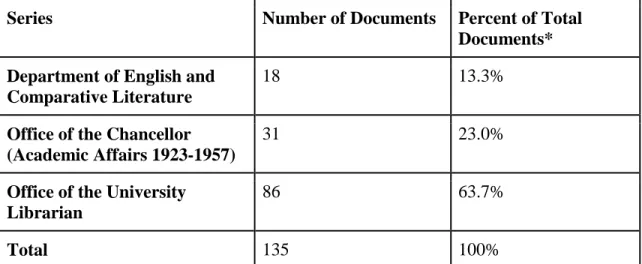
The author located 135 documents associated with the Bull’s Head Book Shop at
the University of North Carolina-Chapel Hill University Archives. The documents were
located in archival series pertaining to the Department of English and Comparative
Literature, the Office of the Chancellor, and the Office of the University Librarian (Table
1) in the University Archives at the University of North Carolina at Chapel Hill. It is not
surprising that most of the documents came from records of the Office of the University
Librarian, since the library was located in the Bull’s Head Book Shop for most of the
period under study. Records from the Chancellor’s office and the Department of English
and Comparative Literature are the earliest of the ones studied, and they pertain mostly to
the need to move the Bull’s Head from its founding home in the English Department and
its later relocation to the library.
Series Number of Documents Percent of Total
Documents* Department of English and
Comparative Literature
18 13.3%
Office of the Chancellor (Academic Affairs 1923-1957)
31 23.0%
Office of the University Librarian
86 63.7%
Total 135 100%
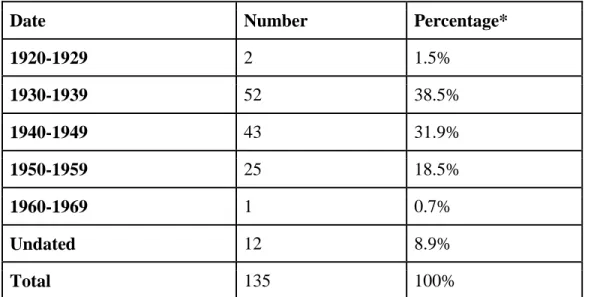
As per Table 2, most of the documents the author found on the Bull’s Head Book
Shop were written during the 1930s, ‘40s, and ‘50s. This was the period during which the
bookstore was most closely allied with the library--prior to this period, it was the private
project of English professor, Howard Mumford Jones, and after this period it was
disarticulated from the library structure and moved to the Book Exchange (now known as
Student Stores).
Date Number Percentage*
1920-1929 2 1.5%
1930-1939 52 38.5%
1940-1949 43 31.9%
1950-1959 25 18.5%
1960-1969 1 0.7%
Undated 12 8.9%
Total 135 100%
Table 2: Decade Distribution of Documents on the Bull’s Head Book Shop(*Rounded to the nearest 0.1%)
The majority of documents on the Bull’s Head were written by literary authors (20
documents), Bull’s Head staff (25 documents), faculty (21 documents), library
administrators (15), and university administrators (15 documents), respectively. This
makes sense, given that most of these groups were probably required to deposit records at
the University Archives. Authors, of course, were not required to do this, but recipients
may have kept their letters because of the writers’ prestige (the letters were
predominantly exchanged in the course of arranging for book talks or readings at the
bookstore). On campus, Bull’s Head staff, faculty members, and library or university
bookstore’s operations, so it stands to reason that they would have often corresponded on
the topic. The same groups are well represented as recipients in the Bull’s Head
documents, with the exception of authors (who likely kept letters they received in their
own archives, if they kept them at all). University staff are slightly better represented as
recipients (12 documents) than as writers (8 documents), but a difference of four
documents is too small to be indicative of any particular significance.
Qualitative Content Analysis
Theme: Recreational Reading
This theme appears in 13 of the Bull’s Head documents reviewed by the author for
this study. This is a small number of documents relative to the total number of Bull’s
Head documents in the archives, but they appear to have been written at significant times
in the Bull’s Head’s history. Five are dated to 1934-35, as the question of the Bull’s
Head’s continued existence was being confronted (a question that was ultimately
resolved by moving the Bull’s Head to the library in October 1935). Five of the
documents were written during the 1950s, when the Bull’s Head’s position in the library
appears to have become more precarious due to conflicts between the University
Librarian and the bookstore manager. Of the remaining three documents that mention
recreational reading, 2 are undated, and one was written in 1946.
It is notable that documents containing mentions of recreational reading were
primarily written by bookstore and Extension Library staff (8 documents), with a
minority of documents coming from library administrators (1), library school students
(1), faculty (2), and university administrators (1). This pattern would seem to indicate that
for the bookstore or argue for its importance, and the contents of the documents tend to
bear this out. Most documents written by bookstore staff that mention recreational
reading were annual, semi-annual, or quarterly reports submitted by the bookstore
manager to the University Librarian. These reports contain accounts of the
accomplishments and activities of the bookstore during the period covered, and many of
these involved recreational reading. For example, in 1955 (J. Valentine, September
1955), Jessica Valentine reports creating displays of books on cats and books for
children. In other reports, the importance of recreational reading is used more explicitly
as a rationale for requesting more resources for the bookstore. In a December 1956
report, Valentine describes an increase in undergraduates looking for books to read, and
writes that “[s]o much more could be done for these promising individuals, at profit to the
Bull’s Head as well as the students, if the manager had more time for them” (J. Valentine,
December 1956). She then goes on to repeat a frequent request for clerical help in the
store (which, however, does not seem to have materialized). In one particularly
interesting memo, sent by Extension Library employees Nelly Robeson, Cornelia Love,
and Agatha Adams to University Librarian Charles Rush (Roberson, December 11,
1946), the writers use the idea of recreational reading to defend Valentine from Rush’s
contention that the bookstore is not stocking enough books during the Christmas rush.
After explaining logistically why the bookstore in fact cannot stock more books, the
writers state that “[u]nder Mrs. Valentine's leadership, the Bookshop is singularly
successful in carrying out its original purpose, to anticipate and provide for the needs of
not only as a defense but also as a subtle accusation of Rush, who the writers feel is
prioritizing commercial success over the educational and cultural good of the students.
Faculty and university administrators also refer to the importance of recreational
reading, particularly during the 1930s, when the faculty board of the Bull’s Head and
Chancellor R. B. House were trying to decide how and whether to maintain it. This
quandary leads to an effort to define the bookstore’s ongoing purpose. When Professor
Jones founded it, there was no bookstore for extra-curricular books in Chapel Hill. By
1935, the Intimate Bookshop had been founded, and faculty were not entirely clear on
whether the Bull’s Head is still needed (House, April 22, 1935). They were reluctant,
however, to let it close. In its defense, they mobilized not only the idea of recreational
reading, but the idea that this reading was particularly important as a university activity
and one of the on-campus recreational offerings (Coffman, October 26, 1934).
In an exchange especially relevant to this study, documents from the 1930s that
mention recreational reading include correspondence between a group of library science
students requesting a browsing room and R.B. Downs, the University Librarian, telling
them that he had no funds for such a room. This exchange will be discussed further in the
discussion section.
Theme: Students’ Personal Libraries
This theme was mentioned explicitly in eight of the Bull’s Head documents, which
were split evenly between the records of the Office of the Chancellor and the records of
the Office of the University. (Howard Mumford Jones, who was the main source of
Bull’s Head records from and to the Department of English and Comparative Literature,
he did not mention it in any of the documents filed as pertaining to the Bull’s Head).
Documents that mention students’ personal libraries were primarily professional ones;
only one was a letter, while three were memos and four were reports. Four of the
documents were written in the 1930s, as the survival of the bookstore was being
discussed, while 3 documents are from the 1950s and one is undated.
As with the theme of recreational reading, a good portion of the documents that
mention students’ personal libraries or book purchasing habits were written by the
bookstore manager in her reports to the University Librarian or in memos to faculty. In
most cases, recreational reading and book purchases are mentioned together, although
sometimes a distinction is made between them. For example, in her November 1951
memo to faculty, Jessica Valentine differentiates between the kinds of books that
graduate and undergraduate students will need to buy (graduate students need help
acquiring hard-to-find books and building personal libraries, undergraduates need books
that parallel their in-class reading) but ends off by reminding professors that “[a]ll readers
welcome our recreational offerings” (J. Valentine, November 3, 1951)
Faculty and at least one university administrator (Chancellor R. B. House) seem to
have attributed great importance to students’ book buying activities and to have seen the
bookstore as one way to influence what one might think of as their students’ collection
management skills. In one document, for example, House initiated the advent of a
smaller Bull’s Head faculty board (which meant relieving faculty board members from
their positions on the board), while expressing the hope that decommissioned board
members would still be available to help students choose “distinctive books” to buy
department and the Bull’s Head board, addressed the faculty at large, enjoining them to
talk to the bookstore manager and recommend new books for her to order to supplement
classroom reading. In this letter, Coffman reminded his fellow faculty members that “one
of the best ways to assist the student to train himself [sic] and to broaden his mind is for
him to acquire a library of his own, to which he is constantly making additions”
(Coffman, October 19, 1934).
The theme of students’ book collecting persists in the 1950s. For example, In a
quarterly report in 1956, Valentine mentioned a “real trend on the part of the
undergraduates to drop in on the B.H. [sic] for advice on extra-curricular reading and to
start building personal libraries” (J. Valentine, October 1, 1956). This focus on curating a
collection of books for posterity seems to have been changing by the time this last
document was written, possibly due to the advent of paperbacks, which were not as
physically durable as hardcover books. In a 1957 report, Valentine expressed a wish that
students would use the Bull’s Heads book rental service more, rather than buying
paperbacks which they could “mark up” (J. Valentine, April 1, 1957). The same report,
however, refers to a continuing special order project designed to “encourag[e] collectors
of NC items old and new,” and to selling autographed copies of books by Robert Frost
and Edith Sitwell. This progression may indicate that, with the advent of cheap
paperbacks, book collecting was becoming a more specialized activity on the campus, not
Theme: Readers’ Advisory at the Bull’s Head
Ten documents in the collection examined mention this theme. Most of these (8
documents) were found in the records of the Office of the University Librarian, while the
Office of the Chancellor records and records from the Department of English and
Comparative Literature contained one each. The bulk of these documents (6) date to the
1950s, with one document each dating to the 1920s, 1930s, 1940s, and 1960s,
respectively. The fact that so many documents that mention readers’ advisory date to the
1950s is probably related to the fact that such activities were often mentioned in official
bookstore reports to the University Librarian. It is thus not surprising that most of the
writers who mention this topic were Bull’s Head employees (6 documents). Other writers
who mention this topic include faculty members (2 documents, one written by Howard
Mumford Jones), Extension Library employees (1 document), and library administrators
(1 document).
The documents that mention readers’ advisory discuss it in two ways: firstly, official
reports detail particular advisory projects or activities undertaken. These were substantial,
since the bookstore not only created booklists and book displays for students (J.
Valentine, April 1, 1956) but also sent booklists and recommendations to women’s clubs
and customers around the state (J. Valentine, July 1, 1956). The manager also gave talks
in the bookstore and to local clubs on newly published literature, and in the 1950s
participated in a TV series on UNC-TV that recommended or highlighted books for the
public (J. Valentine, December 31, 1955).
The manager also made a point of helping students to choose books when they were
administration in 1960, came from towns that did not have bookstores. Some might never
have even been inside one before (Hogan, January 27, 1960). Both Helen Hogan and
Jessica Valentine mention enjoying this aspect of their positions (Hogan, January 27,
1960; J. Valentine, January 1, 1957), although it also may have contributed to Valentine’s
continuing request to be re-classed as a professional university employee. Valentine
actually had a degree in library science, and she may also have been aware that she was
doing the work of a librarian for a much smaller and less secure salary than those of the
university’s librarians. Reports also indicate that she put in a good deal of overtime (J.
Valentine, December 31, 1955), which official librarians probably did not.
The second way that readers’ advisory is discussed in the documents involves the
capacity or (more often) incapacity of student workers to provide it. Aside from the
manager, the bookstore was mainly staffed by student workers after moving to the library
(Littleton, 1958), although Extension Library employees seem to have been involved in
some bookstore activities (Roberson, December 11, 1946). The difficulty of finding
student workers who had some “book knowledge” is therefore a continuing topic
throughout the Bull’s Head documents. In 1928, Howard Mumford Jones requests the
store’s first student worker but specifies that it must be a graduate student, because he
needs someone “bookishly minded and responsible” (Jones, May 1, 1928). During the
Bull’s Head’s tenure in the library, student workers were often evaluated in reports in
terms of their ability to provide readers’ advisory. For example, in 1956, Valentine
describes her two student employees as learning to help “floundering” student shoppers
Theme: New Books at the Bull’s Head
Eleven documents in the Bull’s Head records refer to the store stocking new or
current books. Of these, the majority (10) were found with the records from the Office of
the University Librarian, while only one was found with the records of the Office of the
Chancellor. Accordingly, most of the documents date to the time when the Bull’s Head
was combined with the library. One document dates to the 1930s, while 8 date to the
1950s (two documents are undated). As with the theme of readers’ advisory, most
mentions of the type of books the Bull’s Head stocked were in official bookstore reports
and written by Bull’s Head staff (8 documents) to library administrators (8
documents).The remaining documents included one report on a meeting written by
faculty to a university administrator, and two memos or letters written by library
administrators (1 document) and unidentified individuals (1 document) to unidentified
individuals (1 document) and a librarian from another university (1 document).
In mentions of the Bull’s Head stocking new books, it is not always entirely clear
whether the writers mean books that are physically new (possibly including new editions
of older books) or books that are newly published. For example, the first document to
mention this theme, in the 1930s, comes from the time when faculty were discussing the
Bull’s Head’s future with the Book Exchange and indicated, as a financial selling point,
that it has a “good supply of saleable, up-to-date books” (Board, May 20, 1935). A
similarly ambiguous mention comes from an undated annual report from Jessica
Valentine, who writes that “[o]ne of [the Bull’s Head’s] most important functions is
providing to students and faculty an opportunity to browse among the new books” (J.
example, official bookstore reports to library administrators mention setting up book
displays based on publishers’ lists for new books or new local authors, sending publisher
“stuffers” (ads for seasonal booklists) with book club orders, and giving public talks on
the new books available (J. Valentine, March 1955). In an April 1956 report, Valentine
also mentions shifting more newly published books to the rental library, resulting in more
rentals from customers (J. Valentine, April 1, 1956).
Two documents compare library and Bull’s Head acquisitions of new books more
directly, but because they contradict each other, it is difficult to assess the veracity of
their statements. Under the system of book “jobbers” (middlemen from whom bookstores
and libraries could order large shipments of books combined from different publishers’
lists), both libraries and bookstores got special discounts. Because the Bull’s Head and
the library ordered jointly (McGrath & Jacobson, 2011, p. 308), in theory the library
could have gotten a double discount (i.e., the Bull’s Head could have used its discount
but also gotten an additional discount by saying it was acquiring the books for a library),
although this obviously would have been ethically questionable. In an undated memo
which appears to form part of an exchange from 1944, the writer (probably University
Librarian Charles E. Rush) stated that the library did do this when ordering popular books
(Unknown, n.d.). Ten years later, however, University Librarian Andrew Horn wrote to
University of Arizona librarian Fleming Bennett that the library ordered newer books
through the bookstore, but that it only took the library discount when doing so (Horn,
October 11, 1954). It is possible that the library’s policy on using its relationship with the
bookstore to get extra discounts shifted over time. Either way, both documents open the
ordering many of these, however, as the Bull’s Head book orders are routinely described
DISCUSSION
In this section, the author returns to the study’s original questions and determines
whether they can be answered based on the archival material analyzed.
Question 1: Why was the Bull’s Head integrated into the library?
The first question posed at the outset of this study was whether the idea of
recreational reading was used explicitly as an argument for moving the bookstore under
the library’s umbrella. This question is difficult to answer definitively with the archival
material at hand; only four documents refer to the Bull’s Head’s move to the library, and
none of them provide any rationale for the move at all. R. B. Downs, the University
Librarian in 1935, appears to have approached the faculty board in the fall of that year
and offered to house the bookstore, an offer of which Coffman, the chairman of the
Bull’s Head board, informs R. B. House on September 27 of that year (Coffman, October
27, 1935). The Bull’s Head was reopened under new management by October 15
(Downs, October 15, 1935), but there is no account of whatever negotiations or
considerations went on behind the scenes. One imagines Downs and the Bull’s Head
board conferring behind a large tree on campus, out of the hearing of the ever-curious
archives.
Documents that mention recreational reading, however, may provide some context for
Downs’ decision. Prior to the move to the library, the Bull’s Head’s faculty board and the
University administration had an ongoing discussion of what should happen to the Bull’s
money (House, April 22, 1935), but the faculty was clearly reluctant to let it simply close.
This reluctance did stem partly from a concern with recreational, or at least
extra-curricular, reading (Board, May 20, 1935; House, May 24, 1935). Some of the discussion
centered around whether the existence of a new, off-campus bookstore in Chapel Hill
obviated the need for the Bull’s Head as a source for students’ reading material. The
board ultimately decided to move the bookstore’s remaining stock to the Book Exchange
(Coffman, September 27, 1935). This would have necessarily entailed the end of the kind
of bookstore that it was, since it was not clear that the Book Exchange would continue to
stock recreational reading or that they would continue the Bull’s Head’s popular book
rental service. It was at this juncture that Downs’ offer for the library to house the Bull’s
Head, was made.
Two other documents, one written by Downs himself, may indicate that he was
thinking about recreational reading when he invited the bookstore to the library.
Technically, neither of these documents reference the Bull’s Head, but they are included
here because they were included in a file of early Bull’s Head records in the University
Archives, indicating that whoever filed these items saw them as related to the business of
the bookstore. In the first document, thirteen students from the Library School wrote to
request a browsing room for the library (Blackburn, October 26, 1934). They cannily
pointed out that Wesleyan, Dartmouth, and Harvard each had one, and that they felt that
such a room would “stimulate a recreational reading interest which [was] not... apparent
at the university.” Probably to the students’ chagrin, R.B. Downs responded on
November 1 that the library lacked “suitable space” for a browsing room, and had no
would be required (Downs, November 1, 1934). Discouragingly, he added that even if the
General Assembly were to grant the library increased funds for shelving and space, the
library would still not be able to afford the books involved. It is possible that the library
students were not the only ones requesting this kind of resource. This certainly could
have encouraged Downs to try to create something like a browsing room (in this case, by
incorporating the Bull’s Head), although without the requisite funding.
Question 2: To what extent did the Bull’s Head offer access to reading materials that the library did not provide during the time the two were connected?
The fact that R. B. Downs’ letter to library students requesting a browsing room
explains that the library would not be able to afford the necessary books for one even if
space were available (Downs, November 1, 1934) certainly indicates that this was true
when the bookstore joined the library. The fact that the Bull’s Head rental library still
existed in 1957 (J. Valentine, April 1, 1957) and that students and Chapel Hill residents
were still willing to pay to borrow popular books also indicates that this was the case. In
fact, in April 1956, the idea of being able to read a current, popular book without paying
the full price was still novel enough for Jessica Valentine to write in one of her reports,
“People do appreciate being able to read, at publication, many $7.50 and $10.00 books
for as little as 15 cents” (J. Valentine, April 1, 1956). The fact that such a substantial
portion of the store manager’s job seems to have involved readers’ advisory also
indicates that students were looking at books with which they were not familiar.
Although other documents indicate that the library did buy some newer or more popular
books, as mentioned above, the fact that the rental library continued to be popular even at
were at least significant gaps between what the library offered and what students wanted
to read.
Not all the additional services provided by the bookstore, however, involved newly
published books or recreational reading, although those have been the focus of this study.
In addition to providing access to new books, the bookstore was also heavily involved in
locating out-of-print or rare books for graduate students, faculty, and possibly the library
(J. Valentine, April 1, 1956, April 1, 1957). Jessica Valentine routinely went to the yearly
conference of the American Bookseller’s Association (J. Valentine, April 1, 1956, July 1,
1956) and seems to have used this as an opportunity to search area bookstores and
maintain contacts with booksellers who purchased such books. In 1958, an article in
College and Research Libraries also reported that the Bull’s Head ordered book in print,
set up magazine subscriptions, and placed orders with a local bookbinder for customers
(Littleton, 1958, p. 473). In the 1950s, the bookstore also sold non-textbook required
readings (J. Valentine, September 1955), an activity which may have caught the attention
of the manager of the Book Exchange (see below). None of these functions, however,
were used as any kind of argument for the bookstore’s importance or continued existence
in the documents examined. Due to the limitations of the sample, it is difficult to say
whether this was because recreational reading and book ownership were seen as more
persuasive arguments, because other functions were not part of the bookstore’s original
mandate, or because they were not seen as persuasive specifically to campus authorities
(whose records are the ones preserved in the archives).
Official records of the Bull’s Head Book Store in the University Archives do not offer
any answers to this question: there simply are no documents associated with its
independent operation dated after 1960. A sales report associated with the Book
Exchange (now Student Stores) indicates that the bookstore came under its auspices in
the first quarter of 1966 (Shetley, 1966). Correspondence between Thomas A. Shetley,
the Book Exchange manager, and J. A. Branch, the University business manager, indicate
that they had begun to discuss this possibility as early as 1963 (Shetley, September 1963),
but there is no indication as to where the bookstore was housed at that time or whether it
was still associated with the library.
If one assumes that the Bull’s Head was part of the library until it moved to the Book
Exchange, one possible reason for the move may have been that Shetley lobbied
intensively for it. His reports to Branch indicate that he saw trade books as a financially
beneficial new market for the Book Exchange; “Too long,” he exclaimed in the monthly
report for January 1964 (Shetley, January 1964), “have we failed to reap in lucrative
fields because we made no effort.” Underlying the desire to move into trade book
territory may also have been Shetley’s near-obsession with the Umstead Act, the 1939
North Carolina law that forbids state entities to compete with private business. In 1973,
all campuses in the UNC system were exempted from the law. However, in the 1960s it
represented a serious challenge to the Book Exchange, which at the time held a jealously
guarded on-campus monopoly on everything from cigarette machines to laundry services
and textbooks (Shetley, 1966). The possibility that even one of these services might be
ceded to an outside vendor due to the Umstead Act was a constant worry to Shetley, who
1964). He also predicted that it would eventually become “a pistol pointed at the head of
our enterprise” (Shetley, September 1963). Shetley seems to have felt particular
animosity towards the off-campus Intimate Bookstore, whose owner he suspected of
wanting to take over the Book Exchange (Shetley, January 15, 1968). The situation was
only exacerbated by the fact that some students did buy assigned trade books at the
Intimate Bookstore and that some professors sent their book orders there, thus threatening
the Book Exchange monopoly on class texts. In 1963, Shetley complained to Branch that
Mrs. Shetley, who was taking a university course, had had to make an extra trip to buy a
recommended book, which he could have gotten her at a 40% discount! One gets the
impression that he objected less to the extra trip and expense and more to the idea that the
book had not been ordered through him in the first place (Shetley, January 1964).
Although it was smaller than the Intimate Bookstore, the Bull’s Head also sold
non-textbook class readings, and Shetley may have become interested in annexing it as a way
of eliminating one source of competition.
Aside from pull from the Book Exchange/Student Stores, there may have been
another reason for the library and the Bull’s Head to disambiguate in the 1960s. In 1958,
a separate Undergraduate Library was opened within the main library building (now
Wilson Library), and construction of a separate building for it was planned starting in
1962 (Hallam, 2015, p. 13). Although it was no longer called a “browsing room,” the idea
of giving undergraduates access to good popular reading on open shelves (they were not
allowed to access much of the regular library directly) was an essential part of this plan.
In part, the establishment of a separate space for undergraduates in the main library may
Head, but it is also likely that the Bull’s Head was seen as extraneous. The library had
CONCLUSION
In 2016, the University of North Carolina-Chapel Hill, after some local outcry (Rice),
privatized the Student Stores by outsourcing them to Barnes and Noble (Jackson;
Stancill, 2016). At the time of this transaction, the Bull’s Head operated as its own
department in a large area at the rear of Student Store’s first floor, stocking and selling
unusual and interesting recreational reading as it always had. Administrators’ statements
at the time of the Stores’ privatization indicated that the Bull’s Head would gain by the
deal, expanding the number of books it could stock and moving into a larger space in the
building (Stancill, 2016). This may be true; however, the nature of the bookstore has
changed substantially under Barnes and Noble management. Fewer staff are hired, and
the Bull’s Head’s long tradition of selling unusual books that “will last” has given way to
an increased focus on current bestsellers (Wakeman). This was not the kind of bookstore
Howard Mumford Jones imagined when he founded the Bull’s Head, and one can
imagine that he would deeply disapprove. In a 1928 article in Publisher’s Weekly, he
acidly informed publishers that books were not to be sold in the same way as canned
tomatoes (Jones, 1928), a description which could arguably be applied to Barnes and
Noble’s marketing ethos. Even in its current form, however, the Bull’s Head continues to
be involved in a long-standing question about recreational reading: is all of it equally
good? Are literacy and reading inherently praise-worthy, or does it matter whether one
reads Danielle Steele or Doris Lessing (Olson, 1979; Schneider, 2010)? Howard
Head certainly thought that it did matter, and that belief, as much as a desire to encourage
BIBLIOGRAPHY
Beach, P. A. (1928). The Bull's Head Book Shop. New York: R.R. Bowker].
Blackburn, M., Amy Steen Fetzer, Margaret Olmstead, Helen Rosser, Winona Walker, Victoria Young, Bertha Edwards, Betty J. Durham, Minnie Kallam, Elizabeth S. Walker, Sarah Glenn, J. E. Greenaway, and Catherine Cline (October 26, 1934). [Letter].
Board, E. C. o. t. B. s. H. A. (May 20, 1935). [Report].
Buschman, J. (2007). Talkin' 'bout My (Neoliberal) Generation: three theses. Progressive Librarian(Generic), 28-40.
Chapin, R. (1951). Recreational reading of University of Illinois students. College & Research Libraries, 12, 155-157.
Churchwell, C. D. (2007). The Evolution of the Academic Research Library During the 1960s. College & Research Libraries, 68, 104-105.
Coffman, G. (October 19, 1934). [Memo]. Coffman, G. (October 26, 1934). [Letter]. Coffman, G. (October 27, 1935). [Memo]. Coffman, G. (September 27, 1935). [Letter].
Dewan, P. (2010). Why Your Academic Library Needs a Popular Reading Collection Now More Than Ever. College & Undergraduate Libraries, 17(Generic), 44-64. doi:10.1080/10691310903584775
Dewan, P. (2013). Reading Matters in the Academic Library: Taking the Lead from Public Librarians. Reference & User Services Quarterly, 52(4), 309-319.
The Disciplines, Interdisciplinarity, and the University. (2009). ASHE Higher Education Report, 35(2), 31-42.
Downs, R. B. (November 1, 1934).
Downs, R. B. (October 15, 1935). [Announcement].
Elliott, J. (2009). Barriers to Extracurricular Reading Promotion in Academic Libraries.
Reference & User Services Quarterly, 48(4), 340-346.
Eppard, P. B. (1986). The Rental Library in Twentieth-Century America. The Journal of Library History (1974-1987), 21(1), 240-252.
Fullerton, K. M. (2015). Popular Reading Collections in Academic Libraries: Are they worth it? A Master's Paper for the M.S. in L.S degree (pp. MP4248-MP4248). Gilbert, J., & Fister, B. (2011). Reading, Risk, and Reality: College Students and Reading
for Pleasure. College & Research Libraries, 72(5), 474-495.
Hallam, C. (2015). The Definition and Roles of a Contemporary Undergraduate Library.
(MSLS), University of North Carolina-Chapel Hill, Chapel Hill, NC. Hamlin, A. T. (1958). PAPERBOUNDS IN COLLEGE LIBRARIES. ALA Bulletin,
52(1), 29-33.
Harding, T. S. (1959). College literary societies: their contribution to the development of academic libraries, 1815-76. Library Quarterly, 29, 1-112.
Hogan, H. (January 27, 1960). [Semi-annual report].
Hoole, W. S. (1938). Course in recreational reading in Birmingham-Southern college.
Library Quarterly, 8, 1-12.
Horn, A. H. (October 11, 1954). [Letter]. House, R. B. (April 22, 1935). [Letter]. House, R. B. (May 24, 1935). [Letter]. House, R. B. (October 3, 1934). [Memo].
Hsieh, H.-F., & Shannon, S. E. (2005). Three Approaches to Qualitative Content Analysis. Qualitative health research, 15(9), 1277-1288.
doi:10.1177/1049732305276687
Jackson, A. (04/21/2016). Barnes & Noble College will take over UNC Student Stores on July 1. Daily Tar Heel.
Johnson, B. L. (1935). Dormitory Libraries at Stephens College. The Library Quarterly: Information, Community, Policy, 5(2), 215-231.
Jones, H. M. (1928). Books and the South / Howard Mumford Jones. Publishers Weekly, 114(13).
Jones, H. M. (May 1, 1928). [Letter].
Julien, H. (2008). Content Analysis. In L. Given (Ed.), The Sage Encyclopedia of Qualitative Research Methods. (pp. 121-122, 123). London, UK: Sage Publications.
Kramp, R. S. (2010). The Great Depression electronic resource] : its impact on forty-six large American public libraries : an inquiry based on a content analysis of published writings of their directors. Duluth, MN: Library Juice Press. Kraus, J. W. (1973). Book collections of early American college libraries. Library
Quarterly, 43, 142-159.
Lawson, S., Sanders, K., & Smith, L. (2015). Commodification of the Information Profession: A Critique of Higher Education Under Neoliberalism. Journal of Librarianship & Scholarly Communication, 3(Generic), 1-24. doi:10.7710/2162-3309.1182
Littleton, I. T. (1958). Bull's Head bookshop---a unique library bookstore. College & Research Libraries, 19, 471-473.
Loss, C. P. (2003). Reading between enemy lines: Armed Services Editions and World War II. The Journal of Military History, 67(3), 811.
Lyle, G. R. (1935). Students and the College Library. Bulletin of the American Library Association, 29(5), 234-242.
Lyle, G. R. (1944). The administration of the college library.
McGrath, E., & Jacobson, L. (2011). The Great Depression and Its Impact on an Emerging Research Library: The University of North Carolina Library, 1929-1941. Libraries & the Cultural Record, 46(3), 295-320.
Michalak, S. C. (2012). This Changes Everything: Transforming the Academic Library.
Journal of Library Administration, 52, 411-423. doi:10.1080/01930826.2012.700801
Morgan, K. (1931). The Harvard house libraries. Law Journal, 56, 536-539.
Novotny, E. (2011). "Bricks without Straw": Economic Hardship and Innovation in the Chicago Public Library during the Great Depression. Libraries & the Cultural Record, 46(3), 258-275.
Olson, L. E. (1979). The fiction of fiction collection development in secondary school and public libraries. Top of the News, 36(1).
Oltmanns, G. (1985). Purposes and uses of residence hall libraries. College and Research Libraries, 46(2).
Peterson, K. L. (2006). American Academic Librarians' Attitudes Toward Recreational Reading: A Content Analysis of the Periodical Literature, 1945-1975. (MSLS), University of North Carolina-Chapel Hill.
Pfeil, U. (2003). Applying qualitative content analysis to study online support
communities. Universal access in the information society, 9(1), 1; 1. doi:pmid: Rice, K. (11/30/2015). Student Stores rally in the rain: "We're going to fight it every way
we can.". Daily Tar Heel.
Roberson, N., Cornelia Love, Agatha Adams (December 11, 1946). [Letter]. Rogerson, L. B. (May 22, 1935). [Letter].
Saldana, J. (2014). Coding and Analysis Strategies. In P. Leavy (Ed.), Oxford Handbook of Qualitative Research. Oxford, UK: Oxford University Press.
Salter, A., & Brook, J. (2007). Are we becoming an aliterate society? The demand for recreational reading among undergraduates at two universities. College & Undergraduate Libraries, 14(3), 27-43.
Sanders, M. (2009). Popular Reading Collections in Public University Libraries: A Survey of Three Southeastern States. Journal of Library Administration, 5(Generic), 174-183. doi:10.1080/15228950902976083
Schneider, R. (2010). Collection Development without Plan, Structure and Profile: Public Library Fiction Collections Based on Tradition and Uncritical Response to
Demand. [Bestandaufbau ohne Konzept, Gewichtung und Profil: Das Belletristik-Angebot Offentlicher Bibliotheken als Ort der Traditionspflege und Unkritischer Nachfrageorientierung]. BuB Forum Bibliothek und Information, 62(9), 616-621. Seavey, C. A. (2003). The American public library during the Great Depression. Library
Review, 52(8), 373-378.
Shavit, D. (1999). `The greatest morale factor next to the Red Army': Books and libraries in American and British. Libraries & Culture, 34(2), 113.
Shetley, T. A. (1966). [University of North Carolina Retail Stores Comparative Sales and Percentages of Increase for the 10 Month periods ended April 30, 1965 and April 30, 1966].
Shetley, T. A. (January 14, 1964). [Semi-Annual Report ]. Shetley, T. A. (January 15, 1968). [Letter].
Shetley, T. A. (September 1963). [Monthly Report ].
Stancill, J. (2016, 4/21/2016). UNC to outsource its bookstore to Barnes & Noble. News and Observer.
Unknown (n.d.). [Memo].
Valentine, J. (April 1, 1956). [Quarterly report]. Valentine, J. (April 1, 1957). [Quarterly report]. Valentine, J. (December 31, 1955). [Quarterly report]. Valentine, J. (December 1956). [Quarterly report]. Valentine, J. (January 1, 1957). [Quarterly report]. Valentine, J. (July 1, 1956). Quarterly report.
Valentine, J. (March 1955, March 1955). [Quarterly report]. Valentine, J. (n.d.). [Annual report].
Valentine, J. (November 3, 1951). [Memo].
Valentine, J. (October 1, 1956). [Quarterly report]. Valentine, J. (September 1955). [Quarterly report].
Valentine, P. (2012). The Origin of College Libraries in North Carolina: A Social History, 1890-1920. Information & Culture, 47(1), 79-112.
Wakefield, H. (2010). A Content Analysis of Archival Journal Literature. (MSLS), University of North Carolina-Chapel Hill.
Wakeman, E. (8/28/2016). Under new management, community reacts to Student Stores changes. Daily Tar Heel.
Watson, E. M. (2014). Leisure reading collections in academic health sciences and science libraries: results of visits to seven libraries. Health Information & Libraries Journal, 31(1), 20-31. doi:10.1111/hir.12042
Weber, R. (1990). Basic Content Analysis. Basic Content Analysis. SAGE Publications, Inc. London, UK: Sage Publications.
Yoder, E. M. (2/01/2016). Bull's Head Bookstore is fine the way it is, Letters to the Editor. Daily Tar Heel.