Critique on the Use of Language Regarding Transgender Health in U.S. Women’s Health Publications since the Advent of Healthy People 2020
By Emily Ann Briggs
Senior Honors Thesis School of Nursing
University of North Carolina at Chapel Hill
April 5, 2018
Approved:
Abstract
The LGBTQ community has long been underrepresented in published research, with research pertaining to transgender populations particularly scarce. I chose to examine the
language used in obstetric and gynecologic care, which has the potential for neglecting to acknowledge the identities of transgender individuals and their need for care, contributing to the health disparities faced by this population. The purpose of this critique is to determine how women’s health publications discuss transgender health, and the extent to which
transgender health topics were covered since 2010, the start of Healthy People 2020. My literature search in CINAHL revealed thirty-‐one articles published in the Journal of
Midwifery and Women’s Health, the Journal of Obstetric, Gynecologic, and Neonatal Nursing, the American Journal of Maternal-‐Child Nursing, the American Journal of Obstetrics and Gynecology, and the Journal of Women’s Health between January 2010 and December 2017. Two journals, Birth: Issues in Perinatal Care and the Journal of Perinatal and Neonatal Nursing, yielded no related search results. Of the thirty-‐one articles identified, twenty-‐three addressed transgender individuals beyond their inclusion within the LGBTQ acronym. The
language analyzed regarding transgender health within women’s health disciplines was uniformly inadequate, using inappropriate pronouns and gendered language, outdated terminology and definitions, and inappropriate and pejorative terminology. This critique on language revealed the limited resources available for women’s health professionals to obtain
Critique on the Use of Language Regarding Transgender Health in U.S. Women’s Health Publications since the Advent of Healthy People 2020
The transgender community has a long history of living with discrimination,
mistreatment, poverty and violence, facing significant disparities within “the most basic elements of life, such as finding a job, having a place to live, accessing medical care, and enjoying the support of family and community” (James et al., 2016, p. 2). The medical community contributes to these conditions, and discrimination and lack of knowledge continue to present a significant barrier in access to adequate, affirmative healthcare for transgender persons. According to the 2015 U.S. Transgender Survey Report, 33% of transgender individuals “who saw a health care provider had at least one negative experience related to being transgender, such as being verbally harassed or refused treatment because of their gender identity”, 23% reported not seeking health care they needed in the year prior to completing the survey due to fear of being mistreated as a transgender person, and 33% did not go to a health care provider when needed because they could not afford it (James et al., 2016, p. 3). Lack of awareness of issues faced by the
transgender community, however, is no longer an acceptable reason for health care providers to make care inaccessible, or providing substandard care to transgender persons.
undergone genital reassignment or gender affirmation procedures require routine gynecologic care, often deemed “well woman care,” which erases, excludes, and alienates individuals who need access to sexual and reproductive care. The language used in obstetric and gynecologic care neglects to acknowledge the identities of transgender individuals and their need for care,
contributing to the health disparities faced by this population. Providers need to work to undo their own assumptions, and take an active role in educating themselves in order to provide adequate, accessible, and affirmative obstetric and gynecologic care to all who require their services.
Background A Brief Overview of DSM Classification and Terminology
The Diagnostic and Statistical Manual of Mental Disorders (DSM) provides a common language guiding the way healthcare professionals classify and diagnose mental disorders. The first edition of the DSM (DSM-I), published in 1952, outlined the diagnosis of sexual deviation, with a note to “specify the type of pathologic behavior,” listing homosexuality and transvestitism alongside fetishism, pedophilia, and sexual sadism (American Psychiatric Association, 1952, p. 38-39). The DSM-II, published in 1968, introduced new, detailed subdivisions of sexual
deviation, now listing homosexuality and transvestitism as specific diagnoses as well as those categories included in the DSM-I (American Psychiatric Association, 1968, p. 44).
The DSM-III-R (revised edition), published in 1987, introduced Gender Identity
DSM III R, because individuals thought it suggested homosexuality to be a disorder (American Psychiatric Association, 1985).
In the DSM IV TR (text revision), published in 2000, homosexuality was no longer listed as a paraphilia or sexual disorder. The diagnoses of “Gender Identity Disorder,” “Transvestic Fetishism,” and “Gender Identity Disorder Not Otherwise Specified” were all included in this edition, with additional description of each. Additionally, the DSM IV TR specified whether the patient’s sexual attraction is to males, females, both, or neither, showing a recognition of the distinction between gender identity and sexual orientation (American Psychiatric Association, 2000). The current edition, the DSM V, published in 2013, eliminated the diagnosis of Gender Identity Disorder, and included the diagnoses of gender dysphoria, unspecified gender dysphoria, and other specified gender dysphoria in their text, with detailed descriptions of each (American Psychiatric Association, 2013).
Notably, the progression of language used in the DSM in the past 66 years regarding homosexuality and sexual orientation (same-gender attraction, “a person's enduring physical, romantic, and/or emotional attraction to another person” (“GLAAD Media Reference Guide - Transgender,” 2017)) is much more rapid than with language regarding gender identity (“a person’s internal sense of self and how they fit into the world, from the perspective of gender” (Center of Excellence for Transgender Health, 2016, p. 15)). The third revised edition of the DSM acknowledged the implication of including homosexuality as a disorder; however it was not until 2013 with the publication of the DSM V that non-cisgender gender identities were eliminated as psychiatric diagnoses (American Psychiatric Association, 2013). [Note: specific definitions of terms are in a subsequent subsection, p.11-19]
The LGBTQ acronym, Lesbian, Gay, Bisexual, Transgender, and Queer/Questioning has often been used as a collective or umbrella term, as seen in the common phrase “LGBTQ
community.” Although this use of language is unifying for a historically marginalized community, such reduction in healthcare to this heteronormative “other” erases the varying health needs and issues unique to each of these identities individually. Eliason’s important paper Nursing’s Silence on Lesbian, Gay, Bisexual and Transgender Issues, published in 2010, tackles the persistent silence surrounding the coverage of LGBTQ health issues overall, but the
sentiment can be applied to issues regarding gender identity healthcare just the same. When health care needs of one subset of the population are not named, they are not addressed, and the members of that population are at risk for negative health consequences ranging from diminished health care, delaying or not seeking routine medical care, to poor quality of care or discriminatory treatment. (Eliason et al., 2010, p. 207)
A goal to improve lesbian, gay, bisexual and transgender health on a national level was established by Healthy People 2020 by the Secretary’s Advisory Committee of the U.S.
Department of Health and Human Services. The Healthy People program sets science-based, ten-year measurable goals and objectives to reduce health disparities and improve health through a variety of measures. The objectives relating specifically to LGBT health focus on data collection, both improving data collection methods and increasing their use, in order to better identify health disparities and their contributing factors as well as generate evidence for developing best practice guidelines at a national level (U.S. Department of Health and Human Services, Office of Disease Prevention and Health Promotion, 2014). The health needs of LGBTQ individuals are not
individual identities. Although the improvement in LGBT inclusion in healthcare literature is promising, strides can still be made in acknowledging and addressing the broad spectrum of identities it encompasses, particularly with those relating to gender identity.
UCSF Center of Excellence for Transgender Health
The Center of Excellence for Transgender Health is a collaborative effort of the Pacific AIDS Education and Training Center and the Center for AIDS Prevention Studies at the
University of California, San Francisco. Their mission is to “increase access to comprehensive, effective, and affirming health care services for trans communities” (“Center of Excellence for Transgender Health: About Us,” n.d.), part of which is accomplished through the development of their Guidelines for the Primary and Gender-Affirming Care of Transgender and Gender
Nonbinary People, to which I will refer as the Primary Care Guidelines. The second edition of the Primary Care Guidelines, published June 2016, are intended to inform, educate, and enable primary care providers and health systems to effectively meet the health needs of transgender and gender nonconforming patients. Serving as a complement to the Standards of Care and Endocrine Society Guidelines established by the World Professional Association for Transgender Health (WPATH), the Primary Care Guidelines are intended for “implementation in every day evidence-based primary care” (Center of Excellence for Transgender Health, 2016, p. 2). GLAAD
Founded in 1985, GLAAD, formerly known as the Gay & Lesbian Alliance Against Defamation, has been a leader in cultural change, working to promote acceptance for the
through the media, and when the media discusses transgender issues, “it is imperative that they get it right” (“GLAAD Transgender Media Program,” 2017). Through GLAAD’s “Transgender Resources,” “Transgender FAQ,” “Resources for Media Professionals,” “Tips for Allies,” and other programming, GLAAD works to promote the use of accurate terminology and information within media representations of transgender individuals, as well as provide resources for
transgender individuals and their allies (“GLAAD Transgender Media Program,” 2017). GLAAD works closely with transgender people and advocacy groups to promote awareness of transgender issues, empowering transgender people to share their stories and have their voices heard in the media (“GLAAD Transgender Media Program,” 2017).
Trans Student Educational Resources
Trans Student Educational Resources, or TSER, was founded in 2011 by two transgender women, Eli Erlick and Alex Sennello, and is the only national organization to be run by
transgender young people. (“History-Trans Student Educational Resources,” n.d.). TSER is “a youth-led organization dedicated to transforming the educational environment for trans and gender nonconforming students through advocacy and empowerment” (“Mission-Trans Student Educational Resources,” n.d.). TSER publishes material relevant to transgender students, organizing, and education in the form of infographics, model policies, and online resources, as well workshops and other programming (“Publications-Trans Student Educational Resources,” n.d.). The TSER “LGBTQ+ Definitions” section is “updated as often as possible to keep up with the rapid proliferation of queer and trans language,” as terminology is “always changing in the LGBTQ+ community” (“LGBTQ+ Definitions-Trans Student Educational Resources,” n.d.).
The purpose of this paper is to identify the coverage of transgender health topics in women’s health literature since the advent of Healthy People 2020, and to critique the use and evolution of language regarding transgender health topics in this timeframe, following the Primary Care Guidelines published by the Center of Excellence for Transgender Health at the University of California, San Francisco (Center of Excellence for Transgender Health, 2016).
I used the InCites Journal Citation Reports to aid in the journal selection process, taking into account the journal impact factor and rankings for each. From this process, I selected five nursing journals, one medicine journal, and one women’s studies journal, to compare the coverage of transgender health topics and related use of language in additional women’s health disciplines/perspectives. The nursing journals, ranked by the 2016 journal impact factor, are: Birth: Issues in Perinatal Care (2.518), the Journal of Midwifery and Women’s Health (1.500); Journal of Obstetric, Gynecologic, and Neonatal Nursing (1.261); MCN: The American Journal of Maternal-Child Nursing (0.940) and the Journal of Perinatal and Neonatal Nursing (0.937). Additionally, I selected the American Journal of Obstetrics and Gynecology, ranked second in the Obstetrics and Gynecology category of the 2016 InCites Journal Citation Reports based on its journal impact factor of 5.226, and the Journal of Women’s Health, ranked third in the Women’s Studies category of the 2016 InCites Journal Citation Reports based on its journal impact factor of 2.332 (InCites Journal Citation Reports, 2017).
gay men and other marginalized persons affected by HIV/AIDS. I aim to provide a larger anthropologic and sociologic perspective for comparison with the inclusion of Social Science and Medicine, ranked fifth in the Social Sciences: Biomedical category based on its journal impact factor of 2.797 and Medical Anthropology Quarterly, ranked thirteenth in the Social Sciences: Biomedical category based on its journal impact factor of 1.831, (InCites Journal Citation Reports, 2017).
I searched the literature and identified journal and journal article selections using the Cumulative Index of Nursing and Allied Health Literature (CINAHL) database. I selected search terms related to transgender health consistent with the “Terminology and definitions” and
“Approach to genderqueer, gender non-conforming, and gender nonbinary people” sections of the Primary Care Guidelines published by the Center of Excellence for Transgender Health at the University of California, San Francisco (Center of Excellence for Transgender Health, 2016, p. 15-16, 69). Additionally, I included language now considered out of date or no longer
appropriate in order to capture all potential journal articles that discussed trans health, even if not done optimally. The search terms were as follows: “Transgender* OR transsexual* OR
transvestit* OR “trans man” OR “trans male” OR “trans masculine” OR “trans woman” OR “trans female” OR “trans feminine” OR “gender queer” OR “gender fluid” OR “gender ambiguous” OR pangender OR agender OR “gender nonbinary” OR “gender non-binary” OR "gender nonconform*" OR “gender non-conform*” OR "gender identity" OR "gender minority" OR "gender atypical" OR "gender dysphoria" OR “gender dysphoric” OR androgyn*.” I
articles published in the US, written in English, and published between January 2010 and December 2017, to capture articles written within the Healthy People 2020 parameters.
In my analysis, I identified which of three categories the articles captured with the above listed search terms fell within. The categories were as follows: articles that made no mention of transgender or LGBTQ health and were captured due to a different use or definition of “gender identity,” articles that discussed elements of LGBTQ health and/or defined transgender as a component of the LGBTQ acronym, but did not address transgender individuals specifically, and articles that addressed transgender individuals specifically beyond their inclusion within the LGBTQ acronym.
I used three sets of criteria to assess the quality of the language used in each article: 1) whether appropriate pronouns are used; 2) if the terminology is up to date; and 3) if any terms used were offensive, inappropriate, or inaccurate. Importantly, while noting language and terminology are ever evolving to better meet the needs of the groups who use them, I adhered to the recommendations set by the Primary Care Guidelines, GLAAD, and Trans Student
Educational Resources. I indicated terminology obtained from the articles and terminology recommended by the Primary Care Guidelines, GLAAD, and Trans Student Educational
background in which topics are being researched and published, and which areas may still be lacking.
Terminology and Definitions
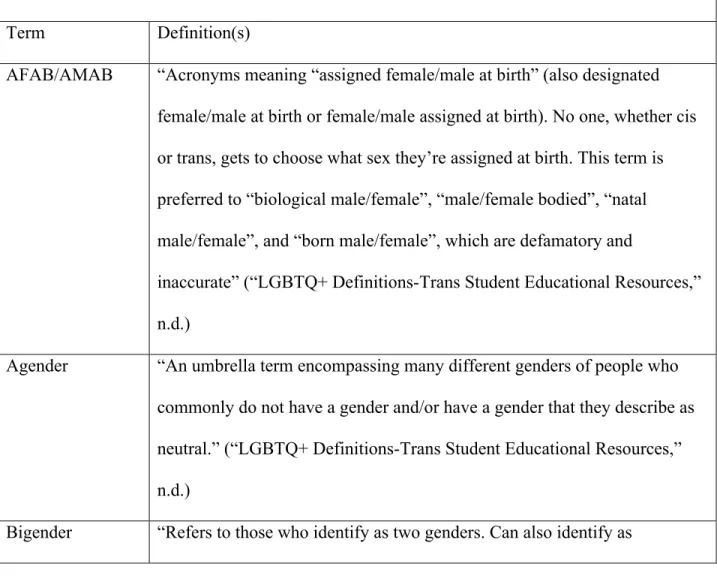
Terminology considerations for this paper follow the recommendations made by the “Terminology and definitions” section of the Primary Care Guidelines. Because the Primary Care Guidelines state that a detailed discussion of terminology extends beyond their scope (Center of Excellence for Transgender Health, 2016), I supplemented their terminology and definitions with those published in GLAAD’s “Media Reference Guide - Transgender,” and in the Trans Student Educational Resources’ “LGBTQ+ Definitions” (Table 1)
Table 1. Terminology and Definitions
Term Definition(s)
AFAB/AMAB “Acronyms meaning “assigned female/male at birth” (also designated female/male at birth or female/male assigned at birth). No one, whether cis or trans, gets to choose what sex they’re assigned at birth. This term is preferred to “biological male/female”, “male/female bodied”, “natal male/female”, and “born male/female”, which are defamatory and
inaccurate” (“LGBTQ+ Definitions-Trans Student Educational Resources,” n.d.)
Agender “An umbrella term encompassing many different genders of people who commonly do not have a gender and/or have a gender that they describe as neutral.” (“LGBTQ+ Definitions-Trans Student Educational Resources,” n.d.)
multigender (identifying as two or more genders). Do not confuse this term with Two-Spirit, which is specifically associated with Native American and First Nations cultures.” (“LGBTQ+ Definitions-Trans Student Educational Resources,” n.d.)
Cisgender “A non-transgender person” (Center of Excellence for Transgender Health, 2016, p. 15)
“Adjective that means ‘identifies as their sex assigned at birth’ derived from the Latin word meaning ‘on the same side.’ A cisgender/cis person is not transgender. ‘Cisgender’ does not indicate biology, gender expression, or sexuality/sexual orientation. In discussions regarding trans issues, one would differentiate between women who are trans and women who aren’t by saying trans women and cis women.” (“LGBTQ+ Definitions-Trans Student Educational Resources,” n.d.)
Cross-dresser / drag king/queen
“While anyone may wear clothes associated with a different sex, the term cross-dresser is typically used to refer to men who occasionally wear clothes, makeup, and accessories culturally associated with women. Those men typically identify as heterosexual. This activity is a form of gender expression and not done for entertainment purposes. Cross-dressers do not wish to permanently change their sex or live full-time as women. Replaces the term ‘transvestite’” (“GLAAD Media Reference Guide - Transgender,” 2017).
cross-dresser. “Transvestite” is often considered a pejorative term with the same meaning. Drag performers are cross-dressing performers who take on stylized, exaggerated gender presentations (although not all drag performers identify as cross-dressers). Cross-dressing and drag are forms of gender expression and are not necessarily tied to erotic activity, nor are they indicative of one’s sexual orientation or gender identity.” (“LGBTQ+ Definitions-Trans Student Educational Resources,” n.d.)
Gender/ gender identity
“A person’s internal sense of self and how they fit into the world, from the perspective of gender” (Center of Excellence for Transgender Health, 2016, p. 15).
Gender affirming surgery /
genital
reassignment / reconstruction
“Refers to surgical alteration, and is only one part of some trans people’s transition.” “Only the minority of transgender people choose to and can afford to have genital surgery. The following terms are inaccurate, offensive, or outdated: sex change operation, gender
reassignment/realignment surgery (gender is not changed due to surgery), gender confirmation/confirming surgery (genitalia do not confirm gender), and sex reassignment/realignment surgery (as it insinuates a single surgery is required to transition along with sex being an ambiguous term)”
(“LGBTQ+ Definitions-Trans Student Educational Resources,” n.d.). Gender binary “A system of viewing gender as consisting solely of two, opposite
categories, termed “male and female”, in which no other possibilities for gender or anatomy are believed to exist. This system is oppressive to
gender-variant or do not fit neatly into one of the two standard categories” (“LGBTQ+ Definitions-Trans Student Educational Resources,” n.d.) Gender dysphoria “In 2013, the American Psychiatric Association released the fifth edition of
the Diagnostic and Statistical Manual of Mental Disorders (DSM-V) which replaced the outdated entry ‘Gender Identity Disorder’ with Gender
Dysphoria, and changed the criteria for diagnosis. The necessity of a
psychiatric diagnosis remains controversial, as both psychiatric and medical authorities recommend individualized medical treatment through hormones and/or surgeries to treat gender dysphoria. Some transgender advocates believe the inclusion of Gender Dysphoria in the DSM is necessary in order to advocate for health insurance that covers the medically necessary
treatment recommended for transgender people” (“GLAAD Media Reference Guide - Transgender,” 2017).
Gender expression “The outward manner in which an individual expresses or displays their gender. This may include choices in clothing and hairstyle, or speech and mannerisms. Gender identity and gender expression may differ; for example a woman (transgender or non-transgender) may have an androgynous appearance, or a man (transgender or non-transgender) may have a feminine form of self-expression” (Center of Excellence for Transgender Health, 2016, p. 15)
considered masculine or feminine changes over time and varies by culture.” (“GLAAD Media Reference Guide - Transgender,” 2017)
Gender fluid “A changing or “fluid” gender identity.” (“LGBTQ+ Definitions-Trans Student Educational Resources,” n.d.)
Gender
nonconforming
“A term used to describe some people whose gender expression is different from conventional expectations of masculinity and femininity. Please note that not all gender non-conforming people identify as transgender; nor are all transgender people gender non-conforming. Many people have gender expressions that are not entirely conventional – that fact alone does not make them transgender. Many transgender men and women have gender expressions that are conventionally masculine or feminine. Simply being transgender does not make someone gender non-conforming. The term is not a synonym for transgender or transsexual and should only be used if someone self-identifies as gender non-conforming” (“GLAAD Media Reference Guide - Transgender,” 2017).
Genderqueer “An identity commonly used by people who do not identify or express their gender within the gender binary. Those who identify as genderqueer may identify as neither male nor female, may see themselves as outside of or in between the binary gender boxes, or may simply feel restricted by gender labels.” “Not everyone who identifies as genderqueer identifies as trans or nonbinary.” (“LGBTQ+ Definitions-Trans Student Educational Resources,” n.d.)
chromosomes, and anatomy that are used to assign sex at birth. There are many examples such as Klinefelter Syndrome, Androgen Insensitivity Syndrome, and Congenital Adrenal Hyperplasia. Parents and medical professionals usually coercively assign intersex infants a sex and have, in the past, been medically permitted to perform surgical operations to
conform the infant’s genitalia to that assignment. This practice has become increasingly controversial as intersex adults speak out against the practice. The term intersex is not interchangeable with or a synonym for transgender (although some intersex people do identify as transgender).” (“LGBTQ+ Definitions-Trans Student Educational Resources,” n.d.)
Nonbinary “Terms used by some people who experience their gender identity and/or gender expression as falling outside the categories of man and woman. They may define their gender as falling somewhere in between man and woman, or they may define it as wholly different from these terms. The term is not a synonym for transgender or transsexual and should only be used if someone self-identifies as non-binary and/or genderqueer” (“GLAAD Media Reference Guide - Transgender,” 2017)
Sex “Historically has referred to the sex assigned at birth, based on assessment of external genitalia, as well as chromosomes and gonads. In everyday language is often used interchangeably with gender, however there are differences, which become important in the context of transgender people” (Center of Excellence for Transgender Health, 2016, p. 15)
birth another sex assigned at birth often based on physical anatomy at birth and/or karyotyping” (“LGBTQ+ Definitions-Trans Student Educational Resources,” n.d.)
Sexual orientation “Describes a person's enduring physical, romantic, and/or emotional attraction to another person. Gender identity and sexual orientation are not the same.” (“GLAAD Media Reference Guide - Transgender,” 2017) They/them/their “Neutral pronouns used by some who have a nonbinary or nonconforming
gender identity” (Center of Excellence for Transgender Health, 2016, p. 15) Transgender/trans “An umbrella term for people whose gender identity and/or gender
expression differs from what is typically associated with the sex they were assigned at birth. People under the transgender umbrella may describe themselves using one or more of a wide variety of terms - including transgender.” “Many transgender people are prescribed hormones by their doctors to bring their bodies into alignment with their gender identity. Some undergo surgery as well. But not all transgender people can or will take those steps, and a transgender identity is not dependent upon physical appearance or medical procedures” (“GLAAD Media Reference Guide - Transgender,” 2017)
“The term transgender is not indicative of gender expression, sexual orientation, hormonal makeup, physical anatomy, or how one is perceived in daily life” (“LGBTQ+ Definitions-Trans Student Educational
Resources,” n.d.)
birth assigned sex; a transgender woman is someone with a female gender identity and a male birth assigned sex” (Center of Excellence for
Transgender Health, 2016, p. 15)
Transition “Altering one's birth sex* is not a one-step procedure; it is a complex process that occurs over a long period of time. Transition can include some or all of the following personal, medical, and legal steps: telling one's family, friends, and co-workers; using a different name and new pronouns; dressing differently; changing one's name and/or sex on legal documents; hormone therapy; and possibly (though not always) one or more types of surgery. The exact steps involved in transition vary from person to person. Avoid the phrase ‘sex change’” (“GLAAD Media Reference Guide - Transgender,” 2017).
*More appropriately, “sex assigned at birth” (“LGBTQ+ Definitions-Trans Student Educational Resources,” n.d.).
Trans-masculine/ trans-feminine
“Terms to describe gender non-conforming or nonbinary persons, based on the directionality of their gender identity. A trans-masculine person has a masculine spectrum gender identity, with the sex of female listed on their original birth certificate. A trans-feminine person has a feminine spectrum gender identity, the sex of the male listed on their original birth certificate” (Center of Excellence for Transgender Health, 2016, p. 15)
however some individuals and communities maintain a strong and
affirmative connection to this term” (Center of Excellence for Transgender Health, 2016, p. 15-16)
“Unlike transgender, transsexual is not an umbrella term. Many transgender people do not identify as transsexual and prefer the word transgender. It is best to ask which term a person prefers. If preferred, use as an adjective: transsexual woman or transsexual man” (“GLAAD Media Reference Guide - Transgender,” 2017)
“A deprecated term that is often considered pejorative similar to
transgender in that it indicates a difference between one’s gender identity and sex assigned at birth.” (“LGBTQ+ Definitions-Trans Student
Educational Resources,” n.d.)
Transvestite* “No longer used in the English language and is considered pejorative” (Center of Excellence for Transgender Health, 2016, p. 16)
*See cross-dresser.
Two-spirit “An umbrella term indexing various indigenous gender identities in North America.” (“LGBTQ+ Definitions-Trans Student Educational Resources,” n.d.)
Women’s Health Journals Birth: Issues in Perinatal Care
and childbirth. Their focus does not include high-risk pregnancies, and Birth does not “accept case reports or comparisons of drugs, products, or technologies” (“Birth: Author Guidelines,” n.d.). In the literature search, I found 0 search results pertaining to the trans health search terms in Birth: Issues in Perinatal Care between the years of 2010 and 2017.
The Journal of Midwifery and Women’s Health
According to the author guidelines published in the Wiley Online Library, the aim of the Journal of Midwifery and Women’s Health, or JMWH is to present research and current
knowledge on topics regarding maternity care, gynecology, primary care for women and neonates, health care policy, public health, and global health, with a focus on evidence-based practice and improving care for women across their lifespan (Journal of Midwifery and Women’s Health: Overview,” n.d.). In the literature search, I found eight search results
pertaining to the trans health search terms in JMWH between the years of 2010 and 2017. Seven of the eight articles addressed transgender individuals specifically beyond their inclusion within the LGBTQ acronym; one addressed elements of LGBTQ health but did not address transgender individuals specifically. Additionally, one article was published simultaneously in the Journal of Obstetric, Gynecologic, and Neonatal Nursing.
In the Special Report “Current Resources for Evidence-Based Practice,
transgender is included in the subheading “Evidence-Based Care of Individuals Who are Lesbian, Gay, Bisexual, Transgender and/or Queer/Questioning (LGBTQ),” and in the phrase lesbian or transgender women, however transgender individuals are not specifically discussed beyond this limited inclusion (Carlson, 2017, p 760).
In “Hormonal Management of the Female-to-Male Transgender Patient,” Steinle (2011) provided an overview of testosterone hormone management in “female-to-male” transgender patients directed at certified nurse-midwives (CNMs) and women’s health nurse practitioners (WHNPs). The author discussed current recommendations for pre-screening prior to hormone initiation, testosterone selection, monitoring for effectiveness, and the potential for adverse effects and benefits of testosterone therapy, as well as discussion of barriers to care and follow-up recommendations. The author used appropriate pronouns consistently throughout the paper; however, the author consistently used outdated, using sources from 2008 and 1997 in defining terminology related to transgender individuals, three and fourteen years prior to the article’s publication date respectively (Steinle, 2011). For instance, the author used the phrase FTM patients throughout the article, although the term trans men is more appropriate in referring to this group. The author noted in the terminology section that the term female-to-male or FTM is “more appropriately, transman ” because it “recognizes the ultimate gender identity of the
individual through inclusion of the word man” (Steinle, 2011, p. 294), however Steinle then used the phrase FTM patient for the remainder of the paper.
Resources,” n.d.). A more appropriate term for gender variant is “gender nonconforming,” which is less clinical in nature. The author referenced the DSM-IV gender identity disorder diagnosis, which was current for the time of publication, and acknowledged the proposed revisions for the DSM-V, which include “renaming the disorder gender incongruence” and revising diagnostic criteria (Steinle, 2011, p. 293). Language implying a disease or disorder state in reference to gender identity is no longer appropriate. The term gender incongruence is a misnomer, as transgender people do not have an incongruence with their gender, but rather with the sex they were assigned at birth (Steinle, 2011). Terminology such as biological sex, natal female sex, natal men, and born male (Steinle, 2011) are considered inappropriate and inaccurate, and should be replaced with “sex assigned at birth,” “assigned female at birth” or “assigned male at birth” (“LGBTQ+ Definitions-Trans Student Educational Resources,” n.d.). The phrase original sex is inaccurate and inappropriate, as it implies that the individual was previously a “different sex”, when more accurately, a transgender person’s gender identity is one that does not align with the sex they were assigned at birth by a healthcare provider or other outside entity.
the purpose of laboratory coding for interpretation of particular tests” (Steinle, 2011, p. 301), coding convenience provided as an excuse for unnecessary misgendering. The article addressed transgender individuals specifically beyond their inclusion within the LGBTQ acronym.
In “Other Literature of Interest” published in the Updates from the Literature column, Bond (2013) reviewed three articles that did not make it into volume 58, issue 5 of the Journal of Midwifery and Women’s Health, under the topic headings “Transgender care,” “Trends in
preconception health indicators,” and “An examination of legal cases against pregnant women from 1973 to 2005” (Bond, 2013, p. 578). The author used gender neutral language in her brief description of the 2013 article titled “Management of Transgenderism.” The term
In “Breast Care in the Transgender Individual,” Maycock and Kennedy (2014) conducted a literature review on breast care related to hormone therapy, breast binding, mastectomy, and/or breast augmentation in transgender individuals. The authors used appropriate pronouns, however they used consistently gendered language throughout the paper. Maycock and Kennedy used somewhat appropriate terminology, and obtained terminology and definitions from a source within five years of the article’s publication date. For instance, the authors used the phrase nontransgender populations to describe cisgender populations, a positive framing of language that does not place transgender individuals in the “other” category (Maycock & Kennedy, 2014).
The authors defined being transgender “for the purposes of this article” as “those persons actively engaged in anatomically and/or physiologically transitioning from their biologic sex to their actual sex” (Maycock & Kennedy, 2014, p. 74), however “not all transgender people can or will take those steps, and a transgender identity is not dependent upon physical appearance or medical procedures” (“GLAAD Media Reference Guide - Transgender,” 2017). This statement acknowledged the authors’ awareness of a person’s gender identity being their actual sex, a term often used interchangeably with gender (Center of Excellence for Transgender Health, 2016). Terminology such as biological sex, genetic sex, genetic females, biologic females, biologic women, and born male are considered inappropriate and inaccurate, and should be replaced with sex assigned at birth, assigned female at birth or assigned male at birth (“LGBTQ+ Definitions-Trans Student Educational Resources,” n.d.).
Assigning gender to body parts, as in the terms male breast and female breast, does not provide much clarity in discussing physiologic properties in this context, where individuals with non-cisgender identities are being discussed (Maycock & Kennedy, 2014). The authors
estrogen than cisgender females, who lack male levels of testosterone,” referring to transgender women as having “male levels” (Maycock & Kennedy, 2014, p. 76). The more appropriate term is assigned male at birth (“LGBTQ+ Definitions-Trans Student Educational Resources,” n.d.). A suitable replacement for this phrase would read “cisgender women, who lack the testosterone levels present in individuals assigned male at birth.” Additionally, the phrase “treated with attention to their genetic sex, but also to the sex they are assuming” (Maycock & Kennedy, 2014, p. 80) was inappropriate. The word assume implied that a person’s gender identity took on or adopted the role of someone or something they were not (Oxford University Press, n.d.), and a more appropriate term for genetic sex is sex assigned at birth. There are a variety of intersex conditions that present with “less common combination of hormones, chromosomes, and anatomy” that made this a less straightforward/meaningful designation (“LGBTQ+ Definitions-Trans Student Educational Resources,” n.d.). The article addressed transgender individuals specifically beyond their inclusion within the LGBTQ acronym.
In “Men in Midwifery: A National Survey,” Kantrowitz-Gordon, Adriane Ellis and McFarlane (2014) conducted a survey of the experiences of men and transgender individuals in midwifery, including challenges, barriers, and attitudes toward their practice. The authors identified themes of being singled out, degree of social support, exclusion, gender reading, invisibility, and loneliness, among others. The authors used appropriate pronouns, however they used inappropriate and inaccurate language and terminology throughout the paper. For instance, the authors refer to transgendered nurses (Kantrowitz-Gordon, 2014, p. 517); however the term transgender is an adjective, not a verb, and should not be written as transgendered.
identify your gender.” They weeded out respondents who were female, in favor of collecting responses from midwives who “identified as men or transgender” (Kantrowitz-Gordon et al., 2014, p. 518). The option transsexual is considered an outdated term, to be used as an adjective only if preferred by the patient. It is not a synonym for transgender, and is often considered pejorative, and \should be used with caution (“LGBTQ+ Definitions-Trans Student Educational Resources,” n.d.). Although the authors acknowledged that the transgender option “did not specify identification as male or female” (Kantrowitz-Gordon, 2014, p. 518), by structuring their survey in this manner, they negated the identities of transgender men and women, who, by definition, are both transgender and male, or transgender and female. Transgender is not
necessarily a separate gender from male or female. It is an adjective used to describe individuals whose gender identity do not align with the sex they were assigned at birth, who may identify as male, female, or somewhere outside the gender binary, just as cisgender is an adjective used to describe individuals who do identify with the sex they were assigned at birth. It would be more appropriate to provide options for cisgender women, cisgender men, transgender women, and transgender men, if the authors had intended for the “male” and “female” categories to capture cisgender participants only. Transgender and other should be included to encompass individuals who do not identify within the gender binary of male or female.
considered a synonym for transgender and does not refer to gender identity (“LGBTQ+ Definitions-Trans Student Educational Resources,” n.d.). Terms such as (but not limited to) nonbinary, genderqueer, and gender nonconforming are more appropriate to refer to a person who does not “identify as exclusively male or female” (Kantrowitz-Gordon et al., 2014, p. 518).
Additionally, the phrase “born with female sex but identifying as male” is inaccurate, with the implication that the individual in question is both of the female sex and male gender identity, as opposed to having been mis-identified at birth in the sex they were assigned by a medical provider or other outside entity (Kantrowitz-Gordon, 2014, p. 520). A more appropriate term is assigned female at birth (“LGBTQ+ Definitions-Trans Student Educational Resources,” n.d.). The phrase “adopting a more male appearance” and other commentary on a person’s appearance were unnecessary, as gender identity is not performative or dictated by means of gender expression, which should be referred to as masculine or feminine if gendered language is used (Center of Excellence for Transgender Health, 2016, p. 15). Kantrowitz-Gordon and colleagues addressed transgender individuals specifically beyond their inclusion within the LGBTQ acronym.
the article’s publication date. The authors used the terms male gender marker and female gender marker in reference to the gender written on study participants’ legal identification, which showed an awareness of the potential for disconnection between documentation and a person’s gender, that legal documents do not determine gender identity (Ellis et al., 2015).
The authors’ phrase “male-identified and gender-variant natal females” (Ellis et al., 2015, p. 62) was inaccurate and inappropriate with the implication that the individual in question is both a natal female and gender variant or of the male gender identity, as opposed to having been mis-identified at birth in the sex assigned to them by a health care provider or other outside entity (“LGBTQ+ Definitions-Trans Student Educational Resources,” n.d.). Transgender men are male and should be referred to as such. Terminology such as natal female and natal sex are inappropriate and inaccurate, should be replaced with assigned female at birth and sex assigned at birth (“LGBTQ+ Definitions-Trans Student Educational Resources,” n.d.). A more
The decision to “come-out” is an intensely personal and individual one, and the authors’ reference to someone in active nondisclosure as “hiding” was inappropriate and inaccurate (Ellis et al., 2015). Transgender individuals do not owe explanations or announcements to the people around them, be it for safety considerations or simply a lack of desire to disclose personal information to others, or a variety of other reasons. The author’s use of language such as “being open” in defining active self-disclosure again was inappropriate, with the implication that
individuals who do not actively self-disclose were then being “deceptive” (Ellis et al., 2015). The article addressed transgender individuals specifically beyond their inclusion within the LGBTQ acronym.
In “Educational Strategies to Help Students Provide Respectful Sexual and Reproductive Health Care for Lesbian, Gay, Bisexual, and Transgender Persons,” Walker, Arbour, and
Waryold (2016) provided educational strategies for including LGBT health into graduate
medical, nursing, and midwifery curriculum. The authors provided targeted education strategies for LGBT individuals, particularly women, without differentiating the needs of the individuals in each of these groups related to sexual and reproductive health, describe the PLISSIT model for sexual health interviewing and provide sample case studies for teaching topics regarding
gynecologic care and same-sex female relationships. The authors used appropriate pronouns and gender neutral language, however, the authors used consistently outdated terminology, obtaining terminology and definitions from a 2003 source, thirteen years before the article’s publication date.
Terminology within the authors’ paper itself was generally more accurate and
to the chromosomes, XX or XY, that differentiate the sexes biologically” (Walker et al., 2016, p. 738) was inaccurate, because there are a variety of genetic conditions that result in intersex conditions that present with “less common combination of hormones, chromosomes, and anatomy” (“LGBTQ+ Definitions-Trans Student Educational Resources,” n.d.). The term biologic sex, as well as physical sex, were inappropriate and inaccurate, and should be replaced with sex assigned at birth (“LGBTQ+ Definitions-Trans Student Educational Resources,” n.d.).
The terminology and definitions provided within “Table 1. Terminology for Use When Working With LGBT Clients” were significantly inaccurate and outdated (Walker et al., 2016, p. 739). The authors included intergendered as the second “I” within LGBTIIQ. Intergendered, written in the same style as intersex, which as an adjective to describe an individual should not be written as a verb, is not a term typically included within the extended LGBTQIA acronym, which includes “intersex” and “asexual.” Intergender, when used as an identity, has been defined by AllWords as being “midway between female and male,” however this term had not been seen elsewhere (AllWords.com, n.d.).
recognized term, and like transgenderism is inappropriate and inaccurate, and should not be used. Additionally, cross-dressing is considered to be a form of gender expression but not gender identity, and cross-dressers are not considered to be transgender (“GLAAD Media Reference Guide - Transgender,” 2017). The authors define transsexual as “a person who experiences a mismatch of the biological sex they were born as and the biological sex they identify as. A transsexual sometimes undergoes medical treatment to change his/her physical sex to match his/her sex identity through hormone treatments and/or surgically” (Walker et al., 2016, p. 739). However as previously stated, a more appropriate term for “biological sex” is “sex assigned at birth.” The term “sex identity” is inaccurate, and a more accurate and appropriate term for the concept the authors refer to here is “gender identity” (Center of Excellence for Transgender Health, 2016, p. 15).
The authors provided an inaccurate definition of sex, referring to sex terms that include “male, female, transsexual, and intersex” (Walker et al., 2016, p. 739). Transsexual is considered an outdated gender identity, and should not be included in a definition of sex (“GLAAD Media Reference Guide - Transgender,” 2017). Sex is a vague term often used interchangeably with gender, however the term sex identity should be used to refer to the “label people adopt to signal to others who they are as a sexual being, particularly regarding sexual orientation” (Grollman, 2010). The author’s definition “the sex that a person sees themselves as. This can include
particularly those who transition from one sex to another on the job” was unnecessary, inappropriate, and inaccurate (Walker et al., 2016, p. 739). The article addressed transgender individuals specifically beyond their inclusion within the LGBTQ acronym.
In “Provision of Patient-Centered Transgender Care,” Selix and Rowniak (2016) conducted a review of the limited literature available regarding the specific health needs of transgender individuals, and the provision of culturally competent health care services for transgender populations. They provided an overview of general primary care needs, mental health needs, hormone therapy, and surgical treatments, and differentiate health needs specific to trans men and trans women, looking at the health impact and care considerations for individuals across transition. The authors used gender neutral language in regards to pronouns, and used mostly appropriate terminology, obtaining definitions and terminology from a source within five years of the article’s publication date. However, the term transvestite, included in the authors’ terminology section as “transvestite (e.g. cross dressing)” is considered pejorative and should not be used. It is more appropriate to use the term cross-dressing in reference to an “individual who dresses as the opposite gender but does not necessarily have a gender identity different from their sex at birth” (Selix & Rowniak, 2016, p. 745).
The authors recommended including a “section on patient health data forms for gender identity as male, female, or transgender,” and appeared to use the terms transgender and gender-variant interchangeably, referring to “male, female, and gender-gender-variant patients” at the end of the same sentence (Selix & Rowniak, 2016, p. 745). A more appropriate term for gender variant is gender nonconforming, which is less clinical in nature. Additionally, gender nonconforming is not a synonym for transgender, as “not all gender non-conforming people identify as
Media Reference Guide - Transgender (2017). The authors correctly define transgender as an umbrella term that referred to “any individual who does not identify with the gender they were assigned at birth” (Selix & Rowniak, 2016, p. 744). However, by structuring the gender options as “male, female, or transgender,” Selix and Rowniak (2016, p. 744) negated the identities of transgender men and women, who, by definition, are both transgender and male, or transgender and female. The authors later recommended that clinical settings “include a section on patient health data forms for gender identity as male, female, transgender, trans man, or trans woman,” which was more appropriate in addressing the gender identities of their patients (Selix & Rowniak, 2016, p. 749). The phrase “more accommodating” within the heading “Approaches That Make Clinical Settings More Accommodating to Transgender Individuals” implied that transgender patients had needs in excess of what cisgender patients required, and that clinical settings were exceeding expectations by meeting some needs but not all (Selix & Rowniak, 2016, p. 749). The article addressed transgender individuals specifically beyond their inclusion within the LGBTQ acronym.
Journal of Obstetric, Gynecologic, and Neonatal Nursing (JOGNN)
According to the “about JOGNN” section published in the JOGNN website, JOGNN takes a focus on nursing practice in the care of women, neonates, and the childbearing family. They are known for publishing groundbreaking articles on important issues, with an emphasis on research evidence and clinical practice (“About JOGNN: the Journal of Gynecologic and
transgender individuals specifically. Additionally, one article was published simultaneously in the Journal of Midwifery and Women’s Health.
In the editorial “Improving the Care of Lesbian, Bisexual, and Transgender Populations,” Harner (2014) examined three articles related to LBT populations and health. The articles
addressed factors affecting sexual safety and security in women who have sex with men and women, the nursing role in treatment and care of LBT women in education, practice,
certification, and licensure, and the effects of language surrounding motherhood on the maternal role for the non-birth partner in lesbian relationships. The author used consistently appropriate pronouns throughout the paper, and mostly appropriate language, however she used the phrase “lesbian, bisexual, and transgendered” in defining LBT populations (Harner, 2014, p. 507). Transgender is an adjective and not a verb, and should not be written as transgendered. The editorial did not address transgender health beyond its inclusion in the LGBT/LBT acronyms (Harner, 2014).
In “Increasing Self-Awareness in Nursing Students to Promote Culturally Competent Care Within a Lesbian Population”, Adams and Turner (2016) described a poster presentation proposing a two-pronged didactic and clinical approach to promote awareness in nursing students of the impact of gender expression and identity, and sexual orientation, on healthcare needs in the lesbian childbearing family. The authors used appropriate pronouns and language throughout the paper. The poster presentation description did not address transgender health beyond its inclusion in the LGBT acronym (Adams & Turner, 2016).
delivered in pre-licensure nursing programs. Of the thirteen articles reviewed, three covered LGBTQ topics, largely with a focus on sexuality and sexual health as opposed to gender identity, and two that merited mention but did not meet inclusion criteria discussed LGBTQ and
“intersexed” healthcare, and transgender health curriculum concepts (Cappiello et al., 2017). The authors used appropriate pronouns throughout the paper, and used mostly accurate terminology, although the term intersex is an adjective, describing a component of a person’s identity, and should not be used as a verb, as seen in the authors’ phrase “intersexed healthcare” (Cappiello et al., 2017, p. e163) The article contained primarily gendered, woman-centric language, referring to women’s health and its relation to sexual and reproductive health, pregnancy, and family planning throughout the article. The authors addressed this, and stated they used a “broad definition of sexual and reproductive health; however, some studies were based on the more narrow definition of women’s health care and thus did not address men’s health issues or
transgender health care” (Cappiello et al., 2017, p. e162). The term transgender was included as a component of the LGBTQ acronym in the phrase “medical needs of transgender people,” and in referencing the development of a “transgender health curriculum”; however transgender individuals were not discussed beyond this limited inclusion and a statement on the authors’ definition of sexual and reproductive health (Cappiello et al., 2017, p. e161, e163).
Carlson’s Special Report “Current Resources for Evidence-Based Practice,
November/December 2017,” was published simultaneously in JMWH (Carlson, 2017). See entry listed under the Journal of Midwifery and Women’s Health section for analysis.
non-affirming, and even hostile, unsafe healthcare encounters experienced by this population, due to provider bias, systems issues, and lack of knowledge. The author mentioned an extensive glossary of LGBT terminology published by the Joint Commission in 2011 and resources from the National LBGT Health Education Center in 2013 for terminology and language guidance. However, these resources were not used consistently. Some definitions and terminology used in the paper came from a 2008 source, six years prior to the article’s publication date, which led to inconsistencies in the author’s use of both appropriate and outdated language. The author used gender neutral language in regard to pronouns and was inconsistent in using the terms sex and gender, often using them interchangeably, “however there are differences [between sex and gender], which become important in the context of transgender people” (Center of Excellence for Transgender Health, 2016, p. 15). The author showed purposeful inclusion of both sexual
orientation and gender identities in the term “LBT women” (Zuzelo, 2014).
Defining transgender using the term birth sex was inaccurate and inappropriate, and it would be more appropriate to use sex assigned at birth (“LGBTQ+ Definitions-Trans Student Educational Resources,” n.d.). The term anatomic sex was also inaccurate, as there are a variety of intersex conditions that present with “a less common combination of hormones,
The author defined transsexual as “individuals who pursue medical therapies to establish congruency between their physical bodies and intrinsic, sexual self knowledge” (Zuzelo, 2014, p. 521). However, the term transsexual is outdated and is often considered pejorative, and
individuals who choose to pursue “medical therapies” are more appropriately considered transgender (“LGBTQ+ Definitions-Trans Student Educational Resources,” n.d.). The author’s phrase “sexual self knowledge” was an example of equating sex with gender in a way that left the reader unclear of the intended meaning, as the phrase could have also been referring to a person’s sexual orientation or sexual preferences (Zuzelo, 2014). The author defined gender variant, as being sexually nonconforming, however this term refers to gender identity, not
sexuality, and a more appropriate term is gender nonconforming, which is more accurate and less clinical in nature (“GLAAD Media Reference Guide - Transgender,” 2017). The author included transgender individuals within their definition of intersex, however the “term intersex is not interchangeable with or a synonym for transgender,” and should not be included within this definition (“LGBTQ+ Definitions-Trans Student Educational Resources,” n.d.). Demonstrating some awareness of appropriate language, the author provided terms to be avoided, ‘real’ man or woman, in differentiating cisgender and transgender men and women (Zuzelo, 2014, p. 521). “Real” is a subjective, vague term, insinuating that one identity is more legitimate than the other, and as the author noted, should not be used. The author discussed the negative impact of
homophobia and heterosexism, however the impact of transphobia and cissexism were not included (Zuzelo, 2014). Zuzelo addressed transgender individuals specifically, beyond their inclusion within the LGBTQ acronym (2014).
contained one question related to transgender health, “A person who utilizes medical
interventions to alter his/her physical sex to achieve congruency with sexual self knowledge is labeled as ____” (Zuzelo, 2014, p. e40). The author provided outdated and/or inappropriate answer choices, gender variant, transsexual, and transvestite (Zuzelo, 2014, p. e40). Terminology in this article came from a 2008 source, demonstrated in the use of the term
transsexual, which is generally considered an outdated term, as is the definition provided for it. It should be used as an adjective if preferred by the individual, however, caution should be used as transsexual is often considered pejorative (“LGBTQ+ Definitions-Trans Student Educational Resources,” n.d.). Additionally, the term transvestite is considered pejorative and should not be used (Center of Excellence for Transgender Health, 2016, p. 16), and a more appropriate term for gender variant is gender nonconforming, which is less clinical in nature. The post-test addressed transgender individuals specifically, beyond their inclusion within the LGBTQ acronym.
In “Providing Family-Centered Care to the Transgender Community,” Kester and Viloria (2017) described a poster presentation intended to promote transgender inclusive programming as a component of family centered care, with implementation of comprehensive, gender
affirmative education for staff, use of gender-neutral language and signage, and identification of implications for nursing practice. The authors used gender neutral, current terminology
throughout the paper, for example, “gender-affirming surgical masculinizing procedures” in reference to transition related surgeries, and the gender neutral term chestfeeding (i.e., breastfeeding) (Kester & Viloria, 2017, p. s22). Kester and Viloria addressed transgender individuals specifically beyond their inclusion within the LGBTQ acronym .
According to the “about the journal” section published on the Wolters Kluwer website, the focus of MCN: The American Journal of Maternal/Child Nursing on current major issues and high priority problems related to maternal/child nursing, women’s health, and family nursing. Their articles include topics such as disease updates, health promotion, patient and family behavior, physiology and pathophysiology findings, clinical investigations and research for evidence-based nursing practice (“About the Journal: MCN,” n.d.). In the literature search, I found 5 results pertaining to the trans health search terms in MCN, between the years of 2010 and 2017. Of the five articles captured, four addressed transgender individuals specifically beyond their inclusion within the LGBTQ acronym, and one addressed elements of LGBTQ health but did not address transgender individuals specifically.
In “Anxiety Disorders, Gender Nonconformity, Bullying and Self-Esteem in Sexual Minority Adolescents: Prospective Birth Cohort Study,” published in the Toward Evidence-Based column of MCN, Capitulo (2017) reviewed a study published in the Journal of Child Psychology and Psychiatry, discussing the relation between non-heterosexual orientation and reported gender nonconformity, adolescent anxiety, self-esteem, and bullying. The author used gender neutral language and mentions the experience of “sexual minority adolescents” and the relation to “early-childhood gender nonconformity” but otherwise did not discuss transgender health in this brief comment (Capitulo, 2017, p. 364).
appropriate pronouns, aside from one instance of in referring to a trans man having “legally changed her gender to male”, however other gendered language was not used appropriately (Adams, 2010, p. 28). For example, the description of a trans man being “outwardly female but inwardly was gender confused” (Adams, 2010, p. 28) was inaccurate, as a person’s gender identity is not based on how they appear to other people or their methods of gender expression (Center of Excellence for Transgender Health, 2016). The author referenced the DSM-IV gender identity disorder diagnosis (Adams, 2010), which was current for the time of publication,
however this diagnosis is no longer appropriate and was not included in the DSM-V (American Psychiatric Association, 2013).
The author’s use of terminology was consistently outdated and inappropriate. For instance, the article’s title “if transgender men can have babies, how will perinatal nursing adapt?” placed the focus on perinatal nurses and their experience, instead of focusing on the experience of the patient, and the word if implied that transgender men were less capable of bearing children (Adams, 2010, p. 26). The author placed an emphasis on identity related to biologic sex, biological sex at birth, being born biologically female or born female and being biological women, and individuals who had “maintained their female reproductive organs” (Adams, 2010, p. 29) as opposed to the person’s identified gender. These terms are considered inaccurate and inappropriate, and instead sex assigned at birth, and assigned female at birth should be used (“LGBTQ+ Definitions-Trans Student Educational Resources,” n.d.).
The term transgender should not be used as a noun, as seen in the author’s phrase “reading a transgender’s chart” (Adams, 2010, p. 29). Transgender should be used as an
adjective, changing the above phrase to “reading a transgender individual’s chart,” substituting other nouns as appropriate to the situation (“LGBTQ+ Definitions-Trans Student Educational Resources,” n.d.). Additionally, it was inappropriate and grammatically incorrect to use the term transgendered, as seen in the author’s phrases transgendered man, transgendered individual, and transgendered obstetric patient (Adams, 2010), as transgender is an adjective and should not be used as a verb. Use of the term transgenderism and the phrase “transgenderism and its
concomitant sequelae” (Adams, 2010, p. 29) implied the experience of being transgender to be a disease state or disorder, with sequela defined as “an aftereffect of a disease, condition, or injury” by Merriam-Webster (Merriam-Webster, Incorporated, n.d.). The term transgenderism is inappropriate and should be avoided. According to GLAAD, a more appropriate phrase to use is being transgender, as transgenderism is not “commonly used by transgender people” and is “used by anti-transgender activists to dehumanize transgender people and reduce who they are to ‘a condition’” (“GLAAD Media Reference Guide - Transgender,” 2017).
The author used inaccurate and inappropriate terminology regarding transition, referring to individuals who had “partially transitioned to the male gender via hormones” and a man that “had not had his uterus or ovaries surgically removed and his transition to the male gender was therefore not complete,” which attempted to delegitimize and impose restrictions on individuals’ ability to identify as transgender (Adams, 2010, p. 27, 28). The process of transitioning “is a complex process that occurs over a long period of time” which may involve a variety of
procedures” (“GLAAD Media Reference Guide - Transgender,” 2017). The author’s statements that “transition can be temporary or permanent” and “once the change in gender has been made, whether temporary or permanent” were inappropriate, with the implication that a person’s gender identity was a choice that may be undone, and detracted from of the complexity and significance of the difficult process of coming out and transitioning (Adams, 2010, p. 27, 28). “Patients who have not changed their gender” should have been referred to as cisgender, or non-transgender, as the phrase implied the misconception that transgender individuals were “changing” their gender (Adams, 2010, p. 31). More accurately, a transgender person’s gender identity is one that does not align with the sex they were assigned at birth by a medical provider or other outside entity (“GLAAD Media Reference Guide - Transgender,” 2017). The article addressed transgender individuals specifically beyond their inclusion within the LGBTQ acronym.
In “Gender Nonconforming Children,” published in the Hot Topics in Pediatric Nursing column of MCN, Beal (2015) provided information for healthcare providers regarding
affirmation surgery or genital reassignment (“LGBTQ+ Definitions-Trans Student Educational Resources,” n.d.). Beal addressed transgender individuals specifically beyond their inclusion within the LGBTQ acronym.
In “Transgender Men and Lactation: What Nurses Need to Know,” Wolfe-Roubatis and Spatz (2015) conducted a three-case exemplar in response to the Healthy People 2020 goals of increasing lactation and breastfeeding, and improving healthcare for transgender individuals. The authors aimed to promote awareness of the role of the perinatal nurse in providing
knowledgeable care and support for trans patients, by addressing the current gaps in care and providing perinatal nurses with suggestions for creating a welcome environment, developing relationships and educating themselves, and provided additional resources for caring for
transgender patients. The authors used consistently appropriate pronouns and gendered language throughout the paper. The authors used mostly appropriate terminology throughout, with gender neutral terms such as human milk and chestfeeding, and used sources that were within five years of the article’s publication date (Wolfe-Roubatis & Spatz, 2015); however, it was inappropriate and grammatically incorrect to use the term transgendered, as in the phrase “transgendered and GNC patients” (Wolfe-Roubatis & Spatz, 2015, p. 37), as transgender is an adjective and should not be used as a verb. Additionally, while the authors used the phrase birth assigned anatomical sex (Wolfe-Roubatis & Spatz, 2015, p. 33), the current recommendation is sex assigned at birth, which places less emphasis on a patient’s “anatomy,” and places the responsibility for this mis-designation back on the provider who assigned it (“LGBTQ+ Definitions-Trans Student
In “Healthcare for Transgender Youth: Still Inadequate…Still at Risk,” published in the Hot Topics in Pediatric Nursing Column of MCN, Beal (2017) examined several studies of transgender youth, and identified a repeated concern regarding a lack of access to healthcare services. Participants within these studies made recommendations for healthcare providers to focus on training to promote gender-affirming protocols and cultural humility, and adhere to well-established protocols and current best practice for pediatric hormone therapy, as well as establish programs to provide resources for caregivers with transgender children and group programs to promote self-esteem and resilience in trans youth. The author used gender-neutral language throughout the paper, and used an outdated and inaccurate definition of the term transgender, pulling from sources published in 2006 and 1997. Transsexual is considered to be an outdated term and should be used as an adjective if preferred by the patient, as in the phrase “transsexual individuals” as opposed to the author’s use, transsexuals (“GLAAD Media Reference Guide - Transgender,” 2017). Caution should be used, as transsexual is often
considered pejorative (“LGBTQ+ Definitions-Trans Student Educational Resources,” n.d.). The authors also included cross-dressing within the transgender umbrella, however, cross-dressing is considered to be a form of gender expression but not gender identity, and cross-dressers are not considered transgender (“LGBTQ+ Definitions-Trans Student Educational Resources,” n.d.). Additionally, the word “purposefully” within the author’s phrase “individuals who purposefully present with ambiguous gender identity” was unnecessary, and implied that a person’s gender presentation and identity are chosen and “performed” for the benefit of the people observing and interacting with them (Beal, 2017, p. 296). The article addressed transgender individuals