Modern Susceptibility to Fake News
By:
Rebecca Kronebusch
Senior Honors Thesis School of Media and Journalism University of North Carolina at Chapel Hill
April 4, 2018
Dedications
To my superhero mom,
for your constant encouragement and sacrifice. You are the reason I am graduating from my dream school with honors.
I love you.
To Francesca Dillman-Carpentier,
for being the kindest and most intelligent mentor. I learned so much from your support and guidance throughout the year.
To Danny Fischbeck,
for always pushing me to live my dreams. Without you, I never would have had the courage to take on this thesis.
Chapter I.I INTRODUCTION
On a cold December day in Washington D.C., Edgar Welch burst into a family pizzeria and accused the owner, James Alefantis, of conspiring with Hillary Clinton and the Democrats to operate a child sex trafficking ring. Equipped with an assault rifle and handgun, Welch had driven some five hours from his North Carolina home to “rescue” children he believed were being harbored in the restaurant’s basement (Alefantis, 2017).
Only, the child-slavery ring did not exist; it had been concocted by conspiracy theorists and spread rapidly via social media and fake news websites. As a result of his actions, Welch will serve four years in jail for assault with a deadly weapon and transporting a firearm across state lines (Bendix, 2017). Media personality Alex Jones, threatened with a libel suit, apologized publicly for promoting the “Pizzagate” conspiracy theory on his InfoWars website and through other sources (Alefantis, 2017). Even so, Comet Ping Pong, its employees, and Alefantis
received death threats and online discussion in fake news chat rooms alleging the authenticity of “Pizzagate” continued. Additionally, groups protested loudly outside the restaurant, referring to it “Sodom and Gomorrah,” among other names (Alefantis, 2017).
“Pizzagate” is one example of how fake news can have negative consequences in society, including risks to public and individual safety and damage to reputation. Fake news sites have capitalized on current events to circulate hoaxes and conspiracy theories to varying results. For example:
false rumors that an injured hotel security guard was arrested as an accomplice and second gunman (Mikkelson, 2017).
• A fake news website falsely accused acclaimed chef Gordon Ramsay of kicking four
Miami Dolphins football players out of his restaurant because he was ashamed of them kneeling during the national anthem (LaCapria, 2017).
• Multiple media outlets published exaggerated claims that Yellowstone National Park volcano was going to erupt and wipe out the human race. These claims exploited research from Arizona State University about new developments in understanding the volcano and turned it into a doomsday conspiracy (Kasprak, 2017).
In an effort to better understand fake news and its impact, this study examines the
psychological processes through which people observe, are persuaded by, and motivated to share fake news on social media. This is a valuable site of study because fake news, as illustrated above, negatively impacts, misleads, and has the potential to endanger society. Because media are an important site of information for most people, it is necessary to develop ways to combat the harmful proliferation of fake news in order to promote media literacy and journalistic integrity. Research about the psychological reasons that people consume and share fake news is an important step to conceptualizing successful tools to combat fake news.
the article, participants’ affect will be more positive. These people, consequently, are the most likely to be fooled by fake news.
At its core, this study will examine cognitive dissonance in people who go on to share fake news. Psychologists have used cognitive dissonance as a way to explain how people act in a way that is inconsistent with previously held beliefs but reason with themselves in some way to resolve this dissonance (Brehm, 2007; Cooper, 2012; Festinger, 1957; Stone & Cooper, 2001). The present study will examine the presence or lack of cognitive dissonance by looking at participants’ self-reported affect they feel after being exposed to the fake news article stimulus and recording their thoughts about it. More negative affect will indicate participants are
experiencing more dissonance.
The study will also examine the degree to which people elaborate on their thoughts or feelings about a fake news article presented to them, their level of skepticism about the article, and the person’s affect. It will rely on the Elaboration Likelihood Model, or ELM, to predict which demographics are more or less likely to elaborate (Cacioppo & Petty, 1984). This study hypothesizes that people with strong positive or negative feelings about an article, as well as those who align with the leaning of the article and have peripheral cues will be more likely to elaborate on their thoughts about the article. One research question about elaboration that will be addressed is what effect peripheral cues will have on participants’ elaboration when they align ideologically with the article. It will also examine if there is a relationship between participants’ elaboration and their reported skepticism and affect.
that create virtual echo chambers (Quattrociocchi, Scala, & Sunstein, 2016). Users are more likely to see posts from people with similar beliefs or interests than posts from others with different beliefs. If a person who is experiencing dissonance shares the false news and receives positive feedback in the form of “likes” or affirmative comments, dissonance could potentially be resolved. The social “good” they are doing—by promoting their network’s preferred
Chapter I.II LITERATURE REVIEW
Fake news has been present throughout American history (Seidenberg, 2017); however, it is being promulgated at an alarming rate due in part to the efficiency of social media. This
section defines important terms and provides a review of the concepts and theories most relevant to the study’s focus: fake news, and why some people believe it.
What Is Fake News and Why Does It Matter
For this study, fake news is defined as “news articles that are intentionally and verifiably false and could mislead readers” (Allcott & Gentzkow, 2017, p. 213). This straightforward definition can be applied to a social media context and, importantly, emphasizes intent. Intention requires someone to be cognizant that their action will likely produce a specific reaction, and in the case of fake news, this means being aware that it will cause negative consequences, such as misleading the public on an important public issue, even if that individual author profits
monetarily, politically, or in other ways.
Scholars have distinguished categories of fake news. In “Three Types of Fake News,” Rubin, Chen, and Conroy (2015) define three major types of fake news: serious fabrications, large-scale hoaxes, and humorous fakes. Serious fabrications are sensationalized content such as tabloids, or yellow journalism. Large-scale hoaxes are designed to imitate legitimate news articles and are specifically intended to deceive people. Because large-scale hoaxes are
specifically, this study will examine large-scale breaking political news hoaxes. The current state of large-scale political fake news is of increasing interest to scholars. The 2016 election, coupled with the social media boom, bolstered fake news proliferation (Allcott & Gentzkow, 2017), and researchers are working to make sense of it all.
Authors of fake news or content often are motivated by money (Allcott & Gentzkow, 2017). In these cases, the creators know that unassuming people will pass along a story and help it ‘go viral,’ resulting in more advertising revenue for the originating site owner due to increased clicks and social media sharing. Another motivation people have to create fake news stories is to support and promote their preferred candidates, as was done in the 2016 election cycle (Allcott & Gentzkow, 2017). Whether the intent is for good or ill, these kinds of stories have the potential to impact the democratic process in significant ways; how they may have shaped the 2016 election outcome is just beginning to be uncovered. Allcott and Gentzkow (2017) suggest that the
average American voter was exposed to one or more fake news articles during the election cycle. These creators knew that the content of the news they tried to pass off as real was fake and would misinform voters, but the goal of getting their preferred candidate elected outweighed the social cost of misleading the public. Another reason that misinformation on social media is dangerous is because it can be difficult to assess a source’s credibility at first blush and because social media has created echo chambers (Lazer et al., 2017).
Elaboration Likelihood Model (ELM)
One cognitive process relevant to this study is the Elaboration Likelihood Model (ELM). First proposed by John Cacioppo and Richard Petty (1984), ELM is a dual-processing theory of persuasion that illustrates that the different ways individuals respond to various factors affects how they are persuaded. ELM posits that one can examine various factors in individuals’ lives to determine “people’s motivation and ability to think carefully about the merits” of an argument (Cacioppo & Petty, 1984, p. 673). Various factors combine to motivate the person to elaborate on their thoughts. These factors also lead individuals to have attitudes that persist for a relatively long amount of time. ELM can also predict future behavior by the individual. People are more likely to be in high elaboration category if they have a large pool of knowledge about the subject, care a lot about the issue, or have some other connection to the stimulus at hand (Cacioppo & Petty, 1984). Cacioppo and Petty (1984) also argue that individuals with low elaboration likelihood usually either “conserve their cognitive resources” by skipping over information or stimuli that are not relevant to their knowledge, or “expand their cognitive resources” by doing other activities, such as daydreaming (Cacioppo & Petty, 1984, p. 673).
attitudes, and it is associated with low elaboration likelihood (Cacioppo & Petty, 1984, p. 673-674). Instead of processing information in a systematic way, people using peripheral processing will commonly look for context clues such as buzzwords to get a quick idea of what the
argument is stating, and then they will make a decision whether they agree or disagree with the argument.
Attitude importance is one moderator of persuasion outlined by Zuwerink and Devine (1996). Their studies are centered around the issue of gay people serving in the military. Researchers presented participants with counter-attitudinal messages to see what effect the participants’ attitudes surrounding the issue had on their evaluation of the message. Their first study found that participants who valued the issue as highly important were more resistant to the counter-attitudinal messages presented to them. Results refuted the idea that these results are attributable to processing differences; both high- and low-importance groups processed the information at the same rate (p. 93). Participants in both groups had the same number of thoughts about the counter-attitudinal message. Zuwerink and Devine’s second study built onto Study 1 and found that message quality also affects how people with both high and low attitude
importance process and react to counter-attitudinal messaging. Results showed that both high- and low-importance groups were motivated to resist weak messages more that strong messages, and the high-importance group consistently showed more resistance overall than the
the less positive the reader’s affect will be. Participants experience dissonance and will have a harder time elaborating on the article, given that they are conflicted that an article with which they align ideologically contains fake news cues.
who receive information that is unfavorable to their views. A study by Taber and Lodge (2006) illustrates this application of motivated skepticism to political beliefs, attitudes, and arguments. Taber and Lodge (2006) conduct two experiments to examine the relationship between skepticism and response to political information about gun control and affirmative action. Their findings first show that people who are political ideologues and people who have strong prior beliefs find it very difficult to set these prejudices or beliefs aside when evaluating arguments. This was the case even though participants were instructed to set these aside (p. 760). The pro and con arguments were even pre-tested and found to be equally effective, yet prior beliefs still strongly motivated these two groups of people to rate messages congruence with beliefs as stronger than incongruent messages. Results showed that people who were less politically inclined or people who had less strong prior beliefs about the issues were able to evaluate arguments in a more balanced way (p. 760). People with stronger prior beliefs showed a
disconfirmation bias where they accepted confirmatory information at face value but elaborated and refuted information that contradicted their prior beliefs (p. 761-762). Researchers noted that political ideologues and people with strong prior beliefs spent more time reading and refuting articles that countered their beliefs than those who were less politically sophisticated or had weaker prior beliefs (p. 762). Furthermore, a confirmation bias was examined when people with stronger prior beliefs or political ideologues were allowed so self-select their sources. These groups of people selected more articles that supported their prior beliefs instead of articles that refuted it (p. 764, Figure 6). All of these factors contributed to increasing attitude polarization over time (p. 766, Table 3).
mood groups. To induce these moods, researchers showed each person in each group a film. The happy group watched a comedy, the neutral group watched a nature documentary, and the sad group watched a video about dying from cancer (p. 1364). This induction was successful, and researchers confirmed this through questions at the end of the experiment testing the films’ effectiveness. After being shown the film, participants were asked to watch four different students deny taking a ticket. Some of the students were lying, some were not. Results showed that people in the sad mood condition were more inclined to judge students as guilty than those in happy or neutral conditions (p. 1364). Mood had a greater effect on judgements of guilt when the students were lying, or being deceptive (p. 1364, Figure 1). Additionally, sad participants were more likely to find arguments deceptive than happy participants, suggesting that the happier people are, the more trusting and susceptible they are to deceptive messaging (p. 1364).
Researchers have used ELM to explain modern political activities and behavior. A study by Terry L. Chmielewski (2012) uses Cacioppo and Petty’s ELM to explain and predict voting preferences in the 2004 and 2008 presidential elections, as well as the 2006 Wisconsin
gubernatorial election. Chmielewski used a meta-data approach and kept the same variables in each study. Chimielewski conducted three total studies. Each had a questionnaire that was administered face-to-face or over the phone, and each study took place five days before each election. The first two studies had only student participants, but the last study focused on residents of Eau Claire, Wisconsin, whose average age was 48 years old (Chimielewski, 2012). The questionnaires measured candidate favorability, image, credibility, political orientation, political party preference, political involvement, and voting preference. Chmielewski categorized participants by two groups — high involvement and low involvement — based on their
The survey results showed how and why people make the voting choices that they do. Results tested the effects of different variables on voting preference among participants with low involvement and among participants with high involvement. For participants in the low
involvement category, results indicated that there was a strong relationship (p < .05) between political party preference and voting preference. Political orientation and voting preference, however, did not have a statistically significant relationship (Chimielewski, 2012). For participants in the high involvement category, there is a statistically significant positive relationship between candidate image, favorability, and voting preference. Voting preference was not statistically related to candidate credibility or political orientation (Chimielewski, 2012). These results gave strong support for the Elaboration Likelihood Model as being a predictor of voting behavior. Those with high political involvement use more variables and a central
processing route to come to voting preference decisions. Both candidate image and favorability require using preexisting knowledge to accurately rate the candidate. Meanwhile, those with low political involvement rely more on clues such as the candidate’s partisan affiliation to use a peripheral route to make voting decisions (Chimielewski, 2012).
Holt (2017) conducted a study that further illustrated ELM. The study analyzes people’s opinions surrounding the Black Lives Matter Movement (BLM) and what cognitive processing they use to form those opinions. Specifically, the study highlights the rise of the BLM movement in relation to police officer shootings of African Americans. ELM is the theoretical basis in the study, and it has not been widely applied to racial issues prior to this study (Holt, 2017, p. 4). Researchers found that African Americans have more positive attitudes toward the BLM
African Americans used ELM’s central route processing to evaluate the movement whether it came from an expert source or a novice source. White participants, however, were more likely to evaluate the BLM movement using peripheral cues such as source credibility (Holt, 2017). Results also showed that whites have a more favorable view of the movement if news surrounding it comes from a relevant, expert source. The study found that people’s attitudes toward race-based policies, such as affirmative action, could help predict their level of support for BLM. If people viewed race-based policies more favorably, they were more likely to show stronger support for BLM (Holt, 2017, p. 9).
Based on extant literature, this study hypothesizes: People whose political leanings align with the leanings in the fake news message will (a) experience more positive affect, (b) be less skeptical of the message, and (c) demonstrate superficial processing of the message (less elaboration), while also (d) focusing on or recalling the peripheral cues of the message when asked to relay their memory and thoughts about the message. Additionally, people whose political leanings are in contrast to the leanings in the fake news message will (a) experience more negative affect, (b) be more skeptical of the message, and (c) demonstrate more central processing of the message (more elaboration), while also (d) focusing on/recalling the contents of the message itself. These findings will be translated into hypotheses following discussion of cognitive dissonance.
Cognitive Dissonance
One way that people have come to rationalize with themselves is through cognitive dissonance. Leon Festinger (1957) was the first to theorize this. Festinger’s theory states that a person holds certain beliefs and assumptions; dissonance arises when those beliefs or
dissonance by whatever means necessary (Brehm, 2007). When there are at least two competing factors or values, whichever factor is the least resistant to changing will be the factor that does change in order to restore consonance (Brehm, 2007; Cooper, 2012). This framework uses drive theory, which shows that as the magnitude of reward was higher, the dissonance reduction decreased. The drive theory ran contrary to popular behavioral research at the time that showed positive rewards had a positive effect on actions (Cooper, 2012).
Psychologist Joel Cooper has proposed two notable variations to Festinger’s original theory: the New Look Model and Self-Standards Model (Cooper, 2012; Stone & Cooper, 2001). New Look was developed with the help of Russel Fazio. The first step in the New Look Model, just as in Festinger’s original theory, is behaving in a way that is inconsistent with previously held beliefs or values. Next, dissonance arousal occurs from unwanted consequences. This differs from Festinger’s theory that said dissonance occurs simply because of inconsistent behavior. The next step in New Look is dissonance motivation, which leads to a cognitive or attitudinal change (Cooper, 2012). New Look theory was a meaningful step forward from
Festinger’s original cognitive dissonance theory because it brought in higher-level thinking about the consequences of one’s actions.
that people will experience dissonance after judging themselves by personal or normative standards. If one judges the action based on personal standards, idiographic, or specified,
dissonance arousal is produced and self-esteem is a moderator. However, if one judges the action based on normative standards, nomothetic, or generalized, dissonance arousal is produced (Stone & Cooper, 2001). The next step involves bringing in self-attributes into play to begin resolving the dissonance. One can either have no self-relevant thought, positive relevant self-attributes, or positive irrelevant self-attributes. Depending on which route is taken, one will resolve dissonance by the self-consistency effect, self-justification of behavior, or self-affirmation. This model is predictive of behavior (Stone & Cooper, 2001, p. 229).
Nail, Bedell, and Little (2003) provide an example as to how this self-standards model is applied to political psychology. This study conducted in 2000 in which 96 student participants examined what groups or types of people thought that President Clinton should have been prosecuted for perjury in 1998 for misleading a federal grand jury about his relationship with a White House intern (Nail, Bedell, & Little, 2003, p. 1824). Researchers measured each student’s preference for consistency, self-esteem, and party affiliation and also recorded whether each student though Clinton should be prosecuted. The results showed that people with a high preference for consistency favored prosecuting Clinton more than people with a low preference for consistency. Researchers pointed to the fact that Clinton’s unlawful actions while in office created more dissonance in high preference for consistency individuals and these people favored prosecution as a way to reduce this dissonance (Nail, Bedell, & Little, 2003, p. 1827). As
high-esteem individuals display more dissonance-reducing justification of behavior than low-esteem individuals, and a self-affirmation effect occurs when the reverse happens” (Nail, Bedell, & Little, 2003, p. 1828). They found that high-esteem individuals were more likely to favor prosecution than low-esteem individuals. This portion of the study shows strong support for the validity of the Self-Standards Model of cognitive dissonance.
While Stone and Cooper’s (2001) Self-Standards Model and Cooper’s (2012) New Look Model are both well-regarded in the scholarly community, they miss the mark on effectively testing the psychological discomfort of dissonance motivation; they instead discuss dissonance arousal in great detail (Elliot and Devine, 1994, p. 383). Elliot and Devine (1994) fill this void and directly test this relationship using two induced-compliance experiments. In the first experiment, participants who self-reporting being strongly against a proposed 10% tuition increase were instructed to write an essay in support of or it. Participants were randomly sorted into groups. A low-choice (baseline) group was forced to write the essay in support of the tuition increase; a high-choice, counter-attitudinal group was strongly encouraged to write the essay in support of the tuition increase; a high-choice, pro-attitudinal group was asked to write an essay that corresponded to their previously identified attitude of being for or against the tuition
or attitude-change measure came first. Additionally, people in the post-essay affect-then-attitude condition reported higher levels of Discomfort — a key measure Festinger (1957) lays out as a psychological component of dissonance — than people in the baseline low-choice condition and people in the other post-essay attitude-then-affect condition (Elliot and Devine, 1994, p. 389-390). This supports “dissonance-as-psychological-discomfort and dissonance-reduction hypotheses” (Elliot and Devine, 1994, p. 390).
Cognitive dissonance theory is critical to explaining political decision making. Previous research has applied cognitive dissonance theory to political science and political communication to examine if and how voting affects political attitudes. Many researchers have found that voting does affect political attitudes (Beasley & Joslyn, 2001; McGregor, 2013). A person votes for a particular candidate, then sees new information that will either support or condemn that
candidate for views that the candidate has. If the information favors the candidate they voted for or is consistent with the person’s beliefs, no dissonance occurs. However, if the information criticizes the candidate or contradicts previously held beliefs, the person experiences dissonance. That person will resolve the dissonance by either changing their voting preferences based on the new information presented to them or by changing her political knowledge so that her preferred candidate is still the best choice (Beasley & Joslyn, 2001; McGregor, 2013). Other studies have applied dissonance theory to examine other aspects of political communication such as selective exposure (Donsbach, 1991).
will be interesting to see if people who receive the fake news cues will be likely to ignore these cues in favor of focusing on other cues. Perhaps they will “misread” these cues and make them seem more legitimate than they really are. But their discomfort, if they notice, should be a constant, as in, if they notice and they would prefer not to notice, they should experience discomfort, and the way they reduce that dissonance might differ. They may choose to turn a blind eye to the problems, change their strength of political leaning, or change their attitude toward the political figure to compensate.
Social Network Homogeneity and Echo Chambers
One explanation as to how and why fake news spreads easily is because of social network homogeneity and echo chambers. Social network homogeneity refers to people seeing more posts from people with whom they agree and fewer posts by people with whom they disagree. Specifically, social media platforms such as Facebook have implemented algorithms that produce homogeneity (Quattrociocchi, Scala, & Sunstein, 2016). When one’s social network is comprised primarily of people with similar views, they will receive affirmation in the form of “likes,” “retweets,” and such. This creates a cycle wherein people will more readily post statuses or share news that confirm their beliefs and please their social network. They will receive limited pushback against polarizing claims they share because their network is homogenous. The
on Facebook. Forty-five percent of Facebook users get their news from the site, and over one-quarter of adults consume their media from multiple social media websites (Shearer & Gottfried, 2017).
Take John Doe, for example. John is a devout Republican; he is fiscally and socially conservative. He lives in a rural, conservative suburb of Los Angeles during the 2016
presidential primary season. After watching the debates, John’s views best align with those of Ted Cruz. He writes a Facebook status about Cruz’s strong performance. Some of John’s friends “like” his post, some share it, and others comment. Some comments are from his liberal,
Democratic friends discussing their distaste for Ted Cruz, while other comments are made by Republicans who disagree with Cruz and prefer a different candidate. John “likes” comments that promote his favored viewpoint and does not “like” comments that disagree with his opinion. This process repeats itself every time John posts a status regarding Cruz. Over time, Facebook’s algorithm recognizes John prefers to interact with these select people who agree with him ideologically. Now John begins seeing more posts from these friends who like Cruz too, and he sees fewer posts from Republican friends who prefer a different candidate or his friends who are Democrats. After Cruz loses the primary, John decides to support Donald Trump. This same process occurs again, with John seeing more posts from people who also support Trump and fewer posts in support of Trump’s Democratic opponent, Hillary Clinton. By the time the general election rolls around, John’s Facebook timeline is almost exclusively composed of people
The present study will contribute to the field by examining on which social channels people are willing to share polarizing fake news content. The study will help us to better understand the nature of people’s social networks. For example, if a participant is interested in sharing the fake news article to their personal Facebook account, it points to this being an open forum for them to express their beliefs and perhaps suggests that their network is more
homogenous, composed of like-minded people who will applaud or “like” the story, reaffirming their beliefs. On the other hand, someone who elects only to share the news article via email may prefer to maintain a professional or dispassionate presence on social media or have more friends that would disapprove of the content and give negative feedback.
Justification
Research surrounding the topic of fake news is critical, especially given the current political climate. According to previous research, millions of voting-age Americans were
exposed to at least one instance of fake news during the 2016 Presidential election cycle (Allcott & Gentzkow, 2017). The impact of this has not yet been resolved. My study seeks to understand the types of people who are susceptible to fake news, and this would be the first step in
Hypotheses and Research Questions
H1a: In cases when peripheral cues do not contain fake news cues, the more a reader’s political leaning matches the leaning conveyed in the message, the more positive the reader’s affect will be.
H1b: In cases when peripheral cues contain fake news cues, the more a reader’s political leaning matches the leaning conveyed in the message, the less positive the reader’s affect will be.
H2a: In cases when peripheral cues do not contain fake news cues, the more a reader’s political leaning matches the leaning conveyed in the message, the stronger the
relationship their positive affect will be with (lower) skepticism about the message. H2b: In cases when peripheral cues contain fake news cues, the more a reader’s political leaning matches the leaning conveyed in the message, the weaker the relationship their positive affect will be with (lower) skepticism about the message.
H3: In cases when peripheral cues do not contain fake news cues, the more a reader’s political leaning matches the leaning conveyed in the message, the less overall
elaboration the reader will demonstrate, as indicated by (a) the number of thoughts generated and (b) the amount of focus on peripheral cues (as opposed to central story components) in those generated thoughts.
the reader will demonstrate differ from similar readers whose message does not contain these cues, as indicated by (a) the number of thoughts generated and (b) the amount of focus on peripheral cues (as opposed to central story components) in those generated thoughts?
RQ2: In cases when peripheral cues contain fake news cues, the more a reader’s political leaning matches the leaning conveyed in the message, how will the overall elaboration the reader demonstrates relate to their reported skepticism of the message and the credibility they assign to the message?
Chapter II METHOD Overview
This study was two 3-by-2-by-2 experiments conducted using the UNC School of Media and Journalism Research Participant Pool (Study 1) and Amazon Mechanical Turk (Study 2). Participants self-reported their political ideology on a scale ranging from Extremely
Conservative to Extremely Liberal. Participants were also given a fake news article that consisted of one of two topics. Their randomly assigned article was also either anti-Trump or Anti-Clinton. Anti-Trump articles were considered pro-liberal, and anti-Clinton articles were considered pro-conservative. Using both their political leaning and the article’s leaning, participants were categorized into three groups: matching the article, neither matching nor
mismatching the article, or mismatching the article. Mismatch means that the participant reported a political leaning that was opposite the article’s slant. Participants who reported a slight leaning or no leaning at all were categorized as neither matching nor mismatching the article.
In addition to being varied by topic and political slant, articles were also varied by
whether or not they contained peripheral cues that were designed to call participants’ attention to the article’s fakeness. All articles were fake news created by the experimenter and not actually found on the internet. Participants were randomly assigned to read one of the fake news articles and then answered various questions about what they thought about the article and whether they wanted to share it.
Participants
as well as from Amazon Mechanical Turk (n = 183). The average age for participants in the UNC pool was 20 years old. Participants in the UNC pool were 80% white, 7.5% Asian or Pacific Islander, 6.7% Hispanic, 5.1% African American, and 2.8% other. Participants were 79.8% female and 19.8% male. UNC participants also overwhelmingly self-identified as Democrats (43.9%), but 31.6% identified as Independent, 19% Republican, 2.8% Democratic Socialist, and 0.8% Libertarian.
The average age of Mechanical Turk participants was 32 years old. Participants in the Mechanical Turk platform were 43.2% white, 41.5% Asian or Pacific Islander, 6% African American, 3.8% Hispanic, and 3.3% Native American or American Indian. A total of 65% of Mechanical Turk participants were male and 33.9% were female. Mechanical Turk participants had a more balanced political affiliation spread with 30.1% identifying as Democratic, 26.8% Republican, 31.1% Independent, 7.7% Libertarian, and 1.6% Democratic Socialist.
Use of the local research pool was advantageous because many instructors require
Procedure
The questionnaire began with demographic questions — such as age, race, income, education, and partisan affiliation. Additionally, questions about media use and political attitudes were posed in this section. These questions included asking what devices or platforms
participants gathered their news from as well as how often they used various social media. The political leaning questions were buried within various other demographic questions to avoid having participants notice the relationship between their own leaning and the article’s leaning.
Following the demographic questions, participants were presented with one of eight fake news stories. The participants were not informed that the story was fake. Each news story was written by the primary researcher, with the headlines and topics based on those tested in Allcott and Gentzkow (2017). The eight possible fake news articles are as follows (See Appendix for examples):
Fake without fake peripheral cues • Liberal-leaning polling story • Liberal-leaning foundation story • Conservative-leaning polling story • Conservative-leaning foundation story Fake with fake peripheral cues:
The polling story had a headline and content about Republican or Democratic voters, depending on the leaning of the article, driving members of the opposite party to the wrong polling locations. The foundation story had a headline and content about either Trump or Clinton, depending on the leaning, misusing their respective Foundation funds to host lavish parties in the Caribbean for large political donors. The content of each article on the same topic was only modified to reflect the two distinct partisan viewpoints. The language used in the conservative articles was as similar as possible to the language in the liberal articles with only names of political figures, ideologies, and position statements changed.
News articles with fake peripheral cues contained headlines that were more hyperbolic and full of capital letters, such as “MUST READ: TRUMP Foundation GROSS MISUSE of Charity Funds for Alcohol at Caribbean Parties.” It also contained a less legitimate author and source, @janet16680 from World-News-Daily.co with a profile picture placeholder image. These fake peripheral cues are highly typical of fake news articles, and participants did not need to read into the article to find them. The peripheral cues were designed to look fake using some of the common tactics used in actual fake news articles compiled by Harvard and Psychology Today. The fake news articles with no fake peripheral cues contained seemingly credible headlines, author and source. For example, “Trump Foundation Gross Misuse of Charity Funds for Alcohol at Caribbean Parties” by Janet Anderson from the Associated Press with a professional headshot.
the Elaboration Likelihood Model discussed earlier (Cacioppo & Petty, 1984). When evaluating responses, researchers looked for cues such as “agree/disagree” or “true/false,” length of the response, outside citations, and the time taken to complete the response.
A prompt designed to measure participants’ affect followed this thought-listing activity. Participants used a five-point scale ranging from “very slightly or not at all” to “extremely” to describe the extent to which they feel certain emotions. There were 10 negative and 10 positive emotions listed. Researchers expected to see a more positive affect among participants who read an article that matches their leaning. This positive affect was useful in evaluating which
participants, if any, experience cognitive dissonance.
Following the affect measure, another list was presented to participants. This time, participants used a five-point scale ranging from “strongly disagree” to “strongly agree” to respond to statements regarding their perceived truthfulness or informative nature of the article. Some examples include, “I feel I can depend on getting the truth from this article” and “In general, this article presents a true picture of the situation being featured.” Items on the list were combined to show a general level of skepticism for each participant. Some hypotheses in this experiment relied on examining skepticism’s relationship with positive affect, elaboration, and propensity to share fake news.
personal message on social media, it could indicate they don’t feel comfortable sharing partisan or fake news on their public pages. This also shed light on cognitive dissonance reduction. Participants were also asked in an open-ended format to explain why they chose to share or not share the article. The questionnaire debriefing followed this and ended the experiment.
Participants taking the questionnaire as part of the School of Media and Journalism received research participation credit, and participants using Amazon Mechanical Turk were paid $0.30 for their time.
Measures
Creating the match variable. Participants were asked to rate the extent of their political leaning on a seven-point scale from “extremely conservative” to “extremely liberal”. Ideology was collapsed into three groups: extremely conservative and conservative (coded as -1); slightly conservative, neither conservative nor liberal, and slightly liberal (coded as 0); and liberal and extremely liberal (coded as 1). The political slant of the fake news articles were coded as -1 = Conservative/anti-Clinton and 1 = Liberal/anti-Trump. The article score was multiplied with the collapsed ideology score to create a match variable. A positive one indicated a match, negative one indicated mismatch, and zero indicated neither a match nor mismatch.
General article impression. Participants were asked, “What was your general impression
of the news article?” Participants responded using a seven-point scale ranging from Extremely Good (1) to Extremely Bad (7). For UNC, the mean score was 4.34, SD = 1.46. For Mechanical Turk, the mean score was 3.25, SD = 1.80.
participants. The fewest number of unique thoughts listed was zero, and the greatest number of unique thoughts was seven. Statements were scored by researchers along an appropriate
dimension discussed in Cacioppo and Petty (1981). The lead researcher tested participant elaboration (for H1 and H2) by counting the number of unique statements/thoughts participants made in this listing section and appropriately coding them into a unique count variable. In the UNC sample, this variable did not relate to UNC participants’ general impression scores, r = .02, p = .70. However, the number of unique thoughts related positively to general impression scores
for the MTurk sample, indicating that more thoughts were listed when their general impression of the article was bad, r = .19, p < .05.
Also examined was the extent to which participants picked up on peripheral cues by counting the number of times participants mentioned any of the peripheral variables (author name, photo, source, and headline). Higher numbers meant the participant noticed more peripheral cues. amount of focus placed on peripheral cues within participants’ responses to evaluate and test multiple hypotheses. In total, 93% of the UNC sample and 97% of the Mechanical Turk sample had zero for this score. Because there was so little variation in this measure, this measure was deemed to be inappropriate for the analyses and was dropped from further consideration.
Mechanical Turk at .90 and .92, respectively. Items were averaged into a composite measure, UNC M = 2.12 (SD = .77), Mechanical Turk M = 3.32 (SD = .96).
Positive affect related negatively to overall general impressions of the news article for both the UNC and MTurk samples, which means that participants who felt the article was bad were less likely to feel positive after reading it, UNC r = -.24, p < .001; MTurk r = -.36, p < .001. Positive affect related negatively to the number of unique thoughts generated by the UNC sample only, meaning that UNC participants provided more thoughts when they felt less positive after reading the article, r = -.15, p < .05. Positive affect did not relate to the number of thoughts for the MTurk sample.
Skepticism. Skepticism was measured based on the SKEP measure by Obermiller and
Spangenberg (1998, p. 171, Table 1). This measure was originally published to measure advertisement skepticism but has been adapted to fit the needs of this study to measure news article skepticism. Skepticism is defined as “a sense of disbelief,” as found in Obermiller and Spangenberg (1998, p. 160). Participants were asked the extent they agreed or disagreed with nine statements. For example, “The aim of this article is to inform the public” and “I feel I’ve been accurately informed after the situation featured in this article.” Response choices ranged from Strongly Disagree = 1 to Strongly Agree = 5. These items were internally consistent with Cronbach’s alphas at .95 for both UNC and Mechanical Turk samples. These skepticism items were averaged together for each participant to create a single score, with higher scores indicating less skepticism and lower scores indicating more skepticism. For UNC, M = 2.72 (SD = .91) and for Mechanical Turk, M = 3.36 (SD = .97).
For both samples, skepticism related positively to positive affect, meaning that
MTurk r = .50, p < .001. Skepticism also related negatively to general impressions, which means that participants were less skeptical of the article when the article left them with a good
impression, UNC r = -.38, p < .001; MTurk r = -.46, p < .001. Skepticism did not relate to the number of thoughts listed by the UNC sample. But there was a negative relationship between skepticism and number of thoughts listed by the MTurk sample, suggesting MTurk participants had more elaboration when they were feeling more skeptical of the article, r = -.20, p < .01.
Willingness to share. Participants were asked if they would like to share the news article
Chapter III RESULTS
For all analyses, the UNC sample was run as Study 1, and the MTurk sample was run separately as Study 2. The first analyses tested the first set of hypotheses, shown below:
H1a: In cases when peripheral cues do not contain fake news cues, the more a reader’s political leaning matches the leaning conveyed in the message, the more positive the reader’s affect will be.
H1b: In cases when peripheral cues contain fake news cues, the more a reader’s political leaning matches the leaning conveyed in the message, the less positive the reader’s affect will be.
Two 3 (match/neither/mismatch) X 2 (no fake peripherals/with fake peripherals) X 2 (poll story/foundation story) univariate ANOVAs were used to evaluate H1a and H1b on the level of positive affect, one for the UNC sample and one for the MTurk sample. Positive affect was entered as the dependent variable. For H1a, I looked for highest mean scores for 1 = match and 1 = no fake peripheral. For H1b, I looked for lowest mean scores for 1 = match and 2 = fake peripheral cues. To find this, I needed to see a statistically significant interaction between the match variable and the peripherals variable for positive affect. None of the terms in the ANOVA for UNC were statistically significant. Therefore, H1a and H1b were not supported for the UNC sample.
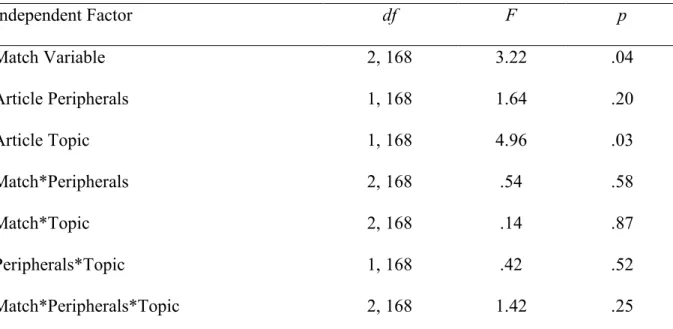
For MTurk, there was a significant main effect for the match variable as well as the article topic. See Table 1 for a report of the ANOVA. For the main effect of the match variable, M = 3.50, SD = 1.06 for participants whose political leaning matched the article’s leaning, M =
article’s leaning, and M = 3.45, SD = .97 for participants whose political leaning mismatched the article’s leaning. According to Fisher’s Least Significant Difference post-hoc analyses
comparing two groups at a time, the means for the match and neither conditions differed, but the match and mismatch conditions were the same. For the main effect of article topic, M = 3.15, SD = .95 for the foundation story and M = 3.50, SD = .95 for the polling story. No other terms were
significant for the MTurk sample. Because the interaction between match and peripheral variables were not statistically significant, H1a and H1b were not supported for the MTurk sample either.
Table 1. MTurk Sample ANOVA Explaining Positive Affect After Reading a Fake News Article
Independent Factor df F p
Match Variable 2, 168 3.22 .04
Article Peripherals 1, 168 1.64 .20
Article Topic 1, 168 4.96 .03
Match*Peripherals 2, 168 .54 .58
Match*Topic 2, 168 .14 .87
Peripherals*Topic 1, 168 .42 .52
Match*Peripherals*Topic 2, 168 1.42 .25
Note. The match variable signals whether the participant’s political leaning matched the political leaning of the article (= 1), whether there was neither a match nor mismatch because the
The next analyses were used to test the second set of hypotheses, shown below:
H2a: In cases when peripheral cues do not contain fake news cues, the more a reader’s political leaning matches the leaning conveyed in the message, the stronger the
relationship their positive affect will be with (lower) skepticism about the message. H2b: In cases when peripheral cues contain fake news cues, the more a reader’s political leaning matches the leaning conveyed in the message, the weaker the relationship their positive affect will be with (lower) skepticism about the message.
To test H2a and H2b, a Pearson correlation analysis was used looking at the relationships between positive affect and (lack of) skepticism for those participants in the UNC sample (and then MTurk) who matched the article’s political leaning, comparing the correlations when the article had fake peripherals versus when the article did not have the fake peripherals. For the UNC sample, the correlation analysis indicated that positive affect did not correlate significantly with lack of skepticism. For UNC participants who matched the article’s political leaning, the correlation was r = .09, p = .61 for the participants who got the article with the fake peripherals and r = .20, p = .21 for those who got the article without the fake peripherals. H2a and H2b are not supported for UNC.
were hypothesized to have the weaker relationship. So actually, H2a and H2b were not supported for MTurk either, although there was at least the relationship present.
The next analyses were used to test the following set of hypotheses:
H3: In cases when peripheral cues do not contain fake news cues, the more a reader’s political leaning matches the leaning conveyed in the message, the less overall elaboration the reader will demonstrate, as indicated by (a) the number of thoughts generated and (b) the amount of focus on peripheral cues (as opposed to central story components) in those generated thoughts.
Two 3 (match/neither/mismatch) X 2 (no fake peripherals/with fake peripherals) X 2 (poll story/foundation story) univariate ANOVAs were used to evaluate H3a for UNC and MTurk with the count of unique thoughts as the dependent variable. None of the terms were statistically significant for either ANOVA for UNC or MTurk, so H3a was not supported. Originally, two ANOVAs were going to be used to evaluate H3b with count of peripheral mentions as the dependent variable. However, because there was so little variation in the mention of peripheral cues by participants, this analysis was dropped and so H3b could not be evaluated.
The above analyses for H3 were planned to also address, RQ1, stated below:
The ANOVAs for the tests of H3 had no significant findings, therefore, RQ1 could not be evaluated because there were no differences found. Had there been differences, a T-test would have been conducted looking for differences among only the people who matched their article’s leaning. In general, there was too little variation among the elaborations, especially among the peripherals. Very few participants picked up on, or wrote down, any of the peripheral cues in the news articles.
The next analyses were used to address RQ2:
RQ2: In cases when peripheral cues contain fake news cues, the more a reader’s political leaning matches the leaning conveyed in the message, how will the overall elaboration the reader demonstrates relate to their reported skepticism of the message and the credibility they assign to the message?
To test RQ2, a Pearson correlation analysis was used looking at the relationships between elaboration and (lack of) skepticism among UNC and MTurk participants who received the fake news article with fake peripheral cues based on how much their article matched their political leaning (match, neither, or mismatch). The correlation analysis indicated that lack of skepticism did not correlate significantly with elaboration, using the count of unique thoughts as the
measure of elaboration. In the UNC sample, there was no correlation between skepticism and count for the participants who got a mismatch, neither a match or mismatch, or a match, r = .07, p = .72; r = -.05, p = .69; and r = -.12, p = .48, respectively. For MTurk, skepticism and
The next analyses were used to evaluate RQ3 below:
RQ3: In cases where participants’ levels of skepticism are low, what will be participants’ propensity to share the fake news article? Do participants share fake content more widely (i.e., through a Facebook post as opposed to email)?
Exploratory Analyses
While this was not part of any hypotheses or research questions, two 3 (match/neither/mismatch) X 2 (no fake peripherals/with fake peripherals) X 2 (poll
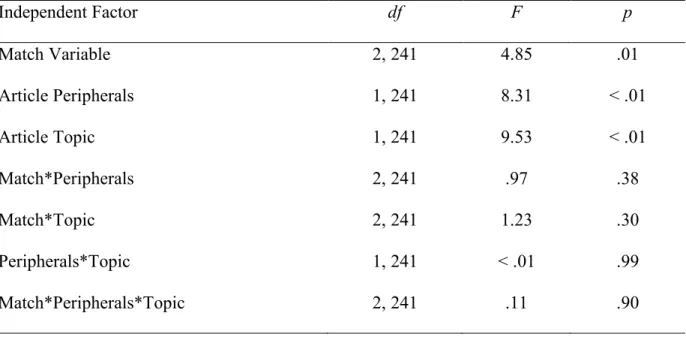
story/foundation story) univariate ANOVAs were used to evaluate willingness to share for both the UNC and MTurk samples. Table 2 shows the ANOVA results for UNC. UNC participants were significantly more likely to share the story with their networks if they were in matched with their article (M = 2.55, SD = .96) compared to participants who were mismatched (M = 2.00, SD = 1.02), based on Fisher’s Least Significant Difference post-hoc analyses of pairs of groups. The participants who neither matched nor mismatched their article were in between (M = 2.32, SD = .94) and differed from the mismatch but not the match group. Also, UNC participants were more likely to share when no obviously fake peripheral cues were present (M = 2.49, SD = .96) than if fake cues were present (M = 2.14, SD = .97), and they were more likely to share the foundation story (M = 2.48, SD = .95) compared to the poll story (M = 2.16, SD = .98).
Table 2. UNC Sample ANOVA for Willingness to Share After Reading a Fake News Article
Independent Factor df F p
Match Variable 2, 241 4.85 .01
Article Peripherals 1, 241 8.31 < .01
Article Topic 1, 241 9.53 < .01
Match*Peripherals 2, 241 .97 .38
Match*Topic 2, 241 1.23 .30
Peripherals*Topic 1, 241 < .01 .99
The MTurk sample ANOVA did not have any significant findings. Therefore, MTurk participants’ willingness to share was not based on the type of article used in this study.
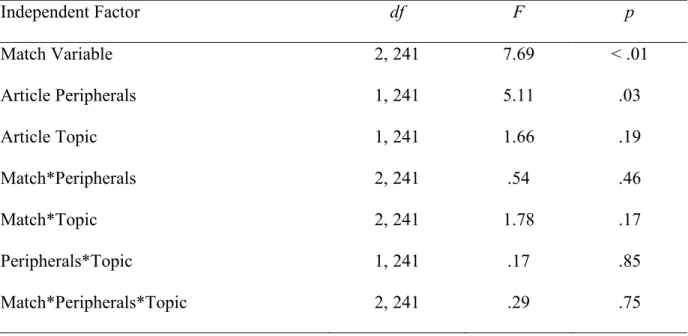
One final exploratory set of analyses looked at general impressions of the article as the dependent variable in similar ANOVAs for UNC and MTurk. For UNC, impressions were better if they were in matched with their article (M = 4.17, SD = 1.54) compared to participants who were mismatched (M = 4.64, SD = 1.48), and participants who neither matched nor mismatched their article were in between (M = 4.32, SD = 1.38). However, based on Fisher’s Least
Significant Difference post-hoc analyses, none of these means significantly differed if compared directly with one another (two at a time). Also, impressions were significantly worse when their article contained fake peripherals (M = 4.58, SD = 1.42), compared to participants who got articles that did not have those fake cues (M = 4.12, SD = 1.46). The MTurk sample’s ANOVA had no significant results. Table 3 shows the UNC ANOVA results.
Table 3. UNC Sample ANOVA for General Impressions After Reading a Fake News Article
Independent Factor df F p
Match Variable 2, 241 7.69 < .01
Article Peripherals 1, 241 5.11 .03
Article Topic 1, 241 1.66 .19
Match*Peripherals 2, 241 .54 .46
Match*Topic 2, 241 1.78 .17
Peripherals*Topic 1, 241 .17 .85
Chapter IV.I DISCUSSION
The overarching research problem this study addressed was whether or not people are susceptible to falling for fake news and whether or not they would take their susceptibility one step further and share the fake news with their social networks. This subject is a critical area of research because of the proliferation of fake news across social media platforms during the 2016 Presidential Election cycle. I examined the role that factors such as peripheral cues in a fake news article and the political leaning of the fake news article influence how people feel after reading the article, whether or not people believe in or are skeptical of the article, have lingering thoughts about the article, and are willing to share fake news through their own digital media channels.
This study was based on existing literature surrounding cognitive dissonance.
these results were not statistically significant, the participants collected from UNC (Study 1) also showed this pattern. This is consistent with previous literature and suggests that these individuals experienced less cognitive dissonance when reading the article than those who did not agree with the article’s slant.
The Elaboration Likelihood Model (ELM) was another major pillar guiding this study. ELM proposes two routes, central and peripheral, that people use to process information
(Cacioppo & Petty, 1984). The central route of processing is a more meaningful, involved route where people pay attention to the information presented to them and engage in synthesis. In contrast, the peripheral route is a more passive way of processing in which a person uses peripheral cues to make decisions or judgements about the information.
This study focused on what effect specific factors—in this case presence or lack of peripheral cues and article ideology match or mismatch—had on participants’ elaboration, or unique thoughts. As the model suggests, people are expected to be more likely to elaborate on something when they are more connected to it (Cacioppo & Petty, 1984). Additionally,
skepticism plays a large role in elaboration likelihood (Taber & Lodge, 2006) (Ditto & Lopez, 1992) (Zuwerink & Devine, 1996) (Sher & Lee, 2009). From the existing literature surrounding skepticism and ELM, it was hypothesized that the more a participant’s political leaning matched that of the article, the less skeptical they would be and vice versa (H2a and H2b). A lack of skepticism would then theoretically lead people to report a more positive affect and elaborate less on the article since they align with the leaning and vice versa (H3a and H3b).
with a different study that encouraged the writing down of thoughts in a different way, or perhaps if there were more people in the samples, a statistically significant finding might have emerged. Additionally, Ditto and Lopez (1992) found that people who received information contrary to their preferred conclusion were more skeptical of the results and examined them more critically. Perhaps it was the case in the present study that participants were less motivated to share their thoughts on the article or felt that it was “just another political article” designed to polarize people.
Although there were no statistically significant results relating to elaborating on thoughts about articles, there were significant results on the relationship between sharing and skepticism. Specifically, this study found that both UNC and Mechanical Turk participants who were less skeptical were more likely to share the article, regardless of the article topic or if peripheral cues were present. This finding is very interesting and shines light on the potential cause of the fake news proliferation crisis on social media. Perhaps the fake news articles that were most widely circulated had a certain quality that made readers less skeptical and therefore more likely to share it. According to this study, peripheral cues were not the factors that led readers to be less
skeptical. Maybe the syntax of the articles or another factor causes low skepticism. Further research could be conducted to more thoroughly examine this relationship. Also, in future
studies, more obvious or more numerous fake news peripheral cues could be used to test ELM in a better way. Future studies could also vary the topics more. One last possibility is that people may process political information differently than they do information regarding topics like math and science.
toward social networks, such as Facebook, becoming increasingly homogenous. Furthermore, if a person elects to share the news on their social media, it could mean that they are entirely convinced by the article or that their social network will “like” or view the article in the same way. In congruence with Greenwood, Perrin, and Duggan (2016), participants in both UNC and Mechanical Turk groups reported using Facebook at a very high rate. Sixty six percent of UNC respondents and 58% of Mechanical Turk respondents reported using Facebook every day. However, only 22.9% of UNC respondents reported that they would share the article on Facebook, compared to 27.3% of Mechanical Turk respondents. It is interesting that roughly a quarter of each group would share the article on their Facebook even though the average age for participants in the UNC pool was 20 compared to 32 years old for Mechanical Turk participants.
Chapter IV.II CONCLUSION
References
Alefantis, J. (2017, April 20). What happened when ‘Pizzagate’ came to my restaurant. The Washington Post. Retrieved from https://www.washingtonpost.com/opinions/pizzagate-
taught-us-the-value-of-community/2017/04/19/92cae67c-23b0-11e7-bb9d-8cd6118e1409_story.html?utm_term=.2d84f1934500.
Allcott, H. and Gentzkow, M. (2017). Social media and fake news in the 2016 election. Journal of Economic Perspectives, 31(2), 211-236.
Beasley, R. and Joslyn, M. (2001). Cognitive dissonance and post-decision attitude change in six presidential elections. Political Psychology, 22, 521–540.
Bendix, A. (2017, June 22). Pizzagate shooter to serve four years in jail. The Atlantic. Retrieved from http://www.theatlantic.com/news/archive/2017/06/dcs-pizzagate-shooter-sentenced-to-4-years-in-jail/531381/.
Brehm, J. W. (2007). A brief history of dissonance theory. Social and Personality Psychology Compass, 1(1), 381-391. http://dx.doi.org/10.1111/j.1751-9004.2007.00035.x.
Cacioppo, J. T., & Petty, R. E. (1981). Social psychological procedures for cognitive response assessment: The thought listing technique. Cognitive assessment, 388-438.
Cacioppo, J. T. and Petty, R. E. (1984). The elaboration likelihood model of persuasion. Advances In Consumer Research, 11(1), 673-675.
Cacioppo, J. T., Glass, C. R., & Merluzzi, T. V. (1979). Self-statements and self-evaluations: A cognitive-response analysis of heterosocial anxiety. Cognitive Therapy and Research, 3, 249-262.
Chimielewski, T. L. (2012). Applying the elaboration likelihood model to voting. The International Journal of Interdisciplinary Social Sciences, 6(10), 33-47.
Cooper, J. (2012). Cognitive dissonance theory. Handbook of Theories of Social Psychology, 1, 377-397. http://dx.doi.org/10.4135/9781446249215.n19.
Ditto, P. H. and Lopez, D. F. (1992). Motivated skepticism: Use of differential decision criteria for preferred and nonpreferred conclusions. Journal of Personality and Social
Psychology, 63(4), 568-584. http://dx.doi.org/10.1037/0022-3514.63.4.568.
Elliot, A. J. and Devine, P. G. (1994). On the motivational nature of cognitive dissonance: Dissonance as psychological discomfort. Journal of Personality and Social Psychology, 67(3), 382-394. http://dx.doi.org/10.1037/0022-3514.67.3.382.
Festinger, L. (1957). A theory of cognitive dissonance. Evanston, IL: Row & Peterson.
Forgas, J. P., & East, R. (2008). On being happy and gullible: Mood effects on skepticism and the detection of deception. Journal of Experimental Social Psychology, 44(5), 1362-1367. https://doi.org/10.1016/j.jesp.2008.04.010.
Greenwood, S., Perrin, A., and Duggan, M. (2016). Social media update 2016: Facebook usage and engagement is on the rise, while adoption of other platforms holds steady. Pew Research Center. Retrieved from http://www.pewinternet.org/2016/11/11/social-media-update-2016/.
Harmon-Jones, E. and Mills, J. (2001). An introduction to cognitive dissonance theory and an overview of current perspectives on the theory. Criminal Behavior and Mental Health, 11(1), S34-S37. http://dx.doi.org/10.1002/cbm.420.
Holt, L. F. (2017). Using the elaboration likelihood model to explain to whom “Black Lives Matter” … and to whom it does not. Journalism Practice.
http://dx.doi.org/10.1080/17512786.2017.1370974.
Kasprak, A. (2017, Oct. 12). New research suggests massive Yellowstone eruption could occur sooner than expected?. Snopes. Retrieved from http://www.snopes.com/new-research-yellowstone-eruption-occur-sooner/.
LaCapria, K. (2017, Oct. 3). Gordon Ramsay has entire staff take a knee, refuse to serve Miami Dolphins?. Snopes. Retrieved from http://www.snopes.com/gordon-ramsay-entire-staff-take-knee-refuse-serve-miami-dolphins/.
Lazer, D., Baum, M., Grinberg, N., Friedland, L., Joseph, K., Hobbs, W., & Mattsson, C. (2017, May). Combatting fake news: An agenda for research and action. Paper presented at Harvard Kennedy School and Northeastern University Conference Feb. 17-18, Cambridge, MA. Retrieved from https://shorensteincenter.org/combating-fake-news-agenda-for-research/.
Lemire, J. Robert Mueller Examining President Trump’s Connections to Cambridge
Lewis, K., Gonzalez, M., & Kaufman, J. (2012). Social selection and peer influence in an online social network. Proceedings of the National Academy of Sciences, 109(1), 68-72.
McGregor, M. R. (2013). Cognitive dissonance and political attitudes: the case of Canada. The Social Science Journal, 50, 168-176.
Mikkelson, D. (2017, Oct. 13). Police arrest Mandalay security guard Jesus Compos as second shooter in Las Vegas massacre?. Snopes. Retrieved from http://www.snopes.com/police-arrest-jesus-campos/.
Nail, P. R., Bedell, K. E., Little, C. D. (2003). Should President Clinton be prosecuted for perjury? The effects of preference for consistency, self-esteem, and political party affiliation. Personality and Individual Differences, 35(8), 1821-1831.
https://doi.org/10.1016/S0191-8869(03)00032-1.
Obermiller, C., & Spangenberg, E. R. (1998). Development of a scale to measure consumer skepticism toward advertising. Journal of consumer psychology, 7(2), 159-186.
Office of Institutional Research and Assessment (2017). Analytic Reports. http://oira.unc.edu/reports/.
Paolacci, G., Chandler J., Ipeirotis P. (2010). Running experiments on Amazon Mechanical Turk. Judgment and Decision Making, 5(5), 411-419.
Quattrociocchi W., Scala, A., Sunstein, C. R. (2016). Echo chambers on Facebook. Unpublished manuscript, Laboratory of Computational Social Science, IMT Lucca, Lucca, Italy; Institute of Complex Systems, CNR, Rome, Italy; Harvard Law School, Cambridge, MA, US.
Rubin, V. L., Chen, Y., and Conroy, N. J. (2015). Deception detection for news: three types of fakes. Proceedings of the Association for Information Science and Technology, 52(1), 1-4. http://dx.doi.org/10.1002/pra2.2015.145052010083.
Seidenberg, S. (2017). Fake news has long held a role in American history. ABA Journal. Retrieved from http://www.abajournal.com/magazine/article/history_fake_news.
Sher, P. J., and Lee, S. H. (2009). Consumer skepticism and online reviews: An elaboration likelihood model perspective. Social Behavior and Personality: an international journal, 37(1), 137-143. https://doi.org/10.2224/sbp.2009.37.1.137.
Stone, J. and Cooper, J. (2001). A self-standards model of cognitive dissonance. Journal of Experimental Social Psychology, 37, 228-243. http://dx.doi.org/10.1006/jesp.2000.1446.
Taber, C. S., & Lodge, M. (2006). Motivated skepticism in the evaluation of political beliefs. American Journal of Political Science, 50(3), 755-769. https://doi.org/ 10.1111/j.1540-5907.2006.00214.x.
Watson, D., Clark, L. A., & Tellegen, A. (1988). Development and validation of brief measures of Positive and Negative Affect: The PANAS Scales. Journal of Personality and Social Psychology, 54,1063-1070.
Appendices
A. UNC Questionnaire
Susceptibility to Fake News - UNC
participants
Start of Block: Consent Form for UNC participants
Q45 --Dear participant,
My name is Becca Kronebusch and I am a media and journalism student at the University of North Carolina at Chapel Hill. I am conducting a research study, in partial fulfillment of graduating with honors. The purpose of the research is to gain insight into article messaging.
The survey, which will ask you questions after reading, should take less than 15 minutes of your time and is voluntary. You may choose not to participate or stop taking the survey at any time, and you may skip any question for any reason. This will not affect your class standing or grades at UNC-Chapel Hill. You will not be offered or receive any special consideration if you take part in this research. You will not receive any direct benefit from being in this research study. The only possible risk to you of participating in this research study might be embarrassment if your answers became public, but that is very unlikely. All possible measures have been taken to protect the confidentiality of your answers. UNC Media and Journalism students who choose to participate in the study will receive 0.5 hours of research participation credit. Mechanical Turk users who participate in the study will receive $0.30 for their participation.
I will report only summaries of the aggregated data. This means that your responses will be combined with all of the other responses received and will not be able to be identified as yours. Deductive disclosure which is the discerning of an individual respondent's identity and responses through the use of known characteristics of that individual is also possible but unlikely. MTurk worker IDs will not be shared with anyone outside of the research team, will be removed from the data set, and/or will not be linked to survey/study responses (as applicable). Note that Amazon.com has stated that the MTurk platform is NOT meant to support participant
anonymity. MTurk worker IDs are linked to Amazon.com public profiles. Amazon.com may disclose worker information. Additionally, worker information may be available to others (who submit a request) for tax reporting purposes.
If you have any questions regarding this survey, you may contact me via email at
By clicking below and completing the survey, you agree to be a participant in this study.
Thank you, Becca Kronebusch
o
I agree to be a participant in this study (take me to the survey). (1)Q46 At the end of this study, you will be asked to enter your name and UNC PID in order to get research credit for your participation. Please continue!
Q1 Please enter your age in numbers.
________________________________________________________________
Q2 If you had to choose, which of the following categories best describes your ethnic or racial heritage? Please check all that apply.
o
White- Non-Hispanic (1)o
Hispanic or Latinx (2)o
Black or African American (3)o
Native American or American Indian (4)o
Asian or Pacific Islander (5)o
Other (6)Q7 What gender do you identify as?