Julie L. Greenberg. Intra-Professional Mobility Between Public and Academic Libraries: An Exploration of Trends and Barriers to Mobility. A Master‘s Paper for the M.S. in L.S. degree. April, 2011. 41 pages. Advisor: Ronald E. Bergquist
This study examines the myths surrounding intra-professional mobility between public and academic libraries by analyzing data from the Workforce Issues in Library and Information Science (WILIS) I career survey to determine how many librarians have moved professionally between the two environments. Examining responses from
librarians who have held positions in public libraries, but no academic libraries; academic libraries but no public libraries; and those who have held positions in both environments, this study attempts to construct a more concrete understanding of the actual professional movements of librarians, and some insight into the barriers, if any, to this transition. By developing an evidence-based picture of the professional movements of practicing librarians, librarians just entering the field and those considering a career change will be able to make more informed decisions in choosing their first and subsequent professional environments.
Headings:
Librarians -- College and University Librarians
Librarians -- Public libraries / Staff -- Personnel / Selection and appointment -- Placement of Librarians
Intra-Professional Mobility Between Public and Academic Libraries: An Exploration of Trends and Barriers to Mobility
by
Julie L. Greenberg
A Master‘s paper submitted to the faculty of the School of Information and Library Science of the University of North Carolina at Chapel Hill
in partial fulfillment of the requirements for the degree of Master of Science in
Library Science.
Chapel Hill, North Carolina April, 2011
Approved by
Acknowledgements
The WILIS 1 and 2 studies were supported by grants from the Institute of Museum and Library Services. The primary research team from the School of
Information and Library Science at UNC Chapel Hill and the UNC Institute on Aging consisted of Joanne Gard Marshall, Lead Principal Investigator; Victor W. Marshall, Co-Principal Investigator; Jennifer Craft Morgan, Co-Co-Principal Investigator; Deborah Barreau, Investigator; Barbara Moran, Investigator; Paul Solomon, Co-Investigator; Susan Rathbun Grubb, Graduate Research Assistant; and Cheryl A. Thompson, Project Manager.
Table of Contents
Introduction ... 3
Literature Review... 8
Systems of Professions and Occupational Prestige ... 9
Intra-professional Mobility in Libraries... 15
Method ... 21
Research Design... 21
Survey Population ... 22
Data Analysis ... 24
Accounting for Risk ... 25
Results ... 26
Discussion ... 31
Conclusion ... 32
References ... 35
List of Tables Table 1: WILIS I Participating LIS Programs ... 23
Table 2: Public and Academic Job Histories ... 26
List of Figures Figure 1: Current Job by Library Type (All Respondents of WILIS I) ... 4
Figure 2: WILIS I Respondents by Library Type ... 27
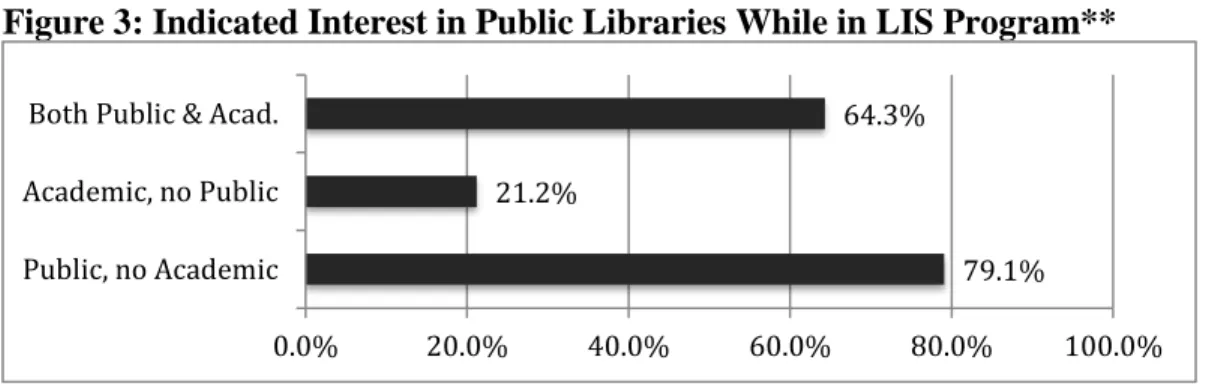
Figure 3: Indicated Interest in Public Libraries While in LIS Program ... 28
Figure 4: Indicated Interest in Academic Libraries While in LIS Program ... 28
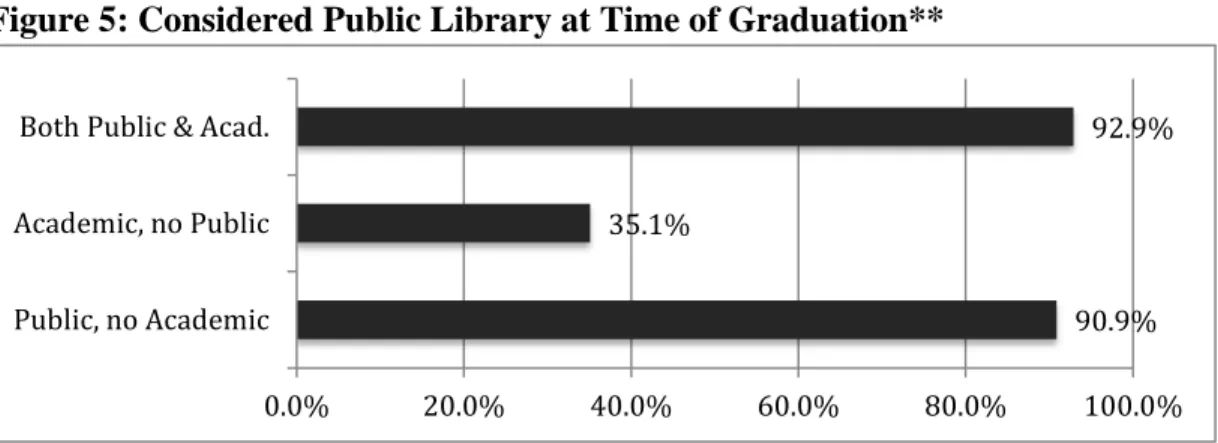
Figure 5: Considered Public Library at Time of Graduation ... 29
Introduction
In a recent post to her ALA blog, ―Annoyed Librarian‖ presented an interesting if crass reflection on intra-professional mobility between public and academic libraries. The author noted that while many online forums reflect the desire and difficulty of moving from public to academic libraries, comparatively few posts express a desire to move in the opposite direction: ―I notice almost no one wants to move from academic to public libraries, but I‘m not sure what one does to move the other way. The libraries seem like two different cultures that share a basic vocabulary but not much else. Outside of technical work, do the two have anything in common? It doesn‘t seem to me that experience in one is preparation for work in the other‖ (Annoyed Librarian, 2010). Although the comments section of this blog post reveal a wide range of opinions, it appears that many librarians share common beliefs and anxieties about transitioning from one environment to another. The comments express concerns about skill transference, previous experience, hiring bias, and the distinct nature of the work and patrons in each environment.
employed in public libraries (Henderson et al., 2010), and approximately 27,030 full-time equivalent librarians employed in academic libraries (Phan, Hardesty, Sheckells & Davis, 2009). What is not known (or as-yet reported) is the amount of interchange that happens between these two branches of the profession. How many librarians have successfully negotiated the divide between public and academic libraries and have been employed in both spheres?
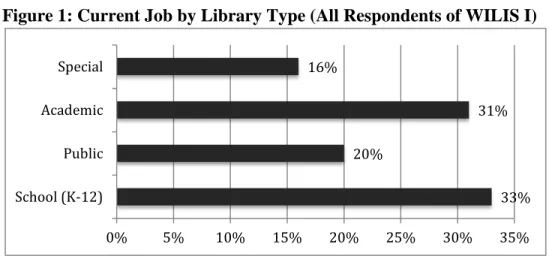
This study focuses on public and academic library environments for two primary reasons. The first, self-serving motive (and the impetus behind this study), is that over the course my LIS program I had considered working in both of these settings, and had received advice on several occasions regarding the difficulty of moving professionally between public and academic libraries. The second reason these two environments were chosen over any other, is that, as evidenced by the results of the WILIS I survey (see Figure 1), public and academic libraries constitute two of the most common settings in librarianship (Marshall et al., 2005b). While similar inquiries into other library
environments would also be valuable, the current study‘s scope will be limited to these two settings.
Figure 1: Current Job by Library Type (All Respondents of WILIS I)
Working in Libraries (N = 1515)
33% 20%
31% 16%
0% 5% 10% 15% 20% 25% 30% 35%
The intent of this quantitative study is to explore the occurrence of intra-professional mobility of librarians between public and academic libraries, and the barriers, if any, to this professional movement. Data from the Workforce Issues in Library and Information Science (WILIS) career survey (Marshall et al., 2005) will be analyzed using quantitative methods to discover the number and percentage of graduates from six library and information science programs in North Carolina who have worked in only public libraries, only academic libraries, and both public and academic libraries. Survey responses from each of these three groups will be compared to discover trends or commonalities over the course of the respondents‘ careers. In addition, responses to questions related to job satisfaction will be examined to identify potential affective forces which may have influenced professional mobility decisions, and these responses will be used to further inform the data on intra-professional mobility.
Intra-professional mobility in this context refers to the ability to move
Fortunately, other fields—such as management and sociology—have written extensively about the phenomenon of career mobility and career change more generally, and so theories of mobility used in this study will be drawn from research outside the realm of library science.
Intra-professional mobility will be considered within the context of theories of social capital and occupational prestige. As will be noted in the literature review, intra-professional perceptions and constructions of value can have important implications for occupational status, power, and by extension, mobility. Of particular interest to the present study, are Abbott‘s (1988) musings on the development of the library profession. Abbott notes that around the turn of the twentieth century, academic and special libraries stood at the center of the profession, and their professional status was both created and reinforced by their efforts to manage standardized cataloging and by their association with prestigious universities and their associated clientele. At the same time, school librarians were often seen as teachers serving a dual-role, while small public librarians retained very localized priorities and concerns, and so these two subsets of the profession remained on the periphery as professional organizations further stratified librarianship. And thus, these separate branches of the profession developed in parallel, ultimately concerned with different priorities, pressures, and constraints which shaped their present relationships (Abbott, 1988).
environments may contribute to this movement, though no explicit research on this issue has been conducted to date. Through examining this issue, it is assumed that a more complete and nuanced understanding of the experience of moving professionally from one branch of librarianship to another will emerge. This study will address the following research questions: How many WILIS survey respondents have worked in both public and academic libraries over the course of their career? Is making the transition from public libraries to academic libraries (or vice versa) difficult? If so, what are the barriers encountered in attempting to carry out this professional move? And finally, a question that is expected to arise from the data, but which will need to be addressed in future research: Are there commonalities in the perception of public librarians and public library work by academic librarians (and vice versa), and do these create barriers to professional mobility?
uncommitted to one environment or the other, having a greater knowledge of the experience of librarians who have shifted or attempted to shift professionally might influence their decisions when pursuing their first job. After all, if an MLS graduate possesses the skills necessary to work in either a public or academic library upon graduation, it would be valuable to know whether her first job might limit or expand future career possibilities.
This study would also be of interest to schools of library science, especially since—depending on the findings of this study—a greater or lesser degree of
specialization might be advisable for library students considering a career in either public or academic libraries, or both. Curriculum decisions and advisory models could also potentially be adjusted in the wake of more evidence-based conceptions of professional mobility. Finally, the findings of this study might influence the hiring practices of individual institutions, as results of the study will likely point to the success (or lack of success) of librarians who have shifted from one professional sphere to another, and institutions may find their beliefs about skill transference and professional mobility reinforced or challenged. It is the aim of this study to contribute positively to the body of knowledge about professional mobility and work force issues within the field of library science, and to unveil the myth of the public-academic professional chasm.
Literature Review
workforce may indeed be presented with an array of career choices, if commonly-held beliefs about the difficulty of intra-professional mobility hold true (Edwards, 2002), the environment that librarians choose for their first position may limit future job prospects. This literature review and the study that follows will attempt to reveal the actual
professional moves, and the challenges that librarians face over the course of their career in an attempt to answer the question: Approximately how many librarians move
professionally from public libraries to academic libraries, and from academic libraries to public libraries, and what barriers to intra-professional mobility do they encounter, if any?
As there are no empirical studies that address this problem directly to date, this review of the literature will explore more broadly theories of professions as systems, theories of occupational prestige, and mobility within the professions. While this
literature primarily addresses professions such as medicine and law, the insights gathered may have important implications for the field of library science, at least until the
profession is able to generate its own data. Finally, the limited research on professional stratification and intra-professional mobility within libraries will be reviewed in order to build on existing inquiries undertaken in archives and business libraries.
Systems of Professions and Occupational Prestige
studies examining patrons‘ perceptions of libraries exist (e.g., Martin & Park, 2010), there are currently no studies that examine librarians‘ perceptions of other types of libraries. If barriers to intra-professional mobility become evident in the current study (whether actual or perceived), it is assumed that these barriers will be closely related to professional status and perceptions of the nature of the work and related skill sets of other library environments. Through reviewing the literature on intra-professional status hierarchies and occupational prestige, the author hopes to gain insight into the complex relationships and exchanges between public and academic librarians.
are those who deal with problems from which the human complexities are not or cannot be removed‖ (p. 824). Purity of work translates into purity of status.
If this theory of intra-professional status is extended to libraries, it is not difficult to imagine why a public reference librarian, who frequently serves populations with complex, daily life-emergent, critical needs, might be perceived as possessing less prestige than a librarian in an academic research institution who serves primarily academic clients with clearly defined research goals and a high degree of prestige themselves. As Abbott (1981) notes, higher status clients are in turn better able to translate ―professional prescriptions into their own world of action,‖ thus further maintaining the purity of the transaction. While the present study will not attempt to measure intra-professional status among public and academic librarians, and while the secondary part of Abbott‘s theory would not appear to hold true for the library profession (that as intra-professional prestige and professional purity increase, the profession‘s perceived prestige among the general public decreases), it is hypothesized that Abbott‘s theory will provide valuable insight for interpreting the results of intra-professional mobility and perceived barriers to mobility.
Building on Abbott‘s theory, Zhou‘s (2005) study which examined occupational prestige rankings, developed the hypothesis that legitimacy and appropriateness (a logic of ‗social recognition‘) contribute to perceived regularities in occupational prestige rankings, once again pointing to perceptions of legitimate or ‗pure‘ practice as impacting perceived professional status. In particular, one of Zhou‘s hypotheses has significant implications for the present study:
its authority is contested and challenged, hence the less likely that its claims can be ‘naturalized’ and that it receives higher prestige rating [sic] compared with those knowledge-based occupations. (p. 100)
Like Abbott (1981), Zhou points to the nature of a profession‘s work and its involvement with the complexities and challenges of human lives as contributing negatively to
occupational prestige. Controlling for the effects of resources (e.g., income), and education requirements and training time (all elements of functional logic), Zhou
developed a sample of 1,500 respondents, divided into 12 subsamples of 125 respondents each, and asked them to rate the ―social standing‖ of occupations based on the Dictionary of Occupational Titles on a scale of 1-9. Zhou found that past consistencies in studies of prestige rankings may be attributable to the use of functionalist logic (as opposed to social recognition) and methodological aggregation problems. Zhou proposes that future studies of occupational prestige must account for social recognition in addition to
functional importance, resources, and authority, when investigating perceptions of status. Working within the theoretical traditions of Pierre Bourdieu and Max Weber, Burris‘ (2004) investigation of prestige hierarchies among PhD departments found that departmental status is impacted by the department‘s ―position within networks of
productivity. While the primary results of the study are not directly applicable to the present study (since there is no indication that productivity is the basis for status differences in library science), the secondary finding of the study—that departmental prestige rankings were remarkably stable over long periods of time, suggesting the ―self-reproducing capacity of social capital‖ (Burris, 2004, p. 260)—lends further support to the idea that occupational prestige is a socially constructed phenomenon. While the results of this study cannot be generalized to a profession as different as librarianship, it is still useful to consider the impact that social capital might have on a branch of
librarianship or the field as a whole.
Similar to Burris‘ investigation of intra-professional prestige disparities, Kay (2009) investigated intra-professional competition and earnings inequalities among the legal profession in Québec, Canada. Kay administered two surveys to a stratified simple random sample of the two legal professions in question—notaires and avocats—yielding a total of 580 usable surveys. Survey questions addressed six categories of variables: demographic, human capital, symbolic capital, social capital, organizational context, and dispositions. In addition, Kay conducted semi-structured interviews with 20 avocats and 10 notaires in order to explore four central themes: professional context, career
satisfaction, family responsibilities, and dynamics of change in the Québec legal
capital (e.g., skill of firm‘s lawyers), pointing to the strong tie between social capital and professional value.
Outlining a social capital theory of career success, Seibert, Kraimer, and Liden (2001) undertook three distinct ventures: to examine and integrate current theories of social capital as they relate to career success, to examine the effects of social capital on career outcomes, and to integrate social network structure research with research on mentoring and careers. Examining and using three different theories of social capital— weak tie theory, structural holes (both considered ―social network structures‖), and social resources theory—the authors mailed a paper survey to 2,781 randomly-selected
While Seibert et al.‘s (2001) study does not address professional mobility per se, it has important implications for the role of social capital in job satisfaction, networking, and by extension, mobility. In addition, exploring the role of social capital as it relates to intra-professional mobility in librarianship could provide important insights into the mechanisms of and barriers to professional mobility. Further exploration of theories related to social capital (e.g., the work of Pierre Bourdieu) as they apply to the library profession would provide a theory in which to ground studies similar to the present study.
To reiterate, all of the studies considered in this literature review related to intra-professional status, occupational prestige, and social capital provide a rich context in which to place the current study, yet very little research has been conducted within the particular challenges and opportunities that a segmented field such as library science offers. By investigating the ways in which prestige and perceptions of professional value (i.e., social capital) impact actual professional value and opportunities, a more nuanced and complete understanding of the complexities involved in intra-professional mobility could be constructed.
Intra-professional Mobility in Libraries
be found will now be examined with particular attention to methodologies and implications for study development.
Interested in the phenomenon of librarianship as a second or even third career, Whitten and Nozero (1997) conducted a pilot study investigating the effect of first careers on second-career academic reference librarians, defining the sample as those librarians who had moved from other professional librarian positions and
paraprofessional positions into academic reference librarianship. Employing an initial sample of 57 librarians at the University of Nevada, Las Vegas; the University of
Nevada, Reno; and the Community College of Southern Nevada, the authors distributed a one-page survey questionnaire inquiring about the ―impact of their previous experience on their reference philosophy‖ (p. 193-94). While only two of the survey respondents had previously worked in libraries, it is still interesting that most respondents thought that ―their prior work experience helped them get their first job as an academic librarian‖ (p. 200), even though most were attempting to enter the field from a career outside of librarianship. Unfortunately, the results of this survey are limited (sample size and response rate were very low—26% and 45.6% respectively, and gender distribution was biased), and the authors were unable to sufficiently answer their initial question of whether or not hiring committees are influenced by previous work experience.
A similar, if also limited (convenience sample size: 21 librarians), study was conducted in the UK, and found that people who had changed careers to librarianship thought that they had created their own opportunities in securing a position in their new profession (Deeming & Chelin, 2001). However, caution should be used when
methodology (regardless of the author‘s confidence: ―The key themes relating to the career change process can thus be generalised to the UK population of professional librarians, if the assumption that people are fundamentally the same, whatever their location, is accepted‖ [p. 25]). So, while studies of newly-entering or second-career librarians exist, results and implications are significantly limited, further supporting the need to investigate workforce issues within the profession.
In a study that approaches this issue from the opposite direction, Luzius and Ard (2006) investigated the motivations of former academic librarians for leaving the
Ard pointed to the need to ―properly [train] and [support] administrators and supervisors in order to improve working conditions for librarians‖ (p. 597), though it is not clear from their research that this would have a significant mitigating effect. While limited in scope, the results of this survey point to potential impetuses for making a career shift, whether to another library, or outside of the field entirely.
Addressing the same question of ‗library desertion‘ in her dissertation and also utilizing the WILIS data set (see methodology section of this paper for further
discussion), Rathbun-Grubb (2009) noted that 23% (n = 331) of library workers hold a position that is different from their first post-LIS program job: ―Of those who started in public libraries but have changed library types, 36% are working in school libraries, 34% are in academic libraries, and 30% are in special libraries or archives‖ (p. 99). This would suggest that librarians are indeed making intra-professional career moves, though further exploration of the data and further research is needed to determine exactly how many librarians are moving in either direction, and how many librarians have faced barriers to this mobility. In addition, Rathbun-Grubb reported that of those WILIS survey respondents whose first job after completing their MLS program was in a public library (n = 91), 34% were currently working in an academic library, and of those respondents whose first job after completing their MLS program was in an academic library (n = 93), 24% were currently working in a public library at the time of the survey. Rathbun-Grubb‘s dissertation provides important groundwork for the present study, as well as an indication that intra-professional moves are indeed occurring.
Loughridge (1996) found that the number of librarians taking their first job in a public or academic library had declined from 77 % in the late 1970s and early 80s, and 62 % in the late 80s, to just under 50% in the early 90s, though academic positions still accounted for the largest employment sector. Survey results also revealed that significant percentages of Sheffield graduates chose academic 1993: 42%) and public libraries (1990-1993: 17%) as second and/or current positions. While it is not possible to ascertain the number of librarians who moved between these two environments from the data
provided, let alone generalize from an extra-national library system to the United States, the results suggest that intra-professional movements occur not infrequently, and that further study is needed to measure the amount of and process involved in these transitions.
In perhaps the closest-related professional mobility study, LeBeau (2008)
analyzes the results of a survey designed to measure the experience of business librarians who have made the switch to academic libraries. The survey, distributed to an
Despite the weaknesses of LeBeau‘s methodology and reporting (number of total participants, number of surveys, survey questions, and study objectives are unclear), this article provides a strong justification for the need to examine the issue of
intra-professional mobility in librarianship. Through obtaining a clearer picture of the experience of transitioning from one library environment to another, library schools, hiring institutions, and individual librarians will be able to make better-informed decisions with regard to future career changes and hiring practices.
Two recent issues of Library Trends also provide important perspectives for the proposed study. In an article focused on public librarianship, Rathbun-Grubb and Marshall (2009) note that of respondents to the WILIS I survey who graduated between 2001 and 2005 who completed the job search section of the survey (n = 327), only 38% considered, and 21% ultimately entered public librarianship upon graduation, compared to 45% who considered, and 21% who ultimately entered academic librarianship. Finally, Johnson‘s (2002) personal account of the process of moving from an archives position to a small college, and then to a large university, and Edward‘s (2002) advice on transitioning into public libraries, provide insight into the context surrounding these numbers. Although data-poor, these narrative accounts are valuable in contextualizing the experience that library workers have in moving—or attempting to move—
professionally. After all, data from the WILIS study or other workforce surveys can show movement, but it is only through the sharing of personal experience that these numbers take on meaning.
studies have yet addressed the issue of intra-professional mobility within librarianship. Especially during a period of economic and employment strain, in which people are finding themselves unexpectedly in search of new positions, a clearer sense of the processes involved in moving from one library environment to another would be extremely valuable. Not only is there an absence of research on intra-professional movement within the library profession, but the specific contexts within which librarians change environments, and the challenges or support systems which hinder or aid their movement remains largely unexplored. By framing the current study within larger theories of social capital and intra-professional hierarchies, it is hoped that a more
complete and nuanced view of intra-professional mobility can be achieved for the benefit of both new and existing members of the library profession.
Method Research Design
The purpose of survey research is to use data gleaned from a representative sample population in order to make inferences about some characteristic, attitude, or behavior of a larger population (Babbie, 1990; Creswell, 2009; Rea & Parker, 2005). Due to the impracticability, and in many cases impossibility, of administering a survey to every member of a population, scientifically-determined sample populations are
developed as a representative ―microcosm‖ with which to make generalizations about the larger group (Rea & Parker, 2005). Surveys have many practical advantages as a
easily uploaded into data analysis software for more efficient analysis. Finally, electronic surveys can be distributed, and the responses gathered, much more quickly than their paper counterparts, allowing the researcher to devote more time to initial survey creation and subsequent analysis.
Although survey research has many advantages, it also has the potential to introduce bias and error. Dillman (2000) identifies four significant sources of error in sample surveys: sampling error—―the extent to which the precision of sample survey estimates is limited by the number of persons … surveyed,‖ coverage error—―the list from which the sample is drawn does not include all elements of the population, thus making it impossible to give all elements of the population an equal or known chance of being included,‖ measurement error—―when a respondent‘s answer to a survey question is inaccurate, imprecise, or cannot be compared in any useful way to other respondents‘ answers,‖ and finally, non-response error—―when a significant number of people in the survey sample do not respond to the questionnaire and have different characteristics from those who do respond, when these characteristics are important to the study‖ (pp. 9-10). Since careful measures were taken to assure the quality of the WILIS data, if patterns or significant results can be demonstrated through this geographically limited but substantial population, it is hoped that further, more extensive studies could then be carried out and a stronger model for intra-professional mobility practices could be established.
Survey Population
research project of the School of Information and Library Science at the University of North Carolina at Chapel Hill and the UNC Institute on Aging. The WILIS I study was conducted between the years 2005-2008, and was administered to graduates from five library and information science master‘s degree programs, and one community college library technician program, in North Carolina between 1964-2007 (see Table 1). Table 1: WILIS I Participating LIS Programs
LIS Program Name
Appalachian State University Library Science Program
East Carolina University Department of Library Science and Instructional Technology
North Carolina Central University School of Library and Information Sciences
UNC Chapel Hill School of Information and Library Science
UNC Greensboro Department of Library and Information Studies
Central Carolina Community College Library and Information Technology Program
Utilizing a life course perspectiveiii to design a long-term career retrospective survey, the researchers collected data on more than 1,700 variables using a web-based survey designed by Survey Sciences Group. Initial invitations to participate in the career survey were sent by postal mail, along with a two-dollar bill incentive. In addition, four reminders were sent to non-respondents, including one mailed letter and up to three email reminders—an approach recommended by Dillman (2007). The survey was
cross-sectional (Creswell, 2009), with data gathered during one period from September until December of 2007. The response rate for master‘s program graduates within the WILIS I survey was 35% (N = 2,653). Interestingly, although three quarters of the respondents were living in the Southeastern United States at the time of the survey, the study received responses from graduates living in all fifty states and fourteen countries.iv
Data Analysis
Analysis for this study utilizes data from a subset of the WILIS I survey
responses. Within the employment history section of the survey, six different jobs were addressed: 1) the job respondents held before beginning an LIS program, 2) the job respondents held immediately after completing their LIS program, 3) respondents‘ current job, 4) if not currently employed, the last job held, 5) the longest job held, and 6) the highest achieving job. For each of these positions, respondents were asked to
academic library, and 3) held at least one position in both a public and an academic library over the course of their career.
Using SPSS 15.0, queries were developed which culled survey response sets from the complete data set so as to only gather responses from participants who had identified either public or academic libraries at some point over the course of their described career. After considering the nature of community colleges and the purpose of the present study, the decision was made to collapse ―college/university library‖ and ―community
college/technical institute library‖ into an umbrella ―academic library‖ category since there were generally fewer respondents in the community college/technical institute category (n ranged from 2 to 60 across the six jobs described), and community colleges and technical institutes are still institutions of higher education.
Accounting for Risk
Although the nature of the WILIS I survey is generally innocuous, it is possible that survey participants could reveal potentially sensitive information about past
public and academic libraries far outweighs the slight risk presented by the demographic information and open-form responses gathered. In addition, the use of a financial incentive for participation should not introduce undue bias, since each participant received an equal amount, and the cash incentive was a small amount that was awarded regardless of participation.
Results
Results of the WILIS I data analysis provided much in the way of addressing the initial research questions of this study. After recoding all of the survey responses so as to reflect the new public and academic categories, the number of respondents who had selected public or academic environments for each of the six positions enumerated below was then determined (see Table 2). Having identified that a significant number of the 2,321 total responses had selected public (n = 633) or academic (n = 870) environments at least once throughout their career history, this study‘s primary research question was then directly addressed: how many librarians have worked in both public and academic libraries?
Table 2: Public and Academic Job Histories
Position Public Academic
BEFORE LIS Program 197 290
AFTER LIS Program 327 431
CURRENT Job 302 464
LAST Job 66 65
LONGEST Job 80 125
HIGHEST ACHIEVING Job 38 38
was then parsed and coded into three groups: LIS graduates who had 1) held at least one position in a public library, but no academic library positions, 2) held at least one position at an academic library, but no public library positions, and 3) held at least one position in both public and academic libraries. It was determined that 633 respondents had held at least one position in a public library, 870 respondents had held at least one position in an academic library, and 144 respondents had held at least one position in both a public and an academic library. In addition, 489 respondents had worked in public libraries but held no academic library positions, and 726 respondents had worked in academic libraries but held no public library positions.
Figure 2: WILIS I Respondents by Library Type
Another aspect of these three groups (librarians who had worked in at least one public library, but no academic libraries; librarians who had worked in at least one academic library, but no public libraries; and librarians who had worked in at least one public and one academic library) that was considered, was both respondents‘ stated library environment interest while in their LIS program, and the type of library they considered working in at the time of graduation. These survey questions were posed only to respondents who had graduated within the last five years.
As one would expect, indicated preferences for one environment over the other tended to correspond with actual work history, with a slightly stronger association in
633
870 144
489
726
0 200 400 600 800 1000
Public Academic Both
Only
academic libraries. Since these were nominal variables, a Pearson chi square test was used. All four instances were significant, meaning that those respondents who were interested in academic libraries while in their LIS program tended to have had at least one job in academic libraries. Conversely, those respondents who were interested in public libraries while in their LIS program tended to have had at least one job in public libraries. This association was slightly stronger for public libraries, though there were many
respondents who had worked in both environments. While there is nothing in the data to suggest anything about the causes for the difference in interest among those who have worked in both public and academic libraries (64.3% expressed interest in public libraries compared to 28.6% who expressed interest in academic libraries), this could have been influenced by the job market at the time respondents were in their LIS program, though this hypothesis is speculative at best.
Figure 3: Indicated Interest in Public Libraries While in LIS Program**
Pearson 2
, *p<.05, **p<.01
Figure 4: Indicated Interest in Academic Libraries While in LIS Program**
Pearson 2
, *p<.05, **p<.01
79.1% 21.2%
64.3%
0.0% 20.0% 40.0% 60.0% 80.0% 100.0%
Public, no Academic Academic, no Public Both Public & Acad.
34.3%
89.4% 28.6%
0.0% 20.0% 40.0% 60.0% 80.0% 100.0%
Similarly, associations between the library environment that respondents considered at the time of their graduation and their actual reported work history were examined. Just as with interest during their LIS program, respondents tended to have had at least one job in the library environment that they considered at the time of graduation. Notably, this association was even stronger than that of expressed interest during the LIS program. One would expect this to associate more closely, given that interests may change over the course of an LIS program, and that the type of environment considered at the time of graduation would likely be the place the respondent would seek (and
ultimately find) a job.
Figure 5: Considered Public Library at Time of Graduation**
Pearson 2
, *p<.05, **p<.01
Figure 6: Considered Academic Library at Time of Graduation**
Pearson 2
, *p<.05, **p<.01
90.9% 35.1%
92.9%
0.0% 20.0% 40.0% 60.0% 80.0% 100.0%
Public, no Academic Academic, no Public Both Public & Acad.
34.8%
91.0% 85.7%
0.0% 20.0% 40.0% 60.0% 80.0% 100.0%
In an attempt to discover whether there were any other significant differences among these three groups, age and sex variables were considered. After running an ANOVA on age responses for these three groups (since age is a continuous variable), as well as Tukey and LSD post-hoc tests, the data showed no significant differences for the respondents‘ age. While there was a statistically significant difference for age at
graduation (public, no academic = 30.9, academic, no public = 30.5, both = 29.1), these differences are not substantively different, and so were not of interest.
More interesting, if predictable, were the differences among sex. Among the considered responses of the three groups, women accounted for 84.9% of those
respondents who had at least one public library job, but no academic jobs; 75.5% of those respondents who had at least one academic library job, but no public jobs; and 81.3% of those respondents who had at least one job in both environments. Men accounted for 15.1% of those respondents who had at least one public library job, but no academic jobs; 24.5% of those respondents who had at least one academic job, but no public jobs; and 18.8% of those respondents who had at least one job in both. A chi square test revealed these associations to be statistically significant (p<.01), indicating that among this subset of the study population, there is a greater proportion of men who had jobs in academic libraries than in public libraries.
library environment was particularly better than the other among this subset of
respondents when it came to job satisfaction, a point which has significance for future intra-professional mobility studies which consider the reasons librarians move from one environment to another.
Discussion
The results of this analysis of the WILIS I data set suggest that despite popular opinion, significant numbers of librarians are moving between public and academic libraries over the course of their career. In fact, just over 10% (n = 144) of the librarians who participated in the WILIS I survey and who have held at least one position in an academic and/or public library (n = 1359) have transitioned between the two spaces. What would be even more interesting to investigate, would be whether these librarians began the transition in public or academic libraries—a sequencing task that was outside the scope of the present analysis. A more in-depth analysis such as this would provide further insight into the potential challenges of moving in one direction or the other.
In addition, this analysis demonstrates a strong association between expressed interest in a particular library environment during an LIS program, and eventual
valuable to explore causal factors for those respondents who considered a particular type of library at the time of graduation, but ultimately never worked in this type of library. For example, 35.1% of respondents who had never worked in a public library considered public libraries at graduation, and 34.8% of respondents who had never worked in an academic library considered academic libraries at graduation. It is unclear at this point what factors influenced this outcome, if there were any barriers to employment in this alternative environment, or if the respondent considered this environment again post-graduation.
Several questions emerged throughout the course of this study but were ultimately beyond the scope of the present analysis. One broader question which was raised is the existence and impact of perceptions of one library environment by members of another environment. That is to say, do public librarians‘ perceptions of academic librarians (and vice versa) inhibit professional movement? Similarly, are professional hierarchies evident in hiring practices within the library profession? And finally, does the order of employment by environment have any effect on future career options? Rephrased in a more personal way, if my first job is in a public library, will that preclude me from ever working in an academic library (or vice versa)? This topic is far from exhausted, but the initial insights gained from looking at the WILIS I study provide a promising path for continued research.
Conclusion
environments, and even greater percentages had expressed interest in or considered working in both public and academic libraries during their LIS program. Given this data, perhaps it is time to reconsider our collective perception of the professional
impermeability of library environments.
This research has significant personal implications in addition to implications for the field. One month after the completion of this paper, I will be entering the library workforce, and if commonly-held beliefs hold true, my first job could have important consequences for the rest of my career in libraries. As a member of an information profession, it is frustrating to be forced to rely on rumor and anecdote when making significant professional decisions. For these reasons, the results of this study are
important, not only for the continued development of knowledge about the field, but for the benefit of future generations of the profession. Library science is unique in its ability to infiltrate nearly every aspect of the workforce—schools, neighborhoods, academia, businesses, information industries, non-profits, the government, and the arts. It is a profession of limitless possibilities, so long as its practitioners are provided the opportunity to gain varied experience. Without knowledge about current intra-professional movement, perceptions, and skill sets, prohibitive barriers based on little more than rumor and anecdote could easily develop between these separate
environments, ultimately impacting career choices.
there exists the potential for hierarchies of occupational prestige and bias within this professional system, it is suspected that these professional distinctions are not as impermeable as they might at first seem. Toward that end, it is hoped that a new
construct of intra-professional mobility within library science will be developed based on data, not a professional mythology, and that this insight will ultimately afford greater professional freedom for practicing librarians.
NOTES
i
Social capital is defined by Bourdieu (2011) as ―the aggregate of the actual or potential resources which are linked to possession of a durable network of more or less institutionalized relationships of mutual acquaintance and recognition…‖ (p. 86).
ii
A significant difference was observed for gender—slightly more males completed the pilot survey than the non-response study. See Rathbun-Grubb, 2009, p. 77.
iii
See, for example: Elder, G. H., Jr., Johnson, M. K., & Crosnoe, R. (2003). The emergence and
development of life course theory. In J. T. Mortimer & M. J. Shanahan (Eds.), Handbooks of the life course
(pp. 3-19). New York: Kluwer Academic.
iv
References
Abbott, A. (1981). Status and status strain in the professions. The American Journal of Sociology, 86(4), 819-835.
Abbott, A. (1988). The system of professions: An essay on the division of expert labor. Chicago: The University of Chicago Press.
Annoyed Librarian. (2010, August 18). Public to academic, but never the other way around. [Web log]. Retrieved from:
http://blog.libraryjournal.com/annoyedlibrarian/2010/08/18/public-to-academic-but-never-the-other-way-around/
Babbie, E. (1990). Survey research methods (2nd ed.). Belmont, CA: Wadsworth Publishing Company.
Bourdieu, P. (2011). ―The forms of capital‖ 1986. In I. Szeman, & T. Kaposy (Eds.), Cultural theory: An anthology (pp. 81-93). Malden, MA: Wiley-Blackwell. Burnam, P. (1991, September/October). Making career changes between different types
of libraries. Ohio Libraries, 4, 10-12.
Burris, V. (2004). The academic caste system: Prestige hierarchies in PhD exchange networks. American Sociological Review, 69, 239-264. DOI:
10.1177/000312230306900205
Creswell, J. W. (2009). Research design: Qualitative, quantitative, and mixed methods
Deeming, C. & Chelin, J. (2001). Make your own luck: A study of people changing
career into librarianship. New Library World, 102(1160/1161), 13-25.
DeMajo, M. M. (2008, November). It‘s never too late to retool: An uprooted public librarian adjusts to a high-tech academic environment. American Libraries, 39(10), 50-53.
Dillman, D. A. (2000). Mail and internet surveys: The tailored method design (2nd ed.).
New York: John Wiley & Sons.
Dillman, D. A. (2007). Mail and internet surveys: The tailored design method. Hoboken, NJ: John Wiley and Sons.
Dority, G. K. (2006). Rethinking information work: A career guide for librarians and other information professionals. Westport, CT: Libraries Unlimited.
Edwards, R. G. (2002). Migrating to public librarianship: Depart on time to ensure a
smooth flight. Library Trends, 50(4), 631-639.
Fotenot, M. J. (2008). The ambidextrous librarian, or ―You can teach a middle-aged dog some new tricks!‖ Reference & User Services Quarterly, 48(1), 26-28.
Gwen, A. (1998). The "graying" of librarianship: Implications for academic library managers. The Journal of Academic Librarianship. 24(4), 323-327.
Hall, M. (2003, May/June). Public to academic: Reflections for librarians who are
considering the switch. Public Libraries, 42(3), 155-156.
Henderson, E., Miller, K., Craig, T., Dorinski, S., Freeman, M., Isaac, N., Keng, J.,
O‘Shea, P., & Schilling, P. (2010). Public libraries survey: Fiscal year 2008
(IMLS-2010–PLS-02). Washington, D. C.: Institute of Museum and Library
Johnson, T. J. (2002). Making it to the major leagues: Career movement between library and archival professions and from small college to large university libraries. Library Trends, 50(4), 614-630.
Kay, F. M. (2009). Intraprofessional competition and earnings inequalities across a professional chasm: The case of the legal profession in Québec, Canada. Law & Society Review, 43(4), 901-938.
LeBeau, C. (2008). Transitions to academic libraries for business librarians and librarians‘ response to adjunct teaching. Journal of Business & Finance Librarianship, 13(3), 295-309.
Loughridge, B. (1996). Career development: Follow-up studies of Sheffield MA graduates 1985/1986 to 1992/1993. Journal of Librarianship and Information Science, 28(2), 105-117.
Luzius, J. & Ard, A. (2006). Leaving the Academic Library. The Journal of Academic Librarianship, 32(6), 593-598.
Lynch, M. J. (2005). Retirement and Recruitment: A Deeper Look. American Libraries, 36(1), 28.
Marshall, J. G., Marshall, V. W., Morgan, J. C., Barreau, D., Moran, B. B., Solomon, P., et al. (2005a). Workforce issues in library and information science (WILIS). UNC Institute on Aging and UNC School of Information and Library Science: Institute of Museum and Library Services.
School of Information and Library Science: Institute of Museum and Library Services. Retrieved from http://www.wilis.unc.edu/results.html
Marshall, J. G., Marshall, V. W., Morgan, J. C., Barreau, D., Moran, B. B., Solomon, P., Rathbun-Grubb, S. & Thompson, C. A. (2009). Where are they now? Results of a career survey of library and information science graduates. Library Trends, 58(2), 141-154.
Martin, P. N. & Park L. (2010). Reference desk consultation assignment: An exploratory study of students' perceptions of reference service. Reference & User Services Quarterly, 49(4), 333-340.
Oleski, D. & Subich, L. M. (1996). Congruence and career change in employed adults. Journal of Vocational Behavior, 49, 221-229.
Phan, T., Hardesty, L., Sheckells, C., & Davis, D. (2009). Academic libraries: 2008
(NCES 2010–348). Washington, D. C.: National Center for Education Statistics, Institute of Education Sciences, U.S. Department of Education.
Rathbun-Grubb, S. R. (2009). Leaving librarianship: A study of the determinants and consequences of occupational turnover (Doctoral dissertation, University of North Carolina at Chapel Hill). Available from ProQuest Dissertations and Theses database. (Publication No. AAT 3366411)
Rathbun-Grubb, S. & Marshall, J. G. (2009). Public librarianship as a career: Challenges and prospects. Library Trends, 58(2), 263-275.
Seibert, S. E., Kraimer, M. L., & Liden, R. C. (2001). A social capital theory of career success. The Academy of Management Journal, 44(2), 219-237.
Steffen, N. & Lietzau, Z. (2009). Retirement, retention, and recruitment in Colorado libraries: The 3Rs Study revisited. Library Trends, 58(2), 179-191.
Whitten, P. A. & Nozero, V. A. (1997). The impact of first careers on ―second career‖ academic reference librarians: A pilot study. The Reference Librarian, 28(59), 189-201.
Zhou, X. (2005). The institutional logic of occupational prestige ranking: