Self Managed
Super Fund
Service
As
ga
rd
S
el
f M
an
ag
ed
S
up
er
F
un
d
Se
rv
ic
e
Product Disclosure Statement
Issued by the trustees
Issue date: 15 April 2010
Prepared by Smartsuper Pty Ltd
ABN 47 003 822 339
AFS Licence 247120
PO Box 529
North Sydney NSW 2059
Phone: 1300 725 170
Product Disclosure Statement | 1
What’s inside
2 General information 2 Introduction
3 The main participants 3 Application process 6 Investments 6 Investment risks 8 Your Fund’s investments 9 Other risks
9 Establishing your Fund 10 Winding up your Fund 11 Accumulation accounts 11 Overview
11 Superannuation choice of fund 11 Operating your Fund
13 Benefits and preservation 14 Insurance
15 Pension accounts 15 Overview
15 Eligibility
15 Account based pensions 16 Term allocated pensions 17 Death benefits
18 Fees and other costs 18 Fees and other costs
22 Additional explanation of fees and costs 23 Examples of annual fees and costs 24 Tax
24 Accumulation accounts 25 Pension accounts 25 General
27 Further information
27 Terms and conditions for administration services 30 Complaint procedures
30 Communications 31 Death benefits 32 Family law
32 Investments and social security Application Booklet
A trustee of a self managed superannuation fund (SMSF) is responsible for ensuring that it satisfies all of its obligations, including any disclosure obligations to members in relation to the fund.
The trustees are to establish or have established an SMSF for the members (Fund). The trustees are required to issue this Product Disclosure Statement (PDS) to members of the Fund.
This PDS follows requirements set by the Corporations Act 2001 (Corporations Act). It will help you to:
• decide whether an SMSF and the administrative service to be provided to the trustee(s) of your Fund will meet your needs and
• compare the administrative service with other products or services you may be considering.
Asgard Capital Management Ltd ABN 92 009 279 592 (Asgard) has joined with smartsuper pty limited ABN 47 003 822 339, AFSL 247120 (smartsuper) to make available the Asgard Self Managed Super Fund Service (the Service). References in this PDS to ‘we’, ‘us’ and ‘our’ are to smartsuper. smartsuper provides the administration services outlined in this PDS. smartsuper is a wholly owned subsidiary of Perpetual Limited (ABN 86 000 431 827) and a member of the Perpetual Group (Perpetual), which has been in operation for more than 120 years.
We have prepared this PDS on behalf of the trustees. Neither we, Asgard nor Perpetual are the issuers of this PDS.
‘Fund’ means your SMSF to be specified in the application forms included with this PDS, which are to be completed by the trustees.
References to ‘you’ or ‘your’ and ‘member(s)’ or ‘trustee(s)’ are to members/ trustees and prospective members/trustees of a Fund using the Service, as the context requires, as specified in the application forms.
References to ‘the law’ are to the Superannuation Industry (Supervision) Act 1993 (SIS), the Corporations Act, Regulations made under these Acts, general trust law and any other applicable laws.
This PDS is only available to persons receiving it (electronically or otherwise) in Australia.
If you make this PDS available to another person, you must give them the entire electronic file or printout, including the application forms.
If we become aware of any change that is materially adverse, we’ll prepare a replacement PDS or supplementary PDS. You should keep a copy of the current PDS and any supplementary PDS for future reference.
Members’ interests in their Fund are subject to investment risk. These risks may include the loss of income and capital invested.
Neither Asgard, smartsuper, Perpetual nor any of their associates or officers guarantee that you’ll earn any return on your Fund’s investments or that your investment will gain in value or retain its value.
The information contained in this PDS is of a general nature only. It is factual information only, based on legislation current as at the issue date of this PDS. No responsibility is accepted for any loss created as a result of subsequent legislative changes.
This PDS does not take into account any member’s particular investment objectives, financial situation or needs. We recommend that you obtain professional advice from a financial and/or tax adviser, taking into account your own objectives, financial situation and needs, before deciding to use the Service. Applications to use the Service may only be made on the relevant application forms provided in the current PDS.
All amounts in this PDS are in Australian dollars (unless otherwise specified). A business day is a working day for smartsuper.
Important information
2 | Product Disclosure Statement General information
Introduction
About self-managed superannuation Superannuation funds are long-term savings vehicles designed to help provide an income to you in retirement. They offer a number of tax concessions, for example:
• when you contribute, you can invest ‘before tax dollars’ through salary
sacrifice or claim a tax deduction in some circumstances for personal contributions
• while your money is invested, you benefit because complying superannuation funds are concessionally taxed, with a maximum tax rate of 15% and • when you receive the benefits, you
generally won’t pay any tax on them if you are aged 60 and over. SMSFs are flexible vehicles that can enable you to effectively manage your retirement assets. SMSFs can have up to four members, and give the members the ability to invest their super directly into a wide variety of assets, including shares and real estate. They also allow members more
influence over the way their SMSF is managed, and the benefits it provides. About the Service
As the trustee of your SMSF, you are responsible for the administration, management and compliance of your Fund.
The Service is designed to assist trustees of SMSFs to effectively manage the operations and compliance of their fund. The Service provides the administrative support you’ll need as a trustee.
This Service consists of two elements being establishment of the SMSF and fund administration. It operates on the basis that we act as your administrator for a new SMSF that we assist you to establish, or we become the administrator of your existing SMSF. Each member may have a range of different accounts within the SMSF providing for a range of superannuation and pension benefits. In some cases your Fund may also maintain reserves.
An adequate income is fundamental to enjoying your retirement years.
General
information
Retirement income streams paid from your Fund allow you to retain more control over your capital and investments than most other types of retirement income streams.
The Service extends to the establishment of your Fund,
administering your member benefits, tax and regulatory needs (please refer to page 24 for further details). This leaves you free to focus on your Fund’s investments, and to tailor your Fund to provide the benefits most appropriate to your needs. Your financial and/or tax adviser can also assist you in this regard.
The investment strategies available with an SMSF give you more investment control, allowing you to tailor investments to better meet your needs and expectations.
Product Disclosure Statement General information | 3
The main participants
The Fund
The Service is only available for SMSFs, which must have all the following characteristics:
• up to four members
• all members of the fund are trustees of the fund or directors of the corporate trustee and there are no other trustees or directors (certain exemptions are available for single member funds)
• no member is an employee of another member unless they are related and
• the trustees are not paid for performing their duties as trustees. You’ll need to establish a trust for your Fund that meets the SMSF rules under the law. This is more complex in the case of single member funds (see ‘Members’ section).
We recommend that you speak to a financial adviser or superannuation specialist to help ensure that your Fund meets the SMSF definition. Trustee
We’ll assist you in the following key areas to make your role as trustee much easier for:
• establishment of the Fund • administration of the Fund • compliance
• reporting.
As trustee, you have sole responsibility for the operation, management
and compliance of your Fund, including the lodgement of tax and other regulatory returns and the preservation and payment of benefits. This is a complicated task, with serious implications if you get it wrong. As trustee of your Fund you are required to understand your responsibilities and ensure that they are properly discharged.
There are a number of covenants contained in superannuation law that impose minimum requirements on trustees and are deemed to be included in the trust deed of every regulated fund. These covenants reflect the duties imposed on a trustee under trust law in general. The covenants bind trustees to:
• act honestly in all matters • exercise the same degree of care,
skill and diligence as an ordinary
prudent person would exercise when acting on behalf of others • act in the best interest of the fund
members
• keep the assets of the fund separate from other assets (eg the trustee’s personal assets)
• retain control over the fund so that the trustee’s powers and functions are not hindered
• develop and implement an investment strategy that meets certain standards
• allow members access to certain information.
Each trustee of an SMSF is also required to complete a ‘Trustee declaration’ form issued by the Australian Taxation Office (ATO). The
declaration aims to ensure that new trustees (or directors of corporate trustees) are aware of their duties and responsibilities under superannuation law. We prepare this declaration for you to sign as part of the fund establishment process.
The Service is designed to make your role easier, but it cannot replace certain aspects of your duties as a trustee.
Certain people may be disqualified from acting as a trustee under the law. Minors (under 18 years old) and other people who are under a legal disability cannot be fund trustees however their personal legal representative can act in their place. You should seek professional advice in this regard. Members
You must operate in two capacities, one as trustee of your Fund and the other as a member. The Service helps you perform the trustee role and comply with the law.
The key difference between SMSFs and other private superannuation funds is that all of the members of SMSFs must also be the trustees, except in the case of single member funds. Special rules apply to single member funds as follows.
The member must:
• be the sole director of the trustee company or
• be related to the other director of the trustee company and the member is one of only two directors of that company or
• not be an employee of the other director of the trustee company
and the member is one of only two directors of that company.
If the single member SMSF does not have a corporate trustee, the fund must have two individuals as trustees. The member must be the trustee with: • another person who is a relative of
the member or
• any other person provided the member is not an employee of that person.
Administrator
We have a dedicated team which specialises in SMSF administration. The administration team is responsible for ensuring that your Fund’s
establishment and administration runs as smoothly as possible.
For your Fund this means we handle most of the paperwork associated with the administration of your Fund. Your financial adviser
Your financial adviser will typically be actively involved with your Fund and, as such, our services assist them in their role of providing a service to you. Auditor
All SMSFs are required to have the financial accounts and statements of the fund audited each year by an approved auditor. The approved auditor is also required to assess the fund’s overall compliance with the law. They must also notify the SMSF trustee of any concerns they have about the SMSF’s financial position or compliance with the law. If they are not satisfied that the trustees have taken appropriate action to rectify any issues raised they must inform the ATO. The trustees can appoint any approved auditor to perform the Fund audit, however we have arrangements in place where we can refer you to our preferred SMSF auditor to conduct the audit for you.
Application process
Setting up a new SMSFWe provide the necessary documents required for the establishment of your Fund. The documentation includes: • trust deed (original and copy) • trustee minutes and resolutions • member application forms • declaration of capacity to be
4 | Product Disclosure Statement General information • declaration of understanding of
responsibilities by trustees/trustee directors
• investment strategy for completion • statement of compliance and • instructions on the establishment
and lodgement process. There are a number of matters requiring attention when establishing your Fund. The key steps in joining the Service are:
Step 1: The application
Attached to the back of this document is an application form for the
Service. It is important that the information requested on the form is fully completed. This information is essential to the establishment and ongoing administration of your Fund. Once completed forward the
application form to us and your Fund’s establishment documentation will be prepared. By completing the application you are applying to formally appoint us as administrator of your Fund in accordance with the terms and conditions contained in this document.
Step 2: Establishment documentation
There are a number of documents that are required to ensure your Fund is appropriately established. We’ll generally prepare these documents and forward them to you, as trustee, for your review and execution. Your adviser will be able to assist you with this process.
The trust deed
Your Fund is governed by a set of rules known as the trust deed.
For new SMSFs a trust deed is sourced from our preferred legal supplier unless you advise otherwise.
Once the trust deed is signed by the trustees and stamp duty (if applicable) has been paid, the governing rules of your Fund are in place.
Product disclosure statement (PDS) requirements
SMSF trustees are required to give new fund members (including themselves) a PDS unless they are satisfied that the member has received or has access to all of the information that would have been contained in the PDS.
This document has been designed to help you satisfy those PDS requirements, however you may need to provide new members with
additional information, particularly if you have chosen not to adopt a trust deed drafted by our preferred legal supplier.
As trustee of your SMSF you should seek professional advice as to what PDS requirements may apply to your Fund, and the extent to which this PDS may satisfy them for you. Cash account
You will need to set up a suitable cash account or working account for your Fund.
Step 3: Other requirements
Once the required documents have been properly signed, there are other issues that need attention. We will assist you by preparing:
• and lodging with the ATO an: − application for fund tax file
number (TFN)
− Australian business number (ABN) application
− election to become a regulated fund
• trustee resolutions and minutes to meet establishment requirements • membership application forms for
all Fund members
• statutory declarations for eligible trustees as required under the law • a statement of compliance
• an auditor appointment minute and • the appointment of a tax agent.
Transactional documentation
To make sure that we can reconcile your Fund’s cash account and transactions each month, we need to receive copies of any relevant documents.
Transferring an existing SMSF
If you have an existing SMSF, you may transfer this fund into the Service. This means that we may agree to become administrator of your Fund. The process involved is outlined below:
1. Assessment
We must first determine whether your SMSF is suitable for the Service. We’ll send you a detailed checklist of the information that we need. In general, to make this assessment we’ll need: • completed application forms from
all members
• a copy of the fund’s original trust deed and all amending deeds
• a current list of all assets held by the fund
• a copy of the fund’s most recent set of audited financial statements • a copy of the regulator’s
acknowledgment that the fund is a regulated fund under the law • details of the fund’s ABN and TFN • confirmation of whether the fund is
registered for GST and
• contact details of your previous fund administrator.
The application form contains more details on the information that we will need. Once we have reviewed the information provided, we’ll advise you of any further requirements.
2. Legal documentation
We recommend that all trust deeds for SMSFs using the Service be prepared and reviewed by our preferred legal supplier to ensure ease of compliance, monitoring and update.
For existing SMSFs, we can arrange for the trust deed to be reviewed and amended by our preferred legal supplier to ensure it is adequate and complies with the law.
Once the trust deed has been amended to the standard, our preferred legal supplier will continue to provide updates and changes when needed. If the Fund does not adopt our
standard recommended deed rules, we assume no responsibility for organising updates to the trust deed until such time as it is upgraded to the standard. Similarly, if your Fund does not adopt our preferred standard deed, it may not be able to offer the full range of features and benefits as described in this PDS.
We assume no responsibility for the content of the trust deed of a fund using the Service as to whether it is adequate or complies with the law. You should speak to your financial and/
or tax adviser before executing any deed of amendment as there may be stamp duty and CGT consequences particularly if the amendments are such that the old fund is taken to have been replaced by a new SMSF (sometimes referred to as a resettlement).
3. Collate and reconcile fund information
We must establish and confirm the fund’s present position. This involves recording all of the fund’s transactions from the most recent audit up to the
Product Disclosure Statement General information | 5 present date in our system. At the
same time we confirm the CGT history of the assets and the exact asset holdings.
The length of time that this will take to complete will depend for example on the types of assets held, the frequency of purchases and sales and dividend reinvestment and other relevant transactions, as well as the quality of the data received.
If we find that prior work is incomplete or requires rectification, we’ll inform you and provide an estimate of the cost for us to complete that work.
You will also need to make sure that we receive a copy of all statements and transaction notices for your Fund’s investments.
4. Funds paying pensions
Where an existing fund is paying a pension, we’ll require full details about the pension including TFN and declaration forms lodged on commencement, together with details of the current year pension calculations.
5. Funds with insurance policies
Where a fund provides insured benefits for a member, you’ll need to arrange for correspondence to be sent to us.
6. Takeover completion
Once the fund is established within the Service, your SMSF is fully operational.
6 | Product Disclosure Statement Investments
Investments
Investment risks
As trustee of your Fund, you are required to provide all of the
information that would be contained in a product disclosure statement to members of your Fund.
All investments are subject to risk which means the value of your Fund’s investments may rise or fall and/ or you may not be able to withdraw your investment within the expected timeframe.
Before making an investment decision, it is important to understand the risks that can affect the value of your Fund’s
investments. While it is not possible to identify every risk factor relevant to investing, we have outlined below some of the significant risks that may apply to the investments you may choose for your Fund.
The risk information contained in this PDS is of a general nature only. You should also obtain specific information about the risks associated with any particular investments that you may choose for your Fund.
Your financial adviser can assist you in determining appropriate investments for your Fund.
Product Disclosure Statement Investments | 7 Type of risk Description of risk
Investment risk The value of your investment may fall for a number of reasons, including the risks set out below, which means that you may receive back less than your original investment when you withdraw. Market risk Certain events may have a negative effect on the price of all types
of investments within a particular market. These events may include changes in economic, social, technological, political, legal, tax or accounting conditions, as well as market sentiment.
Asset risk A particular asset that a fund invests in may fall in value, which can result in a reduction of your investment.
Currency risk For investments in international assets, which have currency exposure, there is potential for adverse movements in exchange rates to reduce their Australian dollar value. For example, if the Australian dollar rises, the value of international investments expressed in Australian dollars can fall.
Interest rate risk Changes in interest rates may have a negative impact, either directly or indirectly, on investment returns.
Credit risk The issuer or party to a transaction may not repay the principal, make interest payments or fulfil other financial obligations in full and/or on time.
The market value of an investment can also fall significantly when the perceived risk of a note or bond increases or its credit rating declines. Liquidity risk The absence of an established market or shortage of buyers for an
investment can result in a loss if the holder of the investment needs to sell it within a particular timeframe. A shortage of liquidity can also result in delays in the payment of withdrawals from a fund.
Derivatives risk Losses can occur if there is an adverse movement in the asset underlying the derivative or where a derivative is costly to reverse. Counter-party risk A loss may occur if the other party to a contract, including derivatives
contracts, defaults on their obligations under the contract. Foreign law and
regulatory risk Investing in foreign markets with different legal and regulatory systems means that foreign investments may be exposed to more risk than Australian assets because of potential changes in legal and regulatory policies.
Portfolio
concentration risk Investing in a portfolio with a smaller number of investments may lead to more volatile returns than investing in a more diversified portfolio. Investment
strategy risks A fund’s investment strategy may involve specific risks. These include gearing risk (see page 7). You should also refer to the relevant disclosure document for details about any specific investment strategy risks.
Gearing risk
The law allows your Fund to use gearing (eg via instalment warrants) as an investment strategy provided certain rules are met.
While gearing can result in larger investment gains in a rising market, it is also likely to magnify losses in a falling market.
Gearing increases the volatility of investment returns. Consequently, a geared investment is considered to have a higher investment risk than a comparable investment that is ungeared.
The returns on a geared investment depend on the underlying type(s) of investments as well as the level of gearing and the costs of borrowing, including interest rates.
The greater the level of gearing, the greater the potential for loss of capital. Consequently, the greater the level of gearing, the less the fall in asset value needs to be for a greater loss of your investment capital.
Member directed investment risk
You choose the underlying assets for your Fund. There is a risk that the assets you select may not meet your investment return expectations, and may fall in value. There are also risks that your member’s portfolio under the chosen investment strategy may not be adequately diversified or sufficiently liquid to meet your individual needs. Managing investment risks
While you cannot eliminate investment risks for your Fund, it is important to consider your individual investment
timeframe, your investment objectives and your individual risk tolerance. Choose your Fund’s investments carefully.
We recommend you consult your financial adviser to assist you with your choice of investment strategy, investments and risk tolerance. This will help you with your choice of investments for your Fund and the level of diversification you need. Diversifying your Fund’s investments can help to reduce both risk and the volatility of investment returns.
Selecting suitable investments
Your financial adviser can provide you with advice on which investments for your Fund are best suited to your circumstances. There are several important considerations when making your selection:
• Risk profile: Different types of investments have different levels of expected risk and return. Likewise members have varying degrees of risk tolerance. Before you make your selection, it is important to understand your own risk profile in order to match your risk and return expectations with those of the investments you select for your Fund. This is because there is no one asset class or investment that consistently outperforms the others each year.
• Investment time horizon: If you only plan to be invested for a short period of time you may consider investments with low or medium volatility as their returns typically do not fluctuate widely. Choosing investments with low volatility means that if you have to withdraw your benefit at a particular time, there is less chance of it being worth less than when you first invested. On the other hand, if you are planning to invest for a longer period of time and have the flexibility in electing the time for your withdrawal, you may wish to consider investments with higher volatility.
• Risk tolerance: Risk tolerance is your ability to cope with potential losses on your investments. If you are more concerned with the security of your investments than the level of returns, you’ll generally be considered to be a conservative investor. The more willing you are to sit out the ups and downs in the market in order to achieve your
8 | Product Disclosure Statement Investments desired returns, the higher your risk tolerance.
• Return expectations: To achieve returns greater than the cash or fixed interest bond rates you need to be able to withstand possible low returns as well as high. While investments in Australian and international shares have had periods of very high returns, these have sometimes been followed by periods of low or negative returns. If you want to achieve the high returns over the long term then you must be prepared to accept the low returns as well as possible negative returns in the short term.
Diversification
Diversifying your Fund’s investments can help reduce the volatility of investment returns and the risk of poor returns. While having a diversified portfolio can mean your best performing investment offsets the worst, the reverse also holds in that your worst performing investment can offset the best.
You can diversify your Fund’s investments in several ways:
1. Across different asset classes: You can diversify by spreading your Fund’s investments across the different major asset classes such as shares, property, fixed interest and cash. Since each asset class has its own volatility and return characteristics, by combining them you can tailor the range of investments to help meet your needs.
2. Across several assets within the one class: You can diversify your Fund’s investment across a range of assets within the one class such as shares. Assets within the same class can have differing volatility and return characteristics. Combining them within your portfolio can help diversify the asset risk of the individual asset and reduce the reliance upon one asset in particular.
3. Across several investment managers (for managed funds): Investment managers have different
investment styles which may lead to variations in returns in various market conditions. Diversifying across investment managers can reduce the reliance upon one style.
Your Fund’s investments
We recommend that you seek financial advice in relation to your Fund’s investments.
Formulating your Fund’s investment strategy
Your Fund must have an investment strategy which is based on the objectives your Fund seeks to achieve. As your Fund’s trustee, you must formulate and implement this investment strategy.
Issues to consider when formulating your Fund’s investment strategy include:
• the risk and likely return from the types of assets held
• diversification (the range of investments within the portfolio) • liquidity of investments (the ease
with which they can be sold to meet cash needs) and
• the ability to meet fund expenses and obligations to members. An appropriate investment strategy will set out the investment objectives of the SMSF and detail the investment methods the Fund will adopt to achieve these objectives.
In your capacity as trustee, you need to be aware that implementing a poor or inappropriate investment strategy may result in your investments not meeting your needs.
Setting an investment strategy for a super fund should be looked at in the same way as setting an investment strategy in any financial plan, that is, by having regard to the risk tolerance levels of the members and meeting their medium to long term objectives. Typically, this will lead to the Fund adopting asset allocation ranges (or limits within different assets types) within which the Fund’s investments will be made.
The ranges should be set so that investment strategy monitoring can be done in a meaningful manner. Wide ranges suggest either you have
not thought about the strategy at all or that the Fund is going to be a heavy trader and hence have a highly speculative investment strategy. Asset allocation ranges are not a wish list but should be set so that the Fund can reasonably achieve them. An asset class allocation should not be selected just because you think you might invest in it one day.
Care needs to be taken to make sure your investment strategy provides for adequate liquidity. Factors to consider include whether the Fund is paying pensions, the level of income being generated from the assets and the level of fees, tax and expenses that the Fund has to pay.
We would suggest that a Fund using the Service should maintain cash holdings of a minimum of 2% of the fund size or $10,000 (converted to a %) to allow for payments to be met without the need to redeem investments.
On establishing an SMSF within the Service an ‘Investment strategy selection form’ should be completed to indicate your Fund’s chosen investment strategy. We will notify the trustees of any deviation from the chosen strategy on a quarterly basis. This will assist the trustees in choosing one of the following options:
• adjust the investment mix to align with the stated strategy or
• review the strategy and adopt an alternate one.
You will need to complete a detailed investment strategy to cover non-standard investments or where a large component of the Fund is invested in one asset. Please obtain a template for this from us or your adviser.
Selecting your investments
You should not make contributions or rollovers to your Fund until an investment strategy is in place. Trustees must make sure all investment decisions are made in accordance with the documented investment strategy of the Fund. Changing your investment strategy As your circumstances change, you can select another investment strategy that more effectively meets your needs as a member by completing a new ‘Investment strategy selection form’.
Investment restrictions
A key area of responsibility for trustees of SMSFs is investment management. Superannuation law places certain duties and responsibilities on trustees when making investment decisions. The following outline some of the investment restrictions under superannuation law.
Product Disclosure Statement Investments | 9
Loans/financial assistance to members or a member’s relative
Trustees of SMSFs are not allowed to provide lending or financial assistance from the fund to a member or a member’s relative.
Borrowings
SMSFs are prohibited from borrowing money except in some limited
circumstances. Trustees are able to borrow for a maximum of 90 days to meet benefit payments due to members as long as the borrowing does not exceed 10% of the fund’s total assets. Trustees can also borrow for a maximum of seven days to cover the settlement of security transactions if the borrowing does not exceed 10% of the fund’s total assets. However, trustees cannot, as a matter of course, borrow to settle security transactions, unless at the time the transaction was entered into it was likely that the borrowing would not be needed.
Instalment warrants
Under section 67(4A) of the Superannuation Industry (Supervision) Act 1993 (SIS Act) superannuation funds are permitted to borrow to invest in instalment warrants under limited circumstances as long as certain conditions are met. It is recommended that appropriate tax and financial advice, including further information about the risks of gearing, are sought before implementing this type of strategy.
Acquisition of assets from a related party
Trustees of SMSFs are prohibited from acquiring assets from a related party of the fund. Limited exceptions to this rule exist, including where:
• the asset is an in-house asset (see below) and would not result in the level of in-house assets of the fund exceeding 5% of the fund’s assets, or is an asset specifically excluded from being an in-house asset • the asset is a listed security (eg
shares, units or bonds listed on an approved stock exchange)
• the asset is a ‘widely held’ unit trust
• the asset is business real property. Business real property of an entity generally relates to land and buildings used wholly and exclusively in a business. Trustees are permitted to use up to 100% of a fund’s total assets to acquire business real property, subject to diversification and liquidity
considerations as outlined on page 8 and this page respectively.
In-house assets
An in-house asset is a loan to, an investment in, and leases with, a related party of the fund. In general, SMSFs are restricted from lending, investing or leasing more than 5% of the fund’s total assets in related parties of the fund. Some exceptions do exist, including allowing an exemption for business real property which is subject to a lease between the fund and a related party of the fund and a limited exemption for certain investments in related non-geared trusts or companies.
Related party of a fund
A related party of a fund covers all members of the fund and their associates and all employer sponsors of the fund and their associates. Associates of members would include
their relatives, business partners and any companies or trusts that they control (either alone or with their other associates). Associates of employers would include business partners and any companies or trusts that the employer controls (either alone or with their other associates) or companies and trusts which control the employer.
Investments to be made and maintained on an arms-length basis
Investments by SMSFs must be made and maintained on a strict commercial basis. The purchase and sale price of fund assets should always reflect a true market value for the asset. Income from assets held by the fund should always reflect a true market rate of return.
Liquidity and cash flow considerations
While it is possible to invest up to 100% of a fund’s cash holdings, from a
prudent management and investment perspective all funds should hold sufficient cash to cover expenses and taxes that are payable throughout the year. Where benefits are being paid additional cash reserves should be held to meet these requirements.
Other risks
TaxationThe rate of income, capital gains or contribution tax payable may change, or additional taxes applied, due to changes in legislation or government policy.
Access to benefits
Access to your superannuation may be further restricted by changes in legislation.
Lack of understanding
In your capacity as both member and trustee, you may not understand your obligations. This may result in unintended costs or fines and, potentially, the loss of the Fund’s complying status.
Fraud
A trustee may defraud the Fund and/or the members.
Death of an individual trustee
In the event an individual trustee dies, investments need to be transferred into the names of the remaining trustees. This may give rise to tax or stamp duty being imposed, depending on the type(s) of investment(s) being transferred.
Establishing your Fund
Once your chosen investment strategy is accepted by the trustees, you can select investments for your Fund, either personally or through your authorised adviser.
To establish your SMSF through the Service, you must make either an initial contribution into the Fund’s cash account or transfer existing assets into the Fund.
When your SMSF is fully established in the Service, you can then set up stockbroking, investment and online reporting arrangements for your Fund. Your financial adviser will help you
with this.
We suggest that you meet with your financial adviser at regular intervals to discuss the progress of your Fund and its investments. If you don’t have an adviser, you need to review your Fund on a regular basis, obtaining appropriate advice where necessary. Initial contributions
You can make initial and additional contributions to your Fund by
depositing money into the Fund’s cash account. We will need a breakdown of the contribution from you and will contact you to obtain a breakdown each month.
10 | Product Disclosure Statement Investments The cash account is used to:
• collect any investment income • pay our fees, adviser fees, other
costs incurred in the administration of your Fund and any taxes that are due
• receive rollovers
• make pension and lump sum benefit payments
• buy Fund assets and
• receive the proceeds of any sales of Fund assets.
Disclosure for your investments You’ll need a copy of the disclosure document for any investment you wish to make for your Fund if one is required to be given to you before you make an initial or additional investment.
Your adviser will provide this when they make investment recommendations to you.
Mailing address for your investments We reconcile your investment transactions with your cash account each month.
Listing us as the mailing address for correspondence on all your Fund’s assets will help us reconcile your Fund quickly and easily.
You can help this process by also ensuring copies of any documents that you may receive relating to your Fund, such as bank and investment statements, dividend notices, ATO correspondence and purchase
documents for real estate are also sent to us immediately.
Transferring existing assets
Where permitted by superannuation law, existing assets may be transferred into your Fund to consolidate your portfolio without needing to sell securities. Assets are transferred into the name of the trustee/s (as trustee/s of the Fund). This may result in a nominal amount of stamp duty being incurred. See ‘In specie contributions’ on page 13 for more details.
The asset information you provide will be used in the ongoing administration of your Fund. To ensure this
information is reliable, we must be able to obtain details of the assets, including their CGT history, in a form acceptable to us at the time the assets are transferred.
Winding up your Fund
Your Fund will wind up (terminate) in a number of circumstances as governed by the trust deed. Generally however a fund will terminate if:
• all members request the trustees in writing to wind up the Fund or • the trustees are removed or retire
as trustee, and you have not appointed a replacement trustee after a specified period.
Upon receipt of a request from the trustees to wind up an SMSF we’ll require notice of how the members’ balances are to be treated (that is, rolled over or paid to the member). If a condition of release has not been met, the member’s balance must be rolled over to another complying superannuation fund (see page 11 for further information on conditions of release). In some circumstances we may seek confirmation as to the receiving fund’s complying status. In addition, as the SMSF is required to lodge all regulatory returns in the year in which it is wound up, money will need to remain in the Fund’s cash account to meet any expenses or taxes that we anticipate will be incurred. Where an SMSF is paying a term allocated pension the law does not generally allow the pension to be commuted and a lump sum paid to the member. In these circumstances we can only roll over the commuted pension to another complying fund (of your choice), in order to commence a new complying pension or complying annuity (of your choice).
Where the benefits have been paid out or rolled over from the Fund, we may require the members to indemnify us for any further expenses in relation to the wind up of the Fund.
The wind up process generally takes a minimum of six to eight weeks or longer, depending on how quickly the assets of the Fund can be realised. During this time we’ll continue to charge our fees.
Product Disclosure Statement Accumulation accounts | 11
Accumulation
accounts
Overview
Your contributions and rollovers form part of your individual member accumulation account within the Fund and are invested according to your selected investment strategy. Contributions paid by you or on your behalf, including benefits transferred from a former fund or employer, are credited to an account maintained in your name. The accumulation account is also credited with investment earnings including any realised and unrealised change in net market value and the proceeds of any insurance policies. It is also debited with administration and other charges including tax on income and contributions.
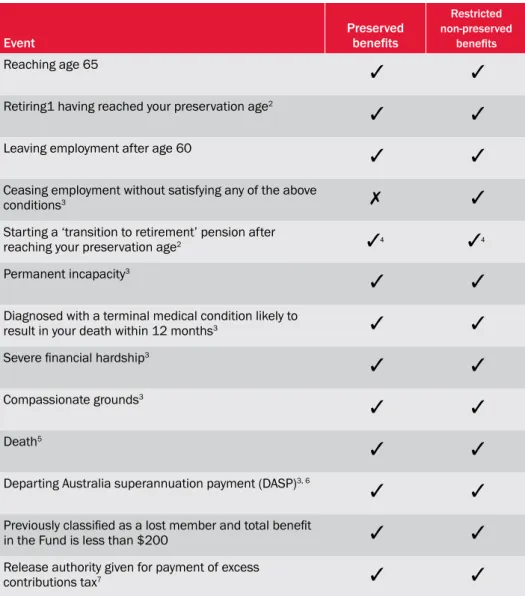
Your benefits may be paid when you satisfy a condition of release. ‘Table 2 – Benefit payments’ on page 14 provides details of the conditions of release. Your benefit may be divided if you separate or divorce from your spouse (either by court order after legal proceedings between you and your spouse, or by agreement between you and your spouse) – see ‘Family law’ on page 32 for further information.
Your benefits can be paid to your estate or dependants if you die – see ‘Death benefits’ on page 17 for further
information.
You may roll over your benefit to another superannuation fund which complies with the law.
Superannuation choice of fund
Many Australians may choose their own superannuation fund and direct their future employer superannuation guarantee contributions into their fund of choice.To see if you are eligible, contact your employer, visit the Government’s website at www.superchoice.gov.au or phone the ATO on 13 28 64.
Your employer’s obligations
If super choice applies to you, and you are a new employee who commenced employment after 1 July 2005, your employer should provide you with a ‘standard choice form’ within 28 days
of commencement of your employment with them.
Existing employees wishing to exercise choice of fund may also be able to
obtain a ‘standard choice form’ from their employer, the Government’s website at www.superchoice.gov.au or from the ATO on 13 28 64.
How to exercise choice of fund
The ‘standard choice form’ enables you to choose a superannuation fund to which your employer is to contribute. To instruct your employer to make contributions on your behalf into your Fund, simply complete the ‘standard choice form’ with your Fund
and member details and return it to your employer together with a letter confirming the complying status of your Fund.
Operating your Fund
ContributionsOnce established, your Fund is able to accept contributions and rollovers. Contributions may be made by cheque, periodic payment or transfer of assets into the Fund according to the law. You must provide us with full details of all contributions made to your Fund so that we can ensure they receive the correct tax treatment.
12 | Product Disclosure Statement Accumulation accounts Contributions are required to be
allocated and fully vested in the relevant member.
If you wish to establish an SMSF pension using superannuation
contributions, you’ll need to make your contributions into an accumulation account within your Fund and then provide us with details for your pension and an instruction to commence your pension.
Provided you are eligible, you can start a new SMSF pension immediately using one or more rollovers from an existing superannuation fund. Alternatively you can transfer your existing SMSF into the Service and start a pension from it.
Superannuation rules are complex, which is why we recommend that you obtain appropriate professional financial and/or tax advice before deciding to make a particular type of contribution.
Eligibility to make contributions
Provided that you meet the eligibility conditions outlined in ‘Table 1 – Who can contribute to superannuation’ on page 12, contributions can be accepted by your Fund.
Table 1 – Who can contribute to superannuation
Your situation
Concessional contributions After-tax contributions
Employer
Self-employed Personal Spouse SG1 Award Voluntary
You are under age 65.2
z z z z z z
You are aged 65 to 69 (inclusive) and have worked at least 40 hours in a period of no more than 30 consecutive days
during the financial year. z z z z z z You are aged 70 to 74 (inclusive) and have worked at least
40 hours in a period of no more than 30 consecutive days
during the financial year. x z z z z z You are aged 75 or over.
x z x x x x
1 SG (Superannuation Guarantee) – Your employer is generally required to pay contributions on your behalf (currently 9% of your salary).
2 Contributions made by or on behalf of children (under 18 years of age) can also be accepted by the Fund. However, if the contributor is seeking to claim any amount of contribution as a tax deduction, then the child must be gainfully employed on at least a part-time basis.
Contribution limits
Subject to the above eligibility requirements, there are few restrictions on the amount of contributions that can be made into your Fund.
Concessional contributions
Concessional contributions generally include employer contributions
(including superannuation guarantee and salary sacrifice) and personal contributions for which you claim a tax deduction.
The concessional contributions cap is $25,0001 per annum. However, if you are already aged 50 or turn 50 between 1 July 2009 and 30 June 2012, you can instead make concessional contributions up to $50,000 (non-indexed) for each relevant year in this period that you are aged at least 50. Excess concessional contributions attract additional tax (see page 9 for details) and also count towards your after-tax contributions limit (see below).
As trustees of your Fund you are responsible for monitoring your total concessional contributions against the cap.
1 This amount applies from 1 July 2009 and will be indexed in line with Average Weekly Ordinary Time Earnings (AWOTE) once the increase in the indexed amount is greater than $5,000.
After-tax contributions
These contributions are also referred to as ‘non-concessional contributions’. The non-concessional contributions cap is $150,0002 for the 2009/2010 financial year. However, if you are under age 65 or turn 65 during the year, you can bring forward two years of after-tax contributions (that is, you could make after-tax contributions totalling $450,000 in a financial year provided no such contributions were made in the following two years).
2 Beyond 2009/2010, this limit will be calculated at six times the concessional contributions cap noted above.
Excess non-concessional contributions attract additional tax (see page 9 for details).
As trustees of your Fund you are responsible for monitoring your total non-concessional contributions against the cap. Any spouse contributions are counted towards the receiving spouse’s after-tax contributions limit.
Settlement proceeds received for an injury resulting in permanent disablement that meet the qualifying criteria3 are exempt from the after-tax contribution limit.
3 Two qualified medical practitioners must certify that as a result of the injury the individual is unlikely to ever be able to be gainfully employed in a capacity for which they are reasonably qualified, the contribution must be made to a superannuation fund within 90 days of the payment being received or the structured settlement coming into effect (whichever is later) and the individual must ensure that the fund is aware that the contribution is being made under this exemption before or when making the contribution.
Government co-contributions
Your Fund is able to receive any co-contributions paid by the Government on your behalf (see ‘Tax’ on page 24 for further information).
Small business capital gains
Small business owners who qualify for the small business CGT concessions may be exempt from the after-tax contribution limit. The proceeds from the disposal of eligible assets are exempt up to a lifetime limit of $1.1 million for the 2009/2010 financial year (indexed).
Product Disclosure Statement Accumulation accounts | 13 There are a number of conditions
which must be satisfied in order to qualify for this exemption. Accordingly, you should seek professional financial and/or tax advice before making any decisions or taking any action in relation to the application of this exemption to your small business assets.
In specie contributions
An in specie contribution is one where an asset, rather than cash, is contributed to your Fund. An in specie contribution can be made by you, your employer or your spouse.
It is important to note that
superannuation funds are generally prohibited from acquiring assets from members or their related parties. However, there are some exceptions to this rule, including listed securities, widely held unit trust investments and ‘business real property’ which must be
obtained at arm’s length and at market value.
If you would like to make an in specie contribution, you should contact us to ensure the contribution is allowed and to obtain further information about the process to be followed. Assets will be valued using applicable prices on the date the transfer is effected.
Contribution limits (see page 12 for details) also apply to in specie contributions and they will have tax consequences for the contributor. As recommended above, you should obtain appropriate professional financial and/ or tax advice before proceeding. Super contributions splitting Members may elect to ‘split’ their concessional contributions with their spouse. Concessional contributions include superannuation guarantee and other employer contributions, salary sacrifice, and personal contributions for which you claim a tax deduction. Super contributions splitting generally operates as follows:
• a member may apply to have a maximum of up to 85% of their concessionally capped contributions made in any financial year
transferred to a superannuation account in the name of their spouse • the application by a member to
transfer the contributions for a financial year can only be made after the end of that financial year (or during the financial year where the member’s entire benefit is being
withdrawn from the fund), and must be made in writing and given to the fund to which the member’s contributions were paid
• the member’s application must contain a statement by their receiving spouse to the effect that they have either not reached their preservation age, or have not satisfied a relevant condition of release (see ‘Benefits and preservation’ on this page for details) if they are aged between their preservation age and 65 years • the fund will then transfer the
relevant amount from the member’s account to an account for the spouse. This will occur as soon as is practicable and in any case within 90 days of receipt of a valid application.
Rollovers and transfers of overseas superannuation benefits to an Australian fund are not permitted to
be split.
Further information on super contributions splitting is available on the ATO’s website. We recommend you consult your financial and/or tax adviser if you are considering super contributions splitting.
Benefits and preservation
We recommend that you discuss your superannuation benefit payments with your financial and/or tax adviser, as there are a number of tax matters that impact on these payments, especially if you are under age 60.
As trustee of your Fund you are required to understand your responsibilities and ensure they are properly discharged. We provide all the administration support required by you as trustee to ensure benefits are correctly accrued, calculated, preserved and paid.
Please note that the information provided in this PDS about benefit payments is general in nature only. Unless you choose to adopt a standard trust deed prepared by our preferred legal supplier, the trustees will need to satisfy themselves that any proposed benefit payments are actually permitted under the rules of the trust deed.
Benefits accrue in your member account within your Fund over time, comprising contributions and rollovers received, together with investment
earnings and the proceeds of any insurance policies.
The law prescribes that benefits may only be paid when a ‘condition of release’ is met. The conditions required for release will depend on the ‘preservation status’ of your benefit, as
shown in ‘Table 2 – Benefit payments’ on page 14.
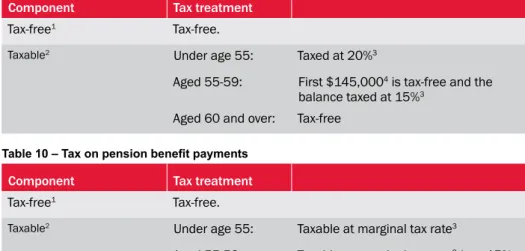
The taxable portion of any
superannuation lump sum or pension benefit is subject to tax depending on your age when it is received (see Tables 9 and 10 on page 25 for respective details).
You can withdraw any ‘unrestricted non-preserved’ benefits at any time. There is no compulsory payment of superannuation benefits at any time. Superannuation benefit payments If you satisfy a condition of release, and wish to have your superannuation benefit paid in the form of a lump sum, the trustees should write to us detailing the condition of release you have satisfied and the amount to be paid to you.
The benefit will be paid proportionately from the taxable and tax-free
components (see Table 9 on page 25 for details of tax payable on these components).
You can receive your superannuation benefit payment, excluding pension payments, as cash or in specie (actual assets). If you choose to take your benefit payment as assets, transfer costs such as stamp duties and CGT may be included in the calculation of fund earnings allocated to your member account in the Fund.
Transfers and rollovers
Any partial transfer or rollover of benefits to another fund that you may request will also be made proportionately from the taxable and tax-free components of your total benefit.
14 | Product Disclosure Statement Accumulation accounts Table 2 – Benefit payments
Event Preserved benefits
Restricted non-preserved
benefits
Reaching age 65
z z
Retiring1 having reached your preservation age2
z z
Leaving employment after age 60
z z
Ceasing employment without satisfying any of the above
conditions3 x z Starting a ‘transition to retirement’ pension after
reaching your preservation age2 z4 z4 Permanent incapacity3
z z
Diagnosed with a terminal medical condition likely to
result in your death within 12 months3 z z Severe financial hardship3
z z
Compassionate grounds3
z z
Death5
z z
Departing Australia superannuation payment (DASP)3, 6
z z
Previously classified as a lost member and total benefit
in the Fund is less than $200 z z Release authority given for payment of excess
contributions tax7 z z 1 Under superannuation law, this means an arrangement under which you were gainfully employed has ceased
and you don’t intend to become gainfully employed for 10 hours or more each week again. 2 Preservation age is determined by your date of birth, as shown in the following table. 3 There are additional requirements you’ll need to satisfy before a payment can be made. 4 Your benefit can only be taken as a pension.
5 See ‘Death benefits’ on page 17 for more information.
6 Applies to temporary residents (excluding Australian citizens, New Zealand citizens or permanent residents) who have left Australia and their visa has ceased to be in effect.
7 See ‘Tax’ on page 24 for more information.
Please refer to ‘Pension accounts’ on page 25 for further information.
Insurance
Life insurance
Your Fund is able to hold life insurance for you. On your death, the net
proceeds of any life policies will form part of the assets to be distributed to your beneficiaries.
Total & Permanent Disablement (TPD) insurance
Your Fund is able to hold TPD insurance for you, however most insurers only offer TPD in conjunction with life insurance. If you become permanently incapacitated, any TPD benefit paid under the terms of such a policy will form part of your assets in the Fund.
You should note that in order for a TPD benefit to be paid from the Fund, a condition of release must have been met (see Table 2 on this page for details).
Salary continuance insurance Your Fund is able to hold salary
continuance insurance for you. If you can’t work due to illness or injury you may be eligible to receive a partial replacement of your income depending on the terms of the insurance policy you take out.
Arranging insurance policies All policies must be held in the trustee’s name (with the mailing address care of us) and you’ll need to arrange for a suitable policy yourself, which may require insurance underwriting. Your financial adviser will be able to assist you.
Please contact your financial adviser prior to completing any insurance applications to ensure the policy can be held by your Fund.
Please also contact your adviser when the policy has been issued to provide them with a copy of the policy schedule and to make premium payment arrangements.
Part of your superannuation benefit may be paid to your spouse or former spouse as a consequence of the superannuation benefit payment provisions under family law splitting laws (see ‘Family law’ on page 32 for further information).
Pension benefits
Rather than having your entire superannuation benefit paid as a lump sum, you may wish to receive all or part of your entitlement as a pension benefit payment.
Table 3 – Preservation age
Date of birth Preservation age
Before 1 July 1960 55
1 July 1960 to 30 June 1961 56
1 July 1961 to 30 June 1962 57
1 July 1962 to 30 June 1963 58
1 July 1963 to 30 June 1964 59
Product Disclosure Statement Pension accounts | 15
Pension accounts
Overview
Your accumulated benefits form part of your member pension account within your Fund and are invested according to your selected investment strategy. Your pension account is credited with investment earnings including any realised and unrealised change in net market value and is debited with administration and other charges including any applicable taxes. These benefits are used to provide regular income to you in the form of an account based pension (ABP) or a term allocated pension (TAP).
Eligibility
You are generally eligible to start receiving a pension if you have an ‘unrestricted non-preserved’ benefit.
This will generally be when you have met a ‘condition of release’, as detailed in ‘Table 2 – Benefit payments’ on page 14.
However, you may have the option to start an ABP prior to ceasing employment through the transition to retirement provisions (see this page for details).
Account based pensions
The main characteristics of account based pensions are summarised in the following table.
Main characteristics of account based pensions Feature Characteristics
Term of the
pension There is no fixed term – the pension finishes when your account balance is exhausted. Minimum annual
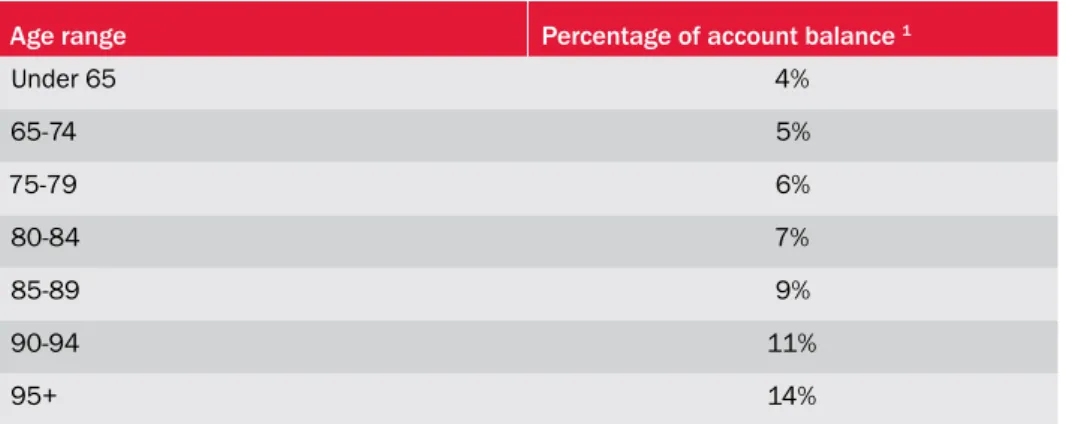
pension payment Your annual pension amount must be at least the minimum determined by multiplying your account balance by the percentage based on your age (see ‘Table 4 – Minimum annual pension payments’ on this page for details), calculated at commencement and each 1 July.
Pension payments are required at least annually, except in the first financial year if your pension commences after 1 June.
Maximum annual
pension payment There is no maximum annual pension amount, except where your ABP has commenced as a ‘transition to retirement (TTR) pension’ (see this page for details). Access to
benefits Unless your ABP has commenced as a TTR pension, you can withdraw your remaining benefit as a lump sum at any time, provided you have received at least the minimum pension payment for the financial year at the time of withdrawal.
16 | Product Disclosure Statement Pension accounts Table 4 – Minimum annual pension payments
Age range Percentage of account balance 1
Under 65 4%
65-74 5% 75-79 6% 80-84 7% 85-89 9% 90-94 11% 95+ 14%
1 For the 2009/2010 financial year, the Government has halved the minimum payment amount percentages shown in the table. You should check with your financial adviser regarding any concessions that may be granted in future years.
Your ABP will only continue to be paid until the balance of your account is exhausted. You should be aware that the balance of your account may not be sufficient to provide a pension for the rest of your life.
You can start an ABP from a new SMSF, or convert all or part of your accumulated benefits or current allocated pension in an existing fund into an ABP.
Transition to retirement (TTR) pensions If you have reached your preservation age (see ‘Table 3 – Preservation age’ on page 14) but have not ceased employment, you may commence an ABP as a TTR pension (also known as a pre-retirement pension).
A TTR pension allows you early access to your super money without retiring. A TTR pension provides you with additional income flexibility where, for example, you wish to remain in the workforce but may choose to reduce your hours of work as you approach retirement. It may also provide an opportunity for you to boost your retirement savings by salary sacrificing into superannuation. You should speak to your financial adviser about how a TTR pension can be used to supplement your pre-retirement income and whether it is appropriate for you.
If you commence an ABP as a TTR pension:
• you are also limited to a maximum pension amount of 10% of your account balance each year (this amount is not pro rata if you commence your TTR pension after 1 July)
• you can stop (or commute) your pension and return your benefit to a superannuation accumulation account (eg if you return to work full time)
• you cannot otherwise access your benefit without satisfying a condition of release under superannuation law (see ‘Table 2 – Benefit payments’ on page 14 for
details).
Minimum pension amount in the first year
If you commence your ABP on a day after 1 July, your annualised minimum pension payment in the first year will be a pro rata amount based on the number of days in the financial year from the commencement date to the next 30 June. We will advise you if your chosen pension amount is below this limit.
If you start your pension on or after 1 June in a financial year you are not
required to take a pension payment in that financial year.
Accessing your benefit in an account based pension
By investing in an ABP, you generally retain unlimited access1 to your benefit and may withdraw part or all of your balance as a superannuation benefit payment at any time.
If you withdraw (commute) your entire benefit part way through the financial year, you may be required to take part of your benefit as income, in the form of a pension payment.
Term allocated pensions
Generally new term allocated pensions (TAPs) can’t be started after 20 September 2007. An existing complying pension can be commuted and re-commenced as a TAP. Also, an existing TAP can be rolled over into your Fund and continued.The annual payment amount you can draw from the TAP is subject to a formula prescribed by the Government. However, you have a number of choices to make to determine what the initial and annual amounts you can be paid will be.
Step 1: Choosing the term for your TAP Before you start your TAP, you must select the term for which it will be paid. You can choose any number of years
within ranges set by the Government. The choice you have depends on whether or not you have nominated a reversionary beneficiary (generally, a person to whom your pension will be paid to after your death) who must also be your spouse as defined in the Social Security Act 1991 (reversionary spouse).
You must choose the term based on one of the two following methods:
1. No reversionary spouse
You can choose a term anywhere between:
• your life expectancy and
• your life expectancy based on you living to 100.
OR
2. Reversionary spouse
If your reversionary spouse’s life expectancy is greater than yours, you can choose a term anywhere between: • your spouse’s life expectancy and • your spouse’s life expectancy based
on them living to 100.
Table 5 below sets out the available terms for a TAP, based on the 2000/2002 Australian Life Tables published by the Australian Government Actuary. For terms applicable to other ages, please speak to your financial adviser or contact us.
Product Disclosure Statement Pension accounts | 17 Table 5 -Term allocated pension available
terms1
Age at
commencement
of pension Female Male
55 30-45 26-45 56 29-44 26-44 57 29-43 25-43 58 28-42 24-42 59 27-41 23-41 60 26-40 22-40 61 25-39 21-39 62 24-38 21-38 63 23-37 20-37 64 22-36 19-36 65 22-35 18-35 66 21-34 17-34 67 20-33 17-33 68 19-32 16-32 69 18-31 15-31 70 18-30 15-30 71 17-29 14-29 72 16-28 13-28 73 15-27 13-27 74 15-26 12-26 75 14-25 11-25 76 13-24 11-24 77 12-23 10-23 78 12-22 10-22 79 11-21 9-21 80 10-20 9-20 1 The terms are rounded up to the next whole year.
Step 2: Decide whether you want to take more or less than your standard initial and/or annual payments Once you’ve chosen the term of your TAP, you may select an annual pension amount that is between 90% and 110% of the ‘standard’ payment amount we calculate, based on the payment factor for the term you have chosen. This provides some flexibility, both at commencement and from year to year, and may help you to minimise the impact of fluctuations in investment earnings on the underlying assets of your pension.
We will write to you at the start of each year and advise you of the minimum and maximum amounts you may draw down in the following year.
First year’s pension payments
If you commence your TAP on a day after 1 July, your annualised pension payment in the first year will be a pro rata amount based on the number of days in the financial year from the commencement day to the next 30 June.
Final pension payments
If the remaining term of your TAP is one year or less (after rounding up or down in accordance with the law), we will pay the remaining balance of your pension over a 12 month period, regardless of the actual term remaining. If this occurs we will notify you in writing of the final payments to be made.
Death benefits
Following your death and upon
instruction from the surviving trustees, the balance of your member account in your Fund must be:
• transferred to one of your dependants or
• cashed as a lump sum to your estate.
Reversionary pensions
You can elect to have your ABP continue to be paid after your death to your spouse or another dependant. This is known as a ‘reversionary pension’ because it generally reverts to the other person on your death provided they are a ‘dependant’ for tax purposes (see ‘Tax on death benefits’ on page 25 for details) at that time. A reversionary pension that is being paid to the reversionary beneficiary is a continuation of the same pension. If you want to access a reversionary pension, you must nominate the person at the time the pension is established. A reversionary beneficiary nomination cannot generally be changed. The decision to commence the reversionary pension is at the surviving trustees’ discretion (subject to the law). If you already have a binding nomination in place, you should ensure that it is consistent with any reversionary pension nomination you have made. Where the two are inconsistent,
the surviving trustees will make a determination.
Death benefit pension
If you don’t elect to have a reversionary pension, upon your death your benefit can be paid to your dependants (including dependant children under 25 years of age) in the form of a pension. Your dependants would need to specifically request this type of benefit payment from the surviving trustees at the time. In these circumstances the payment of a death benefit pension is at the surviving trustees’ discretion (subject to the law). Death benefit nominations
Death benefit nominations are discussed in detail on page 17.