When Good Randomness Goes Bad: Virtual Machine
Reset Vulnerabilities and Hedging Deployed Cryptography
Thomas Ristenpart
Scott Yilek
Dept. of Computer Science and Engineering
University of California, San Diego, USA
{tristenp,syilek}@cs.ucsd.edu
Abstract
Random number generators (RNGs) are consistently a weak link in the secure use of cryptography. Routine cryp-tographic operations such as encryption and signing can fail spectacularly given predictable or repeated random-ness, even when using good long-lived key material. This has proved problematic in prior settings when RNG imple-mentation bugs, poor design, or low-entropy sources have resulted in predictable randomness. We investigate a new way in which RNGs fail due to reuse of virtual machine (VM) snapshots. We exhibit such VM reset vulnerabilities in widely-used TLS clients and servers: the attacker takes advantage of (or forces) snapshot replay to compromise sessions or even expose a server’s DSA signing key. Our next contribution is a backwards-compatible framework for hedging routine cryptographic operations against bad ran-domness, thereby mitigating the damage due to randomness failures. We apply our framework to the OpenSSL library and experimentally confirm that it has little overhead.
1. Introduction
The security of routine cryptographic operations such as encryption, key exchange, and randomized signing rely on access to good (unpredictable, fresh) randomness. Unfortu-nately, the random number generators (RNGs) used in prac-tice frequently fail. Examples stem from poorly designed RNGs [28, 32, 35], implementation bugs [13, 51], untimely exposure of randomness [17], and even the inability to find sufficient entropy in a system’s environment [36]. Since deployed cryptographic routines provide no security given bad randomness (even when using good long-lived keys), the attacks that result from RNG failure are spectacular [13, 16, 32, 35, 53].
In this work, we first show a new way in which deployed RNGs fail, due to virtual machine (VM) resets. Beyond
their relevance to RNG failures, the vulnerabilities are also interesting because they introduce a potentially-widespread class of practical problems due to virtualization technolo-gies. Our second contribution is a general and backwards-compatible framework to hedge against the threat of ran-domness failures in deployed cryptographic algorithms. We discuss each contribution more in turn.
VM reset vulnerabilities. Virtualization technologies en-able significant flexibility in handling the state of guest sys-tems (an operating system, user applications, and data). In particular, virtual machine (VM) snapshots, i.e. copies of the state of the guest, can be used to replicate, backup, trans-fer (to another physical system), or reset (to a prior state) the guest. Snapshots are one reason virtualization is trans-forming numerous areas of computing. However, Garfinkel and Rosenblum [31] suggest that, in theory, snapshots might lead to security problems due to reuse of security-critical state. Namely, reusing a VM snapshot might lead to (what we call) VM reset vulnerabilities. But no insecurities have been reported for real systems, leaving open the question of whether reset vulnerabilities are a practical problem.
We answer this question by revealing exploitable VM reset vulnerabilities within popular software. Our attacks are against TLS [8] implementations used for secure web browsing and work when a victim VM runs twice from the same snapshot. We investigate both TLS clients and servers, presenting session-compromise attacks against clients in the Firefox and Chrome web browsers and secret-key recov-ery attacks against the Apache HTTPS server. The latter is particularly damaging — an attacker can remotely extract a server’s DSA secret key. With this key, the attacker can impersonate the server. We exhibit exploits when the victim is run within either VMWare [12] or VirtualBox [10], two popular VM managers.
The attacks work because the VM resets lead to crypto-graphic operations (here, key exchange and signing) using the same randomness more than once. These cryptographic operations, in turn, fail to provide any security given
re-peat randomness. One conceptually simple solution, then, is to ensure that applications sample sufficiently fresh ran-domness immediately before use. Unfortunately, there are lurking complexities to overcome. Besides the difficulty of ensuring every RNG-using application is updated, there is the more subtle problem of where to find good randomness after VM resets. For example, the state of traditional RNGs (e.g., Linux’s /dev/random) is also reset with the rest of the guest. We provide more discussion of systems solutions in the body, but leave the bulk of this task to future work.
Finally, we suspect that the VM reset vulnerabilities we show are indicative of further issues. An important open question is whether other practical insecurities arise due to VM resets.
Hedging deployed cryptography. The attacks above are symptomatic of the widespread fragility of cryptographic operations to repeated or predictable randomness. Because many cryptographic operations fundamentally rely on good randomness to achieve the desired security level, repairing RNGs is the only full solution. However, the complexity of RNG design, the frequency with which RNG failures occur, and the significant damage that results all suggest that cryp-tography should be designed so that bad randomness has as little ill effect as possible.
One potential approach is to implement some form of hedged cryptography, considered in various ways in [19, 37, 46, 48]. The general idea is that routine cryptographic oper-ations should be designed so that, given good randomness, they provably meet traditional security goals and, given bad randomness, they nevertheless provably achieve some meaningful security level. While not everywhere eliminat-ing the need for good randomness, hedgeliminat-ing against bad ran-domness can significantly mitigate the threat of RNG fail-ure. Unfortunately, existing approaches only treat specific primitives such as public-key encryption [19, 52] or sym-metric encryption [37, 46, 48] and only treat specific, dis-parate kinds of RNG failures. In this work we seek an ap-proach that is fast, conserves existing security when ran-domness is good, works with arbitrary deployed algorithms, and can boost security in the face of arbitrary types of RNG failures.
We give a framework for hedging cryptographic opera-tions that achieves these goals. Our starting point is tech-niques from [19, 52], which we show can be straightfor-wardly combined to be applicable to arbitrary cryptographic primitives. Briefly, an operation is replaced by a hedged version with equivalent functionality. The hedged ver-sion preprocesses RNG-derived randomness together with other inputs (messages, keys, etc.) withHMACto provide (pseudo)randomness for the cryptographic operation. The modifications are simple. Even so, by changing the cryptog-raphy we can prove that important schemes are more secure in the face of various kinds of randomness failure.
We apply our framework to the latest OpenSSL code base, which doubles as a cryptographic library used by many applications and as a widely used implementation of the TLS protocol. Benchmarking the hedged version of the library indicates that overhead is very low. Because hedg-ing does not impact functionality, our library interoperates transparently with existing TLS implementations. We are currently in the process of preparing our implementation for public release, which will allow immediate deployment with the corresponding security benefits.
2. Random Number Generation and Threat
Models
There are many methods for generating cryptographi-cally strong random numbers. We do not go into significant detail regarding particular implementations. See [36, 43] for details regarding some platform-specific random num-ber generators. Instead we give an abstract model of random number generation which already suffices for discussing threats and attacks. We will fill in further details when nec-essary.
The task of a cryptographic random number generator (RNG) is to provide uniform, private bits to applications. We find it convenient to view an RNG as a stack. The first layer is theentropy layer where entropy is generated. Here sources of (hopefully) unpredictable events occur in a manner that can be sampled. Examples include tempera-ture variations, clock drift, interrupt timings, mouse move-ments or keyboard clicks, and network packet arrivals. We view the entropy layer not as an actual software or hardware system, but rather as an encapsulation of the physical pro-cesses from which entropy is harvested. The second layer is thesampling layerwhich samples from the entropy layer to measure events and generate digital descriptions of them. This layer also attempts to extract uniform random bits from the unpredictable data and maintains a pool of such bits. The uniform bits are then provided to applications requir-ing randomness in theconsuming layer.
We note that, crucially, the consuming layer may it-self consist of further sequences of RNG-related systems. For example, in typical operating systems the kernel imple-ments the sampling layer, a cryptography library consumes kernel-supplied randomness and also provides it to further applications. Note that every layer above the first poten-tially stores randomness internally in state. Looking ahead, this aspect of RNG stacks will be important in the context of reset attacks, which abuse reused state. Security requires that each layer ensures distinct requests (even ones made in parallel) are answered with fresh randomness.
Threat models. There exist numerous ways in which an RNG stack might fail or be tampered with by a dedicated
attacker. For the purposes of threat modeling, however, we can loosely categorize randomness failures by the resultant quality of randomness as seen from the point of view of an application.
(1)Fresh randomness: An application is always provided new, private, uniform bits.
(2)Reused randomness: An application is provided private, uniform bits, but these bits might have been provided to the application before.
(3)Exposed randomness: An application is provided uni-form bits but attackers later learn these bits.
(4)Predictable randomness: An application is provided random bits that are predictable by an adversary. (5)Chosen randomness: An application is provided
adversarially-chosen random bits.
For simplicity we will sometimes refer to fresh randomness asgoodand any of the four other kinds of randomness as bad. Our threat model is potentially malicious failure (at any level) of the RNG stack when performing routine ran-domized cryptographic operations, for example encrypting a message, signing a message, or performing key exchange. Randomness vulnerabilities lead to applications using one of the four kinds of bad randomness.
Previous failures. We classify previous randomness vul-nerabilities into these threat models. We are unaware of any reports on vulnerabilities leading to reused randomness that didn’t also lead to predictable randomness. Becherer et al. recently describe a possible vulnerability on Amazon EC2 [17] that leads to exposed randomness. Due to the ar-chitecture of EC2, an attacker might learn the initial state of a victim virtual machine’s RNG. They conjecture (but provide only anecdotal evidence) that one might use this in-formation to recreate cryptographic keys generated by the victim.
Examples of vulnerabilities leading to predictable ran-domness abound. Wagner and Goldberg exhibit session compromise attacks against SSLv2 because clients used predictable randomness for session keys [32]. Gutterman et al. point out that some systems may not have access to a sufficiently rich entropy layer, for example network routers without disks [36]. Gutterman and Malkhi discuss pre-dictable randomness vulnerabilities in Java session identi-fiers [35]. Dorrendor et al. [28] point out that the Window’s kernel RNG stored randomness in a way that is accessible to unprivileged programs. Woolely et al. uncovered a bug in the FreeBSD RNG that led to no entropy for several min-utes after a reboot [51]. Perhaps the most spectacular exam-ple thus far is the Debian OpenSSL vulnerability, originally discovered by Bello [13]. Here a bug was introduced in the OpenSSL crypto library that tragically rendered impotent the RNG. Mueller [42] shows how to abuse the ensuing pre-dictable randomness to recover long-lived TLS secret keys.
Abeni et al. [16] and Yilek et al. [53] show how to abuse the predictable randomness to perform session compromise attacks.
3. VM Reset Vulnerabilities Affecting TLS
In this section we explore virtual machine (VM) reset vulnerabilities. These arise when applications’ security-critical state is captured by a VM snapshot and starting the VM repeatedly from the snapshot leads to security prob-lems. The VM reset vulnerabilities we consider are due to cryptographic randomness being cached by applications and caught in a snapshot. Running multiple times from the snapshot results in cryptographic operations consuming re-peated randomness, and in turn, failing to provide security. Virtualization and snapshots. Modern virtual machine monitors (VMMs) allow physical multiplexing of hardware resources between numerous guest operating systems, each run within a virtual machine (VM). Virtualization technolo-gies have become almost ubiquitous. Consumers use VMs for home PC security, for example to contain malware infec-tions. Businesses use virtualization to more efficiently man-age computing infrastructure. The (so-called) cloud com-puting paradigm is powered by virtualization.An important feature of almost all modern VMMs is the ability to take VM snapshots. Asnapshotis a copy of the entire state of a VM, including active memory. This al-lows restarting the VM exactly in the state at which the snapshot was taken. VMWare [12], VirtualBox [10], and Virtual PC [11] all include snapshot mechanisms and ad-vertise them as a core feature. Some VMMs offer a more limitedvolume snapshot, which is a copy of the persistent state (volumes) of a VM (but not active memory). Restart-ing from a volume snapshot requires bootRestart-ing the guest OS from the persistent state. Modern third-party cloud comput-ing services such as Amazon EC2 [3], Microsoft Azure [7], Mosso Rackspace [1] all rely on volume snapshots to allow users of the service to save convenient server configurations for later use.
The attacks we describe below work against TLS [9] clients and servers when run multiple times from full snap-shots. We did not investigate vulnerabilities due to volume snapshots; the particular vulnerabilities we found would not seem to carry over.
3.1. TLS Client Vulnerabilities
Recall that TLS is used to secure HTTP connections over the Internet. Thus, TLS protects the security of online bank-ing, shoppbank-ing, and other sensitive traffic. Every popular web browser therefore includes a TLS client, which is used to negotiate a shared secret, called a session key, between it
and the remote HTTP server. The most prevalent [53] mode for establishing a session key is RSA key transport. Here the client chooses a secret value, called the premaster secret (PMS), encrypts it under the server’s public RSA key, and then sends the resulting ciphertext to the server. The sym-metric session keys used to secure the rest of the session are then derived from the PMS and two other values that are sent in the clear.
In abstract, a VM reset vulnerability could arise if the PMS, or the randomness used to create it, is generated be-fore a snapshot and consumed upon resumption after the snapshot. This vulnerability would lead to an immediate compromise of sessions if the same PMS is sent to multiple different servers.
Before assessing whether this can occur in practice, we first ask: Why might a user run their browser in a virtual machine? Security experts recommend users do their web browsing within a VM toincreasesecurity. The idea is that if the browser has a vulnerability and a malicious site ex-ploits it, the damage is contained to the VM. A user can revert to a previous snapshot taken before the browser and VM were compromised to undo the effects of any malware. We performed experiments on a variety of browsers on both Linux and Windows to determine if there is a real prob-lem. There is. Our results are summarized in Figure 1. We explain the results in detail below.
Experimental setup. We used two Apache web servers (call them server1 and server2) running on two separate physical machines. The servers used an instrumented ver-sion of OpenSSL that, upon receipt of the client’s key ex-change message in a TLS session using RSA key transport, would decrypt the premaster secret and write it to a file. Each server was given an RSA certificate signed by our own certificate authority (CA). We ran the various browsers (listed in Figure 1) within the indicated operating systems as guests inside a VM running in either VMWare 1.0.10 or VirtualBox 3.0.12. The physical host ran Ubuntu 8.04 Desktop. The client browsers, excepting Safari in Windows, were configured to accept our CA. This ensured that, upon visiting one of our servers, a browser in the guest OS would not complain about a certificate signed by an untrusted CA. (For Safari, we ended up just clicking “continue” when pre-sented with a warning about an untrusted certificate.) Experiments.We start with the following test sequence. (1) Reboot the OS.
(2) Load the browser.
(3) Take a snapshot of guest in this state. (4) Reset the VM.
(5) Navigate browser to server1. (6) Reset the VM.
(7) Navigate browser to server2.
For each VM manager OS combination, steps (1-3) were performed once followed by 3 iterations of steps (4-7) for each browser. For Chrome on Linux, we also ran a separate test sequence where step (2) was changed to
(2a) Load the browser, navigate to an HTTPS url, and then navigate to a blank page.
The results were consistent between the two VM man-agers, meaning the VMM used had no impact on client be-havior. For Firefox on Windows or Linux, the same PMS was sent to both servers in all 3 trials. If the user caused 100 mouse events (e.g., moved the mouse 100 pixels) between steps (4) and (5) or (6) and (7) then distinct PMS values were sent to the servers. This is because Firefox folds new entropy into the RNG every 100 mouse events. For Chrome on Linux, when step (2a) was used then the same PMS was sent to both servers in all 3 trials. When step (2) was used, distinct PMS values were sent to the two servers.
On Windows, all browsers except Firefox always sent distinct PMS values to both servers. We note however that on Windows, the same PMS value was sent to the same server in many of the trials. While this does not admit an ob-vious attack, it violates the TLS specification. For example, on IE 6.0 and VMWare, 2 out of the 3 PMS values sent to server1 were the same and 2 out of the 3 PMS values sent to server2 were the same. We note that all the browser/VMM combinations showed this problem; for Chrome in Win-dows, it did not even matter whether or not step (2a) or (2) was used.
3.2. TLS Server Vulnerabilities
We turn our attention to TLS servers. We target TLS servers using authenticated Diffie-Hellman key exchange when the digital signature scheme used is DSA. Ignor-ing numerous (but not really relevant) details, the protocol works as follows. The client sends a nonce of its choos-ing to the server. The server chooses a randomy, computes
gy, and uses DSA to signgytogether with session state
in-cluding the client nonce. Now, if the server uses the same randomness to sign in two different sessions, an attacker who knows the messages signed and sees the resulting sig-natures can extract the server’s DSA signing key. This at-tack is well-known; see Appendix A for details.
A VM reset vulnerability could therefore arise if running a server multiple times from a snapshot led to the same ran-domness being used by DSA. This situation would occur, for example, if an HTTP server seeds its RNG at startup and uses the RNG (without new seeding) to generate ran-domness when handling a new connection. If a snapshot of the server is taken after startup, then the RNG’s state would be captured. Reuse of the snapshot could lead to the same randomness being consumed by DSA.
TLS Client Guest OS Same PMS to diff. sites? Same PMS to same site? Comments Firefox 3.5 Windows Always Always Mouse moves<100pixels
Chrome 3.0 Windows Never Sometimes
-IE 6.0 Windows Never Sometimes
-Safari 4.0 Windows Never Sometimes
-Firefox 3.0 Ubuntu Always Always Mouse moves<100pixels
Chrome 4.0 Ubuntu Always Always Visit one HTTPS site before snapshot Figure 1. Summary of our TLS client attacks. We performed all of the experiments on both VMWare Server version 1.0.10 and VirtualBox version 3.0.12 and observed the same behavior. Ubuntu refers to version 8.04 (Hardy) Desktop, Windows refers to XP Professional with Service Pack 2.
due to the ever-increasing use of virtualization to man-age servers. For example, cloud computing services such as EC2 (popular for hosting HTTP servers) utilize volume snapshots to store customer server configurations for rapid deployment. Progressing to full snapshots that include ac-tive memory could make provisioning of VMs even faster. In other settings, snapshots are often suggested as a simple mechanism for fast server crash recovery.
We therefore investigate whether servers are vulnera-ble. We focus on Apache using mod ssl, the most widely-used HTTPS web server software. Below we describe how Apache generates randomness and then experimentally val-idate that, in fact, VM reset vulnerabilities can be exploited by an attacker to extract a server’s DSA secret key.
The Apache + mod ssl RNG. Apache uses the OpenSSL cryptographic library for its RNG and TLS implementation. On Apache startup, the main process seeds the OpenSSL RNG from various entropy sources. Which sources to use can be specified in the Apache configuration file. By de-fault, Apache only uses time (seconds since the Epoch), process ID, and a portion of the runtime stack to seed the RNG; this is referred to as “built-in” in the configuration file. The OpenSSL RNG will also seed itself from a variety of sources depending on how it is configured; these sources usually include /dev/random or /dev/urandom on Unix-based systems. Apache then forks off into child pro-cesses that will actually handle the incoming HTTP and HTTPS requests. At this point each child process has its own copy of the now-initialized RNG state.
When an HTTPS request comes in, Apache assigns a child process to handle it. Before handling the process, the child adds more entropy to its RNG. Here what is added again depends on the Apache configuration, which by de-fault is set to “built-in”, meaning only the time, process ID, and some of the runtime stack are added to the RNG before the request is handled. The nature of our attack is such that only these new additions affect whether randomness will be repeated between two reverts. In other words, if we can connect to a server twice run from the same snapshot and
the time, pid, and runtime stack are the same in both cases, the server will use the same randomness for both sessions. Experiments without Clock Synchronization. Because time is added to the RNG, it is clear that the server’s clock plays a crucial role in whether an attack could be success-ful. Specifically, if the server resynchronizes its clock after starting execution from a snapshot but before an adversary can connect to it, then the RNG will never supply the same value twice. Thus, as a first step, we experiment with VMs that do not perform guest clock synchronization.
We set up a default installation of an Ubuntu 8.04 Hardy desktop guest OS inside VMWare Server. Here the guest does not synchronize its clock. (If one additionally in-stalls VMWare Tools, which are guest utilities supplied by VMWare, then the guest defaults to synchronizing its clock.) On the guest, we also set up OpenSSL 0.9.8k and the latest version of Apache web server with mpm-prefork (i.e., unthreaded) and using the default configuration. The only changes we made to the configuration file were to point the server at a DSA key and certificate.
We then performed the following steps. We rebooted the guest VM, started the web server, paused the VM, and took a snapshot. Then we repeatedly attempted to start the VM from the snapshot and have a client connect to the server at exactly the same time (as read on the guest’s clock). We did this by setting a client machine physically next to the server’s host machine, and having one person watch for the clock on the guest VM to tick to the next minute after the snapshot was taken. Immediately, that person executed the openssl s_clientcommand on the client machine to initiate a DSA-authenticated key exchange with the server.
Somewhat surprisingly, this worked. The randomness used by the server was repeated. We observed repeated ses-sion IDs (generated using the RNG), and repetitions of the randomness used to sign with DSA. We tried many more times with similar success. Apparently the same child PID and stack contents were used each time to generate the ran-domness, and it was easy for the single operator to get the timing right.
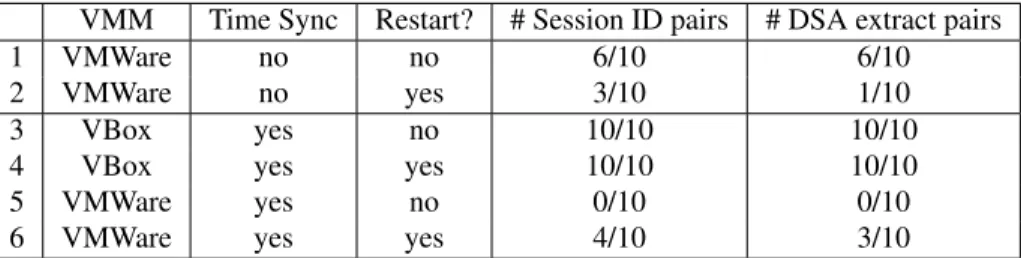
VMM Time Sync Restart? # Session ID pairs # DSA extract pairs
1 VMWare no no 6/10 6/10
2 VMWare no yes 3/10 1/10
3 VBox yes no 10/10 10/10
4 VBox yes yes 10/10 10/10
5 VMWare yes no 0/10 0/10
6 VMWare yes yes 4/10 3/10
Figure 2. Summary of Server attacks. Each row corresponds to five trials. The second-to-last column reflects how many pairs of trials (out of a possible ten) contained sessions using the same session IDs. The last column reflects how many pairs of trials contained sessions using the same randomness for DSA signing.
Our next step was to try to automate the attack to see if it would work remotely. We worked under the assumption that after a reset, the VM would usually take about the same amount of time to start servicing HTTPS requests. Thus, our attack strategy was to repeatedly attempt to connect to the server (starting around the time we knew the reset oc-curred) with the hope of achieving a successful connection at the very moment the server started answering requests. If after two different resets the server takes the same num-ber of seconds to start answering, then the attack should succeed. To test this, we created a script that attempted to connect to the server once every 0.1 seconds and recorded any session data. We then performed five trials consisting of the following steps using VMWare 1.0.10 as our VMM, Ubuntu 8.04 Desktop as our host and guest OS, and Apache 2.2.14 mpm-prefork with OpenSSL 0.9.8k:
(1) Start the VM from the snapshot. (2) Start the attack script.
(3) Stop the script after a few seconds of successful con-nections.
We did this both when restarting the host physical machine before each trial and restarting before only the first trial. We call trials executed immediately after a reboot “cold” trials, while we call trials executed after other trials (without a reboot in between) “hot” trials.
The results are summarized in the first two rows of Fig-ure 2; the first row represents hot trials (except the first of the five, which is cold), while the second row represents cold trials. Now, we are interested in whether or not ran-domness is reused across resets. Thus, for each set of five trials, we count how many pairs of trials contain sessions using the same randomness. We particularly record if a pair had the same session ID (chosen using the RNG) or used the same randomness for DSA signing.
As can be seen randomness repetition occurred in both sets of 5 trials. We noticed that during cold trials, resum-ing from a snapshot is significantly slower than in hot tri-als. This affected timing. For example, row 1 in the table
did not have 4 randomness collisions because the first trial there was cold while the others were hot, leading to timing differences. Also, we believe the timing variability of cold trials accounts for the lower success rate seen in row 2. Experiments with Clock Synchronization.We would like our automated attack to work even if the guest is synchro-nizing its clock. Though synchronization would seem to bar any chance of attack, it turns out that there is often a win-dow of opportunity for an attacker. Once a VM is loaded from a snapshot, everything needs to be reinitialized; this includes re-loading values into memory, re-enabling net-working, synchronizing the clock, and more. We observed that VMs running on both VirtualBox and VMWare VMMs would, after starting from a snapshot, often enable network-ing and service HTTPS requestsbeforesynchronizing the clock.
We experimented with VMWare 1.0.10 and VirtualBox 3.1.0 using the same configuration, automated script, and steps as above. For VMWare, we tested our attack with VMWare tools installed to ensure clock synchronization. As before and for each VMM, we performed five trials booting the host machine between trials and five trials re-booting only before the first trial. The results are shown in Figure 2, rows 3 through 6. Again, sessions used the same randomness across multiple TLS sessions. VirtualBox had very consistent resumption timing. The higher variability of VMWare leads to lower success rates. In particular, as seen in row 5 of the table, when doing hot trials VMWare actually synchronized the guest clock before Apache started servicing the attack connections.
Discussion. One might wonder why session IDs repeat more often than DSA randomness; while we do not have a definitive answer for this, we suspect it is because OpenSSL mixes in an additional time value immediately before DSA signing, and for some sessions this time ends up being time X while for others it ends up as time X+1.
In these experiments, we also observed repeat Server-Randoms and Diffie-Hellman key exchange values. These
values should all be unique in a proper TLS handshake. We do not know how to exploit this repetition, but nevertheless believe care should be taken to avoid it.
4. On Fixing the Vulnerabilities
In this section we provide a brief discussion about fix-ing the VM reset vulnerabilities uncovered. In the TLS clients and servers we described above, we saw that good randomness was sampled at some point (such as starting the program or launching a child process) and buffered un-til it was needed at some much later time. This allowed a large window in which snapshots would capture to-be-used randomness. In the browser client vulnerabilities, the randomness was used directly in a cryptographic operation after the snapshot. On the other hand, with Apache, new en-tropy was added to the RNG right before its output was used in the cryptographic operation — unfortunately the sources had little to no entropy conditioned on their being used al-ready by a previous snapshot.
In abstract, fixing these vulnerabilities requires ensur-ing that RNGs get access to sufficient entropy after a snap-shot and ensuring that applications take randomness from an RNG at the time of the cryptographic operation. For example, one approach would be to mandate using a guest OS source such as/dev/randomor/dev/urandomto generate randomness right before a cryptographic operation is performed.
Unfortunately, the state of these sources is also reset by snapshots, and so it is unclear whether sufficient entropy is generated between a snapshot resumption and randomness consumption by the cryptographic operation. In general, a better option would likely be linking guest RNG services with hardware-based RNGs or other external sources.
This is a large topic, and we leave finding the best solu-tions to future work. Instead, we turn our attention to strate-gies for mitigating the threat of all types of RNG failures to better protect against future problems.
5. A General Framework for Hedging against
Randomness Failures
As mentioned in the introduction, there is a long his-tory of RNG failures [13, 17, 28, 32, 35, 36, 51] stemming from a variety of issues. The VM reset attacks discussed in Section 3 show yet another manner by which RNG’s fail. Additionally, the reset attacks, among other attacks [16, 53], target routine cryptographic operations that are fragile in the face of bad randomness. For example, most construc-tions for key exchange, randomized signing, and encryption admit damaging attacks given bad randomness, even when good long-lived key material is used.
We propose a general framework for hedging against RNG failures. Our method modifies routine cryptographic operations so that they can defend themselves against vari-ous forms of bad randomness. By focusing on the cryptog-raphy, our framework is application- and VMM-agnostic. It protects against many different kinds of bad randomness. It is simple to implement and deploy.
Hedging is not a replacement for good RNGs. In partic-ular, for many cryptographic tasks one needs randomness to achieve the most desirable security levels (e.g., public-key encryption). In these cases, hedging provides graceful degradation of achieved (provable) security.
Hedged cryptography.Our framework is the following. A hedging functionHedge is a deterministic algorithm with inputs being an arbitrary-sized bit string R and an arbi-trary numberpof associated data bit strings(d1, . . . , dp)∈ ({0,1}∗)p. (In implementations, we will actually have to
cap the maximum length of inputs treated by Hedge to, e.g.,264
. We omit this detail throughout for simplicity.) We writedto mean the vector(d1, . . . , dp). The algorithm
out-puts a bit string of size|R|bits, where|R|is the length ofR
in bits. We writeHedge(R,d) =Hedge(R, d1, . . . , dp)to
denote running the algorithm. A hedging function handles variable-length keys, inputs, and outputs.
Let Op be a randomized cryptographic operation tak-ing inputs i1, i2, . . . , ik and using an RNG-supplied bit
stringR. Denote execution of it byOp(i1, i2, . . . , ik ;R).
We hedge by replacing calls
Op(i1, i2, . . . , ik ;R)
with
Op(i1, i2, . . . , ik;Hedge(R,hdi))
whered= (OpID, i1, i2, . . . , ik). That is, we applyHedge
to the RNG-supplied randomness and the inputs to the op-eration become the associated data. We also include OpID, which denotes some unique identifier for the operation, to provide domain separation between uses ofHedgewith dis-tinct operations. Note that we will omit explicit mention of OpID later for brevity, but it is crucial to use within im-plementations. The output ofHedge is used as the “ran-domness” for the operation. Note that functionality is not changed since randomized cryptographic operations must work for anyR.
The idea of hedging originates with work by Bellare et al. where they treat the specific case of public-key en-cryption [19]. One of their constructions is a special case of ours, where Hedge is replaced with a cryptographic hash function andOpis specifically public-key encryption. Yilek [52] treats the special case of randomness reuse at-tacks against public-key encryption. His construction is a special case of ours whereHedgeis just a PRF andOpis public-key encryption. These two approaches achieve
dif-Primitive Repeat Exposed Predictable Chosen
Public-key encryption ⋆ ⋄ ⋄ ⋄
Symmetric encryption ⋆ ⋆ ⋆ ⋆
Digital signatures UF UF UF UF
Figure 3. Summary of hedged primitive’s provable security in the face of Repeat, Exposed, Pre-dictable, or adversarially Chosen randomness. Symbol⋆means no partial information about plain-texts leaked except plaintext equality. Symbol⋄means no partial information about plaintexts leaked assuming plaintexts have high min-entropy (unpredictable to attacker). Symbol UF means no attacker can forge an honest party’s signature.
ferent (and orthogonal) security guarantees for public-key encryption, as discussed further in the next section. Suffice to say, we simultaneously want both guarantees. Moreover, we want the same hedging approach to work for other cryp-tographic primitives. We can achieve this by instantiating
Hedgewith an object that is good both as a hash function and as a PRF.
We suggest the widely-availableHMACalgorithm [20], built from a sufficiently strong underlying hash function, such as SHA-256, SHA-512 or the upcoming SHA-3. HMAC takes as input an arbitrarily-long key K and message M and outputs a string of n bits (e.g., n = 256 for SHA-256). We can use HMAC to instantiate
Hedge(R, d1, . . . , dk)for some numberkof associated data
strings as follows. Letpbe the smallest integer such that
np≥ |R|. ComputeR′
i =HMAC(R,hd1, . . . , dki ||i)for
1≤i≤pand then output the first|R|bits of
R′1|| · · · ||R′p .
Herehd1, . . . , dkiis some unambiguous encoding of the
as-sociated data and || represents concatenation of bit strings. In words we applyHMACseveral times, using the RNG-supplied randomnessRas the key and the associated data combined with a counter as the message. The counter allows us to produce p times the output size of HMAC (e.g. 512p if using SHA512 within HMAC). We then runOpusing the appropriate number of bits ofHMAC out-put.
Discussion. As mentioned above, functionality is not hin-dered. That means that hedging a cryptographic operation has no impact on other, related operations (e.g., decryption need not be changed when hedging an encryption routine). This crucially means that hedging is legacy-compatible: any party can use it and no other parties need know.
We point out that the framework can be just as easily applied to long-lived key generation (in addition to routine cryptographic operations). However here one will not, gen-erally, achieve significant security improvement: there are usually no other inputs to such routines beyond the random-ness used. Nevertheless in cases where there are (e.g. the identity of a party generating a public key, secret key pair)
it might prove beneficial for some kinds of randomness fail-ures. Note that long-lived key generation is a rare operation and ensuring it access to fresh randomness might therefore be easier than more routine operations.
Lastly, the focus of this work is cryptographic consumers of randomness. However there are other security-critical uses of randomness and hedging might prove useful in these as well.
6. Security of Hedging
In this section we discuss the security that hedging pro-vides. First, we present some general security properties of hedging, namely that the hedge function does not degrade the quality of good randomness given to an underlying oper-ation. This is important because it provides some argument that hedging won’t hurt most security properties. We will then discuss hedging of four important primitives: public-key encryption (PKE), symmetric encryption (SE), digital signatures (DS), and key exchange. For all these primitives, many in-use schemes fail completely to provide security in each of the randomness failure models.
Figure 3 provides a summary of the security provably achieved by hedging public-key encryption, symmetric en-cryption and digital signing. (This is assuming the underly-ing primitive is secure when randomness is good.) Briefly, hedgedPKE will not leak anything but plaintext equality when randomness is repeated. If randomness is adversari-ally chosen, predictable, or exposed, then hedgedPKEwill not leak any partial information assuming unpredictable, public-key independent messages. HedgedSEleaks noth-ing but plaintext equality even against adversarially-chosen randomness. Hedging essentially removes the need for ran-domness in digital signing — the traditional notion of un-forgeability is achieved. All these results, including the more complex situation for hedged key exchange, are dis-cussed in further detail in the remainder of this section. Formalisms and notation. We formalize our security no-tions using code-based games [25]. In this framework, one models security as a game played with an adversary. A
game (see Figure 5 for an example) has anInitialize proce-dure, procedures to respond to adversary oracle queries, and aFinalizeprocedure. First,Initializeexecutes and its out-puts are given as inout-puts to an adversaryA. NextAexecutes and can adaptively make queries to procedures (other than InitializeandFinalize), receiving the computed responses. WhenAterminates with some output, this becomes the in-put toFinalize. We denote running a gameGwith adver-saryAasGAand letGA⇒wbe the event (in the
probabil-ity space induced byGA) that the output of gameG, when
run with adversaryA, isw. An adversary’s run time is the time to runGA, meaning particularly that we charge the
ad-versary for its queries. If working within the random oracle model (i.e. assumingHedgebehaves like an ideal hash func-tion), then the game has one more procedure implementing the random oracle. This procedure, usually denotedH, re-turns for each (distinct) message queried a randomly chosen value.
6.1. General Security Properties of Hedging
Proving the security improvements achieved by hedging requires focusing on individual primitives, as we do in the following sections. First however, we discuss general se-curity properties needed fromHedgeand (informally) how they lead to security gains. To start, we point out that one desires that the output ofHedge is indistinguishable from true randomness whenever one of the following holds: (1) fresh randomnessRis used;(2) repeatedRis used, but all pairs of associated data used withRare distinct; or
(3) adversarially chosenRis used, but some portion of the associated data is unpredictable to and hidden from the adversary (e.g. a secret key or large plaintext).
Informally, property (1) holds under the very mild assump-tion that Hedgeis a good pseudorandom function (keyed by R) for a very small number of queries. Property (2) should hold under the assumption thatHedgeis a good PRF for many queries and property (3) should hold ifHedgeis an ideal hash function (a random oracle). We therefore discuss howHedgemeets the preconditions just described (being a weak PRF, a PRF, and an ideal hash).
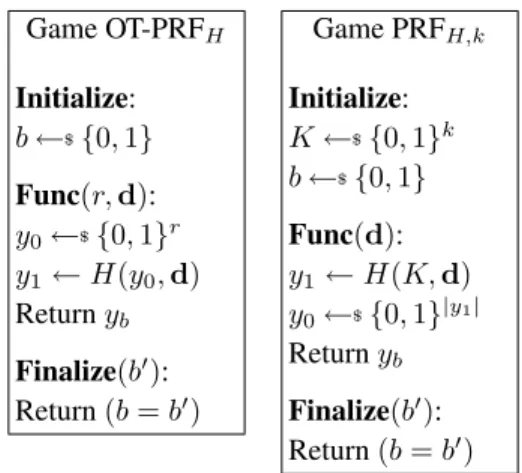
We first show thatHedgeis a one-time secure PRF. For-mally, a variable-key-length one-time PRF (ot-prf) adver-saryAtakes no input, can query a pairr,dwhere r > 0 is a number and d is a vector of bit strings to an ora-cle, and outputs a bit. LetH be a hedging function (as per Section 5). Game OT-PRFH is defined in Figure 4.
The advantage of ot-prf adversaryAagainst a keyed func-tion H is AdvotH-prf(A) = Pr
OT-PRFAH⇒true
− Pr
OT-PRFAH ⇒false .
LetHbe a variable-key-length (VKL) function with out-put lengthn. This means H is a deterministic algorithm
Game OT-PRFH
Initialize:
b←${0,1}
Func(r,d):
y0←${0,1}r y1←H(y0,d)
Returnyb
Finalize(b′):
Return(b=b′)
Game PRFH,k
Initialize:
K←${0,1}k b←${0,1}
Func(d):
y1←H(K,d) y0←${0,1}|y1|
Returnyb
Finalize(b′):
Return(b=b′)
Figure 4. One-time PRF and PRF security games for variable-key-length functionH.
that takes a key K of some arbitrary length k >0 and an arbitrary-sized-input and outputs a string of lengthn. HMAC is an example of a VKL function. Game PRF defines normal PRF security, see Figure 4. The prf ad-vantage of adversary B against H is AdvprfH (B) = Pr
PRFAH,k⇒true
−Pr
PRFAH,k⇒false .
It is well-known thatHMACis a secure PRF [18, 20] as-suming the underlying hash function’s compression func-tion has suitable PRF-like security properties. (Techni-cally, one needs resistance to a mild form of related-key at-tack [22] in addition to the standard PRF security.) Namely, one can use the results of [18, 20] to derive bounds for
AdvprfHMAC,k(B)for anyk. A simple hybrid argument es-tablishes the following theorem, which is stated for an arbi-trary VKL functionF.
Theorem 6.1 Let F be a VKL function with output length n. Let Hedge be the hedging function built from
F, as in Section 5. Let A be a ot-prf adversary run-ning in time t, making at most q queries specifying lengthsr1, r2, . . . , rq. Then there existsqprf adversariesBi
such that
AdvotHedge-prf(A)≤ q
X
i=1
AdvprfF,ri(Bi)
whereBiruns in time that ofAand makes⌊(ri+n−1)/n⌋
queries.
We can see that the security required from the VKL func-tion, e.g.,HMACis mild, becausem=⌊(ri+n−1)/n⌋is
generally very small. For example when one uses SHA-256 and ri = 1024, we have that HMAC must resist
merelym= 4queries for the same key. Finally, we point out that this reasoning doesn’t hold ifriis too small.
Finally, security relies on choosingnsufficiently large (e.g., if using SHA-256, SHA-512 inHMAC).
WhenHedgeis used repeatedly with the same random-ness, security as a one-time PRF no longer suffices. Here we require it to be a secure PRF, but this provably holds under the assumption that HMACis a secure PRF for an appropriate number of queries.
Finally, and as mentioned above, we also require that
Hedge enjoys security properties when randomness is known (or even chosen) by an adversary, meaning in par-ticular that the randomness input can no longer serve as a secret key (allowing us to use the PRF security of HMAC). In these contexts we’ll appeal to modelingHedgeas ideal, or in cryptographic parlance, a random oracle. This means that it maps every input to an output randomly chosen from the space of all outputs for that length. Note that this re-quirement excludes many other potential instantiations (in-stead ofHMAC), such as most block-cipher-based [15] or universal-hashing-based [50] MACs, which are not suitable for modeling as random oracles.
6.2. Public-key Encryption
Public-key encryption (PKE) schemes are used to pro-vide message privacy, and they have the benefit of asym-metry: only the recipient’s public key value is needed to encrypt a message. Existing PKE schemes fail spec-tacularly in the face of randomness failures. For exam-ple, all hybrid encryption schemes (those used most fre-quently in practice) allow plaintext recovery given pre-dictable randomness and some (e.g., those based on CTR-mode symmetric encryption) allow plaintext recovery given repeat randomness [19]. Predictable randomness leads to plaintext recovery for the Goldwasser-Micali scheme [33] and the El Gamal scheme [30]. Brown gave a plaintext-recovery attack against OAEP abusing predictable random-ness [26]. Ouafi and Vaudenay gave a plaintext-recovery attack against Rabin-SAEP [45].
Hedged public-key encryption was recently introduced by Bellare et al. [19]. They propose to hedge arbitrary
PKEschemes with their Randomized Encrypt with Hash (REwH1) approach, which is the hedging approach de-scribed in the last section except explicitly using a normal hash functionH (instead of Hedge). In [19] it is shown that if H is modeled as ideal (a random oracle) then the hedged PKE scheme simultaneously enjoys two security properties. The first is the traditional notion of semantic security [33]. The second is a new notion they introduce called indistinguishability under chosen distribution attack (IND-CDA). Intuitively this latter notion means the scheme behaves like a secure deterministic encryption scheme — no partial information about plaintexts is leaked as long as they are drawn from a sufficiently large “space”. That is,
one gets stronger guarantees of security even when random-ness is adversarially chosen. In subsequent work Yilek [52] treats the case of reused (but not adversarially chosen) ran-domness. He suggests a construction which is what we described above exceptHedge is replaced by an arbitrary keyed PRF. His security notion is orthogonal to that of [19], meaning meeting one does not imply meeting the other (and vice versa). Our hedging framework was inspired by these works.
Hedged security. Formally, aPKE scheme consists of a triple of algorithms (Kg,Enc,Dec). Key generation Kg
uses randomness to generate a public key, secret key pair (pk, sk). Encryption Enc takes inputs a public key pk, messageM, and randomnessR and outputs a ciphertext. We denote this computation byEnc(pk, M;R). Decryp-tion Dectakes inputs a secret key sk and a ciphertextC
and outputs either a message M or a distinguished er-ror symbol⊥. We denote computing this byDec(sk, C). We hedge a scheme PKE by replacing Enc(pk, M ;R) withEnc(pk, M ;Hedge(R, pk, M)). As before, decryp-tion need not be modified.
Since we specify thatHedgebe both a secure keyed PRF and an ideal hash function, hedging aPKEscheme simul-taneously achieves the security goals of [19] and of [52]. Indeed, the analyses given by Bellare et al. and Yilek apply directly, and so for the (lengthy) technical details we refer the reader to these papers [19, 52].
6.3. Symmetric Encryption
Symmetric encryption (SE) schemes are used to provide message privacy and authenticity when two parties share a secret key. Many schemes have randomized encryption algorithms. In this context the randomness used is of-ten called theIV (initialization vector). When the IV is repeated, existing schemes leak partial information about plaintexts (e.g., CBC-based modes [44], OCB [47]) or even leak plaintexts completely (e.g., CTR-based modes [44] in-cluding GCM [40]).
Symmetric encryption robust to randomness failure was first proposed by Rogaway and Shrimpton [48] where they formalize misuse-resistant authenticated encryption. They provide new cryptographic schemes that meet this stronger goal. A viewpoint inherent in their work is that of nonce-based symmetric encryption due to Rogaway [46], where the IV is an explicit input to encryption. We inherit this viewpoint as well. Kamara and Katz [37] also suggest a form ofSEthat survives some kinds of randomness failures, but these goals and schemes handle more limited random-ness threats. Applying our hedging framework to a tradi-tional authenticated-encryption scheme results in the same security levels achieved in [48], while retaining backwards compatibility. Informally, the achieved security prevents
Initialize:
K∗←$Kg b←${0,1}
Enc(M, R):
C←EncH(K∗, M ;R)
Ifb= 1then RetC C′←${0,1}|C|
RetC′
Dec(C):
Ifb= 1then RetDec(K∗, C)
Ret⊥
Finalize(b′):
Ret(b=b′)
Game MRAESE H(X):
IfH[X] =⊥then
H[X]←${0,1}r
RetH[X]
Figure 5. Security game for symmetric encryption (MRAE).
leaking anything but plaintext equality no matter how bad the randomness.
Hedged security. Formally, anSE scheme is a triple of algorithms (Kg,Enc,Dec). Key generation Kg uses ran-domness to generate a key. EncryptionEnctakes as input a keyK, messageM, and uses randomness R to gener-ate a ciphertext (or ⊥). We say that SE has randomness length r when Enc only accepts R with|R| = r. (This check will always be implicit.) We denote executing en-cryption byEnc(K, M ;R). Decryption Dectakes as in-put a keyKand ciphertextCand outputs either a message
M or distinguished error symbol ⊥. We denote this pro-cess byDec(K, C). We hedge a schemeSEby replacing
Enc(K, M ;R)with
Enc(K, M ;Hedge(R, K, M)).
Decryption works as before.
We utilize the notions of security due to Rogaway and Shrimpton [48] for misuse-resistant authenticated encryp-tion. Here we measure an adversary’s ability to distinguish between two pairs of oracles, one pair being an encryption oracle and a decryption oracle and the other pair being an oracle that returns an appropriately long string of random bits and an oracle that always returns⊥. LetSEbe a sym-metric encryption scheme with randomness lengthr. Game MRAESEin Figure 5 defines security, in the random oracle model [23], in the sense of misuse-resistant authenticated encryption (MRAE). The notation EncH means that Enc
might use access to the random oracle implemented by pro-cedureH. An MRAE adversaryAtakes no inputs, never re-peats an encryption query orHquery, and never queriesDec on a value returned byEnc. Its advantage against scheme
SEis defined by
AdvmraeSE (A) = 2·Pr
MRAEASE⇒true
−1.
We define the traditional notion of symmetric encryption security via game AESE(not shown) which is the same as MRAESE except that there is no input R toEnc and in-stead this value is picked uniformly at random upon each encryption query. (We omit random oracles here since we will not need them.) An AE adversaryAtakes no inputs and never queriesDecon a value returned byEnc. Its advantage
against schemeSEis defined by
AdvaeSE(A) = 2·Pr
AEASE⇒true
−1.
A standard fact is that AdvmraeSE (A) = Pr
MRAE1A
SE⇒true
− Pr
MRAE0A
SE⇒false
where MRAE1 (resp. MRAE0) is the same as game MRAE except that the challenge bit b is set to one (resp. zero). The same holds for AdvaeSE(A) = Pr
AE1A
SE⇒true
− Pr AE0A
SE⇒false
. Let SE
be any scheme, let MsgSp be the set of all messages
SE handles, and let SE+ be the hedged version of it. We implement Hedge via the appropriate unambiguous encoding of the triple(R, K, M)into a valueXthat is then queried to the random oracleH. (For simplicity, we ignore algorithm identifiers.) We have the following theorem. Theorem 6.2 Let A be an MRAE adversary making at mostqhhash queries,qe<|MsgSpSE|encryption queries, andqd decryption queries. Then there exists an AE
adver-saryBsuch thatAdvmraeSE+ (A)≤2·AdvaeSE(B). Moreover, Bruns in time at mostT(A) +qhT(Enc), makes the same
number of encryption queries, and makes at mostqh+qd
decryption queries.
Note that our reduction is not entirely tight. We believe a tighter analysis can be given, at the cost of a slightly more involved reduction than the one we give.
Proof: We use a sequence of games to prove the theo-rem. Let game G0 work exactly like MRAE1SE+ except
that we set a flagbadifA makes a query toHencoding a triple(R, K∗, M)for some R, M. Let G1 be the same
as G0except thatEncnow implementsEncinstead of the hedged function. That is, it uses true randomness and does not query the random oracle. We have by the fundamental lemma of game playing [25] that
Pr
G0A⇒true
−Pr
G1A⇒true
≤ Pr
G1Asetsbad where “G1Asetsbad” is the event thatAforcesbadto be
set in game G1. Game G2 works like G1 except thatEnc queries are responded to with randomness of equal length (i.e., using theEncprocedure of game AE0SE) and allDec
queries are responded to with⊥. We have that G2is equiv-alent to MRAE0SE+, meaning that Pr[G2A ⇒ true] =
Pr[MRAE0SE+ ⇒ true]. Moreover we can build an
ad-versaryB′such that Pr
G1A⇒true
−Pr
G2A⇒true
≤ AdvaeSE(B′).
The adversaryB′just runs G1A except implementingEnc
andDec using its oracles instead. All that remains is to bound the setting ofbadin game G1. This event indicates thatAmanaged to query the secret keyK∗when given an
encryption oracle forEnc(using real randomness) and de-cryption oracles. We will boundPr[G1Asetsbad]by an ae
adversaryB′′againstSE.
The adversaryB′′works as follows.
RunA, simulating its oracles by Enc(M, R):
M ∪
←M;C←Enc′(M);C ∪
←C; returnC
Dec(C): returnDec′(C) H(R, K, M): K ∪
←K; returnY ←${0,1}r Ahalts with outputb′
ChooseM /∈ M
ForeachK∈ Kdo
C←$Enc(K, M); IfC∈ Cthen Output 0 M′←Dec(C); IfM′ =M then Output 1
Output 0
That isB′′simulates G1Aexcept using its own oraclesEnc′
andDec′to reply toA’s encryption and decryption queries. At the end it checks what set of oracles it has by using the keys queried byAtoH. We have thatPr[QueryK] = Pr[G1Asetsbad]where “QueryK” is the event thatK∗is
queried byAin the event space defined by AEB′′. More-over, we have thatPrhAE1B′′
⇒true|QueryKi = 1 be-cause if the key is queried then one of Ki will pass the
decryption checkB′′ executes. Moreover Pr[AE0B′′
⇒
false] = 0 because in AE0 the decryption oracle always returns ⊥. By conditioning on QueryK we derive that
AdvaeSE(B′′)≥Pr[QueryK] = Pr[G1Asetsbad]. Letting
B be the adversaryB′ or B′′ with better advantage gives
the theorem statement.
6.4. Digital Signatures
A digital signature (DS) scheme is used to sign a mes-sage in an unforgeable manner. Many DS schemes use randomized signing algorithms. Randomness failures cause significant security problems for these schemes. For exam-ple, well-known secret key recovery attacks work against DSA when repeated or predictable randomness is used.
This property of DSA was exploited by our attacks in Section 3. Such attacks also affect many schemes built us-ing the Fiat-Shamir transform [29].
Note that there is a folklore technique for removing ran-domization from signature schemes (e.g. see [38]). It in-volves adding to the secret key of a randomized signature scheme a key for a secure PRF (e.g.HMAC). To sign a message, then, one generates randomness for theSign al-gorithm deterministically by applying the PRF to the input message. Our hedged construction follows this in spirit, but crucially does not require modifying the description of the secret key. Moreover, the security achieved when random-ness is fresh is better than that obtained by the folklore tech-nique, because the assumption onHedgeis milder.
Hedged security.Formally, a randomizedDSscheme con-sists of a triple of algorithms (Kg,Sign,Vf). Key gener-ationKg uses randomness to generate a (public) verifica-tion key, signing key pair(pk, sk). SigningSigntakes in-puts a signing keysk, messageM, and randomnessRand outputs a signature. We denote computing a signature by Sign(sk, M ;R). Verification Vf takes inputs a verifica-tion keypk, a messageM, and a signatureσand outputs a bit. We denote verification of a signature byVf(pk, M, σ). We hedge a schemeDSby replacingSign(sk, M ;R)with Sign(sk, M ;Hedge(R, sk, M)). Verification remains un-modified.
DSschemes should be what is called existentially un-forgeable against chosen message attacks (UF-CMA) [34]. Intuitively, this means that an adversary should not be able to forge a signature on a new message, even after seeing signatures on many chosen messages. We extend this def-inition to treat chosen message and chosen randomness at-tacks. Game UFCMRA in Figure 6 specifies UF-CMRA se-curity in the random oracle model. A uf-cmra adversaryA
takes input a public key, never repeats a query to the ran-dom oracle H, and outputs a bit. Game UFCMA is the same as UFCMRA except thatR is not chosen by adver-saries forSignqueries, but rather chosen freshly at random each for each query. We define the uf-cmra advantage of an adversaryAagainst signature scheme DSand the uf-cma advantage of an adversaryBalso againstDSby
AdvufDS-cmra(A) = Pr
UFCMRAA⇒true and
AdvufDS-cma(B) = Pr
UFCMAB ⇒true
.
For any digital signature schemeDS, letDS+be the hedged version of it where the hedge function is modeled by the random oracle. Then we have the following theorem. Theorem 6.3 Let DS be a digital signature scheme and
DS+be its hedged version. LetAbe a uf-cmra adversary againstDS+ making at mostqh hash queries. Then there
Initialize: (pk∗, sk∗)←$Kg
S← ∅
Retpk
Sign(M, R):
σ←SignH(sk∗, M ;R) Retσ
Finalize(M, σ):
IfVf(pk∗, M, σ) = 1then
Rettrue
Retfalse
Game UFCMRADS H(X):
IfH[X] =⊥then
H[X]←${0,1}r
RetH[X] Figure 6. Security game for digital signatures (UFCMRA).
2·AdvufDS-cma(B). AdversaryBmakes the same number of signing queries asAand runs in time that ofAplus the time to computeqhsignatures and verify each.
Proof:LetB work as follows. On input public keypk∗ it
runsA(pk∗). WhenAmakes a random oracle queryX,
ad-versaryBparsesXas a triple(R, sk, M)and then usesk
to a sign a new messageM′not before queried and see if it
verifies underpk∗. If so, halt and output the forgery.
Oth-erwise return a random value toA. WhenAmakes signing queries, AdversaryBanswersA’s signing queries using its own oracle (and ignoring the queried valueR). When A
halts outputting a forgery attempt,Boutputs it. We can see that
Pr
UFCMRAADS+⇒true
≤ Pr
UFCMRAADS+⇒true|QuerySK
+ Pr
UFCMRAADS+ ⇒true|QuerySK
where the event QuerySK represents the event that A
queries challenge sk to H and QuerySK is its comple-ment. But the right hand terms are both bounded by
AdvufDS-cma(B) since, in the first case, B succeeds using the secret key and, in the second case,BsimulatesA’s ex-periment.
6.5. Key Exchange
A key exchange (KE) protocol involves two parties, which we’ll call a client and server. The goal is for the client and server to privately agree on a secret session key. Typically this session key is used as a key for anSE
scheme. There are a wide variety of key exchange pro-tocols, but generally they can be defined via two update algorithmsUpdateClnt andUpdateSrvr run by the client and server respectively. These take as input an internal statest, a string msgs describing all the messages sent and received thus far, and a string of random coins used for randomness. We writeUpdateClnt(st,msgs;R)to denote computing, using randomnessR, the next message sent by the client when its current state isstand all the messages so far sent and received are encoded in msgs. Likewise we writeUpdateSrvr(st,msgs;R). Then we can simply
apply hedging in the now usual way, by instead running
UpdateClnt(st,msgs;Hedge(R,AlgID, st,msgs)) and similarly modifyUpdateSrvrto use hedged randomness.
To make this concrete, we give the hedged RSA key transport and authenticated Diffie-Hellman key exchange protocols used in TLS and elsewhere. See Figure 7 for a (slightly simplified) explanation of the protocols. In RSA key transport, the client uses a server’s public key to encrypt a secret valueR′
1that is used as the secret material to derive
a session key. In Diffie-Hellman the session key is chosen as a combination of randomness chosen by both the client and the server. The server’s contribution is signed using a
DSscheme. Note that for brevity we do not show hedging of the (random) nonces used in these protocols, nor do we show hedging of the encryption and signing operations.
Security definitions for key exchange are complex (e.g., see [24, 27, 39]), and extending existing definitions to model randomness failures is a considerable topic of its own. We leave it to future work. That said, we can make several meaningful statements about security. First, hedg-ing does not hinder meethedg-ing traditional goals here as per the discussion in Section 6.1. Second, hedging ensures that key transport will not send the same session key to dif-ferent servers, meaning in particular a hedged TLS client from Section 3 will never send the same PMS to different servers. (For the server attack, hedging DSA already pro-tects from extraction of the secret key.)
7. Implementing Hedging in OpenSSL
We report on a case study of implementing hedging within the OpenSSL code base. This implementation con-sists of a cryptographic tools library (the OpenSSL crypto library), and a TLS library (the OpenSSL ssl library). The former is widely used within security applications beyond TLS, and so hedging it can have far-reaching consequence. Besides hedging an important code base, this case study will allow us to evaluate the performance impact of hedging in-use cryptographic tools. Looking ahead, hedging appears to have little performance impact for numerous operations and usage scenarios. This case study indicates that many cryp-tographic deployments can easily support hedging, motivat-ing the adoption of hedgmotivat-ing to protect against unforeseen RNG failures.
Client Server
Nc
-Ns, certe
R′
1←Hedge(R1,0, Nc, Ns, certe)
C←Enc(pke, R′1;R2) C
-R′
1←Dec(ske, C)
K=H(Nc||Ns||R′1) K=H(Nc||Ns||R1′)
Client Server
Nc
-y←Hedge(R1,2, Nc) ;Y ←gy Ns, certs, Y, σ
σ←Sign(sks, Y ;R2) x←Hedge(R3,1, Nc, Ns, certs, gy, σ)
X←gx gx
-K=H(Nc||Ns||X, Y, Yx) K=H(Nc||Ns||X, Y, Xy)
Figure 7. Hedging (top) RSA key transport and (bottom) signed Diffie-Hellman authenticated key exchange. We use Nc, Ns to denote nonces and R1, R2, R3 to denote RNG-derived randomness.
Application ofHedgeincludes numbers 0,1,2 as stand-ins for unique algorithm identifiers. (Top)The server has a certificatecertefor aPKEscheme with keys(pke, ske). The client checks this certificate,
aborting if the check fails. (Bottom) The server has a certificatecerts for a DS scheme with keys (pks, sks). The client checks the certificate and signatureσ, aborting if either fails.
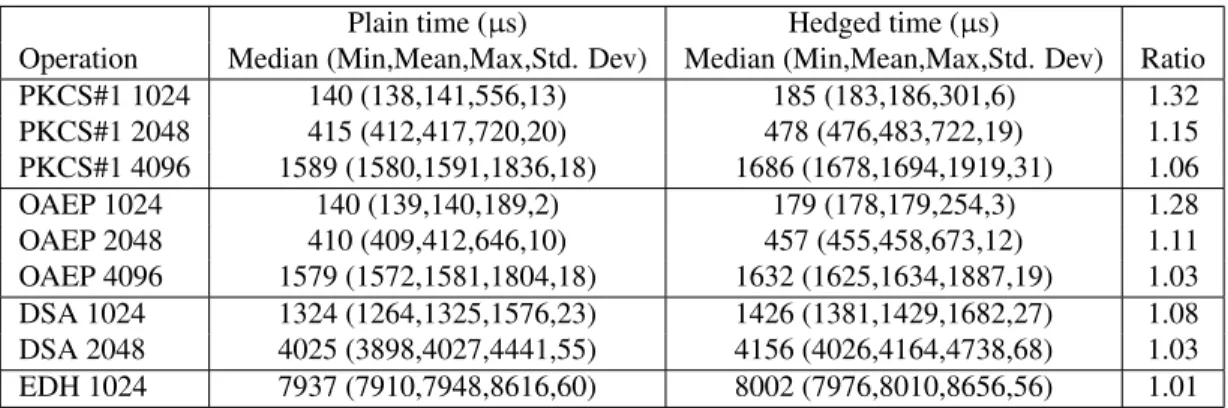
Our starting point was the current stable version of OpenSSL at the time of writing, version 0.9.8k. We hedged the most commonly utilized operations: RSA public-key encryption with PKCS#1 v1.5 randomized padding, RSA OAEP public-key encryption, DSA signing, and the ephemeral Diffie-Hellman (DHE) key exchange client and server. The first three operations involved only modify-ing code within the crypto library while the key exchange code is in the ssl library. Note that TLS 1.0 only uses stateful symmetric encryption and as such this version of OpenSSL does not implement randomized symmetric en-cryption primitives1. Future work could evaluate the hedg-ing of symmetric encryption primitives in TLS 1.1 or 1.2 or in other tools, also comparing them to custom solutions proposed by [48]. (These solutions will likely be included in future versions of TLS.)
Our hedged version of OpenSSL 0.9.8k will be referred to as “hedged”, while “plain” refers to the original, unmod-ified OpenSSL 0.9.8k. We used the cloc utility for counting lines of code [5] to get a sense of the scale of modifica-tions due to hedging. The hedged ssl library added 45 more physical lines of code and the hedged crypto library had 728 more physical lines of code.
In the following we use two machine configurations for benchmarking. Our server system is a Pentium 4 2.0 GHz 1For example, the CBC block cipher mode of TLS 1.0 does in fact
uti-lize a randomized IV, but it is generated only once per session during key exchange. Further packets are encrypted using as IV the last block of the previous ciphertext. So in this version of TLS, hedging key exchange ef-fectively hedges the symmetric encryption routines as much as is possible. For further details see [8] and [41].
with 1 GB of RAM running Ubuntu Linux 8.04 Server. It ran Apache 2.2.13 with mod ssl built from either the hedged OpenSSL or plain OpenSSL library, with both RSA and DSA keys setup, and all other options set to their defaults. We recompiled Apache when switching between libraries. Our client systems are Dual Pentium 4 3.20 GHz systems with 1 GB of RAM running Ubuntu Linux 8.04 Desktop. Performance of Hedge implementations. Recall that
Hedgemakes black-box use ofHMAC, which in turn uses an underlying hash function. We investigate three natu-ral choices for this hash function: SHA-1, SHA-256, and SHA-512. Recent attacks [49] mean SHA-1 is no longer considered secure. We do not recommend its use but in-clude it for the sake of comparison. New hash functions are being designed for an eventual SHA-3 standard [2]; one can easily upgradeHedgeto use newer hash functions.
We first report on a na¨ıve implementation ofHedgethat simply iteratesHMACa sufficient number of times follow-ing the description in Section 5. The left graph in Figure 8 depicts the performance of this implementation when us-ing each of the hash functions and when requestus-ing vari-ous amounts of random bytes. The benchmarks were per-formed on one of the client machines. The amount of asso-ciated data was set to 3,000 bytes. (The primitives we hedge never supply more than this amount of associated data for standard key lengths.) As expected, SHA-1 is the fastest. SHA-256 provides little performance benefit over SHA-512 for small output lengths and is significantly slower as output length increases. This is because SHA-512 generates more output per iteration.