Test
Management and Techniques
These slides are distributed under the Creative
Commons License.
In brief summary, you may make and distribute
copies of these slides so long as you give the
original author credit and, if you alter,
transform or build upon this work, you
distribute the resulting work only under a
license identical to this one.
For the rest of the details of the license, see
http://creativecommons.org/licenses/by-sa/2.0/legalcode.
Introduction
Test Management
and Techniques
ET Planning, Exec.
and Documentation
ET Styles
ET Management
•
Testing Fundamentals in 1 hour!
•
Black Box and Glass Box testing
•
Test Planning and Management
•
Test Documentation
•
Test Execution and Techniques
•
Heuristic Risk-Based Testing
•
Progress Tracking and Metrics
5.
4.
3.
2.
1.
ET Workshop v. 1.20
-2. Test Management and
Techniques
2.1 Testing Fundamentals in 1 hour!
2.2 Test Execution and Techniques
2.3 Heuristic Risk-Based Testing
2.4 Test Management and Metrics
3.
4.
5.
and Techniques ET Planning and
Documentation ET Styles
ET Management
Testing Fundamentals in 1 hour!
Black-Box and Glass Box testing
Test Strategy
Test Planning
Test Documentation and Structure
This is what you will learn about if you take a
”Testing Fundamentals” class – anywhere else...
and Techniques ET Planning and
Documentation ET Styles
ET Management
Black Box Testing
Black-Box Testing
The tester pretend NOT to know how the
program works
Feed ”interesting” input (expected do lead to
”interesting” output
Observe ”interesting” outcome
and Techniques ET Planning and
Documentation ET Styles
ET Management
Glass Box / White Box Testing
The programmer will test based on access to and
understanding of source code
Focused testing
Test the program in pieces
Testing Coverage
Lines of code, branches, paths etc.
Control Flow
State transitions
Data Integrity
Data manipulation
Internal boundaries
Algorithm-specific testing
and Techniques ET Planning and
Documentation ET Styles
ET Management
Test Strategy
“How we plan to cover the product so
as to develop an adequate assessment
of quality.”
A good test strategy is:
Product-Specific
Risk-focused
Diversified
Practical
Test Plan
According to IEEE Std 829-1983:
A document describing the scope, approach, resources, and
schedule of intended testing activities. It identifies test
items, the features to be tested, the testing tasks, who will
be doing each task, and any risks requiring contingency
planning.
Kaner et al 1999:
A test plan is a valuable tool to the extent that it
helps you manage your testing project and find bugs.
Beyond that, it is a diversion of resources.
and Techniques ET Planning and
Documentation ET Styles ET Management
Test Plan IEEE Std 829-1998
IEEE Standard for Software Documentation
Test Plan Identifier
Introduction
Test Items
Features to be tested
Features not to be tested
Approach
Item pass / fail criteria
Suspension criteria and resumption criteria
Test deliverables
Testing tasks
Environmental needs
Responsibilities
Staffing and training needs
Schedule
Risks and contingencies
Approvals
and Techniques ET Planning and
Documentation ET Styles ET Management
Alternatives can be found in Black 1999 and Kaner et al 1999
What?
How?
Who?
When?
and Techniques ET Planning and
Documentation ET Styles
ET Management
Test Documentation (IEEE 829 – 1998)
Test Plan (see previous slide)
Test Design Specification
Test approach and features to be tested
Test Case Specifications
Input, Expected Output and Environmental needs
Test Procedure Specification
Steps for executing a test case
Test Item Transmittal Report
List items for testing
Test Log
Chronological record of the execution of tests
Test Incident Report
Document events that requires investigation
Test Summary Report
Application based
groups
v222Test log
Test
Procedure
Spec.
TEST EXECUTION
Incident
Report
(CR)
2Test
design
Test
data
Function based
groups
DYNAMIC
TEST PLANNING
STATIC
TEST PLANNING
plan
Test item
tree
Test item spec.
Test case
spec.
Test
summary
report
LOG KEEPING
Event
log
Error /
change
log
strategy
for the
test project
specific.
Test documentation
Test Management and Techniques ET Planning and
Documentation ET Styles ET Management
Test Item
Transmittal Report
2. Test Management and
Techniques
2.1 Testing Fundamentals in 1 hour!
2.2 Test Execution and Techniques
2.3 Heuristic Risk-Based Testing
2.4 Test Management and Metrics
3.
4.
5.
Documentation ET Styles
ET Management
Test Execution and Techniques
The Problem of testing
Test Models, Coverage and Evaluation
Overview Test Techniques
Boundaries and Equivalence Classes
Bug Reporting
Documentation ET Styles
ET Management
The Universal Test Procedure
“Try it and see if it works.”
Learn about it
Model it
Speculate about it
Configure it
Operate it
Know what
to look for
See what’s
there
Understand the
requirements
Identify problems
Distinguish bad
problems from
not-so-bad problems
Documentation ET Styles ET Management
All Product Testing is Something Like This
(The Satisfice Testing Model)
Project
Environment
Product
Elements
Quality
Criteria
Test
Techniques
Perceived
Quality
Documentation ET Styles ET Management
The Four Problems of Testing
Project
Environment
Product
Elements
Quality
Criteria
Test
Techniques
Perceived
Quality
L
ogistics
Problem
C
overage
Problem
E
valuation
Problem
R
eporting
Problem
Models
A Model is…
A map of a territory
A simplified perspective
A relationship of ideas
An incomplete representation of reality
A diagram, list, outline, matrix…
No good test design has ever been done without models.
The trick is to become aware of how you model
the product, and learn different ways of modeling.
From Rapid Software Testing, copyright © 1996-2002 James Bach
Documentation ET Styles ET Management
Coverage
There are as many kinds of coverage as there
are ways to model the product.
Structural
Functional
Data
Platform
Operations
Product coverage is the proportion of the
product that has been tested.
Documentation ET Styles ET Management
Documentation ET Styles ET Management
An evaluation strategy is
how you know the product works.
“...it works.”
really means
“...it appeared to meet some requirement to some degree.”
Which requirement? Appeared how?
To what degree? Perfectly? Just barely?
Documentation ET Styles
ET Management
Evaluation: “HICCUPP”
Consistent with History: Present function behavior is consistent with
past behavior.
Consistent with our Image: Function behavior is consistent with an
image that the organization wants to project.
Consistent with Comparable Products: Function behavior is consistent
with that of similar functions in comparable products.
Consistent with Claims: Function behavior is consistent with what
people say it’s supposed to be.
Consistent with User’s Expectations: Function behavior is consistent
with what we think users want.
Consistent within Product: Function behavior is consistent with
behavior of comparable functions or functional patterns within the
product.
Consistent with Purpose: Function behavior is consistent with apparent
purpose.
Documentation ET Styles
ET Management
Test Techniques
A
test technique
is a recipe for performing
these tasks in order to reveal something
worth reporting:
Analyze the situation
Model the test space
Select what to cover
Determine test oracles
Configure the test system
Observe the test system
Evaluate the test result
Documentation ET Styles
ET Management
General Test Techniques (1)
Functional testing
Domain testing
Stress testing
Flow testing
User testing
Risk testing
Claims testing
Random testing
Regression testing
For any one of
these techniques
there’s somebody,
somewhere, who
believes that is the
Documentation ET Styles
ET Management
General Test Techniques (2)
Flow graphs and Path Testing
Transaction-Flow Testing
Data-Flow Testing
Domain Testing
Boundaries and Equivalence Classes
Syntax Testing
Logic-Based Testing
States, State Graphs, and Transition Testing
Documentation ET Styles
ET Management
Five-fold Testing System
Five dimensions of testing:
Testers
Who
does the testing.
Coverage
What
get tested.
Potential Problems
Why
you’re testing (what risk you’re testing for)
Activities
How
you test. For example: exploratory testing
Evaluation
Documentation ET Styles
ET Management
People based techniques: Who
User Testing
Alpha testing
Beta testing
Bug bashes
Subject-matter expert testing
Paired testing
Eat your own dog food
Documentation ET Styles
ET Management
Coverage-based techniques: What
Function testing
Feature or function
integration testing
Menu tour
Domain testing
Equivalence class analysis
Boundary testing
Best representative testing
Input field test catalogs or
matrices
Map and test all the ways to
edit a field
Logic testing
State-based testing
Path testing
Statement and branch
coverage
Configuration coverage
Specification-based testing
Requirements-based testing
Combination testing
Documentation ET Styles
ET Management
Problem-based techniques: Why
Risk-Based Testing
Risk-Based Test Management (Amland 1999)
Doing risk analysis for the purpose of finding
errors (Bach 1999a)
Constraint violations
Input constraints
Output constraints
Computation constraints
Storage (or data) constraints
Documentation ET Styles
ET Management
Activity Based Techniques: How
Regression testing
Scripted testing
Smoke testing
Exploratory testing
Guerilla testing
Scenario testing
Use Case Flow tests
Installation testing
Load testing
Long Sequence
testing
Documentation ET Styles
ET Management
Evaluation-based techniques
Self-verifying data
Comparison with saved results
Comparison with a specification or other
authoritative document
Heuristic consistency
HICCUPP (see earlier slide)
Oracle-based testing
Documentation ET Styles ET Management
Boundaries and Equivalence Classes
(Example Test Series)
Here is the program’s specification:
This program is designed to add two numbers,
which you will enter
Each number should be one or two digits
The program will print the sum. Press
Enter
after
each number
To start the program, type ADDER
Before you start testing, do you have any
questions about the spec?
Documentation ET Styles ET Management
Boundaries and Equivalence Classes
(Example Test Series)
Example continued: The First Cycles of Testing
Basic strategy for dealing with new code:
1.
Start with mainstream-level test.
Test the program with
easy-to-pass values that will be taken as serious issues if
the program fails.
2.
Test broadly, rather than deeply.
Check out all parts of
the program quickly before focusing.
3.
Look for more powerful tests.
Once the program can
survive the easy test, put on your thinking cap and look
systematically for challenges.
4.
Pick boundary conditions.
There will be too many good
tests. You need a strategy for picking and choosing.
5.
Do some exploratory testing.
Run new tests every week,
from the first week to the last week of the project.
Documentation ET Styles ET Management
Equivalence Classes &
Boundary Analysis
There are too many tests!
There are 199 x 199 = 39.601 test cases for valid values:
Definitely valid:
0 to 99
Might be valid:
-99 to -1
There are infinitely many invalid cases:
100 and above
-100 and below
Anything non-numeric
Some people want to automate these tests.
Can you run all the tests?
How will you tell whether the program passed or failed?
We cannot afford to run every possible test. We need a method
for choosing a few tests that will represent the rest.
Documentation ET Styles ET Management
Classical Equivalence Class and
Boundary Analysis
To avoid unnecessary testing, partition (divide) the
range of inputs into groups of equivalent tests.
Then treat an input value from the equivalence class
as representative of the full group.
Two tests are equivalent if we would expect that an
error revealed by one would be revealed by the
other.
Boundaries mark the point or zone of transition from
one equivalence class to another. The program is
more likely to fail at a boundary, so these are good
members of equivalence classes to use.
Documentation ET Styles
ET Management
Traditional Presentation (Myers)
One input or output field
The “valid” values for the field fit within
one (1) easily specified range.
Valid values: -99 to 99
Invalid values
< -99
> 99
Documentation ET Styles
ET Management
Building the Table (in practice)
Relatively few programs will come to you with all fields fully
specified. Therefore, you should expect to learn what variables
exist and their definitions over time.
To build an equivalence class analysis over time, put the
information into a spreadsheet. Start by listing variables. Add
information about them as you obtain it.
The table should eventually contain all variables. This means,
all input variables, all output variables, and any intermediate
variables that you can observe.
In practice, most tables that I’ve seen are incomplete. The best
ones that I’ve seen list all the variables and add detail for critical
variables.
Documentation ET Styles
ET Management
Myers’ Boundary Table
Variable
Valid Case
Equivalence
Classes
Invalid Case
Equivalence
Classes
Boundaries
and Spcial
Cases
Notes
First
Number
-99 to 99
>99
<-99
non-number
expressions
99, 100
-99, -100
/
:
0
null entry
Second
Number
same as first same as first
same
SUM
-198 to 198
Are there other
sources of data for
this variable? Ways
to feed it bad data?
3.
4.
5.
Bug Reporting / Advocacy
You are what you write
Bug reports are the primary work of testers
Programmers rely on your reports for vital
information
Your advocacy drives the repair of the bugs
you report
Any bug report that you write is an advocacy
document that calls for the repair of the bug
Make your bug report an effective sales tool
3.
4.
5.
Exercise: How do you advocate this bug?
Test Automation
Kaner, Bach, Pettichord 2001b.
Use automation when it advances the
mission of testing.
Select your automation strategy based
on your context.
A test tool is not a strategy.
Test automation is a significant investment.
Test automation is design and programming.
Fewster & Graham 1999
“Automating chaos just gives faster chaos”
Documentation ET Styles ET Management
2. Test Management and
Techniques
2.1 Testing Fundamentals in 1 hour!
2.2 Test Execution and Techniques
2.3 Heuristic Risk-Based Testing
2.4 Test Management and Metrics
3.
4.
5.
Documentation ET Styles
ET Management
Heuristic Risk-Based Testing
”
This kind of analysis is always available to you, no
calculator required.”
”A heuristic method: a useful method that doesn’t
always work.”
Checklist of open-ended questions, suggestions or
guidewords.”
Two Approaches:
Inside-Out:
”What can go wrong here?”
Outside-In (predefined lists of risk):
Quality Criteria Categories
Generic Risk Lists
Risk Catalogs
Documentation ET Styles
ET Management
Heuristic Risk-Based Testing
Inside-out:
“What can go wrong here?”
“What risks are associated with this thing?”
Require technical insight
Vulnerabilities
What weaknesses or possible failures?
Threats
What situation might exploit a vulnerability and trigger a
failure?
Victims
Who or what would be impacted by potential failures – and
how bad?
3.
4.
5.
Possible Inside-Out-process
Sit down with one of the programmers / developers
Create a non-threatening, friendly atmosphere (Coffee? Tee? Beer?)
Start asking about what he is working on (you need to understand the
technology well enough to ask questions!):
Can he explain what the functions are supposed to do?
Is he aware of how his function fits into the ”big picture”? I.e. do he know all
(the main) interfaces? And data flows?
Do he know where to find the information he needs?
Can he draw a (high level) diagram of process / flow?
Is he aware of data being read (used), modified, deleted etc.
What kind of error / exception handling has been implemented?
What are the complex and / or complicated part(s) of his functions? Why?
What kind of Unit Testing has been / will be performed? How?
Look for Uncertainty, Contradictions, Inconsistency etc.
They are all indicators of potential problems; misunderstandings, incorrect
implementation and possibly poor unit testing
Documentation ET Styles
ET Management
Heuristic Risk-Based Testing
Outside-in
“What things are associated with this kind
of risk?”
Predefined set of potential risks
Quality Criteria Categories
Generic Risk Lists
Risk Catalogs
Documentation ET Styles
ET Management
Heuristic Risk-Based Testing
Quality Criteria Categories
Capability
Reliability
Usability
Performance
Installability
Compatibility
Supportability
Testability
Maintainability
Portability
Localizability
Risk Catalogues
See
Testing Computer
Software
by Kaner, Falk
and Nguyen
Generic Risk Lists
Complex
New
Changed
Upstream Dependency
Downstream Dependency
Critical
Precise
Popular
Strategic
Third-party
Distributed
Buggy
Recent Failure
Documentation ET Styles
ET Management
Communicating Heuristic RBT
Risk Watch List
Risk / Task Matrix
Component Risk Matrix
Complex
Lower
Clipart Library
Popular, usability, changed
Lower
Installation
New, strategic, third-party, complex, critical
Higher
Report Generation
Distributed, popular
Normal
Printing
Risk Heuristics
Risk
Other Risk Catalogues
www.bugnet.com
www.cnet.com (news)
Testing Computer Software
Includes Kaner, Falk and Nguyen’s list of bugs
Software Testing Techniques
Includes Boris Beizer’s taxonomy of bugs
Computer-Related Risks
Peter G. Neumann
Managing the Testing Process
Includes Rex Black’s list of common software failures
Documentation ET Styles ET Management
WEB E-business Risks
No second chance – risks outside control
Unlimited potential users – anyone can visit
Many Potential Points of Failure
No control over client platform
No control over client configuration
Which browser to support?
Required plug-ins not available
The context of web transactions is a risk area
Cookies
Network connections
Firewalls
Usability
Internationalisation
Etc....
Documentation ET Styles ET Management
ET Workshop v. 1.20
-2. Test Management and
Techniques
2.1 Testing Fundamentals in 1 hour!
2.2 Test Execution and Techniques
2.3 Heuristic Risk-Based Testing
2.4 Test Management and Metrics
3.
4.
5.
Test Management
Establish a strong and supportive testing role.
Re-visit your strategy and mission every day.
Advocate for bugs and testability.
Maintain three lists: risks, issues, coverage.
Test with your team.
Continuously report the status and dynamics
of testing.
Documentation ET Styles ET Management
Documentation ET Styles ET Management
Documentation ET Styles
ET Management
Metrics - Overview
Defect Analysis
Defect Density
Defect Aging
Defect Trends
Planning and Progress tracking
Planned vs. Actual
Progress indicators
Number of hours (days) remaining? Estimated to Complete (EtC)
Iterative Projects – Trend Analysis
Coverage
Identifies how “complete” the testing is (will be)
Defect Detection Percentage – DDP (Overall test efficiency)
Documentation ET Styles ET Management
On-line Test Cases Completed
Date
Number of Test
Cases
Planned
Executed
QAed
Documentation ET Styles ET Management
Progress Indicators - “To be” vs. “Actual”
“To be fixed”
vs.
“Actually fixed”
“To be
Re-tested”
vs.
“Actually
Re-tested”
To be Re-tested
Act. Re-tested
Rejected
To Be Re-tested, Actually Re-tested and Rejected
Number of Faults
Actually fixed
To Be Fixed and Actually Fixed
Number of Faults
Documentation ET Styles
ET Management
Progress Indicators - Hours
Hours Indicators
Number of hours for finding one fault and
for fixing one
Hours per Fault for Test and
Fix
Date
Hours
per
Fault
Test
Documentation ET Styles ET Management
“Estimated to Complete”
ETC for system test based on:
Number of hours testing per fault found
Number of hours fixing per fault
Number of
faults found
per function
Number of
fixes being
rejected
Number of
remaining
tests
(functions
to be tested)
Calculated ETC and Actual Hours
Date
Hours ETC
Estimated to Complete at Time t
Actual to Complete
at Time t
Documentation ET Styles
ET Management
Iteration Trend Analysis
1 0 0 0 2 0 0 0 3 0 0 0 4 0 0 0 5 0 0 0 6 0 0 0 7 0 0 0 Verification Points Approx. 6900 Approx. 5700 1 0 0 0 2 0 0 0 3 0 0 0 4 0 0 0 5 0 0 0 6 0 0 0 7 0 0 0 Verification Points Days
1 2 3 4 5
Approx. 6200 Approx. 4200 1 0 0 0 2 0 0 0 3 0 0 0 4 0 0 0 5 0 0 0 6 0 0 0 7 0 0 0 Verification Points Days
1 2 3 4 5
Approx. 7200 Approx. 5000
Iteration 1
Iteration 2
Iteration 3
Documentation ET Styles
ET Management
Test planning and execution coverage
Identify units to be tested:
Use Cases
Use Case flows
Requirements
Etc.
Build and prioritise test Cases (based on risk)
Track:
Test preparation/planning: number of test cases built for
each priority
Test Execution: number of tests executed for each priority,
with status
3.
4.
5.
Defect Detection Percentage
est
rOfBugsInT
TotalNumbe
roduction
rOfBugsInP
TotalNumbe
est
rOfBugsInT
Documentation ET Styles
ET Management
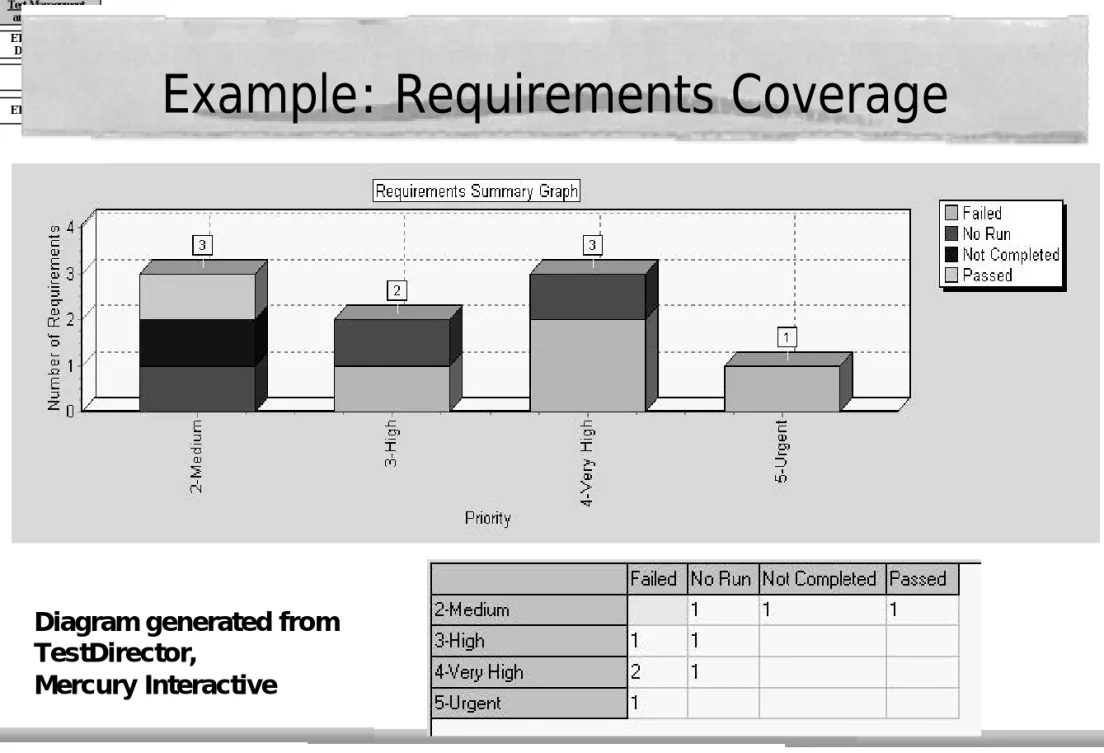
Example: Requirements Coverage
Diagram generated from
TestDirector,
Documentation ET Styles
ET Management
Risk - ordinal scale!
Ordinal Scale:
The numbers are ordered but no arithmetic
can be applied.
A Risk Exposure of 3 IS bigger then 2
We do NOT know HOW much bigger!
Documentation ET Styles ET Management
Ordinal vs. Linear Scales
Documentation ET Styles
Documentation ET Styles